Introduction
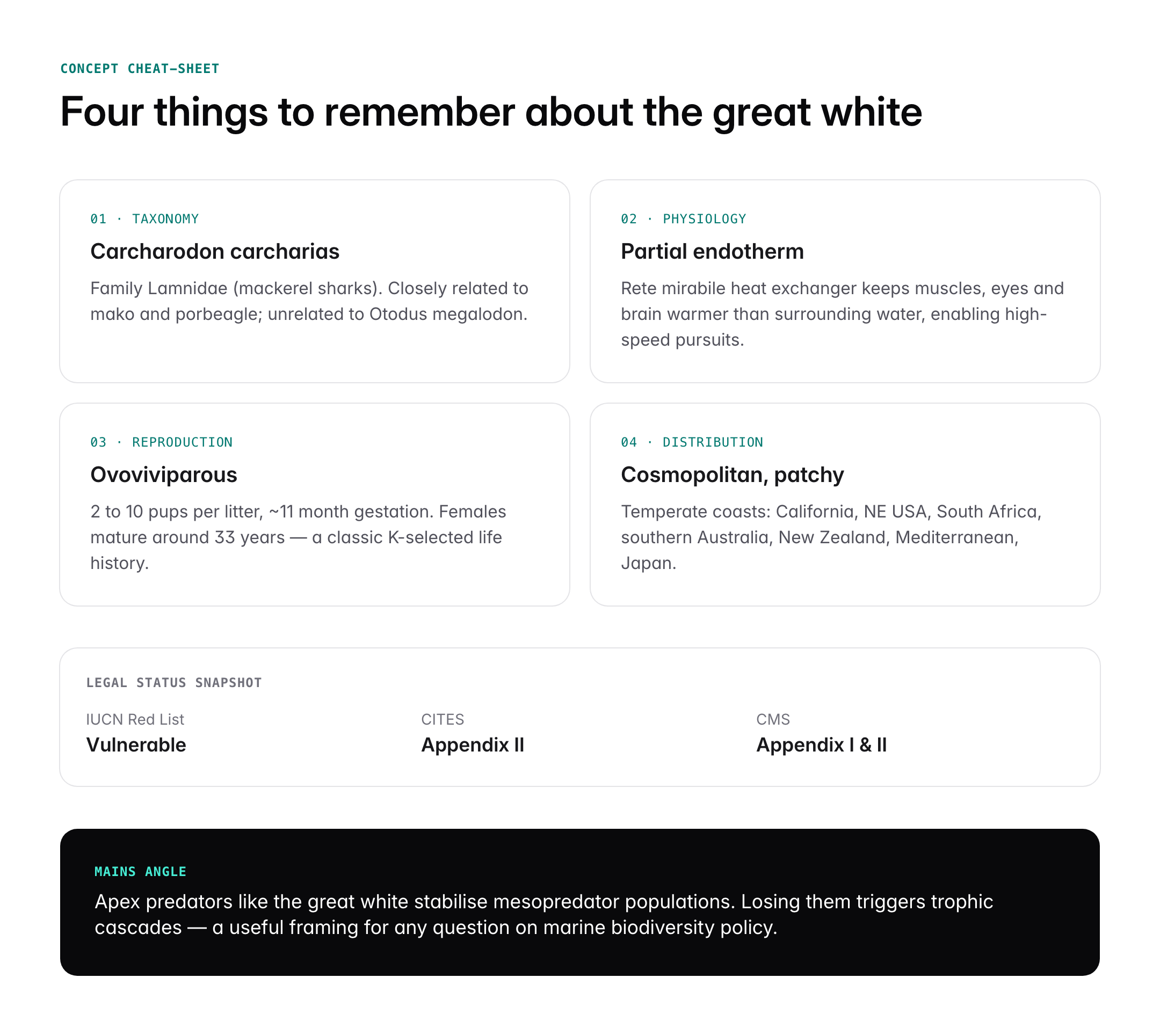
The great white shark, scientifically named Carcharodon carcharias, is the largest predatory fish in the modern ocean and one of the most recognisable apex predators on the planet. Despite its fearsome reputation in popular culture, the species is ecologically fragile, slow to mature, and in global decline. Conservation biologists treat it as a sentinel species for the health of temperate and subtropical coastal ecosystems.
For UPSC aspirants, the great white shark appears in the Environment and Ecology section of GS Paper 3 and in Prelims through questions on IUCN Red List categories, CITES appendices, and the Convention on Migratory Species. It also features in current-affairs coverage whenever an Indian coast guard intercepts illegal fin exports or when a new marine protected area is proposed. Understanding the shark’s biology, distribution, threats, and legal status gives candidates a ready-made template for any charismatic marine megafauna question.
Quick Facts at a Glance
| Attribute | Detail |
|---|---|
| Scientific name | Carcharodon carcharias |
| Family | Lamnidae (mackerel sharks) |
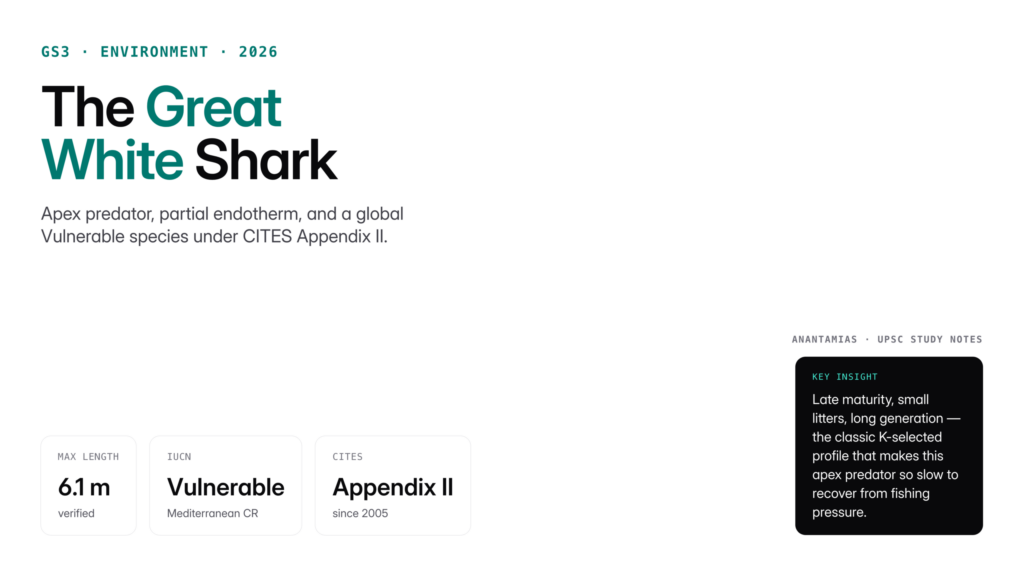
| Maximum length | Up to 6.1 m (verified); commonly 4 to 4.8 m |
| Maximum weight | Over 1,900 kg |
| Lifespan | 70 years or more |
| Sexual maturity | Males around 26 years, females around 33 years |
| Diet | Marine mammals, fish, seabirds, carrion |
| IUCN Red List status | Vulnerable (globally) |
| CITES listing | Appendix II (since 2005) |
| CMS listing | Appendix I and II |
| Indian legal status | Whale shark is Schedule I under WLPA; great whites not resident in Indian waters but fins regulated |
Background and Historical Context
Carcharodon carcharias belongs to an ancient lineage. Fossil teeth suggest that the modern great white shark diverged from a mako-like ancestor in the early Miocene, roughly 16 million years ago. It is not descended from the extinct giant shark Otodus megalodon, despite the persistent popular myth; genetic and dental evidence places megalodon in a separate family, Otodontidae.
Scientific interest in the species is much more recent. Carolus Linnaeus formally described Squalus carcharias in 1758 in the tenth edition of Systema Naturae. The species was reclassified into the genus Carcharodon by Andrew Smith in 1838. Through most of the twentieth century the great white was a poorly studied animal. Focused field research expanded only after satellite tagging became feasible in the 1990s, led by teams in South Africa, Australia, and the United States. The OCEARCH programme and the Monterey Bay Aquarium white shark project have since generated the richest data sets on migration, feeding, and nursery habitat.
Culturally the shark suffered enormous reputational damage from the 1975 film Jaws. The subsequent trophy-fishing boom and demand for jaws and teeth accelerated declines in several populations. Only in the 2000s did major fishing nations begin to regulate targeted harvest. The species is now protected in the United States, South Africa, Australia, New Zealand, Malta, Namibia, and the European Union waters, among others.
Key Biology, Habitat and Behaviour
Morphology and Senses
The great white shark has a counter-shaded body — dark grey or slate blue dorsally and white ventrally — that breaks up its outline against both the surface and the seafloor. It has a fusiform body plan designed for burst speeds up to 56 km per hour. Its triangular serrated teeth can replace themselves several times across a lifetime, with a single shark shedding thousands of teeth.
Sensory adaptations include the ampullae of Lorenzini, electroreceptive pores on the snout that detect the bioelectric fields of prey, and a lateral line sensitive to low-frequency vibrations. Great whites are also partially endothermic — the rete mirabile heat exchanger in their circulatory system keeps their muscles, eyes, and brain warmer than the surrounding water, enabling rapid pursuit in cold seas.
Habitat and Distribution
Great whites are cosmopolitan but patchily distributed. Core populations are found off California and Baja California, the north-eastern United States, the Gulf of Mexico, South Africa (notably Gansbaai and False Bay), southern Australia (Neptune Islands, Port Lincoln), New Zealand, the Mediterranean, and Japan. They inhabit coastal and offshore waters from the surface down to around 1,200 metres, with preferred surface temperatures between 12 and 24 degrees Celsius. They are rare visitors to Indian Ocean tropical waters and are not considered resident on Indian coasts.
Feeding and Behaviour
Juveniles feed predominantly on fish and small sharks. Sub-adults and adults switch to marine mammals — especially pinnipeds like seals and sea lions — using the classic ambush-from-below attack. They are capable of breaching fully clear of the water. Individuals follow predictable seasonal routes tracked as the Shared Offshore Foraging Area between Hawaii and Baja California, and the South African to Mozambique migration. Tagging data show solitary behaviour for most of the year, with occasional aggregations at pinniped colonies.
Reproduction
The great white is ovoviviparous. Females produce live young after a gestation of around 11 months. Litters contain 2 to 10 pups, each about 1.2 metres at birth. The combination of late maturity, small litters, and long reproductive intervals makes the population extremely vulnerable to fishing pressure.
Significance for UPSC and General Knowledge
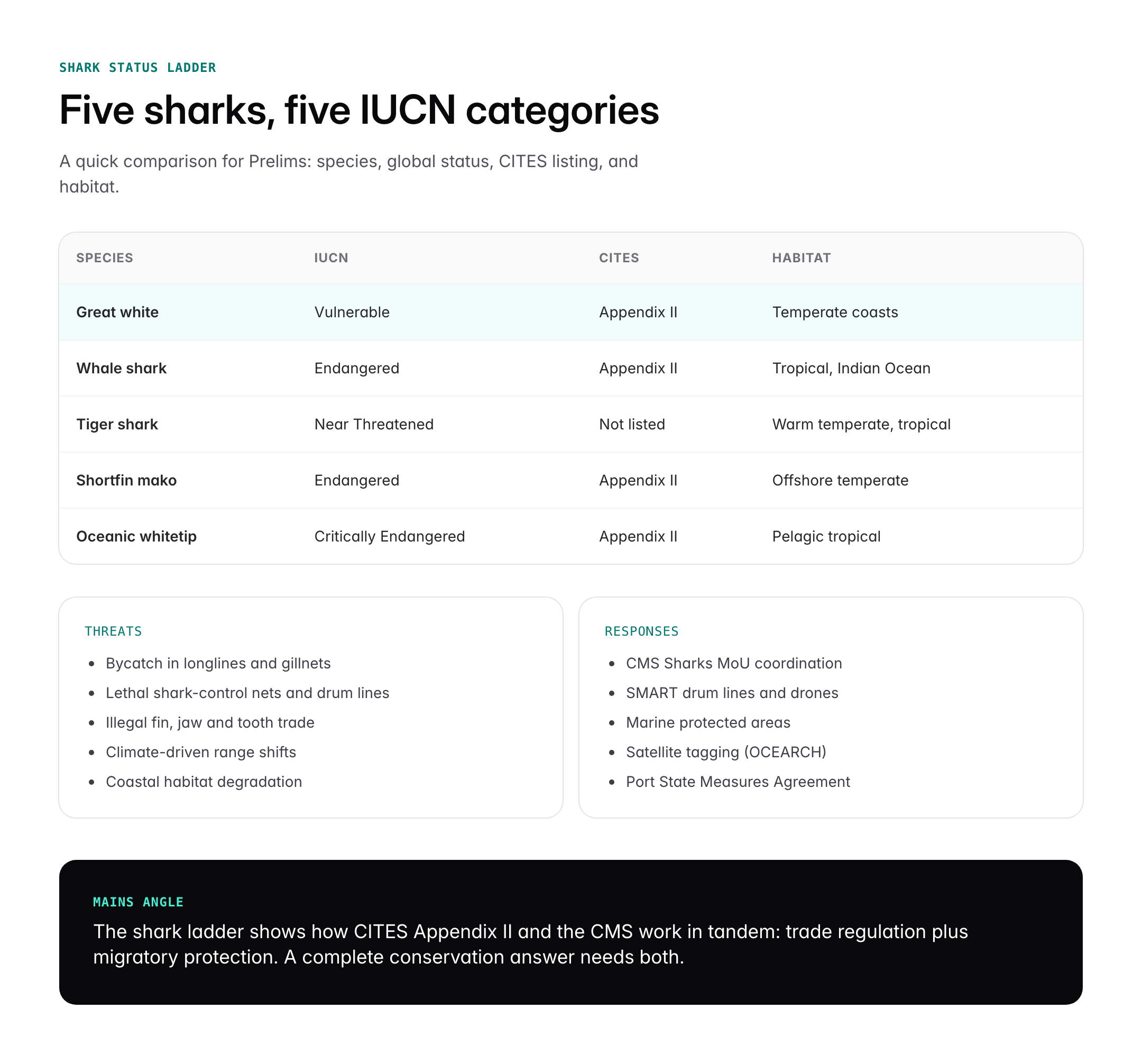
- Case study for apex predator ecology and trophic cascades, useful for questions on marine biodiversity.
- Core example for IUCN Red List categories — the species is Vulnerable globally.
- Reference species under CITES Appendix II and CMS Appendices I and II.
- Illustrates the concept of K-selected species in conservation biology.
- Used in discussions of bycatch and finning in international fisheries management.
- Relevant to India’s obligations under the Convention on Biological Diversity and the Port State Measures Agreement.
Conservation Status and Threats
The International Union for Conservation of Nature assesses the great white shark as Vulnerable (VU) on the global Red List, based on suspected population declines of 30 to 49 percent over three generations. Regional assessments vary — the Mediterranean subpopulation is listed as Critically Endangered, with fewer than 250 mature individuals estimated.
Key threats are fairly well documented.
Targeted fishing and bycatch. Although directed fisheries for great whites are now illegal in most major range states, the species is still caught incidentally in gillnets, longlines, and purse seines. Post-release mortality is high because of stress and internal injuries.
Shark control programmes. Australia and South Africa operate beach-safety programmes using drum lines and nets. These have killed thousands of sharks, including juveniles and pregnant females. Conservation NGOs are pushing for replacement with non-lethal deterrents such as SMART drumlines, drone surveillance, and electronic exclusion devices.
Illegal trade in fins, teeth, and jaws. CITES Appendix II since 2005 requires exporting states to issue non-detriment findings. Enforcement gaps remain in several fishing nations. A pair of great white jaws can fetch tens of thousands of US dollars on the black market.
Climate change. Warming waters are shifting prey distributions. Tagging studies have documented juvenile great whites appearing north of Monterey Bay and in previously unsuitable temperate ranges, with unknown consequences for resident ecosystems.
Coastal habitat degradation. Loss of pinniped and fish nursery habitats due to coastal development reduces foraging opportunities for sub-adults.
Recovery is possible but slow. The Monterey Bay population has shown modest rebound since focused protections began in California in the 1990s. This offers the clearest policy lesson — long-term coordinated protection combined with rigorous enforcement can reverse declines even in slow-reproducing apex predators.
Comparative Perspective
| Species | IUCN Status | CITES | Typical Adult Length | Key Region |
|---|---|---|---|---|
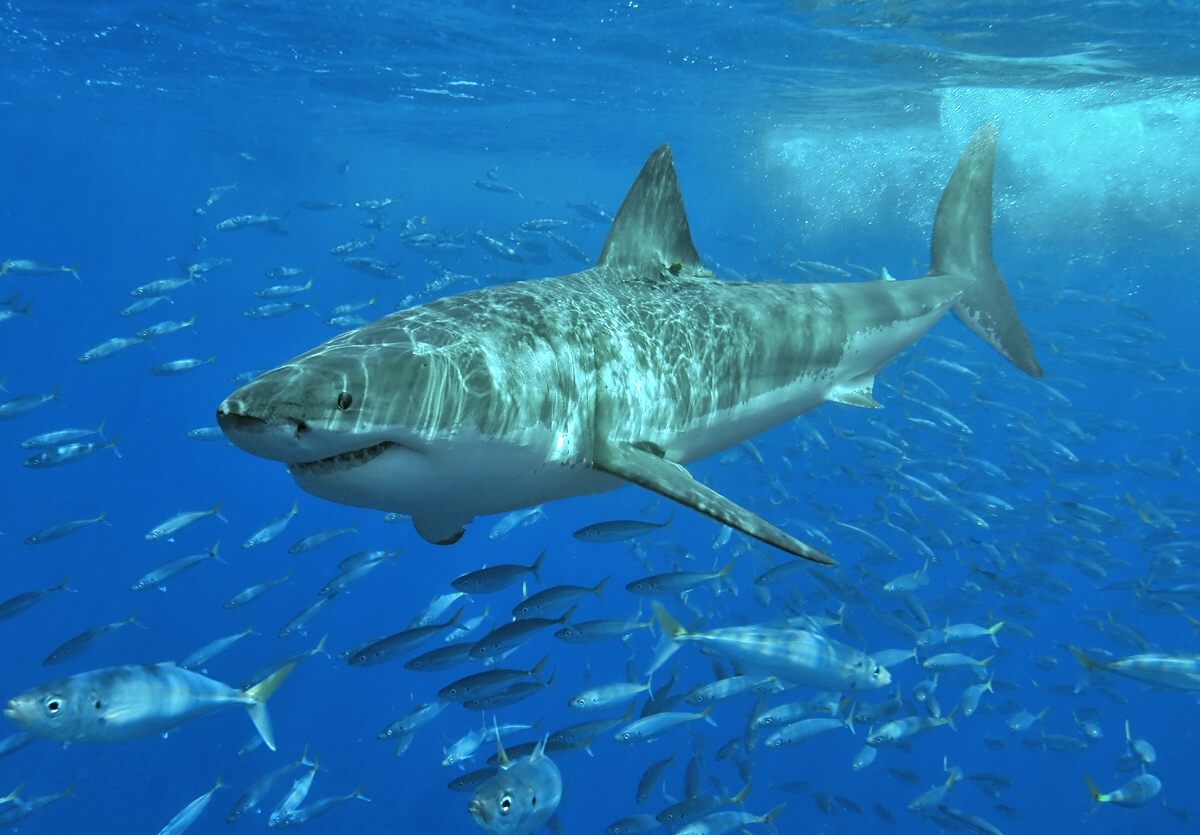
| Great white (Carcharodon carcharias) | Vulnerable | Appendix II | 4.0 to 4.8 m | Temperate coasts worldwide |
| Whale shark (Rhincodon typus) | Endangered | Appendix II | 8 to 12 m | Tropical seas, Indian Ocean |
| Tiger shark (Galeocerdo cuvier) | Near Threatened | Not listed | 3 to 4.3 m | Tropical and warm temperate |
| Shortfin mako (Isurus oxyrinchus) | Endangered | Appendix II | 2.5 to 3.2 m | Offshore temperate |
| Oceanic whitetip (Carcharhinus longimanus) | Critically Endangered | Appendix II | 1.8 to 2.5 m | Pelagic tropical |
The comparison is useful for Prelims questions that mix shark species with IUCN or CITES status. Note that India’s own flagship shark, the whale shark, is listed under Schedule I of the Wildlife (Protection) Act, 1972 and receives full legal protection in Indian waters, particularly off Gujarat where an annual coastal aggregation occurs.
Challenges and Controversies
The central controversy around great white conservation is the beach-safety versus biodiversity trade-off. Australia’s New South Wales and Queensland operate shark-meshing programmes that have reduced shark attacks but killed thousands of protected sharks, dolphins, turtles, and rays as bycatch. In South Africa the KwaZulu-Natal Sharks Board has moved towards non-lethal alternatives, and Western Australia has phased out drum lines in favour of tagging and alerts.
A second debate concerns shark tourism. Cage diving operations in Gansbaai, the Neptune Islands, and Guadalupe Island have been criticised for potentially conditioning sharks to associate boats with food, raising bite risk for swimmers. Supporters counter that tourism generates strong economic incentives for live-shark protection and funds monitoring programmes.
Third, there is a data gap. Global population estimates rely on local mark-recapture studies in South Africa, California, and Australia. Estimates for the north-west Atlantic, Mediterranean, and western Pacific remain imprecise. Expanding standardised monitoring is a priority under the CMS Sharks Memorandum of Understanding.
Prelims Pointers
- Scientific name: Carcharodon carcharias; family Lamnidae.
- IUCN global status: Vulnerable; Mediterranean subpopulation Critically Endangered.
- CITES Appendix II listing since 2005.
- Listed on Appendices I and II of the Convention on Migratory Species (CMS).
- Partially endothermic due to the rete mirabile heat exchanger.
- Senses include ampullae of Lorenzini (electroreception) and lateral line.
- Ovoviviparous; gestation around 11 months; 2 to 10 pups per litter.
- Can breach fully out of the water while attacking pinniped prey.
- Not resident in Indian waters; whale shark is India’s Schedule I protected shark.
- Monterey Bay is a major research hotspot for juvenile white sharks in California.
- Jaws (1975) triggered trophy-fishing pressure that accelerated population declines.
- Does not descend from Otodus megalodon; modern sharks diverged from mako-like ancestors.
Mains Practice Questions
- Discuss the ecological significance of apex marine predators, using the great white shark as an example, and evaluate the effectiveness of global conservation instruments. (250 words)
- Explain apex-predator role in regulating mesopredators and maintaining trophic balance.
- Assess IUCN Red List, CITES Appendix II, and CMS listings as conservation levers.
- Discuss bycatch, shark control programmes, and finning; recommend non-lethal deterrents and CMS-style MoUs.
- “Shark conservation in the twenty-first century is as much about communication as it is about policy.” Examine with reference to public perception and management of the great white shark. (250 words)
- Show how post-Jaws cultural narratives hindered early conservation.
- Discuss positive roles of citizen science (OCEARCH), documentaries, and shark tourism.
- Argue for stronger science communication in Indian coastal fisheries policy.
Conclusion
The great white shark is a paradox of power and fragility. It sits at the top of the marine food web and yet is biologically ill-equipped to withstand modern fishing pressure, bycatch, and habitat change. Decades of misinformation turned it into a cultural villain, but the last twenty years of research have replaced that caricature with a rigorous portrait of a slow-growing, long-lived, partially endothermic apex predator that is globally Vulnerable and regionally Critically Endangered.
For UPSC aspirants, mastering this single species unlocks a family of high-yield topics — IUCN Red List categories, CITES appendices, the Convention on Migratory Species, bycatch and finning, and the broader debate on how to balance biodiversity with public safety. The great white also demonstrates the kind of patient, data-driven conservation that India will need to apply to its own threatened marine species, from the whale shark of Gujarat to the sawfishes of the Andaman and Nicobar Islands.
Frequently Asked Questions
What is the great white shark?
The great white shark (Carcharodon carcharias) is the largest predatory fish in the modern ocean. It belongs to the family Lamnidae, commonly reaches 4 to 4.8 metres in length, and is found in temperate and subtropical coastal waters worldwide. It is a partially endothermic, apex predator that feeds mainly on marine mammals, fish, and carrion, and is assessed as Vulnerable on the IUCN Red List.
Why is the great white shark important for UPSC?
The species is a high-yield example for UPSC Environment and Ecology topics. It illustrates IUCN Red List categories, CITES Appendix II regulation, Convention on Migratory Species listings, K-selected life history, and trophic cascades. It also supports current-affairs questions on shark finning, bycatch, and marine protected areas, making it relevant to both Prelims and GS Paper 3 Mains.
How is the great white shark related to the megalodon?
The two are distant relatives, not direct ancestors. Megalodon (Otodus megalodon) belonged to the extinct family Otodontidae, while the great white evolved from a mako-like ancestor in the family Lamnidae about 16 million years ago. Dental and genetic evidence confirms that the great white did not descend from megalodon, despite the popular myth.
What is the IUCN status of the great white shark?
The great white shark is listed as Vulnerable on the global IUCN Red List, with a suspected population decline of 30 to 49 percent over three generations. The Mediterranean subpopulation is separately assessed as Critically Endangered, with an estimated population of fewer than 250 mature individuals, due to heavy fishing pressure and habitat degradation.
Is the great white shark found in Indian waters?
The great white shark is not considered resident in Indian waters. It is an occasional visitor to the northern Indian Ocean. India’s principal protected shark is the whale shark (Rhincodon typus), which is listed on Schedule I of the Wildlife (Protection) Act, 1972 and is famously sighted in annual aggregations along the Gujarat coast near Veraval and Sutrapada.
What are the main threats to great white sharks?
Key threats include incidental bycatch in gillnets and longlines, lethal shark control programmes at popular beaches, illegal trade in fins, teeth and jaws, climate-driven shifts in prey distribution, and coastal habitat degradation. Late sexual maturity and small litters mean the species recovers slowly, so even moderate adult mortality can drive long-term population decline.
How are great white sharks protected internationally?
Great white sharks are listed on CITES Appendix II, which regulates international trade by requiring non-detriment findings. They are also on Appendices I and II of the Convention on Migratory Species and covered by the CMS Sharks Memorandum of Understanding. Several major range states including the United States, South Africa, Australia, and the EU prohibit targeted fishing.
Why are great white sharks partially endothermic?
Great whites possess a specialised counter-current heat exchanger called the rete mirabile, which retains metabolic heat in the muscles, eyes, and brain. This keeps core body temperature several degrees above the surrounding seawater, allowing faster burst swimming, sharper vision, and improved neural function in cold temperate seas where most of their prey concentrate.
Tell Google you want more of this.
Add Anantam IAS as a preferred sourceOne tap, and this site shows up more often in your own Top Stories, AI Overviews and AI Mode. Remove it any time.