Introduction
A surprisingly common search query asks how many countries there are in India. The factual answer is simple. India is one country, a sovereign republic that is a single member state of the United Nations. What the query usually means is how many states there are within India, or how India fits into wider international groupings. UPSC aspirants must be precise about this distinction. A country is a sovereign state. A state within India is a federal subunit.
This article uses that starting point to do something more useful. It clarifies India’s status as a single country, then builds a clean reference for the global groupings that matter most for UPSC International Relations and Prelims. You will find the membership of OPEC, the G7, the G20, BRICS, SAARC and others, with the kind of quick comparison tables that save time in revision and make current-affairs questions easier to crack.
Quick Facts at a Glance
| Query | Correct answer |
|---|---|
| How many countries in India | India is one country |
| States in India (2026) | 28 states |
| Union Territories (2026) | 8 UTs |
| UN member states (2026) | 193 member states |
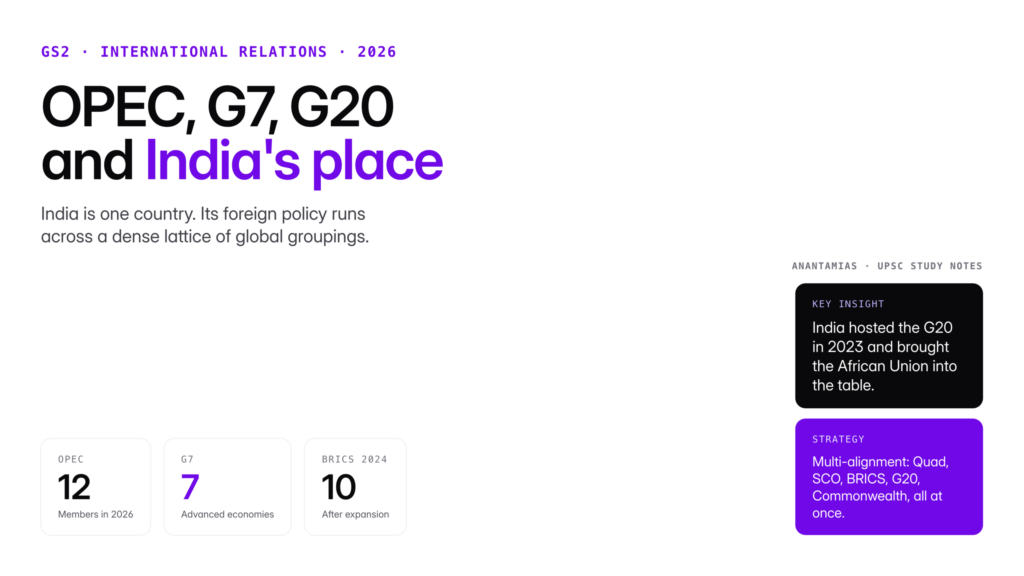
| OPEC members | 12 |
| G7 members | 7 |
| G20 members | 19 countries + EU + African Union |
| BRICS members (2026) | 10 after 2024 expansion |
| SAARC members | 8 |
| ASEAN members | 10 |
Background and Historical Context
The confusion behind the query “how many countries in India” often traces to the British colonial period, when India was a patchwork of directly ruled provinces and more than 560 princely states with varying degrees of internal sovereignty. On 15 August 1947 the Indian Dominion was created as a single sovereign country. Integration under Sardar Vallabhbhai Patel and V. P. Menon ensured that princely states were absorbed into this Dominion. The Constitution of India, adopted on 26 November 1949 and in force from 26 January 1950, established the Republic of India as a single country, a Union of States under Article 1.
On the international stage, India was a founding member of the United Nations in 1945 and has been a vocal participant in decolonisation debates, the Non-Aligned Movement and the G77. Through the twentieth century, as new countries emerged from decolonisation and the break-up of the Soviet Union, the number of UN member states climbed from 51 in 1945 to 193 today. India’s single seat in this body underlines that it is one country, however internally diverse.
International groupings beyond the UN developed for specific economic, security or regional reasons. OPEC was formed in 1960 to coordinate oil export policies. The G7 emerged from the 1973 oil crisis and became formalised from 1975. The G20 was launched in 1999 after the Asian financial crisis and elevated to leaders’ level in 2008. BRICS began as BRIC in 2006, added South Africa in 2010, and expanded further in 2024. These groupings shape global policy on energy, finance, trade and climate, and are therefore a recurring Prelims and Mains concern.
Key Features — Major Global Groupings
OPEC Countries
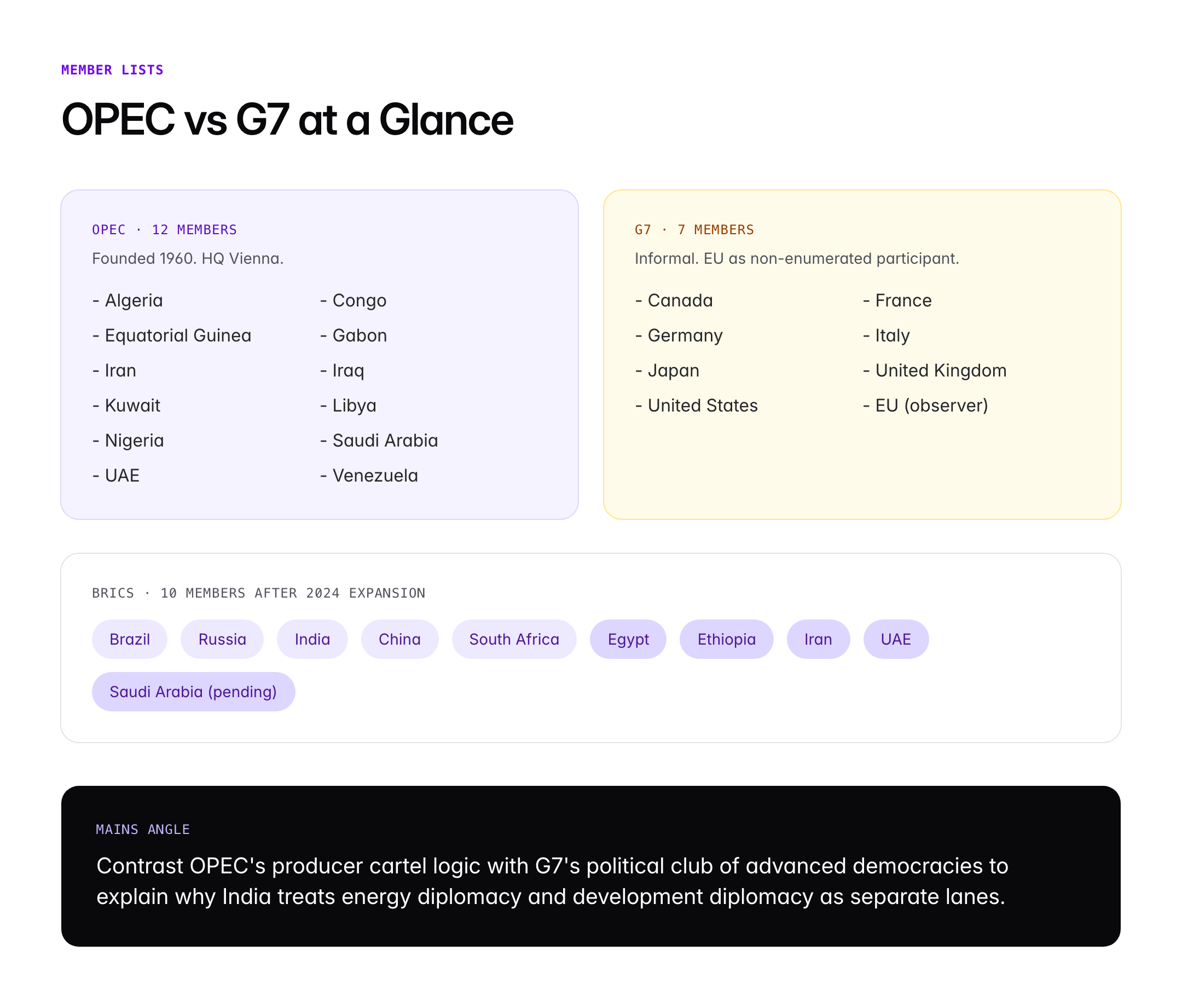
The Organization of the Petroleum Exporting Countries was founded in Baghdad in 1960 by Iran, Iraq, Kuwait, Saudi Arabia and Venezuela. Its headquarters is in Vienna. As of 2026, OPEC has 12 members after Angola’s exit in 2024: Algeria, Congo, Equatorial Guinea, Gabon, Iran, Iraq, Kuwait, Libya, Nigeria, Saudi Arabia, United Arab Emirates and Venezuela. OPEC plus non-OPEC allies such as Russia and Kazakhstan form the larger grouping often called OPEC+, which coordinates production cuts and supply decisions that directly influence global oil prices and India’s import bill.
G7 Countries
The Group of Seven is an informal forum of advanced industrial democracies. Its members are Canada, France, Germany, Italy, Japan, the United Kingdom and the United States. The European Union is a non-enumerated participant. The G7 does not have a permanent secretariat, rotating the presidency annually among members. It discusses global economic policy, security, climate action and aid. India is not a G7 member but is regularly invited to G7 summits as a partner country under the outreach format.
G20 Members
The Group of Twenty is the premier forum for international economic cooperation. It comprises 19 countries plus the European Union and, since 2023, the African Union. India hosted the G20 presidency in 2023 in New Delhi, where the African Union’s permanent membership was announced. G20 country members are Argentina, Australia, Brazil, Canada, China, France, Germany, India, Indonesia, Italy, Japan, Mexico, Republic of Korea, Russia, Saudi Arabia, South Africa, Turkey, the United Kingdom and the United States.
BRICS and BRICS+
BRICS started as BRIC in 2006 with Brazil, Russia, India and China. South Africa joined in 2010 to form BRICS. In January 2024, Egypt, Ethiopia, Iran and the United Arab Emirates formally joined. Saudi Arabia’s accession remains under discussion. As of 2026, BRICS has 10 full members, covering over 40 percent of the global population and a growing share of world GDP in purchasing power parity terms. The New Development Bank, established in 2014, is the grouping’s flagship financial institution.
SAARC and Neighbourhood
The South Asian Association for Regional Cooperation was founded in Dhaka in 1985. It has 8 members: Afghanistan, Bangladesh, Bhutan, India, Maldives, Nepal, Pakistan and Sri Lanka. SAARC has been largely dormant since the 2016 Islamabad summit was cancelled after the Uri attack. India has increasingly pivoted to BIMSTEC, the Bay of Bengal Initiative for Multi-Sectoral Technical and Economic Cooperation, which brings together India with Bangladesh, Bhutan, Myanmar, Nepal, Sri Lanka and Thailand.
Significance for UPSC and General Knowledge
- Clears a common factual confusion: India is a single country, not a collection of countries
- Builds a compact knowledge base for International Relations questions in GS2
- Anchors Prelims current affairs on OPEC+ decisions and oil prices
- Supports Mains answers on reform of global governance and UNSC permanent seat
- Connects India’s foreign policy choices to groupings like G20, BRICS and SCO
- Helps distinguish between political, economic and regional organisations
Detailed Analysis — India in the World Order
India’s foreign policy in 2026 operates across a dense lattice of multilateral memberships. It is a founding UN member, a nuclear power outside the Non-Proliferation Treaty, a G20 economy, and a BRICS founder. It is also a member of the Shanghai Cooperation Organisation, the International Solar Alliance, the Coalition for Disaster Resilient Infrastructure and the Quad with the United States, Japan and Australia. The diversity of these memberships reflects India’s strategic posture of multi-alignment, where it engages with overlapping and sometimes competing groupings rather than committing to a single bloc.
The country is not in OPEC or the G7. That absence is strategic rather than accidental. India is a major oil importer, so OPEC membership is not relevant. It is still classified as a developing economy by the IMF and the World Bank, so G7 membership is not on offer. India does, however, attend G7 summits as an invited guest, usually under the outreach format, and has built close climate and technology partnerships with G7 nations.
Within BRICS and the G20, India increasingly positions itself as a voice of the Global South. The 2023 New Delhi G20 declaration and the inclusion of the African Union as a permanent G20 member are seen as diplomatic successes. Within BRICS, India has been cautious about the 2024 expansion, balancing the grouping’s solidarity rhetoric with its own concerns about China’s dominant role and about allowing the grouping to become a vehicle for anti-Western positioning.
Comparative Perspective
| Grouping | Year founded | Members (2026) | India’s status | Primary focus |
|---|---|---|---|---|
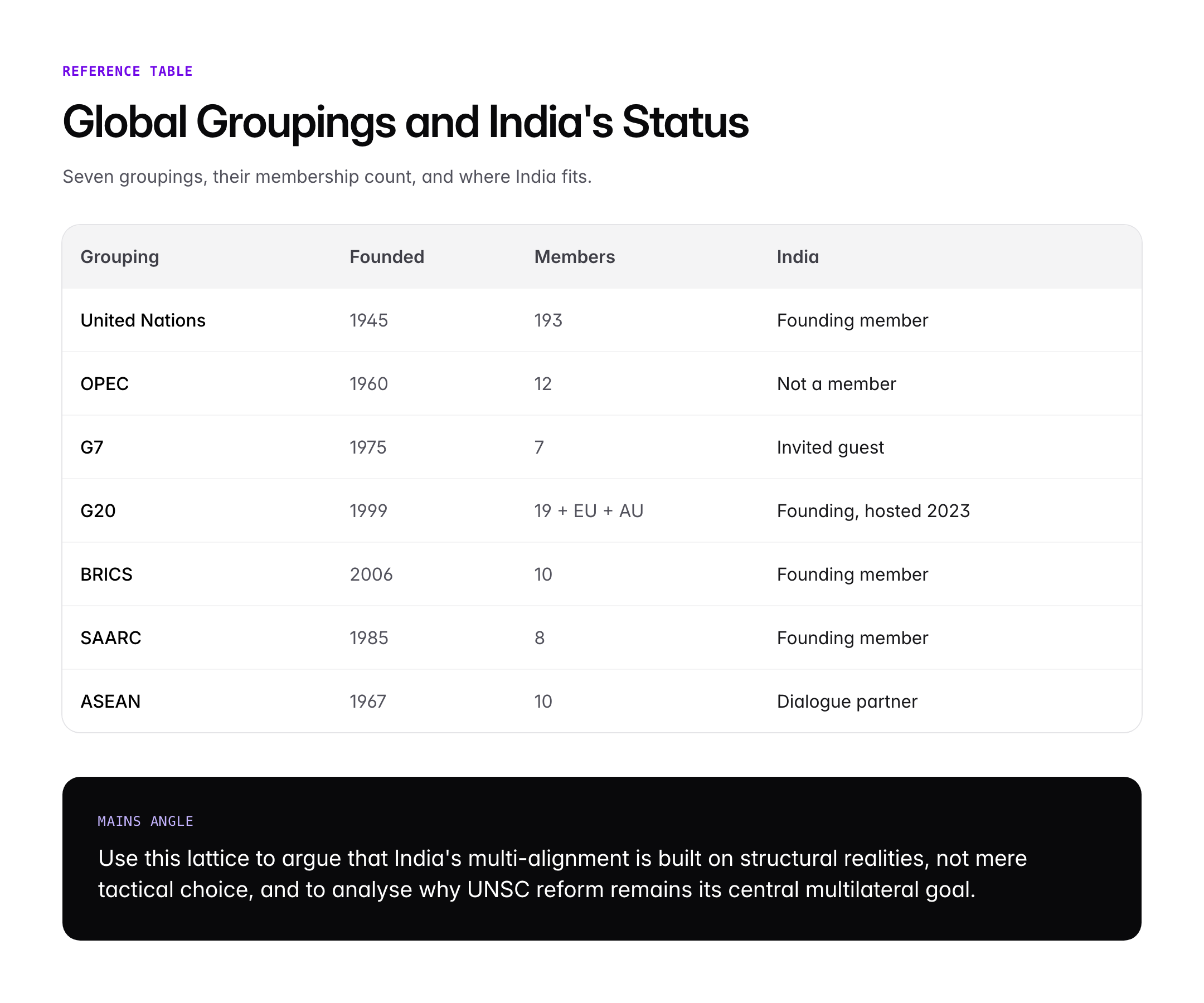
| United Nations | 1945 | 193 | Founding member | Global governance |
| OPEC | 1960 | 12 | Not a member | Oil export policy |
| G7 | 1975 | 7 | Invited guest | Advanced-economy policy |
| G20 | 1999 | 19 + EU + AU | Member, hosted 2023 | Global economic cooperation |
| BRICS | 2006 / 2010 | 10 | Founding member | Multipolar cooperation |
| SAARC | 1985 | 8 | Founding member | South Asian cooperation |
| ASEAN | 1967 | 10 | Dialogue partner | Southeast Asian cooperation |
The table makes clear that India is either a member or a consequential partner in most groupings that matter. The one notable structural gap is the UN Security Council, where India holds non-permanent seats but not a permanent seat with veto power. Reform of the UNSC remains a long-standing Indian diplomatic objective.
Challenges and Criticisms
India’s web of memberships brings strategic benefits but also real costs. Managing contradictions between Quad and SCO, between Western sanctions regimes and BRICS solidarity, and between Global South rhetoric and G20 compromises is a constant diplomatic challenge. Critics argue that multi-alignment can look like strategic ambiguity and that it sometimes limits India’s ability to lead decisively.
There is also a critique of the groupings themselves. OPEC is often accused of distorting energy markets, though member states argue that coordination prevents damaging price swings. The G7 is criticised as a self-selected club of wealthy democracies with outdated claims to global leadership. The G20, while more inclusive, has been hampered by geopolitical polarisation since the Russia-Ukraine conflict. BRICS, after the 2024 expansion, faces questions about coherence and whether it can sustain consensus across very different political systems.
Prelims Pointers
- India is one country with 28 states and 8 Union Territories in 2026
- United Nations has 193 member states as of 2026
- OPEC was founded in 1960 in Baghdad with five members
- OPEC headquarters is in Vienna, Austria
- OPEC had 12 members after Angola’s exit in 2024
- G7 consists of Canada, France, Germany, Italy, Japan, UK and US
- G7 has no permanent secretariat and rotates the presidency annually
- G20 became a leaders’ summit in 2008 after the global financial crisis
- India hosted the G20 summit in New Delhi in September 2023
- African Union became a permanent G20 member at the 2023 New Delhi summit
- BRICS expanded in 2024 to add Egypt, Ethiopia, Iran and UAE
- SAARC has 8 member states and is headquartered in Kathmandu
Mains Practice Questions
- India’s foreign policy in the 2020s has been described as strategic multi-alignment. Critically examine how India balances its participation across the G20, BRICS, Quad and SCO and evaluate the sustainability of this approach.
- Define multi-alignment versus non-alignment
- Illustrate with G20 presidency, BRICS expansion and Quad summits
- Assess risks of contradictory commitments
- The expansion of BRICS in 2024 has been called a reshaping of the global economic order. Discuss the implications for India of an enlarged BRICS, including its place in the New Development Bank and energy diplomacy.
- Map the 10-member BRICS and its combined weight
- Analyse India’s concerns about Chinese dominance
- Propose a principled Indian line for the next decade
Conclusion
The question of how many countries are in India reveals a basic misunderstanding that is easy to correct. India is one country, one UN member, and one constitutional Union. The interesting follow-up is how that single country sits in the broader architecture of global groupings, and what choices it makes across OPEC-driven energy politics, G7-led agenda setting, G20 economic coordination, and BRICS-driven Global South diplomacy.
For a UPSC aspirant, the payoff is twofold. First, avoid the basic error of counting states as countries. Second, memorise the small, stable facts of each grouping, then layer on current-affairs updates like the 2023 New Delhi G20 declaration and the 2024 BRICS expansion. That combination of structural knowledge and live context is what separates a good answer from a complete one.
Frequently Asked Questions
How many countries are in India?
India is one country, not many. It is a single sovereign republic and a single member state of the United Nations. Internally, India is organised as a Union of States with 28 states and 8 Union Territories in 2026, but all of these are federal subunits under one Indian Constitution, not separate countries.
Why is this question important for UPSC?
The question highlights the distinction between country, state and federal subunit, which matters for GS2 polity and international relations. Prelims tests organisations like OPEC, G7 and G20 membership, while Mains demands precise vocabulary on sovereignty, federalism and multilateral diplomacy. Getting the basic framing right underpins stronger answers.
How is India related to the United Nations?
India is a founding member of the United Nations, having joined in 1945 before independence. It participates in the UN General Assembly, serves periodic terms on the UN Security Council as a non-permanent member, and is a long-standing advocate for UNSC reform and for a permanent seat reflecting its population and economic weight.
How many OPEC countries are there in 2026?
OPEC has 12 member countries in 2026, after Angola’s exit at the start of 2024. Current members include Algeria, Congo, Equatorial Guinea, Gabon, Iran, Iraq, Kuwait, Libya, Nigeria, Saudi Arabia, the UAE and Venezuela. OPEC+ adds non-OPEC allies such as Russia and Kazakhstan for production coordination.
Which are the G7 countries and is India one of them?
The G7 members are Canada, France, Germany, Italy, Japan, the United Kingdom and the United States, with the European Union as a non-enumerated participant. India is not a G7 member because it is still classified as a developing economy, but it regularly attends G7 summits as an invited outreach partner.
How many members does the G20 have?
The G20 has 19 country members plus the European Union and, from 2023, the African Union. India is a founding G20 member and hosted the leaders’ summit in New Delhi in September 2023. That summit delivered the New Delhi Declaration and formalised African Union membership in the grouping.
What changed in BRICS in 2024?
On 1 January 2024, BRICS expanded for the first time since 2010 by admitting Egypt, Ethiopia, Iran and the United Arab Emirates as full members. Saudi Arabia’s accession remains under discussion. With this expansion, BRICS grew to 10 full members, covering more than 40 percent of the world’s population and a larger share of global GDP in PPP terms.
How is SAARC different from BIMSTEC?
SAARC is a South Asian regional grouping of 8 countries founded in 1985, while BIMSTEC is a Bay of Bengal grouping that connects five South Asian states with Myanmar and Thailand. SAARC has been dormant since 2016 due to India-Pakistan tensions, so India has shifted its regional cooperation emphasis to BIMSTEC, which excludes Pakistan and is seen as more functional.
Tell Google you want more of this.
Add Anantam IAS as a preferred sourceOne tap, and this site shows up more often in your own Top Stories, AI Overviews and AI Mode. Remove it any time.