Introduction
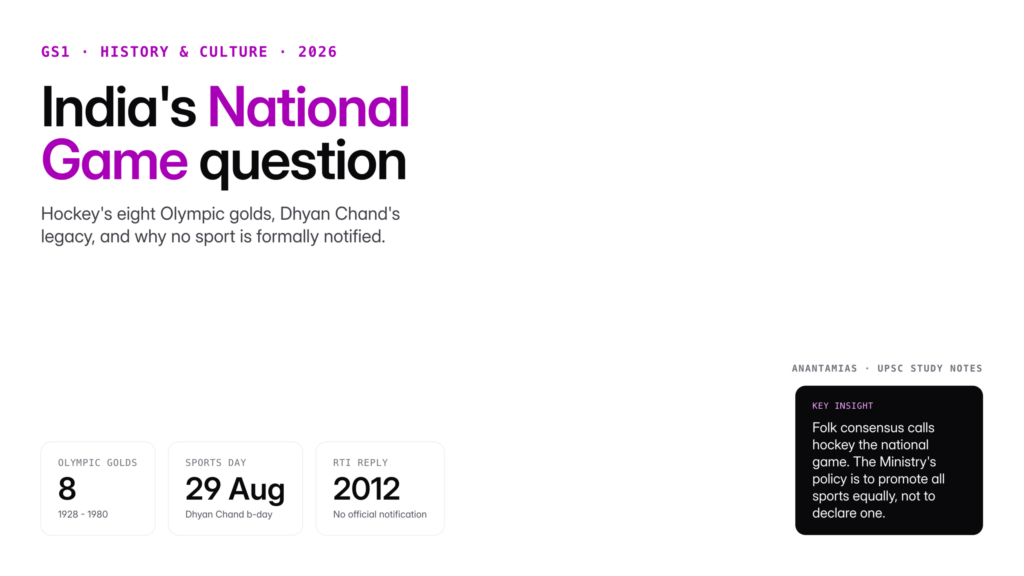
Ask any Indian schoolchild to name the national game and the answer comes instantly: hockey. The sport is woven into textbooks, general-knowledge quizzes and postage stamps, evoking images of Major Dhyan Chand’s wizardry on grass fields and eight Olympic gold medals that remain the benchmark of Indian sporting glory. Yet the subject is surprisingly complex. In 2012, in response to an RTI query filed by a ten-year-old student, the Ministry of Youth Affairs and Sports clarified that the Government of India has not officially declared any game as the national game. The widely held belief, it turns out, rests on tradition rather than statutory proclamation.
For UPSC aspirants, the national game of India is more than a trivia question. It opens a window into colonial cultural history, Olympic heritage, post-Independence sporting decline, administrative reform through the Khelo India programme, and contemporary debates on federalism in sport. This article unpacks the hockey legacy, examines why the “national game” tag persists despite the absence of formal notification, compares India’s sporting culture with peer nations, and builds a Prelims-ready factual base along with Mains-level analytical depth.
Quick Facts at a Glance
| Attribute | Detail |
|---|---|
| Popular national game | Field Hockey |
| Official status | Not formally declared by the Government of India (RTI reply, August 2012) |
| Governing body | Hockey India (recognised by FIH since 2008) |
| International federation | International Hockey Federation (FIH), founded 1924 |
| Olympic golds (men) | 8 (1928, 1932, 1936, 1948, 1952, 1956, 1964, 1980) |
| Most recent Olympic medal | Bronze, Paris 2024 |
| Iconic player | Major Dhyan Chand (1905-1979) |
| National Sports Day | 29 August (Dhyan Chand’s birthday) |
| Major Dhyan Chand Khel Ratna | India’s highest sporting honour, renamed 2021 |
Background and Historical Context
Field hockey as a codified sport reached India through the British Army in the 1850s. The first hockey club in the country was established in Calcutta in 1885, and the Beighton Cup, instituted in 1895, became Asia’s oldest surviving hockey tournament. By the 1920s Indian regimental teams were playing at a standard that rivalled anything in Europe. The Indian Hockey Federation (IHF) was founded in 1925 and affiliated to the FIH in 1927, opening the door to Olympic competition.
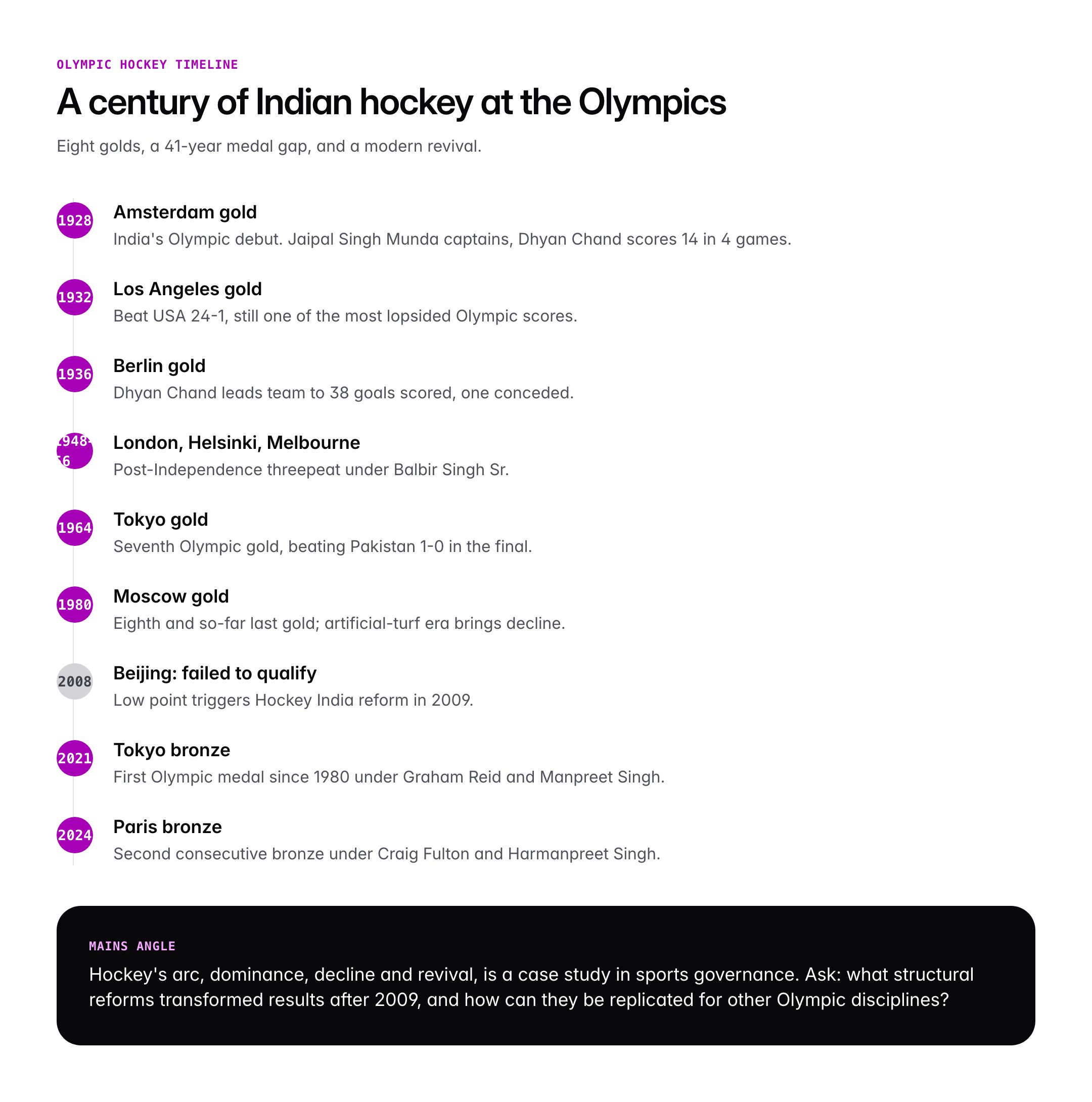
India’s Olympic debut in hockey at Amsterdam 1928 was a watershed moment. Under captain Jaipal Singh Munda, a tribal leader later to draft parts of the Indian Constitution, the team won gold without conceding a single goal across five matches. Dhyan Chand scored fourteen goals in four games. The performance was repeated at Los Angeles 1932, where India beat the United States 24-1, still one of the most lopsided scores in Olympic history, and at Berlin 1936 when Dhyan Chand led a team that scored 38 goals and conceded one across the tournament. Adolf Hitler reportedly offered him a commission in the German army, which he politely declined.
Between 1928 and 1956 India won six consecutive Olympic golds, an unmatched run in any team sport. A seventh came at Tokyo 1964 and the eighth at Moscow 1980. This era coincided with the shift from natural grass to artificial turf, a transition that hurt the stick-work-centric Indian style. Pakistan, the Netherlands, Australia and Germany adapted faster. India failed to qualify for the Moscow Olympics originally because of the US-led boycott politics, but won gold in the depleted field that actually played. From 1984 onwards results deteriorated sharply, culminating in failure to qualify for Beijing 2008, a national sporting low-point that triggered structural reform and the eventual creation of Hockey India.
Key Features and Provisions
Hockey India and the Governance Reset
Hockey India was constituted in 2009 after the FIH suspended the Indian Hockey Federation over governance failures. Hockey India unified men’s and women’s hockey under a single body, introduced franchise leagues (first the Hockey India League, 2013-2017, revived 2024-25), and aligned coaching with FIH benchmarks. The organisation operates from New Delhi and reports to the Ministry of Youth Affairs and Sports through the Sports Authority of India.
The 2012 RTI Clarification
In 2012, Aishwarya Parashar, a class V student from Lucknow, filed an RTI application asking for a copy of the notification declaring hockey the national game. The Ministry replied that no such notification exists because the government has not declared any game or sport as the national game. The reply said the focus is on “promotion of sports and excellence of players” rather than symbolic designation. This clarification is repeatedly cited in Prelims questions.
National Sports Day and the Khel Ratna Rename
National Sports Day is observed on 29 August each year, commemorating the birth anniversary of Major Dhyan Chand. On this day the President confers the Arjuna Award, Dronacharya Award and the Major Dhyan Chand Khel Ratna. The Khel Ratna, India’s highest sporting honour instituted in 1991-92 and originally named after Rajiv Gandhi, was renamed the Major Dhyan Chand Khel Ratna Award in August 2021 following a demand by athletes and the public.
Contemporary Performance
After a 41-year wait India’s men won Olympic bronze at Tokyo 2020 under captain Manpreet Singh and coach Graham Reid. A second consecutive bronze followed at Paris 2024 under captain Harmanpreet Singh and coach Craig Fulton. The women’s team, captained by Savita Punia and Rani Rampal in earlier cycles, finished fourth at Tokyo 2020, the best Olympic showing ever. Domestic structures have expanded via the Khelo India programme, launched 2018, and the Target Olympic Podium Scheme (TOPS) which funds elite athletes.
Cricket, Kabaddi and the Competing Claims
Although hockey enjoys the de facto national-game label, cricket dominates popular attention and commercial revenue. Kabaddi, chess, wrestling and shooting have all been proposed at various times as candidates for national game status. The government’s position remains unchanged: all recognised sports are equally promoted through SAI, NSFs and the National Sports Policy 2001 (revision under discussion).
Significance for UPSC and General Knowledge
- Frequently tested in Prelims under sports awards, Olympic history and sports governance reforms.
- Touches GS1 history topics: colonial institutions, post-1947 nation-building through sport, role of tribal leaders like Jaipal Singh Munda.
- Relevant to GS2 governance via Hockey India restructuring, RTI Act application, and Sports Code 2011.
- Illustrates soft-power diplomacy and India’s Olympic heritage for essay and interview stages.
- Links to social-justice themes: women’s hockey growth, tribal representation, Chak De India cultural moment.
- Offers a lens on India’s sports-science deficit and the shift from talent-based to system-based excellence.
Detailed Analysis: Sporting Contributions and Cultural Impact
The Golden Generation
The pre-Independence team that won three Olympic golds was drawn heavily from the Punjab, Bengal and Anglo-Indian communities, with railway and army teams providing the bulk of players. Dhyan Chand, his younger brother Roop Singh, and goalkeeper Richard Allen anchored the 1928-36 dynasty. After Independence, the tradition continued with Balbir Singh Sr., a three-time Olympic gold medallist (1948, 1952, 1956) who captained India to the 1956 Melbourne title and is the only athlete chosen among the sixteen iconic Olympians celebrated by the IOC at London 2012. K.D. Singh “Babu”, Leslie Claudius (four Olympic medals), and Udham Singh Kular (three golds) are other names every aspirant should recognise.
The Artificial-Turf Transition
The 1976 Montreal Olympics introduced compulsory artificial turf. This favoured speed, stamina and straight-line passing over the close-ball control that Indian players had perfected on grass. Countries with municipal investment in synthetic surfaces gained a structural advantage. India’s response was slow: the first major astroturf was laid at Delhi’s National Stadium only in the late 1970s, and school-level infrastructure lagged by decades. By the 1990s India was outside the medal bracket at every major tournament.
The Revival Architecture
The modern revival rests on four pillars: Hockey India’s professional governance; SAI residential academies at Bhubaneswar, Bengaluru and Majitha; the Odisha state government’s sponsorship of the national teams since 2018; and the Khelo India Youth Games which feed talent into state-level systems. The FIH Pro League, introduced in 2019, has given the senior teams regular exposure to top-eight nations. Odisha’s decision to host the FIH Men’s Hockey World Cup in 2018 and 2023 marked India as the global event capital for the sport.
Women’s Hockey and Social Change
The women’s national team’s fourth-place finish at Tokyo 2020, immortalised in the film Chak De India’s real-world sequel, accelerated a social shift. Players such as Rani Rampal from Shahbad, Salima Tete from Simdega, and Vandana Katariya from Haridwar embody a tribal and small-town talent pipeline. The Rs 25-lakh Khelo India scholarships and the Tata Trusts-backed Naval Tata Hockey Academy in Jamshedpur have institutionalised female participation.
Comparative Perspective
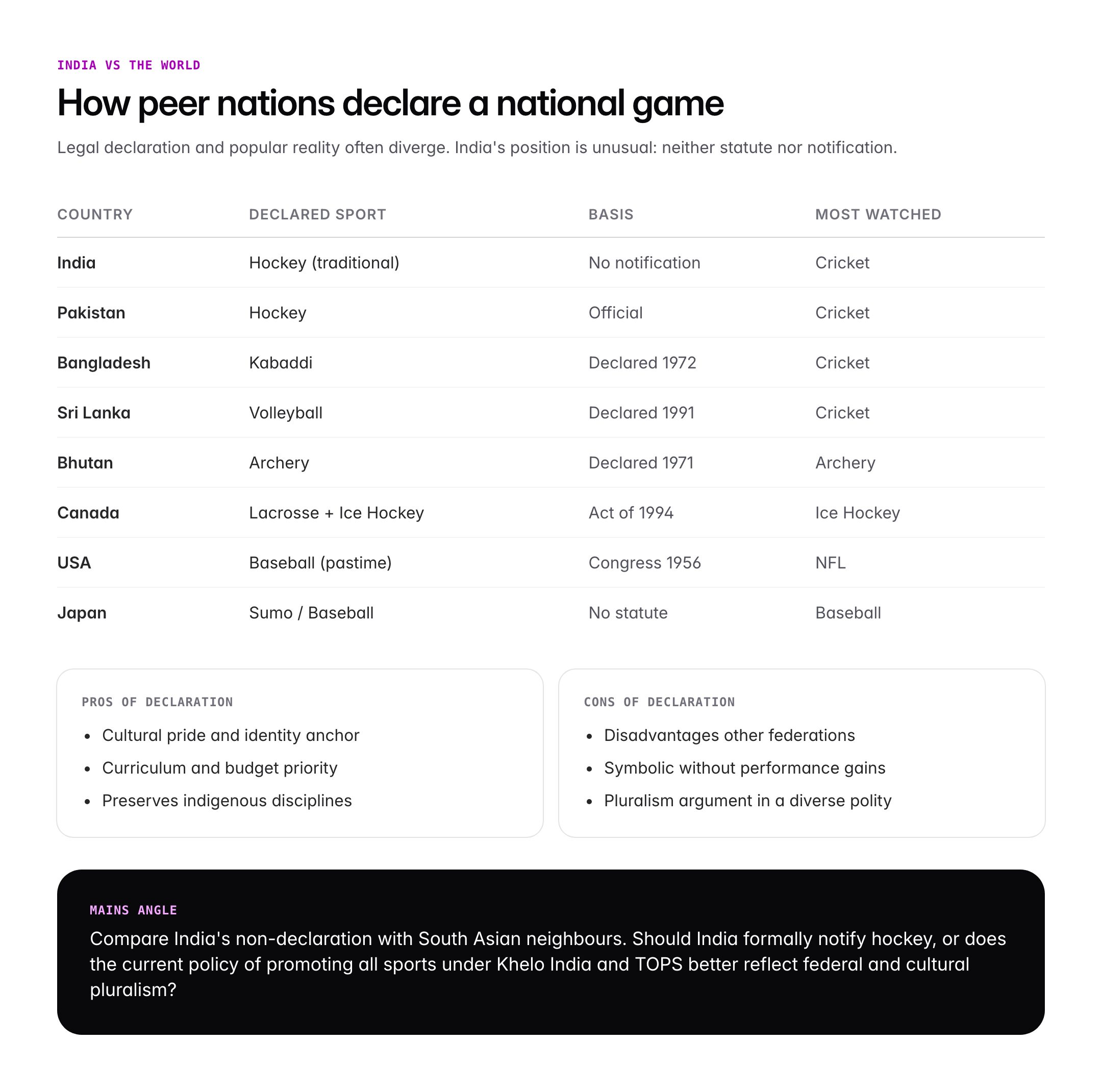
How India’s national-game status compares with selected peer nations.
| Country | Declared National Game | Legal Basis | Popular Reality |
|---|---|---|---|
| India | None officially; hockey by tradition | RTI reply 2012 confirms no notification | Cricket dominates viewership |
| United States | Baseball (unofficial) | Congressional resolution 1956 used “national pastime” | American football leads ratings |
| Canada | Lacrosse (summer) and Ice Hockey (winter) | National Sports of Canada Act 1994 | Ice hockey culturally dominant |
| Japan | Sumo (traditional); Baseball (popular) | No formal act | Baseball professional league leads |
| Sri Lanka | Volleyball | Declared 1991 | Cricket most watched |
| Bangladesh | Kabaddi (Ha-Du-Du) | Declared 1972 | Cricket most watched |
| Pakistan | Hockey | Declared officially | Cricket dominates |
| Bhutan | Archery | Declared 1971 | Archery widely practised |
The pattern is consistent across South Asia and beyond: legal declaration often diverges from commercial and participatory reality. India’s unusual position is that it has neither legislation nor a Presidential notification, despite a seven-decade folk consensus on hockey.
Challenges and Criticisms
Three debates recur. First, the symbolic-versus-substantive argument: some sports administrators argue that declaring any single game as national would disadvantage indigenous disciplines like kabaddi, kho-kho, malkhamb and mallakhamba, as well as minority sports like sailing and archery. Second, the cricket-hegemony critique: with cricket accounting for over 85 percent of India’s sports-sponsorship revenue (KPMG sports industry report 2023), other disciplines struggle for media space, sponsorship and school infrastructure. The BCCI’s autonomy from direct government control, upheld in BCCI v Cricket Association of Bihar (2015), further sharpens the disparity.
Third, the governance question: despite Hockey India’s reforms, concerns persist around coach tenure, player-association friction, and the pay gap between men’s and women’s squads. The 2021 IOA elections, supervised by a Supreme Court-appointed Committee of Administrators under Justice L. Nageswara Rao, highlighted continuing structural weaknesses in Indian sports bodies. Critics also note that Olympic medals alone cannot repair a base that lacks grassroots coaches, synthetic turfs in government schools, and a viable domestic league ecosystem.
Prelims Pointers
- India has won 8 Olympic gold medals in men’s field hockey, the most by any nation in the sport.
- Major Dhyan Chand was born on 29 August 1905 in Allahabad (now Prayagraj); National Sports Day is observed on his birthday.
- Dhyan Chand scored over 400 international goals in his career.
- The Government of India has not officially declared any sport as the national game, as confirmed via RTI reply in 2012.
- Hockey India, the governing body, was formed in 2009 and recognised by the FIH in 2009-10.
- The Rajiv Gandhi Khel Ratna was renamed the Major Dhyan Chand Khel Ratna Award in August 2021.
- India won Olympic hockey bronze at Tokyo 2020 and Paris 2024.
- The FIH World Cup was hosted by India in Bhubaneswar and Rourkela in 2018 and 2023.
- The Beighton Cup, instituted in 1895 in Calcutta, is Asia’s oldest hockey tournament.
- Jaipal Singh Munda captained India to the 1928 Olympic hockey gold and later served in the Constituent Assembly.
- Balbir Singh Sr. was named among the IOC’s 16 iconic Olympians at London 2012.
- The Khelo India programme was launched in 2018 to strengthen grassroots sport.
Mains Practice Questions
- “India’s claim to hockey as its national game is cultural rather than constitutional. Discuss, with reference to the 2012 RTI clarification and the broader role of symbols in Indian nation-building.” (250 words, GS1)
- Introduce the folk consensus on hockey and the RTI reply establishing absence of formal notification.
- Analyse the Ministry’s stated preference for promotion over designation, citing National Sports Policy 2001 and Khelo India.
- Conclude by weighing the symbolic value of a declared national game against federal and cultural pluralism.
- “Evaluate the structural reforms that led to the revival of Indian field hockey between 2008 and 2024. To what extent are they replicable for other Olympic sports?” (250 words, GS2/GS3)
- Trace the 2008 qualification failure, FIH intervention and formation of Hockey India.
- Discuss state-sponsorship (Odisha), SAI academies, TOPS funding and FIH Pro League participation.
- Assess replicability, noting the need for a strong NSF, long-term state partnership and coach-scientist integration.
Conclusion
The national game of India, for purposes of civic memory and popular pedagogy, remains hockey, even without a formal statutory imprimatur. The sport’s Olympic record, its intertwining with the freedom struggle, and the enduring shadow of Dhyan Chand give it a cultural weight that no bureaucratic notification could manufacture. The 2012 RTI reply, rather than demoting hockey, clarified the administrative reality that India promotes all sports under a common policy architecture.
For aspirants, the lesson extends beyond trivia. The hockey story showcases how governance failure can drag a dominant sport into decline and how targeted reform, state partnership and scientific support can rebuild a system within a generation. As India prepares bids for the 2036 Olympics and builds the Khelo India-to-TOPS pipeline, the national game debate will likely evolve from symbolic claim to performance-backed reality. Whether or not hockey is ever formally notified, its place in India’s sporting imagination is secure.
Frequently Asked Questions
What is the national game of India?
Field hockey is widely regarded as India’s national game because of its Olympic dominance between 1928 and 1980, the legacy of Major Dhyan Chand, and decades of textbook tradition. However, the Government of India has not formally notified any sport as the national game, as confirmed by a 2012 RTI reply from the Ministry of Youth Affairs and Sports.
Why is hockey important for UPSC aspirants to study?
Hockey appears in Prelims factual questions on Olympic medals, awards like the Major Dhyan Chand Khel Ratna, and the RTI-based clarification on national-game status. It also figures in Mains GS1 cultural history and GS2 sports-governance reforms, including the formation of Hockey India and the Khelo India programme launched in 2018.
Did India officially declare hockey as the national game?
No. In August 2012, in reply to an RTI application filed by a schoolgirl from Lucknow, the Ministry of Youth Affairs and Sports stated that the Government of India has not declared any sport as the national game. The Ministry’s policy focuses on promotion and excellence rather than symbolic designation.
How is hockey related to Indian history and the freedom struggle?
The Indian hockey team won its first Olympic gold in Amsterdam 1928 under Jaipal Singh Munda, a tribal leader who later served in the Constituent Assembly. Three successive pre-Independence golds in 1928, 1932 and 1936 became a source of national pride under colonial rule, and the sport became a vehicle of nation-building after 1947.
How many Olympic gold medals has India won in hockey?
India has won eight Olympic gold medals in men’s field hockey, in 1928, 1932, 1936, 1948, 1952, 1956, 1964 and 1980. This is the highest tally by any nation in the sport. India also won bronze at Tokyo 2020 and Paris 2024 ending a 41-year Olympic medal drought in the discipline.
Who was Major Dhyan Chand and why is he celebrated?
Major Dhyan Chand (1905-1979) was India’s greatest hockey player, part of the Olympic gold-medal teams of 1928, 1932 and 1936. He scored over 400 international goals and is known for his extraordinary ball control. National Sports Day is observed on his birthday, 29 August, and the Khel Ratna was renamed after him in 2021.
What is Hockey India and when was it formed?
Hockey India is the national governing body for field hockey, formed in 2009 after the FIH suspended the Indian Hockey Federation over governance failures. It unified men’s and women’s hockey, runs the domestic league, oversees national teams, and works with the Sports Authority of India and the Ministry of Youth Affairs and Sports.
Why did Indian hockey decline after 1980?
The shift to artificial turf from Montreal 1976 onwards favoured speed and stamina over the stick-work-centric Indian style. Countries with municipal investment in synthetic surfaces adapted faster. India’s response was slow, infrastructure lagged at school level, and governance issues within the IHF compounded the decline through the 1990s and 2000s.
Tell Google you want more of this.
Add Anantam IAS as a preferred sourceOne tap, and this site shows up more often in your own Top Stories, AI Overviews and AI Mode. Remove it any time.