Introduction
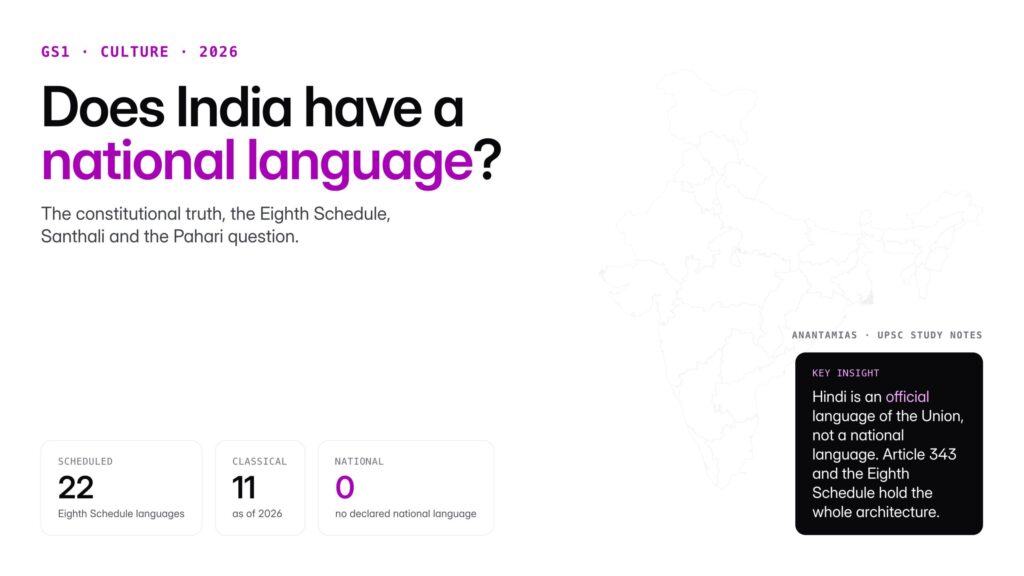
Few questions in the Indian civil services syllabus generate as much confusion as the one about the indian national language. A common belief, repeated in quiz shows and school textbooks, is that Hindi is the national language of India. The legal and constitutional reality is more nuanced. India is a multilingual federation where no single tongue carries the formal status of a national language, and the Constitution carefully distinguishes between official languages, scheduled languages and classical languages.
For a UPSC aspirant, understanding this landscape is essential for Prelims questions on the Eighth Schedule, Mains answers on linguistic federalism, and even essay papers on unity in diversity. This article decodes the national language debate, profiles two important scheduled languages, Santhali and Pahari, and maps out the legal architecture that binds India’s linguistic mosaic together.
Quick Facts at a Glance
| Item | Detail |
|---|---|
| National language of India | None (officially) |
| Official languages of the Union | Hindi (Devanagari script) and English |
| Constitutional provisions | Articles 343 to 351, Part XVII |
| Eighth Schedule languages | 22 |
| Classical languages (as of 2026) | 11 |
| Santhali added to Eighth Schedule | 2003 (92nd Amendment) |
| Pahari status | Western Pahari and Eastern Pahari dialect clusters; Nepali in Eighth Schedule represents Eastern Pahari |
| Largest spoken language (Census 2011) | Hindi (43.63% speakers) |
| Second most spoken | Bengali (8.03%) |
Background and Historical Context
The Indian Constitution was framed against the backdrop of fierce linguistic debate. In the Constituent Assembly, the Munshi-Ayyangar formula of 1949 resolved a deadlock between pro-Hindi members and representatives of non-Hindi regions. Hindi in Devanagari script was adopted as the official language of the Union under Article 343, while English was to continue for official purposes for fifteen years. The Constituent Assembly consciously avoided the phrase “national language” because India’s linguistic diversity could not be reduced to a single identity.
The Official Languages Act, 1963 extended the use of English indefinitely alongside Hindi, a concession that followed the anti-Hindi agitations in Tamil Nadu in 1965. The agitations, led by the Dravidian movement, forced Parliament to amend the Act in 1967, guaranteeing the continued use of English as long as any non-Hindi state desired. This settlement has held for over five decades and is often cited as a textbook case of cooperative federalism.
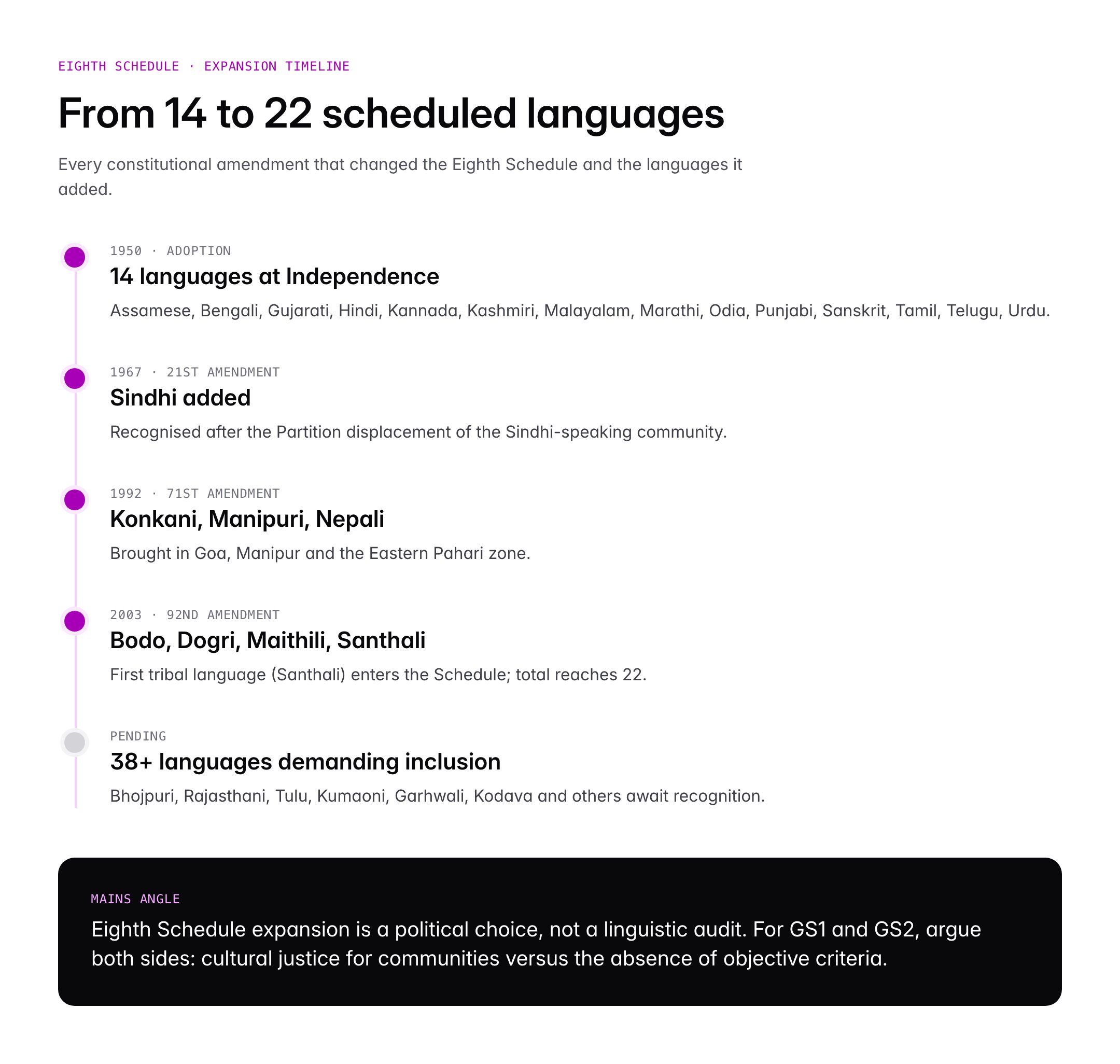
Parallel to the official language question, the Eighth Schedule was drafted to recognise languages that the Union could draw from to enrich Hindi and to include in public service examinations. The Schedule began with 14 languages in 1950 and has been expanded four times: Sindhi in 1967, Konkani, Manipuri and Nepali in 1992, and Bodo, Dogri, Maithili and Santhali in 2003 through the 92nd Constitutional Amendment. The Sitakant Mahapatra Committee had recommended the 2003 additions after years of advocacy by tribal and regional movements.
Key Features
The constitutional framework
Part XVII of the Constitution, spanning Articles 343 to 351, governs the language regime. Article 343 designates Hindi as the official language of the Union. Article 344 provided for the Official Languages Commission, while Article 345 empowers states to adopt one or more official languages for their own use. Article 346 covers inter-state communication, and Article 347 allows the President to recognise a language spoken by a substantial section of a state’s population. Articles 348 and 349 deal with the language of courts and legislation, and Articles 350A and 350B protect mother-tongue education for linguistic minorities and create the Special Officer for Linguistic Minorities.
The Eighth Schedule today
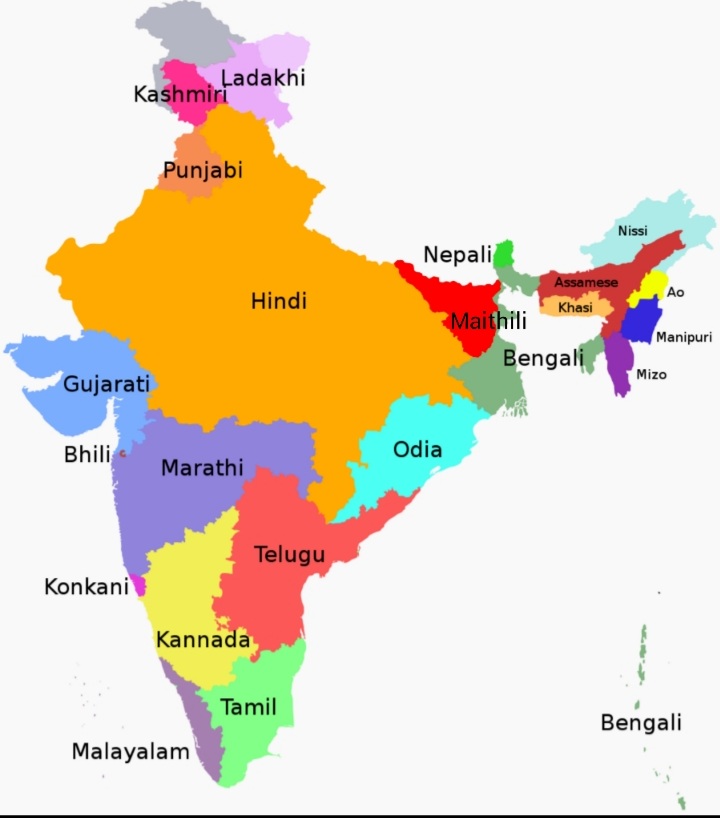
The Eighth Schedule currently lists 22 languages: Assamese, Bengali, Bodo, Dogri, Gujarati, Hindi, Kannada, Kashmiri, Konkani, Maithili, Malayalam, Manipuri, Marathi, Nepali, Odia, Punjabi, Sanskrit, Santhali, Sindhi, Tamil, Telugu and Urdu. Inclusion does not confer official status but triggers important consequences. Candidates can write UPSC civil services examination papers in any Eighth Schedule language. The government is expected to develop these languages, and members of Parliament can address the House in any Eighth Schedule tongue with advance notice.
Santhali language
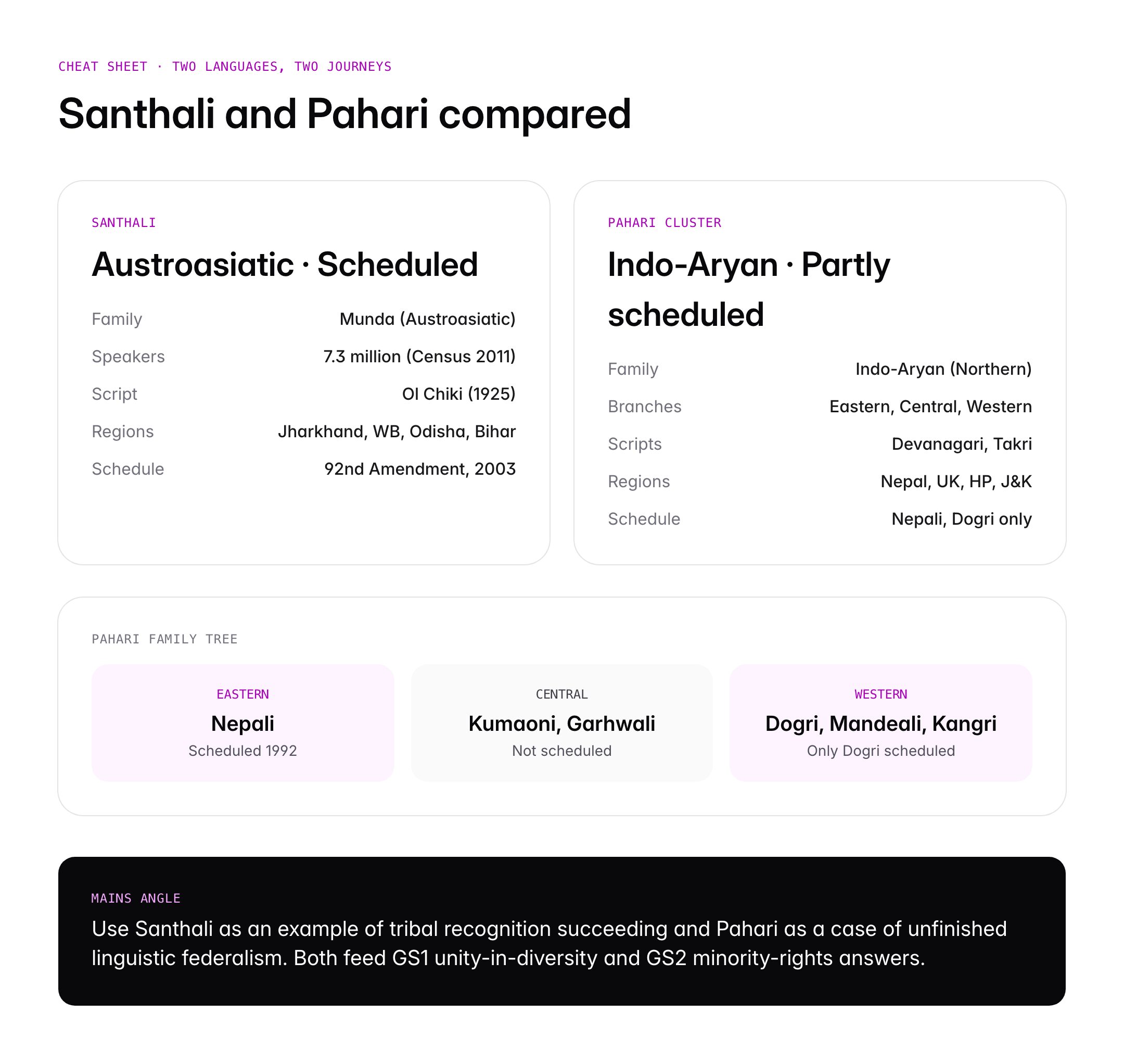
Santhali is the largest language of the Austroasiatic Munda subfamily in India, spoken by about 7.3 million people according to Census 2011. Its speakers are concentrated in Jharkhand, West Bengal, Odisha, Bihar and Assam. Santhali is written in the Ol Chiki script, devised by Pandit Raghunath Murmu in 1925. It was added to the Eighth Schedule in 2003 and became one of the first tribal languages to receive constitutional recognition. Santhali oral literature, including the Karam and Baha festival songs, is a living tradition. The language is now offered in Sahitya Akademi awards and in several central universities.
Pahari language cluster
The Pahari languages form a chain stretching across the Himalayan foothills from Nepal through Uttarakhand, Himachal Pradesh and Jammu and Kashmir. Linguists classify them into three groups: Eastern Pahari (Nepali), Central Pahari (Kumaoni and Garhwali) and Western Pahari (Dogri, Mandeali, Kangri, Bhaderwahi and others). Of these, Nepali and Dogri enjoy Eighth Schedule status. Demands for inclusion of Kumaoni, Garhwali, Himachali Pahari and the Jammu and Kashmir Pahari language have been persistent. The Pahari-speaking community of Jammu and Kashmir received Scheduled Tribe status in 2023, intensifying the case for the language’s formal recognition.
Classical languages
Separate from the Eighth Schedule is the classical languages category, which confers scholarly and financial recognition. As of 2026, eleven languages hold this status: Tamil (2004), Sanskrit (2005), Telugu (2008), Kannada (2008), Malayalam (2013), Odia (2014), and the 2024 additions of Marathi, Pali, Prakrit, Assamese and Bengali.
Significance for UPSC and General Knowledge
- Tests the frequent Prelims trap that confuses “national language” with “official language”
- Links to Mains GS1 questions on unity in diversity, linguistic reorganisation of states and cultural heritage
- Provides source material for GS2 answers on cooperative federalism, minority rights and Articles 29 and 30
- Supplies essay hooks on pluralism, soft power and the politics of identity
- Aligns with Optional papers in History, Anthropology and Political Science
- Anchors current affairs tracking on Eighth Schedule demands (Bhojpuri, Rajasthani, Kumaoni, Tulu and others)
Detailed Analysis: Linguistic Federalism in Practice
India’s linguistic settlement is a classic federal bargain. The States Reorganisation Act, 1956, implemented on the recommendations of the Fazal Ali Commission, redrew state boundaries along linguistic lines. Andhra State, carved out of Madras in 1953 after Potti Sriramulu’s fast unto death, set the template. Over the following decades Bombay was bifurcated into Maharashtra and Gujarat, Punjab was split to create Haryana, and the Northeast was reorganised into smaller linguistically homogeneous units.
The three-language formula, first articulated in 1968 and reaffirmed in the National Education Policy 2020, seeks to balance regional, national and international language learning. Students learn their mother tongue or regional language, Hindi or another modern Indian language, and English. Tamil Nadu has long rejected the Hindi component, preferring a two-language formula of Tamil and English.
At the level of governance, Hindi serves as the link language in officially Hindi-speaking Region A states, while Region B and Region C states use English and their regional languages extensively. The Department of Official Language under the Ministry of Home Affairs monitors progressive use of Hindi, issues the Annual Programme on official language, and runs training institutes.
For scheduled languages outside the Eighth Schedule, the fight for recognition is often political. The Bhasha Research and Publication Centre’s People’s Linguistic Survey of India (2010-2013) identified 780 living languages, many of them unrecognised. Advocacy groups for Bhojpuri, Rajasthani and Tulu frequently petition Parliament. The Union government has stated that it is examining inclusion but has added no new language since 2003.
The Central Institute of Indian Languages (CIIL) in Mysuru, along with the Sahitya Akademi and the National Translation Mission, carries out linguistic research, literary promotion and translation, giving institutional support to both majority and minority languages. The UNESCO Atlas of the World’s Languages in Danger lists 197 Indian languages as endangered, making preservation work a cross-cutting policy area.
Comparative Perspective
| Country | Constitutional status of languages | Approach |
|---|---|---|
| India | 22 scheduled; Hindi and English as official Union languages | Plural, no national language |
| South Africa | 12 official languages | Equal status, sign language added in 2023 |
| Switzerland | German, French, Italian, Romansh | Territoriality principle |
| Canada | English and French | Bilingualism at federal level |
| China | Mandarin (Putonghua) as state common language | Unitary promotion |
| Nepal | Nepali in Devanagari as official; 123 languages listed in Census | Mother-tongue use permitted in local bodies |
India’s approach is closer to the South African and Swiss models of institutional pluralism than to the unitary assimilation favoured by China or France. Unlike Canada, India does not operate a strict bilingual rule; instead it stacks regional, link and classical categories. The flexibility has helped manage diversity but has also slowed the development of a single administrative idiom.
Controversies and Debates
The question of a national language resurfaces every few years. Proposals to declare Hindi the national language have been floated in Parliament and by civil society groups, triggering predictable resistance from Tamil Nadu, Karnataka, Kerala, West Bengal and the Northeast. Critics argue that formal nationalisation of Hindi would violate the federal spirit, disadvantage non-Hindi speakers in employment and undercut the 1965 settlement.
Another long-running controversy concerns the imposition of Hindi through signage on highways, banking forms and central government recruitment. Organisations such as the Bharatiya Bhasha Andolan counter that English dominance, not Hindi, is the real imbalance. The Kothari Commission, the Official Language Committee headed by the Home Minister, and the Parliamentary Committee on Official Language regularly weigh these claims.
Eighth Schedule expansion raises its own debates. Critics argue that political bargaining, not linguistic criteria, drives inclusion; no objective cut-off for speaker numbers, literary corpus or script exists. Supporters reply that recognition empowers communities to demand educational and cultural entitlements. The classical language category, meanwhile, has been accused of competitive tokenism after the 2024 expansion to eleven languages.
Prelims Pointers
- India has no official national language; Hindi and English are official languages of the Union
- Part XVII of the Constitution, Articles 343 to 351, deals with language
- Article 343 sets Hindi in Devanagari as the official language
- The Eighth Schedule lists 22 languages as of 2026
- Sindhi was added in 1967 by the 21st Amendment
- Konkani, Manipuri and Nepali were added in 1992 by the 71st Amendment
- Bodo, Dogri, Maithili and Santhali were added in 2003 by the 92nd Amendment
- Santhali uses the Ol Chiki script, created by Raghunath Murmu in 1925
- Pahari includes Eastern (Nepali), Central (Kumaoni, Garhwali) and Western (Dogri and others) branches
- There are 11 classical languages as of 2026
- Article 350A mandates primary education in the mother tongue for minorities
- Article 351 directs the Union to promote the spread of Hindi
Mains Practice Questions
Q1. “India has no national language but many official languages.” Examine this statement in the light of constitutional provisions and post-Independence language politics. (250 words)
- Map Articles 343 to 351 and distinguish official from national language
- Discuss Munshi-Ayyangar formula, 1965 agitations and the 1967 amendment
- Evaluate the Eighth Schedule and classical language policy as instruments of federal accommodation
Q2. The recognition of Santhali and the demand for Pahari illustrate the tension between linguistic justice and administrative feasibility in India. Discuss. (150 words)
- Trace Santhali’s inclusion and its impact on tribal identity and education
- Outline Pahari’s dialect continuum and the specific J&K Pahari community claim
- Weigh objective criteria for Eighth Schedule inclusion against political pressures
Conclusion
The national language debate is less a puzzle than a choice India made deliberately. By refusing to crown a single tongue, the framers preserved a federation in which Tamil, Bengali, Santhali and Mandeali could coexist with Hindi, English and Sanskrit. The Eighth Schedule, the classical language category and the three-language formula are imperfect but durable instruments of this pluralism.
For the UPSC aspirant, the task is to move beyond the textbook reflex of naming Hindi the national language and to engage with the constitutional nuance. The story of Santhali’s rise from an ignored tribal tongue to a scheduled literary language, and the unresolved case of the Pahari languages, show that linguistic recognition in India remains a living negotiation, not a settled fact.
Frequently Asked Questions
What is the national language of India?
India does not have a national language. The Constitution, in Articles 343 to 351, designates Hindi in Devanagari script and English as official languages of the Union. The Eighth Schedule recognises 22 scheduled languages, but none of them carries the formal status of a national language. This deliberate choice preserves India’s linguistic federalism.
Why is the indian national language question important for UPSC?
The question is a recurring Prelims trap and a Mains staple on federalism, unity in diversity and minority rights. Aspirants must distinguish official, scheduled and classical languages, cite the Munshi-Ayyangar formula, and understand the 1965 Tamil Nadu agitations. The topic connects GS1 culture, GS2 polity and essay papers on pluralism.
How is Santhali related to the Eighth Schedule?
Santhali was added to the Eighth Schedule in 2003 through the 92nd Constitutional Amendment, along with Bodo, Dogri and Maithili. Spoken by about 7.3 million people mainly in Jharkhand, West Bengal and Odisha, Santhali belongs to the Austroasiatic Munda family. It uses the Ol Chiki script devised by Pandit Raghunath Murmu in 1925.
What are the Pahari languages?
Pahari is a language cluster spoken across the Himalayan belt, divided into Eastern Pahari (Nepali), Central Pahari (Kumaoni and Garhwali) and Western Pahari (Dogri, Mandeali, Kangri and others). Nepali and Dogri are in the Eighth Schedule. Demands for Kumaoni, Garhwali and the Jammu and Kashmir Pahari variety continue, strengthened by the 2023 ST status for J&K Pahari speakers.
How many languages are in the Eighth Schedule of the Constitution?
As of 2026 the Eighth Schedule lists 22 languages: Assamese, Bengali, Bodo, Dogri, Gujarati, Hindi, Kannada, Kashmiri, Konkani, Maithili, Malayalam, Manipuri, Marathi, Nepali, Odia, Punjabi, Sanskrit, Santhali, Sindhi, Tamil, Telugu and Urdu. It began with 14 in 1950 and has been expanded in 1967, 1992 and 2003.
What is the three-language formula?
The three-language formula, first recommended by the Kothari Commission in 1968 and reaffirmed by the National Education Policy 2020, requires students to study three languages: the mother tongue or regional language, Hindi or another modern Indian language, and English. Tamil Nadu follows a two-language formula of Tamil and English instead.
How is Hindi different from a national language?
Hindi is an official language of the Union under Article 343, not a national language. The Official Languages Act, 1963 preserves English alongside Hindi for Union government communication. States adopt their own official languages under Article 345, so Hindi has no monopoly over inter-state or administrative use. The word ‘national’ was deliberately avoided by the Constituent Assembly.
Which are the classical languages of India?
As of 2026 India recognises 11 classical languages: Tamil (2004), Sanskrit (2005), Telugu and Kannada (2008), Malayalam (2013), Odia (2014), and Marathi, Pali, Prakrit, Assamese and Bengali added together in 2024. Classical status entitles languages to Centres of Excellence, international chairs and research funding through the Ministry of Culture.
Tell Google you want more of this.
Add Anantam IAS as a preferred sourceOne tap, and this site shows up more often in your own Top Stories, AI Overviews and AI Mode. Remove it any time.