Disclosure: this guide contains Amazon affiliate links. As an Amazon Associate, Anantam IAS earns from qualifying purchases — at no extra cost to you.
Introduction
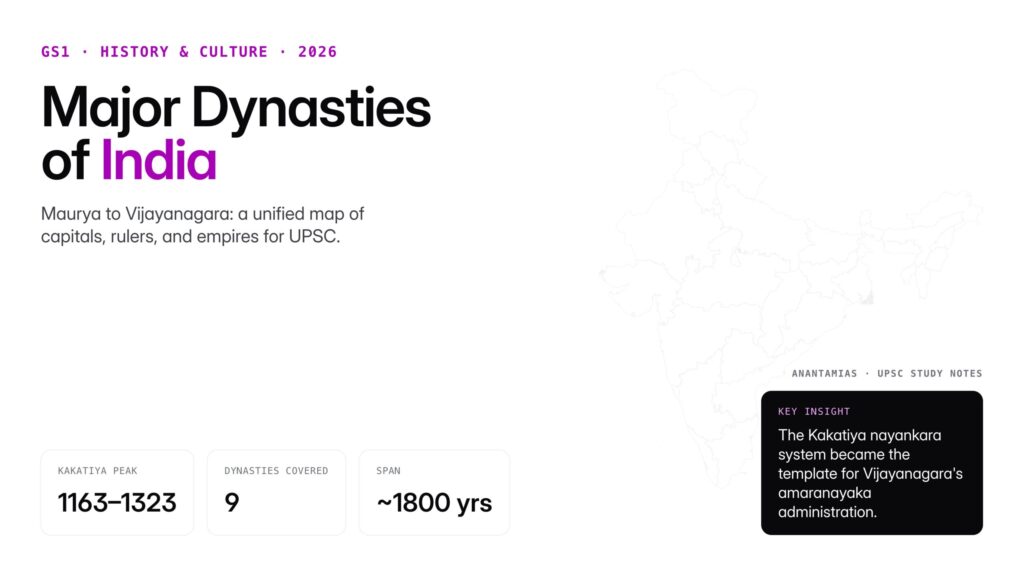
The history of India is essentially the history of its dynasties. From the Mauryas who forged the first pan-Indian empire in the 4th century BCE to the Vijayanagara rulers who held the torch of Hindu polity against northern sultanates in the 14th century CE, each dynasty left a layered imprint of administration, art, coinage, religion, and political thought. For UPSC aspirants, the dynastic map is not a list of kings but a causal chain: the Mauryas made centralised empire possible; the Shungas responded to that collapse; the Kushanas turned India into a Silk Road hub; the Guptas produced the classical synthesis; the Kakatiyas and Vijayanagara preserved Dravidian identity; and the Lodis opened the door to the Mughals.
This evergreen note unifies the kakatiya dynasty, Maurya, Shunga, Kushana, Lodi, and Vijayanagara lineages into a single comparative framework. It prioritises the facts most tested in Prelims and the themes most useful for Mains GS Paper 1 essays on Indian culture and polity continuity.
Quick Facts at a Glance
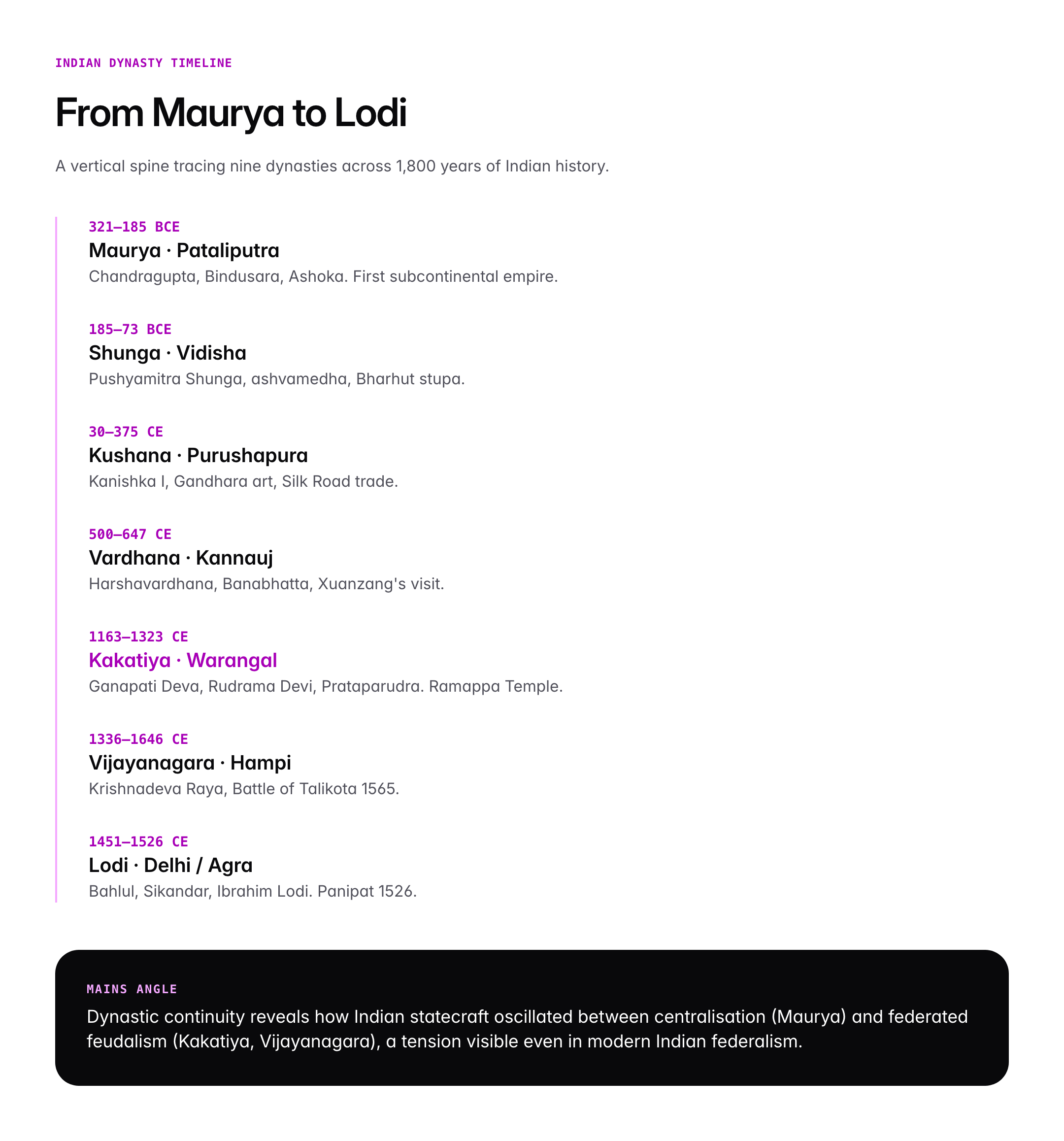
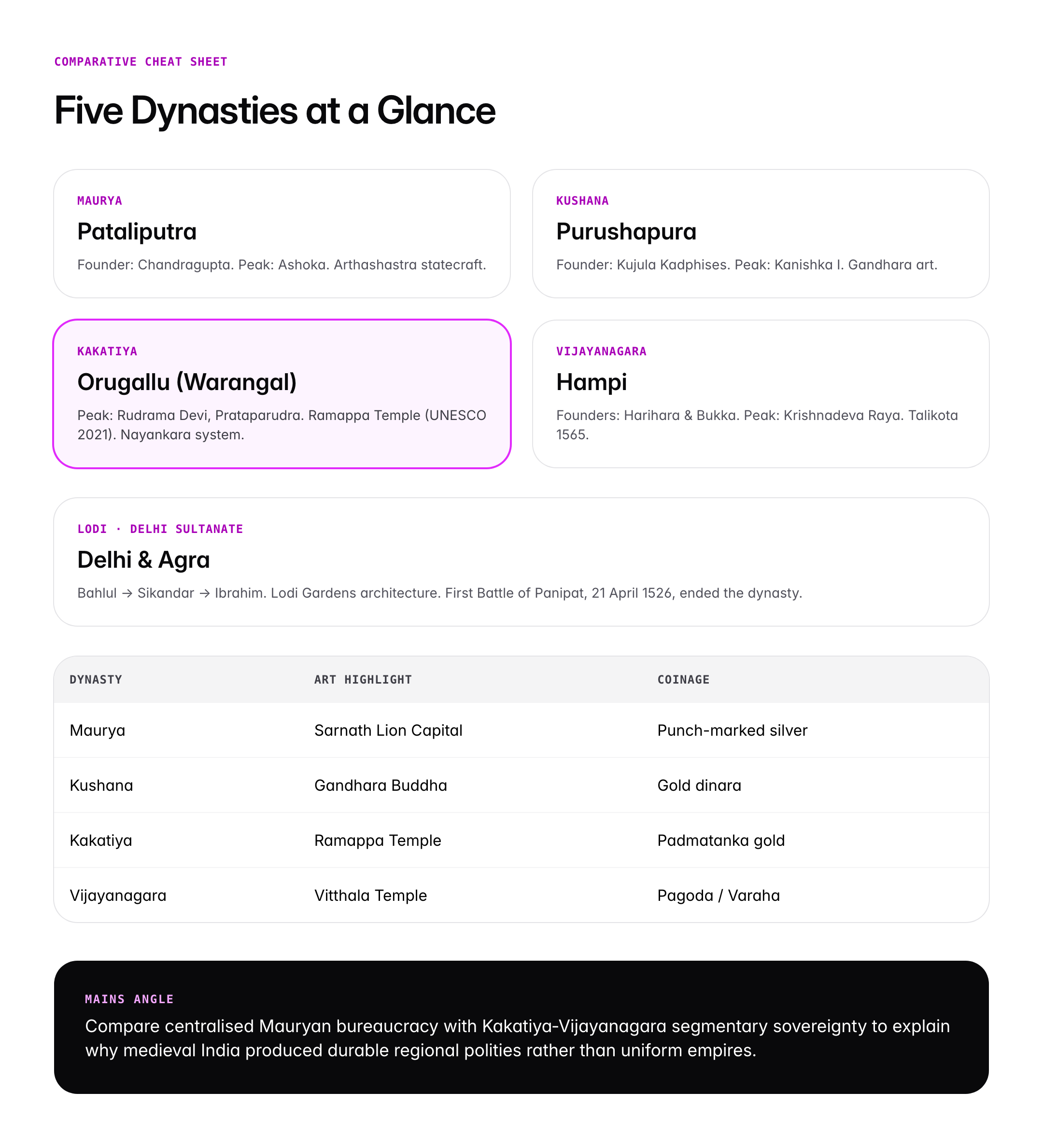
| Dynasty | Period (approx.) | Capital | Founder | Peak Ruler |
|---|---|---|---|---|
| Maurya | 321–185 BCE | Pataliputra | Chandragupta Maurya | Ashoka |
| Shunga | 185–73 BCE | Pataliputra / Vidisha | Pushyamitra Shunga | Pushyamitra Shunga |
| Kanva | 73–28 BCE | Pataliputra | Vasudeva Kanva | Vasudeva |
| Kushana | 30–375 CE | Purushapura (Peshawar) | Kujula Kadphises | Kanishka I |
| Vakataka | 250–500 CE | Nandivardhana | Vindhyashakti | Pravarasena II |
| Vardhana (Pushyabhuti) | 500–647 CE | Thanesar / Kannauj | Pushyabhuti | Harshavardhana |
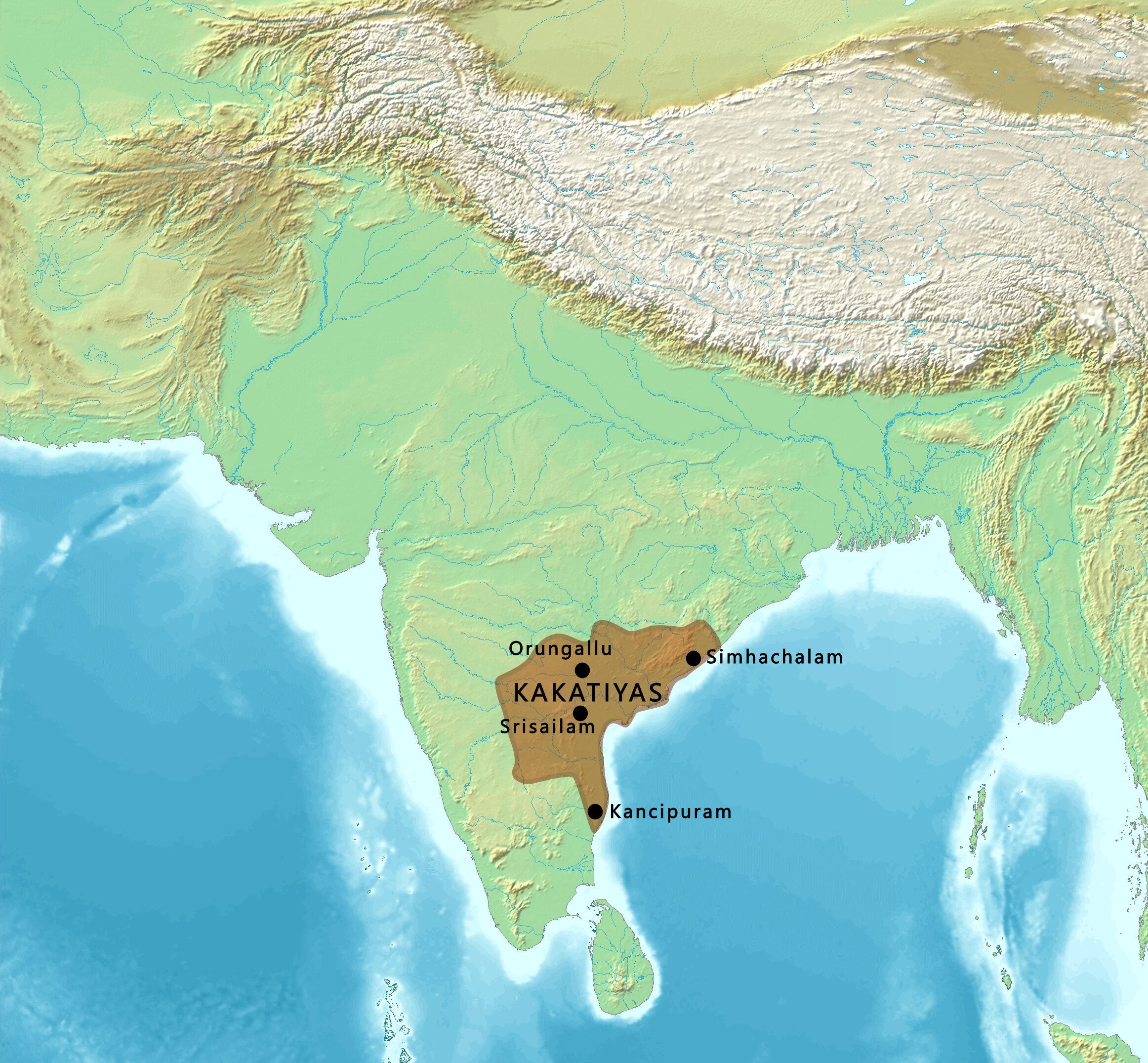
| Kakatiya | 1163–1323 CE | Orugallu (Warangal) | Prola II / Beta I | Rudrama Devi, Prataparudra |
| Vijayanagara | 1336–1646 CE | Hampi | Harihara I & Bukka I | Krishnadeva Raya |
| Lodi | 1451–1526 CE | Delhi / Agra | Bahlul Lodi | Sikandar Lodi |
Background and Historical Context
Indian dynastic history follows a rhythm of integration and fragmentation. The Mauryan empire under Chandragupta (advised by Kautilya) and Ashoka created the first subcontinental state with a unified bureaucracy, inscriptional governance, and Buddhist diplomacy. After Ashoka’s death (232 BCE), centrifugal forces broke this unity, opening a post mauryan dynasty phase dominated by regional powers.
The Shunga dynasty emerged in 185 BCE when Pushyamitra Shunga, a Brahmin general, assassinated the last Mauryan ruler Brihadratha. The Shunga dynasty map stretched across the middle Gangetic plain, Malwa, and parts of Vidarbha, and is remembered for the Bharhut stupa and the revival of Sanskrit learning. The short-lived Kanva dynasty time period (73–28 BCE) followed, with four rulers who never consolidated power beyond Magadha.
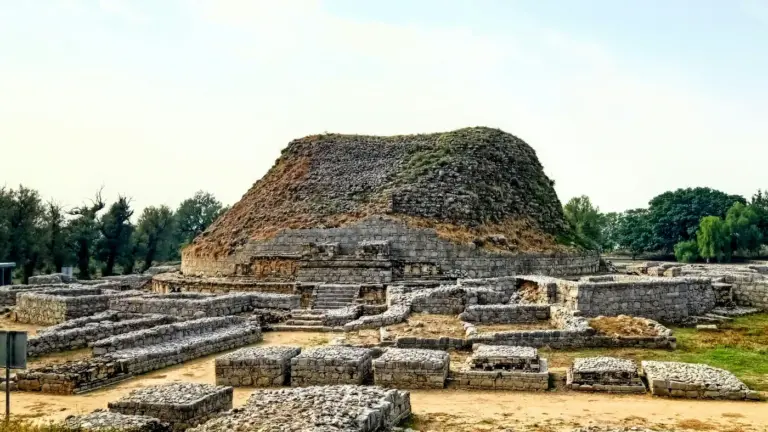
Meanwhile, the northwest saw waves of foreign entrants. The Shakas dynasty (Indo-Scythians) ruled Gandhara, Mathura, and western India; the Kshaharatas and Western Kshatrapas were their most durable branches. They were eclipsed by the Kushana dynasty under Kujula Kadphises, which peaked under Kanishka I (c. 127 CE) and patronised the Gandhara and Mathura schools of art.
In the Deccan, the Vakataka dynasty (founder of vakataka dynasty: Vindhyashakti) filled the southern vacuum left by the Satavahanas and were contemporaries and matrimonial allies of the Guptas. The Vardhana dynasty of Thanesar produced Harshavardhana, whose court hosted Xuanzang and who is often called the last great Hindu emperor of northern India.
The medieval Deccan belonged to the kakatiya dynasty of Warangal (1163–1323 CE), followed by the Musunuri Nayakas and eventually the vijaynagar dynasty (1336–1646 CE). In the north, the Delhi Sultanate‘s final chapter was written by the Afghan Lodi dynasty (1451–1526 CE), defeated by Babur at the First Battle of Panipat. The mutharaiyar dynasty, a lesser-known Tamil lineage (7th–9th century CE), served as feudatories of the Pallavas and later Cholas.
Key Features
Maurya: The First Empire
The Maurya dynasty created a command-and-control state with four provinces plus the core, ruled from Pataliputra. Ashoka’s 33 rock and pillar edicts in Prakrit, Greek and Aramaic functioned as governance through inscription. The empire operated a sophisticated espionage network, standardised weights, and a 25 percent land revenue share. Arthashastra by Kautilya remains the canonical text of Mauryan statecraft.
Shunga and Kanva: Brahmanical Revival
Pushyamitra Shunga (185–149 BCE) is associated with ashvamedha sacrifices and the reassertion of Vedic ritual. The Shungas patronised Patanjali, sponsored the Bharhut stupa railings, and developed Sanskrit drama precursors. The Kanvas who followed were essentially dynastic successors confined to Magadha.
Kushana: Silk Road Emperors
Kanishka I convened the Fourth Buddhist Council in Kashmir, issued gold dinaras with images of Iranian, Greek, and Indian deities, and ruled from Purushapura. The Kushana realm linked the Roman Mediterranean with Han China; the Mathura and Gandhara schools produced the first anthropomorphic Buddha images under their patronage.
Kakatiya: Warangal’s Warrior Kings
The Kakatiyas began as Rashtrakuta and later Western Chalukya feudatories. Ganapati Deva (r. 1199–1262) unified the Telugu-speaking region; Rudrama Devi (r. 1262–1289) was one of the few reigning queens in medieval India, noted by Marco Polo. Prataparudra (r. 1289–1323) finally fell to the Tughlaq invasions of Malik Kafur and Ulugh Khan. The Thousand Pillar Temple at Hanamkonda, the Ramappa Temple (UNESCO World Heritage, 2021), and the Warangal Fort are enduring architectural markers.
Vijayanagara: Bulwark of the South
Founded by Harihara I and Bukka I in 1336, with ideological guidance from Vidyaranya, the Vijayanagara empire passed through four dynasties: Sangama, Saluva, Tuluva, and Aravidu. Krishnadeva Raya (r. 1509–1529) of the Tuluva line authored Amuktamalyada in Telugu and expanded the empire to its greatest extent. The Battle of Talikota (1565) shattered the empire.
Lodi: The Last Delhi Sultanate
Bahlul Lodi (1451–1489) founded Afghan rule in Delhi; Sikandar Lodi shifted the capital to Agra in 1504; Ibrahim Lodi lost to Babur at Panipat on 21 April 1526. The Lodis are remembered for the Moth ki Masjid and the tomb architecture of Lodi Gardens in Delhi.
Significance for UPSC and General Knowledge
- Dynastic geography is recurring Prelims content: pair each dynasty with its capital, founder, and peak ruler.
- The kakatiya dynasty is high-weight after the UNESCO inscription of Ramappa Temple in 2021.
- Indian dynasty timeline questions often test the sequence: Maurya, Shunga, Kanva, Satavahana/Kushana, Gupta, Vardhana, Pratihara, Pala, Rashtrakuta, Chola, Kakatiya/Hoysala, Delhi Sultanate, Vijayanagara/Bahmani, Mughal.
- Mains GS1 syllabus explicitly lists “art forms, literature and architecture from ancient to modern times” — dynastic patronage is the anchor.
- Art history questions map specific schools to dynasties: Gandhara-Kushana, Amaravati-Satavahana, Mathura-Kushana/Gupta, Pallava-Mahabalipuram, Chola-bronzes, Hoysala-Belur/Halebidu, Kakatiya-Ramappa, Vijayanagara-Hampi.
Detailed Analysis: Comparative Political Thought
Mauryan governance rested on the saptanga theory of the Arthashastra — seven state limbs of swami, amatya, janapada, durga, kosha, danda, and mitra. Ashoka’s dhamma was less a religion than a civic ethic broadcast through inscriptions. The Kushanas introduced the title devaputra (son of heaven), borrowing Iranian and Chinese notions of divine kingship, which influenced later Gupta royal iconography.
The Vardhanas under Harsha practised a looser hegemonic model — a network of tributary chieftains held together by an annual distribution assembly at Prayag. This contrasts sharply with the tightly centralised Kakatiya model, where Ganapati Deva and Rudrama Devi pioneered the nayankara system, assigning revenue rights over territories to warrior chiefs in return for military service. The Vijayanagara amaranayaka system was directly modelled on Kakatiya precedent; Burton Stein classified this as “segmentary” rather than fully centralised sovereignty.
The Lodis, by contrast, operated under the Afghan tribal principle of the sultan as first among equals, which created perpetual succession disputes. Sikandar Lodi briefly centralised by enforcing market regulation and strict coinage, but Ibrahim Lodi’s attempt to impose absolute monarchy alienated the Afghan nobility and triggered the invitation to Babur. Cynthia Talbot’s work on “Precolonial India in Practice” shows that Kakatiya inscriptions recorded land grants to peasants and merchants, not just Brahmins, demonstrating an early participatory polity absent in sultanate models. These political cultures profoundly shaped subsequent Mughal, Maratha, and British administrative choices, making the dynastic lens indispensable for understanding modern Indian federalism and land revenue systems.
Comparative Perspective
| Theme | Maurya | Kushana | Kakatiya | Vijayanagara | Lodi |
|---|---|---|---|---|---|
| Religion | Buddhism (Ashoka) | Mahayana Buddhism | Shaivism | Vaishnavism | Sunni Islam |
| Script | Brahmi, Kharoshthi | Bactrian, Brahmi | Telugu | Telugu, Kannada | Persian |
| Landmark | Sarnath Pillar | Peshawar stupa | Ramappa Temple | Hampi Vitthala | Lodi Gardens |
| Coinage | Punch-marked silver | Gold dinara | Padmatanka gold | Pagoda/Varaha | Silver tanka |
| Military | Infantry-heavy | Cavalry + horse archery | Nayankara chiefs | Amaranayaka | Afghan cavalry |
Across 1,800 years, the common thread is fiscal centralisation versus feudal delegation. The Mauryas and early Kushanas leaned centralised; the Kakatiyas, Vijayanagara, and Lodis leaned delegated. Delegation enabled rapid territorial expansion but also invited fragmentation, a pattern repeated in Mughal decline and Maratha confederation.
Challenges and Criticisms
Dynastic history has faced sharp criticism from modern scholarship. R. S. Sharma and Romila Thapar argue that “dynasty-centric” narratives obscure economic continuities, peasant agency, and regional autonomy. Hermann Kulke’s “segmentary state” thesis challenges the idea that Vijayanagara or Kakatiya were unitary empires; he sees them as ritual overlordships where core sovereignty weakened with distance.
Communal framings also distort interpretation. Pushyamitra Shunga is sometimes caricatured as anti-Buddhist on the basis of the Divyavadana, but archaeological evidence at Sanchi and Bharhut shows continued Buddhist patronage. Similarly, the Lodi period is often flattened into “foreign rule,” ignoring Indo-Afghan cultural synthesis in cuisine, architecture, and Hindustani music. The Kakatiyas are celebrated regionally for Telugu identity, yet colonial historians marginalised them in favour of northern narratives. For UPSC answers, the balanced approach is to acknowledge dynastic agency while crediting economic structures, regional cultures, and trans-dynastic continuities.
Prelims Pointers
- Chandragupta Maurya defeated Seleucus Nikator c. 305 BCE.
- Ashoka’s Kalinga war: 261 BCE; Rock Edict XIII.
- Pushyamitra Shunga performed two ashvamedha sacrifices.
- Kanishka’s era began in 78 CE — basis of the Shaka Samvat.
- The founder of vakataka dynasty was Vindhyashakti.
- Harshavardhana’s court poet was Banabhatta; biography: Harshacharita.
- The Kakatiya capital Orugallu is modern Warangal in Telangana.
- Rudrama Devi ruled 1262–1289 CE; Marco Polo praised her administration.
- Ramappa Temple inscribed as UNESCO World Heritage in 2021.
- Vijayanagara founded in 1336 by Harihara I and Bukka I; Battle of Talikota 1565.
- Krishnadeva Raya composed Amuktamalyada in Telugu.
- Bahlul Lodi founded the Lodi dynasty in 1451; First Battle of Panipat 1526.
- The mutharaiyar dynasty ruled Tanjavur region as Pallava feudatories.
Mains Practice Questions
- “The Kakatiya dynasty was not a regional footnote but a formative phase of south Indian polity.” Critically examine with reference to administrative innovations, cultural patronage, and subsequent influence on Vijayanagara.
- Political: nayankara system, Telugu linguistic consolidation, inclusive land grants.
- Cultural: Ramappa Temple, Kakatiya Kala Toranam, Warangal Fort, Palampet sculpture.
- Legacy: template for Vijayanagara amaranayaka, foundation of modern Telangana identity.
- Compare the centralising strategies of the Maurya and Vijayanagara empires. Which features of each are visible in modern Indian federalism?
- Maurya: bureaucratic uniformity, inscriptional law, fiscal standardisation.
- Vijayanagara: segmentary sovereignty, nayaka feudatories, ritual kingship.
- Modern parallels: Union list vs State list, centrally sponsored schemes, cooperative federalism.
Conclusion
The arc from Maurya to Lodi is not a procession of kings but a laboratory of Indian statecraft. Each dynasty tested a different answer to the same question: how do you govern a subcontinent of plural languages, religions, and economies? The Mauryas chose bureaucratic centralisation; the Kushanas chose trans-regional commerce; the Kakatiyas and Vijayanagara chose negotiated feudalism; the Lodis chose tribal confederation. None fully succeeded, but each contributed a layer to the Indian political imagination.
For the UPSC aspirant, mastering this dynastic ladder means more than memorising dates. It means seeing how inscriptions, coins, temples, and tax systems together narrate a civilisation’s continuous experiment in self-governance. The kakatiya dynasty, often overlooked beside Mauryas and Mughals, is the crucial bridge between the classical Chalukyan South and the medieval Vijayanagara response to Islamic expansion, a bridge whose stones still stand in Warangal and Palampet today.
Frequently Asked Questions
What is the Kakatiya dynasty?
The Kakatiya dynasty (1163–1323 CE) was a Telugu ruling house based at Orugallu (modern Warangal) that governed most of present-day Andhra Pradesh and Telangana. It began as feudatories of the Western Chalukyas and reached its peak under Ganapati Deva, Queen Rudrama Devi, and Prataparudra before falling to the Delhi Sultanate under Ulugh Khan in 1323.
Why is the Kakatiya dynasty important for UPSC?
It is tested in GS1 art and culture through the Ramappa Temple (UNESCO 2021), Thousand Pillar Temple and Warangal Fort. The dynasty pioneered the nayankara land-grant system later adopted by Vijayanagara and produced Rudrama Devi, one of medieval India’s few reigning queens. It is also central to modern Telangana cultural identity.
How is the Kakatiya dynasty related to the Vijayanagara empire?
The Vijayanagara empire emerged in 1336 in the political vacuum left by the Kakatiya collapse of 1323. Vijayanagara’s amaranayaka system was directly modelled on Kakatiya nayankara administration. Several Kakatiya nobles, including the Musunuri Nayakas, resisted Tughlaq rule and helped transfer Telugu military and administrative expertise to the new southern empire.
Who founded the Vakataka dynasty?
The founder of the Vakataka dynasty was Vindhyashakti in the mid-3rd century CE. The Vakatakas ruled central India and the Deccan as contemporaries of the Guptas and are remembered for patronising the Ajanta cave murals, particularly under Harisena in the late 5th century CE.
What was the time period of the Kanva dynasty?
The Kanva dynasty ruled Magadha from approximately 73 BCE to 28 BCE, producing four rulers — Vasudeva, Bhumimitra, Narayana, and Susarman. They succeeded the Shunga dynasty and were limited to the Gangetic core before being absorbed by the rising Satavahana power from the Deccan.
Who was the last Lodi ruler?
Ibrahim Lodi was the last Lodi sultan, ruling from 1517 to 1526. He was defeated and killed by Babur at the First Battle of Panipat on 21 April 1526, an event that ended the Delhi Sultanate and inaugurated Mughal rule in India.
What is the Indian dynasty timeline in order?
The standard sequence is Haryanka, Shishunaga, Nanda, Maurya, Shunga, Kanva, Satavahana, Kushana, Gupta, Vardhana, Pala, Pratihara, Rashtrakuta, Chola, Chalukya, Hoysala, Kakatiya, Delhi Sultanate (Slave, Khalji, Tughlaq, Sayyid, Lodi), Vijayanagara and Bahmani, Mughal, Maratha, and finally British rule ending in 1947.
What were the main post-Mauryan dynasties?
The main post-Mauryan dynasties were the Shungas and Kanvas in the Gangetic plain, the Satavahanas in the Deccan, the Indo-Greeks, Shakas, Parthians, and Kushanas in the northwest, and the Cheras, Cholas, and Pandyas in the Tamil south. This period (c. 185 BCE to 320 CE) was marked by intense trade, coinage innovation, and Buddhist monastic expansion.
Tell Google you want more of this.
Add Anantam IAS as a preferred sourceOne tap, and this site shows up more often in your own Top Stories, AI Overviews and AI Mode. Remove it any time.