Introduction
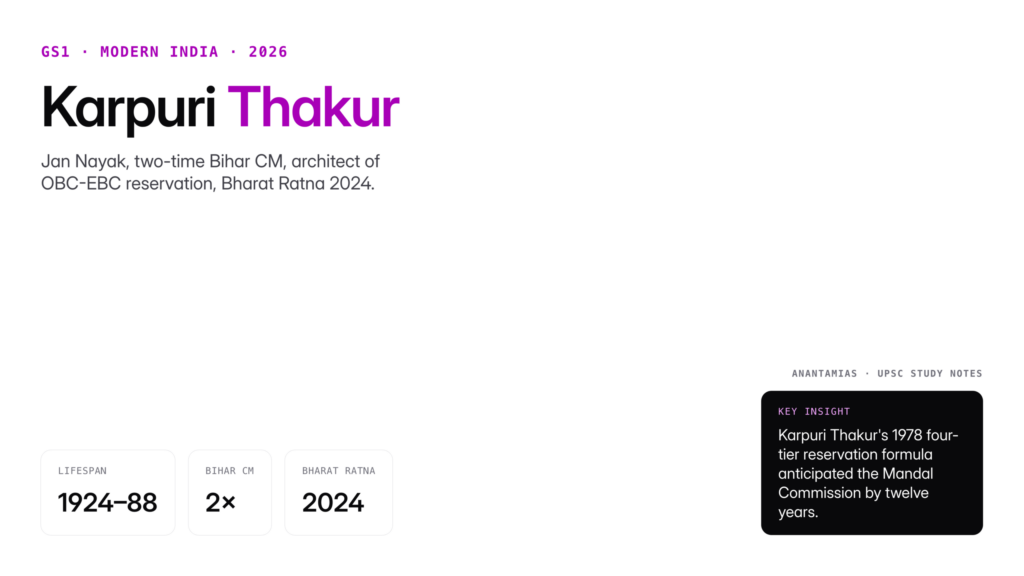
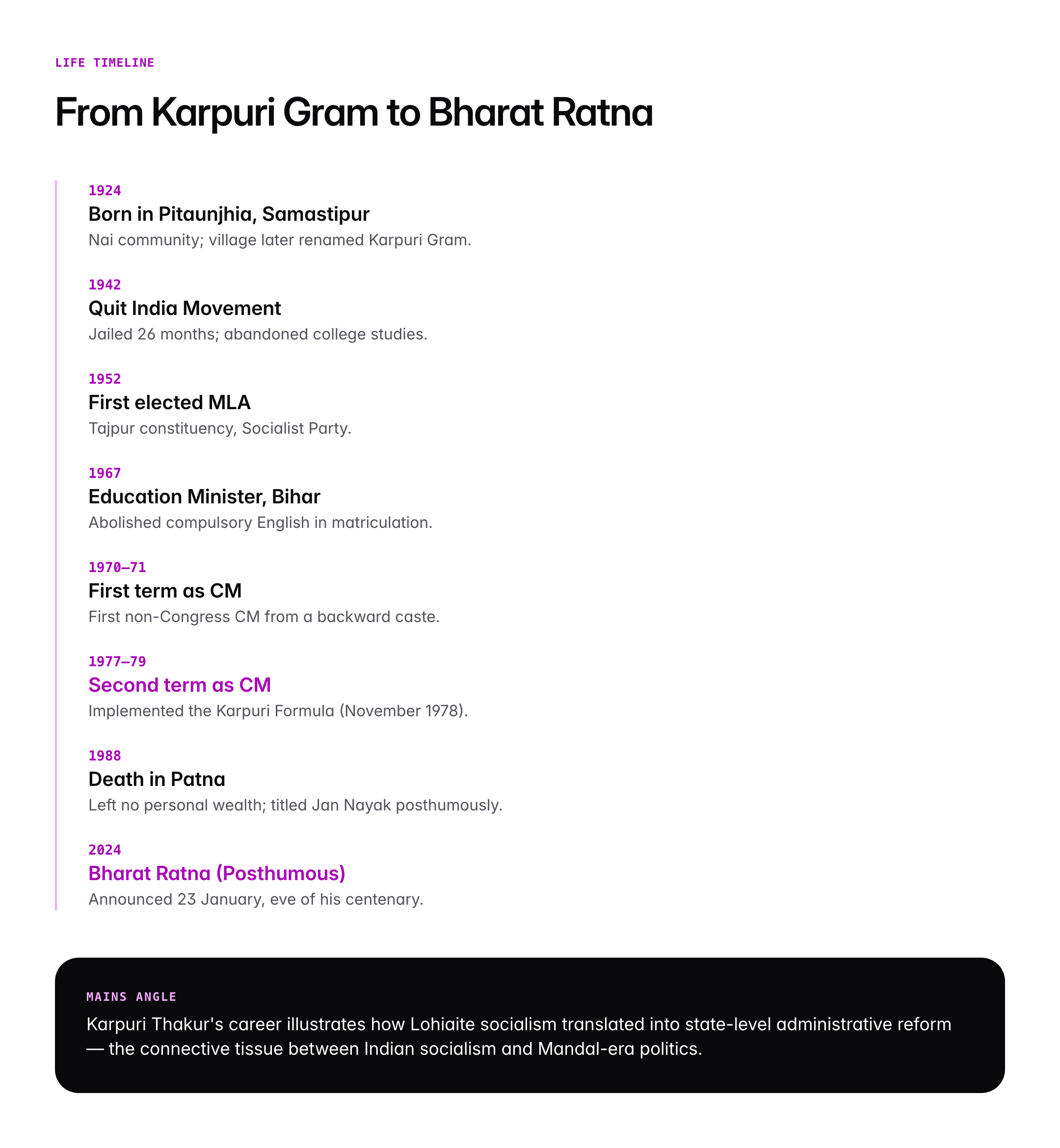
Karpuri Thakur (1924–1988), known as Jan Nayak or “people’s leader”, is one of post-independence India’s most consequential social-justice politicians. Twice Chief Minister of Bihar, a lifelong socialist, and the architect of the Karpuri formula of reservation that foreshadowed the Mandal Commission’s recommendations, Thakur shaped the political vocabulary of Other Backward Classes (OBC) empowerment in the Hindi heartland. In January 2024, the Government of India awarded him the Bharat Ratna posthumously, recognising his centenary year and his foundational role in Indian social justice.
This evergreen note unpacks Karpuri Thakur’s biography, his reform agenda as Bihar Chief Minister, the legacy of the Karpuri formula, the Mungeri Lal Commission that he institutionalised, his influence on Lalu Prasad Yadav and Nitish Kumar, and the constitutional and political significance of his posthumous Bharat Ratna.
Quick Facts at a Glance
| Parameter | Detail |
|---|---|
| Full name | Karpuri Thakur |
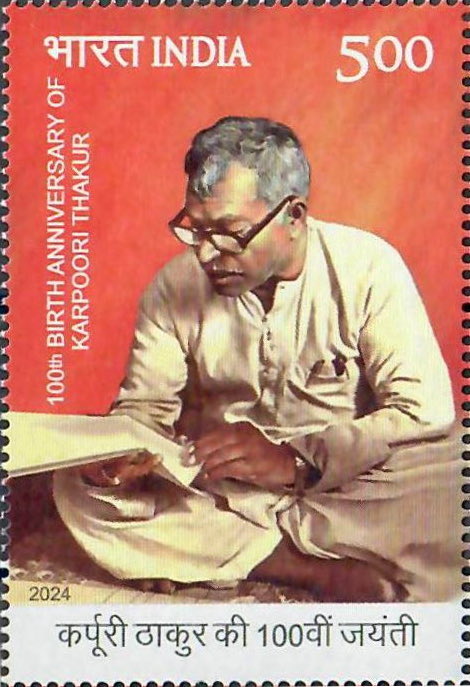
| Born | 24 January 1924, Pitaunjhia (now Karpuri Gram), Samastipur, Bihar |
| Died | 17 February 1988, Patna |
| Community | Nai (Barber), a Most Backward Class (MBC/EBC) |
| Party affiliations | Socialist Party, Praja Socialist, Samyukta Socialist, Bharatiya Lok Dal, Janata Party, Janata Dal |
| Chief Minister of Bihar | 22 Dec 1970 – 2 June 1971; 24 June 1977 – 21 April 1979 |
| Deputy CM of Bihar | 1967–1968 under Mahamaya Prasad Sinha |
| Key policy | Karpuri Formula of reservation (November 1978) |
| Bharat Ratna | Announced 23 January 2024, posthumous |
| Sobriquet | Jan Nayak (People’s Leader) |
Background and Historical Context
The Bihar into which Karpuri Thakur was born in 1924 was a province of deep caste hierarchy, where the upper castes — Bhumihar, Rajput, Brahmin, Kayastha — held disproportionate control of land, education, and administration. The backward and Dalit castes, constituting more than 70 percent of the population, were largely excluded from governance. This context defined every phase of Thakur’s political life.
Thakur studied at Chandradhari Mithila College, Darbhanga, where he came under the influence of Ram Manohar Lohia’s socialism and Jayaprakash Narayan‘s Sarvodaya ideas. During the Quit India Movement of 1942, he abandoned studies to join the underground and was jailed for 26 months. He taught briefly as a schoolteacher, a profession that shaped his lifelong frugality and his concern with education access. He was elected to the Bihar Legislative Assembly for the first time in 1952 from Tajpur constituency as a Socialist Party candidate, and he would remain in electoral politics for 36 years until his death in 1988.
Thakur served as Education Minister in the first non-Congress government of Bihar under Mahamaya Prasad Sinha in 1967, where he abolished the compulsory matriculation English requirement (a symbolically charged decision in Hindi-belt politics) and opened state universities to backward-caste students. As Deputy Chief Minister he pushed prohibition and mass land-reform enforcement. In 1970 he became the first non-Congress, non-Brahmanical Chief Minister of Bihar, an event that reframed state politics. His second term as Chief Minister from 1977 to 1979 under the Janata Party was the most consequential: it delivered the Karpuri formula, the most far-reaching OBC reservation scheme in pre-Mandal India.
Key Features
The Karpuri Formula
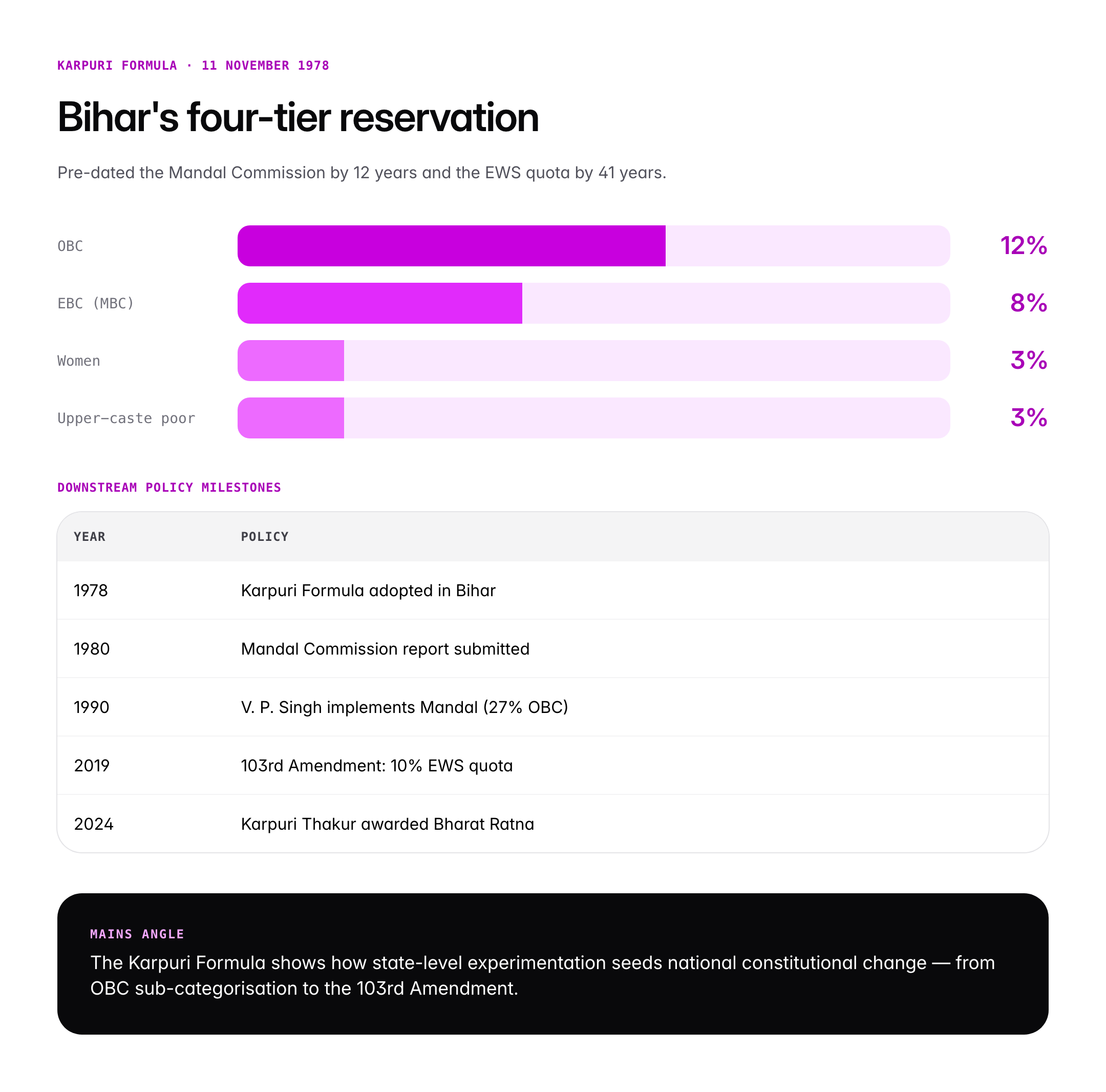
In November 1978, Karpuri Thakur’s cabinet implemented a reservation scheme based on the Mungeri Lal Commission report submitted to the state. The formula divided reservations in state government jobs and education into four tiers:
- Backward classes (OBC): 12 percent
- Most Backward Classes (EBC): 8 percent
- Women of all castes: 3 percent
- Economically Weaker Sections among upper castes: 3 percent
This 26 percent reservation added to the existing 14 percent for SCs and 10 percent for STs brought the Bihar reservation ceiling to 40 percent in 1978, a full twelve years before the Mandal Commission’s 27 percent national OBC reservation of 1990. The jan nayak karpuri thakur formula was pioneering because it separated the EBC layer from the general OBC layer and introduced an EWS-style provision for upper-caste poor, an idea realised nationally only in 2019 through the 103rd Constitutional Amendment.
Educational Reforms
Thakur abolished the English compulsion in Bihar matriculation, which critics mocked but supporters credited with widening access to secondary education for first-generation learners. He expanded free primary education, introduced mid-day cooked meals in several districts on a pilot basis, and opened block-level intermediate colleges to absorb rural enrollment.
Prohibition and Land Reform
In 1970 and 1977, Thakur imposed total prohibition in Bihar on ethical and welfare grounds, arguing that liquor consumption disproportionately harmed poor women and children. He enforced Bihar’s ceiling on agricultural landholding more aggressively than his predecessors, distributing surplus land to SC and landless tenants. Nitish Kumar’s 2016 prohibition policy in Bihar is a conscious homage to Thakur’s legacy.
Frugality as Politics
Thakur is remembered for refusing an official house, living in a modest Patna flat, and travelling in economy class. He left no personal wealth at death; his son Ramnath Thakur recalls that the family could not afford a proper memorial without state help. This simplicity was not apolitical; it was a direct challenge to the durbar culture of Congress chief ministers of the era.
Significance for UPSC and General Knowledge
- Karpuri Thakur is a high-probability Prelims topic after his 2024 Bharat Ratna.
- His formula influenced the Mandal Commission (B. P. Mandal, 1980), which recommended 27 percent OBC reservation nationally.
- His EBC-OBC sub-categorisation pre-dates the Justice Rohini Commission (2017) on OBC sub-categorisation.
- His EWS-style 3 percent quota for upper-caste poor anticipated the 103rd Constitutional Amendment (2019).
- His abolition of English pre-requisite in matriculation is a standing GS1 question on language politics.
- His political mentorship produced two of Bihar’s longest-serving Chief Ministers: Lalu Prasad Yadav and Nitish Kumar.
Detailed Analysis: Political Contributions
Karpuri Thakur’s enduring contribution is not the Bihar chief ministership, which was brief and turbulent, but the reservation architecture he institutionalised. Before 1978, backward-class politics in India oscillated between southern assertiveness (Tamil Nadu’s E. V. R. Periyar) and Hindi-belt silence. Thakur’s formula placed the OBC-EBC distinction at the centre of northern politics and made it impossible for any successor — Congress or Janata — to reverse course. When V. P. Singh implemented the Mandal recommendations in 1990, the political ground had been tilled by Thakur more than a decade earlier.
Thakur mentored a generation of socialist politicians. Lalu Prasad Yadav, Ram Vilas Paswan, Nitish Kumar, Sushil Kumar Modi, Sharad Yadav, and Devendra Prasad Yadav all rose through Thakur’s political orbit. His framework made possible the Mandal-versus-Kamandal (caste-versus-Hindutva) axis of north Indian politics in the 1990s and 2000s. Yogendra Yadav’s concept of India’s “second democratic upsurge” rests significantly on Thakur’s 1978 policy as a key causal node.
Thakur’s socialism was distinct from Nehruvian statism. Drawing from Lohia, he rejected both Soviet-style planning and Congress-style patronage in favour of affirmative action anchored in caste realities, vernacular education, and village-level economic democracy. His attempted prohibition and his pressure on zamindari remnants put him in conflict with upper-caste Congress legislators who engineered the fall of his 1977 government in April 1979. Yet, his brief time in office re-coded the state bureaucracy, with large numbers of EBC candidates cleared through the Bihar Public Service Commission for the first time. Political scientist Christophe Jaffrelot describes this as the “silent revolution” of the lower castes, of which Thakur was the first mature state-level architect.
Comparative Perspective
| Leader | Role | Key reform | Year |
|---|---|---|---|
| Karpuri Thakur | Bihar CM | Karpuri Formula, EBC quota | 1978 |
| B. P. Mandal | Mandal Commission Chairman | 27% OBC national quota (report) | 1980 |
| V. P. Singh | Prime Minister | Mandal implementation | 1990 |
| M. G. Ramachandran | Tamil Nadu CM | MBC sub-quota | 1989 |
| Narendra Modi | Prime Minister | EWS 10% (103rd Amendment) | 2019 |
Thakur’s 1978 reform stands out for simultaneously addressing four constituencies — OBC, EBC, women, and upper-caste poor — decades before any of them received national-level recognition. No comparable state-level package of the 1970s sought such wide coverage.
Challenges and Criticisms
Thakur’s reforms drew criticism from multiple directions. Upper-caste legislators organised a successful no-confidence motion in 1979, arguing that the EBC sub-category was politically motivated and administratively unworkable. Some progressives criticised the 3 percent EWS-style quota for upper castes as conceptually inconsistent with a caste-based reservation framework. Administrative agencies complained that the four-tier quota system created confusion in recruitment and litigation in the Patna High Court.
The deeper challenge was capacity. Bihar in the late 1970s lacked the state capacity to absorb the reform; many reserved seats went unfilled due to inadequate candidate pools, and coaching institutes for EBC aspirants did not exist at scale until the 2000s. Thakur’s frugality meant the state did not invest in the institutional scaffolding needed for his reforms to succeed. Critics also note the absence of a parallel agricultural reform push in his second term, which limited the economic uplift of the very groups the reservations targeted. Thakur’s defenders counter that a two-year chief ministership cannot be fairly judged against decadal outcomes and that the subsequent mainstreaming of his ideas is the ultimate vindication.
Prelims Pointers
- Karpuri Thakur born 24 January 1924 at Pitaunjhia, Samastipur district, Bihar.
- He was Chief Minister of Bihar from 1970–71 and 1977–79.
- He was a member of the Nai community (a Most Backward Class).
- His reservation formula was implemented on 11 November 1978.
- The Karpuri Formula drew from the Mungeri Lal Commission report.
- Bharat Ratna announcement: 23 January 2024, a day before his 100th birth anniversary.
- He was awarded the Bharat Ratna posthumously by President Droupadi Murmu.
- He abolished compulsory English for matriculation in Bihar.
- He imposed prohibition in Bihar during both his tenures.
- His political base was the Samastipur-Darbhanga region of north Bihar.
- His son Ramnath Thakur is a Janata Dal (United) Rajya Sabha MP.
- He is often called Jan Nayak (people’s leader).
- The Jan Nayak Karpuri Thakur Memorial is at Karpuri Gram, Samastipur.
Mains Practice Questions
- “Karpuri Thakur’s 1978 reservation formula was a blueprint for post-Mandal India.” Critically evaluate.
- Design innovation: four-tier quota, EBC sub-category, women, upper-caste poor.
- Influence on Mandal Commission and later 103rd Amendment.
- Limitations: capacity gaps, administrative complexity, litigation.
- Discuss the role of socialist leaders from Bihar in shaping India’s social-justice politics. How did Karpuri Thakur’s ideology differ from Nehruvian socialism?
- Lohia-ite socialism: caste over class, vernacular over English, village over centre.
- Contrast with Nehruvian planning and Congress patronage politics.
- Legacy: Mandal movement, Janata Dal, contemporary Bihar political grammar.
Conclusion
Karpuri Thakur’s political life is a study in translating moral conviction into administrative architecture. He did not merely speak for backward classes; he built the constitutional machinery through which they would eventually claim power. The four-tier reservation formula of 1978, the abolition of English matriculation barriers, prohibition, and his refusal of personal wealth together form a distinctive socialist practice that influenced an entire generation of Indian politicians.
The 2024 Bharat Ratna finally granted Thakur the national recognition he had been denied in his lifetime. For UPSC aspirants, Karpuri Thakur is not a regional footnote but a central node in the story of Indian democracy’s deepening, the link between the ideas of Lohia and the politics of Mandal, between the promise of Article 15(4) and the practice of Article 16(4). To understand his career is to understand how Indian federalism absorbs radical social reform one state at a time.
Frequently Asked Questions
Who was Karpuri Thakur?
Karpuri Thakur (1924–1988), popularly called Jan Nayak, was a socialist politician from Bihar who served as Chief Minister twice — 1970–71 and 1977–79. A disciple of Ram Manohar Lohia, he championed backward-class reservation, prohibition, and vernacular education, and is credited with the 1978 Karpuri Formula that anticipated the Mandal Commission by more than a decade.
Why is Karpuri Thakur important for UPSC?
Karpuri Thakur is central to UPSC GS1 social reform and GS2 constitutional history topics. His 1978 reservation framework prefigured the Mandal Commission, OBC sub-categorisation (Justice Rohini Commission), and the EWS quota of the 103rd Constitutional Amendment. His January 2024 Bharat Ratna also makes him a current-affairs priority for Prelims 2026.
How is Karpuri Thakur related to the Mandal Commission?
Karpuri Thakur’s 1978 Bihar reservation scheme, based on the Mungeri Lal Commission, implemented a 26 percent quota for OBCs, EBCs, women, and upper-caste poor twelve years before the Mandal Commission’s 27 percent national OBC quota of 1990. B. P. Mandal, who chaired the national commission, was himself a Bihar politician influenced by the political climate Thakur created.
When did Karpuri Thakur receive the Bharat Ratna?
The Government of India announced the Bharat Ratna for Karpuri Thakur on 23 January 2024, a day before his 100th birth anniversary. The award was posthumous and was conferred by President Droupadi Murmu. It was the first Bharat Ratna announcement of 2024 and marked his formal elevation into India’s pantheon of national icons.
What is the Karpuri Formula?
The Karpuri Formula was a four-tier reservation scheme implemented in Bihar on 11 November 1978: 12 percent for OBCs, 8 percent for Most Backward Classes or EBCs, 3 percent for women, and 3 percent for economically weaker sections among upper castes. Added to existing SC and ST quotas, it pushed Bihar’s reservation ceiling to 40 percent, a pioneering design for affirmative action.
Which caste did Karpuri Thakur belong to?
Karpuri Thakur belonged to the Nai (barber) community, classified as a Most Backward Class in Bihar. This community background shaped his political vision and made him one of the first Chief Ministers in the Hindi belt from a numerically small, historically marginalised caste, which gave his advocacy for EBC reservation particular moral authority.
Who were Karpuri Thakur’s political disciples?
Karpuri Thakur mentored many of Bihar’s most prominent politicians, including Lalu Prasad Yadav, Nitish Kumar, Ram Vilas Paswan, Sushil Kumar Modi, Sharad Yadav, and Devendra Prasad Yadav. His political school shaped the Samata Party, Rashtriya Janata Dal, Lok Janshakti Party, and the modern Janata Dal (United), making him the ideological patriarch of contemporary Bihar politics.
What were Karpuri Thakur’s major reforms as Bihar CM?
His major reforms included the 1978 four-tier reservation formula, abolition of compulsory English in Bihar matriculation examinations, state-wide prohibition of liquor, enforcement of agricultural land-ceiling legislation, expansion of free primary education, and opening of block-level intermediate colleges. He also appointed the Mungeri Lal Commission and institutionalised its recommendations into Bihar’s recruitment rules.
Tell Google you want more of this.
Add Anantam IAS as a preferred sourceOne tap, and this site shows up more often in your own Top Stories, AI Overviews and AI Mode. Remove it any time.