Introduction
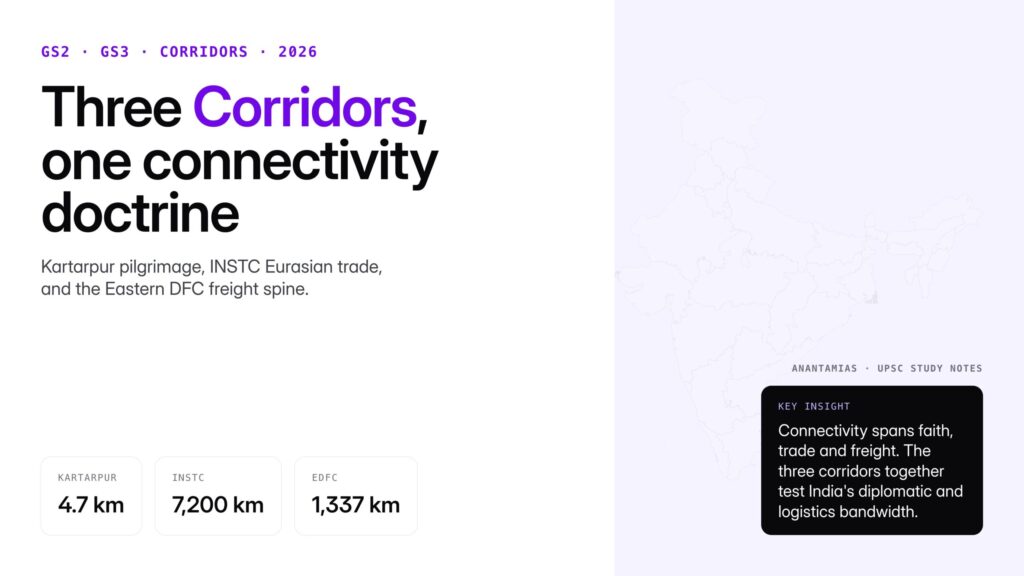
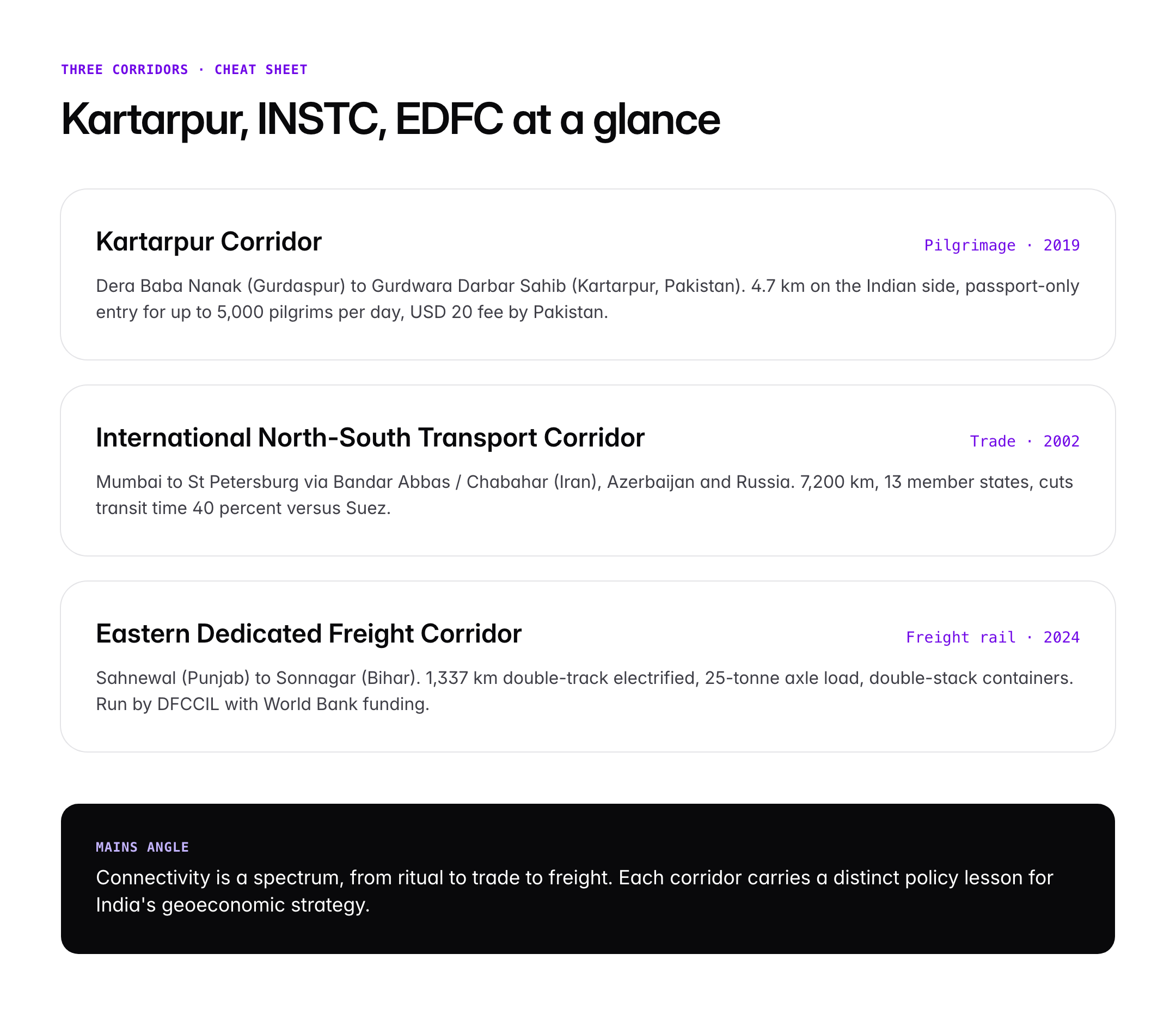
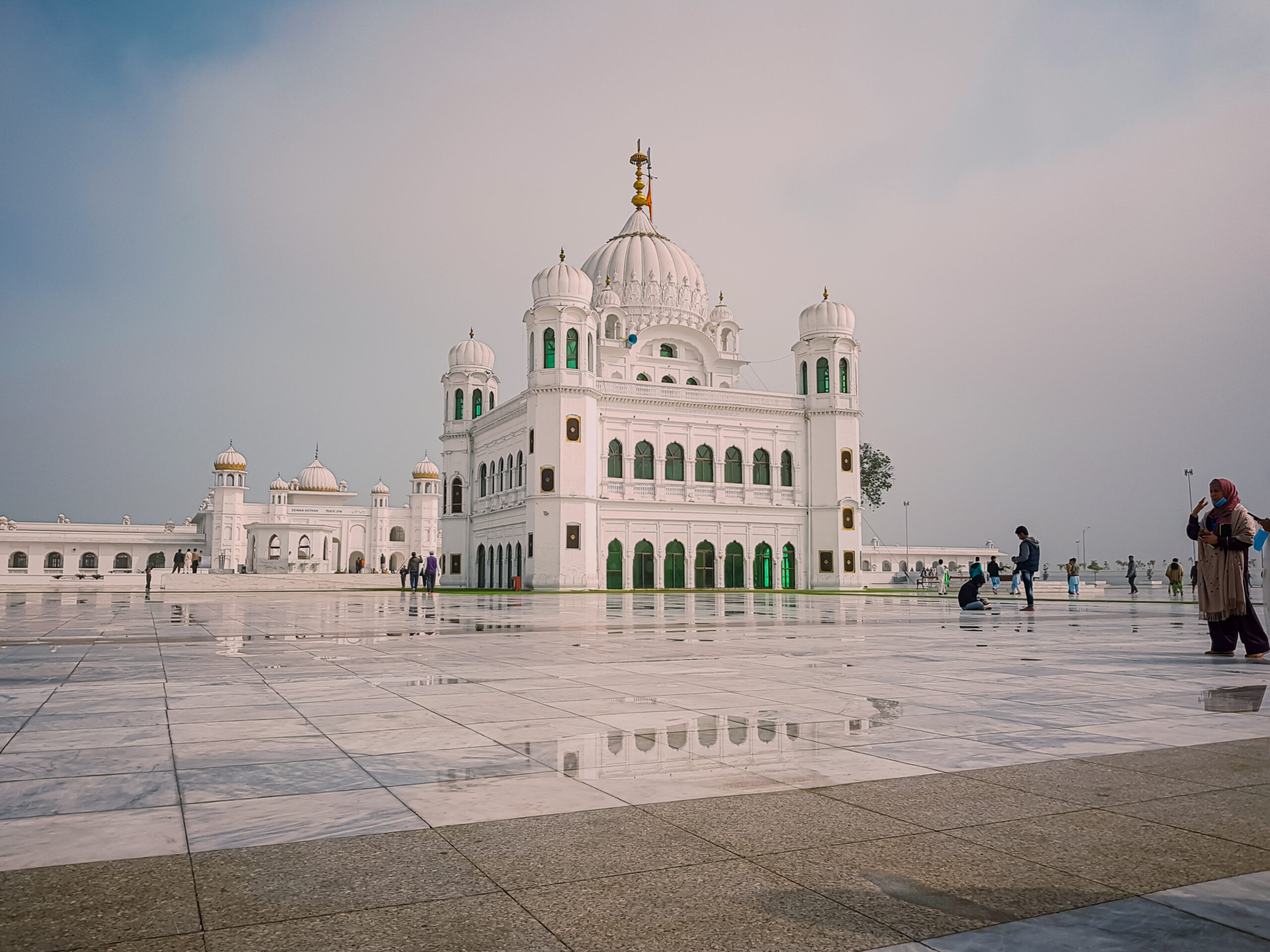
Corridors, whether religious, logistics or trade, have become a defining feature of 21st century Indian policy. The Kartarpur Corridor is a visa-free pilgrimage route connecting Dera Baba Nanak in Gurdaspur (Punjab, India) to Gurdwara Darbar Sahib in Kartarpur (Pakistan). The International North-South Transport Corridor (INSTC) is a 7,200 km multimodal route linking India to Russia via Iran. The Eastern Dedicated Freight Corridor (EDFC) is a 1,337 km electrified double-track rail corridor between Sahnewal and Sonnagar.
Three corridors, three purposes. UPSC treats them as one thematic cluster because they test the aspirant’s grasp of connectivity as an instrument of faith diplomacy, geoeconomic reach, and domestic logistics reform.
Quick Facts at a Glance
| Corridor | Length | Inauguration | Connects | Purpose |
|---|---|---|---|---|
| Kartarpur Corridor | 4.7 km (India side) | 9 November 2019 | Dera Baba Nanak to Kartarpur | Pilgrimage |
| INSTC | 7,200 km | Ratified 2002, operational in phases | Mumbai to St Petersburg via Bandar Abbas, Chabahar | Trade and transport |
| EDFC | 1,337 km | Fully commissioned June 2024 | Sahnewal (Punjab) to Sonnagar (Bihar) | Freight rail |
Background and Historical Context
The Kartarpur Corridor traces its origin to the 550th birth anniversary celebrations of Guru Nanak Dev Ji, founder of Sikhism, who spent the final 18 years of his life at Kartarpur. The corridor was announced in November 2018, construction began December 2018, and it was formally opened on 9 November 2019, days before the Prakash Parv. It allows Indian pilgrims to visit Gurdwara Darbar Sahib Kartarpur without a Pakistan visa, subject to a daily cap.
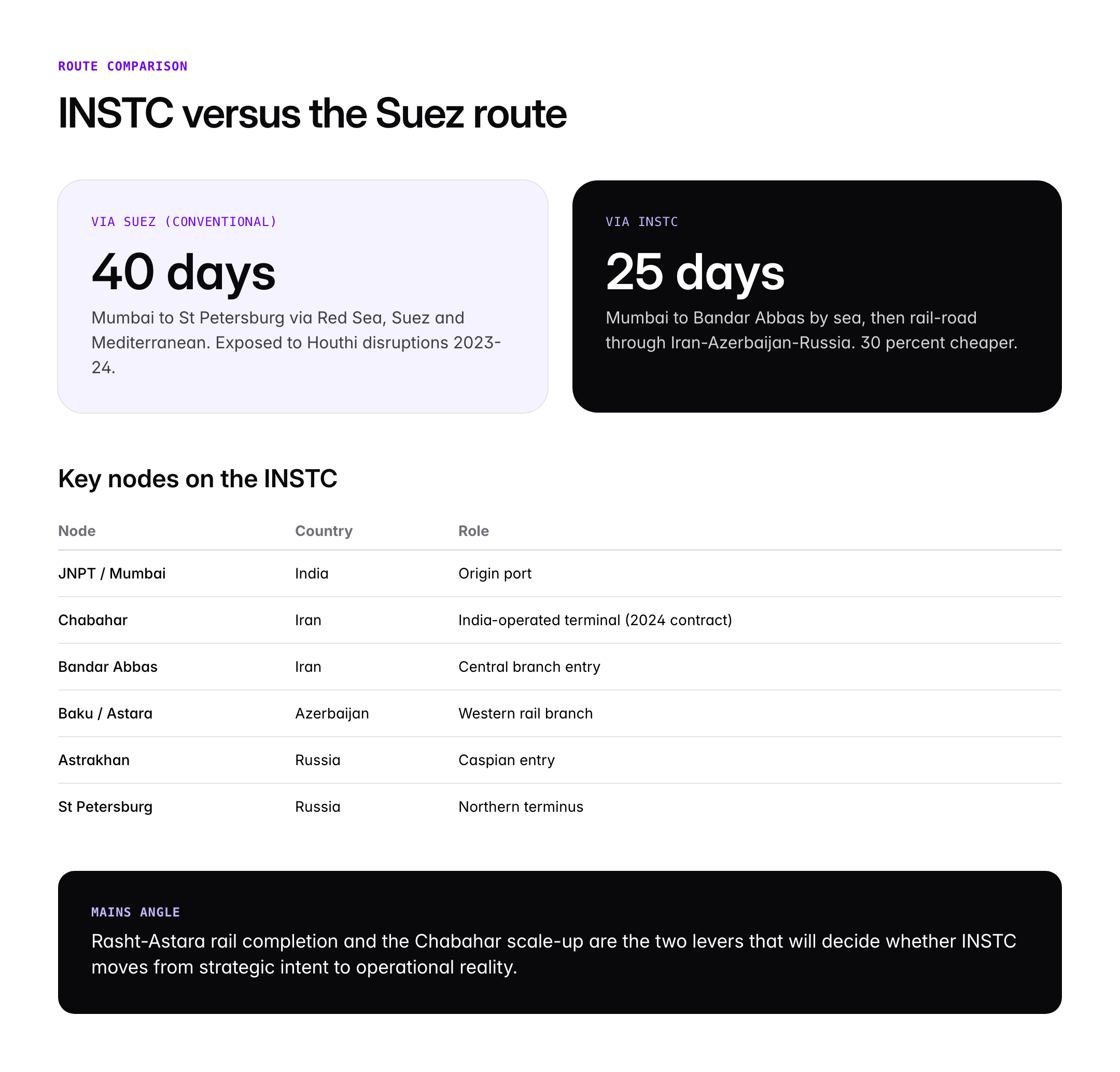
The International North-South Transport Corridor was proposed in 2000 by Russia, Iran and India to reduce cargo transit time between Mumbai and St Petersburg from 40 days (via the Suez Canal) to under 25 days. The trilateral agreement was ratified in 2002. The corridor has since expanded to 13 member states including Azerbaijan, Armenia, Belarus, Bulgaria, Kazakhstan, Kyrgyzstan, Oman, Syria, Tajikistan, Turkey and Ukraine.
The Dedicated Freight Corridor programme was conceived in 2005 to decongest the Golden Quadrilateral rail routes where freight was losing share to road. The Dedicated Freight Corridor Corporation of India Limited (DFCCIL) was incorporated in October 2006 as a special purpose vehicle under the Ministry of Railways. Two corridors are under construction: the Eastern DFC from Sahnewal to Sonnagar (1,337 km) and the Western DFC from Dadri to JNPT Mumbai (1,506 km). The Eastern DFC was fully commissioned in June 2024.
Key Features
Kartarpur Corridor
The Kartarpur Corridor is a 4.7 km stretch on the Indian side with a four-lane highway, state-of-the-art passenger terminal building at Dera Baba Nanak spread across 15 acres, and capacity for 5,000 pilgrims per day. The Pakistan side features a 4 km road, immigration counters and the redeveloped Gurdwara Darbar Sahib complex. Pilgrims require only a valid Indian passport and online registration via the Prakash Punj portal. A service fee of USD 20 per pilgrim is charged by Pakistan.
Key facilities on the Indian side include the Passenger Terminal Building (PTB), developed by the Land Ports Authority of India (LPAI) under the Ministry of Home Affairs. The corridor operates under the India-Pakistan Agreement on Kartarpur Sahib Corridor signed on 24 October 2019, renewed periodically.
International North-South Transport Corridor
The INSTC has three main routes: the Central Corridor (via Bandar Abbas port), the Western Corridor (via Azerbaijan and Astara rail link), and the Eastern Corridor (via Central Asia and Russia). The Chabahar port in Iran, developed by India, serves as a strategic node bypassing Pakistan. India signed a 10-year contract in May 2024 with Iran’s Port and Maritime Organization for operation of the Shahid Beheshti terminal at Chabahar.
The INSTC cuts freight cost by around 30 percent and transit time by 40 percent compared to the Suez route. Goods from Mumbai reach Bandar Abbas by sea, then move by rail-road through Iran to the Caspian Sea, and onward via Russia to Europe. The Rasht-Astara rail link in Iran, under construction, is the critical missing link for the Western branch.
Eastern Dedicated Freight Corridor
The EDFC runs 1,337 km through Punjab, Haryana, Uttar Pradesh, Bihar and ends at Sonnagar. It is electrified with 2×25 kV AC, designed for a 25-tonne axle load, double-stack containers, and speeds of 100 kmph for freight trains. Funding came from the World Bank (USD 2.725 billion) and Indian Railways counterpart funding.
The EDFC primarily carries coal from the Eastern coalfields to northern power plants, alongside food grains, cement, fertiliser and containers. It has reduced freight journey time from Ludhiana to Kolkata by up to 50 percent and freed up capacity on existing rail lines for passenger services.
Significance for UPSC and General Knowledge
- Kartarpur Corridor illustrates faith diplomacy and the limited India-Pakistan cooperation template.
- INSTC is a flagship of India’s Eurasian connectivity strategy and a counter to China’s Belt and Road Initiative.
- Chabahar is India’s only operational overseas port and central to the INSTC.
- EDFC demonstrates PPP-style project delivery through a government SPV (DFCCIL) with multilateral financing.
- Freight corridors support India’s target of reducing logistics cost from 13 percent of GDP toward the global average of 8 percent under the National Logistics Policy 2022 and PM Gati Shakti.
- Corridors tie into GS2 (IR), GS3 (infrastructure, economy), and case studies for essays.
Detailed Analysis: Geopolitics of the Three Corridors
The three corridors reveal three distinct geopolitical logics.
The Kartarpur Corridor functions as a people-to-people bridge even when formal India-Pakistan relations have deteriorated. It survived the abrogation of Article 370 in August 2019 and the downgrade of diplomatic ties. For India, the corridor honours a religious obligation to the Sikh community and neutralises external efforts to use the Sikh diaspora against Indian interests. For Pakistan, it serves as a soft-power gesture and a source of foreign exchange. Intelligence concerns remain, with Indian agencies periodically flagging attempts to recruit pilgrims for Khalistani activities.
The INSTC is a response to India’s post-1991 quest for reliable connectivity to Central Asia and Europe. The Suez Canal route exposes Indian trade to Red Sea disruptions (as seen in 2023-24 Houthi attacks) and passes through long, exposed sea lanes. The INSTC provides redundancy and a direct overland link to the Russian and Iranian markets. However, progress has been uneven. Iran sanctions limit banking and insurance. The Rasht-Astara rail link, crucial for the Western branch, remains incomplete. The Chabahar port was held back for years until the 2024 long-term contract. Still, the INSTC remains central to India’s Connect Central Asia policy.
The EDFC is a domestic corridor but with strategic resonance. It unbundles freight from passenger rail, permitting double-stack container movement and heavier axle loads. By cutting logistics costs and enabling port hinterland connectivity (via the Western DFC and planned spurs), it strengthens India’s manufacturing and export competitiveness. The EDFC also feeds into PM Gati Shakti, the National Master Plan for Multimodal Connectivity launched in October 2021.
Taken together, the three corridors show connectivity as a spectrum: from ritual to trade to freight, each with a policy lesson.
Comparative Perspective
| Parameter | Kartarpur Corridor | INSTC | EDFC |
|---|---|---|---|
| Type | Pilgrimage | Multimodal international trade | Domestic freight rail |
| Length | 4.7 km (India side) | 7,200 km | 1,337 km |
| Key agreement | 2019 bilateral | 2002 trilateral, 13 members now | 2005 cabinet approval |
| Funding | Government of India | Member states and private investment | World Bank + MoR |
| Strategic theme | Faith diplomacy | Connect Central Asia | Logistics reform |
| Nodal ministry | MHA (LPAI) | MEA + MoPSW | Ministry of Railways |
Challenges and Criticisms
The Kartarpur Corridor faces recurring security concerns over Khalistani propaganda, the USD 20 fee charged by Pakistan, and occasional unilateral suspensions. The visa-free model is narrow, and aspirants sometimes question whether it can be a template for Hinglaj or Nankana Sahib.
The INSTC is constrained by US sanctions on Iran, limited rail capacity between Iran and Azerbaijan, and the Ukraine conflict’s disruption of Russia-Europe trade. The World Bank is not a participant, so financing is piecemeal. Progress on the Rasht-Astara rail, funded by a USD 1.6 billion Russian loan in 2023, will determine the corridor’s near-term viability.
The EDFC has faced cost escalation, land acquisition delays and questions over tariff-setting. Freight share on rail continues to lag, and the operational integration with the Western DFC (to be fully commissioned) remains a work in progress. Decongestion benefits will only be realised fully once both DFCs and their feeder lines are live.
Prelims Pointers
- Kartarpur Corridor opened 9 November 2019, on the 550th birth anniversary of Guru Nanak.
- It connects Dera Baba Nanak (Gurdaspur, Punjab) to Gurdwara Darbar Sahib, Kartarpur, Pakistan.
- Pakistan charges USD 20 per pilgrim; India charges no fee.
- INSTC was established in 2000 and ratified in 2002 by India, Iran and Russia.
- INSTC now has 13 member states including Azerbaijan, Armenia, Bulgaria and Turkey.
- Chabahar port is in Sistan-Baluchistan province on the Gulf of Oman.
- India signed a 10-year contract for Chabahar’s Shahid Beheshti terminal in May 2024.
- DFCCIL was incorporated in October 2006 under the Companies Act 1956.
- EDFC runs 1,337 km from Sahnewal (Punjab) to Sonnagar (Bihar).
- Western DFC runs 1,506 km from Dadri to JNPT Mumbai.
- EDFC received World Bank funding of about USD 2.725 billion.
- National Logistics Policy was launched in September 2022.
Mains Practice Questions
Q1. “The International North-South Transport Corridor complements India’s Indo-Pacific strategy by anchoring its Eurasian reach.” Examine. (15 marks, 250 words)
- Describe the INSTC routes and members; highlight Chabahar as India’s counter-Gwadar node.
- Argue complementarity: Indo-Pacific secures sea lanes, INSTC secures overland route to Central Asia and Russia.
- Note bottlenecks: Iran sanctions, Rasht-Astara rail delays, Ukraine war; conclude on the need for resilient, diversified connectivity.
Q2. Discuss the significance of Dedicated Freight Corridors in reducing India’s logistics cost and supporting Make in India. (10 marks, 150 words)
- Explain EDFC and WDFC specifications and routes.
- Link to National Logistics Policy 2022 target and PM Gati Shakti.
- Highlight double-stack containers, decongestion of passenger lines and hinterland connectivity.
Conclusion
The Kartarpur, INSTC and EDFC corridors, though different in scale and purpose, share an underlying premise: connectivity is a strategic good. The Kartarpur Corridor keeps a fragile channel of faith diplomacy open. The INSTC positions India as a pivotal node between the Indian Ocean and Eurasia. The EDFC translates logistics ambition into operational freight throughput.
For aspirants, the lesson is to read each corridor in three registers: the factual specification, the institutional design, and the strategic intent. All three corridors will generate news through the decade, particularly as Chabahar scales, the Rasht-Astara rail closes the INSTC loop, and the Western DFC nears full commissioning.
Frequently Asked Questions
What is the Kartarpur Corridor?
The Kartarpur Corridor is a 4.7 km visa-free pilgrimage route opened on 9 November 2019 that connects Dera Baba Nanak in Gurdaspur, Punjab, India, with Gurdwara Darbar Sahib in Kartarpur, Pakistan, where Guru Nanak Dev Ji spent his final 18 years. It allows up to 5,000 Indian pilgrims per day to visit the shrine on a passport-only basis, subject to a USD 20 service fee charged by Pakistan.
Why are these corridors important for UPSC?
They appear across GS2 (India-Pakistan relations, India-Iran-Russia cooperation), GS3 (infrastructure, logistics, ports and rail), and GS1 (Sikhism, Guru Nanak). The Kartarpur Corridor is a model of faith diplomacy, the INSTC is central to India’s Connect Central Asia policy and counters the Belt and Road Initiative, and the EDFC is a flagship of domestic logistics reform under PM Gati Shakti.
How is the INSTC related to the Chabahar port?
Chabahar in Iran’s Sistan-Baluchistan province is the key Indian-operated node on the Central branch of the INSTC. Goods from Indian ports arrive at Chabahar’s Shahid Beheshti terminal, which India committed to operate for 10 years under the May 2024 long-term agreement. From Chabahar, cargo moves by road and rail through Iran toward the Caspian Sea and onward to Russia and Europe, bypassing Pakistan.
What is the length and route of the Eastern Dedicated Freight Corridor?
The EDFC is 1,337 km long, running from Sahnewal in Punjab through Haryana, Uttar Pradesh and Bihar to Sonnagar. It is an electrified double-track corridor designed for 25-tonne axle loads, double-stack containers and 100 kmph freight speeds. Primary cargo includes coal, food grains, cement and fertiliser. It was fully commissioned in June 2024 and is operated by DFCCIL.
When was the INSTC established?
The International North-South Transport Corridor was proposed in September 2000 at a conference in St Petersburg and ratified through a trilateral agreement between India, Iran and Russia in May 2002. It has since expanded to 13 member states including Azerbaijan, Armenia, Belarus, Bulgaria, Kazakhstan, Kyrgyzstan, Oman, Syria, Tajikistan, Turkey and Ukraine, making it one of the most extensive multimodal corridors in Eurasia.
Who manages the Dedicated Freight Corridors in India?
Dedicated Freight Corridor Corporation of India Limited (DFCCIL), a special purpose vehicle incorporated in October 2006 under the Companies Act 1956, manages the corridors. It operates under the Ministry of Railways. Funding for the EDFC came largely from the World Bank (around USD 2.725 billion) while the Western DFC draws on Japanese yen loans through JICA.
What is the total length of the INSTC?
The INSTC spans approximately 7,200 km from Mumbai to St Petersburg, linking India to Russia through Iran, Azerbaijan and other member states. It reduces cargo transit time by about 40 percent and freight cost by about 30 percent compared with the conventional Suez Canal route, while offering redundancy during Red Sea disruptions like those caused by Houthi attacks in 2023-24.
What are the security challenges in the Kartarpur Corridor?
Indian agencies have periodically flagged attempts by Pakistan-based Khalistani elements to approach pilgrims at the Kartarpur shrine and spread propaganda. Additional concerns include the USD 20 fee charged unilaterally by Pakistan, short-notice operational suspensions, and surveillance risks. India has responded through traveller advisories, passenger screening by the Land Ports Authority of India at Dera Baba Nanak, and diplomatic protests.
Tell Google you want more of this.
Add Anantam IAS as a preferred sourceOne tap, and this site shows up more often in your own Top Stories, AI Overviews and AI Mode. Remove it any time.