Introduction
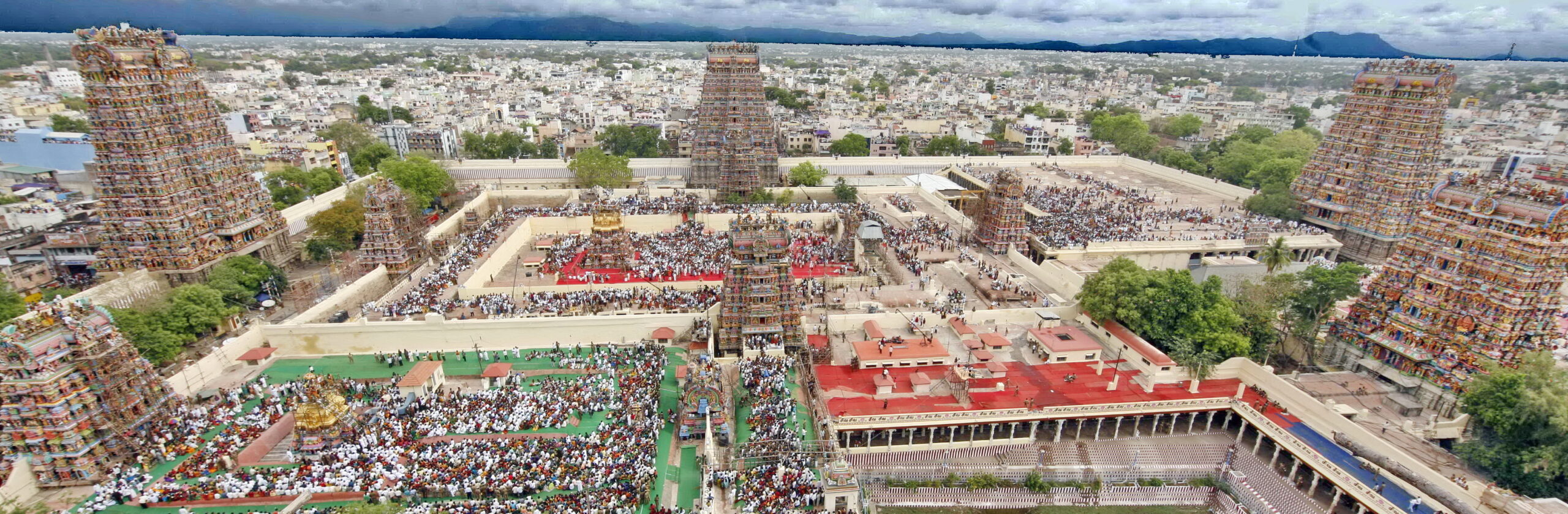
The Meenakshi Sundareshwarar Temple at Madurai, popularly called the Madurai Temple, is one of the most celebrated shrines in the Indian subcontinent. Rising above the old city of Madurai on the banks of the Vaigai river, its fourteen towering gopurams, four thousand painted figures, and a thousand-pillar hall have drawn pilgrims, poets, and travellers for centuries. Dedicated jointly to Goddess Meenakshi, a form of Parvati, and her consort Sundareshwarar, a form of Shiva, the complex is an unusual double-sanctum temple where the deity-consort pair is worshipped side by side with the goddess as the presiding figure.
For the UPSC aspirant, the temple is a textbook case study in Dravidian temple architecture, the Nayak dynasty’s patronage of art, and the living continuity of Tamil bhakti tradition. It regularly features in Prelims questions on Indian architecture, in Mains GS1 answers on art and culture, and in essay writing on heritage and tourism. Understanding its history, plan, iconography, and governance challenges is therefore indispensable.
Quick Facts at a Glance
| Parameter | Detail |
|---|---|
| Location | Madurai, Tamil Nadu, on the southern bank of Vaigai river |
| Presiding deities | Meenakshi (Parvati) and Sundareshwarar (Shiva) |
| Architectural style | Dravidian, Nayak-period idiom |
| Principal patron | Tirumalai Nayak (r. 1623-1659) |
| Number of gopurams | 14 (4 outer at cardinal directions, tallest at south) |
| Tallest gopuram | Southern, approximately 51.9 metres |
| Sacred tank | Porthamarai Kulam (Golden Lotus Tank) |
| Major festival | Chithirai Festival (April-May) |
| Governance | Hindu Religious and Charitable Endowments (HR&CE), Tamil Nadu |
| Heritage listing | UNESCO tentative list (2014) as part of Nayak monuments |
Background and Historical Context
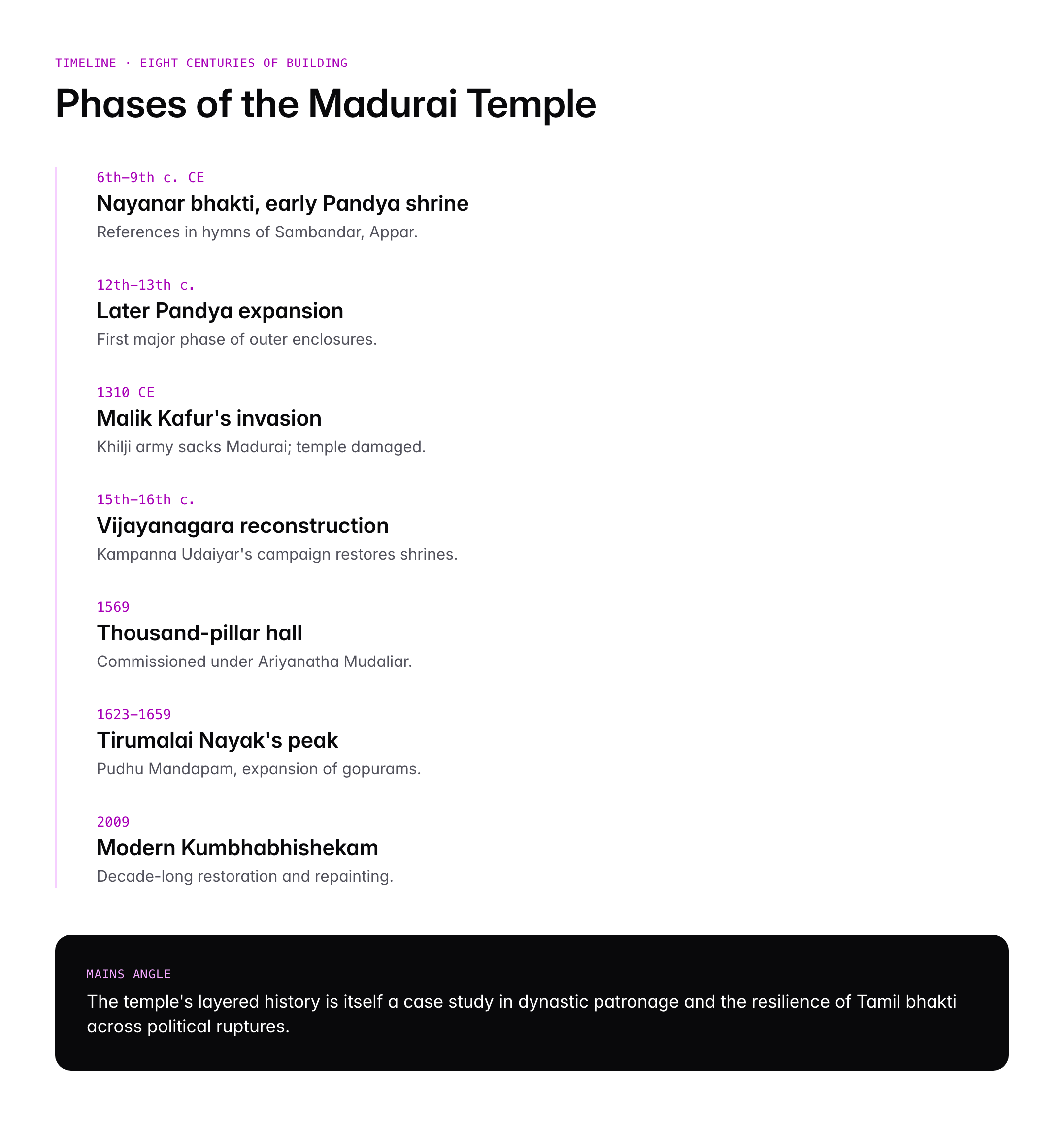
The origins of the Madurai temple lie deep in Tamil tradition. Madurai itself was the seat of the three Sangams, the ancient academies of Tamil literature, and served as the capital of the Early Pandya dynasty. References to a shrine of Aalavai or Aalavay appear in Sangam-age texts and in the seventh-century hymns of the Shaiva Nayanars, including Tirujnanasambandar and Appar. The Tiruvilaiyadal Puranam, a fourteenth-century Tamil text by Paranjothi Munivar, compiles sixty-four sacred sports of Shiva associated with Madurai.
The present temple owes its grand form to successive waves of reconstruction. The first major phase was under the later Pandyas in the twelfth and thirteenth centuries. In 1310, the armies of Malik Kafur, general of Alauddin Khilji, sacked Madurai and the temple was damaged. A second wave of rebuilding came under the Vijayanagara emperors in the fifteenth and sixteenth centuries after the victory of Kampanna Udaiyar. The temple reached its peak expansion under the Nayak dynasty of Madurai, an offshoot of Vijayanagara after its decline.
Tirumalai Nayak, who ruled from 1623 to 1659, commissioned the Pudhu Mandapam, expanded the thousand-pillar hall, and shaped much of what the modern visitor sees. After the fall of the Nayaks, the temple passed through the Nawab of Arcot, the Maratha Setupati of Ramnad, the British East India Company, and, since Independence, the Tamil Nadu government through the HR&CE Department. A major consecration or Kumbhabhishekam was performed in 2009 after a decade-long restoration programme.
Key Features and Provisions
Architectural plan
The temple occupies a walled rectangle of about 258 by 223 metres, with four outer gopurams at the cardinal directions. Inside are two principal sanctums. The Meenakshi shrine is located to the south-west and the Sundareshwarar shrine to the east. The axial alignment of Dravidian temples is modified here: devotees typically worship the goddess first, then the god, reversing the usual Shaiva order, a feature reflecting the goddess-centred tradition of Madurai.
Gopurams
The fourteen gopurams are the temple’s signature. The southern gopuram, rising about 51.9 metres, is the tallest. Each tower is covered with stucco figures of deities, dvarapalas, musicians, and mythological scenes, periodically repainted in vivid polychrome. The outer gopurams likely date from the thirteenth to the sixteenth centuries, with later Nayak additions.
Mandapas and corridors
The Ayiram Kaal Mandapam, the Hall of a Thousand Pillars, actually contains 985 sculpted pillars, each a different design. Built around 1569 under Ariyanatha Mudaliar, it now houses a temple museum. The Ashta Shakti Mandapam at the eastern entrance depicts the eight goddesses. The Kilikoondu Mandapam or Parrot Cage hall once housed trained green parrots. The Pudhu Mandapam outside the eastern gopuram, built by Tirumalai Nayak, is a textbook example of late Nayak sculpture.
Sacred tank and iconography
The Porthamarai Kulam, or Golden Lotus Tank, was traditionally used by the Tamil Sangam to test the literary merit of poetry. The goddess Meenakshi is depicted in green stone with a parrot on her hand, characteristic of Tamil Shakta iconography.
Significance for UPSC and General Knowledge
- Central example in GS1 Art and Culture for Dravidian temple architecture
- Key Prelims fact source on Nayak dynasty, Vijayanagara legacy, and South Indian temple organisation
- Essay material on heritage tourism, urban temple towns, and living traditions
- GS2 angle on HR&CE governance and the state-temple relationship
- GS3 angle on heritage conservation and climate-proofing
- Useful for Ethics case study on balancing ritual tradition with inclusive access
Detailed Analysis: Dravidian Architectural Idiom
The Madurai temple is the apotheosis of the late Dravidian or Nayak style. Compared with the earlier Chola idiom, which emphasised a tall vimana over the garbhagriha as at Thanjavur’s Brihadisvara Temple, the Madurai complex inverts the hierarchy: the garbhagrihas are modest while the gopurams on the outer walls soar upward. This shift, which began under the later Pandyas and matured under Vijayanagara and the Nayaks, reflects the urban temple-town pattern where the shrine is the centre of a radial city of concentric streets.
The hall or mandapa tradition is carried to an extreme, with hypostyle pavilions designed for festivals, teaching, music, and commerce. Sculptors exploited Nayak-era access to hard granite to produce pillars with multiple figures carved in the round, such as yali pillars showing riders on mythological creatures, and composite pillars that ring out different notes when struck.
Iconographically, the temple blends Shaiva, Shakta, and Vaishnava elements. The presence of the Kumara Vigneshwarar shrine, the sculptures of the Dashavatara in the Pudhu Mandapam, and the participation of Vishnu as Azhagar in the Chithirai festival show an inclusive devotional culture. Chithirai Thiruvizha, the April-May festival, narrates the celestial wedding of Meenakshi and Sundareshwarar and draws more than a million pilgrims.
Materially, the temple uses stucco on brick for gopuram figures, granite for pillars, and polished basalt for icons. Conservation is a continuing challenge: the 2009 restoration re-plastered gopurams and repainted figures, but the use of synthetic pigments has been criticised by the Archaeological Survey of India and by INTACH for long-term damage to the stucco.
Comparative Perspective
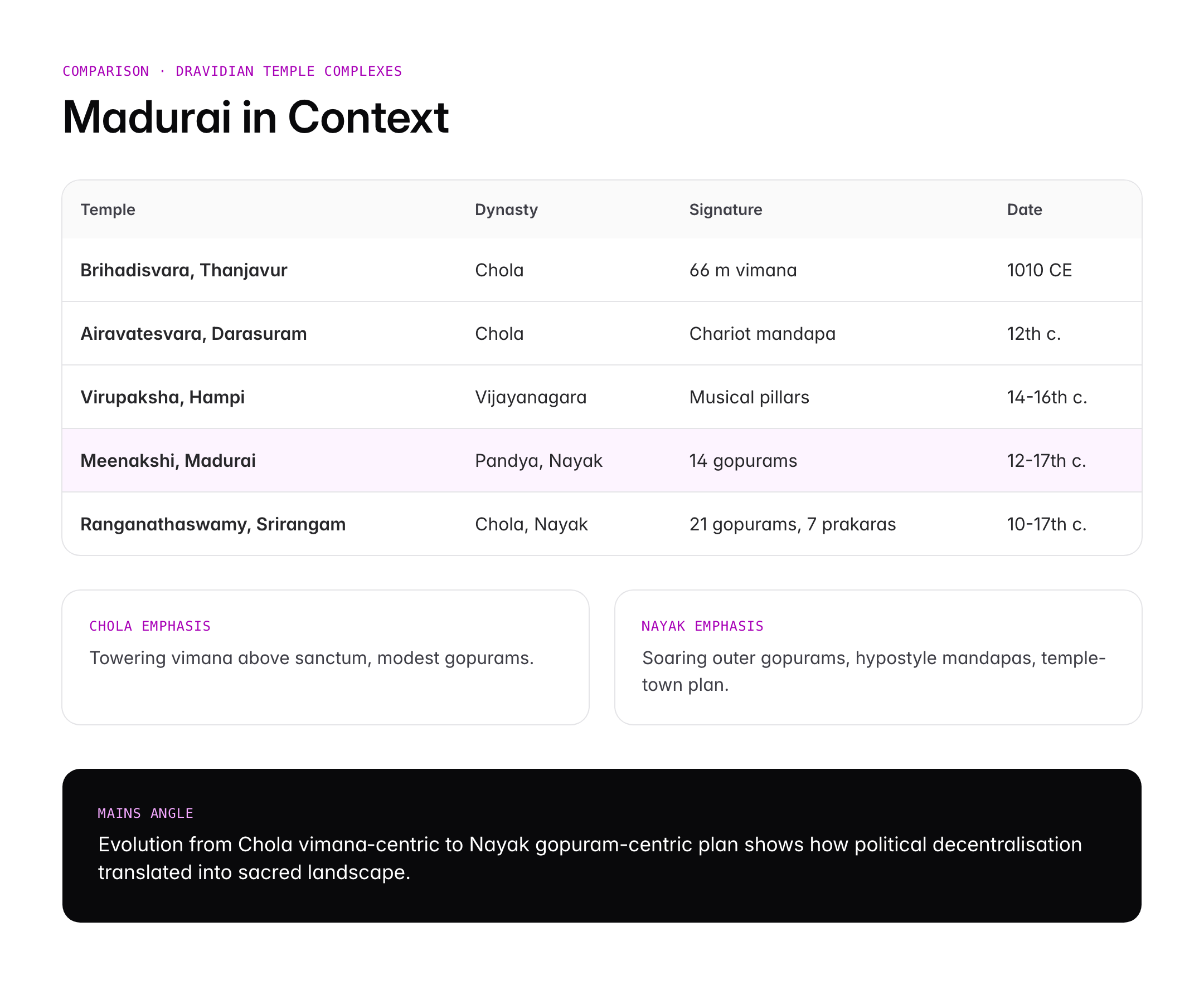
The Madurai temple belongs to a regional family of Dravidian temple complexes. A brief comparison clarifies where it stands.
| Temple | Principal dynasty | Signature feature | Approximate date |
|---|---|---|---|
| Brihadisvara, Thanjavur | Chola | 66m vimana over sanctum | 1010 CE |
| Virupaksha, Hampi | Vijayanagara | Stepped gopuram, musical pillars | 14th-16th c. |
| Meenakshi, Madurai | Pandya and Nayak | 14 gopurams, Thousand-pillar hall | 12th-17th c. |
| Ranganathaswamy, Srirangam | Chola, Nayak | 21 gopurams, 7 enclosures | 10th-17th c. |
| Airavatesvara, Darasuram | Chola | Chariot-form mandapa | 12th c. |
Compared with Thanjavur, Madurai emphasises outer gopurams over a central vimana. Compared with Srirangam, it is smaller in total enclosed area but denser in sculptural ornament per square metre.
Controversies and Debates
Several debates surround the temple. The first is governance. Like most large Tamil Nadu temples, Madurai is administered by the state HR&CE Department. Supporters argue this ensures transparent accounting and social access; critics, including some petitioners before the Supreme Court, argue that state management violates Article 26’s guarantee of autonomy for religious denominations. The Padmanabhaswamy judgement of 2020 has revived this debate.
A second debate concerns restoration aesthetics. The 2009 Kumbhabhishekam involved aggressive repainting of gopuram figures in bright colours. Art historians such as M A Dhaky argued for subtler pigments based on historical records. The Madras High Court in 2014 directed that future repainting should follow ASI guidelines.
A third debate is about access and inclusivity. While non-Hindus can visit the outer corridors, they are barred from the inner sanctum, a policy challenged in public-interest petitions. Similarly, women’s entry during certain rituals has been questioned after the Sabarimala judgement of 2018.
Finally, tourism pressure on the old city, congestion, and vendor encroachment around the gopurams threaten the temple-town fabric, prompting calls for a comprehensive Madurai Smart Temple-Town Plan.
Prelims Pointers
- Meenakshi is a form of Parvati, consort is Sundareshwarar
- Tallest gopuram is the southern tower at about 51.9 metres
- Tirumalai Nayak ruled 1623 to 1659 CE from Madurai
- Malik Kafur’s invasion of 1310 damaged the earlier temple
- Porthamarai Kulam was linked to the third Tamil Sangam
- Thousand-pillar hall has 985 pillars and was built in 1569
- Chithirai festival celebrates celestial wedding of Meenakshi and Sundareshwarar
- Temple is governed by Tamil Nadu HR&CE Department
- Added to UNESCO World Heritage tentative list in 2014
- Tiruvilaiyadal Puranam is a 14th-century work by Paranjothi Munivar
- Ariyanatha Mudaliar was a Nayak minister associated with the Thousand-pillar hall
- Nayanars were 63 Tamil Shaiva saints of the 6th to 9th centuries CE
Mains Practice Questions
- “The Madurai temple represents the maturation of the Dravidian architectural idiom under the Nayaks.” Elaborate with reference to its gopurams, mandapas, and iconographic programme.
- Define Dravidian and Nayak idiom, contrast with Chola vimana emphasis
- Describe gopurams, thousand-pillar hall, Pudhu Mandapam
- Link to temple-town urbanism and living tradition
- Examine the governance of Hindu religious institutions in Tamil Nadu with reference to the Meenakshi Temple. Should state control be continued?
- Outline HR&CE Act 1959 and its scope
- Present arguments for state oversight: transparency, inclusion
- Counterarguments: Article 26, denominational autonomy, Padmanabhaswamy model
Conclusion
The Meenakshi Sundareshwarar Temple at Madurai is more than a monument. It is a living urban centre, a theatre of festivals, an archive of Tamil bhakti, and a textbook of Dravidian architecture. Across eight centuries of patronage by Pandya, Vijayanagara, and Nayak rulers, it has acquired fourteen gopurams, a thousand-pillar hall, and an iconographic universe that blends Shaiva, Shakta, and Vaishnava themes into a single composition.
For the UPSC aspirant, the temple illustrates how art, politics, religion, and urban planning converged in pre-modern India, and how contemporary India must reconcile heritage conservation, religious autonomy, and inclusive access. A good answer on Madurai does not merely list features; it shows how the stones of the temple still speak about society, governance, and culture.
Frequently Asked Questions
What is the Madurai temple?
The Madurai temple is the Meenakshi Sundareshwarar Temple in Madurai, Tamil Nadu, dedicated jointly to Goddess Meenakshi, a form of Parvati, and her consort Sundareshwarar, a form of Shiva. It is one of the largest and most elaborately sculpted Dravidian temple complexes, noted for its fourteen gopurams and thousand-pillar hall.
Why is the Madurai temple important for UPSC?
The temple is a core example in GS1 Art and Culture for Dravidian and Nayak-period architecture. It also enters Prelims questions on Tamil Sangam, Nayanars, Vijayanagara successor states, and HR&CE governance. Mains and Essay use it as a case study in heritage, tourism, and state-temple relations.
How is the Madurai temple related to the Nayak dynasty?
The Nayaks of Madurai, originally governors under Vijayanagara, became independent after 1565 and turned Madurai into a major capital. Tirumalai Nayak (1623-1659) expanded the temple, built the Pudhu Mandapam and the Thousand-pillar hall’s surroundings, and commissioned much of the sculptural programme visible today.
How tall are the gopurams of Madurai temple?
There are fourteen gopurams in all, four outer at the cardinal directions and ten inner ones. The southern gopuram, the tallest, rises about 51.9 metres. Each tower carries thousands of stucco figures of gods, dvarapalas, and mythological scenes, repainted periodically in vivid colours.
What is the Chithirai festival?
Chithirai Thiruvizha is the biggest annual festival of the Madurai temple, celebrated in April-May. It narrates the celestial wedding of Meenakshi and Sundareshwarar and the arrival of Lord Vishnu as Azhagar from the nearby Azhagar Kovil. The festival draws over a million pilgrims and blends Shaiva and Vaishnava traditions.
Who destroyed and rebuilt the Madurai temple?
The earlier Pandya-era temple was damaged during Malik Kafur’s 1310 invasion under Alauddin Khilji. Reconstruction began under Vijayanagara rulers after Kampanna Udaiyar recovered the south, and peaked under the Madurai Nayaks, particularly Tirumalai Nayak. Major modern restorations culminated in the 2009 Kumbhabhishekam.
What is the Thousand-pillar hall?
The Ayiram Kaal Mandapam is a hypostyle hall in the temple built around 1569 by Ariyanatha Mudaliar, minister of the Nayaks. It contains 985 intricately carved pillars, including yali pillars and musical pillars. A section of it now houses a temple museum documenting sculpture, bronzes, and manuscripts.
Who manages the Madurai temple today?
The temple is managed by the Hindu Religious and Charitable Endowments Department of the Government of Tamil Nadu under the HR&CE Act 1959. A Joint Commissioner heads day-to-day administration. This arrangement has been challenged before the Supreme Court on Article 26 grounds after the Padmanabhaswamy judgement of 2020.