Disclosure: this guide contains Amazon affiliate links. As an Amazon Associate, Anantam IAS earns from qualifying purchases — at no extra cost to you.
Introduction
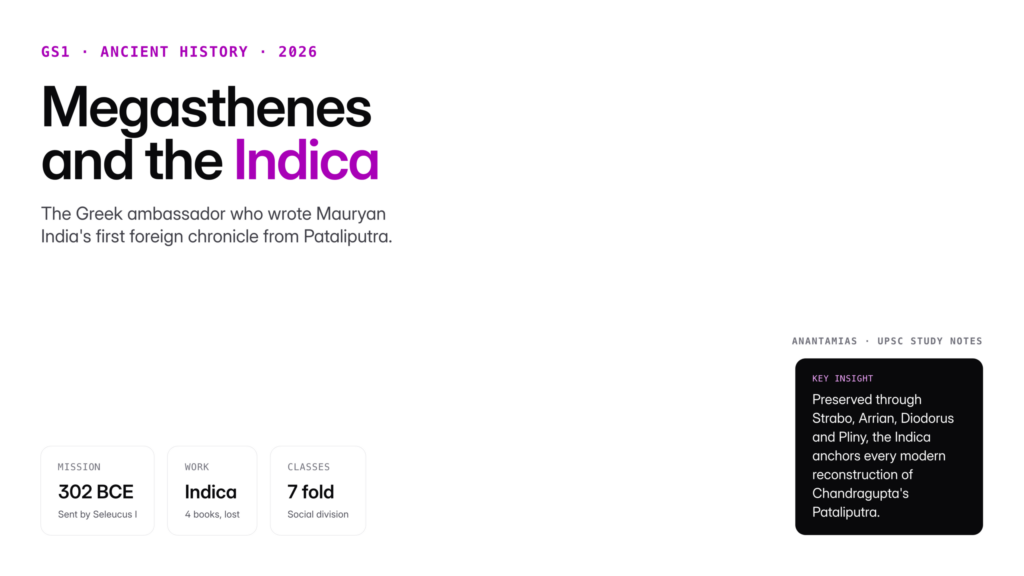
Megasthenes is one of the most consequential foreign observers in early Indian history. Dispatched by Seleucus I Nicator to the court of Chandragupta Maurya around 302 BCE, he authored Indica, a four-book ethnography that became the single most cited Greco-Roman source on Mauryan India for more than a thousand years. Although the original text has not survived intact, later classical writers like Diodorus, Strabo, Arrian, and Pliny quoted him extensively, allowing modern historians to reconstruct a vivid, if sometimes flawed, picture of Pataliputra under the first Mauryan emperor.
For a UPSC aspirant, Megasthenes is not a minor trivia figure. He anchors the early Mauryan chapter in GS Paper 1 (Indian Heritage and Culture), supplies comparative material for Paper 2 discussions of diplomatic history, and appears repeatedly in Prelims through questions on the seven-fold caste division, the layout of Pataliputra, and the duties of city superintendents. Understanding him means understanding how India first entered the written record of the Mediterranean world.
Quick Facts at a Glance
| Attribute | Detail |
|---|---|
| Name | Megasthenes (Greek: Megasthenes) |
| Lifespan | c. 350 BCE to c. 290 BCE (approximate) |
| Nationality | Greek (Ionian) |
| Sent by | Seleucus I Nicator of the Seleucid Empire |
| Host court | Chandragupta Maurya at Pataliputra |
| Date of mission | c. 302 BCE, following the Seleucid-Mauryan treaty |
| Major work | Indica (four books, lost in original) |
| Surviving form | Quoted fragments in Strabo, Diodorus, Arrian, Pliny |
| Capital described | Palibothra (Pataliputra), modern Patna |
| Key observation | Seven-caste division of Indian society |
Background and Historical Context
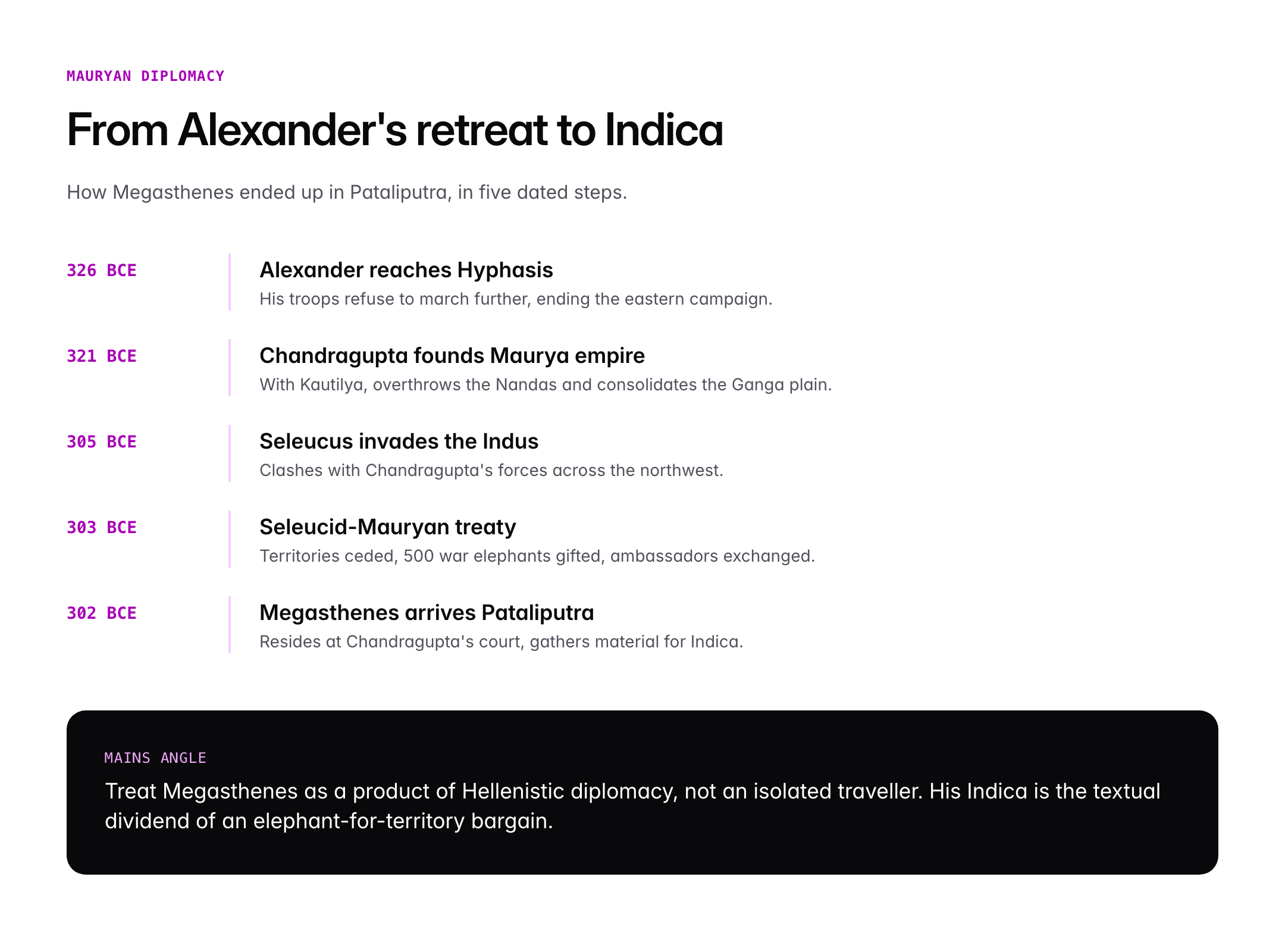
The arrival of Megasthenes in India was a direct consequence of the collision between Alexander the Great’s eastern campaigns and the rise of the Mauryan empire. After Alexander’s death in 323 BCE, his general Seleucus I Nicator inherited the eastern satrapies. When Seleucus attempted to recover the Indus territories around 305 BCE, he encountered a far more powerful adversary than the splintered republics and tribes Alexander had faced. Chandragupta Maurya, having already overthrown the Nandas and consolidated the Gangetic heartland, marched westward with a reputedly massive army.
The resulting Seleucid-Mauryan treaty, concluded around 303 BCE, redrew the political map of the subcontinent’s northwest. Seleucus ceded Arachosia, Gedrosia, Paropamisadae, and Aria, territories roughly corresponding to modern Kandahar, Balochistan, the Hindu Kush, and Herat. In exchange, Chandragupta gifted five hundred war elephants, a force Seleucus later deployed at the decisive Battle of Ipsus in 301 BCE. The treaty also established a matrimonial alliance and a formal exchange of ambassadors.
Megasthenes was the Seleucid envoy chosen for this mission. Earlier scholarship suggested he had already served under Sibyrtius, the satrap of Arachosia, which would explain his familiarity with the Indian frontier. He resided in Pataliputra, the Mauryan capital on the confluence of the Ganga and Son rivers, for several years, returning to Arachosia to compose the Indica. The work was intended less as a political dispatch and more as an ethnographic treatise for the Hellenistic reading public, which was hungry for reliable information about the lands beyond the Hyphasis river that Alexander’s troops had refused to cross.
Key Features of the Indica
The Indica was organised into four books and covered geography, climate, flora and fauna, social organisation, political administration, and cultural practices. Because it survives only in fragments, scholars group the material into thematic clusters.
Description of Pataliputra
Megasthenes portrays Palibothra, his rendering of Pataliputra, as the greatest city of the east. He records a parallelogram measuring roughly 14.5 kilometres long by 2.4 kilometres wide, defended by a timber palisade with 570 towers and 64 gates, and ringed by a wide moat fed by the Son river. Archaeological excavations at Kumhrar and Bulandi Bagh have confirmed wooden palisade fragments, broadly vindicating his description.
The Seven-Fold Division of Society
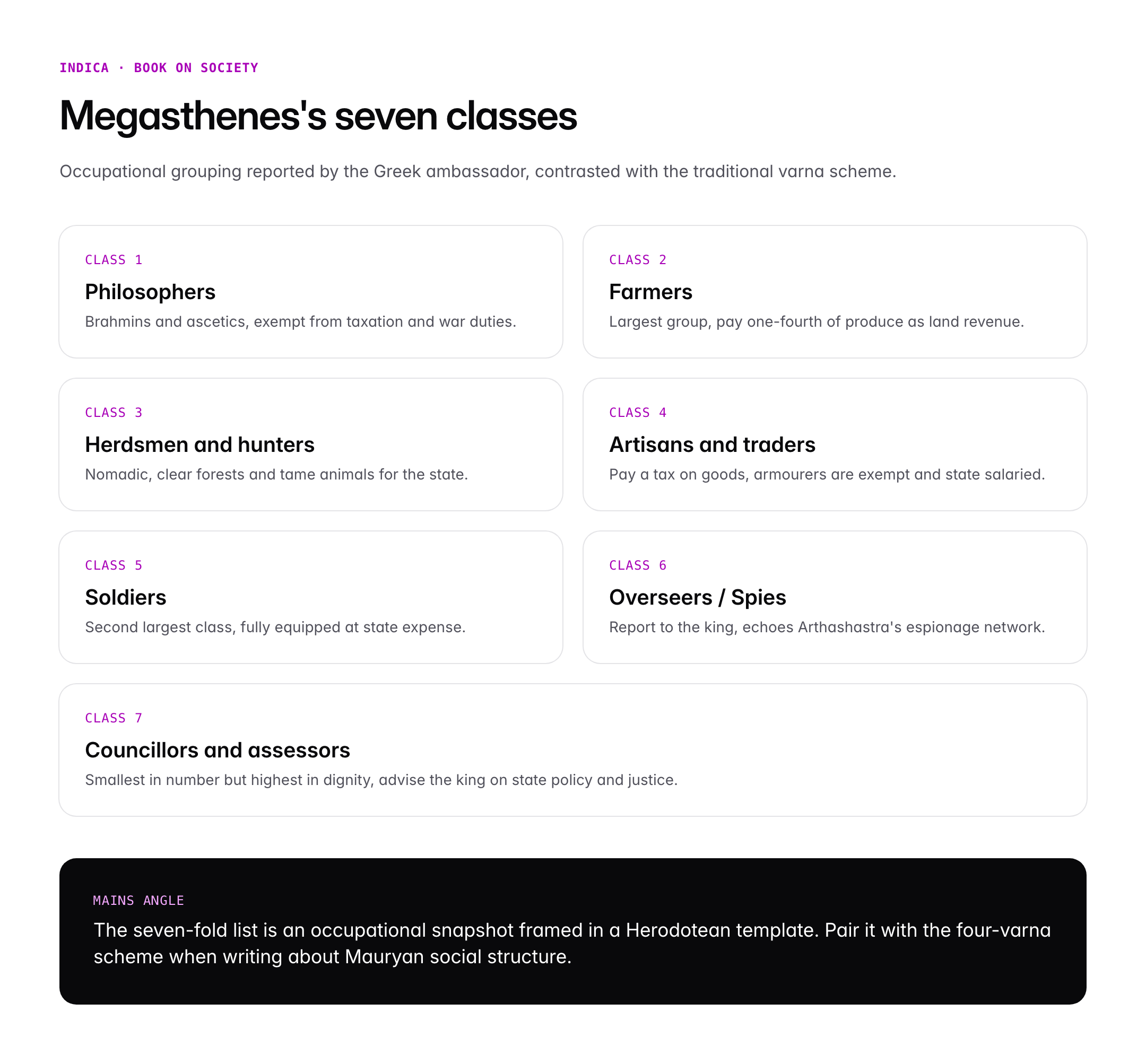
One of the most debated passages is Megasthenes’s division of Indian society into seven endogamous classes: philosophers (Brahmins and ascetics), farmers, herdsmen and hunters, artisans and traders, soldiers, overseers or spies, and councillors. Indian sources recognise the four-fold varna system, so his sevenfold scheme is usually read as an occupational rather than ritual classification, influenced by Herodotus’s earlier seven-class division of Egyptian society.
Administration of the Capital
His account of the city administration of Pataliputra describes six committees of five members each, supervising crafts, foreigners, births and deaths, trade and commerce, manufacture and sale of goods, and collection of sales tax. A parallel six-committee structure managed the military: infantry, cavalry, chariots, elephants, navy, and commissariat. This thirty-member civic council finds echoes in the Arthashastra’s discussion of urban superintendents.
Society, Slavery, and Religion
Megasthenes famously claimed that slavery did not exist in India, a statement historians read as an observation about the absence of chattel slavery of the Greek type rather than a denial of bonded labour. He described Indians as abstemious, truthful, litigation-averse, and observed the worship of Dionysus (identified with Shiva) in the mountains and Heracles (identified with Krishna or Vasudeva) in the plains.
Flora, Fauna, and Wonders
The Indica also carried tales of gold-digging ants, men without mouths who lived on smell, and one-footed humans. These mirabilia were ridiculed by later Greek authors like Eratosthenes and Strabo, who called Megasthenes a teller of fables. Modern scholars read these passages as either mistranslated local legends or material absorbed from Persian and Indian folklore.
Significance for UPSC and General Knowledge
- Megasthenes supplies the earliest substantial foreign account of Indian polity, society, and urban life.
- The Indica corroborates and complements the Arthashastra of Kautilya on Mauryan administration.
- It demonstrates the reach of Indo-Greek diplomatic contact in the post-Alexandrian world.
- His seven-fold social classification is a classic Prelims contrast against the four varnas.
- His description of Pataliputra is the textual bedrock for archaeological work at Kumhrar.
- He is routinely named in NCERT Class 6 and Class 12 history textbooks as a primary foreign source.
Detailed Analysis: Reliability and Historiographical Debates
Assessing Megasthenes is an exercise in source criticism, and UPSC Mains questions on historiography often cite him as a case study. The Indica has travelled to us through a long chain of secondary transmission. Diodorus Siculus used it in the first century BCE, Strabo incorporated it into his Geography around the turn of the era, Arrian drew on it for his Indica in the second century CE, and Pliny the Elder mined it for his Natural History. Each writer abridged, paraphrased, and sometimes contradicted Megasthenes, so the modern reader is reading a reconstruction of a reconstruction.

The Penguin History of Early India — Romila Thapar
- 555 pages, Penguin India
- Origins to AD 1300, with the historiographical debates left visible
- The reference for the Mauryan and post-Mauryan questions
The principal charge against him, first articulated by Eratosthenes and amplified by Strabo, is credulity. The fantastic passages about gold-digging ants and mouthless men have led some historians to dismiss the Indica as unreliable. Yet the same critics accepted his political and administrative detail, which suggests a two-speed text: rigorous when describing what he could see at court, speculative when relaying hearsay from distant regions.
Modern historians like R. C. Majumdar, Romila Thapar, and Upinder Singh have taken a more balanced view. Thapar argues that Megasthenes brought a Hellenistic ethnographic template to an Indian reality that did not fit neatly into Greek categories. His seven-fold division, for instance, probably reflects an attempt to align Indian occupational groups with the Egyptian model familiar to his readers rather than any misrepresentation of Indian society. His claim about the absence of slavery likely means he did not recognise Indian forms of bondage, such as dasa and ahitaka labour described in the Arthashastra, because they did not match the Greek chattel model.
Archaeology has been kinder to Megasthenes than his literary critics were. Excavations at Kumhrar revealed the eighty-pillared hall he describes, and the wooden palisade fragments at Bulandi Bagh match the defensive works of his Palibothra. His river coordinates and distances between cities are broadly accurate. Where he can be tested, he is usually correct about material culture and political organisation.
Comparative Perspective
Megasthenes did not operate in a vacuum. He belongs to a lineage of Greek ethnographers who wrote on the east, and his Indica can be usefully compared with other foreign accounts of India across centuries.
| Observer | Period | Work | Focus |
|---|---|---|---|
| Megasthenes | c. 302 BCE | Indica | Mauryan court, Pataliputra, society |
| Fa Hien | 399 to 414 CE | A Record of Buddhistic Kingdoms | Gupta society, Buddhism |
| Hiuen Tsang | 630 to 645 CE | Si-yu-ki | Harsha’s empire, Nalanda |
| Al Biruni | 1017 to 1030 CE | Kitab al-Hind | Hindu science, philosophy |
| Ibn Battuta | 1333 to 1347 CE | Rihla | Tughlaq administration |
| Abdur Razzaq | 1442 to 1443 CE | Matla us-Sadain | Vijayanagara court |
Compared with these successors, Megasthenes had the weakest linguistic access because he worked through interpreters, but the strongest institutional access because he lived inside the imperial court. Hiuen Tsang and Al Biruni learned local languages and engaged with scholars directly, producing deeper cultural insight. Megasthenes’s comparative advantage is chronological primacy and proximity to political power.
Controversies and Debates
The most persistent debate around Megasthenes concerns the historicity of the Indica itself. Early Greek critics accused him of fabrication, and some modern scholars have questioned whether he ever reached Pataliputra or relied instead on reports from Seleucid agents. Most historians, however, accept that he did visit the Mauryan court, citing the specificity of his administrative and topographical detail.
A second debate concerns the seven-fold division. Was it a genuine observation, a Greek template imposed on Indian reality, or a description of occupational guilds rather than social classes? The near-universal view today is that he recorded real occupational groupings but organised them within a Herodotean framework.
A third controversy concerns his silence on Buddhism, Jainism, and the Ashokan state. His failure to mention the sramana traditions by name has been read as either ignorance, court-centric bias, or a reflection of the still-limited institutional presence of these movements in 300 BCE, before the Ashokan turn. His Indica also preceded Ashoka, so its absence of Buddhist content is chronologically unsurprising.
Prelims Pointers
- Megasthenes was sent by Seleucus I Nicator to Chandragupta Maurya around 302 BCE.
- He resided at Pataliputra, which he called Palibothra.
- His work, Indica, was written in four books and survives only in fragments.
- He is quoted by Diodorus, Strabo, Arrian, and Pliny.
- He described a seven-fold division of Indian society.
- He identified local deities as Dionysus (Shiva) and Heracles (Krishna or Vasudeva).
- He mentioned six committees of five members each for city administration.
- He claimed slavery was absent in India.
- Archaeological sites Kumhrar and Bulandi Bagh vindicate his Pataliputra description.
- The Seleucid-Mauryan treaty saw 500 war elephants gifted to Seleucus.
- His account preceded the reign of Ashoka.
- He is cited in NCERT textbooks as the earliest foreign observer of Mauryan India.
Mains Practice Questions
Q1. Examine the contribution of Megasthenes’s Indica as a source for understanding Mauryan society and administration. What are its limitations?
- Outline the scope and structure of the Indica and its survival through secondary citation.
- Highlight its value for Pataliputra’s civic administration, the seven-fold classification, and material culture.
- Discuss limitations: secondary transmission, Hellenistic templates, credulity regarding mirabilia, and silence on sramana traditions.
Q2. “Foreign accounts enrich but also distort our understanding of ancient India.” Critically analyse with reference to Megasthenes and other foreign travellers.
- Establish the typology of foreign accounts from Megasthenes to Abdur Razzaq.
- Show how each observer’s cultural framework shaped their interpretation.
- Argue for cross-verification with indigenous sources and archaeology as the historiographical corrective.
Conclusion
Megasthenes occupies a singular position at the start of India’s documented history. He is the first Mediterranean writer to describe the subcontinent from inside its most powerful court, and his Indica has anchored every subsequent reconstruction of Mauryan urban life and administration. Even where he errs, his errors are instructive, showing how Hellenistic observers processed Indian complexity through familiar categories.
For UPSC preparation, the lesson is methodological as much as factual. Megasthenes must be read with the Arthashastra in one hand and archaeological reports from Kumhrar and Bulandi Bagh in the other. Triangulating foreign testimony, indigenous statecraft literature, and material remains is how modern Indian history is written, and the Indica remains a first and indispensable pillar of that triangulation.
Frequently Asked Questions
Who was Megasthenes?
Megasthenes was a Greek ambassador sent by Seleucus I Nicator to the court of Chandragupta Maurya around 302 BCE. He lived at Pataliputra for several years and authored Indica, a four-book ethnographic work that became the earliest substantial foreign account of Mauryan India preserved through later Greek and Roman writers.
Why is Megasthenes important for UPSC?
Megasthenes appears in UPSC GS Paper 1 as the earliest foreign observer of Mauryan polity and society. His seven-fold social classification, description of Pataliputra’s civic administration, and account of the Seleucid-Mauryan treaty are recurring Prelims facts and form comparative material for Mains questions on ancient Indian historiography and foreign accounts.
What is the Indica by Megasthenes?
Indica is a four-book ethnographic treatise that Megasthenes wrote after returning from Pataliputra. It described Indian geography, fauna, social classes, administration, and religion. The original is lost, but extensive fragments survive in the works of Diodorus Siculus, Strabo, Arrian, and Pliny the Elder, which modern scholars use to reconstruct the text.
How is Megasthenes related to Chandragupta Maurya?
Megasthenes served as the Seleucid ambassador at Chandragupta Maurya’s court in Pataliputra after the Seleucid-Mauryan treaty of around 303 BCE. His direct observations of Chandragupta’s administration, city planning, and military organisation provide the single most detailed foreign description of the first Mauryan emperor’s government.
What did Megasthenes say about Indian society?
Megasthenes divided Indian society into seven endogamous classes: philosophers, farmers, herdsmen, artisans and traders, soldiers, overseers, and councillors. He also claimed slavery did not exist in India and described Indians as truthful, abstemious, and averse to litigation. Scholars interpret these observations through a Hellenistic lens.
Why did Megasthenes call Pataliputra Palibothra?
Palibothra is simply the Greek transliteration of Pataliputra, reflecting how Greek speakers rendered the Sanskrit name. Megasthenes described Palibothra as a parallelogram city about 14.5 kilometres long, defended by 570 towers and 64 gates, surrounded by a moat fed by the Son river. Archaeological finds at Kumhrar confirm much of his description.
How reliable is Megasthenes as a historical source?
Megasthenes is reliable for material he observed directly at court, including Pataliputra’s layout and administrative committees, but unreliable for distant regions where he relayed folklore such as gold-digging ants. Modern historians like Romila Thapar recommend cross-verifying his Indica against the Arthashastra and archaeological evidence from Mauryan sites.
What is the seven-fold division of Megasthenes?
The seven-fold division lists philosophers, farmers, herdsmen and hunters, artisans and traders, soldiers, overseers or spies, and councillors. It differs from the traditional four varnas of Indian tradition and is thought to reflect an occupational classification organised within the Herodotean seven-class template that Megasthenes inherited from earlier Greek ethnography.
Tell Google you want more of this.
Add Anantam IAS as a preferred sourceOne tap, and this site shows up more often in your own Top Stories, AI Overviews and AI Mode. Remove it any time.