Introduction
A group forms on a street corner after a WhatsApp rumour. Within minutes a passer-by is dragged out, beaten and killed before any uniformed officer can intervene. The footage reaches social media, outrage follows, arrests are announced and the news cycle moves on. This sequence, repeated dozens of times each year across India, sits at the intersection of criminal law, social psychology, digital misinformation and constitutional guarantees of life and liberty.
For the UPSC aspirant, mob lynching is a compact case study. It combines Article 21 jurisprudence, the Tehseen Poonawalla verdict of 2018, the new Bharatiya Nyaya Sanhita 2023 provisions, recommendations of the Law Commission and the National Human Rights Commission, and enduring GS1 themes of communalism and social change. This article unpacks the meaning of mob lynching, traces its legal journey, compares India’s response with peer democracies, and provides a structured base for both Prelims and Mains.
Quick Facts at a Glance
| Attribute | Detail |
|---|---|
| Definition | Extra-judicial killing of a person by a mob on grounds of alleged offence or identity |
| Primary enabling factor | Absence of rule of law at the point of incident |
| Landmark judgment | Tehseen S. Poonawalla v Union of India (2018) 9 SCC 501 |
| Bench | Three-judge bench led by CJI Dipak Misra |
| New statutory provision | Section 103(2), Bharatiya Nyaya Sanhita (BNS) 2023 |
| Punishment under BNS Section 103(2) | Death or life imprisonment and fine |
| Triggering motive (most common) | Cattle transport rumours, child-lifting rumours, inter-faith relationships |
| Key constitutional right engaged | Article 21, right to life and personal liberty |
| Medium of incitement | WhatsApp, Facebook, rumour networks |
Background and Historical Context
The word “lynching” entered English usage in 19th-century America, named after Colonel Charles Lynch of Virginia who presided over extra-judicial punishments during the Revolutionary War. In India the phenomenon predates the term. Pre-colonial chronicles record panchayat-style summary justice; caste-based honour killings have persisted for centuries; and communal riots from Calcutta 1946 to Delhi 1984 to Gujarat 2002 have at their core the mob as an agent of violence. What is new is the digital accelerant.
Between 2014 and 2019, English-language media documented a sharp rise in lynchings linked to cow-vigilantism, the so-called gau rakshak attacks that disproportionately targeted Muslims and Dalits. Data compiled by IndiaSpend, FactChecker.in and Human Rights Watch identified clusters in Uttar Pradesh, Haryana, Jharkhand and Rajasthan. Parallel trends emerged around child-lifting rumours, spiking in 2018 after morphed CCTV clips circulated on WhatsApp led to killings in Tamil Nadu, Maharashtra, Assam and Jharkhand. Inter-faith couples, particularly under the so-called “love jihad” framing, faced targeted violence in several states.
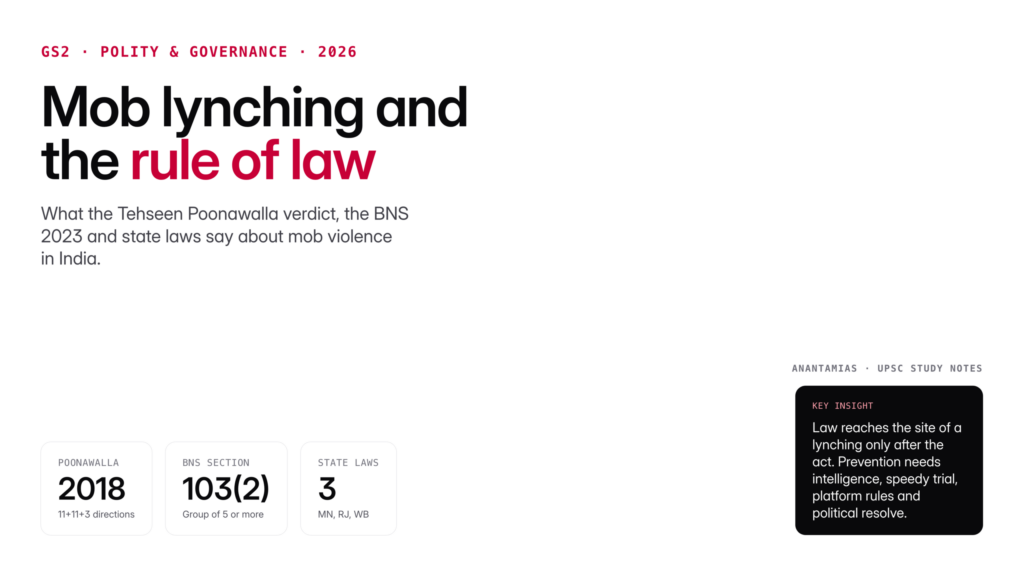
The first judicial recognition of mob lynching as a distinct category arrived in July 2018 when the Supreme Court delivered the Tehseen Poonawalla judgment, observing that “horrendous acts of mobocracy cannot be allowed to become the new normal.” The Court issued eleven preventive, eleven remedial and three punitive directions. Subsequently the Ministry of Home Affairs constituted a Group of Ministers under the then Home Minister Rajnath Singh. A draft anti-lynching law was circulated but never enacted as a stand-alone central statute. Manipur (2018), Rajasthan (2019) and West Bengal (2019) enacted state laws. With the Bharatiya Nyaya Sanhita 2023 replacing the IPC from July 2024, mob lynching has for the first time been specifically named in central criminal law.
Key Provisions
Defining the Offence
A working definition emerges from the Tehseen Poonawalla judgment and the Manipur Protection from Mob Violence Bill 2018. Mob lynching is any act of violence or aiding or abetting such an act, whether spontaneous or planned, by a mob (two or more persons, per the Manipur bill’s adopted definition) on grounds of religion, race, caste, sex, place of birth, language, dietary practices, sexual orientation, political affiliation, ethnicity or any other ground. The essence is an extra-judicial exercise of punitive force by a collective.
Section 103(2), Bharatiya Nyaya Sanhita 2023
The BNS, which replaced the Indian Penal Code of 1860 with effect from 1 July 2024, introduces for the first time a specific clause on mob lynching. Section 103(2) reads: “When a group of five or more persons acting in concert commits murder on the ground of race, caste or community, sex, place of birth, language, personal belief or any other similar ground, each member of such group shall be punished with death or with imprisonment for life, and shall also be liable to fine.” This is the first central statutory recognition of the offence.
Tehseen Poonawalla Guidelines
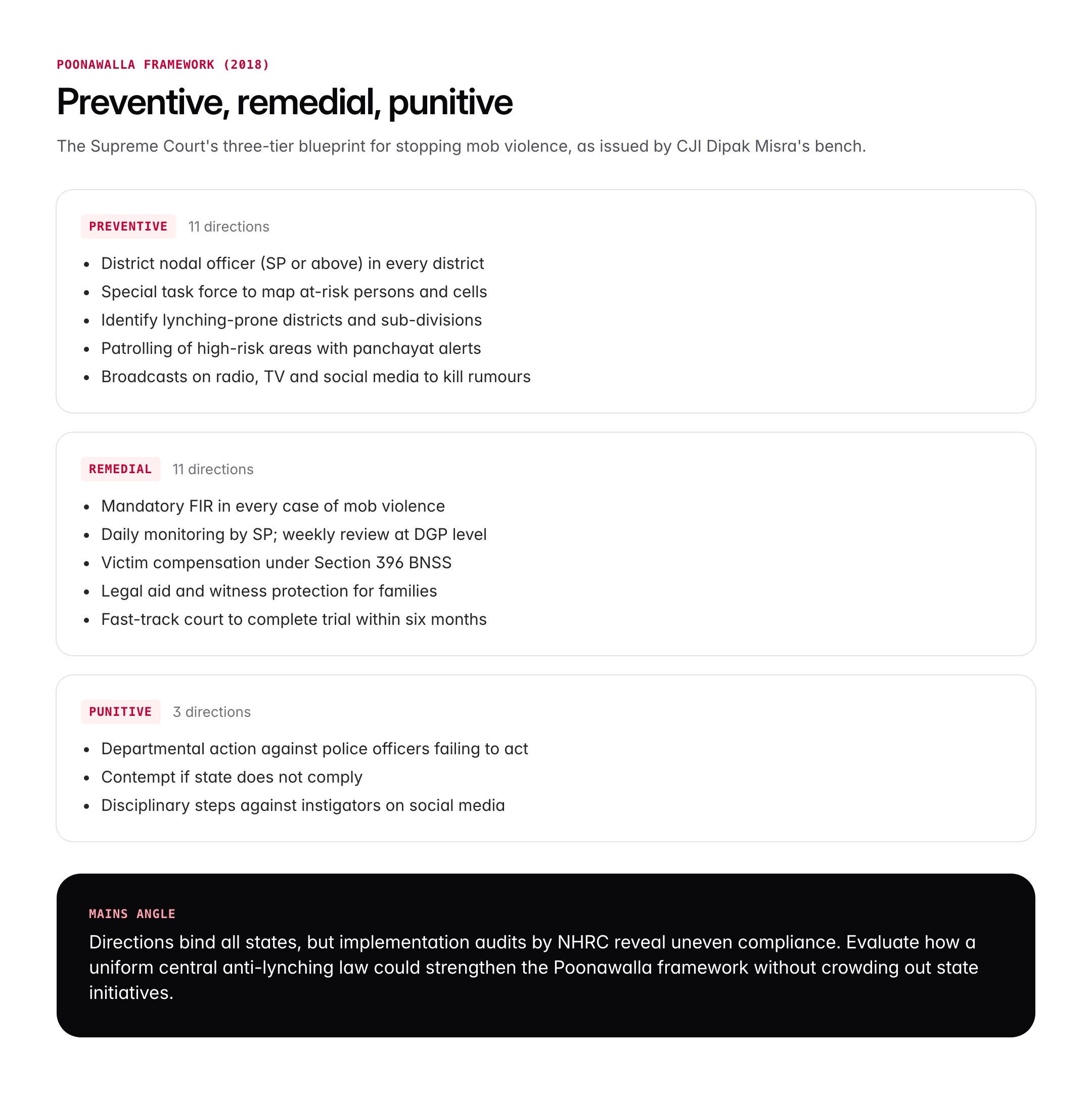
The Supreme Court’s preventive, remedial and punitive framework remains the governance template.
- Designation of a nodal officer not below Superintendent of Police in every district to prevent lynching.
- Special task forces to gather intelligence on persons likely to commit such offences.
- Identification of districts, sub-divisions and villages where lynching has occurred in the past five years.
- Registration of FIR under Section 153A IPC (now Section 196 BNS) and other relevant provisions where calls to violence are made.
- Broadcast of advisories on radio, television and social media to dispel rumours.
- Fast-track courts to complete lynching trials within six months.
- Victim compensation scheme under Section 357A CrPC (now Section 396 BNSS) with graded payouts.
- Departmental action against police officers failing to register FIR or prevent the incident.
State-Level Legislation
Three states have enacted dedicated anti-lynching laws. The Manipur Protection from Mob Violence Act 2018 defines mob, lynching and hostile environment and creates state and district monitoring authorities. The Rajasthan Protection from Lynching Act 2019 prescribes life imprisonment for lynching causing death and creates a special court in every district. The West Bengal (Prevention of Lynching) Act 2019 goes further, prescribing the death penalty and requiring free medical and legal aid for victims. None of these has yet received Presidential assent for full enforcement.
Digital Intermediary Obligations
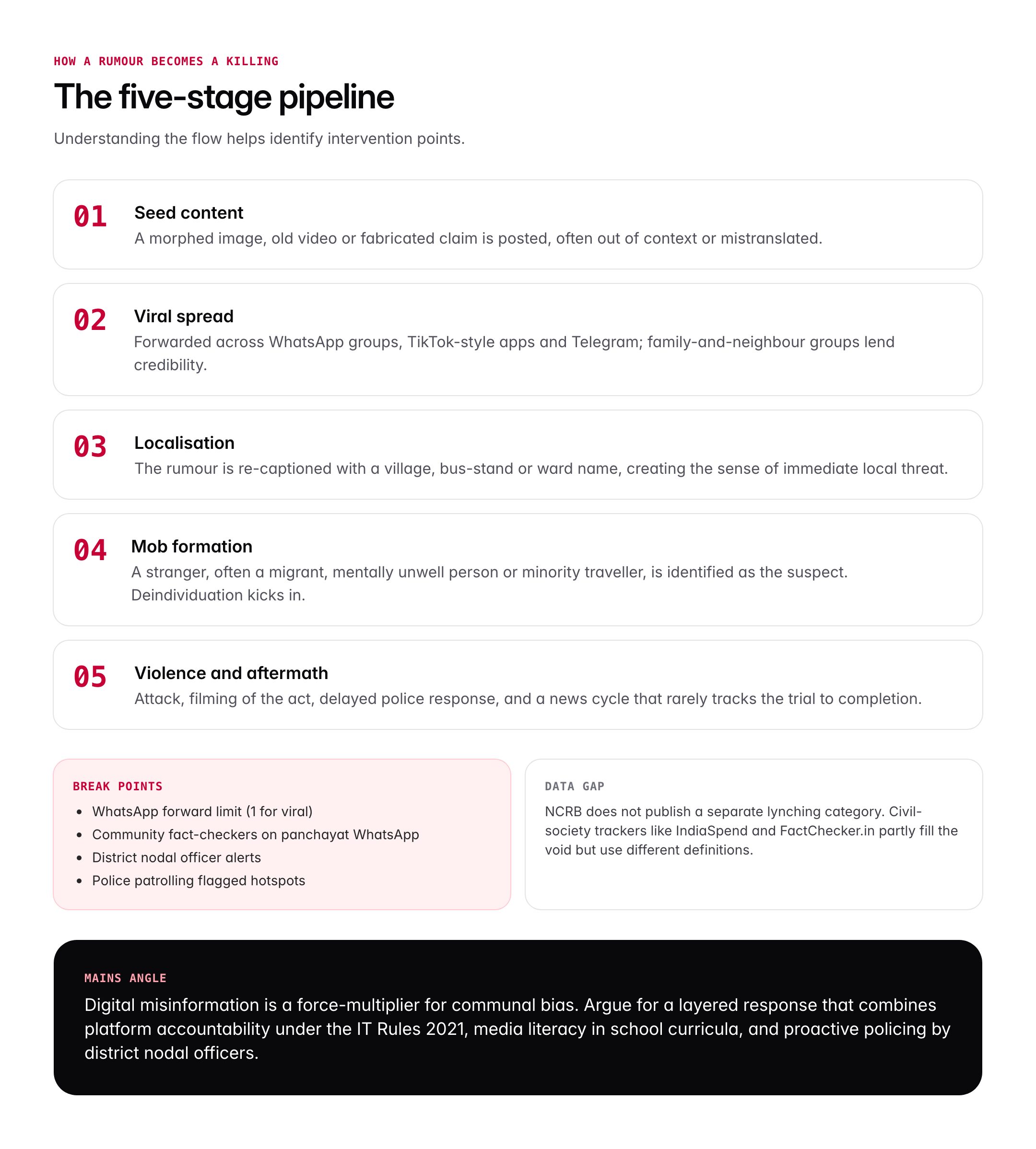
Following the 2018 WhatsApp-triggered killings, the Ministry of Electronics and Information Technology invoked Section 79 of the Information Technology Act 2000 and issued due-diligence notices. WhatsApp responded with the five-forward limit (reduced to one for viral messages in 2020), forward-tagging, and an in-India grievance officer. The IT (Intermediary Guidelines and Digital Media Ethics Code) Rules 2021 and subsequent amendments require significant social-media intermediaries to appoint a Chief Compliance Officer, Nodal Contact Person and Resident Grievance Officer.
Significance for UPSC and General Knowledge
- Direct Prelims utility: Tehseen Poonawalla case, BNS 103(2) specifics, state laws, IT Rules 2021.
- GS2 governance: centre-state friction in enacting a uniform anti-lynching law; Presidential assent delays.
- GS1 social issues: communalism, caste, digital misinformation, mob psychology.
- GS4 ethics: bystander behaviour, role of empathy, media ethics, police accountability.
- Essay relevance: rule of law, majoritarianism, social capital, gossip epistemology.
- Interview and personality-test: balancing free speech with harm prevention on digital platforms.
Detailed Analysis: Why Mobs Form and Kill
Structural Enablers
Social psychologists identify deindividuation, the loss of personal identity within a crowd, as a consistent enabler of collective violence. Physical anonymity, diffused responsibility and emotional contagion allow individuals to perform acts they would not attempt alone. Gustave Le Bon’s 1895 work The Crowd remains foundational; modern research by Steven Reicher on the elaborated social-identity model refines it by showing that mobs are not mindless but enact shared group identities.
In the Indian context, three structural enablers operate together. First, weak last-mile policing: a 2023 BPR&D report showed India has around 155 police personnel per 100,000 population against the UN-recommended 222, with rural beats particularly thin. Second, communal narrative ecosystems that pre-code out-groups as legitimate targets, lowering the psychic cost of violence. Third, digital rumour infrastructure, where WhatsApp forwards and short-video apps carry manipulated content without the gatekeeping of traditional media.
The Rumour Trigger
A 2018 BBC India research project on fake news in India analysed 40 WhatsApp user devices and found that nationalism, religion and morality were the three dominant drivers of message forwarding. Users did not verify because they trusted the source, usually a family or neighbourhood group, more than content. Rumours of child-kidnappers, cow-smugglers or “love jihad” typically have three parts: a graphic image or video, a claim of immediate local threat, and an exhortation to act. By the time police or fact-checkers respond, the violence is already underway.
Law Commission and NHRC Recommendations
The Law Commission of India’s 267th report (2017) on hate speech and subsequent internal notes recommended a new Section 153C and Section 505A in the IPC to criminalise incitement to hate. The Commission’s draft Protection from Lynching Bill, circulated in 2018, proposed a dedicated offence with graded punishment. The National Human Rights Commission issued advisories in 2018 and 2019 asking states to report on compliance with Tehseen Poonawalla. Parliamentary Standing Committee on Home Affairs (232nd report, 2020) asked the government to fast-track a central law. The BNS response in 2023 is a partial fulfilment of these recommendations, though critics say the absence of separate definitional, compensation and hostile-environment clauses leaves gaps.
Compensation and Rehabilitation
Section 396 of the Bharatiya Nagarik Suraksha Sanhita (BNSS) 2023 continues the victim-compensation scheme. State schemes differ: Rajasthan prescribes a minimum of Rs 5 lakh and relocation costs; Manipur references central scales. The NALSA Compensation Scheme for Women Victims/Survivors 2018 offers a template. In practice, compensation reaches families only after protracted follow-up, and rehabilitation beyond a one-time payout is rare.
Comparative Perspective
Anti-lynching law across selected democracies.
| Country | Specific Statute | Scope | Punishment |
|---|---|---|---|
| India (BNS 2023) | Section 103(2) | Group of 5+ killing on ground of identity | Death or life imprisonment + fine |
| United States | Emmett Till Antilynching Act 2022 | Federal hate-crime enhancement for conspiracy causing death | Up to 30 years imprisonment |
| United Kingdom | No dedicated statute | Covered under murder, affray, Public Order Act 1986 | Life (for murder) |
| South Africa | Criminal Matters Amendment Act 2015 | “Common purpose” doctrine plus hate-crime bill pending | Life imprisonment |
| Germany | Strafgesetzbuch Section 211 (murder) plus Section 130 (Volksverhetzung / incitement) | Murder with base motives includes racial motive | Life imprisonment |
| Brazil | Law 7.716/1989 plus hate-crime amendments | Racial discrimination and violence | Up to 5 years (varies) |
The Indian framework is now among the stricter in terms of prescribed punishment but lags on procedural supports such as hate-crime tracking, mandatory data publication and specialised prosecution.
Challenges and Criticisms
Three concerns dominate legal and civil-society commentary. First, the definitional gap: the BNS clause applies only when the mob commits murder; grievous hurt, public humiliation and intimidation short of death are handled under general provisions without the aggravated character of lynching being recognised. The Manipur and West Bengal laws cover this spectrum; the central provision does not. Second, data opacity: the National Crime Records Bureau (NCRB) does not maintain a separate category for mob lynching in its annual report, making independent verification difficult. Civil-society trackers fill the gap but have inconsistent methodologies.
Third, implementation weakness: five years after Tehseen Poonawalla, NHRC audits and media surveys suggest that nodal officers have been named in only some districts, fast-track courts are selectively constituted, and compensation disbursal is slow. The Ministry of Home Affairs reply to Parliament in December 2023 admitted that lynching data is not separately compiled. Critics also note that political rhetoric around cattle, conversion and food habits continues to normalise suspicion of identity-based groups, which no law can fully undo.
Prelims Pointers
- Tehseen S. Poonawalla v Union of India was decided on 17 July 2018 by a three-judge bench led by CJI Dipak Misra.
- The Court issued 11 preventive, 11 remedial and 3 punitive directions.
- The first central statutory recognition of mob lynching is Section 103(2) of the Bharatiya Nyaya Sanhita 2023.
- BNS Section 103(2) applies to a group of five or more persons acting in concert.
- Manipur (2018), Rajasthan (2019) and West Bengal (2019) have passed state anti-lynching laws.
- Right to life under Article 21 is the core constitutional guarantee at stake.
- WhatsApp’s five-forward limit was introduced in India in July 2018 and reduced to one for viral messages in April 2020.
- Section 196 BNS replaces Section 153A IPC on promoting enmity between groups.
- The Law Commission’s 267th report dealt with hate speech and recommended new IPC provisions.
- NCRB does not maintain a separate “mob lynching” category in its Crime in India report.
- Section 396 BNSS continues the victim-compensation scheme earlier under Section 357A CrPC.
- Gustave Le Bon’s theory of deindividuation is often cited in ethics and social-issue answers.
Mains Practice Questions
- “Mob lynching is a symptom of rule-of-law failure rather than a failure of criminal law alone. Critically examine in the light of the Tehseen Poonawalla judgment and the Bharatiya Nyaya Sanhita 2023.” (250 words, GS2)
- Explain the rule-of-law argument with Article 21 and the Court’s “mobocracy” framing.
- Examine the Poonawalla directions and BNS Section 103(2), noting coverage and gaps.
- Conclude on the need for intelligence, speedy trial, victim support and political messaging alongside law.
- “Discuss the role of digital misinformation in triggering mob violence in India. What regulatory, technological and civic responses can reduce the harm?” (250 words, GS3)
- Describe the rumour-to-violence pipeline with examples of 2018 WhatsApp-era killings.
- Assess IT Rules 2021, WhatsApp forward limits and grievance-officer framework.
- Suggest media literacy, fact-checker integration, and police-community interfaces.
Conclusion
Mob lynching in India is a test of every strand of the constitutional fabric: the police-led rule of law under Article 21, the federal balance that lets three states but not the Union enact dedicated legislation, the regulatory reach of the state over private digital platforms, and the ethical compass of citizens who choose to film rather than intervene. The Bharatiya Nyaya Sanhita has narrowed the legal gap, but law follows rather than leads social change.
For the aspirant, the topic is instructive because it rewards integration. A strong answer threads the Tehseen Poonawalla directions, the BNS provision, NCRB data gaps, the psychology of crowds, and the policy responses on platform regulation. Solving the lynching problem requires administrative capacity building, digital literacy, coherent state action and a political consensus that extra-judicial violence has no place in a constitutional democracy. Until those elements align, the law will continue to arrive after the funeral.
Frequently Asked Questions
What is mob lynching?
Mob lynching is the extra-judicial killing of a person by a group, whether spontaneous or planned, on grounds of identity or alleged offence. In India it is now recognised under Section 103(2) of the Bharatiya Nyaya Sanhita 2023 when committed by five or more persons acting in concert on grounds such as race, caste, community, sex, language or belief.
Why is mob lynching important for UPSC aspirants?
It links multiple segments of the syllabus: GS1 communalism and social change, GS2 rule of law and the Tehseen Poonawalla directions, GS3 internal security and digital misinformation, and GS4 ethics of bystander behaviour. It is a frequent interview topic and appears in Prelims through case-law and BNS provisions.
What did the Supreme Court say in the Tehseen Poonawalla case?
In July 2018 a three-judge bench led by CJI Dipak Misra issued eleven preventive, eleven remedial and three punitive directions. It asked states to appoint nodal officers, set up task forces, register FIRs against instigators, run fast-track courts, publish advisories against rumours, and compensate victims. The Court called mob violence ‘horrendous acts of mobocracy’.
How is mob lynching related to digital misinformation?
Many lynchings between 2018 and 2024 were triggered by rumours on WhatsApp and other social platforms, typically about child-lifting, cattle transport or inter-faith relationships. India responded with WhatsApp forward limits, the IT Intermediary Guidelines 2021, and requirements for compliance and grievance officers on large platforms.
Which Indian states have their own anti-lynching laws?
Manipur passed the Protection from Mob Violence Act in 2018, Rajasthan the Protection from Lynching Act in 2019, and West Bengal the Prevention of Lynching Act in 2019. The laws differ in definitions and penalties, ranging from life imprisonment to the death penalty, though Presidential assent has delayed full enforcement in some cases.
What does Section 103(2) of the BNS say?
Section 103(2) of the Bharatiya Nyaya Sanhita 2023 states that when a group of five or more persons acting in concert commits murder on grounds of race, caste, community, sex, place of birth, language, personal belief or similar ground, each member shall be punished with death or life imprisonment and fine. It is the first central statute naming the offence.
Does NCRB publish mob lynching data separately?
No. The National Crime Records Bureau does not maintain a separate category for mob lynching in its annual Crime in India report. Cases are logged under general offences like murder, rioting or culpable homicide. Civil-society trackers like IndiaSpend have attempted to fill the gap but methodologies vary.
How can mob lynching be prevented?
Prevention requires intelligence-led policing by district nodal officers, fast-track prosecution within six months as directed by Poonawalla, platform regulation to slow rumour spread, community fact-checking networks, public messaging against vigilantism, and victim-compensation schemes with clear timelines. Political leadership refusing to normalise identity-based suspicion is equally important.
Tell Google you want more of this.
Add Anantam IAS as a preferred sourceOne tap, and this site shows up more often in your own Top Stories, AI Overviews and AI Mode. Remove it any time.