Disclosure: this guide contains Amazon affiliate links. As an Amazon Associate, Anantam IAS earns from qualifying purchases — at no extra cost to you.
Introduction
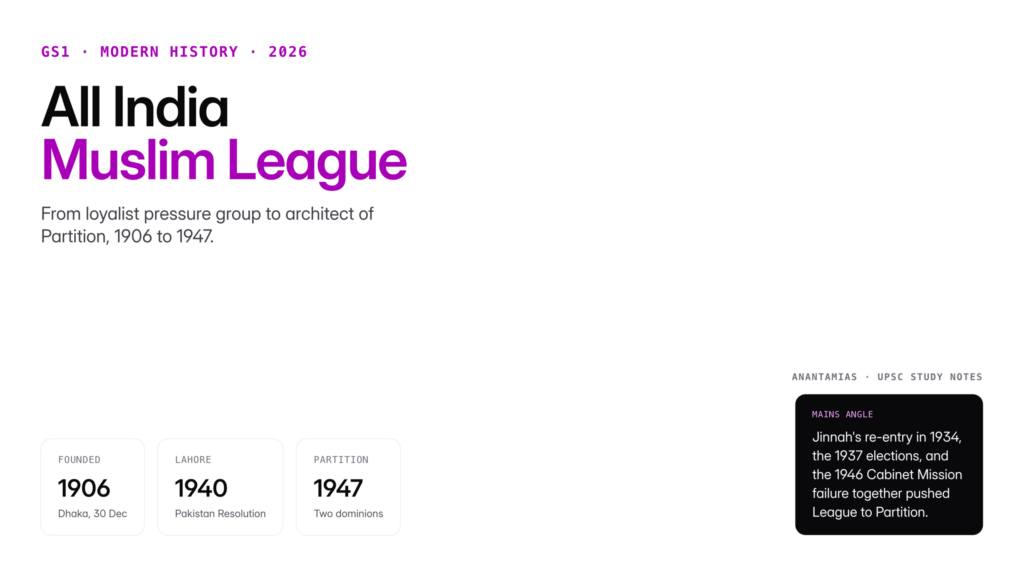
The All India Muslim League, founded in Dhaka on 30 December 1906, was the principal political organisation of Muslim interests in colonial India during the first half of the twentieth century. From a loyalist body of north Indian aristocrats seeking safeguards against Hindu majority rule, it evolved, by 1940, into the party that demanded a separate Muslim homeland, and by 1947 had achieved the Partition of India and the creation of Pakistan. Few political parties in modern South Asian history have had such a decisive impact on borders, demography, and collective memory.
For the UPSC aspirant, the Muslim League sits at the heart of the Modern Indian History syllabus. Prelims questions routinely test its founders, sessions, and resolutions. Mains answers on the freedom movement, communalism, and Partition cannot be written without understanding its trajectory. This guide covers the formation, evolution, key leaders, the Lahore Resolution, the role in Partition, and the criticisms that continue to animate historiographical debate.
Quick Facts at a Glance
| Parameter | Detail |
|---|---|
| Founded | 30 December 1906, Dhaka (then Dacca), Bengal Presidency |
| Venue | All India Muhammadan Educational Conference |
| Founders | Nawab Salimullah, Aga Khan III, Nawab Mohsin-ul-Mulk, Nawab Viqar-ul-Mulk |
| First president | Aga Khan III (Sir Sultan Muhammad Shah) |
| Key organiser | Nawab Salimullah of Dhaka |
| Key later leader | Muhammad Ali Jinnah (permanent president 1934-1948) |
| Watershed session | Lahore, 22-24 March 1940 |
| Outcome | Creation of Pakistan, 14 August 1947 |
| Post-1947 | Split into Muslim League (Pakistan), Indian Union Muslim League (IUML), Awami Muslim League (East Pakistan) |
Background and Historical Context
The late nineteenth century saw deepening anxiety among sections of the Muslim elite, especially in the United Provinces and Bengal, about their political and economic future under a representative system that would privilege the Hindu majority. Sir Syed Ahmad Khan’s Aligarh movement, founded in 1875 with the Muhammadan Anglo-Oriental College, sought education and partnership with the British rather than confrontation. After his death in 1898, the political wing of Aligarh fed directly into the demand for a separate Muslim party.
Two events crystallised that demand. First, the Partition of Bengal in 1905 under Lord Curzon created a new Muslim-majority province of Eastern Bengal and Assam, encouraging Muslim elites to see provincial autonomy as a possible safeguard. Second, the Simla Deputation of 1 October 1906, led by the Aga Khan, met Viceroy Lord Minto at Simla and secured a verbal promise of separate representation. Within three months, the All India Muslim League was founded in Dhaka.
In its early years, the League remained loyalist, accepting the leadership of British-friendly aristocrats. The Morley-Minto Reforms of 1909 granted separate electorates, the first constitutional entrenchment of communal representation. The Lucknow Pact of 1916, brokered by Jinnah and Tilak, showed a brief moment of Congress-League cooperation on joint demands for self-government with protected Muslim seats. The Khilafat movement of 1919-1924 further drew Muslims into the nationalist fold, but the Chauri Chaura incident and the abolition of the Caliphate ended that phase.
From the 1928 Nehru Report, which rejected separate electorates, onwards, relations between Congress and League became progressively more difficult. Jinnah’s Fourteen Points of 1929 were a last attempt at a constitutional compromise. The provincial elections of 1937, in which the League fared poorly and was excluded from coalition ministries, hardened Jinnah’s conviction that Muslims needed a separate homeland.
Key Features and Phases
Loyalist phase (1906-1913)
The League’s original objectives, spelled out in its 1906 constitution, were to promote loyalty to the British Crown, protect Muslim political rights, and prevent hostility toward other Indian communities. Membership was limited to Muslims and leadership was aristocratic.
Nationalist drift (1913-1928)
The entry of Muhammad Ali Jinnah, initially a Congressman, in 1913, and the influence of younger leaders shifted the League toward self-government. The Lucknow Pact, joint Khilafat agitation, and constitutional negotiations marked this phase. The 1913 constitution added the goal of self-government suitable to India.
Separate path (1928-1939)
After the Nehru Report rejected separate electorates and weighted representation, Jinnah’s Fourteen Points of 1929 and the Round Table Conferences of 1930-1932 failed to secure agreement. The 1937 elections, in which the Congress won most general seats and refused to share power in UP with the League, was a decisive turning point. Jinnah, who had returned from London in 1934, rebuilt the League into a mass party.
Pakistan phase (1940-1947)
The Lahore Resolution, moved by A K Fazlul Haq on 23 March 1940, called for independent states in Muslim-majority areas of north-west and north-east India. Though the word Pakistan was not in the text, it came to be known as the Pakistan Resolution. The League used the Second World War, the Direct Action Day of 16 August 1946, and the failure of the Cabinet Mission Plan to press for Partition. The Mountbatten Plan of 3 June 1947 conceded Partition, formalised by the Indian Independence Act 1947.
Significance for UPSC and General Knowledge
- Core topic in Modern Indian History for both Prelims and Mains
- Essential context for understanding communalism in GS1 Society
- Links to the Government of India Act 1935 and provincial elections
- Frequent source of factual Prelims questions on dates, sessions, and leaders
- Historiographical debate material for essay and interview
- Relevant to post-Independence secularism under Article 25-28
Detailed Analysis: Political Contributions and Turning Points
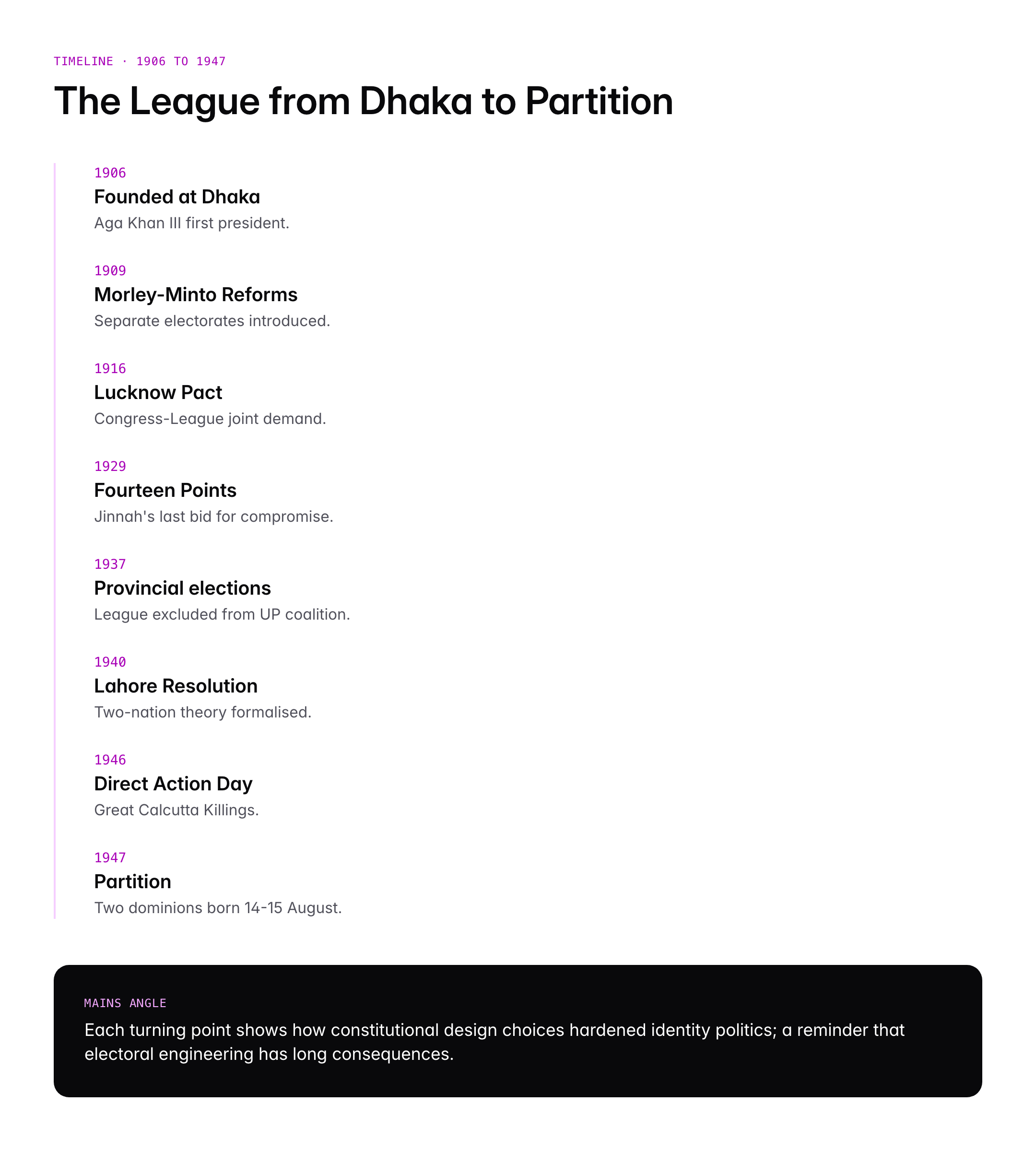
The League’s political journey is marked by decisive turning points that reshaped the subcontinent. The 1906 Dhaka foundation institutionalised Muslim political identity. The 1909 Morley-Minto Reforms enshrined separate electorates, a principle the League would defend for the next four decades. The 1916 Lucknow Pact showed the potential of Congress-League cooperation but was undone by competing visions of the Indian nation.
Jinnah’s re-entry as president in 1934 was pivotal. He reorganised provincial branches, secured a substantial win in the 1946 Central Assembly elections in reserved Muslim seats, and negotiated from a position of strength. The 1937 failure to enter UP coalition government has been debated ever since: Jawaharlal Nehru’s insistence on Congress discipline is seen by some historians as a missed opportunity, while others argue that the League’s demand for veto powers made cooperation impossible.
The Lahore Resolution 1940 marked the ideological break. Drawing on Allama Iqbal’s 1930 Allahabad address and Rahmat Ali’s 1933 Pakistan Declaration, Jinnah adopted the two-nation theory, arguing that Hindus and Muslims were two distinct nations with separate cultures, scripts, and histories. The Second World War allowed the League to negotiate directly with the British while Congress leaders were in jail after the Quit India Movement of 1942.
The Cabinet Mission Plan of 1946 offered a compromise: a three-tier federation with groupings of provinces. Jinnah initially accepted, but after Nehru’s Bombay press conference of July 1946 suggested flexibility on groupings, the League withdrew acceptance and called Direct Action Day on 16 August 1946. The resulting Great Calcutta Killings left thousands dead and convinced Viceroy Wavell and his successor Mountbatten that Partition was inevitable.
After 14-15 August 1947, the League ceased to exist as an all-India party. In Pakistan, it became the ruling Muslim League, later splitting into numerous factions. In India, a rump organisation became the Indian Union Muslim League, active mainly in Kerala and Tamil Nadu. In East Pakistan, the Awami Muslim League of H S Suhrawardy and Sheikh Mujibur Rahman eventually led the Bangladesh liberation movement.

Comparative Perspective
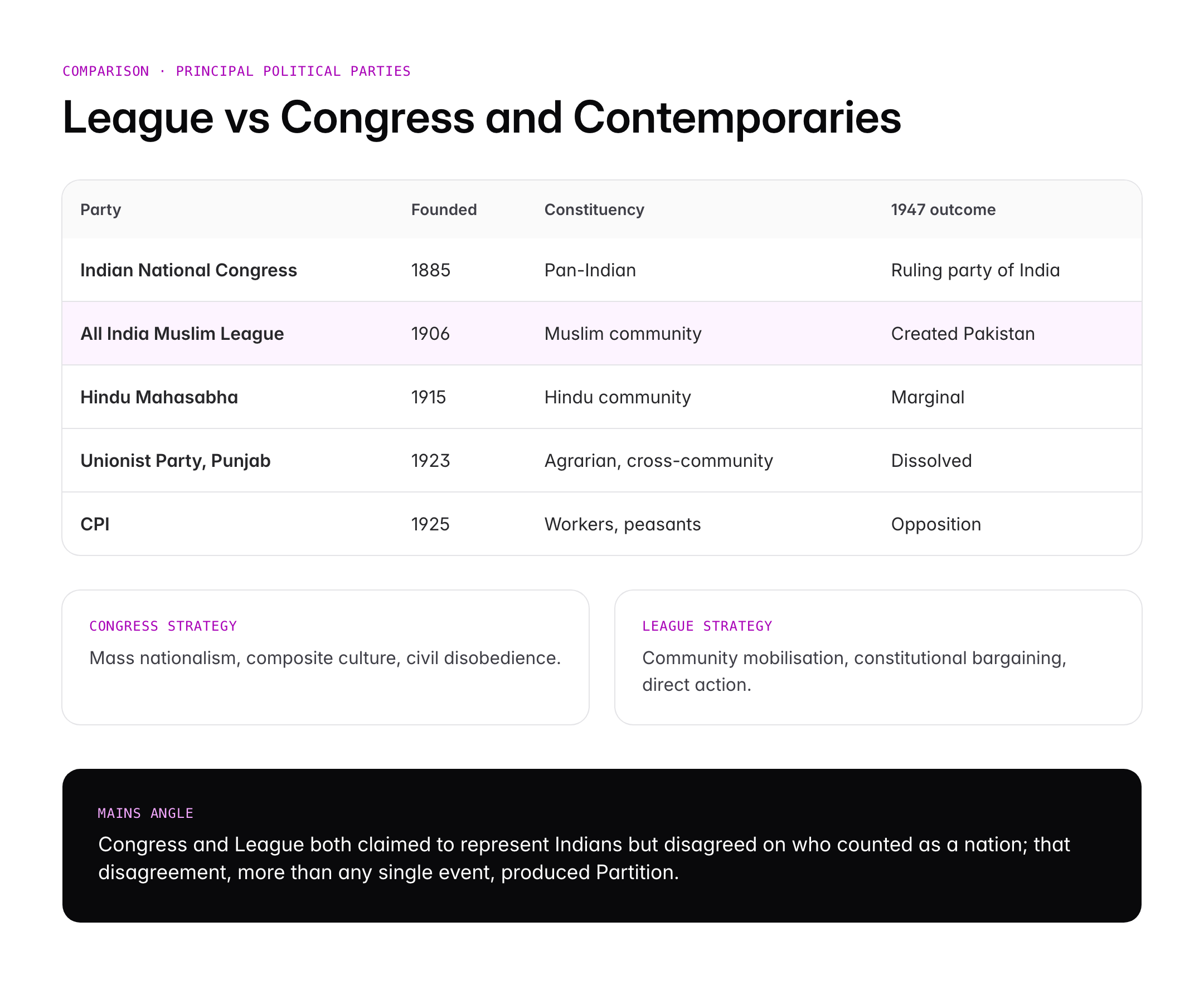
Comparison with contemporary political formations clarifies the League’s distinctive trajectory.
| Party | Founded | Core constituency | Final outcome |
|---|---|---|---|
| Indian National Congress | 1885 | Pan-Indian, multi-religious | Led Independent India |
| All India Muslim League | 1906 | Muslim aristocracy, later mass | Created Pakistan |
| Hindu Mahasabha | 1915 | Hindu community | Marginal after Independence |
| Communist Party of India | 1925 | Workers, peasants | Opposition in India |
| Unionist Party (Punjab) | 1923 | Cross-community agrarian | Dissolved after Partition |
The League’s unique feature was its success in moving from loyalist to mass mobilisation in barely a decade (1937-1947). Compared with the Hindu Mahasabha, which failed to capture the Hindu imagination, the League captured the Muslim imagination after 1940 through a simple, vivid demand.
Controversies and Debates
Historical debate on the League is fierce and ongoing. The one-nation versus two-nation argument continues. Nationalist historians such as R C Majumdar viewed the League as a communal instrument that enabled British divide-and-rule. Marxist historians such as Bipan Chandra placed communalism in a material framework of uneven development and elite insecurity. Revisionist historians such as Ayesha Jalal, in The Sole Spokesman (1985), argued that Jinnah used Pakistan as a bargaining chip for a loose federation and did not originally intend actual Partition.
A second debate concerns Congress responsibility. Some historians hold that Congress’s refusal to share power with the League in UP in 1937 pushed Jinnah into separatism. Others emphasise that the League’s demand for veto powers was incompatible with democratic government.
A third debate involves British complicity. The Morley-Minto separate electorates, the Communal Award of 1932, and Mountbatten’s hurried timetable all shaped outcomes. Yet the final choice for Partition was made by Indian political actors under extreme pressure.
A fourth debate is the human cost: the Partition produced one of the largest forced migrations in history, with estimated killings between five hundred thousand and two million, and twelve to fifteen million displaced.
Prelims Pointers
- All India Muslim League was founded on 30 December 1906 at Dhaka
- First president was Aga Khan III, Sir Sultan Muhammad Shah
- Simla Deputation of 1 October 1906 preceded the foundation
- Morley-Minto Reforms of 1909 granted separate electorates
- Lucknow Pact of 1916 was brokered by Jinnah and Tilak
- Jinnah’s Fourteen Points were presented in March 1929
- Lahore Resolution was moved by A K Fazlul Haq on 23 March 1940
- Direct Action Day was observed on 16 August 1946
- Cabinet Mission arrived in March 1946 under Pethick-Lawrence
- Mountbatten Plan announced Partition on 3 June 1947
- Indian Independence Act received royal assent on 18 July 1947
- Indian Union Muslim League is the post-Partition successor in India, active in Kerala
Mains Practice Questions
- “The All India Muslim League evolved from a loyalist pressure group to the architect of Partition.” Trace this evolution with reference to decisive events between 1906 and 1947.
- Phases: loyalist 1906-13, nationalist 1913-28, separatist 1928-39, Pakistan 1940-47
- Key events: Morley-Minto, Lucknow Pact, Nehru Report, 1937 elections, Lahore Resolution
- Conclude with role of Jinnah and two-nation theory
- Examine the historiographical debate on the responsibility for Partition. Was it an inevitable outcome of colonial policy or a failure of Indian political leadership?
- Present nationalist, Marxist, and revisionist Jalal views
- Analyse British divide-and-rule from Curzon to Mountbatten
- Weigh Congress-League bargaining failures of 1937 and 1946
Conclusion
The All India Muslim League was born in the loyalist twilight of the Mughal-era aristocracy and died at the stroke of Partition midnight, leaving behind two nation-states, three wars, and a still-contested memory. Its evolution from the Simla Deputation to the Lahore Resolution to the Mountbatten Plan is a compressed lesson in how constitutional politics, electoral arithmetic, ideology, and political entrepreneurship interact to produce outcomes that none of the participants fully intended.
For the UPSC aspirant, the League is not merely a chapter in a textbook but a live case study in minority politics, constitutional design, and the unintended consequences of communal representation. Any serious answer on Partition must reckon with the League’s founders, its Jinnah-era transformation, the Lahore Resolution, and the debates that still shape Indian secularism and federalism.
Frequently Asked Questions
What is the Muslim League?
The All India Muslim League was a political party founded at Dhaka on 30 December 1906 to safeguard the political rights of Muslims in colonial India. Initially loyalist and aristocratic, it transformed under Muhammad Ali Jinnah into a mass party that demanded Pakistan through the Lahore Resolution 1940 and achieved Partition in August 1947.
Why is the Muslim League important for UPSC?
The League is central to the Modern Indian History syllabus for GS1, appears regularly in Prelims questions on separate electorates, the Lucknow Pact, and the Lahore Resolution, and supplies essential context for GS1 communalism, GS2 federalism, and Essay papers on Partition and secularism.
How is the Muslim League related to the two-nation theory?
The two-nation theory, articulated by Allama Iqbal in 1930 and later by Jinnah after 1940, held that Hindus and Muslims were two distinct nations with different cultures, scripts, and histories. The Lahore Resolution of 1940 adopted this theory as the political basis for demanding separate Muslim states.
Who founded the All India Muslim League?
The League was founded at the All India Muhammadan Educational Conference in Dhaka on 30 December 1906. Key founders included Nawab Salimullah of Dhaka, Aga Khan III, Nawab Mohsin-ul-Mulk, and Nawab Viqar-ul-Mulk. Aga Khan III was its first president, serving from 1906 to 1912.
What was the Lahore Resolution?
The Lahore Resolution, moved by A K Fazlul Haq on 23 March 1940 at the 27th session of the Muslim League, called for the grouping of Muslim-majority areas into independent states. It did not explicitly use the word Pakistan but became known as the Pakistan Resolution and is commemorated as Pakistan Day on 23 March.
What was the role of Jinnah in the Muslim League?
Muhammad Ali Jinnah joined the League in 1913, brokered the Lucknow Pact of 1916, and after returning from London in 1934 became permanent president. Between 1937 and 1947 he rebuilt the League into a mass party, articulated the two-nation theory, and led negotiations that resulted in the creation of Pakistan.
What happened to the Muslim League after 1947?
After Partition the League split into multiple organisations. In Pakistan it became the ruling Muslim League, later fragmenting into several factions. In India a rump organisation became the Indian Union Muslim League (IUML), active mainly in Kerala and Tamil Nadu. In East Pakistan the Awami Muslim League eventually led Bangladesh’s liberation.
What were Jinnah’s Fourteen Points?
Presented in March 1929 in response to the Nehru Report, Jinnah’s Fourteen Points demanded a federal constitution, residuary powers with provinces, separate electorates, one-third Muslim representation at the Centre, protection of Muslim cultural and religious rights, and safeguards against majority domination. Their rejection pushed the League toward separatism.
Tell Google you want more of this.
Add Anantam IAS as a preferred sourceOne tap, and this site shows up more often in your own Top Stories, AI Overviews and AI Mode. Remove it any time.