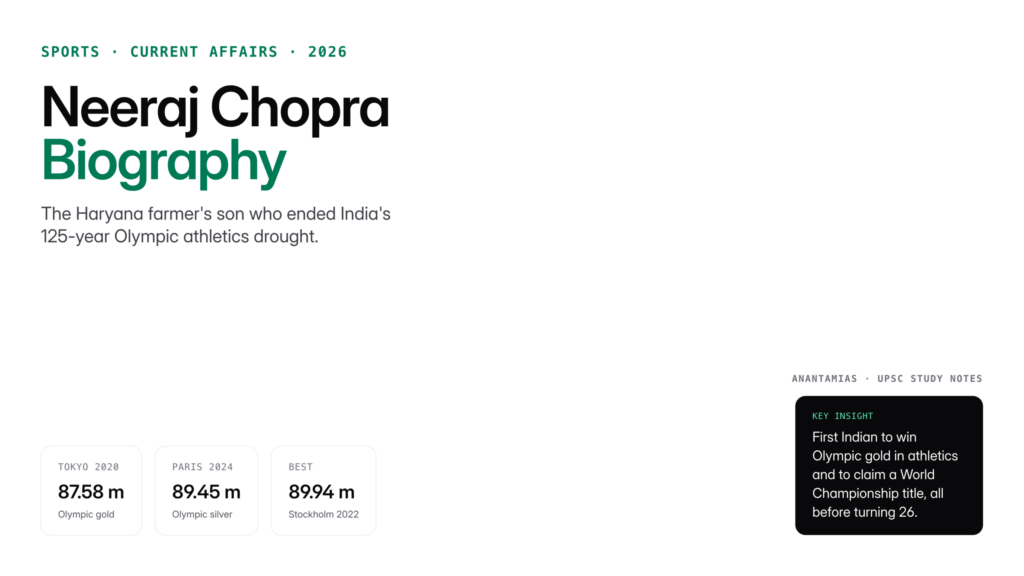
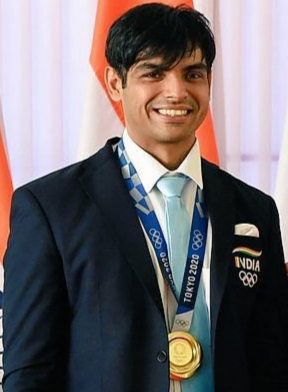
Neeraj Chopra is India's javelin champion and the first Indian to win an Olympic gold in athletics — throwing 87.58 m at Tokyo 2020 — followed by a World Championship gold (Budapest 2023) and an Olympic silver (Paris 2024). On 16 May 2025, at the Doha Diamond League, he crossed the 90-metre barrier for the first time with a 90.23 m Indian record, becoming the 25th man in history to breach 90 m. Born on 24 December 1997 in Khandra village, Haryana, he holds the rank of Subedar in the Indian Army.
Introduction
Neeraj Chopra’s life reads like a sporting screenplay written for a country starved of individual Olympic golds. A farmer’s son from the Haryana village of Khandra, he picked up a javelin at fourteen to lose weight and, inside a decade, became the first Indian in history to win an Olympic gold medal in athletics. His throw of 87.58 metres at the Tokyo 2020 final on 7 August 2021 ended a 125-year wait stretching back to Norman Pritchard’s silvers at the 1900 Paris Games.
For a UPSC aspirant, Chopra is more than a sports story. His career trajectory, training abroad under a German coach, national investment under the Target Olympic Podium Scheme, and repeated global titles, illustrates the modern state-athlete partnership that GS Paper 2 discusses under social sector schemes and GS Paper 1 treats under contribution to nation-building. His biography also appears regularly in essay prompts, Lok Sabha mentions, and current affairs quizzes.
Quick Facts at a Glance
| Attribute | Detail |
|---|---|
| Full name | Neeraj Chopra |
| Date of birth | 24 December 1997 |
| Place of birth | Khandra village, Panipat district, Haryana |
| Height | 1.78 m |
| Event | Men’s javelin throw |
| Personal best | 90.23 m — Indian record (Doha Diamond League, 16 May 2025) |
| Olympic gold | Tokyo 2020, javelin throw, 87.58 m |
| Olympic silver | Paris 2024, javelin throw, 89.45 m |
| World Championship gold | Budapest 2023, 88.17 m |
| Current rank | Indian Army subedar (Junior Commissioned Officer) |
| Awards | Major Dhyan Chand Khel Ratna 2021, Padma Shri 2022, Param Vishisht Seva Medal 2022 |
Background and Historical Context
Neeraj Chopra was born on 24 December 1997 in Khandra, a small village in Panipat district of Haryana, to Satish Kumar Chopra, a farmer, and Saroj Devi, a homemaker. The family belongs to the Ror community, a traditional agricultural group. As a child, Chopra was overweight and his family enrolled him at a local gym and the Shivaji Stadium in Panipat when he was around eleven, primarily to improve his fitness.
He first saw a javelin at the Shivaji Stadium, where senior throwers were training, and was drawn to the sport almost immediately. His early coaches, Jaiveer Chaudhary and later Naseem Ahmed, recognised an unusual combination of arm speed and technique in a boy whose family had no athletic background. By 2014 he had joined the Panchkula Tau Devi Lal Sports Complex as a trainee, moving later to the Sports Authority of India centre in Patiala.
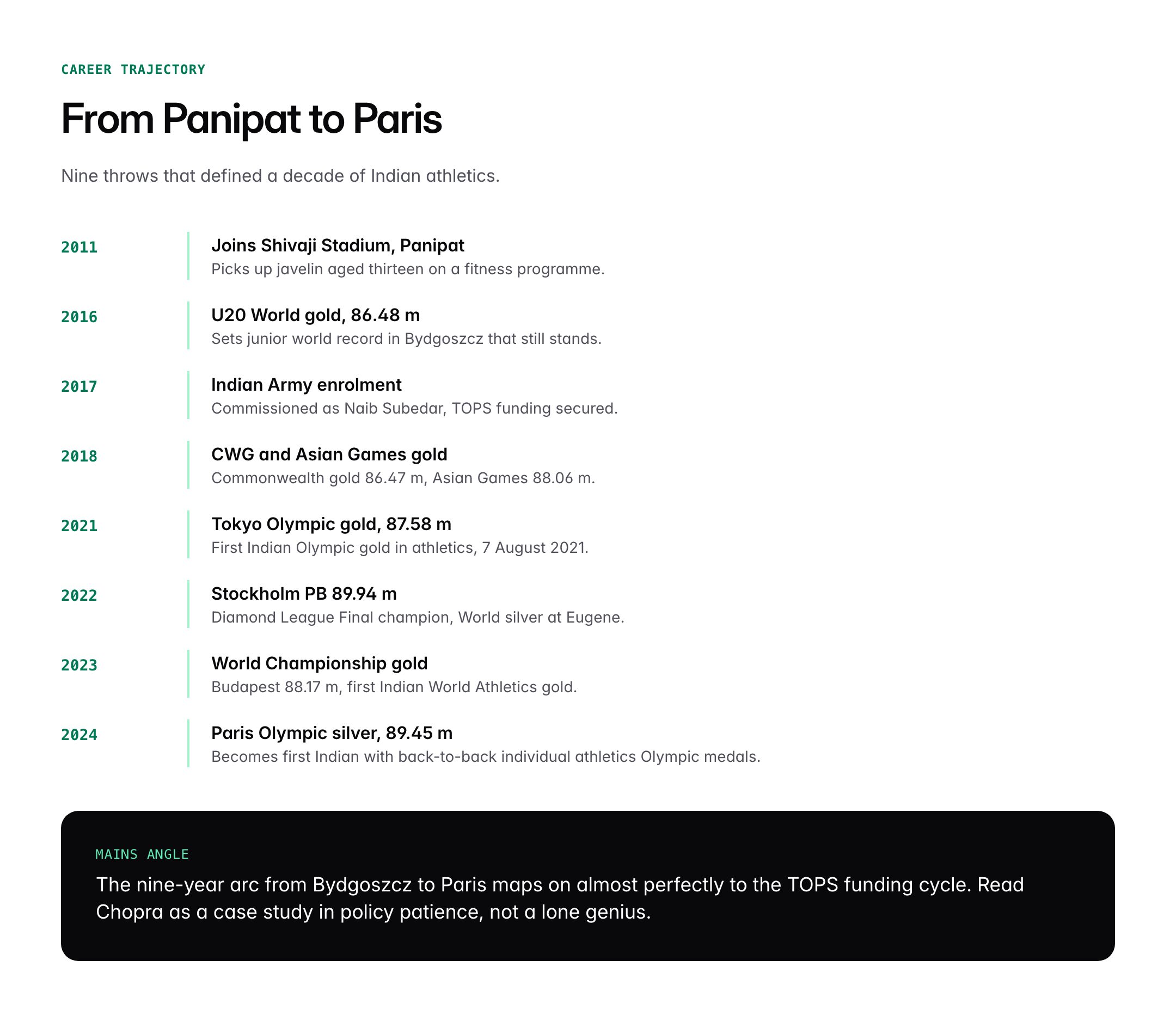
India’s broader javelin context matters for the story. Before Chopra, the sport had produced achievers like Kashinath Naik, who won bronze at the 2010 Commonwealth Games, but no global titles. The 2016 breakthrough came when Chopra, aged eighteen, threw 86.48 metres at the IAAF World U20 Championships in Bydgoszcz, Poland, setting a junior world record that remains unbroken. This single throw transformed him from a state-level prospect to a national prospect and secured institutional backing from the Indian Army, which enrolled him as a Naib Subedar in 2017, and from the Target Olympic Podium Scheme, under which he received funding for training in Finland, South Africa, and Germany.
From 2017 onwards, Chopra trained extensively under German biomechanics expert Klaus Bartonietz and physiotherapist Ishan Marwaha, building a technical model suited to his long arm and explosive blockside. This setup would carry him through the Commonwealth and Asian Games double of 2018, the Covid-interrupted 2019-2020 seasons, and ultimately to Tokyo.
Career and Major Achievements
Chopra’s career has three defined phases: junior ascent through 2016, senior consolidation from 2017 to 2020, and global dominance from Tokyo 2020 onwards.
Junior Breakthrough and Early Records
The 2016 World U20 throw of 86.48 metres in Bydgoszcz was not only a junior world record but a throw that would have medalled at the 2016 Rio Olympics. He followed it with a gold at the 2016 South Asian Games.
Commonwealth and Asian Double 2018
In 2018 Chopra won the Commonwealth Games gold at Gold Coast with 86.47 metres, becoming only the second Indian javelin thrower to stand on the Commonwealth podium. Four months later, at the Asian Games in Jakarta, he threw a then-national record 88.06 metres to win gold, the first Indian javelin gold at the Asian Games since 1982.
Tokyo 2020 Olympic Gold
On 7 August 2021, at the rescheduled Tokyo Olympics, Chopra threw 87.58 metres on his second attempt in the final and held the lead to win India’s first ever Olympic gold in athletics. The moment ended a drought stretching back to Abhinav Bindra’s individual gold in shooting at Beijing 2008 and was India’s only gold at Tokyo 2020.
Stockholm Personal Best
In June 2022 at the Stockholm Diamond League, Chopra launched what was then his personal best of 89.94 metres, placing him among the top throwers of the modern era and just short of the nine-zero mark that separates elite from legendary in javelin. That mark stood until his 90.23 m throw in Doha in 2025 (see below).
World Championship Gold 2023
At the Budapest World Athletics Championships on 27 August 2023, he became the first Indian to win a World Championship gold in athletics, throwing 88.17 metres. He had earlier won silver at Eugene 2022, his first World Championship medal.
Paris 2024 Silver
At the Paris 2024 Olympics on 8 August 2024, Chopra produced a season-best 89.45 metres in the final but was edged out by Pakistan’s Arshad Nadeem’s Olympic record 92.97 metres, winning silver. He became the first Indian to win two individual Olympic medals in athletics and one of only a handful of Indians to win back-to-back Olympic medals in the same individual event.
2025 Season: The First 90-Metre Throw
On 16 May 2025, at the Doha Diamond League, Chopra finally broke the ninety-metre barrier in competition with a throw of 90.23 metres, a new Indian record that made him only the 25th man in history to cross 90 m. He finished second in Doha behind Germany's Julian Weber (91.06 m). The season also saw him win the inaugural Neeraj Chopra Classic in Bengaluru in July 2025, along with victories at the Paris Diamond League and the Golden Spike meet in Ostrava.
The one setback came at the World Athletics Championships 2025 in Tokyo in September, where a back issue limited him to a best of 84.03 metres and an eighth-place finish, his first time off the podium at a major championship since 2018.
Other Milestones
He became the first Indian to win the Diamond League Final title in 2022 at Zurich. The Army promoted him to Subedar rank after Tokyo.
Significance for UPSC and General Knowledge
- First Indian to win Olympic gold in athletics (Tokyo 2020).
- First Indian to win a World Athletics Championship gold (Budapest 2023).
- First Indian to win two individual Olympic medals in athletics (Tokyo, Paris).
- Holds the Under-20 world record in javelin throw since 2016.
- Flagship beneficiary of the Target Olympic Podium Scheme illustrating state investment returns.
- Recipient of the Major Dhyan Chand Khel Ratna Award (2021) and Padma Shri (2022).
Detailed Analysis: Chopra and India’s Sports Policy
Chopra’s medals are the most visible dividends of a decade of Indian sports policy reform. Three strands of policy intersect in his story.
The first is the Target Olympic Podium Scheme, launched in 2014 by the Ministry of Youth Affairs and Sports. TOPS identifies athletes with podium potential and funds their foreign training, nutrition, equipment, and support staff. Chopra’s German coach, Finnish throwing camps, and physiotherapy team were funded through TOPS. The scheme also covers travel for domestic athletes to compete in the European circuit, where most elite javelin meets are held. The 2021 Tokyo medal tally, with seven total medals including one gold, was the clearest evidence that TOPS had begun to deliver.
The second strand is Khelo India, launched in 2018 to build a broader talent pipeline. Chopra himself predates Khelo India, but the scheme has since produced several junior javelin throwers training at Patiala and Bengaluru centres who cite him as a direct inspiration. The National Centre of Excellence at Patiala, where Chopra trained in his early senior years, has been upgraded under the Khelo India framework.
The third is institutional employment in the armed forces and public-sector undertakings. The Indian Army’s Sports Promotion Board, which enrolled Chopra in 2017, is the single largest institutional employer of Indian Olympic athletes. Air India, Indian Railways, and ONGC have similar programmes. This model, critiqued at times for tying athletes to quasi-government service, has nonetheless given talents like Chopra income stability, medical support, and logistical cover during long international seasons.
Chopra’s trajectory also illustrates the importance of foreign coaching. Klaus Bartonietz, a doctorate-holding biomechanist formerly with the German athletics federation, worked with Chopra on block mechanics and release angle. The partnership has been cited in parliamentary replies as a template for hiring foreign coaches across events.
Comparative Perspective
Placing Chopra within Indian and world javelin helps contextualise the scale of his achievement.
| Athlete | Country | Career best | Major titles |
|---|---|---|---|
| Jan Zelezny | Czech Republic | 98.48 m (1996) | 3 Olympic golds, 3 World titles |
| Johannes Vetter | Germany | 97.76 m (2020) | 1 World title 2017 |
| Andreas Thorkildsen | Norway | 91.59 m | 2 Olympic golds 2004, 2008 |
| Arshad Nadeem | Pakistan | 92.97 m (2024) | Olympic gold Paris 2024 |
| Neeraj Chopra | India | 89.94 m (2022) | Olympic gold 2020, World 2023 |
| Julius Yego | Kenya | 92.72 m (2015) | World gold 2015 |
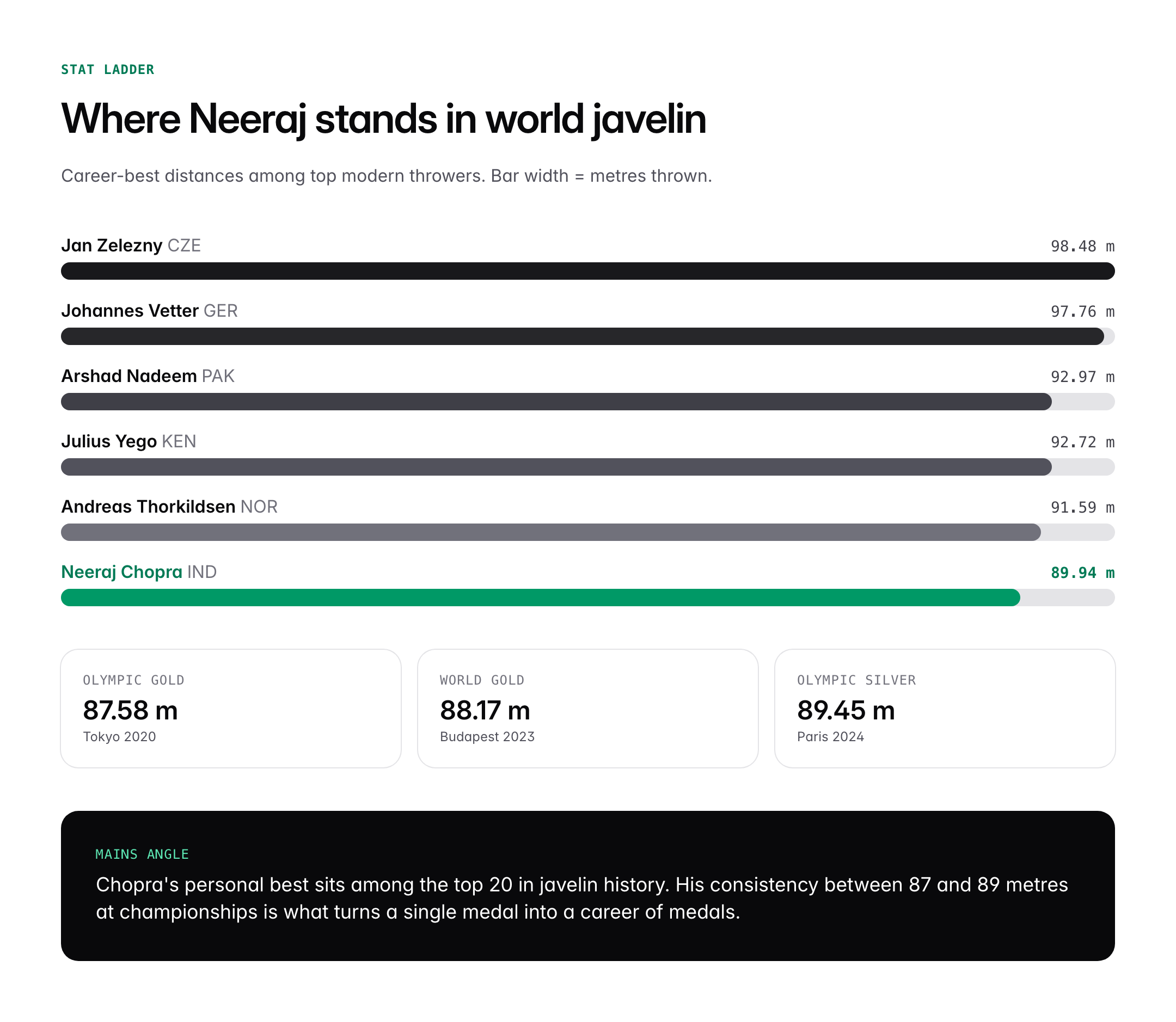
Chopra’s personal best sits below the top four ever but above historical Olympic gold thresholds. Every Olympic javelin gold since 2000 has been won with a best-of-series throw between 87 and 91 metres, which places Chopra squarely in the medal range and explains his consistency across Tokyo and Paris.
Challenges and Criticisms
Chopra’s career has not been without setbacks. A 2019 elbow surgery on his throwing arm kept him out for most of that season and cost him the World Championships that year. Observers questioned whether he would recover fully, and his return in early 2020 was interrupted by the Covid-19 pandemic.
A recurring groin and adductor strain has limited his 2023 and 2024 competition calendars. He skipped several Diamond League meets between Budapest and Paris to preserve fitness, which drew debate about whether top athletes should prioritise championship medals over circuit points. Chopra’s team has consistently argued for peaking at championships, a strategy vindicated by his Paris silver.
The absence of a ninety-metre throw in competition, as distinct from training, has been the persistent question mark. He has crossed the mark in practice but every competitive throw remains sub-ninety. Analysts point to the technical signature of his block leg and a slightly closed release as the margin, and he has spoken openly about the search for the additional metre.
Finally, the commercial side of his career has drawn mixed reactions. Brand endorsements worth several crores annually have made him one of India’s highest-paid athletes outside cricket, a rare breakthrough that critics argue has also increased schedule pressure and reduced recovery windows.
Prelims Pointers
- Born 24 December 1997 in Khandra village, Panipat district, Haryana.
- Event: javelin throw, right-handed.
- 2016 U20 World Championship gold in Bydgoszcz with 86.48 m (still a world junior record).
- 2018 Commonwealth Games gold at Gold Coast, 2018 Asian Games gold at Jakarta.
- 2020 Tokyo Olympic gold on 7 August 2021, throw of 87.58 m.
- First Indian Olympic gold in athletics.
- Personal best 90.23 m (Indian record) at Doha Diamond League, 16 May 2025; previous best 89.94 m at Stockholm, June 2022.
- Diamond League Final champion 2022 at Zurich.
- 2022 World Championship silver at Eugene.
- 2023 World Championship gold at Budapest, 88.17 m.
- 2024 Paris Olympic silver, 89.45 m.
- 2025: first 90 m throw in competition (90.23 m, Doha, 16 May 2025); won the inaugural Neeraj Chopra Classic; finished 8th at the 2025 World Championships in Tokyo.
- Major Dhyan Chand Khel Ratna 2021, Padma Shri 2022, Param Vishisht Seva Medal 2022.
Mains Practice Questions
Q1. Discuss how targeted sports funding schemes like the Target Olympic Podium Scheme have transformed India’s Olympic performance. Illustrate with the trajectory of Neeraj Chopra.
- Outline TOPS objectives, identification criteria, and budget framework.
- Trace Chopra’s career milestones funded under TOPS: German coaching, European circuit, medical support.
- Evaluate outcomes at Tokyo and Paris Games and identify gaps such as depth and para-athletics.
Q2. “Individual brilliance in sport rests on an institutional foundation.” Examine with reference to Neeraj Chopra and India’s sports ecosystem.
- Map the institutional layers: armed forces sports boards, SAI centres, state academies, Khelo India.
- Discuss private philanthropy and corporate endorsements.
- Argue for a balanced assessment of state support, family backing, and personal grit.
Conclusion
Neeraj Chopra’s biography compresses the arc of Indian sport into a single career. A village boy who learned to throw with a makeshift javelin has become the reference athlete for every Olympic cycle the country now plans. His Tokyo gold, Budapest world title, and Paris silver are milestones that redefined what Indian athletics can expect from its global entries.
For UPSC preparation, Chopra is a ready case study on state-athlete partnerships, policy continuity, and the slow returns of long-term funding. His career also offers a quieter lesson: that consistent performance at the absolute top of world sport is the product of years of unglamorous technical work, and that a single throw in a single stadium is always the visible tip of an invisible decade.
Frequently Asked Questions
Who is Neeraj Chopra?
Neeraj Chopra is an Indian javelin thrower born on 24 December 1997 in Khandra village, Panipat district, Haryana. He is the first Indian to win an Olympic gold in athletics, taking the title at Tokyo 2020, and the first Indian to win a World Athletics Championship gold, achieved at Budapest 2023. He currently holds the rank of Subedar in the Indian Army.
Why is Neeraj Chopra important for UPSC?
Neeraj Chopra appears in UPSC current affairs and essay papers as a flagship case of the Target Olympic Podium Scheme’s success. His career illustrates GS Paper 2 themes of state-athlete partnership and GS Paper 1 themes of contribution to nation-building. Candidates must know his medal tally, dates, and the sports policy framework that supported him.
How is Neeraj Chopra related to the Target Olympic Podium Scheme?
Chopra is among the most visible beneficiaries of the Target Olympic Podium Scheme launched in 2014. TOPS funded his training with German coach Klaus Bartonietz, European circuit participation, nutrition, medical support, and equipment. His Tokyo 2020 gold and Paris 2024 silver are frequently cited in parliamentary discussions as the clearest return on TOPS investment.
What is Neeraj Chopra’s personal best in javelin throw?
Neeraj Chopra’s personal best is 90.23 metres, an Indian record he set at the Doha Diamond League on 16 May 2025. It was his first competition throw beyond the ninety-metre barrier, making him only the 25th man in history to breach 90 m. His previous best was 89.94 metres, thrown at the Stockholm Diamond League on 30 June 2022.
When did Neeraj Chopra win his Olympic gold?
Neeraj Chopra won his Olympic gold at the Tokyo 2020 Games on 7 August 2021. He threw 87.58 metres on his second attempt in the men’s javelin final and held the lead through the remaining rounds. The gold was India’s first ever in athletics at any Olympics and the country’s only gold at the Tokyo Games.
What awards has Neeraj Chopra received?
Neeraj Chopra has received the Major Dhyan Chand Khel Ratna Award in 2021, India’s highest sporting honour, the Padma Shri in 2022 for his contribution to sport, and the Param Vishisht Seva Medal in 2022 in recognition of his service in the Indian Army. He also received the Arjuna Award in 2018 after his Commonwealth and Asian Games doubles.
How did Neeraj Chopra perform at the Paris 2024 Olympics?
At the Paris 2024 Olympics on 8 August 2024, Neeraj Chopra won silver in the men’s javelin throw with a season-best 89.45 metres. He was beaten by Pakistan’s Arshad Nadeem, who set an Olympic record of 92.97 metres. The silver made Chopra the first Indian to win two individual Olympic medals in athletics in successive Games.
Who is Neeraj Chopra’s coach?
Neeraj Chopra has trained under several coaches through his career, with German biomechanics expert Klaus Bartonietz serving as his long-term technical coach from 2019 onwards through the Tokyo and Paris Olympic cycles. Earlier coaches include Jaiveer Chaudhary and Naseem Ahmed, who introduced him to javelin at the Shivaji Stadium in Panipat, and Uwe Hohn briefly in 2017-18.
Tell Google you want more of this.
Add Anantam IAS as a preferred sourceOne tap, and this site shows up more often in your own Top Stories, AI Overviews and AI Mode. Remove it any time.