Disclosure: this guide contains Amazon affiliate links. As an Amazon Associate, Anantam IAS earns from qualifying purchases — at no extra cost to you.
Introduction
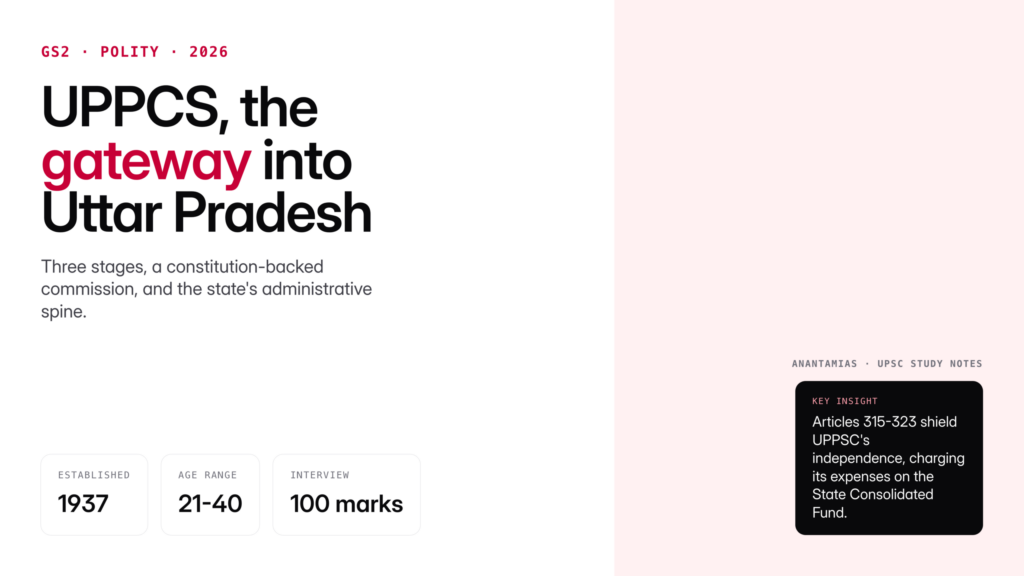
The Uttar Pradesh Public Service Commission, popularly addressed as UPPSC and its flagship recruitment as UPPCS, is the constitutional body that staffs Uttar Pradesh, India’s most populous state, with its core cadre of civil servants. For an aspirant, UPPCS is not just another state exam. It is the gateway into the administrative machinery of a state whose population rivals Brazil, whose districts outnumber many small countries, and whose governance challenges have long shaped the debates around cooperative federalism.
This guide walks through the architecture of the examination as it stands for the 2026 cycle. It covers the commission’s constitutional basis, eligibility, three-stage pattern, post-wise roles, cut-offs, interview weightage, and a realistic preparation strategy. Whether the reader is a first-time UPPCS candidate or a UPSC aspirant diversifying her risk, the goal here is to replace rumour with syllabus-anchored clarity.
Quick Facts at a Glance
| Parameter | Detail |
|---|---|
| Conducting body | Uttar Pradesh Public Service Commission (UPPSC), Prayagraj |
| Constitutional basis | Articles 315-323, Constitution of India |
| Established | 1 April 1937 (as United Provinces PSC) |
| Headquarters | 10, Kasturba Gandhi Marg, Prayagraj (Allahabad) |
| Exam stages | Prelims, Mains, Interview |
| Age limit | 21-40 years (relaxations apply) |
| Nationality | Indian citizen |
| Attempts | Unlimited till upper age limit (for General) |
| Medium | Hindi and English |
| Flagship post | Sub-Divisional Magistrate (SDM), PCS |
Background and Historical Context
The UPPSC traces its origin to the Lee Commission of 1923-24, which recommended a separate Public Service Commission for each province. Acting on the Government of India Act 1935, the United Provinces Public Service Commission was constituted on 1 April 1937, nearly a decade before Independence. When the United Provinces were renamed Uttar Pradesh in 1950, the commission was rebranded as the Uttar Pradesh Public Service Commission.
With the enforcement of the Constitution of India on 26 January 1950, the UPPSC acquired formal constitutional status under Articles 315 to 323, along with the chairman and members being insulated from arbitrary removal through a procedure that mirrors the removal of a Supreme Court judge. The commission’s independence, secured through security of tenure and charging its expenses on the Consolidated Fund of the State under Article 322, is the structural reason India has been able to run merit-based civil services even as political regimes change.
The UPPCS examination itself has evolved in tandem with the UPSC Civil Services Examination. A three-stage pattern, Prelims, Mains and Interview, was adopted in 1979, mirroring the Kothari Committee reforms. Major revisions came in 2018, when the mains pattern was aligned with UPSC CSE by introducing eight general studies papers with an optional subject dropped for most aspirants, and again in 2023-24 with refinements to essay paper structure and descriptive answer length. For 2026, the commission continues the UPSC-style template, making dual preparation feasible.
Key Features
Three-stage Examination Architecture
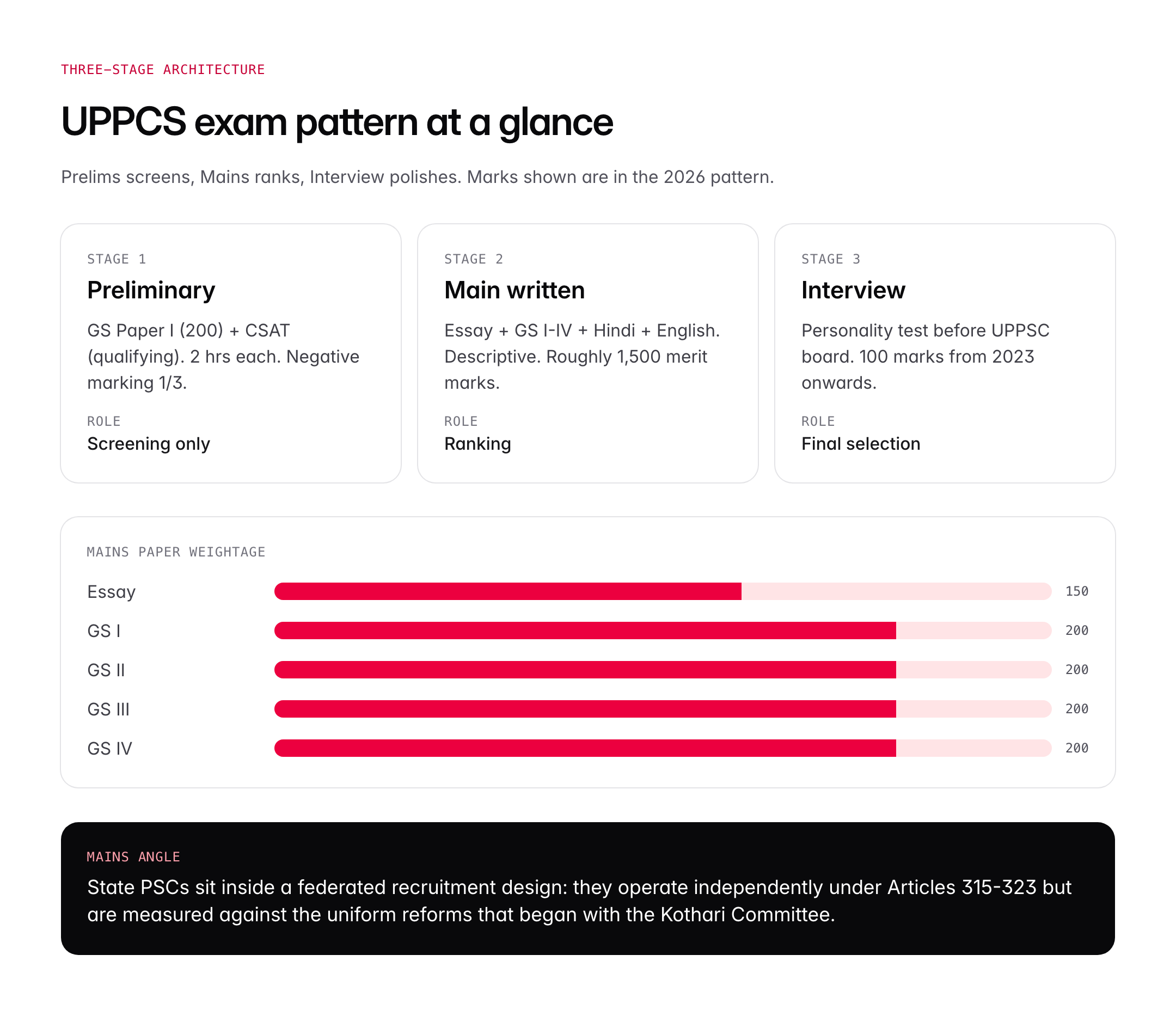
Preliminary Examination is a screening test of two objective papers, each of 200 marks and two hours duration. Paper I, General Studies, carries 150 questions and is treated as the merit paper. Paper II, CSAT, has 100 questions and is qualifying in nature with 33 per cent minimum marks. Negative marking is one-third per wrong answer.
Main Examination is a descriptive stage. The written papers are: one Essay paper, four General Studies papers, two compulsory language papers of Hindi and English, and in 2024 onwards an optional subject was removed for the general stream. Each GS paper carries 200 marks. The essay and GS1 to GS4 weight the mains to about 1,500 marks.
Interview or Personality Test is the final stage. It carries 100 marks from 2023 onwards, down from 200 in earlier cycles, deliberately reducing subjectivity.
Eligibility and Relaxations
The candidate must be an Indian citizen for most posts, though certain posts such as DSP require domicile conditions. Age eligibility is 21 to 40 years as on 1 July of the examination year. SC, ST, OBC non-creamy-layer, PwBD and ex-servicemen receive standard relaxations. The minimum educational qualification is a graduation degree from a recognised university, with final-year students permitted to appear provisionally.
Flagship Posts Covered
UPPCS recruits across Group A and Group B posts. The headline post is Sub-Divisional Magistrate or SDM, which places a young officer in charge of a sub-division covering several hundred villages. Other key assignments include Deputy Superintendent of Police (Dy SP), Block Development Officer (BDO), District Commandant Home Guards, Assistant Commissioner Commercial Tax, District Minority Welfare Officer and District Handicapped Welfare Officer.
Syllabus Outline
The prelims General Studies paper covers Indian history and freedom struggle, Indian and world geography, polity and governance, economy, environment and ecology, current events, general science and specific content on Uttar Pradesh. Mains GS1 to GS4 replicate the UPSC structure with added UP-centric questions, for example state administration, Bundelkhand, Purvanchal economy and UP history.
Significance for UPSC and General Knowledge
- UPPCS is a template example of how state PSCs exercise Article 320 powers over recruitment, appointment and disciplinary matters
- The exam’s shift to UPSC-style pattern illustrates the diffusion of Union Commission reforms into state administration
- Studying UPPCS posts clarifies the difference between All India Services, Central Services and State Services for Prelims polity
- Cut-off and vacancy trends feed into the debate on reservation, horizontal quotas and women’s representation in state cadres
- The commission’s working demonstrates cooperative federalism, since state PSCs complement but do not replicate the UPSC
- UP, with 75 districts and over 200 million people, is a natural case study for governance, welfare delivery and law and order Mains questions
Detailed Analysis: Exam Pattern, Cut-offs and Timelines
UPPCS typically runs on a near-annual cycle, with notifications released between January and April. The preliminary examination is usually held in May or June, the mains three to four months later between September and December, and interviews rolled out over the following quarter. Final results, depending on court matters and revaluation, appear twelve to eighteen months after notification.
Cut-off trends over the last five cycles show prelims General Studies cut-offs for unreserved candidates hovering between 115 and 135 out of 200. Mains cut-offs for the final list typically fall between 820 and 920 out of 1,500, while the final interview aggregate for selection has ranged from 920 to 1,020 out of 1,600 in the pre-2023 pattern and proportionally lower in the current 1,500 plus 100 pattern. These numbers move with paper difficulty and vacancy size, so aspirants should treat them as signal, not target.
Vacancy composition typically spans 250 to 450 posts per notification, with SDM and Dy SP slots being the most contested. Horizontal reservations for women, PwBD, ex-servicemen, dependents of freedom fighters and other categories apply across the vacancy pool and often change the effective cut-off for a subcategory candidate.
Answer key and revaluation practice at UPPSC has been strengthened after High Court interventions. The commission now publishes preliminary answer keys and invites objections within a window, and the UP Lokpal type mechanism through the Lokayukta has not been invoked for UPPSC scandals of the earlier decade, in part because digital workflows reduce leakage.
Comparative Perspective
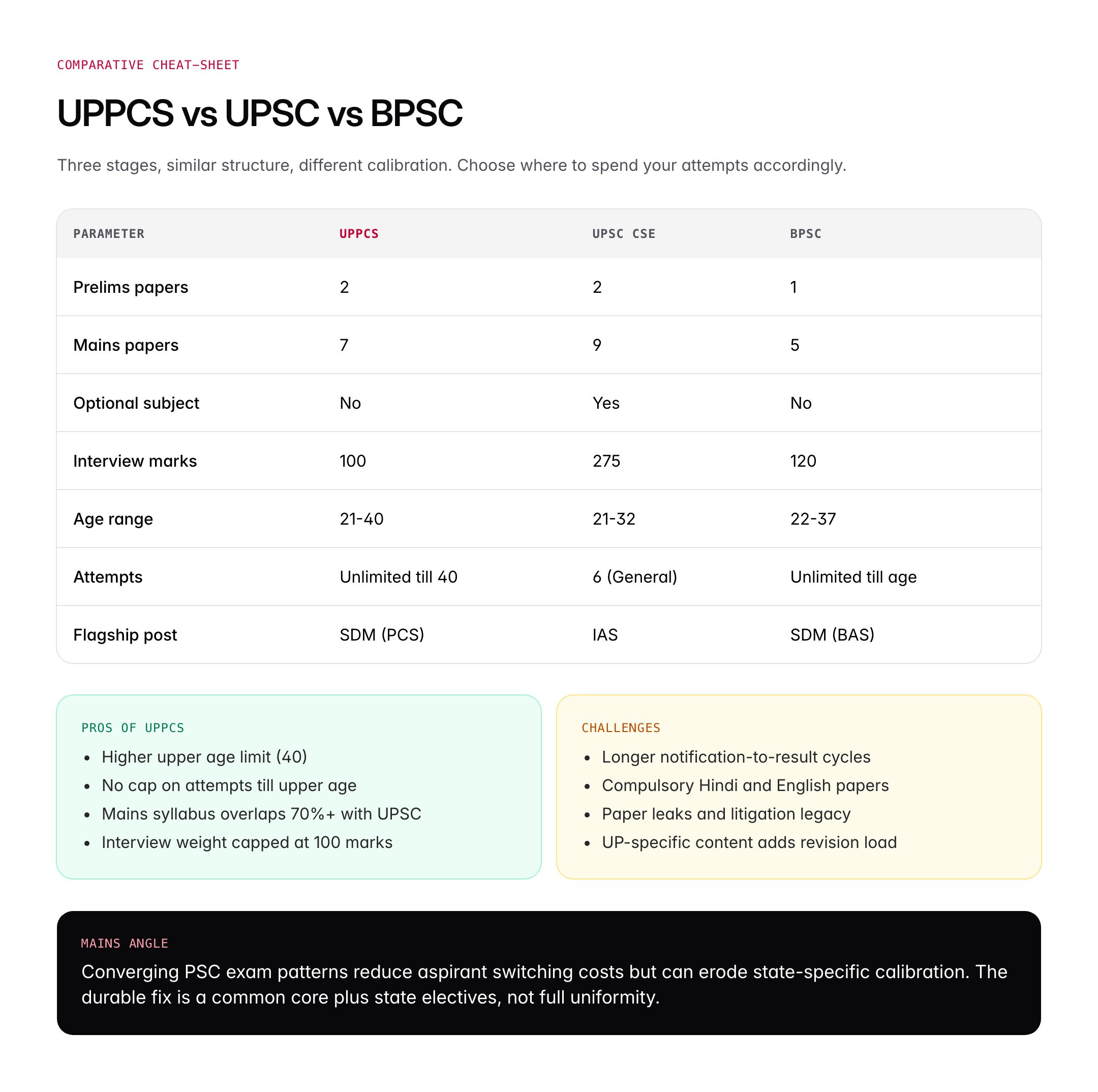
| Feature | UPSC CSE | UPPCS | BPSC (Bihar) |
|---|---|---|---|
| Stages | 3 | 3 | 3 |
| Prelims papers | 2 (GS + CSAT) | 2 (GS + CSAT) | 1 (GS only) |
| Mains papers | 9 (with optional) | 7 (no optional) | 5 |
| Interview marks | 275 | 100 | 120 |
| Flagship post | IAS | SDM, PCS | SDM, BAS |
| Age range | 21-32 | 21-40 | 22-37 |
| Attempts | 6 (General) | Unlimited till 40 | Unlimited till upper age |
UPPCS’s higher upper age ceiling is a significant difference, making it attractive for late starters or UPSC aspirants who have exhausted attempts. Its UPSC-aligned mains syllabus allows effective dual preparation, though UP-specific content and Hindi-English compulsory papers demand dedicated revision. BPSC remains lighter on mains structure but tougher on vacancy to applicant ratio.
Challenges and Criticisms
UPPCS has had a turbulent decade. Question paper leaks, OMR scanning disputes and allegations of scaling bias in mains evaluation have repeatedly landed the commission before the Allahabad High Court. The 2017 CBI inquiry into irregularities during a previous tenure remains a reference point in administrative law debates. Critics argue that notification-to-result cycles are too long, freezing aspirants in career limbo. Reform advocates demand a two-year calendar guarantee, digital marking, and public release of mains scaling methodology, echoing the Arvind Verma committee recommendations for state commissions.
On the other hand, UPPSC defenders point to the scale of operations. Handling over 500,000 applicants for the prelims, setting Hindi-English bilingual papers, and managing reservation across numerous horizontal categories is genuinely harder than in smaller states. The recent shift to normalised scoring, public answer keys and near-annual cycles is evidence of gradual course correction.
Prelims Pointers
- UPPSC was constituted on 1 April 1937 under the Government of India Act 1935
- Its constitutional basis is Articles 315 to 323 of the Constitution
- Expenses are charged on the Consolidated Fund of the State under Article 322
- Chairman and members are appointed by the Governor
- Removal procedure mirrors that of a Supreme Court judge under Article 317
- The headquarters is at Prayagraj, formerly Allahabad
- UPPCS Prelims has two objective papers with CSAT qualifying at 33 per cent
- Mains has one Essay, four GS, and two compulsory language papers (Hindi and English)
- Interview currently carries 100 marks, reduced from 200 in 2023
- Age eligibility is 21 to 40 years for the General category
- The flagship post recruited through UPPCS is Sub-Divisional Magistrate
- Annual report of UPPSC is tabled before the Governor under Article 323
Mains Practice Questions
Q1. The independence of State Public Service Commissions is a structural guarantee of merit-based recruitment. Examine with reference to UPPSC’s recent controversies. (250 words)
- Explain Articles 315-323, security of tenure under Article 317, Consolidated Fund of State linkage under Article 322
- Cite UPPSC controversies of the 2010s and High Court interventions as evidence of institutional strain
- Suggest reforms: fixed calendar, digital marking, transparent scaling, periodic performance audit by CAG
Q2. Compare the UPPCS and UPSC Civil Services Examination patterns and discuss whether a unified model is desirable. (250 words)
- Map differences in attempts, age, optional subject, interview weight and UP-specific content
- Weigh benefits of convergence for aspirant preparation against loss of state-specific calibration
- Conclude with a balanced view on harmonisation rather than uniformity
Conclusion
UPPCS is, in many ways, the most consequential state civil services examination in India. It recruits for the administrative spine of a state that alone sends 80 members to the Lok Sabha and drives national welfare metrics from maternal health to school enrolment. Understanding its structure is not only exam preparation, it is a lesson in how India’s constitutional scheme of public service commissions operates on the ground.
For aspirants, the message is pragmatic. Align the syllabus with UPSC CSE for leverage, layer UP-specific content for differentiation, write Hindi and English compulsory papers with discipline, and respect the exam’s shifting timelines. For citizens and analysts, UPPCS is a live case study in the reform of India’s meritocratic institutions, where incremental transparency, not headline overhauls, is quietly strengthening credibility.
Frequently Asked Questions
What is UPPCS?
UPPCS refers to the combined civil services examination conducted by the Uttar Pradesh Public Service Commission (UPPSC) to recruit Group A and Group B officers for the state. It has three stages: Preliminary, Mains and Interview. The flagship post recruited through UPPCS is Sub-Divisional Magistrate (SDM), along with Dy SP, BDO and various Assistant Commissioner posts.
Why is UPPCS important for UPSC aspirants?
UPPCS is important for UPSC aspirants because its mains syllabus closely mirrors UPSC Civil Services Examination, allowing effective dual preparation. Its higher upper age limit of 40 years and unlimited attempts make it a risk hedge for candidates who have exhausted UPSC attempts. Studying UPPCS also illustrates Articles 315-323 and state recruitment in real time.
How is UPPCS related to the UPSC Civil Services Examination?
Both exams follow a three-stage pattern and share a broadly similar general studies syllabus, but UPPCS recruits for the Uttar Pradesh state services while UPSC CSE recruits for All India Services and Central Services. UPPCS does not have an optional subject in the current pattern, has compulsory Hindi and English papers, and carries only 100 interview marks compared to UPSC’s 275.
What is the age limit for UPPCS 2026?
The age limit for UPPCS 2026 is 21 to 40 years as on 1 July of the examination year, for the General category. SC, ST, OBC non-creamy-layer, PwBD and ex-servicemen candidates receive standard relaxations as per Uttar Pradesh government rules. Final year graduation students can appear provisionally if they produce their degree before the mains document verification.
What posts are offered through UPPCS?
UPPCS offers over 40 post categories across Group A and Group B. The most sought-after are Sub-Divisional Magistrate, Deputy Superintendent of Police, Block Development Officer, Assistant Commissioner Commercial Tax, District Minority Welfare Officer, Assistant Regional Transport Officer, District Audit Officer and District Basic Education Officer. The exact basket is listed in each year’s notification.
What is the UPPCS prelims exam pattern?
UPPCS Prelims has two objective papers of 200 marks each, both two hours long. Paper I, General Studies, is the merit paper with 150 questions. Paper II, CSAT, has 100 questions and is qualifying in nature with a minimum of 33 per cent required. Negative marking is one-third per wrong answer, and only Paper I marks are used for the prelims cut-off.
How does UPPCS differ from BPSC?
UPPCS conducts a two-paper prelims, a seven-paper mains including compulsory Hindi and English, and a 100-mark interview. BPSC in Bihar has a single-paper prelims, five mains papers and a 120-mark interview. UPPCS’s mains is heavier and more aligned with UPSC CSE, while BPSC has traditionally been lighter on structure but tougher on vacancy-to-applicant ratio.
What is the constitutional basis of UPPSC?
UPPSC derives its constitutional authority from Articles 315 to 323 of the Constitution. Article 315 mandates a PSC for each state, Article 316 covers appointment and tenure, Article 317 specifies the removal procedure which mirrors a Supreme Court judge, Article 320 lists functions, Article 322 charges expenses on the State Consolidated Fund, and Article 323 mandates the annual report before the Governor.
Tell Google you want more of this.
Add Anantam IAS as a preferred sourceOne tap, and this site shows up more often in your own Top Stories, AI Overviews and AI Mode. Remove it any time.