Introduction
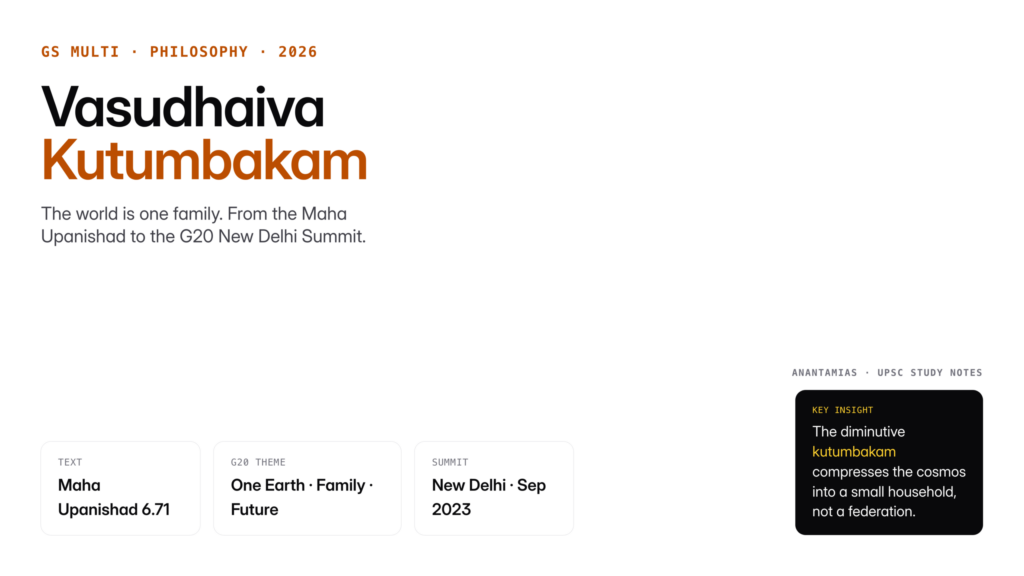
Vasudhaiva Kutumbakam, the Sanskrit phrase meaning “the world is one family,” travelled from a stanza of the Maha Upanishad to the carved sandstone wall of the Parliament of India, and then on to the branding of India’s G20 Presidency in 2023. It is one of those rare classical aphorisms that has outlived its textual context to become a lived principle of Indian diplomacy, constitutional ethos and civilisational self-understanding.
For the UPSC aspirant, the phrase is not merely a quotation to memorise. It sits at the intersection of GS1 (Indian culture and classical philosophy), GS2 (India’s foreign policy and multilateral engagement), GS3 (global commons such as climate, vaccines and food security) and GS4 (Ethics, with its emphasis on universal human values). Understanding its origin, semantic depth, historical reception and contemporary deployment gives aspirants a single, powerful thread they can pull through prelims factoids, mains essays and interview answers on India’s global vision.
Quick Facts at a Glance
| Attribute | Detail |
|---|---|
| Sanskrit phrase | वसुधैव कुटुम्बकम् (Vasudhaiva Kutumbakam) |
| Literal meaning | “The earth (Vasudha) is verily (eva) a family (Kutumbakam)” |
| Primary source | Maha Upanishad, Chapter 6, verse 71-73 |
| Other attributions | Hitopadesha, Panchatantra, Bhagavata Purana |
| Parliament inscription | Central Hall of old Parliament House, New Delhi |
| G20 India theme year | 2023 (1 December 2022 to 30 November 2023) |
| Official G20 theme | “One Earth, One Family, One Future” |
| Host summit | New Delhi Leaders’ Summit, 9-10 September 2023 |
| Appears in | Modern PM speeches, UN addresses, Indian postage stamps |
Background and Historical Context
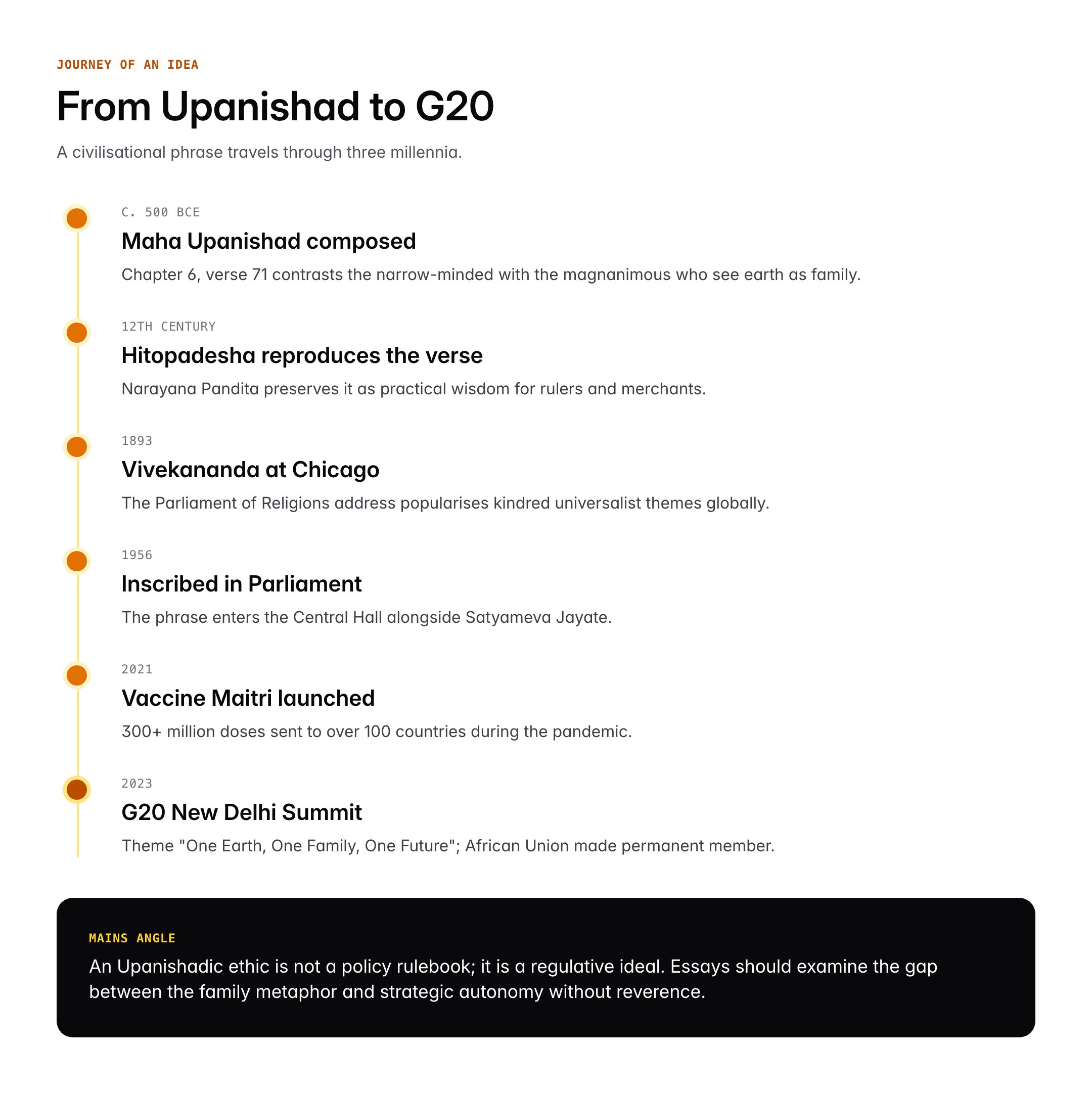
The earliest unambiguous appearance of Vasudhaiva Kutumbakam is in the Maha Upanishad, a late Upanishadic text belonging to the Samaveda tradition. The full verse distinguishes the petty-minded, who ask “is this one ours or a stranger,” from the magnanimous, for whom the whole earth is a family. The phrase therefore arrives not as a slogan of cosmopolitan universalism but as an ethical benchmark set against narrow tribalism.
The same idea travels through Indian literature. The Hitopadesha, a twelfth-century Sanskrit text of animal fables compiled by Narayana Pandita, reproduces the verse as practical wisdom for rulers. The Panchatantra carries cognate formulations. In the Bhagavata Purana, the spirit of treating all beings as extensions of the self is worked into devotional theology. Across these texts, the phrase moves between philosophical, didactic and devotional registers, which is one reason it has proven so portable.
In modern India, Vasudhaiva Kutumbakam was consciously resurrected by nationalist thinkers seeking an indigenous vocabulary for internationalism. Swami Vivekananda invoked the sentiment in his 1893 Chicago address on religious tolerance. Rabindranath Tagore’s Viswa Bharati, founded in 1921, took “Yatra Visvam Bhavatyekanidam” as its motto, a sister formulation meaning “where the whole world makes its one nest.” In 1956, the inscription वसुधैव कुटुम्बकम् was placed in the Central Hall of Parliament, marking it as part of the constitutional imagination of the republic. It has since appeared in speeches at the United Nations, including Prime Ministerial addresses to the General Assembly, and in the visual identity of India’s G20 Presidency.
Key Features and Provisions
Linguistic structure
The compound breaks into three Sanskrit elements. Vasudha means “she who holds wealth,” a classical epithet of the earth. Eva is an emphatic particle meaning “verily” or “indeed.” Kutumbakam is the diminutive neuter of kutumba, meaning “a small family” or “household.” The diminutive is critical. The phrase does not say the world is a vast federation; it says the world is a small, intimate household, a claim that compresses cosmic scale into domestic warmth.
Textual home in the Maha Upanishad
The surrounding verse reads, in rough translation, “This is mine, that is another’s, so say the narrow-minded. For the magnanimous, the entire world is a family.” The ethical move is comparative. Vasudhaiva Kutumbakam is offered as the worldview of the udara-charita, the person of expansive conduct, not as a metaphysical proposition about identity. This distinguishes it from monistic Advaita claims of non-difference.
Constitutional and civic adoption
The inscription in the old Parliament’s Central Hall places the phrase alongside other mottoes such as “Satyameva Jayate” from the Mundaka Upanishad. Together they form an indigenous constitutional grammar that supplements the formally secular text of the Constitution with civilisational vocabulary.
G20 Presidency 2023
India assumed the G20 Presidency on 1 December 2022 and handed over to Brazil on 30 November 2023. The official theme, “One Earth, One Family, One Future,” is a direct rendering of Vasudhaiva Kutumbakam. The three pillars mapped to environmental sustainability (One Earth), inclusive growth and human development (One Family) and technology-led futures including digital public infrastructure (One Future). The New Delhi Leaders’ Declaration of 9 September 2023 secured consensus on issues ranging from the African Union’s permanent G20 membership to the Global Biofuels Alliance.
Diplomatic deployment
Vasudhaiva Kutumbakam has been invoked to frame Vaccine Maitri during the Covid-19 pandemic, Operation Ganga evacuations from Ukraine, HADR missions such as Operation Dost in Turkey and Syria after the 2023 earthquakes, and the International Solar Alliance. It is India’s preferred civilisational brand for South-South cooperation.
Significance for UPSC and General Knowledge
- Directly quotable in GS1 answers on Indian philosophy, classical literature and the cultural continuity of civilisational concepts.
- Central to GS2 questions on India’s foreign policy, multilateralism, G20, UN reform and Global South leadership.
- Supports GS3 answers on climate action, disaster management and global public goods such as vaccines and digital public infrastructure.
- Essential GS4 reference for universal human values, compassion and non-discrimination in public ethics.
- High-value Essay paper phrase, often used as opening or closing motif in essays on globalisation, climate and India’s role in the world.
- Frequent Prelims trigger through current affairs linkage to G20, ISA, CDRI and Vaccine Maitri.
Detailed Analysis: Diplomatic Contributions
The operational utility of Vasudhaiva Kutumbakam lies in its ability to reconcile two otherwise competing strands of Indian foreign policy. On one side is strategic autonomy, an inheritance from the non-aligned tradition that values sovereign independence and resists bloc politics. On the other is an increasingly activist multilateralism, expressed through coalitions such as the International Solar Alliance (2015), the Coalition for Disaster Resilient Infrastructure (2019) and the Global Biofuels Alliance (2023). The phrase binds these together by presenting solidarity not as alignment but as kinship.
During India’s G20 Presidency, the doctrine translated into three concrete deliverables. First, the permanent induction of the African Union as a G20 member at the New Delhi Summit expanded the forum’s representativeness in a manner consistent with the family metaphor. Second, the Global Biofuels Alliance, co-founded by India, the United States and Brazil with 19 participating countries, operationalised “One Earth” by targeting decarbonisation of the transport sector. Third, the endorsement of Digital Public Infrastructure principles drew on India’s own Aadhaar, UPI and CoWIN stack to propose technology transfer to developing economies, realising “One Future.”
Vaccine Maitri, launched on 20 January 2021, remains the most cited pandemic-era expression of the doctrine. India supplied over 300 million doses of Covid-19 vaccines to more than 100 countries through grants, commercial exports and COVAX contributions before a domestic surge necessitated pause. The Voice of Global South Summit convened virtually in January and November 2023 brought together 125 developing countries in two editions, offering a platform distinct from both the G7 and G77 and explicitly framed through Vasudhaiva Kutumbakam.
Beyond grand strategy, the phrase informs humanitarian assistance and disaster relief operations. Operation Dost deployed NDRF teams, field hospitals and over 250 tonnes of relief material to Turkey and Syria within 36 hours of the February 2023 earthquakes. Operation Ganga, in February and March 2022, evacuated over 22,500 Indian and third-country nationals from Ukraine. In both cases, Ministry of External Affairs communications explicitly grounded the operations in the Vasudhaiva Kutumbakam tradition.
Comparative Perspective
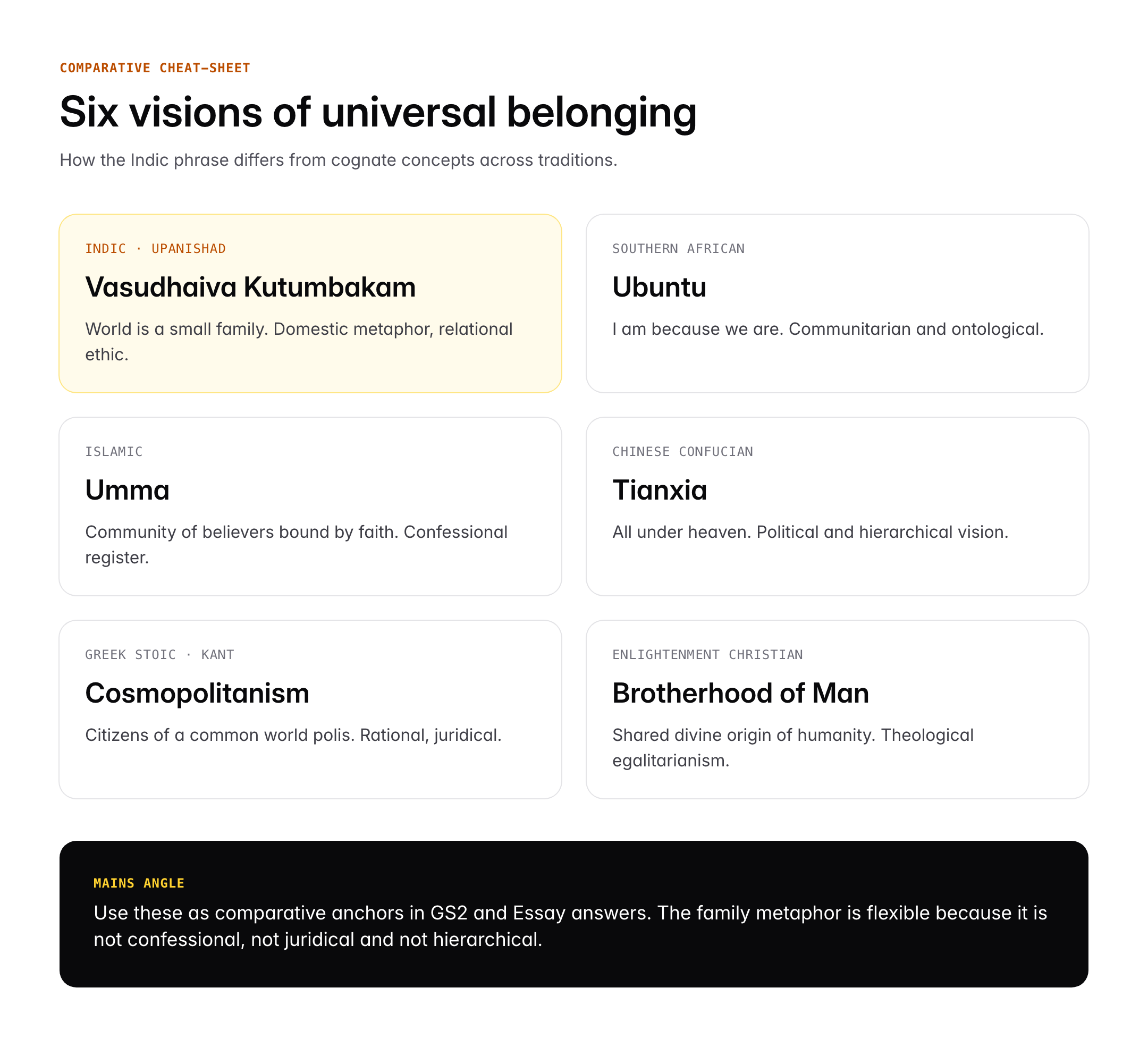
Vasudhaiva Kutumbakam is not unique in offering a universal ethic, but it differs in register from cognate concepts in other traditions. The comparison is instructive because UPSC essays and GS2 answers often test the ability to place Indian concepts in a global frame.
| Concept | Tradition | Core claim | Primary register |
|---|---|---|---|
| Vasudhaiva Kutumbakam | Indic, Maha Upanishad | World is a small family | Ethical, relational |
| Ubuntu | Southern African | I am because we are | Communitarian, ontological |
| Umma | Islamic | Community of believers bound by faith | Religious, confessional |
| Tianxia | Chinese Confucian | All under heaven, a unified order | Political, hierarchical |
| Cosmopolitanism | Greek Stoic via Kant | Citizens of a common world polis | Rational, juridical |
| Brotherhood of Man | Enlightenment Christian | Shared divine origin of humanity | Theological, egalitarian |
The Indic framing is distinctive in that it privileges the domestic metaphor of the household over the political metaphor of citizenship or the confessional metaphor of the faith community. This gives it flexibility: it can accommodate religious pluralism, ecological concern and economic solidarity without collapsing them into a single institutional form.
Controversies and Debates
Critics argue that invoking a two-and-a-half-millennia-old Sanskrit phrase to brand contemporary diplomacy can be read as soft-power marketing that papers over harder realities of national interest. India’s abstentions on United Nations resolutions concerning the Russia-Ukraine conflict, calibrated engagement with Myanmar’s junta, and the granular politics of border disputes are cited as evidence that kinship rhetoric does not straightforwardly translate into foreign-policy practice. The counter-argument is that no great power reconciles values and interests perfectly, and that Vasudhaiva Kutumbakam functions as a regulative ideal rather than an operational rulebook.
A second critique concerns textual interpretation. Some Sanskritists point out that the Maha Upanishad verse is embedded in a renunciatory philosophical context discussing the nature of liberated consciousness, not a manual for statecraft. Lifting the hemistich from its setting arguably secularises a spiritual teaching. Defenders note that classical aphorisms have always been redeployed across registers, and that this mobility is a feature rather than a distortion.
A third line of debate concerns domestic consistency. Commentators ask whether a civilisational vocabulary of universal kinship sits comfortably with episodic majoritarian politics, communal tension or differential treatment of minorities. Answering this question honestly, rather than evasively, is the hallmark of a thoughtful Ethics and Essay answer.
Prelims Pointers
- Vasudhaiva Kutumbakam originates in the Maha Upanishad, Chapter 6, verse 71-73.
- Vasudha means the earth, eva means verily, kutumbakam is the diminutive of kutumba meaning family.
- The phrase is inscribed in the Central Hall of the old Parliament House of India.
- India’s G20 Presidency ran from 1 December 2022 to 30 November 2023.
- The official G20 theme was “One Earth, One Family, One Future.”
- The New Delhi Leaders’ Summit was held on 9-10 September 2023.
- The African Union became a permanent G20 member at the New Delhi Summit.
- The Global Biofuels Alliance was launched during India’s G20 Presidency.
- Vaccine Maitri was launched on 20 January 2021.
- Operation Dost was India’s HADR mission to Turkey and Syria in February 2023.
- The Hitopadesha, compiled by Narayana Pandita, also cites Vasudhaiva Kutumbakam.
- Swami Vivekananda invoked related sentiments in his Chicago address of 11 September 1893.
Mains Practice Questions
- “Vasudhaiva Kutumbakam provides India with a civilisational vocabulary for contemporary multilateralism.” Examine this statement with reference to India’s G20 Presidency 2023. (GS2, 15 marks, 250 words)
- Set up the phrase’s textual origin and its Parliament inscription as civilisational continuity.
- Map the G20 theme’s three pillars to concrete deliverables (AU membership, GBA, DPI).
- Balance critique on strategic autonomy versus activist multilateralism with a reasoned conclusion.
- Classical Indian ethical ideas can inform modern global governance challenges. Discuss with reference to Vasudhaiva Kutumbakam in the context of climate change and pandemic response. (GS4, 10 marks, 150 words)
- Extract the ethical core of the phrase from the Maha Upanishad verse.
- Apply it to Vaccine Maitri and the International Solar Alliance as case studies.
- Conclude with the limits of ethical vocabulary in the face of realpolitik constraints.
Conclusion
Vasudhaiva Kutumbakam is a short phrase doing heavy civilisational work. It carries a late Upanishadic ethical teaching into the vocabulary of modern Indian statecraft, and in doing so offers a coherent alternative to both bloc politics and transactional realpolitik. For the aspirant, it is less a quotation to be deployed once and more a lens through which to read India’s foreign policy, ethical traditions and self-presentation to the world.
The phrase’s durability depends on the gap between rhetoric and practice staying narrow enough to remain credible. When India convenes Voice of Global South Summits, delivers vaccines to Africa or evacuates students from conflict zones, the family metaphor gains substance. When national interest requires selective engagement, the metaphor is tested. Reading Vasudhaiva Kutumbakam critically, not reverently, is the right posture for a civil servant being asked to implement it.
Frequently Asked Questions
What is Vasudhaiva Kutumbakam?
Vasudhaiva Kutumbakam is a Sanskrit phrase from the Maha Upanishad that translates as ‘the world is one family.’ It combines vasudha (earth), eva (verily) and kutumbakam (small household) to express the view that all beings belong to a single intimate family. It is inscribed in the Central Hall of the old Indian Parliament and formed the theme of India’s G20 Presidency 2023.
Why is Vasudhaiva Kutumbakam important for UPSC?
The phrase cuts across GS1 (Indian philosophy and culture), GS2 (foreign policy, G20, multilateralism), GS3 (global commons like climate and vaccines) and GS4 (universal ethics). It appears frequently in Essay and Ethics papers, is linked to current affairs such as Vaccine Maitri, Voice of Global South Summits and the International Solar Alliance, and is a high-value quotable motif for mains answers.
How is Vasudhaiva Kutumbakam related to the G20 India theme?
India’s G20 Presidency from 1 December 2022 to 30 November 2023 used ‘One Earth, One Family, One Future’ as its official theme, which is a direct translation of Vasudhaiva Kutumbakam. The three pillars mapped to environmental sustainability, inclusive growth, and digital-led futures, and culminated in the New Delhi Leaders’ Summit of 9-10 September 2023.
Where does Vasudhaiva Kutumbakam first appear?
The phrase first appears in the Maha Upanishad, Chapter 6, verses 71 to 73. The surrounding verse contrasts narrow-minded people who distinguish their own from others with magnanimous persons for whom the whole earth is a family. It also appears in later texts such as the Hitopadesha of Narayana Pandita and echoes in the Panchatantra and Bhagavata Purana.
Is Vasudhaiva Kutumbakam inscribed in the Indian Parliament?
Yes. The Sanskrit phrase वसुधैव कुटुम्बकम् is inscribed in the Central Hall of the old Parliament House in New Delhi. It sits alongside other civilisational mottos such as Satyameva Jayate, and serves as part of the republic’s unofficial constitutional grammar supplementing the formally secular text of the Constitution.
How does Vasudhaiva Kutumbakam differ from Ubuntu or cosmopolitanism?
Ubuntu, the southern African concept, is ontological and communitarian, meaning ‘I am because we are.’ Kantian cosmopolitanism is rational and juridical, framing humans as citizens of a world polis. Vasudhaiva Kutumbakam is relational and domestic, using the metaphor of a small family rather than a political community or shared being, which gives it flexibility across ecological, religious and economic domains.
What are recent Indian diplomatic initiatives inspired by Vasudhaiva Kutumbakam?
Vaccine Maitri launched on 20 January 2021 supplied Covid-19 vaccines to over 100 countries. Operation Dost delivered earthquake relief to Turkey and Syria in February 2023. Operation Ganga evacuated over 22,500 people from Ukraine in 2022. The Voice of Global South Summit in 2023 gathered 125 developing countries. All were officially framed through this doctrine.
Who popularised Vasudhaiva Kutumbakam in modern India?
Swami Vivekananda invoked the sentiment in his 1893 Chicago address. Rabindranath Tagore used the sister formulation ‘Yatra Visvam Bhavatyekanidam’ for Visva-Bharati University in 1921. The Constituent Assembly-era leadership approved its inscription in the Central Hall of Parliament in the 1950s. Prime Ministers have since used it at UN General Assembly addresses and G20 speeches, embedding it in contemporary Indian diplomacy.
Tell Google you want more of this.
Add Anantam IAS as a preferred sourceOne tap, and this site shows up more often in your own Top Stories, AI Overviews and AI Mode. Remove it any time.