Daily Digest
UPSC · Civil Services Examination
Current Affairs · Thursday, 23 July 2026
Current affairs curated and edited by Anantam IAS faculty — pulled from The Hindu, PIB, IDSA, Foreign Affairs and the ministries. Read, annotate, revise.
Old Rajinder Nagar · Delhi 110005 · anantamias.com
Maharashtra Farmer Loan Waiver: Rollout and Fiscal Trade-Offs
Why in News?
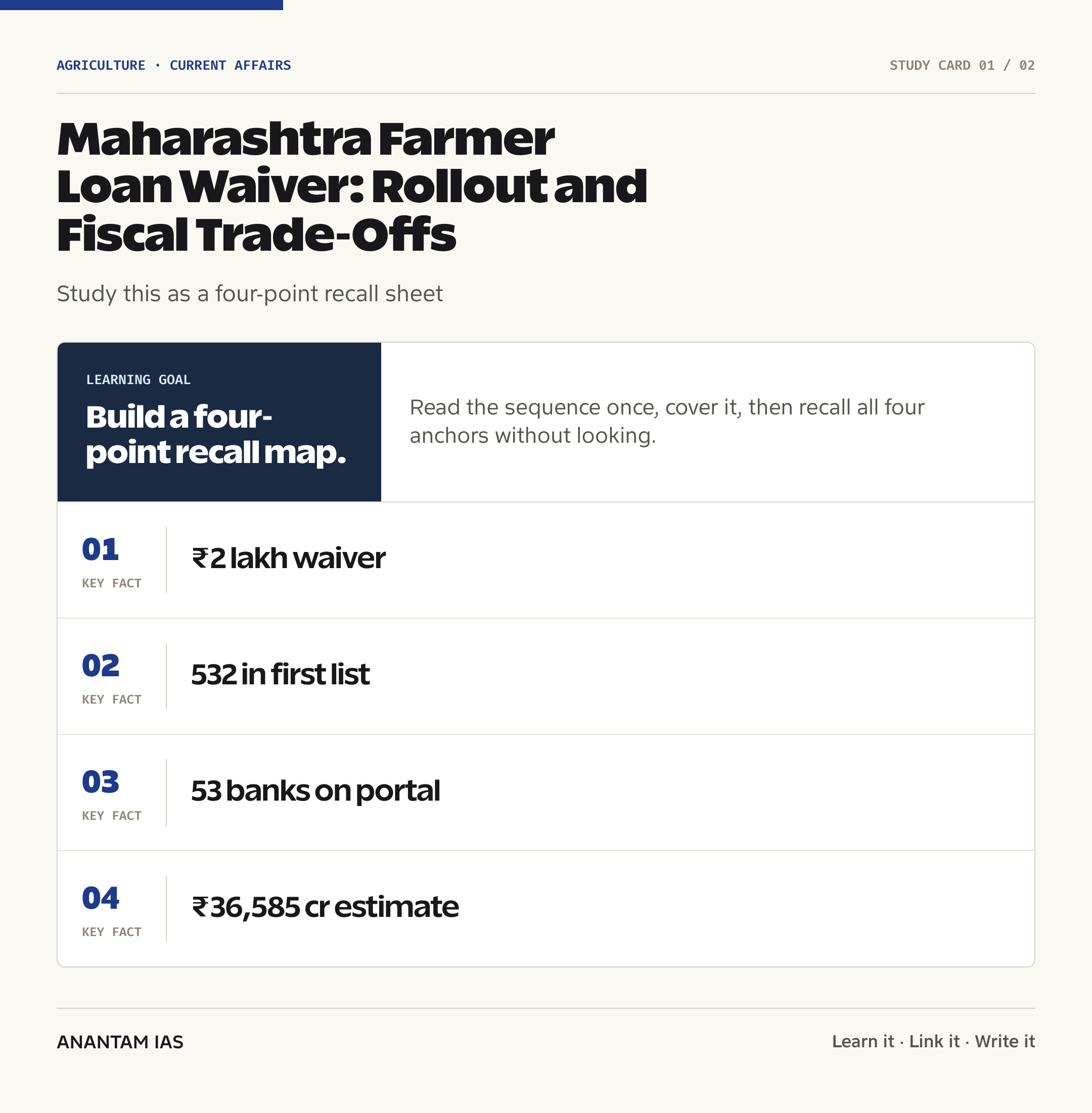
Maharashtra began the beneficiary-verification phase of the Punyashlok Ahilyadevi Holkar Shetkari Karjmukti Yojana 2026 on 22 July. The official Maharashtra DGIPR launch note recorded a representative first list of 532 eligible beneficiaries from seven districts; The Hindu described the rollout more generally as the first 500 beneficiaries.
The first list is an eligibility milestone, not proof that the full waiver estimate has already been spent. Beneficiaries must complete AgriStack registration and Aadhaar authentication before the approved amount is credited by Direct Benefit Transfer to the relevant loan account.
- The Maharashtra Cabinet approved the scheme on 2 June 2026, and revised criteria were issued through a Government Resolution dated 15 July 2026.
- The scheme is projected to cover about 56 lakh farmer families and carry an estimated benefit of ₹36,585 crore.
- The waiver ceiling is ₹2 lakh for eligible short-term crop-loan arrears, including eligible restructured and re-restructured crop loans.
- A total of 53 banks, including 30 District Central Cooperative Banks and 12 nationalised banks, uploaded loan-account data to the MahaIT portal.
- The official note targeted 31 July for eligible DCCB cases, followed by commercial-bank transfers.
UPSC Relevance
Prelims Relevance
- Punyashlok Ahilyadevi Holkar Shetkari Karjmukti Yojana 2026 is a Maharashtra State scheme for eligible crop-loan relief and repayment incentives.
- Eligible loans are short-term crop loans taken from 1 April 2019 to 31 March 2025, overdue on 30 September 2025 and unpaid on 31 March 2026.
- The principal waiver ceiling is ₹2 lakh; revised rules allow relief up to this ceiling even when the total overdue amount is higher.
- AgriStack registration and Aadhaar authentication precede the transfer of benefit to the loan account.
- The covered lending network includes nationalised banks, private banks, Regional Rural Banks, DCCBs and PACS-linked crop credit.
- PACS are the village-level base of the short-term cooperative credit structure, linked upward to DCCBs and State Cooperative Banks.
- The scheme includes an incentive of up to ₹50,000 for eligible regular borrowers, separate from the waiver for defaulters.
- Excluded groups include specified elected representatives, public employees above the notified threshold and persons paying income tax on non-agricultural income.
Mains Relevance
GS Paper 3
- Agricultural credit, farm indebtedness and the difference between temporary balance-sheet relief and durable improvements in farm incomes.
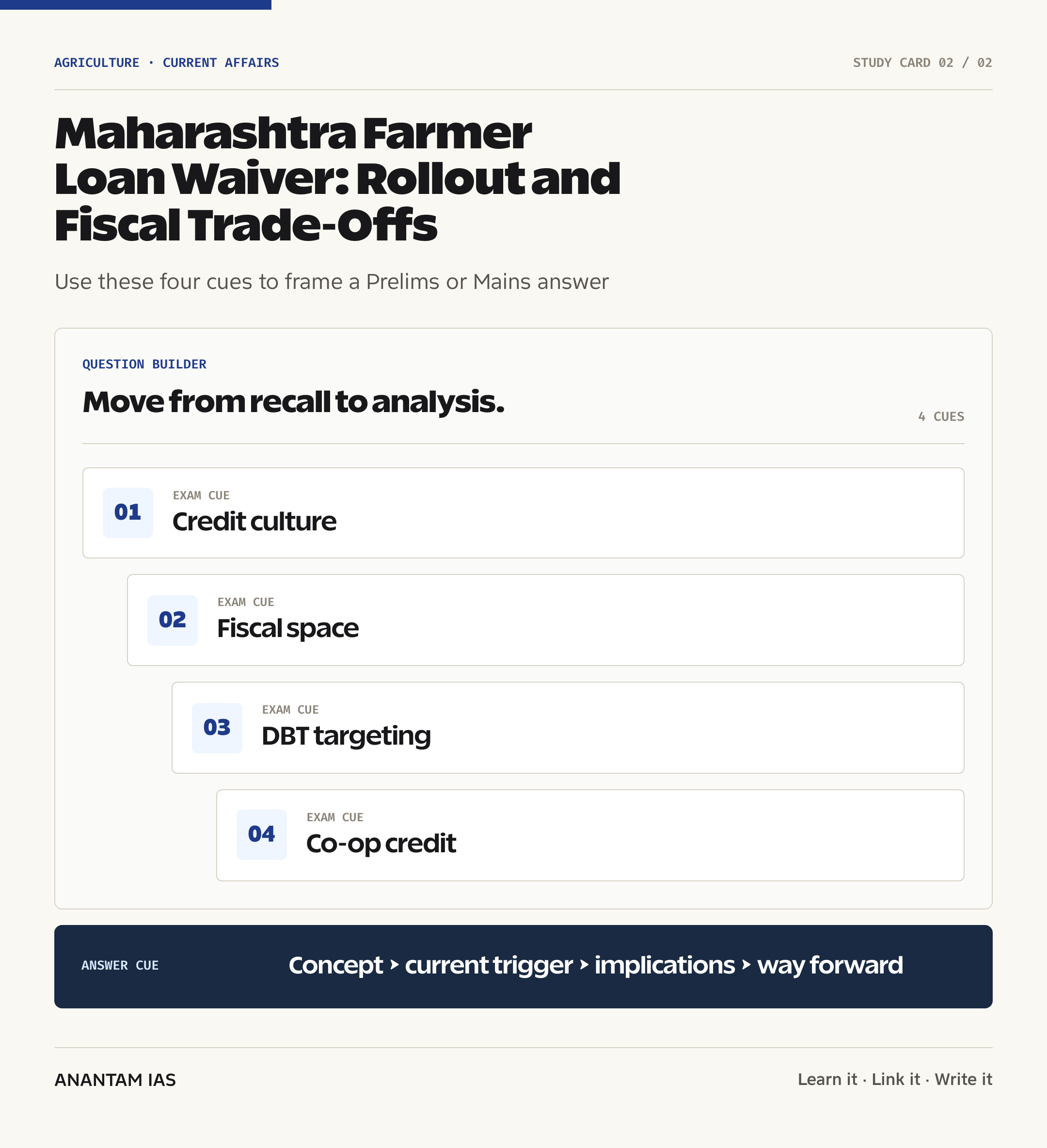
- Impact of repeated waivers on repayment behaviour, bank asset quality, fresh credit, investment and the State’s quality of expenditure.
- Role of crop insurance, irrigation, price-risk management, income support and Farmer Producer Organisations as alternatives to episodic debt cancellation.
GS Paper 2
- Digital welfare delivery through Aadhaar, AgriStack, DBT and grievance redress, including the tension between de-duplication and exclusion.
- Cooperative federalism and institutional accountability when a State-funded scheme depends on public, private, regional rural and cooperative banks.
Background and Context
Scheme Design and Updated Eligibility
The scheme combines debt relief for eligible defaulters with a separate reward for borrowers who maintained repayment discipline.
- Loan window: eligible short-term crop loans were taken between 1 April 2019 and 31 March 2025, remained overdue on 30 September 2025 and were unpaid on 31 March 2026.
- Relief ceiling: the government waives eligible principal and interest up to ₹2 lakh across one or more loan accounts; there is no landholding-size ceiling in the notified design.
- July revision: a borrower owing more than ₹2 lakh can still receive relief up to ₹2 lakh without first clearing the entire excess amount, removing the earlier one-time-settlement barrier.
- Previous beneficiaries: farmers who benefited under the Mahatma Jyotirao Phule Shetkari Karjmukti Yojana 2019 are no longer restricted to the earlier ₹50,000 ceiling and may qualify for relief up to ₹2 lakh under the revised conditions.
- Regular borrowers: eligible timely repayers may receive an incentive up to ₹50,000; the July revision removed the condition that they must take and timely repay a new crop loan in 2026-27.
- Restructured debt: eligible crop loans converted or re-converted after crop loss or disaster are included, recognising that restructuring changes repayment terms but doesn’t remove the underlying farm shock.
- Account relief, not free cash: the benefit settles an eligible institutional liability. Its policy purpose is to clean the overdue account so a genuinely distressed farmer can again seek seasonal crop finance.
How the Digital Rollout Works
The delivery chain uses lender records as the starting point and adds identity checks before any benefit reaches a loan account.
- Banks upload data: 53 participating banks supplied crop-loan account records to a portal developed by MahaIT, while cooperation-department auditors checked District Central Cooperative Bank records.
- Exclusion matching: the system cross-checks specified ineligible categories, including elected office-holders, public employees and taxpayers on non-agricultural income.
- Farmer verification: an eligible person receives an SMS and a unique beneficiary number, then completes Aadhaar authentication after registering on AgriStack.
- Assisted access: the State identified about 32,000 Aaple Sarkar Seva Kendras for authentication support, while lists are also displayed through gram panchayats, cooperative societies and bank branches.
- Transfer stage: only after authentication is the approved benefit sent through DBT to the crop-loan account, allowing the lender to regularise the account and assess fresh credit.
- The process connects directly with AgriStack’s farmer registry, but data-driven delivery still needs offline correction channels for name, land, mobile and Aadhaar mismatches.
Formal and Cooperative Credit Channels
A waiver works through institutional lenders, so its reach depends on who already has a formal crop-loan account.
- Commercial banks bring scale and regulated appraisal, while Regional Rural Banks specialise in rural borrowers and priority-sector lending.
- Cooperative credit follows a three-tier structure: PACS at village level, District Central Cooperative Banks at district level and State Cooperative Banks at the apex.
- PACS offer local knowledge and last-mile access, but weak governance, poor records and dependence on higher-tier refinancing can affect asset quality.
- The Maharashtra rollout prioritises verified DCCB accounts before commercial-bank transfers, showing the operational weight of cooperatives in seasonal crop finance.
- A cleaned loan account can restore formal eligibility, but a waiver doesn’t automatically create a sound next loan. Banks still need credible crop, cash-flow and repayment information.
- The broader architecture is covered in Anantam IAS notes on agricultural credit in India and NABARD’s rural-credit role.
Targeting Gains and Exclusion Risks
Digital verification can reduce leakage, but the scheme may still miss distressed cultivators outside formal records.
- Aadhaar authentication helps establish identity and de-duplicate claims, while bank-account matching ties relief to an actual eligible liability rather than a cash application.
- AgriStack can connect farmer, land and crop records, making future credit and disaster relief faster when the underlying records are accurate.
- Exclusion error arises when a genuine farmer has a spelling mismatch, an unlinked mobile number, pending mutation, joint land title or incomplete AgriStack registration.
- Tenant farmers, sharecroppers and oral lessees may borrow informally because they lack clear title or bank collateral; a formal-loan waiver can leave their most expensive debt untouched.
- Removing the landholding cap simplifies administration but weakens progressivity unless income, vulnerability and repeat-beneficiary rules are applied transparently.
- District grievance committees and public display of lists should operate with time-bound correction, reasoned rejection and an appeal trail, not merely a complaint inbox.
Moral Hazard, Credit Culture and Bank Balance Sheets
A waiver can repair distressed accounts immediately, yet repeated expectations of cancellation can change both borrower and lender behaviour.
- Moral hazard means protection from repayment consequences may encourage some borrowers to delay payment in anticipation of a future waiver, even when they can repay.
- Credit culture weakens if disciplined borrowers feel penalised relative to defaulters; Maharashtra’s separate ₹50,000 incentive is designed to reduce this fairness problem.
- Strategic default must be distinguished from genuine distress caused by drought, flood, crop disease, price collapse or health shocks. A blanket design treats unlike cases alike.
- For banks, government settlement can reduce reported overdue accounts and reopen lending, but delayed reimbursement strains liquidity and may make branches more cautious about subsequent farm loans.
- If lenders become more cautious after repeated political intervention, smaller borrowers may be pushed back toward informal moneylenders.
- A sound evaluation must track fresh credit after relief: account regularisation is incomplete if eligible farmers remain unable to finance the next sowing season.
Fiscal Scale and Opportunity Cost
The key fiscal question is not only whether Maharashtra can finance the waiver, but what public spending it may displace.
- The official ₹36,585 crore figure is a projected scheme benefit or fiscal estimate. The first list of 532 names is only a verification milestone and doesn’t show that this amount has been booked or disbursed.
- Maharashtra’s 2026-27 Budget estimates total expenditure excluding debt repayment at ₹7,69,467 crore; the scheme estimate is about 4.8% of that total.
- The same Budget estimates a ₹40,552 crore revenue deficit and a ₹1,50,491 crore fiscal deficit. The waiver estimate is about 90% of the former and 24% of the latter, illustrating scale rather than proving a one-for-one increase in either deficit.
- Actual impact depends on appropriation, phasing, bank reconciliation, rejected claims and payment timing. Announced beneficiary estimates must not be reported as audited expenditure.
- Because waiver payments are normally revenue expenditure, their opportunity cost can fall on irrigation, extension, storage or insurance unless the State raises revenue or reprioritises other spending.
- Fiscal evaluation should publish the number authenticated, amount sanctioned, amount transferred, lender-wise pendency and the share of beneficiaries who regain fresh crop credit.
Relief Versus Durable Farm Resilience
Debt cancellation addresses the stock of eligible arrears; resilience policy must reduce the shocks that create the next arrear.
- Crop insurance should pay quickly after verified loss so a climate shock doesn’t become a loan default; see the design and implementation issues in PM Fasal Bima Yojana.
- Income support such as PM-KISAN is predictable and crop-neutral, though its small annual transfer can’t replace insurance, remunerative markets or productive investment.
- Irrigation, soil health, extension and climate-resilient seeds reduce yield volatility, while warehouses and negotiable receipts reduce distress sales immediately after harvest.
- Farmer Producer Organisations can aggregate inputs, output and market power, helping small farmers lower costs and negotiate better prices.
- Interest subvention and Kisan Credit Cards can make timely formal credit cheaper, but limits should reflect local crop costs and repayment should track the harvest cycle.
- A rules-based disaster restructuring framework is more predictable than ad hoc political announcements: objective triggers can pause repayment, reschedule principal and preserve borrower credit histories.
Way Forward
Publish an auditable fiscal dashboard
- Separate estimated liability, sanctioned amount and cash transferred by month, lender, district and scheme component.
- Disclose whether payments use existing budget provision or supplementary grants, along with the effect on revenue expenditure and fiscal-deficit projections.
Make verification inclusion-safe
- Allow assisted, offline and exception-based authentication for farmers facing Aadhaar, mobile, land-record or AgriStack mismatches.
- Give every rejection a reason code, a time limit for correction and an appeal to an independent district-level authority.
Protect repayment discipline
- Pay the regular-borrower incentive promptly and retain a clean credit history for farmers who repay despite shocks.
- Use repeat-waiver data, disaster exposure and repayment capacity to distinguish unavoidable distress from strategic default.
Convert relief into renewed credit
- Require banks to report whether a regularised borrower receives a fresh, adequately sized Kisan Credit Card or crop loan for the next season.
Shift spending toward risk reduction
- Expand irrigation reliability, weather services, crop insurance, storage, FPOs and price-risk management to reduce recurring defaults.
- Design formal credit for tenants, women cultivators, sharecroppers and Joint Liability Groups so relief and resilience don’t remain tied only to titled landholders.
Conclusion
Maharashtra’s rollout shows how a farm loan waiver can be made more verifiable through bank data, AgriStack, Aadhaar authentication and DBT. The real test is whether these safeguards remove ineligible claims without shutting out distressed cultivators who sit at the edge of formal records.
The waiver can give a borrower breathing space and reopen a blocked crop-loan account. But its success should be judged by restored access to productive credit, lower future distress and transparent fiscal reporting, not by the size of the announced estimate alone.
A durable farm policy must make waivers exceptional. Insurance, irrigation, stable markets, timely credit and shock-responsive restructuring should do the routine work of keeping farmers solvent.
UPSC Practice Questions
Prelims MCQ 1
With reference to Maharashtra’s Punyashlok Ahilyadevi Holkar Shetkari Karjmukti Yojana 2026, consider the following statements:
- It covers eligible short-term crop loans, including specified restructured crop loans.
- AgriStack registration and Aadhaar authentication are part of the beneficiary-verification process.
- Only loans issued by District Central Cooperative Banks are covered.
How many of the above statements are correct?
(a) Only one (b) Only two (c) All three (d) None
Answer: (b) Only two
Explanation:
Statements 1 and 2 are correct. The lending network extends beyond DCCBs to nationalised, private and regional rural banks, as well as eligible cooperative credit channels, so statement 3 is incorrect.
Prelims MCQ 2
Which one of the following best explains moral hazard in a farm loan-waiver programme?
(a) Banks receive repayment from the government instead of the borrower (b) Borrowers may delay repayment because they expect a future waiver (c) Farmers shift from crop loans to long-term investment loans (d) Aadhaar authentication excludes duplicate beneficiaries
Answer: (b) Borrowers may delay repayment because they expect a future waiver
Explanation:
Moral hazard arises when protection from the consequences of default changes behaviour. An expected future waiver may weaken timely repayment even among borrowers able to pay.
UPSC Mains Questions
- Farm loan waivers can restore a distressed cultivator’s balance sheet but may also weaken credit discipline and State finances. Evaluate this trade-off with reference to Maharashtra’s 2026 rollout and suggest safeguards that distinguish genuine distress from strategic default.
- Digital beneficiary verification can reduce leakage while creating new forms of exclusion. Examine the roles of Aadhaar, AgriStack, bank data and local grievance redress in making agricultural support both precise and inclusion-safe.
- Why do repeated loan waivers fail to resolve structural farm indebtedness? Propose a durable policy package combining formal credit, crop insurance, irrigation, market-risk management, income support and shock-responsive loan restructuring.
Sources: Maharashtra DGIPR and Department of Cooperation and The Hindu.
Frequently Asked Questions
What is Maharashtra’s 2026 loan-waiver scheme?
The Punyashlok Ahilyadevi Holkar Shetkari Karjmukti Yojana 2026 is a Maharashtra government programme that provides eligible crop-loan relief up to ₹2 lakh and a separate incentive up to ₹50,000 for qualifying regular borrowers.
How many names were in the first list?
The official Maharashtra DGIPR launch note reported a representative list of 532 eligible beneficiaries across seven districts. Some news coverage rounded the opening phase to the first 500 beneficiaries.
Has the full waiver amount been spent?
No such conclusion follows from the first list. ₹36,585 crore is the announced scheme estimate. Actual expenditure depends on authentication, final sanction, bank reconciliation and DBT. The government must separately disclose amounts approved and transferred.
Why are Aadhaar and AgriStack required?
They help verify identity, match farmer and loan records, and reduce duplicate or ineligible claims. But farmers with data mismatches, unclear land records or limited digital access need assisted authentication and a time-bound correction process.
Do loan waivers cover informal debt?
Usually not. The programme works through eligible institutional crop-loan accounts. Tenant farmers and other cultivators who borrow from moneylenders may receive no relief, even when their interest burden is higher than that of formal borrowers.
What is a durable alternative to waivers?
No single instrument replaces emergency relief. A durable package combines affordable formal credit, timely crop-insurance claims, reliable irrigation, storage, market and price-risk support, income transfers, FPOs and automatic restructuring after objectively verified disasters.
Source: https://anantamias.com/current-affairs/maharashtra-farmer-loan-waiver-rollout/
France’s Under-15 Social Media Ban: A Digital Governance Test
Why in News?
On 21 July 2026, both houses of the French Parliament definitively adopted a compromise bill restricting access to online social-networking services for children under 15 years. The Hindu described it as the first national under-15 social-media ban adopted in the European Union.
The measure is a test of digital governance, not just a ban. Its success depends on privacy-preserving age assurance, a workable division of powers between France and the European Union, proportionate restrictions on children’s rights, and enforceable duties for cross-border platforms.
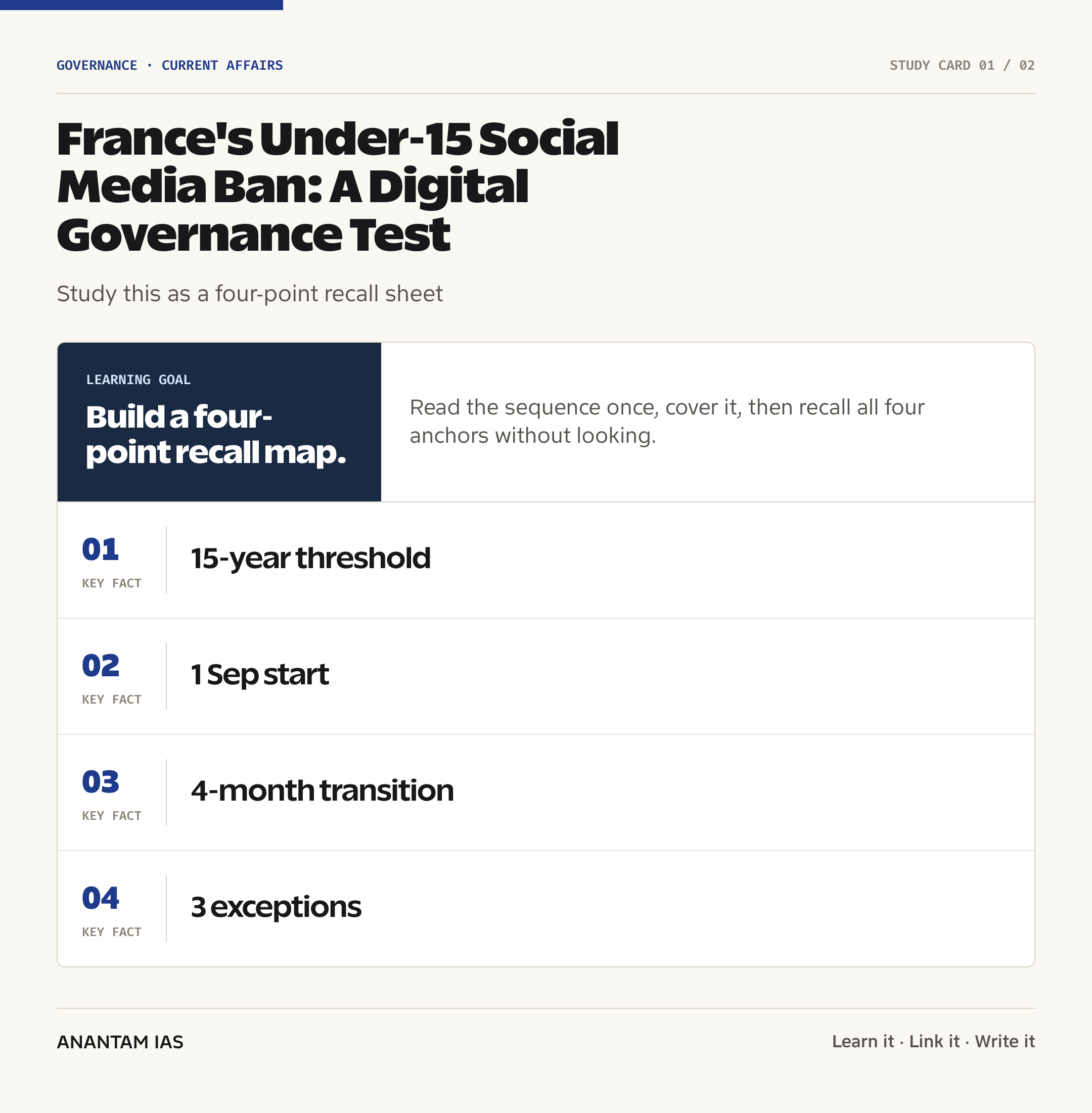
- The rule is scheduled to apply to new access from 1 September 2026; accounts created earlier receive a four-month transition.
- The adopted text exempts online encyclopedias, educational or scientific directories, and open-source development or educational-project platforms.
- As of 23 July 2026, the text had been definitively adopted by Parliament but had not yet been confirmed as promulgated in the official statute book.
- The compromise removed a proposed national platform blacklist and avoided creating a parallel French enforcement structure that could conflict with the Digital Services Act.
The development matters in the context of:
- The development matters in the context of balancing child protection with freedom of expression, access to information and adolescent autonomy.
- It tests whether age assurance can be accurate without turning every user’s identity into a platform-held data point.
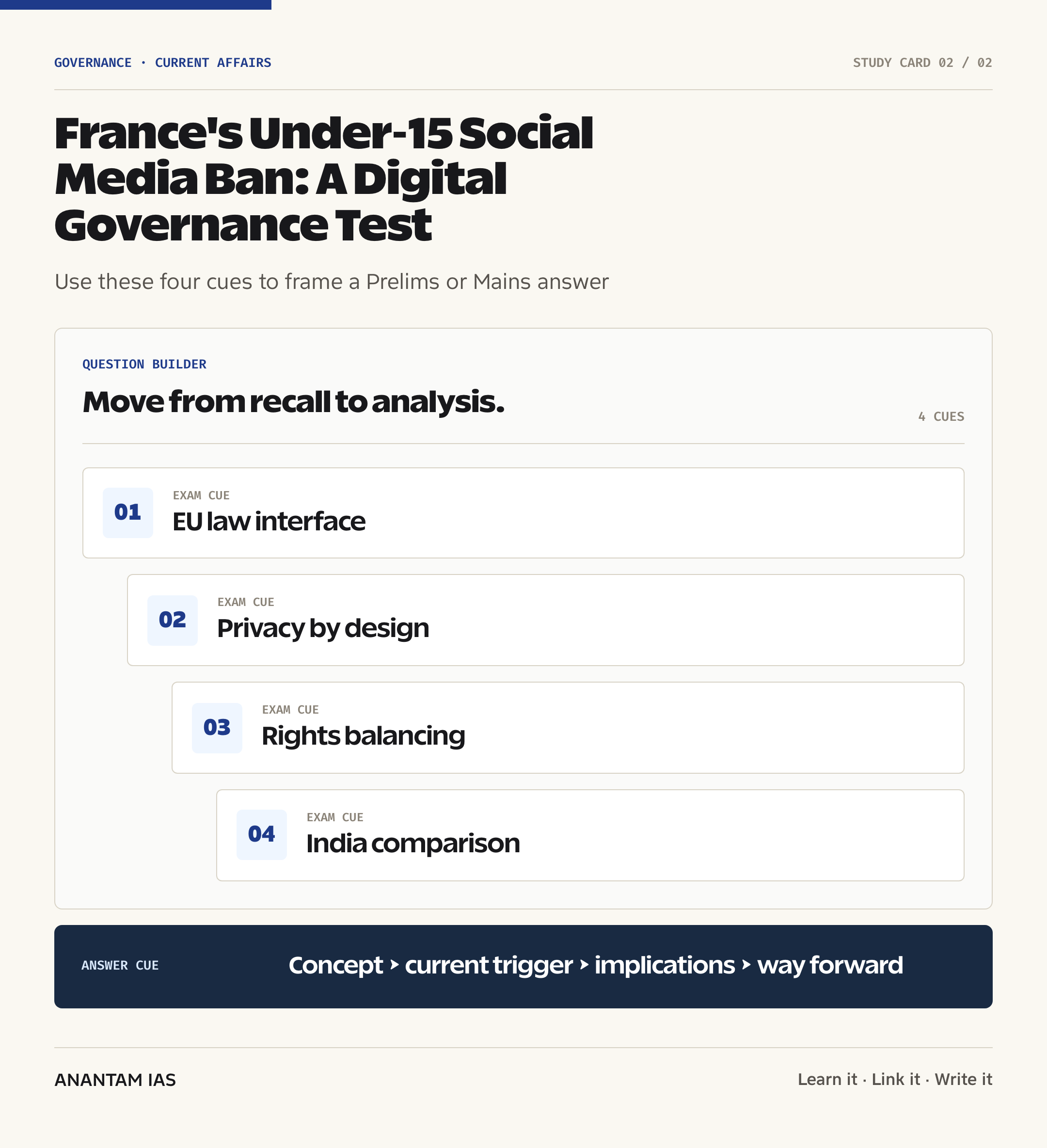
- It illustrates the difficulty of regulating global platforms through a national law inside the EU Single Market.
- For India, comparison with the Digital Personal Data Protection Act, 2023 requires constitutional, institutional and access-related analysis.
UPSC Relevance
Prelims Relevance
- France’s threshold: access to covered social-networking services is restricted for persons below 15 years.
- Commencement: the adopted text specifies 1 September 2026 for new access and a four-month transition for pre-existing accounts.
- Exceptions: online encyclopedias, educational or scientific directories, and specified open-source platforms are outside the prohibition.
- DSA Article 28: platforms accessible to minors must provide a high level of privacy, safety and security through appropriate and proportionate measures.
- Data minimization: DSA compliance does not itself require platforms to process extra personal data merely to decide whether a user is a minor.
- Age verification: proves that a person crosses a legal age threshold; age estimation gives a probability rather than verified identity.
- Zero-knowledge proof: can confirm an age condition without disclosing a name, exact birth date or browsing history.
- India’s DPDP Act: defines a child as a person below 18 and requires verifiable parental consent before covered processing of a child’s personal data.
- Platform duty of care: places preventive responsibility on service design, defaults and risk mitigation, not only on parental control.
Mains Relevance
GS Paper 2
- Governance: institutional coordination across national legislatures, regulators and supranational EU authorities.
- Social justice: protection of children from addictive design, grooming, cyberbullying and harmful commercial practices.
- Rights: proportionality between child welfare, privacy, expression, association and access to information.
- Comparative policy: lessons and limits for India’s child-online-safety framework.
GS Paper 3
- Science and technology: age assurance, anonymous credentials, interoperability and circumvention risks.
- Cybersecurity: risks created when identity documents, biometric estimates or parental credentials become attack surfaces.
- Platform regulation: algorithmic risk assessment, safety by design and cross-border enforcement.
Essay
- Technology and childhood: protection should expand a child’s capabilities, not merely close digital spaces.
- Liberty and paternalism: a legitimate protective aim still needs a proportionate and reviewable means.
- Digital federalism: national democratic choices increasingly operate within transnational regulatory systems.
Background and Context
Legal Status and Legislative Evolution
The headline “ban” must be separated from the measure’s precise stage in France’s legislative process.
- The National Assembly first adopted a general under-15 prohibition in January 2026; the Senate later preferred a graded model that would ban access to services considered particularly harmful and require parental authorization for others.
- A joint parliamentary committee agreed on a compromise on 20 July, and both houses adopted it on 21 July. Parliamentary adoption was final, but promulgation and any constitutional review remained separate legal steps as of 23 July.
- The final compromise returned to a general access prohibition rather than a national blacklist. This is narrower in drafting than a detailed platform-liability code because it states the access rule but leaves several operational questions to the existing European framework.
- France’s 2023 digital-majority law had contemplated parental authorization below 15, but implementation stalled over EU-law problems.
- The adopted bill separately extends school phone restrictions to lycées, complementing the access rule with an education measure.
Scope, Threshold and Exceptions
The measure uses an age threshold but depends on legal definitions to decide which services are actually covered.
- The proposed Article 6-9 states that access to an online social-networking service supplied by an online platform is prohibited to minors under 15.
- The terms online platform and social-networking service draw on EU definitions. The Senate names Instagram, TikTok, Facebook and Snapchat as core services, while hybrid services may need case-specific interpretation.
- The adopted exceptions cover online encyclopedias, educational or scientific directories, and platforms for developing and sharing free software or open-source educational digital projects.
- The final text does not retain a general parental-consent route for ordinary covered networks, unlike the 2023 French model.
- Because the rule is directed at access by minors, operational compliance still needs a lawful mechanism through which services can distinguish under-15 users without building a universal identity register.
- New access is scheduled to be covered from 1 September 2026. For accounts created before that date, the prohibition applies after four months, effectively creating a transition into January 2027 if the text enters into force as planned.
Age Assurance Without Identity Surveillance
A legal threshold works only if age can be established with enough confidence and with no unnecessary identity disclosure.
- Self-declared birth dates are easy to bypass. More reliable methods include document-based verification, national electronic identity, bank-held age attestations, facial age estimation and trusted third-party credentials.
- Each method trades off accuracy, inclusion, privacy, cost and cybersecurity. Document checks can exclude users, facial estimation can produce demographic error, and identity stores can become breach targets.
- The European Commission’s age-verification solution was technically ready in April 2026 and can be adapted to thresholds such as 15. It is designed to return an anonymous yes-or-no proof of age rather than a name or exact birth date.
- Zero-knowledge proof technology allows a user to prove that a statement such as “age 15 or above” is true without revealing the underlying identity data. Unlinkable proofs also reduce cross-service tracking.
- France’s CNIL emphasizes minimization, proportionality, robustness, simplicity, standardization and an independent third party, making privacy a design condition.
- No system is bypass-proof: VPNs, borrowed credentials and account sharing require risk-based enforcement and evidence that the barrier materially reduces exposure.
Interaction with the EU Digital Services Act
France can set a domestic age rule, but platform obligations and cross-border supervision sit within the EU’s harmonized digital-services regime.
- Article 28 of the DSA requires platforms accessible to minors to adopt appropriate and proportionate measures ensuring a high level of privacy, safety and security.
- The DSA also bars profiling-based advertising to a recipient whom the platform knows with reasonable certainty to be a minor, while clarifying that this duty does not compel extra personal-data collection solely to determine age.
- The Commission’s 2025 minors-protection guidelines recommend accurate, reliable, robust, non-intrusive and non-discriminatory age assurance. They are non-binding but can inform enforcement.
- France notified an earlier version through the EU’s Technical Regulation Information System. The Commission questioned features that could create national platform duties overlapping with the DSA.
- The compromise removed the French platform blacklist and redundant Arcom powers. Suspected failures by providers in other EU states must move through DSA cooperation.
- This creates an enforcement dependency: a national norm still relies on EU-level service classification, common age standards and action against cross-border platforms.
Child Rights and the Proportionality Test
Child protection is a legitimate objective, but the restriction must still be suitable, necessary and balanced.
- Potential harms include grooming, cyberbullying, harmful content, addictive design and commercial profiling. Prevention need not wait for perfect causal evidence.
- Children also hold rights to expression, association, participation, privacy and access to information. Social networks may support peer contact, civic learning, creative work and access to help, especially for isolated groups.
- A general ban faces the proportionality question: could less restrictive measures, such as safe defaults, chronological feeds, night-time limits, restricted direct messaging, recommender controls and advertising bans, achieve much of the protective aim?
- France’s Council of State had reportedly preferred a graded approach, combining a ban for high-risk services with parental authorization for others. The final general rule may face constitutional review on this ground.
- The exceptions preserve educational and knowledge access, but rapidly changing service features can make fixed categories over-inclusive or under-inclusive.
- A rights-respecting system needs appeal, correction and redress for false age determinations and must avoid routine identity disclosure by adults.
Platform Duties and Enforceability
The hardest policy question is who must do what when an underage account is detected.
- A workable regime needs duties at the level of account creation, existing-account review, recommender design, default privacy, reporting and audit. A bare prohibition directed at children can otherwise become symbolic.
- The final French clause does not itself specify a new platform fine, a single mandatory verification technology or penalties for children. This avoids criminalizing minors but increases reliance on DSA supervision and implementation standards.
- Regulators need metrics for underage-account prevalence, false rejections, appeals and exposure to harmful recommendations.
- Platforms should not be allowed to treat successful age gating as a substitute for safety by design. Users aged 15 to 17 remain minors and still require high privacy and safety under the DSA.
- Independent researchers need privacy-safe access to test discrimination by gender, ethnicity, disability, device access and documentation status.
- Public policy should combine enforcement with digital literacy, parental support, school counselling and mental-health services.
Lessons and Limits for India
India can learn from the governance architecture without copying France’s threshold or institutional design.
- India’s DPDP Act, 2023 defines a child as a person below 18. Section 9 requires verifiable parental consent before covered processing and bars detrimental processing, behavioural monitoring and targeted advertising directed at children.
- The DPDP Rules, 2025 describe parental verification, but key child-data duties follow phased commencement. India has no French-style national account ban.
- Students can revise India’s framework through DPDP Act study notes and the DPDP Rules overview.
- The French debate supports an Indian shift from simple consent boxes toward platform accountability: child-safe defaults, restricted profiling, algorithmic risk audits, effective grievance redress and transparent regulator-platform coordination.
- Any Indian age-assurance framework must satisfy Articles 14, 19 and 21 and account for unequal access to identity documents, devices and parental digital literacy.
- A phased pilot should publish evidence on accuracy, exclusion, circumvention, data retention and child outcomes before India considers a universal threshold.
- For the wider debate, compare India’s emerging social-media approach with the case against relying on a ban as a complete solution.
Way Forward
Use Privacy-Preserving Age Proof
- Adopt anonymous threshold credentials that reveal only whether the user meets the age condition.
- Separate the credential issuer from the platform so neither party can reconstruct identity and browsing history.
- Ban the use of age-assurance data for advertising.
Regulate Design, Not Only Entry
- Require high-privacy defaults, limits on unsolicited adult contact, controllable recommendation systems and meaningful break prompts.
- Audit engagement-maximizing features such as infinite scroll, autoplay and repeated push notifications for risks to minors.
- Preserve access to educational, health and civic resources.
Build Accountable Enforcement
- Clarify the roles of national regulators, Digital Services Coordinators and the European Commission before commencement.
- Publish compliance metrics and appeal routes, and direct lawful sanctions at providers rather than children.
Follow an Evidence-Led Indian Path
- Implement and evaluate the DPDP child-data safeguards before layering a broad access prohibition on top.
- Commission India-specific research across age, gender, disability, income, language and location.
Conclusion
France’s measure is important because it exposes the full chain of digital governance: Parliament can set a threshold, but technology, regulators, courts and transnational enforcement decide whether that threshold protects children in practice.
The sound policy test is not “ban or no ban”. It is whether the state can reduce demonstrable harm through proportionate, privacy-preserving and reviewable measures while retaining children’s access to knowledge, participation and remedy.
For India, the durable lesson is to make platform design and data practices accountable, test age-assurance systems for exclusion and surveillance, and treat children as rights-holders rather than only as risks to be managed.
UPSC Practice Questions
Prelims MCQ 1
With reference to France’s definitively adopted 2026 social-media measure, consider the following statements:
- It restricts access to covered social-networking services for minors below 15 years.
- It provides a general parental-consent exception for ordinary covered social networks.
- It exempts online encyclopedias and specified educational, scientific and open-source platforms.
How many of the above statements are correct?
(a) Only one (b) Only two (c) All three (d) None
Answer: (b) Only two
Explanation:
Statements 1 and 3 are correct. The final compromise uses a general under-15 access restriction with specified public-interest exceptions; it does not retain a general parental-consent route for ordinary covered networks.
Prelims MCQ 2
Which one of the following best describes the Digital Services Act’s approach to minors?
(a) It creates one uniform EU-wide minimum age for every online service (b) It requires all users to disclose official identity documents to platforms (c) It requires appropriate and proportionate protection for minors and restricts profiling-based advertising to known minors (d) It transfers exclusive enforcement over all platforms to national parliaments
Answer: (c) It requires appropriate and proportionate protection for minors and restricts profiling-based advertising to known minors
Explanation:
DSA Article 28 establishes privacy, safety and security duties for platforms accessible to minors and limits profiling-based advertising. It does not itself fix one EU-wide social-media age or mandate universal identity-document disclosure.
UPSC Mains Questions
- France’s under-15 social-media restriction shows that setting an age threshold is easier than governing its implementation. Examine the challenges of age assurance, privacy protection, cross-border platform enforcement and proportionality in regulating children’s access to social media.
- Child online safety requires a shift from parental consent toward platform accountability, but the two need not be mutually exclusive. Discuss with reference to safety-by-design, algorithmic risk, targeted advertising and grievance redress.
- What lessons can India draw from France and the European Union while implementing the child-data provisions of the Digital Personal Data Protection framework? Identify the constitutional and inclusion safeguards needed before considering access restrictions.
Sources: French Senate, definitively adopted parliamentary text and The Hindu Explained.
Frequently Asked Questions
Is France’s under-15 ban already law?
As of 23 July 2026, both houses of Parliament had definitively adopted the compromise text. Parliamentary adoption was complete, but promulgation and any constitutional review were separate steps. It is most accurate to call it a definitively adopted measure, not an already implemented ban.
When is the restriction scheduled to begin?
The adopted text specifies 1 September 2026 for new access. Accounts created before that date receive a four-month transition, so the rule would apply to them after that period if the measure enters into force as scheduled.
Which services are exempt?
The text exempts online encyclopedias, educational or scientific directories, and platforms used to develop and share free software or open-source educational digital projects. Other borderline services may require interpretation under the incorporated EU definitions.
Can parents authorize an under-15 account?
The final 2026 compromise does not retain a general parental-authorization exception for ordinary covered social networks. This differs from France’s 2023 digital-majority model, which had contemplated parental permission below 15.
How can age be checked privately?
A privacy-preserving credential can return only a yes-or-no proof that a user crosses the age threshold. Zero-knowledge proofs and independent issuers can avoid revealing the person’s name, exact birth date or browsing history to the platform.
What is the main lesson for India?
India should first make child-data and platform-safety duties effective, test age-assurance systems for exclusion and surveillance, and build independent redress. France offers useful design questions, but its age threshold and EU enforcement structure cannot be copied directly.
Source: https://anantamias.com/current-affairs/france-under-15-social-media-ban/
Teesta-VI Tunnel Blast: Hydropower Safety in the Himalayas
Why in News?
At least 15 workers were reported killed after a July 20, 2026 blast about 1.5 km inside Adit-3 of the under-construction Teesta Stage-VI Hydroelectric Project in Sikkim’s Namchi district; rescue work was ongoing.
The Hindu reported that a 2024 technical paper authored by five NHPC engineers had documented earlier releases and fires involving flammable gas in the project’s headrace tunnels. The paper is prior evidence of a known hazard, but it does not establish the cause of the July 20 blast, which remains under investigation.
- NHPC said a sudden burst of suspected methane occurred near a working face and announced a detailed investigation; the Sikkim government constituted a Special Investigation Team.
- About 25 workers were reportedly inside when the blast and associated collapse sealed the tunnel; the casualty and rescue figures were evolving during publication.
- The 2024 paper recorded a November 2009 flammable-gas release at HRT Face 4B that burst into flame during work by the previous developer.
- During later excavation by NHPC, gas released from the arch near HRT Face 4A and a handheld detector recorded up to 30% of the Lower Explosive Limit, followed by a fire at the heading.
- The two earlier faces, 4A and 4B, were accessed through Adit-3, according to The Hindu; this geographical overlap makes the previous records directly relevant to the safety inquiry without proving a common cause.
The development matters in the context of:
- The incident matters in the context of hazard-informed design: a known gas history should shape investigation density, ventilation capacity, ignition control, stop-work thresholds and rescue readiness.
- It also matters in the context of cumulative Himalayan risk, where fractured rock, groundwater, seismicity, landslides, GLOFs and trapped gas interact; see India’s expanding glacial-lake risk and the debate over new hydropower in fragile basins.
UPSC Relevance
Prelims Relevance
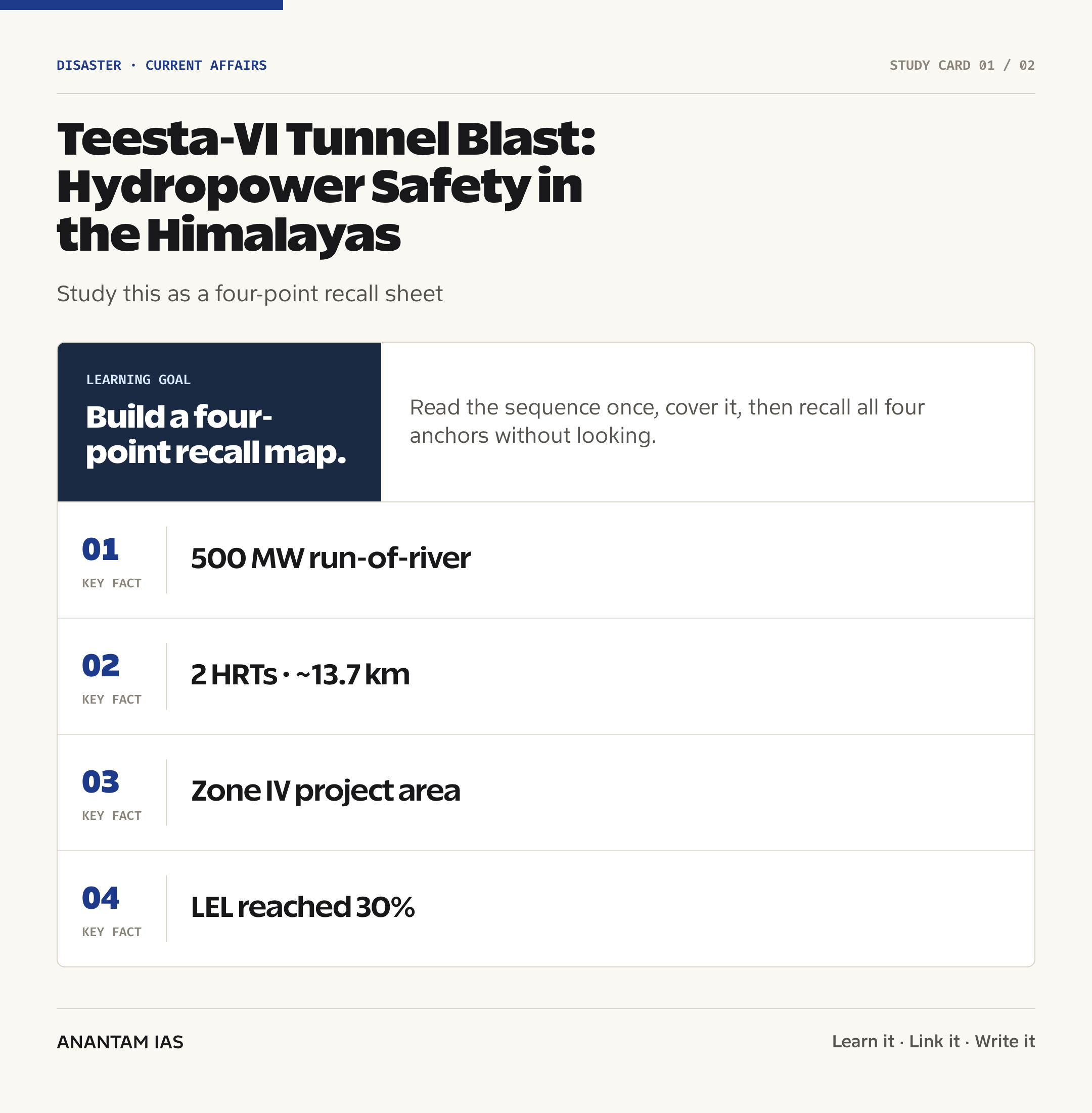
- Teesta Stage-VI is a 500 MW, four-unit, run-of-river hydropower project on the Teesta River in Sikkim.
- The project has two headrace tunnels, each about 13.7 km long and 9.8 m in finished diameter; a headrace tunnel conveys diverted water towards the turbines.
- An adit is a supplementary, near-horizontal access passage used to reach a main tunnel for excavation, transport, ventilation or emergency access.
- The Lower Explosive Limit is the lowest concentration of a flammable gas in air at which ignition can propagate; a reading expressed as percentage of LEL is not the same as the gas’s percentage by volume.
- Methane is colourless and highly flammable; oxygen depletion, carbon monoxide and hydrogen sulphide can create additional confined-space hazards even when an explosion does not occur.
- The project paper places the area in Seismic Zone IV and describes intensely folded, faulted and sheared rocks of the Lesser Himalaya.
- IS 4756:1978 is the BIS safety code for tunnelling work, but its scope expressly excludes gassy tunnels, signalling the need for special hazard-specific methods where flammable gas is present or likely.
- The Building and Other Construction Workers Act, 1996 and its Central Rules contain specific safety provisions for excavation and tunnelling, while the Disaster Management Act, 2005 supports coordinated preparedness and response.
Mains Relevance
GS Paper 3
- Disaster management: shift from rescue-centric response to multi-hazard prevention, trigger-based evacuation, redundant communication and tunnel-specific emergency exercises.
- Environment and infrastructure: assess project-level hazards together with basin-wide seismic, landslide, GLOF, sediment and cascade-dam risks.
- Science and technology: combine geological probing with fixed gas sensors, portable detectors, telemetry, forced ventilation and intrinsically safe equipment.
GS Paper 2
- Governance and accountability: examine whether known hazards were translated into enforceable operating controls, contractor supervision, independent audits and transparent incident reporting.
- Labour protection: connect the right to life and safe work with training, protective equipment, medical surveillance, rescue capacity and compensation.
Essay
- Development without risk memory repeats preventable failures: institutional learning must survive changes in contractors, owners and project timelines.
- In fragile mountains, engineering certainty is limited; resilience comes from monitoring, humility, redundancy and accountable decision-making.
Background and Context
What the 2024 Paper Actually Recorded
The EUROENGEO 2024 paper provides project-specific evidence, but its evidentiary limits must remain clear.
- It recorded that flammable gas at HRT Face 4B first caught fire in November 2009 near the contact between competent quartzite or phyllitic quartzite and softer phyllite.
- It separately recorded gas release from the tunnel arch near HRT Face 4A as excavation entered the Kabrey Khola stretch.
- A handheld instrument registered up to 30% LEL at that face, and the paper reported a fire during heading excavation.
- The response described in the paper included stronger ventilation and monitoring, plus two probe holes of roughly 24–30 m in which readings of 1–5% LEL were detected.
- A 30% LEL reading does not mean that methane formed 30% of tunnel air. It means the detector measured 30% of the calibrated lower explosive threshold, a serious warning that requires withdrawal and control before the atmosphere can move into an ignitable range.
- For the inquiry, the paper is a contemporaneous hazard record, not a causal verdict. Investigators must test whether the 2026 release occurred in the same geological contact, whether monitoring detected it, and whether a separate ignition or collapse sequence was involved.
Project Design and Institutional History
A long project history makes risk-memory transfer as important as physical construction.
- The original developer, Lanco Teesta Hydro Power Limited, halted work in December 2012 after financial distress.
- NHPC acquired the company through insolvency proceedings in October 2019 and resumed tunnel excavation in June 2021 after about nine years of inactivity.
- The technical paper said archived geological records were partly missing or deteriorated, adits were flooded, support elements had degraded and several previously excavated stretches had collapsed.
- The governance lesson is to create a single auditable hazard register that follows the asset across insolvency, contractor replacement and handover.
- A restart after prolonged suspension should be treated as a brownfield safety reassessment, not a continuation from the last work certificate. It requires fresh geological mapping, structural inspection, dewatering, atmosphere testing, equipment revalidation and review of old near-miss records.
- Owner and contractor systems must share one permit-to-work architecture. Fragmented records can leave the project proponent aware of a regional hazard while a subcontracted face crew lacks the latest gas map, alarm threshold or evacuation instruction.
Himalayan Geology Creates Compound Hazards
The Sikkim Himalaya combines young tectonics with highly variable rock and water conditions.
- The paper identifies proximity to the Main Central Thrust, a project location in Seismic Zone IV and rock quality that can change sharply over only a few metres.
- At some faces, pressurised groundwater inflows of about 700–1,000 litres per minute were recorded and associated with surface subsidence.
- Carbonaceous or organic-rich strata and fractures can contain trapped combustible gas; excavation may create a migration pathway into a confined tunnel.
- The proper model is multi-hazard interaction: geology controls gas, water and instability, while blasting, electrical equipment, diesel exhaust and ventilation shape exposure and ignition risk.
- Advance probe drilling should test not only rock competence and groundwater but also gas pressure and composition ahead of the face. Results should govern support, excavation, ventilation and re-entry.
- Cumulative risk also includes surface-to-underground pathways: monsoon infiltration, nala crossings, landslide movement and seismic fractures can alter groundwater and gas migration after the original investigation. Baseline studies need periodic revision during construction.
Combustible-Gas and Confined-Space Safety
Gas safety depends on a continuous detect, dilute, isolate and evacuate chain.
- Fixed sensors and calibrated portable meters should track methane, oxygen, carbon monoxide and hydrogen sulphide at the face, roof, return air and refuge or access routes.
- A percentage-of-LEL alarm must trigger predefined controls: stop work, cut ignition sources, withdraw workers, increase ventilation and verify clearance before re-entry.
- Ventilation requires calculated air quantity, backup power, duct integrity and independent verification; simply installing a fan does not prove effective dilution at the face.
- Electrical and communication systems in a gassy zone should be intrinsically safe or explosion-protected, with hot-work permits and ignition-source control.
- Rescuers need self-contained breathing apparatus, atmospheric monitoring, entry logs, lifelines, thermal or night-vision support and time-limited deployment based on measured conditions.
- Sensor placement must reflect gas behaviour and tunnel airflow. Methane can accumulate near the crown, while heavier toxic gases may collect lower; one portable reading at the face cannot represent the entire heading, return airway, machinery bay and escape path.
- Detectors need scheduled bump tests and calibration, logged before every shift. A failed sensor, broken telemetry link or ventilation-power interruption should place the face in a safe state automatically rather than asking workers to continue while maintenance is arranged.
- Re-entry should require a written gas-clearance protocol: readings below the action threshold at multiple points for a specified duration, stable airflow, isolation of suspected ignition sources, supervisor authorisation and communication to every crew member.
Environmental and Disaster-Governance Framework
Project approval and emergency response sit in different legal systems that must operate as one risk-governance chain.
- Under the EIA Notification, 2006, appraisal of a river-valley project should convert baseline geology, environmental impacts and mitigation promises into monitorable clearance conditions.
- A compliance review after the accident should examine the original Environmental Impact Assessment, clearance conditions, later design changes, six-monthly reports and whether emerging gas evidence led to updated management plans.
- The Disaster Management Act, 2005 enables national, state and district authorities to coordinate preparedness, response and relief, but emergency agencies cannot substitute for the project proponent’s prevention duties.
- The 2023 South Lhonak glacial lake outburst flood showed how an upstream shock can cascade through Teesta infrastructure; see the broader Himalayan ecological crisis.
- Appraisal should cover cumulative basin risk, including GLOFs, extreme rainfall, sediment pulses, landslides, seismicity, dam cascades, access disruption and downstream warning.
- An Environmental Management Plan should not remain frozen at clearance. New evidence such as repeated gas fires, major geological departures or changed climate hazards should trigger a documented risk review, revised mitigation and regulatory inspection.
- Project, district and basin plans must use a common credible-worst-case scenario: simultaneous tunnel collapse, toxic atmosphere, power loss, blocked portal access and monsoon disruption. Rescue time, hospital capacity and alternate access should be tested against that scenario.
Worker Protection and the Right to Safe Work
A high-risk tunnel needs protections that are understandable and usable by every worker and subcontractor.
- The BOCW Act, 1996 and Central Rules place safety, health and welfare duties on construction establishments and contain a dedicated excavation-and-tunnelling chapter.
- Rule 36 requires an approved emergency action plan at a construction site employing more than 500 building workers, covering emergencies such as fire, explosion, gas leakage, structural collapse and landslide.
- Every shift should begin with a toolbox briefing on current gas readings, work-face conditions, alarms, evacuation routes, muster points and who may order a stop.
- Workers must be able to invoke stop-work authority without wage loss or retaliation when an alarm sounds, ventilation fails or gas readings exceed the control threshold.
- Contract labour arrangements should not fragment accountability: the principal employer, project proponent and contractors need a common permit-to-work, incident-reporting and rescue system.
- Post-incident duties include medical care, family communication, lawful compensation, preservation of evidence and psychosocial support for survivors and rescue personnel.
- Training must be role-specific and multilingual. A worker should recognise each alarm, know the nearest refuge or exit, understand why engines and switches can ignite gas, and demonstrate the procedure during drills rather than merely sign an attendance sheet.
- Occupational-health protection should include exposure records and medical surveillance for carbon monoxide, hydrogen sulphide, diesel particulate matter and oxygen-deficient atmospheres. Near misses and symptoms must be reportable without affecting employment.
Accountability Without Premature Causation
A credible inquiry must distinguish known hazard, proximate cause and organisational failure.
- Investigators should secure gas-monitor logs, ventilation records, equipment status, shift rosters, blast and hot-work permits, sensor calibration records, CCTV or telemetry and contractor instructions.
- A forensic sequence should establish the gas species and concentration, release pathway, ignition source, blast dynamics, ground failure and whether collapse preceded or followed ignition.
- The inquiry should compare actual controls with the 2024 paper’s documented history, site risk assessments, standard operating procedures and environmental-clearance commitments.
- Prior fires establish foreseeability of a class of hazard, not automatic proof that the same mechanism caused the later disaster or that a particular person was negligent.
- An independent panel should include engineering geologists, tunnel-ventilation specialists, occupational-safety experts and worker representatives. Members should disclose conflicts and publish the evidence supporting material findings.
- Accountability must follow decision authority: who received the warning, who could stop work, who certified ventilation, who accepted residual risk and whether commercial milestones discouraged precaution. Corrective actions need named owners, deadlines and public closure reports.
Way Forward
Build a Dynamic Gas-Hazard Model
- Combine geological logs, probe drilling, gas incidents and sensor trends in a live spatial hazard register for every face, adit and return-air route.
- Require independent review when a new gas-bearing contact, fault, cavity or unexplained LEL excursion appears.
Make Monitoring Fail-Safe
- Install redundant fixed detectors with remote telemetry, calibrated portable meters and automatic power isolation and alarms at defined thresholds.
- Test ventilation under worst-case face geometry and backup-power loss; retain immutable airflow and gas logs for audit.
Put Workers at the Centre
- Standardise multilingual induction, shift briefings, evacuation drills, self-rescuer access and worker-led safety observations across all contractors.
- Link payment and project milestones to verified safety performance, not only excavation progress.
Review the Whole Teesta Cascade
- Update cumulative assessments for GLOF, seismic, landslide, sediment and access risks across interacting projects rather than treating each clearance as a sealed unit.
- Integrate project emergency plans with district authorities, downstream warnings, hospitals and alternative rescue-access routes.
Publish Learning, Not Just Blame
- Release a time-bound independent report with causal findings, control failures, responsibility mapping and corrective-action deadlines.
- Create a national anonymised database of tunnel gas events, collapses and near misses so every Himalayan project benefits from institutional memory.
Conclusion
The Teesta-VI accident is not yet a settled story of causation. What is settled is that flammable gas had appeared and ignited in the same tunnel system before, alongside severe geological and groundwater problems. The inquiry must resist both extremes: treating the blast as unforeseeable before testing the prior warnings, or treating the prior fires as automatic proof of the final causal chain.
The policy test is whether that knowledge became stronger design assumptions, measurable controls and worker-centred emergency readiness. Safe Himalayan hydropower requires cumulative risk assessment, continuous monitoring and transparent accountability, not confidence based only on project completion schedules. Every warning must travel from the geological log to the work permit, alarm threshold, evacuation drill and regulator’s compliance record.
UPSC Practice Questions
Prelims MCQ 1
With reference to the Teesta Stage-VI Hydroelectric Project, consider the following statements:
- It is a 500 MW run-of-river project on the Teesta River.
- It uses two headrace tunnels, each approximately 13.7 km long.
- The project paper places the area in Seismic Zone IV.
How many of the above statements are correct?
(a) Only one (b) Only two (c) All three (d) None
Answer: (c) All three
Explanation:
All three statements are correct. NHPC describes Teesta-VI as a 500 MW run-of-river scheme; the two headrace tunnels are roughly 13.7 km each, and the 2024 project paper identifies the area as Seismic Zone IV.
Prelims MCQ 2
A tunnel gas detector reading of 30% LEL most accurately means:
(a) Methane forms 30% of the tunnel air by volume (b) The measured flammable-gas concentration is 30% of its lower explosive threshold (c) Oxygen concentration has fallen to 30% (d) An explosion is impossible until the reading exceeds 100% by volume
Answer: (b) The measured flammable-gas concentration is 30% of its lower explosive threshold
Explanation:
Percentage LEL expresses the detected concentration as a fraction of the minimum concentration capable of propagating combustion. It is not the gas’s percentage by volume; sub-LEL readings still demand controls because concentration may rise or vary across the tunnel.
UPSC Mains Questions
- The Teesta-VI tunnel accident shows why prior knowledge of a hazard is not the same as control of that hazard. Examine the institutional and engineering steps needed to convert geological evidence into safe operating decisions in Himalayan infrastructure.
- Hydropower appraisal in the Himalayas must move from project-wise clearance to cumulative basin-risk governance. Discuss with reference to seismicity, landslides, GLOFs, sediment, cascade effects and emergency-access constraints.
- How can India strengthen accountability for construction disasters without prejudging causation? Propose an inquiry and worker-safety framework that combines forensic independence, transparent records, contractor responsibility and enforceable corrective action.
Sources: The Hindu and EUROENGEO 2024 technical paper and The Hindu Editorial.
Frequently Asked Questions
What happened at the Teesta-VI tunnel?
A blast and collapse occurred on July 20, 2026 inside Adit-3 of the under-construction Teesta-VI project in Sikkim. At least 15 workers were reported killed. NHPC referred to suspected methane, but the precise release, ignition source and responsibility remain under investigation.
Did the 2024 paper prove the blast’s cause?
No. The EUROENGEO 2024 paper documented earlier gas releases and fires at two faces accessed through Adit-3. It establishes a known hazard and raises questions about controls, but does not prove that the same gas pocket, ignition source or failure caused the 2026 accident.
What does 30% LEL mean?
Thirty per cent LEL means the detected gas reached 30% of its lower explosive threshold. It does not mean the air contained 30% methane. The reading is an early warning requiring ventilation, ignition control, withdrawal thresholds and repeat measurements across the work zone.
Why are Himalayan tunnels especially risky?
The young Himalayan rocks are folded, faulted and fractured. Excavation can encounter shear zones, squeezing ground, pressurised water, seismic stress and trapped gas within short distances. Steep terrain and landslides can also obstruct access, power, ventilation and rescue, creating compound emergencies.
Which laws govern tunnel worker safety?
The BOCW Act, 1996 and Central Rules provide the construction-safety framework, including tunnelling provisions. Environmental-clearance conditions apply under the EIA framework, while disaster authorities coordinate response under the Disaster Management Act, 2005. BIS standards assist procedure, but gassy tunnels need special controls.
What should an independent inquiry examine?
It should reconstruct the gas release, ignition and collapse sequence; preserve sensor, ventilation, equipment and permit records; compare controls with past incidents and approved plans; hear workers and contractors; and identify authority at each decision point. Findings should separate evidence from inference and set corrective deadlines.
Source: https://anantamias.com/current-affairs/teesta-vi-tunnel-blast-hydropower-safety/
U.S. Generic-Drug Tariffs: Stakes for Indian Pharma
Why in News?
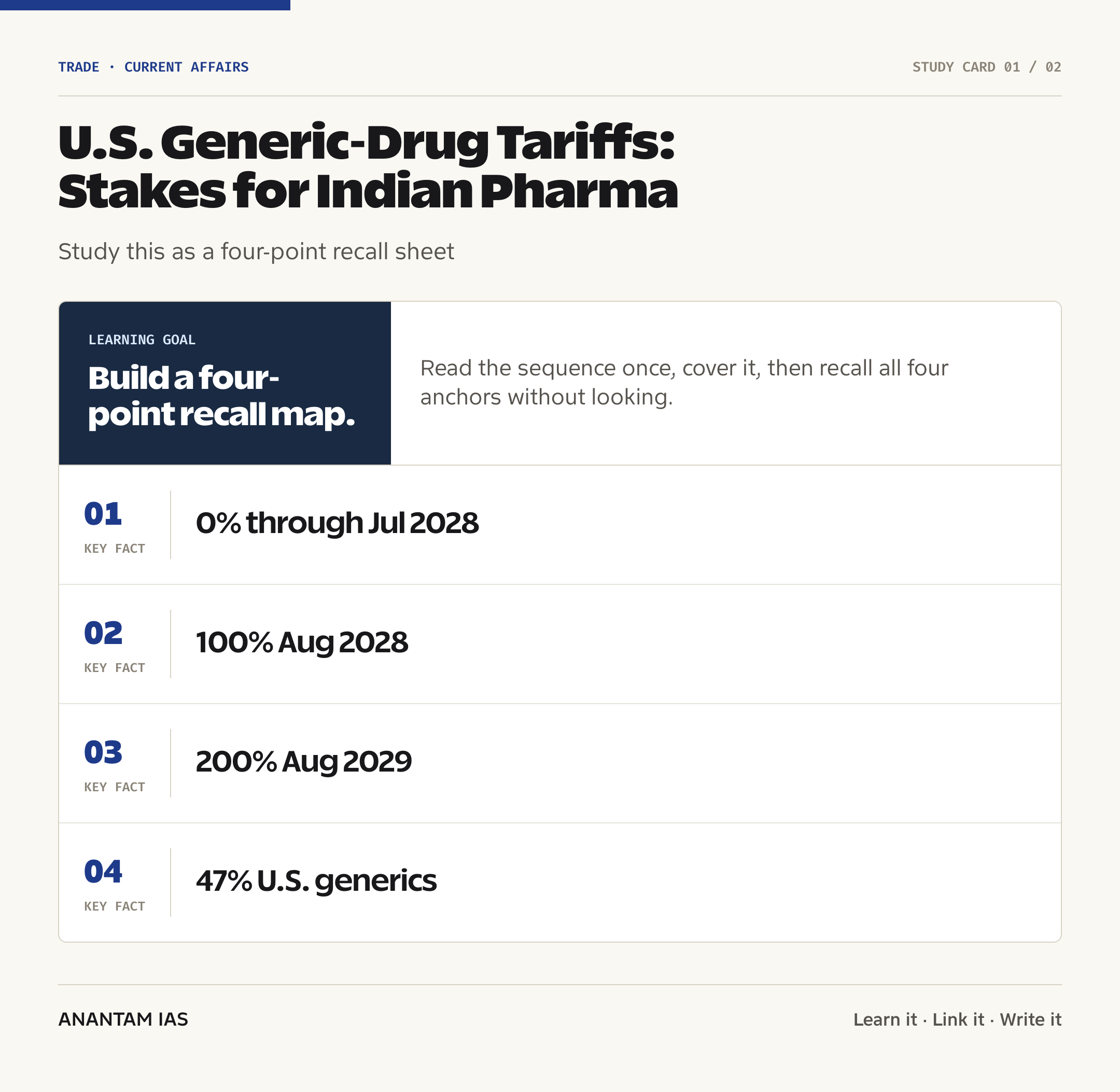
On July 21, 2026, U.S. President Donald Trump said in a social-media post that imported generic drugs would remain at a zero tariff for two years from August 1, 2026, face a 100% tariff from August 2028, and a 200% tariff from August 2029 unless manufacturers shifted production to the United States.
This is a policy threat and announced timetable, not yet an operative customs measure for generics. The existing April 2026 U.S. pharmaceutical proclamation expressly leaves generic medicines, biosimilars and associated ingredients untariffed for the time being. A binding change would still need an implementing legal instrument, product coverage and customs instructions.
- The Hindu reported that the proposed escalation gives manufacturers a two-year onshoring window and could expose India, the largest foreign supplier of low-cost generics to the U.S., to a sharp trade shock.
- Indian Express Explained stressed that earlier pharmaceutical tariff threats often served as investment pressure, while generic drugs remained exempt in the tariff instruments actually issued.
- The proposed sequence is 0% until July 31, 2028, 100% for the following year, and 200% thereafter; it must not be confused with an existing 100% or 200% duty.
- Indian manufacturers warned that generic production has thin margins, globally distributed inputs and product-specific approvals, so tariffs may raise U.S. prices or cause product exits before they create large-scale American capacity.
- The issue links India-U.S. trade negotiations with public health because a tariff designed to change factory location can also alter medicine availability, insurer spending and patient access.
The development matters in the context of:
- The dispute matters in the context of strategic autonomy in health: the U.S. wants supply security, while India seeks predictable access to its largest pharmaceutical export market.
- It tests whether tariffs can repair a fragile low-margin market without worsening the shortages they are meant to prevent.
- It highlights the difference between the high value of patented medicines and the high volume but low value of generic medicines.
- It also raises a policy-design question explored in India-U.S. trade negotiations: should resilience be built through punitive border taxes or through procurement guarantees, regulatory cooperation and investment incentives?
UPSC Relevance
Prelims Relevance
- Generic drug: a medicine required by the U.S. FDA to match the reference drug in active ingredient, strength, dosage form, route, intended use and bioequivalence.
- ANDA: an Abbreviated New Drug Application under section 505(j) of the U.S. Federal Food, Drug, and Cosmetic Act; it relies on the safety and efficacy finding for the reference drug.
- Bioequivalence means the generic delivers the active ingredient to the site of action at a comparable rate and extent; it does not mean lower quality.
- API, or active pharmaceutical ingredient, produces the therapeutic effect, while formulations convert APIs and excipients into finished dosage forms.
- Section 232 of the U.S. Trade Expansion Act, 1962 permits action when imports are found to threaten national security after a Commerce Department investigation.
- Ad valorem tariff is charged as a percentage of the customs value: 100% doubles the pre-logistics landed customs cost, while 200% triples it, before considering contracts and other charges.
- Tariff incidence is the actual economic burden shared across exporters, importers, distributors, insurers and patients; it need not equal the statutory rate or fall entirely on one party.
- The Hatch-Waxman Amendments, 1984 created the modern U.S. ANDA pathway and balanced generic entry with patent and exclusivity protections.
- The U.S. FDA says generics account for more than 90% of prescriptions dispensed in the United States but less than 13% of prescription-drug expenditure.
- India’s Patents Act, 1970, including Section 3(d), and tools such as compulsory licensing are part of the wider access-to-medicines framework; see India’s anti-evergreening safeguard.
Mains Relevance
GS Paper 3
- Impact of protectionism on export competitiveness, investment location, pharmaceutical value chains and India’s shift from volume-led generics to complex generics and biosimilars.
- Use of trade policy, production incentives, quality regulation and market diversification to strengthen a strategic manufacturing sector.
- Economics of tariff pass-through, price elasticity, concentrated buyers and supply disruption in a low-margin market.
GS Paper 2
- Health as a dimension of India-U.S. relations, with affordable medicines functioning as both an export strength and a global public good.
- Tension between national supply security and equitable access to essential medicines in public health systems such as Medicare and Medicaid.
- Scope for regulatory cooperation between the U.S. FDA and Indian regulators without weakening safety, quality or inspection standards.
Essay
- Interdependence versus self-reliance: resilient supply chains require diversified trusted partners, not necessarily complete domestic production.
- Affordable innovation: a health system must reward new medicines while sustaining competition after patents expire.
- Economic security: an instrument that protects domestic capacity can create a different vulnerability if it prices essential goods out of reach.
Background and Context
What Makes a Medicine a Generic?
A generic is a regulated therapeutic substitute, not an untested copy or merely a cheaper brand.
- The U.S. FDA requires the same active ingredient, strength, dosage form, route of administration and conditions of use as the reference listed drug, subject to limited permissible differences such as inactive ingredients.
- An applicant files an ANDA and demonstrates pharmaceutical equivalence, bioequivalence, manufacturing quality, stability and compliant labelling rather than repeating the innovator’s full clinical programme.
- All domestic and foreign facilities supplying the U.S. market must meet current Good Manufacturing Practice standards and remain subject to FDA inspection and enforcement.
- The pathway created by the Hatch-Waxman Amendments lowers duplicative development cost while retaining patent challenges, exclusivities and FDA review.
- Competition matters: FDA analysis says one generic competitor may reduce prices by about 30%, while five competitors are associated with reductions approaching 85%.
- For related concepts, biosimilars are highly similar to complex biological reference products and follow a different evidentiary pathway from small-molecule generics.
The Policy Status: Threat, Not Operative Generic Tariff
The exam-relevant distinction is between a political announcement, an investigation and an enforceable customs duty.
- The July 2026 social-media post announces a future schedule and an onshoring condition, but it does not itself specify tariff-line coverage, exemptions, rules of origin or Customs and Border Protection procedures.
- The April 2, 2026 White House proclamation imposed a separate framework for patented pharmaceuticals and ingredients, while stating that generics, biosimilars and associated ingredients were not subject to those tariffs at that time.
- That proclamation followed a Section 232 investigation, under which the Commerce Department assesses whether the quantity or circumstances of imports threaten national security.
- A binding generic tariff would require a presidential proclamation, executive action or other lawful instrument, followed by changes to the Harmonized Tariff Schedule and operational customs guidance.
- The announced dates are forward-looking: 100% from August 2028 and 200% from August 2029. Aspirants should avoid writing that a 200% generic tariff is already being collected.
- Policy credibility also depends on product exclusions, treatment of APIs and intermediates, trade-agreement partners, grandfathered contracts and whether companies with approved U.S. investment plans receive relief.
Why Indian Pharma Is Highly Exposed
India’s risk comes from the combination of export concentration, large prescription volumes and low unit values.
- The Hindu, citing the Global Trade Research Initiative, reported Indian pharmaceutical exports of $25.8 billion in calendar 2025, of which $9.7 billion, or 37.7%, went to the United States.
- Pharmexcil uses a different fiscal-year basis: its FY2024-25 data put total pharmaceutical exports at about $30.47 billion and the U.S. share near one-third. The two series should not be mixed without noting their periods.
- Indian firms are reported to supply roughly 47% of generic prescriptions dispensed in the U.S., while their value share is lower because generic medicines are priced far below patented products.
- The U.S. is not easily replaceable in the short run because it is India’s largest pharmaceutical export market, with demanding regulation but deep, predictable volumes.
- Exposure differs by firm and product: a company with U.S. plants, complex generics or differentiated products has more room to adjust than an exporter of highly commoditised oral solids.
- Indian companies already operate more than 40 facilities in the U.S., according to the Indian Pharmaceutical Alliance, but this footprint does not automatically replicate every India-made product or upstream input.
Why Tariffs Do Not Translate Mechanically into Retail Prices
The statutory duty is simple, but the final price effect travels through a complicated market.
- The U.S. importer pays the customs duty; the foreign manufacturer does not directly write the tariff cheque to the U.S. Treasury.
- The economic burden can be divided through lower exporter margins, higher invoice prices, renegotiated supply contracts, distributor mark-ups, insurer reimbursements and patient co-payments. This distribution is called tariff incidence.
- Demand for an essential medicine is often price-inelastic at the patient level, but buyers can substitute among FDA-approved therapeutically equivalent suppliers when alternatives exist.
- Generic manufacturers face intense tendering and purchasing pressure from wholesalers, pharmacy-benefit managers and large chains. Their thin margins leave little capacity to absorb a 100% or 200% border charge.
- A 100% ad valorem tariff doubles the customs-value component, not necessarily the pharmacy price; a 200% tariff triples that component. Distribution costs, rebates, insurance and substitution shape the final amount.
- If reimbursement cannot rise enough, the rational response may be to discontinue an unprofitable product rather than sell at a loss. That converts a price intervention into a supply risk.
Supply-Chain and Public-Health Consequences
A medicine supply chain is only resilient when approved capacity, ingredients and commercial incentives all remain available.
- Finished formulations depend on APIs, key starting materials, excipients, packaging, testing laboratories and logistics spread across several countries; moving final assembly alone does not create end-to-end self-sufficiency.
- The FDA says generics make up over 90% of U.S. prescriptions and more than 80% of drug shortages, reflecting market structure, manufacturing interruptions and weak returns on older medicines.
- The same FDA reported just four new shortages in 2025, down from a peak of 251 in 2011, showing that early-warning, accelerated reviews and coordinated mitigation can work better than a single blunt instrument.
- A tariff may encourage inventory accumulation before the deadline, but stockpiling only delays the shock and can temporarily distort orders, capacity planning and availability elsewhere.
- If suppliers withdraw, hospitals may have to use costlier substitutes, change treatment protocols or ration scarce injectables. Public programmes such as Medicare and Medicaid can face higher expenditure.
- India’s role as a dependable source of affordable medicines gives it strategic leverage, but recurring quality lapses at any facility can weaken its case. Quality assurance and supply security must be pursued together.
Why Rapid Reshoring Is Difficult
Pharmaceutical relocation requires regulatory transfer and reproducible quality, not just a new building.
- A new plant needs land, specialised equipment, trained staff, validated utilities, environmental approvals and a functioning quality-management system before commercial output begins.
- For every medicine, the manufacturer may need process validation, stability data, bioequivalence support and an FDA-approved supplement or technology-transfer change tied to the ANDA.
- Sterile injectables, inhalers and other complex generics require more specialised facilities and have higher failure costs than conventional tablets.
- U.S. labour, compliance and capital costs can be higher, while generic prices are held down by buyer concentration and competition. An unqualified reshoring mandate can make commercial viability the binding constraint.
- Indian firms with an existing FDA-approved U.S. site can expand selected products faster, but capacity, equipment type and approval scope are not interchangeable across the entire portfolio.
- A two-year window may support targeted high-risk products, yet duplicating the breadth and scale of offshore production would demand long-term procurement certainty, not only temporary tariff protection.
Trade Strategy and India's Policy Options
India needs a calibrated response that protects market access while reducing single-market and low-value dependence.
- The February 2026 U.S.-India joint statement envisaged negotiated outcomes for generic pharmaceuticals under the Section 232 process and possible removal from reciprocal tariffs after a successful interim agreement.
- That political understanding does not automatically immunise Indian generics from a later sectoral measure. India should seek product-level exemptions, transition rules and recognition of existing U.S. investments.
- Evidence should focus on India’s contribution to U.S. health affordability, shortage prevention, jobs and research, not only on export revenue.
- India can diversify toward Europe, Africa, Latin America and emerging regulated markets, but regulatory registration and buyer relationships mean market diversification takes time.
- The medium-term industrial goal should be a move from commoditised products toward complex generics, biosimilars, specialty formulations and novel delivery systems with better margins and fewer suppliers.
- Domestic policy should strengthen API security through competitive scale, reliable power and logistics, common testing infrastructure and predictable regulation rather than permanent protection from global competition.
Way Forward
Negotiate a Health-Security Compact
- Seek a binding generic and essential-medicine exemption under the bilateral trade framework, with transparent rules for APIs, intermediates and products facing shortages.
- Offer verifiable supply commitments, surge-capacity plans and early-warning data in exchange for predictable market access.
- Create a joint India-U.S. mechanism involving trade, health, FDA and industry officials to resolve tariff classification and regulatory bottlenecks before they disrupt supply.
Make Reshoring Selective and Economically Viable
- Prioritise U.S. co-production for a limited list of critical medicines where concentrated supply poses a demonstrated national-security risk.
- Use long-term purchase contracts, guaranteed minimum volumes, tax credits and low-cost finance so plants do not depend on an indefinitely high tariff wall.
- Permit trusted-friend supply networks in which APIs and finished doses are sourced across diversified compliant locations, avoiding a new single-country dependence.
Strengthen India's Competitive Base
- Raise the consistency of cGMP compliance, data integrity, remediation and inspection readiness across large firms and smaller suppliers.
- Speed investment in complex generics, biosimilars and continuous manufacturing while building skills in regulatory science and intellectual-property strategy.
- Expand export insurance, market intelligence and regulatory assistance for firms entering multiple regulated markets.
Protect Patients During Transition
- Phase any measure by product risk and exempt medicines in shortage, sole-source products and essential public-health supplies from automatic escalation.
- Monitor discontinuation notices, inventory and price movements through the FDA drug-shortage system and accelerate alternative ANDA approvals when supply tightens.
- Evaluate policy by medicine availability and total health-system cost, not merely by the number of factory announcements.
Conclusion
The proposed tariff schedule exposes a genuine U.S. concern about dependence on foreign pharmaceutical capacity, but a 100–200% duty is not yet operative for generic drugs. Treating the announcement as settled law would overstate the immediate trade shock and miss the policy process still ahead.
For India, the answer is neither complacency nor indiscriminate relocation. It is to combine firm trade diplomacy, superior quality, selective overseas capacity and a shift toward higher-value products while preserving the scale that makes Indian generics affordable.
The durable principle is that health security cannot be measured only by where a factory stands. It also depends on whether approved suppliers remain commercially willing and able to deliver safe medicines to patients at the required time and price.
UPSC Practice Questions
Prelims MCQ 1
With reference to generic medicines and their regulation in the United States, consider the following statements:
- An Abbreviated New Drug Application may rely on the regulator’s earlier finding of safety and efficacy for the reference drug.
- A generic medicine must have the same active ingredient, strength, dosage form and route of administration as its reference product.
- Foreign plants supplying the U.S. market are exempt from the manufacturing-quality standards applied to U.S. plants.
How many of the above statements are correct?
(a) Only one (b) Only two (c) All three (d) None
Answer: (b) Only two
Explanation:
Statements 1 and 2 are correct. The ANDA pathway avoids repeating the innovator’s full clinical programme but still requires equivalence and quality evidence. Statement 3 is incorrect: foreign and domestic facilities supplying FDA-approved products must meet applicable cGMP standards and are subject to oversight.
Prelims MCQ 2
Which one of the following best describes the present status of the announced U.S. tariff on imported generic drugs?
(a) A 200% tariff is already being collected on all imported generics (b) A 100% tariff took effect for Indian generics in July 2026 (c) It is a future tariff timetable announced politically, but generics remain untariffed under the existing April 2026 pharmaceutical proclamation (d) It is an FDA regulation changing bioequivalence standards
Answer: (c) It is a future tariff timetable announced politically, but generics remain untariffed under the existing April 2026 pharmaceutical proclamation
Explanation:
The July announcement threatens 100% from August 2028 and 200% a year later. It is not yet an operative generic customs duty. An enforceable measure would need a legal instrument, product scope and customs implementation.
UPSC Mains Questions
- A tariff intended to secure domestic pharmaceutical capacity can also undermine medicine security. Analyse this paradox with reference to the proposed U.S. tariffs on imported generic drugs, their likely incidence, and the role of Indian manufacturers in American health-care supply chains.
- India’s generic-drug strength rests on scale, cost and regulatory capability, but export concentration creates strategic vulnerability. Suggest a policy package combining trade diplomacy, market diversification, quality assurance, higher-value manufacturing and selective overseas investment without compromising affordable access to medicines.
- Distinguish a tariff announcement from an operative trade measure. In this light, examine how Section 232 action, regulatory approvals and commercial incentives shape the feasibility of pharmaceutical reshoring in the United States.
Sources: White House and U.S. Food and Drug Administration and The Hindu and Indian Express Explained.
Frequently Asked Questions
Is the 200% generic tariff already in force?
No. The July 2026 statement announced a future schedule: zero tariff for two years, 100% from August 2028 and 200% from August 2029. The existing April 2026 U.S. pharmaceutical proclamation leaves generics untariffed for now. A binding duty still requires an implementing legal instrument, defined product coverage and customs instructions.
Why are Indian drugmakers especially exposed?
The United States is India’s largest pharmaceutical export market, and Indian manufacturers supply a very large share of its generic prescriptions. Their advantage comes from scale, specialised manufacturing and low costs. But generic margins are thin, so firms cannot easily absorb a 100% or 200% customs charge without raising prices, shifting production or discontinuing products.
Would a 100% tariff double medicine prices?
Not automatically. A 100% ad valorem duty doubles the customs-value component of an import, not its final pharmacy price. Exporter margins, contracts, distributor charges, insurer reimbursement, rebates and substitution determine tariff incidence. But because many generics already earn narrow margins, even partial pass-through or product withdrawal can materially raise health-system costs.
Why can’t firms quickly move production?
A pharmaceutical transfer needs more than a factory shell. The new site requires validated equipment and processes, trained staff, compliant quality systems, stable input supply and FDA acceptance of product-specific manufacturing changes. Sterile and complex generics take longer. Commercial production must also remain viable under the U.S. market’s low prices and concentrated purchasing.
How could tariffs cause drug shortages?
If a tariff makes a low-margin product unprofitable, a supplier may exit rather than continue at a loss. Remaining approved manufacturers cannot always expand immediately, while a new source needs regulatory clearance. The result can be fewer suppliers, tighter inventories and disruption, especially for injectables, older essential medicines and products already made at only a few sites.
What should India seek from negotiations?
India should seek a binding exemption or negotiated treatment for generics, APIs and shortage-prone medicines; recognition of existing U.S. facilities; realistic transition periods; and transparent rules of origin. It should pair that request with quality commitments, supply-warning data and selective investment, while diversifying markets and moving toward complex generics and biosimilars.
Source: https://anantamias.com/current-affairs/us-generic-drug-tariffs-indian-pharma/
RBI Polymer Banknote Trial: Durability, Security and Costs
Why in News?
The Indian Express reported in July 2026 that Bharatiya Reserve Bank Note Mudran Private Limited, an RBI-owned banknote printer, had invited global bids for polymer substrate sheets for a fresh field trial. The development moves the idea from policy consideration toward procurement, but no polymer denomination has yet been issued to the public.
The expression of interest seeks 68,000 reams, with 500 sheets per ream, of security-featured biaxially oriented polypropylene-based opacified substrate. Half the quantity is intended for each of two denominations, which the tender does not name. A trial is not a nationwide replacement decision.
- BRBNMPL and the government-owned SPMCIL are expected to print the trial notes at India’s banknote presses.
- The requirement equals 3.4 crore sheets; the tender describes it as an immediate requirement before any larger procurement after a successful trial.
- At the June 2026 post-policy interaction, RBI Governor Sanjay Malhotra said the proposal was at a preliminary stage and its costs and benefits were still being examined.
- The RBI Annual Report 2025-26, as cited by the Indian Express, recorded ₹4,875 crore of expenditure on printing notes, making lifecycle cost a central trial question.
The development matters in the context of:
- This matters in the context of the Clean Note Policy, because longer-lasting notes could reduce the frequency of sorting, withdrawal, destruction and replacement.
- It also tests whether currency security, public convenience and machine compatibility can improve without creating a weak end-of-life plastic stream.
- The trial connects physical cash management with fiscal prudence: a costlier note can still be economical if it remains fit much longer and lowers recurring logistics costs.
UPSC Relevance
Prelims Relevance
- Section 22 of the RBI Act, 1934 gives the Reserve Bank the sole right to issue banknotes in India.
- Under Section 25, the Central Government approves the design, form and material of banknotes after considering recommendations of the RBI Central Board.
- Section 26 makes every RBI banknote legal tender for its expressed amount and provides a Central Government guarantee.
- Current Indian banknote paper is made from 100% cotton; calling it ordinary wood-pulp paper is inaccurate.
- Polymer supports integrated features such as a transparent window, but the substrate alone does not make a note counterfeit-proof.
- BRBNMPL is a wholly owned RBI subsidiary with presses at Mysuru and Salboni; SPMCIL is a Government of India company with currency presses at Nashik and Dewas.
- The Clean Note Policy aims to keep good-quality notes in circulation by sorting returned notes and destroying those found unfit.
Mains Relevance
GS Paper 3
- Economics of currency lifecycle management, including printing, distribution, machine processing, replacement and destruction costs.
- Role of substrate choice in counterfeit resilience, note quality and trust in sovereign money.
- Environmental appraisal through a cradle-to-grave assessment, not a paper-versus-plastic label.
GS Paper 2
- Division of authority between the RBI Central Board and Central Government under the RBI Act.
- Need for transparent trials, accessibility testing and public communication before a nationwide currency change.
Essay
- The material of money can change, but public trust remains its real foundation.
- A durable technology is sustainable only when its full lifecycle is designed, measured and governed.
Background and Context
What a Polymer Banknote Actually Is
A polymer banknote is a security document printed on engineered film, not ordinary plastic currency.
- Biaxially oriented polypropylene is stretched along two axes, opacified for printing and engineered to receive inks, coatings and machine-readable security elements.
- Selected areas may remain clear to form a transparent window, a feature that is difficult to imitate convincingly with a printed paper counterfeit.
- India’s present notes use cotton-based banknote paper. The policy comparison is polymer versus cotton substrate, not plastic versus tree-based office paper.
- The substrate is only one layer of security. Intaglio print, color-shifting elements, tactile marks, serial numbering and machine authentication still determine the strength of the finished note.
India's Long Trial History and Present Status
India has studied polymer notes for years, but past announcements did not produce a public issue.
- In 2012, the Ministry of Finance said one billion ₹10 polymer notes were planned for a field trial in five cities, primarily to extend the life of low-denomination notes.
- The proposed cities, Kochi, Mysuru, Shimla, Jaipur and Bhubaneswar, represented different climatic conditions, but the announced circulation trial did not materialize.
- A 2016 Lok Sabha reply said procurement had begun, and a 2017 PIB release confirmed government approval for procurement and printing of ₹10 trial notes.
- The Indian Express reports that the RBI’s 2014-15 Annual Report referred to technical infirmities after evaluation. The present procurement should be read as a renewed test, not proof that those issues have already been solved.
Legal and Institutional Architecture
Changing the substrate is an administrative and statutory process within India’s existing currency framework.
- Section 22 of the RBI Act vests the sole right to issue banknotes in the Reserve Bank; printing contractors do not become issuers.
- Under Section 25, the Central Government approves the note’s design, form and material after considering the RBI Central Board’s recommendation.
- The Issue Department manages note issuance separately within RBI, while BRBNMPL and SPMCIL provide production capacity. Read the wider institutional role in RBI functions and responsibilities.
- The RBI Governor heads the central bank, but substrate adoption is not a unilateral personal decision; it follows statutory recommendation, government approval, procurement and testing. See the RBI Governor’s role.
Lifecycle Economics and Printing Costs
The right comparison is total cost per year of useful circulation, not the factory price of one note.
- A polymer note can cost more to produce because it needs specialized substrate, coatings, inks and security integration. Upfront unit cost may rise even when lifecycle cost falls.
- Longer service life can reduce repeated printing, transport, sorting and destruction. Savings are strongest for denominations that circulate frequently and become soiled quickly.
- The RBI’s reported ₹4,875 crore printing expenditure in 2025-26 gives scale, but it does not prove how much polymer would save. Tender prices, yield loss and Indian survival data are still needed.
- The pilot should calculate cost per fit-circulation year, including machine upgrades, staff training, dual-stock handling, reverse logistics and recycling contracts.
- Cost appraisal should use several survival assumptions, because a small change in actual note life can alter the result. RBI should compare identical denominations and handling environments rather than average unlike notes into one headline estimate.
- The procurement test should record sheet yield, printing rejects and feature-integration failures. A lower substrate quote can become expensive if more sheets fail quality control or if presses require slower production runs.
- Tender evaluation should cover supplier concentration, secure transport and technology transfer. Currency material is strategic: price competition matters, but resilience against delayed imports, compromised inputs and vendor lock-in also carries an economic value.
Durability and Security Gains
Polymer’s strongest case is the combination of longer circulation and a richer security-feature platform.
- The non-porous surface resists moisture, dirt and oils better than cotton paper, which may help notes remain machine-readable and visibly clean for longer.
- Polymer can integrate clear windows, complex optical effects and tactile features into the substrate, raising the equipment and skill needed for a convincing imitation.
- A counterfeit number must be interpreted carefully. The reported 2.3 lakh fake notes detected in 2025-26 measures detections in the banking system, not the total stock of counterfeit money in the economy.
- Substrate is not a standalone cure. Effective protection still needs secure design, machine authentication, public awareness and enforcement against production and distribution networks.
- The trial should use an explicit counterfeit attack model: crude paper copies, simulated windows, altered genuine notes and high-quality reproductions may fail in different ways. Security must be tested by both trained cash handlers and ordinary users.
- A security feature is useful only if it remains recognizable after circulation. RBI should measure whether windows, tactile print and optical effects survive folding, abrasion and contamination without causing genuine notes to be rejected as suspect.
- Detection data should be normalized against the volume of notes processed and separated by denomination and imitation method. A raw increase in detected pieces may reflect more counterfeiting, better screening or both.
Climate, Machines and Public Adoption
India’s heat, humidity, cash intensity and diverse handling practices make local evidence essential.
- Tests should expose notes to summer heat, monsoon humidity, dust, sweat, oils and repeated folding, rather than transferring foreign durability claims directly to India.
- Polymer performs in warm countries such as Australia and Thailand, but substrate formulation, coatings and local handling differ. High-temperature deformation still requires controlled laboratory and field testing.
- ATMs, counting machines, note sorters, vending systems and cash recyclers must recognize the new thickness, friction and optical profile. Calibration costs belong in the pilot’s economics.
- New polymer notes can feel slippery or initially stick together. Cash handlers, retailers and banks need training in counting, authentication and safe storage.
- Accessibility testing should cover tactile identification, contrast, note size and performance after wear, with direct participation by persons with visual disabilities.
- The field design should span coastal humidity, dry heat, cold conditions and monsoon exposure, while also sampling dense urban cash use and rural circulation. A short laboratory test cannot reproduce repeated transfer between hands, tills, pockets and machines.
- RBI should provide controlled test packs to ATM and cash-equipment manufacturers before public circulation. Acceptance, dispensing, counting, fitness sorting and counterfeit rejection require separate tests because one successful machine function does not prove the others.
- Accessibility must be assessed on worn notes, not only pristine samples. The pilot should check whether raised marks and color contrast remain usable after abrasion and whether machine-readable aids serve people who cannot reliably inspect visual security features.
Environmental Trade-offs and Recycling
Polymer can lower lifecycle impact only when longer life and a real recycling chain outweigh fossil-based inputs.
- A polymer substrate is based on a non-renewable petrochemical feedstock. It should not be called green merely because it is recyclable in principle.
- The 2012 PIB reply said an RBI-commissioned TERI lifecycle study found environmental benefits over cotton notes, with longevity as the central reason.
- Fewer replacements may reduce material use, printing energy and transport. But India’s decision needs an updated lifecycle assessment covering domestic energy, logistics, reject rates and end-of-life treatment.
- Withdrawn notes require secure destruction before recycling. A credible system needs segregation, granulation, audited recyclers and traceability so security waste does not leak.
- Recycling cannot be improvised after issuance. RBI needs verified capacity to handle coated and printed polymer waste, including production offcuts, rejected sheets and unfit notes, without mixing secure material into ordinary municipal waste.
- Contracts should assign responsibility for collection, destruction certificates and material recovery. Public reporting should distinguish material sent to a recycler from material actually converted into usable feedstock, since the two figures can differ.
- The environmental comparison should test poor outcomes too: shorter-than-expected life, low recovery or long-distance transport to a recycler. Sensitivity analysis reveals whether polymer remains preferable when field performance falls below the optimistic case.
International Experience and Lessons for India
Foreign experience supports cautious optimism, but it also shows that transition management matters as much as substrate choice.
- Australia pioneered modern polymer notes and uses transparent windows and other integrated features; its central bank also recycles withdrawn polymer into other products.
- The Bank of Canada reports longer note life and lower lifecycle impact, while its handling guidance recognizes that fresh notes may initially stick and damaged edges can tear.
- The Bank of England moved denomination by denomination, supplied samples to equipment makers and coordinated ATM, retail and cash-industry readiness before launch.
- Thailand expanded polymer issuance after observing improved durability of its first denomination, showing the value of staged evidence in a warm and humid setting.
Way Forward
Publish a measurable trial protocol
- Predefine note-life, machine-rejection, counterfeit, user-comfort and end-of-life indicators, using matched cotton-note cohorts and varied climatic locations.
Price the whole system
- Compare lifecycle cost, not procurement price alone, including equipment calibration, training, dual circulation, secure disposal and supply continuity.
Design security and inclusion together
- Co-test visible, tactile and machine-readable features with banks, retailers, equipment makers and persons with disabilities, backed by public authentication guidance.
Build end-of-life capacity first
- Contract audited domestic recyclers, define secure destruction and publish recovery and disposal outcomes within a fresh India-specific lifecycle study.
Conclusion
The RBI polymer banknote trial is best viewed as a currency-management experiment, not a symbolic move away from paper and not a fresh demonetization. Its promise lies in keeping notes fit longer while supporting stronger security features.
The policy case will stand only if Indian field evidence shows that durability savings exceed higher production and transition costs, machines remain reliable, users can handle the notes easily and withdrawn polymer enters a secure recycling chain.
For UPSC answers, the balanced position is clear: support a transparent, staged pilot under the RBI Act, but reserve judgment on nationwide adoption until lifecycle, inclusion and climate results are public.
UPSC Practice Questions
Prelims MCQ 1
With reference to the issue of banknotes in India, consider the following statements:
- The Reserve Bank of India has the sole right to issue banknotes under Section 22 of the RBI Act, 1934.
- The material of a banknote is approved by the Central Government after considering the recommendation of the RBI Central Board.
- Changing a banknote from cotton substrate to polymer automatically changes its legal-tender status.
How many of the above statements are correct?
(a) Only one (b) Only two (c) All three (d) None
Answer: (b) Only two
Explanation:
Statements 1 and 2 are correct under Sections 22 and 25 of the RBI Act. Statement 3 is incorrect: substrate choice does not by itself alter legal tender, which is governed by the statutory issue and notification framework.
Prelims MCQ 2
Which one of the following best describes the principal economic test for a polymer banknote?
(a) Whether its factory price is lower than a cotton note (b) Whether it contains no petrochemical material (c) Whether its total lifecycle cost per useful circulation period is lower (d) Whether every counterfeit can be eliminated by the substrate
Answer: (c) Whether its total lifecycle cost per useful circulation period is lower
Explanation:
Polymer may have a higher upfront unit cost. The relevant test includes note life, printing, transport, sorting, machine changes, destruction and recycling. Neither zero petrochemical input nor complete elimination of counterfeiting is a valid assumption.
UPSC Mains Questions
- A banknote substrate is not a minor printing choice but an element of currency governance. Examine the statutory process for changing banknote material in India and assess the institutional safeguards needed before polymer notes move from field trial to wider circulation.
- Polymer banknotes promise greater durability and counterfeit resilience, yet their economic case depends on lifecycle evidence. Analyze the costs, operational risks and environmental trade-offs that the RBI should measure in the renewed trial.
- International adoption of polymer notes offers lessons, not a ready-made verdict for India. Discuss how climate, cash-handling infrastructure, accessibility and end-of-life recycling should shape an India-specific decision.
Sources: PIB, Ministry of Finance and Indian Express Explained.
Frequently Asked Questions
Has RBI launched polymer notes?
No. The 2026 procurement process prepares substrate for a field trial. The tender points to two unnamed denominations, but RBI has not issued polymer notes to the public or announced a nationwide replacement of existing cotton-substrate notes.
Are polymer notes ordinary plastic?
No. They use an engineered, opacified BOPP-based substrate designed for secure printing, coatings and integrated authentication features. The phrase plastic currency is shorthand and should not be confused with ordinary packaging film, payment cards or the digital rupee.
Who approves banknote material?
Under Section 25 of the RBI Act, 1934, the Central Government approves the design, form and material of banknotes after considering recommendations from the RBI Central Board. RBI retains the sole right to issue banknotes under Section 22.
Why can polymer notes cost less?
A polymer note may cost more at the printing stage. It can still be cheaper over time if longer life reduces repeated printing, distribution, sorting and destruction. India needs trial data before claiming a net saving.
Are polymer notes impossible to counterfeit?
No banknote is impossible to counterfeit. Polymer enables difficult-to-copy features such as an integrated clear window, but security also depends on design, inks, tactile features, machine authentication, public awareness and law enforcement.
Are polymer notes better for the environment?
They can be if greater durability reduces manufacturing and transport and if withdrawn notes are securely recycled. But polymer uses a fossil-based feedstock. An India-specific lifecycle assessment must include energy, rejects, logistics and the actual recycling rate.
Source: https://anantamias.com/current-affairs/rbi-polymer-banknote-trial/
Paper-Leak Cases: Centre Announces Fast-Track Courts
Why in News?
Prime Minister Narendra Modi announced on 23 July 2026 that fast-track courts would be set up for paper-leak cases and said the concerned authorities had been directed to take the necessary steps. The Indian Express reported the announcement amid nationwide protests over examination integrity.
The statement is a policy commitment, not proof that a new court network is already operational. It gave no public detail on the number of courts, territorial allocation, funding, staffing, case-transfer criteria or implementation timetable, so those questions must await formal executive, judicial and State-level action.
- The stated objective is swift and stringent punishment for those involved in paper leaks.
- The announcement concerns the trial stage; it does not by itself cure weaknesses in detection, investigation, prosecution or examination design.
- The durable statutory anchor is the Public Examinations (Prevention of Unfair Means) Act, 2024, in force from 21 June 2024.
- Ordinary fast-track courts are set up by States and Union Territories in consultation with their respective High Courts, according to the Department of Justice.
- A workable model must reconcile speed with Article 21, which protects both speedy justice and a fair procedure.
The development matters in the context of:
- The move matters in the context of repeated high-stakes examination failures and the institutional issues explained in Anantam IAS’s NEET 2026 paper-leak analysis.
- It shifts attention from creating offences to securing reliable convictions through forensic evidence, capable prosecutors and disciplined case management.
- It also tests whether a targeted docket can deliver speed without merely moving judges, staff and courtrooms away from other pending criminal cases.
UPSC Relevance
Prelims Relevance
- The Public Examinations (Prevention of Unfair Means) Act, 2024 is Act No. 1 of 2024 and came into force on 21 June 2024.
- Its Schedule covers examinations conducted by UPSC, SSC, Railway Recruitment Boards, IBPS, Central ministries and departments, and NTA, plus any other notified authority.
- Section 3 includes question-paper or answer-key leakage, unauthorised access, collusion, OMR tampering, computer-system tampering and fake examinations among unfair means.
- Under Section 9, offences are cognizable, non-bailable and non-compoundable; non-bailable does not mean that bail can never be granted.
- Section 10 prescribes three to five years’ imprisonment and a fine up to ₹10 lakh for a person resorting to offences under the Act.
- Section 11 prescribes five to ten years’ imprisonment and a fine of at least ₹1 crore for organised crime; an involved institution’s property may be attached and forfeited.
- Under Section 12, investigation must be by an officer not below Deputy Superintendent of Police or Assistant Commissioner of Police; the Centre may refer a case to a Central Investigating Agency.
- The Act supplements other laws under Section 15; charges under other applicable criminal, cyber, corruption or money-laundering laws may coexist when their ingredients are met.
- Police is in the State List, while administration of justice and criminal procedure engage the constitutional distribution of powers between Union and States.
- Article 235 vests control over district courts and subordinate courts in the High Court.
Mains Relevance
GS Paper 2
- Assess fast-track courts as a governance response to breaches of equality of opportunity, merit and public trust in recruitment and admission systems.
- Explain the federal and institutional roles of the Union, States, High Courts, police, examination authorities and prosecuting agencies.
- Balance a time-bound trial with judicial independence, due process, legal aid and reasoned adjudication.
GS Paper 3
- Analyse organised paper-leak networks through cyber forensics, financial trails, vendor risk and chain-of-custody.
- Distinguish deterrent penalties from preventive controls such as compartmentalised access, audit logs and secure question-bank design.
Essay
- Speed is valuable in justice only when accuracy, fairness and institutional legitimacy travel with it.
- A public examination is a test of the candidate, but its integrity is a test of the State.
Background and Context
What the Announcement Does and Does Not Do
The announcement supplies political direction, while the operational court design is still to be disclosed.
- The Prime Minister said fast-track courts would ensure swift punishment and that authorities had been instructed to act.
- A fast-track court is not a separate constitutional tier above ordinary courts; it is generally a designated or additional court with a prioritised docket, focused case management and supporting capacity.
- The statement did not identify whether cases would go to newly created courts, designated existing courts or a special statutory forum.
- It also did not state whether the model would cover only offences under the 2024 central law, related offences, pending cases, future cases or State-level examination leaks.
- The eventual blueprint should distinguish a dedicated court with ring-fenced staff from a designated court that continues to hear its ordinary docket. The labels may sound similar, but their capacity effects are very different.
- Case prioritisation also needs an entry and exit rule: when a matter qualifies, who orders its transfer, how connected prosecutions are grouped and what happens if the charge under the special law is later altered.
- Students should treat phrases such as announced, approved, notified and operational as different administrative stages.
The 2024 Anti-Paper-Leak Framework
The central law targets organised actors and service-provider failures across the examination chain.
- Sections 3 to 8 cover leakage, collusion, unauthorised possession, solving questions during an examination, tampering, security violations, fake websites and failures by service providers to report offences.
- The Act reaches the full ecosystem: individuals, organised groups, institutions, examination authorities, vendors, subcontractors and persons associated with service providers.
- Ordinary offences attract three to five years of imprisonment and a fine up to ₹10 lakh; organised crime attracts five to ten years and a fine of at least ₹1 crore.
- A service provider can face a fine up to ₹1 crore, proportionate recovery of examination cost and a four-year bar from examination work; responsible managers may face personal liability when consent or connivance is proved.
- The statutory design includes a due-diligence defence for specified persons who prove lack of knowledge and reasonable preventive action.
- The Statement of Objects and Reasons says candidates are to remain outside this Act’s penal action and be governed by the examination authority’s administrative rules; the law’s central target is the leak ecosystem, not honest examinees.
Federal and Judicial Architecture
A Union announcement needs coordinated implementation because criminal justice and subordinate-court administration are institutionally distributed.
- The Department of Justice states that ordinary Fast Track Courts are set up by States and Union Territories in consultation with their respective High Courts, based on need and available resources.
- Article 235 places control over district and subordinate courts with the High Court, protecting judicial administration from unilateral executive control.
- Police investigation is principally a State responsibility, while a central agency may investigate where the legal conditions for referral are satisfied; Section 12 expressly permits Central referral under the 2024 Act.
- The executive may provide policy, law, finance and infrastructure, but it cannot dictate the result or day-to-day adjudication of an individual case. Judicial independence remains intact even when a category receives administrative priority.
- For a leak spanning several jurisdictions, a written coordination protocol should prevent parallel teams from duplicating seizures, recording inconsistent versions or leaving evidence gaps. It should identify the lead investigation, nodal prosecutors and lawful channels for sharing records.
- The 2024 Act directly covers the central examination authorities named in its Schedule. State examination cases may depend on State anti-cheating laws and other applicable criminal provisions unless their authority is brought within the central framework.
- The Act’s Objects and Reasons describes it as a model draft for States, making legal harmonisation a cooperative-federalism task rather than an automatic consequence.
- This design should be read with the broader division of responsibility in Indian federalism and Centre-State relations.
Why the Evidence Chain Decides the Trial
A quicker hearing calendar cannot compensate for a broken trail between the sealed question paper, the leak and the accused.
- Investigators must establish the origin, timing, access path, transmission route and beneficiary network, not merely show that a matching paper later appeared online.
- For digital material, device seizure, forensic imaging, hash values, server logs, metadata, access-control records and documented transfers protect the chain of custody.
- CCTV footage, printing logs, custody registers, packet seals, centre access logs and witness statements must fit one coherent timeline.
- A sound case theory should separate discovery evidence, which points investigators towards a suspect, from admissible proof used to establish the offence. This distinction reduces dependence on an unsupported confession or a viral screenshot.
- Time is critical because platform records can be overwritten, devices can be remotely wiped and temporary access logs can expire. Preservation requests, lawful seizure and prompt forensic imaging should begin at the incident-response stage, not after the charge sheet is nearly complete.
- Encrypted messages or screenshots need lawful collection and authentication under the Bharatiya Sakshya Adhiniyam, 2023; an unverified forwarded image is a lead, not automatically conclusive proof.
- Financial investigators should map payments, intermediaries and wrongful gain, especially when the prosecution invokes organised crime or seeks attachment and forfeiture.
- Prosecution teams need early coordination with cyber-forensic laboratories so that data preservation requests and expert reports arrive before volatile evidence disappears.
Speed Must Remain Fair
Fast tracking is legitimate case management, not permission to lower the criminal standard of proof.
- Article 21 protects a speedy trial, but it also requires a fair, just and reasonable procedure for the accused and affected candidates.
- The prosecution must still prove each offence beyond reasonable doubt; public anger, political statements or the scale of an exam cannot replace admissible evidence.
- The accused must receive documents, legal representation, a real chance to cross-examine witnesses and sufficient time to answer complex digital-forensic evidence.
- Non-bailable offences remain subject to judicial bail decisions. Courts must apply the governing law to flight risk, evidence tampering, witness influence and other case-specific factors.
- Open-court principles should guide proceedings, while narrowly tailored protection may be needed for minors, whistle-blowers, confidential question material or personal candidate data. Confidentiality should protect legitimate interests, not conceal the basis of adjudication.
- A fast trial must also permit effective appellate scrutiny. Complete electronic records, properly marked exhibits and reasoned findings help an appellate court review the case without recreating a confused evidence trail.
- Witness protection and candidate privacy matter because whistle-blowers, centre staff and students can face intimidation or reputational harm.
- The design should avoid numerical disposal targets that reward speed at the expense of reasoned judgments or encourage routine adjournment denial.
Capacity Is the Difference Between Priority and Displacement
A labelled fast-track docket works only if it receives additional people, technology and court time.
- Designating an existing court without extra judges, prosecutors, stenographers and infrastructure can simply reorder pendency rather than reduce it.
- Paper-leak cases may span several States, vendors, servers and financial channels, creating a need for joint investigation protocols and a clear lead agency.
- Specially trained prosecutors and judges need competence in cyber evidence, procurement contracts, conspiracy, financial tracing and the 2024 Act.
- Court managers should schedule expert witnesses, ensure timely service of summons and flag missing forensic reports before the hearing date. Active case management can remove avoidable delay without curtailing either side’s legal rights.
- Capacity planning should count not only judges but also prosecutors, defence legal-aid lawyers, forensic analysts, process servers, translators and secure digital-storage support. A bottleneck at any one stage can neutralise a faster courtroom calendar.
- A neutral allocation rule should identify eligible cases by statute and procedural stage, preventing selective listing or political influence over individual matters.
- Public dashboards can report filing-to-disposal time, age of cases, adjournments and appeal outcomes without disclosing protected evidence or prejudicing trial.
- The resource question fits India’s wider judicial pendency and court-capacity challenge: priority needs additional capacity, not a new signboard.
Punishment Cannot Substitute for Exam-System Reform
Conviction addresses a completed breach; exam integrity depends on reducing the opportunity for a breach in the first place.
- Examination authorities should minimise single points of failure through role-based access, compartmentalised question banks, multiple paper sets and tamper-evident custody.
- Vendors need security audits, personnel vetting, subcontractor disclosure, incident-reporting duties and enforceable contractual liability.
- Real-time anomaly detection and immutable access logs can shorten detection time, while independent post-exam audits can identify recurring vulnerabilities.
- Every completed investigation should feed a confidential lessons-learned review: which control failed, when the breach became detectable, why escalation was delayed and which vendor or official retained excessive access. Prevention improves when prosecution evidence informs system redesign.
- Candidate remedies need predetermined rules for cancellation, retest, result correction, fee support and grievance redress so honest students do not carry the full cost of institutional failure.
- The deeper prevention agenda is examined in Paper Leaks and the Crisis of Exam Integrity.
- The best metric is not the number of harsh sentences. It is a sustained fall in compromised examinations, faster lawful case completion and restored confidence in equal opportunity.
Way Forward
Publish an Operational Blueprint
- Specify the legal route, court count, geography, jurisdiction, funding, staffing and start date after consultation with States and High Courts.
- Define objective criteria for transferring pending and future cases, with safeguards against executive selection of a particular judge.
Build an End-to-End Case Protocol
- Create a standard investigation checklist for physical custody, digital preservation, financial trails, inter-State requests and forensic reporting.
- Use one accountable case coordinator per prosecution to track evidence, witnesses, summons, expert reports and statutory disclosures.
Fund Real Additional Capacity
- Provide dedicated judges, trained prosecutors, clerical staff, e-Courts support and accredited forensic access instead of only relabelling existing courtrooms.
- Review workloads with the High Courts so fast tracking one class of offence does not invisibly delay other serious cases.
Protect Fairness and Measure Outcomes
- Set model timelines for investigation and trial while preserving bail adjudication, disclosure, defence preparation and witness examination.
- Publish anonymised performance data on pendency, median age, adjournments, disposal, conviction, acquittal and appellate reversal to test both speed and quality.
Repair the Examination System
- Pair prosecution with secure question-bank architecture, vendor accountability, independent security audits and a clear candidate-compensation framework.
- Encourage States to align their laws and procedures while retaining space for local examination structures and policing needs.
Conclusion
Fast-track courts can close the accountability gap only when they are part of a complete chain: secure examinations, professional investigation, admissible evidence, capable prosecution, independent adjudication and effective remedies for candidates.
The announcement is a starting signal. Its legitimacy will depend on whether the eventual design produces speed with fairness, respects federal and judicial roles, and prevents the next leak instead of only punishing the last one.
UPSC Practice Questions
Prelims MCQ 1
With reference to the Public Examinations (Prevention of Unfair Means) Act, 2024, consider the following statements:
- All offences under the Act are cognizable, non-bailable and non-compoundable.
- An officer below the rank of Deputy Superintendent of Police may investigate an offence under the Act with permission of the examination authority.
- The Central Government may refer an investigation under the Act to a Central Investigating Agency.
How many of the above statements are correct?
(a) Only one (b) Only two (c) All three (d) None
Answer: (b) Only two
Explanation:
Statements 1 and 3 are correct. Sections 9 and 12 make the offences cognizable, non-bailable and non-compoundable, require investigation by an officer not below DSP/ACP rank, and permit Central referral to a Central Investigating Agency. Statement 2 is incorrect.
Prelims MCQ 2
Which one of the following correctly describes the constitutional-administrative position of ordinary Fast Track Courts in India?
(a) They form a separate constitutional hierarchy controlled exclusively by the Union executive (b) They are created only by the Supreme Court under Article 32 (c) States and Union Territories set them up in consultation with their respective High Courts, subject to the applicable legal and funding framework (d) They can try only offences investigated by a Central agency
Answer: (c) States and Union Territories set them up in consultation with their respective High Courts, subject to the applicable legal and funding framework
Explanation:
The Department of Justice describes ordinary FTC establishment and functioning as a State/UT responsibility carried out in consultation with the respective High Court. A fast-track designation does not create a new constitutional court hierarchy.
UPSC Mains Questions
- The announcement of fast-track courts for paper-leak cases can address delay, but not weak investigation or insecure examination design. Critically examine the institutional architecture needed to turn punitive intent into credible deterrence while preserving due process. (250 words)
- Paper-leak prosecution sits at the intersection of Union legislation, State policing and High Court control over the subordinate judiciary. Explain this federal design and suggest a coordination framework for inter-State examination fraud. (250 words)
- A digital evidence chain is the backbone of a modern paper-leak trial. Discuss the investigative and procedural safeguards required to prove leakage, conspiracy and wrongful gain without compromising the accused’s right to a fair trial. (150 words)
Sources: India Code, Public Examinations (Prevention of Unfair Means) Act, 2024 and The Indian Express.
Frequently Asked Questions
Are the new fast-track courts operational?
Not on the evidence publicly reported with the announcement. The Prime Minister announced the decision and directed concerned authorities to act, but no court count, location list, funding plan, notification or operational date was specified. Implementation requires formal steps involving the competent governments and High Courts.
What does the 2024 Act punish?
It punishes conduct such as question-paper leakage, collusion, unauthorised access, answer-sheet tampering, security breaches, fake examinations and service-provider failures. It also creates enhanced punishment for organised crime and allows institutional property attachment and examination-cost recovery in specified cases.
Does non-bailable mean bail is impossible?
No. A non-bailable classification means bail is not an automatic entitlement granted by the police. The accused may seek bail from a court, which applies the governing law and case facts, including flight risk, possible evidence tampering, witness influence and the seriousness of the alleged offence.
Who investigates offences under the Act?
Section 12 requires an officer not below the rank of Deputy Superintendent of Police or Assistant Commissioner of Police. The Central Government may also refer the investigation to a Central Investigating Agency. Inter-State cases still need clear coordination, evidence-sharing and an accountable lead agency.
Why is chain of custody important?
It records how a paper, phone, server image, CCTV file or other exhibit was collected, sealed, copied, transferred, tested and produced in court. A documented chain, supported by hashes and forensic records for digital material, helps establish authenticity and guards against contamination or later alteration.
Can faster trials alone stop paper leaks?
No. Faster trials may improve certainty and timeliness of punishment, but prevention needs secure question banks, restricted access, audited vendors, tamper-evident logistics, digital logs, trained investigators and predictable remedies for candidates. Court speed is one link in a much larger exam-integrity system.
Source: https://anantamias.com/current-affairs/paper-leak-cases-fast-track-courts-exam-governance/
FCRA Amendment Bill: Designated Authority and NGO Asset Control
Why in News?
The Ministry of Home Affairs issued a detailed clarification on the Foreign Contribution (Regulation) Amendment Bill, 2026 after concerns arose about the proposed Designated Authority and its control over assets connected with foreign contributions.
The Bill, introduced in the Lok Sabha on 25 March 2026, would replace the limited asset-management framework in Section 15 of the FCRA, 2010 with a new Chapter IIIA. PIB stressed that vesting is initially provisional, assets must be restored when registration returns within the prescribed period, and orders of the Authority carry statutory remedies.
- PIB clarified that the proposed mechanism concerns foreign contribution and assets created from it, not an NGO’s unrelated asset pool.
- Registration ending through cancellation, surrender or cessation would trigger provisional vesting in the Designated Authority.
- Failure to obtain a fresh, renewed or restored certificate within the prescribed period would convert provisional vesting into permanent vesting.
- Permanently vested assets must serve public purposes; transfer to government bodies is preferred, while sale proceeds and unused foreign contribution go to the Consolidated Fund of India.
- An Authority order may be revised within 90 days, followed by a judicial appeal to the District Judge or another notified judicial officer of the prescribed rank.
The development matters in the context of:
- This matters in the context of balancing national-interest regulation with the institutional autonomy of civil-society organisations.
- It raises a due-process distinction between remedies against a Designated Authority’s order and remedies against the Central Government’s underlying renewal decision.
- Mixed-funded assets bring Article 14 and Article 300A questions into the design of identification, valuation and return procedures.
- Places of worship connect the statutory safeguard to Articles 25 and 26 and religious-institution management.
UPSC Relevance
Prelims Relevance
- The FCRA, 2010 is administered by the Ministry of Home Affairs and regulates the acceptance and use of foreign contribution and foreign hospitality.
- An FCRA registration certificate is valid for five years; a separate prior-permission route applies to a specific source, amount and purpose.
- Existing Section 15 already provides for vesting of foreign contribution and assets when registration is cancelled or surrendered.
- Proposed Section 14B covers cessation where renewal was not sought, was refused, or was not completed before expiry.
- Proposed Chapter IIIA contains Sections 16A to 16L on vesting, management, duties, powers, revision, appeal and exemption.
- A mixed-funded asset would initially vest wholly, but a distinct or ascertainable portion funded from other sources may be returned on application.
- Permanent assets must be applied to public purposes; sale proceeds and unused foreign contribution are credited to the Consolidated Fund of India.
- The religious character of a permanently vested place of worship must be maintained.
- Revision and appeal against an Authority order each carry a proposed 90-day window.
- The Bill reduces the general maximum imprisonment for contravention from five years to one year and requires prior Central approval to begin an FCRA investigation.
Mains Relevance
GS Paper 2
- Examine the balance between executive oversight, civil-society autonomy and accountable use of foreign funds.
- Distinguish statutory appeal, Article 226 judicial review and the procedural hearing required at different stages.
- Apply Articles 14, 19(1)(c), 25, 26 and 300A without treating foreign funding as an unrestricted fundamental right.
GS Paper 4
- Assess proportionality, reasoned orders and conflict safeguards when public authority manages private charitable assets.
- Discuss how auditability and enforcement can coexist with institutional trust and continuity of essential social services.
Essay
- Regulation and freedom: democratic states must guard national interest without shrinking legitimate civic space.
- Procedure as justice: the quality of notice, hearing, reasons and appeal shapes the legitimacy of state power.
- Public purpose and private initiative: charitable assets often sit at the intersection of donor intent, community need and regulatory control.
Background and Context
FCRA Architecture and the Existing Asset Rule
The Bill builds on an asset-vesting idea already present in the FCRA, 2010, but gives it a larger procedural structure.
- The Act regulates foreign grants and donations so their acceptance and use do not harm sovereignty, public order, security or national interest.
- An eligible organisation may use either a renewable registration certificate or prior permission tied to a defined source and project.
- Existing Section 15 says foreign contribution and assets created from it vest in a prescribed authority when a certificate is cancelled or surrendered.
- Under the existing rules, that prescribed authority is associated with the concerned State Government or Union Territory administration; the present framework does not comprehensively settle supervision, restoration, final disposal and legacy cases.
- The current provision also permits the prescribed authority to manage the person’s activities in public interest and use foreign contribution or dispose of assets when adequate operating funds are unavailable.
- PIB said nearly 22,000 registrations had been cancelled and about 15,000 deemed ceased over the previous decade, while State authorities faced practical difficulty taking possession and maintaining the connected assets.
- The 2026 Bill would omit Section 15 and insert Chapter IIIA, making an officer or authority notified by the Central Government the Designated Authority.
Trigger, Provisional Vesting and Restoration
The proposed sequence separates temporary custody from final transfer, making provisional vesting the first legal step.
- Proposed Section 16A(1) is triggered from the date of cancellation under Section 14, surrender under Section 14A, or cessation under proposed Section 14B.
- Cessation covers three situations: no renewal application, refusal of renewal, or failure to obtain renewal before the five-year certificate expires.
- During provisional vesting, the Authority may take possession directly or through an Administrator, safeguard assets and supervise their management.
- When public interest requires, it may manage the organisation’s activities for the prescribed period and use foreign contribution to maintain those assets and activities.
- Because the duration and manner of management are largely left to prescribed rules, the subordinate legislation will determine how intrusive provisional control becomes in practice.
- If a fresh certificate is granted or the old certificate is renewed or restored by revision within the prescribed period, the Authority must return the unused contribution and provisionally vested assets, subject to prescribed conditions.
- PIB’s clarification is important: cancellation does not itself mean permanent appropriation, and expiry or cessation does not automatically establish fraud or criminal wrongdoing.
Permanent Vesting and Public-Purpose Disposal
Permanent vesting follows only after restoration fails within the prescribed time or an organisation becomes inoperative or defunct.
- Under proposed Section 16A(5), foreign contribution and connected assets permanently vest when no fresh, renewed or restored certificate is secured within the prescribed period.
- The Authority must apply permanently vested property for public purposes, not for the personal benefit of an official or the former organisation’s functionaries.
- Public purpose should be stated asset by asset because a school, clinic, shelter and cultural institution have different beneficiaries, operating needs and community dependencies.
- It may transfer an asset to a Central or State ministry, department, authority, agency or local authority, such as placing a hospital with a health department.
- When direct public use is not suitable, the asset may be sold or otherwise disposed of; the proceeds and unused contribution enter the Consolidated Fund of India.
- Former key functionaries and persons acting for their benefit cannot directly or indirectly acquire an interest in a disposed vested asset.
- A sale or transfer certificate issued by the Authority is proposed as conclusive proof for registration even when the original title deeds are unavailable.
Mixed Funding and the Prior-Permission Distinction
The difficult asset question is not a wholly foreign-funded bank balance, but property built from foreign and domestic money together.
- Proposed Section 16A(2) says an asset acquired partly from foreign contribution and partly from other sources initially vests wholly in the Authority.
- The organisation may seek return of a distinct or ascertainable portion created from domestic sources; the Authority must return that portion when satisfied.
- This design places the first evidentiary burden on the organisation, making reliable ledgers, title records, donor restrictions and valuation methods central to fairness.
- PRS Legislative Research notes that an inseparable mixed asset, such as one hospital ward built from pooled donations, may make the domestic portion difficult to identify in physical terms.
- The Bill also creates a potential difference between certificate holders and the prior-permission route: cessation-based vesting attaches to a registration certificate, while prior permission is project- and source-specific.
- Rules should state how proportional shares, improvements, depreciation and third-party interests are treated so an ascertainable domestic component is not lost through procedural uncertainty.
Authority Powers, Organisational Duties and Accountability
The proposed Authority combines custody and management powers with record-keeping duties and civil-court powers for evidence.
- It must maintain inventories, accounts and records, report suspected violations or fraud, and send periodic reports to the Central Government.
- The Authority and Administrator may summon persons, examine them on oath, compel documents, receive affidavits and issue commissions like a Civil Court for specified purposes.
- An affected organisation and its key functionaries must provide access to books, electronic records, premises, bank accounts, lockers, securities and movable assets.
- They cannot alienate, encumber, conceal, remove or otherwise deal with connected property without the Authority’s approval and must continue activities under its supervision.
- The Authority must act under Central Government directions, while specified government officers, banks and public bodies must provide it institutional assistance.
- The Bill defines key functionary broadly to include directors, partners, trustees, a Karta, office-bearers, governing-body members and persons responsible for management.
- These powers need transparent inventories, independent valuation, asset-specific reasons and periodic disclosure because the same institution may identify, manage and propose disposal of valuable property.
Remedies and the Due-Process Distinction
The Bill creates remedies against the Authority, but the legal trigger for vesting may arise from a separate Central Government decision.
- Under proposed Section 16J, the Authority may revise its own Chapter IIIA order on its motion or on application within 90 days.
- Under proposed Section 16K, an aggrieved person may appeal within 90 days to the District Judge or a notified judicial officer not below Civil Judge, Senior Division.
- These remedies can test an Authority’s decisions on possession, identification, management, return or disposal; PIB correctly describes them as safeguards against an Authority order.
- Revision by the same Authority can correct an error quickly, while an appeal before a judicial officer supplies external adjudication; both work best when the initial order discloses facts and reasons.
- PRS identifies a different gap: neither the existing Act nor the Bill gives a dedicated appeal or prior hearing against the Central Government’s denial of renewal, even though denial can trigger cessation and vesting.
- A renewal decision remains open to constitutional scrutiny through High Court writ jurisdiction, but writ review is not identical to a fact-intensive statutory appeal.
- A sound procedure should give prompt notice, disclosed reasons subject to lawful confidentiality, an opportunity to respond, a speaking order and a stay route before irreversible disposal.
Constitutional Balance and Religious Institutions
The constitutional test is not whether foreign funding is unlimited, but whether statutory power is exercised through non-arbitrary and proportionate procedure.
- In Noel Harper v. Union of India (2022), the Supreme Court upheld major 2020 FCRA restrictions and rejected an absolute right to receive foreign contribution.
- Article 14 still requires intelligible classifications, consistent criteria and protection against arbitrary identification, valuation or disposal of assets.
- Article 19(1)(c) protects citizens’ freedom to form associations, subject to Article 19(4); management takeover can affect associational functioning even when receipt of foreign money itself is regulated.
- Article 300A allows deprivation of property only by authority of law, making the statutory basis, public purpose and fairness of the vesting procedure constitutionally relevant.
- For permanently vested property that is wholly or partly a place of worship, proposed Section 16A(7) requires the Authority to entrust management as prescribed and preserve its religious character.
- That safeguard must operate alongside Articles 25 and 26, which protect religious freedom and denominational management subject to public order, morality, health and other constitutional limits.
Way Forward
Specify the Vesting Rules
- Define the prescribed restoration period, inventory method, valuation date, maintenance standard and sequence from provisional control to permanent vesting.
- Create an asset register that separates foreign-funded, domestic-funded and mixed components and records third-party rights, liabilities and donor restrictions.
Make Hearing Effective
- Provide an organisation with notice, relevant material, adequate response time and a reasoned renewal order before cessation produces serious asset consequences.
- Allow an interim stay of management transfer or sale while revision, appeal or judicial review is pending, except where urgent preservation is recorded.
Separate Custody from Disposal
- Use independent professional valuation and a transparent disposal plan, with audit trails reviewed by the Comptroller and Auditor General or another suitable oversight mechanism.
- Require conflict declarations and prohibit connected persons from influencing the selection of a transferee or buyer.
Protect Service Continuity
- Keep schools, hospitals, shelters and places of worship functioning during litigation through time-bound interim management and beneficiary-protection plans.
- Match a permanently vested asset to a public body capable of preserving its charitable purpose before considering sale.
Improve Regulatory Trust
- Publish anonymised data on cessation, restoration, asset return, permanent vesting and disposal to permit parliamentary and public scrutiny.
- Issue standard operating procedures and train officials so similar cases receive consistent treatment across States and Union Territories.
Conclusion
The FCRA Amendment Bill, 2026 attempts to close a real administrative gap left by Section 15: long-term custody of foreign-funded assets without a complete path for supervision, restoration or lawful disposal.
Its legitimacy will depend less on the label Designated Authority and more on the quality of notice, hearing, valuation, reasons, review and service continuity. A carefully bounded mechanism can protect public purpose and regulatory accountability without treating every lapse as wrongdoing or every civil-society body as suspect.
UPSC Practice Questions
Prelims MCQ 1
With reference to the Foreign Contribution (Regulation) Amendment Bill, 2026, consider the following statements:
- It proposes provisional vesting when an FCRA certificate is cancelled, surrendered or deemed to have ceased.
- A mixed-funded asset may vest wholly, subject to return of a distinct or ascertainable portion created from other sources.
- A permanently vested place of worship must retain its religious character.
How many of the above statements are correct?
(a) Only one (b) Only two (c) All three (d) None
Answer: (c) All three
Explanation:
All three follow proposed Sections 14B and 16A. Vesting begins provisionally; mixed assets have a domestic-portion return mechanism; and the Authority must preserve the religious character of a permanently vested place of worship.
Prelims MCQ 2
Which statement best distinguishes the remedies discussed in the FCRA Amendment Bill debate?
(a) Every renewal refusal is automatically appealed to the District Judge. (b) Authority orders have proposed revision and judicial appeal, while renewal refusal lacks a dedicated statutory appeal in the Bill. (c) Only the Supreme Court may examine an Authority order. (d) Permanent vesting cannot be reviewed by any court.
Answer: (b) Authority orders have proposed revision and judicial appeal, while renewal refusal lacks a dedicated statutory appeal in the Bill.
Explanation:
Proposed Sections 16J and 16K cover revision and appeal from Designated Authority orders. PRS notes that the separate Central Government decision refusing renewal has no dedicated appeal under the Bill, although constitutional judicial review remains available.
UPSC Mains Questions
- The FCRA Amendment Bill, 2026 seeks to replace indefinite custodial uncertainty with a structured regime for provisional and permanent asset vesting. Examine whether its safeguards adequately balance national-interest regulation, civil-society autonomy and continuity of public services.
- Distinguish remedies against an order of the proposed Designated Authority from remedies against refusal to renew an FCRA certificate. Why is this distinction central to procedural fairness under Articles 14 and 300A?
- Assets created from both foreign and domestic contributions present a hard regulatory problem. Discuss how identification, valuation, proportionality and independent review should shape a constitutionally sound vesting framework.
Sources: PIB, Ministry of Home Affairs and The Hindu.
Frequently Asked Questions
What does the FCRA Amendment Bill propose?
It proposes a new Chapter IIIA under which a notified Designated Authority would provisionally receive, protect and manage foreign contribution and connected assets after cancellation, surrender or cessation of registration. Assets return if registration is restored within the prescribed period; otherwise, they may vest permanently and be applied to public purposes.
Does cancellation immediately transfer assets permanently?
No. The first stage is provisional vesting. If the organisation obtains a fresh certificate or gets its certificate renewed or restored within the prescribed period, the Authority must return unused foreign contribution and the provisionally vested assets. Permanent vesting follows only when restoration fails within that period or specified defunct-organisation provisions apply.
Can domestic-funded property also vest?
An unrelated domestic asset is outside the stated mechanism. But an indivisible asset created partly from foreign contribution and partly from other sources would initially vest wholly. The organisation may apply for return of a distinct or ascertainable domestic-funded portion, making documentation and fair valuation especially important.
What remedies exist against Authority orders?
The Bill permits the Designated Authority to revise a Chapter IIIA order within 90 days, either on its own or on application. An aggrieved person may also appeal within 90 days to the District Judge or another notified judicial officer of at least the prescribed seniority.
Why does PRS identify a due-process gap?
The statutory revision and appeal concern orders made by the Designated Authority. PRS notes that refusal by the Central Government to renew the underlying certificate has no dedicated hearing or appeal mechanism in the Bill, even though refusal triggers cessation. High Court judicial review remains available, but it is structurally different from a statutory appeal.
How are places of worship protected?
For an asset permanently vested in the Authority that is wholly or partly a place of worship, the Bill requires management to be entrusted as prescribed and its religious character to be maintained. This statutory safeguard operates alongside constitutional protections for religious freedom and denominational affairs under Articles 25 and 26.
Source: https://anantamias.com/current-affairs/fcra-amendment-bill-designated-authority-ngo-assets/