Why in News?
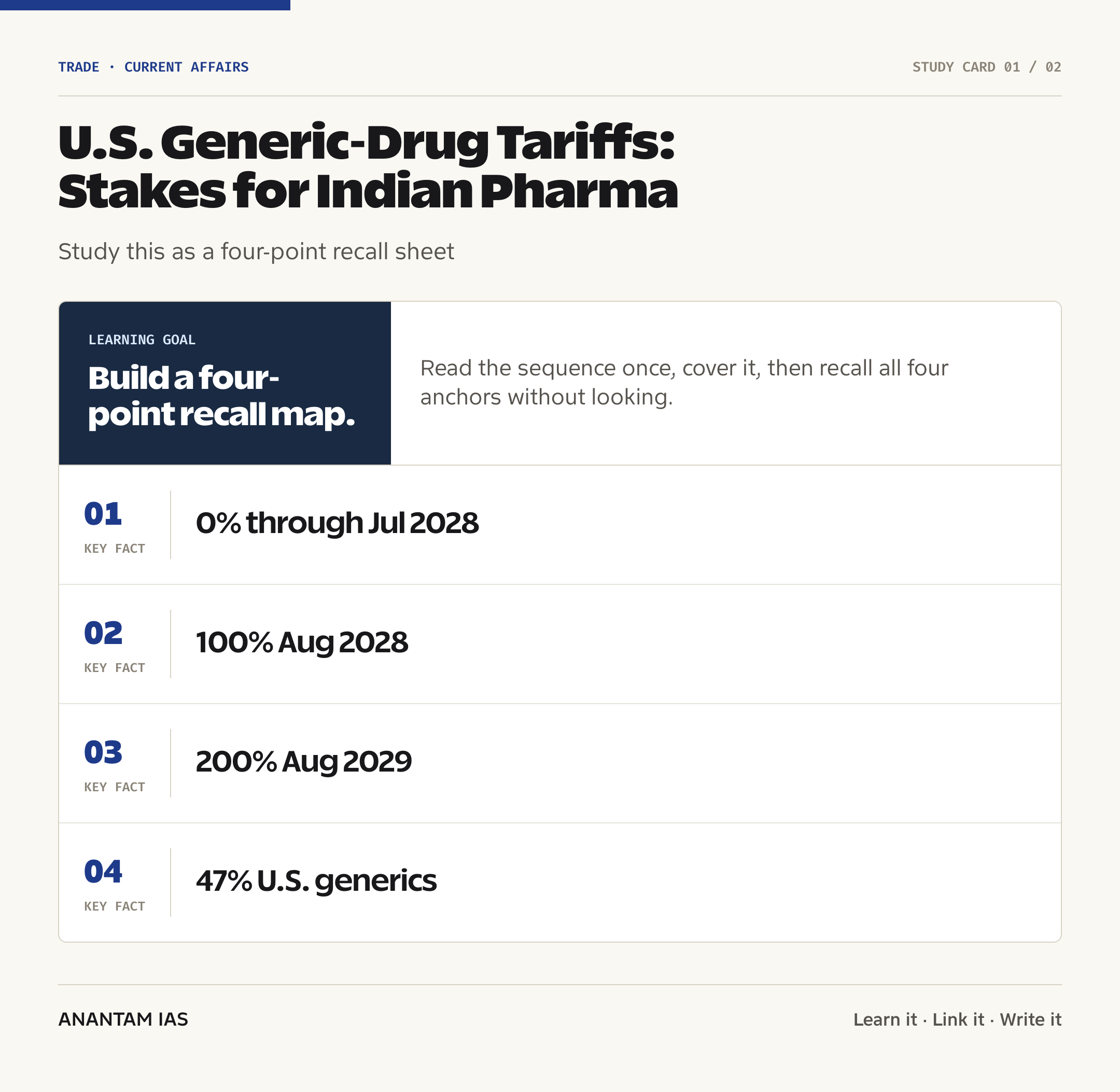
On July 21, 2026, U.S. President Donald Trump said in a social-media post that imported generic drugs would remain at a zero tariff for two years from August 1, 2026, face a 100% tariff from August 2028, and a 200% tariff from August 2029 unless manufacturers shifted production to the United States.
This is a policy threat and announced timetable, not yet an operative customs measure for generics. The existing April 2026 U.S. pharmaceutical proclamation expressly leaves generic medicines, biosimilars and associated ingredients untariffed for the time being. A binding change would still need an implementing legal instrument, product coverage and customs instructions.
- The Hindu reported that the proposed escalation gives manufacturers a two-year onshoring window and could expose India, the largest foreign supplier of low-cost generics to the U.S., to a sharp trade shock.
- Indian Express Explained stressed that earlier pharmaceutical tariff threats often served as investment pressure, while generic drugs remained exempt in the tariff instruments actually issued.
- The proposed sequence is 0% until July 31, 2028, 100% for the following year, and 200% thereafter; it must not be confused with an existing 100% or 200% duty.
- Indian manufacturers warned that generic production has thin margins, globally distributed inputs and product-specific approvals, so tariffs may raise U.S. prices or cause product exits before they create large-scale American capacity.
- The issue links India-U.S. trade negotiations with public health because a tariff designed to change factory location can also alter medicine availability, insurer spending and patient access.
The development matters in the context of:
- The dispute matters in the context of strategic autonomy in health: the U.S. wants supply security, while India seeks predictable access to its largest pharmaceutical export market.
- It tests whether tariffs can repair a fragile low-margin market without worsening the shortages they are meant to prevent.
- It highlights the difference between the high value of patented medicines and the high volume but low value of generic medicines.
- It also raises a policy-design question explored in India-U.S. trade negotiations: should resilience be built through punitive border taxes or through procurement guarantees, regulatory cooperation and investment incentives?
UPSC Relevance
Prelims Relevance
- Generic drug: a medicine required by the U.S. FDA to match the reference drug in active ingredient, strength, dosage form, route, intended use and bioequivalence.
- ANDA: an Abbreviated New Drug Application under section 505(j) of the U.S. Federal Food, Drug, and Cosmetic Act; it relies on the safety and efficacy finding for the reference drug.
- Bioequivalence means the generic delivers the active ingredient to the site of action at a comparable rate and extent; it does not mean lower quality.
- API, or active pharmaceutical ingredient, produces the therapeutic effect, while formulations convert APIs and excipients into finished dosage forms.
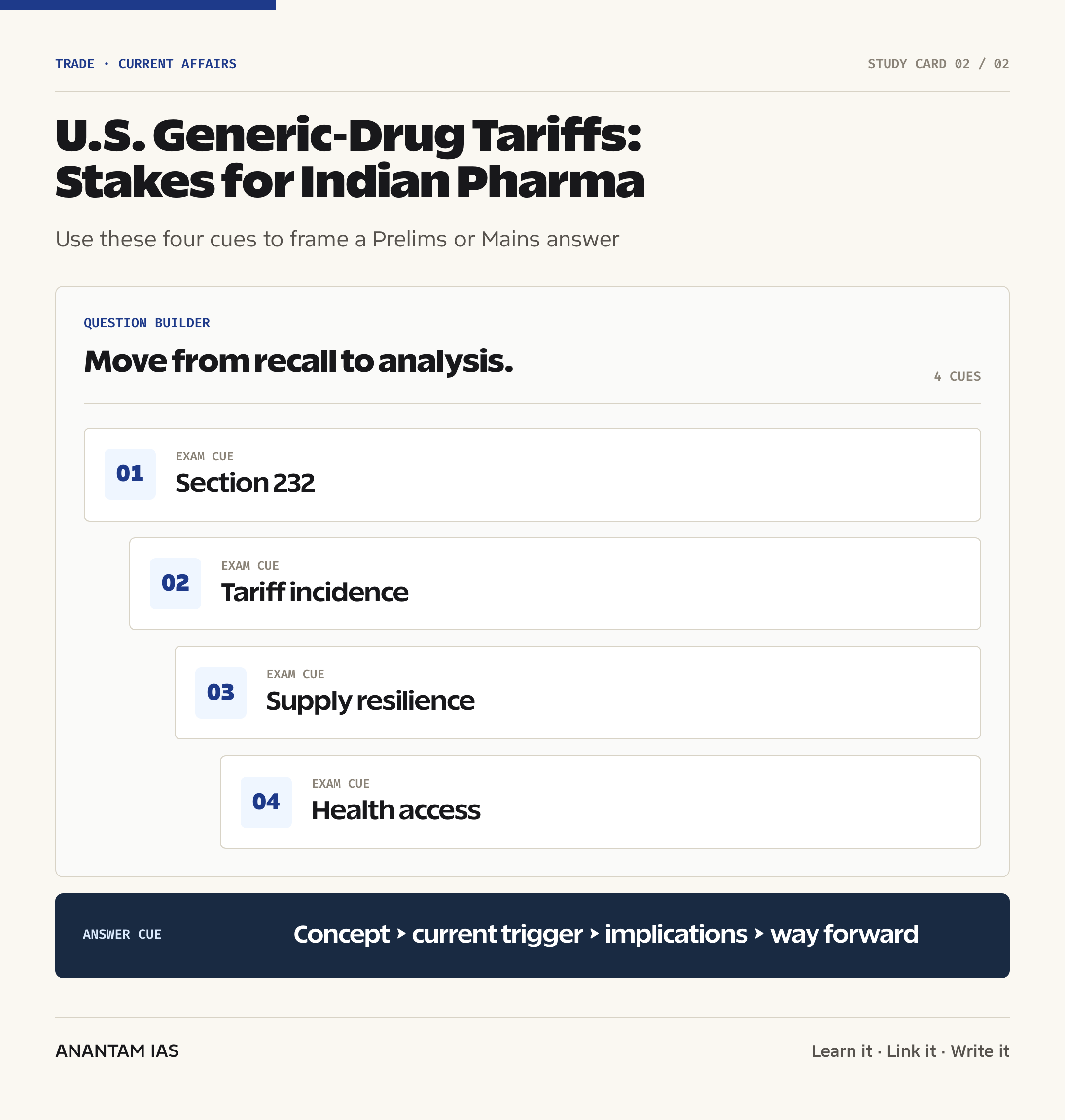
- Section 232 of the U.S. Trade Expansion Act, 1962 permits action when imports are found to threaten national security after a Commerce Department investigation.
- Ad valorem tariff is charged as a percentage of the customs value: 100% doubles the pre-logistics landed customs cost, while 200% triples it, before considering contracts and other charges.
- Tariff incidence is the actual economic burden shared across exporters, importers, distributors, insurers and patients; it need not equal the statutory rate or fall entirely on one party.
- The Hatch-Waxman Amendments, 1984 created the modern U.S. ANDA pathway and balanced generic entry with patent and exclusivity protections.
- The U.S. FDA says generics account for more than 90% of prescriptions dispensed in the United States but less than 13% of prescription-drug expenditure.
- India’s Patents Act, 1970, including Section 3(d), and tools such as compulsory licensing are part of the wider access-to-medicines framework; see India’s anti-evergreening safeguard.
Mains Relevance
GS Paper 3
- Impact of protectionism on export competitiveness, investment location, pharmaceutical value chains and India’s shift from volume-led generics to complex generics and biosimilars.
- Use of trade policy, production incentives, quality regulation and market diversification to strengthen a strategic manufacturing sector.
- Economics of tariff pass-through, price elasticity, concentrated buyers and supply disruption in a low-margin market.
GS Paper 2
- Health as a dimension of India-U.S. relations, with affordable medicines functioning as both an export strength and a global public good.
- Tension between national supply security and equitable access to essential medicines in public health systems such as Medicare and Medicaid.
- Scope for regulatory cooperation between the U.S. FDA and Indian regulators without weakening safety, quality or inspection standards.
Essay
- Interdependence versus self-reliance: resilient supply chains require diversified trusted partners, not necessarily complete domestic production.
- Affordable innovation: a health system must reward new medicines while sustaining competition after patents expire.
- Economic security: an instrument that protects domestic capacity can create a different vulnerability if it prices essential goods out of reach.
Background and Context
What Makes a Medicine a Generic?
A generic is a regulated therapeutic substitute, not an untested copy or merely a cheaper brand.
- The U.S. FDA requires the same active ingredient, strength, dosage form, route of administration and conditions of use as the reference listed drug, subject to limited permissible differences such as inactive ingredients.
- An applicant files an ANDA and demonstrates pharmaceutical equivalence, bioequivalence, manufacturing quality, stability and compliant labelling rather than repeating the innovator’s full clinical programme.
- All domestic and foreign facilities supplying the U.S. market must meet current Good Manufacturing Practice standards and remain subject to FDA inspection and enforcement.
- The pathway created by the Hatch-Waxman Amendments lowers duplicative development cost while retaining patent challenges, exclusivities and FDA review.
- Competition matters: FDA analysis says one generic competitor may reduce prices by about 30%, while five competitors are associated with reductions approaching 85%.
- For related concepts, biosimilars are highly similar to complex biological reference products and follow a different evidentiary pathway from small-molecule generics.
The Policy Status: Threat, Not Operative Generic Tariff
The exam-relevant distinction is between a political announcement, an investigation and an enforceable customs duty.
- The July 2026 social-media post announces a future schedule and an onshoring condition, but it does not itself specify tariff-line coverage, exemptions, rules of origin or Customs and Border Protection procedures.
- The April 2, 2026 White House proclamation imposed a separate framework for patented pharmaceuticals and ingredients, while stating that generics, biosimilars and associated ingredients were not subject to those tariffs at that time.
- That proclamation followed a Section 232 investigation, under which the Commerce Department assesses whether the quantity or circumstances of imports threaten national security.
- A binding generic tariff would require a presidential proclamation, executive action or other lawful instrument, followed by changes to the Harmonized Tariff Schedule and operational customs guidance.
- The announced dates are forward-looking: 100% from August 2028 and 200% from August 2029. Aspirants should avoid writing that a 200% generic tariff is already being collected.
- Policy credibility also depends on product exclusions, treatment of APIs and intermediates, trade-agreement partners, grandfathered contracts and whether companies with approved U.S. investment plans receive relief.
Why Indian Pharma Is Highly Exposed
India’s risk comes from the combination of export concentration, large prescription volumes and low unit values.
- The Hindu, citing the Global Trade Research Initiative, reported Indian pharmaceutical exports of $25.8 billion in calendar 2025, of which $9.7 billion, or 37.7%, went to the United States.
- Pharmexcil uses a different fiscal-year basis: its FY2024-25 data put total pharmaceutical exports at about $30.47 billion and the U.S. share near one-third. The two series should not be mixed without noting their periods.
- Indian firms are reported to supply roughly 47% of generic prescriptions dispensed in the U.S., while their value share is lower because generic medicines are priced far below patented products.
- The U.S. is not easily replaceable in the short run because it is India’s largest pharmaceutical export market, with demanding regulation but deep, predictable volumes.
- Exposure differs by firm and product: a company with U.S. plants, complex generics or differentiated products has more room to adjust than an exporter of highly commoditised oral solids.
- Indian companies already operate more than 40 facilities in the U.S., according to the Indian Pharmaceutical Alliance, but this footprint does not automatically replicate every India-made product or upstream input.
Why Tariffs Do Not Translate Mechanically into Retail Prices
The statutory duty is simple, but the final price effect travels through a complicated market.
- The U.S. importer pays the customs duty; the foreign manufacturer does not directly write the tariff cheque to the U.S. Treasury.
- The economic burden can be divided through lower exporter margins, higher invoice prices, renegotiated supply contracts, distributor mark-ups, insurer reimbursements and patient co-payments. This distribution is called tariff incidence.
- Demand for an essential medicine is often price-inelastic at the patient level, but buyers can substitute among FDA-approved therapeutically equivalent suppliers when alternatives exist.
- Generic manufacturers face intense tendering and purchasing pressure from wholesalers, pharmacy-benefit managers and large chains. Their thin margins leave little capacity to absorb a 100% or 200% border charge.
- A 100% ad valorem tariff doubles the customs-value component, not necessarily the pharmacy price; a 200% tariff triples that component. Distribution costs, rebates, insurance and substitution shape the final amount.
- If reimbursement cannot rise enough, the rational response may be to discontinue an unprofitable product rather than sell at a loss. That converts a price intervention into a supply risk.
Supply-Chain and Public-Health Consequences
A medicine supply chain is only resilient when approved capacity, ingredients and commercial incentives all remain available.
- Finished formulations depend on APIs, key starting materials, excipients, packaging, testing laboratories and logistics spread across several countries; moving final assembly alone does not create end-to-end self-sufficiency.
- The FDA says generics make up over 90% of U.S. prescriptions and more than 80% of drug shortages, reflecting market structure, manufacturing interruptions and weak returns on older medicines.
- The same FDA reported just four new shortages in 2025, down from a peak of 251 in 2011, showing that early-warning, accelerated reviews and coordinated mitigation can work better than a single blunt instrument.
- A tariff may encourage inventory accumulation before the deadline, but stockpiling only delays the shock and can temporarily distort orders, capacity planning and availability elsewhere.
- If suppliers withdraw, hospitals may have to use costlier substitutes, change treatment protocols or ration scarce injectables. Public programmes such as Medicare and Medicaid can face higher expenditure.
- India’s role as a dependable source of affordable medicines gives it strategic leverage, but recurring quality lapses at any facility can weaken its case. Quality assurance and supply security must be pursued together.
Why Rapid Reshoring Is Difficult
Pharmaceutical relocation requires regulatory transfer and reproducible quality, not just a new building.
- A new plant needs land, specialised equipment, trained staff, validated utilities, environmental approvals and a functioning quality-management system before commercial output begins.
- For every medicine, the manufacturer may need process validation, stability data, bioequivalence support and an FDA-approved supplement or technology-transfer change tied to the ANDA.
- Sterile injectables, inhalers and other complex generics require more specialised facilities and have higher failure costs than conventional tablets.
- U.S. labour, compliance and capital costs can be higher, while generic prices are held down by buyer concentration and competition. An unqualified reshoring mandate can make commercial viability the binding constraint.
- Indian firms with an existing FDA-approved U.S. site can expand selected products faster, but capacity, equipment type and approval scope are not interchangeable across the entire portfolio.
- A two-year window may support targeted high-risk products, yet duplicating the breadth and scale of offshore production would demand long-term procurement certainty, not only temporary tariff protection.
Trade Strategy and India's Policy Options
India needs a calibrated response that protects market access while reducing single-market and low-value dependence.
- The February 2026 U.S.-India joint statement envisaged negotiated outcomes for generic pharmaceuticals under the Section 232 process and possible removal from reciprocal tariffs after a successful interim agreement.
- That political understanding does not automatically immunise Indian generics from a later sectoral measure. India should seek product-level exemptions, transition rules and recognition of existing U.S. investments.
- Evidence should focus on India’s contribution to U.S. health affordability, shortage prevention, jobs and research, not only on export revenue.
- India can diversify toward Europe, Africa, Latin America and emerging regulated markets, but regulatory registration and buyer relationships mean market diversification takes time.
- The medium-term industrial goal should be a move from commoditised products toward complex generics, biosimilars, specialty formulations and novel delivery systems with better margins and fewer suppliers.
- Domestic policy should strengthen API security through competitive scale, reliable power and logistics, common testing infrastructure and predictable regulation rather than permanent protection from global competition.
Way Forward
Negotiate a Health-Security Compact
- Seek a binding generic and essential-medicine exemption under the bilateral trade framework, with transparent rules for APIs, intermediates and products facing shortages.
- Offer verifiable supply commitments, surge-capacity plans and early-warning data in exchange for predictable market access.
- Create a joint India-U.S. mechanism involving trade, health, FDA and industry officials to resolve tariff classification and regulatory bottlenecks before they disrupt supply.
Make Reshoring Selective and Economically Viable
- Prioritise U.S. co-production for a limited list of critical medicines where concentrated supply poses a demonstrated national-security risk.
- Use long-term purchase contracts, guaranteed minimum volumes, tax credits and low-cost finance so plants do not depend on an indefinitely high tariff wall.
- Permit trusted-friend supply networks in which APIs and finished doses are sourced across diversified compliant locations, avoiding a new single-country dependence.
Strengthen India's Competitive Base
- Raise the consistency of cGMP compliance, data integrity, remediation and inspection readiness across large firms and smaller suppliers.
- Speed investment in complex generics, biosimilars and continuous manufacturing while building skills in regulatory science and intellectual-property strategy.
- Expand export insurance, market intelligence and regulatory assistance for firms entering multiple regulated markets.
Protect Patients During Transition
- Phase any measure by product risk and exempt medicines in shortage, sole-source products and essential public-health supplies from automatic escalation.
- Monitor discontinuation notices, inventory and price movements through the FDA drug-shortage system and accelerate alternative ANDA approvals when supply tightens.
- Evaluate policy by medicine availability and total health-system cost, not merely by the number of factory announcements.
Conclusion
The proposed tariff schedule exposes a genuine U.S. concern about dependence on foreign pharmaceutical capacity, but a 100–200% duty is not yet operative for generic drugs. Treating the announcement as settled law would overstate the immediate trade shock and miss the policy process still ahead.
For India, the answer is neither complacency nor indiscriminate relocation. It is to combine firm trade diplomacy, superior quality, selective overseas capacity and a shift toward higher-value products while preserving the scale that makes Indian generics affordable.
The durable principle is that health security cannot be measured only by where a factory stands. It also depends on whether approved suppliers remain commercially willing and able to deliver safe medicines to patients at the required time and price.
UPSC Practice Questions
Prelims MCQ 1
With reference to generic medicines and their regulation in the United States, consider the following statements:
- An Abbreviated New Drug Application may rely on the regulator’s earlier finding of safety and efficacy for the reference drug.
- A generic medicine must have the same active ingredient, strength, dosage form and route of administration as its reference product.
- Foreign plants supplying the U.S. market are exempt from the manufacturing-quality standards applied to U.S. plants.
How many of the above statements are correct?
(a) Only one (b) Only two (c) All three (d) None
Answer: (b) Only two
Explanation:
Statements 1 and 2 are correct. The ANDA pathway avoids repeating the innovator’s full clinical programme but still requires equivalence and quality evidence. Statement 3 is incorrect: foreign and domestic facilities supplying FDA-approved products must meet applicable cGMP standards and are subject to oversight.
Prelims MCQ 2
Which one of the following best describes the present status of the announced U.S. tariff on imported generic drugs?
(a) A 200% tariff is already being collected on all imported generics (b) A 100% tariff took effect for Indian generics in July 2026 (c) It is a future tariff timetable announced politically, but generics remain untariffed under the existing April 2026 pharmaceutical proclamation (d) It is an FDA regulation changing bioequivalence standards
Answer: (c) It is a future tariff timetable announced politically, but generics remain untariffed under the existing April 2026 pharmaceutical proclamation
Explanation:
The July announcement threatens 100% from August 2028 and 200% a year later. It is not yet an operative generic customs duty. An enforceable measure would need a legal instrument, product scope and customs implementation.
UPSC Mains Questions
- A tariff intended to secure domestic pharmaceutical capacity can also undermine medicine security. Analyse this paradox with reference to the proposed U.S. tariffs on imported generic drugs, their likely incidence, and the role of Indian manufacturers in American health-care supply chains.
- India’s generic-drug strength rests on scale, cost and regulatory capability, but export concentration creates strategic vulnerability. Suggest a policy package combining trade diplomacy, market diversification, quality assurance, higher-value manufacturing and selective overseas investment without compromising affordable access to medicines.
- Distinguish a tariff announcement from an operative trade measure. In this light, examine how Section 232 action, regulatory approvals and commercial incentives shape the feasibility of pharmaceutical reshoring in the United States.
Sources: White House and U.S. Food and Drug Administration and The Hindu and Indian Express Explained.
Frequently Asked Questions
Is the 200% generic tariff already in force?
No. The July 2026 statement announced a future schedule: zero tariff for two years, 100% from August 2028 and 200% from August 2029. The existing April 2026 U.S. pharmaceutical proclamation leaves generics untariffed for now. A binding duty still requires an implementing legal instrument, defined product coverage and customs instructions.
Why are Indian drugmakers especially exposed?
The United States is India’s largest pharmaceutical export market, and Indian manufacturers supply a very large share of its generic prescriptions. Their advantage comes from scale, specialised manufacturing and low costs. But generic margins are thin, so firms cannot easily absorb a 100% or 200% customs charge without raising prices, shifting production or discontinuing products.
Would a 100% tariff double medicine prices?
Not automatically. A 100% ad valorem duty doubles the customs-value component of an import, not its final pharmacy price. Exporter margins, contracts, distributor charges, insurer reimbursement, rebates and substitution determine tariff incidence. But because many generics already earn narrow margins, even partial pass-through or product withdrawal can materially raise health-system costs.
Why can’t firms quickly move production?
A pharmaceutical transfer needs more than a factory shell. The new site requires validated equipment and processes, trained staff, compliant quality systems, stable input supply and FDA acceptance of product-specific manufacturing changes. Sterile and complex generics take longer. Commercial production must also remain viable under the U.S. market’s low prices and concentrated purchasing.
How could tariffs cause drug shortages?
If a tariff makes a low-margin product unprofitable, a supplier may exit rather than continue at a loss. Remaining approved manufacturers cannot always expand immediately, while a new source needs regulatory clearance. The result can be fewer suppliers, tighter inventories and disruption, especially for injectables, older essential medicines and products already made at only a few sites.
What should India seek from negotiations?
India should seek a binding exemption or negotiated treatment for generics, APIs and shortage-prone medicines; recognition of existing U.S. facilities; realistic transition periods; and transparent rules of origin. It should pair that request with quality commitments, supply-warning data and selective investment, while diversifying markets and moving toward complex generics and biosimilars.
Tell Google you want more of this.
Add Anantam IAS as a preferred sourceOne tap, and this site shows up more often in your own Top Stories, AI Overviews and AI Mode. Remove it any time.