Daily Digest
UPSC · Civil Services Examination
Current Affairs · Monday, 27 July 2026
Current affairs curated and edited by Anantam IAS faculty — pulled from The Hindu, PIB, IDSA, Foreign Affairs and the ministries. Read, annotate, revise.
Old Rajinder Nagar · Delhi 110005 · anantamias.com
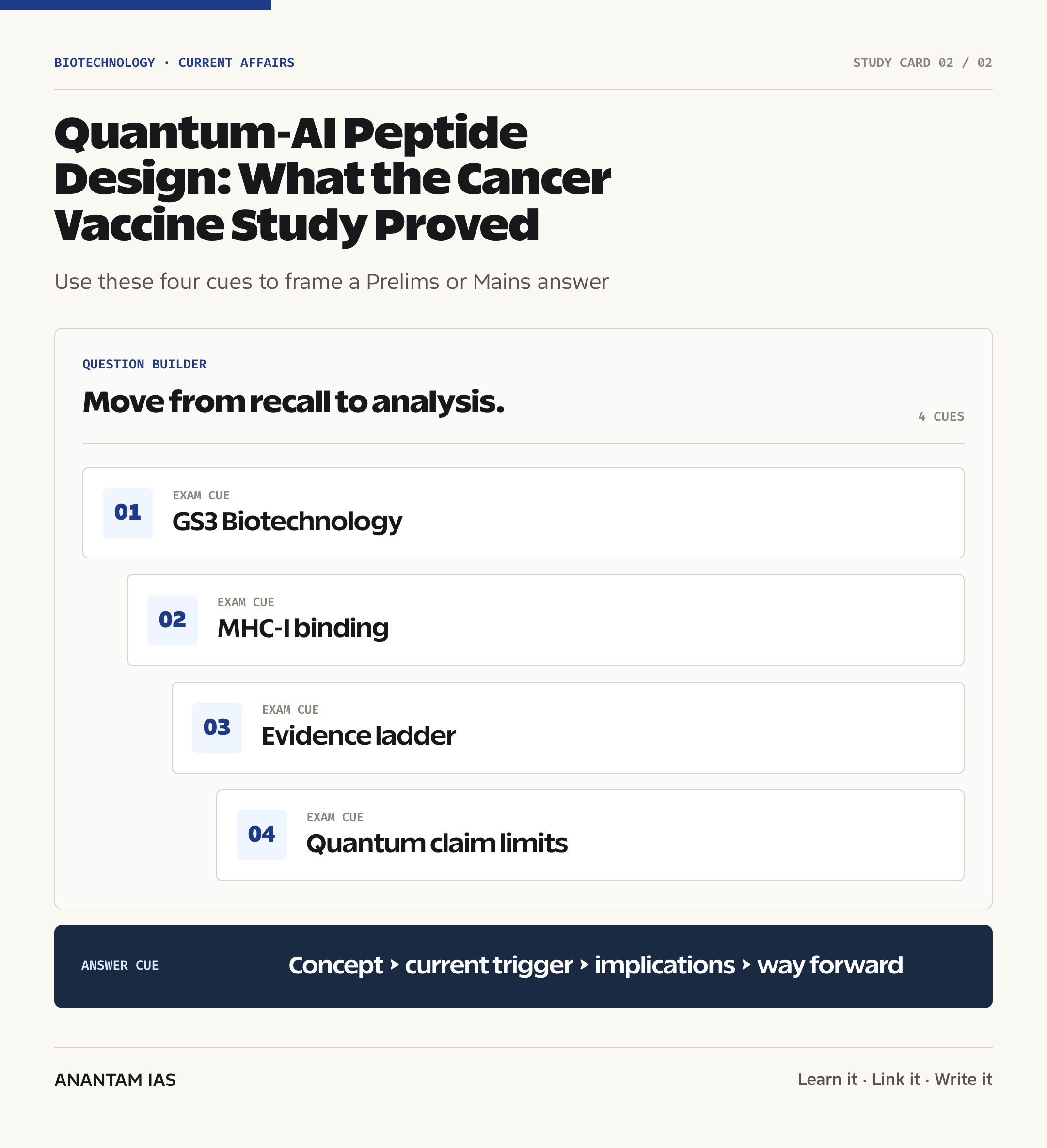
Quantum-AI Peptide Design: What the Cancer Vaccine Study Proved
Why in News?
A DTU-led research consortium reported a hybrid quantum-classical pipeline that used a real photonic processor with a generative AI model to design short peptides predicted to bind human leukocyte antigen molecules. The work appeared as a bioRxiv preprint on July 10, 2026 and was discussed by The Indian Express.
The result is an early proof of concept, not a clinically tested cancer vaccine. Researchers demonstrated computational generation and laboratory stabilisation of peptide–MHC complexes; they did not show tumor targeting, T-cell activation, protection in animals, safety in humans or improved patient outcomes.
- The model combined a conditional generative adversarial network with latent samples from a 32-mode photonic quantum processor.
- Researchers evaluated generated nine-amino-acid peptides across 131 HLA alleles, including five alleles absent from the training dataset.
- For three understudied alleles, the team synthesised the 20 highest-ranked peptides per allele and tested peptide–MHC stability by ELISA.
- Quantum-prior models produced more predicted strong binders than simple Gaussian and Bernoulli baselines, with gains concentrated in data-sparse alleles.
- The authors explicitly stated that the system size remained classically simulable and that their results did not demonstrate quantum advantage.
The development matters in the context of:
- The finding matters in the context of personalised medicine, where an individual’s HLA type affects which peptide fragments can be presented to T cells.
- It also highlights the difference between candidate discovery and a medical product: MHC binding is necessary for many peptide vaccines, but it is not sufficient for immunogenicity or clinical benefit.
- For India, the study connects biotechnology with the National Quantum Mission, while showing why public investment must pair frontier computing with wet-lab validation, representative biological data and health regulation.

UPSC Relevance
Prelims Relevance
- Major histocompatibility complex class I molecules display intracellular peptide fragments on most nucleated cells for surveillance by CD8+ T cells.
- Human leukocyte antigen is the human form of the MHC system; HLA genes are highly polymorphic, so binding preferences vary between alleles.
- A peptide is a short chain of amino acids; the experiment restricted its training set to nine-amino-acid peptides, a common MHC-I ligand length.
- A generative adversarial network contains a generator that proposes samples and a discriminator that distinguishes generated samples from training data.
- The model’s latent prior is the input probability distribution from which the generator begins its search; the study compared quantum-derived priors with Gaussian and Bernoulli priors.
- Gaussian boson sampling uses squeezed light, optical interference and photon-number detection to sample a correlated probability distribution.
- In silico means computer-based evaluation; in vitro refers to experiments performed outside a living organism under laboratory conditions.
- A peptide–MHC stability ELISA can test whether a peptide stabilises an MHC complex, but it does not establish T-cell recognition or therapeutic efficacy.
- A neoantigen is a tumor-specific antigen arising from mutations; this study generated HLA-binding peptides without building a patient-specific tumor vaccine.
- A preprint is a research manuscript shared before formal peer review; its conclusions require independent scrutiny and replication.
Mains Relevance
GS Paper 3
- Convergence of quantum computing, artificial intelligence and biotechnology in therapeutic-candidate discovery.
- Role of India’s National Quantum Mission in building research capacity, hardware access, skills and translational partnerships.
- Need to distinguish a computational benchmark from clinical evidence when evaluating emerging technologies.
GS Paper 2
- Public-health implications of personalised medicine, including affordability, informed consent, privacy and equitable access.
- Regulatory need for staged evidence across laboratory studies, preclinical models and human trials before medical claims are made.
GS Paper 4
- Ethics of communicating early biomedical research without hype, especially when patients may mistake candidate design for an available treatment.
- Fair representation of diverse HLA profiles in datasets to reduce population bias in precision health tools.
Essay
- Frontier technologies create public value when computational novelty is matched by biological proof and responsible communication.
- Precision medicine can widen health equity only if its data, validation and access models include underrepresented populations.
Background and Context
How T Cells Read Peptide Signals
The immune relevance begins with antigen presentation, not with the quantum computer.
- Cells break proteins into short peptide fragments, load some onto MHC-I molecules and display them for inspection by CD8+ T cells.
- In humans, MHC molecules are encoded by highly variable HLA genes; each allele has preferences for amino acids at particular anchor positions.
- For a therapeutic cancer vaccine, a useful peptide should ideally originate from a tumor-specific or tumor-associated antigen, bind the patient’s HLA, be naturally processed and presented, activate suitable T cells, avoid harmful cross-reactivity and produce clinical benefit.
- The current study addressed mainly one gate in that chain: whether generated peptides can form stable complexes with selected MHC-I molecules.
How the Hybrid Pipeline Worked
The experiment altered the starting distribution of an otherwise classical generative model.
- The training set contained 105,970 experimentally validated peptide–HLA ligand pairs, representing about 77,000 unique nine-amino-acid sequences across 126 MHC-I molecules.
- A conditional GAN learned to generate peptide sequences for a specified HLA label; its architecture and training objective were held constant across comparisons.
- Classical baselines used factorised Gaussian and Bernoulli input distributions. Quantum conditions used distributions from simulated boson sampling and from a physical photonic processor.
- The real device was a 32-mode photonic system hosted at the United Kingdom’s National Quantum Computing Centre. It used optical interference and photon-number detection to produce correlated samples.
- The quantum hardware did not simulate immune biology or calculate a finished vaccine. It supplied a structured latent prior that seeded the classical generator’s search.
What the Computational Results Showed
The reported gain was real within the chosen benchmark but modest on average and dependent on the comparison.
- The team generated 1,000 peptide sequences per target allele across 131 HLA alleles and used NetMHCpan 4.2 to predict binding.
- A peptide was labelled a predicted strong binder at an eluted-ligand percentile rank of 0.5%, and each model configuration was trained with 30 random seeds.
- A quantum-derived prior outperformed the Gaussian prior on 63% of alleles; the real-hardware condition showed an estimated gain of 6.3 strong binders per 1,000 attempts.
- The simulated quantum prior showed an estimated gain of 10.6 additional strong binders per 1,000 over the Gaussian baseline.
- Benefits were concentrated among alleles for which classical baselines performed poorly or moderately, supporting the hypothesis that structured priors may help explore data-sparse sequence spaces.
- Quantum-prior models increased diversity mainly at non-anchor positions while preserving recognised HLA anchor patterns, suggesting broader exploration rather than random loss of specificity.
What the Laboratory Test Added
Wet-lab testing strengthened the binding claim but did not move the work to animal or clinical evidence.
- Researchers selected HLA-A*68:01, HLA-B*37:01 and HLA-A*31:01, three underrepresented alleles for which the quantum-prior model had shown gains.
- They synthesised the 20 top-ranked peptides for each allele from the physical quantum-prior configuration and included three predicted non-binders per allele as negative controls.
- A UV-mediated exchange assay replaced a light-cleavable peptide, after which a sandwich ELISA measured whether each candidate stabilised the peptide–MHC complex.
- All tested predicted binders for HLA-A*31:01 and HLA-A*68:01 crossed the positivity threshold; HLA-B*37:01 produced many binders but also several failures.
- The best quantum-generated and classical-generated sets had similar mean ELISA signals, although the strongest binder for each tested allele came from the quantum-prior model.
- The observations don’t establish immune-cell activation, tumor killing, safety, dose, delivery, durability or survival benefit.
Why This Is Not Yet a Cancer Vaccine
The evidence ladder prevents a promising design method from being mistaken for a therapy.
- The researchers did not begin with a patient’s tumor mutations and did not show that generated sequences were tumor-specific neoantigens.
- MHC binding is necessary for many peptide-vaccine strategies, but immunogenicity also depends on antigen processing, natural presentation, T-cell receptor availability, immune context and immune escape.
- No experiment tested T-cell activation, cytokine response, selective killing of cancer cells, tumor control in animals or outcomes in human clinical trials.
- The manuscript was a preprint, so peer review, independent replication and broader experimental comparison remained pending.
- The authors said their 32-dimensional distributions were classically simulable. The experiment demonstrated a useful quantum-derived input, not quantum computational advantage.
- A safe description is: a hybrid platform generated laboratory-confirmed HLA-binding peptide candidates that may inform future immunotherapy research.
Equity, Governance and India's Policy Opportunity
The most important policy question is whether frontier models work for diverse populations and reach patients responsibly.
- HLA allele frequencies differ across populations, while immunopeptidomics datasets often overrepresent groups with stronger research infrastructure. This can produce data inequity in prediction quality.
- A model that improves candidate yield for underrepresented alleles could support inclusion, but only after validation using representative Indian HLA data and transparent performance reporting.
- India can link the National Quantum Mission with genomics, immunology, bioinformatics and clinical-research networks instead of treating quantum hardware as an isolated computing project.
- Publicly funded platforms should require auditable datasets, reproducible benchmarks, disclosure of competing interests, privacy protection and clear labels for preclinical evidence.
- Personalised products may be expensive and logistically demanding. Policy must consider manufacturing, diagnostics and access so that personalised medicine does not become limited to a small group.
Way Forward
Climb the Biological Evidence Ladder
- Test whether candidates are naturally processed and presented on tumor cells through immunopeptidomics, not binding assays alone.
- Measure T-cell recognition, specificity, cross-reactivity and tumor-cell killing before moving to animal studies and phased clinical trials.
- Integrate antigen origin and tumor expression with HLA binding so the model designs medically relevant candidates.
Benchmark the Quantum Contribution
- Compare quantum priors against richer classical priors, modern generative architectures and matched computing budgets using preregistered metrics.
- Release non-proprietary code and sampling details where possible, invite replication and report runtime, cost and scaling before claiming quantum advantage.
Build Representative and Ethical Datasets
- Expand allele-resolved datasets with informed consent and strong privacy safeguards, especially for populations underrepresented in existing HLA resources.
- Communicate the stage of evidence in plain language so patients aren’t misled by labels such as cancer vaccine breakthrough.
Create an Indian Translational Testbed
- Connect quantum mission hubs with DBT, ICMR, hospitals, biofoundries and clinical-trial networks for joint computational and wet-lab validation.
- Support shared photonic hardware, immunoinformatics skills and milestone-based funding tied to reproducible biological progress.
Conclusion
The study offers a careful proof that a quantum-derived latent prior can change how a classical generative model searches peptide space and can yield candidates that stabilise selected HLA complexes in vitro. Its strongest contribution is methodological: it connects real photonic hardware with an end-to-end biological design-and-test loop.
But the distance from HLA binding to a safe, effective cancer vaccine remains large. The credible next step is not a clinical promise; it is deeper immunological validation, stronger classical benchmarking, representative datasets and transparent evidence. That distinction is central to responsible frontier-technology policy.
UPSC Practice Questions
Prelims MCQ 1
With reference to peptide presentation and the hybrid quantum-AI study, consider the following statements:
- MHC class I molecules commonly present intracellular peptide fragments to CD8+ T cells.
- Human leukocyte antigen alleles can differ in their peptide-binding preferences.
- A stable peptide–MHC complex by itself proves that the peptide will produce clinical protection against cancer.
How many of the above statements are correct?
(a) Only one (b) Only two (c) All three (d) None
Answer: (b) Only two
Explanation:
Statements 1 and 2 are correct. MHC-I presentation is part of CD8+ T-cell surveillance, and HLA polymorphism creates allele-specific binding preferences. Statement 3 is incorrect because binding does not by itself prove immunogenicity, tumor killing, safety or clinical efficacy.
Prelims MCQ 2
What was the most accurate role of the photonic quantum processor in the reported pipeline?
(a) It diagnosed cancer directly from patient scans (b) It simulated complete human immune responses (c) It supplied a structured latent distribution to a classical generative model (d) It conducted a randomised clinical trial
Answer: (c) It supplied a structured latent distribution to a classical generative model
Explanation:
The photonic processor generated correlated samples used as the GAN’s latent prior. The generator, prediction model and laboratory validation performed the other stages; there was no diagnosis, whole-immune-system simulation or clinical trial.
UPSC Mains Questions
- The convergence of quantum computing, artificial intelligence and biotechnology can accelerate candidate discovery, but it can also blur the line between computational promise and medical proof. Discuss the opportunities, evidence requirements and regulatory safeguards for India’s emerging health-technology ecosystem.
- Personalised immunotherapy depends on diverse biological datasets as much as advanced algorithms. Examine how unequal HLA-data coverage can affect health equity, and suggest institutional measures for representative research, privacy protection, transparent benchmarking and affordable access.
- A laboratory demonstration may be scientifically valuable without constituting a deployable therapy or quantum advantage. Using the quantum-AI peptide-design study as context, explain how policymakers should evaluate claims, fund translational research and communicate uncertainty.
Sources: bioRxiv preprint by a DTU-led research consortium and The Indian Express Explained.
Frequently Asked Questions
Did quantum AI create a cancer vaccine?
No. The study generated short peptides designed to bind selected HLA molecules and confirmed peptide–MHC stability in a laboratory assay. It did not create a patient-ready vaccine, use tumor-specific patient data, activate T cells, treat animals or enrol humans. Cancer-vaccine development is a possible future application, not a demonstrated clinical outcome.
What did the quantum computer actually do?
A 32-mode photonic processor produced correlated samples through Gaussian boson sampling. Those samples served as the latent starting distribution for a classical generative adversarial network. The quantum device did not model the whole immune system or test a drug; it influenced how the AI explored possible peptide sequences.
Why are HLA-binding peptides important?
HLA molecules display peptide fragments to T cells. A peptide that binds the right HLA allele may become visible to immune surveillance, making HLA binding an important early filter in peptide-vaccine and T-cell-therapy research. But natural processing, presentation, T-cell recognition, safety and therapeutic effect must still be established.
Did the study prove quantum advantage?
No. The authors explicitly said the tested system size remained classically simulable and the average improvement over simple classical priors was modest. The narrower result is that a structured distribution sampled from real quantum hardware acted as a useful input bias. Stronger classical baselines, scale tests, runtime and cost comparisons remain necessary.
What evidence came from the laboratory?
For three understudied HLA alleles, researchers synthesised the 20 highest-ranked quantum-prior peptides per allele and measured peptide–MHC stability by ELISA. Many candidates stabilised the complexes, with all tested predicted binders succeeding for two alleles. The assay confirmed binding-related stability, not T-cell activation or anti-cancer efficacy.
Why do underrepresented HLA alleles matter?
HLA alleles vary across populations, and prediction systems learn best where experimental data are abundant. Poor coverage can make models less reliable for some groups. Better candidate generation for data-sparse alleles is promising, but equity requires representative datasets, allele-wise audits, consent, privacy protection and independent biological validation.
Source: https://anantamias.com/current-affairs/quantum-ai-cancer-vaccine-peptide-design/
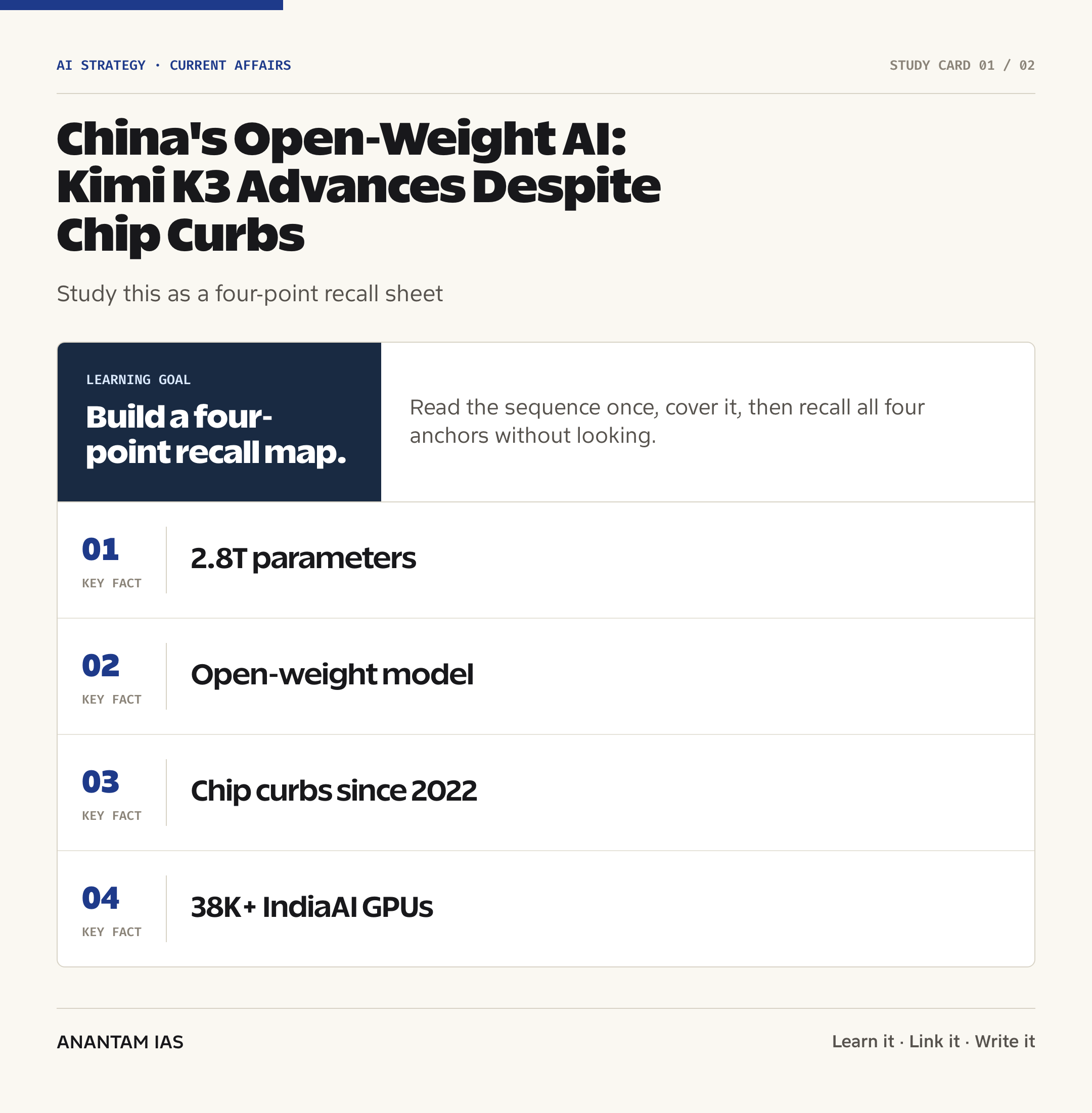
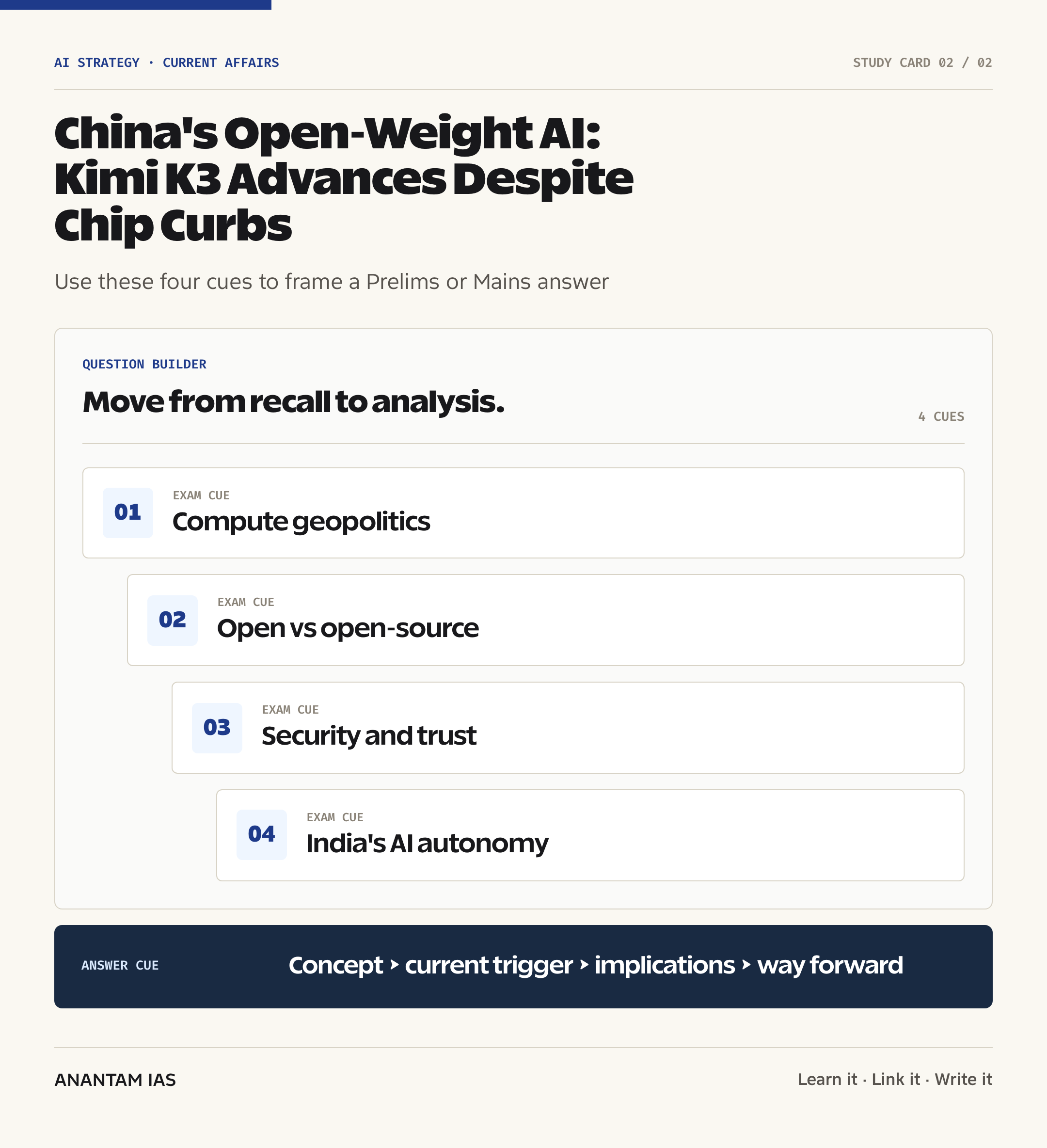
China’s Open-Weight AI: Kimi K3 Advances Despite Chip Curbs
Why in News?
The Hindu Explained reported on 27 July 2026 that Chinese developer Moonshot AI’s Kimi K3, a model with 2.8 trillion parameters, represents China’s growing ability to build capable AI systems despite restrictions on access to the most advanced chips.
The immediate issue is an open-weight AI strategy: trained parameters are made available so well-resourced users can inspect, adapt or host the model, while abundant electricity, larger clusters of less advanced chips and state-supported research partly cushion the compute constraint.
- Kimi K3 has 2.8 trillion parameters, according to The Hindu’s report; parameter count measures model scale, not reliability or social value.
- Chinese firms face restrictions on access to certain advanced graphics processing units and semiconductor-manufacturing equipment.
- The response combines model openness, engineering efficiency, electricity supply, domestic industrial capacity and a wider developer ecosystem.
- This note concerns the technology and industrial strategy; the 18 July note on China’s AI governance pitch examined WAICO and diplomatic rule-setting.
- For India, the question isn’t a binary choice between Chinese and Western models; it is how to secure compute access, local control, safety evaluation and strategic autonomy.
The development matters in the context of:
- The development matters in the context of technology denial regimes: export controls can raise costs and slow access without automatically stopping innovation.
- It also matters for AI sovereignty, because downloadable weights can reduce dependence on a single foreign application programming interface while creating new security and licensing duties.
- The episode links GS Paper 3 themes of emerging technology and indigenisation with GS Paper 2 themes of geopolitics and global rule-making.
UPSC Relevance
Prelims Relevance
- Open-weight model: trained numerical parameters are available for download or deployment; this doesn’t by itself disclose the full source code, training data or training process.
- Open-source software: source code is available under a licence permitting specified study, modification and redistribution; the term shouldn’t be used automatically for every open-weight model.
- Inference: use of a trained model to generate an output from a new input; it is distinct from the compute-intensive training stage.
- Graphics processing unit: a parallel-processing chip widely used for training and serving large AI models.
- Mixture-of-Experts: a model design in which a routing mechanism activates selected expert components for a given input, potentially reducing active computation relative to total parameters.
- Export control: a legal restriction on the transfer of specified goods, software or technology to designated destinations or end uses.
- Entity List: a U.S. export-control list that imposes licence requirements on listed foreign persons and organisations.
- IndiaAI Mission: a Union government programme approved in March 2024 for compute, datasets, foundational models, applications, skills, startup finance and safe AI.
- Strategic autonomy: capacity to make technology choices without excessive dependence on one external power, vendor or infrastructure stack.
Mains Relevance
GS Paper 3
- Role of compute, energy, algorithms, data and talent as complementary inputs in an AI ecosystem.
- Limits of judging AI capability through parameter count or vendor benchmarks alone.
- Need for indigenous foundational models, common compute and semiconductor capability under the IndiaAI Mission.
- Cybersecurity, model evaluation and supply-chain risks arising from third-party open weights.
GS Paper 2
- Use of export controls as an instrument of national security and technology competition.
- Tension between open innovation and strategic restrictions in the emerging global AI order.
- India’s options amid U.S.-China competition: selective engagement, domestic capacity and standards-based procurement.
Essay
- Scarcity can delay innovation, but it can also redirect it towards efficiency.
- Technological openness expands access only when countries possess the capacity to evaluate and deploy what is opened.
- Digital sovereignty is built through capability, not isolation.
Background and Context
What Open Weight Actually Means
Model openness is a spectrum, so exam answers should separate access to weights from access to the whole development process.
- A trained model stores learned relationships in numerical weights; releasing them can let researchers run, fine-tune, evaluate or adapt the model subject to its licence.
- An open-weight release may still withhold training data, data-cleaning methods, safety filters, full training code or compute records.
- The broader label open source is accurate only when the relevant source material and licence satisfy the claimed level of openness.
- Self-hosting can keep prompts and outputs within a chosen infrastructure boundary, but it doesn’t automatically remove model-level vulnerabilities, malicious code, unsafe outputs or hidden dependencies.
- Large open weights can remain inaccessible to small users because deployment needs memory, accelerators, electricity, cooling and technical expertise.
Why Kimi K3 Is Strategically Significant
Kimi K3 is important less as a single benchmark score and more as evidence that China has a broad route to frontier-scale AI.
- The Hindu identifies Kimi K3 as a 2.8-trillion-parameter model from Beijing-based Moonshot AI and places it within a wider group of Chinese open or open-weight systems.
- A large parameter count signals scale, but it doesn’t prove factual accuracy, safety, reasoning quality or cost-effectiveness; those require independent, task-specific evaluation.
- Chinese firms also develop lighter models for local deployment, showing that the ecosystem isn’t based only on building the largest possible model.
- The strategic effect is diffusion: once weights circulate, a foreign government can’t easily treat access as if it were a single centrally hosted service.
Chip Curbs and the Compute Constraint
Advanced AI depends on accelerators and semiconductor equipment, which makes the hardware stack a field of geopolitical competition.
- The U.S. Bureau of Industry and Security introduced controls in October 2022 covering certain advanced-computing chips, supercomputer end uses and semiconductor-manufacturing items for China.
- The controls were updated in October 2023 to adjust chip thresholds, cover more equipment and address circumvention routes.
- Such controls target access to selected high-end items and know-how; they don’t amount to a complete ban on every chip, cloud service or AI activity.
- China can partly compensate through more lower-tier chips, engineering optimisation and abundant electricity, but larger clusters bring communication, cooling, reliability and energy costs.
- Export controls may slow capability growth and raise costs, yet they can also encourage domestic substitution, model efficiency and alternative supply chains.
- An answer should avoid technological determinism: hardware matters, but data quality, algorithms, talent, infrastructure and organisational learning also shape outcomes.
China's Ecosystem Approach
The reported advance reflects an ecosystem built across research labs, large technology firms, infrastructure and policy support.
- The Hindu notes government support for AI laboratories and established firms such as Tencent, Baidu and Alibaba, creating multiple competing model families.
- A diverse model supply allows developers to select between large general systems and lighter task-specific models rather than depend on a single national champion.
- Open distribution encourages external experimentation, translations, fine-tunes and deployment tools, producing network effects beyond the original developer.
- Third-party inference can challenge closed providers, but the economics can change if developers move towards captive commercial models.
- The outcome is resilience through multiplicity, although Chinese firms still face exposure to foreign semiconductor tools, global markets and trust concerns.
Benefits and Risks of Open Weights
Open weights redistribute control from the original vendor to deployers, but they also redistribute responsibility.
- Potential benefits include local deployment, customisation, audit access, competition and reduced vendor lock-in.
- Potential risks include removal of safety safeguards, malicious fine-tuning, opaque training data, licence uncertainty and software-supply-chain compromise.
- Local hosting reduces one pathway for prompt leakage, but data can still escape through logging, plugins, telemetry, compromised dependencies or poor access controls.
- Models can encode political censorship, factual distortions or cultural assumptions; openness makes inspection possible but doesn’t guarantee that an inspection has occurred.
- Public agencies need model cards, provenance records, red-team results, incident reporting and sector-specific human oversight before deployment.
India's Strategic Choice
India can learn from open-model diffusion without exchanging one form of dependence for another.
- The Press Information Bureau reported in March 2026 that the IndiaAI common-compute facility had onboarded more than 38,000 GPUs.
- The IndiaAI Mission, approved with an outlay of ₹10,371.92 crore, includes compute, foundational models, datasets, applications, skills, startup finance and safe-and-trusted AI.
- India should evaluate foreign open weights through reproducible tests for Indian languages, constitutional values, cybersecurity, bias and sectoral accuracy.
- Procurement should require disclosure of licence terms, model provenance, update policies, security controls, energy costs and data-governance responsibilities.
- The wider technology base also matters: the notes on India’s semiconductor and emerging-technology ecosystem show why AI policy can’t be separated from chips, research and innovation institutions.
- Regulatory design should stay technology-neutral and risk-based, consistent with India’s evolving debate on AI autonomy, consent and sandboxes.
How This Differs from the July 18 Development
The two China-AI developments belong to the same competition but answer different syllabus questions.
- The 18 July note examined China’s WAICO proposal, Global South outreach and contest over international AI-governance standards.
- The 27 July development examines Kimi K3, open-weight diffusion, compute economics and adaptation to advanced-chip controls.
- The earlier issue is mainly about institutions, diplomacy and norm-setting; today’s issue is mainly about technology capability, industrial policy and strategic supply chains.
- A Mains answer can connect them: technological capability gives credibility to a governance pitch, while governance partnerships can expand markets and standards for a technology ecosystem.
- They shouldn’t be collapsed into one claim, because a country can promote open models while still seeking influence over deployment standards and international institutions.
Way Forward
Build an Indian Evaluation Layer
- Create independent benchmarks for Indian languages, public-service tasks, safety, cybersecurity and factual reliability.
- Publish reproducible evaluation protocols instead of accepting vendor scores or parameter counts as proof.
Diversify Compute and Models
- Use the IndiaAI common-compute facility to widen access for universities, startups and public-interest projects.
- Maintain a portfolio of domestic, open-weight and commercial models so that critical systems don’t depend on one vendor or country.
Secure Open-Weight Deployment
- Require weight verification, dependency scanning, sandboxing, access control and continuous red-teaming for high-impact deployments.
Link AI Policy with Industrial Policy
- Coordinate AI compute with semiconductor design, data centres, power planning, skills and research funding while preserving the ability to audit and switch systems.
Conclusion
Kimi K3 shows why AI competition can’t be reduced to possession of the newest chip. Hardware constraints remain real, but model openness, engineering choices, power, talent and ecosystem depth can partly change their effect.
For India, the durable lesson is to combine open access with verified trust. Strategic autonomy will come from compute, domestic capability, independent evaluation and secure deployment, not from uncritical adoption or blanket exclusion.
UPSC Practice Questions
Prelims MCQ 1
With reference to open-weight AI models, consider the following statements:
- Availability of model weights necessarily means that the complete training dataset is public.
- Open weights may allow a deployer to host a model on infrastructure of its choice.
- Local hosting by itself eliminates every cybersecurity and data-governance risk.
How many of the above statements are correct?
(a) Only one (b) Only two (c) All three (d) None
Answer: (a) Only one
Explanation:
Only Statement 2 is correct. Open weight doesn’t necessarily disclose training data or the complete development process. Local hosting can reduce dependence on a vendor’s remote service, but vulnerabilities, logging errors, unsafe dependencies and poor access control can still create risks.
Prelims MCQ 2
Which one of the following best describes inference in an AI system?
(a) Fabricating semiconductor wafers (b) Training a model only on labelled data (c) Using a trained model to produce outputs for new inputs (d) Publishing a model’s full training dataset
Answer: (c) Using a trained model to produce outputs for new inputs
Explanation:
Inference is the operational use of a trained model on new inputs. Training creates or adjusts the weights; inference applies those learned weights to generate a prediction or response.
UPSC Mains Questions
- Advanced-chip export controls can raise the cost of AI development without creating an absolute technological blockade. Examine this statement with reference to China’s open-weight model ecosystem and the interaction among compute, energy, algorithms, talent and industrial policy.
- Open-weight AI can support digital sovereignty, but openness isn’t a substitute for trust. Discuss the benefits and security risks of deploying foreign open-weight models in Indian public and private systems.
- Suggest a strategy through which the IndiaAI Mission can combine common compute, indigenous models, independent evaluation and international partnerships while avoiding both vendor lock-in and technological isolation.
Sources: The Hindu Explained and U.S. Bureau of Industry and Security.
Frequently Asked Questions
What is Kimi K3?
Kimi K3 is a large AI model developed by China’s Moonshot AI. The Hindu reported it as a 2.8-trillion-parameter model within China’s expanding open-weight ecosystem. The number describes total scale, not guaranteed quality. Reliability, safety, cost and suitability still need independent testing on specific tasks.
What does open weight mean?
Open weight means the trained numerical parameters of a model are made available under stated licence terms. Users may be able to run, inspect or adapt the model. It doesn’t automatically mean the training data, training code, safety process and every software component are publicly available.
Are open weight and open source identical?
No. Open weight refers specifically to access to trained parameters. Open source normally implies access to source code under a licence allowing defined reuse and modification. A model can publish weights while withholding training data, data preparation methods or parts of its software stack.
How do chip curbs affect China?
U.S. controls restrict access to specified advanced-computing chips, supercomputer end uses and semiconductor-manufacturing items. They can raise costs and slow access to leading hardware. China can partly adapt through more less-advanced chips, engineering efficiency, domestic substitution and electricity supply, but those responses carry performance and energy trade-offs.
Does local hosting prevent data leakage?
Local hosting can keep prompts and outputs within an organisation’s chosen infrastructure, reducing reliance on a remote vendor. It doesn’t remove risks from compromised dependencies, insecure logs, plugins, weak access control, malicious fine-tuning or model vulnerabilities. Security review and continuous monitoring remain necessary.
What should India learn?
India should expand common compute and domestic model capability while testing foreign open weights through transparent benchmarks for Indian languages, cybersecurity, bias and public-service accuracy. Procurement should preserve the ability to audit and switch models. Open access should complement, not replace, indigenous research, trusted infrastructure and accountable regulation.
Source: https://anantamias.com/current-affairs/china-open-weight-ai-kimi-k3-chip-curbs/
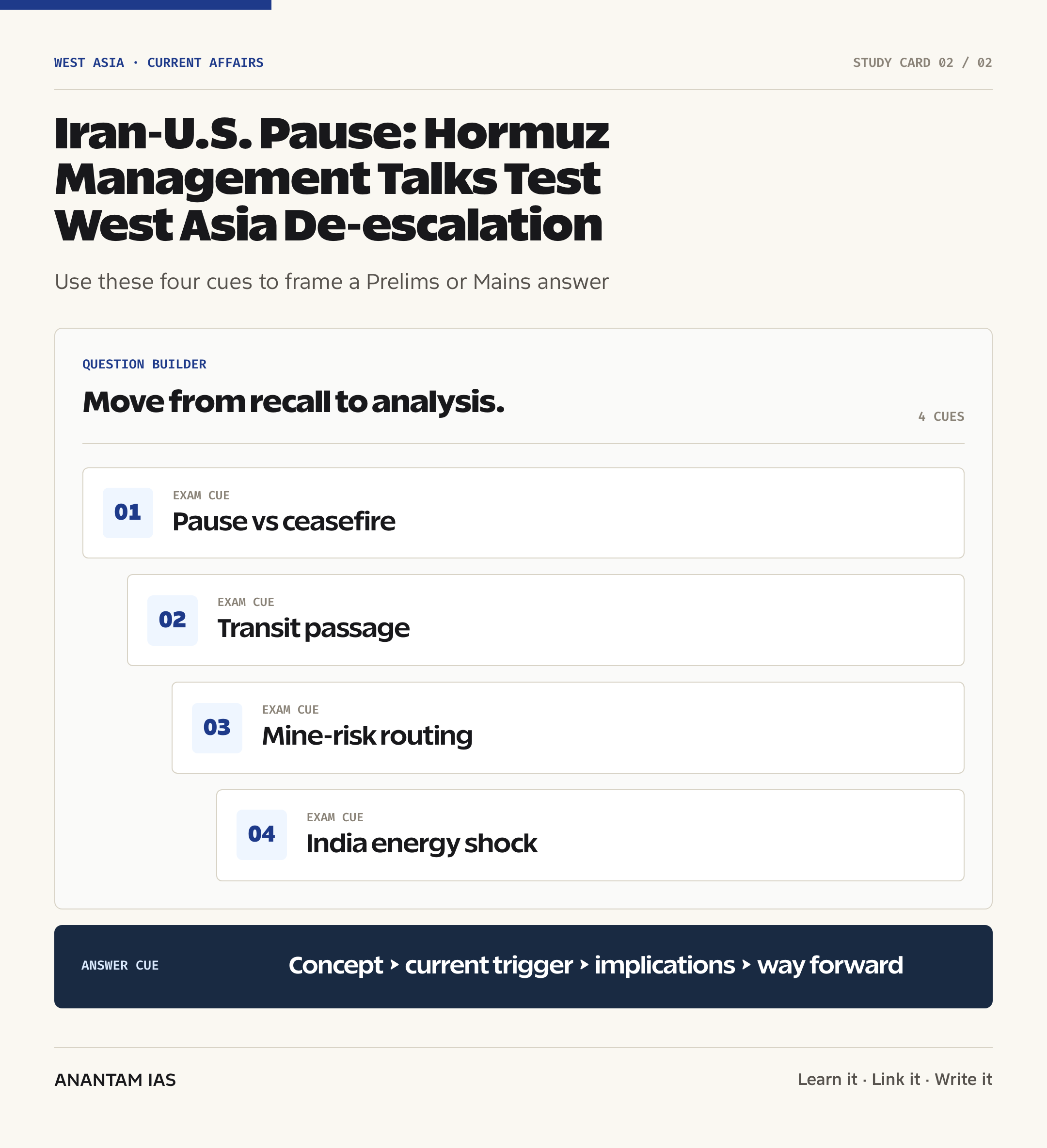
Iran-U.S. Pause: Hormuz Management Talks Test West Asia De-escalation
Why in News?
Iran announced on July 26, 2026 that it had halted retaliatory operations after the United States stopped strikes following 13 consecutive nights of attacks. The move created an operational pause, but neither side announced a final ceasefire or a political settlement.
Iran also reported progress in technical talks with Oman on common principles and operational mechanisms for shipping through the Strait of Hormuz. The talks matter because the dispute now concerns not only military escalation, but also who routes vessels, how mine risks are managed and whether transit remains non-discriminatory.
- Iranian army spokesperson Mohammad Akraminia described Iran’s operations as retaliatory and said they had stopped after the U.S. lull.
- Iranian Foreign Ministry spokesperson Esmail Baghaei said several rounds of technical discussions with Oman had made progress and were continuing.
- The Hindu reported Iranian claims of tanker mine incidents, but UKMTO had not confirmed those incidents; maritime bodies still warned that mine risks remained elevated.
- Early Asian trading reflected relief rather than resolution: Brent crude fell about 5% on July 27 while traffic through Hormuz remained low.
- This is newer than the July 20 escalation: that episode centred on claimed attacks on U.S. facilities in Kuwait and renewed strikes; the present development adds reciprocal restraint and a concrete Iran-Oman shipping-management track.
The development matters in the context of:
- A pause in attacks can reduce immediate risk, but it is reversible and must not be confused with an enforceable ceasefire.
- A stable Hormuz arrangement must reconcile coastal-state coordination with transit passage, non-discrimination and internationally recognised navigation rules.
- For India, the outcome affects energy costs, seafarer safety, shipping insurance, Gulf connectivity and the security of a large diaspora.

UPSC Relevance
Prelims Relevance
- The Strait of Hormuz connects the Persian Gulf with the Gulf of Oman and the Arabian Sea.
- Iran lies to the north of the strait; Oman’s Musandam Peninsula lies on its southern side.
- UNCLOS Part III governs straits used for international navigation and provides for transit passage.
- Under UNCLOS Article 44, states bordering such straits must not hamper transit passage and must publicise known dangers to navigation.
- The International Maritime Organization is a specialised UN agency responsible for global shipping safety, security and pollution-prevention standards.
- The Traffic Separation Scheme adopted by the IMO in 1968 is the internationally recognised routing framework for Hormuz, although emergency mine-risk advisories may temporarily prescribe different corridors.
- SOLAS, the International Convention for the Safety of Life at Sea, is a central treaty for ship-safety standards.
- UKMTO provides maritime-security information and incident reporting; it does not itself determine legal sovereignty over a waterway.
- Chabahar Port is on Iran’s Gulf of Oman coast, outside the Persian Gulf side of the Hormuz chokepoint.
Mains Relevance
GS Paper 2
- Role of Oman as a regional mediator and littoral state in converting military restraint into rules-based maritime coordination.
- Tension between coastal-state security powers and the international right of transit passage through a strategic strait.
- India’s strategic autonomy when Iran, the U.S., Israel and Gulf partners have competing security objectives.
GS Paper 3
- Transmission of a maritime chokepoint shock into crude prices, LNG availability, freight, insurance, inflation and the current account.
- Need for energy resilience through diversified suppliers, flexible contracts, inventories, alternate routes and demand management.
- Protection of merchant shipping and seafarers through risk assessment, maritime-domain awareness and coordinated advisories.
Essay
- A military pause becomes peace only when institutions can manage the interests that caused the fighting.
- Freedom of navigation is both a legal principle and a public good sustained by practical cooperation.
- Geography gives small littoral states an outsized role in global economic stability.
Background and Context
What Exactly Changed on July 26-27?
The new development is a shift from an expanding strike cycle to conditional restraint paired with technical diplomacy.
- The United States stopped strikes after 13 consecutive nights; Iran then said it had halted operations because its stated strategy was retaliatory.
- This sequence suggests reciprocal restraint, but the absence of a signed instrument, monitoring mechanism or agreed duration leaves the pause fragile.
- Iran and Oman moved beyond general calls for dialogue to discussions on common principles and operational mechanisms for vessel movement.
- Associated Press reported that commercial traffic was at a three-week low and no new attack had been confirmed in the preceding 72 hours, showing that reduced violence had not yet restored normal shipping.
- Oil prices fell sharply in early trading as markets priced in lower immediate risk, but the continued traffic slump showed the difference between market relief and physical normalisation.
- The conflict also remained active elsewhere, including Houthi-Saudi tensions near Bab al-Mandab; a pause in one theatre does not equal regional peace.
Why This Is Not a Repeat of the July 20 Escalation
The July 20 note examined geographic widening; today’s note examines whether an off-ramp can acquire operational rules.
- The earlier development involved an IRGC claim of attacks on U.S. facilities in Kuwait, renewed U.S. strikes and severe disruption around Hormuz.
- Its main analytical question was whether retaliation would pull another Gulf state deeper into the conflict and increase India’s consular and energy risks.
- Today’s fact pattern introduces two new variables: a stated halt in Iranian retaliatory operations and advanced Iran-Oman technical talks on safe passage.
- The policy question has shifted from containing an expanding battlefield to designing routing, deconfliction and verification that can survive political disagreement.
- Continuity still matters: mine allegations, low traffic and threats of renewed strikes mean the escalation ladder remains available. Students should read this as a new phase, not a settled outcome.
- The progression can be tracked alongside the earlier Hormuz standoff and India’s energy stakes.
Hormuz: Geography, Law and Navigation
Hormuz is both a narrow physical chokepoint and a strait used for international navigation.
- The waterway links the Persian Gulf to the Gulf of Oman; Iran and Oman are the two coastal states directly bordering the passage.
- Transit passage under UNCLOS allows continuous and expeditious navigation and overflight through straits used for international navigation.
- Coastal states may adopt lawful rules on navigation safety, traffic, pollution and customs, but those rules cannot discriminate in form or effect or deny and hamper transit passage.
- The IMO Council has stressed that passage must remain non-discriminatory and unimpeded, and that regulation must conform to IMO rules and SOLAS.
- The IMO has also stated that the 1968 Traffic Separation Scheme remains the internationally recognised route. Yet mine danger can make a recognised route operationally unsafe until hazards are cleared and security assurances exist.
- This distinction is central: legal entitlement to passage does not remove the shipmaster’s duty to conduct a realistic voyage-risk assessment.
What a Viable Iran-Oman Mechanism Must Resolve
A durable arrangement needs technical precision, legal legitimacy and political acceptance.
- First, it must establish verified mine-risk information, hydrographic updates, safe corridors and procedures for suspending or resuming vessel movements.
- Second, it needs a shared picture of vessel identity, routing and hazards without turning safety coordination into political screening of cargoes or flags.
- Third, deconfliction channels must connect Iran, Oman, the IMO, ship operators and maritime-information centres while keeping civilian mariners outside military bargaining.
- Fourth, any fees must be limited by applicable law and linked to genuine services; the IMO Council has opposed tolls or charges that burden the right of passage.
- Fifth, incident attribution needs evidence. Iran’s mine-strike claims and the lack of UKMTO confirmation show why independent verification is needed before retaliation.
- Sixth, the mechanism requires review and dispute-resolution procedures so a single incident does not automatically collapse operational cooperation.
Oman's Mediation Advantage and Limits
Oman combines geographic responsibility with a diplomatic record of maintaining channels across rival camps.
- As a littoral state, Oman has a direct responsibility for navigation on the southern side of the strait and practical knowledge of routing conditions.
- Its foreign policy has often favoured quiet mediation, allowing Muscat to communicate with Iran, the U.S. and Gulf partners without adopting maximalist public positions.
- Technical talks can lower political temperature by focusing on coordinates, communications and safety procedures rather than beginning with contested claims of control.
- But Oman cannot by itself guarantee U.S.-Iran restraint, remove mines, settle sanctions disputes or bind every armed actor operating across West Asia.
- A workable arrangement needs buy-in from commercial shipping, other Gulf states and international bodies; bilateral management without wider confidence may be viewed as exclusive control.
- Oman’s value lies in turning an opening into a process, not in substituting for a broader political settlement.
India's Stakes: Energy, Trade and Citizens
India experiences Hormuz instability through prices, shipping risk, connectivity and human security.
- A disruption raises the delivered cost of crude oil, LNG and LPG through higher benchmark prices, freight, war-risk insurance and voyage delays.
- The effects can spread to inflation, the current-account deficit, the rupee, fertiliser costs, transport and the fiscal choices involved in cushioning consumers.
- Indian crews on international vessels face direct risks from mines, missiles, detention and prolonged waiting; seafarer welfare is an economic and consular issue.
- A large Indian community across the Gulf requires calibrated travel advice, mission registration, evacuation planning and uninterrupted remittance channels.
- Chabahar Port lies outside the Strait on the Gulf of Oman, but conflict can still disrupt its insurance, finance and inland connectivity. See the background on India’s Chabahar interests.
- India should support freedom of navigation and civilian safety while maintaining communication with Iran, Oman, Gulf partners and the U.S.; this is a practical test of strategic autonomy.
Why a Pause Is Not Yet De-escalation
De-escalation is a process of reducing capability, intent and miscalculation, not merely the absence of strikes for a weekend.
- A ceasefire normally specifies parties, prohibited actions, duration, monitoring and procedures for alleged violations; the current pause lacks those public safeguards.
- Continued threats of higher-level strikes can make restraint coercive and reversible rather than confidence-building.
- Mine danger has a long tail: even after firing stops, uncertain locations can keep routes closed, premiums high and crews at risk.
- Proxy conflicts around Bab al-Mandab and the Red Sea can shift rather than remove pressure on energy and shipping networks.
- Markets can react immediately to diplomatic signals, while ports, insurers and shipmasters require verified security guarantees before normal traffic resumes.
- The real test is whether talks produce repeatable rules that prevent one disputed incident from restarting the retaliation cycle.
Way Forward
Convert the Pause into a Monitored Arrangement
- Iran and the U.S. should define prohibited actions, notification channels and a process for investigating alleged violations under a time-bound interim restraint arrangement.
- Oman can maintain a secure communication channel and convene technical meetings even when public political dialogue stalls.
- A shared incident log should distinguish verified attacks, navigational accidents and unconfirmed claims to reduce miscalculation.
Put Seafarer Safety Before Strategic Signalling
- Iran and Oman should publish coordinated navigation notices, hazard information, communication frequencies and clear responsibility for each transit corridor.
- Vessel movement should resume in phases only after mine-risk assessment, independent checks and credible security assurances.
- The IMO, flag states and industry bodies should monitor safety without legitimising discriminatory restrictions on lawful passage.
Build India's Shock Absorbers
- India should test crude, gas and LPG inventories against multiple Hormuz-disruption scenarios and set transparent triggers for strategic reserve decisions.
- Supply diversification must include flexible contracts, compatible refinery feedstocks, alternate ports and demand-side conservation, not only a longer supplier list.
- Missions and maritime agencies should maintain verified seafarer and diaspora contact systems, route-specific advisories and assisted-departure plans.
- Indian diplomacy should consistently support de-escalation, transit passage and civilian safety while keeping channels open with all principal actors.
Conclusion
The July 26-27 pause is significant because it interrupts an expanding strike cycle and places Hormuz management at the centre of diplomacy. It is a genuine development beyond the July 20 escalation, but it remains an opening rather than an outcome.
Durable de-escalation requires verified restraint, mine-risk reduction and a shipping arrangement that respects international law while giving Iran and Oman workable safety roles. India should use the window to support diplomacy and strengthen its own energy, maritime and consular resilience.
UPSC Practice Questions
Prelims MCQ 1
With reference to the Strait of Hormuz, consider the following statements:
- It connects the Persian Gulf with the Gulf of Oman.
- Iran and Oman are the two coastal states directly bordering the strait.
- UNCLOS permits states bordering an international strait to suspend transit passage whenever security conditions deteriorate.
How many of the above statements are correct?
(a) Only one (b) Only two (c) All three (d) None
Answer: (b) Only two
Explanation:
Statements 1 and 2 are correct. Under UNCLOS Article 44, states bordering straits must not hamper transit passage, and there shall be no suspension of such passage.
Prelims MCQ 2
Which institution adopted the internationally recognised Traffic Separation Scheme for the Strait of Hormuz?
(a) International Hydrographic Organization (b) International Maritime Organization (c) United Nations Environment Programme (d) Indian Ocean Rim Association
Answer: (b) International Maritime Organization
Explanation:
The IMO adopted the Hormuz Traffic Separation Scheme in 1968. Crisis advisories may prescribe temporary safe corridors, but that does not by itself alter the scheme’s international status.
UPSC Mains Questions
- The Iran-U.S. operational pause shows that stopping fire is easier than designing a stable maritime order. Examine the legal, technical and political issues an Iran-Oman mechanism for the Strait of Hormuz must resolve.
- Differentiate between a military pause, a ceasefire and durable de-escalation. Apply this distinction to the July 2026 developments in West Asia and assess Oman’s role as a littoral mediator.
- A Hormuz crisis reaches India through more channels than crude oil prices alone. Discuss the energy, shipping, consular and diplomatic dimensions of India’s exposure, and suggest a resilient policy response.
Sources: The Hindu and International Maritime Organization.
Frequently Asked Questions
Did Iran and the U.S. agree to a ceasefire?
No. Both sides paused strikes, and Iran linked its halt to the U.S. lull, but no public instrument specified duration, monitoring or violation procedures. It is best described as operational restraint, not a final ceasefire or peace settlement.
What is new in the Iran-Oman talks?
Iran said several rounds of technical talks had advanced work on common principles and operational mechanisms for shipping. This moves the discussion from broad diplomacy toward practical questions such as routes, communication, mine risks and vessel deconfliction.
Why is Oman central to Hormuz management?
Oman’s Musandam Peninsula borders the southern side of Hormuz. Oman is both a coastal state with navigation responsibilities and a mediator able to maintain channels with Iran, the United States and Gulf partners.
Can coastal states control transit through Hormuz?
They may regulate navigation safety, traffic and pollution under applicable law, but rules cannot discriminate against ships or hamper transit passage. The IMO has also stressed unimpeded passage, internationally recognised routing and freedom from tolls not tied to lawful services.
Why does shipping remain low after strikes pause?
Shipmasters and insurers need credible evidence that mine, missile and detention risks have fallen. A short absence of attacks doesn’t clear hazards, restore damaged navigation systems or provide the security assurances required for normal commercial traffic.
How should India respond to the pause?
India should back de-escalation and safe navigation, keep diplomatic channels open, monitor seafarers and the Gulf diaspora, diversify energy arrangements and test inventories and emergency plans against renewed disruption. Relief should be used to build resilience, not assumed to be permanent.
Source: https://anantamias.com/current-affairs/iran-us-pause-hormuz-management-talks/
Qdenga Approval: The DENV-3 Safety Caveat
Why in News?
India’s drug regulator has reportedly approved Qdenga, a live-attenuated tetravalent dengue vaccine made by Takeda, for people aged 4–60 years. It is being described as India’s first approved dengue vaccine.
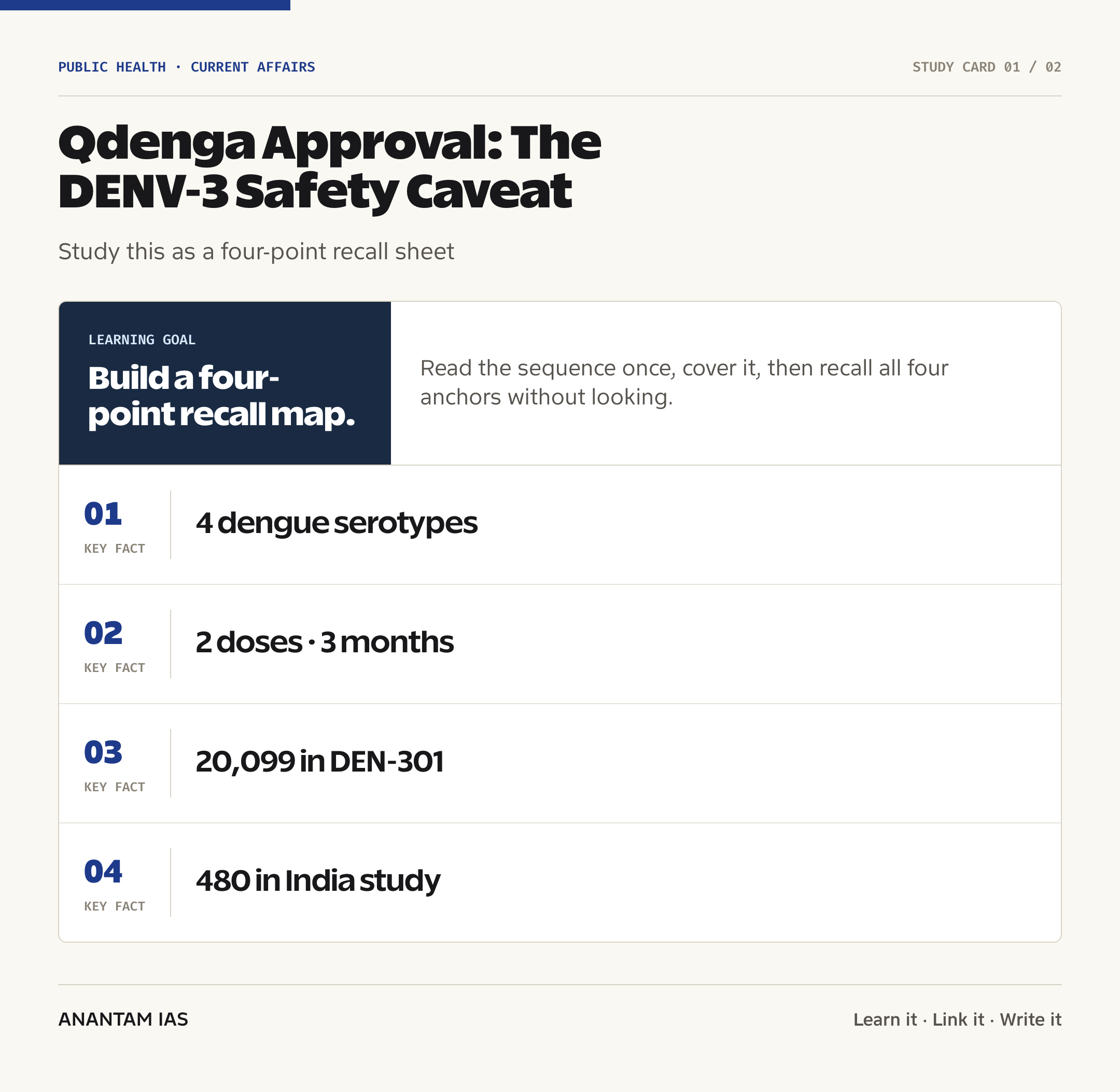
The approval has renewed scrutiny of the DENV-3 trial signal among children who were seronegative before vaccination. The available evidence doesn’t establish vaccine-enhanced disease, but it also doesn’t demonstrate protection against DENV-3 in this subgroup.
- The CDSCO Subject Expert Committee recommended import permission in March 2026 after reviewing the complete Indian Phase III report.
- The Indian study enrolled 480 healthy participants aged 4–60 and assessed safety and immunogenicity; it wasn’t designed as a large clinical-efficacy trial.
- The committee required a post-marketing safety and effectiveness study in Indians within six months of market introduction.
- The Hindu highlighted the unresolved question of DENV-3 protection in baseline-seronegative children and the biological concern of antibody-dependent enhancement.
- The public CDSCO minutes record an expert recommendation; the reported final approval is a later regulatory step and shouldn’t be confused with the committee’s advice.
The development matters in the context of:
- This matters in the context of India’s recurrent dengue burden and the need to add vaccines without weakening Aedes mosquito control and clinical surveillance.
- It also tests how regulators communicate subgroup uncertainty when a vaccine’s overall benefit can coexist with weak serotype-specific evidence.
- The issue links clinical-trial interpretation with pharmacovigilance, informed consent and evidence-based design of a future public immunisation programme.
UPSC Relevance
Prelims Relevance
- Dengue virus has four antigenically distinct serotypes: DENV-1, DENV-2, DENV-3 and DENV-4.
- Qdenga or TAK-003 is a live-attenuated tetravalent vaccine administered as two subcutaneous doses three months apart.
- A seropositive person has evidence of prior dengue exposure; a seronegative person lacks such baseline antibodies.
- Antibody-dependent enhancement is a mechanism in which non-neutralising antibodies may facilitate infection and contribute to severe disease during a later heterologous-serotype infection.
- The pivotal DEN-301 trial enrolled 20,099 children aged 4–16 across 26 sites in eight dengue-endemic countries.
- The World Health Organization recommends programmatic use of TAK-003 mainly for children aged 6–16 in settings with high dengue-transmission intensity.
- WHO’s recommendation doesn’t require routine pre-vaccination screening, but national policy may consider local epidemiology, test performance, feasibility and equity.
- The CDSCO regulates drugs and vaccines in India under the Union Ministry of Health and Family Welfare.
- Approval, trial evidence, WHO prequalification and inclusion in a national immunisation programme are distinct decisions.
Mains Relevance
GS Paper 3
- Interpretation of clinical-trial evidence by baseline serostatus and virus serotype.
- Vaccine biotechnology, pharmacovigilance and management of low-certainty safety signals.
- Integrated dengue control combining vaccination, surveillance, diagnostics and vector management.
GS Paper 2
- Public-health regulation, transparent risk communication and informed consent.
- Centre–State coordination for sentinel surveillance and adverse-event reporting.
- Equity implications of screening, private-market access and possible public-programme introduction.
Essay
- Scientific progress is strongest when uncertainty is made visible rather than hidden.
- Public trust depends on institutions explaining both the benefits and limits of medical evidence.
Background and Context
What the Regulatory Record Shows
The Indian decision must be read as a sequence of regulatory steps rather than as one undifferentiated approval event.
- In August 2025, the SEC asked Takeda to submit the complete Indian Phase III report before further deliberation.
- On 19 March 2026, the committee reviewed the completed report and recommended grant of new-drug import permission for ages 4–60.
- The minutes say the Indian study of 480 participants found the vaccine tolerated, safe and immunogenic in the presented dataset.
- Safety and immunogenicity, meaning the ability to generate an immune response, aren’t equivalent to demonstrated protection against clinical disease.
- The global efficacy evidence came chiefly from DEN-301, while the Indian trial supplied bridging evidence across adults, adolescents and children.
- The committee attached a condition: Takeda should begin an Indian post-marketing safety and effectiveness study within six months of market introduction.
- Students should distinguish an SEC recommendation from the regulator’s final permission order, and both from a government decision to procure the vaccine for a public programme.
How Qdenga Works
Qdenga seeks to induce protection against all four dengue serotypes with weakened viral components.
- The vaccine is live attenuated: its viral components are weakened so they stimulate immunity without causing ordinary dengue disease in immunocompetent recipients.
- It is tetravalent, covering DENV-1, DENV-2, DENV-3 and DENV-4; the construct uses a DENV-2 backbone for the other serotype components.
- The standard course is two subcutaneous doses separated by three months.
- The EMA authorises Qdenga from age four, while WHO’s public-programme recommendation focuses on ages 6–16 in high-transmission settings.
- A broad product licence states who may receive a product under official guidance; it doesn’t mean every eligible person should be vaccinated without a national risk-benefit policy.
- As a live vaccine, it is contraindicated for some people with severe immunodeficiency, as well as during pregnancy and breastfeeding under current product information.
Why Serostatus Changes the Question
Prior dengue exposure affects how both natural infection and vaccination are interpreted.
- A person is baseline seropositive when antibodies indicate a previous dengue infection before vaccination; a baseline-seronegative person has no such evidence.
- In natural dengue, infection by one serotype usually creates durable protection against that serotype but only temporary or incomplete cross-protection against the others.
- A later infection with a different serotype can carry a greater risk of severe disease, although severe outcomes depend on several host, viral and epidemiological factors.
- Antibody-dependent enhancement is one proposed mechanism: antibodies that bind but don’t neutralise a different serotype may help the virus enter immune cells.
- A dengue vaccine must ideally provide balanced protection, because weak protection against one serotype could leave a theoretical pathway for an infection resembling a secondary exposure.
- But a negative efficacy estimate isn’t proof of ADE. Demonstrating vaccine-enhanced disease requires consistent clinical, epidemiological and mechanistic evidence.
What the Global Trial Found
Overall results were favourable, but averages concealed important differences by serotype and baseline exposure.
- The pivotal trial randomised 20,099 children aged 4–16 in a roughly 2:1 vaccine-to-placebo ratio across eight endemic countries.
- Early trial results showed about 80% efficacy against virologically confirmed dengue and about 90% efficacy against hospitalisation over the principal follow-up window.
- Protection was strongest and most consistent against DENV-2; useful protection was also demonstrated against DENV-1.
- Among baseline-seropositive children, WHO’s evidence tables estimated DENV-3 efficacy of 52.3% against confirmed disease and 74.0% against hospitalised disease over 57 months.
- Among baseline-seronegative children, the point estimate against confirmed DENV-3 disease was −15.5%, with a very wide 95% confidence interval from −108.2% to 35.9%.
- For hospitalised DENV-3 in the same subgroup, the estimate was −87.9%, but it rested on only 14 cases and had a 95% confidence interval from −573.4% to 47.6%.
- Different hospital-admission practices, especially at Sri Lankan sites, added clinical heterogeneity; excluding Sri Lanka changed the point estimate substantially.
- The correct conclusion is limited: efficacy against DENV-3 wasn’t demonstrated in seronegative children, and a safety risk couldn’t be excluded. The trial didn’t prove increased risk.
WHO's Risk-Benefit Position
WHO supports targeted use where the expected population benefit is high, while acknowledging serotype-specific uncertainty.
- WHO recommends introduction of TAK-003 in children aged 6–16 in places where high transmission creates a substantial public-health problem.
- Countries should vaccinate about one to two years before the age-specific peak of dengue hospitalisation, using local surveillance to choose the target age.
- WHO doesn’t require routine pre-vaccination serological screening for this strategy, unlike the history of the earlier CYD-TDV vaccine.
- The position paper says no protection against DENV-3 and DENV-4 has been documented in seronegative recipients and available data can’t exclude increased hospitalisation or severe-dengue risk.
- At the same time, WHO judged that benefits substantially outweigh possible risks in high-transmission settings.
- This is a population-level recommendation, not a claim of uniform protection for every serotype, age or epidemiological setting.
Screening Debate and Policy Trade-offs
Screening may appear precautionary, but its public-health value depends on test accuracy and implementation.
- Advocates of screening argue that identifying seronegative children could reduce exposure of the subgroup with uncertain DENV-3 protection.
- A false-positive result could label a truly seronegative child as previously exposed and lead to vaccination; a false-negative could deny a potentially beneficial vaccine.
- Laboratory assays may show cross-reactivity with other flaviviruses or vary by time since infection, which complicates mass screening.
- Screening raises costs, access barriers and delay, potentially favouring urban families with better laboratory access.
- A no-screening strategy may be rational in areas of demonstrably high transmission, while a targeted-screening approach could be examined in lower-transmission or uncertain settings.
- India needs age- and district-specific seroprevalence, circulating-serotype data and validated tests before treating either strategy as universally correct.
Why Vaccination Cannot Stand Alone
Even an effective vaccine doesn’t remove the need for conventional dengue prevention and rapid care.
- Breakthrough infection remains possible, so vaccination can’t replace Aedes aegypti source reduction, larval control and household protection.
- DENV serotypes vary by place and season; genomic and serotype surveillance should be linked to hospital and vaccine-effectiveness data.
- Clinical services still need early recognition of warning signs, rational fluid management and referral pathways for severe dengue.
- India should integrate vaccination data with the Integrated Disease Surveillance Programme and adverse-event reporting systems.
- The distinct safety questions around Qdenga and India’s indigenous DengiAll programme shouldn’t be conflated; each product needs its own evidence review.
- For the wider regulatory background, compare this development with the earlier Qdenga approval note.
Way Forward
Publish a transparent Indian label
- State the approved ages, dose schedule, contraindications and evidence limits for baseline-seronegative recipients in plain language.
- Publish the final regulatory order and the rationale linking the Indian bridging study to global efficacy data.
- Keep product licensing separate from any later decision on public procurement or universal recommendation.
Build active post-marketing surveillance
- Begin the SEC-mandated study within the prescribed six-month window and pre-register outcomes and analysis plans.
- Track breakthrough cases by age, baseline serostatus where available, vaccine dose, infecting serotype, severity and hospitalisation.
- Use independent safety review and publish periodic findings, including null or reassuring results.
Design a context-specific rollout
- Pilot vaccination in high-burden districts with strong laboratory and hospital surveillance before wider expansion.
- Evaluate screening using Indian test-performance data rather than assuming that a theoretically cautious step is operationally safer.
- Ensure consent materials explain known benefits, unresolved uncertainty and the continued need for mosquito control.
Strengthen the evidence base
- Fund Indian effectiveness studies large enough to examine DENV-3 and DENV-4 outcomes, not only overall dengue.
- Maintain serotype and genomic surveillance so changes in circulating viruses can be linked to vaccine performance.
- Coordinate CDSCO, ICMR, the National Centre for Disease Control, States and independent experts through a public risk-management plan.
Conclusion
Qdenga gives India a new tool against a large and recurrent disease burden. Its overall efficacy and global use support cautious optimism, but population averages can’t erase the unresolved DENV-3 evidence in seronegative children.
A credible rollout should neither amplify an unproven harm nor dismiss a genuine uncertainty. Transparent labelling, local epidemiology, active surveillance and integrated vector control are the route from regulatory approval to responsible public-health use.
UPSC Practice Questions
Prelims MCQ 1
With reference to Qdenga, consider the following statements:
- It is a live-attenuated tetravalent dengue vaccine.
- Its standard course consists of two doses three months apart.
- WHO recommends its routine use in every country regardless of dengue transmission.
How many of the above statements are correct?
(a) Only one (b) Only two (c) All three (d) None
Answer: (b) Only two
Explanation:
Statements 1 and 2 are correct. WHO’s programme recommendation targets children in settings where high dengue transmission creates a substantial public-health problem; it isn’t a universal recommendation for every country.
Prelims MCQ 2
Antibody-dependent enhancement in dengue most accurately refers to:
(a) Antibodies directly destroying mosquito larvae (b) Non-neutralising antibodies facilitating infection by another serotype (c) A vaccine producing antibodies only after natural infection (d) Antivirals preventing antibody formation
Answer: (b) Non-neutralising antibodies facilitating infection by another serotype
Explanation:
ADE is a proposed mechanism in which binding but insufficiently neutralising antibodies can facilitate viral entry into immune cells. It is relevant to secondary heterologous dengue infection, but a negative efficacy estimate alone doesn’t prove ADE.
UPSC Mains Questions
- India’s reported approval of Qdenga combines a major preventive opportunity with unresolved serotype-specific evidence. Discuss how regulators should balance overall vaccine benefit, subgroup uncertainty, informed consent and post-marketing surveillance while designing a dengue vaccination strategy.
- Why can overall vaccine efficacy conceal important public-health risks or uncertainties? Explain with reference to baseline serostatus, DENV serotypes and confidence intervals in the Qdenga evidence, and suggest principles for responsible interpretation of clinical trials.
- Vaccination cannot substitute for integrated vector management in dengue control. Examine the institutional measures India needs to combine vaccination, serotype surveillance, adverse-event reporting, community communication and timely clinical management.
Sources: CDSCO Subject Expert Committee and WHO Position Paper on Dengue Vaccines.
Frequently Asked Questions
What is Qdenga?
Qdenga, also called TAK-003, is a live-attenuated tetravalent vaccine made by Takeda to prevent dengue caused by four virus serotypes. The standard schedule is two subcutaneous doses three months apart. Its use must follow the approved product label and public-health recommendations.
Who is seronegative for dengue?
A baseline-seronegative person has no detectable evidence of prior dengue exposure before vaccination. This status matters because Qdenga’s efficacy varied by baseline serostatus and serotype. WHO found no demonstrated protection against DENV-3 in seronegative children in the available Phase III evidence.
Does Qdenga cause antibody-dependent enhancement?
The available trial evidence doesn’t prove that Qdenga causes antibody-dependent enhancement. Negative DENV-3 efficacy estimates and case imbalances in seronegative children create a safety uncertainty, but the estimates are based on few cases and wide confidence intervals. A risk couldn’t be excluded.
What did the Indian trial establish?
The Indian Phase III study reviewed by the CDSCO expert committee enrolled 480 healthy people aged 4–60. The committee reported that the vaccine was tolerated, safe and immunogenic in the presented data. Global DEN-301 evidence, not this small Indian bridging study, supplied the main clinical-efficacy evidence.
Does WHO require screening before Qdenga?
WHO’s 2024 position doesn’t require pre-vaccination screening for its recommended use in children aged 6–16 in high-transmission settings. Screening remains a policy debate because it may identify prior exposure, but test errors, cost, access and local transmission can change its net value.
What should India monitor after rollout?
India should track breakthrough dengue by age, dose, baseline serostatus where feasible, infecting serotype, severity and hospitalisation. Active surveillance should especially examine DENV-3 and DENV-4 outcomes in seronegative recipients, alongside adverse events, circulating serotypes and real-world vaccine effectiveness.
Source: https://anantamias.com/current-affairs/qdenga-approval-denv3-safety-caveat/
India’s External Position: FCNR(B)-Led Inflows Near $32 Billion
Why in News?
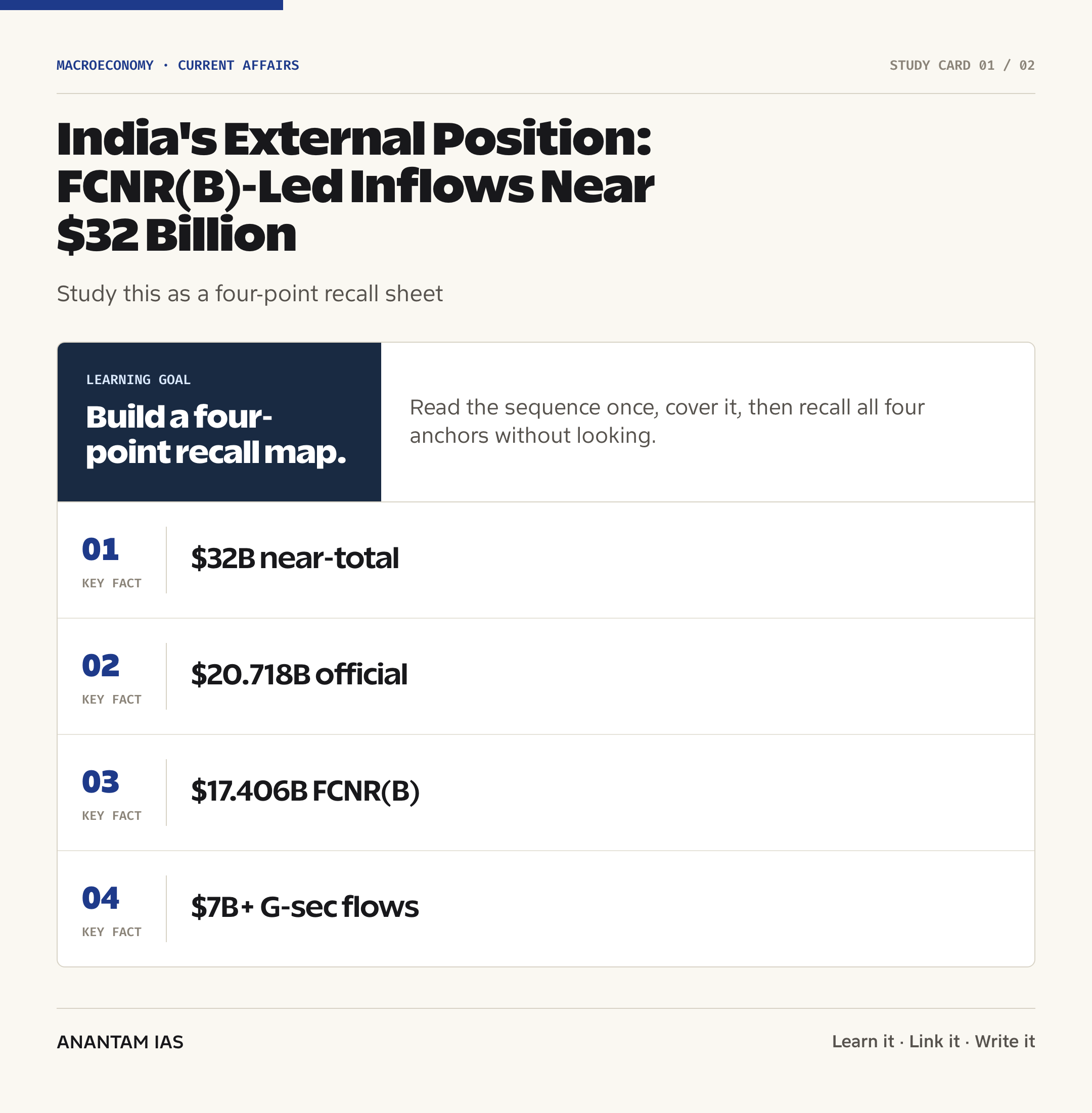
The Hindu reported on 27 July 2026 that banks had mobilised nearly $32 billion after the Reserve Bank of India’s June foreign-currency measures, with the inflow led by FCNR(B) deposits. RBI Governor Sanjay Malhotra also said foreign investment in government securities had exceeded $7 billion since those measures.
The latest interview figure extends the official interim picture. An RBI press release dated 20 July recorded $20.718 billion under its swap facilities up to 17 July: $17.406 billion in FCNR(B) deposits, $1.970 billion in overseas foreign-currency borrowings and $1.342 billion in external commercial borrowings. The different totals reflect different reporting cut-offs and scopes, so they shouldn’t be treated as contradictory like-for-like figures.
- FCNR(B) means Foreign Currency Non-Resident (Bank), a foreign-currency term deposit available to eligible non-resident Indians and persons of Indian origin.
- The RBI operationalised its special US dollar-rupee swap facilities on 8 June 2026 to attract longer-tenor foreign-currency inflows.
- The official 17 July break-up put FCNR(B) deposits at $17.406 billion, about 84% of the $20.718 billion reported under the three swap windows.
- The Governor said the broader mobilisation had reached nearly $32 billion, while government securities separately drew more than $7 billion after the June measures.
- The RBI described the rupee as possibly undervalued in nominal and real effective terms, but repeated that it targets excessive volatility rather than a fixed exchange-rate level.
The development matters in the context of:
- The inflows matter in the context of balance-of-payments resilience amid geopolitical risk, dollar strength and volatile emerging-market capital flows.
- They test whether incentive-based capital-flow management can stabilise the rupee without relying only on sales of foreign-exchange reserves.
- They also expose the trade-off between an immediate forex buffer and future foreign-currency liabilities that must be repaid or rolled over.
UPSC Relevance
Prelims Relevance
- FCNR(B) accounts are maintained as term deposits in permitted foreign currencies; principal and interest are freely repatriable.
- Because the deposit is denominated in foreign currency, the depositor doesn’t bear rupee-conversion risk; the bank ordinarily manages the currency exposure.
- The 2026 facility covers fresh or eligible renewed FCNR(B) deposits with a three-to-five-year tenor; the RBI swap itself is conducted in US dollars.
- An Authorised Dealer Category-I bank can deal in all permissible current-account and capital-account foreign-exchange transactions under RBI authorisation.
- ECBs are commercial borrowings raised by eligible Indian entities from recognised non-resident lenders, while OFCBs are overseas foreign-currency borrowings raised by authorised banks.
- The balance of payments records transactions between residents and non-residents; NRI deposits, ECBs and portfolio investment create financial-account flows.
- NEER is a trade-weighted average of nominal bilateral exchange rates; REER adjusts the effective rate for relative inflation.
- Foreign-exchange reserves include foreign currency assets, gold, Special Drawing Rights and India’s reserve position in the IMF.
- RBI intervention under India’s market-determined exchange-rate system aims to curb disorderly or excessive volatility, not defend a declared parity.
Mains Relevance
GS Paper 3
- External-sector management through forex reserves, capital-flow measures and currency swaps.
- The quality of capital inflows: comparing deposits and debt with FDI, portfolio flows and current-account receipts.
- The link among the rupee, imported inflation, current account and monetary-policy choices.
GS Paper 2
- Institutional roles of the RBI, Union government and authorised dealer banks in managing cross-border finance.
- Rule-based regulation under the Foreign Exchange Management Act, 1999 and transparent disclosure of policy costs.
Essay
- Economic resilience depends not only on the size of a buffer, but also on the quality and maturity of the liabilities used to build it.
- A flexible currency can absorb shocks, but public policy must distinguish volatility management from price targeting.
Background and Context
Reading the Headline Numbers Correctly
The new headline is a later assessment, while the RBI release supplies an auditable interim benchmark.
- The RBI’s official data, collected from Authorised Dealer banks, showed $20.718 billion mobilised from 8 June through 17 July under the special swap facilities.
- Within that total, $17.406 billion came from FCNR(B) deposits, $1.970 billion from OFCBs and $1.342 billion from ECBs.
- The Hindu’s 27 July report cited the Governor’s later figure of nearly $32 billion mobilised by banks, largely through FCNR(B), but did not publish the same instrument-wise table or cut-off used in the 20 July release.
- The more than $7 billion in government securities is a separate portfolio-flow indicator. It shouldn’t be added mechanically to an unlike total without matching dates and coverage.
- For answer writing, use the official break-up as the verified baseline and describe the $32 billion figure as the Governor’s updated assessment.
What an FCNR(B) Deposit Does
FCNR(B) converts diaspora savings into a relatively stable foreign-currency liability for an Indian bank.
- Eligible non-residents place a fixed-term deposit in a permitted foreign currency rather than converting the money into rupees.
- Both principal and interest are repatriable, and the depositor is protected from a fall in the rupee because repayment remains in the designated currency.
- The bank must still manage the mismatch between its foreign-currency liability and the rupee or foreign-currency assets funded with those deposits.
- FCNR(B) differs from an NRE account, which is rupee-denominated and exposes the depositor to the rupee’s exchange value when money is converted back.
- The durable static concept is covered in Anantam IAS’s note on the FCNR(B) swap window and NRI deposit rates.
How the RBI Swap Facility Works
The swap lowers the cost of hedging eligible inflows and gives banks a reason to mobilise longer-tenor dollars.
- A participating bank delivers eligible foreign currency and receives rupees from the RBI, with a reverse exchange agreed for the end of the swap tenor.
- For FCNR(B), the underlying deposit must generally have a minimum tenor of three years and maximum tenor of five years; the swap tenor follows the deposit.
- The facility was operationalised on 8 June 2026. The FCNR(B) mobilisation window remains available up to 30 September, while the ECB and OFCB windows extend to 31 December.
- For eligible ECBs and OFCBs, the June Economic Review of the Department of Economic Affairs recorded a concessional swap rate of 1.5% a year, compounded half-yearly.
- The mechanism transfers or reduces a major hedging-cost constraint; it doesn’t erase the public-sector risk associated with future exchange-rate movements.
- A prior explainer on RBI hedging support for FCNR(B) deposits sets out the policy design and the 2013 precedent.
The 2013 Precedent and the 2026 Difference
India has used an FCNR(B) swap window before, but precedent should guide risk assessment rather than encourage mechanical comparison.
- During the 2013 taper tantrum, expectations of tighter US monetary policy triggered capital outflows, rupee depreciation and wider concern about India’s current-account financing.
- The RBI offered banks a concessional swap against fresh three-to-five-year FCNR(B) deposits and also supported overseas borrowings by banks.
- RBI’s published account says the two 2013 windows mobilised about $34 billion, adding dollar resources and helping restore market confidence.
- The 2026 package again uses longer-tenor diaspora deposits, but it also covers eligible ECBs and OFCBs and sits beside measures designed to attract government-security investment.
- The shock context differs: 2013 centred on US taper expectations and India’s then-large current-account deficit, while 2026 combines geopolitical risk, dollar strength and volatile capital flows.
- The lesson is conditional: a swap window can break a cycle of panic and thin forex liquidity, but successful mobilisation doesn’t prove that the underlying trade or energy imbalance has disappeared.
Why the Inflows Strengthen the External Position
Fresh foreign currency improves near-term financing capacity even though the underlying instruments remain liabilities.
- A larger supply of dollars can ease pressure in the foreign-exchange market and reduce the need for abrupt reserve sales during global risk-off episodes.
- Longer-tenor deposits and borrowings offer more stability than very short-term speculative flows, helping the RBI manage liquidity and maturity risk.
- Capital inflows help finance a current-account deficit when merchandise imports exceed receipts from exports, services, remittances and income.
- The accounting relationship is explained in Anantam IAS’s guide to the balance of payments, current account and capital flows.
- The Governor also pointed to a current-account surplus during April-May, strong services exports and remittances, rising merchandise exports and improving FDI as supporting indicators.
- But a deposit inflow doesn’t improve export competitiveness by itself. It provides financing time while structural measures address trade, energy and productivity constraints.
Rupee Valuation and the RBI's Mandate
A currency can weaken against the dollar even when broader effective-rate measures and domestic fundamentals tell a more qualified story.
- NEER aggregates bilateral nominal exchange rates using trade weights, so it is broader than the rupee-dollar rate alone.
- REER adjusts the effective nominal rate for inflation differences between India and its trading partners and is often used as an indicator of external competitiveness.
- The Governor said the rupee was not overvalued and could be undervalued in nominal and real effective terms, linking recent pressure to geopolitics, dollar strength and emerging-market volatility.
- An undervaluation claim is sensitive to the base year, currency basket, trade weights and price indices; it isn’t a permanent or exact fair-value verdict.
- India follows a market-determined exchange rate. RBI operations seek orderly conditions and curb excessive volatility rather than promise a fixed level or band.
- This distinction preserves some monetary-policy autonomy: trying to fix the exchange rate, keep capital fully mobile and run an independent monetary policy creates the impossible trinity constraint.
Government-Security Inflows and the Broader Package
Portfolio demand for government debt broadens the inflow mix, but it behaves differently from an NRI term deposit.
- The Governor reported more than $7 billion of foreign inflows into government securities following the June policy measures.
- The June package included a tax exemption on interest and capital gains from eligible foreign portfolio investment in government securities with effect from 1 April 2026.
- Foreign purchases can deepen the government-securities market, diversify the investor base and reduce pressure on domestic financing costs.
- Portfolio debt is marked to market and can reverse when global yields, risk appetite or the dollar change; FCNR(B) deposits have a contractual term but create a maturity repayment.
- A stronger external account needs a balanced mix of FDI, portfolio flows, external debt, remittances and export earnings, not dependence on a single window.
Benefits, Costs and Warning Signs
The policy is best judged as a bridge against volatility, not as a substitute for external-sector reform.
- The immediate benefit is a larger forex liquidity cushion, improved market confidence and less pressure to use reserves defensively.
- The three-to-five-year FCNR(B) tenor reduces instant reversal risk, but concentrated maturities can create a redemption hump when deposits fall due.
- Higher deposit rates and subsidised or concessional hedging can shift costs to bank margins or the RBI balance sheet, depending on the instrument’s terms.
- Sterilising large inflows may be necessary if the rupee liquidity created by swaps conflicts with inflation control or short-term liquidity conditions.
- Debt-creating inflows improve financing but also increase future payment obligations. FDI and export earnings usually provide a more durable foundation.
- The strongest success test is not a one-day rupee level; it is whether reserve adequacy, maturity structure and the current account remain manageable after the special windows close.
Interaction with Inflation and Monetary Policy
Forex support and domestic price stability are connected through the rupee-liquidity and imported-inflation channels.
- A weaker rupee raises the domestic-currency cost of imported crude oil, fertiliser, electronics and intermediate goods, creating imported inflation even when domestic demand is moderate.
- Attracting dollars can calm abrupt currency moves, but when the RBI buys foreign currency it releases rupee liquidity into the banking system.
- If that liquidity is excessive, the RBI can absorb it through variable-rate reverse repos, deposit facilities or securities operations. This process is called sterilisation.
- Sterilisation has a cost and may affect money-market rates, bond yields and bank liquidity. The external-sector operation must remain aligned with the Monetary Policy Committee’s inflation mandate.
- The Governor said price stability remains the foremost priority and described the policy stance as data-dependent, allowing decisions to respond to domestic growth and inflation rather than copy foreign central banks.
- For analysis, separate three choices: attracting capital to improve forex supply, intervening to smooth volatility and setting the policy repo rate to meet the inflation objective.
Way Forward
Publish Comparable Data
- RBI should continue releasing instrument-wise, cut-off-specific figures so markets can distinguish FCNR(B), ECB, OFCB and government-security flows.
- Disclosures should show tenor buckets and future maturity concentrations without compromising bank-level confidentiality.
Manage Liquidity and Risk
- Use calibrated sterilisation operations when swap-generated rupee liquidity threatens monetary-policy alignment.
- Stress-test banks and the central bank balance sheet for exchange-rate, rollover and interest-rate shocks before the deposits mature.
Improve the Quality of Inflows
- Pair temporary deposit incentives with stable rules for FDI, bond-market access and long-term institutional investment.
- Avoid repeated exceptional windows becoming an assumed public hedge for private foreign-currency liabilities.
Repair Structural External Gaps
- Lower oil-import vulnerability through energy efficiency, diversified supplies and domestic clean-energy capacity.
- Raise export competitiveness through logistics, standards, services depth and productive capacity, rather than relying on currency weakness.
Keep the Exchange Rate Flexible
- Intervene against disorderly moves while allowing the rupee to reflect inflation, productivity and external demand over time.
- Explain NEER and REER assessments with their methodology so an undervaluation observation isn’t misread as an exchange-rate target.
Conclusion
FCNR(B)-led mobilisation has given India a meaningful near-term external buffer. The official $20.718 billion interim break-up and the Governor’s later nearly $32 billion assessment together show strong demand for the June measures, while government-security inflows broaden the support.
But resilience can’t be measured by gross inflows alone. A sound assessment must track cost, maturity, reversibility and the current account. The swap window can buy stability; exports, productive FDI, energy security and credible macroeconomic policy must convert that time into durable strength.
UPSC Practice Questions
Prelims MCQ 1
With reference to Foreign Currency Non-Resident (Bank) deposits, consider the following statements:
- They are maintained as term deposits in permitted foreign currencies.
- The depositor bears the risk of rupee depreciation because repayment is made only in rupees.
- Principal and interest are repatriable subject to the applicable scheme.
How many of the above statements are correct?
(a) Only one (b) Only two (c) All three (d) None
Answer: (b) Only two
Explanation:
Statements 1 and 3 are correct. FCNR(B) deposits remain denominated and repayable in the designated foreign currency, so the depositor doesn’t carry rupee-conversion risk. The bank manages the currency exposure.
Prelims MCQ 2
Which one of the following best distinguishes REER from NEER?
(a) REER covers only the rupee-dollar rate, while NEER covers all currencies (b) REER adjusts an effective nominal exchange-rate index for relative price or inflation changes (c) REER is fixed by the government, while NEER is market determined (d) REER records capital flows, while NEER records current-account flows
Answer: (b) REER adjusts an effective nominal exchange-rate index for relative price or inflation changes
Explanation:
NEER is a weighted average of bilateral nominal exchange rates. REER adjusts that effective rate for price or inflation differentials with trading partners, making it a broader competitiveness indicator.
UPSC Mains Questions
- RBI’s FCNR(B) swap window can strengthen the balance of payments without resolving the economy’s structural current-account vulnerabilities. Explain the mechanism and critically assess the benefits, fiscal-monetary costs and future redemption risks of relying on such debt-creating inflows.
- A currency’s fall against the US dollar doesn’t by itself prove that it is overvalued or fundamentally weak. Discuss with reference to NEER, REER, capital flows, imported inflation and the Reserve Bank of India’s stated approach to exchange-rate intervention.
- Distinguish among FCNR(B) deposits, foreign portfolio investment in government securities and foreign direct investment as sources of external financing. Which mix offers India the strongest balance between immediate liquidity and long-term resilience?
Sources: Reserve Bank of India and The Hindu.
Frequently Asked Questions
What is an FCNR(B) deposit?
An FCNR(B) deposit is a fixed-term bank deposit held by an eligible non-resident in a permitted foreign currency. Principal and interest are repaid in that currency and are repatriable. Because the money isn’t converted into rupees for the deposit, the depositor is protected from rupee depreciation during the term.
How much had RBI officially recorded?
The RBI recorded $20.718 billion under the three special swap facilities from 8 June through 17 July 2026. FCNR(B) deposits contributed $17.406 billion, overseas foreign-currency borrowings $1.970 billion and external commercial borrowings $1.342 billion. This is the official instrument-wise interim benchmark.
Why does the latest report say $32 billion?
The nearly $32 billion figure came from the RBI Governor’s later assessment reported on 27 July and covered mobilisation led by FCNR(B) deposits. The RBI’s $20.718 billion table had an earlier 17 July cut-off and a defined swap-facility scope. The figures should be cited with their dates and coverage.
How does a forex swap help banks?
A swap lets a bank exchange incoming foreign currency for rupees and reverse the exchange later on agreed terms. It reduces uncertainty or cost around hedging the bank’s foreign-currency liability. That makes longer-tenor FCNR(B) deposits and eligible overseas borrowings more attractive to mobilise.
Does RBI target a fixed rupee value?
No. India has a market-determined exchange rate, and the RBI says its intervention is intended to curb excessive or disorderly volatility rather than defend a declared rate or band. It may buy or sell foreign currency and manage liquidity, but market conditions and fundamentals still influence the rupee.
Are large inflows always beneficial?
No. Inflows add forex liquidity and can support confidence, but deposits, portfolio debt and external borrowings may reverse or require repayment. Their interest and hedging costs also matter. Durable external strength needs manageable maturities, adequate reserves, productive FDI, competitive exports and a sustainable current account.
Source: https://anantamias.com/current-affairs/rbi-fcnr-inflows-rupee-external-position/
Public Examinations Reform: Tougher Penalties and a Nilekani-Led Task Force
Why in News?
The Union government listed the Public Examinations (Prevention of Unfair Means) Amendment Bill, 2026 for introduction in the Lok Sabha on 27 July 2026. The proposed changes seek stronger punishment for paper leaks and organised examination crime.
A day earlier, the Prime Minister’s Office announced through PIB that a high-powered examination-reform task force had been constituted under Nandan Nilekani. The legal proposal and expert panel represent two different reform tracks: punishment after an offence and prevention across the examination lifecycle.
- The Indian Express reported that the amendment proposes raising imprisonment for an individual involved in a paper leak from three-to-five years to five-to-10 years.
- The reported fine for such an offence would rise from up to ₹10 lakh under the existing Act to ₹50 lakh under the proposal.
- For organised crime, the reported minimum imprisonment would rise from five to seven years and the minimum fine from ₹1 crore to ₹10 crore.
- The draft reportedly proposes a Special Task Force for investigation, with a two-month investigation timeline.
- The PIB release of 26 July 2026 officially confirms the constitution of the Nilekani-led reform panel, but that short release does not publish detailed terms of reference or a deadline for its report.
The development matters in the context of:
- The move follows renewed concern over the NEET 2026 paper leak and the wider credibility of high-stakes examinations.
- Stronger penalties can deter organised networks, but secure examinations also require institutional design, audited technology, vendor accountability and timely candidate remedies.
- The reform debate concerns both equality of opportunity and trust in the state because a compromised exam can alter admission and public-employment outcomes for millions of candidates.

UPSC Relevance
Prelims Relevance
- The parent law is the Public Examinations (Prevention of Unfair Means) Act, 2024, enacted on 12 February 2024 and brought into force on 21 June 2024.
- Its scheduled public examination authorities include the UPSC, SSC, Railway Recruitment Boards, IBPS and NTA, along with notified Union authorities.
- The Act covers conduct such as question-paper leakage, unauthorised possession or solving, impersonation, tampering with records, manipulation of seating and creation of fake examination websites.
- Offences under the central Act are cognizable, non-bailable and non-compoundable.
- The existing general punishment is three-to-five years of imprisonment and a fine up to ₹10 lakh; the 2026 Bill reportedly proposes a higher range.
- The existing punishment for organised crime is five-to-10 years of imprisonment and a fine of at least ₹1 crore.
- An investigation under the Act must ordinarily be conducted by an officer not below the rank of Deputy Superintendent of Police or Assistant Commissioner of Police.
- The Public Examinations (Prevention of Unfair Means) Rules, 2024 prescribe incident reporting, centre coordination and norms for computer-based tests.
- A Bill does not become law merely on introduction; it requires passage by both Houses, presidential assent and commencement according to its enacted terms.
Mains Relevance
GS Paper 2
- Governance and accountability: examine whether criminal penalties, institutional responsibility and audit systems form a coherent examination-integrity framework.
- Social justice: explain how leaks impose unequal costs on candidates with fewer financial, geographic and digital resources.
- Parliamentary process: distinguish a proposed amendment, an enacted law, rules and executive reform through a task force.
GS Paper 3
- Cybersecurity: assess secure question-paper generation, encryption, access controls, tamper-evident logs and incident response.
- Internal security: study organised leak networks, insider threats, money trails and inter-State investigation.
Essay
- Trust in institutions is built less by the severity of punishment than by the certainty, fairness and transparency of public processes.
- Technology can reduce discretion and leakage, but accountable governance must decide how technology is designed, audited and challenged.
Background and Context
Existing Legal Architecture
The 2024 Act created a central criminal-law framework against organised unfair means in specified public examinations.
- Its central purpose is to protect the integrity of examinations conducted by listed public examination authorities, including recruitment and national entrance-test bodies.
- The schedule covers the UPSC, SSC, Railway Recruitment Boards, IBPS and NTA; the Union government may add another authority through notification.
- The Act targets persons, groups, institutions and service providers behind unfair means. Ordinary candidate misconduct remains subject to the concerned examination authority unless the candidate is part of a prosecutable conspiracy or organised offence.
- The central law does not automatically govern every school, university or State examination. Legislative competence, the schedule and notification determine its reach, while several States also have their own anti-malpractice laws.
- The Act operates in addition to other laws, allowing related conduct such as forgery, cheating, cyber intrusion or conspiracy to attract relevant provisions of the Bharatiya Nyaya Sanhita and information-technology law.

What Counts as Unfair Means
The law addresses the full chain of compromise, not only the moment when a question paper becomes public.
- Pre-exam offences include leaking, procuring, possessing or solving a question paper before the authorised time and helping another person do so.
- Identity and response fraud include impersonation, providing unauthorised assistance, tampering with answer sheets and altering documents used for shortlisting or rank determination.
- System manipulation includes deliberate breach of security measures, manipulation of seat allocation or examination centres and violation of standards prescribed for conducting the test.
- Deceptive infrastructure includes fake websites, fake examinations and fraudulent offer letters created to cheat candidates or compromise a public examination.
- The breadth of these categories matters because a leak may involve insiders, printing and logistics vendors, centre personnel, digital administrators, brokers and organised criminal financiers.
Penalties: Existing Law and Proposed Change
The amendment is a proposal before Parliament; its reported clauses should not be confused with the penalties currently in force.
- Under the existing Act, a person resorting to unfair means can face three-to-five years of imprisonment and a fine up to ₹10 lakh.
- An organised-crime offence presently carries five-to-10 years of imprisonment and a fine of at least ₹1 crore; the property of an institution involved may also be attached and forfeited.
- A service provider can face a fine up to ₹1 crore, recovery of the proportionate examination cost and a four-year bar from conducting public examinations.
- The Indian Express reported that the 2026 Bill proposes five-to-10 years and a ₹50 lakh fine for individual paper-leak involvement.
- For organised crime, the report says the minimum jail term would rise to seven years and the minimum fine to ₹10 crore.
- The reported two-month investigation timeline may improve urgency, but its impact will depend on staffing, forensic capacity, coordination across States and safeguards against hurried or weak investigation.
Nilekani-Led High-Powered Task Force
The panel is meant to address the preventive and structural side of examination reform beyond criminal prosecution.
- PIB officially confirmed that Nandan Nilekani would lead the high-powered task force announced on 26 July 2026.
- The Indian Express reported a six-member panel comprising Nilekani, former ISRO chairperson S. Somanath, former Intelligence Bureau director Tapan Deka, IIT Madras director V. Kamakoti, former Education Secretary Anita Karwal and logistics expert Amrit Lal Meena.
- The composition brings together large-scale technology, operational precision, security, education administration and logistics, all of which matter in national examinations.
- The official PIB announcement available at the time of writing does not specify detailed terms of reference, consultation procedures or a reporting deadline. These details are essential for evaluating the panel’s accountability.
- The task force should be read alongside earlier debates on reforming the National Testing Agency, not as a replacement for statutory oversight or day-to-day managerial responsibility.
Technology Can Reduce Risk, Not Eliminate It
A secure system must protect the complete question-paper lifecycle from creation to evaluation.
- Least-privilege access should ensure that no official or vendor can view more information, or retain access longer, than a defined task requires.
- A maker-checker system can separate creation, approval and release functions so that one insider cannot independently compromise a paper.
- Encryption, hardware-backed key management, tamper-evident logs and time-bound access can make unauthorised activity easier to prevent and investigate.
- Technology must be paired with independent security audits, red-team testing, offline contingency plans and clear responsibility when a vendor fails.
- Biometric or identity tools raise privacy, exclusion and accessibility concerns. A candidate must have an effective alternative when authentication fails through no fault of their own.
- Digitisation can shift risk rather than erase it: centralised databases and platforms may become high-value targets, while poorly trained centres remain vulnerable at the last mile.
Governance and Federal Challenges
Examination integrity is a coordination problem involving the Union, States, testing bodies, police agencies and private service providers.
- Education lies in the Concurrent List, while Union recruitment and central examination bodies have distinct constitutional and statutory bases; reform must respect this layered allocation.
- A leak can cross State borders through encrypted messaging, coaching networks, money transfers and shared vendors, requiring interoperable evidence protocols and designated nodal officers.
- Contracts must specify security standards, audit rights, breach reporting, data retention and financial liability rather than treating cybersecurity as an informal vendor promise.
- Testing bodies need governing boards with expertise, internal risk teams and published accountability lines. Repeated outsourcing must not blur who is answerable to candidates.
- Investigation and prosecution should connect with the recently announced fast-track court framework, while preserving due process and quality of evidence.
From Deterrence to Examination Resilience
The goal should be a resilient examination system that prevents common failures, detects attempted breaches and recovers without imposing arbitrary costs on candidates.
- The deterrent effect of a law depends on the certainty of detection and conviction, not only the maximum sentence. Investigators need reliable logs, preserved devices, documented custody of evidence and financial trails that connect brokers to organisers.
- Testing bodies should maintain a live risk register covering paper-setting, moderation, printing, digital distribution, centre access, candidate identity, evaluation and result publication. Each risk needs a named owner and a tested control.
- Security performance should be measured through attempted breaches detected, access exceptions, unresolved audit findings, centre-level incidents and time taken to notify affected candidates. Public reporting can use aggregated indicators without exposing exploitable technical details.
- The system needs protection for both computer-based and pen-and-paper tests. Encryption cannot prevent a photographed paper at an insecure centre, while physical custody controls cannot stop compromise of a question bank or administrator account.
- Sensitive candidate data should follow purpose limitation and minimal retention. Collecting more biometrics or identity attributes than required can deepen harm after a breach and create new exclusion risks.
- A stable examination calendar, reserve question sets, alternate centres and rehearsed recovery protocols can reduce the pressure to choose between a compromised test and an indefinite delay. Continuity planning is part of integrity, not a separate administrative concern.
- Independent post-incident reviews should identify which control failed and whether warnings were ignored. Their recommendations, compliance status and candidate remedies should be tracked by the governing body rather than disappearing after the immediate controversy.
Candidate-Centred Reform
The real measure of reform is whether honest candidates receive a fair, accessible and timely examination.
- A leak creates direct costs through travel, accommodation, coaching and lost work, with the heaviest burden falling on low-income and rural candidates.
- Authorities need predefined rules for cancellation, re-examination, fee refunds and compensation so that crisis decisions are not improvised after public pressure.
- A time-bound grievance and disclosure system should explain what happened, what data was affected and why a remedy was selected without compromising the investigation.
- Accessibility safeguards for persons with disabilities, language options and reasonable digital alternatives must be included in security design from the start.
- The Supreme Court’s scrutiny of post-leak safeguards in NEET-UG 2026 underlines that institutional credibility depends on demonstrable reform, not assurances alone.
Way Forward
Publish a Measurable Reform Mandate
- Release the task force’s terms of reference, timeline, consultation plan and conflict-of-interest disclosures.
- Translate recommendations into a public action matrix with responsible agencies, deadlines and outcome indicators.
Build Security by Design
- Map every examination step, identify its root of trust and apply separation of duties, minimal access and continuous logging.
- Create common security baselines while allowing examination-specific offline and accessibility arrangements.
Regulate the Vendor Chain
- Accredit centres and critical vendors through periodic technical and physical audits, not a one-time tender check.
- Require prompt breach reporting, preservation of evidence and enforceable contractual liability.
Protect Candidates During a Crisis
- Adopt a graded incident-response policy covering local disruption, partial compromise and system-wide cancellation.
- Provide quick grievance decisions, transparent re-examination rules and support for candidates forced to travel again.
Improve Enforcement Capacity
- Pair higher penalties with trained investigators, digital-forensics facilities, financial investigation and inter-State coordination.
- Track investigation and trial outcomes so Parliament can judge whether punishment is becoming more certain, not merely more severe.
Conclusion
The 2026 amendment proposal raises the cost of paper-leak offences, while the Nilekani-led task force opens a broader path toward prevention. The two tracks are complementary: criminal law addresses culpability, and institutional reform reduces opportunities for wrongdoing.
A credible examination system needs verifiable security, clear responsibility, candidate remedies and independent scrutiny. Stronger sentences may signal resolve, but lasting trust will come from examinations that consistently work fairly before a crisis begins.
UPSC Practice Questions
Prelims MCQ 1
With reference to the Public Examinations (Prevention of Unfair Means) Act, 2024, consider the following statements:
- The Act applies to every examination conducted by every State university automatically.
- Offences under the Act are cognizable, non-bailable and non-compoundable.
- The National Testing Agency is included among the scheduled public examination authorities.
How many of the above statements are correct?
(a) Only one (b) Only two (c) All three (d) None
Answer: (b) Only two
Explanation:
Statements 2 and 3 are correct. The central Act covers listed or notified public examination authorities; it does not automatically extend to every State-university examination.
Prelims MCQ 2
Which one of the following correctly describes the legal status of the reported 2026 changes on 27 July 2026?
(a) They became law immediately after Cabinet approval (b) They replaced all State anti-malpractice laws (c) They were proposed through an amendment Bill listed for introduction (d) They were issued as rules under the existing Act
Answer: (c) They were proposed through an amendment Bill listed for introduction
Explanation:
Introduction begins the parliamentary process. A Bill must pass both Houses, receive presidential assent and commence according to the enacted framework before its amendments operate as law.
UPSC Mains Questions
- Stronger criminal penalties are necessary but insufficient to secure high-stakes public examinations. Analyse this statement with reference to the Public Examinations law, institutional accountability, technology design and the rights of candidates.
- Examination integrity is both a cybersecurity challenge and a governance challenge. Discuss how India can combine secure digital infrastructure, vendor regulation, federal coordination and transparent grievance redressal.
- Evaluate the potential and limits of expert task forces as instruments of administrative reform. What safeguards can ensure that the Nilekani-led examination-reform panel produces accountable and implementable outcomes?
Sources: PIB, Prime Minister's Office and The Hindu and The Indian Express.
Frequently Asked Questions
What is the 2026 examination amendment?
It is a proposed amendment to the Public Examinations (Prevention of Unfair Means) Act, 2024. As reported on 27 July, it seeks higher jail terms and fines for paper leaks and organised crime, along with a Special Task Force and a two-month investigation timeline. These provisions remain proposals until Parliament completes the legislative process.
Who heads the examination reform task force?
Nandan Nilekani heads the high-powered task force officially announced by the Prime Minister’s Office on 26 July 2026. The Indian Express reported five other members from space administration, intelligence, higher education, education policy and logistics. The brief PIB announcement did not publish detailed terms of reference or a report deadline.
Does the 2024 Act punish candidates?
The law was designed mainly to act against organised networks, institutions, service providers and other persons who enable unfair means. Routine candidate misconduct is ordinarily handled under the examination authority’s rules. A candidate who participates in a criminal conspiracy or organised leak can still face action under applicable criminal provisions.
Which examinations does the central law cover?
The schedule names authorities such as the UPSC, SSC, Railway Recruitment Boards, IBPS and NTA, along with Union departments and notified authorities. It does not automatically cover every State, university or school examination. States may apply their own examination laws, and the Union can notify additional authorities under the central framework.
Why are higher penalties not enough?
A severe sentence matters only when offences are detected, investigated and proved. Leak prevention also requires controlled access, secure logistics, audited vendors, trained personnel, evidence preservation and quick incident response. Candidate-focused rules for cancellation, re-examination and grievances are equally important because punishment after the event cannot restore lost time and opportunity.
How can technology make examinations safer?
Useful controls include encryption, separation of duties, time-limited access, tamper-evident logs, independent security testing and resilient offline plans. Technology must also protect privacy and accessibility. A centralised platform can itself become a target, so technical tools need clear human accountability, external audit and workable alternatives when authentication or connectivity fails.
Source: https://anantamias.com/current-affairs/public-examinations-reform-bill-nilekani-task-force/