Why in News?
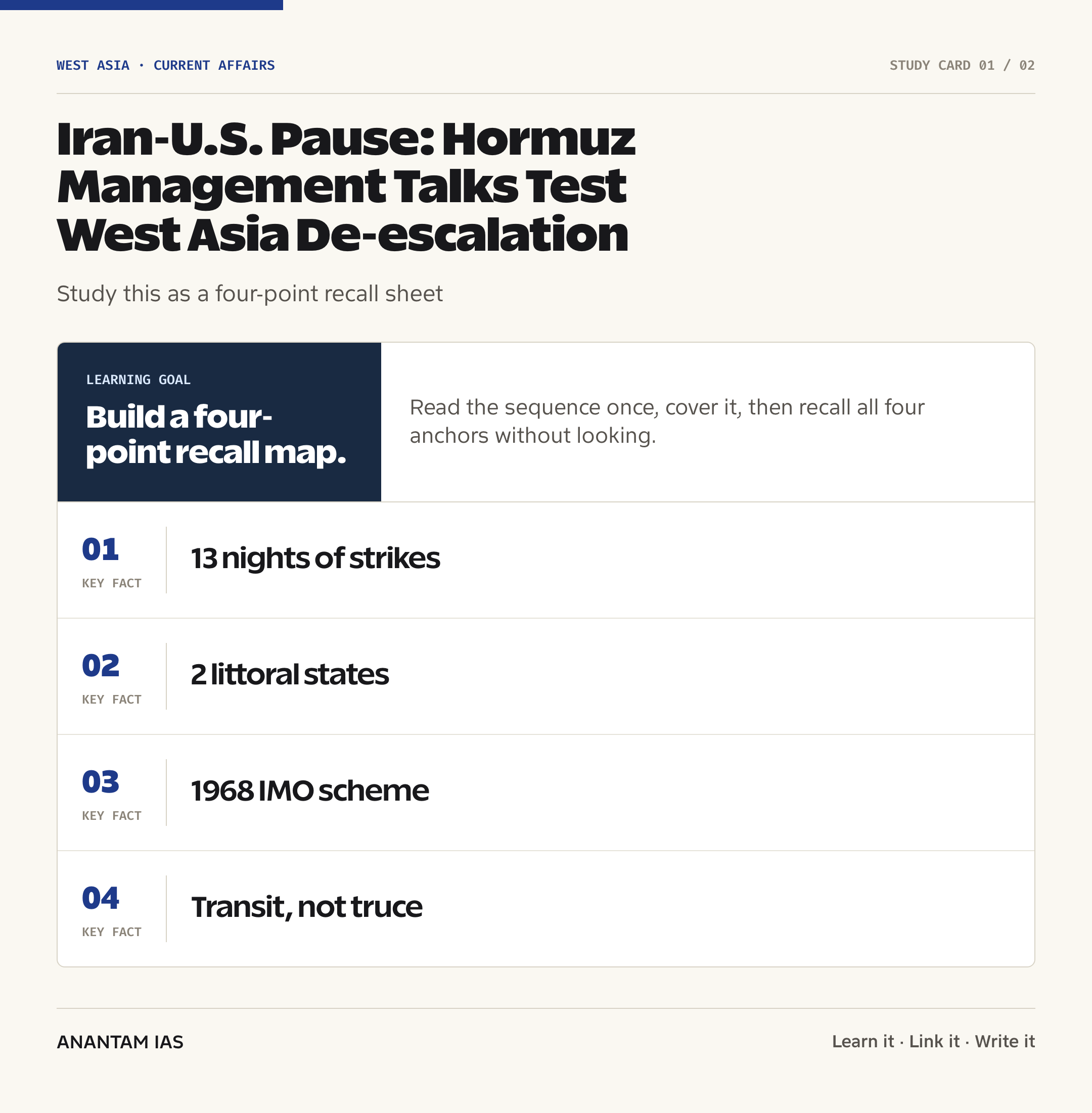
Iran announced on July 26, 2026 that it had halted retaliatory operations after the United States stopped strikes following 13 consecutive nights of attacks. The move created an operational pause, but neither side announced a final ceasefire or a political settlement.
Iran also reported progress in technical talks with Oman on common principles and operational mechanisms for shipping through the Strait of Hormuz. The talks matter because the dispute now concerns not only military escalation, but also who routes vessels, how mine risks are managed and whether transit remains non-discriminatory.
- Iranian army spokesperson Mohammad Akraminia described Iran’s operations as retaliatory and said they had stopped after the U.S. lull.
- Iranian Foreign Ministry spokesperson Esmail Baghaei said several rounds of technical discussions with Oman had made progress and were continuing.
- The Hindu reported Iranian claims of tanker mine incidents, but UKMTO had not confirmed those incidents; maritime bodies still warned that mine risks remained elevated.
- Early Asian trading reflected relief rather than resolution: Brent crude fell about 5% on July 27 while traffic through Hormuz remained low.
- This is newer than the July 20 escalation: that episode centred on claimed attacks on U.S. facilities in Kuwait and renewed strikes; the present development adds reciprocal restraint and a concrete Iran-Oman shipping-management track.
The development matters in the context of:
- A pause in attacks can reduce immediate risk, but it is reversible and must not be confused with an enforceable ceasefire.
- A stable Hormuz arrangement must reconcile coastal-state coordination with transit passage, non-discrimination and internationally recognised navigation rules.
- For India, the outcome affects energy costs, seafarer safety, shipping insurance, Gulf connectivity and the security of a large diaspora.
UPSC Relevance
Prelims Relevance
- The Strait of Hormuz connects the Persian Gulf with the Gulf of Oman and the Arabian Sea.
- Iran lies to the north of the strait; Oman’s Musandam Peninsula lies on its southern side.
- UNCLOS Part III governs straits used for international navigation and provides for transit passage.
- Under UNCLOS Article 44, states bordering such straits must not hamper transit passage and must publicise known dangers to navigation.
- The International Maritime Organization is a specialised UN agency responsible for global shipping safety, security and pollution-prevention standards.
- The Traffic Separation Scheme adopted by the IMO in 1968 is the internationally recognised routing framework for Hormuz, although emergency mine-risk advisories may temporarily prescribe different corridors.
- SOLAS, the International Convention for the Safety of Life at Sea, is a central treaty for ship-safety standards.
- UKMTO provides maritime-security information and incident reporting; it does not itself determine legal sovereignty over a waterway.
- Chabahar Port is on Iran’s Gulf of Oman coast, outside the Persian Gulf side of the Hormuz chokepoint.
Mains Relevance
GS Paper 2
- Role of Oman as a regional mediator and littoral state in converting military restraint into rules-based maritime coordination.
- Tension between coastal-state security powers and the international right of transit passage through a strategic strait.
- India’s strategic autonomy when Iran, the U.S., Israel and Gulf partners have competing security objectives.
GS Paper 3
- Transmission of a maritime chokepoint shock into crude prices, LNG availability, freight, insurance, inflation and the current account.
- Need for energy resilience through diversified suppliers, flexible contracts, inventories, alternate routes and demand management.
- Protection of merchant shipping and seafarers through risk assessment, maritime-domain awareness and coordinated advisories.
Essay
- A military pause becomes peace only when institutions can manage the interests that caused the fighting.
- Freedom of navigation is both a legal principle and a public good sustained by practical cooperation.
- Geography gives small littoral states an outsized role in global economic stability.
Background and Context
What Exactly Changed on July 26-27?
The new development is a shift from an expanding strike cycle to conditional restraint paired with technical diplomacy.
- The United States stopped strikes after 13 consecutive nights; Iran then said it had halted operations because its stated strategy was retaliatory.
- This sequence suggests reciprocal restraint, but the absence of a signed instrument, monitoring mechanism or agreed duration leaves the pause fragile.
- Iran and Oman moved beyond general calls for dialogue to discussions on common principles and operational mechanisms for vessel movement.
- Associated Press reported that commercial traffic was at a three-week low and no new attack had been confirmed in the preceding 72 hours, showing that reduced violence had not yet restored normal shipping.
- Oil prices fell sharply in early trading as markets priced in lower immediate risk, but the continued traffic slump showed the difference between market relief and physical normalisation.
- The conflict also remained active elsewhere, including Houthi-Saudi tensions near Bab al-Mandab; a pause in one theatre does not equal regional peace.
Why This Is Not a Repeat of the July 20 Escalation
The July 20 note examined geographic widening; today’s note examines whether an off-ramp can acquire operational rules.
- The earlier development involved an IRGC claim of attacks on U.S. facilities in Kuwait, renewed U.S. strikes and severe disruption around Hormuz.
- Its main analytical question was whether retaliation would pull another Gulf state deeper into the conflict and increase India’s consular and energy risks.
- Today’s fact pattern introduces two new variables: a stated halt in Iranian retaliatory operations and advanced Iran-Oman technical talks on safe passage.
- The policy question has shifted from containing an expanding battlefield to designing routing, deconfliction and verification that can survive political disagreement.
- Continuity still matters: mine allegations, low traffic and threats of renewed strikes mean the escalation ladder remains available. Students should read this as a new phase, not a settled outcome.
- The progression can be tracked alongside the earlier Hormuz standoff and India’s energy stakes.
Hormuz: Geography, Law and Navigation
Hormuz is both a narrow physical chokepoint and a strait used for international navigation.
- The waterway links the Persian Gulf to the Gulf of Oman; Iran and Oman are the two coastal states directly bordering the passage.
- Transit passage under UNCLOS allows continuous and expeditious navigation and overflight through straits used for international navigation.
- Coastal states may adopt lawful rules on navigation safety, traffic, pollution and customs, but those rules cannot discriminate in form or effect or deny and hamper transit passage.
- The IMO Council has stressed that passage must remain non-discriminatory and unimpeded, and that regulation must conform to IMO rules and SOLAS.
- The IMO has also stated that the 1968 Traffic Separation Scheme remains the internationally recognised route. Yet mine danger can make a recognised route operationally unsafe until hazards are cleared and security assurances exist.
- This distinction is central: legal entitlement to passage does not remove the shipmaster’s duty to conduct a realistic voyage-risk assessment.
What a Viable Iran-Oman Mechanism Must Resolve
A durable arrangement needs technical precision, legal legitimacy and political acceptance.
- First, it must establish verified mine-risk information, hydrographic updates, safe corridors and procedures for suspending or resuming vessel movements.
- Second, it needs a shared picture of vessel identity, routing and hazards without turning safety coordination into political screening of cargoes or flags.
- Third, deconfliction channels must connect Iran, Oman, the IMO, ship operators and maritime-information centres while keeping civilian mariners outside military bargaining.
- Fourth, any fees must be limited by applicable law and linked to genuine services; the IMO Council has opposed tolls or charges that burden the right of passage.
- Fifth, incident attribution needs evidence. Iran’s mine-strike claims and the lack of UKMTO confirmation show why independent verification is needed before retaliation.
- Sixth, the mechanism requires review and dispute-resolution procedures so a single incident does not automatically collapse operational cooperation.
Oman's Mediation Advantage and Limits
Oman combines geographic responsibility with a diplomatic record of maintaining channels across rival camps.
- As a littoral state, Oman has a direct responsibility for navigation on the southern side of the strait and practical knowledge of routing conditions.
- Its foreign policy has often favoured quiet mediation, allowing Muscat to communicate with Iran, the U.S. and Gulf partners without adopting maximalist public positions.
- Technical talks can lower political temperature by focusing on coordinates, communications and safety procedures rather than beginning with contested claims of control.
- But Oman cannot by itself guarantee U.S.-Iran restraint, remove mines, settle sanctions disputes or bind every armed actor operating across West Asia.
- A workable arrangement needs buy-in from commercial shipping, other Gulf states and international bodies; bilateral management without wider confidence may be viewed as exclusive control.
- Oman’s value lies in turning an opening into a process, not in substituting for a broader political settlement.
India's Stakes: Energy, Trade and Citizens
India experiences Hormuz instability through prices, shipping risk, connectivity and human security.
- A disruption raises the delivered cost of crude oil, LNG and LPG through higher benchmark prices, freight, war-risk insurance and voyage delays.
- The effects can spread to inflation, the current-account deficit, the rupee, fertiliser costs, transport and the fiscal choices involved in cushioning consumers.
- Indian crews on international vessels face direct risks from mines, missiles, detention and prolonged waiting; seafarer welfare is an economic and consular issue.
- A large Indian community across the Gulf requires calibrated travel advice, mission registration, evacuation planning and uninterrupted remittance channels.
- Chabahar Port lies outside the Strait on the Gulf of Oman, but conflict can still disrupt its insurance, finance and inland connectivity. See the background on India’s Chabahar interests.
- India should support freedom of navigation and civilian safety while maintaining communication with Iran, Oman, Gulf partners and the U.S.; this is a practical test of strategic autonomy.
Why a Pause Is Not Yet De-escalation
De-escalation is a process of reducing capability, intent and miscalculation, not merely the absence of strikes for a weekend.
- A ceasefire normally specifies parties, prohibited actions, duration, monitoring and procedures for alleged violations; the current pause lacks those public safeguards.
- Continued threats of higher-level strikes can make restraint coercive and reversible rather than confidence-building.
- Mine danger has a long tail: even after firing stops, uncertain locations can keep routes closed, premiums high and crews at risk.
- Proxy conflicts around Bab al-Mandab and the Red Sea can shift rather than remove pressure on energy and shipping networks.
- Markets can react immediately to diplomatic signals, while ports, insurers and shipmasters require verified security guarantees before normal traffic resumes.
- The real test is whether talks produce repeatable rules that prevent one disputed incident from restarting the retaliation cycle.
Way Forward
Convert the Pause into a Monitored Arrangement
- Iran and the U.S. should define prohibited actions, notification channels and a process for investigating alleged violations under a time-bound interim restraint arrangement.
- Oman can maintain a secure communication channel and convene technical meetings even when public political dialogue stalls.
- A shared incident log should distinguish verified attacks, navigational accidents and unconfirmed claims to reduce miscalculation.
Put Seafarer Safety Before Strategic Signalling
- Iran and Oman should publish coordinated navigation notices, hazard information, communication frequencies and clear responsibility for each transit corridor.
- Vessel movement should resume in phases only after mine-risk assessment, independent checks and credible security assurances.
- The IMO, flag states and industry bodies should monitor safety without legitimising discriminatory restrictions on lawful passage.
Build India's Shock Absorbers
- India should test crude, gas and LPG inventories against multiple Hormuz-disruption scenarios and set transparent triggers for strategic reserve decisions.
- Supply diversification must include flexible contracts, compatible refinery feedstocks, alternate ports and demand-side conservation, not only a longer supplier list.
- Missions and maritime agencies should maintain verified seafarer and diaspora contact systems, route-specific advisories and assisted-departure plans.
- Indian diplomacy should consistently support de-escalation, transit passage and civilian safety while keeping channels open with all principal actors.
Conclusion
The July 26-27 pause is significant because it interrupts an expanding strike cycle and places Hormuz management at the centre of diplomacy. It is a genuine development beyond the July 20 escalation, but it remains an opening rather than an outcome.
Durable de-escalation requires verified restraint, mine-risk reduction and a shipping arrangement that respects international law while giving Iran and Oman workable safety roles. India should use the window to support diplomacy and strengthen its own energy, maritime and consular resilience.
UPSC Practice Questions
Prelims MCQ 1
With reference to the Strait of Hormuz, consider the following statements:
- It connects the Persian Gulf with the Gulf of Oman.
- Iran and Oman are the two coastal states directly bordering the strait.
- UNCLOS permits states bordering an international strait to suspend transit passage whenever security conditions deteriorate.
How many of the above statements are correct?
(a) Only one (b) Only two (c) All three (d) None
Answer: (b) Only two
Explanation:
Statements 1 and 2 are correct. Under UNCLOS Article 44, states bordering straits must not hamper transit passage, and there shall be no suspension of such passage.
Prelims MCQ 2
Which institution adopted the internationally recognised Traffic Separation Scheme for the Strait of Hormuz?
(a) International Hydrographic Organization (b) International Maritime Organization (c) United Nations Environment Programme (d) Indian Ocean Rim Association
Answer: (b) International Maritime Organization
Explanation:
The IMO adopted the Hormuz Traffic Separation Scheme in 1968. Crisis advisories may prescribe temporary safe corridors, but that does not by itself alter the scheme’s international status.
UPSC Mains Questions
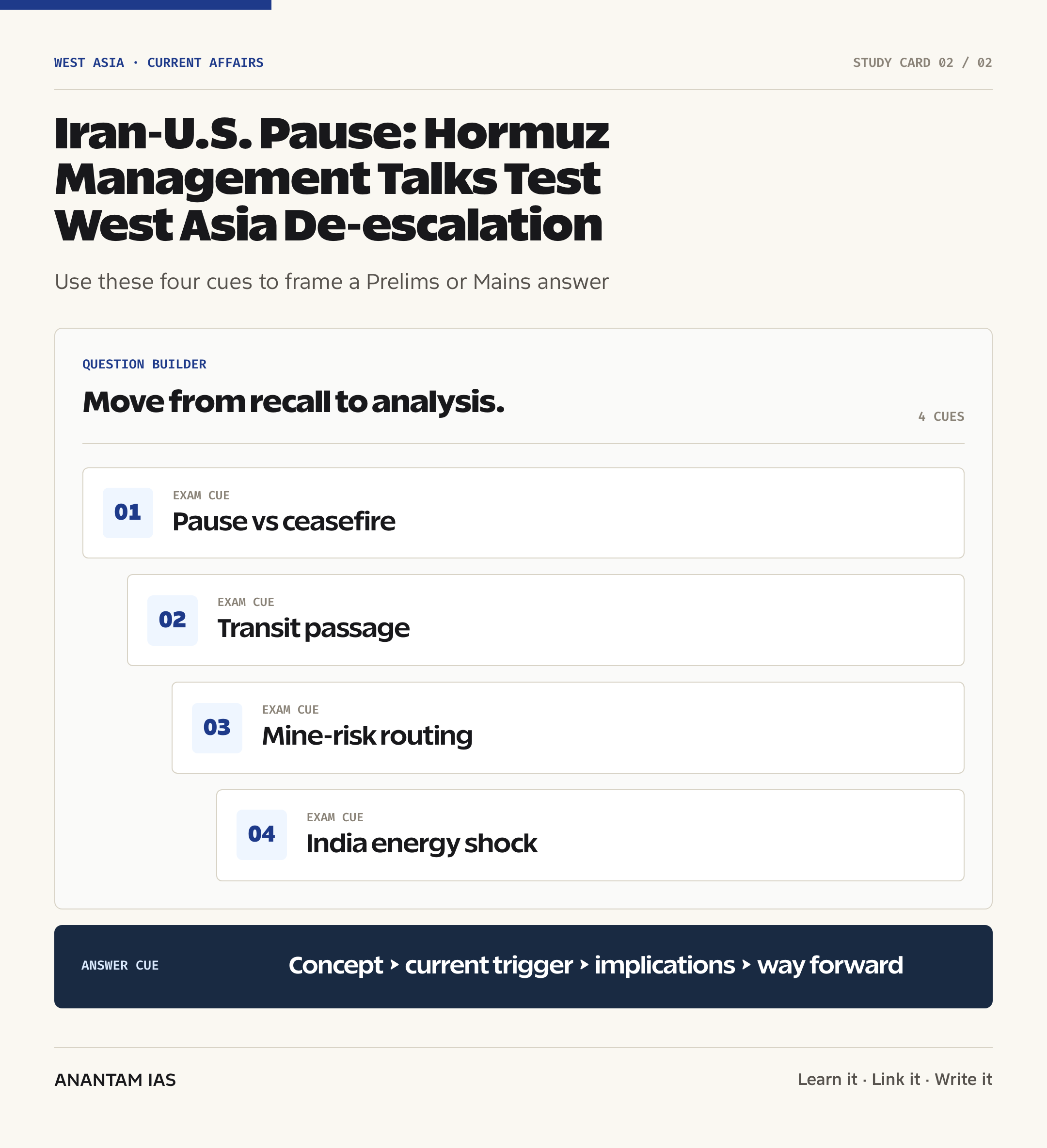
- The Iran-U.S. operational pause shows that stopping fire is easier than designing a stable maritime order. Examine the legal, technical and political issues an Iran-Oman mechanism for the Strait of Hormuz must resolve.
- Differentiate between a military pause, a ceasefire and durable de-escalation. Apply this distinction to the July 2026 developments in West Asia and assess Oman’s role as a littoral mediator.
- A Hormuz crisis reaches India through more channels than crude oil prices alone. Discuss the energy, shipping, consular and diplomatic dimensions of India’s exposure, and suggest a resilient policy response.
Sources: The Hindu and International Maritime Organization.
Frequently Asked Questions
Did Iran and the U.S. agree to a ceasefire?
No. Both sides paused strikes, and Iran linked its halt to the U.S. lull, but no public instrument specified duration, monitoring or violation procedures. It is best described as operational restraint, not a final ceasefire or peace settlement.
What is new in the Iran-Oman talks?
Iran said several rounds of technical talks had advanced work on common principles and operational mechanisms for shipping. This moves the discussion from broad diplomacy toward practical questions such as routes, communication, mine risks and vessel deconfliction.
Why is Oman central to Hormuz management?
Oman’s Musandam Peninsula borders the southern side of Hormuz. Oman is both a coastal state with navigation responsibilities and a mediator able to maintain channels with Iran, the United States and Gulf partners.
Can coastal states control transit through Hormuz?
They may regulate navigation safety, traffic and pollution under applicable law, but rules cannot discriminate against ships or hamper transit passage. The IMO has also stressed unimpeded passage, internationally recognised routing and freedom from tolls not tied to lawful services.
Why does shipping remain low after strikes pause?
Shipmasters and insurers need credible evidence that mine, missile and detention risks have fallen. A short absence of attacks doesn’t clear hazards, restore damaged navigation systems or provide the security assurances required for normal commercial traffic.
How should India respond to the pause?
India should back de-escalation and safe navigation, keep diplomatic channels open, monitor seafarers and the Gulf diaspora, diversify energy arrangements and test inventories and emergency plans against renewed disruption. Relief should be used to build resilience, not assumed to be permanent.
Tell Google you want more of this.
Add Anantam IAS as a preferred sourceOne tap, and this site shows up more often in your own Top Stories, AI Overviews and AI Mode. Remove it any time.