A notifiable disease is one that doctors and health facilities are legally bound to report to public health authorities. The reporting trigger is suspicion or confirmation, not a final diagnosis. The point is speed: the faster the public health system knows, the faster it can isolate, trace, and respond.
April 2026 saw fresh debate on India’s notifiable disease framework after seasonal outbreaks of measles in two states and a small but worrying cluster of suspected scrub typhus cases. State health departments updated their notifiable disease lists, and the Integrated Health Information Platform (IHIP), the digital surveillance backbone, processed a record number of weekly disease reports.
This explainer maps the legal architecture, the surveillance pipeline, the difference between centrally and state-listed notifiable diseases, and the reform debates that have been simmering since the Covid years. For UPSC, notifiable diseases India is a core topic at the intersection of GS-II governance and GS-III health policy.
Quick Facts at a Glance
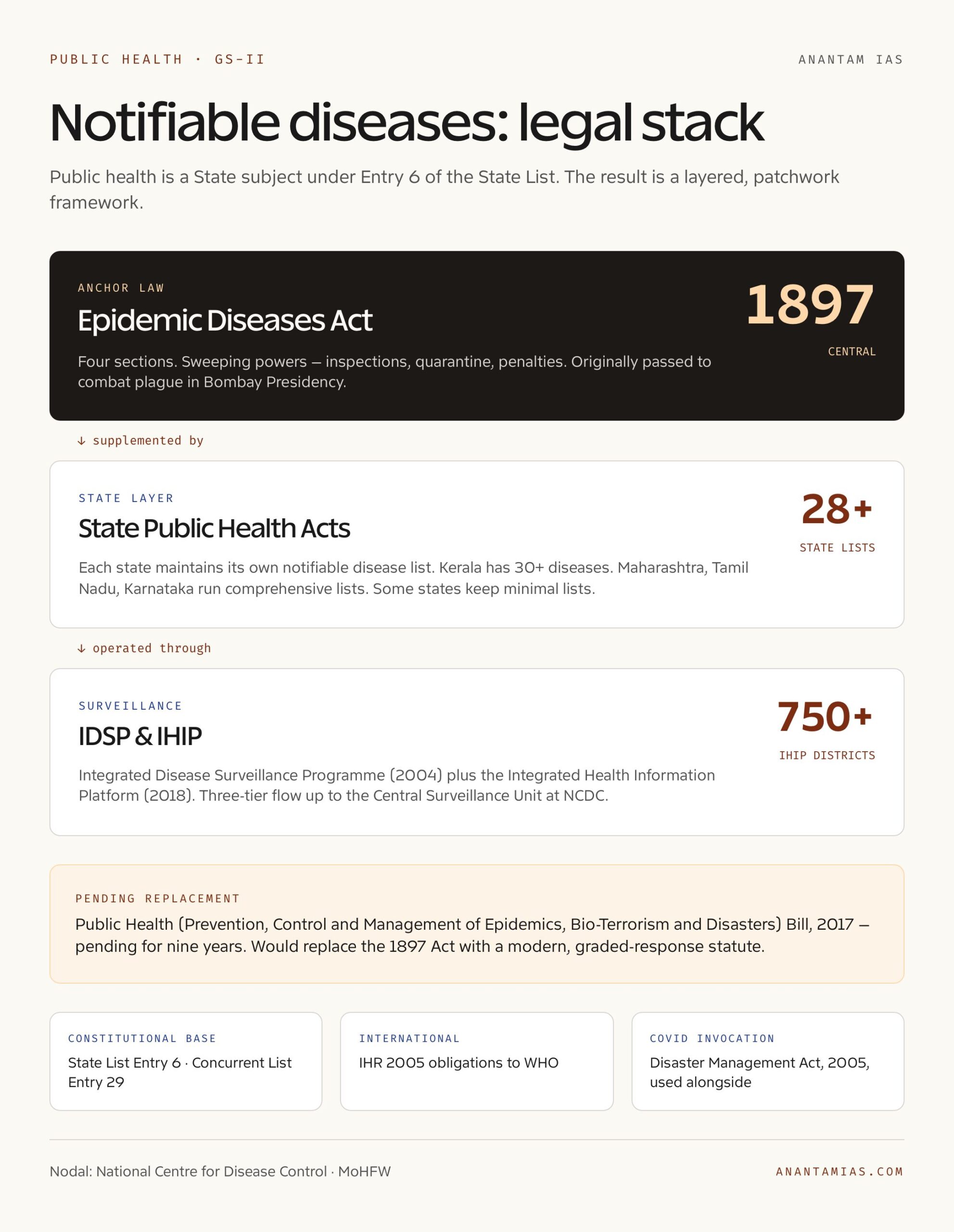
- Anchor law: Epidemic Diseases Act, 1897
- Replacement bill: Public Health (Prevention, Control and Management of Epidemics, Bio-Terrorism and Disasters) Bill, 2017 (pending)
- Surveillance program: Integrated Disease Surveillance Programme (IDSP), launched 2004
- Digital platform: Integrated Health Information Platform (IHIP), launched 2018, scaled post-Covid
- Nodal agency: National Centre for Disease Control (NCDC), under MoHFW
- Notification authority: State governments (each state maintains its own list)
- Centrally notifiable: International Health Regulations (IHR) 2005-listed diseases via WHO
- UPSC relevance: GS-II Health, GS-III Disaster Management, GS-III Public Health
What Just Happened
Through April 2026, multiple states reported updates to their notifiable disease lists. Karnataka added two more diseases to its list. Maharashtra issued a fresh circular reminding private hospitals of their reporting obligations under the state Public Health Act. Kerala, which has the most comprehensive notifiable disease framework, expanded reporting requirements for vector-borne illnesses ahead of monsoon.
The Ministry of Health and Family Welfare also flagged the IHIP portal’s expansion to over 750 districts. Weekly outbreak reports through IDSP-IHIP crossed pre-pandemic norms, indicating both better surveillance and the steady-state infectious disease burden.
The April updates are routine administrative actions, but they sit on top of a legal framework that needs serious reform, which is why UPSC aspirants need to understand both the operational and legal layers.
Background and Historical Context
The Epidemic Diseases Act, 1897, was passed in colonial India to combat the bubonic plague that had ravaged Bombay Presidency. The Act gave the government sweeping powers: inspecting and detaining travellers, prescribing quarantines, and penalising non-compliance. It was a four-section law, brief and broadly worded.
The Constitutional and Legislative Framework
Public health is a State subject under Entry 6 of the State List in the Seventh Schedule of the Indian Constitution. This means state governments have primary legislative authority over disease control, hospitals, and sanitation. The Centre operates through the Concurrent List entries on prevention of infectious diseases extending across states (Entry 29) and through international treaty obligations like IHR 2005.
This division creates the patchwork in India’s notifiable disease framework. There’s no single national list of notifiable diseases. Each state maintains its own list under a state Public Health Act or Epidemic Diseases Act. The Centre coordinates through IDSP, NCDC, and IHIP, but cannot directly mandate notification beyond what international regulations require.
The Public Health (Prevention, Control and Management of Epidemics, Bio-Terrorism and Disasters) Bill, 2017, was an attempt to replace the 1897 Act with a comprehensive modern framework. The Bill includes definitions of public health emergency, graded response protocols, accountability mechanisms, and explicit notifiable disease provisions. It has not been passed.
Post-Covid, the National Disaster Management Act, 2005, was invoked extensively, treating the pandemic as a notified disaster. This worked operationally but exposed the gaps in dedicated public health legislation.
Key Provisions and Features
What gets notified
Notifiable diseases typically fall into four categories:
- Vaccine-preventable diseases: measles, polio, diphtheria, pertussis, tetanus, hepatitis B
- Vector-borne diseases: dengue, chikungunya, malaria, Japanese encephalitis, scrub typhus
- Water/food-borne diseases: cholera, acute diarrhoeal disease, typhoid, hepatitis A and E
- Emerging and re-emerging diseases: nipah, zika, Crimean-Congo haemorrhagic fever, leptospirosis
- High-mortality and quarantinable diseases: yellow fever, plague, pandemic influenza, Covid-19
Who reports
All registered medical practitioners, government and private hospitals, diagnostic laboratories, and public health centres are required to report. The Indian Medical Association periodically reminds members of these obligations.
Where it goes
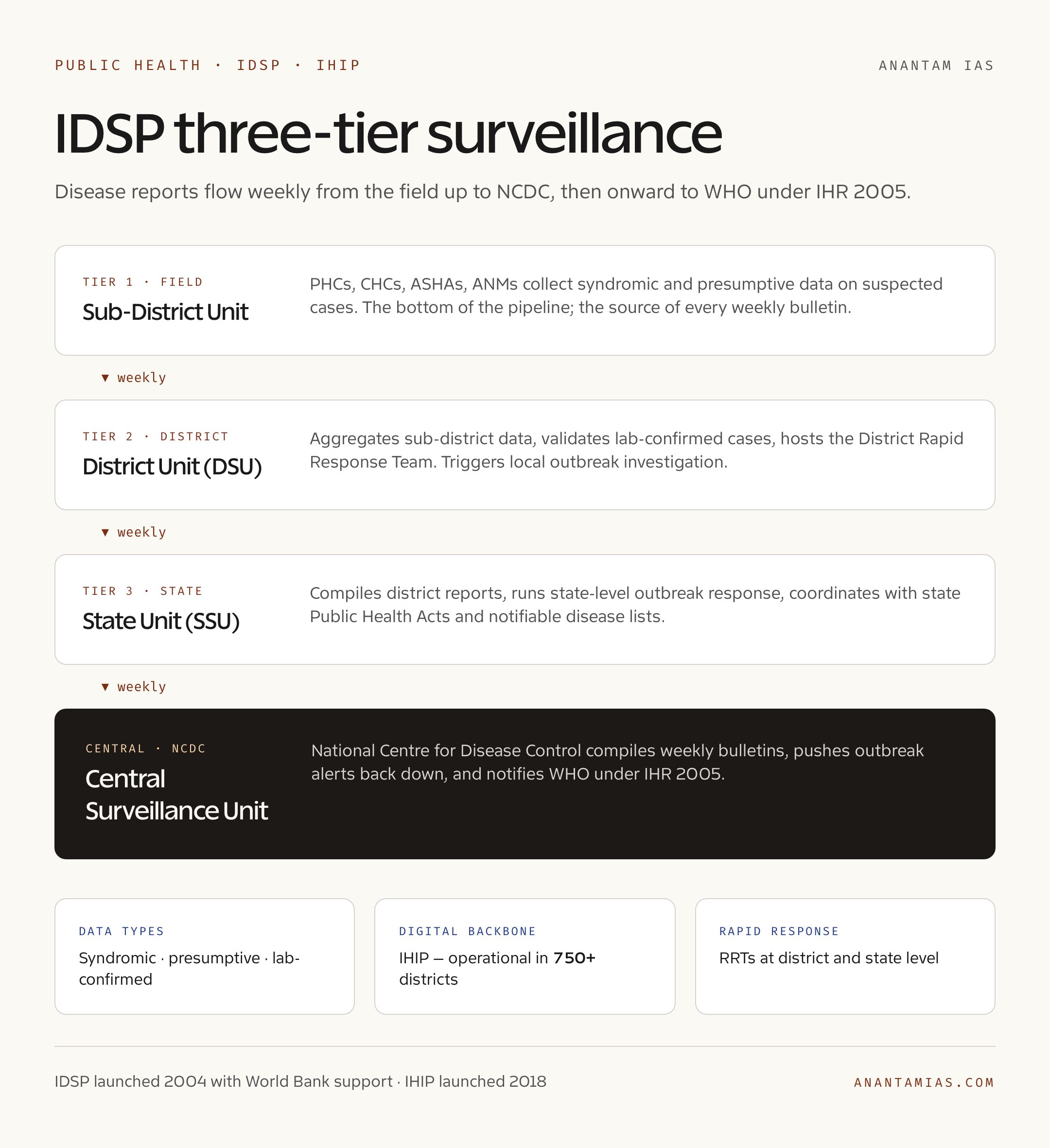
Reports flow up the IDSP three-tier structure: sub-district unit, district surveillance unit, state surveillance unit, and finally the Central Surveillance Unit (CSU) at NCDC. The IHIP portal digitises this entire pipeline. The CSU compiles weekly reports and shares them with the WHO under IHR 2005.
What happens next
Confirmed outbreaks trigger Rapid Response Teams (RRT) at district and state level. RRTs investigate, isolate, treat, contact-trace, and report. State governments may invoke the Epidemic Diseases Act, 1897, for stricter quarantine and movement restrictions.
Why It Matters
Three reasons make notifiable disease frameworks central to public health governance.
The first is early warning. Diseases like cholera, measles, and dengue can blow up into outbreaks within days. Without legally enforceable reporting, the public health system reacts too late. The 2018 Nipah outbreak in Kerala was contained largely because the state’s notifiable disease framework activated within 48 hours.
Second, accountability. When private hospitals don’t report, outbreaks remain hidden. Mandatory notification with penalties (typically Rs 200 to Rs 5,000 across states) creates an enforceable obligation.
Third, international compliance. IHR 2005 obligates India to notify the WHO about events that may constitute public health emergencies of international concern. Without a domestic notifiable disease pipeline, India cannot meet its treaty commitments.
Detailed Analysis: How IDSP and IHIP Actually Work
The Integrated Disease Surveillance Programme launched in 2004 with World Bank assistance. It replaced earlier disease-specific vertical programs that didn’t talk to each other. IDSP’s three-tier surveillance covers all districts in India.
Data flows weekly through the Integrated Health Information Platform (IHIP), launched in 2018 and scaled aggressively post-Covid. IHIP is now operational in over 750 districts. It captures three forms of data: syndromic (symptoms-based, by ASHAs and ANMs at field level), presumptive (clinically suspected, by primary health centres and hospitals), and laboratory-confirmed (from testing facilities).
Weekly bulletins published by NCDC analyse trends. Outbreak alerts are pushed to state authorities for response. The IHIP also feeds into the WHO’s Event-Based Surveillance system.
The improvement post-Covid is real. Pre-pandemic IDSP was patchy in private sector reporting. Now, with IHIP digitisation, more private hospitals report routinely. But gaps remain. Field-level reporting depends on under-resourced ASHAs. Smaller laboratories often don’t submit. The legal teeth to enforce reporting are unevenly applied across states.
State-Wise Notifiable Disease Lists
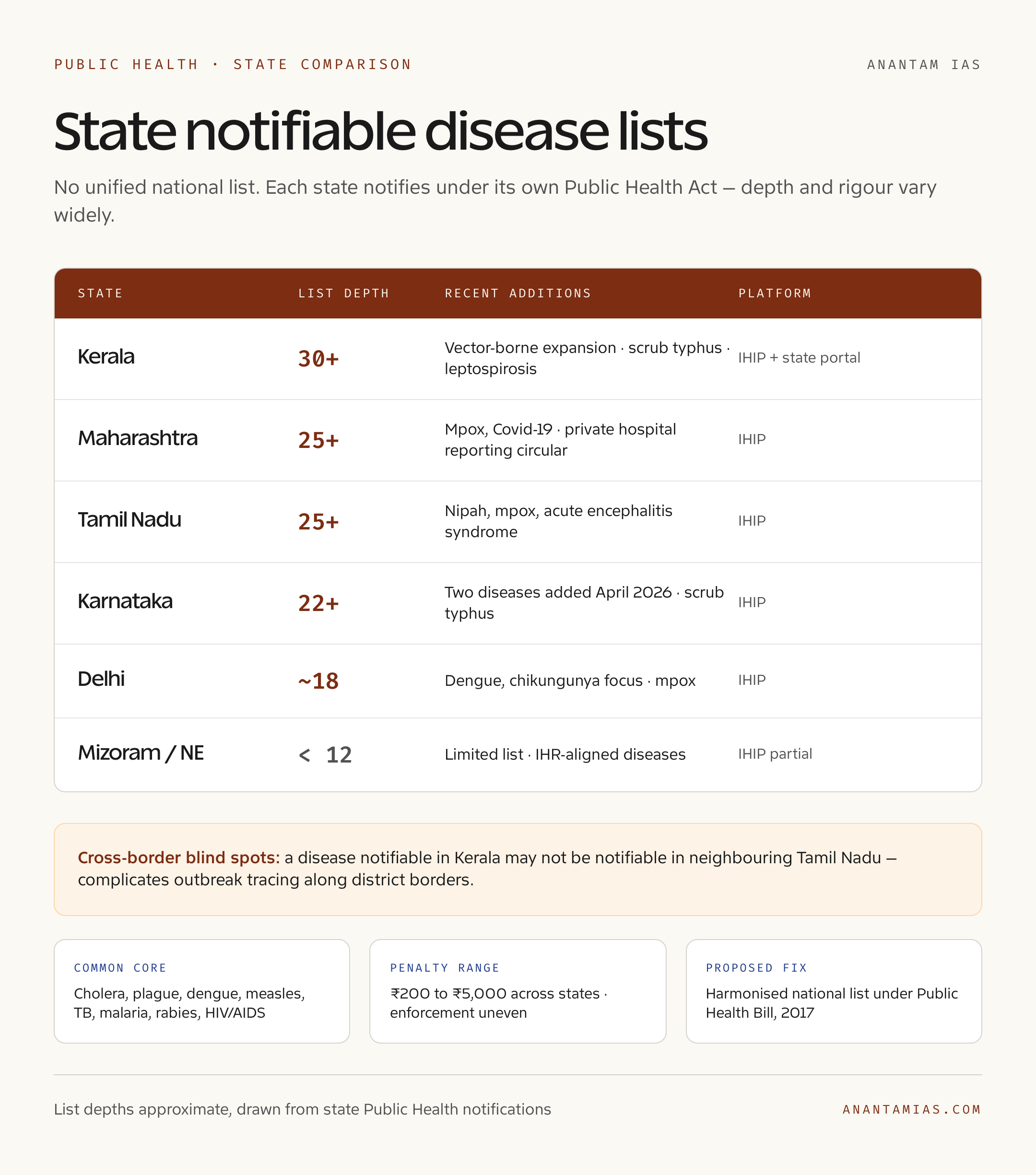
Different states list different diseases, which is a source of confusion. Kerala has the most extensive list, including over 30 notifiable diseases. Maharashtra, Tamil Nadu, and Karnataka also maintain comprehensive lists. Some states list only the WHO IHR 2005 diseases plus a few additions. Mizoram, Nagaland, and some other smaller states have minimal or outdated lists.
Common diseases on most state lists include cholera, plague, yellow fever, dengue, measles, diphtheria, pertussis, tuberculosis, leprosy, HIV/AIDS, viral hepatitis, Japanese encephalitis, malaria, and rabies.
Recent additions across multiple states include scrub typhus, leptospirosis, nipah, Covid-19, monkeypox (mpox), and chikungunya. Some states have added congenital rubella syndrome and acute encephalitis syndrome.
The lack of a unified national list is one of the most cited limitations. The Public Health Bill, 2017, would address this if passed.
Comparative Perspective
The United States CDC maintains a National Notifiable Diseases Surveillance System (NNDSS) with over 100 conditions. Each state has its own list but flows data centrally. The UK Health Security Agency operates under the Public Health (Control of Disease) Act 1984 with a unified national list.
India’s federalised structure makes a single national list politically and legally tricky, but operational coordination is achievable. The IHIP platform demonstrates this. What’s missing is statutory backing.
For the larger context of how the Indian state organises public service delivery, our Indian Polity Notes covers the constitutional division of powers that drives this fragmentation.
Challenges and Critiques
Five issues deserve attention.
The 1897 law is outdated. Four sections, broad powers, no graded response, no accountability. Covid-19 exposed every gap. The Public Health Bill, 2017, has been pending for nine years.
Private sector under-reporting. Despite IHIP, many private hospitals and standalone diagnostic labs don’t notify in real time. Penalties are weak. Enforcement is inconsistent.
Field-level capacity. ASHAs and ANMs are the bottom of the surveillance pyramid. They’re under-resourced, under-paid, and over-loaded. The quality of syndromic reporting reflects this.
State-Centre coordination. The patchwork of state lists creates blind spots. A disease notifiable in Kerala may not be notifiable in neighbouring Tamil Nadu, complicating border surveillance.
Data privacy. With IHIP digitising disease data, questions arise about personal health information protection. The Digital Personal Data Protection Act, 2023, applies, but disease surveillance carve-outs need clarification.
UPSC Prelims Pointers
- Epidemic Diseases Act, 1897, has only four sections.
- Public health is a State subject under Entry 6 of the State List, Seventh Schedule.
- IDSP launched in 2004 with World Bank assistance.
- IHIP (Integrated Health Information Platform) launched in 2018.
- NCDC (National Centre for Disease Control) is the nodal agency for disease surveillance, under MoHFW.
- IHR 2005 governs India’s international notification obligations.
- The Public Health Bill, 2017, is the proposed replacement for the Epidemic Diseases Act, 1897.
- During Covid-19, the Disaster Management Act, 2005, was invoked alongside the Epidemic Diseases Act, 1897.
- Recent additions to many state notifiable disease lists: scrub typhus, leptospirosis, nipah, mpox.
- IDSP three-tier structure: Sub-District Surveillance Unit, District Surveillance Unit, State Surveillance Unit, Central Surveillance Unit at NCDC.
Mains Practice Questions
- The Epidemic Diseases Act, 1897, is widely seen as inadequate for managing modern public health emergencies. Discuss the limitations and the need for replacement legislation. (GS-II, 15 marks)
- Examine the structure and effectiveness of the Integrated Disease Surveillance Programme (IDSP) in India. How has the Integrated Health Information Platform (IHIP) strengthened it? (GS-II, 10 marks)
- The federal structure of India creates challenges in disease surveillance and notification. Suggest reforms to balance Centre-State coordination with public health imperatives. (GS-II, 15 marks)
- Notifiable diseases India is a critical pillar of public health governance. Critically evaluate India’s framework in the post-Covid context. (GS-II and GS-III, 15 marks)
Way Forward and Conclusion
India’s notifiable disease framework needs three reforms.
The Public Health Bill, 2017, must be enacted with appropriate amendments. The 1897 Act cannot remain the anchor law for 21st century public health. A modern statute with graded response, accountability, data protection, and explicit notifiable disease provisions is overdue.
A harmonised national notifiable disease list, agreed between the Centre and states, would close the inter-state gaps. Federalism doesn’t preclude coordination. A National Public Health Authority, recommended in multiple reports, could host this list.
Strengthening field-level surveillance through better-paid, better-trained ASHAs, ANMs, and primary care staff is non-negotiable. The data is only as good as the bottom of the pipeline.
Notifiable diseases India isn’t a topic that grabs headlines until an outbreak hits. By then, it’s too late. The April 2026 updates are routine, but the underlying framework needs sustained reform pressure. For UPSC aspirants, this is exactly the kind of topic where prelims facts and Mains analysis converge cleanly. Aspirants should also revisit our explainer on the Seventh Schedule for the constitutional foundation.
Frequently Asked Questions
Q1: What is a notifiable disease?
A: A disease that doctors, hospitals, and laboratories are legally required to report to public health authorities upon clinical suspicion or confirmation, regardless of final diagnosis.
Q2: Which law governs notifiable diseases in India?
A: Primarily the Epidemic Diseases Act, 1897, supplemented by state Public Health Acts and the Disaster Management Act, 2005, in extreme situations.
Q3: Is there a single national notifiable disease list in India?
A: No. Public health is a State subject under the Seventh Schedule, so each state maintains its own list. The Centre coordinates through IDSP and IHR 2005 obligations.
Q4: What is IDSP?
A: Integrated Disease Surveillance Programme, launched in 2004, is a decentralised, three-tier disease surveillance system covering all districts in India.
Q5: What is IHIP?
A: Integrated Health Information Platform, launched in 2018, is the digital backbone for IDSP that enables real-time disease reporting from over 750 districts.
Q6: Who is required to report notifiable diseases?
A: All registered medical practitioners, hospitals (public and private), diagnostic laboratories, and primary health centres.
Q7: What is the penalty for not reporting?
A: Penalties vary by state, typically ranging from Rs 200 to Rs 5,000. Enforcement is inconsistent and is one of the weaknesses of the current framework.
Q8: Are mpox and Covid-19 notifiable diseases in India?
A: Yes. Both have been added to most state notifiable disease lists in recent years, though specific notification procedures vary by state.
Tell Google you want more of this.
Add Anantam IAS as a preferred sourceOne tap, and this site shows up more often in your own Top Stories, AI Overviews and AI Mode. Remove it any time.