Daily Digest
UPSC · Civil Services Examination
Current Affairs · Wednesday, 8 July 2026
Current affairs curated and edited by Anantam IAS faculty — pulled from The Hindu, PIB, IDSA, Foreign Affairs and the ministries. Read, annotate, revise.
Old Rajinder Nagar · Delhi 110005 · anantamias.com
Quantum advantage: An Indian lab’s 120-qubit algorithm outpaces classical computers
Why in News?
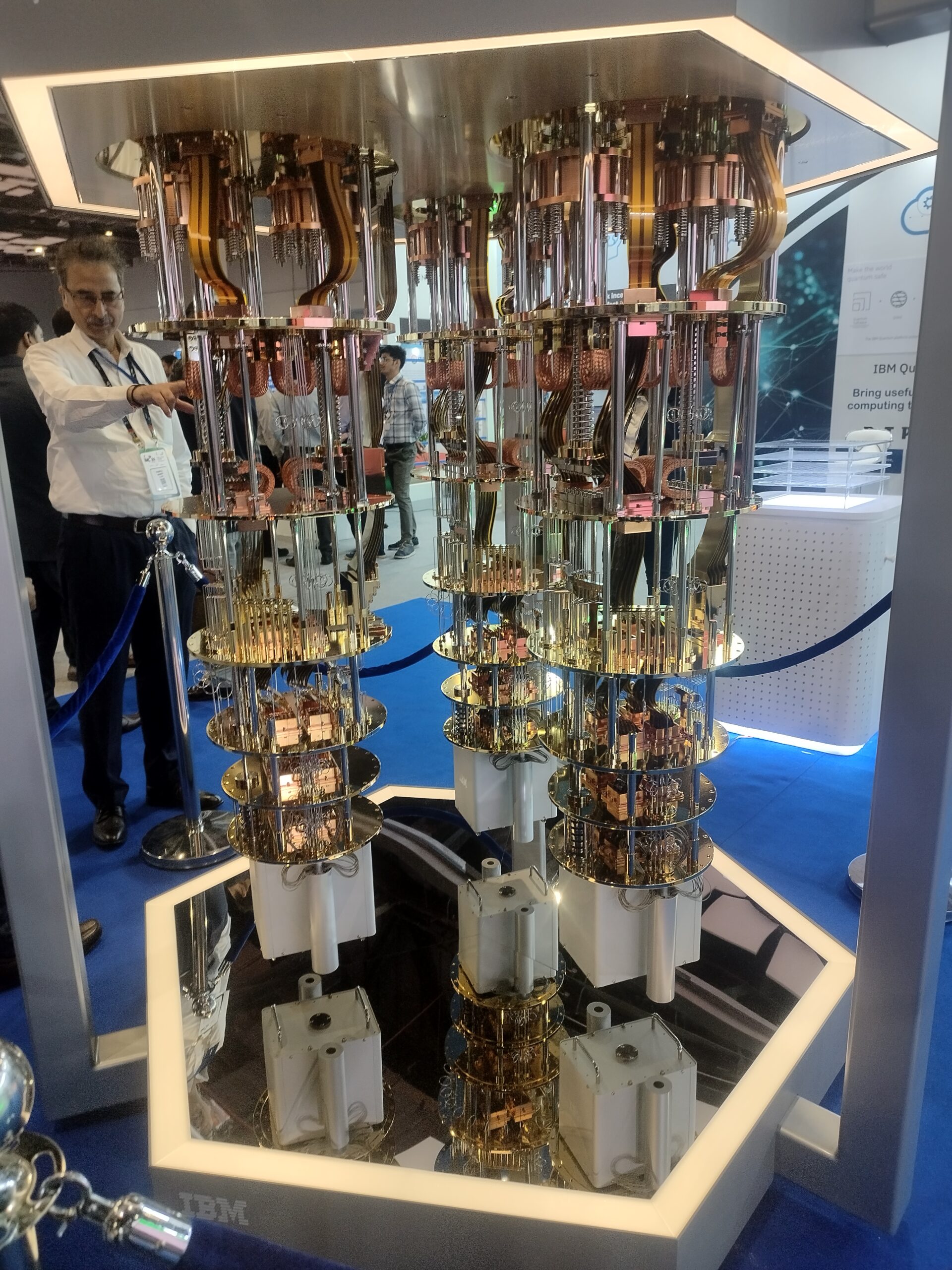
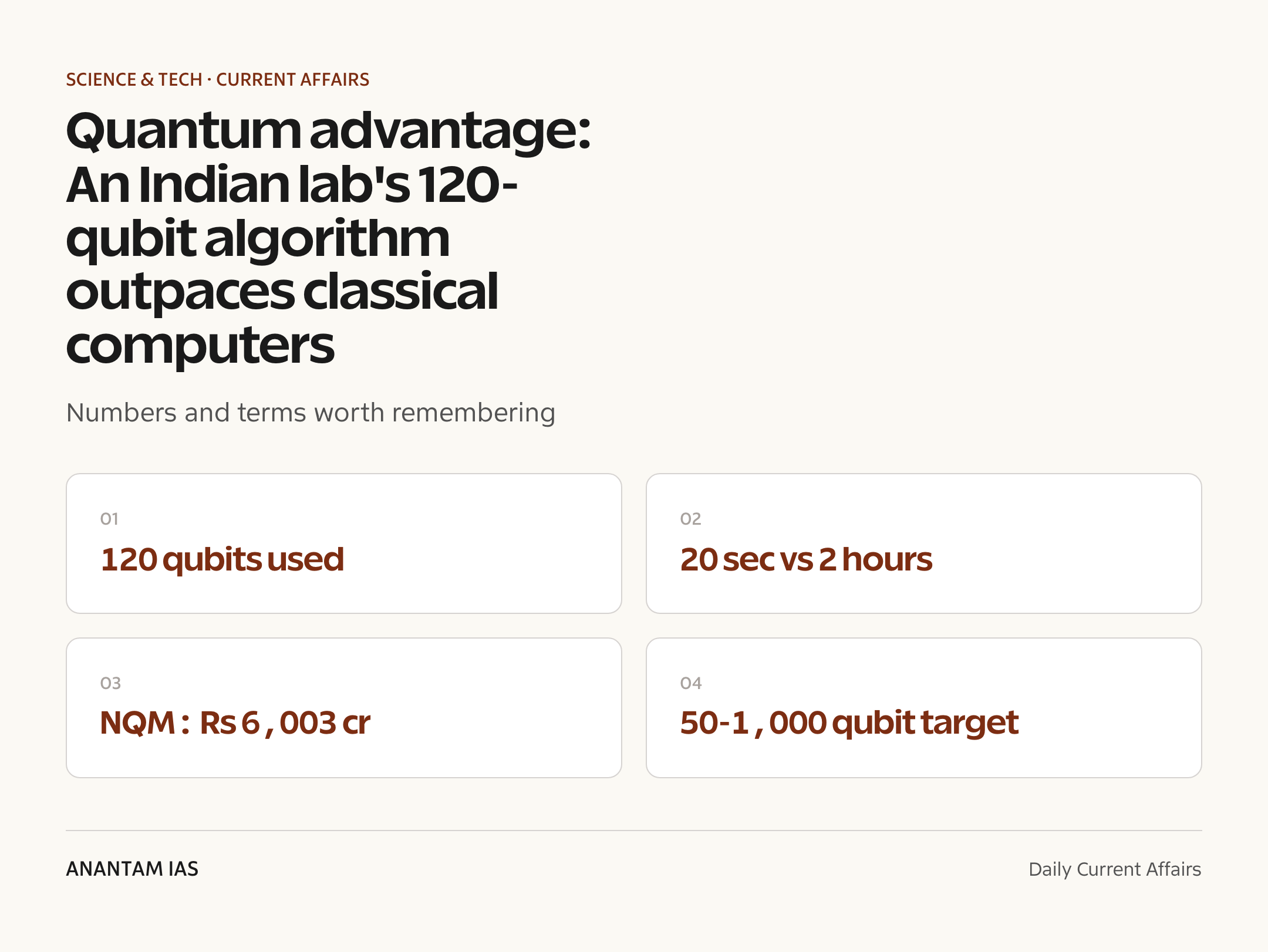
A team led by Dr. Indrakshi Raychowdhury at BITS Pilani (Goa campus), working with scientists from IBM Quantum, simulated the real-time behaviour of subatomic particles governed by the strong nuclear force on 120 qubits of an IBM processor. The Hindu reported that the result has become the first Indian entry marked ‘active’ on IBM’s Quantum Advantage Tracker.
The calculation took the quantum machine about 20 seconds against roughly two hours on a classical computer — a rare, independently checked demonstration of ‘useful’ quantum advantage on a genuine physics problem, not a contrived benchmark.
- The problem simulated: how quarks and gluons bound by the strong force move and rearrange in real time — a lattice gauge dynamics model, exponentially hard classically.
- The team’s encoding stripped away mathematical redundancy, pushing a task others had run on at most 27 qubits up to 120 qubits.
- The Quantum Advantage Tracker (QAT) was launched in November 2025 by IBM with the Flatiron Institute and startups BlueQubit and Algorithmiq as a live, reproduce-before-you-accept peer review.
- Of some 220 items logged on QAT’s public page, only about a dozen have been accepted and just a handful survive as ‘active’ claims; this entry has stood since May 2026.
- India’s National Quantum Mission (NQM) — a ₹6,003.65-crore programme approved in 2023 — funds such algorithms but the country still owns no high-end quantum hardware; the runs used IBM machines over the cloud via Qiskit.
The development matters in the context of:
- ‘Quantum advantage’ here is narrow and benchmarked — a specific simulation task, not blanket ‘supremacy’ over all computing.
- It signals that Indian researchers can compete at the algorithm frontier even without domestic quantum hardware.
UPSC Relevance
Prelims Relevance
- Qubit — the quantum bit; can hold 0, 1 and states in between via superposition
- Superposition and entanglement — the two properties behind quantum speed-ups
- Quantum advantage vs the 2019 Google ‘supremacy’ demonstration
- National Quantum Mission: ₹6,003.65 crore, approved 2023, period up to 2030-31, four thematic hubs
- NQM target: 50–1,000 physical qubits in 8 years; computing hub anchored at IISc Bengaluru
- NISQ — Noisy Intermediate-Scale Quantum (term coined by John Preskill)
- Decoherence, qubit error rates of 1%–0.1%, cooling near absolute zero (-273 °C)
- Quantum error correction: many physical qubits forming one logical qubit
- Qiskit — IBM’s Python toolkit for programming quantum computers over the cloud
- Lattice gauge theory / QCD — the strong force binding quarks and gluons
Mains Relevance
GS Paper 3
- Quantum computing as an emerging technology: strategic significance, applications and India’s readiness.
- Why software and algorithms matter as much as hardware in the quantum race — ‘without algorithms, the hardware is useless’.
- Indigenisation gap: India funds research but leans on foreign machines; implications for technological sovereignty.
GS Paper 2
- Mission-mode governance (NQM) and public-funded R&D as instruments of self-reliance and international collaboration.
Essay
- Science advances by silencing the noise: the patience behind breakthrough technologies.
- Can a nation lead in a technology it cannot yet build?
Background and Context
What actually happened
A physics simulation, not a stunt — and independently reproduced before it counted.
- Dr. Indrakshi Raychowdhury, an associate professor of physics at BITS Pilani, Goa, and IBM Quantum colleagues modelled the strong force acting on subatomic particles.
- The run used 120 qubits of an IBM processor and finished in about 20 seconds; the equivalent classical calculation took roughly two hours.
- Per one expert assessment, it is one of only three problems that are both genuinely useful to physicists and (so far) beyond classical machines.
- Crucially, everything ran over the cloud in Python via Qiskit — ‘none of it required her to leave her desk’.
Quantum computing basics
Where the power comes from — and why it is not a faster calculator for everything.
- A classical bit is 0 or 1; a qubit can be 0, 1 and any state in between — the property of superposition (like a spinning coin that is both heads and tails).
- Qubits can be entangled — their states linked regardless of distance, so measuring one affects the others; together these make a quantum machine a ‘massively parallel’ processor.
- The advantage is task-specific: quantum computers are poor at plain arithmetic but strong at simulating interacting quantum systems and some search/sorting problems.
- Common qubit types: superconducting (Josephson junctions, as in Google’s Willow), trapped-ion, photonic, quantum-dot and NMR qubits.
The problem: simulating the strong force
Watching quarks and gluons evolve frame by frame is exponentially hard for classical methods.
- Inside a proton, quarks are bound by gluons through the strong nuclear force — nature’s most powerful force, described by quantum chromodynamics.
- Classical methods handle ‘snapshots’ well (they pin down a proton’s mass) but tracking real-time evolution is ‘exponentially hard to calculate classically’.
- A quantum computer, being itself made of quantum parts, can imitate the system directly — ‘a still photograph replaced by a film’.
- The team used a simplified lattice gauge stand-in for the full theory; the novelty is the method, not a new particle. CERN researchers have invited her to see if the approach can extend their simulations.
Quantum Advantage Tracker — the referee
A live peer-review that reproduces claims on both classical and quantum machines before accepting them.
- The QAT was launched in November 2025 by IBM with the Flatiron Institute and startups BlueQubit and Algorithmiq, plus academic reviewers.
- A researcher submits a result; a committee reproduces it on both classical and quantum hardware before it stands — ‘more thorough than a standard academic journal’.
- Of roughly 220 items logged, only about a dozen have been accepted and only a handful remain ‘active’.
- This BITS entry is the first from an Indian laboratory to be marked ‘active’; if a classical machine later solves it, the claim becomes ‘superseded’. It has not been superseded since May 2026.
'Advantage', not 'supremacy'
The 2019 Google milestone was real but contrived; the field now chases ‘useful’ advantage.
- In 2019, Google reported its processor finishing in minutes a task a supercomputer would need 10,000 years to match — but the task had no practical use and was chosen to suit quantum hardware.
- So researchers now target ‘useful’ advantage: a quantum win on a real problem whose answer can be independently checked — exactly what QAT verifies.
- Breaking modern encryption or simulating a large molecule from scratch remains years away; this result is a narrow, benchmarked win, not general ‘supremacy’.
- ‘While the media often highlights drug discovery or materials, those fields are computationally more primitive than high-energy physics,’ Dr. Raychowdhury noted.
The noise problem and error correction
Today’s machines are ‘Noisy Intermediate-Scale Quantum’ — fragile and error-prone.
- Any interaction with the environment causes decoherence — qubits lose their quantum state; so they are isolated and cooled near absolute zero (-273 °C).
- Quantum processors have error rates of 1% to 0.1%, versus about one error in a quintillion operations for classical machines; John Preskill named this era NISQ.
- The fix is quantum error correction — many physical qubits act as one logical qubit; below a threshold error rate, adding qubits suppresses errors exponentially, as Google’s Willow showed (2024).
- The BITS team sidestepped noise cheaply: run the experiment twice — once with the particle, once without, within fractions of a second — then subtract, so near-identical errors cancel.
India's National Quantum Mission
A ₹6,003-crore mission-mode push — strong on algorithms, still short on home-grown hardware.
- The NQM, approved in 2023 at ₹6,003.65 crore (2023-24 to 2030-31), aims to make India a leader in quantum technologies and applications.
- It runs four thematic hubs — computing, communication, sensing & metrology, and materials & devices — with the computing hub anchored at IISc Bengaluru.
- A headline target is intermediate-scale machines of 50–1,000 physical qubits within eight years, plus long-distance quantum communication.
- The gap this result exposes: India has no high-end quantum hardware of its own, so researchers still lean on machines abroad. ‘Without algorithms, the hardware is useless,’ Dr. Raychowdhury said.
Way Forward
Build indigenous hardware
- Use NQM funding to move beyond cloud access toward domestic superconducting/photonic testbeds and a sovereign fabrication base.
Invest in algorithms and talent
- Back algorithm design, error-mitigation methods and a deep talent pool — the layer where India already shows an edge.
Deepen global collaboration
- Sustain partnerships like BITS-IBM and the CERN engagement while guarding against long-term dependence on foreign machines.
Pair the mission’s hardware targets with clear use-case pipelines — high-energy physics, materials and secure communication — so ‘useful advantage’ translates into national capability.
Conclusion
The BITS Pilani result is a genuine, independently verified marker of India’s arrival at the quantum-algorithm frontier — the first Indian claim to stay ‘active’ on a demanding tracker. It matters most as proof that Indian teams can win narrow, useful quantum problems on borrowed hardware.
But the same story underlines the mission’s unfinished task: without home-grown machines and error-corrected, fault-tolerant qubits, quantum advantage stays specialised and fragile. The next decade will test whether the National Quantum Mission can convert bright algorithms into durable, sovereign capability.
UPSC Practice Questions
Prelims MCQ 1
With reference to quantum computing, consider the following statements:
- A qubit can exist in a superposition of the 0 and 1 states.
- Entanglement links the states of qubits regardless of the distance between them.
- Present-day quantum processors have lower error rates than classical computers.
How many of the above statements are correct?
(a) Only one (b) Only two (c) All three (d) None
Answer: (b) Only two
Explanation:
Statements 1 and 2 are correct — superposition and entanglement are the defining quantum properties. Statement 3 is wrong: today’s ‘NISQ’ processors have error rates of 1%-0.1%, far worse than classical machines (about one error in a quintillion operations).
Prelims MCQ 2
The National Quantum Mission, approved in 2023, is correctly described by which of the following?
(a) It is a ₹6,003-crore mission with four thematic hubs running up to 2030-31 (b) It targets only quantum communication and excludes quantum computing (c) It is implemented by the Ministry of Defence through DRDO alone (d) It bars any international collaboration on quantum research
Answer: (a) It is a ₹6,003-crore mission with four thematic hubs running up to 2030-31
Explanation:
The NQM has an outlay of ₹6,003.65 crore (2023-24 to 2030-31) with four thematic hubs — computing, communication, sensing & metrology, and materials & devices — coordinated under the Department of Science & Technology, and it explicitly targets 50-1,000 physical qubits.
UPSC Mains Questions
- ‘Without algorithms, the hardware is useless.’ In the light of an Indian team achieving verified quantum advantage on borrowed hardware, examine India’s strengths and gaps in quantum computing and assess whether the National Quantum Mission is adequately designed to close them. (250 words)
- Distinguish ‘quantum advantage’ from ‘quantum supremacy’, and explain why noise and error correction remain the central obstacles to practically useful quantum computers. (150 words)
Sources: The Hindu (Science) and Department of Science & Technology, National Quantum Mission.
Frequently Asked Questions
What did the BITS Pilani team achieve?
A team led by Dr. Indrakshi Raychowdhury at BITS Pilani, Goa, working with IBM Quantum, simulated the strong-force behaviour of subatomic particles on 120 qubits. The run took about 20 seconds versus two hours on a classical computer, and became the first Indian entry marked ‘active’ on IBM’s Quantum Advantage Tracker.
Is this the same as ‘quantum supremacy’?
No. This is a narrow, benchmarked ‘quantum advantage’ on a specific and genuinely useful physics problem that can be independently checked. It is not blanket supremacy over all computing. Google’s 2019 ‘supremacy’ demonstration was faster but used a contrived task with no practical use.
What is a qubit?
A qubit, or quantum bit, is the basic unit of a quantum computer. Unlike a classical bit that is either 0 or 1, a qubit can exist in a superposition of both at once, and qubits can be entangled so their states are linked. These properties let quantum machines process certain problems in a massively parallel way.
What is the Quantum Advantage Tracker?
The QAT is a live peer-review platform launched in November 2025 by IBM with the Flatiron Institute and startups BlueQubit and Algorithmiq. Submitted results are reproduced on both classical and quantum machines before being accepted. Of about 220 logged items, only a handful remain ‘active’ — including this Indian entry.
What is the National Quantum Mission?
The NQM is a ₹6,003.65-crore mission approved in 2023 and running to 2030-31, with four thematic hubs covering computing, communication, sensing and metrology, and materials and devices. It targets intermediate-scale machines of 50-1,000 physical qubits, with the computing hub anchored at IISc Bengaluru.
Why is ‘noise’ such a big problem in quantum computing?
Qubits are fragile and lose their quantum state through decoherence at the slightest environmental interaction, so they are cooled near absolute zero. Current processors err once in every 100 to 1,000 operations. Overcoming this needs quantum error correction, where many physical qubits combine into a single, more reliable logical qubit.
Source: https://anantamias.com/current-affairs/quantum-advantage-indian-lab-ibm-120-qubits/
Sardar Sarovar cost pact: four states settle the decades-old Narmada dues dispute
Why in News?
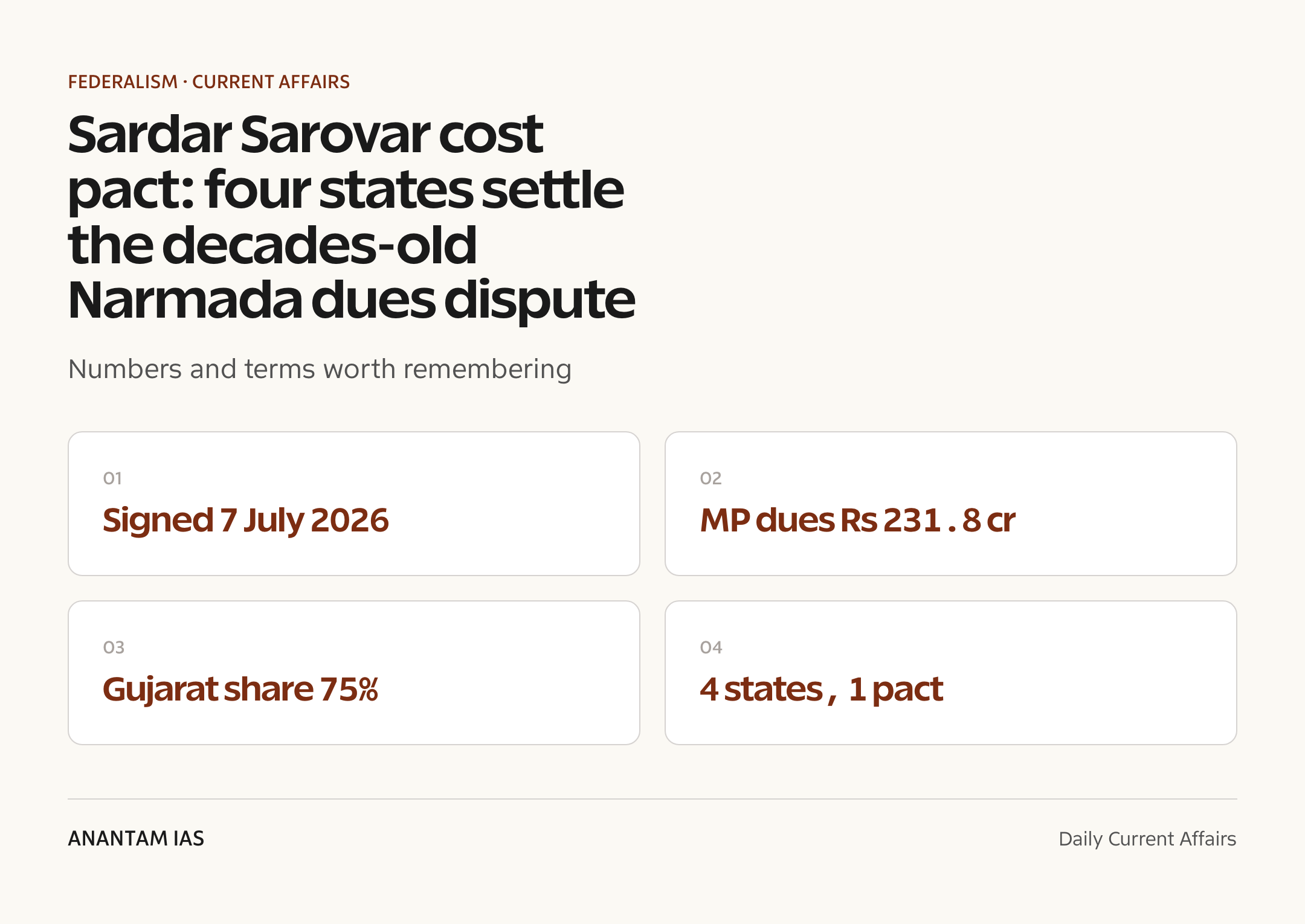
The four beneficiary states of the Sardar Sarovar Project — Madhya Pradesh, Gujarat, Maharashtra and Rajasthan — signed a one-time settlement on 7 July 2026 in New Delhi, ending a payment and cost-sharing dispute that had festered for over three decades on the Narmada river.
Millennium Post reported the pact was inked in the presence of Union Home and Cooperation Minister Amit Shah and Union Jal Shakti Minister C.R. Patil, with the four Chief Ministers signing alongside senior Centre and state officials. The Free Press Journal reported the deal slashes Madhya Pradesh’s rehabilitation dues to Gujarat from about Rs 1,500 crore to Rs 231.80 crore.
- Signed by CMs Mohan Yadav (Madhya Pradesh), Bhupendra Patel (Gujarat), Devendra Fadnavis (Maharashtra) and Bhajan Lal Sharma (Rajasthan).
- A one-time settlement of all outstanding dues, liabilities and claims — rehabilitation costs, submerged-land compensation and construction cost — under the Narmada Water Disputes Tribunal (NWDT) award.
- Madhya Pradesh’s dues to Gujarat cut from roughly Rs 1,500 crore to Rs 231.80 crore.
- MP’s rehabilitation cost share reduced from a proposed 31.98% to 16.17%; Gujarat’s share raised from 50.57% to 75%.
- Maharashtra’s share cut to 7.76% (from 15.15%) and Rajasthan’s to 1.17% (from 2.31%).
- Madhya Pradesh agreed to shelve a counter-claim of about Rs 7,669 crore it had sought from Gujarat on rehabilitation.
The development matters in the context of:
- The dispute traces to the 1979 NWDT award and the way rehabilitation-and-resettlement costs of submergence were to be split among the four states.
- It matters because inter-state river projects routinely stall on cost and rehabilitation liabilities, not just water shares — a negotiated close-out is rare.
UPSC Relevance
Prelims Relevance
- Narmada — largest west-flowing peninsular river; rises at Amarkantak (Madhya Pradesh), drains into the Gulf of Khambhat (Arabian Sea).
- Sardar Sarovar Dam — gravity dam near Kevadia/Navagam in Gujarat’s Narmada district; final height 138.68 m.
- Narmada Water Disputes Tribunal (NWDT) — set up 1969, final award 1979, under the ISRWD Act.
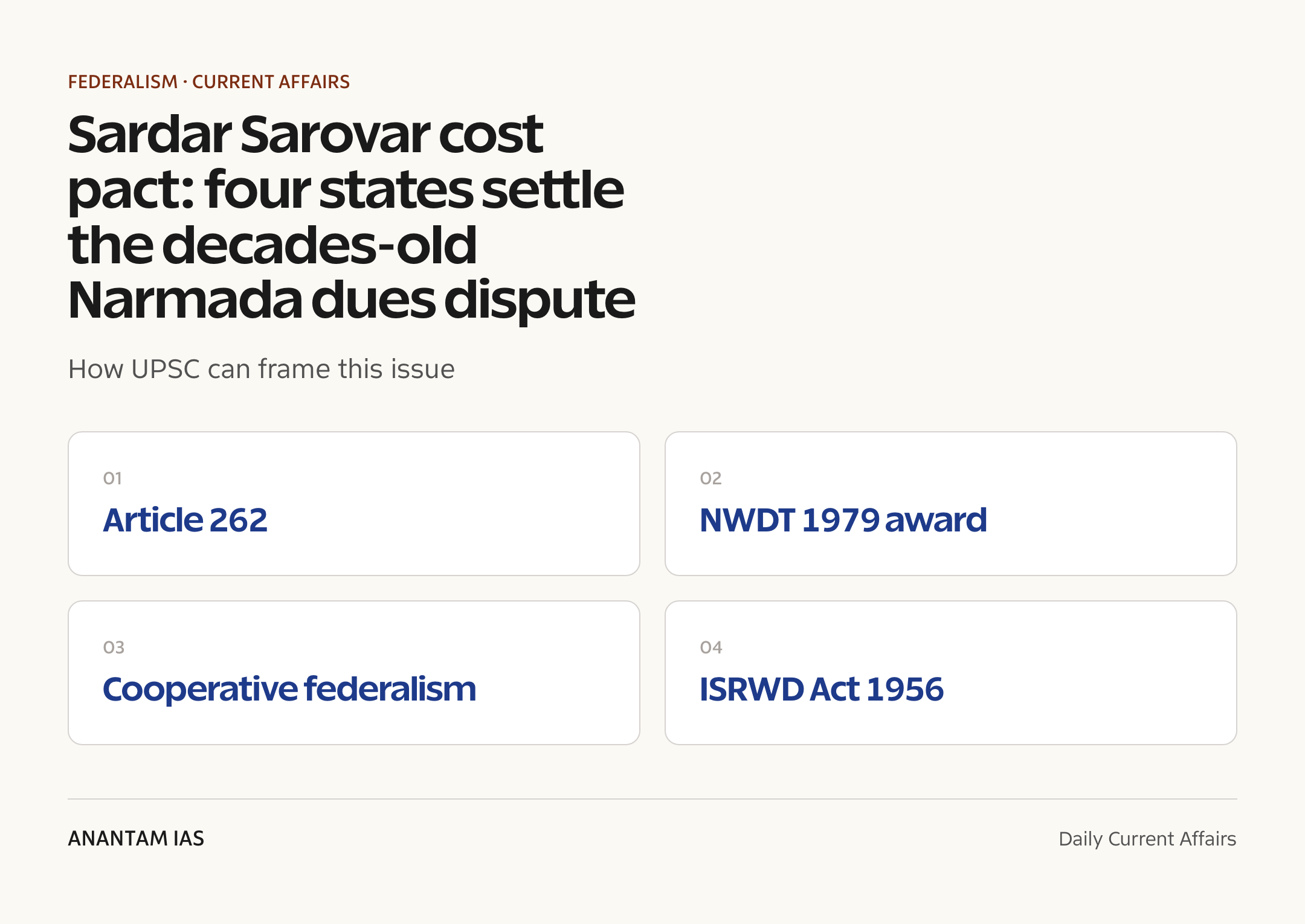
- Inter-State River Water Disputes Act, 1956 — enacted under Article 262.
- Article 262 — adjudication of inter-state river/river-valley water disputes; bars Supreme Court/court jurisdiction.
- Narmada Control Authority (NCA) — Indore-based body implementing the NWDT award.
- NWDT water allocation at 75% dependability (28 MAF): MP 18.25, Gujarat 9.0, Rajasthan 0.50, Maharashtra 0.25 MAF.
- Four beneficiary states: Madhya Pradesh, Gujarat, Maharashtra, Rajasthan.
- Statue of Unity stands downstream of the Sardar Sarovar Dam at Kevadia.
- Article 263 — Inter-State Council for coordination between states.
Mains Relevance
GS Paper 2
- Cooperative federalism and dispute resolution: how negotiated settlements between states compare with tribunal adjudication.
- Inter-state relations and the constitutional machinery (Articles 262, 263) for water disputes.
GS Paper 1
- Distribution of water resources, river-valley projects and displacement/rehabilitation issues in Indian geography.
GS Paper 3
- Major infrastructure and irrigation projects, and the fiscal-liability dimension of multi-state ventures.
Essay
- Cooperation, not confrontation: the federal idea of India in practice.
- Rivers unite, boundaries divide — water as a test of Indian federalism.
Background and Context
The Sardar Sarovar Project in brief
The dam is the terminal, largest structure of the wider Narmada Valley Development plan.
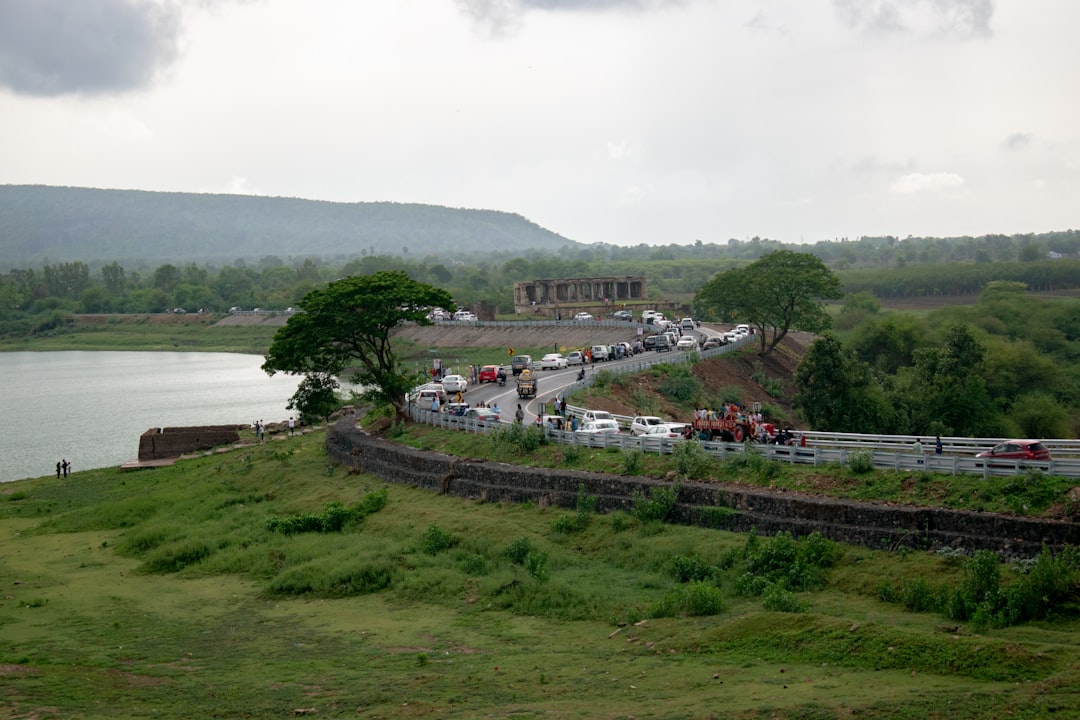
- The Sardar Sarovar Dam is a concrete gravity dam on the Narmada near Kevadia (Navagam), in Gujarat’s Narmada district.
- Its reservoir submerges land across Gujarat, Madhya Pradesh and Maharashtra; the final height of 138.68 m was reached in 2017.
- It supplies irrigation and drinking water to Gujarat (including Saurashtra and Kutch) and Rajasthan, and hydropower shared chiefly by Madhya Pradesh and Maharashtra.
- The Statue of Unity, the world’s tallest statue, stands just downstream at Kevadia.
- Because submergence falls mostly on Madhya Pradesh while benefits flow largely to Gujarat, cost-and-rehabilitation sharing was always the fault line.
Roots: the NWDT award, 1979
The allocation and cost architecture flows from a tribunal award nearly half a century old.
- The Narmada Water Disputes Tribunal was constituted in 1969 under the Inter-State River Water Disputes Act, 1956; it gave its final award in 1979.
- It shared 28 million acre-feet of Narmada water at 75% dependability: Madhya Pradesh 18.25, Gujarat 9.0, Rajasthan 0.50 and Maharashtra 0.25 MAF.
- It fixed the dam’s design and directed that rehabilitation and resettlement (R&R) and submergence costs be borne by the states in proportion to benefits.
- The Narmada Control Authority, headquartered in Indore, was created to implement the award and monitor R&R and dam height.
- Successive disputes over exactly how R&R and land-compensation costs should be apportioned kept dues unsettled for decades.
What the 2026 settlement changes
The pact re-fixes each state’s share of rehabilitation cost and closes the ledger with a lump-sum payment.
- Gujarat’s share of rehabilitation expenditure rises from 50.57% to 75% — it now shoulders the bulk, reflecting that it is the prime beneficiary.
- Madhya Pradesh’s share falls from a proposed 31.98% to 16.17%, cutting its dues to Gujarat from about Rs 1,500 crore to Rs 231.80 crore.
- Maharashtra’s share drops to 7.76% (from 15.15%) and Rajasthan’s to 1.17% (from 2.31%).
- Madhya Pradesh withdraws a claim of about Rs 7,669 crore it had pressed against Gujarat on rehabilitation — a mutual give-and-take rather than a winner-take-all outcome.
- The Free Press Journal noted about 55% of the project-affected land among the partner states lay in Madhya Pradesh, which shaped MP’s lighter cost share.
The constitutional and legal frame
Water disputes sit inside a distinct constitutional channel that discourages courtroom resolution.
- Article 262 empowers Parliament to legislate for adjudicating inter-state river-water disputes and to bar the Supreme Court and other courts from such disputes.
- The Inter-State River Water Disputes Act, 1956 operationalises Article 262 through tribunals such as the NWDT.
- Water is a State List subject (Entry 17), while inter-state rivers fall under Union List Entry 56 — a split that fuels friction.
- Article 263 allows an Inter-State Council to inquire into and advise on disputes, offering a negotiated, non-adversarial route.
- The 2026 pact is a negotiated closure outside fresh litigation — the constitutional preference for cooperative resolution in action.
Why it reads as cooperative federalism
Ministers framed the deal as a template for settling contentious inter-state ledgers by consensus.
- Amit Shah called it a resolution reflecting the spirit of cooperative federalism and consensus among beneficiary states.
- The Ministry of Jal Shakti facilitated the talks — the Centre acting as an honest broker rather than an adjudicator.
- It follows other recent water settlements cited by the government, including the Rajasthan-Haryana Yamuna water pact of 29 June 2026 and progress on the Kishau Dam project.
- Each state accepted a trade-off — Gujarat pays more, MP drops its large claim — showing settlements need distributed concessions.
- A clean cost close-out removes a long-standing irritant to project operations, maintenance and future works on the Narmada.
The unresolved backdrop
The financial pact does not, by itself, close the project’s older social and ecological questions.
- The Sardar Sarovar’s history is inseparable from the Narmada Bachao Andolan and long-running debates over displacement and adequate rehabilitation of oustees.
- Raising the dam to full height submerged additional villages, keeping R&R adequacy a live grievance for affected families.
- A cost-sharing settlement between governments is distinct from ground-level rehabilitation of displaced people, which remains monitored.
- Downstream flow, silt and environmental-flow concerns continue to attract scrutiny of large-dam operations.
- The pact’s real test is whether smoother finances translate into faster, fairer delivery of benefits and pending R&R.
Way Forward
Institutionalise negotiated settlements
- Use the Inter-State Council and Jal Shakti-brokered talks proactively so disputes are settled before they harden into decades-long stand-offs.
- Document the Narmada template as a replicable model for other multi-state basins.
Separate cost pacts from rehabilitation delivery
- Ensure the financial closure does not slow pending R&R for oustees; keep the Narmada Control Authority’s monitoring active.
- Publish transparent accounts of who pays what, so future ledgers do not reopen.
Strengthen the dispute architecture
- Advance long-pending reform ideas such as a permanent tribunal and a dispute-resolution committee to cut delays under the ISRWD Act.
- Improve basin-level data on flows and dependability to reduce factual disputes.
Conclusion
The Sardar Sarovar settlement matters less for its rupee figures than for the method: four states with genuinely conflicting interests closed a decades-old ledger by consensus, with the Centre as facilitator rather than referee. That is cooperative federalism doing quiet, unglamorous work.
But a cost pact between governments is not the same as justice for those the reservoir displaced. The durable lesson for aspirants is to separate the two threads — inter-state fiscal disputes and ground-level rehabilitation — and to judge the deal by whether it speeds delivery on both.
UPSC Practice Questions
Prelims MCQ 1
With reference to the Sardar Sarovar Project and the Narmada waters, consider the following statements:
- The Narmada Water Disputes Tribunal gave its final award in 1979.
- Madhya Pradesh, Gujarat, Maharashtra and Rajasthan are the beneficiary states of the award.
- The Narmada is the largest east-flowing river of peninsular India.
How many of the above statements are correct?
(a) Only one (b) Only two (c) All three (d) None
Answer: (b) Only two
Explanation:
Statements 1 and 2 are correct. Statement 3 is wrong: the Narmada is the largest WEST-flowing peninsular river, draining into the Arabian Sea via the Gulf of Khambhat.
Prelims MCQ 2
Which Article of the Constitution provides for the adjudication of disputes relating to waters of inter-state rivers and river valleys?
(a) Article 261 (b) Article 262 (c) Article 263 (d) Article 371
Answer: (b) Article 262
Explanation:
Article 262 lets Parliament legislate on inter-state river-water disputes and bar the Supreme Court/other courts. The Inter-State River Water Disputes Act, 1956 was enacted under it. Article 263 deals with the Inter-State Council.
UPSC Mains Questions
- The Sardar Sarovar cost-sharing settlement has been described as a model of cooperative federalism. In light of the constitutional machinery for inter-state water disputes, examine how negotiated settlements compare with tribunal adjudication. (250 words)
- Large multi-state river-valley projects generate disputes over cost and rehabilitation, not merely over water shares. Discuss with reference to the Narmada Valley Development and the recent four-state pact. (250 words)
Sources: Millennium Post and Free Press Journal.
Frequently Asked Questions
What is the Sardar Sarovar cost pact about?
On 7 July 2026, Madhya Pradesh, Gujarat, Maharashtra and Rajasthan signed a one-time settlement of long-pending Sardar Sarovar Project dues. It re-fixed each state’s share of rehabilitation costs and closed decades-old financial claims among the four beneficiary states of the Narmada river.
How much will Madhya Pradesh now pay Gujarat?
Under the settlement, Madhya Pradesh’s rehabilitation dues to Gujarat were cut from roughly Rs 1,500 crore to about Rs 231.80 crore. In return, MP agreed to withdraw a counter-claim of nearly Rs 7,669 crore it had pressed against Gujarat on rehabilitation.
What was the Narmada Water Disputes Tribunal award?
The tribunal, set up in 1969 under the Inter-State River Water Disputes Act, 1956, gave its final award in 1979. It shared 28 million acre-feet of Narmada water among the four states, fixed the dam’s design, and directed that rehabilitation costs be borne in proportion to benefits.
Which constitutional Article covers inter-state water disputes?
Article 262 empowers Parliament to provide for adjudication of inter-state river-water disputes and to bar the Supreme Court and other courts from them. The Inter-State River Water Disputes Act, 1956 was enacted under this Article. Article 263 provides for an Inter-State Council.
Why is the settlement called cooperative federalism?
Because four states with conflicting interests resolved a decades-old dispute by consensus, with the Centre’s Jal Shakti Ministry facilitating rather than imposing a verdict. Each side accepted trade-offs, showing disputes can be closed through negotiation instead of prolonged litigation.
Does the pact resolve displacement concerns too?
No. The settlement is a financial pact between state governments over cost-sharing. It is separate from the ground-level rehabilitation of people displaced by the reservoir, a long-running concern linked to the Narmada Bachao Andolan that continues to be monitored.
Source: https://anantamias.com/current-affairs/narmada-sardar-sarovar-four-state-cost-pact/
Justice Yashwant Varma Case: Can a Judge Escape Impeachment by Resigning?
Why in News?
The Indian Express reported on 7 July 2026 that Lok Sabha Speaker Om Birla has decided to table the report of the statutory committee that investigated former Allahabad High Court judge Justice Yashwant Varma under the Judges (Inquiry) Act, 1968 — even though the judge resigned in April 2026, before the committee concluded its hearings.
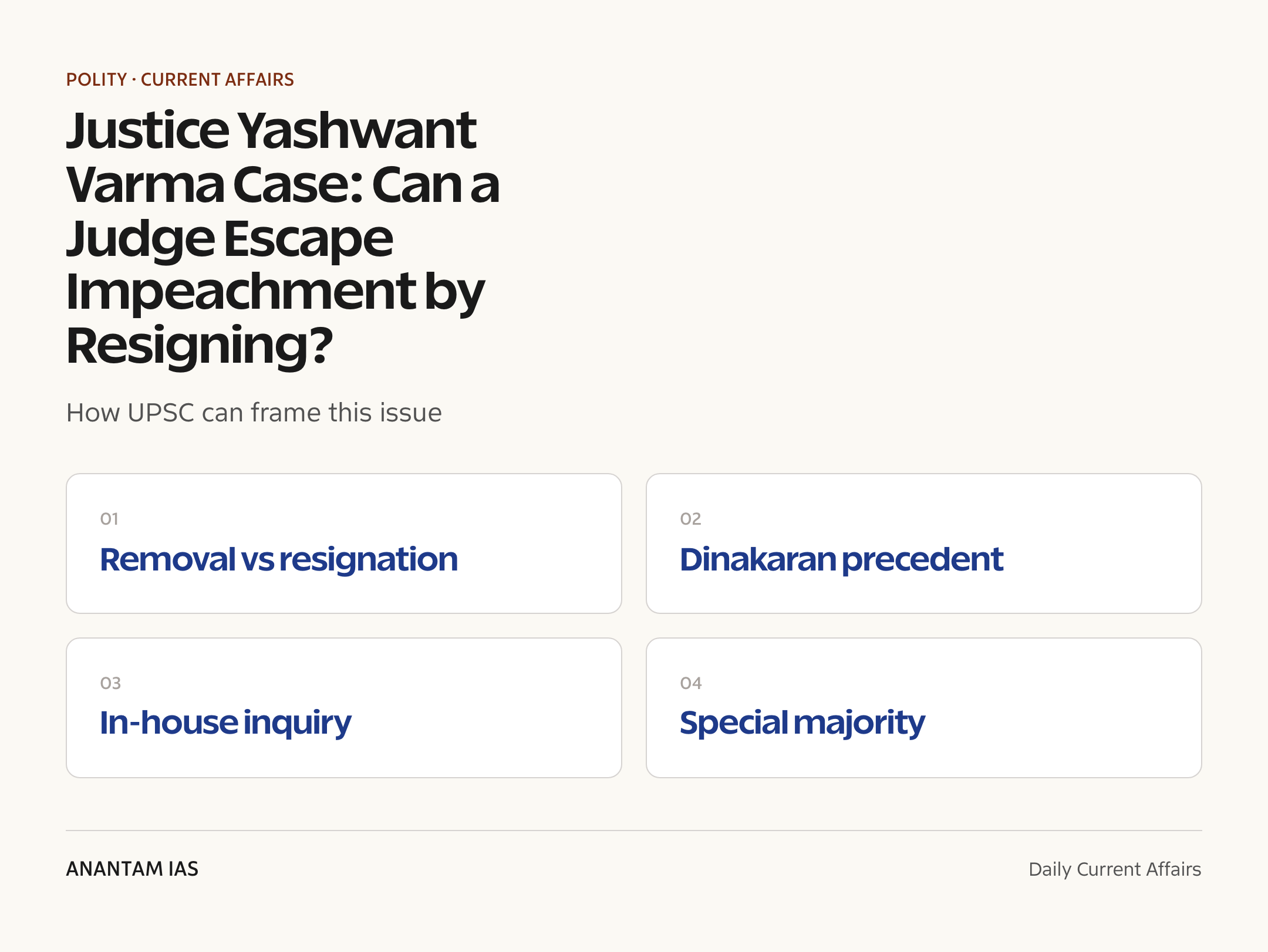
The decision takes India’s judicial-accountability framework into uncharted territory. It challenges the assumption — set by the 2011 P. D. Dinakaran and Soumitra Sen episodes — that a judge’s resignation automatically extinguishes a parliamentary probe.
- The case began on 14 March 2025, when wads of burnt currency notes were found in the storeroom of Justice Varma’s official Delhi residence during a fire-fighting operation.
- A Supreme Court in-house inquiry reportedly found him culpable; on 8 May 2025 then CJI Sanjiv Khanna forwarded the report to the President and the Prime Minister.
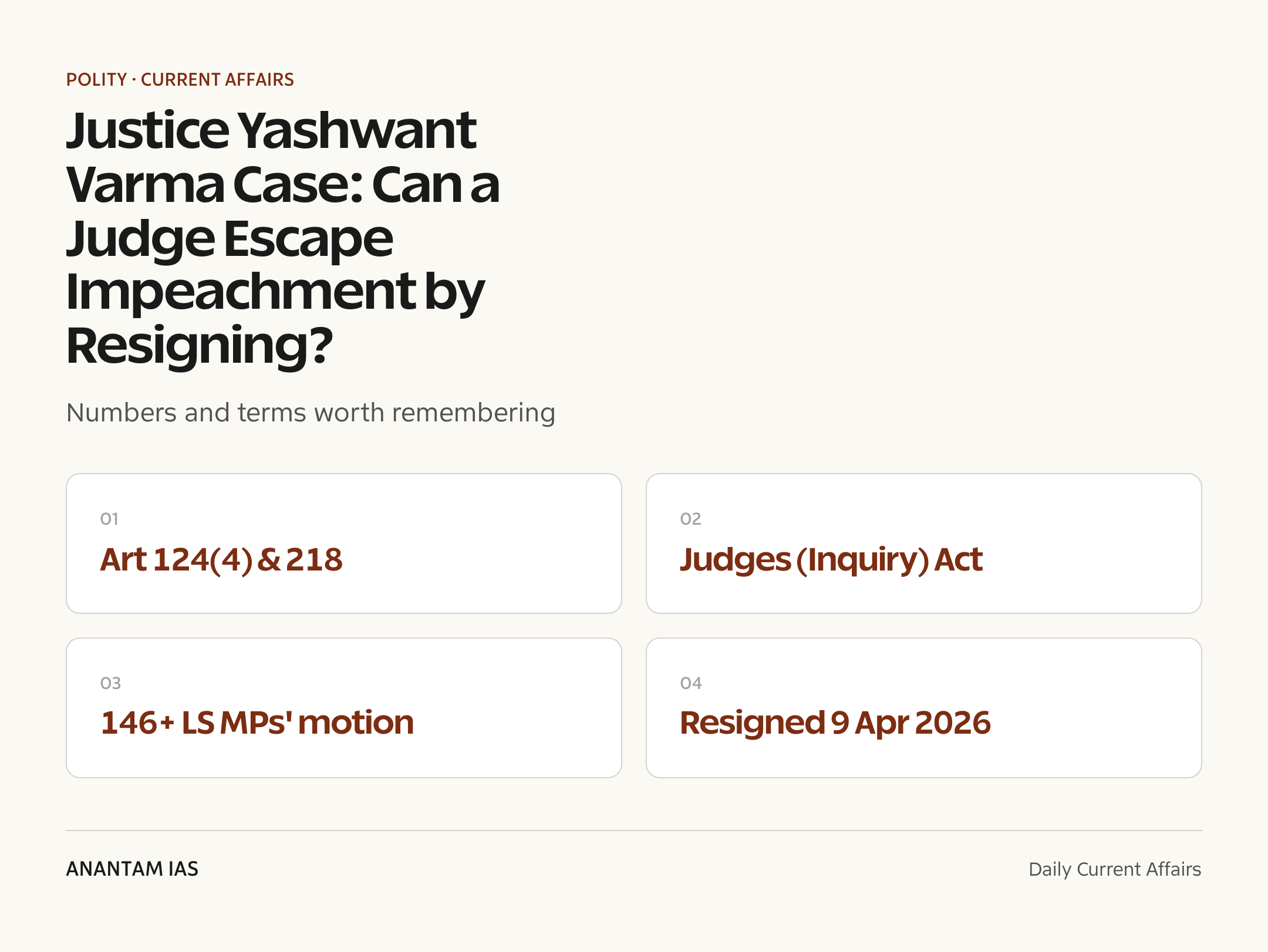
- Over 146 Lok Sabha MPs moved a removal motion in July 2025; the Speaker constituted a three-member committee under the Judges (Inquiry) Act, 1968.
- Justice Varma resigned to President Droupadi Murmu on 9 April 2026, before the committee finished its work.
- Legal experts quoted by the Indian Express note the law nowhere says an inquiry must lapse on resignation.
The development matters in the context of:
- The removal route under Articles 124(4) and 218 is the Constitution’s only mechanism against a sitting judge — and no judge has ever been removed through it.
- The case revives the design gap exposed in 2011: a judge can end a constitutionally mandated probe simply by resigning, while keeping full post-retirement benefits.
UPSC Relevance
Prelims Relevance
- Article 124(4): a judge is removed by the President after an address by each House, supported by a majority of total membership and two-thirds of members present and voting, on grounds of proved misbehaviour or incapacity.
- Article 124(5) lets Parliament regulate the procedure by law — the Judges (Inquiry) Act, 1968 and the Judges (Inquiry) Rules, 1969.
- Article 218 applies the same removal provisions to High Court judges; under Article 217(1)(a) a High Court judge resigns by writing to the President.
- The Constitution uses impeachment only for the President (Article 61); for judges the correct term is removal.
- A motion needs 100 Lok Sabha or 50 Rajya Sabha MPs; the Speaker/Chairman may admit or refuse it.
- The statutory committee: a Supreme Court judge, a Chief Justice of a High Court and a distinguished jurist.
- Union of India v. Gopal Chandra Misra (1978): a judge’s resignation is unilateral, effective from the chosen date, needing no acceptance.
- V. Ramaswami (1993): first removal motion against a Supreme Court judge, defeated in the Lok Sabha; Soumitra Sen (2011): resigned after the Rajya Sabha passed his removal motion.
Mains Relevance
GS Paper 2
- Judicial accountability vs judicial independence: does the resignation route defeat the scheme of Articles 124(4) and 218?
- Working of the Judges (Inquiry) Act, 1968 — gaps and the case for reform after Ramaswami, Sen, Dinakaran and Varma.
- The in-house procedure as a non-statutory accountability device and its interface with the parliamentary route.
Essay
- Power without accountability corrupts institutions as surely as it corrupts individuals.
- Public trust is the true foundation of judicial authority.
Background and Context
The Cash-Discovery Case: A Timeline
The proceedings have run through every layer of India’s judicial-accountability machinery in sixteen months.
- 14 March 2025: during a fire at his official Delhi residence, fire-service personnel found wads of burnt currency notes in an outhouse storeroom. He was then a Delhi High Court judge.
- Then CJI Sanjiv Khanna ordered a three-member in-house committee inquiry; the judge was transferred to the Allahabad High Court and judicial work was withdrawn from him.
- The committee reportedly concluded he had tacit or active control over the storeroom; on 8 May 2025 the CJI forwarded the report to the President and the Prime Minister.
- On 7 August 2025, the Supreme Court dismissed his writ petition against the in-house findings and the removal recommendation.
- Over 146 Lok Sabha MPs moved a removal motion in July 2025; the Speaker admitted it and constituted the statutory committee, headed by Supreme Court judge Justice Aravind Kumar, with a High Court Chief Justice and senior advocate B. V. Acharya.
- On 9 April 2026, before the committee concluded its hearings, he resigned by writing to President Droupadi Murmu. In July 2026, Speaker Om Birla decided to table the report anyway.
How a Judge Is Removed: Articles 124(4), 217 and 218
The Constitution makes removal deliberately hard — the full procedure is in our explainer on the removal of High Court and Supreme Court judges.
- Article 124(4): removal only by Presidential order, after an address by each House passed in the same session by a majority of total membership AND two-thirds of members present and voting.
- The only grounds are proved misbehaviour or incapacity — neither term is defined in the Constitution.
- Article 218 extends the same procedure to High Court judges; Article 124(5) is the constitutional hook for the 1968 Act.
- No judge has ever been removed under this procedure since 1950; every episode has ended in a failed vote or a pre-emptive resignation.
The Judges (Inquiry) Act, 1968: Step by Step
The 1968 Act splits the process into a judicial-style investigation and a political vote.
- A motion needs at least 100 Lok Sabha or 50 Rajya Sabha MPs; the Speaker or Chairman may admit or refuse it.
- If admitted, a three-member committee is constituted: a Supreme Court judge, a High Court Chief Justice and a distinguished jurist.
- The committee frames charges, hears the judge, and conducts a quasi-judicial investigation and proof of the allegations.
- A not guilty finding kills the motion; a guilty finding sends the report to the House for debate and the special-majority address in both Houses.
- The Act is silent on what happens if the judge resigns midway — the heart of the present controversy.
Resignation Under Article 217: The 1978 Ruling
Resignation is legally the judge’s unilateral exit door.
- Under Article 217(1)(a), a High Court judge may resign by writing under his hand addressed to the President.
- Union of India v. Gopal Chandra Misra (1978): resignation is a unilateral act — it takes effect on the date the judge chooses and needs no acceptance.
- Legal scholar Shubhankar Dam, quoted in the Indian Express, notes the 1978 ruling never considered a judge resigning mid-probe.
- A resigning judge typically keeps the same pensionary benefits as one who retires normally — why critics call resignation an accountability escape hatch.
Precedents: Ramaswami, Sen and Dinakaran
Three earlier episodes shaped the assumption that resignation kills a removal process.
- V. Ramaswami (1993): the inquiry committee found him guilty on 11 of 14 charges, but the Lok Sabha motion failed when the ruling party abstained — the address never reached the required majority of total membership. He served until retirement.
- Soumitra Sen (2011), Calcutta High Court: the Rajya Sabha passed his removal motion — the first House ever to do so — but he resigned before the Lok Sabha vote, and the motion was dropped.
- P. D. Dinakaran (2011), Chief Justice of the Sikkim High Court: he resigned mid-probe; the Rajya Sabha secretariat held that resignation made the committee’s work infructuous.
- Jurist G. Mohan Gopal, then on the Dinakaran panel, urged colleagues to finish the probe — distinguishing investigation and proof from removal, and warning that resignation gives judges a de facto veto over accountability.
- The probe was wound up anyway: a vacancy made the committee dysfunctional, and Chairman Hamid Ansari considered the removal objective moot.
The Legal Question: Does Resignation End the Probe?
The Varma case squarely poses a question the 2011 episodes ducked — presented here as the two competing readings.
- View one — the process is spent: the sole object of the Article 124(4)/218 route is removal; once the judge resigns there is no office to vacate, so the inquiry serves no operative purpose. This was the 2011 position.
- View two — accountability survives: nothing in the Constitution or the 1968 Act says the inquiry lapses; the investigation-and-proof stage is an end in itself, creating a public record of judicial conduct.
- Lawyer Alok Prasanna Kumar told the Indian Express that tabling the report lets the Speaker overturn the Dinakaran precedent, and that the public is entitled to the findings of an inquiry run on public money.
- Experts argue a finding of proved misbehaviour could support stopping post-retirement benefits and opening criminal action.
- The counter-concern is judicial independence: pursuing a person who is no longer a judge has no express constitutional anchor — a tension central to the separation of powers between the judiciary and the executive.
The Wider Accountability Architecture
The formal removal route sits alongside softer, non-statutory mechanisms.
- The in-house procedure (adopted in 1999) lets the CJI have allegations examined by a peer committee; its strongest sanctions are withdrawal of work and a request to resign.
- The Judicial Standards and Accountability Bill, 2010 — proposing a National Judicial Oversight Committee — was passed by the Lok Sabha but lapsed with the 15th Lok Sabha.
- Appointment-side reform met a parallel fate: the NJAC Act was struck down in 2015 — see our explainer on judicial appointments, the collegium and the NJAC.
- The Varma episode is unusual for its transparency: official disclosures and a media leak of the in-house report were public before the statutory committee reported.
Way Forward
Close the statutory gap
- Amend the Judges (Inquiry) Act, 1968 to state expressly whether — and how — an inquiry continues after a judge resigns.
- Require a committee that has framed charges to deliver its findings even if the removal motion becomes infructuous.
Link findings to consequences
- Legislate clear rules on post-retirement benefits where a committee records proved misbehaviour, so resignation does not automatically preserve full pension.
- Clarify the pathway from an adverse finding to criminal investigation and asset inquiries.
Rebuild the standards framework
- Revive a modernised Judicial Standards and Accountability Bill with graded sanctions — censure, withdrawal of work — short of removal.
- Codify the in-house procedure‘s interface with the parliamentary route, preserving judicial primacy in fact-finding.
Conclusion
The Justice Varma case has moved the impeachment debate from the abstract to the immediate. Tabling the statutory committee’s report tests whether the removal process under Articles 124(4) and 218 is only a mechanism to vacate an office, or also a constitutional instrument of public accountability whose findings matter even after the office is gone.
Either way, the episode has exposed the design gap in the Judges (Inquiry) Act, 1968: a process that a judge can switch off by resigning protects neither judicial independence nor public trust. Statutory clarity — on continuation of inquiries, benefits and graded sanctions — is the unavoidable next step.
UPSC Practice Questions
Prelims MCQ 1
With reference to the removal of judges of the Supreme Court and High Courts in India, consider the following statements:
- A motion for the removal of a judge must be signed by at least 100 members of the Lok Sabha or at least 50 members of the Rajya Sabha.
- The committee constituted under the Judges (Inquiry) Act, 1968 consists of a Supreme Court judge, a Chief Justice of a High Court and a distinguished jurist.
- The Constitution expressly provides that removal proceedings against a judge lapse the moment the judge resigns.
How many of the above statements are correct?
(a) Only one (b) Only two (c) All three (d) None
Answer: (b) Only two
Explanation:
Statements 1 and 2 correctly describe the Judges (Inquiry) Act, 1968 scheme. Statement 3 is wrong — the Constitution and the Act are silent on the effect of resignation; the 2011 lapsing of the Dinakaran and Sen probes rested on secretariat reasoning, not any express provision.
Prelims MCQ 2
Which one of the following judges was the first against whom a removal motion was put to vote and defeated in the Lok Sabha?
(a) Justice V. Ramaswami (b) Justice Soumitra Sen (c) Justice P. D. Dinakaran (d) Justice Yashwant Varma
Answer: (a) Justice V. Ramaswami
Explanation:
In 1993, the motion against Supreme Court judge V. Ramaswami failed in the Lok Sabha despite a guilty finding on 11 of 14 charges, for want of the required majority of total membership. Sen and Dinakaran resigned before any Lok Sabha vote.
UPSC Mains Questions
- The removal procedure for judges under Articles 124(4) and 218 has never resulted in an actual removal, while resignation has repeatedly halted proceedings midway. Critically examine whether the Judges (Inquiry) Act, 1968 needs amendment to balance judicial independence with public accountability.
- The investigation and proof of misbehaviour is an end in itself, distinct from removal from office. In the light of the Justice Yashwant Varma episode, discuss whether a statutory inquiry against a judge should continue after the judge resigns.
Sources: The Judges (Inquiry) Act, 1968 — India Code and The Indian Express (Explained).
Frequently Asked Questions
Why is the Justice Varma case in the news?
Lok Sabha Speaker Om Birla decided to table the report of the statutory committee that investigated Justice Yashwant Varma, though the judge resigned in April 2026 before the inquiry concluded. This challenges the 2011-era assumption that resignation automatically ends removal proceedings against a judge.
How is a judge removed in India?
Under Articles 124(4) and 218, a Supreme Court or High Court judge is removed by the President after each House of Parliament passes an address, in the same session, by a majority of total membership and two-thirds of members present and voting, on grounds of proved misbehaviour or incapacity.
What does the Judges (Inquiry) Act, 1968 provide?
It operationalises removal: a motion signed by 100 Lok Sabha or 50 Rajya Sabha MPs, admission by the Speaker or Chairman, and investigation by a three-member committee — a Supreme Court judge, a High Court Chief Justice and a distinguished jurist. Only a guilty finding lets the motion proceed to a vote.
Can a judge resign while facing impeachment?
Yes. A judge resigns by writing to the President, and the Supreme Court held in 1978 that resignation is unilateral and needs no acceptance. The law is silent on what happens to a pending inquiry, which is why resignation has worked as an escape route in past cases.
What happened in the Dinakaran and Sen cases in 2011?
Justice P. D. Dinakaran resigned mid-probe and Justice Soumitra Sen resigned after the Rajya Sabha passed his removal motion but before the Lok Sabha voted. Both proceedings were dropped, on the reasoning that removal had become pointless once the judge left office.
Has any Indian judge been removed by Parliament?
No. Since 1950 no judge has been removed under the constitutional procedure. The closest case was Justice V. Ramaswami in 1993, where the committee found proved misbehaviour but the Lok Sabha motion failed for want of the required special majority.
Source: https://anantamias.com/current-affairs/justice-varma-impeachment-resignation-question/
Guwahati Declaration: BRICS anti-drug agencies agree on joint action against trafficking
Why in News?
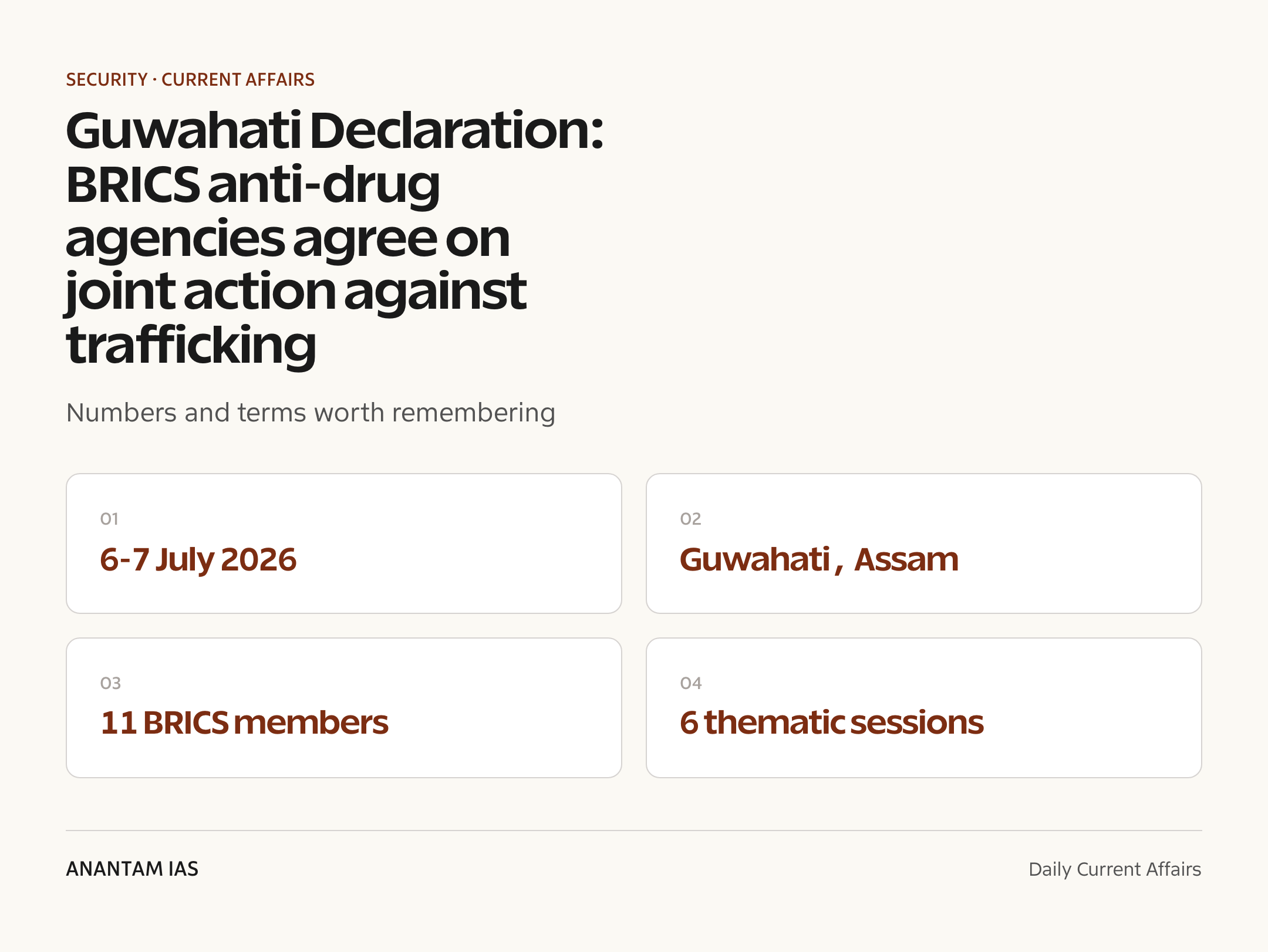
The heads of anti-drug agencies of the BRICS grouping, meeting in Guwahati on 6–7 July 2026 under India’s chairship, adopted the Guwahati Declaration — a joint commitment to coordinated action against illicit drug trafficking and transnational organised crime. The two-day meeting was hosted by the Narcotics Control Bureau (NCB) under the Ministry of Home Affairs. It marks the first time a BRICS counter-narcotics conclave has been held in India’s Northeast, a region that sits directly on the trafficking routes running out of the Golden Triangle.
As per PIB and reports from India Today NE, the declaration prioritises real-time intelligence sharing, tackling synthetic drugs and precursor diversion, and countering darknet– and cryptocurrency-enabled trafficking. India proposed a BRICS Virtual Working Group for faster operational coordination. The move signals a broadening of BRICS from a mainly economic and financial platform into a working forum for internal-security and law-enforcement cooperation, an agenda India has pushed through its 2026 chairship.
- Meeting held 6–7 July 2026 in Guwahati, Assam, hosted by the NCB, Ministry of Home Affairs.
- Culminated in the adoption of the Guwahati Declaration (a Joint Declaration) on 7 July.
- NCB Director General Anurag Garg proposed a BRICS Virtual Working Group and enhanced cross-border training for real-time intelligence sharing.
- Deliberations spanned six thematic sessions on emerging challenges — darknet, NPS, precursor leakage, digital interdiction.
- Held under India’s 2026 BRICS Chairship, themed “Building for Resilience, Innovation, Cooperation and Sustainability”.
The development matters in the context of:
- India sits between the world’s two largest opium-producing belts — the Golden Crescent (Afghanistan-Iran-Pakistan) and the Golden Triangle (Myanmar-Laos-Thailand) — making it both a transit and consumption zone.
- Follows India’s release of the Vision Document on Drug Control (2026–2029) and the NCB Annual Report 2025, signalling a shift from dialogue to action-oriented enforcement.
UPSC Relevance
Prelims Relevance
- Guwahati Declaration — adopted at BRICS Heads of Anti-Drug Agencies Meeting, July 2026
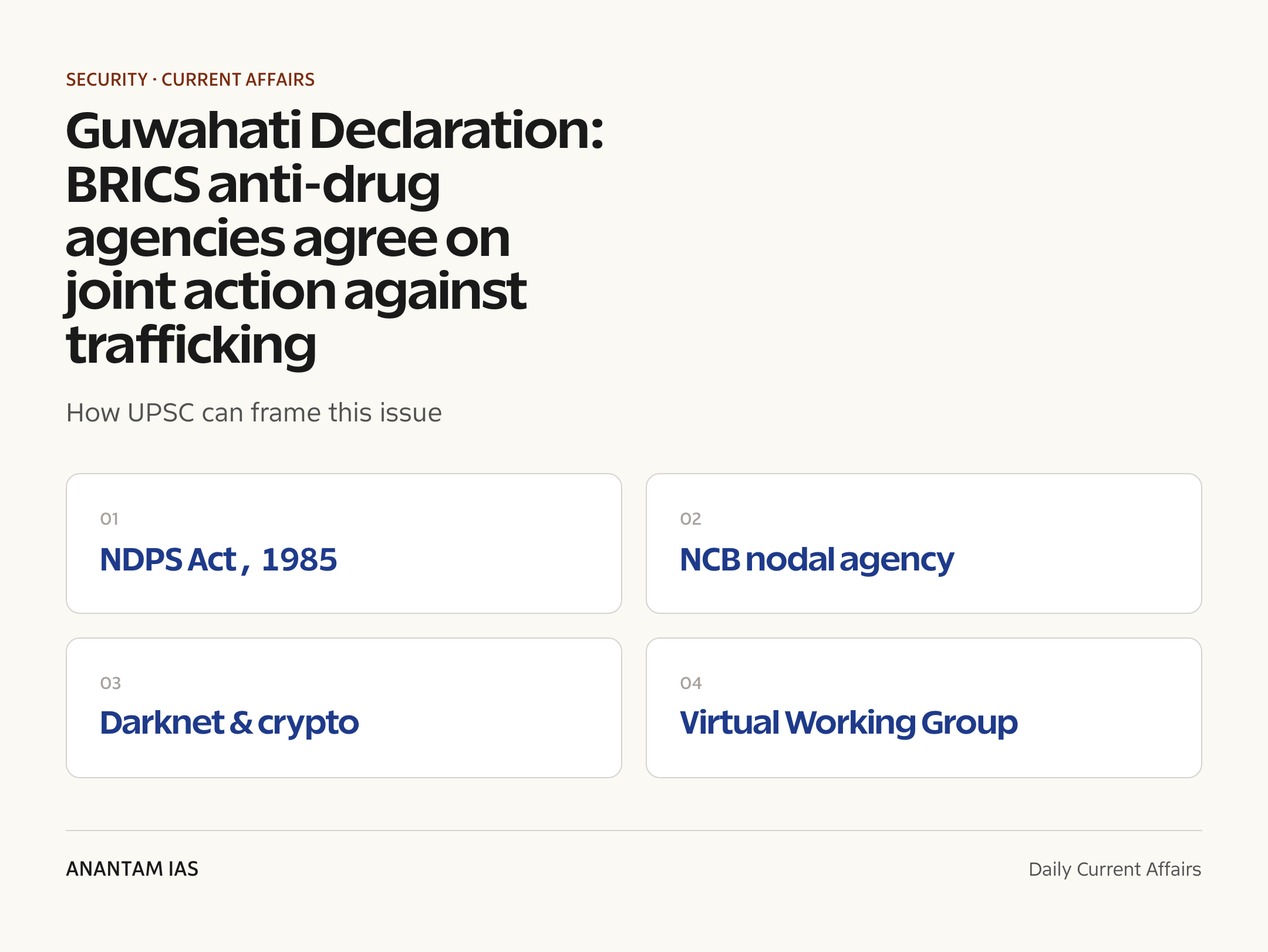
- Narcotics Control Bureau (NCB) — central nodal agency under Ministry of Home Affairs
- NDPS Act, 1985 — governs narcotic drugs and psychotropic substances in India
- New Psychoactive Substances (NPS) and synthetic drugs — emerging threat category
- Precursor chemicals — substances used to manufacture illicit drugs; diversion is a key concern
- MANAS-1933 — National Narcotics Helpline (Madak Padarth Nishedh Asoochna Kendra)
- NCORD — Narco-Coordination Centre, four-tier drug-enforcement coordination mechanism
- BRICS membership — 11 nations after 2024–25 expansion (Brazil, Russia, India, China, South Africa + Egypt, Ethiopia, Iran, Saudi Arabia, UAE, Indonesia)
- India’s 2026 BRICS Chairship theme and priorities
- Vision Document on Drug Control (2026–2029); Nasha Mukt Bharat Abhiyaan
- “Detect, Disrupt and Destroy” — India’s narcotics-control strategy
Mains Relevance
GS Paper 3
- Linkages of organised crime with terrorism; role of external state and non-state actors in creating challenges to internal security — drug trafficking, darknet, crypto-enabled finance.
- Money-laundering and its prevention; use of technology in internal security and border management.
GS Paper 2
- Bilateral, regional and global groupings involving India and their interests; effect of policies of developed and developing countries on India’s interests — BRICS as a security-cooperation platform.
Essay
- Borderless crime, bordered enforcement: cooperation as the frontline against synthetic drugs.
- Technology as both the enabler and the antidote of transnational trafficking.
Background and Context
What the Guwahati Declaration commits to
The declaration converts BRICS drug-control dialogue into an action-oriented framework.
- Reaffirms commitment to combating illicit drug trafficking and transnational organised crime, anchored in national laws and international obligations.
- Pledges timely exchange of information, intelligence and best practices among member anti-drug agencies.
- Promotes innovative technologies, digital tools and data-driven approaches to counter trafficking.
- Flags concern over synthetic drugs, misuse of emerging technologies, and virtual assets (cryptocurrencies) in illicit finance.
- Prioritises protection of children and youth through evidence-based prevention and demand reduction.
- Situates the pledge within the three UN drug-control conventions and the mandate of the UNODC, keeping the framework consistent with the global regime rather than parallel to it.
- Being a declaration, it is politically binding but not a treaty — its value depends on member agencies converting the language into standing operating channels.
India's proposal: a Virtual Working Group
New Delhi pushed for a permanent, always-on coordination mechanism.
- NCB DG Anurag Garg called for a partnership built on “speed, mutual trust and real-time intelligence sharing.”
- Proposed a BRICS Virtual Working Group to enable near-instant exchange on clandestine labs and synthetic-drug trends.
- The group is conceived as an always-on digital channel, so a seizure or a new NPS analogue detected in one country can be flagged to the others within hours, not months.
- Sought cross-border training programmes, expert exchanges and shared best practices among enforcement officers.
- Aim: dismantle transnational drug syndicates through a unified enforcement network rather than episodic dialogue.
- Complements existing bilateral and UN channels but is faster and narrower — a peer network of agencies that already speak the same operational language.
The three priority areas and six sessions
The agenda was structured around present-day trafficking realities.
- Priority areas: combating synthetic drugs and precursor diversion; strengthening intelligence sharing and operational coordination; capacity building and institutional cooperation.
- Thematic sessions covered real-time drug interdiction via digital technology and neutralising trafficking over the darknet.
- Sessions on tackling New Psychoactive Substances (NPS) and securing global supply chains against precursor and chemical leakage.
- Further sessions on drug-demand reduction and strengthening institutional mechanisms for follow-through.
- The structure mirrors the modern trafficking chain — chemistry (precursors), logistics (supply chains), marketplace (darknet) and money (crypto) — so cooperation targets every link rather than only the finished consignment.
The NDPS Act, 1985 and its statutory scheme
India’s entire drug-control effort rests on one framework law.
- The Narcotic Drugs and Psychotropic Substances (NDPS) Act, 1985 is the parent statute prohibiting the production, manufacture, cultivation, possession, sale, purchase, transport and consumption of narcotic drugs and psychotropic substances, except for medical and scientific purposes.
- It gives effect to India’s obligations under the three UN conventions — the 1961 Single Convention on Narcotic Drugs, the 1971 Convention on Psychotropic Substances and the 1988 Convention against Illicit Traffic.
- Amended in 1988, 2001 and 2014 — the 2001 amendment rationalised punishment by quantity slabs (small / commercial), and the 2014 amendment eased access to essential narcotic drugs for pain relief.
- Provides for stringent bail conditions, property forfeiture of illegally acquired assets, and preventive detention under the linked PIT-NDPS Act, 1988.
- The Act also empowers the government to regulate controlled substances and precursor chemicals, the upstream inputs synthetic-drug makers depend on.
The NCB and India's coordination architecture
One nodal agency sits atop a multi-tier coordination grid.
- The Narcotics Control Bureau (NCB), created in 1986 under the NDPS Act and attached to the Ministry of Home Affairs, is the apex agency to coordinate drug law enforcement across states and central agencies.
- It liaises with customs, DRI, state police, BSF, SSB, Coast Guard and the Directorate of Revenue Intelligence, and is India’s point of contact for the UNODC and INTERPOL on narcotics.
- The NCORD (Narco-Coordination Centre) mechanism, restructured into a four-tier structure (apex, executive, state and district committees), knits together central and state agencies for joint action.
- The NIDAAN portal and a national narcotics database help pool seizure, arrest and case data across agencies.
- The strategy is summed up as “Detect, Disrupt and Destroy” — blending human, technical and community intelligence into a whole-of-government, network-centric approach.
Golden Crescent vs Golden Triangle: India's geography of risk
India is wedged between the world’s two great opium belts.
- The Golden Crescent spans Afghanistan, Iran and Pakistan to India’s west and northwest — historically the largest source of illicit opium and heroin, feeding routes into Punjab, Rajasthan, Gujarat and the Kashmir Valley.
- The Golden Triangle spans Myanmar, Laos and Thailand to the east — now a major hub for methamphetamine and synthetic drugs, feeding routes into the Northeast.
- This dual exposure makes India simultaneously a transit corridor and a growing consumption market, with maritime routes along the coasts adding a third vector.
- Seizures of heroin, methamphetamine tablets (yaba) and hashish along both frontiers underline the two-front nature of the problem.
- The location explains why India frames narcotics not merely as a public-health issue but as a national-security and border-management challenge.
Why the threat has changed: synthetics, precursors and NPS
The trafficking landscape has migrated from bulk consignments to chemistry.
- Synthetic drugs — methamphetamine, tramadol, and fentanyl-class New Psychoactive Substances (NPS) — can be cooked in mobile labs, bypassing crop-based supply and weather dependence.
- Precursor chemicals such as ephedrine, pseudoephedrine and acetic anhydride are diverted from legitimate pharma and chemical industry into clandestine manufacture.
- NPS are engineered to stay a step ahead of scheduling — a molecule is tweaked so it falls outside the controlled list until regulators catch up, which is why real-time information-sharing matters.
- Being potent by weight, synthetics are easier to conceal and courier than bulky opium or hashish, raising the premium on intelligence over physical interdiction.
- India, with a large legitimate pharmaceutical sector, faces a specific challenge in plugging precursor leakage without choking genuine industry.
The digital shift: darknet and crypto-enabled trafficking
Dealing and laundering have moved onto encrypted rails.
- Darknet marketplaces and encrypted messaging apps anonymise buyer, seller and courier, replacing street dealing with drop shipments hidden in ordinary parcels.
- Cryptocurrency and other virtual assets launder proceeds beyond conventional banking trails, complicating the money-following that traditionally cracked syndicates.
- Payments split across wallets, mixers and stablecoins make financial forensics a specialised, cross-border task requiring cooperation with financial-intelligence units.
- Fragmented, borderless and largely digital networks outpace single-country enforcement, making intelligence-led cooperation the only workable response.
- This is precisely the gap the Virtual Working Group and the declaration’s technology-cooperation clauses are designed to close.
India's demand-side and citizen architecture
Enforcement is paired with prevention, reporting and rehabilitation.
- The MANAS-1933 national narcotics helpline (Madak Padarth Nishedh Asoochna Kendra) offers a toll-free, anonymous line for tip-offs, counselling and de-addiction referrals.
- The Nasha Mukt Bharat Abhiyaan (NMBA), run by the Ministry of Social Justice and Empowerment, drives community outreach, awareness and de-addiction across identified vulnerable districts.
- A network of de-addiction and rehabilitation centres and the earlier drug-demand-reduction schemes address the health side of the problem.
- The Vision Document on Drug Control (2026–2029), released by the Union Home Minister with the NCB Annual Report 2025, sets a three-year roadmap blending supply control, demand reduction and harm reduction.
- The design reflects a settled principle: interdiction alone cannot succeed without cutting demand and protecting youth, the constituency the Guwahati Declaration singles out.
BRICS, India's 2026 chairship and the security turn
A security angle expands what BRICS traditionally does.
- BRICS now spans 11 members after its 2024–25 expansion — Brazil, Russia, India, China, South Africa plus Egypt, Ethiopia, Iran, Saudi Arabia, UAE and Indonesia.
- Delegations from Brazil, China, Ethiopia, India, Indonesia, Iran, Russia and the UAE deliberated at Guwahati.
- India’s 2026 chairship theme — “Building for Resilience, Innovation, Cooperation and Sustainability” — foregrounds resilience and people-centred cooperation.
- Counter-narcotics cooperation extends BRICS beyond its economic and financial core (the New Development Bank, local-currency trade) into internal-security and law-enforcement ground.
- Several member states — Iran on the Golden Crescent, and consumer and transit economies across the bloc — have a direct stake in coordinated interdiction, giving the platform natural convergence.
The Northeast dimension
Hosting the meeting in Guwahati was a deliberate signal.
- The Northeast shares a long, porous frontier with Myanmar, placing it on the front line of Golden-Triangle trafficking of heroin and methamphetamine.
- Difficult terrain, riverine borders and cross-border ethnic linkages make interdiction and monitoring harder than on a settled land boundary.
- The drug economy in the region intersects with insurgency financing and organised crime, deepening the internal-security stakes.
- Choosing Guwahati spotlights the region’s exposure and ties a multilateral commitment to a live domestic vulnerability.
- It also fits the government’s broader push to place the Northeast at the centre of India’s Act East and border-security agenda rather than at its margins.
Way Forward
Operationalise the Virtual Working Group
- Stand up the proposed BRICS Virtual Working Group with clear protocols, secure channels and named nodal officers for round-the-clock exchange.
- Build interoperable databases on precursors, clandestine labs and NPS analogues.
Follow the money and the code
- Pair anti-drug agencies with financial intelligence units to trace crypto flows and virtual assets.
- Invest in darknet-monitoring and forensic capacity, plus joint takedowns of trafficking marketplaces.
Balance enforcement with health
- Sustain demand reduction, treatment and rehabilitation alongside interdiction, protecting youth as the declaration urges.
- Convert commitments into measurable, time-bound outcomes to avoid a purely declaratory framework.
Conclusion
The Guwahati Declaration matters less for the paper and more for the plumbing it promises — real-time channels, shared training and a standing working group among agencies that rarely coordinate at speed. Against a threat that has shifted from crop-based opium to lab-made synthetics, encrypted marketplaces and crypto money, the value of a peer network that can move information in hours is exactly where enforcement has been losing ground.
For India, hosting it in the Northeast under its BRICS chairship ties a durable domestic push — the NDPS framework, the NCB, the NCORD grid and the 2026–29 Vision Document — to a multilateral front against a threat that no border, and no single country, can hold alone. The test now is delivery: whether the declaration hardens into working channels and measurable seizures, or remains one more well-drafted statement of intent.
UPSC Practice Questions
Prelims MCQ 1
With reference to the Guwahati Declaration (2026), consider the following statements:
- It was adopted at a meeting of the heads of anti-drug agencies of BRICS nations.
- The meeting was hosted by the Narcotics Control Bureau under the Ministry of Home Affairs.
- It proposed a permanent BRICS military command for counter-narcotics operations.
How many of the above statements are correct?
(a) Only one (b) Only two (c) All three (d) None
Answer: (b) Only two
Explanation:
Statements 1 and 2 are correct. India proposed a BRICS Virtual Working Group for intelligence sharing — not a military command — so statement 3 is wrong.
Prelims MCQ 2
The Narcotics Control Bureau (NCB) functions as the central nodal agency under which of the following laws?
(a) The Unlawful Activities (Prevention) Act, 1967 (b) The Narcotic Drugs and Psychotropic Substances Act, 1985 (c) The Prevention of Money Laundering Act, 2002 (d) The Arms Act, 1959
Answer: (b) The Narcotic Drugs and Psychotropic Substances Act, 1985
Explanation:
The NCB, set up under the Ministry of Home Affairs, is the apex coordinating agency for drug law enforcement under the NDPS Act, 1985.
UPSC Mains Questions
- The migration of drug trafficking from bulk crop-based consignments to synthetic drugs, darknet marketplaces and crypto-enabled finance has outpaced traditional enforcement. Examine how multilateral mechanisms like the Guwahati Declaration can address this, using India’s experience.
- “Internal security is increasingly shaped by transnational networks that no single state can police alone.” Discuss with reference to India’s location between the Golden Crescent and the Golden Triangle and its narcotics-control architecture.
Sources: PIB, Ministry of Home Affairs and India Today NE.
Frequently Asked Questions
What is the Guwahati Declaration?
It is a joint declaration adopted on 7 July 2026 by the heads of anti-drug agencies of BRICS nations, meeting in Guwahati under India’s chairship. It commits members to coordinated action against illicit drug trafficking, real-time intelligence sharing, and countering synthetic drugs, darknet trafficking and crypto-enabled drug finance.
Who hosted the BRICS anti-drug agencies meeting?
The Narcotics Control Bureau (NCB), under the Ministry of Home Affairs, Government of India, hosted the two-day meeting on 6–7 July 2026 in Guwahati, Assam, as part of India’s 2026 BRICS Chairship.
What is the BRICS Virtual Working Group?
It is a mechanism proposed by NCB Director General Anurag Garg to enable near-instant, always-on intelligence sharing among BRICS anti-drug agencies. The idea is to move from periodic dialogue to real-time operational coordination against transnational drug syndicates, backed by cross-border training.
What is the NCB and under which law does it work?
The Narcotics Control Bureau is India’s central nodal agency for drug law enforcement. It coordinates action under the Narcotic Drugs and Psychotropic Substances (NDPS) Act, 1985, and works with state agencies, customs and financial intelligence units to combat trafficking.
Why is India especially exposed to drug trafficking?
India lies between the two largest illicit opium-producing regions — the Golden Crescent (Afghanistan-Iran-Pakistan) to the west and the Golden Triangle (Myanmar-Laos-Thailand) to the east. This makes it both a transit corridor and a consumption market, with the Northeast particularly vulnerable to Golden-Triangle routes.
What are precursor chemicals and why do they matter?
Precursor chemicals are legitimate industrial or pharmaceutical substances that can be diverted to manufacture illicit synthetic drugs. Controlling their diversion — a key priority in the Guwahati Declaration — chokes drug production upstream, before finished narcotics reach the market.
Source: https://anantamias.com/current-affairs/guwahati-declaration-brics-anti-drug-agencies/
India-EU FTA: envoy signals signing by end-2026, entry into force in early 2027
Why in News?
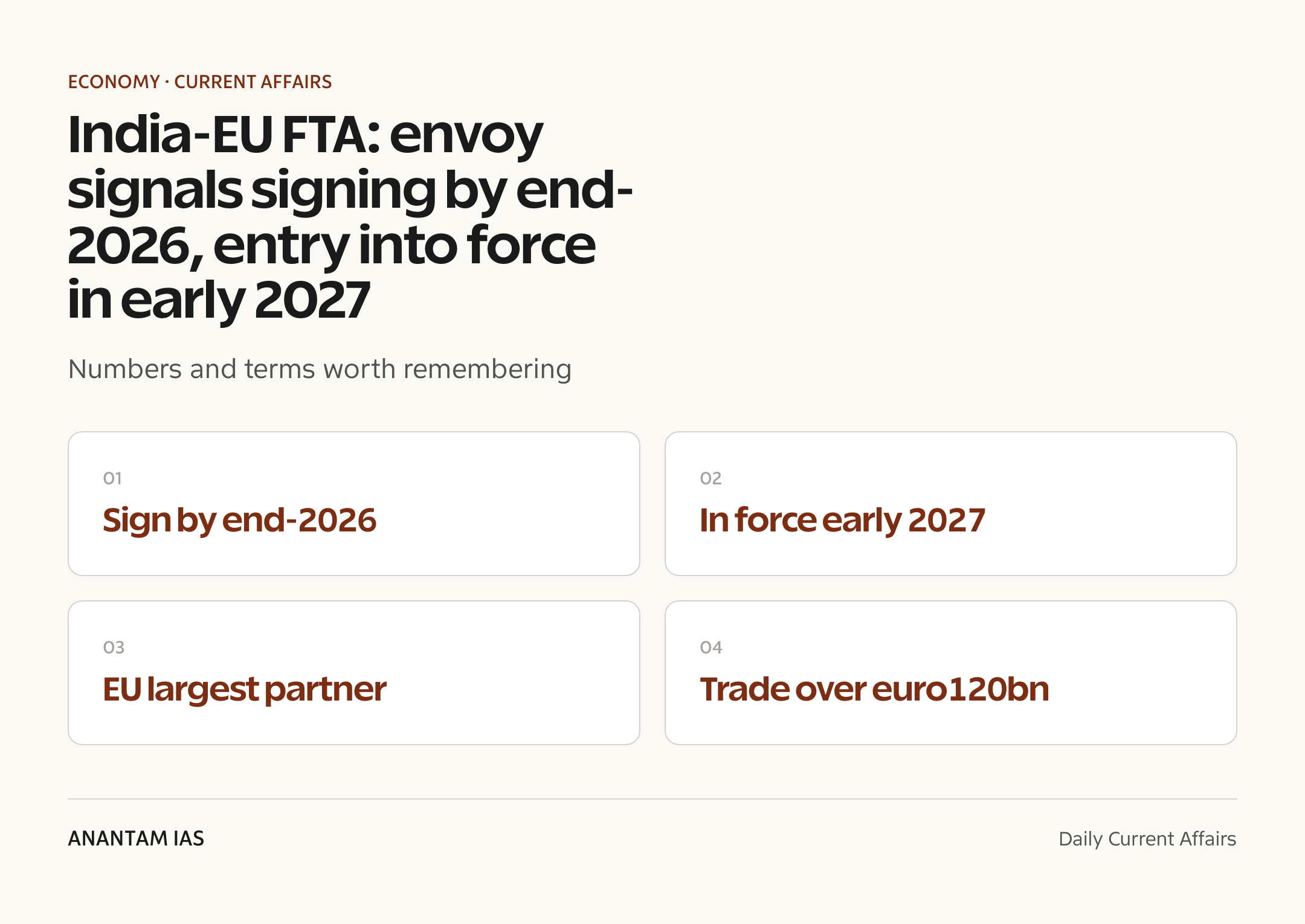
In an interview reported by the Indian Express and ThePrint in early July 2026, the European Union‘s Ambassador to India, Herve Delphin, said New Delhi and Brussels aim to sign the India-EU Free Trade Agreement (FTA) by the end of 2026 and bring it into force in early 2027, likely the first quarter.
Delphin framed the pact as a joint choice of openness over protectionism at a time of tariff wars and fractured supply chains, with the Carbon Border Adjustment Mechanism (CBAM), investment liberalisation and professional mobility flagged as the live threads still being settled before signature.
- Negotiations on the India-EU FTA were formally concluded in late January 2026; the text is now in legal scrubbing (legal vetting) and translation into EU languages before signing.
- Target sequence: signature by end-2026, then ratification, then entry into force in Q1 2027.
- The EU is India’s largest trading partner, with bilateral goods trade of over euro 120 billion in 2024 that both sides want to roughly double.
- The EU is set to liberalise nearly all (about 99.5%) of its tariff lines for Indian goods; India opens about 96.6% of its tariff lines to EU goods, phased over years.
- Delphin said any future changes to CBAM would be applied ‘in the context of India as well’, and pointed to a euro 500 million EU package to support India’s decarbonisation.
The development matters in the context of:
- This is India’s largest pending trade pact by combined GDP and population, and its most demanding on regulatory standards.
- It lands amid a broader Indian FTA push — the India-UK CETA, India-EFTA TEPA and an interim India-US framework — signalling a shift from India’s older protectionist reflex toward calibrated openness.
UPSC Relevance
Prelims Relevance
- India-EU FTA negotiations concluded January 2026; began as the BTIA (Broad-based Trade and Investment Agreement) in 2007.
- BTIA launched 2007, stalled 2013, relaunched June 2022 on three tracks: a trade FTA, a separate Investment Protection Agreement (IPA), and a Geographical Indications (GI) agreement.
- The EU is India’s largest trading partner; a customs union and single market of 27 member states.
- CBAM — Carbon Border Adjustment Mechanism — enters its definitive regime from 2026; covers cement, iron and steel, aluminium, fertilisers, electricity and hydrogen.
- EUDR — EU Deforestation Regulation — a non-tariff measure; enforcement pushed to 30 December 2026 (large/medium) and 30 June 2027 (small/micro).
- Mode 4 of trade in services covers movement of natural persons — the basis of professional mobility commitments.
- ‘Legal scrubbing‘ is the legal-linguistic review of an agreed treaty text before signature.
- EU Ambassador to India: Herve Delphin.
Mains Relevance
GS Paper 2
- India and the developed world: features and challenges of the India-EU strategic and trade partnership.
- Bilateral and regional groupings involving India and their impact on India’s interests.
GS Paper 3
- Effects of liberalisation on the economy; impact of a high-standard FTA on Indian industry, MSMEs and agriculture.
- CBAM and green trade barriers as challenges to India’s exports and its decarbonisation pathway.
Essay
- Openness versus protectionism: rules-based trade in an age of tariff walls.
- Trade and the climate: when a carbon border tax reshapes development.
Background and Context
From BTIA to breakthrough: a two-decade road
The FTA is the long-delayed successor to talks first launched almost twenty years ago.
- Negotiations began in 2007 in Brussels as the Broad-based Trade and Investment Agreement (BTIA), covering goods, services, investment and intellectual property.
- Talks stalled in 2013 over autos and wines-and-spirits tariffs, services access, data and agriculture, and stayed frozen for nearly a decade.
- Leaders agreed to relaunch in 2021, and negotiations formally resumed in June 2022 on three parallel tracks — a trade FTA, a separate Investment Protection Agreement, and a Geographical Indications pact.
- Negotiations were concluded in late January 2026, a landmark our note on the India-EU FTA conclusion covers in detail.
What Delphin actually signalled
The envoy’s message was about sequencing and intent, not fresh concessions.
- Ambassador Herve Delphin said the two sides can ‘confidently look at early 2027’ for entry into force, with signing targeted by end-2026.
- Between conclusion and signature the text goes through legal scrubbing and translation into all EU official languages, then ratification.
- He cast the deal as India and the EU having ‘chosen openness over protectionism‘, an implicit contrast with rising unilateral tariffs elsewhere.
- On the sticking points, he stressed dialogue: future CBAM tweaks would be weighed ‘in the context of India as well’, not imposed in isolation.
Scale and stakes: India's biggest pact
The economics explain why this is called the mother of all trade deals.
- The EU is India’s largest trading partner; bilateral goods trade topped euro 120 billion in 2024, with large services and investment flows on top.
- The EU is set to remove duties on nearly all — about 99.5% — of tariff lines for Indian goods; India liberalises roughly 96.6% of its lines for EU goods, phased in over years.
- India has opened over 100 services subsectors to EU firms across finance, telecom and maritime, alongside a structured professional mobility framework for Indian workers.
- Gains are expected in textiles, pharma, leather, engineering goods and IT/ITeS; sensitivities remain in dairy, autos and wines-and-spirits.
The live threads: CBAM, EUDR and non-tariff barriers
The hardest issues are the EU’s green rules, which sit outside the tariff schedule.
- The Carbon Border Adjustment Mechanism (CBAM) enters its definitive regime from 2026, forcing importers to surrender certificates for the embedded carbon in steel, aluminium, cement, fertilisers, electricity and hydrogen.
- India — the largest supplier of iron and steel to the EU — sees CBAM as a unilateral non-tariff barrier that could erode the very tariff gains the FTA delivers; our explainer on the Carbon Border Adjustment Mechanism details the design.
- Delphin pointed to a euro 500 million EU programme to help India decarbonise hard-to-abate sectors — steel, cement, renewables, grids, storage and green hydrogen.
- The EU Deforestation Regulation (EUDR) is a second green hurdle for coffee, leather and agri exports; its enforcement has been delayed to 30 December 2026 for larger firms and 30 June 2027 for small operators.
Investment, mobility and data
Several threads sit alongside the FTA rather than inside it.
- A separate Investment Protection Agreement (IPA) is still being negotiated; the main FTA does not carry comprehensive investor protection.
- Investment liberalisation and a predictable dispute-settlement mechanism are what EU investors most want before committing at scale.
- Mobility — easier movement of Indian professionals and mutual recognition of qualifications — is a headline Indian ask under services Mode 4.
- Data adequacy (whether the EU recognises India’s data-protection regime under the DPDP Act, 2023) shapes how freely digital and services trade can flow.
Strategic context: de-risking and diversification
The pact is as much geopolitics as commerce.
- For the EU, the deal is part of de-risking from China and building resilient supply chains under a ‘China-plus-one’ logic.
- For India, it locks in market access and standards partners amid US tariff turbulence and a wider FTA drive.
- It sits in a run of Indian deals — the India-UK CETA, the India-EFTA TEPA (a separate bloc of Switzerland, Norway, Iceland and Liechtenstein — not the EU), and an interim India-US framework.
- A concluded EU pact would give India a rules-based anchor with a market of about 450 million high-income consumers.
Way Forward
Close the green-trade gap
- Push for CBAM equivalence — recognition of India’s carbon-pricing and reporting so Indian exporters are not double-charged — and deploy the euro 500 million package to cut real emissions in steel and cement.
- Build domestic MRV (measurement, reporting, verification) capacity so MSME exporters can comply with CBAM and EUDR without being priced out.
Lock in investment and mobility
- Conclude the parallel Investment Protection Agreement quickly to convert market access into actual factory-and-jobs investment.
- Secure firm Mode 4 mobility and qualification-recognition commitments, and pursue an EU data-adequacy decision for India.
Protect the sensitive downside: phase in tariff cuts on dairy, autos and wines-and-spirits with adequate transition periods, and pair the FTA with domestic competitiveness reforms so Indian MSMEs and farmers gain rather than lose from openness.
Conclusion
The India-EU FTA has moved from a two-decade negotiating saga to a concrete calendar: sign by end-2026, in force by early 2027. Ambassador Delphin’s framing — openness over protectionism — captures why both sides want it closed while the global trading order is fraying.
The real test is not the tariff schedule but the fine print — CBAM, EUDR, investment protection, mobility and data. Handled well, the pact anchors India to a high-standard, rules-based market and speeds up its own reform and decarbonisation. Handled poorly, green non-tariff barriers could quietly claw back the gains the tariff cuts promise.
UPSC Practice Questions
Prelims MCQ 1
With reference to the India-EU Free Trade Agreement, consider the following statements:
- Negotiations for it began in 2007 as the Broad-based Trade and Investment Agreement (BTIA).
- It was formally concluded in January 2026 and awaits legal scrubbing and signature.
- The European Union is India’s largest trading partner.
How many of the above statements are correct?
(a) Only one (b) Only two (c) All three (d) None
Answer: (c) All three
Explanation:
BTIA talks began in 2007, stalled in 2013 and were relaunched in 2022; negotiations concluded in January 2026 and the text is in legal scrubbing. The EU is India’s largest trading partner. All three statements are correct.
Prelims MCQ 2
The Carbon Border Adjustment Mechanism (CBAM), relevant to India-EU trade, is best described as:
(a) A domestic carbon tax levied by India on its imports (b) An EU levy on the embedded carbon of certain imported goods such as steel and cement (c) A World Trade Organization subsidy for green exporters (d) A United Nations fund for climate adaptation
Answer: (b) An EU levy on the embedded carbon of certain imported goods such as steel and cement
Explanation:
CBAM requires EU importers to surrender certificates matching the embedded emissions of covered goods (iron and steel, aluminium, cement, fertilisers, electricity, hydrogen), so India, a top steel supplier to the EU, treats it as a non-tariff barrier.
UPSC Mains Questions
- The India-EU FTA is described as India’s most demanding trade pact yet. Discuss the opportunities it offers and the challenges posed by non-tariff barriers such as CBAM and the EU Deforestation Regulation. (250 words)
- ‘India has chosen calibrated openness over protectionism.’ Examine this shift in the light of India’s recent free trade agreements and its implications for domestic industry and workers. (250 words)
Sources: Indian Express (interview with EU Ambassador Herve Delphin) and ThePrint.
Frequently Asked Questions
When will the India-EU FTA come into force?
EU Ambassador Herve Delphin said in July 2026 that both sides aim to sign the agreement by the end of 2026, after which it goes through ratification. He expects it to enter into force in early 2027, most likely the first quarter, once legal scrubbing and translation are complete.
How is the India-EU FTA different from the India-EFTA TEPA?
They involve different blocs. The FTA is with the 27-member European Union. The TEPA (Trade and Economic Partnership Agreement) is with EFTA — Switzerland, Norway, Iceland and Liechtenstein, which are not EU members. TEPA is already signed and carries a distinct 15-year, 100-billion-dollar investment pledge.
What is CBAM and why does India object to it?
The Carbon Border Adjustment Mechanism is an EU levy on the embedded carbon of imports like steel, aluminium and cement, entering its definitive phase from 2026. India, the EU’s largest steel supplier, sees it as a unilateral non-tariff barrier that could offset the tariff cuts the FTA offers.
What does ‘openness over protectionism’ mean here?
It is Delphin’s framing that India and the EU have chosen to deepen rules-based, negotiated trade integration at a time when many economies are raising tariffs and turning inward. It signals India’s move from an older protectionist stance toward calibrated, high-standard liberalisation.
Is investment protection part of the FTA?
Not directly. The main FTA covers trade in goods and services and market access. A separate Investment Protection Agreement is still being negotiated to give EU and Indian investors stronger protections and a dispute-settlement mechanism.
How big is India-EU trade?
The EU is India’s largest trading partner. Bilateral goods trade crossed about 120 billion euro in 2024, alongside substantial services and investment flows, and both sides want to roughly double goods trade over the coming years.
Source: https://anantamias.com/current-affairs/india-eu-fta-2027-delphin-openness/
Himalayan Pangolin: Manis aurita Confirmed as a Distinct Species After 189 Years
Why in News?
An international team of scientists has revalidated the Himalayan pangolin (Manis aurita) as a distinct, living species, separate from the Chinese pangolin (Manis pentadactyla) into which it had been lumped as a subspecies for decades. The findings, drawing on genomic and morphological evidence, were published in the journal Communications Biology and reported by Down To Earth and Mongabay in early July 2026.
The animal was first described from Nepal’s Kathmandu Valley in 1836 by the British naturalist Brian Houghton Hodgson, who named it for its unusually large ears, but it was later absorbed into the Chinese pangolin and effectively forgotten for about 189 years. Its confirmed range spans Nepal, southern Tibet and Northeast India, including Assam.
- Researchers sequenced DNA from the original 1836 lectotype specimen and compared it with modern samples, confirming Manis aurita as a separate evolutionary lineage.
- The two lineages diverged roughly 1.8 million years ago in the early Pleistocene, driven by climatic oscillations that split a common ancestor into a western Himalayan and an eastern East/Southeast Asian refugium (allopatric separation).
- The Himalayan pangolin is physically larger, averaging about 95.2 cm in length versus about 71.2 cm for the Chinese pangolin, with a larger skull, longer tail, smaller ears and a shorter, broader nasal bone.
- Genomic evidence shows a sharp demographic collapse during Pleistocene cooling and a further contraction around the 14th century, coinciding with the onset of the Little Ice Age in the Himalaya.
- The study’s authors urge that Manis aurita be explicitly categorised under CITES Appendix I, identifying it as a prime target for illegal wildlife traffickers.
- The revalidation is the work of teams across Asia, the Americas and Europe over about five years, triggered partly by mismatches in scales recovered from smuggling seizures in 2016-17.
The development matters in the context of:
- Pangolins are the world’s most trafficked mammals, hunted for their scales (used in traditional medicine) and meat, so getting their taxonomy right directly shapes anti-trafficking and conservation priorities.
- A newly recognised species with a small, fragmented Himalayan range may need a distinct, more urgent conservation and legal-protection status than the wider Chinese pangolin.
- The finding shows how museum specimens and ancient-DNA methods can resolve long-standing taxonomic disputes with direct policy consequences.
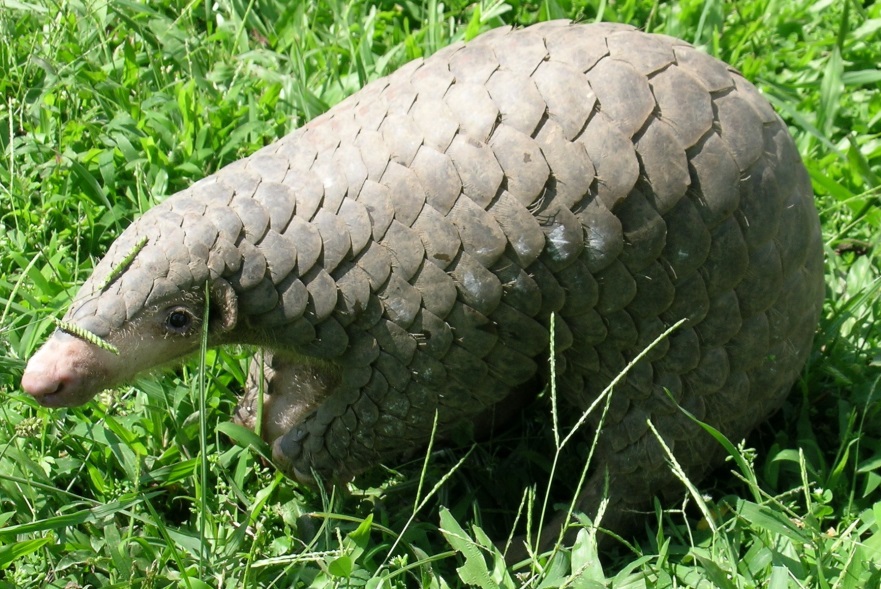

UPSC Relevance
Prelims Relevance
- Pangolins are the only mammals wholly covered in keratin scales; they are toothless, insectivorous (ants and termites), nocturnal and largely solitary.
- There are eight recognised species globally — four Asian and four African; the Himalayan pangolin’s revalidation would raise the count.
- Four Asian species: Indian (Manis crassicaudata), Chinese (Manis pentadactyla), Sunda (Manis javanica) and Philippine (Manis culionensis).
- Four African species: Ground/Temminck’s, Giant Ground, White-bellied and Black-bellied pangolins.
- India hosts two established species: the Indian pangolin (across most of India) and the Chinese pangolin (Northeast India); Manis aurita would add a distinct Himalayan/Northeast presence.
- IUCN Red List: Indian pangolin is Endangered; Chinese pangolin is Critically Endangered.
- All eight pangolin species are listed on CITES Appendix I (moved from Appendix II in 2016, effective 2017), banning all commercial international trade.
- In India, pangolins are protected under Schedule I of the Wildlife (Protection) Act, 1972 — the highest level of protection.
- Lectotype: a single specimen later designated as the definitive name-bearing type for a species; allopatric speciation is divergence caused by geographic isolation.
- Hodgson originally coined the name Manis auritus (‘with large ears’), with a backup name Plurisquamis (‘the many-scaled’).
Mains Relevance
GS Paper 3
- Conservation of biodiversity: how a taxonomic revision reshapes protection priorities, Red List assessment and legal status for a heavily trafficked species.
- Illegal wildlife trade and its control — pangolin scales, the demand chain to East Asian markets, and the role of CITES, the Wildlife Protection Act and enforcement agencies.
- Science and technology in conservation: ancient DNA, genomics and museum collections as tools for species identification and anti-trafficking forensics.
GS Paper 2
- India’s obligations under international conventions (CITES) and how domestic law (WPA 1972) gives them effect; transboundary conservation with Nepal and the Himalayan region.
Essay
- What we lose when a species is hidden in plain sight: taxonomy, memory and the ethics of conservation.
- The smallest scales, the largest trade: humanity’s relationship with the pangolin.
Background and Context
What a pangolin is
The pangolin is a biological oddity — a scaly, ant-eating mammal that predators struggle to crack.
- The only mammals with true keratin scales covering the body; when threatened they roll into a tight ball (the name derives from the Malay pengguling, ‘one who rolls up’).
- Toothless insectivores that use a long sticky tongue and a strong sense of smell to feed on ants and termites; they help regulate insect populations and aerate soil.
- Slow-breeding, nocturnal and solitary — traits that make recovery from population loss very slow.
- Found across Asia and sub-Saharan Africa; every one of the eight recognised species is threatened, ranging from Vulnerable to Critically Endangered.

How the Himalayan pangolin was rediscovered
The case rested on Hodgson’s 1836 words and a nearly two-century-old museum specimen.
- In 1836 Brian Houghton Hodgson, confined to Nepal’s Kathmandu Valley, described a pangolin with prominent ears and more trunk scales than any recorded species, naming it Manis auritus.
- For decades three subspecies of the Chinese pangolin were recognised, with the Nepal form treated as M. p. aurita and its status poorly studied.
- Between 2016 and 2017, mismatches in scales from smuggling seizures prompted researchers to re-examine the lineage.
- A team spanning Asia, the Americas and Europe spent about five years sequencing the original 1836 lectotype and modern specimens, concluding it is a full species: the Himalayan pangolin (Manis aurita).
- The work was published in Communications Biology, providing a genetic and morphological baseline for conservation.
Climate and the deep split
Ice-age climate swings, not distance alone, appear to have carved out the Himalayan lineage.
- The ancestors of M. aurita and M. pentadactyla diverged in the early Pleistocene, about 1.8 million years ago, amid large global climatic oscillations.
- Pangolins are warm-adapted with no fossil record in northern China; cooling and aridification likely forced an allopatric split into a western Himalayan refugium and an eastern East/Southeast Asian one.
- The Himalayan lineage suffered a sharp demographic collapse from unstable, restricted habitat, while the Chinese pangolin found buffering in maritime-influenced southern forests.
- A further genetic contraction around the 14th century tracks the onset of the Little Ice Age, leaving a lasting mark on the species’ low genetic diversity.
- Genes tied to the pangolin’s enlarged olfactory system likely diverged under selection as each lineage adapted.
Why pangolins are the most trafficked mammal
Demand for scales and meat has made pangolins the poster species of the illegal wildlife trade.
- Pangolins are considered the most smuggled mammals on Earth, killed for meat and for scales used in traditional medicine, mainly in East Asian markets.
- As Chinese and Sunda pangolin populations crashed, trafficking pressure shifted to the Indian pangolin and other species.
- Scales are pure keratin — the same protein as human nails — with no proven medicinal value, yet they command high black-market prices.
- Seizures of pangolin scales have repeatedly exposed how mixed, mislabelled consignments obscure which species and populations are being wiped out.
Legal and conservation status
Pangolins carry the strongest protections on paper, both globally and in India.
- All pangolin species are on CITES Appendix I (uplisted from Appendix II in 2016, effective 2017), prohibiting commercial international trade.
- The Indian pangolin is Endangered and the Chinese pangolin Critically Endangered on the IUCN Red List.
- In India, pangolins sit in Schedule I of the Wildlife (Protection) Act, 1972, the strictest domestic category.
- The study’s authors specifically urge listing Manis aurita under CITES Appendix I so that enforcement can target it as a distinct, high-risk species.
Why the reclassification matters
Recognising a species is the first step to protecting it correctly.
- Conservation status, population estimates and Red List categories are assigned per species — a hidden species means a hidden extinction risk.
- A small, fragmented Himalayan range with low genetic diversity may make M. aurita more vulnerable than the wider Chinese pangolin, warranting tailored protection.
- Species-level clarity sharpens wildlife forensics: seized scales can be matched to the correct population and trade route.
- It underscores the value of natural-history museum collections and ancient-DNA techniques for resolving taxonomy with real policy stakes.
Way Forward
Legal recognition
- Formally reflect Manis aurita in CITES listings and in India’s Wildlife (Protection) Act schedules, with a dedicated IUCN Red List assessment.
- Coordinate transboundary protection across Nepal, India and the Himalayan region given the species’ shared range.
Enforcement and science
- Strengthen wildlife forensics and DNA-based identification of seized scales to break trafficking networks.
- Fund field surveys to map the Himalayan pangolin’s true distribution, numbers and habitat in Northeast India and neighbouring areas.
- Curb demand through community engagement and awareness that pangolin scales are only keratin, with no medicinal value.
Conclusion
The revalidation of the Himalayan pangolin is a reminder that conservation begins with knowing what exists. A species described in 1836 and then lost inside another for nearly two centuries has re-emerged just as pangolins face relentless trafficking pressure.
For India, whose Northeast lies within this pangolin’s range, the finding is a chance to update legal protection, enforcement and field research before a newly named species slips toward extinction unnoticed.
UPSC Practice Questions
Prelims MCQ 1
With reference to pangolins, consider the following statements:
- They are the only mammals covered in keratin scales.
- All pangolin species are listed on CITES Appendix I.
- In India, pangolins are protected under Schedule I of the Wildlife (Protection) Act, 1972.
How many of the above statements are correct?
(a) Only one (b) Only two (c) All three (d) None
Answer: (c) All three
Explanation:
Pangolins are the only fully scale-covered mammals; all species are on CITES Appendix I (from 2017); and Indian and Chinese pangolins are in Schedule I of the WPA, 1972.
Prelims MCQ 2
The Himalayan pangolin, recently revalidated as a distinct species, was earlier classified as a subspecies of which species?
(a) Indian pangolin (Manis crassicaudata) (b) Chinese pangolin (Manis pentadactyla) (c) Sunda pangolin (Manis javanica) (d) Philippine pangolin (Manis culionensis)
Answer: (b) Chinese pangolin (Manis pentadactyla)
Explanation:
Manis aurita, first described by Brian Houghton Hodgson in 1836, had long been treated as a subspecies of the Chinese pangolin before genomic and morphological evidence confirmed it as a full species.
UPSC Mains Questions
- The revalidation of the Himalayan pangolin shows that taxonomy is not academic housekeeping but a conservation tool. Discuss, with reference to how species-level clarity shapes legal protection and the fight against wildlife trafficking. (250 words)
- Pangolins are the world’s most trafficked mammals despite the strongest legal protections. Examine the gap between paper protection and ground reality, and suggest measures to close it in the Indian context. (250 words)
Sources: Down To Earth and Mongabay.
Frequently Asked Questions
What is the Himalayan pangolin?
The Himalayan pangolin (Manis aurita) is a scaly, ant-eating mammal now revalidated as a distinct species after decades of being treated as a subspecies of the Chinese pangolin. First described from Nepal in 1836, it is found in Nepal, southern Tibet and Northeast India, including Assam, and is heavily threatened by trafficking.
Why was it reclassified after 189 years?
Scientists sequenced DNA from the original 1836 type specimen and modern samples, and studied morphology. The genetic and physical differences confirmed that the Himalayan pangolin is a separate evolutionary lineage, distinct from the Chinese pangolin, into which it had earlier been merged. The findings were published in the journal Communications Biology.
How is it different from the Chinese pangolin?
The Himalayan pangolin is larger, averaging about 95.2 cm versus about 71.2 cm for the Chinese pangolin, with a larger skull, longer tail, smaller ears and a shorter, broader nasal bone. Genomically, the two lineages diverged roughly 1.8 million years ago during the early Pleistocene.
Why are pangolins so heavily trafficked?
Pangolins are the world’s most trafficked mammals, hunted for their meat and for their scales, which are used in traditional medicine in parts of East Asia. The scales are made only of keratin, the protein in human nails, and have no proven medical value, yet they fetch high black-market prices.
What legal protection do pangolins have?
All pangolin species are on CITES Appendix I, banning commercial international trade since 2017. In India, pangolins are listed under Schedule I of the Wildlife (Protection) Act, 1972, the highest level of protection. Researchers want Manis aurita explicitly listed so enforcement can treat it as a distinct species.
How many pangolin species are there?
Eight species are formally recognised worldwide: four in Asia (Indian, Chinese, Sunda and Philippine) and four in Africa. The revalidation of the Himalayan pangolin would add another distinct Asian species, sharpening conservation attention on the Himalayan and Northeast Indian populations.
Source: https://anantamias.com/current-affairs/himalayan-pangolin-manis-aurita-distinct-species/
Mission Drishti: India’s first OptoSAR satellite lost after solar storm
Why in News?
Bengaluru-based private space startup GalaxEye said on 8 July 2026 that it had lost communication with Mission Drishti — billed as the world’s first OptoSAR satellite — after the spacecraft hit an anomaly during the final stage of its Launch and Early Orbit Phase (LEOP). Business Today and Business Standard reported the failure, which the company traced to a geomagnetic solar storm.
GalaxEye’s founder-CEO Suyash Singh said radiation effects from the space-weather event likely damaged a critical onboard system; communication turned intermittent and was eventually lost, with the likelihood of recovery now low.
- Drishti launched aboard a SpaceX Falcon 9 on 3 May 2026 from California
- It was the largest satellite ever built by India’s private sector at about 190 kg
- Combined multispectral imaging (MSI) and synthetic aperture radar (SAR) on one platform for the first time
- Anomaly struck in the final stage of LEOP after a geomagnetic storm; root-cause points to radiation hitting a critical system
- GalaxEye said the mission still validated key spacecraft, computing and in-house mission-operations systems
The development matters in the context of:
- First high-profile in-orbit loss for an Indian private-sector earth-observation satellite — a real-world test of the post-2020 space reforms
- Underlines space weather as an operational risk for the growing fleet of small commercial satellites in low earth orbit
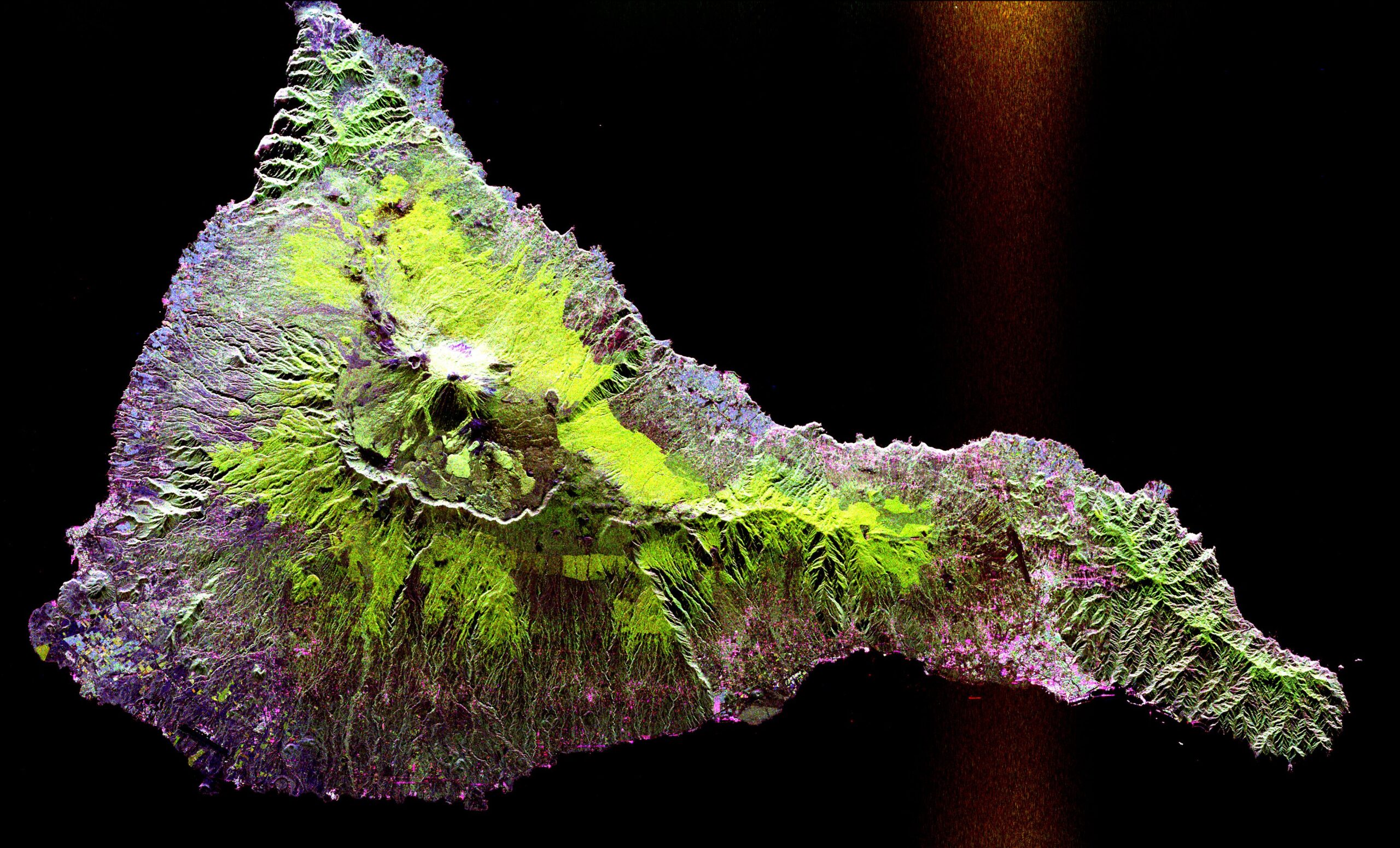
UPSC Relevance
Prelims Relevance
- OptoSAR — fusing optical/multispectral imaging with SAR on a single satellite
- SAR (Synthetic Aperture Radar): active microwave sensor, all-weather, day-night imaging
- Multispectral imaging: capture across several spectral bands (Drishti carried a 7-band imager)
- LEOP — Launch and Early Orbit Phase, the critical commissioning window after separation
- Geomagnetic storm and Coronal Mass Ejection (CME) as space-weather drivers
- Single Event Upset / radiation effects on satellite electronics
- IN-SPACe — single-window regulator for private space activity (est. 2020)
- Indian Space Policy 2023; NGE (Non-Government Entities)
- GalaxEye — IIT Madras-incubated startup; Low Earth Orbit (LEO)
Mains Relevance
GS Paper 3
- Awareness in the field of space; indigenisation and the role of private players in earth observation
- Space weather as a technological risk and the need for radiation-hardened design and space situational awareness
GS Paper 2
- Government policies and reforms — the 2020 space-sector opening, IN-SPACe and the regulatory ecosystem for start-ups
Essay
- Failure as a stepping stone: risk, resilience and India’s private innovation frontier
- Reaching for the stars — the promise and perils of a privatised space economy
Background and Context
What Mission Drishti was
Drishti was pitched as a technology first for Indian private space.
- Built by GalaxEye, a 2021 IIT Madras-incubated startup founded by five alumni of the Avishkar Hyperloop team; Suyash Singh is founder-CEO
- The world’s first OptoSAR satellite — carrying both an optical multispectral imager (7 bands, ~1.8 m resolution) and a synthetic aperture radar on one bus
- At about 190 kg, the largest satellite built by India’s private sector, a jump in scale for a young commercial industry
- Launched on a SpaceX Falcon 9 rideshare on 3 May 2026 from California; drew notice from PM Narendra Modi and Elon Musk
- Meant to deliver analysis-ready, all-weather earth imagery, and to seed a planned constellation of 10 satellites by 2030 for commercial and strategic customers
SAR, optical and why fusing them matters
The novelty was fusing two imaging methods that normally fly on separate satellites.
- Optical/multispectral sensors are passive — they record sunlight reflected off the surface across several spectral bands, giving rich colour, vegetation and material detail, but they are blind through cloud, smoke and at night
- Synthetic Aperture Radar (SAR) is an active microwave sensor: the satellite transmits its own radar pulses and reads the echo, so it needs no sunlight and sees through cloud and darkness in all weather, day or night
- SAR gets its name from motion — the spacecraft’s own travel along orbit synthesises a very long virtual antenna (a large aperture), sharpening resolution far beyond a small physical radar
- Multispectral imaging splits reflected light into discrete bands (visible, near-infrared and beyond); different surfaces — healthy crop, bare soil, water, built-up land — carry distinct spectral signatures that reveal what a scene is made of
- Because SAR senses surface texture, moisture and structure while optical bands sense colour and chemistry, the two are complementary rather than redundant
- Capturing both over the same spot at the same time — the core of OptoSAR — yields cross-validated, analysis-ready data and cuts the classic trade-off between an optical satellite’s clarity and a radar satellite’s reliability
What earth observation is used for
All-weather imagery has a broad civilian and strategic market that a fused sensor targets directly.
- Agriculture — crop-type mapping, acreage and yield estimates, soil-moisture and irrigation tracking, and crop-insurance verification, where SAR’s cloud-piercing view matters most in the monsoon
- Disaster management — flood extent, cyclone and landslide damage and earthquake mapping, since radar can image a disaster zone at night or under thick cloud when optical satellites cannot
- Defence and security — border and maritime surveillance, ship and vessel detection, and ISR (intelligence, surveillance and reconnaissance), a market GalaxEye openly courted
- Urban and infrastructure planning — monitoring land use, encroachment, ground subsidence, dams, ports and construction over time
- Climate and environment — deforestation, glacier and coastline change and oil-spill detection round out the demand for repeat, reliable imagery
- A constellation of many small satellites shortens the revisit time over any location, turning one-off snapshots into near-daily monitoring that these applications need
How the mission was lost
The satellite cleared most commissioning before space weather intervened.
- GalaxEye said Drishti established communication and completed a major portion of LEOP — validating power, attitude control, onboard computing and communications
- In the final stage of LEOP the spacecraft hit an anomaly following a geomagnetic solar storm
- Initial root-cause analysis points to radiation effects from the space-weather event damaging a critical onboard system
- Communication became intermittent and was eventually lost; recovery efforts continue but the chance is low
- CEO Suyash Singh framed it as delivering invaluable engineering insights for future missions rather than a total loss
The space-weather threat
Solar activity is a recurring, physical hazard for satellites in low earth orbit.
- The Sun drives space weather through solar flares (bursts of X-ray and ultraviolet radiation) and Coronal Mass Ejections (CMEs) — vast clouds of charged plasma flung from the corona
- When a CME strikes Earth’s magnetosphere it triggers a geomagnetic storm, injecting energy into the near-Earth space environment
- Storms heat and cause thermospheric expansion — the upper atmosphere puffs up and denser air reaches satellite altitudes, sharply raising aerodynamic drag on LEO spacecraft and pulling their orbits down
- High-energy particles cause Single Event Upsets (SEUs), surface and deep-dielectric charging, and can corrupt memory or permanently damage electronics
- In February 2022 a geomagnetic storm doomed 38 of 49 newly launched Starlink satellites to atmospheric drag — the most-cited precedent for exactly this risk
- Satellites still in early-orbit commissioning are especially exposed, since protective safe-modes and full autonomy are not yet active
India's private space ecosystem and reforms
Drishti is a marker of how far commercial space has come since the 2020 opening.
- GalaxEye is a private, venture-funded firm — clearly distinct from ISRO, the government space agency; Drishti was a commercial mission, not a national one
- The 2020 reforms opened the sector to private players and created IN-SPACe (Indian National Space Promotion and Authorisation Centre) as a single-window promoter, authoriser and regulator for Non-Government Entities (NGEs)
- NSIL (NewSpace India Limited), a PSU under the Department of Space, is the commercial arm that owns operational assets and handles demand-driven missions
- The Indian Space Policy 2023 formalised the roles of ISRO, IN-SPACe, NSIL and private firms across the value chain, letting NGEs build and operate satellites and ground stations
- The Union government also allowed up to 100% FDI in parts of the space sector (2024), easing foreign capital for satellite manufacturing and components
- Registered space startups grew from around 54 in 2020 to 300-plus by 2026 on the IN-SPACe portal
- Peers include Pixxel (hyperspectral imaging), Digantara (space situational awareness), and launch-vehicle makers Skyroot Aerospace and Agnikul Cosmos
- Government backing runs through a dedicated venture-capital fund for space startups and technology-adoption support, signalling that private earth observation is treated as strategic, not niche
Why the loss still counts as progress
In a young ecosystem, a validated technology can outlast a failed satellite.
- GalaxEye demonstrated fully in-house mission operations and validated the design-build-launch-operate pipeline end to end
- The OptoSAR concept reached orbit and operated, proving the payload integration and fused-sensor bus are workable
- The company says the mission strengthened customer engagement and market confidence in its imagery
- Lessons are being folded into a shift toward more in-house supply chain and manufacturing to cut single points of failure
- Early failures are common in first flights worldwide; the durable asset is the engineering knowledge and team capability that survive the satellite
- For India’s aim of raising its share of the global space economy, learning to build, launch and operate complex payloads privately matters more than any single spacecraft’s fate
Way Forward
Radiation-hardened design
- Invest in radiation-hardened and redundant electronics and robust fault-recovery for critical systems
- Build safe-mode and autonomous recovery logic tuned for the vulnerable LEOP window
Space-weather resilience
- Integrate space-weather forecasting into launch and early-operations planning
- Strengthen India’s space situational awareness and solar-monitoring feeds for operators
Ecosystem support
- Use IN-SPACe to share test facilities, insurance and risk-pooling for first-time private missions
- Encourage vertical integration and domestic component supply to cut single points of failure
Conclusion
Losing Mission Drishti is a hard blow, but the mission put a genuine world-first — an OptoSAR payload — into orbit and proved GalaxEye can run an end-to-end space operation. For a startup barely five years old, that is a foundation, not a full stop.
The episode is a reminder that space is unforgiving and that space weather is an operational risk, not a footnote. As India’s private fleet grows, radiation-hardened engineering and space-weather readiness must become baseline design, backed by IN-SPACe and shared national capabilities.
UPSC Practice Questions
Prelims MCQ 1
With reference to Synthetic Aperture Radar (SAR) imaging, consider the following statements:
- It is a passive sensor that relies on reflected sunlight.
- It can image the surface through cloud cover and at night.
- GalaxEye’s Mission Drishti combined SAR with multispectral imaging on a single satellite.
How many of the above statements are correct?
(a) Only one (b) Only two (c) All three (d) None
Answer: (b) Only two
Explanation:
SAR is an active microwave sensor, not a passive optical one, so statement 1 is wrong. It works in all weather, day or night (2 correct), and Drishti’s OptoSAR design fused SAR with multispectral imaging (3 correct).
Prelims MCQ 2
Which organisation was set up in 2020 as the single-window agency to authorise and promote private space activity in India?
(a) ISRO (b) IN-SPACe (c) Antrix Corporation (d) NSIL
Answer: (b) IN-SPACe
Explanation:
IN-SPACe (Indian National Space Promotion and Authorisation Centre) was created in 2020 as the single-window regulator-promoter for non-government entities. ISRO is the space agency; NSIL and Antrix are commercial arms.
UPSC Mains Questions
- The loss of Mission Drishti shows that space is a high-risk frontier for private players. Examine the role of the 2020 space-sector reforms and IN-SPACe in building a resilient private space industry in India. (250 words)
- What is space weather, and how do geomagnetic storms threaten satellites in low earth orbit? Discuss the measures needed to make earth-observation missions resilient to such events. (150 words)
Sources: Business Today and Business Standard.
Frequently Asked Questions
What is Mission Drishti?
Mission Drishti was the first satellite of Bengaluru startup GalaxEye and the world’s first OptoSAR satellite, combining optical multispectral imaging with synthetic aperture radar on a single platform. Launched on a SpaceX Falcon 9 on 3 May 2026, it was, at about 190 kg, the largest satellite built by India’s private sector.
What does OptoSAR mean?
OptoSAR fuses two imaging methods on one satellite: optical or multispectral sensors that capture colour and material detail, and synthetic aperture radar (SAR), an active microwave sensor that works through cloud and at night. Capturing both over the same spot at the same time yields richer, all-weather earth imagery.
Why was contact with the satellite lost?
GalaxEye said Drishti hit an anomaly in the final stage of its Launch and Early Orbit Phase after a geomagnetic solar storm. Initial analysis suggests radiation from the event damaged a critical onboard system, after which communication became intermittent and was eventually lost. Recovery chances are now considered low.
How does a solar storm damage a satellite?
Solar eruptions called coronal mass ejections trigger geomagnetic storms. These heat and expand the upper atmosphere, raising drag on low-orbit satellites, while high-energy particles can cause single event upsets and charging that corrupt or destroy electronics. In 2022 a storm doomed 38 of 49 newly launched Starlink satellites.
Is GalaxEye part of ISRO?
No. GalaxEye is a private, venture-funded startup incubated at IIT Madras in 2021, not part of ISRO. It operates under India’s post-2020 space reforms, which opened the sector to private firms and set up IN-SPACe as the single-window regulator and promoter for non-government space activity.
Does the failure end GalaxEye’s plans?
GalaxEye says no. Although the satellite was lost, the mission validated its OptoSAR payload, in-house mission operations and the full design-to-operate pipeline. The company plans to fold the lessons into future satellites and still aims to build a constellation of about 10 satellites by 2030.
Source: https://anantamias.com/current-affairs/mission-drishti-optosar-satellite-lost/
Engineering Education in the AI Era: Why India’s Colleges Need a Reset
Why in News?
An Indian Express Expert Explains column argued that engineering education, the pipeline meant to power India’s AI and semiconductor ambitions, is steadily losing its sheen even as demand for engineers rises.
The trigger is the AICTE decision in 2025-26 to place 58 engineering colleges under progressive closure and discontinue more than 950 engineering and technical courses.
The closures land at a moment when the India Skills Report 2025 shows engineering graduates are among the most employable streams yet the wider talent base remains uneven, sharpening a debate the author labels ‘Engineering Education 2.0’.
- The real crisis is the widening gap between what a technology-driven economy needs and what a large section of colleges delivers, not falling relevance of engineering.
- IITs and a handful of premier institutions still draw the brightest students; hundreds of lower-tier colleges face declining admissions, weak faculty and outdated curricula.
- India has an approved undergraduate intake of nearly 15 lakh engineering seats, yet 20-40% of seats in many traditional branches stay vacant each year.
- The reform question is quality, relevance and employability, framed by the author as ‘Engineering Education 2.0’.
The development matters in the context of:
- Engineering talent is the cornerstone of India’s push in AI, semiconductors, quantum, advanced manufacturing and clean energy, making the pipeline a strategic, not just academic, concern.
- Demand-driven concentration of admissions in a few institutions is eroding the financial viability of the rest, turning closure into a structural outcome.
- The debate connects education governance (GS2) with the human-capital foundations of the technology economy (GS3).
UPSC Relevance
Prelims Relevance
- AICTE (All India Council for Technical Education) is India’s apex statutory regulator for technical education under the AICTE Act, 1987; it traces its origins to an advisory body set up in 1945.
- Every engineering institution needs AICTE approval before admitting students; approval is a continuous compliance process, not a one-time licence.
- Progressive closure bars fresh admissions but lets existing batches graduate, ensuring an orderly exit of non-viable institutions.
- National Board of Accreditation (NBA) runs outcome-based accreditation aligned with the Washington Accord, replacing the older input-based approach.
- India became a permanent signatory to the Washington Accord in 2014, giving accredited degrees international mobility.
- Institutes of National Importance (INIs): India has 79 — 23 IITs, 31 NITs and 25 IIITs; most enjoy statutory autonomy from AICTE approval.
- Regional engineering colleges were upgraded into NITs; IIITs were added under the INI network.
- AICTE imposed a moratorium on new engineering institutions in 2020 and lifted it in 2023.
- Education sits in the Concurrent List of the Seventh Schedule of the Constitution.
- NEP 2020 promotes multidisciplinary, flexible, outcome-oriented higher and technical education and targets a 50% Gross Enrolment Ratio by 2035.
- Approved UG engineering intake is about 15 lakh seats; IITs account for ~19,000, NITs ~25,000 and IIITs ~11,000.
Mains Relevance
GS Paper 2
- Regulation of technical education and the role of statutory bodies like AICTE and NBA
- Issues in the design, implementation and delivery of education policy (NEP 2020)
- Education as a Concurrent List subject and Centre-State-institution coordination
GS Paper 3
- Human-capital foundations for AI, semiconductors and deep-tech growth
- Skill development, employability and the education-employment mismatch
Essay
- Technology can widen opportunity only if the talent pipeline keeps pace with it.
- Quality over quantity: the crisis of numbers in Indian higher education.
- Will artificial intelligence create work or take it? The engineer’s dilemma.
Background and Context
AICTE and the regulatory architecture
The regulator sets the rules of entry, expansion and exit for technical education.
- AICTE began as an advisory body in 1945 and was given statutory teeth by the AICTE Act, 1987, which empowers it to plan, coordinate, regulate and promote technical education across the country.
- It prescribes binding norms for faculty ratios, physical infrastructure, laboratories, land, governance and financial viability, and no engineering college can admit students without its approval.
- Approval is contingent on year-after-year compliance; on periodic assessment AICTE may allow expansion, cut intake, impose restrictions or withdraw approval altogether.
- The 2016 Supreme Court position and later clarifications confirmed AICTE’s regulatory writ over technical programmes even where universities are involved, though jurisdictional overlaps with the UGC recur.
- Most INIs — the IITs, leading NITs and IIITs — operate with statutory autonomy and sit outside routine AICTE approval, a structural fault-line that concentrates prestige at the top.
Accreditation, NBA and the Washington Accord
Quality assurance has moved from counting inputs to measuring what graduates can actually do.
- The National Board of Accreditation (NBA) benchmarks programmes on measurable learning outcomes and graduate attributes rather than only buildings, seats and staff on paper.
- This outcome-based accreditation is aligned with the Washington Accord, the international agreement for mutual recognition of engineering qualifications.
- India became a permanent signatory to the Washington Accord in 2014, so an NBA-accredited degree carries recognition among member economies and eases global mobility for graduates.
- Accreditation is voluntary for many colleges, which weakens it as a filter; a large share of programmes remain un-accredited, blurring the quality signal students rely on.
- Reformers want NBA status tied firmly to funding, intake expansion and reputation, so that quality assurance becomes the decisive gate rather than an optional badge.
What 'progressive closure' means
Closure here is a managed exit, not an abrupt shutdown.
- Under progressive closure, an institution is barred from admitting fresh students but continues until existing batches graduate, protecting those already enrolled.
- It is typically invoked for persistently low admissions, failure to recruit and retain qualified faculty, or continued non-compliance with academic and infrastructure norms.
- In 2025-26, AICTE placed 58 colleges under progressive closure and discontinued 950+ courses, extending a multi-year trend of shrinking capacity in weak institutions.
- The Indian Express column framed these closures as a ‘necessary regulatory correction to years of indiscriminate expansion’ rather than a sign that engineering itself is in decline.
- The mechanism doubles as a student-protection tool: it prevents new intake into a failing college while guaranteeing that current students are not stranded mid-degree.
How India got here: expansion after Y2K
A supply boom followed the global IT surge, then quality lagged behind capacity.
- Until the late 1990s, engineering was largely confined to IITs, regional engineering colleges, a few state colleges and private institutions concentrated in Maharashtra, Karnataka and Tamil Nadu.
- The Y2K episode and the global IT boom triggered an unprecedented expansion, with thousands of new private colleges opening across metropolitan, urban and even rural India.
- Much of this growth was enrolment-led and profit-driven, outpacing the supply of trained faculty, laboratories and industry linkages that real engineering education requires.
- The Union government simultaneously expanded INIs — sanctioning new IITs and IIITs and upgrading regional colleges into NITs.
- As gross access widened, the policy conversation shifted from expansion to excellence, with NBA accreditation increasingly treated as a prerequisite for further programme growth.
The AI shock and the demand shift
Industry demand tilted sharply toward computing, and student choices followed.
- From the mid-2010s the AI revolution pushed demand toward computer science, AI, data science, machine learning and allied disciplines, while mechanical, electrical, civil and core branches saw sustained decline.
- Post-COVID-19, AICTE relaxed the NBA-accreditation requirement for raising intake or adding programmes, letting institutions pivot faster to market demand for computing seats.
- Reputed and premier colleges expanded high-demand seats while rationalising traditional branches, concentrating fresh admissions in a small set of trusted institutions.
- Hundreds of lower-tier colleges were left with depleted enrolments, eroding their financial viability and pushing many toward the closure list.
- The demand shift also strains India’s core-sector pipeline — manufacturing, energy and infrastructure still need mechanical and civil engineers even as students abandon those branches.
The IIT-NIT-IIIT versus private-college divide
A small elite thrives while a long tail of institutions struggles to stay viable.
- The 79 INIs — 23 IITs, 31 NITs and 25 IIITs — combine autonomy, public funding, research culture and brand to attract the strongest applicants and recruiters.
- Selective public institutions field better faculty depth, laboratories, placement networks and industry tie-ups, so their graduates command a clear labour-market premium.
- The vast self-financed private sector, which absorbs the bulk of the ~15 lakh seats, ranges from a few strong universities to many under-resourced colleges dependent on tuition alone.
- This produces a two-track system: a globally competitive top layer and a large middle-and-bottom tier where quality, teaching and outcomes are highly uneven.
- Closing the gap, not just closing colleges, is the durable challenge — the reset has to lift the vast middle, not simply protect the elite.
Faculty shortage and the industry-academia gap
Weak teaching capacity and thin links to industry are the deepest structural failings.
- Chronic faculty shortages and high vacancy rates, especially of doctorate-qualified teachers, cripple the bottom tier and are cited as the single biggest weakness in weak colleges.
- Reliance on underpaid, ad-hoc or under-qualified staff entrenches rote learning and outdated content in classrooms far from the frontier of the field.
- The industry-academia gap means curricula lag real-world tools and practices; many graduates have never touched current software stacks, fabrication or design workflows.
- Thin internships, live projects and faculty industry-exposure leave students with theory but little applied capability, feeding the employability problem.
- AICTE schemes such as mandatory internships, model curricula and faculty-development programmes aim to bridge this, but uptake and enforcement remain patchy across the tail.
The numbers behind the seat glut
Capacity now far exceeds where students actually want to study.
- Approved UG engineering intake is about 15 lakh seats: IITs ~19,000, NITs ~25,000, IIITs ~11,000, with the remainder in the private and state sector.
- Even in NITs and IIITs, several thousand seats stay unfilled each year; in many traditional programmes 20-40% of seats remain vacant.
- The mismatch between concentrated student demand and dispersed institutional capacity makes survival hard for a large segment of colleges.
- For many, progressive closure is now an inevitable consequence of a demand-driven ecosystem, not merely a regulatory penalty.
- The lifting of the 2020 moratorium in 2023 means new capacity can again be added — but selectively, in high-demand fields, deepening the concentration.
The employability gap
Even for those who graduate, job-readiness is uneven.
- The India Skills Report 2025 (Wheebox-CII-AICTE) rated engineering graduates about 71.5% employable — high among streams, but with wide variation across institutions.
- Overall graduate employability rose to roughly 54.8% in 2025 from 51.25% in 2024, underlining a persistent skills gap across Indian higher education.
- The core weaknesses flagged are outdated curricula, weak faculty, rote learning and thin industry linkage in the bottom tier.
- Employability is uneven not just by institution but by skill domain — demand for AI, cloud and data talent far outstrips supply, while generic degrees add little premium.
- The result is ‘jobless’ potential: opportunity is not scarce, but employable, high-quality talent can be — the essence of the education-employment mismatch.
AI, entry-level jobs and curriculum reform
The same technology reshaping demand is also reshaping the entry-level job it prepares students for.
- Generative AI is automating parts of routine coding, testing and support work, squeezing some entry-level tech roles that once absorbed fresh engineering graduates.
- This raises the essay-worthy question of whether AI is a job-destroyer or a job-transformer — historically technology has shifted the nature of work rather than ending it, but the transition can be painful and unequal.
- The premium is moving toward engineers who can build, deploy and supervise AI systems rather than perform tasks that AI now handles, changing what a degree must teach.
- Curricula are being urged to embed AI, machine learning, data science, cybersecurity and semiconductor design as mainstream content, not optional electives.
- The durable insight is that employability is now a moving target: static syllabi date quickly, so continuous, industry-aligned curriculum reform becomes a survival requirement, not a luxury.
NEP 2020, skilling and apprenticeships
The policy scaffolding for a reset already exists; the task is delivery.
- NEP 2020 envisions multidisciplinary, flexible and outcome-oriented higher and technical education, with multiple entry-exit, a credit framework and a target Gross Enrolment Ratio of 50% by 2035.
- It pushes stronger industry-academia linkage, research and holistic learning, dissolving the rigid silo that separated engineering from the sciences, humanities and management.
- Skilling instruments — the National Apprenticeship Promotion Scheme, apprenticeships under the Apprentices Act, 1961, and internship mandates — aim to give students real workplace exposure alongside the degree.
- Aligning technical education with Skill India and sectoral missions on semiconductors, electronics and clean energy is meant to convert enrolment into employable, deployable talent.
- The gap is execution: policy intent is sound, but faculty capacity, funding and regulatory follow-through decide whether the vast middle of the ecosystem actually improves.
The reform blueprint: Engineering Education 2.0
The proposed reset moves from quantity and compliance to quality and outcomes.
- Continuously align curricula with AI, data science, cybersecurity, semiconductor design, robotics and sustainability, while keeping strong foundations in mathematics, science and core engineering.
- Shift from rote learning to competency-based education — project-based learning, interdisciplinary problem-solving, design thinking, internships and stronger industry-academia collaboration, in line with NEP 2020.
- Move regulation from input-based compliance to outcome-based accountability, judging institutions by employability, research, patents, startups and industry engagement.
- Replicate the excellence of IITs and leading NITs across the wider ecosystem while enabling the orderly exit of persistently non-performing colleges.
- Treat closure as one instrument among many — pairing exit of the unviable with capacity-building, faculty investment and quality upgrades for colleges that can be saved.
Way Forward
Curriculum and pedagogy
- Institutionalise rolling curriculum reviews so emerging fields like AI and chip design enter syllabi without multi-year lag.
- Mandate meaningful internships, capstone projects and faculty industry-exposure to close the theory-practice gap.
Regulation and quality
- Rebalance AICTE oversight toward outcome metrics — employability, research output, patents and startups — rather than only inputs.
- Strengthen NBA outcome-based accreditation as the signal of quality, tied to funding and expansion.
Faculty and equity
- Invest in faculty recruitment, retention and continuous upskilling, the single biggest weakness of the bottom tier.
- Protect students of closing colleges through transparent teach-out, credit transfer and migration safeguards.
Conclusion
India’s ambition to lead the AI and semiconductor era rests less on how many engineers it produces than on how good they are. The AICTE closures are a symptom of a demand-driven correction, but the durable fix is a quality reset across the vast middle of the ecosystem — the private and state-sector colleges that educate most of the country’s engineers.
The policy pieces already fit together: a statutory regulator in AICTE, an outcome-based quality gate in NBA and the Washington Accord, a reform frame in NEP 2020, and skilling instruments from apprenticeships to internships. What remains is execution — faculty investment, industry linkage and rolling curriculum reform that keeps pace with a fast-moving field.
For UPSC, the story is a clean bridge between education governance and the technology economy: a regulator, a policy frame and a strategic goal of deep-tech leadership that only holds together if the talent pipeline is genuinely world-class.
UPSC Practice Questions
Prelims MCQ 1
With reference to the All India Council for Technical Education (AICTE), consider the following statements:
- It is a statutory body established under an Act of Parliament.
- All Institutes of National Importance require its prior approval to admit students.
- ‘Progressive closure’ allows a college to continue teaching existing batches while barring fresh admissions.
How many of the above statements are correct?
(a) Only one (b) Only two (c) All three (d) None
Answer: (b) Only two
Explanation:
AICTE is statutory under the AICTE Act, 1987 (1 correct). Most INIs, such as IITs, enjoy statutory autonomy and are outside routine AICTE approval, so statement 2 is wrong. Progressive closure bars fresh admissions while letting existing batches graduate (3 correct).
Prelims MCQ 2
The outcome-based accreditation of engineering programmes in India is carried out by which body, benchmarked against which international agreement?
(a) AICTE; the Bologna Process (b) National Board of Accreditation; the Washington Accord (c) UGC; the Seoul Accord (d) NAAC; the Canberra Accord
Answer: (b) National Board of Accreditation; the Washington Accord
Explanation:
The National Board of Accreditation (NBA) runs outcome-based accreditation aligned with the Washington Accord, which governs mutual recognition of engineering qualifications; India has been a permanent signatory since 2014.
UPSC Mains Questions
- India’s approved engineering intake of nearly 15 lakh seats coexists with the progressive closure of colleges and 20-40% vacant seats in traditional branches. Examine the structural causes of this paradox and suggest reforms to make engineering education future-ready. (250 words)
- “India’s deep-tech ambitions will be constrained not by a shortage of opportunities but by a shortage of employable engineers.” Critically analyse in the light of the education-employment mismatch and the reforms envisaged under NEP 2020. (250 words)
Sources: The Indian Express (Explained) and India Skills Report 2025 (Wheebox-CII-AICTE).
Frequently Asked Questions
What did AICTE do in 2025-26?
AICTE placed 58 engineering colleges under progressive closure and discontinued more than 950 engineering and technical courses. Progressive closure bars these institutions from admitting fresh students while allowing already-enrolled batches to complete their degrees, ensuring an orderly exit of persistently non-viable colleges rather than an abrupt shutdown that would harm students.
What is ‘progressive closure’?
It is an AICTE regulatory mechanism for the orderly exit of non-viable technical institutions. The college cannot admit new students but continues to run until its existing batches graduate. It is typically invoked for persistently low admissions, inability to recruit and retain qualified faculty, or continued non-compliance with academic, infrastructure and operational norms.
Why are engineering seats going vacant?
Industry demand has shifted sharply toward computer science, AI and data science, so students crowd into a small set of strong institutions and high-demand branches. Traditional branches like mechanical and electrical, and hundreds of lower-tier colleges, are left with 20-40% vacancies, eroding their finances even though India’s total approved intake is about 15 lakh seats.
How employable are Indian engineering graduates?
The India Skills Report 2025 (Wheebox-CII-AICTE) rated engineering graduates about 71.5% employable, among the higher figures across streams. But the number hides wide variation: top institutions place well, while much of the bottom tier struggles with outdated curricula, weak faculty and thin industry linkage, producing the education-employment mismatch reformers want to fix.
What is ‘Engineering Education 2.0’?
It is the reform vision described in the Indian Express column: a shift from quantity to quality, from input-based compliance to outcome-based accountability, and from capacity expansion to global competitiveness. It means aligning curricula with AI, semiconductors and sustainability, adopting competency-based learning, and judging colleges by employability, research and industry engagement.
How does this connect to NEP 2020?
NEP 2020 pushes multidisciplinary, flexible and outcome-oriented higher and technical education, with stronger industry-academia links and project-based learning. The engineering reset operationalises these ideas for technical education, so the policy frame (NEP 2020), the regulator (AICTE) and the strategic goal of deep-tech leadership are closely linked in UPSC answers.
Source: https://anantamias.com/current-affairs/engineering-education-reset-ai-era/
BrahMos to Indonesia: India Seals a Reported $630-Million Missile Export Deal in Jakarta
Why in News?
On 7 July 2026, BrahMos Aerospace and the Indonesian Ministry of Defense signed a contract for the BrahMos supersonic cruise missile system in Jakarta, during Prime Minister Narendra Modi’s two-day visit to Indonesia — his first trip to the country since 2023. The signing was announced after PM Modi’s meeting with President Prabowo Subianto at the Presidential Palace.
Neither government has officially disclosed the contract value, the number of missiles, or the delivery schedule. Reports citing Indian officials put the deal at around $630 million; The Jakarta Post recalled that earlier negotiations in 2023 were pegged in the $200–350 million range. Reuters reported, citing an Indian government official, that India will also supply the indigenous Astra air-to-air missile to Indonesia.
- Contract signed on 7 July 2026 in Jakarta between BrahMos Aerospace and Indonesia’s Ministry of Defense.
- Naval News reported that Indonesia becomes the third export customer of BrahMos, after the Philippines (2022) and Vietnam (deal acknowledged in June 2026).
- Reported value of about $630 million is unofficial; no side has confirmed the figure, quantity, or timeline.
- Reuters reported a parallel plan to export the DRDO-developed Astra beyond-visual-range air-to-air missile — which would be Astra’s first export.
The development matters in the context of:
- This matters for India’s push to become a net defence exporter — exports touched a record ₹38,424 crore in FY 2025-26, against a target of ₹50,000 crore by 2029.
- It matters for the Indo-Pacific balance: three Southeast Asian states near the South China Sea have now ordered the same Indian-Russian supersonic missile.
- It anchors the Act East Policy in hard-capability terms — defence sales, not just diplomacy and connectivity.
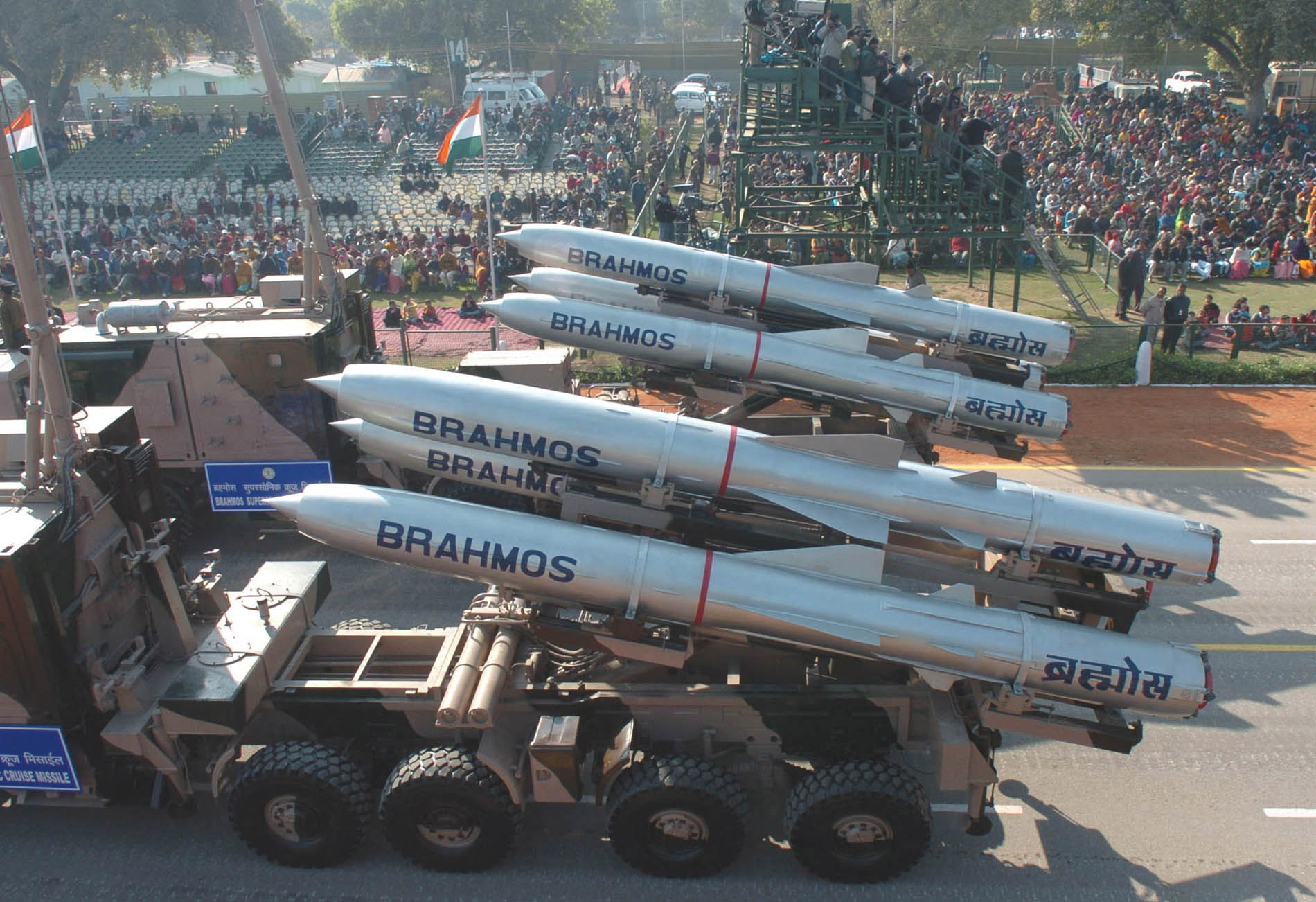
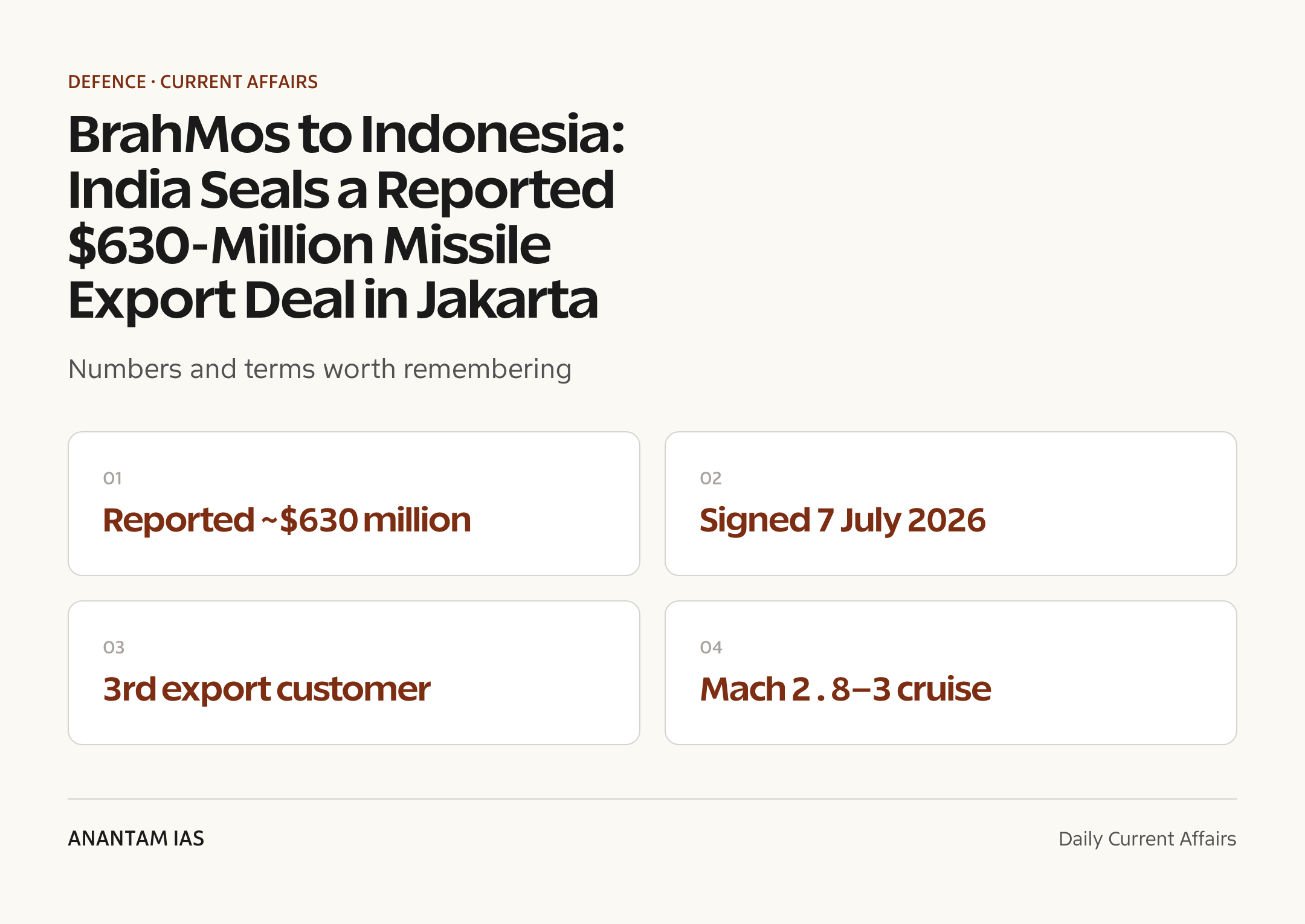
UPSC Relevance
Prelims Relevance
- BrahMos: two-stage supersonic cruise missile — solid-propellant booster + liquid-fuelled ramjet sustainer; cruise speed of about Mach 2.8–3.
- Joint venture BrahMos Aerospace (est. 1998) between DRDO (50.5%) and Russia’s NPO Mashinostroyenia (49.5%), under a Feb 1998 inter-governmental agreement.
- Name derives from two rivers — the Brahmaputra (India) and the Moskva (Russia).
- Launch platforms: land-based mobile launchers, surface ships, submarines, and the Su-30MKI (air-launched variant first tested in 2017).
- Original range capped near 290 km under MTCR limits; extended-range variants (450 km+, with ~800 km class under development) followed India’s MTCR membership in June 2016.
- Philippines — first export customer: Jan 2022 contract worth about $375 million for three shore-based anti-ship missile batteries; first delivery April 2024.
- Vietnam — second export customer: deal signed in FY 2025-26, publicly acknowledged by India’s defence secretary at the Shangri-La Dialogue in June 2026; reports value it at roughly $630–700 million.
- Astra: indigenous DRDO beyond-visual-range air-to-air missile, integrated on Su-30MKI and LCA Tejas.
- India’s defence exports: ₹38,424 crore in FY 2025-26 (up ~63% over ₹23,622 crore in FY 2024-25), reaching 80+ countries.
Mains Relevance
GS Paper 3
- Indigenisation of defence and Atmanirbhar Bharat: BrahMos as the flagship of India’s transition from the world’s largest arms importer to a credible exporter.
- Defence exports as an instrument of economy and security — the ₹50,000 crore by 2029 target, defence industrial corridors, and private-sector participation.
- Technology partnerships: what the DRDO–NPO Mashinostroyenia JV model teaches about co-development versus licence production.
GS Paper 2
- Defence diplomacy in the Act East Policy: arms transfers as the new currency of India’s Southeast Asia engagement.
- India–Indonesia Comprehensive Strategic Partnership — from maritime cooperation to hard-security supply relationships.
- India as a net security provider in the Indo-Pacific: implications of arming Philippines, Vietnam, and Indonesia — all facing pressure in or near the South China Sea.
Essay
- From arms importer to arms exporter — self-reliance as strategic autonomy.
- Hard power and soft power must move together: India’s Indo-Pacific moment.
- Technology partnerships, not technology dependence, build national capability.
Background and Context
What Is the BrahMos Missile System?
BrahMos is a supersonic cruise missile born of a rare co-development partnership between India and Russia.
- It is produced by BrahMos Aerospace, a joint venture set up in 1998 under an inter-governmental agreement of 12 February 1998, with DRDO holding 50.5% and Russia’s NPO Mashinostroyenia 49.5%.
- The name fuses the Brahmaputra and Moskva rivers — a deliberate symbol of the two partners.
- It is a two-stage missile: a solid-propellant booster accelerates it to supersonic speed, then a liquid-fuelled ramjet sustains cruise at about Mach 2.8–3 — among the fastest cruise missiles in service anywhere.
- It flies a low-altitude, fire-and-forget profile and is genuinely multi-platform: land-based mobile launchers, surface ships, submarines, and an air-launched version on the Su-30MKI.
- The export configuration respects the 290 km-class range under MTCR rules; after India joined the Missile Technology Control Regime in June 2016, extended-range versions (450 km+) entered testing for Indian forces, and a lighter BrahMos-NG is under development.
- Production has expanded beyond Hyderabad — a new integration facility at Lucknow, in the UP Defence Industrial Corridor, opened in 2025.
The Indonesia Contract: What Was Actually Signed
The Jakarta announcement confirmed a contract but deliberately withheld the commercial details.
- The contract was signed between BrahMos Aerospace and the Indonesian Ministry of Defense on 7 July 2026, announced by Indonesia’s Presidential Palace after the Prabowo–Modi meeting in Jakarta.
- Naval News reported that neither side has released the contract value, missile numbers, or delivery schedule — the ~$630 million figure circulating in Indian media is attributed to unnamed officials, not an official statement.
- The Jakarta Post noted that BrahMos Aerospace’s 2023 negotiations with Indonesia were then valued between $200 million and $350 million — so the reported final scope is materially larger.
- Reuters reported, citing an Indian government official, that the package extends beyond BrahMos: India is also to supply the Astra air-to-air missile, which would mark the first export of the indigenous DRDO-developed BVR missile.
- The signing was the centrepiece of PM Modi’s two-day Indonesia leg — his first visit to the country since 2023 — part of a wider July 2026 tour covered in our note on the PM’s three-nation visit and the Act East Policy.
Export Precedents: Philippines First, Vietnam Second
Indonesia is the third Southeast Asian buyer, and each earlier sale set a template.
- Philippines (January 2022): the first-ever BrahMos export contract, worth about $375 million, for three shore-based anti-ship missile batteries for the Philippine Marine Corps; the first battery arrived in April 2024 and a second in 2025.
- Each Philippine battery pairs mobile autonomous launchers with radar, command-and-control, and reload vehicles — a coastal-defence configuration aimed at the South China Sea.
- Vietnam: The Diplomat reported in June 2026 that India’s defence secretary confirmed at the Shangri-La Dialogue that a BrahMos contract with Vietnam had been signed in the previous fiscal year but kept unannounced; reports value the package at roughly $630–700 million, including training and logistics.
- With Jakarta signing on, Naval News counts Indonesia as the third export customer — meaning the three largest maritime states of Southeast Asia have all chosen the same Indian missile.
Why Indonesia Wants BrahMos
Jakarta’s interest is rooted in archipelagic geography and a doctrine of sea-denial.
- Indonesian planners have prioritised coastal-defence systems and land-based anti-ship missiles to build an anti-access/area denial (A2/AD) posture along the country’s Archipelagic Sea Lanes.
- The straits of Malacca, Sunda, Lombok, and Makassar — chokepoints of global shipping — are the obvious deployment logic for a supersonic anti-ship missile.
- Indonesia has operated in this class before: its navy fielded the Russian Yakhont (export P-800 Oniks, the missile BrahMos derives from) on the frigate KRI Oswald Siahaan, test-firing it in exercises in 2011 and 2012, per Naval News.
- That legacy matters — crews familiar with the Oniks family shorten the absorption curve, while the old Yakhont stock is believed non-operational.
- Buying Indian also diversifies Jakarta’s suppliers when Western systems carry political conditions and Russian ones carry sanctions risk under measures like CAATSA.
India's Defence-Export Push: The Numbers
The Indonesia deal lands on a steep, policy-driven export curve.
- India’s defence exports hit an all-time high of ₹38,424 crore in FY 2025-26, about 63% higher than the ₹23,622 crore of FY 2024-25, according to Ministry of Defence figures.
- The decadal jump is stark: exports were just ₹686 crore in 2013-14; they now reach 80+ countries.
- The government’s stated target is ₹50,000 crore in exports by 2029, alongside ₹3 lakh crore in total defence production, under Atmanirbhar Bharat.
- Policy scaffolding: two Defence Industrial Corridors (Uttar Pradesh and Tamil Nadu), liberalised export authorisations, positive-indigenisation lists, and lines of credit for buyers.
- Big-ticket export items: BrahMos, the Akash surface-to-air missile (Armenia), Pinaka rockets, artillery guns, radars, and Dornier aircraft — with Astra potentially joining via Indonesia.
- One high-value BrahMos contract moves the needle: the reported Indonesia value alone equals roughly ₹5,200–5,400 crore, a tenth of the 2029 annual target.
India–Indonesia: The Strategic Frame
The missile deal caps a relationship that has been thickening layer by layer since 2018.
- India and Indonesia elevated ties to a Comprehensive Strategic Partnership in 2018, with a shared vision on maritime cooperation in the Indo-Pacific.
- President Prabowo Subianto was chief guest at India’s Republic Day 2025, where defence manufacturing and maritime security headlined the joint statements.
- Defence exercises bind the militaries: Samudra Shakti (navies), Garuda Shakti (special forces), and the India-Indonesia Coordinated Patrol (CORPAT) along the Andaman Sea boundary.
- Indonesia sits astride the Malacca Strait approaches to India’s Andaman & Nicobar Command — cooperation here, including access discussions around Sabang port, has direct naval value for India.
- The two economies are also pairing security with resources — see our note on the India–Indonesia defence and critical minerals partnership for the nickel-and-minerals dimension of the same visit season.
- For India, arming ASEAN partners operationalises both the Act East Policy and the MAHASAGAR maritime vision without formal alliance structures.
Way Forward
Deliver on Time, Every Time
- Export credibility now rests on execution: production lines at Hyderabad and Lucknow must meet Philippine, Vietnamese, and Indonesian schedules simultaneously without starving Indian services.
- A published delivery-and-support track record is India’s best marketing against established exporters like France, South Korea, and Russia.
Build the Full Export Ecosystem
- Sales must come bundled with training, maintenance, spares, and mid-life upgrades — the after-market is where buyer trust (and repeat orders) is won.
- Extend lines of credit and flexible financing, since Southeast Asian defence budgets are stretched; affordability closed this deal as much as capability.
Protect the Technology, Respect the Regimes
- Export configurations must stay scrupulously within MTCR parameters and end-use monitoring norms — one violation would poison the entire export pipeline.
- Russian consent within the JV structure needs careful management as sanctions complicate component sourcing; deeper indigenisation of the propulsion and seeker reduces that exposure.
Widen the Basket Beyond BrahMos
- Convert the reported Astra export into a template for other indigenous systems — Akash-NG, Pinaka, naval sensors — so India’s export story isn’t a one-missile story.
- Institutionalise defence-industry dialogues with ASEAN states so procurement relationships outlast individual visits.
Conclusion
The Jakarta signing is more than a sale. A missile co-developed with Russia, built in India, and now ordered across the Philippines, Vietnam, and Indonesia gives New Delhi a strategic industrial footprint in Southeast Asia’s waters — a standing argument for India as a dependable Indo-Pacific security partner.
The caution flags are real: the headline $630 million remains unofficial, delivery timelines are undisclosed, and the JV’s Russian half sits under sanctions pressure. The 2029 target of ₹50,000 crore will be met by flawless execution of exactly these contracts, not by announcements.
For the aspirant, BrahMos-to-Indonesia is a perfect three-in-one: a GS3 defence-indigenisation case study, a GS2 Act East and Indo-Pacific illustration, and a live example of how technology partnerships convert into geopolitical influence.
UPSC Practice Questions
Prelims MCQ 1
With reference to the BrahMos missile system, consider the following statements:
- It is produced by a joint venture between India’s DRDO and Russia’s NPO Mashinostroyenia.
- Its name is derived from the Brahmaputra and Volga rivers.
- The Philippines was the first country to sign a contract for the export of BrahMos.
How many of the above statements are correct?
(a) Only one (b) Only two (c) All three (d) None
Answer: (b) Only two
Explanation:
Statements 1 and 3 are correct — BrahMos Aerospace is a DRDO–NPO Mashinostroyenia JV (est. 1998), and the Philippines signed the first export contract in January 2022 (~$375 million). Statement 2 is wrong: the name combines the Brahmaputra and the Moskva rivers, not the Volga.
Prelims MCQ 2
‘Astra’, recently in news in the context of India’s defence exports, is:
(a) an indigenous beyond-visual-range air-to-air missile developed by DRDO (b) a surface-to-air missile system jointly developed with Israel (c) a submarine-launched ballistic missile of the Indian Navy (d) an anti-tank guided missile produced under licence from Russia
Answer: (a) an indigenous beyond-visual-range air-to-air missile developed by DRDO
Explanation:
Astra is DRDO’s indigenous beyond-visual-range air-to-air missile, integrated on the Su-30MKI and LCA Tejas. Reuters reported that India will supply Astra to Indonesia alongside BrahMos — its first export if concluded.
UPSC Mains Questions
- India has moved from being the world’s largest arms importer to a growing defence exporter. Using the BrahMos exports to Southeast Asia as a case study, examine the economic and strategic significance of defence exports for India, and the challenges in sustaining this trajectory. (250 words)
- Defence cooperation is emerging as the sharpest instrument of India’s Act East Policy. Discuss with reference to India’s recent defence engagements with Indonesia, Vietnam, and the Philippines, and their implications for the Indo-Pacific balance of power. (250 words)
Sources: The Jakarta Post and Naval News.
Frequently Asked Questions
What BrahMos deal did India sign with Indonesia?
On 7 July 2026, BrahMos Aerospace and Indonesia’s Ministry of Defense signed a contract for the BrahMos supersonic cruise missile system in Jakarta, during PM Modi’s visit. Reports citing Indian officials value it at about $630 million, though neither government has officially confirmed the value, quantity, or delivery schedule.
Which countries have bought the BrahMos missile so far?
The Philippines was the first export customer (January 2022, about $375 million for three coastal batteries, delivered from April 2024). Vietnam signed a deal in FY 2025-26 that India acknowledged in June 2026. Indonesia became the third export customer with the July 2026 Jakarta contract.
Who makes the BrahMos missile?
BrahMos Aerospace, a joint venture formed in 1998 between India’s DRDO (50.5%) and Russia’s NPO Mashinostroyenia (49.5%). The missile is named after the Brahmaputra and Moskva rivers. Production facilities operate at Hyderabad and, since 2025, at Lucknow in the UP Defence Industrial Corridor.
How fast and how far can BrahMos fly?
BrahMos cruises at about Mach 2.8–3, making it one of the fastest cruise missiles in service. The standard export version has a range near 290 km, in line with MTCR limits. After India joined the MTCR in 2016, extended-range variants of 450 km and beyond entered testing for Indian forces.
Why does Indonesia want BrahMos missiles?
Indonesia is building an anti-access/area-denial posture to guard its archipelagic sea lanes and chokepoints like the Malacca, Sunda, Lombok, and Makassar straits. Its navy earlier operated the Russian Yakhont — the missile BrahMos derives from — so BrahMos fits both its doctrine and its operating experience.
What is India’s defence export target?
India aims for ₹50,000 crore in annual defence exports by 2029, under Atmanirbhar Bharat. Exports reached a record ₹38,424 crore in FY 2025-26 — up from ₹23,622 crore the year before and just ₹686 crore in 2013-14 — reaching more than 80 countries.
Source: https://anantamias.com/current-affairs/brahmos-export-indonesia-defence-deal/
UDISE+ 2025-26 Report: What the New School Education Data Shows
Why in News?
PIB confirmed that the Union Ministry of Education released the Report on Unified District Information System for Education Plus (UDISE+) 2025-26 on school education in India on 7 July 2026. Compiled by the Department of School Education and Literacy, UDISE+ is the country’s largest administrative database on schools, covering enrolment, teachers, infrastructure and stage-wise flow indicators for every recognised school from pre-primary to higher secondary across all States and Union Territories.
The headline picture is one of improving inputs and stronger retention: the teacher workforce has crossed 1.02 crore, the Pupil-Teacher Ratio (PTR) at every stage now sits well within the NEP 2020 norm of 30:1, secondary-level Gross Enrolment Ratio (GER) has climbed to 71.7%, and girls make up 48.4% of total enrolment.
For an aspirant, the report matters less as news than as a durable data anchor. It is the single official source that drives Samagra Shiksha fund allocation, feeds the Performance Grading Index (PGI 2.0) that ranks States and UTs, and underpins India’s national reporting against the education targets of Sustainable Development Goal 4. Reading its numbers as a progress card against NEP 2020 is what converts a press release into exam-ready notes.
- Teachers numbered 1,02,73,020 in 2025-26 — an 8.3% rise over the 94,83,294 recorded in 2022-23, the first year the national teacher count has crossed 1.02 crore.
- PTR now stands at 10 (Foundational), 12 (Preparatory), 17 (Middle) and 21 (Secondary) — all comfortably better than NEP 2020’s recommended 30:1 and the older Right to Education (RTE) Act, 2009 norms of 30:1 (primary) and 35:1 (upper primary).
- Secondary-stage dropout rate fell from 8.2% to 7.0%, and secondary retention improved from 47.2% to 51.9% in a single year.
- Secondary GER rose from 68.5% (2024-25) to 71.7% (2025-26); middle-stage GER held near 89.6%.
- Zero-enrolment schools declined about 29% to 5,663; single-teacher schools fell about 3% to 1,00,843.
- Female teachers now form 54.9% of the teaching workforce; girls’ enrolment inched up to 48.4% from 48.3%.
- Digital reach widened sharply since 2022-23: schools with computers rose to 69.9% and those with internet to 67.4%, even as roughly a third of schools stay offline.
The development matters in the context of:
- UDISE+ data is the statistical backbone for Samagra Shiksha planning, PGI 2.0 state grading and India’s reporting against SDG 4 (quality education).
- NEP 2020 targets 100% GER from preschool to secondary level by 2030 — a secondary GER of 71.7% shows how much distance remains at the top of the school pyramid.
- The report is published in both the Existing format and the NEP format (Foundational-Preparatory-Middle-Secondary), reflecting the transition to the 5+3+3+4 curricular design.
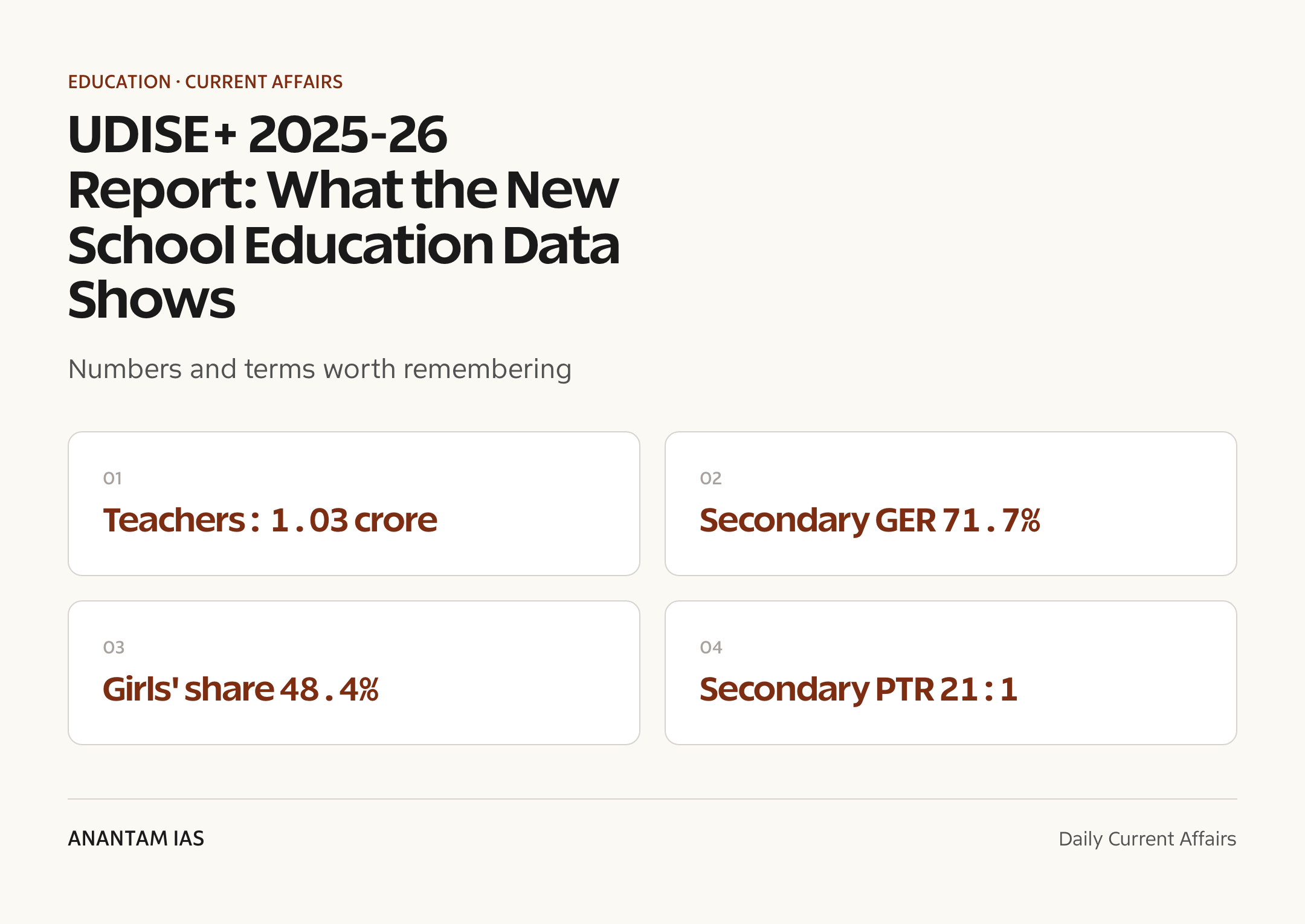
UPSC Relevance
Prelims Relevance
- UDISE+ — online school-data platform of the Department of School Education and Literacy, Ministry of Education; operational since 2018-19 as the upgraded version of UDISE (2012-13), which had merged the earlier DISE databases for elementary and secondary education.
- Since 2022-23, UDISE+ collects individual student-wise data from all recognised schools — a shift from aggregate school-level reporting.
- PTR 2025-26: Foundational 10, Preparatory 12, Middle 17, Secondary 21; NEP 2020 recommends a PTR under 30:1 (under 25:1 in disadvantaged areas).
- GER = enrolment at a stage as a % of population in the official age group (can exceed 100%); NER counts only official-age children, so NER ≤ GER — a standard Prelims trap.
- Dropout rates 2025-26: Preparatory 1.8%, Middle 3.6%, Secondary 7.0%; secondary retention 51.9%.
- Transition rates 2025-26: Foundational→Preparatory 99.2%, Preparatory→Middle 93.8%, Middle→Secondary 88.3%.
- Infrastructure coverage: drinking water 99.5%, girls’ toilets 98.5%, electricity 95.0%, computers 69.9%, internet 67.4%, ramps with handrails 58.2%.
- PGI 2.0 — Performance Grading Index for States/UTs: 73 indicators, 1,000 points, two categories (Outcomes; Governance & Management), grades from Daksh (top) to Akanshi-3 (bottom).
Mains Relevance
GS Paper 2
- Social sector — education: what improving inputs (teachers, PTR, digital access) do and don’t tell us about learning outcomes.
- NEP 2020 implementation: the 5+3+3+4 design, universal GER by 2030, and tracking progress through administrative data.
- Evidence-based governance: UDISE+, PGI 2.0 and data-driven teacher and fund allocation; limits of self-reported data.
- Gender and equity: girls at 48.4% of enrolment, women at 54.9% of teachers; only 58.2% of schools barrier-free.
GS Paper 1
- Social empowerment and the role of schooling in intergenerational mobility; regional and stage-wise disparities in retention.
Essay
- Inputs are necessary, outcomes are the test: what a classroom ratio can and cannot measure.
- Data is the new blackboard: administrative statistics and the governance of Indian education.
Background and Context
What UDISE+ Is and How the Data Is Collected
UDISE+ is India’s official census-style database of school education, run by the Department of School Education and Literacy — the definitional layer an aspirant must fix before reading any of its numbers.
- The lineage runs deep: DISE (District Information System for Education), launched in the mid-1990s under the District Primary Education Programme and later housed at NIEPA, tracked elementary schools, while a parallel SEMIS covered secondary schools.
- UDISE (from 2012-13) merged these elementary and secondary streams into one framework; UDISE+ (from 2018-19) moved the whole exercise online, adding real-time entry, in-built consistency checks and geo-tagging to curb the data-quality and time-lag problems of the manual system.
- It is a complete enumeration, not a sample survey: every government, aided, private and ‘other’ recognised school reports on itself, so UDISE+ describes the school system as a whole rather than estimating from a subset.
- Schools upload their own returns, which are then validated at block, district and state levels before national compilation — a layered check that improves reliability without removing the underlying self-reporting bias.
- Since 2022-23, the platform captures individual student-wise records keyed to a unique ID, with over 60 variables per child — enabling tracking of dropout, retention and transition child-by-child, which aggregate school-level counts could never do.
- The 2025-26 report is published in two formats: the Existing format (primary / upper-primary / secondary / higher-secondary) and the NEP format aligned to the 5+3+3+4 stages — Foundational, Preparatory, Middle and Secondary — letting users read the same system through the old and new architectures.
- Its outputs are not academic: they set per-child and per-school entitlements under Samagra Shiksha, so an inflated or missing entry has direct fiscal and planning consequences.
- Full publications are available on the official UDISE+ portal.
Teachers and PTR: The Input Story
Teacher numbers have risen every year since 2022-23, pulling stage-wise ratios well below both the NEP and RTE ceilings — but headline ratios and ground realities can diverge.
- The Pupil-Teacher Ratio (PTR) is simply total students divided by total teachers at a stage; a lower number means fewer children per teacher, and it is the standard proxy for teacher adequacy even though it says nothing about teacher quality or attendance.
- The workforce grew from 94,83,294 (2022-23) to 98,07,600 (2023-24), 1,01,22,420 (2024-25) and 1,02,73,020 in 2025-26 — a cumulative 8.3% increase over three years.
- PTR improved across every stage over four years: Foundational 11→10, Preparatory 14→12, Middle 18→17, Secondary 23→21.
- Every stage now sits far inside NEP 2020’s recommended ceiling of 30:1, which the policy pairs with a stricter 25:1 for areas with large numbers of socio-economically disadvantaged students.
- The ratios also clear the older statutory benchmarks in the Schedule to the RTE Act, 2009 — 30:1 at primary and 35:1 at upper-primary — showing the input mandate of the last framework has effectively been met nationally.
- A national PTR under the norm masks within-country skew: some blocks and subjects run heavy surpluses while others face acute shortages, especially for maths, science and language teachers at the secondary stage.
- PIB noted that UDISE+ findings are used to rationalise teacher allocation — redeploying teachers to where ratios are stretched rather than only hiring more, which is why accurate school-level entries matter.
- Single-teacher schools fell from 1,18,190 (2022-23) to 1,00,843 (2025-26); over a lakh such schools still running is a structural worry, since one teacher handling multiple grades weakens instruction quality regardless of the national average.
Retention, Dropout and Transition: Children Staying Longer
The flow indicators — how many children stay, leave and move up — improved almost across the board in 2025-26, and knowing exactly what each one measures is a common Prelims discriminator.
- Three flow metrics travel together: the dropout rate is the share of students leaving a stage without completing it; the retention rate is the share reaching the last grade of a stage relative to those who entered its first grade; and the transition rate is the share moving from the last grade of one stage into the first grade of the next.
- Dropout rates since 2022-23 fell steeply: Preparatory 8.7%→1.8%; Middle 8.1%→3.6%; Secondary 13.8%→7.0% — with secondary still the leakiest stage of the system.
- Retention in 2025-26: Foundational 98.5%, Preparatory 91.1%, Middle 83.7%, Secondary 51.9% — the secondary figure jumped nearly five percentage points from 47.2% in a single year.
- Transition rates all rose: Foundational→Preparatory 99.2%, Preparatory→Middle 93.8%, Middle→Secondary 88.3% — the drop at the middle-to-secondary junction being where most adolescent leakage begins.
- PIB attributed the secondary-stage gains partly to an increase in schools offering secondary education, which shortens the physical distance to continued study — a supply-side response to a long-standing access gap.
- The classic drivers behind adolescent dropout — household poverty and child labour, early marriage of girls, distance to secondary schools, and the pull of low-skill work — are exactly what schemes like scholarships, KGBVs and vocational streams try to counter.
- Zero-enrolment schools — schools with no students at all — dropped about 29% in one year, from 7,993 to 5,663, aiding rationalisation of idle buildings and staff.
Access and Enrolment: GER and the Gender Picture
Enrolment ratios show clear gains at the secondary stage, with gender indicators moving gradually in the right direction — but the GER/NER distinction is where the real reading happens.
- Secondary GER rose from 68.5% to 71.7%; middle-stage GER stayed around 89.6%, and enrolment thins visibly as the stage rises — the pyramid narrows towards the top.
- Gross Enrolment Ratio (GER) measures total enrolment at a stage against the corresponding official age-group population, so over-age and under-age children can push it past 100%; it captures coverage but not age-appropriateness.
- Net Enrolment Ratio (NER) counts only children of the official age group enrolled in that stage, so it is always the stricter measure — NER can never exceed GER, and a wide GER-NER gap signals large numbers of over-age or repeating students.
- Girls’ enrolment reached 48.4% of total enrolment (48.0% in 2022-23), broadly mirroring the population share and reflecting the near-closure of the elementary-stage gender gap achieved over the last two decades.
- The Gender Parity Index (GPI) — girls’ GER divided by boys’ GER, with 1.0 as parity — now sits close to or above 1 at the school stages, one of India’s clearest equity successes.
- Female teachers rose to 54.9% of the workforce, from 52.3% in 2022-23; a majority-female teaching profession is associated with safer, more gender-sensitive classrooms and stronger retention of girls, especially at upper stages.
- Both trends support the NEP 2020 equity agenda, including its Gender Inclusion Fund and targeted support for Socio-Economically Disadvantaged Groups (SEDGs), alongside schemes such as Kasturba Gandhi Balika Vidyalayas for adolescent girls.
School Infrastructure: Digital and Basic Facilities
Basic amenities are near-universal; digital infrastructure is expanding fastest but remains the biggest gap — and several of these facilities are legal entitlements, not aspirations.
- The Schedule to the RTE Act, 2009 already mandates minimum norms for every school — an all-weather building, separate toilets for boys and girls, safe drinking water, a library, a playground and a barrier-free environment — so infrastructure numbers double as a compliance scorecard.
- Schools with computer access rose from 64.7% to 69.9%; schools with internet from 63.5% to 67.4% — up dramatically from 47.7% and 49.7% respectively in 2022-23, the fastest-moving indicators in the report.
- Basic facilities in 2025-26 are near-universal: drinking water 99.5%, girls’ toilets 98.5%, boys’ toilets 97.2%, handwash 96.9%, electricity 95.0%, library 90.5%.
- Ramps with handrails reached 58.2% of schools (51.0% in 2022-23) — real progress on inclusive access, yet two in five schools still aren’t barrier-free for children with disabilities.
- Playground availability actually slipped, from 83.0% to 81.9%, and rainwater harvesting exists in under 30% of schools — the two visible soft spots in an otherwise improving table.
- The digital gap has a spatial pattern: the roughly one-third of schools without internet are concentrated in rural, remote and hilly blocks, the same places where teacher shortages and long distances to secondary schools also cluster.
- Digital access matters directly for DIKSHA, PM e-Vidya and the NEP’s technology-in-education agenda; without connectivity, digital content and online assessments simply cannot reach the last-mile school.
The NEP 2020 Yardstick
The report’s own categories are built around NEP 2020, so its numbers read as a running progress card against the policy’s stated targets.
- NEP 2020 replaced the old 10+2 structure with a 5+3+3+4 design: Foundational (ages 3-8, covering pre-primary plus Classes 1-2), Preparatory (8-11, Classes 3-5), Middle (11-14, Classes 6-8) and Secondary (14-18, Classes 9-12), formally bringing early-childhood education into the school system.
- Its headline access target is 100% GER from preschool to secondary level by 2030; secondary GER at 71.7% leaves roughly 28 percentage points to close in about four years — the steepest stretch of the climb.
- On teachers, the policy sets PTR under 30:1 everywhere (25:1 in disadvantaged areas) — now achieved at every stage — alongside continuous professional development, a common National Professional Standards for Teachers, and merit-based deployment.
- NEP also targets public spending on education at 6% of GDP (a goal traced back to the 1968 Kothari Commission that remains unmet), and universal Foundational Literacy and Numeracy (FLN) through the NIPUN Bharat mission.
- It commits to bringing an estimated 2 crore out-of-school children back into the system and to reducing dropout by strengthening the middle-to-secondary bridge, both of which UDISE+ flow data now track directly.
- The falling count of zero-enrolment and single-teacher schools reflects the policy’s push for school complexes/clusters that share resources and rationalise teacher deployment across nearby schools.
Where the Gaps Remain
Read critically, the same tables flag the unfinished agenda a strong Mains answer should foreground rather than celebrate the headlines.
- Secondary retention of 51.9% means nearly half a cohort still doesn’t complete the secondary stage — the single starkest number in the report and the clearest gap against the 100%-by-2030 target.
- Middle-stage dropout ticked up marginally from 3.5% to 3.6%, and Foundational/Preparatory retention dipped slightly after three years of gains — a reminder that trends can plateau or reverse.
- UDISE+ counts inputs and flows, not learning: it cannot say whether children read or compute at grade level — that is the job of learning surveys such as the National Achievement Survey (NAS) run by PARAKH, and independent studies like ASER, which have repeatedly flagged a foundational-learning crisis.
- Data is self-reported by schools; the block-district-state validation layers help, but incentives to over-report enrolment (tied to entitlements) or facilities remain a structural weakness of administrative statistics.
- National averages hide wide inter-state and rural-urban spreads — a national PTR under 30 coexists with severely understaffed districts — which is exactly why the Ministry grades States separately through PGI 2.0.
- Counting a facility as ‘present’ says nothing about whether it functions: a listed computer lab, toilet or library may be non-working, so infrastructure coverage is a ceiling on quality, not proof of it.
From Data to Accountability: PGI 2.0
UDISE+ numbers feed directly into the Ministry’s grading instrument for States, closing the loop between raw data and public accountability.
- PGI 2.0 (Performance Grading Index for States/UTs) scores school education across 73 indicators worth 1,000 points, in two broad categories — Outcomes and Governance & Management — spread over six domains: Learning Outcomes, Access, Infrastructure & Facilities, Equity, Governance Processes, and Teacher Education & Training.
- Grades run from Daksh (above 90%) through Utkarsh, Ati-Uttam, Uttam, Prachesta and Akanshi bands down to Akanshi-3 (the lowest); in the most recent published rounds no State reached the top bands, underscoring that strong inputs alone do not buy quality outcomes.
- A district-level version, PGI-D, applies the same logic below the State level so that intra-State variation is visible too.
- The design deliberately weights outcomes over inputs, nudging States to chase learning and equity rather than only building facilities — the accountability counterpart to UDISE+’s descriptive data.
- Together, UDISE+, PGI 2.0 and PARAKH/NAS assessments form the monitoring architecture of NEP 2020 — administrative data, comparative grading and learning measurement respectively.
- For daily exam-focused coverage of such reports, see the Anantam IAS current affairs archive.
Way Forward
Fix the secondary-stage funnel
- Expand secondary-school availability in underserved blocks, backed by transport support, residential facilities, scholarships and vocational pathways that make staying enrolled worthwhile.
- Target the transition points (middle→secondary at 88.3%) by flagging individual at-risk children early — now feasible with student-wise UDISE+ records — and following up on non-transitioning students by name.
- Strengthen adolescent-specific supports — KGBVs, bicycle and stipend schemes, and bridge courses — that address the poverty, distance and early-marriage pressures behind secondary dropout.
Shift from inputs to outcomes
- Pair UDISE+ input data with PARAKH/NAS learning assessments so PTR and infrastructure gains are judged by what children actually learn, not merely by facilities on a checklist.
- Anchor early grades in the NIPUN Bharat foundational literacy and numeracy mission, since weak foundations are the deepest cause of later dropout.
- Publish district-level dashboards that link spending, staffing and outcomes, and move toward independent third-party audits to offset the self-reporting bias in administrative data.
Close the digital and inclusion gaps
- Prioritise internet and computer access for the remaining roughly 30% of offline schools, converging with BharatNet and PM e-Vidya so digital content and assessments actually reach rural classrooms.
- Accelerate barrier-free access (ramps, accessible toilets) beyond 58.2% — a legal obligation under the Rights of Persons with Disabilities Act, 2016 and the RTE norms, not just a facility metric.
- Arrest the slide in playgrounds, mainstream rainwater harvesting, and shift the focus from whether a facility exists to whether it is functional and used.
Deploy teachers where they are needed
- Use UDISE+ ratios to rationalise teacher deployment — redeploying surplus teachers and filling subject-specific vacancies in maths, science and languages at the secondary stage rather than reading comfort from the national average.
- Phase out the remaining 1,00,843 single-teacher schools through school-complex clustering, so no child depends on one teacher across multiple grades.
Conclusion
UDISE+ 2025-26 is, on balance, a good-news report: more teachers, friendlier classroom ratios, fewer children dropping out, and near-universal basic amenities. The direction of every major flow indicator — dropout, retention, transition, GER — is favourable, and the gender composition of both classrooms and staffrooms keeps improving. The input mandate of the RTE era has largely been fulfilled at the national level.
But the report also defines the next frontier precisely. A secondary retention rate of 51.9% and a secondary GER of 71.7% against NEP 2020’s 100%-by-2030 target mean the system still loses too many adolescents exactly when schooling starts paying off. National averages, which say nothing about learning, also sit atop wide inter-state and rural-urban gaps that only PGI 2.0 and learning surveys expose.
The task ahead is a shift in kind, not degree: from counting inputs to measuring learning, from building facilities to making them function, and from national averages to the specific blocks and children being left behind. Whether India converts its improving inputs into completion and grade-level learning is now the real test of evidence-based education governance — and UDISE+, read honestly, is the instrument that will keep score.
UPSC Practice Questions
Prelims MCQ 1
With reference to the Unified District Information System for Education Plus (UDISE+), consider the following statements:
- It is maintained by the Department of School Education and Literacy under the Union Ministry of Education.
- It has collected individual student-wise data from all recognised schools since 2022-23.
- According to the UDISE+ 2025-26 report, the Pupil-Teacher Ratio at the secondary level is worse than the 30:1 ratio recommended by NEP 2020.
How many of the above statements are correct?
(a) Only one (b) Only two (c) All three (d) None
Answer: (b) Only two
Explanation:
Statements 1 and 2 are correct: UDISE+ is run by the Department of School Education and Literacy and has captured student-wise records since 2022-23. Statement 3 is incorrect — secondary-stage PTR is 21, comfortably better than NEP 2020’s recommended ceiling of 30:1.
Prelims MCQ 2
According to the UDISE+ 2025-26 report, which one of the following indicators recorded a decline compared with 2024-25?
(a) Percentage of schools with playgrounds (b) Girls’ share of total enrolment (c) Gross Enrolment Ratio at the secondary level (d) Percentage of schools with internet access
Answer: (a) Percentage of schools with playgrounds
Explanation:
Playground availability slipped from 83.0% to 81.9%. Girls’ enrolment (48.3%→48.4%), secondary GER (68.5%→71.7%) and internet access (63.5%→67.4%) all improved.
UPSC Mains Questions
- The UDISE+ 2025-26 report shows improving inputs but persistent attrition at the secondary stage. Examine the factors behind low secondary retention in Indian school education and suggest measures to achieve NEP 2020’s target of universal Gross Enrolment Ratio by 2030.
- Reliable administrative data is the backbone of education governance. Discuss the roles of UDISE+, PGI 2.0 and learning assessments in evidence-based policymaking for school education in India, along with the limitations of self-reported data.
- Near-universal toilets and drinking water but only 58% barrier-free schools and 70% with computers — critically assess whether India’s school infrastructure push is keeping pace with the inclusion and digital-learning goals of NEP 2020.
Sources: PIB, Ministry of Education and UDISE+ portal, Department of School Education & Literacy.
Frequently Asked Questions
What is UDISE+?
UDISE+ (Unified District Information System for Education Plus) is the Ministry of Education’s online database covering all recognised schools in India. Operational since 2018-19 as an upgrade of UDISE, it records enrolment, teachers, infrastructure and student flows, and has collected individual student-wise data since 2022-23.
Who publishes the UDISE+ report?
The Department of School Education and Literacy under the Union Ministry of Education compiles and publishes it. Schools upload their own data online, which is verified at block, district and state levels. The 2025-26 report was released on 7 July 2026 in both the Existing and NEP formats.
What are the key findings of UDISE+ 2025-26?
Teachers rose to 1.02 crore (up 8.3% since 2022-23), secondary GER climbed to 71.7%, secondary dropout fell to 7.0%, secondary retention improved to 51.9%, girls’ enrolment reached 48.4%, and 69.9% of schools now have computer access. Zero-enrolment schools fell about 29% to 5,663.
What Pupil-Teacher Ratio does NEP 2020 recommend?
NEP 2020 recommends a PTR under 30:1 at every school, and under 25:1 in areas with many socio-economically disadvantaged students. UDISE+ 2025-26 reports PTRs of 10, 12, 17 and 21 at the Foundational, Preparatory, Middle and Secondary stages — all within the norm.
What is the difference between GER and NER?
Gross Enrolment Ratio counts all students at a stage against the official age-group population, so over-age and under-age children can push it beyond 100%. Net Enrolment Ratio counts only children of the official age group, making it the stricter measure. NER can never exceed GER.
How does UDISE+ relate to PGI 2.0?
UDISE+ supplies much of the raw data for PGI 2.0, the Performance Grading Index that scores states and UTs on 73 indicators worth 1,000 points across outcomes and governance. Grades run from Daksh (highest) to Akanshi-3, turning administrative data into comparative accountability.
Source: https://anantamias.com/current-affairs/udise-plus-2025-26-school-education-report/
Gayatri Mantra in Schools: Chhattisgarh HC Ruling and the Article 28 Framework
Why in News?
The Chhattisgarh High Court dismissed a petition challenging a state School Education Department order that introduced the recitation of the Saraswati Vandana, Gayatri Mantra, Guru Mantra, Shanti Mantra and other invocations in morning assemblies of government schools. Bar and Bench and LiveLaw reported the order in Abdul Salam Rizvi v State of Chhattisgarh on 8 July 2026.
A single-judge bench of Justice Amitendra Kishore Prasad held the plea “entirely premature”, finding that the impugned order dated 12 June 2026 contains no coercive direction compelling any student to act against their religious beliefs — and that Article 28(1) prohibits “religious instruction” in wholly State-funded institutions but “does not ban moral instruction, disassociated from any denominational doctrines”.
- The challenged government order, dated 12 June 2026, directed recitation of Saraswati Vandana, Gayatri Mantra, Guru Mantra, Shanti Mantra, Bhojan Mantra and related invocations in government-school morning assemblies from the 2026-27 academic session.
- Petitioners included former Chhattisgarh Waqf Board chairman Abdul Salam Rizvi, former Minority Department chairman Mahendra Chhabda and a Bilaspur-based activist; they invoked Articles 14, 21, 25, 28(1), 29 and 30.
- The State called the plea politically motivated, arguing the order involves “neither religious instruction nor conversion” and aligns with NEP 2020 and its Indian Knowledge Systems (IKS) component.
- The court noted the order prescribes no punishment or disciplinary action against a student who chooses not to recite the verses, and that petitioners placed no material showing violation of any fundamental right or direct injury.
- The ruling turns on the Article 28(1) distinction between prohibited “religious instruction” and permissible “moral instruction” — a line the Supreme Court has drawn since DAV College (1971) and Aruna Roy (2002).
The development matters in the context of:
- The case revives a recurring constitutional question — where school prayer, value education and the study of religion sit within India’s model of secularism, which the Supreme Court declared part of the basic structure in S.R. Bommai v Union of India (1994).
- A related challenge to the common Sanskrit-Hindi prayer in Kendriya Vidyalayas was referred to a Constitution Bench of the Supreme Court in 2019 and remains pending, so the doctrinal question is live at the national level.
- For aspirants, the episode packages Article 28’s three-tier scheme, freedom of conscience under Article 25, and the right to remain silent under Article 19(1)(a) into one current-affairs hook.
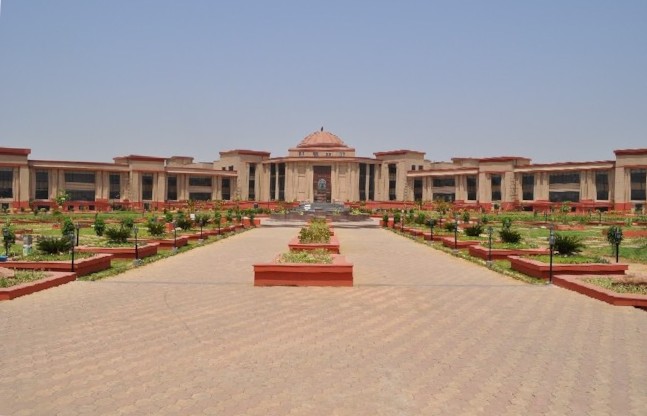
UPSC Relevance
Prelims Relevance
- Article 28(1) — no religious instruction shall be provided in any educational institution wholly maintained out of State funds.
- Article 28(2) — the bar does not apply to an institution administered by the State but established under an endowment or trust requiring religious instruction.
- Article 28(3) — in institutions recognised by the State or receiving State aid, no person can be compelled to attend religious instruction or worship without consent (a guardian’s consent for minors).
- Article 25 — freedom of conscience and free profession, practice and propagation of religion, subject to public order, morality and health.
- Bijoe Emmanuel v State of Kerala (1986) — students cannot be expelled for respectfully declining to sing the national anthem; Article 19(1)(a) includes the right to remain silent.
- Aruna Roy v Union of India (2002) — study of religions and value education is not “religious instruction” under Article 28; upheld the NCFSE 2000.
- DAV College v State of Punjab (1971) — academic study of the life and teachings of Guru Nanak is not religious instruction.
- S.R. Bommai v Union of India (1994) — secularism is part of the basic structure of the Constitution.
- The word “secular” was inserted into the Preamble by the 42nd Constitutional Amendment, 1976.
- Gayatri Mantra — a Vedic verse from the Rigveda (Mandala 3), attributed to sage Vishvamitra.
Mains Relevance
GS Paper 2
- Article 28’s graded scheme as a marker of Indian secularism — principled distance rather than a strict wall of separation between State and religion.
- Judicial tests separating religious instruction from moral instruction and the academic study of religion (DAV College, Aruna Roy).
- Tension between State-prescribed school routines and the freedom of conscience of religious minorities under Articles 25, 29 and 30.
- The doctrine of prematurity and locus in constitutional litigation — courts requiring concrete injury before striking down executive orders.
GS Paper 1
- Secularism and communal harmony in a diverse society; the school’s role in socialisation and value formation.
- Vedic literature in context — the Gayatri Mantra’s Rigvedic origin as an art-and-culture touchpoint.
GS Paper 4
- Value education versus indoctrination — designing moral instruction that is genuinely non-denominational in a plural classroom.
Essay
- Secularism in India is a way of shared living, not a wall of separation.
- Schools shape citizens before they shape scholars — the ethics of what a classroom recites.
- Diversity is not a problem to be managed but a value to be taught.
Background and Context
The order, the petition and the ruling
The dispute began with a routine departmental circular and ended in a constitutional argument.
- On 12 June 2026, the Chhattisgarh School Education Department ordered that morning assemblies in government schools include the Saraswati Vandana, Gayatri Mantra, Guru Mantra, Shanti Mantra and Bhojan Mantra, alongside the national anthem, national song and the Rajya Geet, from the 2026-27 session.
- The petitioners — led by former Waqf Board chairman Abdul Salam Rizvi — argued the order amounts to imparting religious instruction in State-funded schools, compelling minority students to recite practices “that do not belong to their faith”, and pleaded violations of Articles 14, 21, 25, 28(1), 29 and 30.
- The State replied that the terms “compulsory” and “ensure” in the order relate to internal school administration, not religious coercion; that no punishment attaches to non-recitation; and that the verses are pedagogic invocations aligned with NEP 2020’s Indian Knowledge Systems thrust.
- Justice Amitendra Kishore Prasad dismissed the plea as “entirely premature”: a careful reading of the order showed no mandatory or coercive direction, and petitioners produced no material demonstrating a fundamental-rights violation or direct injury.
- On substance, the court held that “religious instruction” in Article 28(1) has a restricted meaning — the teaching of religious customs, rituals, practices and modes of worship — and the provision “does not ban moral instruction, disassociated from any denominational doctrines”, which it called essential to training in citizenship and social cohesion.
Article 28: the graded constitutional scheme
Article 28 does not treat all educational institutions alike — it builds a three-tier scheme keyed to State funding. See the full provision set in Articles 25-28 on freedom of religion.
- Article 28(1) — institutions wholly maintained out of State funds: religious instruction is absolutely prohibited.
- Article 28(2) — institutions administered by the State but established under an endowment or trust requiring religious instruction: the prohibition does not apply (e.g., institutions the State inherited with a religious-teaching mandate).
- Article 28(3) — institutions recognised by the State or receiving State aid: religious instruction may exist, but no person can be compelled to attend it or any religious worship without consent — for a minor, the guardian’s consent.
- The scheme distinguishes funding, administration and recognition — a classic Prelims trap, since the strictness of the bar falls as State involvement in funding falls.
- Article 28 sits within the Right to Freedom of Religion cluster (Articles 25-28), alongside the minority-rights guarantees of Articles 29 and 30 — both of which the petitioners also invoked.
Religious instruction vs moral instruction: the case law
The distinction the Chhattisgarh HC applied has a five-decade judicial lineage.
- DAV College v State of Punjab (1971) — the Supreme Court held that an academic study of the life and teachings of Guru Nanak at Guru Nanak University was not “religious instruction”; studying a religion is different from being instructed in it.
- Aruna Roy v Union of India (2002) — the Court upheld the National Curriculum Framework for School Education, 2000, holding that education about religions, value education and the philosophy of sarva dharma samabhava do not offend Article 28; “religious instruction” means inculcating a particular religion’s rituals, tenets and modes of worship.
- Santosh Kumar v Ministry of HRD (1994) — teaching Sanskrit as an elective in CBSE schools was upheld; a classical language is not a religion.
- Bijoe Emmanuel v State of Kerala (1986) — the counter-weight: three children of the Jehovah’s Witnesses faith could not be expelled for declining to sing the national anthem; Article 19(1)(a) protects the right to remain silent and Article 25 protects conscientious objection.
- Read together, the doctrine permits non-denominational moral education and the comparative study of religions in State schools, while barring both denominational indoctrination and compelled participation in religious practice.
Secularism as basic structure: the constitutional backdrop
The Indian model of secularism frames how courts read school-prayer disputes. The doctrine’s evolution is mapped in this basic structure doctrine explainer.
- S.R. Bommai v Union of India (1994) — a nine-judge bench held secularism is part of the Constitution’s basic structure; the State must treat all religions with equal respect and maintain neutrality.
- India follows positive (principled-distance) secularism — the State may engage with religion to reform or facilitate (temple-entry laws, aid to minority institutions) — unlike the strict wall of separation in the US model.
- The word “secular” entered the Preamble through the 42nd Amendment (1976), but the Supreme Court has held the concept was implicit in the original Constitution.
- The Constituent Assembly consciously drafted Article 28 to keep wholly State-funded classrooms free of denominational teaching while accommodating India’s inherited network of religiously endowed institutions.
- Minority safeguards under Articles 29-30 — conserving culture and running minority institutions — complete the framework; the explainer on cultural and educational rights covers both articles.
The NEP 2020 and value-education angle
The State’s defence leaned on national education policy rather than religion.
- The State argued the order aligns with NEP 2020, which mandates integrating Indian Knowledge Systems (IKS) — languages, philosophy, indigenous science — across curricula; the policy’s design is summarised in this NEP 2020 overview.
- The government characterised the Gayatri Mantra as an “invocation for sharp intellect and wisdom” and a pedagogic cognitive exercise, not denominational propaganda.
- Critics — including the Opposition, which termed the move saffronisation of education — counter that Vedic invocations are intrinsically devotional, so labelling them “moral instruction” blurs the very line Article 28 draws.
- The episode illustrates a wider governance pattern: education is a Concurrent List subject, so state departments can reshape school routines by executive order, with judicial review as the primary check.
- Comparable disputes — the pending Kendriya Vidyalaya common-prayer reference of 2019 — mean the Supreme Court may yet settle the doctrine authoritatively for the whole country.
What the prematurity holding means
Procedure decided this case as much as substance did.
- The court found the petition premature because no student had actually been coerced, punished or denied any benefit — there was no concrete injury, only apprehension.
- Constitutional courts generally avoid striking down executive action on anticipated harm; a challenge ripens when the order is enforced coercively against an identifiable person.
- Practically, the door stays open: if a school penalises a student for declining recitation, a fresh challenge on Bijoe Emmanuel lines would present exactly the injury this petition lacked.
- The holding also signals judicial reluctance to referee politically charged education disputes in the abstract, keeping the remedy tethered to demonstrated facts.
- For Mains answers, this is a clean illustration of ripeness, locus standi and judicial restraint operating alongside substantive fundamental-rights doctrine.
Way Forward
Codify the moral-religious line
- The NCERT and state SCERTs can issue clear curricular guidance distinguishing non-denominational value education from devotional practice, drawing on Aruna Roy (2002), so school orders are drafted defensibly from the start.
- Assembly routines in plural classrooms should offer genuine opt-outs — communicated to students and parents — so voluntariness exists in practice, not only on paper.
Settle the doctrine nationally
- An early hearing of the pending Constitution Bench reference on school prayer would give states a uniform standard and reduce state-by-state litigation.
- Teacher training under NEP 2020 can embed comparative, multi-faith and constitutional-values content so moral instruction reflects sarva dharma samabhava rather than any single tradition.
Conclusion
The Chhattisgarh High Court’s order does not hold that school prayers can never offend the Constitution — it holds that this petition, on this record, showed no coercion and no injury. The substantive line it restated is old and stable: Article 28(1) bars denominational religious instruction in wholly State-funded schools, but leaves room for moral instruction detached from doctrine.
Whether reciting the Gayatri Mantra falls on the moral or the religious side of that line is a question the Supreme Court’s pending school-prayer reference may still answer. Until then, the case is a working tutorial in how Indian secularism operates — through graded constitutional text, judicially crafted distinctions, and a preference for concrete injury over abstract apprehension.
UPSC Practice Questions
Prelims MCQ 1
With reference to Article 28 of the Constitution of India, consider the following statements:
- Religious instruction is prohibited in every educational institution wholly maintained out of State funds.
- The prohibition applies equally to an institution administered by the State but established under an endowment or trust requiring religious instruction.
- In an institution recognised by the State or receiving State aid, a minor cannot be required to attend religious worship unless his or her guardian consents.
How many of the above statements are correct?
(a) Only one (b) Only two (c) All three (d) None
Answer: (b) Only two
Explanation:
Statements 1 and 3 are correct — Article 28(1) imposes an absolute bar on religious instruction in wholly State-funded institutions, and Article 28(3) requires consent (guardian’s consent for minors) in recognised or State-aided institutions. Statement 2 is incorrect: Article 28(2) expressly exempts institutions administered by the State but established under an endowment or trust requiring religious instruction.
Prelims MCQ 2
In which of the following cases did the Supreme Court uphold the National Curriculum Framework for School Education, 2000, holding that the study of religions and value education do not amount to ‘religious instruction’ under Article 28?
(a) S.R. Bommai v Union of India (1994) (b) Bijoe Emmanuel v State of Kerala (1986) (c) Aruna Roy v Union of India (2002) (d) T.M.A. Pai Foundation v State of Karnataka (2002)
Answer: (c) Aruna Roy v Union of India (2002)
Explanation:
In Aruna Roy (2002), the Supreme Court upheld the NCFSE 2000, distinguishing education about religions and value education from denominational ‘religious instruction’ barred by Article 28. Bommai concerns secularism as basic structure; Bijoe Emmanuel concerns the right to remain silent during the national anthem; T.M.A. Pai concerns minority educational institutions.
UPSC Mains Questions
- The distinction between ‘religious instruction’ and ‘moral instruction’ under Article 28 is easier to state than to apply. Examine this distinction in light of judicial pronouncements, with reference to recent controversies over prayer in government schools. (250 words)
- Indian secularism permits the State to engage with religion rather than build a wall of separation against it. Discuss how Articles 25 to 30 embody this model, and evaluate the challenges it faces in public education. (250 words)
- Constitutional courts often decline to test executive orders against fundamental rights until concrete injury is shown. Critically examine how the doctrines of ripeness and prematurity balance judicial restraint with the protection of rights. (150 words)
Sources: Indian Express and Bar and Bench.
Frequently Asked Questions
What did the Chhattisgarh High Court decide?
The High Court dismissed a petition challenging a 12 June 2026 state order introducing the Saraswati Vandana, Gayatri Mantra and other invocations in government-school assemblies. It held the plea premature — no coercion or injury was shown — and said Article 28(1) bars religious instruction but not moral instruction detached from denominational doctrine.
What does Article 28(1) prohibit?
Article 28(1) prohibits religious instruction in any educational institution wholly maintained out of State funds. Courts read ‘religious instruction’ narrowly — the teaching of a particular religion’s rituals, customs, practices and modes of worship — so non-denominational moral education and the academic study of religions remain permissible.
How do Articles 28(2) and 28(3) differ?
Article 28(2) exempts institutions administered by the State but established under an endowment or trust that requires religious instruction. Article 28(3) covers State-recognised or State-aided institutions: religious instruction may exist there, but nobody can be compelled to attend it or any worship without consent — a guardian’s consent for minors.
What was held in Aruna Roy v Union of India?
In Aruna Roy (2002), the Supreme Court upheld the National Curriculum Framework for School Education, 2000. It held that education about religions, value education and the spirit of sarva dharma samabhava are not ‘religious instruction’ under Article 28, which targets denominational indoctrination rather than the comparative or moral study of religion.
Why is Bijoe Emmanuel relevant here?
Bijoe Emmanuel v State of Kerala (1986) protects students who conscientiously decline to join a school recitation. The Supreme Court held expelling children for not singing the national anthem violated Articles 19(1)(a) and 25, since free speech includes the right to remain silent. Any coercive enforcement of school prayers would face this precedent.
Is secularism part of the basic structure?
Yes. In S.R. Bommai v Union of India (1994), a nine-judge bench held secularism is part of the Constitution’s basic structure. The word ‘secular’ was added to the Preamble by the 42nd Amendment in 1976, but the Supreme Court treats the principle as implicit in the Constitution from the beginning.
Source: https://anantamias.com/current-affairs/chhattisgarh-hc-gayatri-mantra-schools-ruling/