

Why in News?
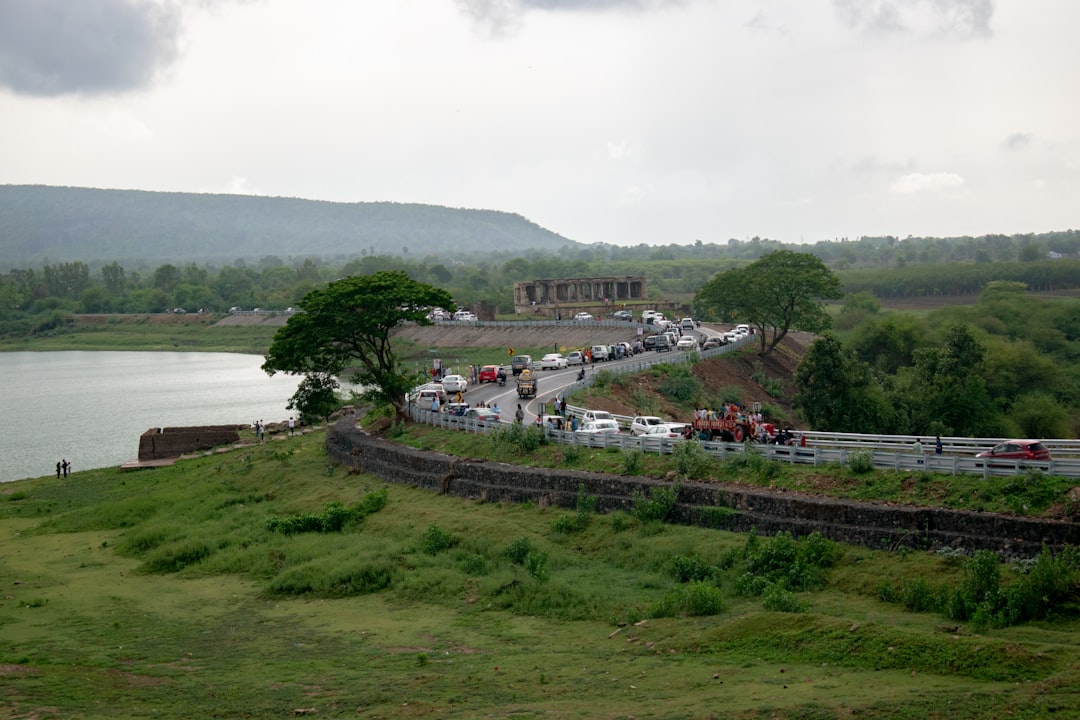
The four beneficiary states of the Sardar Sarovar Project — Madhya Pradesh, Gujarat, Maharashtra and Rajasthan — signed a one-time settlement on 7 July 2026 in New Delhi, ending a payment and cost-sharing dispute that had festered for over three decades on the Narmada river.
Millennium Post reported the pact was inked in the presence of Union Home and Cooperation Minister Amit Shah and Union Jal Shakti Minister C.R. Patil, with the four Chief Ministers signing alongside senior Centre and state officials. The Free Press Journal reported the deal slashes Madhya Pradesh’s rehabilitation dues to Gujarat from about Rs 1,500 crore to Rs 231.80 crore.
- Signed by CMs Mohan Yadav (Madhya Pradesh), Bhupendra Patel (Gujarat), Devendra Fadnavis (Maharashtra) and Bhajan Lal Sharma (Rajasthan).
- A one-time settlement of all outstanding dues, liabilities and claims — rehabilitation costs, submerged-land compensation and construction cost — under the Narmada Water Disputes Tribunal (NWDT) award.
- Madhya Pradesh’s dues to Gujarat cut from roughly Rs 1,500 crore to Rs 231.80 crore.
- MP’s rehabilitation cost share reduced from a proposed 31.98% to 16.17%; Gujarat’s share raised from 50.57% to 75%.
- Maharashtra’s share cut to 7.76% (from 15.15%) and Rajasthan’s to 1.17% (from 2.31%).
- Madhya Pradesh agreed to shelve a counter-claim of about Rs 7,669 crore it had sought from Gujarat on rehabilitation.
The development matters in the context of:
- The dispute traces to the 1979 NWDT award and the way rehabilitation-and-resettlement costs of submergence were to be split among the four states.
- It matters because inter-state river projects routinely stall on cost and rehabilitation liabilities, not just water shares — a negotiated close-out is rare.
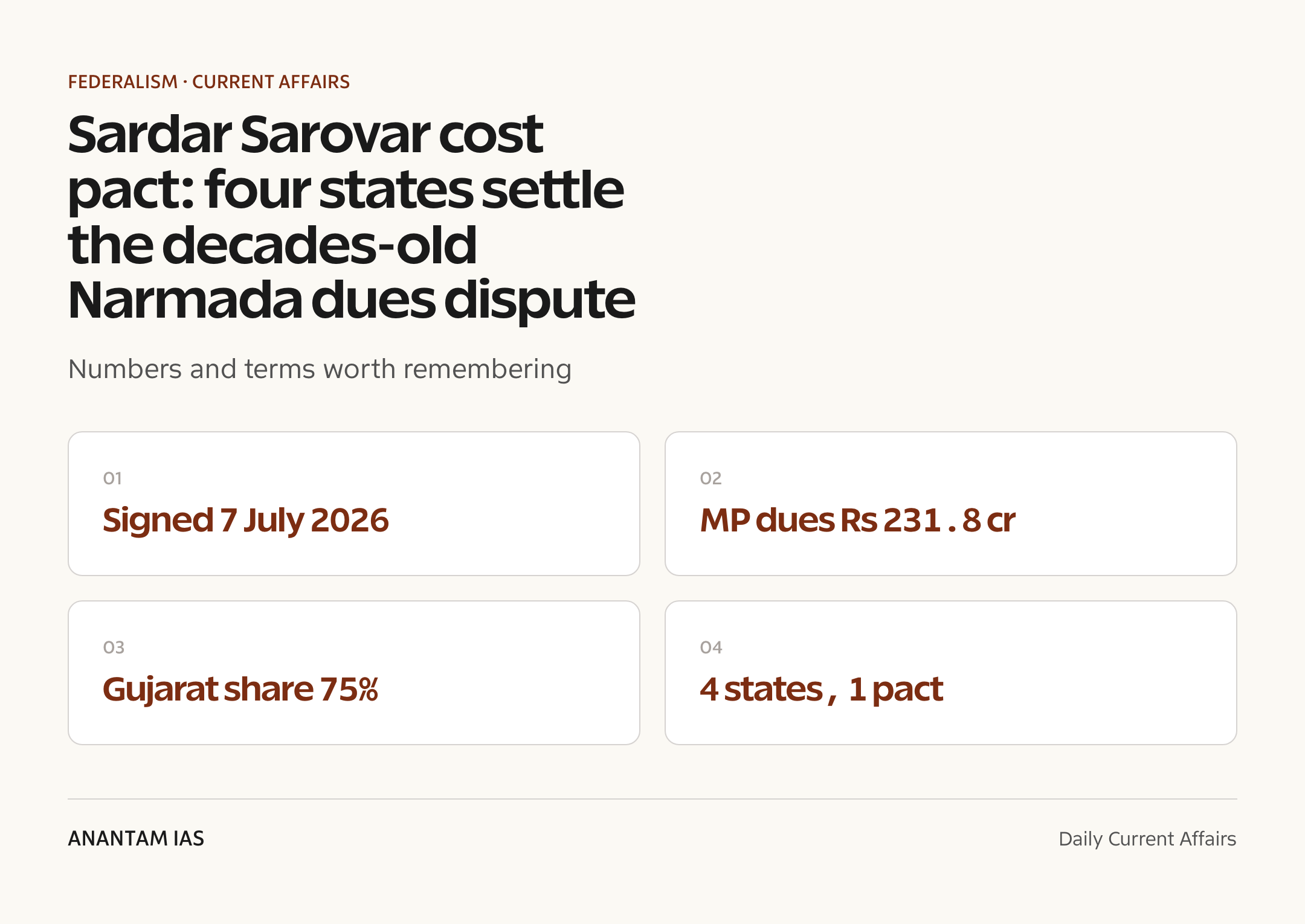
UPSC Relevance
Prelims Relevance
- Narmada — largest west-flowing peninsular river; rises at Amarkantak (Madhya Pradesh), drains into the Gulf of Khambhat (Arabian Sea).
- Sardar Sarovar Dam — gravity dam near Kevadia/Navagam in Gujarat’s Narmada district; final height 138.68 m.
- Narmada Water Disputes Tribunal (NWDT) — set up 1969, final award 1979, under the ISRWD Act.
- Inter-State River Water Disputes Act, 1956 — enacted under Article 262.
- Article 262 — adjudication of inter-state river/river-valley water disputes; bars Supreme Court/court jurisdiction.
- Narmada Control Authority (NCA) — Indore-based body implementing the NWDT award.
- NWDT water allocation at 75% dependability (28 MAF): MP 18.25, Gujarat 9.0, Rajasthan 0.50, Maharashtra 0.25 MAF.
- Four beneficiary states: Madhya Pradesh, Gujarat, Maharashtra, Rajasthan.
- Statue of Unity stands downstream of the Sardar Sarovar Dam at Kevadia.
- Article 263 — Inter-State Council for coordination between states.
Mains Relevance
GS Paper 2
- Cooperative federalism and dispute resolution: how negotiated settlements between states compare with tribunal adjudication.
- Inter-state relations and the constitutional machinery (Articles 262, 263) for water disputes.
GS Paper 1
- Distribution of water resources, river-valley projects and displacement/rehabilitation issues in Indian geography.
GS Paper 3
- Major infrastructure and irrigation projects, and the fiscal-liability dimension of multi-state ventures.
Essay
- Cooperation, not confrontation: the federal idea of India in practice.
- Rivers unite, boundaries divide — water as a test of Indian federalism.
Background and Context
The Sardar Sarovar Project in brief
The dam is the terminal, largest structure of the wider Narmada Valley Development plan.
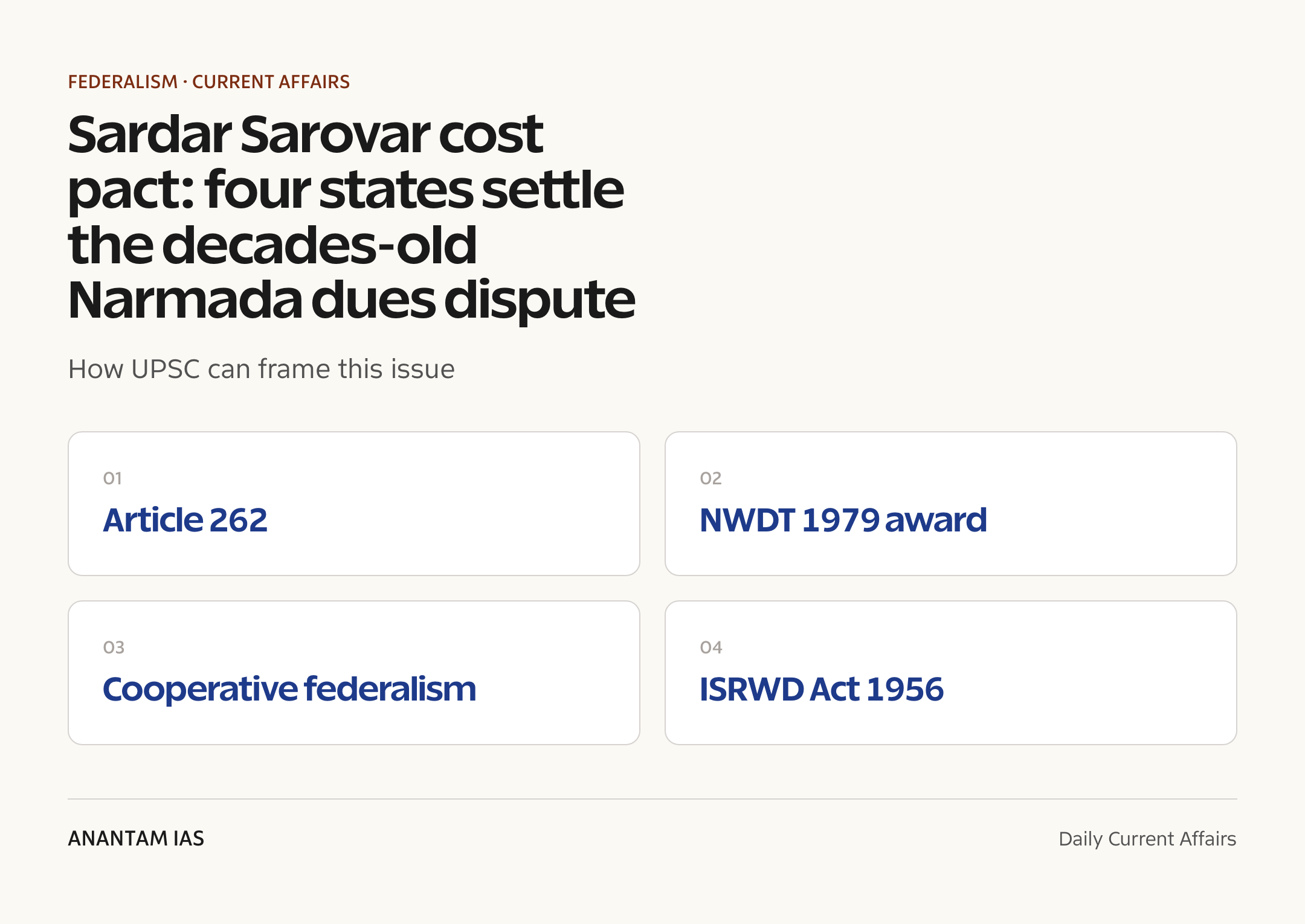
- The Sardar Sarovar Dam is a concrete gravity dam on the Narmada near Kevadia (Navagam), in Gujarat’s Narmada district.
- Its reservoir submerges land across Gujarat, Madhya Pradesh and Maharashtra; the final height of 138.68 m was reached in 2017.
- It supplies irrigation and drinking water to Gujarat (including Saurashtra and Kutch) and Rajasthan, and hydropower shared chiefly by Madhya Pradesh and Maharashtra.
- The Statue of Unity, the world’s tallest statue, stands just downstream at Kevadia.
- Because submergence falls mostly on Madhya Pradesh while benefits flow largely to Gujarat, cost-and-rehabilitation sharing was always the fault line.
Roots: the NWDT award, 1979
The allocation and cost architecture flows from a tribunal award nearly half a century old.
- The Narmada Water Disputes Tribunal was constituted in 1969 under the Inter-State River Water Disputes Act, 1956; it gave its final award in 1979.
- It shared 28 million acre-feet of Narmada water at 75% dependability: Madhya Pradesh 18.25, Gujarat 9.0, Rajasthan 0.50 and Maharashtra 0.25 MAF.
- It fixed the dam’s design and directed that rehabilitation and resettlement (R&R) and submergence costs be borne by the states in proportion to benefits.
- The Narmada Control Authority, headquartered in Indore, was created to implement the award and monitor R&R and dam height.
- Successive disputes over exactly how R&R and land-compensation costs should be apportioned kept dues unsettled for decades.
What the 2026 settlement changes
The pact re-fixes each state’s share of rehabilitation cost and closes the ledger with a lump-sum payment.
- Gujarat’s share of rehabilitation expenditure rises from 50.57% to 75% — it now shoulders the bulk, reflecting that it is the prime beneficiary.
- Madhya Pradesh’s share falls from a proposed 31.98% to 16.17%, cutting its dues to Gujarat from about Rs 1,500 crore to Rs 231.80 crore.
- Maharashtra’s share drops to 7.76% (from 15.15%) and Rajasthan’s to 1.17% (from 2.31%).
- Madhya Pradesh withdraws a claim of about Rs 7,669 crore it had pressed against Gujarat on rehabilitation — a mutual give-and-take rather than a winner-take-all outcome.
- The Free Press Journal noted about 55% of the project-affected land among the partner states lay in Madhya Pradesh, which shaped MP’s lighter cost share.
The constitutional and legal frame
Water disputes sit inside a distinct constitutional channel that discourages courtroom resolution.
- Article 262 empowers Parliament to legislate for adjudicating inter-state river-water disputes and to bar the Supreme Court and other courts from such disputes.
- The Inter-State River Water Disputes Act, 1956 operationalises Article 262 through tribunals such as the NWDT.
- Water is a State List subject (Entry 17), while inter-state rivers fall under Union List Entry 56 — a split that fuels friction.
- Article 263 allows an Inter-State Council to inquire into and advise on disputes, offering a negotiated, non-adversarial route.
- The 2026 pact is a negotiated closure outside fresh litigation — the constitutional preference for cooperative resolution in action.
Why it reads as cooperative federalism
Ministers framed the deal as a template for settling contentious inter-state ledgers by consensus.
- Amit Shah called it a resolution reflecting the spirit of cooperative federalism and consensus among beneficiary states.
- The Ministry of Jal Shakti facilitated the talks — the Centre acting as an honest broker rather than an adjudicator.
- It follows other recent water settlements cited by the government, including the Rajasthan-Haryana Yamuna water pact of 29 June 2026 and progress on the Kishau Dam project.
- Each state accepted a trade-off — Gujarat pays more, MP drops its large claim — showing settlements need distributed concessions.
- A clean cost close-out removes a long-standing irritant to project operations, maintenance and future works on the Narmada.
The unresolved backdrop
The financial pact does not, by itself, close the project’s older social and ecological questions.
- The Sardar Sarovar’s history is inseparable from the Narmada Bachao Andolan and long-running debates over displacement and adequate rehabilitation of oustees.
- Raising the dam to full height submerged additional villages, keeping R&R adequacy a live grievance for affected families.
- A cost-sharing settlement between governments is distinct from ground-level rehabilitation of displaced people, which remains monitored.
- Downstream flow, silt and environmental-flow concerns continue to attract scrutiny of large-dam operations.
- The pact’s real test is whether smoother finances translate into faster, fairer delivery of benefits and pending R&R.
Way Forward
Institutionalise negotiated settlements
- Use the Inter-State Council and Jal Shakti-brokered talks proactively so disputes are settled before they harden into decades-long stand-offs.
- Document the Narmada template as a replicable model for other multi-state basins.
Separate cost pacts from rehabilitation delivery
- Ensure the financial closure does not slow pending R&R for oustees; keep the Narmada Control Authority’s monitoring active.
- Publish transparent accounts of who pays what, so future ledgers do not reopen.
Strengthen the dispute architecture
- Advance long-pending reform ideas such as a permanent tribunal and a dispute-resolution committee to cut delays under the ISRWD Act.
- Improve basin-level data on flows and dependability to reduce factual disputes.
Conclusion
The Sardar Sarovar settlement matters less for its rupee figures than for the method: four states with genuinely conflicting interests closed a decades-old ledger by consensus, with the Centre as facilitator rather than referee. That is cooperative federalism doing quiet, unglamorous work.
But a cost pact between governments is not the same as justice for those the reservoir displaced. The durable lesson for aspirants is to separate the two threads — inter-state fiscal disputes and ground-level rehabilitation — and to judge the deal by whether it speeds delivery on both.
UPSC Practice Questions
Prelims MCQ 1
With reference to the Sardar Sarovar Project and the Narmada waters, consider the following statements:
- The Narmada Water Disputes Tribunal gave its final award in 1979.
- Madhya Pradesh, Gujarat, Maharashtra and Rajasthan are the beneficiary states of the award.
- The Narmada is the largest east-flowing river of peninsular India.
How many of the above statements are correct?
(a) Only one (b) Only two (c) All three (d) None
Answer: (b) Only two
Explanation:
Statements 1 and 2 are correct. Statement 3 is wrong: the Narmada is the largest WEST-flowing peninsular river, draining into the Arabian Sea via the Gulf of Khambhat.
Prelims MCQ 2
Which Article of the Constitution provides for the adjudication of disputes relating to waters of inter-state rivers and river valleys?
(a) Article 261 (b) Article 262 (c) Article 263 (d) Article 371
Answer: (b) Article 262
Explanation:
Article 262 lets Parliament legislate on inter-state river-water disputes and bar the Supreme Court/other courts. The Inter-State River Water Disputes Act, 1956 was enacted under it. Article 263 deals with the Inter-State Council.
UPSC Mains Questions
- The Sardar Sarovar cost-sharing settlement has been described as a model of cooperative federalism. In light of the constitutional machinery for inter-state water disputes, examine how negotiated settlements compare with tribunal adjudication. (250 words)
- Large multi-state river-valley projects generate disputes over cost and rehabilitation, not merely over water shares. Discuss with reference to the Narmada Valley Development and the recent four-state pact. (250 words)
Sources: Millennium Post and Free Press Journal.
Frequently Asked Questions
What is the Sardar Sarovar cost pact about?
On 7 July 2026, Madhya Pradesh, Gujarat, Maharashtra and Rajasthan signed a one-time settlement of long-pending Sardar Sarovar Project dues. It re-fixed each state’s share of rehabilitation costs and closed decades-old financial claims among the four beneficiary states of the Narmada river.
How much will Madhya Pradesh now pay Gujarat?
Under the settlement, Madhya Pradesh’s rehabilitation dues to Gujarat were cut from roughly Rs 1,500 crore to about Rs 231.80 crore. In return, MP agreed to withdraw a counter-claim of nearly Rs 7,669 crore it had pressed against Gujarat on rehabilitation.
What was the Narmada Water Disputes Tribunal award?
The tribunal, set up in 1969 under the Inter-State River Water Disputes Act, 1956, gave its final award in 1979. It shared 28 million acre-feet of Narmada water among the four states, fixed the dam’s design, and directed that rehabilitation costs be borne in proportion to benefits.
Which constitutional Article covers inter-state water disputes?
Article 262 empowers Parliament to provide for adjudication of inter-state river-water disputes and to bar the Supreme Court and other courts from them. The Inter-State River Water Disputes Act, 1956 was enacted under this Article. Article 263 provides for an Inter-State Council.
Why is the settlement called cooperative federalism?
Because four states with conflicting interests resolved a decades-old dispute by consensus, with the Centre’s Jal Shakti Ministry facilitating rather than imposing a verdict. Each side accepted trade-offs, showing disputes can be closed through negotiation instead of prolonged litigation.
Does the pact resolve displacement concerns too?
No. The settlement is a financial pact between state governments over cost-sharing. It is separate from the ground-level rehabilitation of people displaced by the reservoir, a long-running concern linked to the Narmada Bachao Andolan that continues to be monitored.
Tell Google you want more of this.
Add Anantam IAS as a preferred sourceOne tap, and this site shows up more often in your own Top Stories, AI Overviews and AI Mode. Remove it any time.





