Why in News?
On 7 July 2026, BrahMos Aerospace and the Indonesian Ministry of Defense signed a contract for the BrahMos supersonic cruise missile system in Jakarta, during Prime Minister Narendra Modi’s two-day visit to Indonesia — his first trip to the country since 2023. The signing was announced after PM Modi’s meeting with President Prabowo Subianto at the Presidential Palace.
Neither government has officially disclosed the contract value, the number of missiles, or the delivery schedule. Reports citing Indian officials put the deal at around $630 million; The Jakarta Post recalled that earlier negotiations in 2023 were pegged in the $200–350 million range. Reuters reported, citing an Indian government official, that India will also supply the indigenous Astra air-to-air missile to Indonesia.
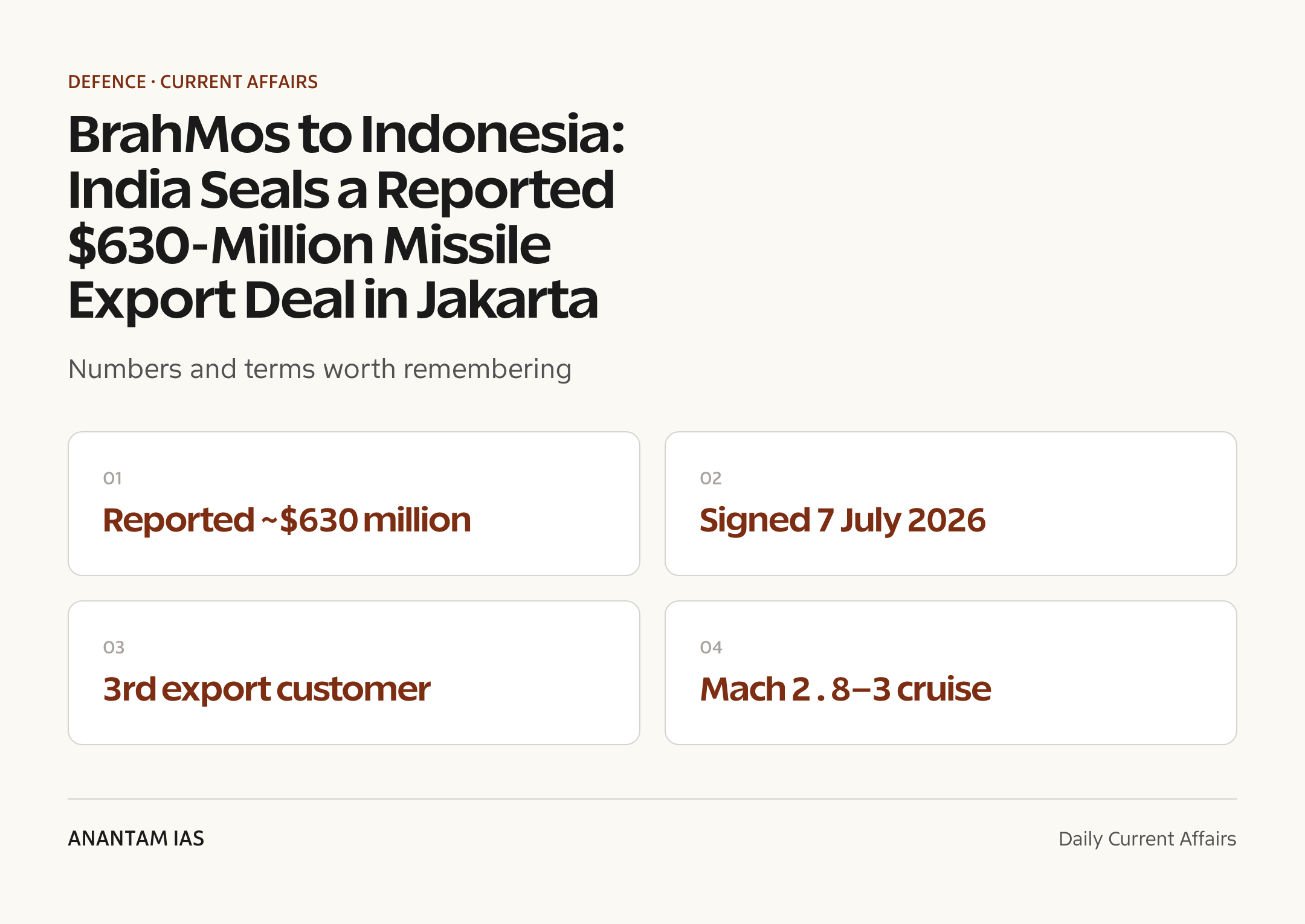
- Contract signed on 7 July 2026 in Jakarta between BrahMos Aerospace and Indonesia’s Ministry of Defense.
- Naval News reported that Indonesia becomes the third export customer of BrahMos, after the Philippines (2022) and Vietnam (deal acknowledged in June 2026).
- Reported value of about $630 million is unofficial; no side has confirmed the figure, quantity, or timeline.
- Reuters reported a parallel plan to export the DRDO-developed Astra beyond-visual-range air-to-air missile — which would be Astra’s first export.
The development matters in the context of:
- This matters for India’s push to become a net defence exporter — exports touched a record ₹38,424 crore in FY 2025-26, against a target of ₹50,000 crore by 2029.
- It matters for the Indo-Pacific balance: three Southeast Asian states near the South China Sea have now ordered the same Indian-Russian supersonic missile.
- It anchors the Act East Policy in hard-capability terms — defence sales, not just diplomacy and connectivity.
UPSC Relevance
Prelims Relevance
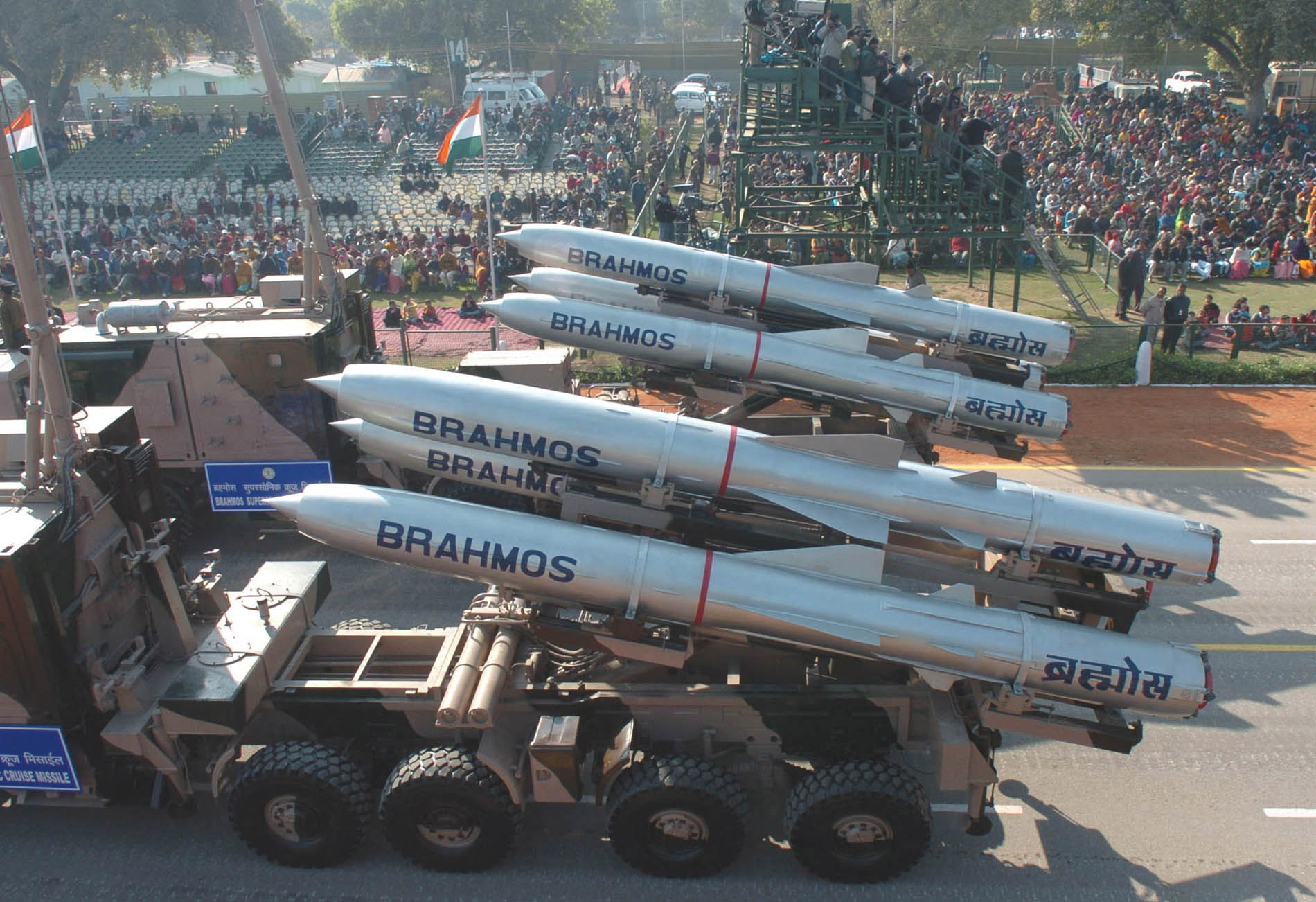
- BrahMos: two-stage supersonic cruise missile — solid-propellant booster + liquid-fuelled ramjet sustainer; cruise speed of about Mach 2.8–3.
- Joint venture BrahMos Aerospace (est. 1998) between DRDO (50.5%) and Russia’s NPO Mashinostroyenia (49.5%), under a Feb 1998 inter-governmental agreement.
- Name derives from two rivers — the Brahmaputra (India) and the Moskva (Russia).
- Launch platforms: land-based mobile launchers, surface ships, submarines, and the Su-30MKI (air-launched variant first tested in 2017).
- Original range capped near 290 km under MTCR limits; extended-range variants (450 km+, with ~800 km class under development) followed India’s MTCR membership in June 2016.
- Philippines — first export customer: Jan 2022 contract worth about $375 million for three shore-based anti-ship missile batteries; first delivery April 2024.
- Vietnam — second export customer: deal signed in FY 2025-26, publicly acknowledged by India’s defence secretary at the Shangri-La Dialogue in June 2026; reports value it at roughly $630–700 million.
- Astra: indigenous DRDO beyond-visual-range air-to-air missile, integrated on Su-30MKI and LCA Tejas.
- India’s defence exports: ₹38,424 crore in FY 2025-26 (up ~63% over ₹23,622 crore in FY 2024-25), reaching 80+ countries.
Mains Relevance
GS Paper 3
- Indigenisation of defence and Atmanirbhar Bharat: BrahMos as the flagship of India’s transition from the world’s largest arms importer to a credible exporter.
- Defence exports as an instrument of economy and security — the ₹50,000 crore by 2029 target, defence industrial corridors, and private-sector participation.
- Technology partnerships: what the DRDO–NPO Mashinostroyenia JV model teaches about co-development versus licence production.
GS Paper 2
- Defence diplomacy in the Act East Policy: arms transfers as the new currency of India’s Southeast Asia engagement.
- India–Indonesia Comprehensive Strategic Partnership — from maritime cooperation to hard-security supply relationships.
- India as a net security provider in the Indo-Pacific: implications of arming Philippines, Vietnam, and Indonesia — all facing pressure in or near the South China Sea.
Essay
- From arms importer to arms exporter — self-reliance as strategic autonomy.
- Hard power and soft power must move together: India’s Indo-Pacific moment.
- Technology partnerships, not technology dependence, build national capability.
Background and Context
What Is the BrahMos Missile System?
BrahMos is a supersonic cruise missile born of a rare co-development partnership between India and Russia.
- It is produced by BrahMos Aerospace, a joint venture set up in 1998 under an inter-governmental agreement of 12 February 1998, with DRDO holding 50.5% and Russia’s NPO Mashinostroyenia 49.5%.
- The name fuses the Brahmaputra and Moskva rivers — a deliberate symbol of the two partners.
- It is a two-stage missile: a solid-propellant booster accelerates it to supersonic speed, then a liquid-fuelled ramjet sustains cruise at about Mach 2.8–3 — among the fastest cruise missiles in service anywhere.
- It flies a low-altitude, fire-and-forget profile and is genuinely multi-platform: land-based mobile launchers, surface ships, submarines, and an air-launched version on the Su-30MKI.
- The export configuration respects the 290 km-class range under MTCR rules; after India joined the Missile Technology Control Regime in June 2016, extended-range versions (450 km+) entered testing for Indian forces, and a lighter BrahMos-NG is under development.
- Production has expanded beyond Hyderabad — a new integration facility at Lucknow, in the UP Defence Industrial Corridor, opened in 2025.
The Indonesia Contract: What Was Actually Signed
The Jakarta announcement confirmed a contract but deliberately withheld the commercial details.
- The contract was signed between BrahMos Aerospace and the Indonesian Ministry of Defense on 7 July 2026, announced by Indonesia’s Presidential Palace after the Prabowo–Modi meeting in Jakarta.
- Naval News reported that neither side has released the contract value, missile numbers, or delivery schedule — the ~$630 million figure circulating in Indian media is attributed to unnamed officials, not an official statement.
- The Jakarta Post noted that BrahMos Aerospace’s 2023 negotiations with Indonesia were then valued between $200 million and $350 million — so the reported final scope is materially larger.
- Reuters reported, citing an Indian government official, that the package extends beyond BrahMos: India is also to supply the Astra air-to-air missile, which would mark the first export of the indigenous DRDO-developed BVR missile.
- The signing was the centrepiece of PM Modi’s two-day Indonesia leg — his first visit to the country since 2023 — part of a wider July 2026 tour covered in our note on the PM’s three-nation visit and the Act East Policy.
Export Precedents: Philippines First, Vietnam Second
Indonesia is the third Southeast Asian buyer, and each earlier sale set a template.
- Philippines (January 2022): the first-ever BrahMos export contract, worth about $375 million, for three shore-based anti-ship missile batteries for the Philippine Marine Corps; the first battery arrived in April 2024 and a second in 2025.
- Each Philippine battery pairs mobile autonomous launchers with radar, command-and-control, and reload vehicles — a coastal-defence configuration aimed at the South China Sea.
- Vietnam: The Diplomat reported in June 2026 that India’s defence secretary confirmed at the Shangri-La Dialogue that a BrahMos contract with Vietnam had been signed in the previous fiscal year but kept unannounced; reports value the package at roughly $630–700 million, including training and logistics.
- With Jakarta signing on, Naval News counts Indonesia as the third export customer — meaning the three largest maritime states of Southeast Asia have all chosen the same Indian missile.
Why Indonesia Wants BrahMos
Jakarta’s interest is rooted in archipelagic geography and a doctrine of sea-denial.
- Indonesian planners have prioritised coastal-defence systems and land-based anti-ship missiles to build an anti-access/area denial (A2/AD) posture along the country’s Archipelagic Sea Lanes.
- The straits of Malacca, Sunda, Lombok, and Makassar — chokepoints of global shipping — are the obvious deployment logic for a supersonic anti-ship missile.
- Indonesia has operated in this class before: its navy fielded the Russian Yakhont (export P-800 Oniks, the missile BrahMos derives from) on the frigate KRI Oswald Siahaan, test-firing it in exercises in 2011 and 2012, per Naval News.
- That legacy matters — crews familiar with the Oniks family shorten the absorption curve, while the old Yakhont stock is believed non-operational.
- Buying Indian also diversifies Jakarta’s suppliers when Western systems carry political conditions and Russian ones carry sanctions risk under measures like CAATSA.
India's Defence-Export Push: The Numbers
The Indonesia deal lands on a steep, policy-driven export curve.
- India’s defence exports hit an all-time high of ₹38,424 crore in FY 2025-26, about 63% higher than the ₹23,622 crore of FY 2024-25, according to Ministry of Defence figures.
- The decadal jump is stark: exports were just ₹686 crore in 2013-14; they now reach 80+ countries.
- The government’s stated target is ₹50,000 crore in exports by 2029, alongside ₹3 lakh crore in total defence production, under Atmanirbhar Bharat.
- Policy scaffolding: two Defence Industrial Corridors (Uttar Pradesh and Tamil Nadu), liberalised export authorisations, positive-indigenisation lists, and lines of credit for buyers.
- Big-ticket export items: BrahMos, the Akash surface-to-air missile (Armenia), Pinaka rockets, artillery guns, radars, and Dornier aircraft — with Astra potentially joining via Indonesia.
- One high-value BrahMos contract moves the needle: the reported Indonesia value alone equals roughly ₹5,200–5,400 crore, a tenth of the 2029 annual target.
India–Indonesia: The Strategic Frame
The missile deal caps a relationship that has been thickening layer by layer since 2018.
- India and Indonesia elevated ties to a Comprehensive Strategic Partnership in 2018, with a shared vision on maritime cooperation in the Indo-Pacific.
- President Prabowo Subianto was chief guest at India’s Republic Day 2025, where defence manufacturing and maritime security headlined the joint statements.
- Defence exercises bind the militaries: Samudra Shakti (navies), Garuda Shakti (special forces), and the India-Indonesia Coordinated Patrol (CORPAT) along the Andaman Sea boundary.
- Indonesia sits astride the Malacca Strait approaches to India’s Andaman & Nicobar Command — cooperation here, including access discussions around Sabang port, has direct naval value for India.
- The two economies are also pairing security with resources — see our note on the India–Indonesia defence and critical minerals partnership for the nickel-and-minerals dimension of the same visit season.
- For India, arming ASEAN partners operationalises both the Act East Policy and the MAHASAGAR maritime vision without formal alliance structures.
Way Forward
Deliver on Time, Every Time
- Export credibility now rests on execution: production lines at Hyderabad and Lucknow must meet Philippine, Vietnamese, and Indonesian schedules simultaneously without starving Indian services.
- A published delivery-and-support track record is India’s best marketing against established exporters like France, South Korea, and Russia.
Build the Full Export Ecosystem
- Sales must come bundled with training, maintenance, spares, and mid-life upgrades — the after-market is where buyer trust (and repeat orders) is won.
- Extend lines of credit and flexible financing, since Southeast Asian defence budgets are stretched; affordability closed this deal as much as capability.
Protect the Technology, Respect the Regimes
- Export configurations must stay scrupulously within MTCR parameters and end-use monitoring norms — one violation would poison the entire export pipeline.
- Russian consent within the JV structure needs careful management as sanctions complicate component sourcing; deeper indigenisation of the propulsion and seeker reduces that exposure.
Widen the Basket Beyond BrahMos
- Convert the reported Astra export into a template for other indigenous systems — Akash-NG, Pinaka, naval sensors — so India’s export story isn’t a one-missile story.
- Institutionalise defence-industry dialogues with ASEAN states so procurement relationships outlast individual visits.
Conclusion
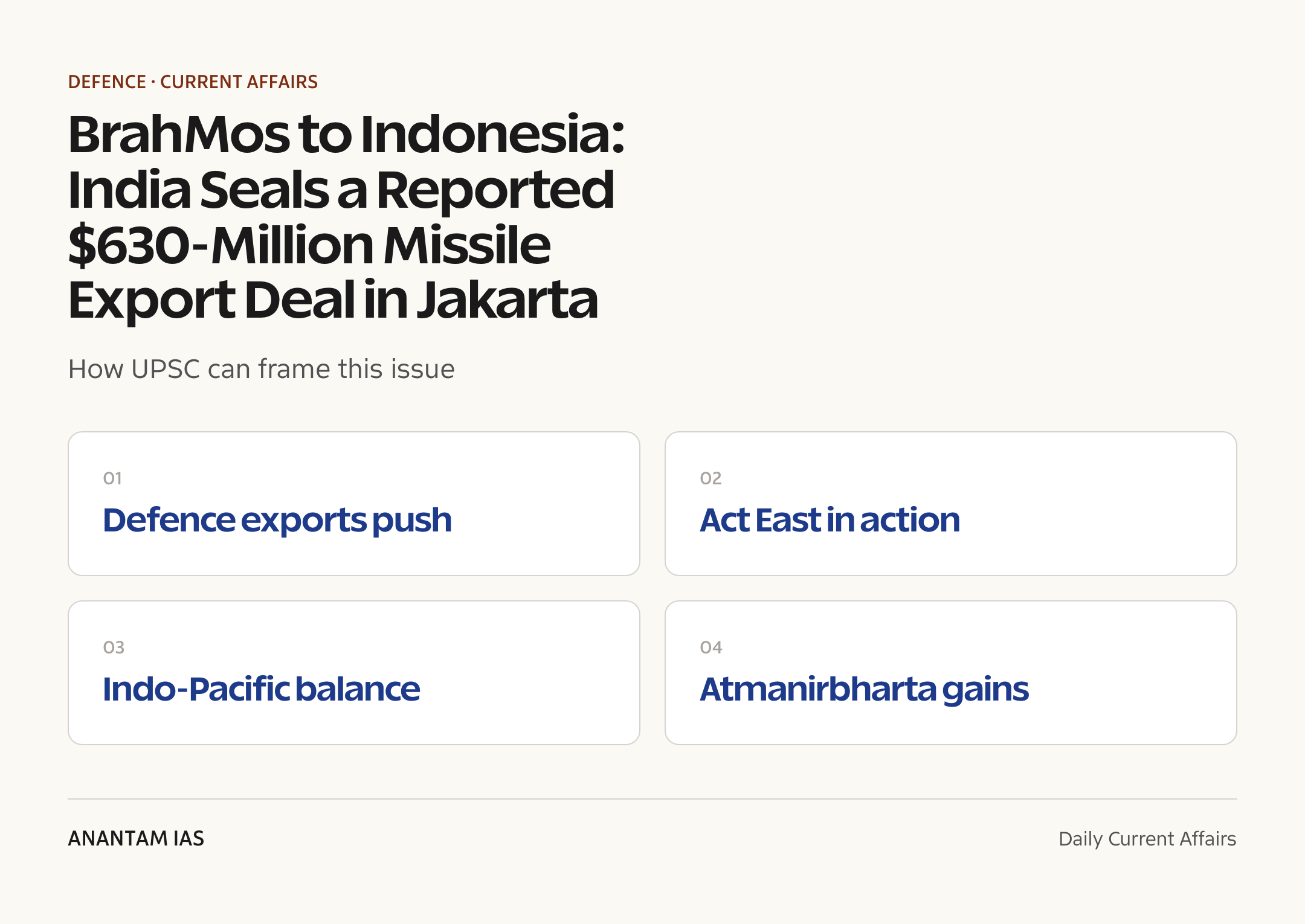
The Jakarta signing is more than a sale. A missile co-developed with Russia, built in India, and now ordered across the Philippines, Vietnam, and Indonesia gives New Delhi a strategic industrial footprint in Southeast Asia’s waters — a standing argument for India as a dependable Indo-Pacific security partner.
The caution flags are real: the headline $630 million remains unofficial, delivery timelines are undisclosed, and the JV’s Russian half sits under sanctions pressure. The 2029 target of ₹50,000 crore will be met by flawless execution of exactly these contracts, not by announcements.
For the aspirant, BrahMos-to-Indonesia is a perfect three-in-one: a GS3 defence-indigenisation case study, a GS2 Act East and Indo-Pacific illustration, and a live example of how technology partnerships convert into geopolitical influence.
UPSC Practice Questions
Prelims MCQ 1
With reference to the BrahMos missile system, consider the following statements:
- It is produced by a joint venture between India’s DRDO and Russia’s NPO Mashinostroyenia.
- Its name is derived from the Brahmaputra and Volga rivers.
- The Philippines was the first country to sign a contract for the export of BrahMos.
How many of the above statements are correct?
(a) Only one (b) Only two (c) All three (d) None
Answer: (b) Only two
Explanation:
Statements 1 and 3 are correct — BrahMos Aerospace is a DRDO–NPO Mashinostroyenia JV (est. 1998), and the Philippines signed the first export contract in January 2022 (~$375 million). Statement 2 is wrong: the name combines the Brahmaputra and the Moskva rivers, not the Volga.
Prelims MCQ 2
‘Astra’, recently in news in the context of India’s defence exports, is:
(a) an indigenous beyond-visual-range air-to-air missile developed by DRDO (b) a surface-to-air missile system jointly developed with Israel (c) a submarine-launched ballistic missile of the Indian Navy (d) an anti-tank guided missile produced under licence from Russia
Answer: (a) an indigenous beyond-visual-range air-to-air missile developed by DRDO
Explanation:
Astra is DRDO’s indigenous beyond-visual-range air-to-air missile, integrated on the Su-30MKI and LCA Tejas. Reuters reported that India will supply Astra to Indonesia alongside BrahMos — its first export if concluded.
UPSC Mains Questions
- India has moved from being the world’s largest arms importer to a growing defence exporter. Using the BrahMos exports to Southeast Asia as a case study, examine the economic and strategic significance of defence exports for India, and the challenges in sustaining this trajectory. (250 words)
- Defence cooperation is emerging as the sharpest instrument of India’s Act East Policy. Discuss with reference to India’s recent defence engagements with Indonesia, Vietnam, and the Philippines, and their implications for the Indo-Pacific balance of power. (250 words)
Sources: The Jakarta Post and Naval News.
Frequently Asked Questions
What BrahMos deal did India sign with Indonesia?
On 7 July 2026, BrahMos Aerospace and Indonesia’s Ministry of Defense signed a contract for the BrahMos supersonic cruise missile system in Jakarta, during PM Modi’s visit. Reports citing Indian officials value it at about $630 million, though neither government has officially confirmed the value, quantity, or delivery schedule.
Which countries have bought the BrahMos missile so far?
The Philippines was the first export customer (January 2022, about $375 million for three coastal batteries, delivered from April 2024). Vietnam signed a deal in FY 2025-26 that India acknowledged in June 2026. Indonesia became the third export customer with the July 2026 Jakarta contract.
Who makes the BrahMos missile?
BrahMos Aerospace, a joint venture formed in 1998 between India’s DRDO (50.5%) and Russia’s NPO Mashinostroyenia (49.5%). The missile is named after the Brahmaputra and Moskva rivers. Production facilities operate at Hyderabad and, since 2025, at Lucknow in the UP Defence Industrial Corridor.
How fast and how far can BrahMos fly?
BrahMos cruises at about Mach 2.8–3, making it one of the fastest cruise missiles in service. The standard export version has a range near 290 km, in line with MTCR limits. After India joined the MTCR in 2016, extended-range variants of 450 km and beyond entered testing for Indian forces.
Why does Indonesia want BrahMos missiles?
Indonesia is building an anti-access/area-denial posture to guard its archipelagic sea lanes and chokepoints like the Malacca, Sunda, Lombok, and Makassar straits. Its navy earlier operated the Russian Yakhont — the missile BrahMos derives from — so BrahMos fits both its doctrine and its operating experience.
What is India’s defence export target?
India aims for ₹50,000 crore in annual defence exports by 2029, under Atmanirbhar Bharat. Exports reached a record ₹38,424 crore in FY 2025-26 — up from ₹23,622 crore the year before and just ₹686 crore in 2013-14 — reaching more than 80 countries.
Tell Google you want more of this.
Add Anantam IAS as a preferred sourceOne tap, and this site shows up more often in your own Top Stories, AI Overviews and AI Mode. Remove it any time.