Why in News?
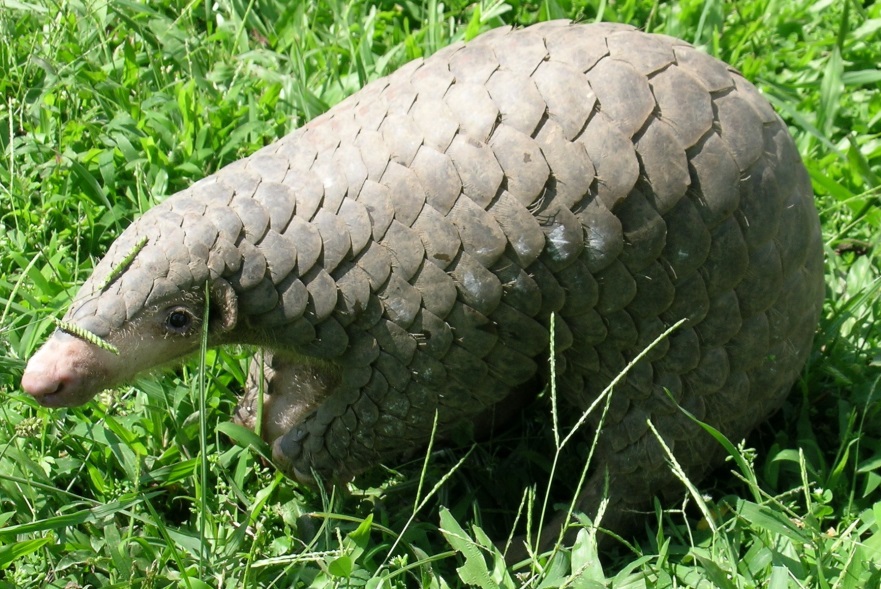
An international team of scientists has revalidated the Himalayan pangolin (Manis aurita) as a distinct, living species, separate from the Chinese pangolin (Manis pentadactyla) into which it had been lumped as a subspecies for decades. The findings, drawing on genomic and morphological evidence, were published in the journal Communications Biology and reported by Down To Earth and Mongabay in early July 2026.
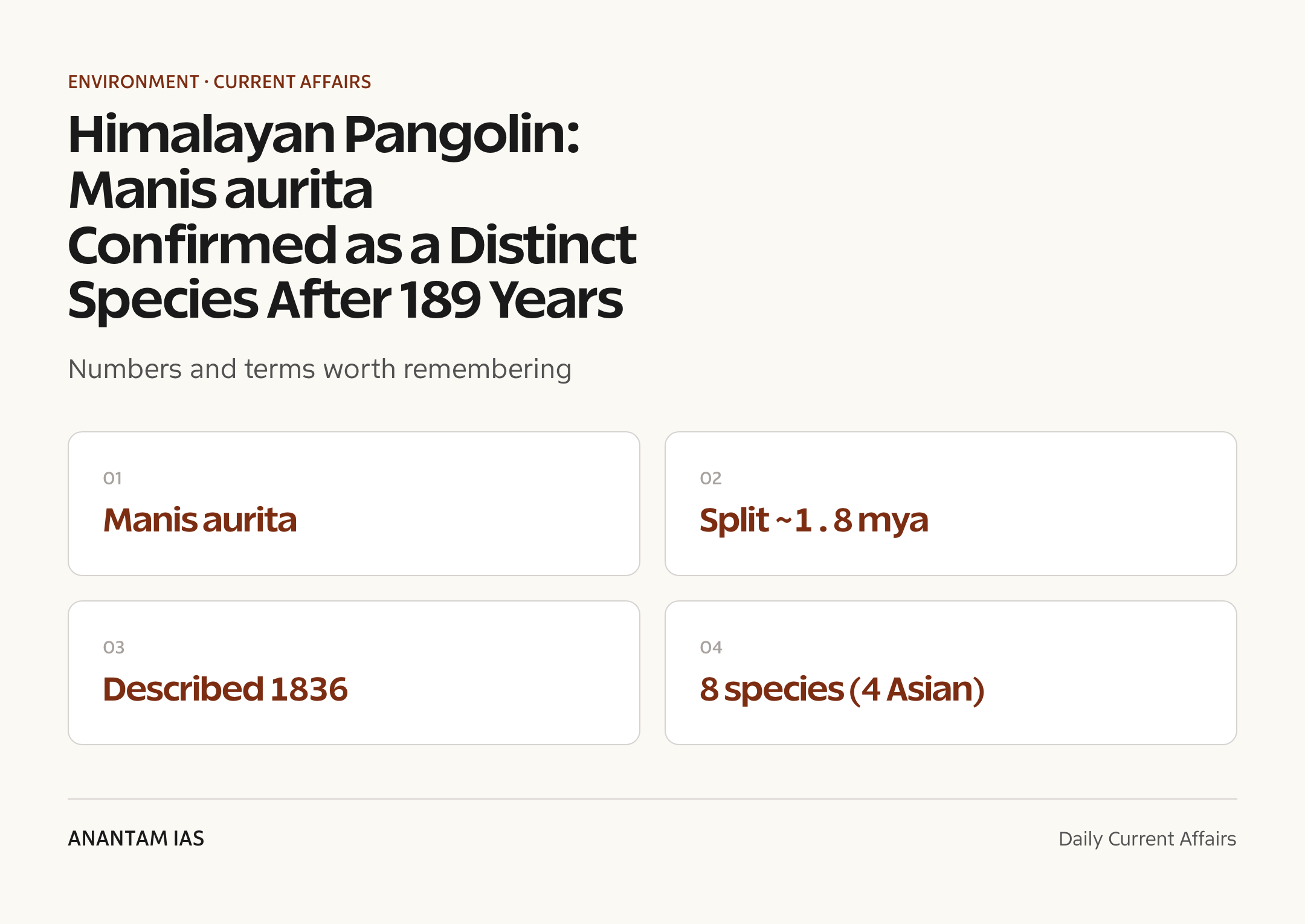
The animal was first described from Nepal’s Kathmandu Valley in 1836 by the British naturalist Brian Houghton Hodgson, who named it for its unusually large ears, but it was later absorbed into the Chinese pangolin and effectively forgotten for about 189 years. Its confirmed range spans Nepal, southern Tibet and Northeast India, including Assam.
- Researchers sequenced DNA from the original 1836 lectotype specimen and compared it with modern samples, confirming Manis aurita as a separate evolutionary lineage.
- The two lineages diverged roughly 1.8 million years ago in the early Pleistocene, driven by climatic oscillations that split a common ancestor into a western Himalayan and an eastern East/Southeast Asian refugium (allopatric separation).
- The Himalayan pangolin is physically larger, averaging about 95.2 cm in length versus about 71.2 cm for the Chinese pangolin, with a larger skull, longer tail, smaller ears and a shorter, broader nasal bone.
- Genomic evidence shows a sharp demographic collapse during Pleistocene cooling and a further contraction around the 14th century, coinciding with the onset of the Little Ice Age in the Himalaya.
- The study’s authors urge that Manis aurita be explicitly categorised under CITES Appendix I, identifying it as a prime target for illegal wildlife traffickers.
- The revalidation is the work of teams across Asia, the Americas and Europe over about five years, triggered partly by mismatches in scales recovered from smuggling seizures in 2016-17.
The development matters in the context of:
- Pangolins are the world’s most trafficked mammals, hunted for their scales (used in traditional medicine) and meat, so getting their taxonomy right directly shapes anti-trafficking and conservation priorities.
- A newly recognised species with a small, fragmented Himalayan range may need a distinct, more urgent conservation and legal-protection status than the wider Chinese pangolin.
- The finding shows how museum specimens and ancient-DNA methods can resolve long-standing taxonomic disputes with direct policy consequences.
UPSC Relevance
Prelims Relevance
- Pangolins are the only mammals wholly covered in keratin scales; they are toothless, insectivorous (ants and termites), nocturnal and largely solitary.
- There are eight recognised species globally — four Asian and four African; the Himalayan pangolin’s revalidation would raise the count.
- Four Asian species: Indian (Manis crassicaudata), Chinese (Manis pentadactyla), Sunda (Manis javanica) and Philippine (Manis culionensis).
- Four African species: Ground/Temminck’s, Giant Ground, White-bellied and Black-bellied pangolins.
- India hosts two established species: the Indian pangolin (across most of India) and the Chinese pangolin (Northeast India); Manis aurita would add a distinct Himalayan/Northeast presence.
- IUCN Red List: Indian pangolin is Endangered; Chinese pangolin is Critically Endangered.
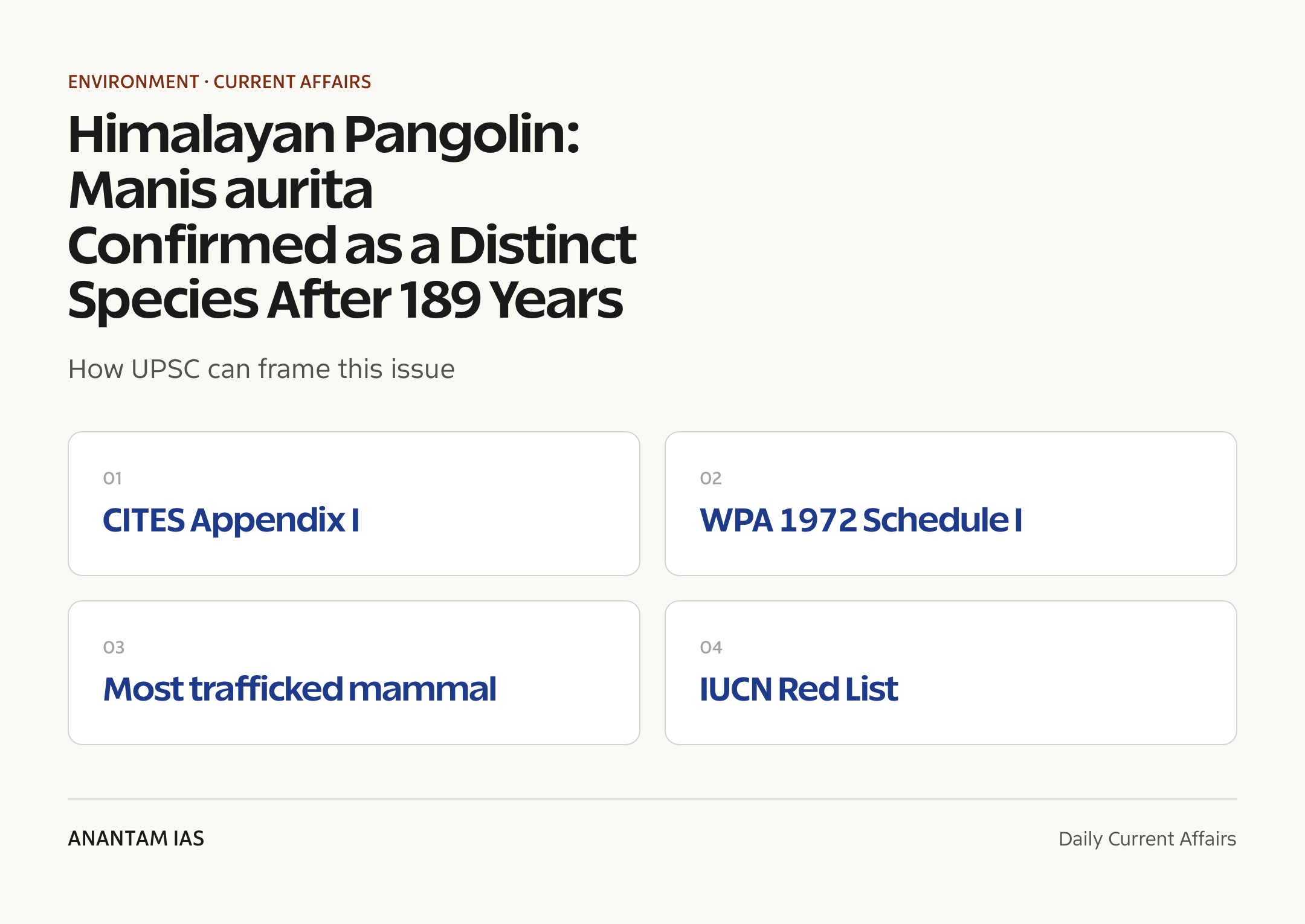
- All eight pangolin species are listed on CITES Appendix I (moved from Appendix II in 2016, effective 2017), banning all commercial international trade.
- In India, pangolins are protected under Schedule I of the Wildlife (Protection) Act, 1972 — the highest level of protection.
- Lectotype: a single specimen later designated as the definitive name-bearing type for a species; allopatric speciation is divergence caused by geographic isolation.
- Hodgson originally coined the name Manis auritus (‘with large ears’), with a backup name Plurisquamis (‘the many-scaled’).
Mains Relevance
GS Paper 3
- Conservation of biodiversity: how a taxonomic revision reshapes protection priorities, Red List assessment and legal status for a heavily trafficked species.
- Illegal wildlife trade and its control — pangolin scales, the demand chain to East Asian markets, and the role of CITES, the Wildlife Protection Act and enforcement agencies.
- Science and technology in conservation: ancient DNA, genomics and museum collections as tools for species identification and anti-trafficking forensics.
GS Paper 2
- India’s obligations under international conventions (CITES) and how domestic law (WPA 1972) gives them effect; transboundary conservation with Nepal and the Himalayan region.
Essay
- What we lose when a species is hidden in plain sight: taxonomy, memory and the ethics of conservation.
- The smallest scales, the largest trade: humanity’s relationship with the pangolin.
Background and Context
What a pangolin is
The pangolin is a biological oddity — a scaly, ant-eating mammal that predators struggle to crack.
- The only mammals with true keratin scales covering the body; when threatened they roll into a tight ball (the name derives from the Malay pengguling, ‘one who rolls up’).
- Toothless insectivores that use a long sticky tongue and a strong sense of smell to feed on ants and termites; they help regulate insect populations and aerate soil.
- Slow-breeding, nocturnal and solitary — traits that make recovery from population loss very slow.
- Found across Asia and sub-Saharan Africa; every one of the eight recognised species is threatened, ranging from Vulnerable to Critically Endangered.
How the Himalayan pangolin was rediscovered
The case rested on Hodgson’s 1836 words and a nearly two-century-old museum specimen.
- In 1836 Brian Houghton Hodgson, confined to Nepal’s Kathmandu Valley, described a pangolin with prominent ears and more trunk scales than any recorded species, naming it Manis auritus.
- For decades three subspecies of the Chinese pangolin were recognised, with the Nepal form treated as M. p. aurita and its status poorly studied.
- Between 2016 and 2017, mismatches in scales from smuggling seizures prompted researchers to re-examine the lineage.
- A team spanning Asia, the Americas and Europe spent about five years sequencing the original 1836 lectotype and modern specimens, concluding it is a full species: the Himalayan pangolin (Manis aurita).
- The work was published in Communications Biology, providing a genetic and morphological baseline for conservation.
Climate and the deep split
Ice-age climate swings, not distance alone, appear to have carved out the Himalayan lineage.
- The ancestors of M. aurita and M. pentadactyla diverged in the early Pleistocene, about 1.8 million years ago, amid large global climatic oscillations.
- Pangolins are warm-adapted with no fossil record in northern China; cooling and aridification likely forced an allopatric split into a western Himalayan refugium and an eastern East/Southeast Asian one.
- The Himalayan lineage suffered a sharp demographic collapse from unstable, restricted habitat, while the Chinese pangolin found buffering in maritime-influenced southern forests.
- A further genetic contraction around the 14th century tracks the onset of the Little Ice Age, leaving a lasting mark on the species’ low genetic diversity.
- Genes tied to the pangolin’s enlarged olfactory system likely diverged under selection as each lineage adapted.
Why pangolins are the most trafficked mammal
Demand for scales and meat has made pangolins the poster species of the illegal wildlife trade.
- Pangolins are considered the most smuggled mammals on Earth, killed for meat and for scales used in traditional medicine, mainly in East Asian markets.
- As Chinese and Sunda pangolin populations crashed, trafficking pressure shifted to the Indian pangolin and other species.
- Scales are pure keratin — the same protein as human nails — with no proven medicinal value, yet they command high black-market prices.
- Seizures of pangolin scales have repeatedly exposed how mixed, mislabelled consignments obscure which species and populations are being wiped out.
Legal and conservation status
Pangolins carry the strongest protections on paper, both globally and in India.
- All pangolin species are on CITES Appendix I (uplisted from Appendix II in 2016, effective 2017), prohibiting commercial international trade.
- The Indian pangolin is Endangered and the Chinese pangolin Critically Endangered on the IUCN Red List.
- In India, pangolins sit in Schedule I of the Wildlife (Protection) Act, 1972, the strictest domestic category.
- The study’s authors specifically urge listing Manis aurita under CITES Appendix I so that enforcement can target it as a distinct, high-risk species.
Why the reclassification matters
Recognising a species is the first step to protecting it correctly.
- Conservation status, population estimates and Red List categories are assigned per species — a hidden species means a hidden extinction risk.
- A small, fragmented Himalayan range with low genetic diversity may make M. aurita more vulnerable than the wider Chinese pangolin, warranting tailored protection.
- Species-level clarity sharpens wildlife forensics: seized scales can be matched to the correct population and trade route.
- It underscores the value of natural-history museum collections and ancient-DNA techniques for resolving taxonomy with real policy stakes.
Way Forward
Legal recognition
- Formally reflect Manis aurita in CITES listings and in India’s Wildlife (Protection) Act schedules, with a dedicated IUCN Red List assessment.
- Coordinate transboundary protection across Nepal, India and the Himalayan region given the species’ shared range.
Enforcement and science
- Strengthen wildlife forensics and DNA-based identification of seized scales to break trafficking networks.
- Fund field surveys to map the Himalayan pangolin’s true distribution, numbers and habitat in Northeast India and neighbouring areas.
- Curb demand through community engagement and awareness that pangolin scales are only keratin, with no medicinal value.
Conclusion
The revalidation of the Himalayan pangolin is a reminder that conservation begins with knowing what exists. A species described in 1836 and then lost inside another for nearly two centuries has re-emerged just as pangolins face relentless trafficking pressure.
For India, whose Northeast lies within this pangolin’s range, the finding is a chance to update legal protection, enforcement and field research before a newly named species slips toward extinction unnoticed.
UPSC Practice Questions
Prelims MCQ 1
With reference to pangolins, consider the following statements:
- They are the only mammals covered in keratin scales.
- All pangolin species are listed on CITES Appendix I.
- In India, pangolins are protected under Schedule I of the Wildlife (Protection) Act, 1972.
How many of the above statements are correct?
(a) Only one (b) Only two (c) All three (d) None
Answer: (c) All three
Explanation:
Pangolins are the only fully scale-covered mammals; all species are on CITES Appendix I (from 2017); and Indian and Chinese pangolins are in Schedule I of the WPA, 1972.
Prelims MCQ 2
The Himalayan pangolin, recently revalidated as a distinct species, was earlier classified as a subspecies of which species?
(a) Indian pangolin (Manis crassicaudata) (b) Chinese pangolin (Manis pentadactyla) (c) Sunda pangolin (Manis javanica) (d) Philippine pangolin (Manis culionensis)
Answer: (b) Chinese pangolin (Manis pentadactyla)
Explanation:
Manis aurita, first described by Brian Houghton Hodgson in 1836, had long been treated as a subspecies of the Chinese pangolin before genomic and morphological evidence confirmed it as a full species.
UPSC Mains Questions
- The revalidation of the Himalayan pangolin shows that taxonomy is not academic housekeeping but a conservation tool. Discuss, with reference to how species-level clarity shapes legal protection and the fight against wildlife trafficking. (250 words)
- Pangolins are the world’s most trafficked mammals despite the strongest legal protections. Examine the gap between paper protection and ground reality, and suggest measures to close it in the Indian context. (250 words)
Sources: Down To Earth and Mongabay.
Frequently Asked Questions
What is the Himalayan pangolin?
The Himalayan pangolin (Manis aurita) is a scaly, ant-eating mammal now revalidated as a distinct species after decades of being treated as a subspecies of the Chinese pangolin. First described from Nepal in 1836, it is found in Nepal, southern Tibet and Northeast India, including Assam, and is heavily threatened by trafficking.
Why was it reclassified after 189 years?
Scientists sequenced DNA from the original 1836 type specimen and modern samples, and studied morphology. The genetic and physical differences confirmed that the Himalayan pangolin is a separate evolutionary lineage, distinct from the Chinese pangolin, into which it had earlier been merged. The findings were published in the journal Communications Biology.
How is it different from the Chinese pangolin?
The Himalayan pangolin is larger, averaging about 95.2 cm versus about 71.2 cm for the Chinese pangolin, with a larger skull, longer tail, smaller ears and a shorter, broader nasal bone. Genomically, the two lineages diverged roughly 1.8 million years ago during the early Pleistocene.
Why are pangolins so heavily trafficked?
Pangolins are the world’s most trafficked mammals, hunted for their meat and for their scales, which are used in traditional medicine in parts of East Asia. The scales are made only of keratin, the protein in human nails, and have no proven medical value, yet they fetch high black-market prices.
What legal protection do pangolins have?
All pangolin species are on CITES Appendix I, banning commercial international trade since 2017. In India, pangolins are listed under Schedule I of the Wildlife (Protection) Act, 1972, the highest level of protection. Researchers want Manis aurita explicitly listed so enforcement can treat it as a distinct species.
How many pangolin species are there?
Eight species are formally recognised worldwide: four in Asia (Indian, Chinese, Sunda and Philippine) and four in Africa. The revalidation of the Himalayan pangolin would add another distinct Asian species, sharpening conservation attention on the Himalayan and Northeast Indian populations.
Tell Google you want more of this.
Add Anantam IAS as a preferred sourceOne tap, and this site shows up more often in your own Top Stories, AI Overviews and AI Mode. Remove it any time.