Why in News?
Bengaluru-based private space startup GalaxEye said on 8 July 2026 that it had lost communication with Mission Drishti — billed as the world’s first OptoSAR satellite — after the spacecraft hit an anomaly during the final stage of its Launch and Early Orbit Phase (LEOP). Business Today and Business Standard reported the failure, which the company traced to a geomagnetic solar storm.
GalaxEye’s founder-CEO Suyash Singh said radiation effects from the space-weather event likely damaged a critical onboard system; communication turned intermittent and was eventually lost, with the likelihood of recovery now low.
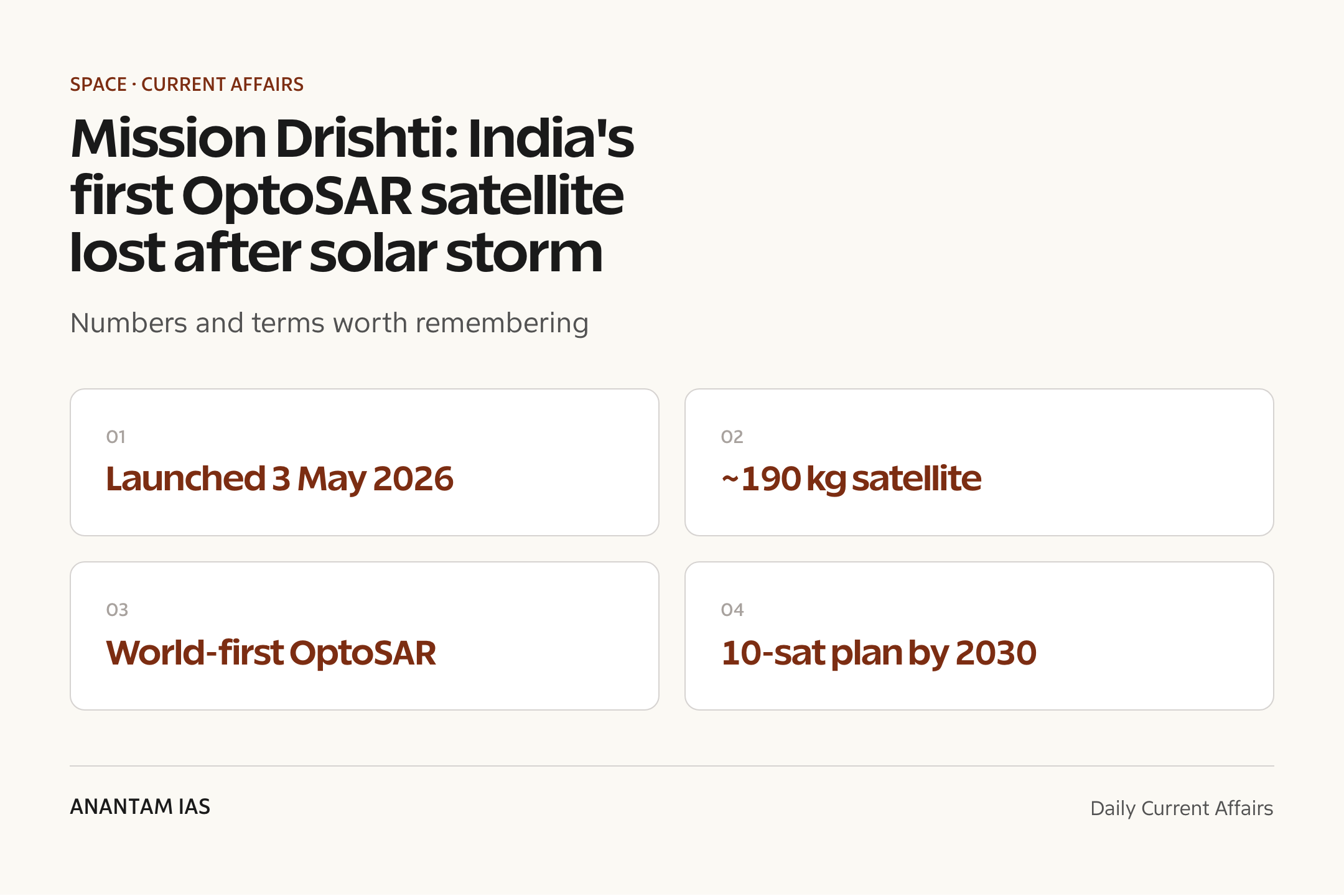
- Drishti launched aboard a SpaceX Falcon 9 on 3 May 2026 from California
- It was the largest satellite ever built by India’s private sector at about 190 kg
- Combined multispectral imaging (MSI) and synthetic aperture radar (SAR) on one platform for the first time
- Anomaly struck in the final stage of LEOP after a geomagnetic storm; root-cause points to radiation hitting a critical system
- GalaxEye said the mission still validated key spacecraft, computing and in-house mission-operations systems
The development matters in the context of:
- First high-profile in-orbit loss for an Indian private-sector earth-observation satellite — a real-world test of the post-2020 space reforms
- Underlines space weather as an operational risk for the growing fleet of small commercial satellites in low earth orbit
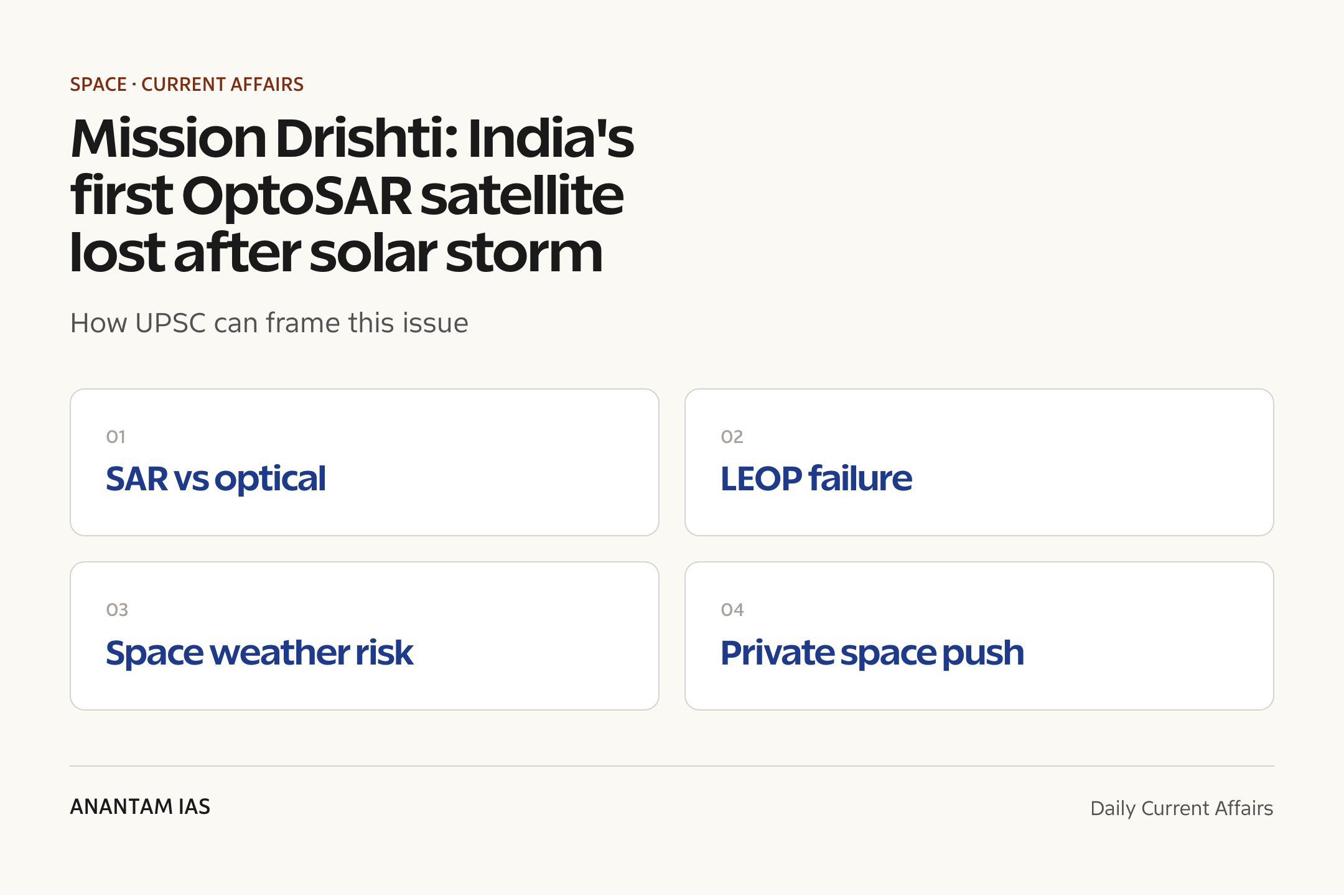
UPSC Relevance
Prelims Relevance
- OptoSAR — fusing optical/multispectral imaging with SAR on a single satellite
- SAR (Synthetic Aperture Radar): active microwave sensor, all-weather, day-night imaging
- Multispectral imaging: capture across several spectral bands (Drishti carried a 7-band imager)
- LEOP — Launch and Early Orbit Phase, the critical commissioning window after separation
- Geomagnetic storm and Coronal Mass Ejection (CME) as space-weather drivers
- Single Event Upset / radiation effects on satellite electronics
- IN-SPACe — single-window regulator for private space activity (est. 2020)
- Indian Space Policy 2023; NGE (Non-Government Entities)
- GalaxEye — IIT Madras-incubated startup; Low Earth Orbit (LEO)
Mains Relevance
GS Paper 3
- Awareness in the field of space; indigenisation and the role of private players in earth observation
- Space weather as a technological risk and the need for radiation-hardened design and space situational awareness
GS Paper 2
- Government policies and reforms — the 2020 space-sector opening, IN-SPACe and the regulatory ecosystem for start-ups
Essay
- Failure as a stepping stone: risk, resilience and India’s private innovation frontier
- Reaching for the stars — the promise and perils of a privatised space economy
Background and Context
What Mission Drishti was
Drishti was pitched as a technology first for Indian private space.
- Built by GalaxEye, a 2021 IIT Madras-incubated startup founded by five alumni of the Avishkar Hyperloop team; Suyash Singh is founder-CEO
- The world’s first OptoSAR satellite — carrying both an optical multispectral imager (7 bands, ~1.8 m resolution) and a synthetic aperture radar on one bus
- At about 190 kg, the largest satellite built by India’s private sector, a jump in scale for a young commercial industry
- Launched on a SpaceX Falcon 9 rideshare on 3 May 2026 from California; drew notice from PM Narendra Modi and Elon Musk
- Meant to deliver analysis-ready, all-weather earth imagery, and to seed a planned constellation of 10 satellites by 2030 for commercial and strategic customers
SAR, optical and why fusing them matters
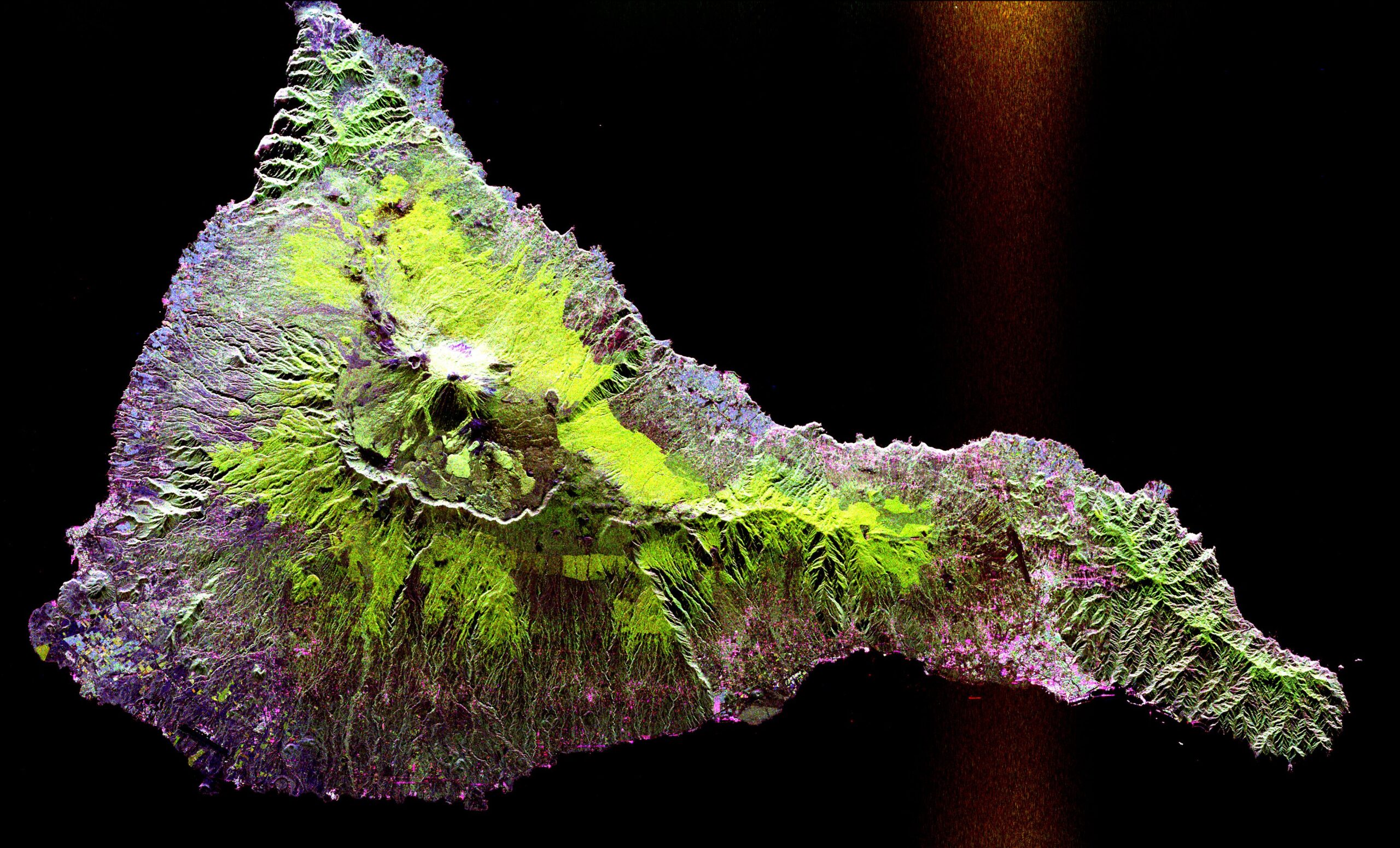
The novelty was fusing two imaging methods that normally fly on separate satellites.
- Optical/multispectral sensors are passive — they record sunlight reflected off the surface across several spectral bands, giving rich colour, vegetation and material detail, but they are blind through cloud, smoke and at night
- Synthetic Aperture Radar (SAR) is an active microwave sensor: the satellite transmits its own radar pulses and reads the echo, so it needs no sunlight and sees through cloud and darkness in all weather, day or night
- SAR gets its name from motion — the spacecraft’s own travel along orbit synthesises a very long virtual antenna (a large aperture), sharpening resolution far beyond a small physical radar
- Multispectral imaging splits reflected light into discrete bands (visible, near-infrared and beyond); different surfaces — healthy crop, bare soil, water, built-up land — carry distinct spectral signatures that reveal what a scene is made of
- Because SAR senses surface texture, moisture and structure while optical bands sense colour and chemistry, the two are complementary rather than redundant
- Capturing both over the same spot at the same time — the core of OptoSAR — yields cross-validated, analysis-ready data and cuts the classic trade-off between an optical satellite’s clarity and a radar satellite’s reliability
What earth observation is used for
All-weather imagery has a broad civilian and strategic market that a fused sensor targets directly.
- Agriculture — crop-type mapping, acreage and yield estimates, soil-moisture and irrigation tracking, and crop-insurance verification, where SAR’s cloud-piercing view matters most in the monsoon
- Disaster management — flood extent, cyclone and landslide damage and earthquake mapping, since radar can image a disaster zone at night or under thick cloud when optical satellites cannot
- Defence and security — border and maritime surveillance, ship and vessel detection, and ISR (intelligence, surveillance and reconnaissance), a market GalaxEye openly courted
- Urban and infrastructure planning — monitoring land use, encroachment, ground subsidence, dams, ports and construction over time
- Climate and environment — deforestation, glacier and coastline change and oil-spill detection round out the demand for repeat, reliable imagery
- A constellation of many small satellites shortens the revisit time over any location, turning one-off snapshots into near-daily monitoring that these applications need
How the mission was lost
The satellite cleared most commissioning before space weather intervened.
- GalaxEye said Drishti established communication and completed a major portion of LEOP — validating power, attitude control, onboard computing and communications
- In the final stage of LEOP the spacecraft hit an anomaly following a geomagnetic solar storm
- Initial root-cause analysis points to radiation effects from the space-weather event damaging a critical onboard system
- Communication became intermittent and was eventually lost; recovery efforts continue but the chance is low
- CEO Suyash Singh framed it as delivering invaluable engineering insights for future missions rather than a total loss
The space-weather threat
Solar activity is a recurring, physical hazard for satellites in low earth orbit.
- The Sun drives space weather through solar flares (bursts of X-ray and ultraviolet radiation) and Coronal Mass Ejections (CMEs) — vast clouds of charged plasma flung from the corona
- When a CME strikes Earth’s magnetosphere it triggers a geomagnetic storm, injecting energy into the near-Earth space environment
- Storms heat and cause thermospheric expansion — the upper atmosphere puffs up and denser air reaches satellite altitudes, sharply raising aerodynamic drag on LEO spacecraft and pulling their orbits down
- High-energy particles cause Single Event Upsets (SEUs), surface and deep-dielectric charging, and can corrupt memory or permanently damage electronics
- In February 2022 a geomagnetic storm doomed 38 of 49 newly launched Starlink satellites to atmospheric drag — the most-cited precedent for exactly this risk
- Satellites still in early-orbit commissioning are especially exposed, since protective safe-modes and full autonomy are not yet active
India's private space ecosystem and reforms
Drishti is a marker of how far commercial space has come since the 2020 opening.
- GalaxEye is a private, venture-funded firm — clearly distinct from ISRO, the government space agency; Drishti was a commercial mission, not a national one
- The 2020 reforms opened the sector to private players and created IN-SPACe (Indian National Space Promotion and Authorisation Centre) as a single-window promoter, authoriser and regulator for Non-Government Entities (NGEs)
- NSIL (NewSpace India Limited), a PSU under the Department of Space, is the commercial arm that owns operational assets and handles demand-driven missions
- The Indian Space Policy 2023 formalised the roles of ISRO, IN-SPACe, NSIL and private firms across the value chain, letting NGEs build and operate satellites and ground stations
- The Union government also allowed up to 100% FDI in parts of the space sector (2024), easing foreign capital for satellite manufacturing and components
- Registered space startups grew from around 54 in 2020 to 300-plus by 2026 on the IN-SPACe portal
- Peers include Pixxel (hyperspectral imaging), Digantara (space situational awareness), and launch-vehicle makers Skyroot Aerospace and Agnikul Cosmos
- Government backing runs through a dedicated venture-capital fund for space startups and technology-adoption support, signalling that private earth observation is treated as strategic, not niche
Why the loss still counts as progress
In a young ecosystem, a validated technology can outlast a failed satellite.
- GalaxEye demonstrated fully in-house mission operations and validated the design-build-launch-operate pipeline end to end
- The OptoSAR concept reached orbit and operated, proving the payload integration and fused-sensor bus are workable
- The company says the mission strengthened customer engagement and market confidence in its imagery
- Lessons are being folded into a shift toward more in-house supply chain and manufacturing to cut single points of failure
- Early failures are common in first flights worldwide; the durable asset is the engineering knowledge and team capability that survive the satellite
- For India’s aim of raising its share of the global space economy, learning to build, launch and operate complex payloads privately matters more than any single spacecraft’s fate
Way Forward
Radiation-hardened design
- Invest in radiation-hardened and redundant electronics and robust fault-recovery for critical systems
- Build safe-mode and autonomous recovery logic tuned for the vulnerable LEOP window
Space-weather resilience
- Integrate space-weather forecasting into launch and early-operations planning
- Strengthen India’s space situational awareness and solar-monitoring feeds for operators
Ecosystem support
- Use IN-SPACe to share test facilities, insurance and risk-pooling for first-time private missions
- Encourage vertical integration and domestic component supply to cut single points of failure
Conclusion
Losing Mission Drishti is a hard blow, but the mission put a genuine world-first — an OptoSAR payload — into orbit and proved GalaxEye can run an end-to-end space operation. For a startup barely five years old, that is a foundation, not a full stop.
The episode is a reminder that space is unforgiving and that space weather is an operational risk, not a footnote. As India’s private fleet grows, radiation-hardened engineering and space-weather readiness must become baseline design, backed by IN-SPACe and shared national capabilities.
UPSC Practice Questions
Prelims MCQ 1
With reference to Synthetic Aperture Radar (SAR) imaging, consider the following statements:
- It is a passive sensor that relies on reflected sunlight.
- It can image the surface through cloud cover and at night.
- GalaxEye’s Mission Drishti combined SAR with multispectral imaging on a single satellite.
How many of the above statements are correct?
(a) Only one (b) Only two (c) All three (d) None
Answer: (b) Only two
Explanation:
SAR is an active microwave sensor, not a passive optical one, so statement 1 is wrong. It works in all weather, day or night (2 correct), and Drishti’s OptoSAR design fused SAR with multispectral imaging (3 correct).
Prelims MCQ 2
Which organisation was set up in 2020 as the single-window agency to authorise and promote private space activity in India?
(a) ISRO (b) IN-SPACe (c) Antrix Corporation (d) NSIL
Answer: (b) IN-SPACe
Explanation:
IN-SPACe (Indian National Space Promotion and Authorisation Centre) was created in 2020 as the single-window regulator-promoter for non-government entities. ISRO is the space agency; NSIL and Antrix are commercial arms.
UPSC Mains Questions
- The loss of Mission Drishti shows that space is a high-risk frontier for private players. Examine the role of the 2020 space-sector reforms and IN-SPACe in building a resilient private space industry in India. (250 words)
- What is space weather, and how do geomagnetic storms threaten satellites in low earth orbit? Discuss the measures needed to make earth-observation missions resilient to such events. (150 words)
Sources: Business Today and Business Standard.
Frequently Asked Questions
What is Mission Drishti?
Mission Drishti was the first satellite of Bengaluru startup GalaxEye and the world’s first OptoSAR satellite, combining optical multispectral imaging with synthetic aperture radar on a single platform. Launched on a SpaceX Falcon 9 on 3 May 2026, it was, at about 190 kg, the largest satellite built by India’s private sector.
What does OptoSAR mean?
OptoSAR fuses two imaging methods on one satellite: optical or multispectral sensors that capture colour and material detail, and synthetic aperture radar (SAR), an active microwave sensor that works through cloud and at night. Capturing both over the same spot at the same time yields richer, all-weather earth imagery.
Why was contact with the satellite lost?
GalaxEye said Drishti hit an anomaly in the final stage of its Launch and Early Orbit Phase after a geomagnetic solar storm. Initial analysis suggests radiation from the event damaged a critical onboard system, after which communication became intermittent and was eventually lost. Recovery chances are now considered low.
How does a solar storm damage a satellite?
Solar eruptions called coronal mass ejections trigger geomagnetic storms. These heat and expand the upper atmosphere, raising drag on low-orbit satellites, while high-energy particles can cause single event upsets and charging that corrupt or destroy electronics. In 2022 a storm doomed 38 of 49 newly launched Starlink satellites.
Is GalaxEye part of ISRO?
No. GalaxEye is a private, venture-funded startup incubated at IIT Madras in 2021, not part of ISRO. It operates under India’s post-2020 space reforms, which opened the sector to private firms and set up IN-SPACe as the single-window regulator and promoter for non-government space activity.
Does the failure end GalaxEye’s plans?
GalaxEye says no. Although the satellite was lost, the mission validated its OptoSAR payload, in-house mission operations and the full design-to-operate pipeline. The company plans to fold the lessons into future satellites and still aims to build a constellation of about 10 satellites by 2030.
Tell Google you want more of this.
Add Anantam IAS as a preferred sourceOne tap, and this site shows up more often in your own Top Stories, AI Overviews and AI Mode. Remove it any time.