Why in News?
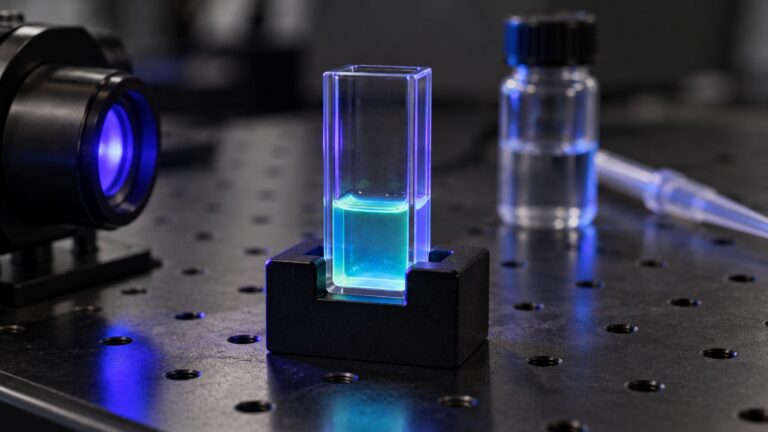
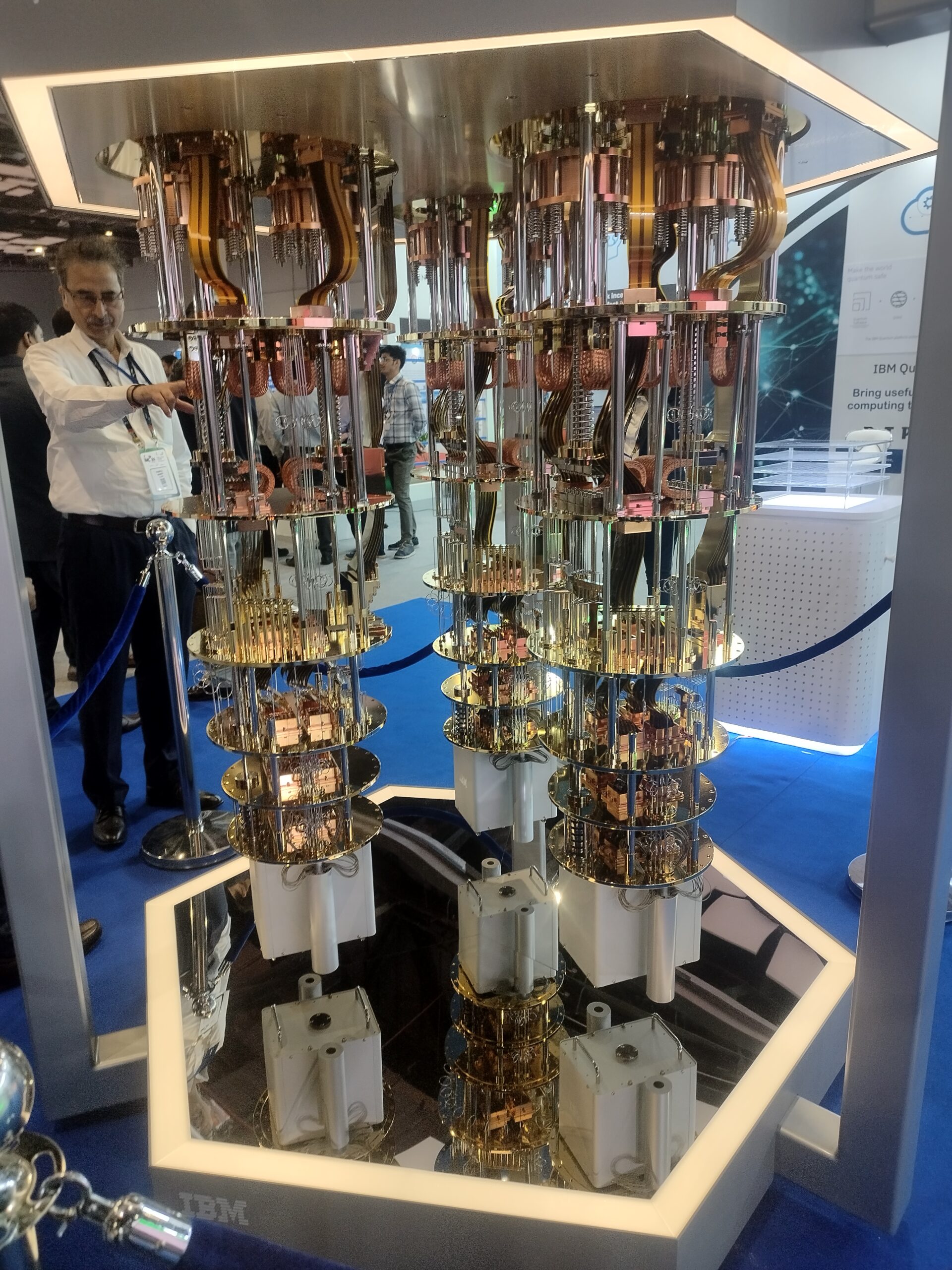
A team led by Dr. Indrakshi Raychowdhury at BITS Pilani (Goa campus), working with scientists from IBM Quantum, simulated the real-time behaviour of subatomic particles governed by the strong nuclear force on 120 qubits of an IBM processor. The Hindu reported that the result has become the first Indian entry marked ‘active’ on IBM’s Quantum Advantage Tracker.
The calculation took the quantum machine about 20 seconds against roughly two hours on a classical computer — a rare, independently checked demonstration of ‘useful’ quantum advantage on a genuine physics problem, not a contrived benchmark.
- The problem simulated: how quarks and gluons bound by the strong force move and rearrange in real time — a lattice gauge dynamics model, exponentially hard classically.
- The team’s encoding stripped away mathematical redundancy, pushing a task others had run on at most 27 qubits up to 120 qubits.
- The Quantum Advantage Tracker (QAT) was launched in November 2025 by IBM with the Flatiron Institute and startups BlueQubit and Algorithmiq as a live, reproduce-before-you-accept peer review.
- Of some 220 items logged on QAT’s public page, only about a dozen have been accepted and just a handful survive as ‘active’ claims; this entry has stood since May 2026.
- India’s National Quantum Mission (NQM) — a ₹6,003.65-crore programme approved in 2023 — funds such algorithms but the country still owns no high-end quantum hardware; the runs used IBM machines over the cloud via Qiskit.
The development matters in the context of:
- ‘Quantum advantage’ here is narrow and benchmarked — a specific simulation task, not blanket ‘supremacy’ over all computing.
- It signals that Indian researchers can compete at the algorithm frontier even without domestic quantum hardware.
UPSC Relevance
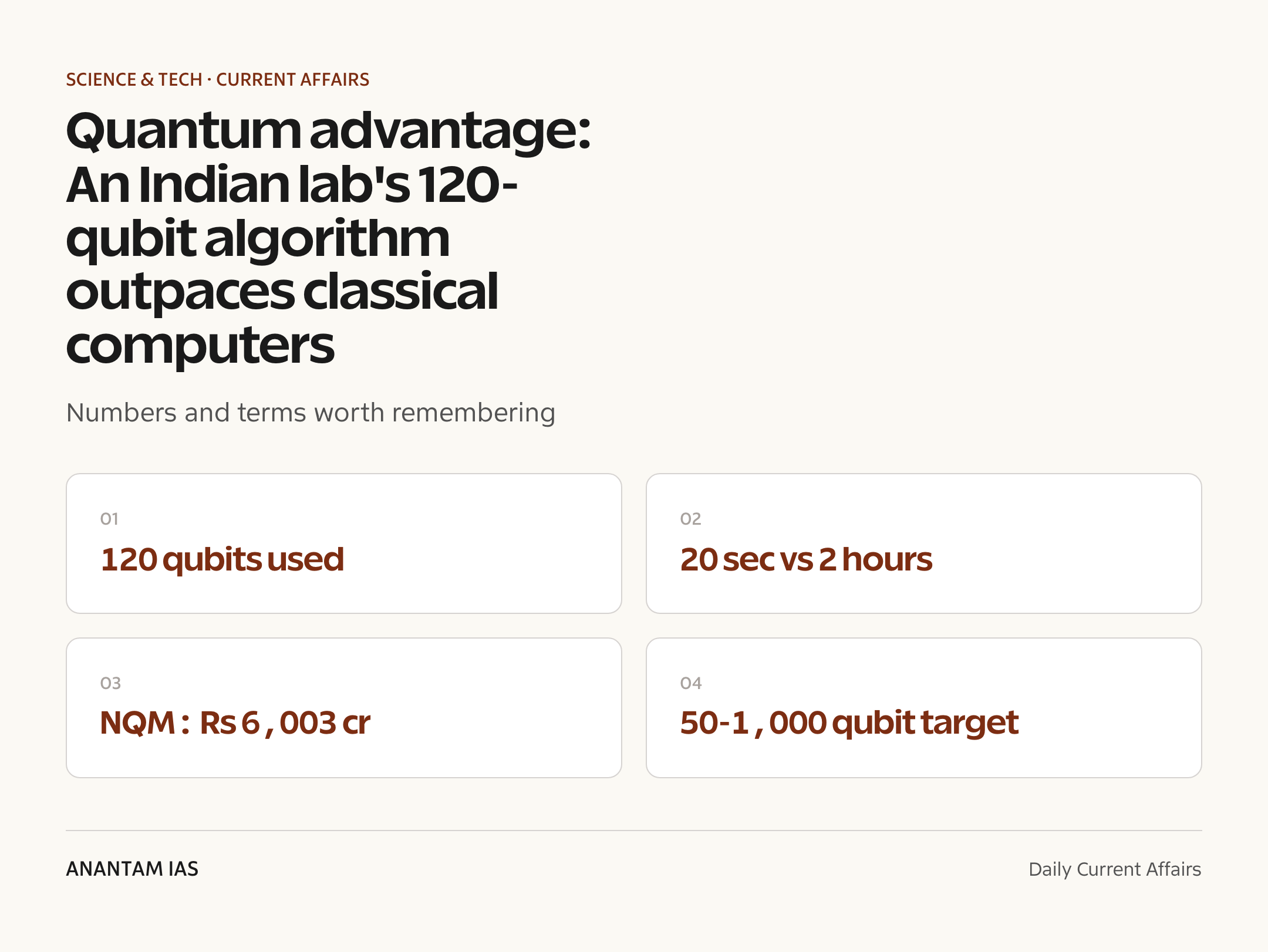
Prelims Relevance
- Qubit — the quantum bit; can hold 0, 1 and states in between via superposition
- Superposition and entanglement — the two properties behind quantum speed-ups
- Quantum advantage vs the 2019 Google ‘supremacy’ demonstration
- National Quantum Mission: ₹6,003.65 crore, approved 2023, period up to 2030-31, four thematic hubs
- NQM target: 50–1,000 physical qubits in 8 years; computing hub anchored at IISc Bengaluru
- NISQ — Noisy Intermediate-Scale Quantum (term coined by John Preskill)
- Decoherence, qubit error rates of 1%–0.1%, cooling near absolute zero (-273 °C)
- Quantum error correction: many physical qubits forming one logical qubit
- Qiskit — IBM’s Python toolkit for programming quantum computers over the cloud
- Lattice gauge theory / QCD — the strong force binding quarks and gluons
Mains Relevance
GS Paper 3
- Quantum computing as an emerging technology: strategic significance, applications and India’s readiness.
- Why software and algorithms matter as much as hardware in the quantum race — ‘without algorithms, the hardware is useless’.
- Indigenisation gap: India funds research but leans on foreign machines; implications for technological sovereignty.
GS Paper 2
- Mission-mode governance (NQM) and public-funded R&D as instruments of self-reliance and international collaboration.
Essay
- Science advances by silencing the noise: the patience behind breakthrough technologies.
- Can a nation lead in a technology it cannot yet build?
Background and Context
What actually happened
A physics simulation, not a stunt — and independently reproduced before it counted.
- Dr. Indrakshi Raychowdhury, an associate professor of physics at BITS Pilani, Goa, and IBM Quantum colleagues modelled the strong force acting on subatomic particles.
- The run used 120 qubits of an IBM processor and finished in about 20 seconds; the equivalent classical calculation took roughly two hours.
- Per one expert assessment, it is one of only three problems that are both genuinely useful to physicists and (so far) beyond classical machines.
- Crucially, everything ran over the cloud in Python via Qiskit — ‘none of it required her to leave her desk’.
Quantum computing basics
Where the power comes from — and why it is not a faster calculator for everything.
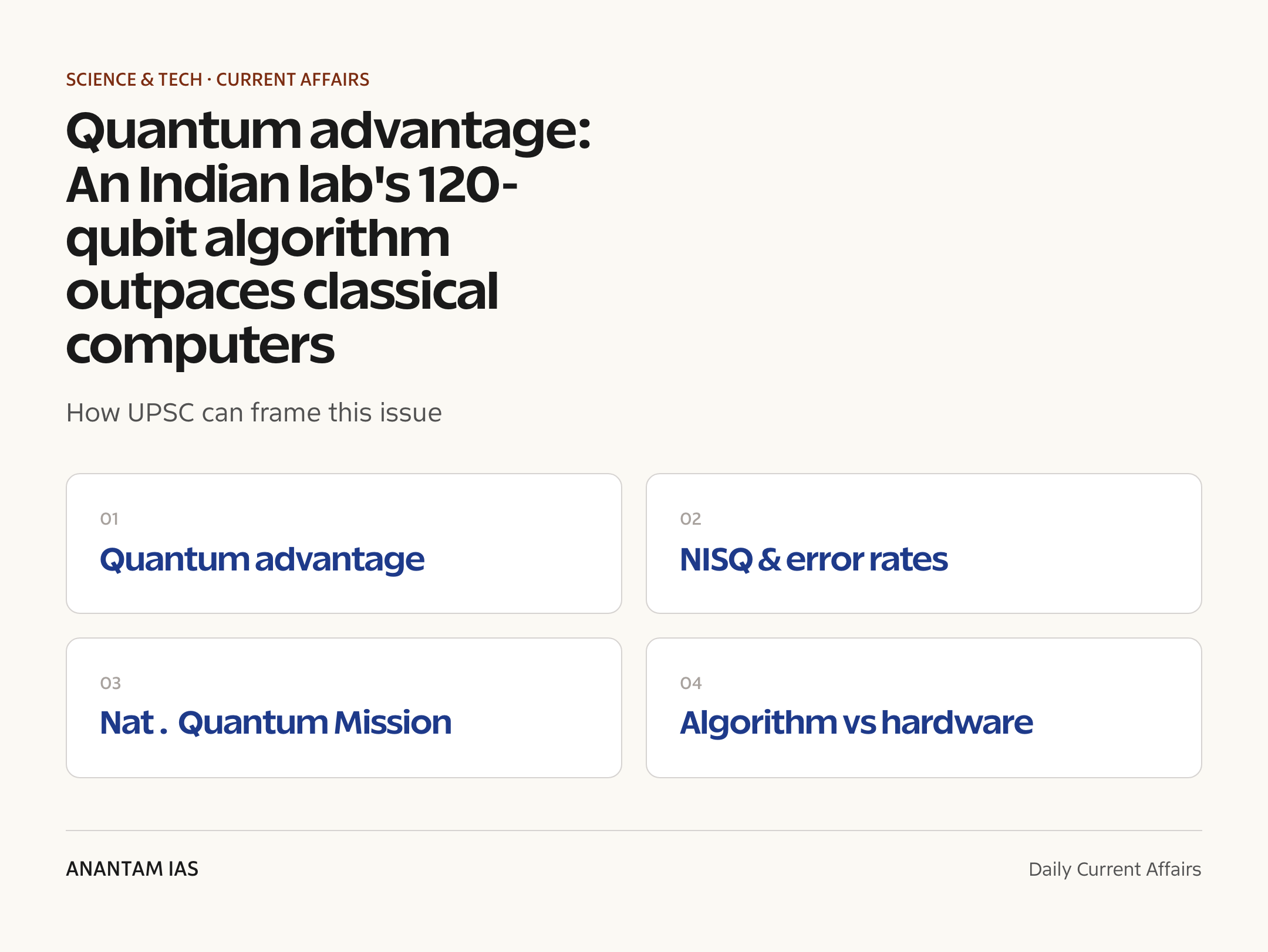
- A classical bit is 0 or 1; a qubit can be 0, 1 and any state in between — the property of superposition (like a spinning coin that is both heads and tails).
- Qubits can be entangled — their states linked regardless of distance, so measuring one affects the others; together these make a quantum machine a ‘massively parallel’ processor.
- The advantage is task-specific: quantum computers are poor at plain arithmetic but strong at simulating interacting quantum systems and some search/sorting problems.
- Common qubit types: superconducting (Josephson junctions, as in Google’s Willow), trapped-ion, photonic, quantum-dot and NMR qubits.
The problem: simulating the strong force
Watching quarks and gluons evolve frame by frame is exponentially hard for classical methods.
- Inside a proton, quarks are bound by gluons through the strong nuclear force — nature’s most powerful force, described by quantum chromodynamics.
- Classical methods handle ‘snapshots’ well (they pin down a proton’s mass) but tracking real-time evolution is ‘exponentially hard to calculate classically’.
- A quantum computer, being itself made of quantum parts, can imitate the system directly — ‘a still photograph replaced by a film’.
- The team used a simplified lattice gauge stand-in for the full theory; the novelty is the method, not a new particle. CERN researchers have invited her to see if the approach can extend their simulations.
Quantum Advantage Tracker — the referee
A live peer-review that reproduces claims on both classical and quantum machines before accepting them.
- The QAT was launched in November 2025 by IBM with the Flatiron Institute and startups BlueQubit and Algorithmiq, plus academic reviewers.
- A researcher submits a result; a committee reproduces it on both classical and quantum hardware before it stands — ‘more thorough than a standard academic journal’.
- Of roughly 220 items logged, only about a dozen have been accepted and only a handful remain ‘active’.
- This BITS entry is the first from an Indian laboratory to be marked ‘active’; if a classical machine later solves it, the claim becomes ‘superseded’. It has not been superseded since May 2026.
'Advantage', not 'supremacy'
The 2019 Google milestone was real but contrived; the field now chases ‘useful’ advantage.
- In 2019, Google reported its processor finishing in minutes a task a supercomputer would need 10,000 years to match — but the task had no practical use and was chosen to suit quantum hardware.
- So researchers now target ‘useful’ advantage: a quantum win on a real problem whose answer can be independently checked — exactly what QAT verifies.
- Breaking modern encryption or simulating a large molecule from scratch remains years away; this result is a narrow, benchmarked win, not general ‘supremacy’.
- ‘While the media often highlights drug discovery or materials, those fields are computationally more primitive than high-energy physics,’ Dr. Raychowdhury noted.
The noise problem and error correction
Today’s machines are ‘Noisy Intermediate-Scale Quantum’ — fragile and error-prone.
- Any interaction with the environment causes decoherence — qubits lose their quantum state; so they are isolated and cooled near absolute zero (-273 °C).
- Quantum processors have error rates of 1% to 0.1%, versus about one error in a quintillion operations for classical machines; John Preskill named this era NISQ.
- The fix is quantum error correction — many physical qubits act as one logical qubit; below a threshold error rate, adding qubits suppresses errors exponentially, as Google’s Willow showed (2024).
- The BITS team sidestepped noise cheaply: run the experiment twice — once with the particle, once without, within fractions of a second — then subtract, so near-identical errors cancel.
India's National Quantum Mission
A ₹6,003-crore mission-mode push — strong on algorithms, still short on home-grown hardware.
- The NQM, approved in 2023 at ₹6,003.65 crore (2023-24 to 2030-31), aims to make India a leader in quantum technologies and applications.
- It runs four thematic hubs — computing, communication, sensing & metrology, and materials & devices — with the computing hub anchored at IISc Bengaluru.
- A headline target is intermediate-scale machines of 50–1,000 physical qubits within eight years, plus long-distance quantum communication.
- The gap this result exposes: India has no high-end quantum hardware of its own, so researchers still lean on machines abroad. ‘Without algorithms, the hardware is useless,’ Dr. Raychowdhury said.
Way Forward
Build indigenous hardware
- Use NQM funding to move beyond cloud access toward domestic superconducting/photonic testbeds and a sovereign fabrication base.
Invest in algorithms and talent
- Back algorithm design, error-mitigation methods and a deep talent pool — the layer where India already shows an edge.
Deepen global collaboration
- Sustain partnerships like BITS-IBM and the CERN engagement while guarding against long-term dependence on foreign machines.
Pair the mission’s hardware targets with clear use-case pipelines — high-energy physics, materials and secure communication — so ‘useful advantage’ translates into national capability.
Conclusion
The BITS Pilani result is a genuine, independently verified marker of India’s arrival at the quantum-algorithm frontier — the first Indian claim to stay ‘active’ on a demanding tracker. It matters most as proof that Indian teams can win narrow, useful quantum problems on borrowed hardware.
But the same story underlines the mission’s unfinished task: without home-grown machines and error-corrected, fault-tolerant qubits, quantum advantage stays specialised and fragile. The next decade will test whether the National Quantum Mission can convert bright algorithms into durable, sovereign capability.
UPSC Practice Questions
Prelims MCQ 1
With reference to quantum computing, consider the following statements:
- A qubit can exist in a superposition of the 0 and 1 states.
- Entanglement links the states of qubits regardless of the distance between them.
- Present-day quantum processors have lower error rates than classical computers.
How many of the above statements are correct?
(a) Only one (b) Only two (c) All three (d) None
Answer: (b) Only two
Explanation:
Statements 1 and 2 are correct — superposition and entanglement are the defining quantum properties. Statement 3 is wrong: today’s ‘NISQ’ processors have error rates of 1%-0.1%, far worse than classical machines (about one error in a quintillion operations).
Prelims MCQ 2
The National Quantum Mission, approved in 2023, is correctly described by which of the following?
(a) It is a ₹6,003-crore mission with four thematic hubs running up to 2030-31 (b) It targets only quantum communication and excludes quantum computing (c) It is implemented by the Ministry of Defence through DRDO alone (d) It bars any international collaboration on quantum research
Answer: (a) It is a ₹6,003-crore mission with four thematic hubs running up to 2030-31
Explanation:
The NQM has an outlay of ₹6,003.65 crore (2023-24 to 2030-31) with four thematic hubs — computing, communication, sensing & metrology, and materials & devices — coordinated under the Department of Science & Technology, and it explicitly targets 50-1,000 physical qubits.
UPSC Mains Questions
- ‘Without algorithms, the hardware is useless.’ In the light of an Indian team achieving verified quantum advantage on borrowed hardware, examine India’s strengths and gaps in quantum computing and assess whether the National Quantum Mission is adequately designed to close them. (250 words)
- Distinguish ‘quantum advantage’ from ‘quantum supremacy’, and explain why noise and error correction remain the central obstacles to practically useful quantum computers. (150 words)
Sources: The Hindu (Science) and Department of Science & Technology, National Quantum Mission.
Frequently Asked Questions
What did the BITS Pilani team achieve?
A team led by Dr. Indrakshi Raychowdhury at BITS Pilani, Goa, working with IBM Quantum, simulated the strong-force behaviour of subatomic particles on 120 qubits. The run took about 20 seconds versus two hours on a classical computer, and became the first Indian entry marked ‘active’ on IBM’s Quantum Advantage Tracker.
Is this the same as ‘quantum supremacy’?
No. This is a narrow, benchmarked ‘quantum advantage’ on a specific and genuinely useful physics problem that can be independently checked. It is not blanket supremacy over all computing. Google’s 2019 ‘supremacy’ demonstration was faster but used a contrived task with no practical use.
What is a qubit?
A qubit, or quantum bit, is the basic unit of a quantum computer. Unlike a classical bit that is either 0 or 1, a qubit can exist in a superposition of both at once, and qubits can be entangled so their states are linked. These properties let quantum machines process certain problems in a massively parallel way.
What is the Quantum Advantage Tracker?
The QAT is a live peer-review platform launched in November 2025 by IBM with the Flatiron Institute and startups BlueQubit and Algorithmiq. Submitted results are reproduced on both classical and quantum machines before being accepted. Of about 220 logged items, only a handful remain ‘active’ — including this Indian entry.
What is the National Quantum Mission?
The NQM is a ₹6,003.65-crore mission approved in 2023 and running to 2030-31, with four thematic hubs covering computing, communication, sensing and metrology, and materials and devices. It targets intermediate-scale machines of 50-1,000 physical qubits, with the computing hub anchored at IISc Bengaluru.
Why is ‘noise’ such a big problem in quantum computing?
Qubits are fragile and lose their quantum state through decoherence at the slightest environmental interaction, so they are cooled near absolute zero. Current processors err once in every 100 to 1,000 operations. Overcoming this needs quantum error correction, where many physical qubits combine into a single, more reliable logical qubit.
Tell Google you want more of this.
Add Anantam IAS as a preferred sourceOne tap, and this site shows up more often in your own Top Stories, AI Overviews and AI Mode. Remove it any time.