

Why in News?
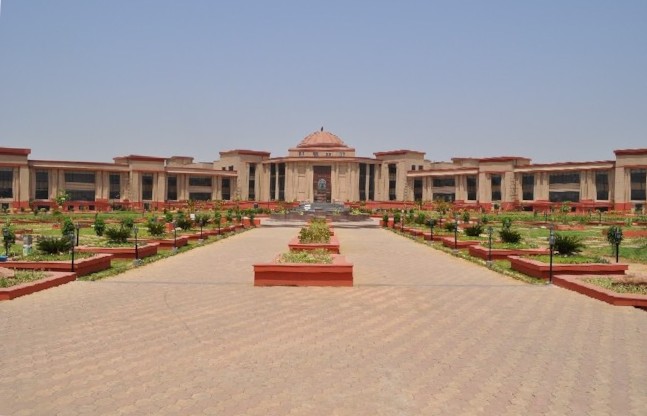
The Chhattisgarh High Court dismissed a petition challenging a state School Education Department order that introduced the recitation of the Saraswati Vandana, Gayatri Mantra, Guru Mantra, Shanti Mantra and other invocations in morning assemblies of government schools. Bar and Bench and LiveLaw reported the order in Abdul Salam Rizvi v State of Chhattisgarh on 8 July 2026.
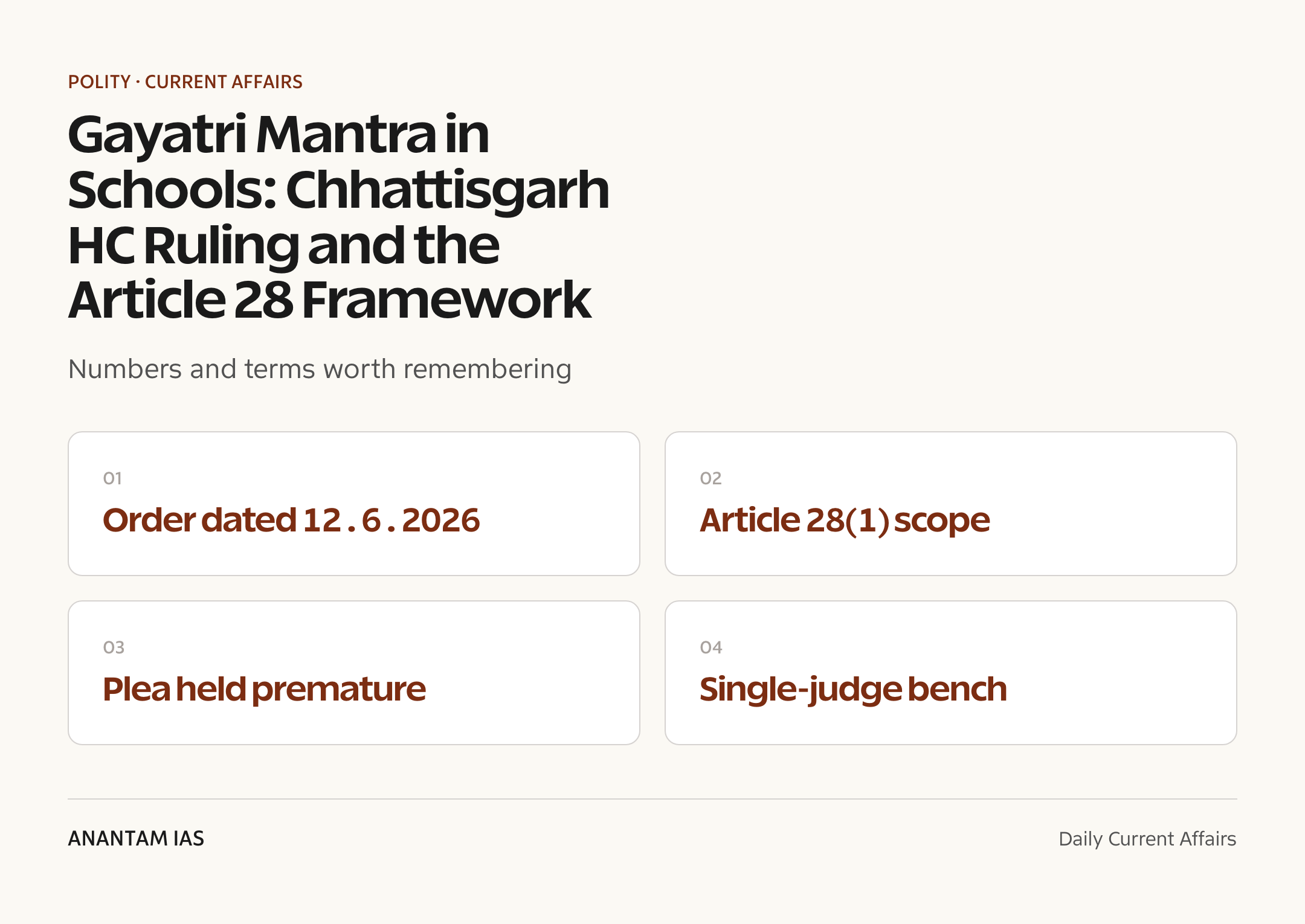
A single-judge bench of Justice Amitendra Kishore Prasad held the plea “entirely premature”, finding that the impugned order dated 12 June 2026 contains no coercive direction compelling any student to act against their religious beliefs — and that Article 28(1) prohibits “religious instruction” in wholly State-funded institutions but “does not ban moral instruction, disassociated from any denominational doctrines”.
- The challenged government order, dated 12 June 2026, directed recitation of Saraswati Vandana, Gayatri Mantra, Guru Mantra, Shanti Mantra, Bhojan Mantra and related invocations in government-school morning assemblies from the 2026-27 academic session.
- Petitioners included former Chhattisgarh Waqf Board chairman Abdul Salam Rizvi, former Minority Department chairman Mahendra Chhabda and a Bilaspur-based activist; they invoked Articles 14, 21, 25, 28(1), 29 and 30.
- The State called the plea politically motivated, arguing the order involves “neither religious instruction nor conversion” and aligns with NEP 2020 and its Indian Knowledge Systems (IKS) component.
- The court noted the order prescribes no punishment or disciplinary action against a student who chooses not to recite the verses, and that petitioners placed no material showing violation of any fundamental right or direct injury.
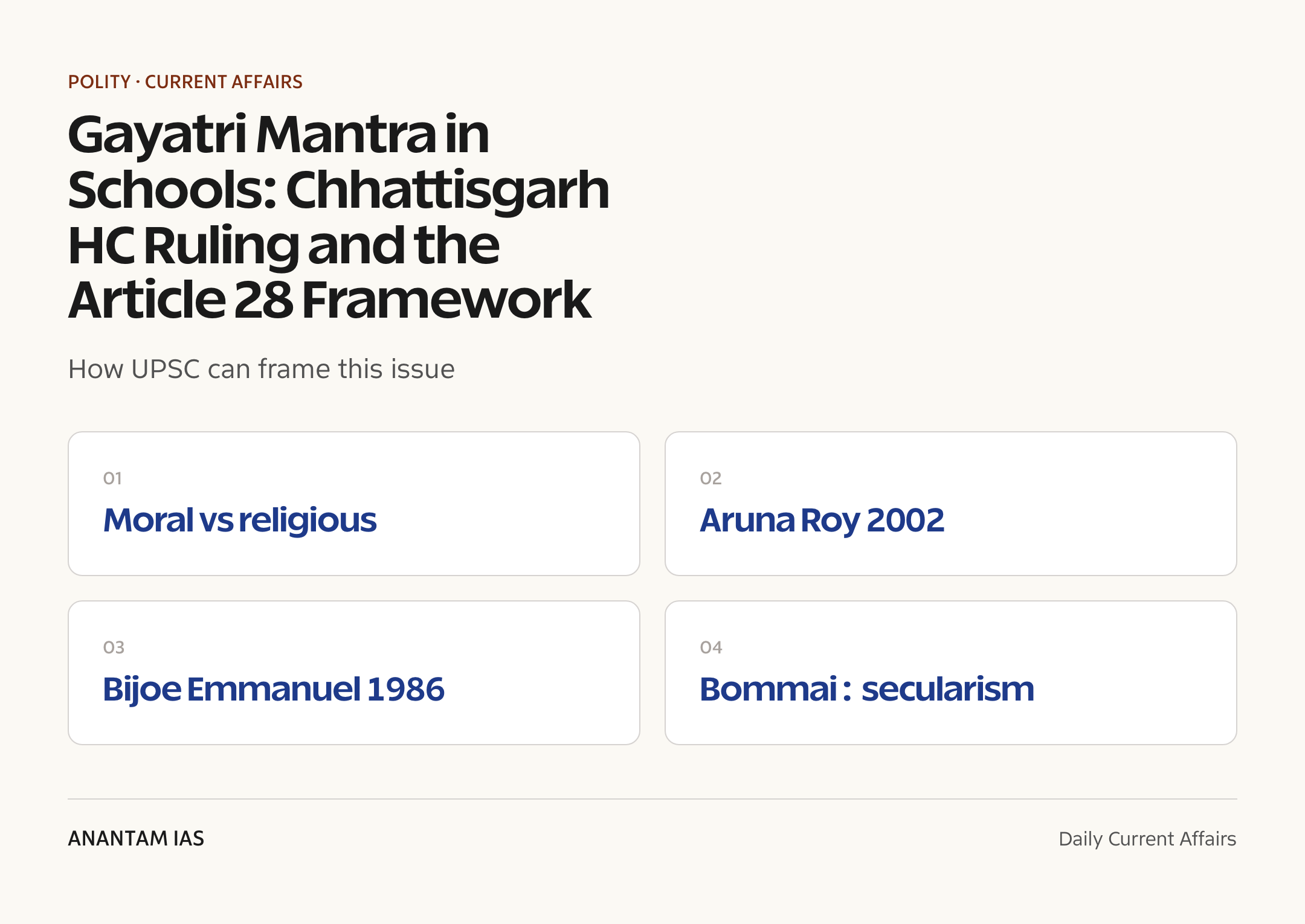
- The ruling turns on the Article 28(1) distinction between prohibited “religious instruction” and permissible “moral instruction” — a line the Supreme Court has drawn since DAV College (1971) and Aruna Roy (2002).
The development matters in the context of:
- The case revives a recurring constitutional question — where school prayer, value education and the study of religion sit within India’s model of secularism, which the Supreme Court declared part of the basic structure in S.R. Bommai v Union of India (1994).
- A related challenge to the common Sanskrit-Hindi prayer in Kendriya Vidyalayas was referred to a Constitution Bench of the Supreme Court in 2019 and remains pending, so the doctrinal question is live at the national level.
- For aspirants, the episode packages Article 28’s three-tier scheme, freedom of conscience under Article 25, and the right to remain silent under Article 19(1)(a) into one current-affairs hook.
UPSC Relevance
Prelims Relevance
- Article 28(1) — no religious instruction shall be provided in any educational institution wholly maintained out of State funds.
- Article 28(2) — the bar does not apply to an institution administered by the State but established under an endowment or trust requiring religious instruction.
- Article 28(3) — in institutions recognised by the State or receiving State aid, no person can be compelled to attend religious instruction or worship without consent (a guardian’s consent for minors).
- Article 25 — freedom of conscience and free profession, practice and propagation of religion, subject to public order, morality and health.
- Bijoe Emmanuel v State of Kerala (1986) — students cannot be expelled for respectfully declining to sing the national anthem; Article 19(1)(a) includes the right to remain silent.
- Aruna Roy v Union of India (2002) — study of religions and value education is not “religious instruction” under Article 28; upheld the NCFSE 2000.
- DAV College v State of Punjab (1971) — academic study of the life and teachings of Guru Nanak is not religious instruction.
- S.R. Bommai v Union of India (1994) — secularism is part of the basic structure of the Constitution.
- The word “secular” was inserted into the Preamble by the 42nd Constitutional Amendment, 1976.
- Gayatri Mantra — a Vedic verse from the Rigveda (Mandala 3), attributed to sage Vishvamitra.
Mains Relevance
GS Paper 2
- Article 28’s graded scheme as a marker of Indian secularism — principled distance rather than a strict wall of separation between State and religion.
- Judicial tests separating religious instruction from moral instruction and the academic study of religion (DAV College, Aruna Roy).
- Tension between State-prescribed school routines and the freedom of conscience of religious minorities under Articles 25, 29 and 30.
- The doctrine of prematurity and locus in constitutional litigation — courts requiring concrete injury before striking down executive orders.
GS Paper 1
- Secularism and communal harmony in a diverse society; the school’s role in socialisation and value formation.
- Vedic literature in context — the Gayatri Mantra’s Rigvedic origin as an art-and-culture touchpoint.
GS Paper 4
- Value education versus indoctrination — designing moral instruction that is genuinely non-denominational in a plural classroom.
Essay
- Secularism in India is a way of shared living, not a wall of separation.
- Schools shape citizens before they shape scholars — the ethics of what a classroom recites.
- Diversity is not a problem to be managed but a value to be taught.
Background and Context
The order, the petition and the ruling
The dispute began with a routine departmental circular and ended in a constitutional argument.
- On 12 June 2026, the Chhattisgarh School Education Department ordered that morning assemblies in government schools include the Saraswati Vandana, Gayatri Mantra, Guru Mantra, Shanti Mantra and Bhojan Mantra, alongside the national anthem, national song and the Rajya Geet, from the 2026-27 session.
- The petitioners — led by former Waqf Board chairman Abdul Salam Rizvi — argued the order amounts to imparting religious instruction in State-funded schools, compelling minority students to recite practices “that do not belong to their faith”, and pleaded violations of Articles 14, 21, 25, 28(1), 29 and 30.
- The State replied that the terms “compulsory” and “ensure” in the order relate to internal school administration, not religious coercion; that no punishment attaches to non-recitation; and that the verses are pedagogic invocations aligned with NEP 2020’s Indian Knowledge Systems thrust.
- Justice Amitendra Kishore Prasad dismissed the plea as “entirely premature”: a careful reading of the order showed no mandatory or coercive direction, and petitioners produced no material demonstrating a fundamental-rights violation or direct injury.
- On substance, the court held that “religious instruction” in Article 28(1) has a restricted meaning — the teaching of religious customs, rituals, practices and modes of worship — and the provision “does not ban moral instruction, disassociated from any denominational doctrines”, which it called essential to training in citizenship and social cohesion.
Article 28: the graded constitutional scheme
Article 28 does not treat all educational institutions alike — it builds a three-tier scheme keyed to State funding. See the full provision set in Articles 25-28 on freedom of religion.
- Article 28(1) — institutions wholly maintained out of State funds: religious instruction is absolutely prohibited.
- Article 28(2) — institutions administered by the State but established under an endowment or trust requiring religious instruction: the prohibition does not apply (e.g., institutions the State inherited with a religious-teaching mandate).
- Article 28(3) — institutions recognised by the State or receiving State aid: religious instruction may exist, but no person can be compelled to attend it or any religious worship without consent — for a minor, the guardian’s consent.
- The scheme distinguishes funding, administration and recognition — a classic Prelims trap, since the strictness of the bar falls as State involvement in funding falls.
- Article 28 sits within the Right to Freedom of Religion cluster (Articles 25-28), alongside the minority-rights guarantees of Articles 29 and 30 — both of which the petitioners also invoked.
Religious instruction vs moral instruction: the case law
The distinction the Chhattisgarh HC applied has a five-decade judicial lineage.
- DAV College v State of Punjab (1971) — the Supreme Court held that an academic study of the life and teachings of Guru Nanak at Guru Nanak University was not “religious instruction”; studying a religion is different from being instructed in it.
- Aruna Roy v Union of India (2002) — the Court upheld the National Curriculum Framework for School Education, 2000, holding that education about religions, value education and the philosophy of sarva dharma samabhava do not offend Article 28; “religious instruction” means inculcating a particular religion’s rituals, tenets and modes of worship.
- Santosh Kumar v Ministry of HRD (1994) — teaching Sanskrit as an elective in CBSE schools was upheld; a classical language is not a religion.
- Bijoe Emmanuel v State of Kerala (1986) — the counter-weight: three children of the Jehovah’s Witnesses faith could not be expelled for declining to sing the national anthem; Article 19(1)(a) protects the right to remain silent and Article 25 protects conscientious objection.
- Read together, the doctrine permits non-denominational moral education and the comparative study of religions in State schools, while barring both denominational indoctrination and compelled participation in religious practice.
Secularism as basic structure: the constitutional backdrop
The Indian model of secularism frames how courts read school-prayer disputes. The doctrine’s evolution is mapped in this basic structure doctrine explainer.
- S.R. Bommai v Union of India (1994) — a nine-judge bench held secularism is part of the Constitution’s basic structure; the State must treat all religions with equal respect and maintain neutrality.
- India follows positive (principled-distance) secularism — the State may engage with religion to reform or facilitate (temple-entry laws, aid to minority institutions) — unlike the strict wall of separation in the US model.
- The word “secular” entered the Preamble through the 42nd Amendment (1976), but the Supreme Court has held the concept was implicit in the original Constitution.
- The Constituent Assembly consciously drafted Article 28 to keep wholly State-funded classrooms free of denominational teaching while accommodating India’s inherited network of religiously endowed institutions.
- Minority safeguards under Articles 29-30 — conserving culture and running minority institutions — complete the framework; the explainer on cultural and educational rights covers both articles.
The NEP 2020 and value-education angle
The State’s defence leaned on national education policy rather than religion.
- The State argued the order aligns with NEP 2020, which mandates integrating Indian Knowledge Systems (IKS) — languages, philosophy, indigenous science — across curricula; the policy’s design is summarised in this NEP 2020 overview.
- The government characterised the Gayatri Mantra as an “invocation for sharp intellect and wisdom” and a pedagogic cognitive exercise, not denominational propaganda.
- Critics — including the Opposition, which termed the move saffronisation of education — counter that Vedic invocations are intrinsically devotional, so labelling them “moral instruction” blurs the very line Article 28 draws.
- The episode illustrates a wider governance pattern: education is a Concurrent List subject, so state departments can reshape school routines by executive order, with judicial review as the primary check.
- Comparable disputes — the pending Kendriya Vidyalaya common-prayer reference of 2019 — mean the Supreme Court may yet settle the doctrine authoritatively for the whole country.
What the prematurity holding means
Procedure decided this case as much as substance did.
- The court found the petition premature because no student had actually been coerced, punished or denied any benefit — there was no concrete injury, only apprehension.
- Constitutional courts generally avoid striking down executive action on anticipated harm; a challenge ripens when the order is enforced coercively against an identifiable person.
- Practically, the door stays open: if a school penalises a student for declining recitation, a fresh challenge on Bijoe Emmanuel lines would present exactly the injury this petition lacked.
- The holding also signals judicial reluctance to referee politically charged education disputes in the abstract, keeping the remedy tethered to demonstrated facts.
- For Mains answers, this is a clean illustration of ripeness, locus standi and judicial restraint operating alongside substantive fundamental-rights doctrine.
Way Forward
Codify the moral-religious line
- The NCERT and state SCERTs can issue clear curricular guidance distinguishing non-denominational value education from devotional practice, drawing on Aruna Roy (2002), so school orders are drafted defensibly from the start.
- Assembly routines in plural classrooms should offer genuine opt-outs — communicated to students and parents — so voluntariness exists in practice, not only on paper.
Settle the doctrine nationally
- An early hearing of the pending Constitution Bench reference on school prayer would give states a uniform standard and reduce state-by-state litigation.
- Teacher training under NEP 2020 can embed comparative, multi-faith and constitutional-values content so moral instruction reflects sarva dharma samabhava rather than any single tradition.
Conclusion
The Chhattisgarh High Court’s order does not hold that school prayers can never offend the Constitution — it holds that this petition, on this record, showed no coercion and no injury. The substantive line it restated is old and stable: Article 28(1) bars denominational religious instruction in wholly State-funded schools, but leaves room for moral instruction detached from doctrine.
Whether reciting the Gayatri Mantra falls on the moral or the religious side of that line is a question the Supreme Court’s pending school-prayer reference may still answer. Until then, the case is a working tutorial in how Indian secularism operates — through graded constitutional text, judicially crafted distinctions, and a preference for concrete injury over abstract apprehension.
UPSC Practice Questions
Prelims MCQ 1
With reference to Article 28 of the Constitution of India, consider the following statements:
- Religious instruction is prohibited in every educational institution wholly maintained out of State funds.
- The prohibition applies equally to an institution administered by the State but established under an endowment or trust requiring religious instruction.
- In an institution recognised by the State or receiving State aid, a minor cannot be required to attend religious worship unless his or her guardian consents.
How many of the above statements are correct?
(a) Only one (b) Only two (c) All three (d) None
Answer: (b) Only two
Explanation:
Statements 1 and 3 are correct — Article 28(1) imposes an absolute bar on religious instruction in wholly State-funded institutions, and Article 28(3) requires consent (guardian’s consent for minors) in recognised or State-aided institutions. Statement 2 is incorrect: Article 28(2) expressly exempts institutions administered by the State but established under an endowment or trust requiring religious instruction.
Prelims MCQ 2
In which of the following cases did the Supreme Court uphold the National Curriculum Framework for School Education, 2000, holding that the study of religions and value education do not amount to ‘religious instruction’ under Article 28?
(a) S.R. Bommai v Union of India (1994) (b) Bijoe Emmanuel v State of Kerala (1986) (c) Aruna Roy v Union of India (2002) (d) T.M.A. Pai Foundation v State of Karnataka (2002)
Answer: (c) Aruna Roy v Union of India (2002)
Explanation:
In Aruna Roy (2002), the Supreme Court upheld the NCFSE 2000, distinguishing education about religions and value education from denominational ‘religious instruction’ barred by Article 28. Bommai concerns secularism as basic structure; Bijoe Emmanuel concerns the right to remain silent during the national anthem; T.M.A. Pai concerns minority educational institutions.
UPSC Mains Questions
- The distinction between ‘religious instruction’ and ‘moral instruction’ under Article 28 is easier to state than to apply. Examine this distinction in light of judicial pronouncements, with reference to recent controversies over prayer in government schools. (250 words)
- Indian secularism permits the State to engage with religion rather than build a wall of separation against it. Discuss how Articles 25 to 30 embody this model, and evaluate the challenges it faces in public education. (250 words)
- Constitutional courts often decline to test executive orders against fundamental rights until concrete injury is shown. Critically examine how the doctrines of ripeness and prematurity balance judicial restraint with the protection of rights. (150 words)
Sources: Indian Express and Bar and Bench.
Frequently Asked Questions
What did the Chhattisgarh High Court decide?
The High Court dismissed a petition challenging a 12 June 2026 state order introducing the Saraswati Vandana, Gayatri Mantra and other invocations in government-school assemblies. It held the plea premature — no coercion or injury was shown — and said Article 28(1) bars religious instruction but not moral instruction detached from denominational doctrine.
What does Article 28(1) prohibit?
Article 28(1) prohibits religious instruction in any educational institution wholly maintained out of State funds. Courts read ‘religious instruction’ narrowly — the teaching of a particular religion’s rituals, customs, practices and modes of worship — so non-denominational moral education and the academic study of religions remain permissible.
How do Articles 28(2) and 28(3) differ?
Article 28(2) exempts institutions administered by the State but established under an endowment or trust that requires religious instruction. Article 28(3) covers State-recognised or State-aided institutions: religious instruction may exist there, but nobody can be compelled to attend it or any worship without consent — a guardian’s consent for minors.
What was held in Aruna Roy v Union of India?
In Aruna Roy (2002), the Supreme Court upheld the National Curriculum Framework for School Education, 2000. It held that education about religions, value education and the spirit of sarva dharma samabhava are not ‘religious instruction’ under Article 28, which targets denominational indoctrination rather than the comparative or moral study of religion.
Why is Bijoe Emmanuel relevant here?
Bijoe Emmanuel v State of Kerala (1986) protects students who conscientiously decline to join a school recitation. The Supreme Court held expelling children for not singing the national anthem violated Articles 19(1)(a) and 25, since free speech includes the right to remain silent. Any coercive enforcement of school prayers would face this precedent.
Is secularism part of the basic structure?
Yes. In S.R. Bommai v Union of India (1994), a nine-judge bench held secularism is part of the Constitution’s basic structure. The word ‘secular’ was added to the Preamble by the 42nd Amendment in 1976, but the Supreme Court treats the principle as implicit in the Constitution from the beginning.
Tell Google you want more of this.
Add Anantam IAS as a preferred sourceOne tap, and this site shows up more often in your own Top Stories, AI Overviews and AI Mode. Remove it any time.




