Daily Digest
UPSC · Civil Services Examination
Current Affairs · Sunday, 26 July 2026
Current affairs curated and edited by Anantam IAS faculty — pulled from The Hindu, PIB, IDSA, Foreign Affairs and the ministries. Read, annotate, revise.
Old Rajinder Nagar · Delhi 110005 · anantamias.com
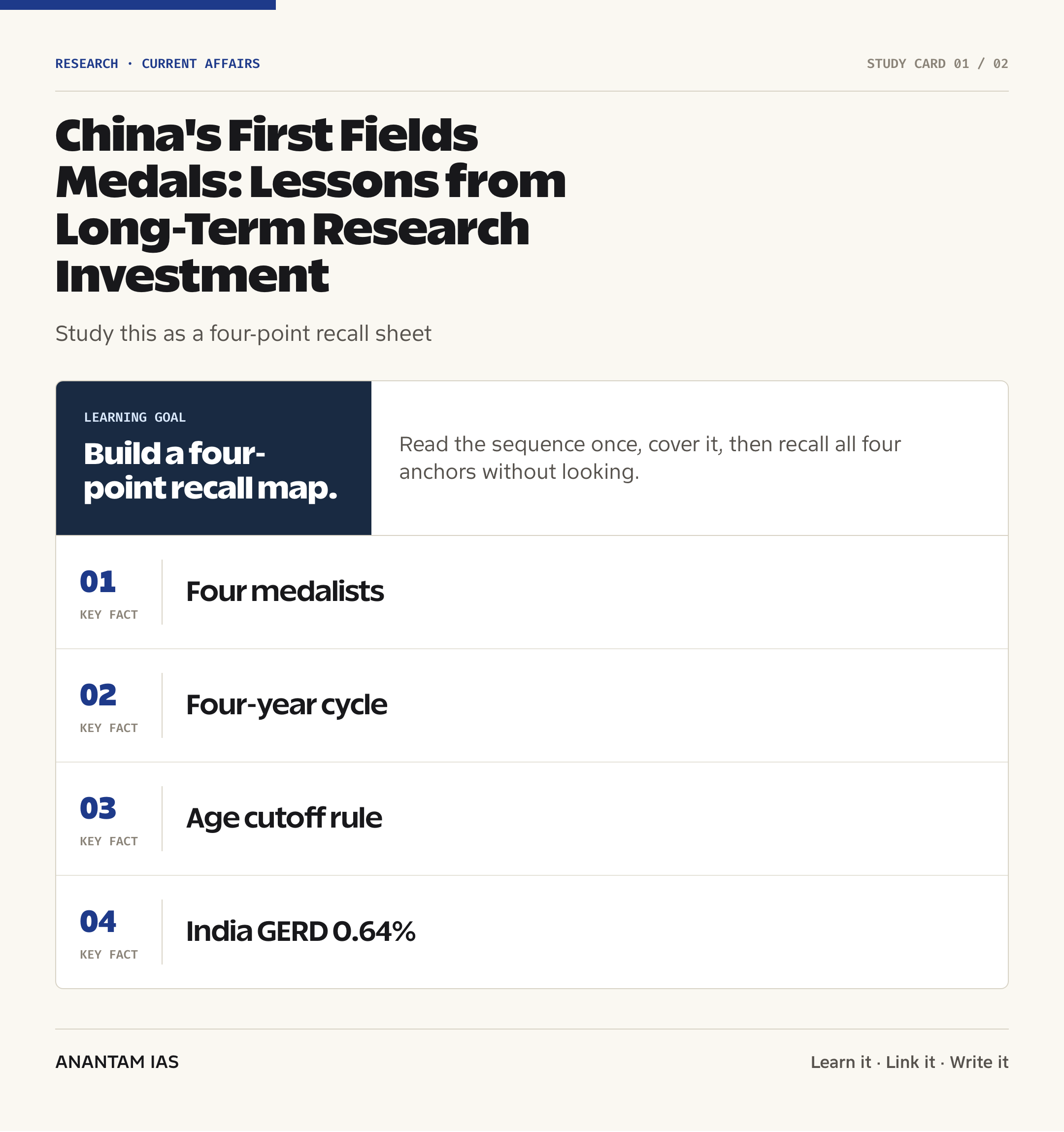
China’s First Fields Medals: Lessons from Long-Term Research Investment
Why in News?
The International Mathematical Union (IMU) awarded the 2026 Fields Medals to Yu Deng, John Pardon, Jacob Tsimerman and Hong Wang at the International Congress of Mathematicians in Philadelphia. Deng was recognised for work in partial differential equations, while Wang was recognised for work in harmonic analysis and geometric measure theory.
The Indian Express reported that Deng and Wang are the first Chinese nationals to receive the medal. Both studied at Peking University before pursuing research careers abroad, making the result useful for examining how universities, long-horizon funding and international talent circulation interact.
- The Fields Medal is awarded every four years at the International Congress of Mathematicians for existing achievement and the promise of future achievement.
- The precise age rule is that a candidate’s 40th birthday must not occur before 1 January of the Congress year; it is not a simple award-day cutoff.
- Yu Deng, a University of Chicago professor, was cited for results involving the Boltzmann equation, wave kinetic equations and nonlinear Schrödinger dynamics.
- Hong Wang, a professor at NYU Courant and IHES, was cited for advances connected with Fourier restriction, Falconer and Furstenberg sets, local smoothing and the three-dimensional Kakeya problem.
- The two other medalists were John Pardon, recognised for work across symplectic geometry, topology and related fields, and Jacob Tsimerman, recognised for work in arithmetic and complex algebraic geometry.
The development matters in the context of:
- A major prize is a lagging indicator: it reflects decades of schooling, mentoring, university capacity, grant support and international research networks rather than one recent programme.
- China’s official statistics put R&D expenditure at 2.80% of GDP in 2025; India’s latest detailed DST series put GERD at 0.64% of GDP in 2020–21, while a 2026 parliamentary reply described the current range as 0.6–0.7%. The reference years differ, so the figures show scale, not a controlled causal comparison.
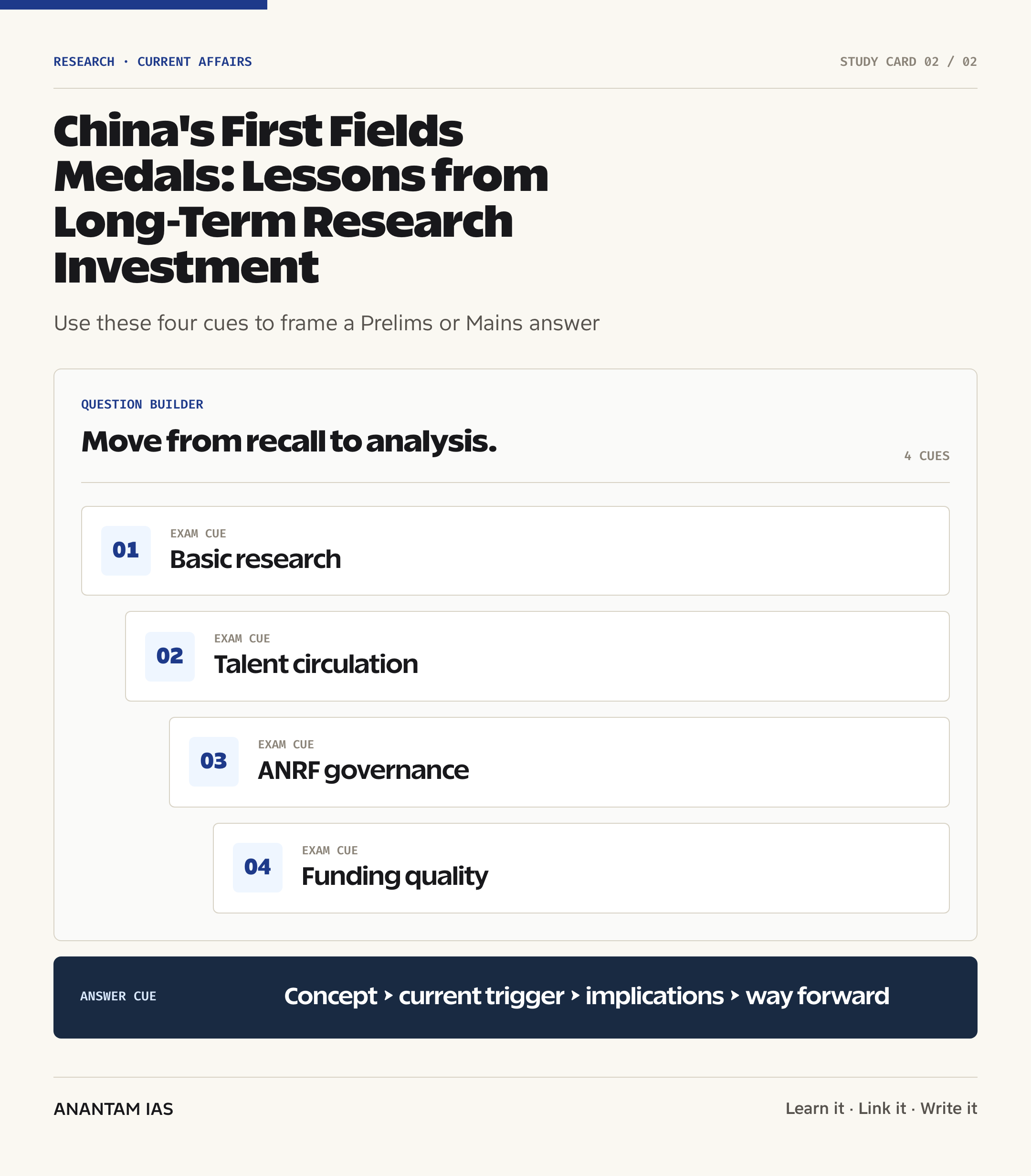
- For India, the policy question is whether the Anusandhan National Research Foundation (ANRF) can widen the base of research-performing universities while preserving rigorous peer review and long-term support for basic science.
UPSC Relevance
Prelims Relevance
- Fields Medal: an IMU award for outstanding mathematical achievement and future promise, presented every four years at the International Congress of Mathematicians.
- Eligibility rule: the candidate’s 40th birthday must not occur before 1 January of the Congress year.
- International Mathematical Union: an international non-governmental, non-profit scientific organisation that promotes international cooperation in mathematics.
- Basic research: systematic work aimed primarily at new knowledge without an immediate commercial application; its benefits may emerge after long and uncertain time lags.
- GERD: Gross Expenditure on Research and Development, covering total domestic R&D spending by government, business, higher education and other sectors.
- R&D intensity: GERD expressed as a share of gross domestic product; it measures resource commitment, not research quality by itself.
- ANRF Act, 2023: Act No. 25 of 2023, in force from 5 February 2024, covering natural sciences including mathematical sciences and their interfaces with other fields.
- ANRF governance: the Governing Board is chaired by the Prime Minister, while the Executive Council is chaired by the Principal Scientific Adviser.
- ANRF funding design: it aims to receive ₹50,000 crore during 2023–28, with a ₹14,000 crore Central Government budgetary provision and the balance expected from other permitted sources.
Mains Relevance
GS Paper 2
- Assess how higher-education governance, faculty autonomy, research mentoring and equitable institutional capacity affect India’s ability to produce original scholarship.
- Examine the links among NEP 2020, research-oriented multidisciplinary universities and the ANRF objective of seeding research beyond a small group of elite institutions.
- Discuss how public policy can support talent circulation so that international mobility builds Indian institutions rather than being framed only as brain drain.
GS Paper 3
- Compare the roles of basic research, mission-oriented research and translational innovation within a balanced science-and-technology strategy.
- Analyse India’s low R&D intensity, limited business participation and concentration of research capacity across institutions.
- Evaluate ANRF through funding additionality, peer-review quality, grant duration, institutional diversity and measurable research outcomes, not only its announced corpus.
Essay
- Scientific excellence is built through patient institutions before it is recognised through prizes.
- Talent becomes national capacity only when institutions allow curiosity, mobility and failure.
- The deepest returns on public investment often arrive after the political cycle that funded them.
Background and Context
What the Fields Medal Actually Recognises
The medal rewards frontier mathematical work, but its design also values the recipient’s potential to shape future research.
- The IMU describes the medal as recognition of outstanding mathematical achievement for existing work and the promise of future achievement.
- It is presented at the International Congress of Mathematicians, held every four years, and the selection committee normally chooses at least two medalists with a strong preference for four.
- The age condition encourages recognition at an earlier career stage, but the formal rule turns on 1 January of the Congress year, not the recipient’s age on the ceremony date.
- The medal is not a national ranking. It honours individual work, and many mathematicians study, collaborate and hold positions across several countries.
- Calling it a lagging indicator avoids a common reasoning error: a prize announced today cannot, by itself, identify which past policy produced the result.
The 2026 Mathematical Contributions
The citations span mathematical analysis, geometry, topology and number theory, showing why a broad research ecosystem matters.
- Yu Deng works on partial differential equations and mathematical physics. The IMU highlighted rigorous links from hard-sphere dynamics to the Boltzmann equation, wave kinetic equations and probabilistic methods for nonlinear Schrödinger dynamics.
- Hong Wang works in harmonic analysis and geometric measure theory. Her citation covers Fourier restriction, Falconer distance sets, Furstenberg sets, local smoothing and major progress on the Kakeya problem in three dimensions.
- John Pardon was recognised for contributions to symplectic geometry, virtual fundamental cycles, Fukaya categories, holomorphic-curve counting, topology and group actions on three-manifolds.
- Jacob Tsimerman was recognised for using o-minimality in arithmetic and complex algebraic geometry and for work connected with the André–Oort and Griffiths conjectures.
- These subjects depend on deep disciplinary communities: seminars, doctoral supervision, postdoctoral positions, research time, libraries, computing and contact with international peers.
Why China's Research Trajectory Draws Attention
China has expanded research resources and institutional capacity over a long period, but prize outcomes should not be reduced to one spending ratio.
- China’s National Bureau of Statistics reported R&D expenditure of 3.9262 trillion yuan in 2025, equal to 2.80% of GDP and 8.1% above the 2024 level.
- Within that total, official data put basic-research expenditure at 277.8 billion yuan in 2025, or 7.08% of total R&D expenditure.
- Deng and Wang’s paths combine Chinese undergraduate education with doctoral training and faculty careers abroad. Their achievements reflect transnational research networks as well as domestic educational foundations.
- The Peking University connection matters as an example of institutional depth: selective students encounter strong peers, research-active faculty, specialist courses and international pathways in one place.
- Spending can expand laboratories and positions, but quality depends on allocation: expert review, room for uncertain inquiry, low administrative friction and protection from short-term target chasing.
- Awards are sparse and volatile. A sound assessment should also examine research quality, doctoral training, open problems solved, institutional spread, industry absorption and societal outcomes.
India's Research Baseline
India has growing research output and strong specialist institutions, yet its research effort remains relatively low and unevenly distributed.
- The Department of Science and Technology’s R&D Statistics at a Glance 2022–23 recorded GERD of ₹1,27,380.96 crore in 2020–21, more than double the 2010–11 level.
- The same DST series put India’s GERD at 0.64% of GDP in 2020–21, compared with China’s 2.4% for 2020 in the international table used by the report.
- In India’s 2020–21 GERD, the Central Government contributed 43.7% and private-sector industry 36.4%; higher education accounted for 8.8%. This points to both a business-investment gap and a university-capacity gap.
- DST counted 262 researchers per million population in 2020. Researcher density matters because advanced work needs enough mentors, collaborators, technicians and doctoral students to sustain specialist communities.
- India’s output is not static: DST reported that scientific publications rose from 60,555 in 2010 to 149,213 in 2020. Quantity, citation impact and originality still need to be read together.
- The policy challenge described in India’s deep-tech and R&D gap is not only to spend more, but to convert public and private resources into durable research capability.
ANRF as India's Institutional Response
ANRF creates a national framework for strategic direction, competitive support and research culture across a wider set of institutions.
- The ANRF Act, 2023 covers natural sciences including mathematical sciences, engineering and technology, environment and earth sciences, health, agriculture and scientific interfaces with humanities and social sciences.
- Its provisions came into force on 5 February 2024. The Foundation replaced the earlier Science and Engineering Research Board framework while giving research policy a broader statutory base.
- The Prime Minister serves as ex-officio President of the Governing Board, and the Principal Scientific Adviser chairs the Executive Council that implements the Foundation’s objectives.
- The Press Information Bureau summary of a December 2024 parliamentary reply said ANRF aims to receive ₹50,000 crore during 2023–28, including a ₹14,000 crore Central Government budgetary provision; the remainder is to come from other permitted sources, including public enterprises, private industry and philanthropy.
- The funding headline is an intended envelope, not proof that every rupee has been mobilised or disbursed. Evaluation must track realised inflows, competitive awards, release delays and additional research created.
- The National Education Policy 2020 envisaged a National Research Foundation to fund outstanding peer-reviewed work and seed research in universities and colleges.
- The One Nation One Subscription initiative addresses journal access, while ANRF must address the connected needs of grants, mentorship, infrastructure and institutional research culture.
What India Can Learn Without Copying China
The transferable lesson is patient system design, not a mechanical import of another country’s governance model.
- Build a broad base and strong peaks: research-intensive centres need depth, while state universities need laboratories, faculty time, doctoral support and fair access to grants.
- Fund people and problems, not only equipment. Stable fellowships, postdoctoral positions, technical staff and multi-year grants reduce the pressure to chase quick, low-risk outputs.
- Treat mobility as brain circulation. Visiting appointments, joint laboratories, return grants and the PM Research Chair Scheme can connect global researchers with Indian institutions.
- Preserve a portfolio that includes curiosity-driven mathematics and basic science. Their applications are often unpredictable, and an excessive demand for immediate commercialisation can crowd out foundational work.
- Strengthen research integrity through transparent peer review, conflict-of-interest rules, reproducibility, ethical training and penalties for plagiarism or manipulated metrics.
- Judge programmes by additionality: whether they create new capacity, bring under-supported institutions into research, improve work quality and retain talent, not whether old spending is merely relabelled.
Limits of Medal-Based Comparisons
A responsible comparison separates the symbolic importance of a prize from the evidence needed to judge a national research system.
- One award cycle is a small sample. Exceptional individuals can emerge from imperfect systems, while strong systems may not produce a winner in a particular year.
- Nationality, birthplace, education and workplace can point to different countries. Deng and Wang’s careers show why credit cannot be assigned to one jurisdiction alone.
- R&D-to-GDP ratios are useful, but they do not reveal field mix, purchasing power, grant quality, institutional autonomy or the distribution of resources.
- University rankings capture selected indicators and can reward scale or reputation. They should not replace evidence on teaching quality, research culture and public value.
- The goal for India should not be to manufacture prize counts. It should be to create conditions in which original, rigorous and socially valuable research can persist over decades.
Way Forward
Make ANRF Funding Predictable and Additional
- Publish a transparent multi-year funding path showing government allocations, non-government mobilisation, grants sanctioned, money released and institution-wise distribution.
- Protect basic-research windows with longer grant periods and review criteria suited to uncertain discovery, alongside separate mission and translation programmes.
- Use independent evaluation to test whether ANRF funds are additional to existing departmental support rather than substitutes for it.
Build University Research Capacity
- Create shared instrumentation, research-computing and library facilities that state universities and smaller colleges can access without prohibitive overheads.
- Fund grant-writing support, technicians, doctoral training and protected faculty time so that institutional capacity grows with the award portfolio.
- Pair emerging departments with established centres through consortia, while preventing permanent dependence through time-bound capability milestones.
Improve Talent Pathways
- Expand high-quality doctoral and postdoctoral positions with reliable stipends, professional mentoring and transparent recruitment.
- Enable diaspora collaboration through joint appointments, visiting semesters and return pathways without treating overseas experience as a test of loyalty.
- Connect school-level problem solving, undergraduate research and advanced institutes so that mathematical talent is not lost at transition points.
Measure Quality, Diversity and Public Value
- Track peer-reviewed quality, influential datasets, solved problems, open tools, patents where relevant and researcher development, rather than raw paper counts alone.
- Report funding by region, institution type, discipline, gender and career stage to reveal whether opportunity is broadening.
- Review grants with field-sensitive time horizons and publish lessons from both success and failure, creating institutional learning instead of target compliance.
Conclusion
China’s first Fields Medal wins are best read as a reminder that research excellence matures slowly. Strong undergraduate foundations, specialist universities, long-horizon investment and international mobility can reinforce one another, but no prize can establish a simple causal chain.
For India, ANRF is an opportunity to move from isolated excellence toward a wider research-performing university system. Its test will be credible peer review, additional and predictable funding, room for basic science, and the ability to build talent and institutions beyond a few established centres.
The durable objective is not a medal target. It is a system where original inquiry can survive uncertainty, capable researchers can build careers, and knowledge can serve both intellectual progress and public needs.
UPSC Practice Questions
Prelims MCQ 1
With reference to the Fields Medal, consider the following statements:
- It is awarded every four years on the occasion of the International Congress of Mathematicians.
- A candidate’s 40th birthday must not occur before 1 January of the Congress year.
- The International Mathematical Union chooses at least two medalists, with a strong preference for four.
How many of the above statements are correct?
(a) Only one (b) Only two (c) All three (d) None
Answer: (c) All three
Explanation:
All three statements reflect the IMU’s rules. The age condition is tied to 1 January of the Congress year, and the medal is presented on the four-year ICM cycle.
Prelims MCQ 2
Which one of the following correctly describes the Anusandhan National Research Foundation?
(a) It is a constitutional body limited to defence research (b) It is a statutory body whose scope includes mathematical sciences (c) It is a private foundation that funds only commercial start-ups (d) It is a university-ranking body under the Ministry of Education
Answer: (b) It is a statutory body whose scope includes mathematical sciences
Explanation:
The ANRF Act, 2023 establishes a statutory foundation with a broad research mandate that expressly includes mathematical sciences, engineering, health, agriculture and other listed fields.
UPSC Mains Questions
- Major scientific prizes are lagging indicators of an ecosystem rather than direct products of a single policy. Examine the institutional conditions that sustain excellence in basic research, and identify the lessons India’s higher-education system can draw from China’s recent Fields Medal milestone.
- The success of the Anusandhan National Research Foundation will depend less on its announced funding envelope than on how it allocates resources and builds institutions. Discuss with reference to peer review, university capacity, talent circulation, basic science and research accountability.
Sources: International Mathematical Union and Indian Express Explained.
Frequently Asked Questions
What is the Fields Medal?
The Fields Medal is an International Mathematical Union award presented every four years at the International Congress of Mathematicians. It recognises outstanding existing mathematical work and the promise of future achievement. The formal age rule requires that a candidate’s 40th birthday must not occur before 1 January of the Congress year.
Who won the 2026 Fields Medals?
The International Mathematical Union named Yu Deng, John Pardon, Jacob Tsimerman and Hong Wang as the four medalists. Their cited work spans partial differential equations, symplectic geometry and topology, arithmetic and complex algebraic geometry, harmonic analysis, and geometric measure theory.
Why are Deng and Wang significant for China?
The Indian Express reported that Yu Deng and Hong Wang are the first Chinese nationals to win the Fields Medal. Both studied at Peking University and later built international research careers, illustrating how domestic education and cross-border academic networks can combine.
What is ANRF’s research mandate?
The ANRF Act, 2023 gives the Foundation a broad mandate across natural sciences, including mathematical sciences, engineering and technology, environmental and earth sciences, health, agriculture, and scientific interfaces with humanities and social sciences. It seeks to provide strategic direction and support research, innovation and entrepreneurship.
What should India learn from this milestone?
India should focus on patient institutional capacity: predictable multi-year grants, rigorous peer review, strong universities, doctoral and postdoctoral pathways, journal and infrastructure access, research integrity, and international talent circulation. Prize counts should remain an outcome, not the policy target.
Source: https://anantamias.com/current-affairs/china-fields-medal-research-ecosystem/
Keeladi Excavations: New Brick Structures Deepen the Sangam-Age Record
Why in News?
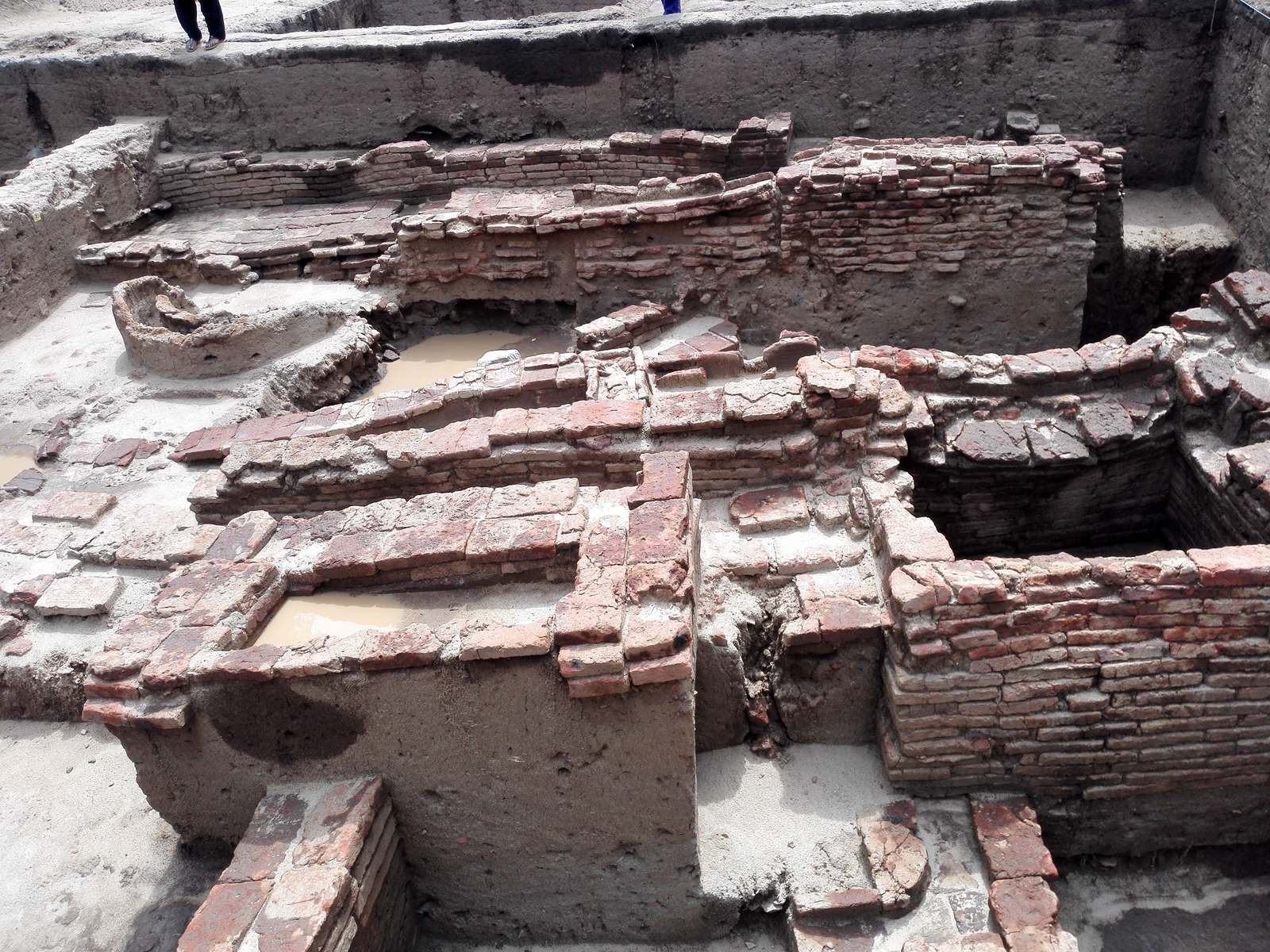
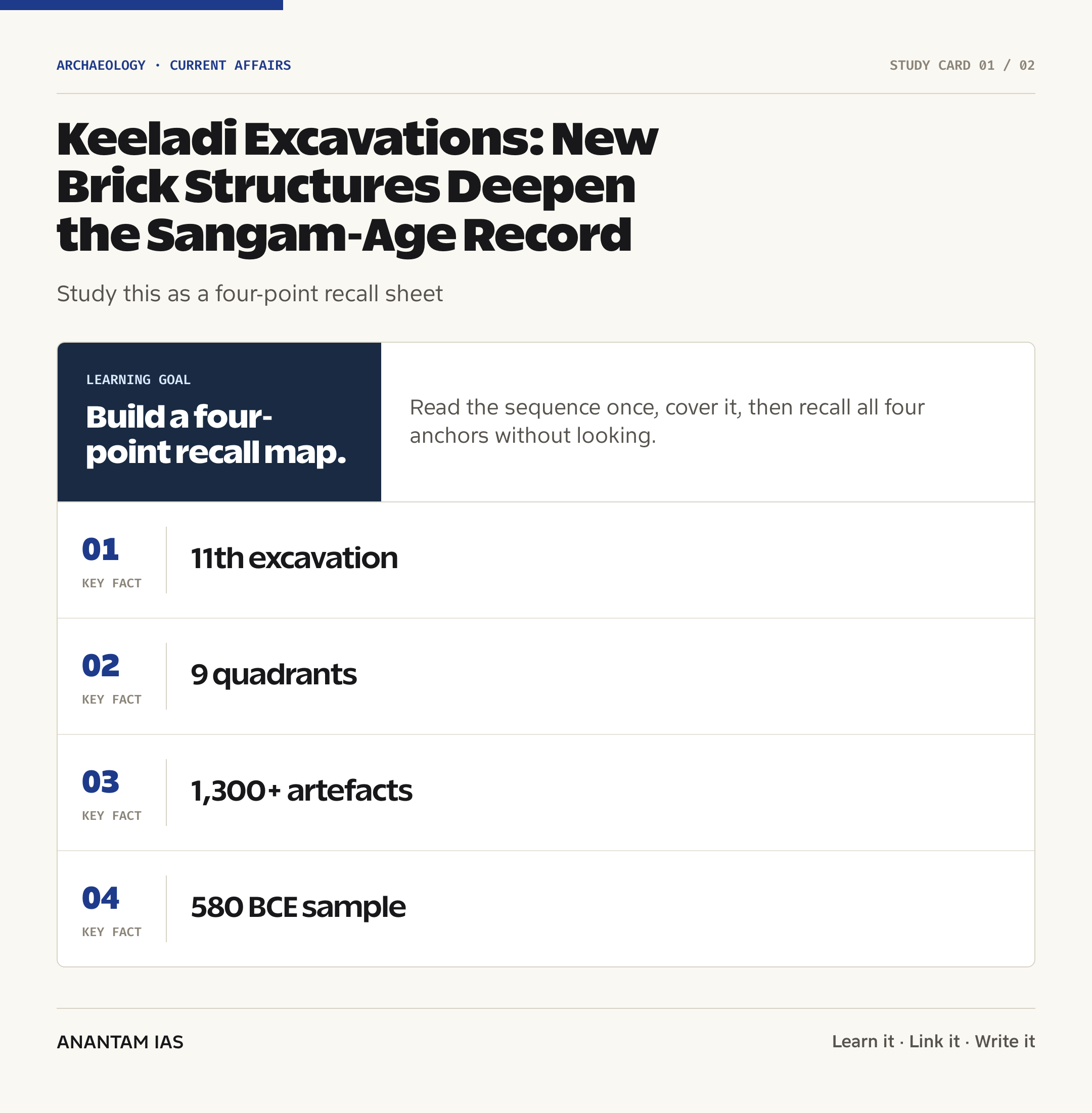
The Hindu reported that the 11th phase of excavation at Keeladi in Tamil Nadu’s Sivagangai district has exposed continuous brick structures across all nine excavated quadrants, along with more than 1,300 artefacts.
The discoveries add fresh material to the study of an early historic settlement in the Vaigai valley, but the function and date of the newly exposed structures must await complete excavation, stratigraphic study and scientific dating.
- The current phase began on 18 March 2026 in an area south of Keeladi’s on-site museum.
- Excavators found continuous brick remains in all nine quadrants; the exposed alignment appears to continue beyond the excavated area towards the west and north.
- One quadrant yielded a terracotta pipeline and a closed drain, while an open drainage feature was also identified in the excavation area.
- The 1,300-plus artefacts include terracotta objects, iron implements, semi-precious stones, ivory dice, tiny gold ornaments and intact pottery.
- One intact pot has a handle, and another carries a fish symbol on its shoulder; these observations need contextual study before wider conclusions are drawn.
- Organic material from the present phase is to undergo radiocarbon dating, so the new structures should not yet be assigned a precise date.
The development matters in the context of:
- The finds matter in the context of debates on early urbanism outside the middle Gangetic plain and the material foundations of Sangam-age society.
- Keeladi allows historians to compare excavated evidence with the society, trade and political geography described in Sangam-age literature.
- The excavation also shows why archaeology works through a chain of context, stratigraphy, dating and publication, rather than through spectacular objects alone.
UPSC Relevance
Prelims Relevance
- Keeladi, also written Keezhadi, is an early historic habitation site in Sivagangai district, near Madurai in Tamil Nadu.
- The site lies in the Vaigai river valley; the Tamil Nadu archaeology department places the cultural mound about 13 km southeast of Madurai.
- The Archaeological Survey of India conducted the first three excavation phases, while the Tamil Nadu State Department of Archaeology has led the subsequent phases.
- The present work is the 11th excavation phase; it began on 18 March 2026 and may continue according to field and weather conditions.
- Earlier Keeladi finds include brick walls, ring wells, roof tiles, drains, iron objects, beads, spindle whorls, graffiti sherds and Tamil-Brahmi-inscribed pottery.
- An earlier radiocarbon result cited by the Tamil Nadu department placed a sample at 580 BCE; this date belongs to a tested sample and cannot automatically date every structure or artefact.
- Tamil-Brahmi is an early adaptation of the Brahmi script used for the Tamil language; inscribed potsherds provide evidence about names, ownership and writing practices.
- The Ancient Monuments and Archaeological Sites and Remains Act, 1958 and its rules form part of the legal framework governing protected archaeology and licensed excavations in India.
- Material remains should be read by provenance, meaning the precise location and context in which an object was recovered, not merely by the object’s appearance.
Mains Relevance
GS Paper 1
- Use Keeladi to discuss how archaeology complements literary sources in reconstructing the history of early Tamilakam.
- Assess the evidence for settlement planning, craft production, exchange and literacy in Sangam-age south India.
- Explain the limits of equating brick architecture or drainage features with a fully demonstrated urban system without settlement-scale analysis.
- Connect Keeladi with the broader geography of the Vaigai valley, Madurai and the Chera-Chola-Pandya world described in early Tamilakam.
- Evaluate the role of scientific dating, conservation and timely excavation reports in credible heritage governance.
Essay
- Objects and texts tell different parts of the past; a responsible history makes them test, refine and sometimes challenge one another.
- Cultural pride becomes durable when it rests on open evidence, careful method and room for scholarly revision.
Background and Context
Keeladi and the Vaigai Valley
Keeladi is valuable because it preserves the material remains of an early historic community close to Madurai, a major centre in the literary geography of Tamilakam.
- The site is in Thiruppuvanam taluk of Sivagangai district, on a cultural mound in the wider Vaigai river landscape.
- The Tamil Nadu department describes the mound as extending over more than 110 acres, which makes settlement-scale investigation more useful than treating a single trench as the whole site.
- Its location near Madurai creates a productive comparison with Sangam texts associated with Pandyan country, but proximity alone doesn’t prove that every literary description refers directly to Keeladi.
- Keeladi, the burial site of Konthagai, and nearby localities such as Agaram and Manalur are often studied as a connected archaeological landscape of habitation, mortuary practice and production.
- For revision, place Keeladi within Sangam-age society, while remembering that archaeological periods and literary chronologies don’t always align neatly.
- Reconstructing the ancient landscape also requires geomorphology and palaeoenvironmental evidence, because river movement, erosion and later land use affect what survives and where archaeologists can find it.
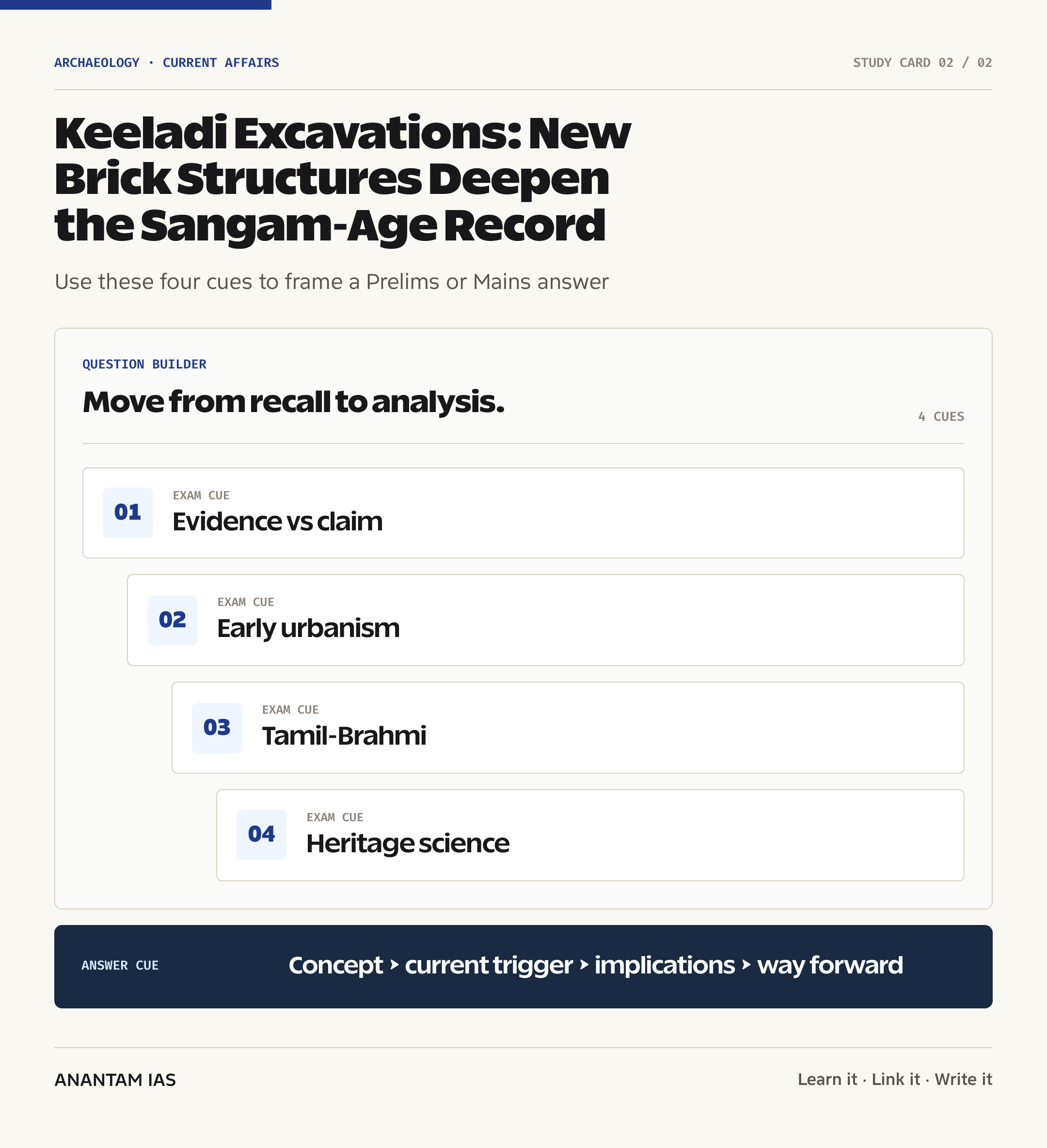
What the Eleventh Phase Has Found
The strongest new evidence is the combination of connected structural remains, water-management features and a varied artefact assemblage recovered from recorded excavation contexts.
- Continuous brick structures were reported across nine quadrants, with the alignment continuing beyond the open trenches towards the north and west.
- A terracotta pipeline and a closed brick drainage feature occurred in one quadrant; an open drain was also noted elsewhere in the excavation area.
- The artefact assemblage includes terracotta hopscotch pieces, beads and spindle whorls, which point towards recreation, ornamentation and textile-related activity.
- Reported iron finds include knives, chisels, swords and nails; each object requires conservation and contextual analysis before its exact function can be fixed.
- Semi-precious materials include amethyst, carnelian, agate and banded agate, alongside ivory dice and tiny gold ornaments measuring less than a centimetre.
- Intact pots were found in four locations; a handled vessel and a pot bearing a fish symbol are notable, but a symbol should not be assigned a political or religious meaning without comparative evidence.
- The relationship between a wall, floor, drain and sealed artefact layer is more informative than proximity alone: stratigraphic contact helps establish which features were contemporary and which were later additions.
Brick Structures and the Urbanism Question
Permanent architecture is an important indicator of organised settlement, yet the label urban requires a bundle of evidence rather than one impressive wall.
- Earlier seasons exposed brick walls, fine-clay floors, post-holes, roof tiles, ring wells and drains; the new continuous structures extend this built-environment record.
- The department’s earlier material analysis found silica and lime in bricks and roof tiles, while a previously exposed wall measured 13 metres and used bricks in regular proportions.
- Drains and pipelines can indicate water disposal, household management or production activity; their slope, connections, residue and surrounding features help distinguish these uses.
- A settlement is usually assessed as urban through the combined presence of density, spatial planning, specialised crafts, exchange networks, social differentiation and administrative or written practices.
- The excavation director’s suggestion that part of the area may have been industrial is a working hypothesis. The report itself says confirmation depends on completed studies.
- A good answer should state that Keeladi strengthens the case for complex early historic settlement in the south without presenting every interpretive claim as settled fact.
- Comparisons with Gangetic or Harappan cities should identify the particular variable being compared, such as drainage, craft specialisation or settlement density, instead of treating urbanism as one universal architectural template.
Writing, Symbols and Historical Inference
Keeladi’s inscribed pottery links everyday objects with the history of writing in early south India, but graffiti marks and readable script are separate categories.
- The Tamil Nadu department reports 56 Tamil-Brahmi-inscribed potsherds from its earlier Keeladi excavations, some bearing personal names or name fragments.
- Many Keeladi inscriptions were scratched after firing, which may suggest marks made by users or owners rather than only by potters during manufacture.
- Graffiti symbols are non-linguistic or not securely deciphered marks on pottery; they should not automatically be described as an alphabet or translated like an inscription.
- The correct method combines palaeography, stratigraphy, ceramic association and absolute dating, since letter form alone can provide only a relative chronological argument.
- For the larger epigraphic framework, compare the site with inscriptions in ancient India, including Brahmi records on pottery, caves and monuments.
- Evidence of writing broadens the picture of communication and identity, but the frequency, social distribution and functions of literacy need more than a count of inscribed sherds.
- A potsherd carrying a name may reflect ownership, workshop marking, exchange or another practice; the reading of the letters doesn’t by itself settle why, where or by whom the inscription was made.
Everyday Life, Craft and Exchange
The small finds are historically powerful because they reveal work, consumption, play and connectivity that monumental architecture can hide.
- Spindle whorls are associated with spinning fibre, while iron chisels and knives can be examined for craft and household use through wear and residue studies.
- Carnelian, agate and other semi-precious stones may indicate bead production or exchange, but provenance studies are needed to identify sources and trade routes.
- Dice and hopscotch pieces suggest recreational practices; they also show how familiar objects can survive in archaeological deposits even when their rules or meanings change.
- Roof tiles, nails, floors, vessels and drains collectively document ordinary habitation, making Keeladi a social-history site rather than only a collection of prestige objects.
- Sangam poetry describes towns, merchants, artisans, agriculture and overseas exchange. Archaeology can test these themes through ceramics, botanical remains, faunal material, metals and beads.
- A comparison with Vadnagar’s excavated settlement layers shows how stratified deposits can track continuity and change without assuming that two sites followed the same urban path.
- Plant remains, animal bones and microscopic residues can test claims about diet, cultivation, livestock and production; spectacular metal or gold finds cannot answer these subsistence questions on their own.
How Archaeologists Build a Reliable Chronology
A date becomes persuasive when the sample, layer and associated finds are documented and the laboratory result is interpreted within the site’s stratigraphy.
- The department cites an earlier Keeladi carbon sample with a date of 580 BCE, supporting a sixth-century-BCE horizon at the site.
- That result does not mean every artefact, wall or drain at Keeladi dates to 580 BCE; a multi-period settlement can contain features from different occupational phases.
- The new organic samples proposed for radiocarbon testing must be checked for secure archaeological association, contamination and the old-wood effect where relevant.
- Accelerator Mass Spectrometry can date small quantities of carbon-bearing material, but calibration converts radiocarbon measurements into probability ranges rather than an exact calendar birthday.
- Ceramic typology, archaeobotany, zooarchaeology, residue analysis and material science supply independent lines of evidence that can support or question a chronological interpretation.
- Full trench records and laboratory methods allow other scholars to review the inference, which is why final reports matter as much as discovery announcements.
- A sequence of dates from multiple secure layers is stronger than one headline result. Bayesian chronological modelling can combine radiocarbon ranges with the known order of strata to narrow occupational phases responsibly.
Institutions, Conservation and Public History
Keeladi also illustrates how field archaeology, state institutions and public interpretation interact in a politically visible heritage project.
- The ASI, under the Union Ministry of Culture, carried out the first three phases; the Tamil Nadu State Department of Archaeology has conducted the later phases.
- Excavation is destructive in the technical sense because soil layers cannot be replaced after removal, so recording, sampling and conservation must accompany digging.
- Brick structures exposed to sun and monsoon need drainage, compatible protective materials and monitoring; premature display can damage the archaeological fabric.
- Museums and open-site interpretation should distinguish the object recovered, the inference proposed and the uncertainty remaining.
- Open catalogues, digital trench plans and prompt final reports make heritage evidence available beyond a small group of excavators and reduce the gap between public claim and scholarly verification.
- Responsible public history can celebrate Tamilakam’s past while keeping methodological caution visible, especially where archaeological findings enter modern identity debates.
- Local communities should be partners in site protection, visitor management and interpretation, since long-term conservation depends on everyday stewardship beyond the excavation season.
Way Forward
Complete the Scientific Record
- Expose the structural alignments only as far as conservation capacity permits, and document stratigraphic relationships between walls, drains, floors and artefact-bearing layers.
- Use radiocarbon dating, residue studies, archaeobotany and material analysis on samples with a clear chain of provenance.
Publish Evidence Promptly
- Release phase-wise trench plans, catalogues, laboratory reports and uncertainty ranges so that independent specialists can assess chronology and function.
- Separate preliminary media statements from peer-reviewed conclusions, while still giving the public accessible updates.
Study the Wider Landscape
- Integrate Keeladi with Konthagai, Agaram, Manalur and the Vaigai basin through settlement surveys, environmental reconstruction and route analysis.
- Compare habitation, burial and production areas without assuming that every nearby site belonged to one politically uniform civilisation.
Conserve Before Display
- Prepare a monsoon-sensitive conservation plan for exposed brickwork, with site drainage, shelters and condition monitoring.
- Use museum labels and digital reconstructions to mark clearly what is observed, reconstructed or still debated.
Conclusion
The 11th phase makes Keeladi’s archaeological case richer through connected brick structures, drainage features and a diverse artefact assemblage. These finds illuminate an organised early historic settlement and the texture of daily life in the Vaigai valley.
Its larger significance will depend on the next steps: secure dating, contextual analysis, conservation and full publication. Keeladi is most persuasive not as a slogan, but as a growing body of evidence that can refine India’s account of regional urbanism, literacy and exchange.
UPSC Practice Questions
Prelims MCQ 1
With reference to Keeladi, consider the following statements:
- It is located in Sivagangai district in the Vaigai river valley.
- The Archaeological Survey of India conducted the first three excavation phases, and the Tamil Nadu State Department of Archaeology conducted the later phases.
- Every brick structure at the site has been conclusively dated to 580 BCE.
How many of the above statements are correct?
(a) Only one (b) Only two (c) All three (d) None
Answer: (b) Only two
Explanation:
Statements 1 and 2 are correct. The 580 BCE result cited by the State department relates to an earlier tested carbon sample; it cannot automatically date every structure or layer at Keeladi.
Prelims MCQ 2
Which one of the following best describes Tamil-Brahmi?
(a) An undeciphered graffiti system found only at Keeladi (b) A medieval script used exclusively for Sanskrit inscriptions (c) An early adaptation of Brahmi used to write the Tamil language (d) A pottery type imported from the Roman Mediterranean
Answer: (c) An early adaptation of Brahmi used to write the Tamil language
Explanation:
Tamil-Brahmi occurs on pottery and in cave inscriptions across early historic Tamil Nadu. It must be distinguished from graffiti marks that aren’t securely read as linguistic script.
UPSC Mains Questions
- Archaeological discoveries at Keeladi have widened the source base for writing the history of early Tamilakam. Discuss how brick structures, inscriptions, craft objects and scientific dating can be combined with Sangam literature, while noting the limits of each category of evidence.
- The identification of an ancient settlement as urban requires more than permanent architecture. Examine this statement with reference to Keeladi’s structural remains, water-management features, craft indicators and the methodological need for settlement-scale excavation and publication.
Sources: Tamil Nadu State Department of Archaeology and The Hindu.
Frequently Asked Questions
Where is Keeladi located?
Keeladi, also written Keezhadi, lies in Sivagangai district of Tamil Nadu, near Madurai and within the wider Vaigai river landscape. The State archaeology department describes the cultural mound as extending over more than 110 acres. Its location helps historians compare excavated settlement evidence with the early historic world represented in Sangam literature.
What did the eleventh phase discover?
The 11th phase exposed continuous brick structures across nine excavated quadrants, a terracotta pipeline, closed and open drainage features, and more than 1,300 artefacts. Reported objects include terracotta play pieces and spindle whorls, iron implements, semi-precious stones, ivory dice, tiny gold ornaments and intact pots, including one with a fish symbol.
Does Keeladi prove early urbanisation?
Keeladi provides strong evidence for a complex early historic settlement, including permanent architecture, drains, craft-related objects, writing and exchange materials. But urban status is assessed through the combined evidence of settlement size, density, planning, specialisation and social organisation. The new structures strengthen the case; they don’t remove the need for full analysis.
Why is 580 BCE important?
The Tamil Nadu archaeology department cites an earlier radiocarbon result of 580 BCE, supporting a sixth-century-BCE occupational horizon at Keeladi. The date belongs to a particular tested sample and archaeological context. It shouldn’t be extended automatically to every wall, drain or artefact, especially at a site that may contain more than one occupational phase.
What is Tamil-Brahmi?
Tamil-Brahmi is an early adaptation of the Brahmi script used to write Tamil. At Keeladi, inscribed potsherds include personal names or fragments, often scratched after firing. Such finds inform debates on writing and identity, but their date and social reach must be assessed through stratigraphy, palaeography and securely associated scientific samples.
Why are final excavation reports necessary?
A final report connects a discovery to its trench, layer, measurements, associated finds and laboratory results. Without that chain, a striking object can be detached from the evidence needed to date and interpret it. Published plans, catalogues and methods also allow specialists to test claims, compare Keeladi with other sites and improve future conservation.
Source: https://anantamias.com/current-affairs/keeladi-excavation-brick-structures-11th-phase/
Panchayat Finance in West Bengal: New Bill Shifts Powers from Pradhans
Why in News?
The Hindu reported on July 26 that the West Bengal Legislative Assembly had passed the West Bengal Panchayat (Second Amendment) Bill, 2026, altering who sanctions and signs financial transactions in rural local bodies.
The reported model leaves elected panchayat heads with a role in approving proposals but moves the clearance, sanction and signing stages to designated officials. The change must be read as an amendment to the West Bengal Panchayat Act, 1973, not as a direct amendment to the Constitution.
- The Bill was passed with 169 votes in favour and 13 against; 32 members did not participate in the vote, according to contemporaneous reports.
- At the Gram Panchayat level, reporting on the Bill says payment orders will require the Executive Assistant, while cheques will be jointly signed by the Executive Assistant and the Panchayat Secretary rather than by the Pradhan or Upa-Pradhan.
- If both the Pradhan and Upa-Pradhan remain absent for more than 15 days and no elected member is willing to take charge, the prescribed authority may appoint an Extension Officer or a higher-ranking officer as Administrator for up to 30 days.
- If no Gram Panchayat meeting is held for two consecutive months because both elected heads are absent, the Panchayat Secretary may convene it with the approval of the Block Development Officer.
- The State government presented the measure as a continuity and anti-corruption reform. Allegations of non-attendance, kickbacks or misuse remain political and administrative claims unless established through audit, inquiry or judicial findings.
The development matters in the context of:
- The issue tests the practical meaning of the 73rd Constitutional Amendment: elected local government needs both democratic authority and reliable financial controls.
- The key question is not simply whether an official signs a cheque. It is whether the full chain of proposal, sanction, procurement, payment, audit and public answerability remains transparent and locally accountable.
- Operational continuity during absence is a legitimate governance concern, but a temporary exception should not become a route for routine bureaucratic substitution of elected institutions.

UPSC Relevance
Prelims Relevance
- Part IX of the Constitution, covering Panchayats, was inserted by the 73rd Constitutional Amendment Act, 1992 and came into force on April 24, 1993.
- Article 243A allows a State Legislature to endow the Gram Sabha with powers and functions at the village level.
- Article 243B provides for Panchayats at village, intermediate and district levels, subject to the constitutional exception for smaller States at the intermediate level.
- Article 243G permits State Legislatures to endow Panchayats with powers needed to function as institutions of self-government, including planning and implementing schemes linked to the Eleventh Schedule.
- Article 243H concerns State laws authorising Panchayat taxes, assignment of revenues, grants-in-aid and constitution of Panchayat funds.
- Article 243I requires the Governor to constitute a State Finance Commission every five years to review Panchayat finances and recommend principles of fiscal devolution.
- Article 243J allows State law to provide for maintenance and audit of Panchayat accounts.
- Entry 5 of the State List covers local government, while State legislation remains subject to the guarantees and architecture of Part IX.
- A Bill passed by a State Legislature does not become an Act merely on passage; it next enters the Article 200 assent process before the Governor.
- The office-specific signing power of a Pradhan comes from State Panchayat law and rules; Part IX does not itself name the cheque signatory.
Mains Relevance
GS Paper 2
- Assess the tension between local democratic autonomy and State-level control over finance, staff and procedures.
- Use the Bill to examine whether the constitutional promise of Panchayats as institutions of self-government can survive without meaningful control over funds and functionaries.
- Distinguish control measures that improve probity from arrangements that create dual accountability between elected representatives and State-appointed officials.
GS Paper 4
- Apply the values of integrity, transparency, answerability and public-service continuity to the design of local financial systems.
- Discuss why anti-corruption architecture should rely on verifiable controls such as e-procurement, social audit and audit trails rather than broad allegations about a class of office-holders.
Essay
- Decentralisation is meaningful only when power, responsibility and accountability travel together.
- Checks and balances can protect democracy, but poorly designed checks may also make authority diffuse and answerability uncertain.
Background and Context
What the Bill changes
The reform separates elected approval from official financial execution in the Panchayat chain.
- According to The Hindu, elected heads will continue to approve proposals, while bureaucratic officers will clear and sanction the resulting bills.
- Contemporaneous reporting describes a specific Gram Panchayat arrangement: the Executive Assistant signs payment orders, and cheques carry the joint signatures of the Executive Assistant and Secretary.
- The change reaches beyond the physical signature. A signatory normally controls the final compliance gate for expenditure, so the legal allocation of signing authority affects the speed, traceability and locus of responsibility for payments.
- Reports also describe curbs on the sanction and signing authority of elected heads at the higher Panchayat tiers, with designated officials taking the execution role. The exact tier-wise officer and procedure must follow the notified statutory text and rules.
- The Bill also creates temporary continuity mechanisms for prolonged absence of elected heads and for Gram Panchayat meetings that have not been convened.

How the earlier Gram Panchayat payment chain worked
The pre-amendment framework already combined an elected signatory with an administrative co-signatory.
- Section 45(5) of the West Bengal Panchayat Act, as substituted by the 1997 amendment, provided that payment orders from the Gram Panchayat Fund were signed by the Pradhan, or by the Upa-Pradhan during the Pradhan’s absence.
- Cheques issued under those payment orders were signed jointly by the Pradhan or Upa-Pradhan and the Executive Assistant.
- The Executive Assistant was responsible for writing the cheques under the elected head’s direction, subject to a resolution of the Gram Panchayat.
- This was not unchecked personal control by one elected office-holder. It was a mixed arrangement involving a Panchayat resolution, an elected signatory and an administrative co-signatory.
- The 2026 Bill’s reported shift replaces the elected half of that final signing chain with another official, while preserving an elected role earlier in proposal approval.
Why the last financial mile matters
Formal approval has limited value if the elected body cannot move an authorised project through the payment system.
- A Panchayat decision normally passes through budget availability, administrative sanction, technical sanction, procurement, work verification, payment authorisation and accounting. Control at any one stage can stop delivery even when every earlier stage is complete.
- The official who returns a bill may be protecting public money from an irregular payment. But an unexplained or indefinite return can also delay wages, materials and services, so reasons and timelines are core safeguards.
- Digital transfers do not eliminate discretion. Someone still validates the beneficiary, amount, supporting record and final release; the system must preserve a named maker, checker and approver for each transaction.
- An elected signatory creates direct political answerability, while a trained official can provide continuity and rule compliance. The design challenge is to combine both forms of accountability without giving either side an unchecked veto.
- Performance should be measured through payment time, audit objections, recoveries, procurement competition and service completion, not by assuming that elected or appointed status alone predicts integrity.
Constitutional design under the 73rd Amendment
Part IX constitutionalises Panchayats but leaves much of their operational design to State law.
- Article 243G uses enabling language: a State Legislature may, by law, give Panchayats powers necessary to function as institutions of self-government. This makes State legislation central to real devolution.
- Article 243H similarly routes taxation powers, assigned revenues, grants and Panchayat funds through State law. The Constitution creates a fiscal framework without prescribing the name of every sanctioning or signing officer.
- Article 243I builds periodic fiscal review through the State Finance Commission, while Article 243J supports accounts and audit. These provisions show that autonomy and scrutiny are meant to coexist.
- The constitutional test is broader than whether the Pradhan personally signs. It asks whether the elected Panchayat retains enough authority over the 3Fs: functions, funds and functionaries to act as self-government.
- For a fuller foundation, see Anantam IAS notes on the 73rd Amendment and the overview of Panchayati Raj Institutions.
Autonomy is institutional, not personal
A useful analysis separates the elected Panchayat as a body from the individual office of Pradhan.
- The Gram Panchayat is a deliberative elected body; the Pradhan chairs and executes functions assigned under State law. Removing one signature does not by itself dissolve the body or cancel elections.
- At the same time, a Panchayat whose elected resolutions cannot be translated into expenditure without uncontrolled administrative discretion may retain form while losing effective agency.
- A defensible design should make the official signatory a rule-bound compliance officer, not an alternate policy-maker. Reasons for refusing or returning a payment should be written, time-bound and open to review.
- The Gram Sabha provides a separate democratic forum for participation and accountability. Its potential is explained in the Anantam IAS guide to Article 243A and Gram Sabha powers.
- Students should avoid the claim that every reduction in a Pradhan’s statutory power automatically violates the 73rd Amendment. The stronger argument examines cumulative effects on institutional devolution.
Continuity versus democratic substitution
The absence clauses address a real administrative risk but need tight safeguards.
- A 15-day absence threshold, followed by appointment of an Administrator for no more than 30 days when no elected member is willing to act, is framed as a short bridge against paralysis.
- Allowing the Panchayat Secretary to convene a meeting after two consecutive months of non-meeting can restore the forum in which elected members deliberate and vote.
- The safeguard is strongest if the administrator’s tenure is non-renewable except through a fresh, reasoned order and if restoration to elected control occurs immediately when the lawful office-holder returns.
- The prescribed authority should record the facts of absence, efforts to find an elected member willing to serve, the administrator’s mandate and every decision taken during the interim.
- Routine use of temporary administrators would invert the exception. Public dashboards should disclose where and why such appointments operate.
Arguments supporting the reform
Supporters frame official signing as a compliance and service-delivery safeguard.
- A professional signatory can check budget head, sanction, procurement record, work measurement, beneficiary data and supporting vouchers before releasing public money.
- Dual official signatures may create a clearer administrative audit trail and reduce payment disruption when an elected head refuses or is unavailable to sign.
- The continuity clauses can protect wage payments, contractor dues and time-bound rural services from an office-holder vacuum.
- Standardised official responsibility can make disciplinary jurisdiction clearer because Executive Assistants and Secretaries operate within an administrative chain.
- These claimed benefits depend on staffing, digital records, deadlines and consequences for unjustified delay; a change of signatory alone cannot establish probity.
Concerns and accountability risks
Critics can question whether the cure concentrates too much practical control in the State bureaucracy.
- If officials can indefinitely withhold sanction after elected approval, policy authority may shift from the local mandate to officers answerable upward to the State government.
- Replacing an elected signatory with officials does not remove corruption risk; it changes the location of discretion. Collusion, delay or rent-seeking can occur in administrative systems too.
- Split authority may enable blame shifting: representatives can say officials blocked delivery, while officials can say the elected body approved a defective proposal.
- Uniform withdrawal of power can be disproportionate if the stated problem concerns particular absent or delinquent office-holders. Targeted inquiry, suspension procedures and audit recovery may be fairer where individual misconduct is alleged.
- The Bill’s passage is not proof that allegations made during debate are true. Evidence should come from audit reports, inquiry records, prosecutions or judicial findings.
A practical constitutional test
Evaluate the law through design outcomes rather than slogans about total autonomy or total control.
- Authority test: Does the elected Panchayat decide priorities, projects, beneficiaries and budgets within law, or can officials alter those choices?
- Reasoned-control test: Must an official cite a specific legal or financial defect when returning a proposal, and is there a time limit for action?
- Accountability test: Can the Gram Sabha, Panchayat members, auditors and citizens identify who approved, checked, delayed and paid each transaction?
- Continuity test: Do the absence provisions restore elected functioning quickly, or do they normalise administration through appointed officers?
- Fiscal-capacity test: Are adequate untied funds, trained staff and own-source revenue available? The broader unfinished devolution problem is covered in Local Government at 30+.
Way Forward
Write a clear responsibility matrix
- Publish a stage-wise matrix covering resolution, technical approval, tender, sanction, payment order, cheque or digital authorisation, accounting and audit.
- State which decisions are policy choices of the elected Panchayat and which are legality or compliance checks by officials.
Make official scrutiny reasoned and time-bound
- Require the Executive Assistant or Secretary to approve or return a file within a fixed period and to record the statutory reason for every objection.
- Create a quick appeal to a neutral district-level authority, with deemed escalation rather than silent pendency.
Strengthen transparent financial controls
- Use e-procurement, public work registers, geo-tagged progress, digital payment trails and exception alerts for higher-risk transactions.
- Publish monthly Panchayat receipts, sanctions, payments, pending bills and audit objections in a format accessible to residents.
Deepen community and audit oversight
- Place major expenditure statements before the Gram Sabha and institutionalise social audit where programme rules permit.
- Link adverse audit findings to time-bound recovery, disciplinary action or elected-office procedures after due process.
Keep interim administration exceptional
- Give every appointment of an Administrator a written necessity finding, a narrow mandate, a public end date and a handback record.
- Track repeated absences separately from temporary illness, vacancy or political boycott so that one remedy is not applied mechanically to different problems.
Conclusion
The West Bengal Panchayat (Second Amendment) Bill, 2026 is best understood as a redesign of financial execution, not a simple abolition of elected Panchayats. The decisive issue is whether officials merely enforce lawful controls or acquire open-ended power over decisions already taken by elected bodies.
Good decentralisation needs two protections at once: local representatives must have enough authority to deliver, and public money must pass through auditable checks. West Bengal’s model will be judged by its notified text, rules and implementation, especially the clarity of roles, speed of payments, quality of audits and prompt return from temporary administration to elected control.
UPSC Practice Questions
Prelims MCQ 1
With reference to the constitutional provisions on Panchayat finance, consider the following statements:
- Article 243H enables a State Legislature to make provisions concerning Panchayat taxation, assigned revenues, grants and funds.
- Article 243I provides for a State Finance Commission to review the financial position of Panchayats.
- Article 243J empowers Parliament alone to prescribe the audit of Panchayat accounts.
How many of the above statements are correct?
(a) Only one (b) Only two (c) All three (d) None
Answer: (b) Only two
Explanation:
Statements 1 and 2 are correct. Article 243J allows the Legislature of a State to provide by law for the maintenance and audit of Panchayat accounts; it does not reserve that power to Parliament alone.
Prelims MCQ 2
Which one of the following best describes Article 243G of the Constitution?
(a) It directly assigns every Eleventh Schedule subject to all Panchayats. (b) It allows State Legislatures to endow Panchayats with powers needed to function as institutions of self-government. (c) It prescribes that the Pradhan must sign every Panchayat payment order. (d) It establishes the State Election Commission for municipal elections only.
Answer: (b) It allows State Legislatures to endow Panchayats with powers needed to function as institutions of self-government.
Explanation:
Article 243G is enabling. It permits State law to devolve powers for self-government, planning and implementation, including matters in the Eleventh Schedule. It does not itself name financial signatories.
UPSC Mains Questions
- The constitutional status of Panchayats does not eliminate the State Legislature’s role in designing their financial procedures. In this context, critically examine whether transferring sanction and signing powers from elected Panchayat heads to officials can reconcile grassroots autonomy with accountability.
- Administrative continuity is a valid concern, but temporary bureaucratic control of local bodies can weaken democratic decentralisation. Suggest safeguards for absence, interim administration and financial scrutiny in Panchayati Raj Institutions.
Sources: The Hindu and West Bengal Panchayat Act, 1973 and 1997 amendment text, India Code.
Frequently Asked Questions
What is the Bill’s exact name?
It is the West Bengal Panchayat (Second Amendment) Bill, 2026. It amends the West Bengal Panchayat Act, 1973. The Assembly’s passage is a legislative stage; the proposal enters the Article 200 assent process before it can operate as an Act according to its commencement clause.
Who will sign Gram Panchayat payments?
Contemporaneous reporting says the Executive Assistant will sign payment orders and cheques will carry the joint signatures of the Executive Assistant and the Panchayat Secretary. Under the earlier Section 45(5) framework, the Pradhan or Upa-Pradhan signed payment orders and jointly signed cheques with the Executive Assistant.
Does the Bill abolish elected approval?
No. The reported design says elected heads will continue to approve proposals, while officials will clear, sanction and sign financial documents. The practical balance will depend on whether officials perform narrow compliance checks with written reasons or gain broad discretion to block or alter elected decisions.
Is the change automatically unconstitutional?
No automatic conclusion follows from changing a statutory signatory. Part IX leaves substantial operational design to State law. A constitutional concern becomes stronger if the cumulative arrangement hollows out the elected Panchayat’s ability to control functions, funds and functionaries or permits indefinite bureaucratic substitution.
What happens when elected heads are absent?
If both the Pradhan and Upa-Pradhan remain absent for more than 15 days and no elected member is willing to act, the prescribed authority may appoint an Extension Officer or higher officer as Administrator for up to 30 days. Separate provisions address two months without a Gram Panchayat meeting.
Which constitutional articles matter most?
Articles 243G, 243H, 243I and 243J cover devolution, Panchayat revenues and funds, State Finance Commissions, and accounts and audit. Article 243A concerns the Gram Sabha. Entry 5 of the State List supplies the legislative field for local government, subject to Part IX.
Source: https://anantamias.com/current-affairs/west-bengal-panchayat-financial-powers-bill/
Electoral Roll SIR: AI Anomaly Detection Raises Due-Process Questions
Why in News?
The Hindu reported on July 26, 2026 that an artificial-intelligence tool was flagging logical discrepancies after Booth Level Officers digitised enumeration forms during the Special Intensive Revision (SIR) in Bengaluru. The Greater Bengaluru Authority disclosed at least 6.41 lakh flags within its jurisdiction, but the category describes potential anomalies requiring verification, not 6.41 lakh proven duplicate, ineligible or invalid voters.
Separate reports from Karnataka described enrolled voters being marked “shifted” despite continuing at their recorded addresses, while Haryana said 33,84,568 names went unrecorded during its first enumeration phase for reasons including relocation, death, duplication, absence and non-submission. Read together, the developments make accuracy, notice, hearing, correction, appeal and meaningful human review central to electoral-roll integrity.
- Within the GBA jurisdiction, at least 6.41 lakh logical discrepancies had been flagged when only 38.81% of enumeration forms had been digitised as of 4 p.m. on July 25; the total included 2.66 lakh flags in Bengaluru Urban.
- The tool also uses Demographic Similar Entries (DSE) to identify records sharing details such as names or fathers’ names, but a similarity flag by itself doesn’t establish that two records belong to one person.
- Bengaluru’s electorate exceeds 1.03 crore, and more than 15.83 lakh electors were categorised as unmapped or with no mapping because their forms lacked traceable 2002-roll details.
- In Haryana, 20,629 BLOs distributed forms to more than 2 crore electors and more than 1 crore forms were digitised; 33,84,568 names remained unrecorded at the end of phase I.
- Haryana scheduled its draft roll for July 31, claims and objections from July 31 to August 30, and final roll for October 3, making the draft-and-remedy stage decisive.
The development matters in the context of:
- The constitutional aim is inclusion with integrity: every eligible citizen should be enrolled, while ineligible or duplicate entries should be removed only through lawful verification.
- At population scale, automated screening can narrow a review queue, but false positives can transfer the cost of correcting official data to genuine electors.
- The issue is a fresh administrative trigger, distinct from the earlier Supreme Court ruling on SIR deletions: the present question is how algorithmic flags are converted, or not converted, into official roll decisions.

UPSC Relevance
Prelims Relevance
- Article 324 vests the superintendence, direction and control of elections in the Election Commission of India.
- Article 326 provides for elections to the Lok Sabha and State Legislative Assemblies on the basis of adult suffrage, subject to constitutional and statutory disqualifications.
- The Representation of the People Act, 1950 governs qualifications of electors and preparation, revision, correction and inclusion in electoral rolls; it should not be confused with the 1951 Act’s main focus on conduct of elections and electoral offences.
- Section 17 bars registration in more than one constituency, while Section 18 bars registration more than once in the same constituency.
- Section 19 links enrolment to the age threshold and ordinary residence; Section 20 explains ordinary residence.
- Section 21 concerns preparation and revision of rolls, while Section 22 permits correction, transposition or deletion by the ERO after inquiry and proper verification.
- Section 23 provides for inclusion of a name on application after verification, and Section 24 provides the statutory appeal framework.
- Form 6 is used to seek inclusion as a new elector; Form 7 is used for objection or deletion; Form 8 covers shifting of residence, correction, replacement of EPIC and marking of disability.
- Under Rule 21A of the Registration of Electors Rules, 1960, a person proposed for deletion during revision should receive a reasonable opportunity to show cause.
- A BLO assists with household-level verification, but the Electoral Registration Officer is the statutory decision-maker for roll entries.
Mains Relevance
GS Paper 2
- Electoral governance: balancing universal inclusion, roll purity, federal field administration and the ECI’s constitutional responsibility.
- Procedural fairness: notice, disclosure of the case, opportunity to respond, reasoned orders and effective appeals before an adverse entry becomes final.
- Institutional accountability: allocating responsibility among the ECI, Chief Electoral Officer, ERO, AERO, BLO, vendors and local authorities.
GS Paper 3
- Technology governance: assessing data quality, false-positive rates, explainability, audit trails, cybersecurity and human oversight in high-impact public decisions.
- Digital public systems: ensuring that scale and speed don’t substitute for verified facts when civic participation is at stake.
Essay
- Efficiency and justice: a fast administrative system isn’t a fair system unless citizens can understand and challenge consequential errors.
- Technology and democracy: algorithms may assist public officials, but legitimate authority and responsibility must remain human and reviewable.
- Invisible exclusions: small data errors can become large democratic harms when replicated across mass databases.
Background and Context
What SIR Is Designed to Do
A Special Intensive Revision is an ECI-directed, field-heavy revision intended to rebuild or closely verify the electoral roll against the statutory eligibility conditions.
- The stated objective is symmetrical: no eligible citizen left out and no ineligible person included, rather than deletion as the exercise’s default purpose.
- During enumeration, BLOs conduct house-to-house visits, distribute and collect forms, and support verification; electors may also use the online channel where available.
- The draft roll isn’t the final roll. Publication opens a structured period in which omissions, wrong particulars and objections can be identified and adjudicated.
- The legal foundation rests on Article 324, Section 21 and other applicable provisions of the 1950 Act; an earlier overview of the judicial position is available in Supreme Court upholds ECI’s SIR.

How the Bengaluru Anomaly Tool Works
The reported system acts as a screening layer after a BLO digitises and submits an enumeration form; it flags records for scrutiny rather than conclusively deciding voter eligibility.
- The disclosed 6.41 lakh refers to logical discrepancies in the wider GBA jurisdiction at an interim stage, while 2.66 lakh were attributed to Bengaluru Urban.
- Officials described DSE matching, under which identical or similar demographic details across records, including names and parental names, may be surfaced as possible duplicates.
- Ordinary Indian naming patterns can create ambiguity: initial expansion, spelling variation, transliteration, reordered names and family members sharing names can produce similarity without duplication.
- Officials also reported implausible flags, including a system inference that two children linked to one parent were born less than nine months apart; that example illustrates why a rule can misread source data or relationships.
- The GBA report didn’t disclose the anomaly taxonomy, and the Statewide progress report reportedly didn’t show this category, limiting public understanding of what the aggregate actually measures.
- Officials said a data-scrubbing exercise would remove wrongly flagged cases before a mechanical review. Scrubbing quality and independent human judgment matter because automation can reproduce the error embedded in its inputs.
Why 'Shifted' Can Be a Data Error
The label shifted should reflect ordinary-residence facts, not merely a mismatch between historical lists, polling-station boundaries or field assignments.
- Voters in Yeshwanthpur and other Bengaluru areas told The Hindu that one household member was marked shifted while other members at the same address received unmarked forms.
- Some BLOs reportedly connected the label to differences between 2002 and 2025 addresses; other field explanations pointed to delimitation and transfer of streets or apartment blocks to a new polling station.
- A voter can remain at the same dwelling while the polling station, part number or BLO assignment changes. Administrative movement of a record isn’t proof that the person ceased to be ordinarily resident.
- The reported advice to submit Form 8 can repair a shift or incorrect entry, but requiring a correctly recorded elector to correct an error they didn’t create raises an access and burden question.
- Karnataka’s Chief Electoral Officer said a person is marked shifted only when unavailable at the address and said no such complaints had reached him. The gap between field reports and headquarters visibility points to a grievance-escalation problem.
What the Haryana Numbers Establish
Haryana’s figures describe names unrecorded at the enumeration stage; the totals shouldn’t be presented as final deletions before the draft, claims, hearings and final roll.
- The 33,84,568 total comprised 13,75,278 permanently shifted, 7,66,205 reported deceased, 2,04,916 already registered, 9,36,646 absent and 1,01,523 who didn’t submit forms for other reasons.
- An absent elector isn’t automatically dead, shifted or ineligible. Temporary work, study, travel, illness, locked premises and failed contact can all require another verification attempt.
- A record categorised as already registered indicates a possible duplication issue, but Sections 17 and 18 require identity-level verification before deciding which entry, if any, should be struck off.
- The CEO said an omitted elector may use Form 6 after the July 31 draft, and no name would be deleted without an opportunity of hearing.
- The Haryana schedule allowed claims and objections until August 30. The CEO also described appeal windows of 15 days to the District Magistrate and a further 30-day appeal to the Chief Electoral Officer.
- Political parties had appointed 37,055 Booth Level Agents to assist. BLAs can support scrutiny and outreach, but the ERO retains responsibility for lawful individual decisions.
The Due-Process Chain
An algorithmically generated queue becomes constitutionally significant only when an official treats it as a basis for notice, burden-shifting, correction or deletion.
- First, verify the facts: Section 22 authorises the ERO to correct, transpose or delete after inquiry and proper verification; a machine score can’t replace evidence of death, change of ordinary residence or ineligibility.
- Second, give intelligible notice: the elector should know the proposed action, the specific mismatch, the underlying record and the deadline for response, not receive an unexplained anomaly label.
- Third, hear the elector: Rule 21A reflects the principle of audi alteram partem, or hearing the other side, through a reasonable opportunity to show cause before deletion.
- Fourth, record reasons: a reasoned ERO order shows whether the officer independently assessed evidence and makes an appeal meaningful.
- Fifth, preserve review: claims, corrections and appeals need accessible online and offline channels, acknowledgement numbers, status tracking and remedies for people with disability, migration or weak connectivity.
- This chain matches the wider lesson from the July 18 SIR decision: an electoral-roll determination must remain confined to electoral law and can’t silently become a wider declaration of civic status.
Algorithmic Accountability in Election Administration
High-impact public technology needs measurable safeguards because errors can be difficult for an individual voter to detect before election day.
- Purpose limitation: define whether each model or rule detects duplication, demographic inconsistency, address mismatch or missing historical mapping; don’t collapse unlike risks into one number.
- Quality metrics: publish category-wise flag counts, sampling results, false-positive rates and correction outcomes without exposing personal electoral data.
- Traceability: retain the source record, rule or model version, time of flag, reviewer action and final reason so an audit can reconstruct the decision path.
- Human-in-command: trained officials should test the flag against field evidence and law; rubber-stamping a dashboard is nominal, not meaningful, review.
- Vendor accountability: procurement contracts should permit technical audit, incident reporting and correction, while the ECI and ERO remain answerable for public decisions.
- Interoperability caution: linked databases can improve verification, but name, address and life-event records carry different error rates. The Civil Registration System data lesson shows why coverage, lag and ground verification still matter.
Democratic Significance
Electoral-roll quality is not a narrow database-management issue; it determines whether the constitutional promise of adult suffrage can be exercised in practice.
- False inclusion can enable duplication or weaken confidence, while false exclusion directly denies an otherwise eligible citizen the chance to vote.
- The burdens aren’t evenly distributed: migrant workers, tenants, women changing residence after marriage, students, elderly electors and people without easy document access may face more mismatches.
- Aggregate accuracy can hide concentrated harm. Even a low false-positive rate can affect many people when the system processes crores of records.
- Public trust depends on both roll purity and procedural legitimacy. A correct outcome reached through an opaque process may still be hard to defend, reproduce or distinguish from an accidental result during independent review.
- The safest institutional framing is that technology supports administrative attention; eligibility, correction and deletion remain legal judgments grounded in verified facts, transparent procedures and an officer’s recorded responsibility for the final action.
Way Forward
Separate Flags from Findings
- Label every automated output as a review flag, prohibit direct deletion from a score, and require an ERO-authorised finding based on documented evidence.
- Use category-specific thresholds and manual sampling so similar names, address changes and historical mapping gaps aren’t treated as one class of risk.
Build Notice Around the Actual Mismatch
- Send a plain-language notice stating the exact field or record conflict, proposed consequence, response route, documents that may help and the hearing timeline.
- Provide notices through multiple channels without making a mobile number mandatory, and preserve doorstep and designated-centre access.
Strengthen Human Review
- Give BLOs and ERO staff written decision rules, training on delimitation and ordinary residence, escalation support and enough time to investigate exceptional cases.
- Audit whether reviewers merely accept the flag or record an independent reason; accountability requires checking the quality of human review, not only the presence of a human click.
Publish Safe Performance Evidence
- Release district- and category-level counts for flags, notices, accepted corrections, rejected flags, hearings and restored names, with privacy-protective aggregation.
- Commission periodic technical and process audits covering data provenance, false positives, access controls, model changes and grievance outcomes.
Make Remedies Usable Before Finalisation
- Run public search-and-check campaigns after the draft roll, provide assisted Form 6 and Form 8 filing, issue acknowledgements and disclose disposal reasons.
- Track restoration times and appeal pendency, and prioritise cases close to final publication so an elector isn’t left with a paper remedy after the voting opportunity has passed.
Conclusion
The Bengaluru and Haryana developments don’t prove that electoral-roll technology is inherently exclusionary. They show that scale magnifies both efficiency and error: millions of records can be screened quickly, but ambiguous labels can also be propagated before citizens know that their status is at risk.
The defensible model is simple: let technology identify records needing attention, but keep verification, notice, hearing, reasons and appeal between a flag and an adverse roll decision. Electoral integrity is protected when inclusion and roll purity are pursued together under accountable human authority.
UPSC Practice Questions
Prelims MCQ 1
With reference to electoral rolls under the Representation of the People Act, 1950, consider the following statements:
- Section 17 bars a person from being registered in more than one constituency.
- Section 22 empowers the Electoral Registration Officer to correct, transpose or delete entries after inquiry and proper verification.
- Form 8 is the prescribed application for a person seeking first-time inclusion as a new elector.
How many of the above statements are correct?
(a) Only one (b) Only two (c) All three (d) None
Answer: (b) Only two
Explanation:
Statements 1 and 2 are correct. Form 6 is used for inclusion as a new elector. Form 8 covers shifting, correction, EPIC replacement and marking of disability.
Prelims MCQ 2
Which safeguard is most directly associated with Rule 21A of the Registration of Electors Rules, 1960?
(a) Automatic deletion of every demographically similar entry (b) Parliamentary approval before revision of a State electoral roll (c) A reasonable opportunity to show cause before proposed deletion (d) Transfer of the ERO’s decision-making power to a software vendor
Answer: (c) A reasonable opportunity to show cause before proposed deletion
Explanation:
Rule 21A requires an effort to give the person concerned a reasonable opportunity to show cause. An algorithmic similarity flag isn’t a substitute for this procedural protection.
UPSC Mains Questions
- Large-scale anomaly detection can improve electoral-roll administration, but an algorithmic flag cannot become an adverse legal finding by default. Examine the safeguards needed to reconcile roll purity with universal inclusion, natural justice and effective appellate remedies. (250 words)
- The quality of human oversight matters more than the mere presence of a human reviewer in high-impact digital governance. Discuss with reference to electoral-roll revision, data quality, explainability, audit trails and institutional accountability. (250 words)
Sources: Election Commission of India and The Hindu.
Frequently Asked Questions
What is an electoral-roll anomaly flag?
It is a screening signal that a record may contain a mismatch, similarity or implausible relationship requiring examination. It is not proof that the elector is duplicated, shifted, dead or ineligible. A lawful adverse decision still needs proper verification by the competent election authority.
What did Bengaluru’s 6.41 lakh figure mean?
It meant at least 6.41 lakh logical discrepancies had been flagged within the Greater Bengaluru Authority jurisdiction at an interim digitisation stage. Only 38.81% of forms had been digitised at the reported cutoff, and the anomaly categories were not publicly broken down.
Were 33.84 lakh Haryana electors finally deleted?
No. The 33,84,568 figure covered names unrecorded at the end of phase-I enumeration across several stated categories. The draft was scheduled for July 31, followed by claims and objections until August 30, hearings and a final roll scheduled for October 3.
Which forms can an affected elector use?
Form 6 is used to seek inclusion as a new elector or after omission from a draft as directed. Form 8 covers shifting and correction of an existing entry. Form 7 is used for objection to inclusion or a deletion request supported by relevant proof.
Who decides whether a roll entry changes?
The Electoral Registration Officer is the statutory decision-maker, supported by AEROs and field verification by BLOs. A software tool or vendor may assist screening, but it does not acquire the ERO’s legal authority or remove the duty to verify facts and provide fair process.
What makes human review meaningful?
A reviewer must examine the underlying record and field evidence, test the machine’s reason against electoral law, give notice where action is proposed, consider the elector’s response and record reasons. Merely approving a preselected system output is not independent human judgment.
Source: https://anantamias.com/current-affairs/sir-ai-electoral-roll-anomalies-karnataka-haryana/
CAG Reports in West Bengal: Four-Year Delay Tests Legislative Accountability
Why in News?
The Indian Express reported that the West Bengal government tabled 28 long-pending CAG reports in the Legislative Assembly on 25 July 2026. The reports covered financial years 2020-21 to 2024-25, and the government announced that a special session would be convened to discuss their findings.
The state government described the earlier non-tabling as a constitutional lapse by the previous TMC administration. That description is a political and legal characterization, not an audit finding by itself. The verified constitutional rule is that Article 151(2) requires state audit reports to be submitted to the Governor, who causes them to be laid before the State Legislature.
- Twenty-eight audit reports were placed before the Assembly after a reported gap of about four years.
- The reports included findings concerning Cyclone Amphan relief, the Swasthya Sathi health scheme, urban local bodies and Samagra Shiksha implementation.
- The Indian Express reported the CAG finding that duplicate housing-relief transfers reached 9,226 beneficiaries, producing an alleged excess payment of ₹18.07 crore.
- The government said only the list and names of the reports were initially presented and promised a special Assembly session for detailed discussion.
- The precise responsibility for delay requires the chronology of when each report was submitted to the Governor, transmitted for tabling and actually listed in the House.
The development matters in the context of:
- The episode tests whether an independent audit can produce accountability when its findings reach elected representatives only after a long delay.
- Tabling is the gateway to legislative scrutiny; it does not by itself prove wrongdoing, recover money or fix a programme.
- Delayed audit discussion weakens the value of departmental replies, corrective action and public memory.
- The issue links constitutional design with practical failures in beneficiary databases, disaster-relief controls and municipal finance.

UPSC Relevance
Prelims Relevance
- Article 148 establishes the Comptroller and Auditor General of India and protects the office’s independence.
- Article 149 links the CAG’s duties and powers to a law made by Parliament, principally the CAG’s DPC Act, 1971.
- Article 150 provides that Union and State accounts are kept in the form prescribed by the President on the advice of the CAG.
- Article 151(1) concerns Union audit reports submitted to the President and laid before both Houses of Parliament.
- Article 151(2) concerns State audit reports submitted to the Governor and laid before the State Legislature.
- The Constitution does not state a specific number of days within which a report must be laid after submission.
- The Public Accounts Committee conducts detailed legislative examination of selected accounts and audit observations; subject-specific state committees may also scrutinize local-body reports.
- A compliance audit tests conformity with applicable laws, rules and authorities, while a performance audit examines economy, efficiency and effectiveness.
- A CAG report is an audit document, not a judicial verdict or a substitute for investigation and adjudication.
Mains Relevance
GS Paper 2
- Constitutional bodies, separation between audit and executive administration, and the role of the Governor under Article 151.
- Legislative committees as instruments of executive accountability, especially when audit observations require departmental evidence and follow-up.
- The democratic cost of delayed tabling: reduced timeliness, weaker corrective pressure and limited public scrutiny.
GS Paper 3
- Disaster-management finance, beneficiary verification and Direct Benefit Transfer controls in post-cyclone relief.
- Fiscal governance of welfare schemes and urban local bodies, including financial statements, grants and own-source revenue.
Essay
- Institutions become effective only when information reaches the forum empowered to act on it.
- Transparency without timely scrutiny can create an archive of failure instead of a system of accountability.
Background and Context
Constitutional Chain Under Articles 148-151
The CAG’s constitutional design separates independent audit from the political process that must debate and act on audit findings.
- Article 148 creates the office, provides appointment by the President and gives the CAG removal protection comparable to that of a Supreme Court judge.
- The CAG’s administrative expenses are charged on the Consolidated Fund of India, helping insulate the institution from an annual vote by the executive’s legislative majority.
- Article 149 supplies the audit mandate through parliamentary law; the CAG’s Duties, Powers and Conditions of Service Act, 1971 specifies major duties and powers.
- Article 150 gives the CAG an advisory role in the form in which Union and State accounts are maintained.
- Under Article 151(2), the formal route for a State report is CAG to Governor to State Legislature.
- The CAG audits public finance but does not administer the audited scheme, vote grants or replace ministerial responsibility.
- This separation lets the auditor examine executive claims without running the programme, while the elected House retains responsibility for demanding explanations, authorising public money and judging whether the executive corrected the failure.

Why Tabling Is the Accountability Trigger
An audit report gains democratic force when it becomes a document of the House and enters the committee-and-response cycle.
- Tabling places authenticated audit findings before elected representatives and makes legislative scrutiny institutionally possible.
- The Public Accounts Committee can select audit paragraphs, seek departmental explanations, examine records and recommend corrective action.
- In West Bengal, the Assembly’s rules also provide a Committee on Local Fund Accounts for CAG and Examiner of Local Accounts reports concerning urban local bodies and Panchayati Raj institutions.
- Departments are expected to provide replies and later report action taken on accepted observations, creating an audit trail from finding to remedy.
- The House or committee must distinguish an audit observation from proof of criminal liability; recovery, disciplinary action and prosecution require their own lawful processes.
- Public access matters because citizens, journalists and researchers can compare the audit evidence with budget promises and service outcomes.
- Committee scrutiny also gives the audited department an opportunity to place missing records, later corrections or disagreement on methodology before legislators. A reasoned committee report is more useful than selective quotation because it records evidence, response and recommendation together.
The Delay Problem: Duty Without an Express Deadline
The reported four-year gap exposes a constitutional-design problem: Article 151 creates a duty to lay reports but does not prescribe an explicit time limit.
- A delayed report can become less actionable as officers transfer, records become harder to retrieve and programme designs change.
- Legislators lose the ability to question the executive while the expenditure and its political consequences remain current.
- The phrase constitutional lapse used by the new government points to the mandatory character of Article 151, but a sound attribution of blame needs document-level chronology.
- Key dates include when the CAG finalized and submitted each report, when the Governor’s office received it, when the executive completed procedural steps and when the Assembly listed it.
- Since the Article contains no fixed deadline, timeliness depends heavily on constitutional convention, House procedure and political commitment.
- Bulk tabling of many old reports can meet a formal step while overwhelming the committee capacity needed for substantive scrutiny.
- Delay can also blur political responsibility across successive governments. Publishing a standard chronology for every report would let the Assembly locate the bottleneck rather than relying on accusation, and would create comparable evidence for future institutional reform.
What the Reported Amphan Audit Found
The disaster-relief findings show why financial controls must work under emergency speed rather than be suspended by it.
- The Indian Express reported that the CAG found West Bengal’s damage assessment for Cyclone Amphan relief to be exaggerated and inadequately supported by evidence.
- The audit reportedly could not verify the assessment because district-wise loss reports were not produced for examination.
- Housing-assistance transfers were reportedly made more than once to 9,226 beneficiaries, leading to an alleged excess disbursement of ₹18.07 crore.
- Duplicate payments point to weak de-duplication, poor exception reporting and inadequate pre-payment checks in the DBT workflow.
- A disaster can justify simplified procedures and faster release, but it increases the need for time-stamped beneficiary lists, maker-checker approval and post-payment reconciliation.
- The durable policy lesson connects audit to India’s disaster-financing architecture: relief must be quick, traceable and reviewable.
- Good emergency design records the source of each damage assessment, preserves the approved beneficiary version and flags repeated bank accounts or household identifiers. These controls can operate rapidly if built before a cyclone instead of being improvised after landfall.
Welfare and Education Control Risks
The reported findings on health coverage and school funding highlight how weak administrative data can distort both inclusion and expenditure.
- For Swasthya Sathi, the CAG reportedly found that enrolled families as of March 2023 were about 10% more than families holding ration cards in August 2023.
- The finding signals a risk of ineligible coverage; it does not establish that every excess record was fraudulent because datasets may differ in timing, household definition and coverage rules.
- A proper response should reconcile identifiers, explain legitimate non-ration-card beneficiaries and investigate duplicate or invalid records.
- For Samagra Shiksha, the reported audit observations included missing perspective plans, weak grassroots feedback and delays in fund release and execution.
- Planning failure can scatter expenditure across activities without a clear results chain linking money to learning, infrastructure and inclusion outcomes.
- Audit should lead to data correction and control redesign, not indiscriminate deletion of beneficiaries or spending cuts.
- Dataset comparison must account for the reference date, household unit and eligibility definition used by each scheme. A numerical mismatch is a risk indicator that justifies verification; treating it as automatic proof of fraud can exclude lawful beneficiaries.
Urban Local Bodies and the 74th Amendment Gap
The municipal findings connect financial audit with the unfinished promise of empowered and accountable urban local bodies.
- The CAG reportedly noted election delays of six to 32 months across 109 ULBs, with possible consequences for eligibility for Central Finance Commission grants.
- None of the 27 test-checked ULBs had prepared draft development plans, while only six had annual development plans.
- Annual Financial Statements were reportedly pending in 119 ULBs, weakening comparability, grant assurance and local legislative control.
- Delays in State Finance Commissions and release of State and Central Finance Commission grants can constrain predictable municipal planning.
- Low own-source revenue and unpaid property-tax dues reduce the fiscal autonomy required for water, sanitation, roads and public-health services.
- The lesson is not only that local bodies need more money; they need timely elections, credible accounts, functional devolution and transparent revenue systems.
- Municipal accounts are also a democratic document: councillors and residents need reliable statements to compare wards, monitor contractors and test whether grants improved services. Long-pending statements weaken local accountability even when the underlying spending was lawful.
Reading CAG Findings Without Partisan Shortcuts
Audit findings are strongest when read as evidence to be tested, answered and corrected rather than as slogans for either side.
- An audit paragraph records evidence and the audited entity’s response available during audit; it is not automatically a finding of personal guilt.
- The government that tables a delayed report may legitimately seek accountability, but it must also disclose the full submission chronology and enable committee examination.
- The audited departments must receive a fair opportunity to submit records, reconcile data and contest factual or methodological errors.
- The committee should separate systemic control failures from one-off errors and intentional diversion from administrative negligence.
- Recovery amounts, disciplinary action and criminal referrals should follow verified evidence and applicable law, not the political label attached to a report.
- The final accountability test is whether recommendations produce corrected databases, stronger controls, recovered funds and better public services.
- A mature response can accept a valid audit finding while disputing an overbroad inference, or reject a paragraph while still repairing a weak control. This evidence-first approach protects both public money and procedural fairness.
Way Forward
Time-bound tabling protocol
- State rules should prescribe a public, time-bound workflow from CAG submission to Governor’s office, government processing and Assembly listing.
- A report register should publish the submission date, tabling date, committee referral and current action-taken status.
- Any delay beyond the prescribed period should require a written reason placed before the House.
Prioritised committee examination
- The Assembly should triage the 28 reports by fiscal risk, service impact, age and possibility of recovery.
- PAC and the Committee on Local Fund Accounts should set hearing calendars and avoid treating bulk tabling as bulk disposal.
- Departments should provide evidence-backed replies, named responsibility centres and deadlines for corrective action.
Close the audit loop
- Use a digital dashboard for audit paragraphs, departmental replies, committee recommendations and Action Taken Notes.
- Require independent verification before a high-value paragraph is marked settled.
- Publish recurring control failures across departments so system-wide reforms aren’t lost inside individual reports.
Build safer beneficiary systems
- Introduce interoperable identifiers, duplicate detection, maker-checker approval and bank-account exception reports before DBT release.
- Keep emergency override rules narrow, logged and subject to rapid post-payment audit.
- Reconcile scheme databases without excluding legitimate beneficiaries solely because two administrative datasets use different definitions.
Strengthen municipal accounts
- Link capacity grants to timely financial statements, audited opening balances and transparent property-tax registers.
- Hold ULB elections on schedule and operationalize State Finance Commissions every five years.
- Train municipal staff in accrual accounting, procurement records and outcome-based development planning.
Conclusion
The West Bengal episode shows that an independent audit is only one part of accountability. Article 151 connects the CAG’s evidence to the legislature, but delay can drain that evidence of urgency and make correction harder.
The next step is not to treat the 28 reports as either final verdicts or political paperwork. Transparent chronology, committee scrutiny, departmental replies and verified action taken are what convert audit into better governance.
UPSC Practice Questions
Prelims MCQ 1
With reference to CAG reports concerning a State, consider the following statements:
- They are submitted to the Governor, who causes them to be laid before the State Legislature.
- Article 151 prescribes a 30-day deadline for laying every such report.
- The CAG’s duties and powers are prescribed by a law made by Parliament under Article 149.
How many of the above statements are correct?
(a) Only one (b) Only two (c) All three (d) None
Answer: (b) Only two
Explanation:
Statements 1 and 3 are correct. Article 151(2) sets the State-report route, while Article 149 enables Parliament to prescribe the CAG’s duties and powers. Article 151 contains no 30-day deadline.
Prelims MCQ 2
What is the most accurate constitutional effect of tabling a CAG report?
(a) It automatically establishes criminal guilt (b) It enables legislative and committee scrutiny of audit findings (c) It converts every audit recommendation into binding law (d) It authorises the CAG to administer the audited department
Answer: (b) It enables legislative and committee scrutiny of audit findings
Explanation:
Tabling makes the report available to the legislature and its committees. It does not decide criminal liability, enact recommendations or transfer executive control to the CAG.
UPSC Mains Questions
- Article 151 creates a constitutional bridge between independent public audit and legislative accountability, but it specifies no express tabling deadline. Examine how delayed CAG reports weaken financial oversight and suggest procedural safeguards that preserve both timeliness and fair scrutiny.
- Recent audit findings from West Bengal connect disaster relief, welfare databases and municipal finance with weak control systems. Discuss how legislatures and Public Accounts Committees can convert audit observations into corrective governance without treating them as judicial verdicts.
Sources: Comptroller and Auditor General of India and The Indian Express.
Frequently Asked Questions
What does Article 151 require for State reports?
Article 151(2) requires CAG reports relating to a State’s accounts to be submitted to the Governor, who causes them to be laid before the State Legislature. The Article creates a mandatory constitutional route, but its text does not prescribe a fixed number of days for tabling.
Did CAG call the delay a constitutional lapse?
The West Bengal government, as reported by The Indian Express, used the phrase constitutional lapse while criticizing the previous administration. The core verified fact is the Article 151 duty and the reported delay. Assigning precise responsibility needs the submission, receipt, processing and tabling dates for each report.
Does a CAG report prove corruption?
No. A CAG report presents audit evidence and observations on legality, compliance, financial accuracy or performance. It can reveal serious control failures and trigger recovery or investigation, but personal guilt and criminal liability require separate evidence, due process and a decision by the competent authority or court.
What happens after an audit report is tabled?
Relevant paragraphs may be selected by the Public Accounts Committee or another competent financial committee. The committee seeks departmental explanations, examines evidence and reports recommendations to the House. Departments then submit action-taken responses, which should be tracked until recovery, control reform or a reasoned closure.
Why are delayed audit reports harmful?
Delay makes records harder to retrieve, weakens questioning of the responsible executive and postpones recovery or control reform. It also forces committees to examine many old reports at once. The result can be formal transparency without timely legislative accountability or practical improvement in public services.
What was the reported Amphan payment issue?
The Indian Express reported a CAG finding that housing assistance was transferred multiple times to 9,226 beneficiaries, causing an alleged excess payment of ₹18.07 crore. The finding points to weak beneficiary de-duplication and pre-payment controls, while any final recovery or liability must follow verification and due process.
Source: https://anantamias.com/current-affairs/bengal-cag-reports-legislative-accountability/
H-1B Visas: U.S. Bill Seeks a Three-Year Pause on New Issuance
Why in News?
U.S. Senator Tim Sheehy, a Republican from Montana, introduced the End H-1B Abuse Act of 2026, numbered S.5097, in the United States Senate. The Hindu reported the proposal’s three-year pause on new H-1B visa issuance; Sheehy’s office says the programme would later restart under narrower rules.
The proposal is not enacted law. The official congressional record shows that it was read twice and referred to the Senate Committee on the Judiciary on 24 July 2026; current H-1B rules remain in force unless both chambers pass legislation and the President signs it.
- The bill would pause issuance of new H-1B visas for three years; it does not itself cancel the programme on the date of introduction.
- It seeks to codify a $100,000 charge per H-1B petition, giving the charge a statutory basis rather than relying only on presidential entry-restriction powers.
- It proposes a wage-based selection system in place of random selection and would restrict concurrent employment and third-party staffing models.
- It would end dual intent, restrict dependants of H-class visa holders and eliminate work authorization routes for foreign students and some exchange visitors.
- The bill is especially relevant to India because skilled mobility, technology services, students and diaspora ties form an important people-to-people pillar of India-U.S. relations.
The development matters in the context of:
- The proposal comes amid a wider U.S. labour-market debate over whether the H-1B programme fills genuine skill gaps or enables labour-cost substitution.
- A separate September 2025 presidential proclamation imposed a $100,000 payment condition for specified new petitions involving workers abroad; that executive charge was later invalidated by a federal district court.
- The First Circuit Court of Appeals declined on 24 July 2026 to stay the district court order while the appeal continues, leaving the lower-court relief operative at that stage.
- The development tests how India can protect legitimate talent mobility without treating another country’s domestic immigration legislation as a bilateral entitlement.

UPSC Relevance
Prelims Relevance
- H-1B is a temporary, employer-sponsored nonimmigrant classification for a specialty occupation requiring highly specialized knowledge and ordinarily a relevant bachelor’s or higher degree.
- The statutory annual regular cap is 65,000, with a separate exemption of up to 20,000 for eligible beneficiaries holding an advanced degree from a U.S. institution.
- Certain petitions for institutions of higher education, affiliated nonprofits, nonprofit research bodies and governmental research organizations are cap-exempt under existing law.
- A worker cannot ordinarily self-petition for H-1B status; a qualifying U.S. employer files the petition with U.S. Citizenship and Immigration Services.
- Dual intent means H-1B status can coexist with an intention to seek lawful permanent residence, unlike the strict temporary-intent approach applied to several other nonimmigrant categories.
- Optional Practical Training is employment authorization connected to F-1 student status; it is not the H-1B programme, though it often forms part of a graduate’s transition to skilled employment.
- A bill introduced and referred to committee has not become a statute; in the U.S. federal process it must pass the House and Senate in identical form and receive presidential approval or overcome a veto.
- The wage rule for current H-1B employment generally requires the employer to pay the higher of the actual wage paid to similarly qualified employees or the applicable prevailing wage.
Mains Relevance
GS Paper 2
- India-U.S. relations: skilled mobility links immigration policy with technology cooperation, services trade and people-to-people relations.
- Effect of developed-country policies: a domestic U.S. visa proposal can affect Indian professionals, students, families and firms even before it becomes a diplomatic dispute.
- Indian diaspora: consular support, reliable legal information and protection against fraud become central when immigration rules face rapid change.
GS Paper 3
- Services and digital economy: higher costs or fewer visas could alter onsite delivery, global capability centres, remote work and investment location decisions.
- Employment and skills: the episode underlines the need for high-quality domestic research jobs, globally portable qualifications and stronger university-industry pathways.
- Innovation policy: talent circulation benefits both origin and destination countries, while abrupt restrictions can redirect skills, capital and entrepreneurship to other markets.
Essay
- Talent mobility sits at the intersection of national sovereignty, labour protection and an increasingly borderless knowledge economy.
- A strategic partnership is tested not only by defence agreements and trade volumes but also by how it manages students, workers and families.
Background and Context
What the H-1B classification does
The durable concept is an employer-led temporary worker route, not a general immigration visa or a guaranteed pathway to permanent residence.
- The Immigration and Nationality Act covers H-1B workers within the H nonimmigrant framework for temporary employment in specialty occupations.
- A specialty occupation involves theoretical and practical application of highly specialized knowledge and ordinarily requires at least a bachelor’s degree in a specific specialty or its equivalent.
- The petitioning employer first seeks classification from USCIS; visa issuance abroad is a separate consular step, and admission at a port of entry remains a separate decision.
- Approval is usually granted for a limited period, commonly up to three years at a time, with a normal six-year aggregate framework subject to statutory exceptions.
- The numerical ceiling applies to cap-subject initial cases, not every H-1B filing. Extensions, many changes of employer for previously counted workers and qualifying cap-exempt employment follow different rules, so the headline cap cannot be read as the programme’s total active workforce.
- For a concise baseline on existing rules, aspirants can compare this development with Anantam IAS’s earlier H-1B visa explainer.
What S.5097 proposes
The Senate measure is a broad restructuring proposal rather than a narrow amendment to one filing fee.
- The official title of S.5097 describes a pause on H-1B issuance until tighter statutory limitations are implemented.
- Senator Sheehy’s office says the bill would impose a three-year pause on new H-1B visas and later restart issuance under stricter limits and standards.
- The proposal would put a $100,000 per-petition charge into legislation, which is legally distinct from attempting to create the same charge through an executive proclamation.
- It would permanently replace random selection in statute with a wage-based selection method and prohibit concurrent employment and third-party staffing-agency arrangements.
- It also proposes to end dual intent, restrict H-class dependants, bar federal agencies from sponsoring or employing nonimmigrant visa holders and remove certain student and exchange-visitor work authorization routes.
- The phrase new H-1B visas matters: the public summary describes a pause on new issuance, not an automatic cancellation of every approval already held. The exact treatment of extensions, status changes and cap-exempt cases would depend on enacted text and implementing guidance.
- Some reports also describe a post-pause cap of 25,000 and a $200,000 salary threshold; these are proposed restrictions, not the present statutory cap or current universal wage rule.
Bill, statute and executive action are different
UPSC answers should separate the stage of legislation from the operation of existing immigration law.
- An introduced Senate bill is a legislative proposal. Referral to the Judiciary Committee begins scrutiny; it does not create an immediate visa suspension.
- For the proposal to become federal law, identical text must clear the Senate and House of Representatives and then receive presidential assent, unless Congress overrides a veto.
- The President can exercise powers already delegated by Congress, including some entry restrictions, but an executive action cannot simply be treated as a statute passed by Congress.
- Federal courts can review whether an executive charge is a valid regulatory condition, an unauthorized tax or an action beyond delegated authority.
- Committee referral can lead to hearings, amendments, a report or no further action. Even if the Senate passed S.5097, the House version could differ, requiring the chambers to resolve their texts before any measure reaches the President.
- For this reason, students and workers should rely on current USCIS and Department of State notices, not assume that a press release announcing a bill has changed their legal status.
The $100,000 charge and the court dispute
The fee claim needs a precise timeline because the proposed statutory charge and the earlier proclamation-based condition are not the same legal instrument.
- President Donald Trump’s 19 September 2025 proclamation restricted entry of specified new H-1B workers unless the sponsoring employer made a $100,000 payment.
- The Congressional Research Service recorded USCIS’s clarification that the proclamation charge generally targeted new petitions for workers abroad, not existing visas, ordinary renewals or many in-country changes of status.
- On 8 June 2026, U.S. District Judge Leo Sorokin invalidated the charge, holding that the large exaction operated as a tax that had not been authorized by Congress.
- On 24 July 2026, the First Circuit declined the administration’s request to stay that judgment pending appeal. That procedural ruling kept the district-court relief in place at that point but did not end every possible appellate step.
- A stay decision concerns whether a judgment should be paused while litigation continues; it is not the same as a final appellate ruling on every legal claim. This distinction prevents an interim procedural order from being overstated in a current-affairs answer.
- S.5097’s attempt to codify the charge responds to the authorization problem by asking Congress itself to enact it. The bill would still need to complete the full legislative process.
Why Indian workers and firms are exposed
India’s stake comes from the scale of its skilled workforce and the integration of technology services across the two economies.
- Indian professionals form a major part of the H-1B talent pool, especially in information technology, engineering, research and health care.
- A pause in new issuance could disrupt recruitment, project staffing and career transitions, while restrictions on third-party placement could particularly affect the onsite services model.
- A $100,000 charge and a high salary threshold would favour employers and roles able to absorb high fixed costs, potentially squeezing smaller firms, startups, universities and public-interest employers.
- Ending dual intent would weaken the route from temporary skilled work to employment-based permanent residence, where Indian applicants already face long queues linked to numerical limits.
- The impact would not stop at individual migration decisions. Companies could shift work to offshore delivery centres, automation or other countries, changing services exports, investment patterns and demand for specific skills in India without necessarily recreating the same jobs in the United States.
- Restrictions on student work authorization would affect the education-to-employment pathway discussed in Anantam IAS’s note on the U.S. fixed-term visa rule.
Labour protection versus innovation
The policy debate cannot be reduced to a simple choice between open borders and protecting domestic workers.
- Supporters argue that higher wage floors, domestic recruitment duties and limits on outsourcing would reduce wage arbitrage and discourage displacement of U.S. workers.
- Critics argue that an across-the-board pause can ignore genuine shortages in medicine, universities, advanced manufacturing and frontier technology.
- A wage-based system may prioritize better-paid roles, but pay also reflects geography, employer size and career stage; salary alone is an imperfect measure of social value or skill.
- Effective regulation needs worksite enforcement, transparent recruitment and anti-retaliation protection so that both local and migrant workers can report abuse.
- The existing labour-condition framework already links H-1B employment to wage and working-condition attestations. The policy test is whether agencies have the data, inspection capacity and penalties to enforce those safeguards against violators without treating every employer or worker as abusive.
- The core governance question is whether targeted enforcement can address fraud more proportionately than a blanket pause that also blocks compliant employers.
The India-U.S. diplomatic dimension
Visa policy is formally a sovereign U.S. decision, but its external effects make mobility a legitimate subject for structured bilateral engagement.
- The relationship spans defence, critical technology, education and trade; skilled professionals often connect these pillars through research networks and corporate investment.
- India can raise implementation concerns, seek predictable transition rules and protect its citizens without claiming a right to another country’s visas.
- Mobility discussions should sit within a broader view of India-U.S. relations, rather than being treated as an isolated consular problem.
- The Indian diaspora also contributes knowledge networks and soft power, a role examined in Anantam IAS’s diaspora governance notes.
- India should also distinguish mobility diplomacy from lobbying for one corporate model. Its public interest covers workers’ rights, student transitions, research collaboration, remittances, return migration and fair access, not only the staffing needs of large technology-service exporters.
- A durable response combines diplomacy abroad with better opportunities at home, reducing vulnerability to a single destination’s electoral and regulatory cycles.
Way Forward
Maintain legal and consular clarity
- India’s missions should issue timely, source-based advisories distinguishing introduced bills, court orders and rules in force.
- Consular outreach should warn applicants against agents who market guaranteed visas or exploit uncertainty around the proposed pause.
Use quiet bilateral engagement
- India should explain the contribution of skilled mobility to U.S. innovation and bilateral technology cooperation while respecting the U.S. legislative process.
- Bilateral engagement should seek predictable transition periods and protection for current workers, students and families if any final law is enacted.
Diversify global mobility routes
- Government and industry should deepen lawful mobility partnerships with the European Union, United Kingdom, Japan, Australia and Gulf economies.
- Qualifications recognition and social-security coordination can make Indian skills more portable without recreating dependence on one destination.
Build high-value work in India
- India needs stronger research funding, doctoral ecosystems, product companies and global capability centres that can retain and attract advanced talent.
- Indian firms should move from labour-cost arbitrage toward intellectual property, design, consulting and globally delivered high-value services.
Protect workers on both sides
- Employers should support fair recruitment, wage transparency and genuine skill matching rather than opaque subcontracting chains.
- Policy design should punish fraud and exploitation directly while preserving legitimate hiring for hard-to-fill positions.
Conclusion
S.5097 is a serious signal about the direction of U.S. skilled-migration politics, but it remains a Senate proposal. Treating it as an immediate three-year ban would be legally wrong and practically harmful to applicants making career decisions.
For India, the balanced response is to defend predictable mobility through diplomacy, protect citizens with accurate information and build stronger high-skill opportunities at home. That approach recognizes both U.S. regulatory sovereignty and the mutual value of talent circulation.
UPSC Practice Questions
Prelims MCQ 1
With reference to the H-1B nonimmigrant classification in the United States, consider the following statements:
- It is ordinarily based on a petition filed by a qualifying U.S. employer.
- The regular statutory cap is 65,000, with a separate exemption of up to 20,000 for eligible holders of advanced degrees from U.S. institutions.
- The introduction of S.5097 immediately suspended all new H-1B issuance for three years.
How many of the above statements are correct?
(a) Only one (b) Only two (c) All three (d) None
Answer: (b) Only two
Explanation:
Statements 1 and 2 are correct. Statement 3 is incorrect because S.5097 is an introduced Senate bill referred to committee; it has not become law and did not itself trigger a visa suspension.
Prelims MCQ 2
Which of the following best describes the term “dual intent” in the H-1B context?
(a) A worker may hold two H-1B visas issued by different countries (b) An employer may count the same petition under both annual caps (c) Temporary H-1B status can coexist with an intention to seek lawful permanent residence (d) A visa petition automatically grants both work authorization and permanent residence
Answer: (c) Temporary H-1B status can coexist with an intention to seek lawful permanent residence
Explanation:
Dual intent allows an H-1B worker to maintain temporary nonimmigrant status while pursuing permanent residence through a lawful route. It does not itself grant a green card.
UPSC Mains Questions
- The proposed End H-1B Abuse Act of 2026 shows how a developed country’s domestic immigration policy can affect India’s interests. Examine the implications for skilled workers, technology services and India-U.S. relations, while distinguishing a legislative proposal from law in force. (GS2)
- A durable skilled-migration framework must balance labour protection with innovation and genuine skill shortages. Critically assess the merits and limits of blanket visa pauses, high petition charges and wage-based selection as tools for regulating temporary skilled work. (GS2)
- India’s dependence on a narrow set of overseas labour markets creates strategic vulnerability. Suggest a policy mix combining mobility diplomacy, worker protection, market diversification and the creation of high-value research and technology employment within India. (GS3)
Sources: Office of U.S. Senator Tim Sheehy and The Hindu.
Frequently Asked Questions
Has the three-year H-1B pause begun?
No. Senator Tim Sheehy introduced S.5097, and the Senate referred it to the Judiciary Committee. It remains a bill, not enacted law. Existing H-1B rules continue unless Congress passes the same legislation through both chambers and it receives presidential approval, subject to any later implementation provisions.
Who introduced S.5097?
Republican Senator Tim Sheehy of Montana introduced the End H-1B Abuse Act of 2026. The official legislative listing identifies it as S.5097 and records referral to the Senate Committee on the Judiciary on 24 July 2026.
What would the bill change?
The proposal would pause new H-1B issuance for three years, codify a $100,000 petition charge, use wage-based selection and restrict concurrent and third-party employment. It also seeks to end dual intent, limit dependants, bar federal-agency sponsorship and remove some student and exchange-visitor work authorization.
Is the $100,000 fee currently valid?
The earlier charge came from a September 2025 presidential proclamation and generally targeted specified new petitions involving workers abroad. A federal district court invalidated it on 8 June 2026, and the First Circuit declined to stay that judgment on 24 July while the appeal continued. S.5097 separately seeks congressional authorization.
What is the current H-1B cap?
Existing law provides a regular annual cap of 65,000, plus up to 20,000 for eligible beneficiaries with advanced degrees from U.S. institutions. Some employers and petitions are exempt. Any lower figure described in connection with S.5097 is a proposal, not the present statutory cap.
Why does this matter for India?
Indian professionals, students and technology firms are deeply connected to the U.S. skilled-work ecosystem. A pause or sharp cost increase could affect hiring, onsite services, families and the transition from study to work. It could also add friction to India-U.S. technology cooperation and people-to-people ties.
Source: https://anantamias.com/current-affairs/h1b-visa-pause-bill-us-senate/
Sarnath: UNESCO Inscription Recognises a Living Buddhist Heritage
Why in News?
The World Heritage Committee inscribed the ancient Buddhist site at Sarnath, Uttar Pradesh, on the UNESCO World Heritage List during its 48th session in Busan, Republic of Korea. The official decision inscribed it under cultural criteria (iii) and (vi).
The inscription makes Sarnath India’s 45th World Heritage property and Uttar Pradesh’s fourth. PIB confirmed the inscription and highlighted Sarnath’s association with the Buddha’s message of wisdom, compassion and harmony.
- UNESCO’s final property name is Ancient Buddhist Site of Sarnath, not the broader tentative-list wording used in 1998.
- It is a serial cultural property consisting of two component parts: Chaukhandi Stupa and the Archaeological Remains of Sarnath.
- India proposed criteria (ii), (iii), (iv) and (vi); the Committee accepted criteria (iii) and (vi) in Decision 48 COM 8B.17.
- The site had entered India’s UNESCO Tentative List on 3 July 1998, submitted by the Archaeological Survey of India.
- The Committee’s statement links Sarnath directly with the Buddha’s first sermon, his first disciples and the enduring memory of one of Buddhism’s four principal pilgrimage destinations.
The development matters in the context of:
- The decision brings a foundational place in Buddhist sacred geography into the international World Heritage protection framework.
- Recognition creates a governance obligation: tourism growth must support, rather than erode, the site’s Outstanding Universal Value and spiritual character.
- For India, the inscription connects ancient history, ASI conservation, pilgrimage management, cultural diplomacy and the Buddhist Circuit.
- For earlier nomination context, see Anantam IAS’s note on the Sarnath site.

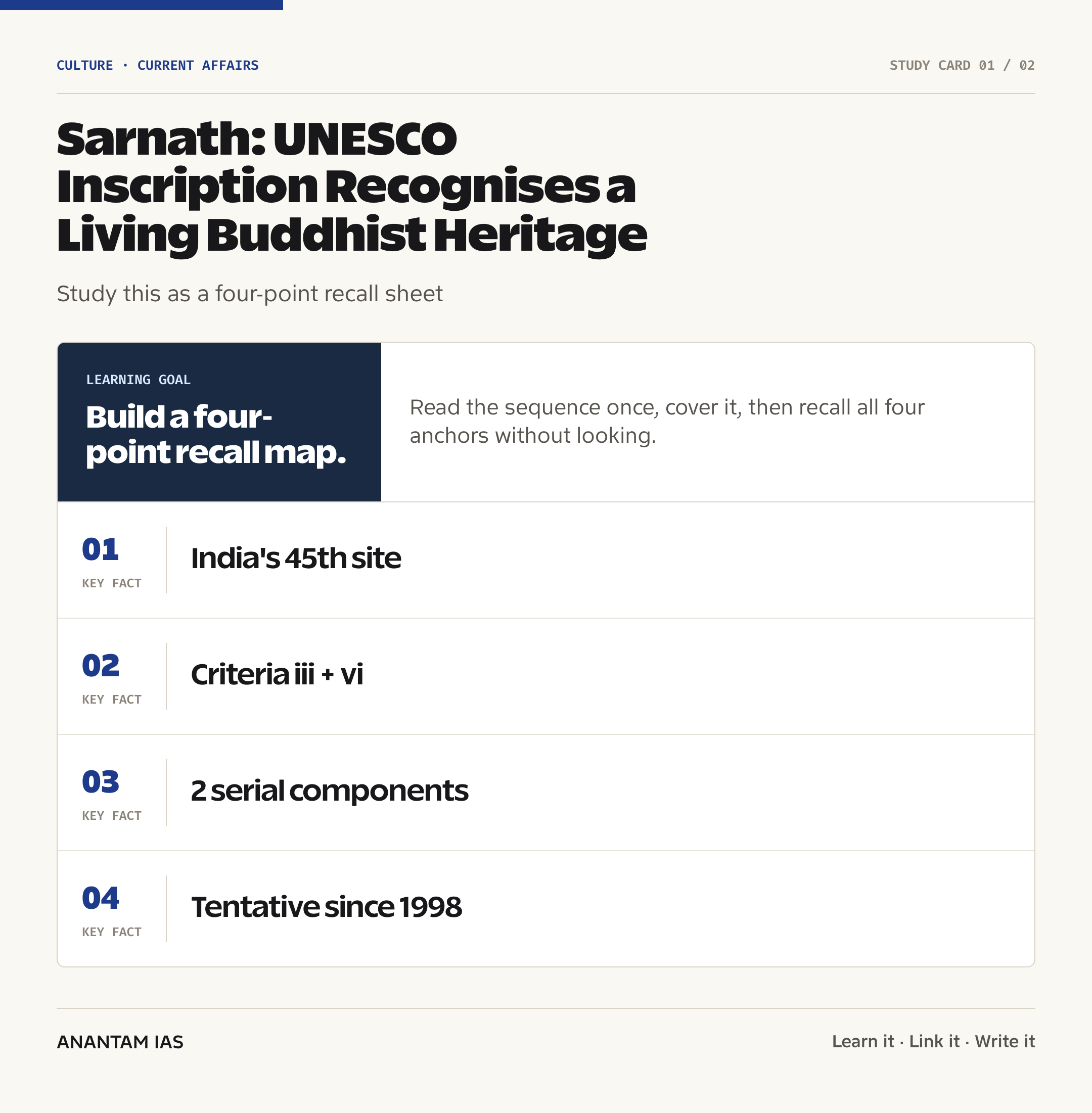
UPSC Relevance
Prelims Relevance
- Sarnath is in Varanasi, Uttar Pradesh, and is associated with the Buddha’s first sermon, traditionally called Dharmachakrapravartana, and his first disciples.
- Traditional names include Rishipatana, Ishipatana, Mrigadava and Deer Park.
- The World Heritage property has two components: Chaukhandi Stupa and the Archaeological Remains of Sarnath.
- The property was inscribed as a cultural site under UNESCO criteria (iii) and (vi).
- Criterion (iii) concerns an exceptional testimony to a cultural tradition or civilisation; at Sarnath it recognises enduring Buddhist spiritual significance and centuries of religious construction.
- Criterion (vi) concerns direct association with events, living traditions, ideas or beliefs of outstanding universal significance; at Sarnath it relates to the Buddha’s first sermon and first disciples.
- The archaeological sequence includes evidence from the pre-Mauryan, Mauryan, Kushana and Gupta phases and continued religious construction up to the 12th century CE.
- Important remains include the Dhamek Stupa, Dharmarajika Stupa, Ashokan pillar, monasteries, temples and votive stupas.
- The Lion Capital of Ashoka found at Sarnath inspired India’s State Emblem, while the wheel on its abacus informs the Ashoka Chakra. Revise the object through the National Emblem explainer.
- Both components are managed by the Archaeological Survey of India and protected under the AMASR Act, 1958, amended in 2010.
Mains Relevance
GS Paper 1
- Trace how royal, monastic and lay patronage shaped Buddhist architecture at Sarnath from the Mauryan to Gupta periods and beyond.
- Explain Sarnath’s place in Buddhist sacred geography, pilgrimage and the diffusion of the Buddha’s teachings across Asia.
- Assess the inscription as recognition of both tangible archaeological remains and the spiritual memory attached to place.
GS Paper 2
- Use the case to discuss UNESCO heritage governance, India’s obligations under the 1972 World Heritage Convention and coordination across institutions.
- Examine stakeholder participation involving the ASI, state and city authorities, Buddhist communities, residents and tourism bodies.
GS Paper 3
- Analyse visitor pressure, carrying capacity, Heritage Impact Assessment and risk preparedness as tools for sustainable heritage tourism.
- Relate conservation to urban planning through the Varanasi Master Plan 2031, protected zones and management of the wider setting.
Essay
- A monument survives through stone, but a sacred place survives through memory, practice and community.
- Heritage protection requires a balance between access and restraint, economic opportunity and cultural responsibility.
- The Buddha’s first sermon offers a bridge between India’s civilisational inheritance and its contemporary cultural diplomacy.
Background and Context
What UNESCO Actually Inscribed
The inscription covers a precisely defined serial property, not every modern religious or tourism facility in greater Sarnath.
- UNESCO identifies two component parts: the Chaukhandi Stupa and the Archaeological Remains of Sarnath, joined conceptually and protected through a common buffer zone.
- UNESCO’s map records component areas of 2.02 hectares for Chaukhandi Stupa and 6.03 hectares for the archaeological remains.
- The serial approach allows separate but historically connected areas to form one World Heritage property when their combined attributes express Outstanding Universal Value.
- The Committee changed the nominated name from Ancient Buddhist Site, Sarnath, Varanasi to Ancient Buddhist Site of Sarnath.
- Uttar Pradesh’s other three World Heritage properties are the Taj Mahal, Agra Fort and Fatehpur Sikri; Sarnath is the first in the state outside the Agra cluster.

Sarnath in the Buddha's Life
Sarnath’s global importance rests on a foundational event in Buddhist tradition rather than on architectural scale alone.
- After attaining enlightenment at Bodh Gaya, the Buddha is believed to have travelled to Mrigadava, the Deer Park, and delivered his first sermon to five former companions.
- The event is remembered as Dharmachakrapravartana, or setting the Wheel of Dharma in motion, and marks the public teaching of the path.
- The meeting with the first disciples is associated with the emergence of the Sangha; together with the Buddha and Dharma, it completes the Triratna or Three Jewels.
- Sarnath is counted among four principal Buddhist pilgrimage places linked to the Buddha’s life, alongside Lumbini, Bodh Gaya and Kushinagar.
- UNESCO’s criterion (vi) rests on this direct and tangible association with the first sermon and the formation of the earliest community of disciples.
Layers of Architecture and Patronage
The site records repeated construction, rebuilding and commemoration across many historical periods.
- UNESCO’s statement notes evidence from the pre-Mauryan period, followed by Mauryan, Kushana and Gupta phases, with activity continuing until Sarnath’s decline in the 12th century CE.
- Under Emperor Ashoka, Sarnath received monumental expressions of imperial Buddhist patronage, including a pillar and stupa tradition.
- The archaeological zone includes the Dhamek Stupa, Dharmarajika Stupa remains, an Ashokan column, temple remains, monasteries and votive stupas.
- The Gupta period made Sarnath an influential centre of Buddhist sculpture, known for refined modelling, serene expression and thin, nearly transparent treatment of monastic robes.
- The polished Sarnath Lion Capital, created under Mauryan patronage, later supplied the model for India’s State Emblem. The Dharma Chakra on the national flag is based on the wheel shown on its abacus, making the site’s visual language part of modern constitutional symbolism.
- The Chaukhandi Stupa marks the traditional meeting place of the Buddha and the five disciples. Its brick mass is crowned by an octagonal Mughal tower built in 1588 to commemorate Humayun’s visit.
- For a comparative view of stupa form, relic worship and narrative art, read the Sanchi Stupa notes.
Why Criteria (iii) and (vi) Matter
The accepted criteria explain the property’s value more accurately than a simple label such as ‘ancient monument’.
- Under criterion (iii), Sarnath bears exceptional testimony to an enduring Buddhist cultural and spiritual tradition, visible in centuries of monuments built and rebuilt at the site.
- Under criterion (vi), the archaeological remains are directly associated with the Buddha’s first sermon, his first disciples and ideas of outstanding significance to Buddhist communities.
- India had also proposed criteria (ii) and (iv), concerning interchange of human values and an outstanding architectural type or ensemble, but the final inscription is based only on (iii) and (vi).
- This distinction matters in Prelims: a State Party’s proposed criteria are not automatically the same as the Committee’s accepted criteria.
- It also shapes management because spiritual association, pilgrimage and the site’s atmosphere become attributes to protect, not incidental uses beside an archaeological park.
A Living Heritage, with a Historical Gap
Sarnath is a living pilgrimage destination today, but UNESCO does not describe its pilgrimage practice as continuously documented for 2,500 years.
- The site declined in the 12th century CE, fell into obscurity and was rediscovered in the 18th century before systematic archaeological work and conservation.
- UNESCO states that pilgrimage is not attested between the 12th century and the modern era; the 20th-century revival shows Sarnath’s powerful place in Buddhist memory and spiritual imagination.
- The property no longer performs its original function as an active monastic complex, but it continues to attract Buddhist pilgrims from around the world.
- Archaeological recovery also has layers. The UNESCO narrative records 18th-century rediscovery, while the ASI’s protected-monument register identifies remains excavated in 1904-05 among the nationally protected Sarnath complex. Documentation, excavation and conservation helped reconnect material evidence with remembered sacred geography.
- So ‘living heritage’ should mean a revived and active relationship among place, belief, community and practice, not an unsupported claim of uninterrupted institutional continuity.
- The distinction protects historical accuracy while recognising that sacred significance can be renewed through collective memory and contemporary practice.
Integrity, Authenticity and the Wider Setting
UNESCO recognised the preserved core while recording real weaknesses in the landscape and visitor experience.
- The two components retain all known preserved structures of the former Buddhist monastic complex, and their common buffer zone reflects their past connection.
- But the wider sacred geography, once understood as a forested setting, has been compromised by later change and urban pressure.
- Conservation since the early 20th century has preserved original materials with minimal intervention, supporting the authenticity of the archaeological and architectural remains.
- UNESCO cautions that treating Sarnath mainly as an archaeological park or recreational destination can weaken its spiritual character.
- This is a useful distinction: integrity asks whether the attributes are sufficiently complete, while authenticity asks whether their form, material, setting, use and meaning credibly express heritage value.
Protection and Institutional Architecture
World Heritage status adds international scrutiny but does not replace India’s domestic conservation law or responsible site management.
- Both components are protected through the Ancient Monuments and Archaeological Sites and Remains Act, 1958, amended in 2010.
- The law provides a 100-metre prohibited area around a protected monument or site, followed by a 200-metre regulated area where construction requires approval.
- The Archaeological Survey of India is responsible for protection, conservation and management of both serial components.
- Planning support comes from the Varanasi Master Plan 2031; UNESCO also notes Wildlife Protection Act, 1972 regulations for the buffer-zone setting.
- World Heritage inscription does not transfer ownership or routine management to UNESCO. India remains responsible for law, staffing, conservation and development control, while the World Heritage Committee monitors whether the property’s Outstanding Universal Value is being protected.
- A Site Management Plan supplies conservation recommendations, but effective delivery needs coordination with city authorities, tourism agencies, religious stakeholders, residents and visitors.
- For the wider national context and updated list logic, use the UNESCO World Heritage Sites in India guide.
The Management Test After Inscription
The harder task begins after celebration: retaining the site’s meaning while visitor numbers, infrastructure demands and global attention grow.
- UNESCO recommends a management strategy balancing devotion, conservation, tourism and community needs, with non-state religious stakeholders included in an advisory role.
- A carrying-capacity study should guide tourism planning so footfall, crowd movement, facilities and events remain compatible with the property’s spiritual dimension.
- The monitoring system must cover every attribute of Outstanding Universal Value, not only visible damage to masonry.
- An interpretation strategy should explain Sarnath as a spiritual destination and connected serial property, instead of presenting isolated ruins as recreational objects.
- Heritage Impact Assessment should precede development within the property, buffer zone and immediate setting, allowing harm to be avoided before project approval.
- Future archaeological survey around the buffer zone can clarify the historical extent of Sarnath’s sacred geography and improve evidence-based boundary management.
Way Forward
Put Outstanding Universal Value at the Centre
- Translate criteria (iii) and (vi) into measurable conservation indicators covering fabric, setting, pilgrimage practice, silence, movement and spiritual atmosphere.
- Publish a clear monitoring dashboard for the ASI, local administration and heritage experts without reducing sacred values to footfall or revenue.
Manage Visitors, Not Just Monuments
- Complete the recommended carrying-capacity study and use timed entry, guided circulation, shaded rest areas and separate quiet zones where evidence supports them.
- Coordinate peak pilgrim seasons, school visits and general tourism so conservation needs and ritual access don’t compete.
Make Development Heritage-Sensitive
- Require credible Heritage Impact Assessments before roads, commercial facilities, lighting, utilities or large visitor infrastructure are approved near the property.
- Enforce the AMASR prohibited and regulated zones alongside the Varanasi Master Plan, with transparent decisions and cumulative-impact review.
Interpret the Whole Cultural Landscape
- Connect Chaukhandi Stupa and the archaeological remains through a single narrative of the first disciples, patronage, monastic life and pilgrimage.
- Use multilingual, accessible interpretation that distinguishes verified archaeology, textual tradition and later memory without flattening them into one claim.
Share Stewardship
- Create regular consultation with Buddhist institutions, monks, local communities, historians, conservation architects and persons with disabilities.
- Direct part of tourism value toward conservation skills, local livelihoods, waste management and respectful public behaviour around the sacred site.
Conclusion
Sarnath’s inscription recognises more than a group of ancient ruins. It recognises a place where archaeology, Buddhist memory and contemporary pilgrimage meet, anchored in the Buddha’s first sermon and the earliest community of disciples.
The strongest response is not higher visitor numbers alone. It is careful stewardship that protects the two serial components, recovers the logic of the wider sacred geography and keeps devotion, learning and conservation compatible.
If India implements UNESCO’s recommendations with the ASI, local authorities and Buddhist communities working together, the 45th inscription can become a model for managing a sacred archaeological site as both inherited evidence and active cultural meaning.
UPSC Practice Questions
Prelims MCQ 1
With reference to the Ancient Buddhist Site of Sarnath, consider the following statements:
- It was inscribed on the World Heritage List under criteria (iii) and (vi).
- The serial property consists of Chaukhandi Stupa and the Archaeological Remains of Sarnath.
- UNESCO records an uninterrupted pilgrimage tradition at Sarnath from the 6th century BCE to the present.
How many of the above statements are correct?
(a) Only one (b) Only two (c) All three (d) None
Answer: (b) Only two
Explanation:
Statements 1 and 2 are correct. Statement 3 is incorrect: UNESCO says pilgrimage is not attested between the 12th century CE and the modern era, while the 20th-century revival demonstrates Sarnath’s continuing place in Buddhist memory.
Prelims MCQ 2
Which one of the following best explains UNESCO criterion (vi) in Sarnath’s inscription?
(a) It is the largest surviving brick monument of the Mauryan age (b) It displays an interchange of architectural values across all Buddhist countries (c) It is directly associated with the Buddha’s first sermon and first disciples (d) It preserves a complete continuously occupied ancient monastic city
Answer: (c) It is directly associated with the Buddha's first sermon and first disciples
Explanation:
Criterion (vi) recognises Sarnath’s direct and tangible association with events and ideas of outstanding significance to the Buddhist community, especially the first sermon and meeting of the first disciples.
UPSC Mains Questions
- Sarnath’s World Heritage inscription rests as much on spiritual association and Buddhist memory as on its archaeological fabric. Examine this statement with reference to UNESCO criteria (iii) and (vi), the site’s historical layers, and the meaning of living heritage.
- World Heritage recognition can intensify the very tourism and development pressures that threaten a sacred archaeological site. Suggest a governance framework for Sarnath that balances conservation, pilgrimage, community needs, interpretation and urban development.
Sources: UNESCO World Heritage Centre and PIB, Prime Minister's Office.
Frequently Asked Questions
Why is Sarnath important in Buddhism?
Sarnath is traditionally identified as the place where the Buddha delivered his first sermon after enlightenment and met his first disciples. The event is remembered as Dharmachakrapravartana, setting the Wheel of Dharma in motion. It is also associated with the early Sangha and is one of the four principal Buddhist pilgrimage places.
Which UNESCO criteria apply to Sarnath?
The World Heritage Committee inscribed the Ancient Buddhist Site of Sarnath under cultural criteria (iii) and (vi). Criterion (iii) recognises its testimony to an enduring Buddhist spiritual tradition. Criterion (vi) recognises its direct association with the Buddha’s first sermon, first disciples and teachings of outstanding significance.
What are Sarnath’s two component parts?
The serial property comprises Chaukhandi Stupa and the Archaeological Remains of Sarnath. The latter includes major stupas, the Ashokan pillar remains, temple remains, monasteries and votive stupas. A common buffer zone reflects the historic relationship between the two separately bounded components.
Is Sarnath an unbroken living monastery?
No. UNESCO says Sarnath declined in the 12th century CE, and pilgrimage isn’t attested there between that period and the modern era. The site no longer functions as its original monastic complex. Its living character comes from a strong 20th-century revival and continuing international Buddhist pilgrimage.
Who protects and manages Sarnath?
The Archaeological Survey of India protects, conserves and manages both components. Domestic protection comes mainly from the AMASR Act, 1958, amended in 2010. The Varanasi Master Plan 2031 and buffer-zone regulations add planning support, while World Heritage status brings monitoring and international accountability.
What must happen after UNESCO inscription?
UNESCO recommends balanced management of devotion, conservation, tourism and community needs. Priorities include a carrying-capacity study, better monitoring, spiritually sensitive interpretation, Heritage Impact Assessment before development, stakeholder participation and archaeological survey around the buffer zone to clarify the historic sacred geography.
Source: https://anantamias.com/current-affairs/sarnath-unesco-world-heritage-inscription/
APAAR and Children’s Aadhaar Data: Supreme Court Mandates Informed Opt-Out
Why in News?
In Abhishek Baxi & Others v. Union of India, the Supreme Court on 20 July directed authorities implementing the Automated Permanent Academic Account Registry, or APAAR, to give nationwide effect to an Orissa High Court direction on an express parental opt-out. The record of proceedings became publicly available on 25 July.
The Court also clarified that every stage of processing personal information under APAAR must comply with the Digital Personal Data Protection Act, 2023. Data cannot be shared with a private entity or third party except according to law and strictly for an authorised purpose.
- The case was Writ Petition (Civil) No. 832 of 2026, filed under Article 32 by parents of students in CBSE-affiliated schools.
- The three-judge Bench comprised the Chief Justice of India, Justice Joymalya Bagchi and Justice V. Mohana.
- The Court adopted the approach in Rohit Anand Das v. State of Odisha, where the High Court had asked authorities to consider amending the model consent form to include an opt-out or refusal option.
- The nationwide direction seeks to make parental consent meaningful and informed rather than a formality with only an affirmative choice.
- The petition was disposed of with safeguards, while the respondents, who had not been heard at that stage, were given liberty to seek clarification.
The development matters in the context of:
- The ruling matters in the context of informational privacy: a child’s identity and academic history can remain linked across institutions and stages of education.
- It also tests whether a formally voluntary digital service remains voluntary when schools or examination processes create practical pressure to enrol.
- The issue connects education governance with data minimisation, purpose limitation, security, retention and effective grievance redress.

UPSC Relevance
Prelims Relevance
- APAAR stands for Automated Permanent Academic Account Registry and is presented by the Ministry of Education as a lifelong academic identity.
- The official APAAR portal describes the ID as a 12-digit code linked to academic records and credentials.
- APAAR works with the Academic Bank of Credits, DigiLocker and UDISE+ to support record access, transfer and credit mobility.
- For a minor, the official process includes parental consent, demographic verification and identity authentication through the school.
- A Permanent Education Number, or PEN, in UDISE+ is a stated prerequisite for generating an APAAR ID.
- Under the DPDP Act, a child means a person who has not completed 18 years of age.
- Section 9 of the DPDP Act requires verifiable parental consent before processing a child’s personal data, subject to notified exceptions.
- The right to privacy is protected as part of life and personal liberty under Article 21, following the Puttaswamy ruling.
- The Supreme Court’s present order extended the opt-out direction pan-India; it did not abolish APAAR or hold the scheme unconstitutional.
Mains Relevance
GS Paper 2
- Fundamental rights: informed consent, informational privacy and the proportionality of State-backed digital identity systems.
- Governance: accountability of schools, CBSE and implementing authorities when an administrative scheme handles children’s sensitive educational records.
- Social justice: the risk that a digital prerequisite may exclude children from admission, examinations or services even when enrolment is described as voluntary.
GS Paper 4
- Public-service ethics: consent loses moral value when refusal carries hidden educational penalties.
- Trust and stewardship: authorities collecting children’s data carry a heightened duty of care, transparency and restraint.
Essay
- Digital public infrastructure earns legitimacy through meaningful choice, limited purposes and enforceable accountability.
- A child’s data may be useful for service continuity, but administrative convenience cannot replace autonomy and constitutional safeguards.
Background and Context
What APAAR Is Designed to Do
APAAR is meant to create continuity in a student’s verified academic identity and records.
- The Supreme Court described APAAR as an Aadhaar-linked lifelong digital academic identifier associated with the objectives of the National Education Policy, 2020.
- Its stated purposes include seamless academic records, transfers across institutions and States, and academic credit mobility through the Academic Bank of Credits.
- The official portal says the ID can consolidate scorecards, marksheets, grades, degrees, diplomas, certificates and co-curricular achievements.
- The creation flow links a student’s UDISE+ record and PEN with verified demographic information; the completed APAAR ID is placed in DigiLocker.
- For a fuller account of its architecture, see APAAR ID and its academic-record ecosystem.

What the Parents Challenged
The petition questioned whether consent was real when schools and examination processes allegedly made refusal costly.
- The parents challenged the constitutional validity of the scheme and the requirement to furnish children’s Aadhaar details as a precondition for registration.
- They alleged that the system could enable long-term tracking, profiling and monitoring of educational trajectories. These were petitioners’ contentions, not factual findings recorded by the Court.
- They argued that the model consent form did not clearly state the purpose, scope, retention period or data-sharing practices, and did not offer an express refusal choice.
- The order records an allegation that some schools threatened denial of admission, Board-examination registration or other services. It also records alleged pressure tied to APAAR enrolment targets.
- The petitioners relied on the privacy test of legality, legitimate aim, necessity and proportionality developed in the Puttaswamy framework.
The Nationwide Opt-Out Direction
The Court treated an express refusal route as an essential safeguard for meaningful and informed consent.
- In Rohit Anand Das, the Orissa High Court had directed authorities to consider amending the model consent form to include an opt-out or refusal option and to pass necessary orders.
- The Supreme Court directed all concerned authorities implementing APAAR to give paragraph 19 of that High Court judgment effect across India.
- The precise formulation matters: the Supreme Court extended the High Court’s direction nationwide; it did not itself publish a rewritten form or prescribe its exact wording.
- An opt-out must be visible, intelligible and usable. A form offering only “I consent” cannot establish that refusal was freely available.
- An operational safeguard should also prevent schools from attaching an unauthorised penalty to refusal, because coerced participation would defeat the basis of consent.
DPDP Act Duties for Children's Data
The Court placed the full lifecycle of APAAR personal data within the DPDP Act, not merely the initial collection step.
- The order covers collection, processing, storage, retention, sharing and use. Compliance cannot be reduced to obtaining a signature once.
- Section 6 says consent must be free, specific, informed, unconditional and unambiguous, expressed through a clear affirmative action and limited to data necessary for the specified purpose.
- Section 5 requires notice about the personal data sought, the purpose of processing, the exercise of rights and the route for a complaint.
- Section 9 requires verifiable parental consent before processing a child’s data and prohibits processing likely to harm a child’s well-being, subject to the Act’s notified framework.
- A data fiduciary must take reasonable security safeguards, respond to breaches as required and erase data when the purpose ends or consent is withdrawn unless lawful retention is necessary.
- The durable statutory framework is explained in DPDP Act 2023: consent and data-fiduciary duties.
Purpose Limitation and Third-Party Sharing
The Court rejected the idea that an administrative scheme sits outside data-protection law.
- The Bench said the non-statutory origin of a scheme does not release authorities from their obligations to protect personal data.
- Processing must be lawful, secure and purpose-limited. Academic record continuity cannot become a blanket justification for unrelated profiling or secondary use.
- Personal information cannot be disclosed to a private entity or third party except in accordance with law and strictly for an authorised purpose.
- This is not an absolute ban on every processor or integration. It is a legal-purpose test that should cover role definition, access controls, contracts, audit trails and data minimisation.
- The APAAR privacy policy refers to integration with educational institutions, DigiLocker, the Academic Bank of Credits and cloud providers. Each flow needs a clear legal basis and limited access.
Constitutional Privacy and Children's Autonomy
A child’s education record engages both informational privacy and the conditions for equal access to schooling.
- The right to privacy under Article 21 includes an individual’s interest in controlling personal information, subject to lawful and proportionate restrictions.
- Children require stronger protection because they may not understand persistent identifiers, future data linkage or the consequences of a digital trail created early in life.
- Parental consent is a protective mechanism, but it must be supported by plain-language notice, age-appropriate information and a genuine route to withdrawal or refusal.
- The larger privacy doctrine, including Puttaswamy and Aadhaar, is covered in Right to Privacy in India.
- Digital education can improve portability and reduce paperwork, but its benefits depend on inclusion, interoperability, security and offline alternatives; see Digital Education in India.
Consent as an Administrative Process
The judgment turns consent design from a one-page formality into a continuing governance responsibility.
- A valid choice begins before enrolment: parents need a clear notice identifying the authority seeking data, the exact fields requested, the purpose served and the consequence of refusal. Vague references to educational benefit cannot substitute for a specified purpose.
- The request should separate Aadhaar authentication, creation of the academic identifier, storage of credentials and any later data sharing. Bundling distinct purposes into one signature makes it difficult to know what a parent actually accepted.
- Consent must remain provable. Authorities need a reliable record of the notice shown, the language selected, the decision made and any later withdrawal, while ensuring that the consent log does not become another excessive personal-data repository.
- The school is the practical interface between the family and the digital system. Training, standard scripts and supervisory checks are needed so a teacher or administrator does not convert a voluntary process into de facto compulsion through deadlines or threats.
- A refusal route also needs administrative continuity. The student should still have a documented method to register for examinations, transfer schools and prove academic history through a non-APAAR alternative wherever no law makes APAAR indispensable.
- Withdrawal raises separate questions from refusal at the start. Implementing rules should explain which processing stops, what data is erased, what must be retained under another law and how linked systems receive the withdrawal instruction.
- Accountability requires evidence rather than assurance. Periodic audits should test notices, permissions, retention, processor access, grievances and school-level coercion, with corrective directions tied to a named responsible authority.
What the Order Did Not Decide
The six-page record of proceedings supplied safeguards without resolving every contested question about APAAR.
- The Court did not strike down the scheme, cancel existing IDs or declare every use of Aadhaar in education invalid.
- It did not find that unlawful surveillance or data misuse had already occurred. The Court called concerns about possible misuse misconceived because DPDP obligations continue to bind authorities.
- It did not authorise broad third-party sharing; the permission is confined to what the law and the authorised purpose allow.
- The respondents had not been heard at that stage and were expressly given liberty to seek clarification, a procedural qualification students should note.
- Implementation questions remain: the revised form, consequences of refusal, deletion or retention after withdrawal, grievance channels, auditability and treatment of legacy records.
Way Forward
Redesign consent around a real choice
- Issue a uniform model form with separate, equally visible options to consent or refuse, without pre-ticked boxes.
- State the data fields, each purpose, recipient category, retention period and withdrawal route in plain language and relevant Indian languages.
- Record refusal without repeatedly pressuring parents or treating non-enrolment as an administrative defect.
Separate education access from voluntary enrolment
- Publish binding instructions that refusal cannot by itself block admission, examination registration or access to an educational service unless a specific law requires the identifier.
- Create a workable alternative process for identity verification and academic-record transfer where a student has no APAAR ID.
- Audit school communications and target-setting practices to detect coercion hidden behind formally voluntary language.
Map and minimise every data flow
- Prepare a public data-flow map covering UDISE+, Aadhaar authentication, APAAR, DigiLocker, the Academic Bank of Credits and processors.
- Collect only fields necessary for a declared purpose and enforce purpose-specific access through role-based controls.
- Set documented retention and deletion schedules, including a process for consent withdrawal, account closure and duplicate-record correction.
Build child-centred accountability
- Provide parents and age-appropriate students with accessible routes to inspect, correct and seek erasure of personal data where the law permits.
- Name responsible officers, publish grievance timelines and maintain tamper-evident logs for access and sharing.
- Conduct periodic security and privacy assessments focused on re-identification, unauthorised linkage and harm to children’s well-being.
Report compliance, not enrolment alone
- Measure the rate of informed refusal, correction, grievance disposal and deletion alongside APAAR coverage.
- Publish anonymised compliance reports without exposing school-level or child-level personal information.
- Use independent review to test whether the revised form and school practice meet the Court’s standard of meaningful consent.
Conclusion
The Supreme Court’s order does not reject digital academic infrastructure. It draws a constitutional line around it: APAAR can support portability and continuity, but participation cannot rest on a consent form that hides refusal or on pressure that makes refusal impractical.
The lasting test is implementation. A nationwide opt-out, DPDP-compliant processing, limited sharing and a penalty-free alternative must work at the school counter, not only in policy text. That is how digital education can gain trust without making a child’s data the price of access.
UPSC Practice Questions
Prelims MCQ 1
With reference to APAAR, consider the following statements:
- It is designed as a lifelong digital academic identifier linked with the Academic Bank of Credits.
- For a minor, the official creation process includes parental consent.
- The Supreme Court has declared the APAAR Scheme unconstitutional and ordered all existing IDs deleted.
How many of the above statements are correct?
(a) Only one (b) Only two (c) All three (d) None
Answer: (b) Only two
Explanation:
Statements 1 and 2 are correct. APAAR supports a lifelong academic record and credit mobility, and the official process includes parental consent for minors. Statement 3 is incorrect: the Supreme Court issued opt-out and data-protection safeguards but did not invalidate the scheme.
Prelims MCQ 2
Which one of the following best describes the Supreme Court’s July 2026 APAAR direction?
(a) Aadhaar was prohibited for every educational purpose (b) APAAR enrolment was made compulsory for all school students (c) The Orissa High Court’s opt-out direction was given nationwide effect, with DPDP safeguards (d) Private entities received unrestricted access to APAAR data
Answer: (c) The Orissa High Court's opt-out direction was given nationwide effect, with DPDP safeguards
Explanation:
The Court required concerned authorities to give the opt-out or refusal safeguard pan-India effect. It also required lawful, secure and purpose-limited processing under the DPDP Act and restricted extraneous third-party sharing.
UPSC Mains Questions
- The Supreme Court’s APAAR order shows that consent in digital governance must be meaningful in both form and practice. Examine how opt-out design, purpose limitation and a penalty-free alternative can reconcile educational record portability with children’s privacy and equal access.
- Administrative schemes handling children’s data cannot treat statutory privacy duties as optional. Discuss with reference to the APAAR ecosystem, the Digital Personal Data Protection Act, 2023, data-fiduciary obligations, and the accountability of schools and public authorities at each stage of processing.
Sources: Supreme Court of India and The Indian Express.
Frequently Asked Questions
What is APAAR?
APAAR is the Automated Permanent Academic Account Registry, a Ministry of Education initiative for a lifelong digital academic identity. It is designed to connect verified student records with systems such as UDISE+, DigiLocker and the Academic Bank of Credits so credentials and credits can move across institutions.
What did the Supreme Court direct?
The Supreme Court directed authorities implementing APAAR to give nationwide effect to the Orissa High Court’s direction on an express opt-out or refusal option. It also required DPDP-compliant processing and barred sharing beyond lawful, authorised purposes. The Court did not itself publish the revised consent form.
Did the Court abolish APAAR?
No. The Court did not strike down APAAR, cancel existing IDs or prohibit all Aadhaar use in education. It disposed of the petition with consent and data-protection safeguards, while allowing respondents who had not been heard to seek clarification.
Can APAAR data be shared privately?
Only within strict legal limits. The order says personal information cannot be made available to a private entity or third party except according to law and strictly for an authorised purpose. Sharing outside the scheme’s scope or for an extraneous purpose is impermissible.
Why is an opt-out important?
An express opt-out shows that refusal is available and helps distinguish consent from compliance under pressure. Its value depends on practice: schools should not deny admission, examination registration or ordinary educational access merely because a parent declines a voluntary identifier.
How does the DPDP Act protect children?
The DPDP Act treats anyone under 18 as a child and requires verifiable parental consent before processing a child’s personal data, subject to the statutory framework. It also imposes notice, security, purpose limitation and other data-fiduciary duties relevant to APAAR.
Source: https://anantamias.com/current-affairs/apaar-aadhaar-consent-supreme-court-safeguards/