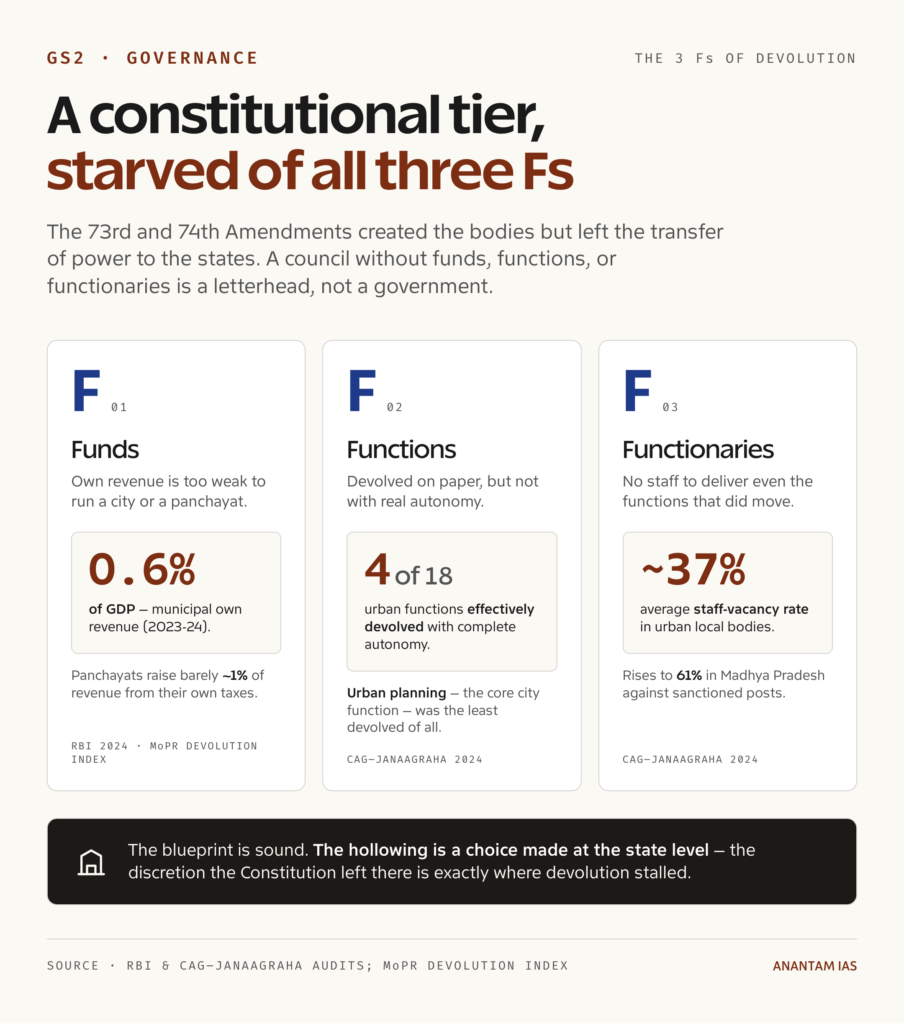
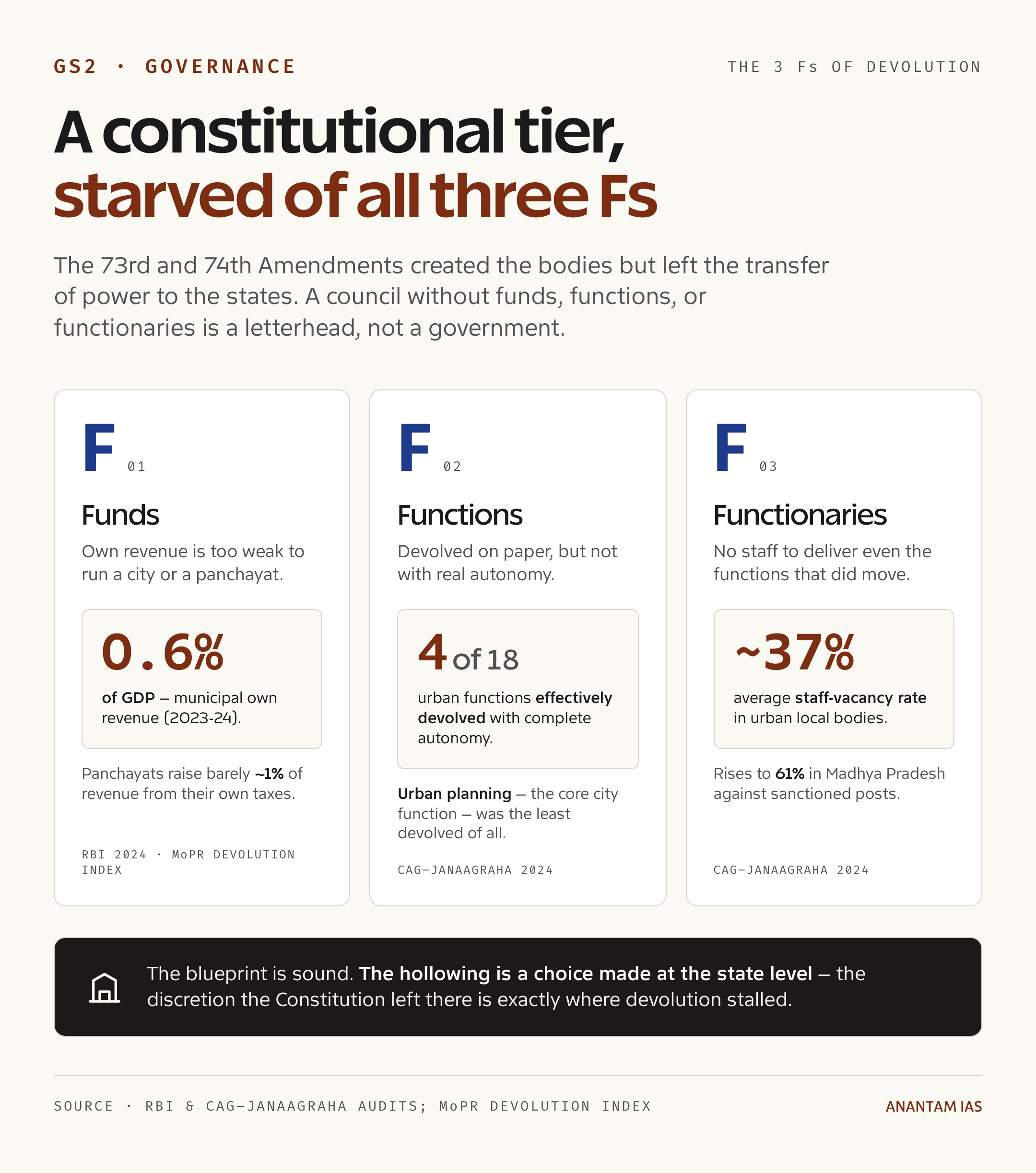
India built its third government in 1993 and then spent thirty years refusing to fund it. That’s the short version. The 73rd and 74th Amendments turned village panchayats and city municipalities from a favour the states could grant or withdraw into a constitutional requirement, with elected councils, reserved seats for women, and a finance commission of their own. The structure is real and it’s enormous. But in November 2024, two government-grade audits landed in the same week and said the same thing in different words: the tier exists, and it’s hollow. The RBI’s Report on Municipal Finances found that India’s cities raise own revenue worth just 0.6% of GDP. The CAG, auditing the 74th Amendment with the civic group Janaagraha, found that of 18 city functions, only four were actually handed over.
So the question for a Mains answer isn’t whether decentralisation happened. It did, on paper, three decades ago. The question is why a constitutional tier with elected leaders and crores of representatives still can’t pave its own roads, hire its own staff, or tax its own land without permission from the state above it. That gap between the mandate and the machinery is the entire topic.
The Issue, Framed
The fight here isn’t about whether India has local government. It does, more of it than anywhere on earth. The fight is about whether that government has any power, or whether it’s an elaborate stage set the states still operate from behind the curtain.
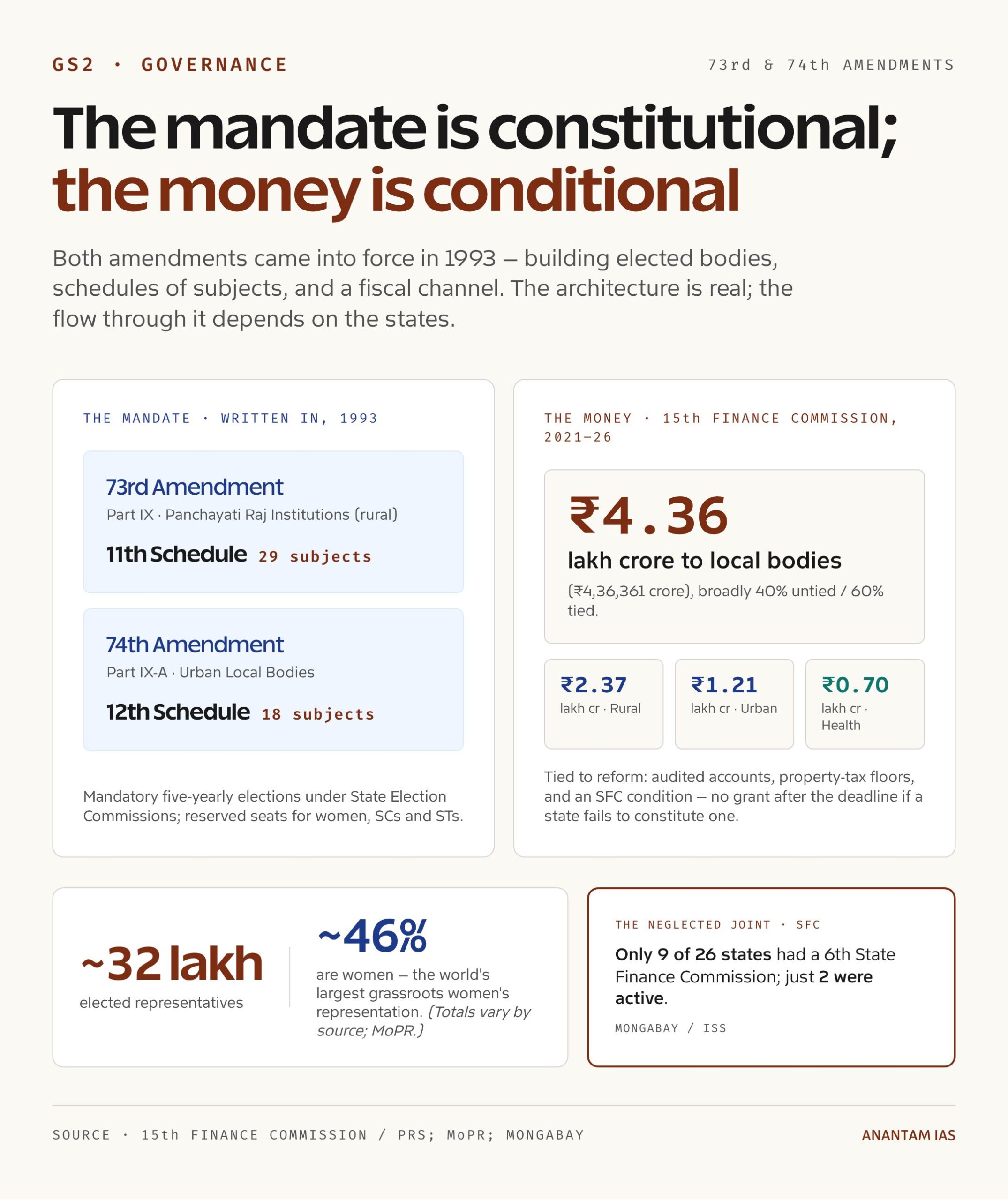
Fix the vocabulary first, because most confusion on this topic comes from loose terms. The 73rd Amendment came into force on 24 April 1993 and inserted Part IX of the Constitution (Articles 243 to 243-O) plus the Eleventh Schedule, a list of 29 subjects for Panchayati Raj Institutions (PRIs) – the elected councils that run rural India across three tiers: the village (Gram Panchayat), the block (Panchayat Samiti), and the district (Zilla Parishad). The 74th Amendment followed on 1 June 1993, inserting Part IX-A (Articles 243-P to 243-ZG) and the Twelfth Schedule, a list of 18 subjects for urban local bodies (ULBs) – the Nagar Panchayats, Municipal Councils, and Municipal Corporations that govern cities and towns. Before 1993, local government was a state subject that states could simply ignore. After 1993, it became a constitutional fixture they couldn’t abolish.
That’s the part everyone celebrates. Here’s the part that decides the answer.
The amendments created the bodies but left the actual transfer of power to the states, through what experts call the “3 Fs”: funds, functions, and functionaries. A function is a job, like running primary schools or supplying water. A functionary is the staff to do that job, the engineers and clerks. Funds are the money to pay for both. A council with a constitutional seat but no functions to perform, no staff to deploy, and no money to spend isn’t a government. It’s a letterhead. Devolution is the word for handing over all three together, and devolution is exactly what the states held back.
There’s a fiscal channel too, and it matters. The amendments created a State Finance Commission (SFC) – under Article 243-I for panchayats and Article 243-Y for municipalities – meant to be set up every five years to recommend how state money flows down to local bodies. It’s the plumbing of the third tier. So the constitutional design wasn’t naive. It built the council, the elections, and the money pipe. The failure was never in the blueprint; it was in the states declining to connect the pipe.
A constitutional tier is a promise. The 3 Fs are whether that promise was kept. On the evidence, mostly it wasn’t.
What the Data Says
The numbers split cleanly into two stories, and you need both: one of scale, genuinely staggering, and one of starvation, just as stark.
Start with scale, because the third tier is no token. India has roughly 2.5 lakh Gram Panchayats, and the Ministry of Panchayati Raj puts the total at around 32 lakh elected panchayat representatives, of whom roughly 46%, more than 15 lakh, are women. That women’s share is the highest grassroots representation of women anywhere in the world, flowing directly from the amendments’ floor of not less than one-third (33%) reservation for women, which many states later pushed to 50%. Read the counts with care, though: the ~32 lakh is the Ministry’s sanctioned-seat total, while a separate 2024 figure puts representatives currently in office at about 24.4 lakh, women near 49.75%. Both measure different things. The safe line is that India runs more than 30 lakh elected local representatives, about half of them women – one of the largest experiments in grassroots democracy ever attempted.
Now the starvation. This is where two 2024 audits do the heavy lifting.
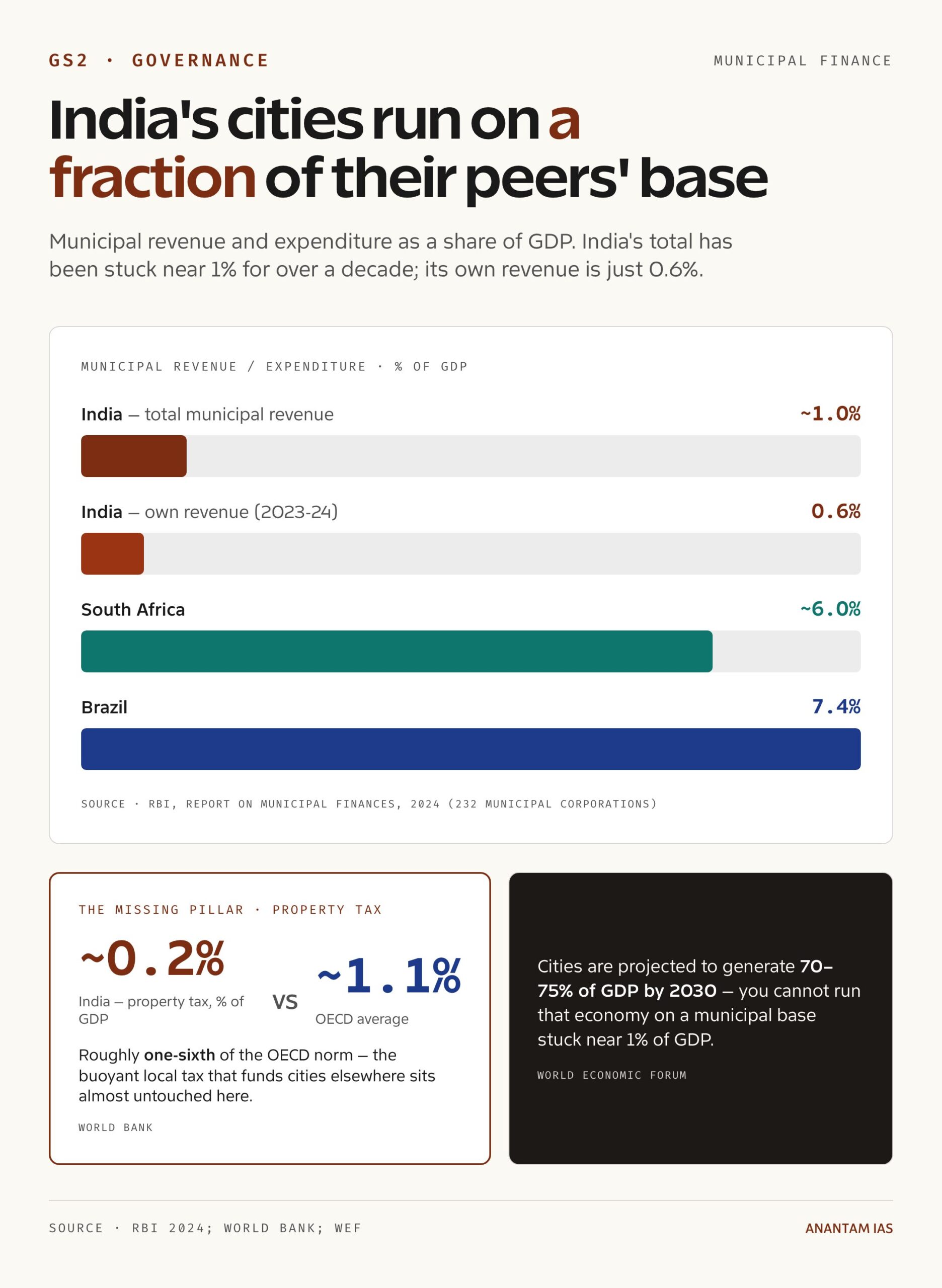
The RBI’s Report on Municipal Finances, released on 12 November 2024 and analysing 232 municipal corporations (over 90% of all such corporations), found municipal own revenue at just 0.6% of GDP in 2023-24 – against the centre’s 9.2% and the states’ 14.6%. Total municipal revenue and spending together has been stuck near 1% of GDP for over a decade, while Brazil sits at 7.4% and South Africa near 6%. So India’s cities, which the World Economic Forum projects will generate 70 to 75% of GDP by 2030, run on roughly one-seventh of Brazil’s municipal fiscal base. Municipal bonds, the borrowing route, are barely a rounding error: about ₹4,204 crore outstanding, 0.09% of the corporate bond market.
The CAG’s performance audit of the 74th Amendment, done with Janaagraha and released on 14 November 2024, audited 393 urban local bodies across 18 states, and its headline is brutal in its specificity. Of the 18 Twelfth-Schedule functions, states had transferred 17 on paper, but only 4 were “effectively devolved with complete autonomy”. Worse, urban planning – the single most important thing a city government does – was the least devolved function of all. On staff, ULBs carried a 37% average vacancy rate against sanctioned posts, rising to 61% in Madhya Pradesh. And they raised only 32% of their revenue themselves, leaving a 42% gap between their resources and their spending.
The rural picture rhymes. The Ministry of Panchayati Raj’s Panchayat Devolution Index 2024 found panchayats raise barely 1% of revenue from their own taxes, leaning on roughly 80% central grants and 15% state grants. The same index recorded the national devolution score climbing from 39.9% in 2013-14 to 43.9% in 2021-22 – real improvement, still short of even halfway.
The Case For: The Third Tier Is Real
The case that the amendments worked is genuinely strong, and a lazy answer skips it. So let’s state it at full strength, because the third tier is not a fiction.
It’s constitutionally permanent now. Before 1993, a state could dissolve a municipality and govern through appointed officers for years, and many did. The 73rd and 74th Amendments ended that. Elected local bodies became mandatory, with five-yearly elections run by independent State Election Commissions – Article 243-K for panchayats, Article 243-ZA for municipalities – so a state can no longer quietly suspend grassroots democracy when it’s inconvenient. That’s the difference between a right and a favour.
The democratic mass is unmatched anywhere on earth. Roughly 2.5 lakh Gram Panchayats and more than 30 lakh elected representatives make this arguably the largest tier of elected office on the planet. And the women’s reservation built something the rest of Indian politics still hasn’t: roughly half of all panchayat seats held by women, against barely a fifth of the Lok Sabha. Whatever else is broken, the amendments put 15 lakh-plus women into elected office who wouldn’t otherwise be there.
Real money now flows through a constitutional channel. The 15th Finance Commission routed ₹4.36 lakh crore (₹4,36,361 crore) to local bodies for 2021-26 – about ₹2.37 lakh crore to rural bodies, ₹1.21 lakh crore to urban bodies, and ₹70,051 crore in health grants through them. And the Commission tied a share of that money to genuine reform: local bodies must publish audited accounts, states must fix minimum property-tax floors, and – the sharp clause – no state gets these grants after March 2024 if it fails to constitute a State Finance Commission and act on it. So the fiscal pipe isn’t just drawn on a chart. Money runs through it, with conditions attached.
And the design works where states actually commit. This is the clincher. Kerala’s People’s Plan Campaign, launched in 1996, devolved 35 to 40% of the state’s plan expenditure to about 1,214 local governments, and Kerala ranks second on the 2024 Devolution Index. So when a state genuinely lets go of funds and functions, the constitutional machinery delivers. That single fact reframes the debate: the hollowing isn’t a flaw in the amendments, it’s a choice by the states that won’t follow Kerala’s lead.
The Case Against: The Hollowing
Here’s what the “third tier is real” case walks past. A government is judged by what it can actually do, not by its place in the Constitution – and on that test, most of India’s local bodies are governments in name and supplicants in practice.
The functions never really moved. The CAG’s finding is the cleanest indictment going: states devolved 17 of 18 urban functions on paper, but only 4 came with complete autonomy. And the function they held back hardest was urban planning – deciding how a city grows, the heart of what a city government is for. A municipality that can’t plan its own land isn’t running the city. Someone else is.
There are no functionaries to run even the functions that did move. A 37% staff-vacancy rate, touching 61% in Madhya Pradesh, means a third of the posts meant to deliver services have nobody in them. Without engineers, sanitation staff, and clerks, the council can’t perform a function however cleanly it’s been devolved on paper. So the mandate arrives without the muscle.
And there are no funds of their own. Municipal own revenue at 0.6% of GDP, ULBs self-generating just 32% of their money, panchayats raising barely 1% from own taxes – these aren’t a temporary squeeze. They’re the structural condition. A government that depends on the tier above it for most of its money is on an allowance, and an allowance comes with strings.
The one tax that could fix this is the one nobody collects. Property tax is the natural local revenue, and India captures almost none of it: about 0.2% of GDP, against the OECD average near 1.1% – roughly one-sixth – with collections running at only 5 to 20% of potential. The NIPFP calls it the most important municipal tax and “grossly under-exploited,” undone by poor coverage, generous exemptions, and weak valuation. So the buoyant local tax that funds cities everywhere else sits almost untouched here.
The fiscal pipe the Constitution built is broken at the joint. State Finance Commissions, meant to channel money down every five years, have been chronically neglected. As of a 2023 review of 26 states, only 9 had constituted their 6th SFC, and only 2 were active. George Mathew of the Institute of Social Sciences called the SFC “the most neglected aspect of the 73rd and 74th amendments,” and former NIPFP economist Tapas Sen put it plainly: “We are nowhere compared to what was envisaged 30 years ago”. When the constitutional plumbing is ignored, the money flows on the state’s own terms, if at all.
Parallel bodies quietly govern instead. Across cities, parastatals – state-controlled development authorities, water boards, and transport corporations – hold the planning, money, and staff that should sit with the elected council. In Bengaluru, water goes to BWSSB, planning to BDA, transport to BMTC, while the municipal corporation BBMP holds what’s left. The elected mayor, meanwhile, is often ceremonial: only 5 states directly elect their mayor, most give one- or two-year terms, and only about 61 million of 241 million urban Indians can directly elect the head of their own city. In most cities the real executive is a state-appointed commissioner the elected council can’t even evaluate.
One honest caveat keeps this fair. High women’s representation doesn’t always mean real women’s authority – the “sarpanch-pati” phenomenon, where an elected woman’s husband runs the office, is well documented. So even the amendments’ proudest achievement carries an asterisk.
The Deeper Structural Read
Step back from the audits and the real fault line shows up. This isn’t a story of bad constitutional design. It’s a good design running through an unwilling intermediary – the state government – which has every incentive to keep the third tier weak.
Think about who loses power when local government gains it. Not the Union. The states. A Chief Minister who genuinely devolves urban planning, water, and staff to elected mayors hands patronage, contracts, and visible credit to potential rivals. The MLA who fixes the local road and takes the credit doesn’t want an empowered corporator doing it instead. So the resistance to devolution isn’t bureaucratic inertia. It’s rational political self-interest, sitting exactly at the state level where the Constitution left the discretion. That’s the fairest read the data supports: the amendments work, and the states fail on purpose.
The fiscal architecture makes that self-interest cheap to act on. The State Finance Commission is the device meant to force the money down, and constituting it on time is a state choice – so a reluctant state can simply skip it, or constitute it and ignore its report, with no real penalty in the Constitution itself. The 15th Finance Commission tried to add one – no SFC, no grant after March 2024 – which tells you the Union had to bolt on a stick the original design lacked.
And here’s the part that should bother a future administrator most. The strongest technical case for stronger local government – that cities will drive 70 to 75% of GDP by 2030 – is also the strongest case against the status quo, because you can’t run a 70%-of-GDP urban economy on municipal finances stuck at 1% of GDP. The mismatch isn’t a fairness problem. It’s a growth problem: underfunded, understaffed cities that can’t plan their own land become the binding constraint on the national economy. So decentralisation stops being a Panchayati Raj seminar topic and becomes a question of whether India’s cities can carry the weight the country is about to put on them.
The Kerala counter-example proves the diagnosis from the other direction. Kerala didn’t amend the Constitution to make the People’s Plan work. It used the same Part IX-A every other state has and chose to devolve 35 to 40% of plan funds anyway. Same blueprint, different outcome – the tool isn’t broken; most states just refuse to use it.
What Should Be Done
So what does a real third tier look like? Not a vague plea for “more decentralisation,” but six fixes you could hand a state government tomorrow, each mapping onto a gap the audits found.
- Devolve functions through binding activity mapping. Move past “17 of 18 functions on paper.” Activity mapping is the exercise of breaking each Schedule subject into specific tasks – who plans, who finances, who executes – and assigning each to a level of government in law. Done properly, a function arrives with the authority to actually discharge it, not just a line in a notification. The CAG’s “only 4 effectively devolved” finding is precisely the gap activity mapping closes. Study the model in our explainer on the 73rd and 74th Amendments.
- Make State Finance Commissions mandatory and binding. Fix the broken joint in the pipe. SFCs should be constituted on time, staffed with experts, synchronised with the Union Finance Commission cycle, and required to produce binding recommendations or at least compulsory Action Taken Reports. The 15th Finance Commission’s “no SFC, no grant” condition should be enforced without waivers, not quietly relaxed. A constitutional mechanism that 17 of 26 states can ignore is not a mechanism.
- Fix own revenue, starting with property tax. This is the single highest-leverage reform. Build GIS-based property registries so every taxable plot is on the map, tie valuations to market value, cut the exemptions, and professionalise collection – the World Bank and NIPFP playbook to move property tax from 0.2% toward the OECD norm near 1.1%. A city that taxes its own land doesn’t have to beg the state for an allowance.
- Fill the functionaries gap. Close the 37% vacancy by building dedicated municipal and panchayat cadres, and give elected heads real control over the staff who serve them. Kerala’s model, where the mayor writes the municipal commissioner’s performance review, flips the accountability the right way: the elected leader supervises the appointed officer, not the reverse.
- Rein in the parallel bodies. Bring development authorities, water boards, and transport corporations under elected local-body oversight, or fold their functions back into the municipality. And operationalise the District Planning Committees (Article 243-ZD) and Metropolitan Planning Committees (Article 243-ZE) the amendments already created, so cities plan themselves instead of leaving it to state parastatals – with mayors given genuine five-year executive terms.
- Route more money directly and untied, then build capacity. Send a larger share of grants straight to local bodies as untied funds they can actually decide how to spend, scale up training for the lakhs of elected representatives, and publish audited accounts to earn the trust that justifies the next round of devolution. Read how the money is structured today in our guide to the 15th Finance Commission grants.
None of these weaken the states’ legitimate role. They simply finish a transfer of power the Constitution ordered in 1993 and the states have slow-walked ever since. The blueprint was always sound; the build-out is the unfinished part.
For Your Mains Answer
This is one of the most reliable GS2 topics there is. It sits at the intersection of federalism, fiscal devolution, governance, and constitutional bodies, and the November 2024 audits give it fresh, quotable data.
GS paper mapping: GS2 – devolution of powers and finances up to local levels and the challenges therein; functions and responsibilities of the Union and the States; statutory and quasi-judicial bodies (Finance Commission, SECs/SFCs); government policies and issues in their design and implementation.
Likely question frames:
- Three decades after the 73rd and 74th Amendments, India’s local governments remain empowered on paper but hollow in practice. Critically examine in light of recent audits of municipal finance and urban devolution.
- “The failure of decentralisation in India is a failure at the state level, not a flaw in the Constitution.” Discuss with reference to the 3 Fs of devolution.
- Examine the role of State Finance Commissions in fiscal federalism, and explain why the third tier remains fiscally dependent.
Quotable data points:
- 73rd Amendment in force 24 April 1993 (Part IX, Eleventh Schedule, 29 subjects); 74th in force 1 June 1993 (Part IX-A, Twelfth Schedule, 18 subjects).
- Municipal own revenue just 0.6% of GDP (2023-24), total municipal revenue ~1% of GDP vs Brazil 7.4% and South Africa ~6%.
- Only 4 of 18 urban functions effectively devolved with autonomy; urban planning the least devolved.
- 37% average ULB staff vacancy (up to 61% in MP); ULBs self-generate only 32% of revenue.
- 15th Finance Commission routed ₹4.36 lakh crore to local bodies for 2021-26, broadly 40% untied / 60% tied.
- Property tax ~0.2% of GDP vs OECD ~1.1%, collections 5-20% of potential.
- Only 9 of 26 states had a 6th State Finance Commission, 2 active.
- Over 30 lakh elected representatives, roughly 46% women (MoPR total) – the world’s largest grassroots women’s representation.
- Kerala’s People’s Plan devolved 35-40% of plan funds to ~1,214 local bodies.
- National devolution score rose 39.9% → 43.9% (2013-14 to 2021-22).
Keywords to use: 3 Fs (funds, functions, functionaries), devolution, activity mapping, fiscal federalism, State Finance Commission, parastatals, subsidiarity, Eleventh and Twelfth Schedules, own-source revenue.
Syllabus linkages: federal structure, devolution to local levels, Finance Commission and State Finance Commissions, governance and transparency, urbanisation, PESA and Scheduled Areas.
PSIR-optional relevance: Paper II maps this onto federalism and decentralisation, the Panchayati Raj experience, and participatory democracy (Kerala’s People’s Plan); Paper I onto theories of democratic decentralisation, the subsidiarity principle, and Gandhi’s “Gram Swaraj” as decentralist political theory.
Balanced conclusion line: The 73rd and 74th Amendments did the constitutional work in 1993; the unfinished half is administrative and political, and it sits squarely with the states – a third tier that cannot tax its own land, hire its own staff, or plan its own city is a tier in name, and naming it without funding it is the precise failure the data exposes.
How to Build the Answer
Open with the gap, not a definition. The sharp opening here is that India created a third government in 1993 and then declined to fund it – empowered on paper, hollow in practice. That one line tells the examiner you’ve grasped both the achievement and the failure. The definition of the 3 Fs can follow in the second sentence. Lead with the tension, define second.
Bring data in early but ration it. A strong first body paragraph can carry three figures: municipal own revenue at 0.6% of GDP, only 4 of 18 functions devolved, and a 37% staff vacancy. Then say what they prove – that the bodies exist without the means to act. UPSC rewards the move from fact to inference, so the “this means” matters as much as the number.
Steelman the other side in the second body paragraph. The amendments genuinely achieved permanence, scale, women’s representation, and a real fund channel of ₹4.36 lakh crore. Concede that before you argue the hollowing. An answer that only attacks reads thin; an answer that credits the design and then locates the failure reads mature.
Group the way forward, don’t scatter it. Cluster the reforms under the 3 Fs plus the SFC fix: activity mapping for functions, cadres for functionaries, property-tax and SFC reform for funds. Use the topic’s own vocabulary – devolution, subsidiarity, fiscal federalism – so the answer sounds like governance analysis rather than a news recap.
Close on judgment, not summary. The reliable pattern is “the goal is not X alone, but X with Y” – here, not a constitutional tier alone, but a constitutional tier with funds, functions, and functionaries. Land it on the state-level diagnosis, because that’s the analytically honest read.
Common Mistakes to Avoid
- Don’t blame the Constitution. The amendments are sound; the failure is in state-level implementation. An answer that calls the 73rd/74th Amendments flawed misreads the evidence.
- Don’t conflate the two municipal-finance numbers. Own revenue is 0.6% of GDP; total municipal revenue is ~1%. The “1% vs 7.4% Brazil” comparison is the total figure. Keep them distinct.
- Don’t treat women’s representation as an unqualified win. Note the “sarpanch-pati” proxy problem in one line for balance.
- Don’t go one-sided. This topic has a real two-sided structure: a genuine constitutional achievement and a genuine implementation failure. Mark both.
- Don’t forget the citizen. Name who pays – the resident of an understaffed city that can’t plan its own growth, the panchayat that can’t fix a road without a tied central scheme.
A Compact Answer Spine
- Introduction: India built a third tier in 1993 and underfunded it; define the 3 Fs in one line.
- Evidence: Two or three attributed figures – 0.6% own revenue, 4 of 18 functions, 37% vacancy – each tied to an implication.
- Arguments: The case that the tier is real (permanence, scale, women, ₹4.36 lakh crore), then the case that it’s hollow (the 3 Fs gap, SFCs, parastatals).
- Structural diagnosis: The failure sits at the state level, where devolution costs the state political power.
- Way forward: Activity mapping, mandatory SFCs, property-tax reform, cadres, reining in parastatals, untied grants.
- Conclusion: Adapt the balanced line to the exact question wording.
Diagram or Flowchart Idea
For a 15-marker, draw one causal chain rather than a decorative web: 73rd/74th Amendment → bodies created (elections, reservations, SFC) → but the 3 Fs left to states → states withhold funds/functions/functionaries → hollow tier (0.6% revenue, 4 of 18 functions, 37% vacancy) → reform (activity mapping, binding SFC, property tax). The examiner reads that logic in five seconds.
For a 10-marker, skip the chain and use a simple three-column table headed Funds, Functions, Functionaries, with one stark stat under each. It does more work than a diagram and is faster to evaluate under time pressure.
Ethics and Governance Angle
Add one line of governance ethics even in a GS2 answer. The principle in play is subsidiarity – that decisions should sit at the lowest level capable of taking them, closest to the people affected. Decentralisation isn’t only about efficiency; it’s about whose voice counts in the decisions that shape daily life. When a city can’t plan its own land, the resident loses agency over the place she lives.
Then convert principle into design. Don’t merely say “empower local government.” Say how: bind the SFC, map the activities, fund the property tax, fill the cadre. That’s the move from value language to administrative maturity, and it’s exactly what the examiner rewards on a governance question.
How to Use Data Without Sounding Mechanical
Use fewer numbers than you know. Three well-explained figures beat ten scattered ones. Lead with one big contrast (municipal revenue ~1% of GDP vs 7.4% in Brazil), add one function figure (4 of 18 devolved), and one fiscal anchor (₹4.36 lakh crore from the 15th FC). One scale contrast, one functions gap, one fund flow is usually enough.
Never leave a statistic standing alone. Follow it with “this means” or “the implication is.” The 37% vacancy means a third of service-delivery posts are empty, so the function can’t be performed even where it’s devolved. That tiny move turns a fact sheet into analysis.
Finish by asking whether a tired examiner can follow it in one pass. Short introduction, data early, two sides marked cleanly, a grouped way forward. For UPSC, clarity is how depth becomes visible – and on a topic this data-rich, the temptation to dump numbers is exactly what you have to resist.
FAQ
What are the 73rd and 74th Amendments in simple terms?
They’re the 1992 constitutional amendments that created India’s “third tier” of elected government. The 73rd (in force 24 April 1993) added Part IX and the Eleventh Schedule for rural Panchayati Raj Institutions, covering 29 subjects. The 74th (in force 1 June 1993) added Part IX-A and the Twelfth Schedule for urban local bodies, covering 18 subjects. Together they made elected village panchayats and city municipalities a constitutional requirement instead of a favour states could withdraw.
What are the “3 Fs” of devolution?
The 3 Fs are funds, functions, and functionaries – the three things a local body needs to actually govern. Functions are the jobs (running schools, supplying water), functionaries are the staff to do them, and funds are the money to pay for both. The amendments created the bodies but left the transfer of all three to the states, and most states transferred them only partly. That gap is why the tier exists on paper but stays weak in practice.
Why is the third tier described as financially hollow?
Because it raises almost nothing of its own. The RBI’s 2024 report found municipal own revenue at just 0.6% of GDP, with total municipal revenue stuck near 1% – against 7.4% in Brazil. Urban bodies self-generate only 32% of their money (CAG, 2024), and panchayats barely 1% from their own taxes (MoPR). Property tax, the natural local revenue, sits at about 0.2% of GDP against the OECD’s 1.1%. So local bodies depend on grants from the tier above, which limits their independence.
Is the failure of decentralisation a flaw in the Constitution?
No, and that’s the analytically honest read. The constitutional design is sound – it created elected bodies, reservations, State Finance Commissions, and a real fund channel. The failure is largely at the state level, where genuine devolution means surrendering political power to local leaders. Kerala proves the point: using the same constitutional provisions, it devolved 35 to 40% of plan funds under the People’s Plan and ranks near the top of the devolution index. The tool works where states choose to use it.
Tell Google you want more of this.
Add Anantam IAS as a preferred sourceOne tap, and this site shows up more often in your own Top Stories, AI Overviews and AI Mode. Remove it any time.