Daily Digest
UPSC · Civil Services Examination
Current Affairs · Sunday, 28 June 2026
Current affairs curated and edited by Anantam IAS faculty — pulled from The Hindu, PIB, IDSA, Foreign Affairs and the ministries. Read, annotate, revise.
Old Rajinder Nagar · Delhi 110005 · anantamias.com
US Strikes on Iran: Strait of Hormuz Closure and the West Asia Crisis
Why in News?
A fragile ceasefire in West Asia has collapsed again. After Iran struck a commercial vessel transiting the Strait of Hormuz in late June 2026, US Central Command launched fresh strikes on Iranian missile, drone and coastal-radar sites, and Tehran responded by hitting US-linked targets at Gulf bases — reopening a crisis that had only paused under a June 17 memorandum.
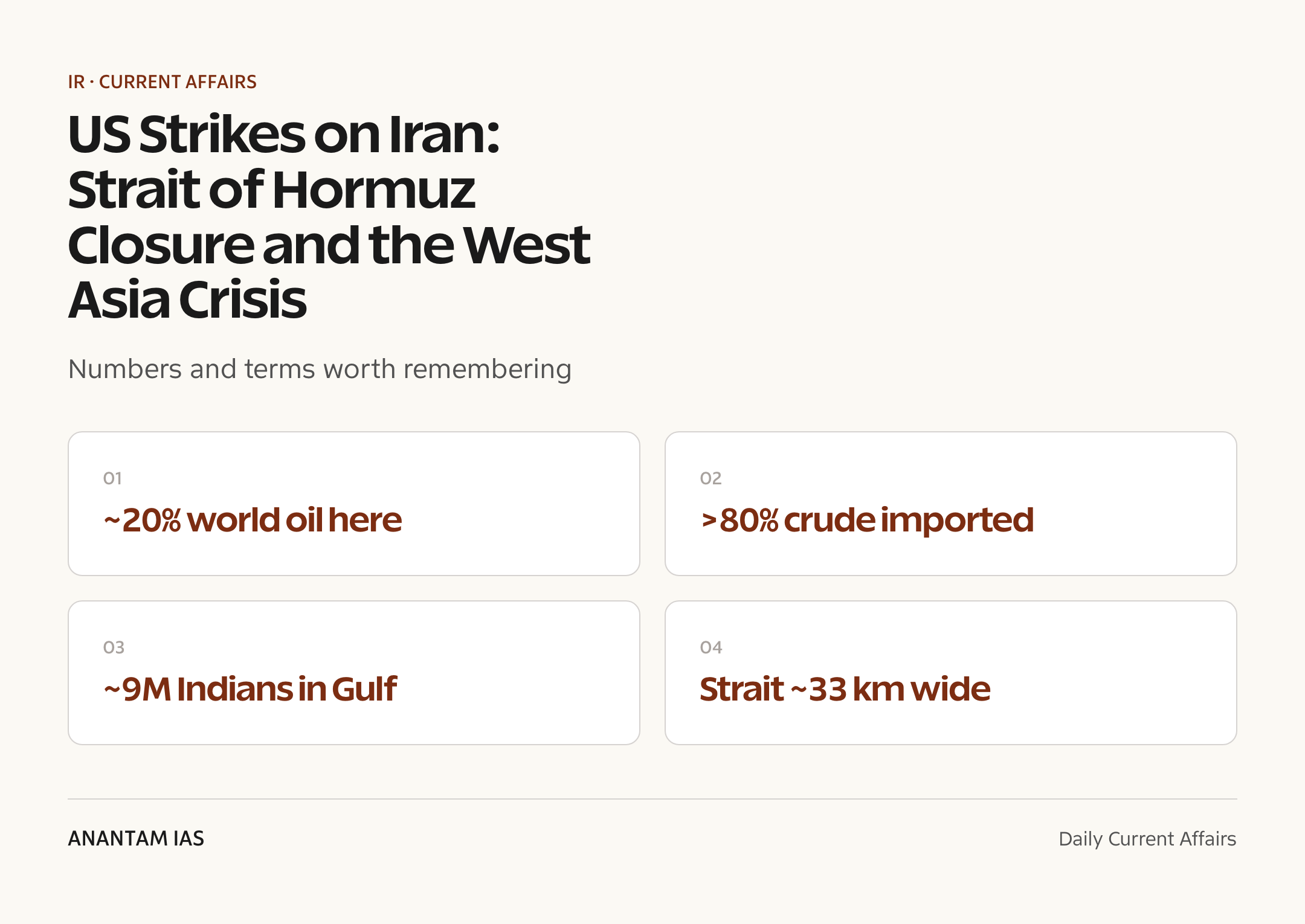
For India the stakes are direct and material. The renewed threat to close the Strait of Hormuz — the chokepoint through which roughly 20% of the world’s seaborne oil moves — endangers India’s crude and LPG import routes, the safety of about 9 million Indians living and working in the Gulf, and the price stability that underpins the domestic economy. As The Hindu’s international coverage has tracked, India is once again weighing energy-supply diversion, naval escorts and possible evacuation contingencies while protecting its strategic autonomy.
- Iran attacked a commercial cargo ship exiting the Strait of Hormuz along the Omani coast, breaching the truce signed days earlier.
- US Central Command (CENTCOM) struck Iranian missile and drone storage sites and coastal radar installations, accusing Tehran of violating the ceasefire.
- Iran retaliated against US-linked targets at Gulf bases (the region hosts major US installations such as Al Udeid in Qatar), prompting further American strikes.
- Iran again declared the Strait of Hormuz effectively closed; the US Navy announced a widened transit route to challenge that control.
- The flare-up undoes the June 17, 2026 memorandum under which the Strait was to reopen with 60 days of free, safe passage for commercial vessels.
The development matters in the context of:
- The Strait of Hormuz is the single most important oil chokepoint on earth; even the threat of closure pushes Brent crude sharply higher and feeds global inflation.
- India imports more than 80% of its crude oil and a large share of its LPG; West Asia remains a core supplier despite active diversification.
- India’s response template — naval escorts for Indian-flagged ships and diaspora-safety planning — echoes earlier missions like Operation Sankalp in the Persian Gulf.
UPSC Relevance
Prelims Relevance
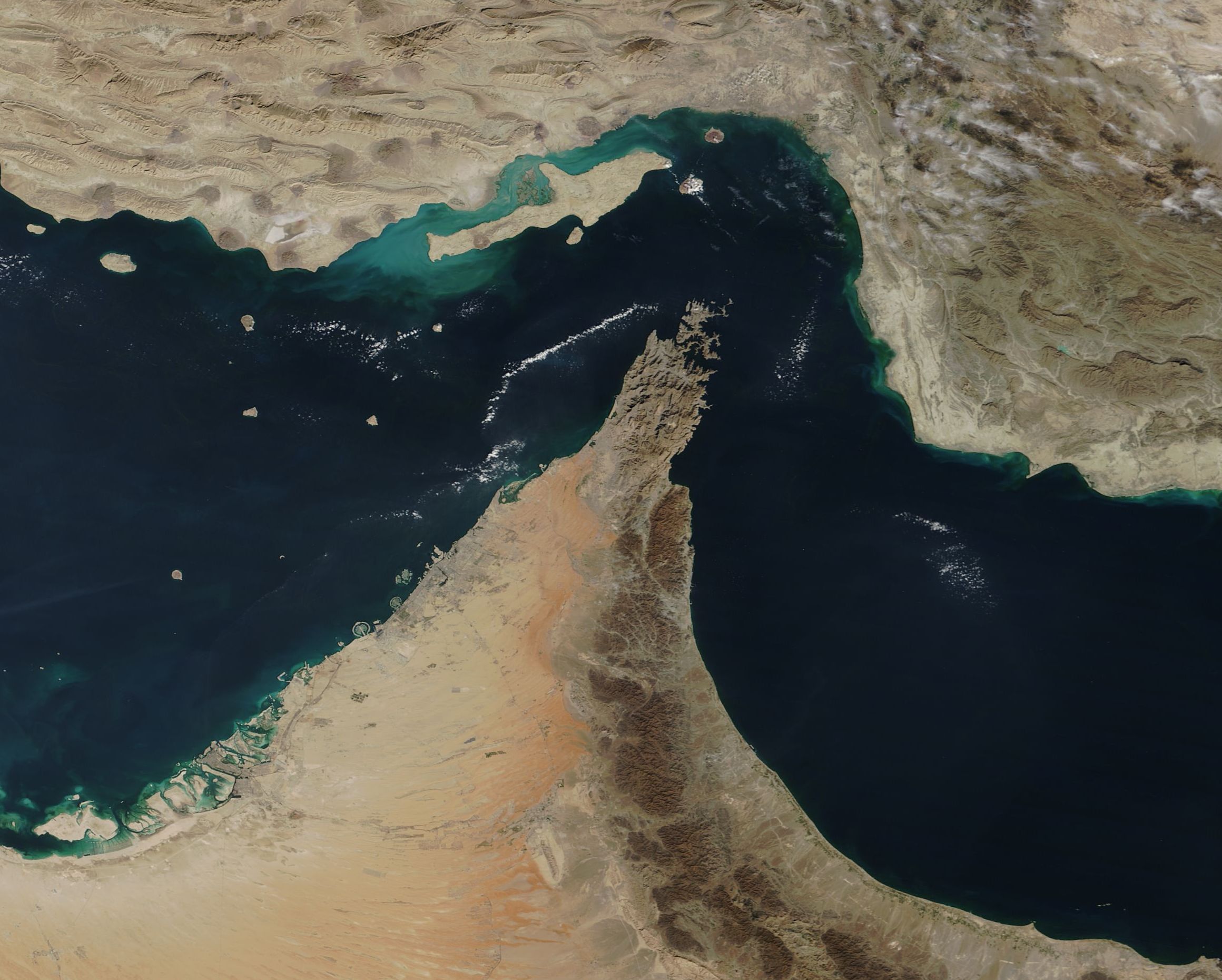
- Strait of Hormuz connects the Persian Gulf with the Gulf of Oman and onward to the Arabian Sea; it is the world’s busiest oil chokepoint.
- The Strait lies between Iran (north) and Oman (the Musandam exclave, south); at its narrowest it is about 33 km wide.
- Roughly 20% of global seaborne oil (and a major share of LNG, much of it from Qatar) transits the Strait.
- OPEC Gulf producers Saudi Arabia, Iraq, the UAE, Kuwait and Iran all ship crude through or near Hormuz.
- India’s crude basket is import-heavy — over 80% import dependence; key Gulf suppliers include Iraq, Saudi Arabia and the UAE.
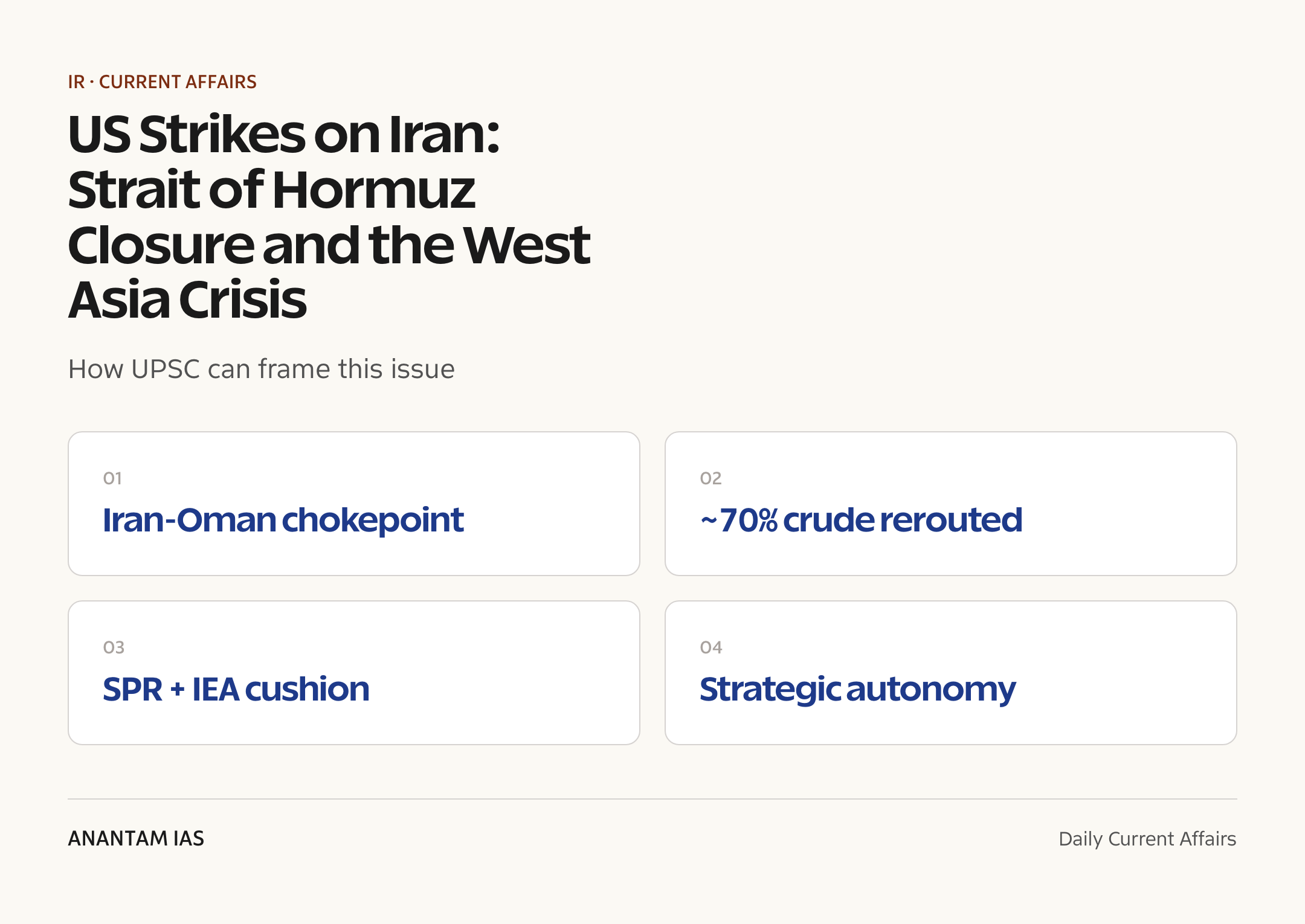
- India has reportedly rerouted about 70% of its crude imports to sources outside the Strait of Hormuz, reducing single-chokepoint exposure.
- India imports a large share of its LPG, and the bulk of those imports come via the Strait of Hormuz, a sharper vulnerability than for crude.
- India holds Strategic Petroleum Reserves (SPR) at Visakhapatnam, Mangaluru and Padur, managed by ISPRL.
- The International Energy Agency (IEA) coordinates emergency oil-stock releases among member countries during supply shocks.
- Bypass infrastructure exists — the UAE’s Fujairah pipeline and Saudi Arabia’s east-west Petroline can route some crude around Hormuz.
Mains Relevance
GS Paper 2
- India’s West Asia policy and the balancing act between Iran, Israel, the Gulf monarchies and the United States.
- Diaspora diplomacy: protecting and, if needed, evacuating roughly 9 million Indians in the Gulf, and the precedent of past evacuation operations.
- Strategic autonomy in a great-power crisis: how India calibrates its stance without aligning fully with any bloc.
GS Paper 3
- Energy security: chokepoint risk, import diversification, strategic petroleum reserves and the macroeconomic transmission of an oil-price spike to inflation and the rupee.
- Internal-security and maritime-security dimensions: protecting sea lanes of communication, naval escort operations and the safety of Indian seafarers.
Essay
- Energy security as the new frontier of national security
- Strategic autonomy in a fractured world order
Background and Context
What Happened: The Strikes and the Retaliation
A ceasefire signed only days earlier unravelled when an attack on shipping triggered a fresh US-Iran exchange.
- Iran struck a commercial cargo ship as it exited the Strait of Hormuz along the Omani coast, in violation of the truce.
- US Central Command responded with strikes on Iranian missile and drone storage and coastal radar sites, calling it a reply to ceasefire violations.
- Iran hit back at US-linked targets at Gulf bases — the region hosts large US installations including Al Udeid Air Base in Qatar, CENTCOM’s forward Gulf hub.
- Washington launched additional strikes hours after the Iranian retaliation, and Tehran again moved to shut the Strait of Hormuz.
- The escalation tears up the June 17, 2026 memorandum that had promised the Strait’s reopening and free passage for shipping.
The Strait of Hormuz: Geography of a Chokepoint
A sliver of water decides the fate of a fifth of the world’s oil trade.
- The Strait links the Persian Gulf to the Gulf of Oman and the Arabian Sea, the only sea route out of the Gulf’s oil ports.
- It runs between Iran to the north and Oman’s Musandam peninsula to the south, narrowing to about 33 km.
- Shipping uses traffic-separation lanes only a few kilometres wide, much of it inside Omani and Iranian territorial waters — which is why Iran can credibly threaten passage.
- Roughly 20% of global seaborne oil and a large volume of LNG (notably Qatari exports) pass through daily.
- There is no full substitute: bypass pipelines like the UAE’s Fujairah line and Saudi Arabia’s Petroline can carry only a fraction of Gulf exports.
India's Energy and Diaspora Stakes
Hormuz sits at the intersection of India’s oil bill, its kitchens and its overseas citizens.
- India imports more than 80% of its crude oil; a Hormuz disruption raises the import bill, widens the current-account gap and pressures the rupee.
- LPG is the sharper exposure — a large share of cooking-gas imports moves through the Strait, with fewer easy alternatives than crude.
- About 9 million Indians live and work in the Gulf (the UAE, Saudi Arabia, Qatar, Kuwait, Oman, Bahrain), sending home a major slice of India’s remittances.
- Their safety and possible evacuation become live concerns the moment Gulf bases and waters come under fire.
- India has cushioned the blow over time by rerouting roughly 70% of crude imports outside Hormuz and by buying discounted Russian crude via non-Gulf routes.
India's Strategic Autonomy and Diplomatic Stance
India seeks to protect its interests without being drawn into either camp.
- India maintains working ties with Iran (Chabahar port, INSTC), with Israel (defence and technology) and with the Gulf monarchies (energy, labour, investment) simultaneously.
- Its consistent line is to call for de-escalation, dialogue and respect for international law, including freedom of navigation, rather than endorsing strikes.
- Strategic autonomy means New Delhi avoids automatic alignment with the United States even as the partnership deepens, and keeps channels open to Tehran.
- Protecting Indian seafarers and merchant shipping has emerged as a distinct strand of India’s consular and maritime diplomacy.
- The Indian Navy can mount escort and presence missions in the Gulf, building on the template of Operation Sankalp.
Global Oil Markets and Escalation Risk
Even short of a full closure, the fear premium reorders world energy markets.
- Threats to Hormuz reliably spike Brent crude and freight and insurance costs, feeding imported inflation in oil-importing economies.
- Coordinated strategic-reserve releases by the IEA and producers’ spare capacity are the main shock absorbers, but both are limited against a sustained blockade.
- A wider war risks dragging in Gulf monarchies, shipping insurers and global supply chains far beyond oil.
- Markets watch whether the US Navy’s widened transit route keeps traffic flowing or invites further Iranian interdiction.
- For India, the policy mix is to diversify suppliers, draw on SPR, manage fuel pricing and prepare diaspora contingencies.
Way Forward
Secure Energy Supply
- Accelerate supplier diversification (Americas, Africa, Russia) and lock in term contracts that avoid single-chokepoint dependence.
- Top up and operationalise Strategic Petroleum Reserves, and coordinate any release with the IEA to blunt a price spike.
Protect the Diaspora
- Activate embassy control rooms and contingency evacuation plans for Indians in the Gulf, with airlines and the Navy on standby.
- Keep advisories and registration channels open for the roughly 9 million Indians across the GCC.
Maritime and Diplomatic Leverage
- Deploy naval escorts for Indian-flagged vessels and coordinate at the IMO on civilian-shipping safety in chokepoints.
- Use India’s ties with both Iran and the Gulf to push back-channel de-escalation, consistent with strategic autonomy.
Conclusion
The renewed Hormuz crisis is a textbook reminder that India’s economic stability runs through a 33-km strait it does not control. Fresh US strikes, Iranian retaliation on Gulf bases and the threat to close the waterway put energy prices, the rupee and millions of Indian lives in the Gulf on the line at the same time. India’s years of quiet diversification — rerouting most crude away from Hormuz, building reserves, deepening non-Gulf suppliers — now show their value as shock absorbers.
The harder task is diplomatic. New Delhi must keep faith with Iran, Israel, the Gulf monarchies and Washington at once, press for de-escalation, and stand ready to escort ships and evacuate citizens — all without surrendering its strategic autonomy. For aspirants, this is a live case study in how energy security, diaspora welfare and great-power balancing fuse into a single foreign-policy test.
UPSC Practice Questions
Prelims MCQ 1
With reference to the Strait of Hormuz, consider the following statements:
- It connects the Persian Gulf with the Gulf of Oman.
- It lies between Iran and Saudi Arabia.
- Roughly one-fifth of the world’s seaborne oil trade passes through it.
How many of the above statements are correct?
(a) Only one (b) Only two (c) All three (d) None
Answer: (b) Only two
Explanation:
Statements 1 and 3 are correct. Statement 2 is wrong: the Strait lies between Iran and Oman (the Musandam exclave), not Saudi Arabia.
Prelims MCQ 2
Which one of the following pairs of countries borders the Strait of Hormuz?
(a) Iran and Saudi Arabia (b) Iran and Qatar (c) Iran and Oman (d) Iran and the United Arab Emirates
Answer: (c) Iran and Oman
Explanation:
The Strait of Hormuz is bordered by Iran to the north and Oman’s Musandam peninsula to the south; Oman’s northern tip controls the southern shipping lanes.
UPSC Mains Questions
- The Strait of Hormuz crisis shows that India’s energy security depends on a chokepoint it cannot control. Examine India’s vulnerabilities and the measures it has taken to reduce single-chokepoint dependence. (250 words)
- Discuss how India can protect its large Gulf diaspora and uphold its strategic autonomy during a US-Iran military escalation in West Asia. (250 words)
Source: The Hindu.
Frequently Asked Questions
Why is the Strait of Hormuz so important?
It is the only sea route out of the oil-rich Persian Gulf, connecting it to the Gulf of Oman and the Arabian Sea. Roughly 20% of the world’s seaborne oil and a large volume of LNG pass through it, so even a threat to close it can spike global oil prices and disrupt energy supplies worldwide.
Which countries border the Strait of Hormuz?
Iran lies to the north and Oman, through its Musandam exclave, controls the southern shore. The main shipping lanes pass through Omani and Iranian territorial waters, which is why Iran can credibly threaten to interfere with passage during a crisis.
How does a Hormuz closure affect India?
India imports over 80% of its crude oil and a large share of its LPG, much of it from the Gulf. A closure or a fear premium raises the oil-import bill, pressures the rupee, and stokes inflation. LPG is especially exposed because most of India’s imports route through the Strait.
How many Indians live in the Gulf and why does it matter?
About 9 million Indians live and work across the GCC countries, sending home a major share of India’s remittances. When Gulf bases and waters come under attack, their safety becomes a priority and the government may activate advisories, contingency planning and evacuation arrangements.
What is India’s diplomatic stance in the crisis?
India calls for de-escalation, dialogue and respect for international law, including freedom of navigation, without taking sides. It maintains ties with Iran, Israel and the Gulf monarchies at once, reflecting its policy of strategic autonomy and refusal to align fully with any bloc.
How has India reduced its dependence on the Strait of Hormuz?
Over time India has rerouted a large share of its crude imports — reportedly around 70% — to suppliers outside Hormuz, expanded purchases of discounted Russian crude via non-Gulf routes, and maintained Strategic Petroleum Reserves. These steps cushion, though do not eliminate, the chokepoint risk, especially for LPG.
Source: https://anantamias.com/current-affairs/us-strikes-iran-strait-of-hormuz-closure/
India-Seychelles Ties: Maritime Security and the MAHASAGAR Vision
Why in News?
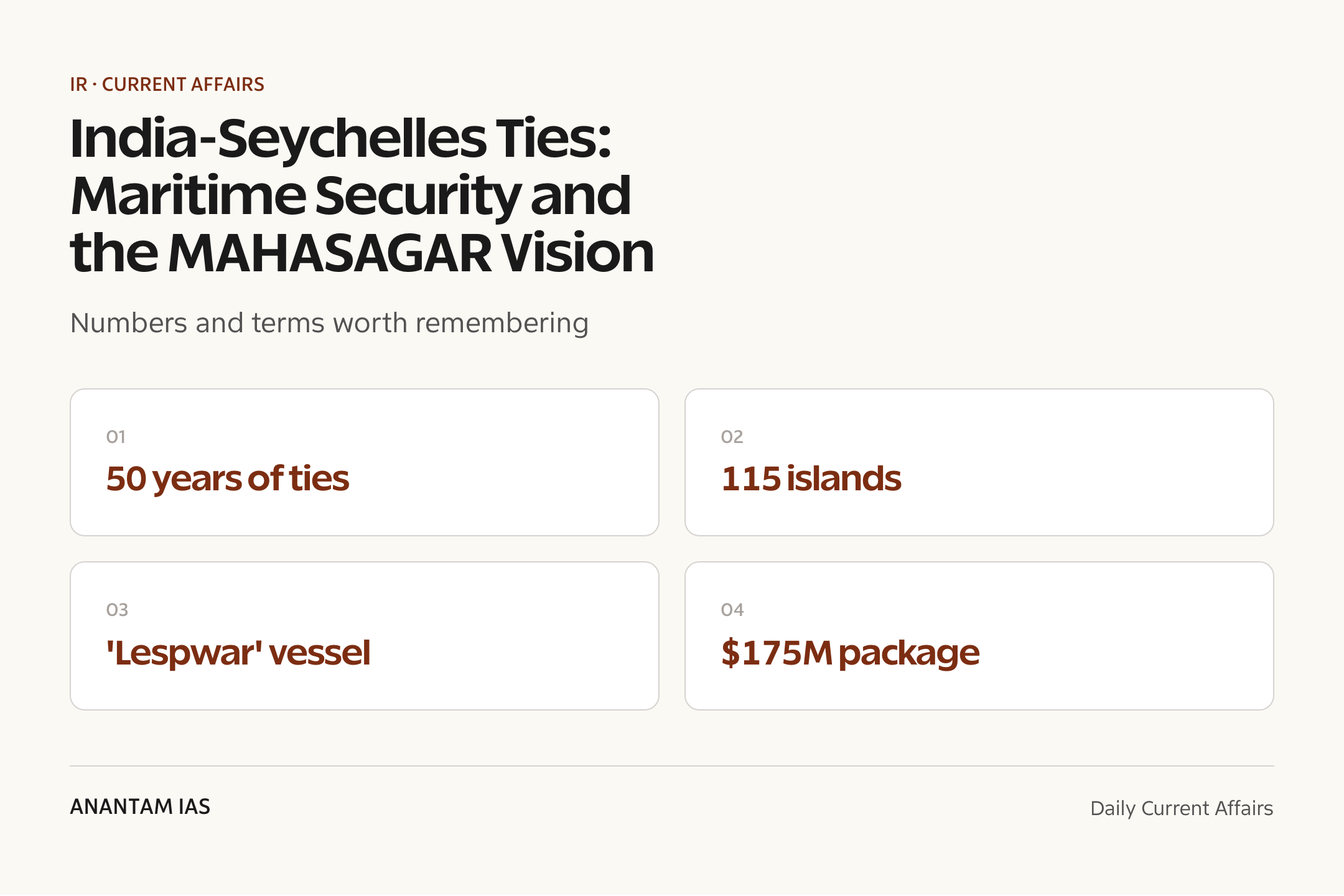
Prime Minister Narendra Modi visited Seychelles for a three-day state visit timed to the island nation’s Golden Jubilee National Day, marking 50 years of India-Seychelles diplomatic relations established in 1976. The Hindu reported him describing the partnership as “steady, strong and long-lasting” and Seychelles as a “valued maritime neighbour.”
The headline deliverable was the handover of the India-built fast patrol vessel ‘Lespwar’ (Creole for “hope”) to the Seychelles Coast Guard, alongside a clutch of pacts spanning maritime security, space, cyber security and mutual legal assistance. The visit folds Seychelles firmly into India’s SAGAR-to-MAHASAGAR doctrine for the western Indian Ocean.
- Handover of the ‘Lespwar’ fast patrol vessel, built by Goa Shipyard Limited (can exceed 30 knots), to boost Seychelles’ surveillance over its large Exclusive Economic Zone.
- Pacts/agreements covering maritime security, space, cyber security and mutual legal assistance, with new areas flagged in AI, blue economy and marine science.
- Additional gifts: six ambulances, 10 utility vehicles and five laser radial boats for healthcare and security.
- India announced a roughly $175 million economic package (a $125 million rupee Line of Credit plus $50 million in grants) for housing, infrastructure, mobility and capacity building.
- Visit synced with Seychelles’ 50th National Day; the year 1976 also saw INS Nilgiri join the original independence ceremony.
- Modi described Seychelles as a “valued maritime neighbour” and the ties as “steady, strong and long-lasting,” framing the partnership in continuity rather than crisis.
The development matters in the context of:
- Diplomatic ties began when Seychelles became independent on 29 June 1976; an Indian Naval Ship contingent took part in that first Independence Day celebration.
- Seychelles sits astride the western Indian Ocean sea lanes that carry a large share of global oil and container traffic, giving it strategic weight far beyond its size.
- People-to-people roots run deep: Indian-origin residents, drawn from Tamil Nadu, Puducherry and later Gujarat, form a notable share of the population.
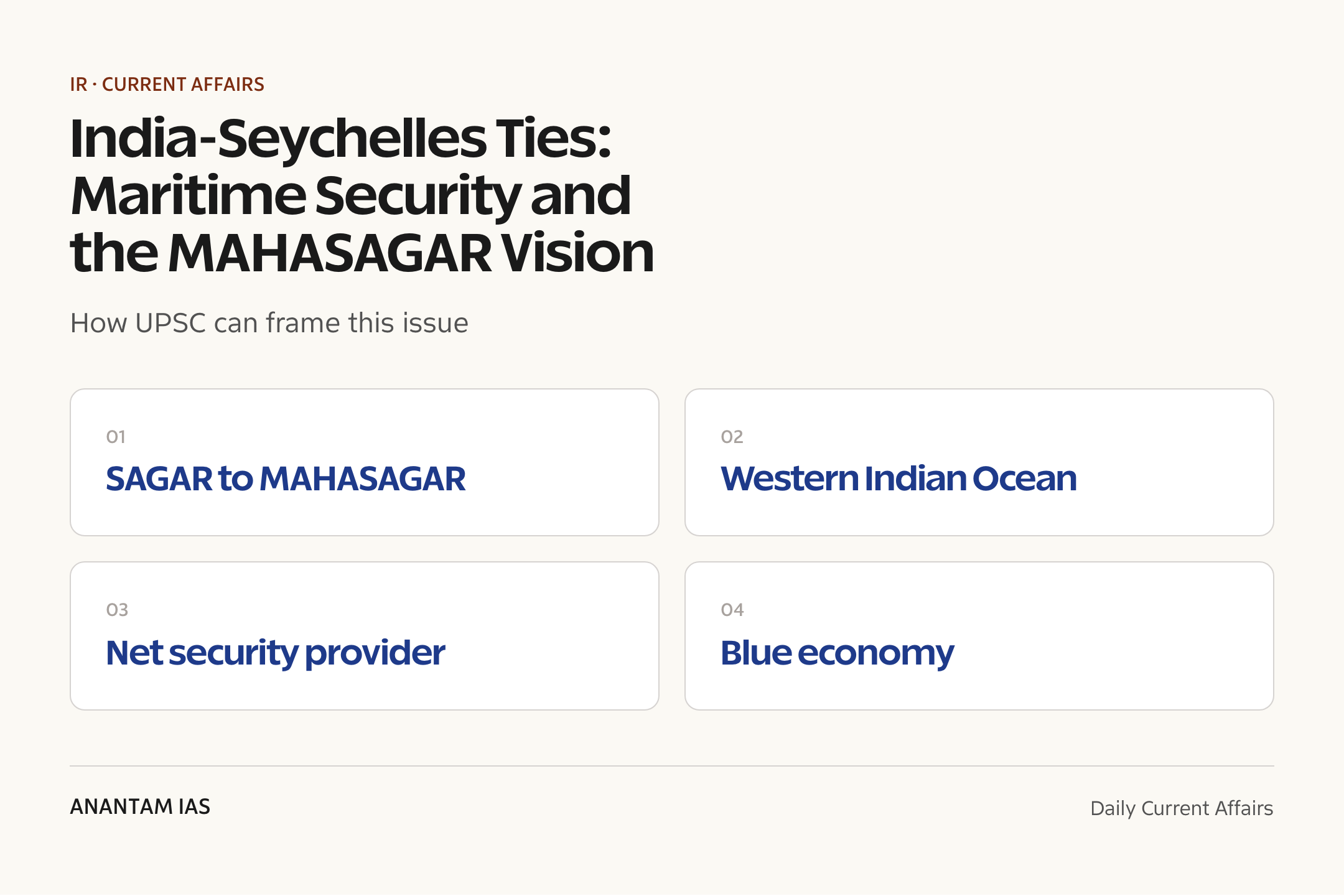
- The visit advances India’s MAHASAGAR vision announced in 2025, widening SAGAR from a regional to a global-maritime, Global-South frame, consistent with India’s neighbourhood policy.
UPSC Relevance
Prelims Relevance
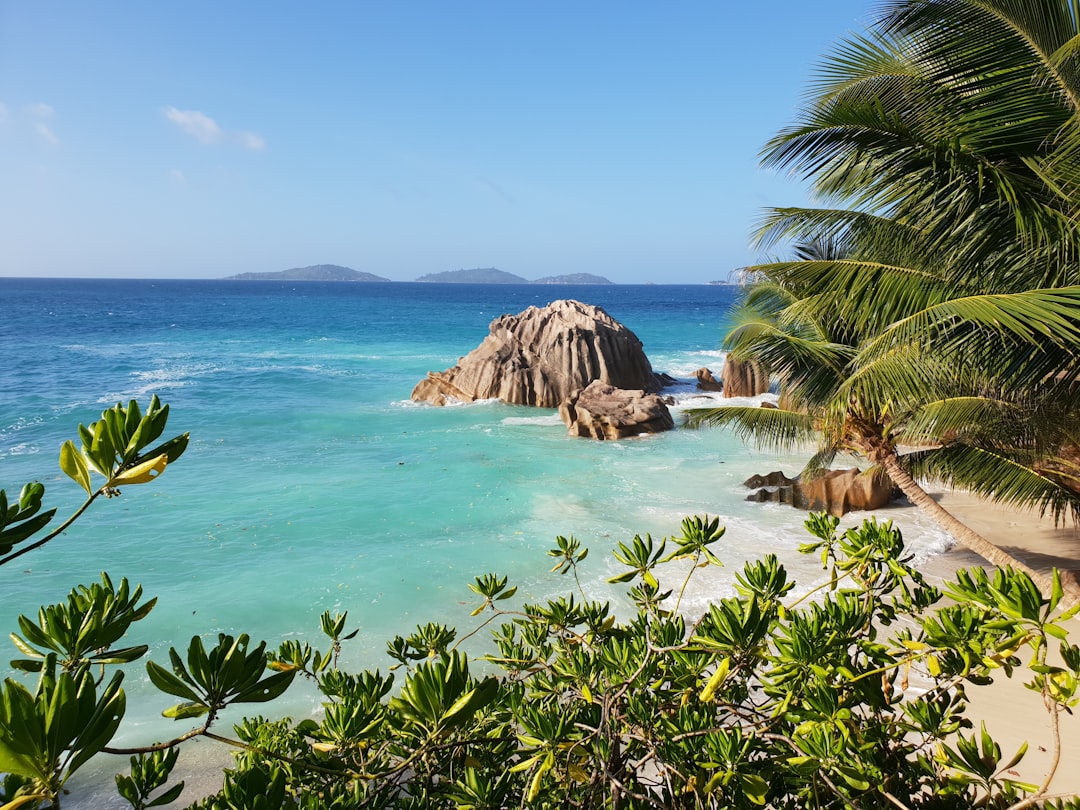
- Seychelles is an Indian Ocean archipelago of about 115 islands; capital is Victoria, on the largest island Mahe.
- Its islands are part granitic (including Mahe) and part coralline (low coral islands and atolls).
- SAGAR (Security and Growth for All in the Region) was articulated by PM Modi in 2015 at Mauritius / before IORA.
- MAHASAGAR = Mutual and Holistic Advancement for Security and Growth Across Regions, announced in 2025 (Mauritius).
- IORA (Indian Ocean Rim Association) is the apex regional grouping of Indian Ocean littoral states; both India and Seychelles are members.
- Assumption Island is a Seychellois island linked to a 2015/2018 India-Seychelles naval-infrastructure project that did not proceed as planned.
- The fast patrol vessel ‘Lespwar’ was built by Goa Shipyard Limited; ‘Lespwar’ means “hope” in Seychellois Creole.
- India has supplied Seychelles with Dornier aircraft, coastal radar/surveillance systems and naval training under SAGAR.
- Seychelles’ Exclusive Economic Zone (EEZ) is vastly larger than its land area, making maritime surveillance a core security need.
- Seychelles became independent on 29 June 1976; India established diplomatic ties the same year.
- Mauritius, Maldives and Seychelles together anchor India’s western Indian Ocean security arc.
- Maritime threats addressed include piracy, illegal/unreported fishing (IUU) and trafficking across the EEZ.
- India positions itself as a ‘first responder’ and ‘preferred partner’ for these island states.
Mains Relevance
GS Paper 2
- Examine how patrol-vessel diplomacy, lines of credit and capacity building make India a ‘first responder’ and ‘preferred partner’ for small Indian Ocean states.
- Assess the strategic logic of SAGAR’s evolution into MAHASAGAR for India’s neighbourhood and the wider Global South amid growing Chinese maritime presence.
Essay
- Neighbourhood and oceans: how a rising power earns trust through development partnership rather than dominance.
- Small states, large stakes: geography, security and the politics of the Indian Ocean.
Background and Context
The visit and its deliverables
A golden-jubilee trip turned into a substantive defence-and-development package.
- PM Modi‘s three-day state visit was anchored to Seychelles’ 50th National Day, with President Patrick Herminie as host, per Indian Express reporting.
- Centrepiece: handover of the fast patrol vessel ‘Lespwar’ to the Seychelles Coast Guard to patrol its sprawling EEZ against piracy, illegal fishing and trafficking.
- Agreements spanned maritime security, space, cyber security and mutual legal assistance, with talks on AI, marine science and blue economy.
- Soft-power and welfare gifts (ambulances, utility vehicles, boats) and a $175 million finance package signalled breadth beyond hard security.
Seychelles: geography, diaspora and why it matters
A tiny archipelago that sits on busy ocean highways.
- An archipelago of about 115 islands with capital Victoria on Mahe; granitic inner islands and far-flung coralline outer islands.
- Its location near key sea lines of communication gives it leverage in any contest over Indian Ocean access and surveillance.
- A sizeable Indian-origin community (Tamil and Gujarati roots) underpins durable people-to-people and cultural links.
- A vast EEZ relative to land makes external maritime-domain-awareness support, like India’s radars and aircraft, strategically valuable.
From SAGAR to MAHASAGAR
India’s Indian Ocean doctrine has widened from region to globe.
- SAGAR (2015) framed India as a net security provider offering ‘Security and Growth for All in the Region’ through cooperation, not coercion.
- MAHASAGAR (2025) scales this up: ‘Mutual and Holistic Advancement for Security and Growth Across Regions’, tilting toward the Global South.
- Core tools stay consistent: concessional loans, grants, technology sharing and capacity building rather than bases or alliances.
- Seychelles is presented as a working model of the doctrine, where vessels, training and credit institutionalise trust over time.
Maritime-security cooperation and the China factor
Hardware and habits of cooperation, set against a contested ocean.
- India has supplied Dornier surveillance aircraft, coastal radar chains and naval training, plus successive patrol vessels, to Seychelles.
- The Assumption Island project (the planned naval-infrastructure tie-up of 2015/2018) stalled amid domestic debate, a reminder that island diplomacy is sensitive.
- India positions itself as a ‘first responder’ and ‘preferred partner’ on disaster relief, anti-piracy and counter-trafficking.
- The backdrop is expanding Chinese maritime and infrastructure activity across the Indian Ocean, making credible, demand-driven partnerships a strategic edge.
Development finance and the wider toolkit
Money, welfare and connectivity travel alongside the ships.
- The package centred on roughly $175 million: a $125 million rupee-denominated Line of Credit plus about $50 million in grants.
- Stated priorities span public housing, infrastructure, sustainable mobility, capacity building and maritime security.
- Welfare gifts (ambulances, utility vehicles, laser radial boats) show India operating across health, mobility and security at once.
- Rupee-denominated credit deepens the use of the Indian rupee in bilateral finance, a small step in India’s push for trade settlement in its own currency.
Significance for India's IOR strategy
Small-island partnerships compound into ocean-wide influence.
- Mauritius, Maldives and Seychelles form a western-Indian-Ocean arc where Indian surveillance and credit anchor a friendly security environment.
- Patrol-vessel and radar diplomacy advances maritime domain awareness without permanent overseas basing.
- Development finance ties trade, the blue economy and climate resilience to security, broadening the partnership’s base.
- Backing for India’s UNSC aspirations and Global-South solidarity adds a diplomatic dividend to the maritime push.
Way Forward
Deepen maritime-domain awareness
- Sustain coastal-radar, white-shipping data and joint-EEZ patrol arrangements so handovers like ‘Lespwar’ translate into round-the-clock surveillance.
- Institutionalise training and maintenance support so platforms stay operational across their service life.
Broaden beyond hard security
- Operationalise the space, cyber and marine-science pacts with concrete projects, not just framework signings.
- Channel the credit-and-grant package into housing, mobility and blue-economy ventures that visibly benefit citizens.
Manage sensitivities and competition
- Keep cooperation demand-driven and transparent to avoid the pitfalls that stalled the Assumption Island plan.
- Coordinate with like-minded partners on capacity building while respecting Seychellois sovereignty and domestic politics.
- Stay alert to expanding Chinese footprints in the region and respond with timely delivery rather than reactive matching.
Link security to livelihoods
- Tie credit and grants to visible blue-economy, fisheries and climate-resilience outcomes so citizens feel the partnership.
- Use tourism, education and diaspora links to broaden the relationship beyond government-to-government deals.
Conclusion
The Seychelles visit shows India’s Indian Ocean strategy maturing from gestures into a steady habit of cooperation: a patrol vessel handed over, pacts signed across new domains, and finance pledged for development. Fifty years on, the relationship rests less on grand declarations than on radars that work, ships that sail and credit that builds homes. The choice of a golden-jubilee National Day as the setting is itself a message, that India shows up for partners at moments that matter to them.
For an aspirant, the case distils a durable theme: how a rising power earns influence in its maritime neighbourhood by being useful rather than dominant, turning SAGAR’s promise into the wider ambition of MAHASAGAR while navigating the sensitivities that small-island partnerships always carry. Seychelles, Mauritius and Maldives together illustrate that influence in the Indian Ocean is built island by island, through delivery, trust and respect for sovereignty rather than through bases or alliances.
UPSC Practice Questions
Prelims MCQ 1
With reference to India’s maritime engagement in the Indian Ocean, consider the following statements:
- SAGAR was articulated as India’s Indian Ocean vision in 2015.
- MAHASAGAR expands India’s maritime outreach with a focus on the Global South.
- Seychelles and India both belong to the Indian Ocean Rim Association (IORA).
How many of the above statements are correct?
(a) Only one (b) Only two (c) All three (d) None
Answer: (c) All three
Explanation:
SAGAR (2015) and MAHASAGAR (2025) are both India’s stated Indian Ocean visions, and both India and Seychelles are IORA members, so all three statements are correct.
Prelims MCQ 2
The capital city of Seychelles, located on its largest island, is:
(a) Port Louis on Mauritius (b) Male on Mahe (c) Victoria on Mahe (d) Moroni on Grande Comore
Answer: (c) Victoria on Mahe
Explanation:
Victoria, on the granitic island of Mahe, is the capital and main port of Seychelles. Port Louis is Mauritius, Male is Maldives, and Moroni is Comoros.
UPSC Mains Questions
- “India’s island-nation partnerships in the Indian Ocean reflect a strategy of cooperation rather than dominance.” Examine with reference to India-Seychelles relations and the SAGAR/MAHASAGAR vision.
- Discuss how patrol-vessel diplomacy, lines of credit and capacity building shape India’s role as a net security provider in the western Indian Ocean.
- Assess the opportunities and sensitivities involved in India’s defence-infrastructure cooperation with small Indian Ocean states.
Sources: The Hindu and Indian Express.
Frequently Asked Questions
What was the headline outcome of PM Modi’s Seychelles visit?
The handover of the India-built fast patrol vessel ‘Lespwar’ to the Seychelles Coast Guard, along with pacts on maritime security, space, cyber security and mutual legal assistance, during celebrations marking 50 years of diplomatic ties.
What is the difference between SAGAR and MAHASAGAR?
SAGAR (2015) framed India as a net security provider for the Indian Ocean region. MAHASAGAR (2025) widens that to a global-maritime vision tilted toward the Global South, using technology sharing, concessional loans and grants.
Why is Seychelles strategically important for India?
It sits near busy Indian Ocean sea lanes, hosts a sizeable Indian-origin community, and controls a vast EEZ, making it a key partner for maritime surveillance and security in the western Indian Ocean.
What is the Assumption Island project?
A planned India-Seychelles naval-infrastructure tie-up (2015/2018) on Assumption Island that did not proceed as originally envisaged amid domestic debate in Seychelles, illustrating the sensitivities of island diplomacy.
What is the capital of Seychelles?
Victoria, located on Mahe, the largest island of the roughly 115-island archipelago; it is also the country’s main port.
When were India-Seychelles diplomatic relations established?
In 1976, the year Seychelles became independent on 29 June; an Indian Naval Ship contingent took part in the first Independence Day celebration.
Source: https://anantamias.com/current-affairs/india-seychelles-50-years-maritime-cooperation/
India’s Wind Energy Push: Offshore Stagnation and the Repowering Gap
Why in News?
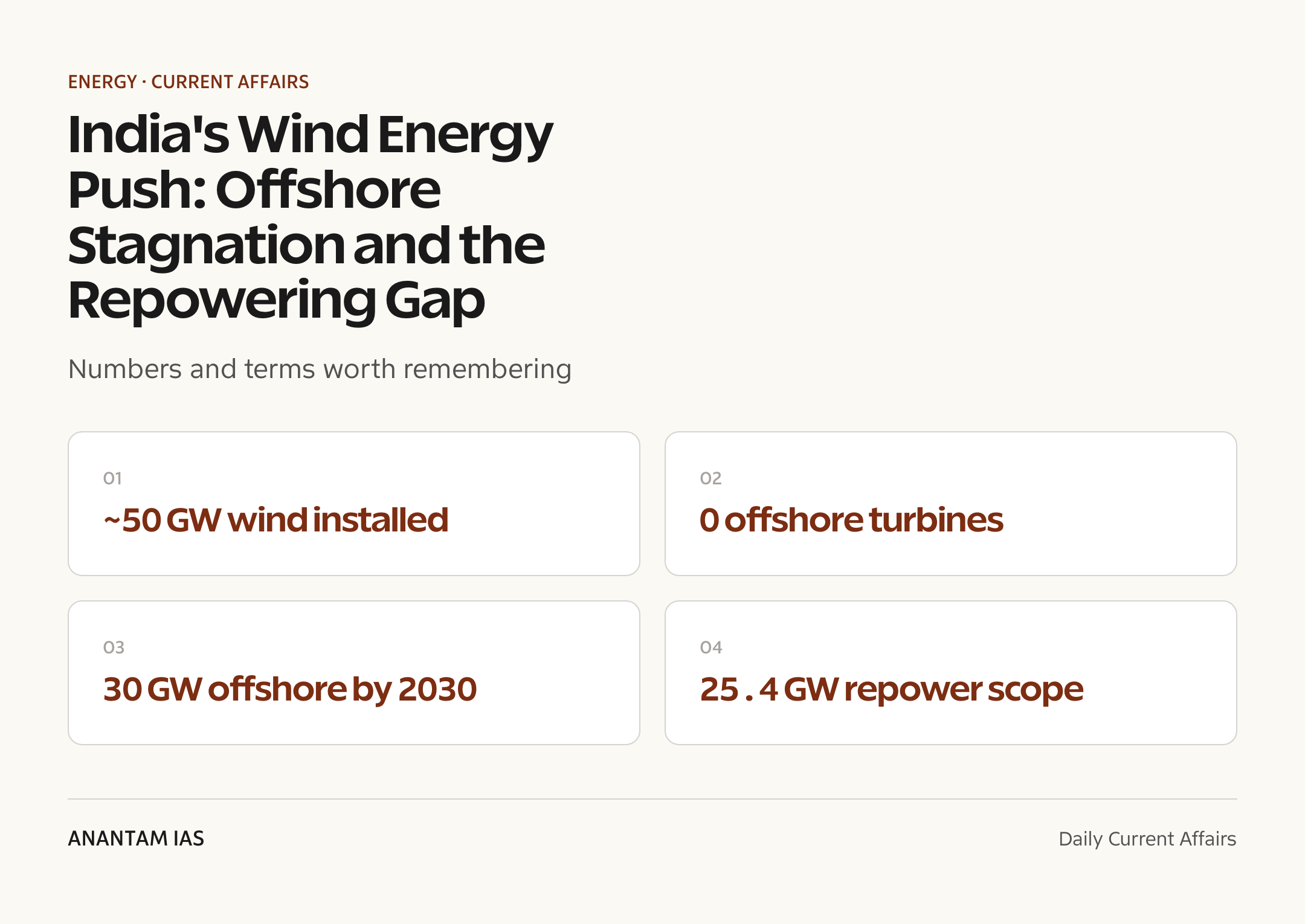
A science feature in The Hindu revisits a recurring puzzle in India’s clean-energy story: the country has crossed 50 GW of installed wind capacity and ranks among the world’s top four wind markets, yet it operates zero offshore wind turbines and has barely begun repowering its first-generation onshore farms.
Both gaps matter for the headline goal — 500 GW of non-fossil capacity by 2030 (the Panchamrit pledge) — because wind is the natural night-time and monsoon complement to solar, and the cheapest extra wind energy may come from upgrading existing windy sites rather than chasing new land.
- India’s cumulative wind capacity stood at roughly 50 GW (about 50.04 GW as of April 2025), almost entirely onshore.
- Offshore installed capacity remains effectively zero, despite a policy in place since 2015 and a 30 GW by 2030 offshore target.
- Repowering of old, sub-2 MW turbines at the best windy sites has been slow, even after MNRE revised the repowering policy in December 2023.
- NIWE has assessed national repowering potential at about 25.4 GW, concentrated in turbines below 2 MW.
- Government has approved ₹6,853 crore in Viability Gap Funding for the first 1,000 MW of offshore wind off Gujarat and Tamil Nadu.
The development matters in the context of:
- Wind is a variable renewable: output rises in the monsoon and at night, partly offsetting solar’s daytime-only profile.
- India’s wind fleet is geographically concentrated — Gujarat leads, followed by Tamil Nadu, with the southern and western windy belts dominating.
- Many older farms sit on the windiest land but carry small, low-yield turbines installed in the 2000s — a classic case for repowering.
- Annual wind additions slowed sharply after India switched from fixed feed-in tariffs to competitive reverse auctions around 2017, squeezing margins and stalling new orders.
- Wind sits inside a broader push covered in our note on renewable energy in India, where solar has scaled faster than wind in recent years.
UPSC Relevance
Prelims Relevance
- India’s installed wind capacity is around 50 GW, nearly all onshore; the country is among the top four global wind markets.
- Gujarat has the highest installed wind capacity, followed by Tamil Nadu; the two together account for roughly half the national total.
- The National Offshore Wind Energy Policy was notified in 2015; MNRE is the nodal ministry.
- The National Institute of Wind Energy (NIWE), Chennai, is the implementing/nodal agency for resource assessment and offshore block demarcation.
- India targets 30 GW of offshore wind by 2030; Gujarat (~36 GW) and Tamil Nadu (~35 GW) hold the bulk of identified offshore potential.
- Viability Gap Funding (VGF) of ₹6,853 crore has been approved for the first 1,000 MW of offshore wind.
- The Panchamrit pledge (COP26, Glasgow 2021) commits India to 500 GW non-fossil capacity by 2030 and net zero by 2070.
- Repowering means replacing old, low-capacity turbines with modern high-yield machines at the same site; NIWE pegs the potential at about 25.4 GW.
- SECI (Solar Energy Corporation of India) and tendering agencies run the auctions that price renewable power.
- Capacity factor — actual output as a share of rated capacity — is the key efficiency metric; modern turbines reach much higher factors than 2000s machines.
Mains Relevance
GS Paper 3
- Examine why India’s offshore wind has stalled despite a decade-old policy — costs, grid evacuation, seabed leasing, and VGF design — and assess corrective measures.
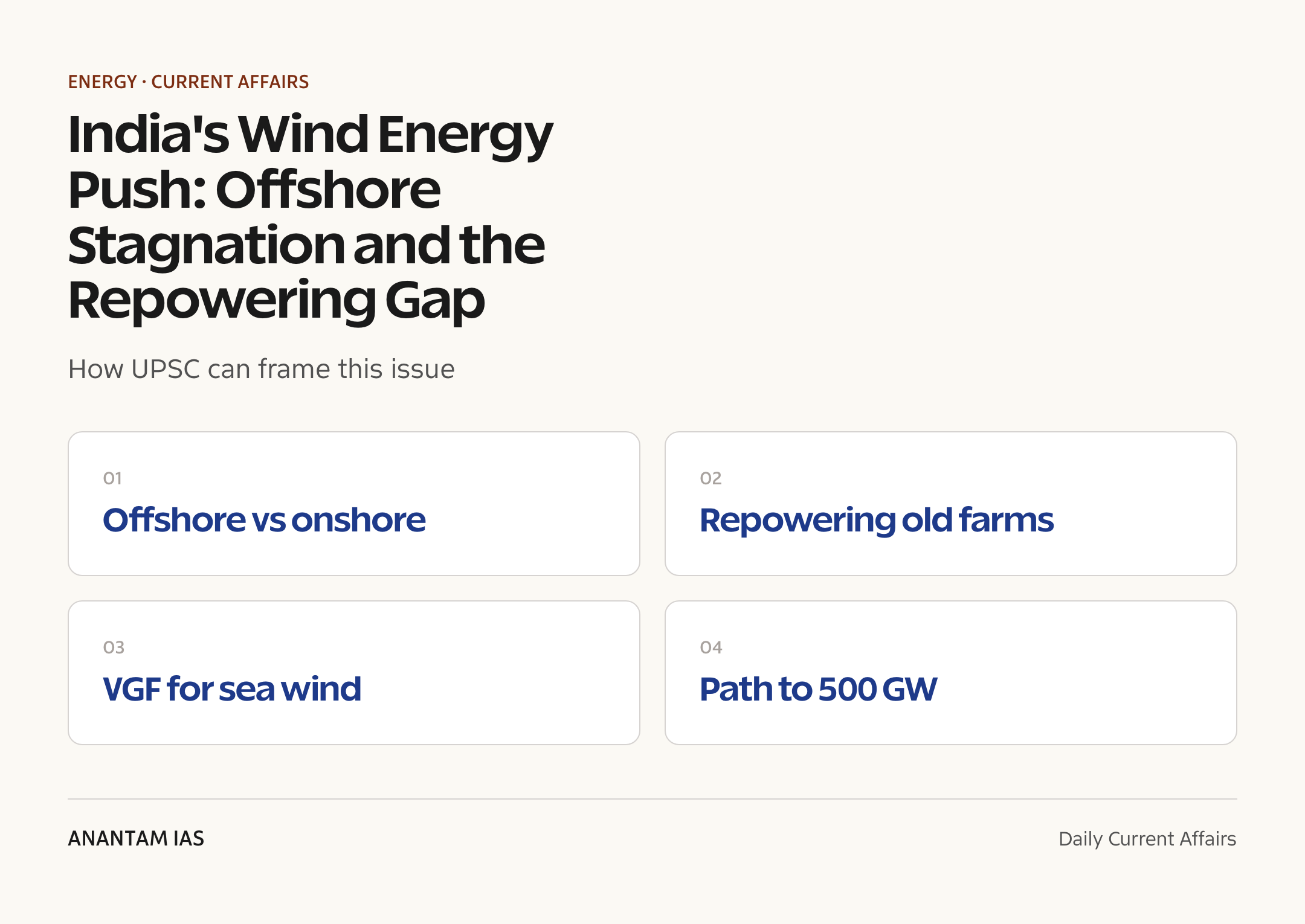
- Evaluate repowering of ageing wind farms as a low-land, high-yield route to the 500 GW non-fossil-by-2030 target, and the policy incentives needed to unlock it.
Essay
- Energy transition and the gap between targets and ground delivery.
- Doing more with less: efficiency, repowering, and the economics of clean energy.
Background and Context
Where India's wind sector stands
A large but lopsided fleet, strong on land and absent at sea.
- Cumulative wind capacity is about 50 GW (50.04 GW as of April 2025), placing India among the world’s top wind markets.
- The fleet is almost entirely onshore, with no operating offshore turbines.
- Gujarat ranks first in installed capacity, followed by Tamil Nadu; the western and southern windy belts dominate.
- Wind complements solar by generating more during the monsoon and at night, smoothing the renewable supply curve.
- After a mid-2010s slowdown tied to the shift from feed-in tariffs to reverse auctions, annual additions have recovered but remain below the pace needed for 2030.
Why offshore wind is stuck
Strong potential on paper, hard economics in the water.
- Offshore turbines stand in the sea, capturing steadier, stronger winds and higher capacity factors than onshore — but at far higher cost.
- Capital costs run well above onshore because of marine foundations, undersea cabling, specialised vessels, and harsh-environment maintenance.
- Grid evacuation from coastal blocks to demand centres needs new transmission, raising the all-in tariff.
- Seabed leasing and clearances were long unsettled; the Offshore Wind Energy Lease Rules were notified only in December 2023.
- To bridge the gap, the government approved ₹6,853 crore in VGF for the first 1,000 MW off Gujarat and Tamil Nadu, but build-out is years away.
- Development follows three frameworks set in the 2023 Strategy Paper — Model-A (government-funded with VGF and a fixed tariff), Model-B (developer-led without central support), and Model-C (developer-identified sites with bidding).
- Eight zones have been identified off each coast, but turbine sizes, water depths, and fishing-ground overlaps make site selection slow and contested.
The repowering challenge
The windiest land is often occupied by the weakest turbines.
- Repowering replaces ageing, low-capacity machines (many below 2 MW) with modern multi-MW turbines on the same windy sites.
- A single repowered site can sharply lift output — modern turbines reach capacity factors of 30-35% versus far lower for 2000s machines.
- NIWE assesses national repowering potential at about 25.4 GW, concentrated in sub-2 MW turbines.
- MNRE revised its 2016 repowering policy in December 2023 to ease replacement at high-resource sites.
- Uptake stays slow: older projects are often fully depreciated, fragmented across owners, and lack a clear financial incentive to scrap working assets.
- Scaling up repowering needs bigger turbines, stronger foundations, and grid upgrades at the same sites, plus fresh power-purchase agreements that older contracts did not anticipate.
- Done at scale, repowering can roughly double or triple energy yield from the very best windy land already secured for generation.
Policy framework and targets
A clear destination, contested by delivery hurdles.
- The National Offshore Wind Energy Policy 2015 set the legal frame, with MNRE as nodal ministry and NIWE as implementing agency.
- India targets 30 GW of offshore wind by 2030; identified potential is about 36 GW off Gujarat and 35 GW off Tamil Nadu.
- The Panchamrit commitments (COP26, 2021) anchor a 500 GW non-fossil target by 2030 and net zero by 2070.
- The updated National Electricity Plan envisages large wind additions alongside solar to approach the 2030 capacity goal.
- Auctions run by SECI and other agencies set tariffs that determine how fast new and repowered wind comes online.
Why it matters for the energy transition
Wind is the hedge that keeps a solar-heavy grid balanced.
- A grid leaning heavily on solar needs night and monsoon generation that wind supplies, reducing reliance on coal and storage.
- Closing the gap to 500 GW non-fossil is hard without faster wind growth, since solar alone cannot meet round-the-clock demand.
- Repowering delivers clean energy with little new land — a major advantage in a land-scarce, densely populated country.
- Offshore wind opens coastal demand centres to high, steady generation and can anchor future green hydrogen hubs near ports.
- Delays raise the risk of locking in fresh fossil capacity to cover demand growth, complicating the net-zero-2070 pathway.
- These commitments connect to India’s wider climate strategy outlined in our explainer on the India climate change policy and its 2070 net-zero goal.
Way Forward
Make offshore bankable
- Front-load transmission and port infrastructure so developers do not price in grid risk.
- Settle seabed leasing timelines and single-window clearances under the 2023 lease rules.
- Stage VGF-backed tenders predictably so the first 1,000 MW seeds a credible pipeline.
Unlock repowering incentives
- Offer clear tariff or accelerated-depreciation incentives so owners replace fully depreciated turbines.
- Ease land and PPA transfer rules to aggregate fragmented old sites for bankable repowering.
- Mandate grid access and evacuation upgrades at high-resource sites flagged by NIWE.
Strengthen the wind ecosystem
- Restore demand visibility through steady SECI auction calendars to revive domestic manufacturing.
- Invest in NIWE resource mapping, met-ocean data, and skilled marine-engineering capacity.
- Pair wind with storage and flexible coal to manage variability across the day.
Conclusion
India’s wind story is one of a strong start and a stalled second act. Crossing 50 GW onshore put the country among the global leaders, but a decade after the 2015 policy there is still no offshore turbine in Indian waters, and the windiest land carries ageing, low-yield machines that few owners have moved to replace.
Both gaps are fixable with predictable auctions, ready transmission, settled seabed rules, and real repowering incentives. Getting wind moving again — at sea and on the best onshore sites — is central to hitting 500 GW of non-fossil capacity by 2030 and staying on the net-zero-2070 path.
UPSC Practice Questions
Prelims MCQ 1
With reference to wind energy in India, consider the following statements:
- India’s installed wind capacity has crossed 50 GW, almost entirely onshore.
- Tamil Nadu has the highest installed wind capacity in the country.
- The National Institute of Wind Energy (NIWE) is the nodal agency for offshore wind resource assessment.
How many of the above statements are correct?
(a) Only one (b) Only two (c) All three (d) None
Answer: (b) Only two
Explanation:
Statements 1 and 3 are correct. Statement 2 is wrong: Gujarat, not Tamil Nadu, leads in installed wind capacity (Tamil Nadu is second). NIWE, Chennai, handles offshore resource assessment and block demarcation.
Prelims MCQ 2
The National Offshore Wind Energy Policy, which provides the framework for offshore wind development in India, was notified in:
(a) 2010 (b) 2015 (c) 2019 (d) 2022
Answer: (b) 2015
Explanation:
The National Offshore Wind Energy Policy was notified in 2015, with MNRE as the nodal ministry and NIWE as the implementing agency. Despite this, India still has no operating offshore wind capacity.
UPSC Mains Questions
- India has crossed 50 GW of wind capacity yet runs no offshore turbines and lags on repowering. Examine the structural reasons and suggest a roadmap to align wind growth with the 500 GW non-fossil-by-2030 target. (GS3, 250 words)
- “For a land-scarce country, repowering ageing wind farms may be the cheapest source of new clean energy.” Critically evaluate, with reference to India’s policy framework. (GS3, 150 words)
Source: The Hindu.
Frequently Asked Questions
How much wind capacity does India have, and how much is offshore?
India’s installed wind capacity is around 50 GW (about 50.04 GW as of April 2025), and it ranks among the world’s top wind markets. Almost all of it is onshore — India currently has no operating offshore wind turbines.
Which states lead India in wind energy?
Gujarat has the highest installed wind capacity, followed by Tamil Nadu. Together they account for roughly half of India’s wind fleet, and they also hold the bulk of the country’s identified offshore potential — around 36 GW off Gujarat and 35 GW off Tamil Nadu.
What is repowering, and why does it matter?
Repowering means replacing old, low-capacity wind turbines (often below 2 MW) with modern high-yield machines on the same windy site. It can sharply raise output without new land. NIWE pegs India’s repowering potential at about 25.4 GW, but uptake has been slow because old projects are fully depreciated and incentives are weak.
Why has offshore wind stalled in India despite a 2015 policy?
Offshore wind costs far more than onshore due to marine foundations, undersea cabling, special vessels, and harsh maintenance, plus the need for new grid evacuation. Seabed leasing rules were settled only in December 2023. The government has approved ₹6,853 crore in Viability Gap Funding for the first 1,000 MW off Gujarat and Tamil Nadu to bridge the cost gap.
What are India’s wind and non-fossil targets?
India targets 30 GW of offshore wind by 2030. Under the Panchamrit pledge (COP26, 2021), it aims for 500 GW of non-fossil capacity by 2030 and net zero by 2070, with wind as a key complement to solar.
Why is wind important when India is adding so much solar?
Wind generates more during the monsoon and at night, when solar output falls. A grid leaning heavily on solar needs wind to stay balanced round the clock, cutting reliance on coal and reducing storage costs — which is why slow wind growth threatens the 2030 and net-zero goals.
Source: https://anantamias.com/current-affairs/india-wind-energy-offshore-repowering-challenge/
Future Warfare and Indian Defence: Lessons for Vision 2047
Why in News?
An Indian Express Explained piece maps how future warfare — driven by drones, artificial intelligence and grey-zone tactics — is reshaping how nations fight, and what it means for India’s road to a Vision 2047 military. The framing matters because the next war is unlikely to look like the last one: short, technology-saturated, often fought below the threshold of declared conflict.
The discussion lands at a moment when India is mid-way through its biggest defence reform in decades — building Integrated Theatre Commands, deepening Atmanirbhar Bharat in arms, and absorbing lessons from Operation Sindoor (May 2025) and live conflicts in Ukraine and West Asia. For UPSC, the topic ties GS3 defence modernisation to GS2 border and neighbourhood security.
- Warfare is shifting from mass and attrition to precision, speed and autonomy — sensor-to-shooter cycles measured in minutes, not hours.
- Loitering munitions and small drones proved decisive in Ukraine and during Operation Sindoor, compressing strike timelines and reducing risk to soldiers.
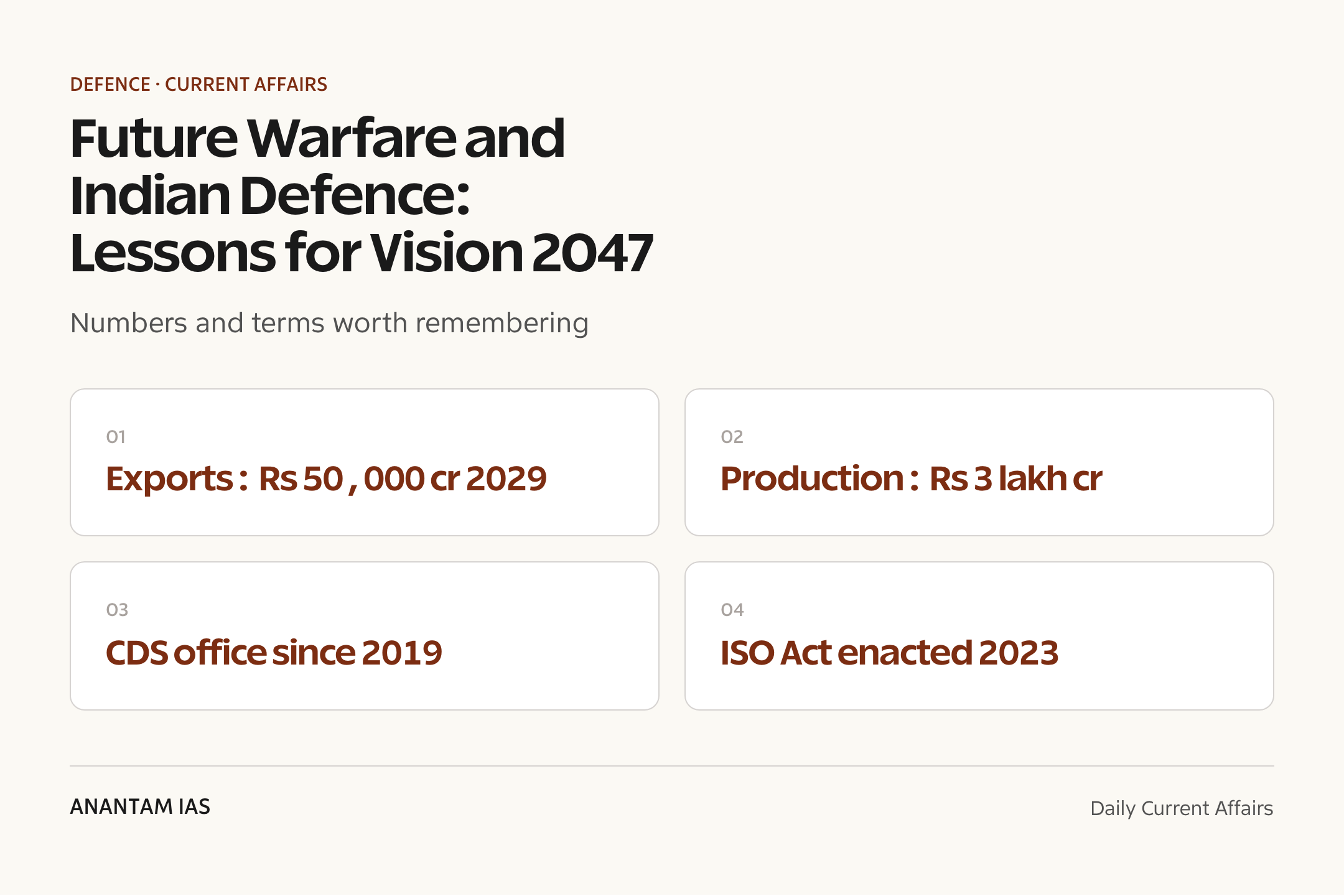
- India’s defence-export target of Rs 50,000 crore by 2029 and a Rs 3 lakh crore production goal anchor the indigenisation drive.
- Reforms in motion — theatreisation, the CDS office, iDEX startups — are being stress-tested against a fast-changing threat picture.
The development matters in the context of:
- Future warfare blends physical (land, sea, air), and newer domains — cyber, space, electromagnetic spectrum and information — into a single multi-domain battlespace.
- India faces a two-front challenge (Pakistan and China) plus persistent sub-conventional threats, making doctrine and jointness urgent rather than academic.
- The reform clock runs alongside a fiscal reality: a large share of the defence budget still goes to salaries and pensions, squeezing modernisation.
UPSC Relevance
Prelims Relevance
- CDS (Chief of Defence Staff): created in 2019; heads the Department of Military Affairs and is the single-point military adviser, tasked with promoting jointness.
- Integrated Theatre Commands: proposed unified commands grouping Army, Navy and Air Force assets under one operational commander for a geography or function; the enabling Inter-Services Organisations Act, 2023 gives commanders authority over personnel of all services.
- iDEX (Innovations for Defence Excellence): launched 2018 under DIO to fund startups, MSMEs and innovators solving defence problems, with the ADITI scheme for critical technologies.
- DAP 2020 (Defence Acquisition Procedure): prioritises Buy (Indian-IDDM) — Indigenously Designed, Developed and Manufactured — as the top procurement category.
- Positive Indigenisation Lists: items banned for import beyond set timelines, issued by MoD and DPSUs to force domestic sourcing.
- Loitering munition: a ‘kamikaze’ drone that hovers/searches over a target area, then dives to destroy it — bridging the gap between a missile and a UAV.
- Grey-zone warfare: coercion below the threshold of open war — cyber intrusions, disinformation, economic pressure, proxies and salami-slicing.
- Operation Sindoor (May 2025): India’s first large-scale ‘non-contact’ operation, where unmanned systems and stand-off strikes featured prominently.
- Agnipath: 2022 short-service recruitment scheme inducting Agniveers for four years; aimed at a younger, tech-savvier force profile.
- DRDO directed-energy and counter-drone work includes laser-based systems and indigenous anti-UAS grids.
Mains Relevance
GS Paper 3
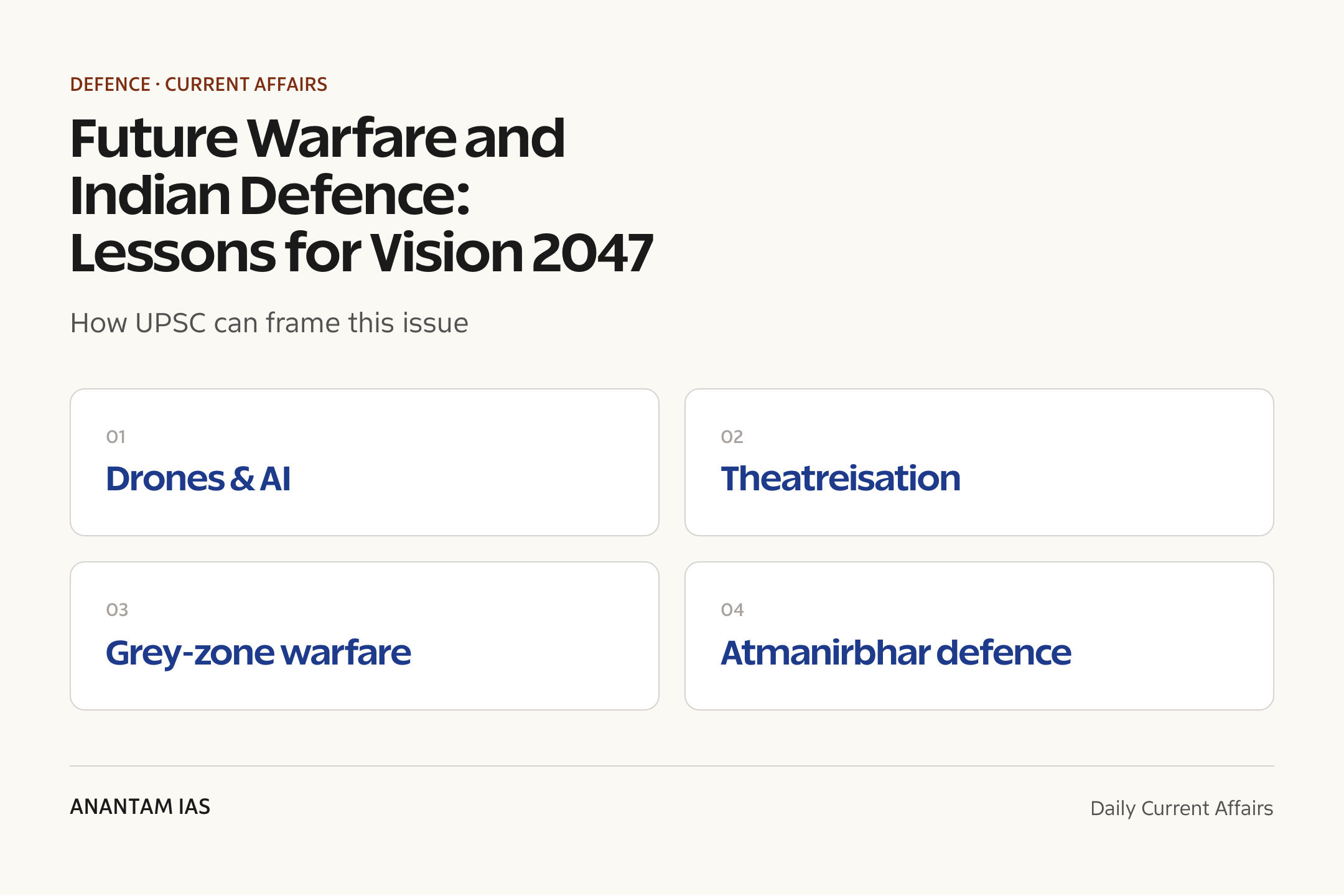
- Examine how drones, AI and grey-zone tactics are changing the character of war, and assess India’s readiness in doctrine, structures and indigenous technology.
- Evaluate theatreisation and Atmanirbhar Bharat in defence as twin pillars of military modernisation — progress, frictions and the road to Vision 2047.
GS Paper 2
- Discuss how a two-front threat and grey-zone coercion on India’s borders shape the case for integrated, multi-domain defence planning.
Essay
- Technology will decide who wins the wars of tomorrow — and who avoids them.
- Self-reliance is the truest form of security.
Background and Context
How warfare is changing
The battlefield is faster, smaller and smarter.
- Unmanned systems — surveillance drones, armed UAVs and loitering munitions — now do reconnaissance and strike that once needed crewed aircraft, at a fraction of the cost and risk.
- Drone swarms and AI-enabled targeting compress the sensor-to-shooter loop, letting forces find, decide and strike in near real time.
- Cyber and electronic warfare can blind sensors, jam communications and disable networks before a shot is fired.
- Space underpins everything — navigation, surveillance, secure communications — making satellites both a force-multiplier and a target.
- Grey-zone and hybrid tactics (disinformation, proxies, economic and cyber coercion) let adversaries gain ground without crossing into open war.
- Conflicts in Ukraine and West Asia have shown cheap drones offsetting expensive platforms, reordering the cost calculus of war.
- Speed of decision is the new advantage: whoever fuses data and acts first inside the opponent’s loop usually wins the exchange.
- The line between combatant and civilian tech is blurring — commercial drones, encrypted apps and cloud compute now show up on the battlefield.
India's reform push: theatreisation and the CDS
Jointness is the organising idea of the current reform wave.
- The CDS post (2019) and the Department of Military Affairs were meant to break service silos and drive integrated planning.
- Integrated Theatre Commands would put land, air and naval assets in a theatre under one commander — replacing today’s largely service-specific command structure (see our explainer on theaterisation of the Indian military).
- The Inter-Services Organisations Act, 2023 gives commanders disciplinary and administrative authority over personnel of all three services, a legal pre-requisite for theatres.
- Newer Army formations — Integrated Battle Groups (IBGs) and drone-heavy units — point toward leaner, faster, multi-domain forces.
- Friction persists over force allocation, air-power apportionment and the pace of rollout; reform is evolutionary, not done.
Indigenisation and the defence-tech ecosystem
Self-reliance is now treated as a security necessity, not just an industrial goal.
- Atmanirbhar Bharat in defence rides on DAP 2020 (Buy Indian-IDDM first) and successive positive indigenisation lists that bar imports of listed items.
- iDEX and ADITI channel funds to startups and MSMEs on AI, drones, counter-UAS and critical technologies.
- DRDO anchors high-end R&D — missiles, radars, directed-energy and counter-drone systems — with a widening private-industry base.
- Defence exports hit a record of roughly Rs 24,000 crore in 2024-25, with a target of Rs 50,000 crore by 2029 and Rs 3 lakh crore in production.
- India now exports items such as Dornier Do-228 aircraft, helicopters, body armour, torpedoes and interceptor boats to over 100 countries.
- Public-private blend: ordnance factories restructured into DPSUs, alongside a rising private sector and startup base, widen the manufacturing pool.
- Technology transfer through co-development and offsets is used to build domestic capability in radars, missiles and electronics.
Lessons from recent conflicts
Ukraine, West Asia and Operation Sindoor are the live syllabus.
- Operation Sindoor (May 2025), launched after the Pahalgam terror attack, showcased stand-off precision strikes and unmanned systems in a short, intense window.
- It underlined that non-contact, technology-led operations can deliver effect while limiting own-force exposure.
- Ukraine demonstrated layered air defence, attrition by cheap drones, and the centrality of resilient communications and cyber defence.
- West Asia showed the value of integrated missile-and-drone defence and the speed of multi-domain escalation.
- Common thread: integration of air power, drones, cyber and EW at the theatre level decides outcomes — exactly what theatreisation seeks.
- Logistics and stockpiles matter again: high-intensity drone-and-missile exchanges burn through munitions far faster than peacetime planning assumes.
- Narrative warfare runs in parallel — controlling the information space shapes domestic morale and international support during a crisis.
Gaps and challenges
Ambition outpaces some hard constraints.
- Revenue-heavy budgets: salaries and pensions crowd out the capital outlay needed for modernisation.
- R&D under-funding: defence R&D remains a small slice of spending, limiting frontier-tech depth.
- Import dependence persists in engines, semiconductors, sensors and some critical components.
- Talent and absorption: rapid tech induction needs trained personnel and doctrine to match — a question mark over the Agnipath scheme‘s four-year cycle for highly skilled roles.
- Implementation lag: theatre commands and procurement timelines have repeatedly slipped against a fast-moving threat.
Way Forward
Finish the structural reform
- Move from blueprints to operational theatre commands with clear allocation of air, land and naval assets.
- Institutionalise a tri-service joint doctrine for multi-domain operations spanning cyber, space and EW.
Build the technology base
- Raise defence R&D spending and scale iDEX/ADITI to deliver drones, counter-UAS, AI and indigenous engines.
- Lock in critical-component self-reliance — sensors, semiconductors, propulsion — through targeted PLI and indigenisation lists.
Master the grey zone
- Strengthen cyber, information-warfare and counter-disinformation capacity for sub-threshold contests.
- Integrate civilian tech, space and private industry into a whole-of-nation deterrence posture.
Get the human capital right
- Align recruitment and training — including Agnipath — with the skills future warfare demands.
- Invest in cyber, drone-operation and data specialists, and retain hard-won technical talent.
Conclusion
Future warfare rewards the side that integrates fastest — fusing drones, AI, cyber, space and electronic warfare into one decision loop, while denying the adversary the same. India’s reforms — theatreisation, a single CDS chain, Atmanirbhar defence-tech and lessons banked from Operation Sindoor — point in the right direction.
The Vision 2047 test is execution: turning structures into operational theatres, R&D into fielded systems, and export ambition into a self-reliant industrial base — fast enough to stay ahead of the threat, not merely catch up with the last war.
UPSC Practice Questions
Prelims MCQ 1
With reference to India’s defence reforms, consider the following statements:
- The Chief of Defence Staff heads the Department of Military Affairs.
- The Inter-Services Organisations Act, 2023 gives a designated commander authority over personnel of all three services.
- DAP 2020 places the ‘Buy (Global)’ category above ‘Buy (Indian-IDDM)’ in procurement priority.
How many of the above statements are correct?
(a) Only one (b) Only two (c) All three (d) None
Answer: (b) Only two
Explanation:
Statements 1 and 2 are correct. Statement 3 is wrong — DAP 2020 places ‘Buy (Indian-IDDM)’ at the top of the procurement priority, not ‘Buy (Global)’.
Prelims MCQ 2
Which of the following best describes a ‘loitering munition’?
(a) A long-range cruise missile with a fixed flight path (b) A surveillance satellite that loiters in geostationary orbit (c) A drone that hovers/searches over a target area before diving to destroy it (d) A static anti-aircraft gun guarding key installations
Answer: (c) A drone that hovers/searches over a target area before diving to destroy it
Explanation:
A loitering munition (a ‘kamikaze’ or suicide drone) loiters over a target area, then strikes it on command — bridging a missile and a reconnaissance UAV.
UPSC Mains Questions
- Drones, artificial intelligence and grey-zone tactics are redefining the character of war. Examine India’s preparedness in doctrine, force structure and indigenous technology, and suggest a road map for Vision 2047. (GS3)
- Theatreisation and Atmanirbhar Bharat are the twin pillars of India’s military modernisation. Critically evaluate the progress and challenges of each. (GS3)
- How do a two-front threat and grey-zone coercion strengthen the case for integrated, multi-domain defence planning in India? (GS2)
Source: Indian Express.
Frequently Asked Questions
What is ‘future warfare’ in simple terms?
It is warfare shaped by drones, artificial intelligence, cyber and space tools, and grey-zone tactics — short, fast, technology-saturated conflicts often fought below the threshold of declared war, rather than long battles of mass and attrition.
What are Integrated Theatre Commands?
They are proposed unified commands that group Army, Navy and Air Force assets for a geography or function under a single operational commander, replacing today’s largely service-specific structure. The Inter-Services Organisations Act, 2023 provides the legal basis for joint command authority.
What is grey-zone warfare?
Coercion that stays below open war — cyber intrusions, disinformation, economic pressure, proxies and ‘salami-slicing’ of territory. It lets an adversary gain advantage without triggering a full military response.
What is India’s defence-export target?
India aims for Rs 50,000 crore in defence exports by 2029, alongside a Rs 3 lakh crore production goal. Exports touched a record of about Rs 24,000 crore in 2024-25.
How does Operation Sindoor link to future warfare?
Operation Sindoor (May 2025), launched after the Pahalgam attack, used stand-off precision strikes and unmanned systems in a short, intense window — a live demonstration of non-contact, technology-led operations and a reference point for India’s doctrine.
What is a loitering munition?
A ‘kamikaze’ drone that hovers and searches over a target area before diving in to destroy it — combining the features of a reconnaissance UAV and a guided missile. Such systems featured in Ukraine and Operation Sindoor.
Source: https://anantamias.com/current-affairs/future-warfare-indian-defence-vision-2047/
112 Emergency Number: How India Built a Single Helpline for All Emergencies
Why in News?
An Indian Express Explained piece revisits how India consolidated a maze of separate emergency helplines into a single, pan-India number, 112, running on the Emergency Response Support System (ERSS). The number is now the common front door for police, fire and ambulance help across states and Union Territories.
The story matters for governance and internal-security study because 112 is a textbook case of citizen-centric digital service delivery: one number, one app and one back-end dispatch system replacing the fragmented 100/101/108 setup that many citizens struggled to remember in a crisis.
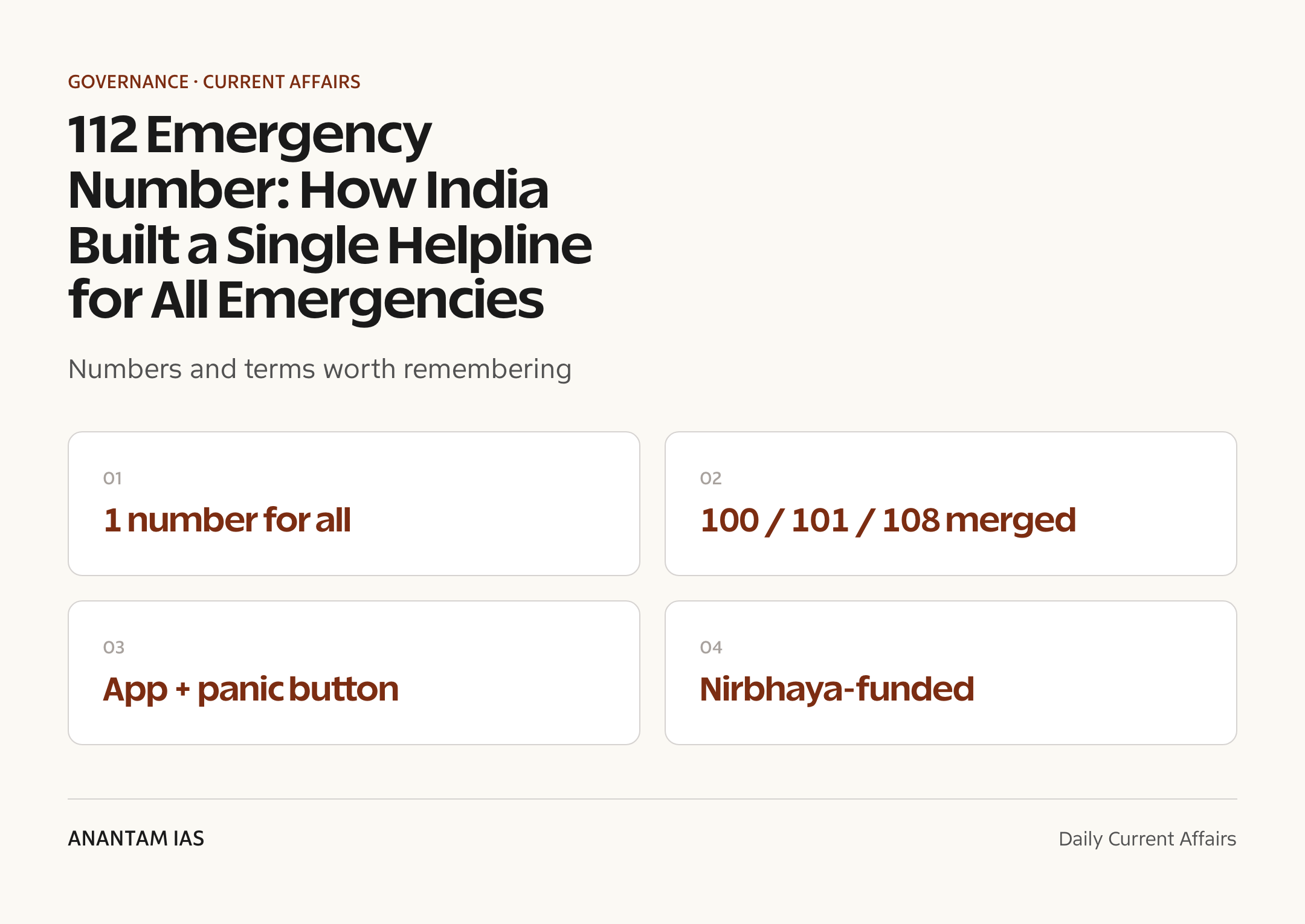
- 112 functions as the all-in-one emergency number, integrating the older 100 (police), 101 (fire) and 102/108 (ambulance) lines.
- The back-end ERSS was rolled out by the Ministry of Home Affairs (MHA) and funded under the Nirbhaya Fund, tying it directly to the women’s-safety mandate.
- Citizens can reach help by dialling 112, using the 112 India app, or pressing the panic button on a phone — a multi-channel design for emergencies.
The development matters in the context of:
- India earlier ran a confusing patchwork of toll-free numbers — one each for police, fire, ambulance, women and children — which slowed response during real emergencies.
- Globally, single emergency numbers like 112 (Europe) and 911 (US) had already proved that one memorable number saves critical seconds.
- Post-2012, the push for a unified system became inseparable from the women’s-safety agenda and the Nirbhaya Fund corpus.
UPSC Relevance
Prelims Relevance
- 112 is India’s single pan-India emergency number, modelled on the international 112 standard used across the European Union.
- The supporting back-end is the Emergency Response Support System (ERSS), rolled out nationally by the Ministry of Home Affairs (MHA) from 2019.
- 112 integrates earlier numbers: 100 (police), 101 (fire and rescue), 102/108 (ambulance) and women/child lines such as 1090 and 1098.
- ERSS was funded under the Nirbhaya Fund, the women’s-safety corpus announced in 2013 after the 2012 Delhi case.
- Citizens can raise an alert by voice call, by the 112 India app, by SMS, or via the app’s SHOUT feature that alerts nearby volunteers for women in distress.
- Indian smartphones and feature phones were mandated by the Department of Telecommunications (DoT) to carry a panic button — long-pressing key 5 or 9 on feature phones, or the power button on smartphones.
- Himachal Pradesh and Nagaland were among the first states to operationalise the 112 ERSS service.
- ERSS uses a Computer-Aided Dispatch (CAD) platform with GIS mapping to locate callers and route the nearest responder.
Mains Relevance
GS Paper 2
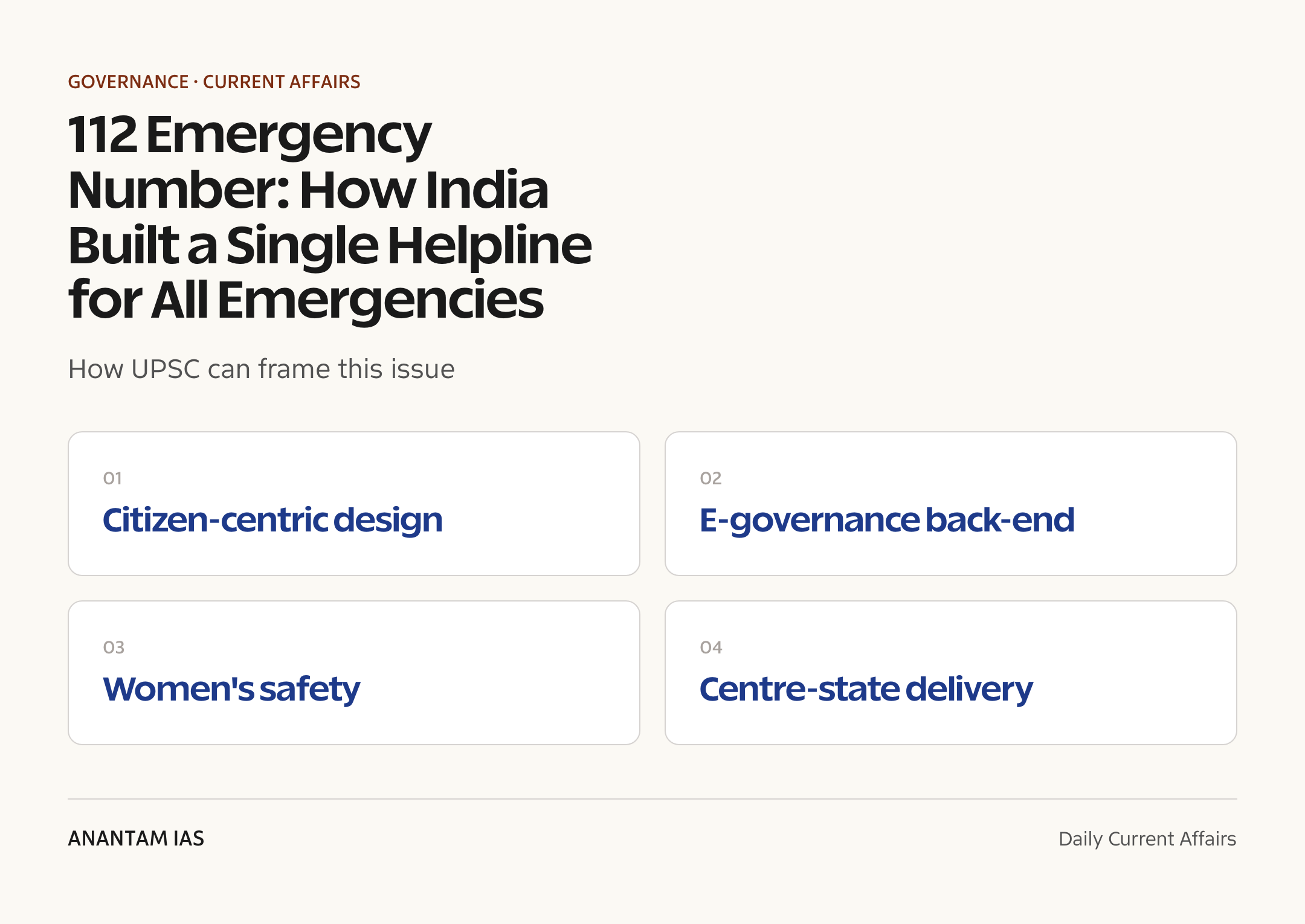
- Discuss how a single emergency number such as 112 illustrates citizen-centric, technology-enabled service delivery and reduces the citizen’s cognitive load during crises.
- Examine the federal coordination challenge: emergency response is a State subject, yet 112 needs uniform standards, centre-funded infrastructure and inter-state interoperability.
Essay
- Technology as an enabler of dignity and safety: how a memorable helpline can be a quiet act of governance.
- Citizen-centric governance — designing public services around the user, not the department.
Background and Context
What 112 and ERSS actually are
One number, one app, one back-end dispatch brain.
- 112 is the single emergency number a citizen dials for any emergency — crime, fire, medical or distress — regardless of the state.
- The Emergency Response Support System (ERSS) is the technology back-end that receives the call, identifies the caller’s location and dispatches the nearest responder.
- It mirrors the international model: 112 is the standard emergency number across the European Union and works on most GSM networks worldwide.
- The aim is simple — replace a list of numbers a panicked citizen cannot recall with one number a child can remember.
The journey from fragmented numbers
From a confusing menu of helplines to a single front door.
- For decades India ran separate lines — 100 for police, 101 for fire, 102/108 for ambulance, plus women and child helplines like 1090 and 1098.
- In a real emergency, citizens often forgot which number applied, or wasted minutes calling the wrong service.
- Under ERSS, these legacy numbers are integrated into 112, so a single call can be triaged and routed to police, fire or ambulance as needed.
- The older numbers were not switched off overnight; 112 was layered on top so existing dialling habits still connect to help.
Technology and features
Voice, app, panic button and location-aware dispatch.
- Citizens can reach 112 by voice call, SMS, email, the 112 India app, or the state ERSS web portal.
- The app’s SHOUT feature lets a woman in distress alert registered volunteers nearby, in addition to the police control room.
- ERSS runs on a Computer-Aided Dispatch (CAD) platform that maps the caller on GIS and pushes the alert to the closest patrol vehicle or responder.
- A nationwide panic button mandate from the Department of Telecommunications (DoT) requires phones to trigger an emergency call — long-pressing 5 or 9 on feature phones, and the power button on smartphones — with location sharing built in.
Funding and governance
Centre seeds it, states run it, Nirbhaya Fund pays for it.
- ERSS was conceived and pushed by the Ministry of Home Affairs (MHA) as a flagship of the women’s-safety and emergency-response agenda.
- It is financed under the Nirbhaya Fund, the dedicated corpus announced in 2013 (around Rs 1,000 crore initially) for projects protecting women.
- Public safety and policing are State subjects, so states and UTs operate their own ERSS control rooms while following common 112 standards.
- Himachal Pradesh and Nagaland were among the first to operationalise the service, with national rollout proceeding from 2019.
Significance and the gaps that remain
A strong model still uneven on the ground.
- 112 embodies citizen-centric digital governance: it is designed around the user’s panic, not the department’s silos.
- It strengthens the women’s-safety architecture by linking the 112 India app, SHOUT and the smartphone panic button into one response chain.
- Response quality still varies by state — control-room staffing, vehicle availability and rural network coverage shape whether the call actually converts into timely help.
- Awareness is uneven; many citizens still dial 100 out of habit, and the system depends on accurate caller-location data that weaker networks cannot always provide.
Way Forward
Close the last-mile response gap
- Invest in control-room staffing, GPS-tracked response vehicles and guaranteed dispatch times so a 112 call reliably reaches a responder.
- Tie ERSS performance to published response-time data, audited per district, to expose weak links.
Deepen integration and awareness
- Run sustained public campaigns so 112 becomes as instinctive as the old 100, especially in rural and non-Hindi regions.
- Fully fold remaining standalone helplines and disaster lines into 112 to end residual fragmentation.
Strengthen women's-safety features and privacy
- Expand the SHOUT volunteer network and verify volunteers to keep the distress-alert chain trustworthy.
- Pair location tracking with clear data-protection safeguards so safety tools do not become surveillance tools.
Conclusion
India’s 112 is a quiet but instructive example of governance done right — taking a confusing menu of helplines and collapsing it into one number a frightened citizen can recall. Built on the ERSS back-end, funded by the Nirbhaya Fund and driven by the MHA, it shows how technology, financing and federal coordination can combine to deliver a citizen-centric service.
The remaining work is less about the design and more about delivery: consistent response times, full state coverage, reliable caller-location data and genuine public awareness. As the Indian Express account underlines, a single number is only as good as the responder it summons — the next phase is making sure every 112 call ends in timely, accountable help.
UPSC Practice Questions
Prelims MCQ 1
With reference to the Emergency Response Support System (ERSS), consider the following statements:
- 112 is the single pan-India emergency number that integrates earlier numbers such as 100, 101 and 108.
- ERSS is funded under the Nirbhaya Fund and was rolled out by the Ministry of Home Affairs.
- Police and public order are Union subjects, so ERSS control rooms are operated solely by the central government.
How many of the above statements are correct?
(a) Only one (b) Only two (c) All three (d) None
Answer: (b) Only two
Explanation:
Statements 1 and 2 are correct. Statement 3 is wrong: police and public order are State subjects, so states and UTs run their own ERSS control rooms under common 112 standards.
Prelims MCQ 2
The Nirbhaya Fund, which finances the Emergency Response Support System, is best described as:
(a) A statutory body created to investigate crimes against women (b) A dedicated corpus announced in 2013 to support initiatives for women’s safety and dignity (c) A scheme that provides direct cash transfers to survivors of violence (d) A constitutional fund managed by the Election Commission
Answer: (b) A dedicated corpus announced in 2013 to support initiatives for women's safety and dignity
Explanation:
The Nirbhaya Fund was announced in 2013 (around Rs 1,000 crore initially) to fund women’s-safety initiatives, including ERSS/112 and Safe City projects; it is not a statutory or constitutional body and does not run direct cash transfers.
UPSC Mains Questions
- A single emergency number is as much a governance reform as a technology project. Discuss this in the context of India’s 112 and the Emergency Response Support System.
- Examine how the 112 ERSS strengthens India’s women’s-safety architecture, and identify the last-mile gaps that limit its effectiveness.
Source: Indian Express.
Frequently Asked Questions
What is 112 in India?
112 is India’s single, pan-India emergency number. A citizen dials 112 for any emergency — police, fire, ambulance or distress — and the call is routed to the right service through the Emergency Response Support System (ERSS).
What is the Emergency Response Support System (ERSS)?
ERSS is the technology back-end behind 112. It receives the call, locates the caller using GIS mapping on a Computer-Aided Dispatch platform, and sends the nearest responder. It was rolled out by the Ministry of Home Affairs from 2019.
Which older numbers does 112 replace?
112 integrates the earlier 100 (police), 101 (fire and rescue), 102/108 (ambulance), and women/child helplines such as 1090 and 1098, so one number now covers them all.
How is 112 funded?
ERSS is financed under the Nirbhaya Fund, the women’s-safety corpus announced in 2013, which links 112 directly to the women’s-safety agenda alongside projects like Safe City.
How can I use 112 besides dialling?
You can reach 112 by voice call, SMS, email, the 112 India app, or the panic button on your phone — long-pressing key 5 or 9 on feature phones, or the power button on smartphones. The app’s SHOUT feature alerts nearby volunteers for women in distress.
Who runs the 112 control rooms?
Because police and public order are State subjects, individual states and Union Territories operate their own ERSS control rooms while following common 112 standards set centrally by the MHA.
Source: https://anantamias.com/current-affairs/112-universal-emergency-number-india/
Europe’s Worst Heatwave: How Attribution Science Links It to Climate Change
Why in News?
Western Europe baked through its most severe recorded heatwave in the days around the June 2026 solstice, with a stagnant heat dome drawing hot Saharan air over the Iberian Peninsula and France. The Indian Express Explained desk, drawing on a rapid World Weather Attribution (WWA) analysis, flagged how quickly scientists were able to tie the event to human-caused warming.
The WWA finding — that a heatwave of this kind would have been virtually impossible in the climate of the 1970s — is a clean teaching case on attribution science, on treating heat as a notified disaster, and on why India’s Heat Action Plans matter for an even more exposed population.
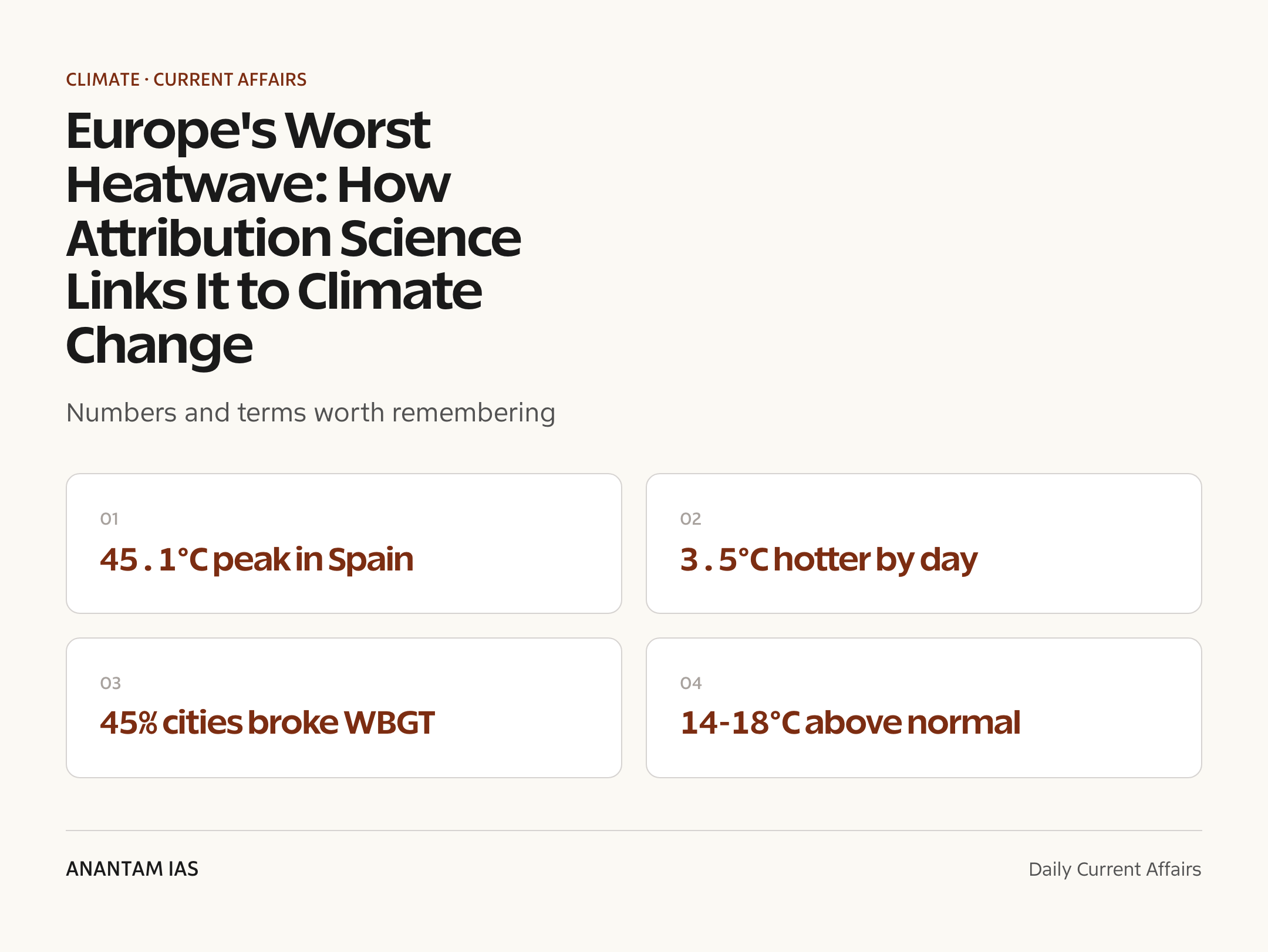
- Peak readings near 45.1°C at Andujar (southern Spain) on 22 June; Spain and Portugal pushed toward 44°C.
- Temperatures ran 14–18°C above normal for late June across the worst-hit belt.
- WWA rapid study: the event was around 3.5°C hotter by day than a comparable event in the 1976 climate.
- 45% of analysed European cities broke heat-stress (Wet Bulb Globe Temperature) thresholds during 18–29 June.
- Past European heat seasons carried huge mortality — over 60,000 excess deaths in 2022, by WWA’s cited figures.
The development matters in the context of:
- Europe is the fastest-warming continent, heating at roughly twice the global average rate, per the WMO and WWA.
- June daytime maxima in Western Europe are warming at close to triple the global mean rate in WWA’s analysis.
- Rapid-attribution studies now appear within days of an event, shifting climate debate from ‘someday’ to ‘this one, now’.
- Night-time minima are rising fast too, so bodies get no overnight recovery — a key driver of heat mortality among the elderly.
- The event sits inside a multi-year run of European heat seasons that carried tens of thousands of excess deaths each year.
UPSC Relevance
Prelims Relevance
- Attribution science: a method that estimates how much human-caused warming changed the likelihood or intensity of a specific extreme event, by comparing today’s climate with a counterfactual cooler one.
- World Weather Attribution (WWA): an international research collaboration that runs rapid, peer-reviewed-method analyses of extreme events; not a government body.
- Heat dome: a persistent high-pressure system that traps and compresses descending air, suppressing cloud and rain and locking in extreme heat.
- Wet Bulb Globe Temperature (WBGT): a heat-stress index combining temperature, humidity, wind and radiant heat — more health-relevant than air temperature alone.
- Return period: the average gap between events of a given severity; warming shortens it (a once-in-50-years heat can become once-in-5-years).
- IPCC AR6 (2021–23) concluded it is virtually certain that hot extremes have become more frequent and intense since the 1950s, with human influence the main driver.
- India’s IMD heatwave criterion: declared when plains touch 40°C, hills 30°C, coastal areas 37°C, with a departure of 4.5–6.4°C above normal (severe heatwave at higher departures).
- NDMA issues national guidelines for heatwave management; over 20 states and 100+ cities/districts run Heat Action Plans (HAPs).
- Heatwave is not currently a notified disaster under the Disaster Management Act, 2005 — a recurring policy debate.
Mains Relevance
GS Paper 3
- Attribution science as evidence: how rapid studies strengthen the case for mitigation, adaptation funding and even climate litigation.
- Heat as a slow-onset disaster: gaps in India’s disaster framework, the case for and against notifying heatwave under the DM Act, and financing of Heat Action Plans.
Essay
- The science we ignore at our peril: extreme weather and the cost of inaction.
- Development versus a warming planet — adaptation as a survival strategy.
Background and Context
What happened across Europe
An early, intense and unusually humid heatwave clustered around the 2026 solstice.
- A stagnant heat dome drew hot Saharan air over Iberia and France, with the worst heat between 20 and 23 June.
- Southern Spain saw readings near 45.1°C at Andujar; Spain and Portugal pushed toward 44°C, with parts of France placed under top-level heat warnings.
- Temperatures ran 14–18°C above normal for late June, and night-time minima stayed dangerously high, denying the body relief.
- WWA called it the most severe heatwave recorded over the region it studied, covering France, Germany, Italy, Spain and southern England.

What attribution science is and how it works
A way to answer ‘did climate change cause this?’ with numbers, not vibes.
- Scientists define the event (say, the three hottest days over a region), then build two model worlds: today’s climate and a counterfactual cooler world without ~1.3°C of human warming.
- They run large ensembles of climate models plus observational datasets such as ERA5, checking the models can reproduce the event’s statistics.
- Comparing the two worlds yields how much hotter and how many times more likely the event became — the core attribution result.
- For Europe 2026, WWA found daytime heat about 3.5°C hotter than a 1976-climate analogue, and the event virtually impossible in that older climate.
- The method does not claim warming ’caused’ the weather pattern; it quantifies how warming loaded the dice toward more extreme outcomes.
- Results carry uncertainty ranges, and scientists report them only when the models pass validation against observations — which is why the conclusions are credible.
- The same framework is applied to floods, droughts and cyclones, building a body of evidence that single events increasingly bear a human fingerprint.
Why heatwaves are intensifying
A hotter baseline plus stickier weather patterns push extremes higher.
- Every fraction of a degree of baseline warming shifts the whole temperature distribution, making record highs far more probable.
- A warmer atmosphere holds more moisture, so heat arrives with higher humidity — lifting WBGT and human heat stress even when air temperature looks moderate.
- Heat domes and stalled jet-stream patterns can park high pressure in place for days, extending exposure.
- Urban heat islands — concrete, asphalt and waste heat — add several degrees in cities and blunt night-time cooling.
- Europe warms at roughly twice the global rate, and Western Europe’s June maxima faster still, in WWA’s analysis.
Heat as a disaster and India's exposure
India is hotter, more humid in parts, and far more exposed by livelihood.
- Hundreds of millions of Indians work outdoors — farm labour, construction, street vending — with limited cooling, raising real-world heat risk.
- IMD declares a heatwave when plains hit 40°C (37°C coastal, 30°C hills) with a 4.5–6.4°C departure above normal; higher departures mark a severe heatwave.
- Heatwave is not a notified disaster under the Disaster Management Act, 2005, so it falls outside the SDRF/NDRF compensation default — a live debate.
- NDMA guidelines and state-city Heat Action Plans push early-warning, cool shelters, work-hour shifts and hospital readiness.
- Studies have flagged that many Indian HAPs are under-funded, weak on local data, and thin on long-term adaptation. See our explainer on heat waves in India.
- Rising wet-bulb temperatures in the humid Indo-Gangetic plains threaten to approach limits beyond which the body cannot cool by sweating, even in shade.
- Heat also strains the power grid, farm yields and water supply, turning a health emergency into a wider economic and food-security shock.
Policy and adaptation levers
Cutting emissions limits future heat; smart adaptation cuts deaths now.
- Mitigation: deep cuts in fossil-fuel emissions cap how much hotter future heatwaves get — the only durable fix.
- Early-warning to action: linking IMD forecasts to automatic local triggers (water points, cooling centres, ASHA outreach).
- Cool cities: cool/green roofs, urban trees, shaded transit and building codes that beat the urban heat island.
- Worker protection: rescheduled hours, rest-shade-water rules and wage protection for the informal workforce.
- Read our wider note on climate change and on disaster management in India.
Way Forward
Treat heat as a managed disaster
- Debate and decide whether to notify heatwave under the DM Act, with clear triggers and funding lines.
- Make Heat Action Plans data-driven, funded and audited, not just paper protocols.
Build the science-policy bridge
- Use rapid attribution to size adaptation budgets and inform climate-resilient infrastructure norms.
- Strengthen India’s own attribution and heat-mortality surveillance to count the true toll.
Protect the most exposed
- Shift outdoor work hours, mandate rest-shade-water, and expand cool public spaces.
- Target the elderly, infants, outdoor workers and slum residents with localised warnings.
- Map high-risk wards and run drills so that cooling shelters, water points and hospitals are ready before the first heat spike arrives.
Conclusion
Europe’s June 2026 heatwave is a warning the attribution numbers make hard to dismiss: a near-impossible event in a 1970s climate, now lived through in a single week. The science has matured to the point where the link between a specific killer heatwave and human emissions can be stated with confidence and speed.
For India — hotter, more humid and far more exposed by livelihood — the lesson is to treat heat as a recurring disaster, fund Heat Action Plans seriously, and protect outdoor workers, while pressing on the emissions cuts that decide how brutal future summers become.
UPSC Practice Questions
Prelims MCQ 1
With reference to extreme-event attribution science, consider the following statements:
- It estimates how human-caused warming has changed the likelihood or intensity of a specific extreme event.
- It works by comparing today’s climate with a modelled counterfactual climate without human warming.
- World Weather Attribution, which conducts such studies, is a specialised agency of the United Nations.
How many of the above statements are correct?
(a) Only one (b) Only two (c) All three (d) None
Answer: (b) Only two
Explanation:
Statements 1 and 2 describe the method correctly. Statement 3 is wrong: WWA is an independent international research collaboration, not a UN agency.
Prelims MCQ 2
As per the India Meteorological Department, a heatwave over the plains is normally declared when the maximum temperature reaches at least:
(a) 35°C (b) 37°C (c) 40°C (d) 45°C
Answer: (c) 40°C
Explanation:
IMD declares a heatwave over the plains at 40°C (37°C for coastal areas, 30°C for hills) with a departure of 4.5–6.4°C above normal; larger departures mark a severe heatwave.
UPSC Mains Questions
- Rapid attribution science has changed how we link extreme weather to climate change. Examine its method and its policy significance for a heat-exposed country like India. (250 words)
- Heatwaves are increasingly deadly yet remain outside India’s notified-disaster framework. Critically evaluate the case for treating heat as a disaster and the adequacy of Heat Action Plans. (250 words)
Sources: Indian Express and World Weather Attribution.
Frequently Asked Questions
What is attribution science?
It is a scientific method that estimates how much human-caused warming changed the probability or intensity of a specific extreme event, by comparing today’s climate with a modelled counterfactual climate that lacks recent warming.
What did World Weather Attribution find about Europe’s June 2026 heatwave?
A rapid WWA analysis found the heatwave was around 3.5°C hotter by day than a comparable event in the 1976 climate, and would have been virtually impossible in that older climate — pointing to human-caused warming as the driver.
What is a heat dome?
A heat dome is a strong, persistent high-pressure system that traps and compresses descending air, suppressing clouds and rain and locking extreme heat over a region for days.
Why is humidity important in measuring heat danger?
High humidity slows the body’s cooling by sweat. Indices like the Wet Bulb Globe Temperature combine humidity, radiant heat and wind with air temperature to better capture real heat stress on the human body.
Is a heatwave a notified disaster in India?
No. Heatwave is not currently notified under the Disaster Management Act, 2005, though several experts and states have urged its inclusion. The NDMA issues guidelines and many states run Heat Action Plans.
When does the IMD declare a heatwave?
Over the plains, when the maximum temperature is 40°C or more (37°C coastal, 30°C hills) with a departure of 4.5–6.4°C above normal; a higher departure marks a severe heatwave.
Source: https://anantamias.com/current-affairs/europe-2026-heatwave-climate-attribution/
New Moth Genus in the Western Ghats: A Window into Hidden Biodiversity
Why in News?
As The Hindu (Science) reports, a research team has described a new genus and species of tiger moth from the southern Western Ghats, naming it Antaram idukki after Kerala’s Idukki district where it was found. The moth belongs to the tiger-moth subfamily Arctiinae (family Erebidae) and is so far known only from this one stretch of hills, a hallmark of the Ghats’ deep endemism.
The find matters less for the single insect than for what it signals: the Western Ghats, one of the world’s most-celebrated biodiversity hotspots, still hides whole genera that science has never catalogued. Each such description strengthens the case for taxonomy-led conservation in a landscape under steady pressure from plantations, roads, and a warming climate.
- New genus + species: Antaram idukki is described as both a new genus and a new species, not merely a new species in a known genus.
- Classification: a tiger moth in subfamily Arctiinae, family Erebidae, order Lepidoptera.
- Endemic range: currently known only from Idukki in the southern Western Ghats of Kerala.
- How it was distinguished: a unique combination of external wing features and genitalic morphology separates it from related genera.
- Why it counts: tiger moths act as night-time pollinators, prey for birds and bats, and indicator species for ecosystem health.
The development matters in the context of:
- The Western Ghats run roughly 1,600 km along India’s west coast across Gujarat, Maharashtra, Goa, Karnataka, Tamil Nadu, and Kerala, and are older than the Himalayas.
- They are recognised both as a global biodiversity hotspot and as a UNESCO World Heritage Site, with very high levels of species found nowhere else on Earth.
- Insect groups like moths are vastly under-described compared with birds or mammals, so most new discoveries in the Ghats are invertebrates.
- Conservation governance of the Ghats has been shaped by the Gadgil and Kasturirangan reports and the idea of Ecologically Sensitive Areas.
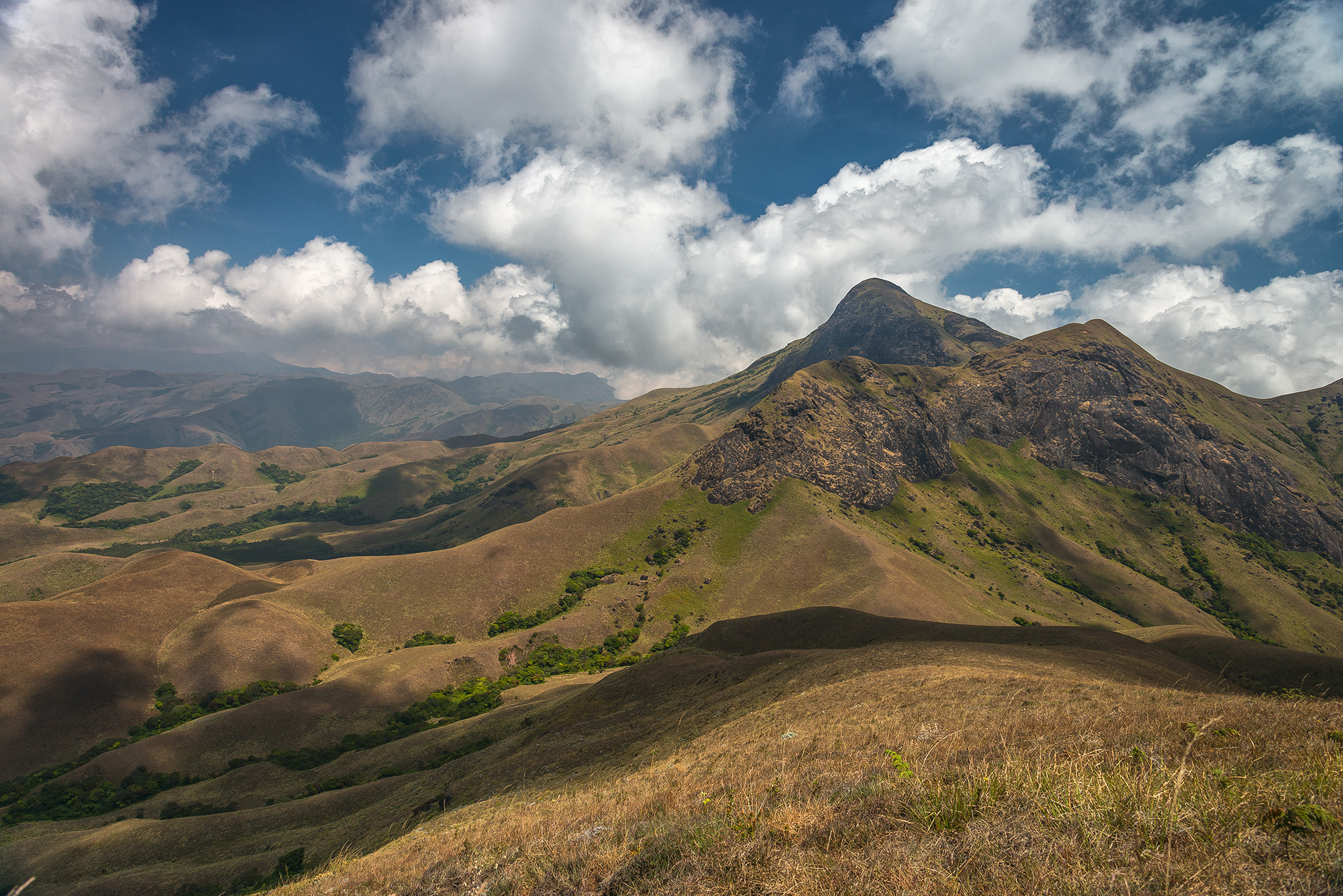
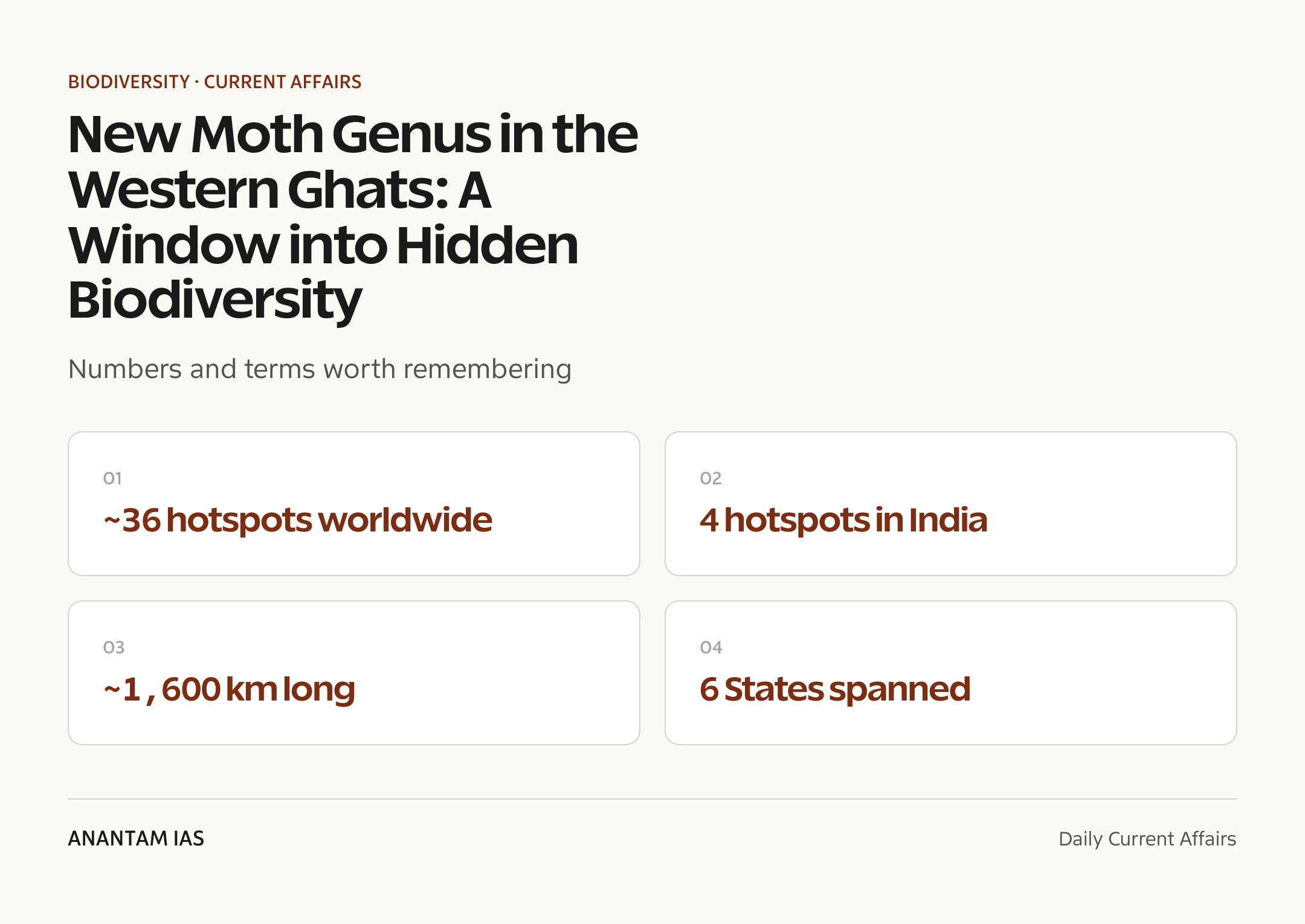
UPSC Relevance
Prelims Relevance
- The Western Ghats are one of the world’s recognised biodiversity hotspots and a UNESCO World Heritage Site (inscribed 2012).
- A biodiversity hotspot must meet two criteria: at least 1,500 endemic vascular plant species and loss of at least 70% of its original primary vegetation.
- There are around 36 biodiversity hotspots worldwide; India hosts four — the Western Ghats, the Eastern Himalaya, the Indo-Burma region, and the Sundaland (Nicobar Islands).
- The Western Ghats span six States and are geologically older than the Himalayas.
- Endemism means a species occurs naturally in only one defined area; Antaram idukki is so far endemic to Idukki, Kerala.
- A genus is a rank above species; a new genus implies a lineage distinct enough that no existing genus fits it.
- Tiger moths belong to subfamily Arctiinae, family Erebidae, order Lepidoptera.
- The Gadgil Committee (Western Ghats Ecology Expert Panel, 2011) and the Kasturirangan Committee (2013) advised on protecting the Ghats via Ecologically Sensitive Areas.
- Moths are indicator species — their presence or decline signals broader environmental change.
- Idukki, a high-range district of Kerala, is known for the Idukki dam, cardamom hills, and reserves such as Eravikulam National Park.
Mains Relevance
GS Paper 3
- Use the discovery to argue why species inventories and taxonomy are foundational to conservation: you cannot protect what you have not yet named.
- Examine the governance tension over the Western Ghats — Gadgil vs Kasturirangan recommendations, Ecologically Sensitive Areas, and the balance between ecology and local livelihoods.
Essay
- Themes on humanity’s relationship with nature, the value of the unseen and the unmeasured, and why knowledge precedes stewardship.
Background and Context
The discovery and why moths matter
A small insect carries an outsized scientific message.
- A research team described Antaram idukki as a new genus and species of tiger moth, reported by The Hindu‘s science desk.
- It sits in subfamily Arctiinae (family Erebidae) and is currently recorded only from Idukki in Kerala’s southern Western Ghats.
- Taxonomists separated it using external wing characters plus genitalic morphology — the fine structural details that reliably tell closely related moths apart.
- Moths are not just nuisance fliers: many are pollinators of night-blooming plants, working a niche bees and butterflies leave open after dark.
- They are a major food source for birds, bats, and other wildlife, so their abundance ripples up the food web.
- Sensitive to light, temperature, and habitat change, moths serve as practical indicator species for the health of a forest.
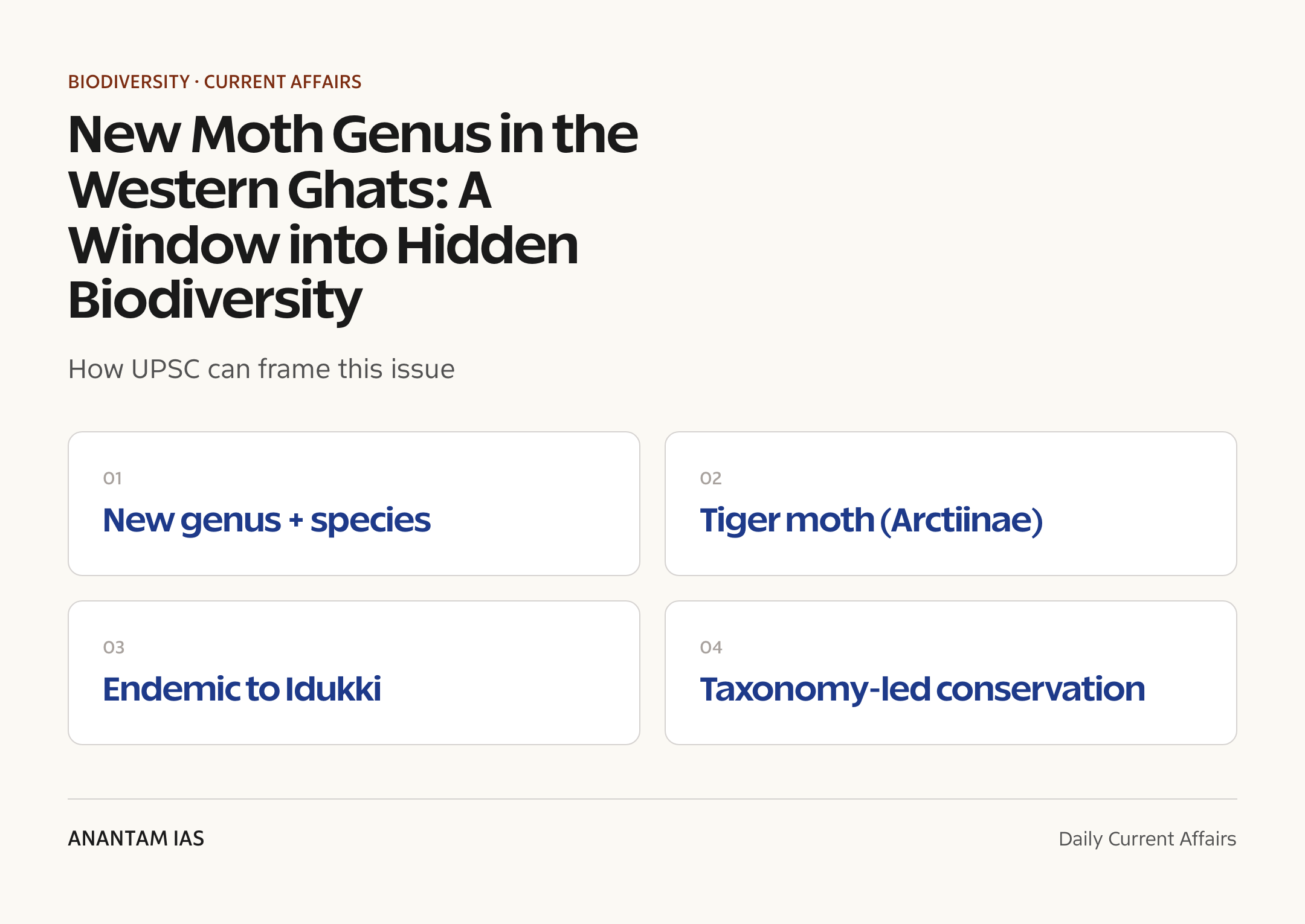
The Western Ghats as a biodiversity hotspot
A narrow green spine that punches far above its size.
- The Western Ghats stretch about 1,600 km along the west coast through six States, intercepting the monsoon and shaping the rainfall of peninsular India.
- They are one of the world’s roughly 36 biodiversity hotspots — regions that are both exceptionally rich in endemic life and exceptionally threatened.
- The hotspot label requires two things: at least 1,500 endemic plant species and the loss of at least 70% of original natural vegetation.
- The Ghats clear both bars comfortably, hosting large numbers of endemic amphibians, fish, reptiles, plants, and invertebrates, alongside flagship endemics like the Malabar large-spotted civet.
- Their age — older than the Himalayas — and varied altitude and rainfall have let isolated lineages evolve in pockets, driving high endemism.
- Insects, especially moths, remain among the least-surveyed groups here, so the true species count is far above what is formally described.
UNESCO status and ecological importance
Global recognition for a region that waters and cools a subcontinent.
- The Western Ghats were inscribed as a UNESCO World Heritage Site in 2012, recognised for outstanding universal value in biodiversity.
- The inscription covers a serial set of protected areas — national parks, wildlife sanctuaries, and reserve forests — spread across the southern States.
- Ecologically, the Ghats are the catchment for major peninsular rivers, regulating water for millions downstream.
- Their forests store carbon, moderate the regional climate, and sustain the monsoon rhythm that agriculture depends on.
- Idukki itself anchors high-range habitats — shola-grassland mosaics and reserves like Eravikulam — that shelter narrow-range endemics.
- Discoveries like Antaram idukki add scientific weight to keeping these landscapes intact rather than fragmented.
Conservation governance: Gadgil vs Kasturirangan
Two reports, two visions, one unresolved debate.
- The Gadgil Committee (Western Ghats Ecology Expert Panel, 2011) proposed treating almost the entire Ghats as ecologically sensitive, graded into three zones with strong local-body (gram sabha) say.
- Critics, especially State governments and some farming communities, called it too restrictive for development and livelihoods.
- The Kasturirangan Committee (2013) scaled back the protected footprint to roughly 37% of the Ghats, focusing on relatively undisturbed ‘natural landscapes’.
- It recommended declaring these as Ecologically Sensitive Areas (ESAs) where polluting and high-impact activities would be curbed.
- Successive draft notifications on the ESA boundary have faced pushback from affected States, leaving the final demarcation long contested.
- The result is a governance gap: scientific value is clear, but the legal protection of much of the Ghats remains incomplete.
Threats and why taxonomy is the first line of defence
You cannot conserve what you have not named.
- The Ghats face habitat loss from plantations (tea, coffee, cardamom), encroachment, dams, mining, quarrying, and linear projects like roads.
- Climate change is shifting the cool, wet high-altitude zones that many endemics — including specialised moths — depend on.
- Fragmentation isolates small populations, raising the risk that a narrow-range species is lost before it is even described.
- Taxonomy — the work of formally describing and classifying species — turns an unknown insect into a documented, trackable unit of biodiversity.
- A named genus can be assessed for conservation status, mapped, and folded into impact assessments and frameworks like the Biodiversity Act, 2002.
- Each description like Antaram idukki makes the abstract case for protecting the Ghats concrete and defensible.
Way Forward
Invest in taxonomy and surveys
- Fund long-term moth and invertebrate inventories across the Ghats, with trained taxonomists and reference collections.
- Build digital, open biodiversity databases so new descriptions feed directly into conservation planning.
Settle the protection framework
- Finalise the Ecologically Sensitive Area boundaries with State consultation rather than indefinite drafts.
- Reconcile the Gadgil and Kasturirangan visions into a workable, livelihood-sensitive zoning that still safeguards core habitats.
Conserve habitats, not just species
- Protect shola-grassland and high-range mosaics in districts like Idukki where narrow-range endemics concentrate.
- Reduce light pollution, pesticide drift, and fragmentation that hit nocturnal pollinators such as moths hardest.
Engage local communities
- Involve gram sabhas and plantation communities as partners, with incentives for habitat-friendly practices.
- Support citizen-science moth monitoring to widen survey coverage and public ownership of the Ghats’ biodiversity.
Conclusion
A single tiger moth from Idukki will not change a balance sheet, but it reframes how we should read the Western Ghats. If a whole new genus could go unnoticed in one of the planet’s most-studied hotspots, the real biodiversity of the Ghats is larger, and more vulnerable, than our records admit.
The lesson for policy is plain. Taxonomy is not an academic luxury but the first step in conservation, and the long-stalled question of how strictly to protect the Ghats cannot wait for every species to be named. Antaram idukki is a small reminder that India is still discovering what it stands to lose.
UPSC Practice Questions
Prelims MCQ 1
With reference to the Western Ghats, consider the following statements:
- They are recognised as both a global biodiversity hotspot and a UNESCO World Heritage Site.
- They are geologically younger than the Himalayas.
- They extend across six Indian States.
How many of the above statements are correct?
(a) Only one (b) Only two (c) All three (d) None
Answer: (b) Only two
Explanation:
Statements 1 and 3 are correct. Statement 2 is wrong: the Western Ghats are older than the Himalayas, not younger.
Prelims MCQ 2
To qualify as a biodiversity hotspot under the standard global criteria, a region must:
(a) Contain at least 500 endemic plant species and any forest cover (b) Have at least 1,500 endemic vascular plant species and have lost at least 70% of its original vegetation (c) Lie entirely within a single country and be a World Heritage Site (d) Host at least 36 endemic mammal species
Answer: (b) Have at least 1,500 endemic vascular plant species and have lost at least 70% of its original vegetation
Explanation:
The two-part criterion combines exceptional endemism (1,500+ endemic vascular plants) with severe threat (70%+ loss of original natural vegetation).
UPSC Mains Questions
- “You cannot conserve what you have not named.” Discuss the role of taxonomy and species inventories in biodiversity conservation, using recent discoveries from the Western Ghats.
- Examine the debate over the conservation governance of the Western Ghats with reference to the Gadgil and Kasturirangan reports and the notification of Ecologically Sensitive Areas.
- How do biodiversity hotspots like the Western Ghats illustrate the link between endemism, ecological services, and conservation priority? Explain.
Source: The Hindu.
Frequently Asked Questions
What exactly was discovered?
A new genus and species of tiger moth, named Antaram idukki, from Kerala’s Idukki district in the southern Western Ghats. It belongs to subfamily Arctiinae in the family Erebidae and is so far known only from that area.
What is the difference between a new genus and a new species?
A species is a single kind of organism; a genus is the rank just above it, grouping closely related species. Describing a new genus means the lineage is distinct enough that no existing genus fits it, which makes the find more significant than a new species alone.
Why are moths ecologically important?
Many moths are pollinators of night-blooming plants, they are a key food source for birds and bats, and they act as indicator species whose decline signals wider environmental change.
Why are the Western Ghats called a biodiversity hotspot?
They meet the two global criteria: at least 1,500 endemic vascular plant species and the loss of at least 70% of their original vegetation. They are also a UNESCO World Heritage Site with very high endemism.
What were the Gadgil and Kasturirangan reports about?
Both advised on protecting the Western Ghats. The Gadgil report (2011) proposed strict protection across most of the range; the Kasturirangan report (2013) limited it to about 37%, recommending Ecologically Sensitive Areas. The final boundaries remain contested.
How does naming a new species help conservation?
A formally described species can be assessed for conservation status, mapped, tracked, and included in environmental impact assessments. Taxonomy turns an unknown organism into a documented unit that policy and law can protect.
Source: https://anantamias.com/current-affairs/western-ghats-new-moth-genus-idukki/