The Republic of Maldives — 1,192 coral islands spread across 90,000 sq km of the Indian Ocean — sits astride some of the world’s busiest shipping lanes. The relationship with India is shaped by proximity (closest point only 70 nautical miles off Minicoy), SAGAR doctrine, and the India-Out campaign that brought President Mohamed Muizzu to power in 2023. By 2024, the Muizzu government had softened the anti-India rhetoric after economic pressure mounted. For UPSC GS II, this file tests small-state politics, Indian Ocean security, and how India manages hostile transitions in the immediate neighbourhood.
Historical context
India recognised Maldives on the day of its independence from Britain in 1965. The turning point was Operation Cactus (November 1988) — India's rapid intervention to crush a coup attempt against President Gayoom; 1,600 Indian paratroopers secured Malé in hours. Since then, India has positioned itself as the security first responder of the Maldives.
Importance of Maldives for India
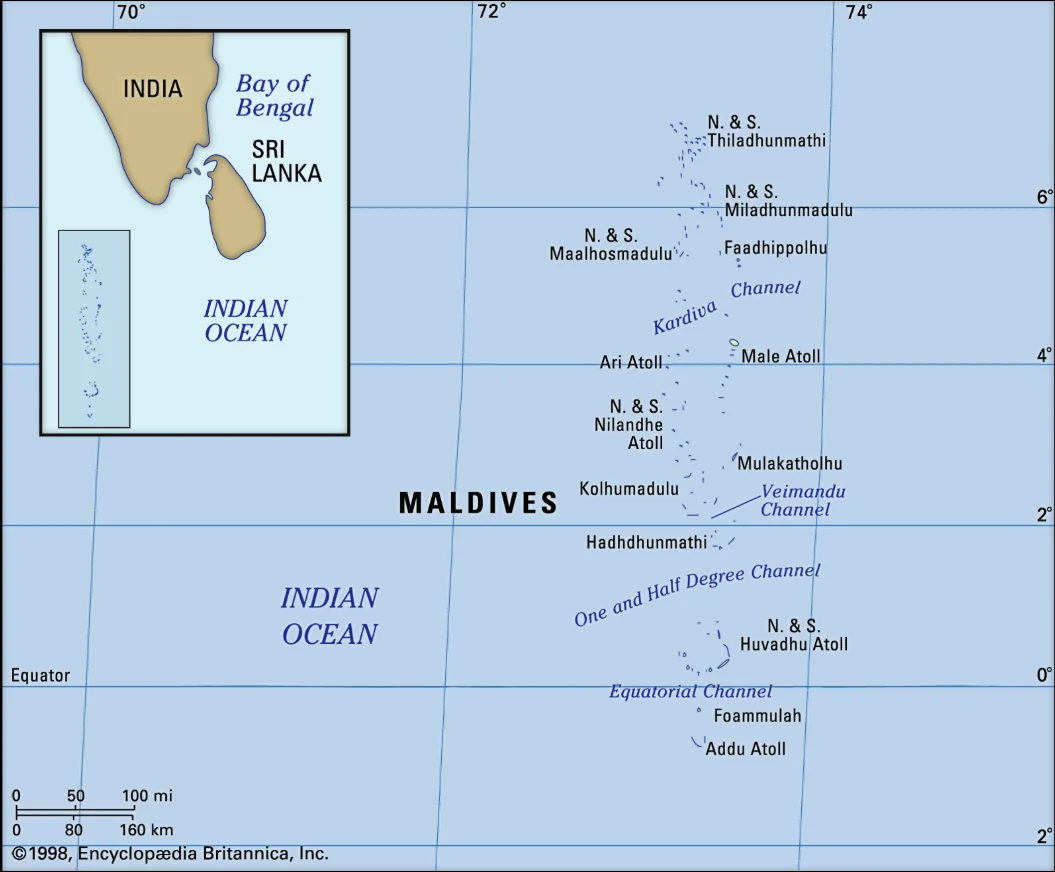
Strategic location
- Proximity to sea lanes carrying nearly half the world's maritime trade.
- Part of the Indian Ocean Region vital to Indian energy imports (80%+ of crude).
Maritime security
- Joint EEZ surveillance and maritime domain awareness.
- Coastal radar network — 10 radars across Maldives integrated with India's coastal chain.
- Dornier aircraft and helicopters gifted and operated jointly.
Defence
- Approximately 70% of Maldivian military training conducted by India.
- Naval exercises Ekuverin (army) and Ekatha.
Economic
- India among Maldives' top trading partners; essential commodities under bilateral quota.
- Infrastructure: housing, airports, hospitals, water projects.
People-to-people
- Tourism — Indian tourists have been among the top arrivals.
- Medical tourism — Maldivians frequent Trivandrum, Chennai, Bengaluru.
- Indian expatriates in Maldivian services.
Multilateral
- SAARC, Colombo Security Conclave (with Sri Lanka, Mauritius).
Recent political shift
Muizzu's election (September 2023)
Mohamed Muizzu, of the People's National Congress (PNC), campaigned on an "India Out" platform — removal of Indian military personnel operating the Dornier aircraft and two helicopters. After winning, he:
- Made China the destination of his first foreign visit (breaking tradition).
- Signed 20 agreements with China, elevated ties to "China-Maldives Comprehensive Strategic Cooperative Partnership".
- Signed first military deal with China for non-lethal equipment and training.
- Permitted a Chinese research/'spy' vessel to dock.
- Visited Turkey as first state visit — adding another axis.
India Out operationalised
By March 2024, all Indian military personnel were replaced by civilian technical experts to continue operating platforms.
Economic pressure
Maldivian foreign reserves collapsed by mid-2024; sovereign default loomed. Chinese concessional debt (USD 1.5 billion) was not waived despite Muizzu's Beijing visit.
Thaw in 2024
Muizzu visited India in August 2024 (after attending Modi's swearing-in in June); a USD 750 million currency swap was agreed. Development assistance raised from ₹400 crore to ₹600 crore in the 2024 budget.
Areas of cooperation
Economic lifelines
India announced highest-ever export quotas for 2024-25: eggs, potatoes, onions, sugar, rice, wheat flour, pulses, river sand, and stone aggregates. Maldives cannot sustain itself without these imports.
Infrastructure
- Greater Malé Connectivity Project — USD 500 million LoC + USD 100 million grant; 6.74 km bridge and causeway connecting Malé, Villingilli, Gulhifalhu, Thilafushi.
- Hanimaadhoo Airport expansion.
- Water and sewerage projects across 34 islands.
Digital
UPI rollout discussion; RuPay card tie-ups; health and education exchanges.
Colombo Security Conclave
India, Sri Lanka, Maldives, Mauritius — Bangladesh and Seychelles as observers. Agenda: maritime security, counter-terrorism, cyber, transnational crime.
Points of friction
China factor
- Belt and Road Initiative loans for airport expansion, housing, bridges.
- Sinamalé Bridge (China-Maldives Friendship Bridge) opened 2018.
- March 2024 defence pact with China.
Turkey's role
Muizzu's first state visit to Turkey. Turkey supplies drones to Maldives and has been active in South Asian diplomacy (Pakistan-leaning on Kashmir).
Radicalisation
Growing Wahhabi influence; Maldivian foreign fighter presence in Syria; ISIS/Daesh sympathy in some islands. India watches this closely.
Indian Consulate in Addu
Proposed consulate in Addu City faced a social media backlash (#saveAddu); Maldivian government yet to formally approve.
Way forward
Respecting sovereignty
India's approach post-2023: less military footprint, more civilian development assistance. Avoid the "big brother" framing.
Economic partnership over subsidy
Move from quotas and LoCs to trade agreements, investment, tourism flows.
Colombo Security Conclave activation
Use the CSC for maritime domain awareness, cyber, and narcotics.
Diaspora welfare
Ensure Indian workers in Maldives — in tourism, construction, healthcare — are treated well.
Engage plural political spectrum
Don't rely on one party; maintain links across Maldivian political factions (MDP, PNC, JP).
Latest developments (2024-26)
- Muizzu India visit (October 2024) — full state visit; USD 750 million currency swap operationalised; strategic partnership language revived.
- Muizzu attended Modi's swearing-in (June 2024) — first foreign policy thaw.
- Indian military withdrawal (March 2024) — replaced by civilian technical crew.
- G20 New Delhi (2023) — Maldives invited; cooperation on digital public infrastructure.
- Quad Summit Wilmington (2024) — Indo-Pacific maritime focus.
- BRICS expansion (2024) — Maldives has not applied.
- Red Sea crisis — hit Maldives tourism; sharpened regional maritime security cooperation.
- Israel-Hamas conflict — Maldives banned Israeli passport holders (2024), creating a minor bilateral moment with India.
- Russia-Ukraine update — Maldives maintained moderate UN stance.
- AI Action Summit Paris (2025) — Maldives engaged via digital public goods agenda.
- Operation Sindhu Thakur style NEOs — Maldivian diaspora covered.
- UPI launch in Maldives planned for 2025-26.
- Chinese spy ship episodes recurring; India monitoring port visits closely.
Key Maldivian political movements
| Party | Orientation | Stance on India |
|---|---|---|
| MDP (Maldivian Democratic Party) | Liberal-democratic | India-friendly (Nasheed, Solih) |
| PNC (People's National Congress) | Nationalist, religious-conservative | India-Out under Muizzu (softening 2024) |
| JP (Jumhooree Party) | Centrist | Balanced |
| Adhaalath Party | Religious | Anti-India rhetoric |
India's approach engages all mainstream parties, recognising that Maldivian politics swings every five years.
India's toolkit for small-state diplomacy
Maldives illustrates India's small-state playbook:
- Immediate security response (Operation Cactus template).
- Economic lifelines during crisis (quotas, swaps, LoCs).
- Development projects with visible outcomes (bridges, airports, hospitals).
- People-to-people (tourism, medical, education).
- Strategic presence without overt base politics.
- Plural political engagement — not one party.
- Accept political swings as natural; respond pragmatically.
Operation Cactus and the security template
When President Maumoon Abdul Gayoom's government faced a coup attempt by Sri Lankan Tamil mercenaries in November 1988, India launched Operation Cactus — 1,600 paratroopers airlifted by IAF IL-76s from Agra to Malé within 9 hours. The operation became the template for India as the first responder in the Indian Ocean. It has been invoked in subsequent incidents (2004 tsunami relief, 2014 Malé water crisis when India airlifted bottled water within hours).
Colombo Security Conclave
Members: India, Sri Lanka, Maldives, Mauritius. Observers: Bangladesh, Seychelles. Agenda areas: maritime security, counter-terrorism, trafficking, cyber security, HADR. Secretariat planned in Colombo. The CSC is India's most evolved plurilateral in the IOR — a quieter cousin of the Quad.
Maldives economic profile
| Sector | Share of GDP |
|---|---|
| Tourism (direct + indirect) | ~28% |
| Fisheries | 4% |
| Transport | 10% |
| Public sector | ~20% |
Tourism is highly India-dependent — Indian arrivals ranged from 1,50,000 to 2,50,000 per year pre-India-Out campaign; numbers fell in 2024 before recovering late in the year.
Critical infrastructure projects
- Greater Malé Connectivity Project (GMCP) — bridge + causeway linking Malé, Villingilli, Gulhifalhu, Thilafushi; USD 500 million LoC + USD 100 million grant.
- Hanimaadhoo International Airport expansion.
- National College for Policing and Law Enforcement — India-built.
- Water and sewerage projects across 34 islands.
- Coastal radar system — 10 radars integrated with Indian network.
UPSC Relevance
India-Maldives is a GS II topic — India and its neighbourhood, effect of policies of neighbours on India's interests. Prelims has asked about Operation Cactus, SAGAR, and Colombo Security Conclave. Mains prompts focus on the India Out campaign, China's role, and India's recovery of relations in 2024.
Practice question (Mains): "In small states, domestic politics can redraw foreign policy overnight." Examine India's response to the political transition in Maldives since 2023. (250 words)
Tell Google you want more of this.
Add Anantam IAS as a preferred sourceOne tap, and this site shows up more often in your own Top Stories, AI Overviews and AI Mode. Remove it any time.