Monthly Digest
UPSC · Civil Services Examination
Current Affairs · January 2025
Current affairs curated and edited by Anantam IAS faculty — pulled from The Hindu, PIB, IDSA, Foreign Affairs and the ministries. Read, annotate, revise.
Old Rajinder Nagar · Delhi 110005 · anantamias.com
Cabinet extends one-time special DAP package beyond NBS from 01.01.2025
Why in News?
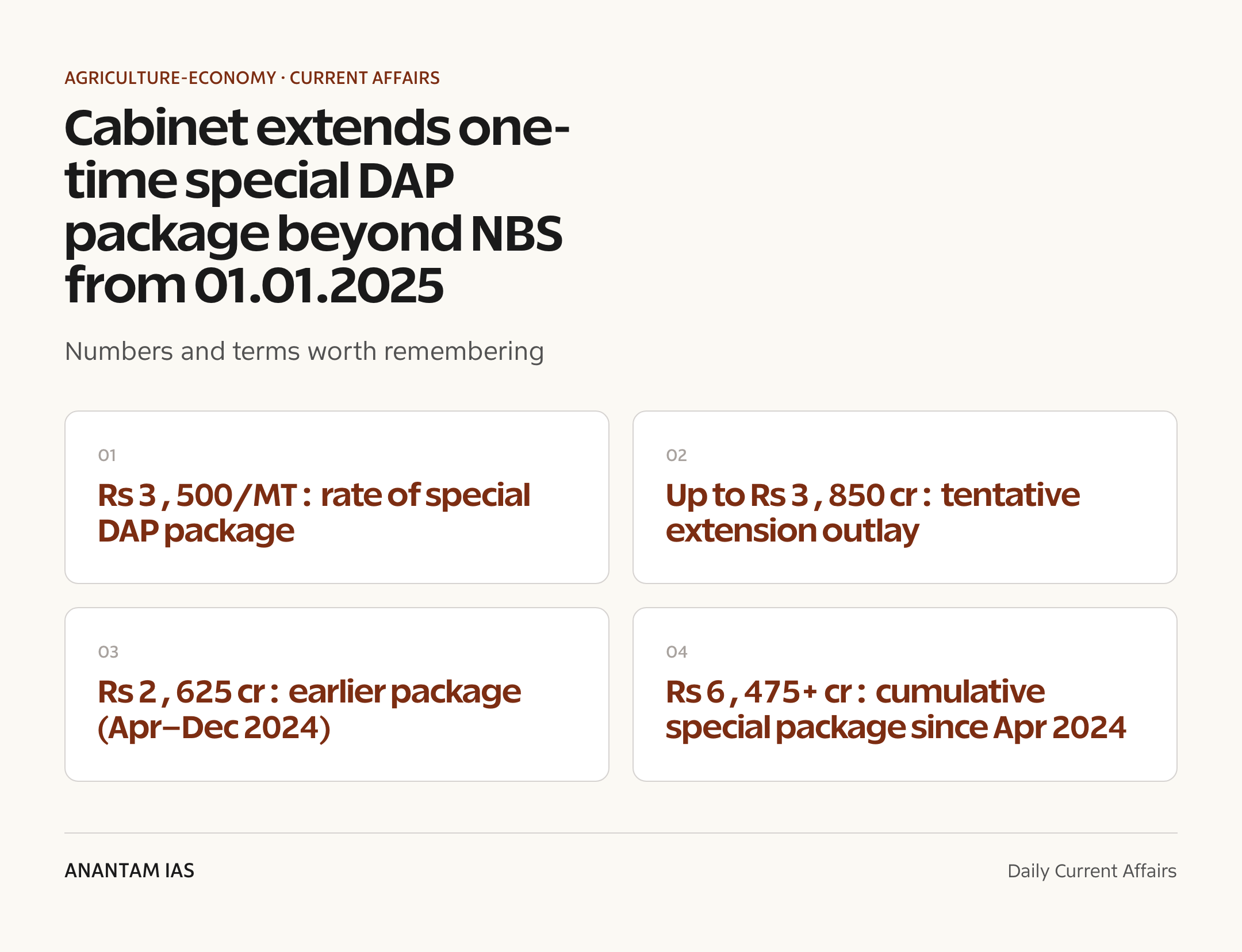
The Union Cabinet approved an extension of the One-time Special Package for Di-Ammonium Phosphate (DAP) beyond the Nutrient Based Subsidy (NBS) regime at Rs 3,500 per metric tonne, effective from 01.01.2025 until further orders. The decision aims to secure availability of DAP at affordable prices for farmers during the ongoing cropping cycles and to stabilise the fertiliser market against global supply and price shocks.
The extension carries a tentative additional budgetary requirement of up to Rs 3,850 crore. This builds on an earlier one-time special package that covered 01.04.2024–31.12.2024 and raises the cumulative special support on DAP since April 2024 to more than Rs 6,475 crore. The move has immediate implications for agricultural input costs, procurement and distribution logistics ahead of Kharif and Rabi seasons, and for short-run fiscal planning.
- Policy decision: Extension of the special DAP package to continue over and above NBS subsidy from 01.01.2025.
- Fiscal element: Tentative additional budgetary requirement up to Rs 3,850 crore for the extended period.
- Farmer impact: Keeps retail DAP prices stable and predictable across sowing windows, reducing input cost stress.
- Market signal: Government intervention to manage import-linked price shocks and ensure uninterrupted supply.
- Aggregate relief: Total special package for DAP since April 2024 now exceeds Rs 6,475 crore, reflecting recurring short-term support.
The development matters in the context of:
- NBS framework: Nutrient Based Subsidy (NBS) has been the primary mechanism for P&K fertiliser subsidies since 01.04.2010 and specifies nutrient-wise subsidy rates paid to manufacturers and importers.
- Earlier special package: Cabinet had approved a one-time special DAP package at Rs 3,500/MT for 01.04.2024–31.12.2024 with an estimated outlay of Rs 2,625 crore to mitigate 2024 price volatilities.
- Supply risk: Global geopolitical tensions and volatility in commodity markets in 2024 raised import prices and threatened domestic availability of DAP, prompting emergency fiscal support.
- Coverage: Under NBS, 28 grades of P&K fertilisers are covered and supplied to farmers through manufacturers and importers; the special package targets DAP specifically.
- Implementation: The special support is paid over and above NBS rates to manufacturers/importers so that retail prices remain unchanged for farmers until further orders.

UPSC Relevance
Prelims Relevance
- Nutrient Based Subsidy (NBS) scheme details and its start date (01.04.2010).
- Role and nutrient profile of DAP (Di-Ammonium Phosphate) as a phosphate and nitrogenous fertiliser used widely in Indian cropping systems.
- Specifics of the Cabinet decision: special support of Rs 3,500 per MT and tentative outlay up to Rs 3,850 crore for the extension period.
Mains Relevance
GS3 Economy
- Assess implications of input subsidies on agricultural productivity, resource use efficiency and fiscal balance.
- Analyse pros and cons of episodic fiscal interventions versus structural reforms in fertiliser policy and supply chains.
- Discuss policy options for ensuring affordable, efficient and sustainable fertiliser supplies, including targeting, domestic capacity enhancement and nutrient management.
Essay
- Can be used as empirical evidence in essays on state support to agriculture, public finance trade-offs, market interventions during crises and long-term institutional reforms.
- Useful when discussing food security linkages, agricultural price policies and the transition from universal subsidies to targeted welfare mechanisms.
Background and Context
NBS scheme basics
Structure, intent and operational mechanics of the Nutrient Based Subsidy regime.
- Launch date: NBS has been in operation since 01.04.2010 as a replacement for earlier concession-based subsidy systems.
- Mechanism: The scheme prescribes fixed subsidy rates per kg for major nutrients (N, P, K), paid to fertiliser manufacturers/importers to keep retail prices steady.
- Objective: Encourage rationalisation of subsidies across fertiliser grades and enable differentiated pricing by nutrient content.
- Administration: Ministry of Chemicals & Fertilizers sets NBS rates periodically based on input costs, with payments routed to producers/importers.
DAP in Indian agriculture
Why Di-Ammonium Phosphate is critical to cropping and how demand patterns shape policy choices.
- Nutrient profile: DAP provides phosphorus and a portion of nitrogen; phosphorus is essential for root development and early crop growth.
- Crop usage: Widely used across cereals, oilseeds and horticulture; demand peaks before sowing in Kharif and Rabi seasons.
- Supply pattern: Domestic capacity exists but India imports significant quantities of phosphoric raw materials and finished DAP depending on global prices.
- Price sensitivity: Domestic retail prices link to international phosphoric acid and rock phosphate markets; supply disruptions can quickly affect farmer access.
Reasons for the one-time special package
Immediate drivers that led the government to offer additional support beyond NBS.
- Global price shocks in 2024 raised input costs for DAP manufacturers and importers, threatening retail price increases.
- Short-term policy gap: NBS rates may not have fully shielded farmers from sudden international market moves during the cropping season.
- Food security risk: Elevated fertiliser prices risked lower application rates and potential yield loss if left unchecked.
- Political economy: Protecting farmer incomes and sowing decisions ahead of key seasons is a high priority for governments during stress periods.
Fiscal implications and scale
How episodic support affects government budgets and planning.
- Estimated cost: The January 2025 extension carries a tentative additional requirement up to Rs 3,850 crore.
- Cumulative outflow: Combined with earlier measures since April 2024, total special support on DAP exceeds Rs 6,475 crore.
- Budget trade-offs: Recurring emergency measures compress fiscal space for other programmes if not offset by savings or revenue measures.
- Contingent planning: Repeated extensions necessitate clearer contingency provisions in budgetary frameworks for commodity-linked subsidies.
Supply chain and implementation dynamics
Operational aspects of keeping fertiliser available at farm gates.
- Channel payments: Subsidy payments are routed to manufacturers/importers to bridge gap between landed costs and retail price caps.
- Distribution timing: Stocks and logistics must be aligned with sowing windows to prevent local shortages even when national supplies are adequate.
- Monitoring needs: Timely data on allocations, offtake and retail availability is necessary to prevent diversion and hoarding.
- Quality controls: Ensuring genuine, standard-grade DAP reaches farmers requires inspection and grievance redress mechanisms.
Alternatives and long-term considerations
Policy pathways to reduce recurring fiscal dependence while securing farmer access.
- Targeting: Direct Benefit Transfer (DBT) mechanisms to channel support only to eligible farmers can save resources.
- Balanced nutrition: Promote soil testing and balanced fertilisation to reduce over-reliance on single fertiliser grades like DAP.
- Domestic investments: Encourage capacity building in phosphate rock processing, phosphoric acid production and recycling of nutrients.
- Market instruments: Use strategic buffer stocks and price-linked triggers for temporary support instead of open-ended subsidies.
Way Forward
Design clearer time-bound rules
Set explicit criteria and review timelines for any future extensions.
- Institute periodic market reviews linked to international price indices and domestic availability metrics to decide extensions.
- Announce sunset clauses and phased exit strategies to avoid open-ended fiscal commitments.
- Develop contingency protocols that tie emergency support to measurable supply disruptions or price thresholds.
Move towards better targeting
Reduce universal fiscal outgo by focusing support where it is most needed.
- Pilot DBT for fertiliser users in high-need regions to evaluate leakage reduction and administrative feasibility.
- Design differentiated support for smallholders and marginal farmers who are most price-sensitive.
- Leverage Aadhaar–land records–soil health card data to deliver targeted assistance while protecting legitimate entitlements.
Strengthen domestic supply and resilience
Reduce exposure to global shocks through capacity and market interventions.
- Provide incentives for phosphate rock exploration and processing to reduce import dependence over the medium term.
- Encourage public–private investment in DAP manufacturing and storage infrastructure to smooth seasonal bottlenecks.
- Promote nutrient recycling technologies and use of indigenous phosphate alternatives where agronomically viable.
Promote efficient nutrient management
Address demand-side factors to lower subsidy dependency sustainably.
- Scale up soil health cards, micro-nutrient advisories and farm-level soil testing to guide balanced fertiliser use.
- Support extension and precision farming tools that optimize dose and timing of fertiliser application.
- Link incentive programmes for balanced nutrient application with credit and crop insurance schemes to encourage adoption.
Conclusion
Immediate objective: The extension preserves DAP affordability and availability for farmers during critical cropping periods by providing an additional Rs 3,500/MT over NBS until further orders.
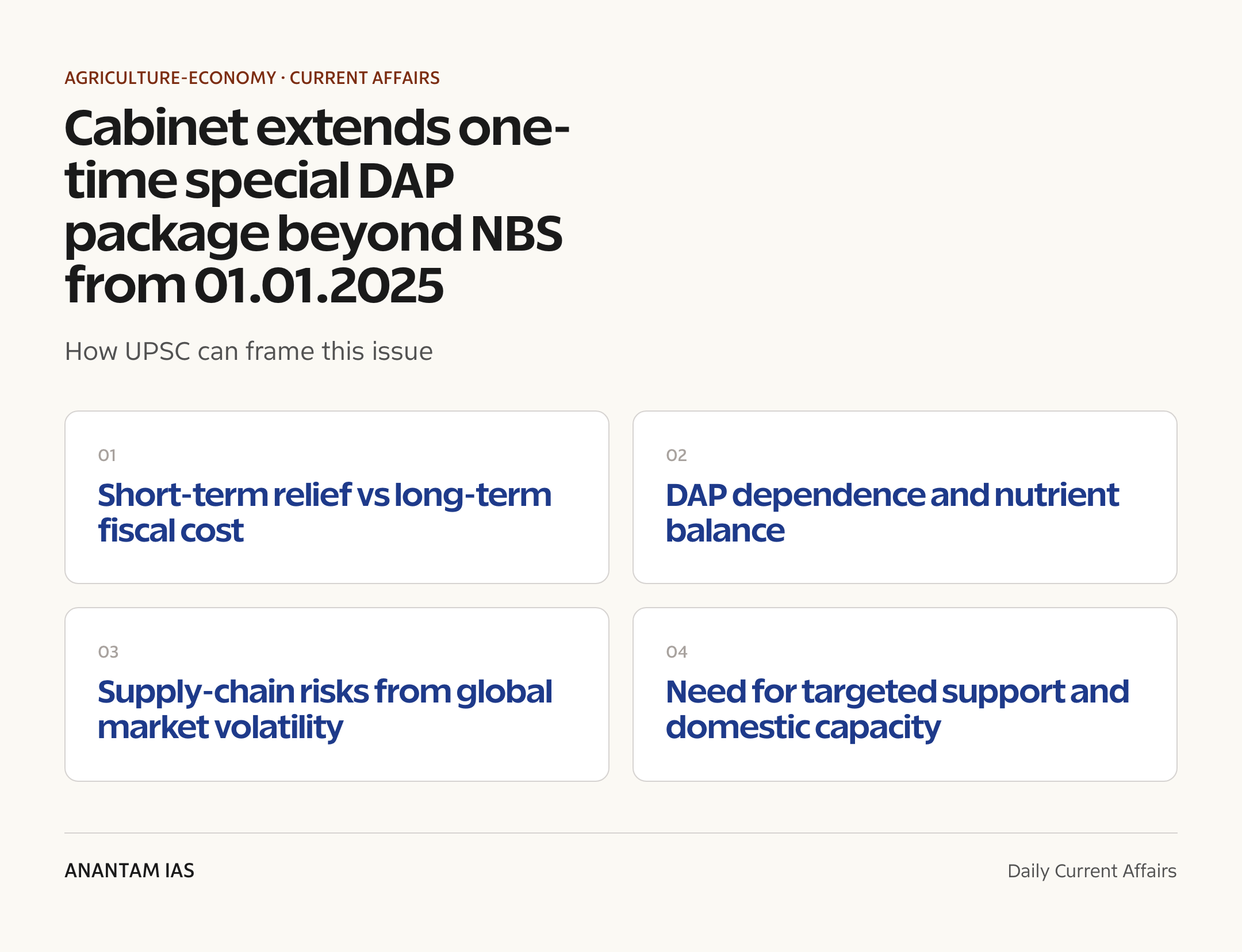
Trade-offs: While short-term relief reduces risks of input underuse and protects cropping decisions, recurrent extensions raise questions about fiscal sustainability, market distortions and long-term resilience of domestic supply chains.
Policy message: Emergency interventions should be paired with clearer exit rules, targeted delivery mechanisms and investments in domestic capacity and nutrient management to reduce the need for repeated fiscal support.
UPSC Practice Questions
Prelims MCQ 1
The Nutrient Based Subsidy (NBS) scheme for P&K fertilisers in India was introduced in which year?
(a) 2005 (b) 2010 (c) 2015 (d) 2020
Answer: (b) 2010
Explanation:
NBS for P&K fertilisers has been in effect since 01.04.2010. The scheme replaced earlier subsidy mechanisms and prescribes nutrient-wise subsidy rates paid to manufacturers and importers.
Prelims MCQ 2
The Cabinet approval on 01.01.2025 extended a one-time special package on DAP at what rate over and above NBS?
(a) Rs 1,500 per MT (b) Rs 2,500 per MT (c) Rs 3,500 per MT (d) Rs 4,500 per MT
Answer: (c) Rs 3,500 per MT
Explanation:
The extension continues the special DAP package at Rs 3,500 per metric tonne over and above the NBS subsidy, aimed at keeping retail prices stable for farmers.
UPSC Mains Questions
- {‘question’: ‘Examine the economic and fiscal implications of providing recurrent fertilizer subsidies such as the extended one-time DAP package. Suggest reforms to balance farmer support and fiscal sustainability.’, ‘model_answer_points’: [‘Economic effects: Subsidies reduce input prices and can boost short-term fertiliser use, agricultural output and farmer incomes; they also support planting decisions in stress periods.’, ‘Market distortions: Price support can bias nutrient choice, encourage inefficient use and retard adoption of integrated nutrient management practices.’, ‘Fiscal burden: Recurrent episodic support increases subsidy outgo, constrains budgetary space for other rural investments and complicates fiscal planning.’, ‘Leakage and targeting: Universal subsidies risk diversion to non-target users; targeted transfers and improved delivery systems can enhance efficiency.’, ‘Reforms: Transition to targeted DBT pilots, link temporary support to transparent triggers, incentivise balanced fertilisation and invest in domestic production capability.’, ‘Implementation: Strengthen monitoring with public disclosure of allocation and offtake data, set market-linked review mechanisms and prepare phased exit pathways.’]}
- {‘question’: ‘Discuss the role of central government interventions in stabilising agricultural input markets. Use the DAP special package extension as an example to illustrate short-term and long-term policy trade-offs.’, ‘model_answer_points’: [‘Stabilisation role: Central interventions can avert acute shortages, prevent price spikes and maintain cropping intensity, thereby safeguarding food production.’, ‘Short-term benefits: Immediate affordability and predictability of input prices reduce risk aversion among farmers and support yields in vulnerable seasons.’, ‘Long-term trade-offs: Prolonged state support can crowd out private investment, create dependency and impose recurring fiscal costs that may be unsustainable.’, ‘Case illustration: The DAP extension prevented price-driven cutbacks in fertiliser use in 2024–25, but repeated measures signal the need for structural steps such as capacity building and targeted delivery.’, ‘Policy synthesis: Combine emergency support with reforms—promote domestic supply, precision nutrient management, targeted transfers and transparent exit criteria to optimise outcomes.’]}
Sources: PIB, Cabinet Secretariat and PIB, Ministry of Chemicals & Fertilizers.
Frequently Asked Questions
q
a
q
a
q
a
q
a
q
a
q
a
Source: https://anantamias.com/current-affairs/dap-subsidy-extension-2025/
Ministry of Defence declares 2025 as Year of Reforms
Why in News?
On the eve of the New Year, Raksha Mantri chaired a meeting of all MoD Secretaries and the Ministry resolved to observe 2025 as its ‘Year of Reforms’. The declaration creates a concentrated policy window to accelerate ongoing modernisation efforts across organisational structures, procurement systems and the defence industrial ecosystem.
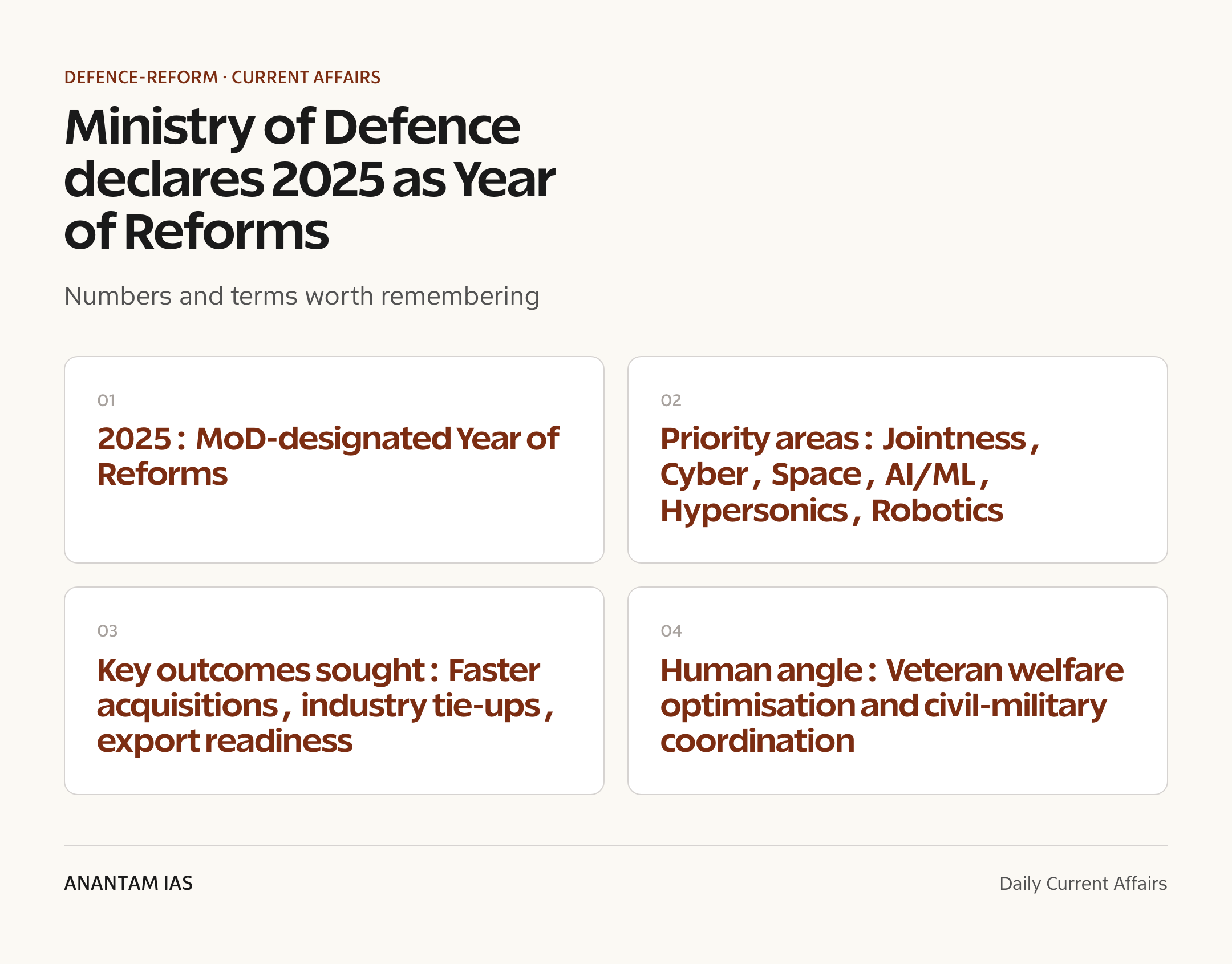
The initiative identifies a cluster of priority interventions — strengthening jointness through Integrated Theatre Commands, operationalising new domains such as cyber and space, prioritising emerging technologies (AI/ML, hypersonics, robotics), simplifying acquisitions, encouraging public-private partnerships and improving veteran welfare. The move signals an administrative attempt to align doctrine, resources and industry over a clearly defined timeframe.
- Official policy signal: The MoD has designated a calendar year to concentrate administrative energy and political will on defence reform, which helps focus leadership attention and resource allocation.
- Priority areas identified: Jointness and Integrated Theatre Commands; operational capacity in cyber and space; investment in AI/ML, hypersonics and robotics; doctrinal updates to match technological change.
- Procurement and industry push: Commitment to simplify acquisition procedures, promote technology transfer, incentivise public-private partnerships and improve ease of doing business to accelerate capability delivery and export readiness.
- Human and institutional aspects: Emphasis on veteran welfare, utilising ex-servicemen expertise, breaking silos across stakeholders and strengthening civil-military coordination to reduce duplication and optimise resources.
The development matters in the context of:
- Modernisation backlog: Indian Armed Forces are engaged in a long-running modernisation cycle; many platforms and systems need replacement or augmentation, and procurement delays have affected force preparedness.
- Integrated Theatre Commands: A structural reform intended to create unified command for theatre-level operations, requiring changes to command-and-control, logistics and legal frameworks.
- New operational domains: Cyber and space have become essential to contemporary warfare; developing doctrine, persistent capabilities and resilient systems is a strategic imperative.
- Emerging tech centrality: AI/ML, hypersonics and robotics are expected to transform combat dynamics; bridging R&D to production is essential for operational utility.
- Defence industrial base: ‘Make in India’ objectives and export ambitions demand regulatory ease, quality assurance, supply-chain integration and international partnerships.
- Procurement bottlenecks: Complex approval chains, protracted trials and unclear vendor engagement processes have contributed to delays and cancellations in defence projects.

UPSC Relevance
Prelims Relevance
- Facts to remember: 2025 designated by MoD as ‘Year of Reforms’ to focus on jointness, new domains, acquisitions and industry tie-ups.
- Key terms and concepts: Integrated Theatre Commands, public-private partnership (PPP), technology transfer, defence exports, AI/ML in defence.
Mains Relevance
GS3 Economy
- Governance and public administration: Demonstrates how the executive uses focused timelines to push cross-cutting reforms and the administrative machinery required to implement sectoral change.
- Industrial policy and trade: Links defence industrial policy with ease of doing business, incentives for domestic production and export promotion; useful for analysing industrial strategy and trade implications.
- Science & technology and national security: Illustrates the strategic integration of emerging technologies into national security planning and the policy levers needed to transition R&D into fielded capabilities.
Essay
- Themes: Modernisation of the armed forces, technology and national power, civil-military relations, administrative reform and industry-state relations.
- Use in essays: Can be cited as a recent example of targeted administrative focus to accelerate sectoral reform, and to discuss the interplay between policy intent and execution challenges in large public organisations.
Background and Context
Why a Year-based push
A time-bound declaration aims to create momentum and internal accountability within MoD and services.
- Concentrated timelines generate measurable milestones, which can be tracked through quarterly reviews and performance indicators.
- Political and administrative visibility can help resolve inter-departmental blockages and prioritise funds in budgetary cycles.
- Task forces and dedicated cells can be constituted to break complex reforms into implementable packages with assigned timelines.
- A single-year focus helps test pilot reforms and produce implementation templates for scaling up in subsequent years.
- Public reporting, where appropriate, can create external accountability and reduce information asymmetry with stakeholders.
Integrated Theatre Commands
An institutional change aimed at improving joint operational capability and faster decision-making in theatres of operation.
- Objective is to unify command of land, sea and air assets under theatre commanders for theatre-specific strategy and operations.
- Operational prerequisites include shared logistics, joint intelligence, common planning systems and interoperable communications.
- Administrative measures needed: transfer of assets, funding realignment, personnel policies and changes to service-specific command prerogatives.
- Risks include institutional resistance from services protective of domain-specific identities and redistribution of resources.
- A phased implementation with pilot commands, legal clarifications and doctrinal publications reduces friction and operational disruption.
Operationalising cyber and space
New domains need tailored organisational structures, doctrine and resilient infrastructure.
- Space requirements include persistent situational awareness, resilient satellite communications and space situational awareness capabilities.
- Cyber needs include defensive posture, offensive options with legal oversight, and integration with conventional operations for real-time support.
- Doctrine must clarify attribution thresholds, rules of engagement and escalation control in non-kinetic theatres.
- Human capital pipelines should be created through specialised training institutes, lateral recruitment and civil-military exchanges.
- Procurement pathways should favour rapid fielding of modular, upgradable systems to keep pace with short technology cycles.
Emerging technologies: AI, hypersonics and robotics
These technologies are force multipliers but require systems-level integration and governance.
- Research must move beyond prototype to certified platforms with clear test-and-evaluation regimes and interoperability standards.
- Supply chains for critical components (sensors, semiconductors, composites) must be secured through domestic capacity and trusted imports.
- Legal, ethical and operational frameworks should guide use of autonomy, human oversight and fail-safe mechanisms.
- Collaboration between DRDO, academia, startups and industry will accelerate transition from lab to operational use.
- Investments in simulation, digital twins and live testing ranges are necessary to validate systems under realistic conditions.
Acquisition reform and industry linkages
Faster, transparent procurement can incentivise domestic manufacturing and global competitiveness.
- Simplified procurement rules and fast-track clearances for critical projects can reduce cycle times and cost overruns.
- Pre-qualification frameworks and strategic vendor lists for key technologies can shorten tendering while maintaining oversight.
- PPP models and technology transfer clauses can help scale production and embed industrial capability domestically.
- Export promotion requires quality assurance, lifecycle support mechanisms and diplomatic initiatives to open markets.
- Standards alignment with global systems and participation in international supply chains will increase supplier credibility.
Veteran welfare and civil-military coordination
Retaining institutional knowledge and ensuring social compact with veterans strengthens human resources and societal trust.
- Optimising pensions and healthcare delivery is part of social justice and reduces administrative burden through digitisation.
- Structured programs to place veterans in training, maintenance, manufacturing and R&D roles can channel experience into capability building.
- Civil-military coordination improvements can reduce duplication of infrastructure and improve disaster-response synergy.
- Leveraging veteran expertise in doctrine development and institutional training can bridge operational requirements and industry needs.
- Transparent grievance redressal and stakeholder consultations help maintain morale and public confidence.
Way Forward
Governance and accountability
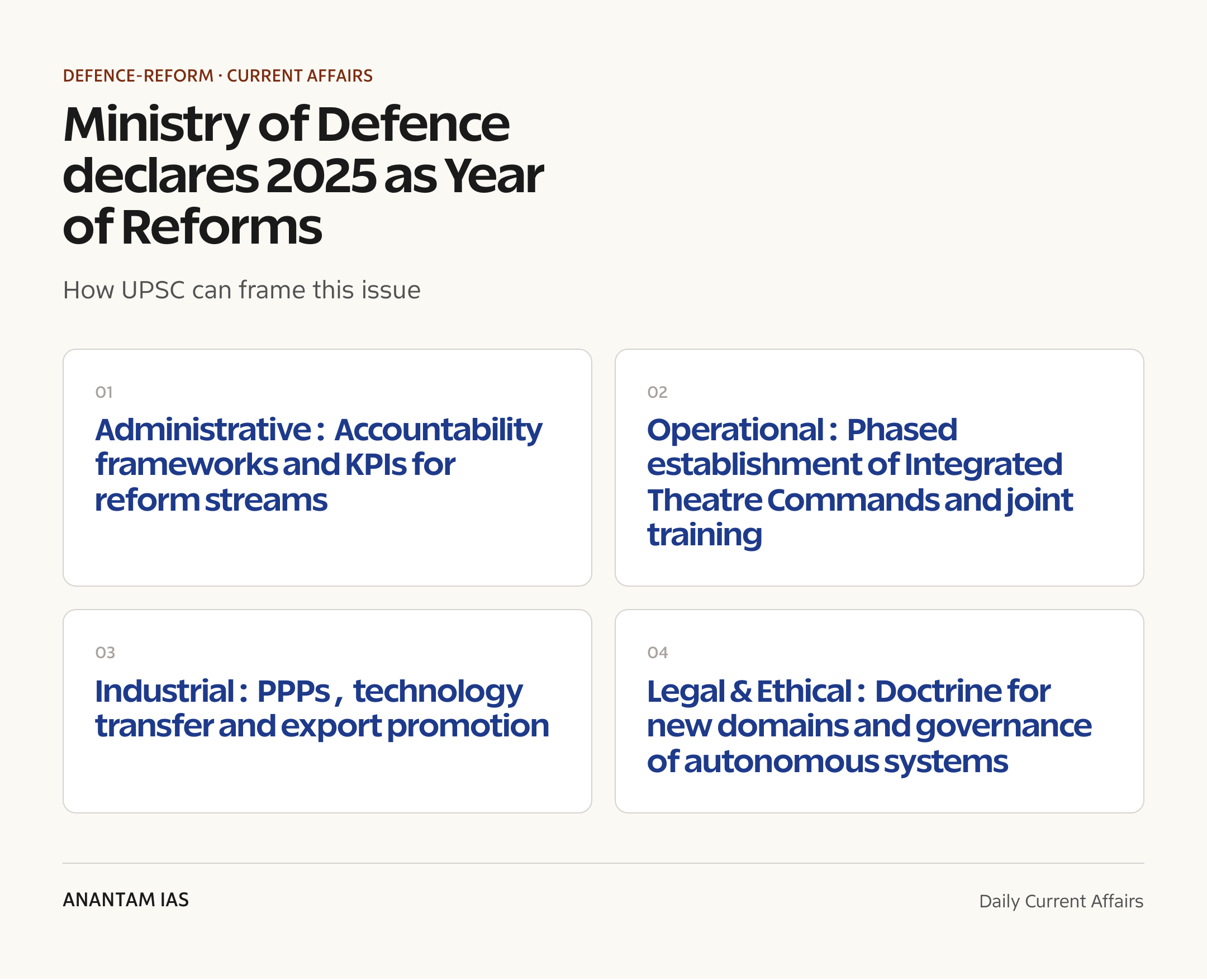
- Set measurable KPIs for each reform stream with quarterly reviews by an empowered steering committee.
- Publish periodic progress reports to build stakeholder confidence and enable course correction.
- Create cross-functional task forces with clear mandates, deliverables and sunset clauses to avoid permanent bureaucratic expansion.
Acquisition and industrial incentives
- Fast-track acquisition paths for critical technologies with pre-qualified vendor lists and fixed evaluation timelines.
- Offer targeted fiscal incentives, concessional financing and procurement preference tied to technology transfer and export milestones.
- Encourage clustering of defence MSMEs and anchor large orders to create scalable supply chains and quality standards.
Operational and doctrinal measures
- Establish joint centres of excellence for cyber and space with pooled funding and integrated staffing.
- Pilot Integrated Theatre Commands in selected regions with monitored performance metrics before national rollout.
- Develop doctrinal handbooks for AI and autonomous systems specifying human-in-loop mandates and escalation protocols.
Human capital and veterans
- Create lateral recruitment channels for specialists from industry and academia, supplemented by in-service training.
- Launch veteran integration programs linking ex-servicemen to training roles, maintenance contracts and industry placements.
- Invest in education partnerships to build a pipeline of engineers and technologists attuned to defence requirements.
Conclusion
The ‘Year of Reforms’ is a clear policy intent by MoD to accelerate cross-cutting modernisation, but success will depend on follow-through, institutional incentives and measurable delivery against timelines.
If reforms are synchronised across doctrine, procurement and industry while safeguarding operational readiness, India can achieve meaningful improvements in jointness, technology adoption and defence industrial capacity with positive spillovers for exports and strategic autonomy.
UPSC Practice Questions
Prelims MCQ 1
Which of the following is a declared focus area in the MoD’s 2025 ‘Year of Reforms’?
(a) Privatisation of the Indian Army (b) Development of Integrated Theatre Commands (c) Abolition of defence exports policy (d) Complete civilianisation of defence R and D
Answer: (b) Development of Integrated Theatre Commands
Explanation:
The MoD announcement explicitly lists strengthening jointness and facilitating establishment of Integrated Theatre Commands as a priority. Options (a), (c) and (d) do not reflect the content of the press release and are not part of the declared agenda.
Prelims MCQ 2
The MoD’s 2025 reforms explicitly list which technological domains for attention?
(a) Artificial Intelligence, Machine Learning, Hypersonics and Robotics (b) Quantum computing, Blockchain, 3D printing and Bioengineering (c) Nuclear propulsion, Coal gasification, Traditional artillery modernization (d) None of the above
Answer: (a) Artificial Intelligence, Machine Learning, Hypersonics and Robotics
Explanation:
The press release names AI, ML, hypersonics and robotics among the emerging technologies to be focussed on during the Year of Reforms. The other choices include technologies not listed in the announcement or are unrelated.
UPSC Mains Questions
- {‘question’: ‘Examine the likely administrative and doctrinal challenges in establishing Integrated Theatre Commands in India and suggest measures to address them.’, ‘guidance’: ‘Discuss inter-service rivalry, allocation of assets, command and control, logistics, legal frameworks and propose institutional reforms, phased implementation and legislative or policy adjustments.’}
- {‘question’: ‘Assess how prioritising new domains such as cyber and space in defence reforms would alter India’s strategic posture. What policy steps are required to operationalise these domains?’, ‘guidance’: ‘Cover capability development, doctrine, international norms, resource allocation, human capital and inter-agency coordination.’}
Sources: PIB, Ministry of Defence and PIB, Indian Navy commissioning release (context).
Frequently Asked Questions
q
a
q
a
q
a
q
a
q
a
Source: https://anantamias.com/current-affairs/defence-year-of-reforms-2025/
Indian Telecom Services Performance Indicator Report: Q2 July–Sept 2024
Why in News?
The Telecom Regulatory Authority of India (TRAI) has released its quarterly “Indian Telecom Services Performance Indicator Report” for the period 1 July to 30 September 2024. The report compiles sector-wide metrics on mobile and broadband subscribers, quality of service (QoS) parameters, complaint statistics and broadcasting service indicators (Cable TV, DTH and radio). It is a routine release, but one that carries fresh empirical inputs used by policymakers, regulators, market analysts and civil-society stakeholders to gauge the health of India’s digital infrastructure.
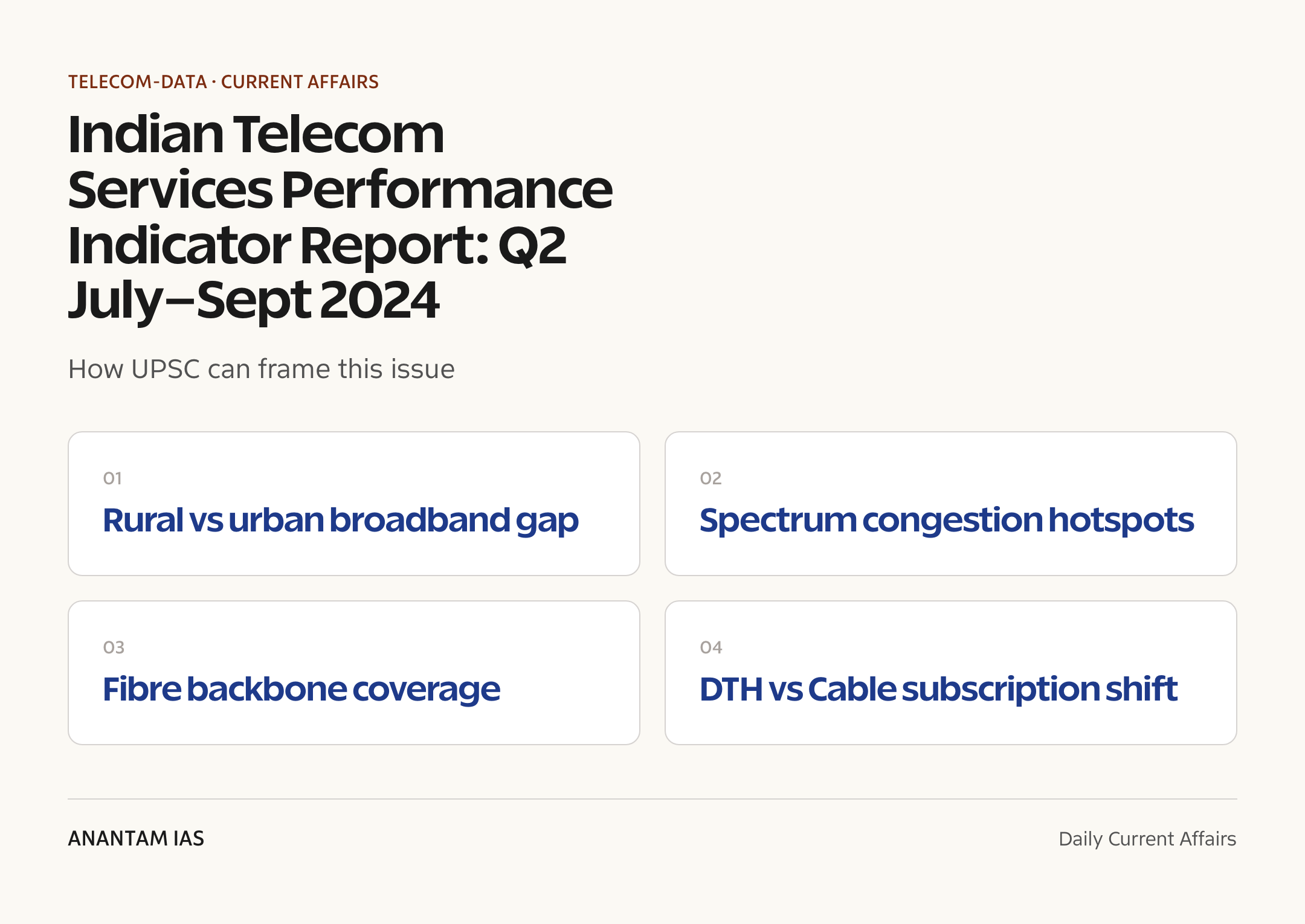
Beyond headline subscriber numbers, the report provides granular signals about network congestion, ARPU (Average Revenue Per User) trends, rural–urban divides in broadband access and the status of transport infrastructure such as fibre backhaul. These signals directly inform spectrum management choices, investment needs for fibre and backhaul, and targeted interventions for improving service delivery in underserved geographies — matters that are central to GS3 topics on technology, infrastructure and economic growth.
- Release: TRAI published the performance indicator report for the quarter ending 30 September 2024; the executive summary and the full report are available on TRAI’s website and via the Department of Telecommunications press release.
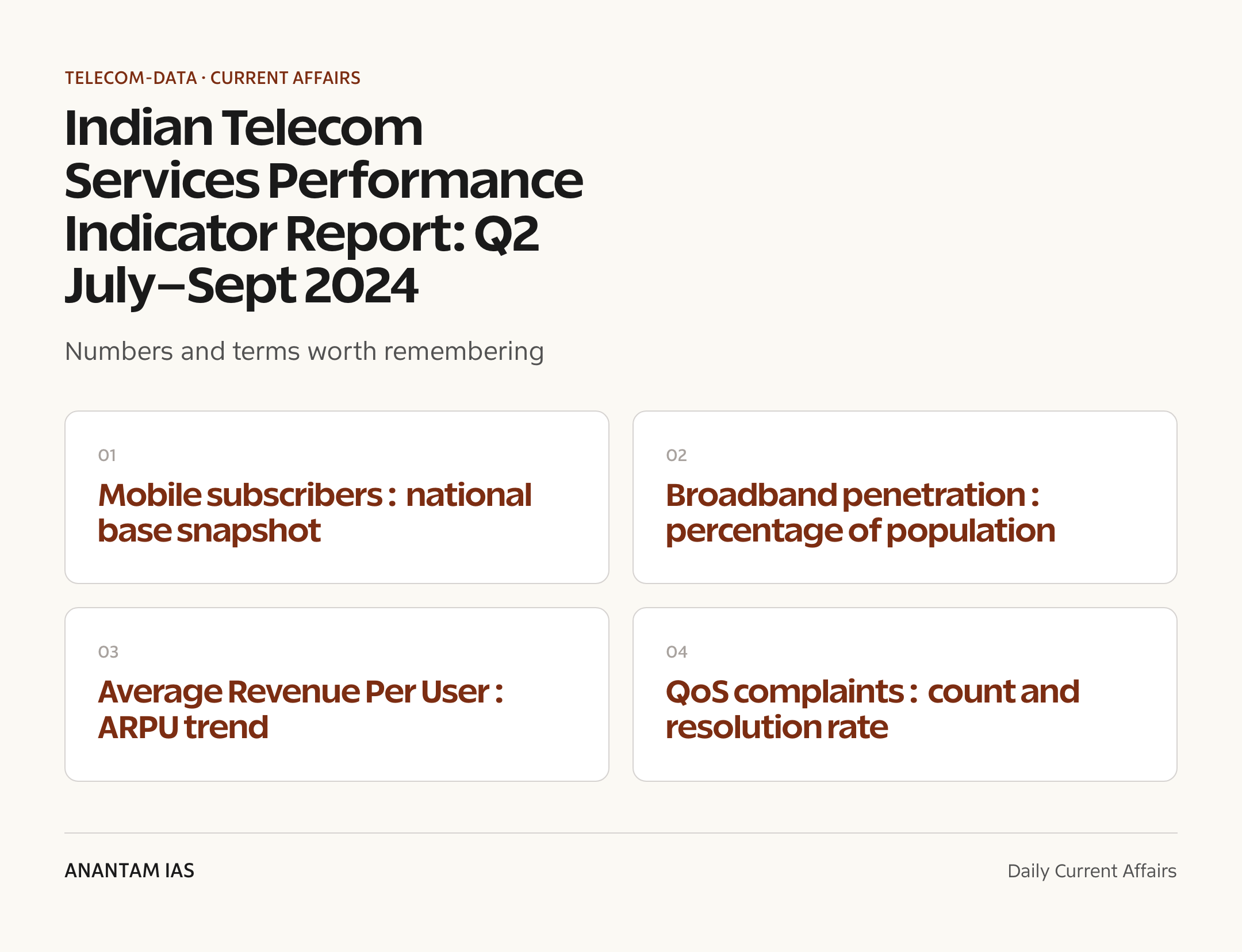
- Subscriber trends: The report details national aggregates and quarterly net additions for mobile, broadband and fixed-line segments, including the mix of prepaid/postpaid and the distribution across urban and rural areas — critical for assessing market saturation and outreach.
- Quality metrics and complaints: QoS statistics such as call-drop rates, data throughput and latency together with complaint volumes and resolution times provide an evidence base for enforcement, licence-condition reviews and consumer protection measures.
- Spectrum and capacity indicators: Information on spectrum usage, utilisation pressures in specific frequency bands and indications of congestion in urban hotspots help shape auctions, refarming decisions and policies on sharing or dynamic spectrum access.
- Broadcasting trends: DTH, Cable TV and radio service metrics in the report reflect consumer behaviour shifts — for example migration to OTT platforms — and inform regulatory choices in content distribution, carriage and signalling.
The development matters in the context of:
- Regulatory input: Quarterly TRAI reports are primary inputs for DoT policy deliberations, parliamentary questions and industry consultations on licensing and spectrum.
- Digital India objectives: Broadband penetration and quality metrics bear directly on goals such as e-governance delivery, digital education and access to health services.
- Market structure and competition: Subscriber additions, churn, ARPU and market share trends help competition authorities and policymakers assess concentration risks and the financial health of operators.
- Investment signals: Persistent QoS problems and spectrum pressure indicate where private capex or public interventions (e.g., incentives for fibre rollout) are needed to expand capacity.
- Consumer protection: Complaint patterns and QoS shortfalls drive regulatory action on penalties, mandatory remediation and improvements to grievance redress systems.
UPSC Relevance
Prelims Relevance
- – Sectoral statistics on subscriber counts, broadband penetration rates and broadcasting subscriber numbers are concrete factual details useful for preliminary examinations. The report’s definition of broadband, frequency bands commonly referenced (e.g., 700 MHz, 3.5 GHz) and institutional roles (TRAI vs DoT) are high-yield facts.
Mains Relevance
GS3 Economy
- – Use the report’s empirical data to frame answers on telecom regulation, digital infrastructure deficits, spectrum policy and the economic implications for the digital economy.
- – Incorporate QoS and ARPU trends when discussing industry viability, investment needs and the case for public policy support in low-ARPU rural markets.
- – Draw on broadcasting metrics to discuss the interplay between content distribution markets (DTH, Cable, OTT) and regulation of carriage, pricing and consumer choice.
Essay
- – The report provides data points and trends that strengthen essays on technology and development, infrastructure-led growth, the digital divide and regulatory challenges in transitioning to a 5G/6G-enabled economy.
Background and Context
TRAI and Reporting
Mandate: TRAI is the statutory regulator for telecommunications in India and is responsible for monitoring sector performance and advising the government.
- TRAI issues periodic performance indicator reports that aggregate data furnished by service providers, offering a consolidated view of sector metrics.
- The reports are non-financial and focus on operational parameters such as subscribers, QoS, complaints and broadcasting statistics.
- Findings from these reports feed into DoT decisions on licensing, spectrum allocation and regulatory enforcement.
- TRAI’s methodology typically includes definitions for metrics (for instance, what counts as broadband) and standardised reporting templates used by operators.
Subscriber Metrics and Market Structure
Key indicators: Total mobile and broadband subscriber numbers, net additions and the split between prepaid and postpaid services provide a snapshot of market dynamics.
- Net additions reveal current growth momentum; stagnation or decline can signal market saturation or competitive pressures.
- Prepaid-dominated markets have different revenue profiles and service expectations compared with postpaid-heavy segments.
- Urban–rural splits in subscriber distribution expose the geographic reach of services and where policy focus is required.
- Subscriber churn, while not always published in every quarter, is a useful indicator of competitive intensity and service quality.
Broadband Definitions and Penetration
Broadband penetration is frequently used as a proxy for digital access and socioeconomic inclusion.
- TRAI defines broadband for the purposes of its reporting; the threshold (e.g., minimum speed) can change over time and affect comparability.
- Penetration is expressed as subscriptions per 100 population and is sensitive to multiple SIM ownership and inactive accounts.
- Fixed broadband (fibre/DSL) and mobile broadband trends together determine effective internet reach.
- Affordability, availability of handsets and last-mile infrastructure (fibre to home or wireless links) are key determinants of real uptake.
Quality of Service and Consumer Complaints
Operational quality metrics measure whether services meet licence obligations and consumer expectations.
- QoS metrics commonly tracked include call completion rates, dropped-call rates, accessibility of signaling channels, data throughput and latency.
- TRAI also publishes complaint statistics — volume, types (billing, network, service denial), and resolution times — which spotlight consumer-facing problems.
- Persistently high complaint volumes or QoS breaches may lead to regulatory directives, inspection of networks or monetary penalties.
- Improved monitoring (e.g., use of crowdsourced speed tests) complements operator-reported metrics and can reveal ground realities.
Spectrum Management and Capacity
Spectrum is a scarce national resource; its allocation and efficient use underpin network capacity and the rollout of new services.
- Reports can signal congestion in particular bands and geographies, prompting considerations for auctioning additional spectrum or enabling sharing.
- Refarming (repurposing older spectrum holdings) and densification using small cells are common technical responses to capacity constraints.
- Backhaul capacity, especially fibre to towers and to the last mile, affects how much traffic can be carried without overloading radio spectrum.
- Policy tools such as spectrum caps, sharing frameworks, and dynamic access regimes are calibrated using utilization and congestion indicators.
Broadcasting and Content Distribution
Cable TV, DTH and radio indicators show the demand-side evolution in content consumption and revenue models.
- DTH and cable subscriber shifts point to migration patterns and monetisation through subscriptions versus ad-supported models.
- Radio reach remains significant for news, emergency messaging and local language content, especially in semi-urban and rural areas.
- The rise of OTT streaming affects traditional broadcasters’ market share and drives convergence in regulation and taxation debates.
- Regulatory concerns for broadcasting include carriage charges, interconnection agreements and consumer choice preservation.
Economic Linkages and Policy Implications
Telecom sector performance has multiplier effects on economic activity, governance and inclusion.
- Higher broadband penetration supports digital commerce, telemedicine, remote education and improved market access for microenterprises.
- ARPU levels and operator revenues influence willingness to invest in network expansion and technology upgrades like 5G.
- A predictable regulatory regime and clarity on spectrum pricing reduce investment risk for long-duration capex decisions.
- Policy interventions may include targeted subsidies, public infrastructure sharing and incentives for rural network expansion.
Way Forward
Accelerate Fibre and Backhaul Expansion
- Prioritise fibre-to-tower and fibre-to-the-premises rollouts to increase transport capacity and reduce reliance on scarce radio spectrum.
- Encourage municipal-level permissions, right-of-way simplification and coordinated trenching to lower deployment costs.
- Promote public–private partnerships and viability-gap funding for fibre in low-return rural corridors.
- Mandate dark-fibre access and infrastructure sharing to reduce duplication and speed up last-mile connectivity.
Improve Spectrum Management and Utilisation
- Adopt flexible approaches such as spectrum sharing, geographic licensing and market-based dynamic access where feasible.
- Regularly review band utilisation to enable refarming of legacy allocations for more efficient bands.
- Use data from TRAI reports to prioritise auctions or temporary spectrum assignments in chronic congestion hotspots.
- Design auction and pricing parameters that balance revenue needs with the imperative to expand capacity rapidly.
Focus on Rural and Low-ARPU Markets
- Deploy targeted subsidy mechanisms, performance-based support or concessional access to public infrastructure to make rural rollouts viable.
- Encourage affordable device programmes and digital literacy campaigns so that physical availability converts to effective usage.
- Leverage universal service obligations and funds to incentivise operators to meet minimum QoS and coverage thresholds in underserved areas.
- Support community networks and last-mile innovations such as shared-owned micro-operators where commercial models alone fall short.
Strengthen QoS Monitoring and Consumer Redressal
- Upgrade monitoring systems, including independent measurements and crowdsourced data, to validate operator-reported QoS.
- Mandate faster grievance redress timelines and transparent escalation paths for unresolved consumer complaints.
- Introduce outcome-based performance standards tied to license renewals or incentives to align operator behaviour with public interest.
- Publicly publish more granular QoS and complaint metrics to increase accountability and enable civil-society scrutiny.
Conclusion
The TRAI Q2 2024-25 performance indicator report supplies policymakers and market actors with current, operational data about subscriber dynamics, service quality and capacity constraints. Policymakers should use these empirical signals to prioritise fibre expansion, refine spectrum management, and deploy targeted interventions for rural connectivity. Improving monitoring and consumer redress mechanisms will strengthen trust in services while a predictable regulatory environment will encourage sustained private capital for 5G rollouts and future digital infrastructure.
UPSC Practice Questions
Prelims MCQ 1
Which body publishes the Indian Telecom Services Performance Indicator Report?
(a) Department of Telecommunications (DoT) (b) Telecom Regulatory Authority of India (TRAI) (c) Ministry of Electronics and Information Technology (MeitY) (d) Telecommunications Consultants India Limited (TCIL)
Answer: (b) Telecom Regulatory Authority of India (TRAI)
Explanation:
TRAI is the statutory regulator that compiles operational data from service providers and issues periodic performance indicator reports covering telecom and broadcasting sectors.
Prelims MCQ 2
A key capacity-related lever that can relieve spectrum congestion noted in TRAI reports is:
(a) Increase in DTH subscriptions (b) Fibre deployment to towers and last mile (c) Reduction of radio stations (d) Closure of small telecom operators
Answer: (b) Fibre deployment to towers and last mile
Explanation:
Fibre backhaul and last-mile fibre increase transport capacity, enabling higher data throughput and offloading traffic from radio links; this directly reduces spectral pressure and improves QoS.
UPSC Mains Questions
- {‘question’: ‘Critically examine how telecom performance indicators influence spectrum policy and auction timings in India.’, ‘answer’: ‘Telecom performance indicators such as congestion metrics, band utilisation reports and QoS degradations provide the empirical basis for spectrum policy choices. When TRAI highlights persistent congestion in specific bands or geographies, policymakers and DoT must weigh the immediacy of capacity needs against fiscal and market considerations. Auction timing can be accelerated to supply scarce spectrum, though aggressive pricing may deter participation and delay network upgrades. Alternative tools include enabling spectrum sharing, allowing temporary liberalised access in emergencies, and refarming legacy bands for newer technologies. A balanced approach combines targeted auctions for critical bands with regulatory facilitation of sharing and reuse to address immediate capacity shortfalls while preserving revenue objectives. Case examples where QoS deterioration precipitated regulatory engagement illustrate that timely data can trigger interventions such as temporary spectrum assignments or directives for infrastructure augmentation.’}
- {‘question’: ‘Evaluate the role of broadband penetration and network quality in achieving Digital India objectives, using insights from TRAI quarterly reports.’, ‘answer’: ‘Broadband penetration and network quality are foundational to Digital India goals across governance, education, health and commerce. TRAI reports reveal not only headline subscription counts but also quality dimensions — latency, throughput and outage frequency — which determine whether digital services are usable. Urban–rural disparities in these metrics point to persistent access gaps; improving mere coverage without quality will not achieve service delivery objectives. Policy responses include large-scale fibre buildout to support high-capacity services, targeted subsidies or VGF for low-ARPU areas, and regulatory obligations that ensure minimum QoS. Coordinated action to lower deployment costs (streamlined permissions), incentivise private investment and leverage universal service funds can accelerate inclusive digital access. The argument should stress that broadband is an enabler: improved penetration must be coupled with quality and affordability to yield the socioeconomic benefits envisioned under Digital India.’}
Source: PIB, Department of Telecommunications (DoT).
Frequently Asked Questions
q
a
q
a
q
a
q
a
q
a
Source: https://anantamias.com/current-affairs/indian-telecom-performance-q2-2024-25/
One Nation One Subscription: Research Access for Public Institutions
Why in News?
The Union Cabinet approved the One Nation One Subscription (ONOS) scheme on 25 November 2024 and the scheme is slated to be implemented from 1 January 2025. ONOS centralises procurement and licensing of international scholarly journals and articles for government higher education institutions (HEIs) and central government R&D centres, enabling nationwide digital access to subscription content without individual institutional subscriptions.
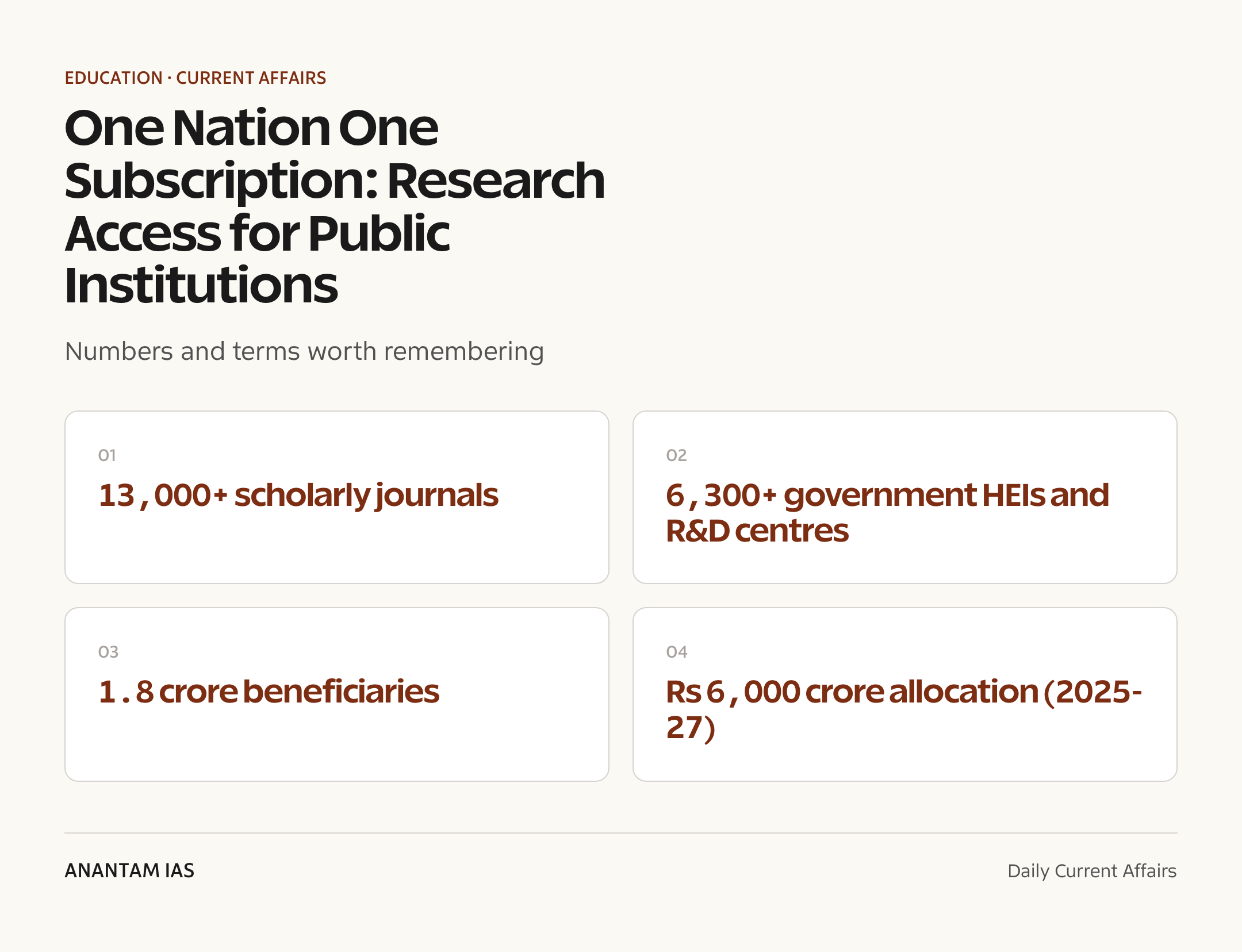
The announcement carries a targeted three-year funding envelope of Rs 6,000 crore (1 January 2025 to 31 December 2027) and promises access to more than 13,000 journals from around 30 major international publishers. The scale — covering over 6,300 government-managed HEIs and an estimated 1.8 crore beneficiaries — makes ONOS a significant national intervention in knowledge access and research-support infrastructure.
- Cabinet approval: ONOS has been approved as a centrally funded scheme to negotiate and provide subscription access on behalf of eligible government HEIs and central R&D institutions.
- Scale and scope: It targets coverage of over 13,000 scholarly journals from about 30 international publishers, extending benefits to roughly 1.8 crore students, faculty and researchers across more than 6,300 institutions.
- Funding and timeline: A budgetary allocation of Rs 6,000 crore has been provided for the initial three-year phase (2025–2027) to operationalise procurement, access management and capacity building.
The development matters in the context of:
- NEP 2020 alignment: The National Education Policy 2020 emphasises strengthening research culture and capacity in HEIs; ONOS operationalises the access component of that strategic aim.
- Jai Anusandhan and Viksitbharat@2047: Political and policy initiatives encouraging a national research push provide the impetus for measures that expand researchers’ access to global literature.
- Existing consortia experience: Several ministries and institutions have run subscription consortia; ONOS seeks to scale those lessons into a unified national model to improve negotiating leverage.
- Digital emphasis and repositories: The scheme focuses on electronic access via institutional authentication and is intended to complement investments in repositories, Indian journals and open access infrastructure.
- Time-bound pilot: The three-year window provides a period to stabilise licensing, monitor usage patterns and design a sustainable transition plan beyond subscription-heavy models.

UPSC Relevance
Prelims Relevance
- What ONOS provides: centralised digital access to international journals for public HEIs and central R&D institutions across disciplines.
- Key numbers: 13,000+ journals, 6,300+ institutions, ~1.8 crore beneficiaries, Rs 6,000 crore funding for 2025–2027.
- Implementation actors: Ministry of Education as nodal sponsor with designated agencies to handle procurement, authentication, access control and analytics.
Mains Relevance
GS2 Education
- Policy design and equity: Evaluate centralised procurement versus institutional autonomy, including trade-offs between negotiating power and local needs.
- Research quality and innovation: Discuss the anticipated impact on research outputs, collaborations, citation networks and translation of research into innovation.
- Fiscal and governance implications: Assess budgetary sustainability, procurement transparency, contractual safeguards (archival access, text-mining rights) and integration with open access goals.
Essay
- Themes: Education reform, science and technology policy, knowledge equity, capacity building and India’s development trajectory to 2047.
- Arguments: Case for facilitating access to global knowledge as a driver of development; examining how subscription access must be paired with open-science investments for long-term resilience.
Background and Context
Policy genesis
ONOS builds on policy pronouncements and the NEP 2020 focus on research-driven higher education.
- NEP 2020 places research and innovation at the centre of higher education reform and recommends strengthening institutional research capacity.
- Statements such as ‘Jai Anusandhan’ and the Viksitbharat@2047 vision elevated research as a national priority and underscored the need for broad access to global knowledge resources.
- Prior experiments with consortia by ministries and large universities exposed operational models for centralised subscriptions and shared services.
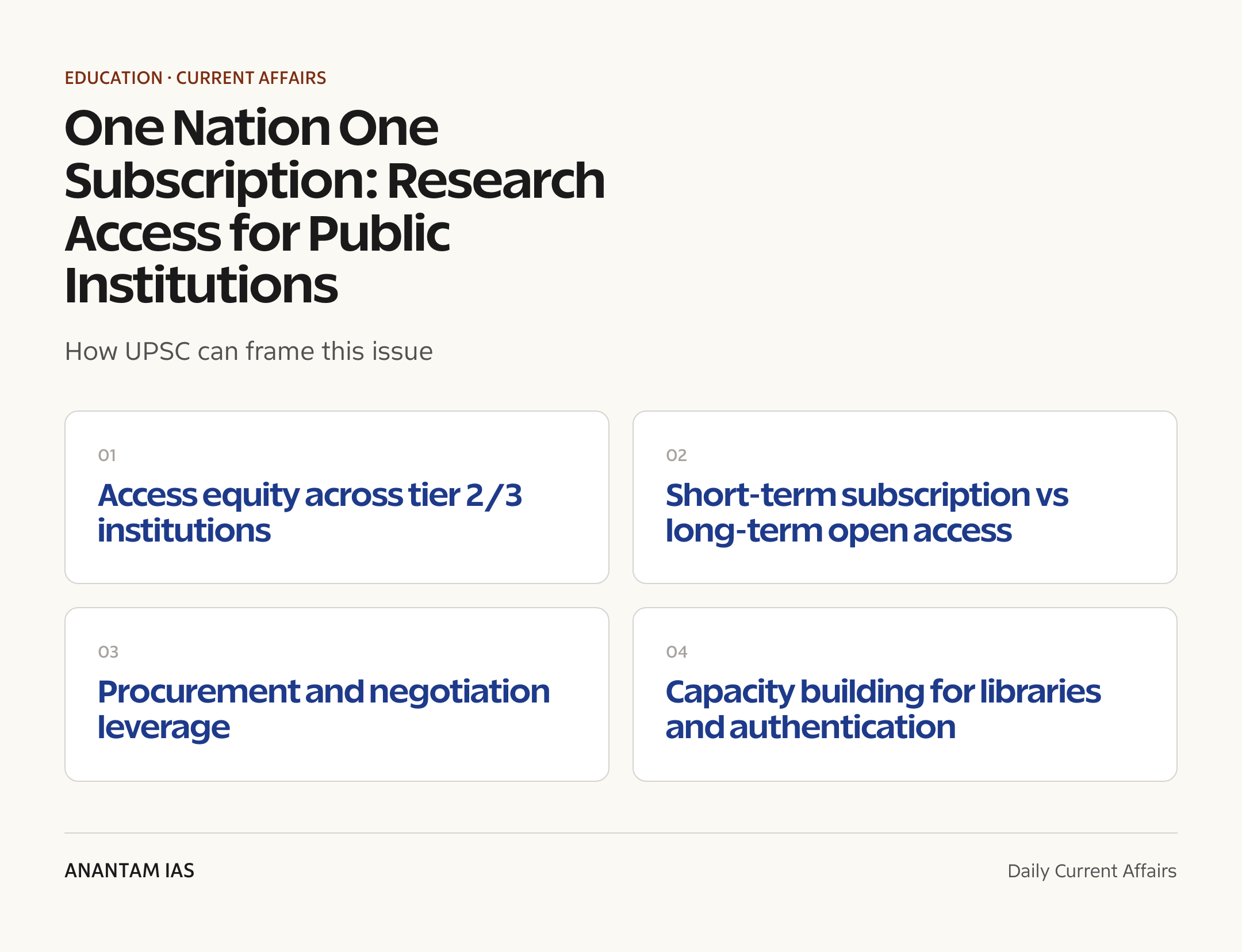
- Policymakers identified paywalls as a structural barrier for many public institutions, particularly in tier 2 and tier 3 cities, motivating a national scale intervention.
What ONOS offers
The scheme’s principal commitments as outlined by the Ministry of Education.
- Access to more than 13,000 scholarly journals from about 30 major international publishers spanning STEM, medicine, social sciences, humanities, management and professional subjects.
- Coverage envisaged for over 6,300 government-managed HEIs and central government R&D institutions, with estimated 1.8 crore beneficiaries including students, faculty and researchers.
- A dedicated budget allocation of Rs 6,000 crore to operationalise central procurement, licensing, authentication systems and capacity-building during 2025–2027.
- A time-bound approach to test procurement mechanisms, usage analytics, and to build the infrastructure for federated access and support services.
Implementation mechanics
How subscriptions, access and monitoring are expected to be organised under ONOS.
- Central procurement will involve negotiating national licenses with publishers, seeking bundled deals that include archival access and permissible uses such as text and data mining.
- Access management is likely to use a mix of IP-based access for institutional networks, federated logins (e.g., eduGAIN-like models) and individual credentials where necessary.
- Usage analytics and reporting are planned to inform renewal decisions by tracking downloads, active users, subject-wise demand and geographic distribution of usage.
- Operational responsibilities will include a nodal agency for licensing, technical teams for authentication, and local library networks to facilitate end-user support.
Equity and reach
The equity objective aims to reduce disparities in access between well-resourced and less-resourced institutions.
- Tier 2 and tier 3 colleges and remote institutions often lack budgets for multiple subscriptions; ONOS aims to remove that financial barrier by extending digital access.
- Digital-only delivery lowers logistical hurdles associated with print subscriptions, though it relies on adequate internet connectivity and local devices.
- Cross-disciplinary coverage ensures practitioners across social sciences, professional courses and humanities can benefit, not just STEM fields.
- Inclusion requires capacity building in institutional libraries so that faculty and students can discover and effectively use resources.
Synergies with open access
ONOS is positioned as an interim, pragmatic step that must work with the broader open science agenda.
- The scheme does not replace the long-term objective of expanding open access publishing and strengthening Indian journals and repositories.
- Practical measures could include negotiating offsetting agreements with publishers and safeguarding text- and data-mining rights for public research.
- Investment in national repositories, preprint servers and capacity to host Indian journals will be necessary to reduce dependence on subscription models over time.
- Research assessment reforms — rewarding open dissemination and reproducibility — would align incentives for authors to publish in accessible venues.
Fiscal and procurement challenges
While the initial allocation is sizeable, operational complexities will determine value for money.
- The Rs 6,000 crore allocation provides runway for three years, but long-term commitments need a sustainability plan that balances central support and institutional contributions.
- Transparent publisher negotiations are critical: rights such as perpetual archival access, multi-user licenses and text-mining must be secured.
- Measuring impact requires robust metrics beyond raw downloads — quality of use, citations, collaborative outputs and changes in research productivity matter.
- There is a risk of paying for low-usage titles; strategic curation and periodic reviews must avoid blanket renewals that waste public funds.
Way Forward
Usage-driven procurement and analytics
- Deploy advanced usage analytics to identify high-impact titles and subject gaps, guiding renewals and reallocation of spend.
- Implement periodic cost-benefit reviews to discontinue low-use subscriptions and reinvest in under-served disciplines.
- Use demand data to negotiate performance-based clauses with publishers, such as price adjustments tied to measured institutional usage.
Capacity building and authentication
- Strengthen institutional library infrastructure, including discovery platforms, link resolvers and training for librarians and researchers.
- Adopt federated authentication standards to provide secure and seamless off-campus access while protecting license terms.
- Provide user training modules and outreach to improve discoverability and proper citation practices among students and faculty.
Aligning subscriptions with open science
- Develop an explicit open access roadmap that runs in parallel — subsidise Indian journals, support repositories and negotiate offsetting deals.
- Mandate clauses in licensing that permit text and data mining for public-interest research and archival rights for long-term preservation.
- Reform research assessment frameworks to reward open dissemination and reproducibility, reducing incentives to publish solely in high-paywall journals.
Governance, transparency and sustainability
- Create an independent advisory committee comprising librarians, researchers, legal experts and government representatives to oversee renewals.
- Publish procurement outcomes, where contractual confidentiality allows, to build public trust and academic scrutiny into pricing and rights.
- Design a post-2027 funding strategy that blends central funding with calibrated institutional co-contributions and efficiency savings.
Conclusion
One Nation One Subscription is a major, time-bound initiative to democratise access to international scholarly literature for public HEIs and central R&D institutions. The scheme can raise research visibility and quality provided strong governance, demand-driven procurement and investments in library capacity accompany licensing. To realise long-term value, ONOS must be integrated with a broader open science strategy: strengthen Indian publishing and repositories, secure rights for archival and text-mining uses, and reform research assessment so that open dissemination is rewarded. Fiscal prudence, transparency in negotiations and an evidence-driven renewal process will determine whether ONOS becomes a bridge to an equitable, sustainable research ecosystem or a short-term bandage on systemic access challenges.
UPSC Practice Questions
Prelims MCQ 1
Which of the following are features of the One Nation One Subscription (ONOS) scheme announced for 2025?
(a) Centralised access to international journals for government HEIs and central R&D institutions (b) Access limited to only STEM journals (c) Allocation of Rs 6,000 crore for 2025-2027 (d) Coverage of over 13,000 scholarly journals
Answer: (a) and (c) and (d)
Explanation:
ONOS provides centralised access to international journals for government HEIs and central R&D centres, is funded with Rs 6,000 crore for 2025–2027, and covers over 13,000 journals. It is not restricted to STEM; social sciences, humanities and professional disciplines are included.
Prelims MCQ 2
ONOS primarily aims to address which issue in India’s higher education and research system?
(a) Digital infrastructure for online exams (b) Paywall-related barriers to accessing international scholarly literature (c) Faculty recruitment rules (d) Student loan interest rates
Answer: (b)
Explanation:
The core objective of ONOS is to remove paywall barriers by providing centralised access to international journals for eligible public institutions. The scheme does not directly target online exam infrastructure, faculty recruitment or student loan policies.
UPSC Mains Questions
- {‘question’: ‘Analyse how One Nation One Subscription can influence research quality and innovation capacity in India. What governance and fiscal safeguards are needed to ensure long-term impact?’, ‘answer’: ‘Comprehensive answers should argue that ONOS will increase access to global literature, enabling researchers in smaller institutions to engage with current scholarship, design better experiments and collaborate internationally. This can raise the baseline research quality, diversify citation networks and accelerate translation of research into innovation. Safeguards needed include: transparent national procurement with clauses on archival and text-mining rights; independent oversight for renewals based on usage and impact metrics; capacity building for institutional libraries and federated authentication; phased co-funding mechanisms and periodic cost-benefit analysis to ensure fiscal sustainability; and parallel investments to strengthen Indian journals and open repositories so dependence on paid subscriptions reduces over time.’}
- {‘question’: ‘Critically examine the tension between subscription-based national access schemes and the open access movement. How should India reconcile short-term access needs with long-term open science goals?’, ‘answer’: ‘Model answers should note the practical tension: subscription deals provide immediate, broad access but reinforce pay-to-read models that can crowd out open access growth. Reconciling the two requires a two-track strategy: use central subscriptions as a transitional measure while negotiating offsetting agreements and clauses that support open access (e.g., APC discounts, read-and-publish deals), invest in capacity for domestic journal publishing and repositories, reform evaluation metrics to reward open dissemination and reproducibility, and allocate funds to subsidise APCs for Indian authors. Policy coherence across funding agencies, publishers and institutions will be crucial for a smooth transition.’}
Source: PIB, Ministry of Education.
Frequently Asked Questions
q
a
q
a
q
a
q
a
q
a
Source: https://anantamias.com/current-affairs/one-nation-one-subscription-2025/
Cabinet approves continuation and modifications of PMFBY and RWBCIS till 2025-26 with budgetary support
Why in News?
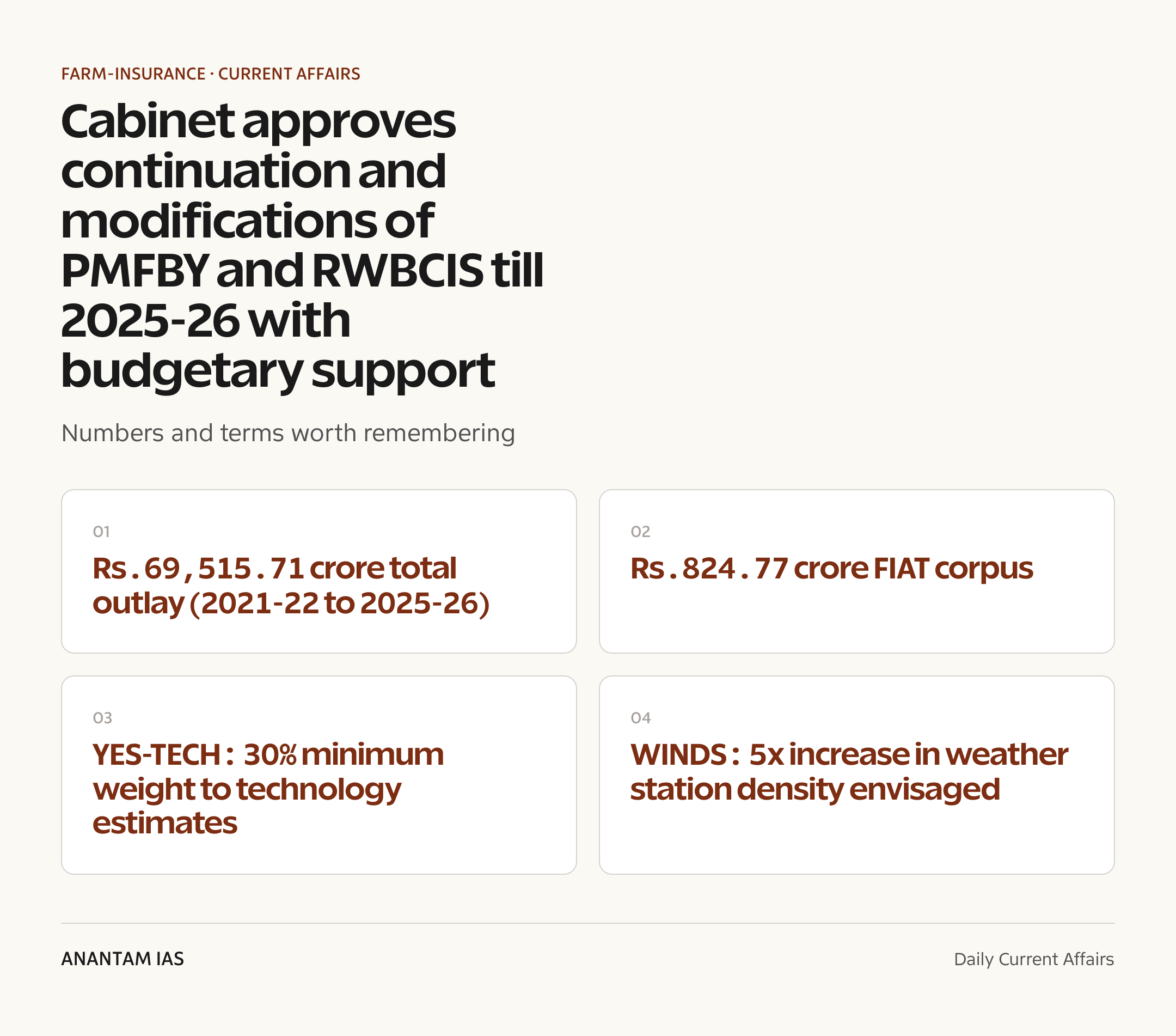
The Union Cabinet approved the continuation of Pradhan Mantri Fasal Bima Yojana (PMFBY) and Restructured Weather Based Crop Insurance Scheme (RWBCIS) up to the financial year 2025-26, along with modifications intended to improve transparency and speed of claim settlement. The decision includes an overall budgetary outlay of Rs.69,515.71 crore for the period 2021-22 to 2025-26 and establishes a dedicated Fund for Innovation and Technology (FIAT) to accelerate technology adoption across scheme operations.
The move is significant because it institutionalises a large central subsidy for crop insurance while signalling a shift towards technology-driven yield estimation and weather monitoring. Key initiatives under the modifications — YES-TECH (remote sensing based yield estimation) and WINDS (a denser network of Automatic Weather Stations and rain gauges) — aim to reduce dependence on manual Crop Cutting Experiments and enable more objective, quicker settlements. The policy change will influence fiscal planning, state implementation strategies and the broader approach to agrarian risk management.
- Continuation: PMFBY and RWBCIS extended through 2025-26 with central funding and operational modifications.
- Budget outlay: Total allocation of Rs.69,515.71 crore for 2021-22 to 2025-26 to meet premium subsidies and implementation costs.
- Tech fund: Creation of FIAT with a corpus of Rs.824.77 crore to finance YES-TECH, WINDS and research & development required for scaling.
- YES-TECH: Remote sensing-based yield estimation will carry a minimum 30% weight in yield calculations and is already in implementation in nine major states.
- WINDS: Plan to increase weather station density up to five times current networks, with AWS at block level and ARGs at panchayat level to generate hyper-local weather data.
- Special support: A 90:10 central-state premium sharing for North Eastern States and flexibility to reallocate unused funds there to other development schemes.
The development matters in the context of:
- Scheme background: PMFBY launched to protect farmers from crop losses due to non-preventable natural calamities, pests and diseases and to stabilise farm incomes.
- Coverage model: Premiums are actuarially determined, with central and state governments subsidising portions to keep farmer contributions affordable.
- Operational issues: Persistent delays in claim settlement, disputes over Crop Cutting Experiments (CCEs), and limited weather data coverage have undermined farmer trust.
- Technology push: Strengthening remote sensing and local weather networks is intended to increase objectivity and reduce the logistical burdens of field-based yield estimation.
- Fiscal implications: The large outlay increases the recurring subsidy burden, raising questions about medium-term sustainability and prioritisation within agriculture spending.
- State heterogeneity: States vary in administrative capacity and willingness to adopt technology-based methods; some have moved faster to tech-heavy approaches than others.
UPSC Relevance
Prelims Relevance
- Memorise: Schemes extended up to 2025-26; total outlay Rs.69,515.71 crore for 2021-22 to 2025-26; FIAT corpus Rs.824.77 crore.
- Understand components: YES-TECH (remote sensing yield estimation with minimum 30% weight) and WINDS (block-level AWS and panchayat-level ARGs).
- Remember special provisions: Central premium sharing on a 90:10 basis for North Eastern States and flexibility to reallocate unused funds.
Mains Relevance
GS3 Economy
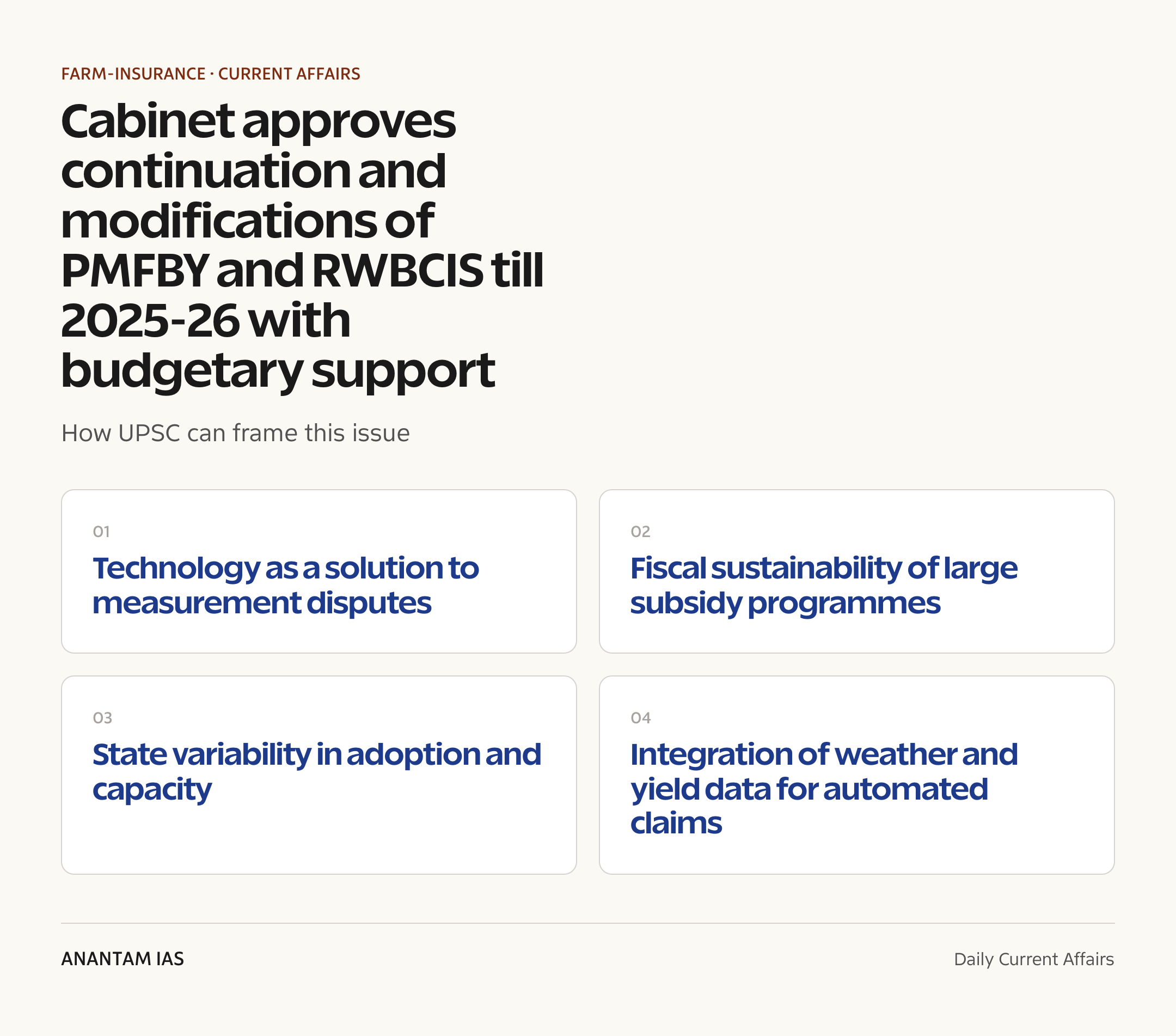
- Evaluate the role of technology in improving the delivery and credibility of public crop insurance and reducing measurement disputes.
- Discuss fiscal tradeoffs and sustainability concerns associated with large subsidy-backed insurance programmes and alternatives to fiscal transfers.
- Analyse centre-state relations in scheme administration, capacity differences across states and their implications for farmer welfare and coverage equity.
Essay
- Themes: Agrarian distress and policy responses; Role of technology and data in governance; Public finance and subsidy design.
- Arguments: Assess balancing protective public finance for farmers against incentives for risk reduction, efficiency and market-based solutions.
Background and Context
Origin and objectives
Why PMFBY and RWBCIS were created and what they aim to achieve.
- Provide insurance cover to farmers against crop losses from natural calamities, pests and diseases to stabilise incomes and protect credit flow.
- Reduce post-disaster distress among farmers that can lead to indebtedness and farm abandonment.
- Encourage agricultural investments by reducing farm-sector volatility and improving access to institutional credit against insured crop value.
- Design intended to be national in scope, with central subsidy to make insurance affordable and with scope for state adaptations.
Implementation mechanics
How the schemes have functioned operationally since inception.
- Premiums are determined on actuarial principles, with the government subsidising a portion of the actuarial premium to keep farmer premiums capped.
- Private and public insurance companies are contracted as implementing agencies by state governments to underwrite risks and manage claims.
- Claims traditionally rely on Crop Cutting Experiments (CCEs) for area-yield estimation and on weather/area-index methodologies for certain crops.
- Farmer enrolment is done seasonally; the schemes cover notified crops, with sums insured linked to scale of finance or expected yield.
Key operational challenges
Persistent problems that have limited scheme effectiveness and farmer trust.
- Delay in claim settlements and procedural complexities leading to farmer dissatisfaction and litigation in some instances.
- Disputes around CCEs, inadequate sample sizes, and alleged manipulation have undermined perceived fairness.
- Sparse weather station networks and limited granularity of ground data reduce precision of weather-index products and area estimates.
- Adverse selection concerns, insurer solvency risks in high-loss years and heterogeneity across states in subsidy capacity and monitoring.
Technology interventions introduced
YES-TECH and WINDS are designed to address measurement and data gaps.
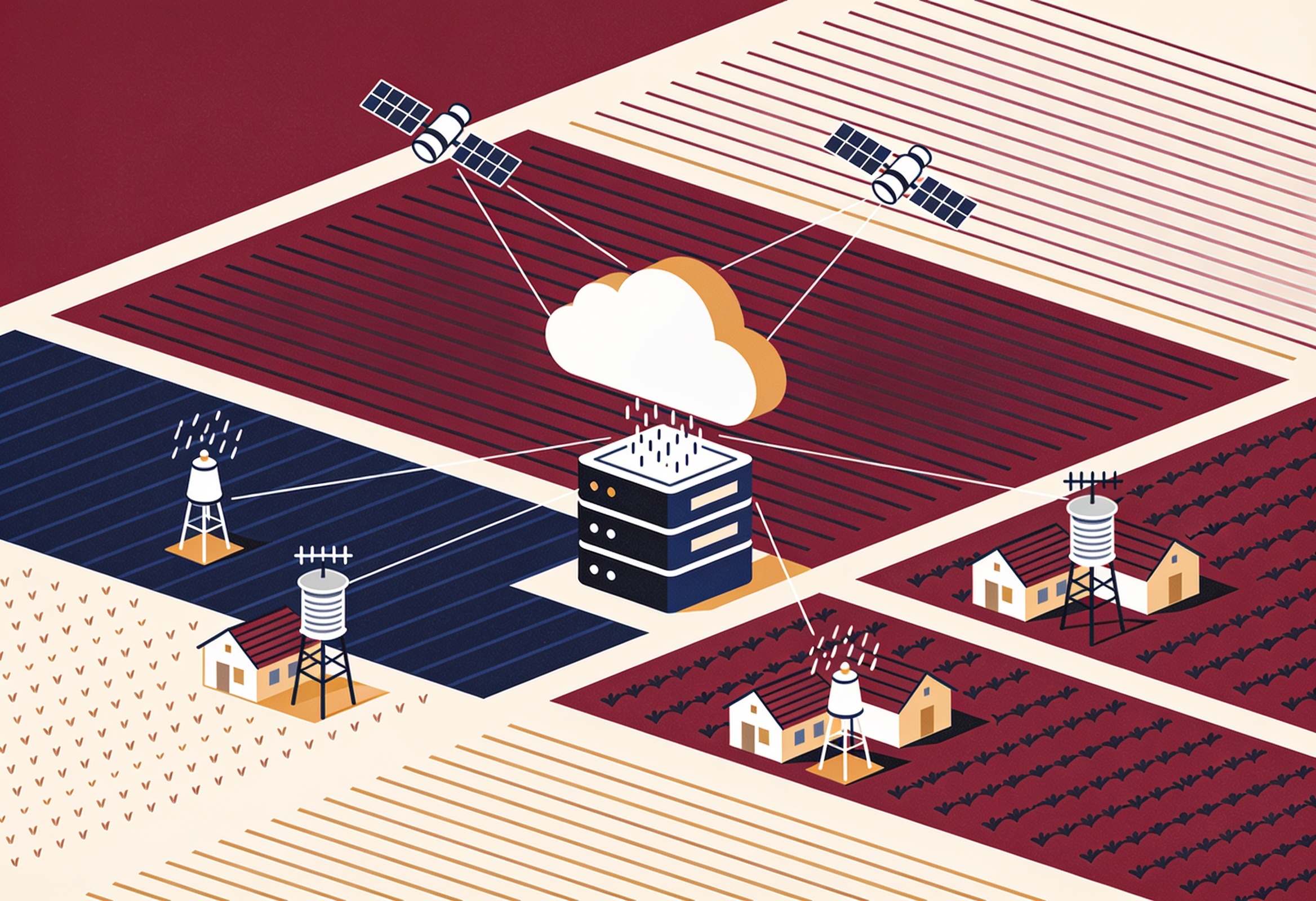
- YES-TECH employs remote sensing and satellite-derived indices to estimate yields, with technology-based estimates carrying at least 30% weight in final calculations.
- WINDS proposes Automatic Weather Stations at block level and Automatic Rain Gauges at panchayat level to create hyper-local weather datasets for trigger-based assessments.
- Early adopters: Nine major states have begun implementing YES-TECH and are in different stages of piloting WINDS installations.
- Objective is to reduce reliance on time-consuming CCEs and to enable faster, more objective, and automated claim triggers.
FIAT: Fund for Innovation and Technology
Purpose, scope and intended uses of the new technology fund.
- FIAT has a corpus of Rs.824.77 crore dedicated to scaling technology solutions under PMFBY and RWBCIS.
- Funds will finance procurement of remote sensing data, installation and maintenance of weather station networks, platform development and research studies.
- Intended to support state-level onboarding, capacity building, tendering and proof-of-concept testing before full roll-out.
- Expectation that central funding will reduce entry barriers for states to adopt tech-based estimation and monitoring systems.
Special provisions for North Eastern States
Why the North East receives differentiated treatment under the scheme.
- Centre offers a 90:10 central-state premium sharing to encourage coverage in the North Eastern States where agriculture is predominantly small and fragmented.
- Given low gross cropped area and voluntary nature of participation, states have flexibility to reallocate unspent scheme funds to other development needs.
- Policy aims to balance equity in coverage with practical considerations about scheme uptake and administrative cost-effectiveness in difficult terrain.
- Prioritisation for saturation of farmers in the region is part of a wider strategy to improve outreach and social protection for marginal cultivators.
Fiscal and policy trade-offs
Budgetary implications and broader policy considerations.
- The Rs.69,515.71 crore allocation for 2021-22 to 2025-26 represents a substantial recurring subsidy that must be balanced against other agricultural investments.
- Sustainability questions arise in high-loss years when claims spike and insurer stress can lead to contingent liabilities for the exchequer.
- Policymakers face trade-offs between broad subsidisation to protect farmers and targeting limited resources to most vulnerable areas or crops.
- Long-run resilience requires combining insurance with investments in irrigation, extension, climate-resilient practices and market infrastructure.
Way Forward
Operationalising and validating technology
- Scale YES-TECH after rigorous ground-truthing and transparent methodology disclosure to reduce distrust among stakeholders.
- Create standard validation protocols and third-party audits for remote sensing algorithms and yield models.
- Pilot interoperability standards so remote-sensing outputs, CCEs and WINDS data can be reconciled during transition periods.
- Invest in local capacity building for data interpretation at state agricultural departments and insurance implementing agencies.
Fast-tracking WINDS deployment
- Adopt standard procurement templates and central-supported tenders to reduce planning delays and economies of scale.
- Ensure ongoing maintenance and data quality agreements to prevent sensor downtimes and data gaps.
- Integrate WINDS outputs with national meteorological and agri-data platforms to enrich modelling and index designs.
- Provide funds from FIAT for initial capital expenditure and training for state-level staff to operate AWS/ARG networks.
Strengthening governance and grievance redress
- Establish clear timelines for claim settlement, with automated triggers for index-based payouts and defined escalation mechanisms.
- Set up independent grievance cells with farmer-friendly access and mobile-enabled claim status tracking.
- Mandate disclosure of actuarial assumptions, premium components and claim ratios to improve transparency.
- Use open-data policies selectively to enable research while protecting farmer privacy and commercial data rights.
Fiscal sustainability and policy integration
- Institute periodic actuarial reviews and scenario-based stress tests to assess long-term subsidy needs and insurer solvency risks.
- Consider targeting higher subsidy rates to regions with greater vulnerability while encouraging market-based products elsewhere.
- Link insurance with investments in risk reduction — irrigation, improved seeds and extension — to reduce indemnity burden over time.
- Explore blended finance and reinsurance arrangements, and encourage private-sector innovation in complementary products.
Conclusion
The Cabinet decision secures continuity of two flagship crop insurance programmes while committing resources to technological modernisation intended to address core operational weaknesses.
Realising the intended gains will require transparent implementation of YES-TECH and WINDS, robust validation and grievance mechanisms, timely claim settlements and prudent fiscal management so that insurance strengthens farmer resilience without unsustainable subsidy pressure.
UPSC Practice Questions
Prelims MCQ 1
Which of the following statements about YES-TECH under PMFBY is/are correct? 1) It uses remote sensing for yield estimation. 2) Technology based yield estimates must carry minimum 30 percent weightage. 3) YES-TECH replaces WINDS. Choose the correct option.
(a) 1 and 2 only (b) 1 and 3 only (c) 2 and 3 only (d) All of the above
Answer: (a) 1 and 2 only
Explanation:
YES-TECH employs remote sensing to generate yield estimates and mandates that technology-based estimates carry at least 30% weight when computing final yields. It is designed to complement other initiatives and does not replace WINDS, which focuses on weather data infrastructure.
Prelims MCQ 2
The Fund for Innovation and Technology (FIAT) approved for PMFBY has a corpus closest to which of the following amounts?
(a) Rs.82.5 crore (b) Rs.824.77 crore (c) Rs.8,247.7 crore (d) Rs.82,477 crore
Answer: (b) Rs.824.77 crore
Explanation:
The Cabinet approved a Fund for Innovation and Technology (FIAT) with a corpus of Rs.824.77 crore to support technology initiatives such as YES-TECH and WINDS and related R&D and pilot activities.
UPSC Mains Questions
- {‘question’: ‘Analyse the potential of remote sensing based yield estimation in improving the effectiveness of crop insurance schemes. What governance measures are needed to ensure its credibility?’, ‘model_answer_points’: [‘Begin by outlining the limitations of crop cutting experiments (CCEs): logistical complexity, sampling errors, time lags and susceptibility to disputes in heterogeneous smallholder landscapes.’, ‘Explain how remote sensing provides scalable, repeatable and frequent observations over large areas, potentially enabling area-based yield estimation, early-warning signals and automation of parts of claim processing.’, ‘Identify implementation challenges: sensor resolution constraints for fragmented holdings, cloud cover affecting optical data, need for robust calibration with ground truth, potential algorithmic bias and data ownership concerns.’, ‘Recommend governance measures: mandatory ground-truth validation and phased roll-out, independent third-party audits of algorithms and models, publication of methodologies and error margins, grievance mechanisms and continuity of CCEs until validated technology attains reliability.’, ‘Conclude by suggesting integration with complementary investments (local weather stations, farmer registries, digital land records) to maximise the benefits and credibility of technology-driven estimation.’]}
- {‘question’: ‘Critically examine the fiscal tradeoffs involved in providing large central subsidies for crop insurance. Suggest policy alternatives to complement insurance for managing agrarian risk.’, ‘model_answer_points’: [‘Start with the fiscal dimension: present the Rs.69,515.71 crore allocation and discuss recurring subsidy implications, particularly under years with large claims that can strain budgets.’, ‘Examine efficiency and incentive effects: subsidies can buffer farmers but may create moral hazard, reduce private risk mitigation investments and favour broad coverage over targeted protection.’, ‘Discuss distributional issues: uniform subsidy regimes may not prioritise the most vulnerable regions or crops, and insurer risks can translate into contingent public liabilities.’, ‘Offer alternatives and complements: invest in climate-resilient infrastructure (irrigation, watershed management), expand risk-reducing extension services, promote diversified and indexed financial products, and design targeted cash transfers for highly vulnerable households.’, ‘Propose policy mixes: use targeted subsidies, encourage private crop insurance markets for commercially viable segments, leverage reinsurance markets, and condition subsidies on adoption of risk-reduction measures to reduce long-term fiscal exposure.’]}
Sources: PIB, Cabinet Secretariat and PIB, Ministry of Agriculture & Farmers Welfare.
Frequently Asked Questions
q
a
q
a
q
a
q
a
q
a
q
a
Source: https://anantamias.com/current-affairs/pmfby-continuation-and-modifications-2025/
Captive and Commercial Coal Mines: Output Growth and Energy Security
Why in News?
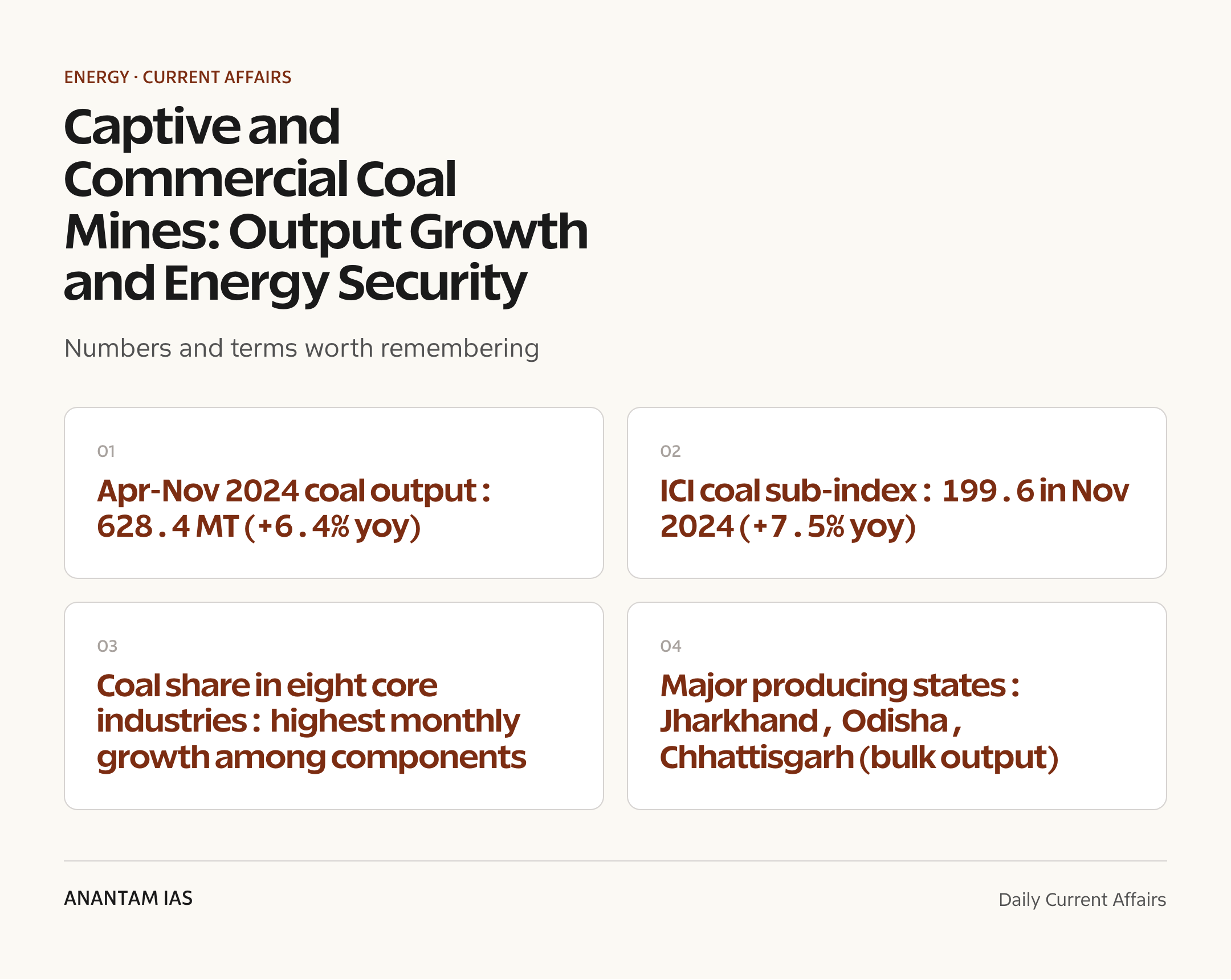
Ministry of Commerce and Industry ICI data and Ministry of Coal releases report higher coal output and a 7.5% growth for the coal industry in November 2024, with output of 628.4 MT in Apr-Nov 2024 up 6.4% year on year.
- Output growth: Coal sector ICI at 199.6 points for Nov 2024, up 7.5% over Nov 2023; Apr-Nov 2024 coal production 628.4 MT, up 6.4% year on year.
- Energy security: Higher domestic supply lowers near-term pressure on coal imports that affect forex and strategic stockpiles.
- Industrial impact: Availability of coal influences costs for steel, cement and heavy industries reliant on captive mines.
- Policy signal: Growth underlines success of reforms around commercial mining, e-auctioning and operationalisation of captive blocks.
- Transition debate: Output expansion raises questions on balancing fossil fuel supply with decarbonisation commitments and energy transition planning.
The development matters in the context of:
- What the numbers cover: ICI measures combined performance of eight core industries; the coal sub-index reported the strongest growth among the eight cores in Nov 2024.
- Components of coal supply: Domestic supply comprises commercial production (public and private), captive mining for user industries and imports for shortfalls or quality needs.
- Recent policy changes: Commercial mining opened to private and foreign investment since 2020; auctions and allocation processes have increased private participation and capacity additions.
- Demand drivers: Thermal power generation remains the largest coal consumer; heavy industries and cement also consume captive and commercial coal.
- Import dynamics: India imports both steam and coking coal when domestic quality or proximity does not meet demand; imported volumes fluctuate with domestic output and international prices.
- Logistics and bottlenecks: Railway offtake, pithead connectivity, loading infrastructure and environmental clearances influence the pace at which mined coal reaches consumers.

UPSC Relevance
Prelims Relevance
- Index of Eight Core Industries (ICI) and its components.
- Distinction between captive and commercial coal mines under Indian law and policy.
- Basic trends in India’s coal production and import dependence for energy security.
Mains Relevance
GS3 Economy
- Discuss linkages between coal production and industrial growth, energy security and external sector.
- Evaluate the impact of commercialisation of coal mining on resource allocation, competition and regulatory oversight.
- Assess the challenges in balancing short-term supply needs with India’s long-term net zero and transition commitments.
Essay
- Topics on energy security, industrialisation, role of fossil fuels in development and sustainable transition pathways.
- Arguments on growth versus environment, and India’s development priorities in the near to medium term.
Background and Context
Structure of India's coal sector
Understanding actors, mine types and end users clarifies how output changes affect the economy.
- Public sector dominance historically: Coal India Limited (CIL) has been the major producer, with state subsidiaries supplying most commercial coal.
- Captive mines: Allocated to industrial users to supply their own plants; they reduce dependence on external suppliers and give cost certainty.
- Commercial mines: Mines that sell coal in the market to utilities, traders and industries; opened to private players after reforms.
- Private participation: Reforms since 2014 and 2020 have enabled private and foreign entities to bid in commercial auctions and operate mines.
- Importers and traders: Private trading houses and government agencies supplement domestic supply through imports.
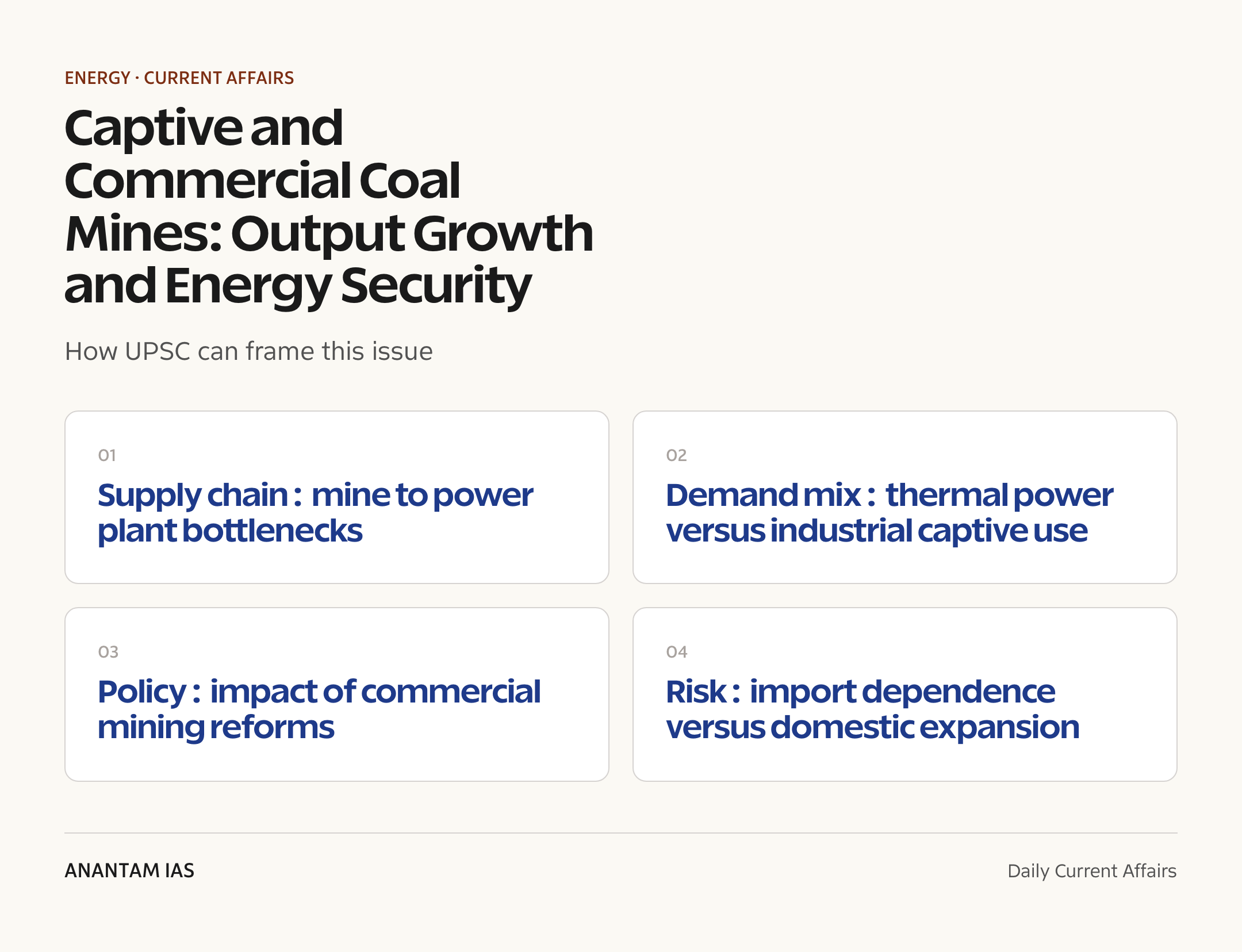
Policy reforms and timelines
Recent policy actions expanded access and aimed to boost production rapidly.
- Liberalisation steps: Commercial mining permissions, auction frameworks and streamlined clearances seek to mobilise private capital.
- Coal linkage reforms: Shift from administrative allocation to market mechanisms for certain segments to improve efficiency.
- Ease of doing business: Changes in forest and environmental clearance processes and faster clearances at central and state levels have shortened lead times.
- Production targets: Government has set higher production goals to reduce imports and supply growing demand of power and industry.
Production trends and statistics
Recent data signals a recovery and expansion in domestic coal output.
- Apr-Nov 2024 output: 628.4 million tonnes, a 6.4% increase year on year as reported in ICI release.
- ICI coal sub-index: Rose to 199.6 points in Nov 2024, the highest growth among the eight cores for that month.
- Seasonality and supply cycles: Monsoon, mining ramp-up and demand from thermal stations cause intra-year fluctuations in dispatches.
- Regional concentration: Major coalfields in eastern and central India (Jharkhand, Odisha, Chhattisgarh) account for bulk of production.
Demand side: power and industry
End use determines how changes in production propagate through the economy.
- Thermal power sector: Largest consumer; plant stocks and generation plans determine procurement needs.
- Captive consumption: Steel and cement plants with captive mines secure fuel and reduce exposure to volatile spot markets.
- Quality factors: Indian thermal coal calorific value varies; some industries import to meet higher quality or coking coal needs.
- Domestic price signals: Market prices, linkages and e-auction outcomes impact cost structures for end users.
Import dependence and external risks
Imports remain an important lever for balancing quality and shortfalls, with macro implications.
- Import drivers: Quality mismatch, short-term demand spikes and logistics constraints push utilities toward imports.
- Forex impact: Higher imports worsen the current account and expose the economy to global price swings.
- Geopolitical risk: Global supply disruptions and shipping costs affect import availability and price.
- Stock policy: Strategic and working stocks at power plants act as buffers but require capital and logistics.
Environmental and social constraints
Mining expansion interacts with land, forest, water and community issues.
- Land acquisition: Displacement and rehabilitation remain contested in several mining areas.
- Forest clearances: Many high-yield deposits lie under forest land, requiring multi-agency approvals.
- Pollution impacts: Air and water pollution from mining and transport affect local health and ecosystems.
- Regulatory compliance: Environmental safeguards and mine reclamation obligations increase project complexity and costs.
Way Forward
Improve logistics and last mile delivery
Operational efficiency reduces transit losses and ensures timely supplies to end users.
- Prioritise dedicated rail corridors and increase rake availability for coal movements.
- Develop pithead stocking yards and multimodal links to reduce bottlenecks at loading points.
- Use data-driven scheduling between mines, railways and power plants for synchronized dispatch.
- Encourage private investment in rail sidings and handling infrastructure under PPP models.
Strengthen environmental and social governance
Better safeguards make mining expansion sustainable and socially acceptable.
- Mandate robust rehabilitation and livelihood plans tied to mine approvals and release of funds.
- Enforce strict monitoring of dust, effluent and groundwater impacts with community reporting mechanisms.
- Fast-track reforestation and phased mine closure plans to restore landscapes post-mining.
- Ensure transparent benefit sharing with local communities through development trusts or revenue sharing.
Optimise policy mix for transition and security
A calibrated policy approach can secure supply while aligning with climate commitments.
- Use domestic production to meet near-term reliability needs while scheduling gradual capacity additions in cleaner technologies.
- Design transition financing to help coal-dependent regions diversify economic activities and retrain workers.
- Adopt market instruments like hedging and long-term contracts to reduce import exposure without abrupt production shocks.
- Coordinate coal strategy with renewable build-out to avoid stranded assets and ensure grid stability.
Improve market functioning and regulation
Transparent markets and effective regulation support efficient coal allocation and investment.
- Strengthen auction design to reward quality, timeline compliance and sustainable practices.
- Improve data transparency on production, dispatches and stocks for better policymaking.
- Harmonise central and state-level approvals to reduce delays and uncertainty for investors.
- Promote competition in coal trading while preventing anti-competitive practices that distort prices.
Conclusion
Stronger domestic coal output in 2024 helped reduce short-term supply pressure and supported industrial activity. Policy focus must shift from only raising volumes to improving logistics, social and environmental governance, and linking coal strategy with the energy transition. Pragmatic steps can lock in energy security while lowering economic and social costs of mining.
UPSC Practice Questions
Prelims MCQ 1
Which of the following correctly distinguishes captive coal mines from commercial coal mines in India?
(a) A. Captive mines sell coal only in the open market; commercial mines supply only their own plant. (b) B. Captive mines supply coal exclusively to the entity that developed the mine; commercial mines can sell coal to any buyer. (c) C. Captive mines are owned only by public sector undertakings; commercial mines are owned only by private companies. (d) D. Captive mines require no environmental clearances while commercial mines do.
Answer: B
Explanation:
Captive mines are allocated or developed to meet the requirements of the entity that operates the mine; commercial mines produce coal for sale in the market. Ownership can be public or private for both types and both require environmental clearances.
Prelims MCQ 2
The Index of Eight Core Industries includes which of the following sectors?
(a) A. Coal, cement, telecommunications, steel (b) B. Coal, crude oil, electricity, fertilizers (c) C. Coal, agriculture, services, steel (d) D. Coal, mining of precious metals, healthcare, electricity
Answer: B
Explanation:
The ICI comprises coal, cement, crude oil, electricity, fertilizers, natural gas, refinery products and steel. Telecommunications and services are not included.
UPSC Mains Questions
- {‘question’: “Analyse how increased domestic coal production affects India’s energy security and external sector. In your answer, discuss short-term benefits and medium-term trade-offs.”, ‘points’: [‘Explain the immediate relief to import dependence and reduced exposure to international price volatility.’, ‘Discuss how reliable supply supports industrial output and avoids generation shortfalls in thermal plants.’, ‘Assess medium-term concerns about infrastructure bottlenecks, environmental impacts and fiscal costs of subsidies or stockpiles.’, ‘Evaluate trade-offs between supporting domestic coal for security and committing to decarbonisation targets.’]}
- {‘question’: ‘Critically examine the impact of opening commercial coal mining to private players on resource governance, competition and environmental safeguards.’, ‘points’: [‘Discuss improvements in efficiency, additional investment and potential for higher production.’, ‘Analyse challenges in regulatory oversight, monitoring of compliance and risks of rent-seeking.’, ‘Evaluate mechanisms to ensure environmental standards, community compensation and reclamation.’, ‘Offer policy measures to balance competition with sustainable mining practices.’]}
Sources: PIB, Ministry of Coal and PIB, Ministry of Coal monthly production and dispatch update.
Frequently Asked Questions
q
a
q
a
q
a
q
a
q
a
q
a
Source: https://anantamias.com/current-affairs/captive-commercial-coal-output-2025/
DRDO marks 67th Foundation Day with focus on indigenous defence R&D
Why in News?
Raksha Mantri and DRDO leadership set priorities for 2025: mission-mode completion targets, greater private-sector and start-up engagement, open test facilities and accelerated technology transfers to industry.
- Policy push: Raksha Mantri asked DRDO labs to identify 2-3 critical projects each and complete them by 2025, targeting 100 completed projects by next Foundation Day.
- Industry linkage: DRDO has handed over 1,950 Transfers of Technology to industry; 256 licensing agreements were signed in 2024 to scale indigenous production.
- Test infrastructure access: DRDO opened facilities to industry — over 18,000 tests in three years, with more than 5,000 tests in 2024 — to speed up private-sector adoption.
- Start-up outreach: Directives to include start-ups in R&D and hold regular open days aim to inject innovation and accelerate dual-use solutions.
- Strategic capability: Public felicitation of the design team for a Long Range Hypersonic Anti-Ship Missile signals emphasis on advanced deterrence technologies.
The development matters in the context of:
- DRDO mandate: National agency for defence research, design and development covering missiles, avionics, electronic warfare, naval systems, armaments and more.
- Aatmanirbhar Bharat link: Technology transfer and industry partnerships are central to the government’s push for indigenous manufacturing in defence.
- Defence industrial ecosystem: Since reforms beginning in 2020, greater private-sector participation, licensing, and corporatised production agencies have been promoted.
- Global tech competition: Hypersonics, AI, quantum sensing and missile defence are priority domains as regional security dynamics intensify.
- Testing bottlenecks: Limited test infrastructure historically slowed private-sector absorption of defence tech; opening facilities addresses this gap.
- Mission-mode projects: Focused, time-bound R&D projects are used to fast-track operational systems from lab prototypes to production.

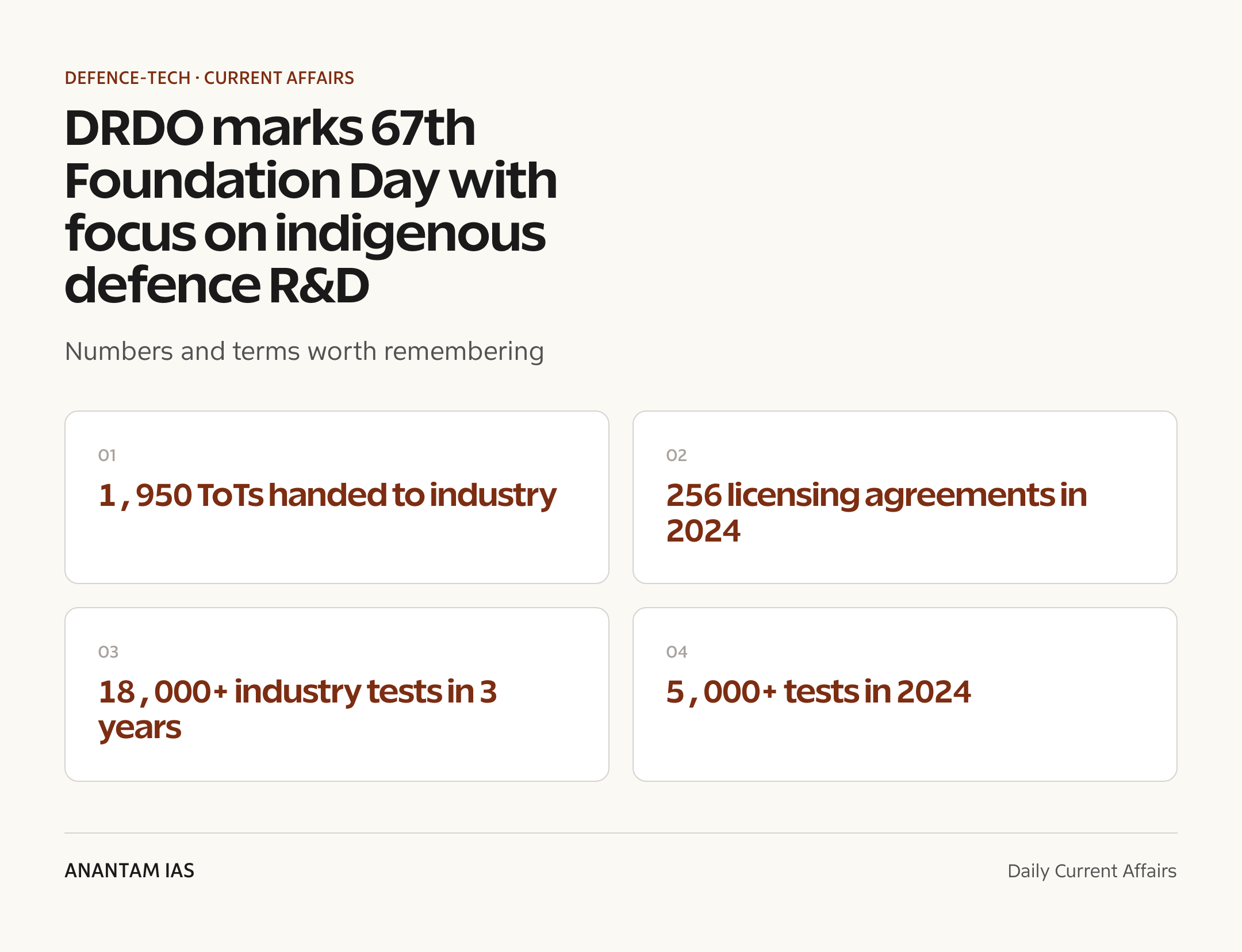
UPSC Relevance
Prelims Relevance
- Facts to remember: DRDO celebrates Foundation Day on 1 January every year; 67th Foundation Day marked in 2025.
- Key numbers: 1,950 ToTs handed to industry overall; 256 licensing agreements in 2024; > 18,000 tests for industry over three years.
- Organisational leaders: Raksha Mantri Shri Rajnath Singh and DRDO Chairman Dr Samir V Kamat featured in the event.
Mains Relevance
GS3 Science & Tech
- Policy analysis: Implications of accelerating ToTs and test-facility access for domestic defence manufacturing and strategic autonomy.
- Governance: Role of DRDO as a state R&D agency in enabling private-sector growth while balancing security and intellectual property concerns.
- Strategic studies: Significance of hypersonic weapon development for regional deterrence, arms-race dynamics and arms control debates.
Essay
- Technology and national power: DRDO’s initiatives exemplify how state-led R&D ecosystems contribute to economic and strategic strength.
- Public-private partnerships: Case study on defence-technology transfer, start-up engagement and converting research into production.
- Innovation ecosystems: Discuss creating dual-use technology flows and the societal impact of defence R&D spillovers.
Background and Context
DRDO: mandate and structure
Basic overview of the organisation, its responsibilities and working model.
- Mandate: Design, develop and deliver state-of-the-art indigenous defence systems and technologies to Indian Armed Forces and security agencies.
- Organisational spread: Comprises multiple labs and establishments across domains like missiles, aeronautics, armaments, electronics and naval systems.
- Governance: Falls under the Department of Defence R&D, Ministry of Defence; chaired by the Chairman, DRDO who also serves as Secretary, Defence R&D.
- Partner model: Works with DPSUs, private industry, academic institutions and start-ups through ToTs, licensing, and Development cum Production Partners.
- Funding & priorities: Funded by central allocations with project-specific prioritisation; recent years show emphasis on rapid prototyping and production partnerships.
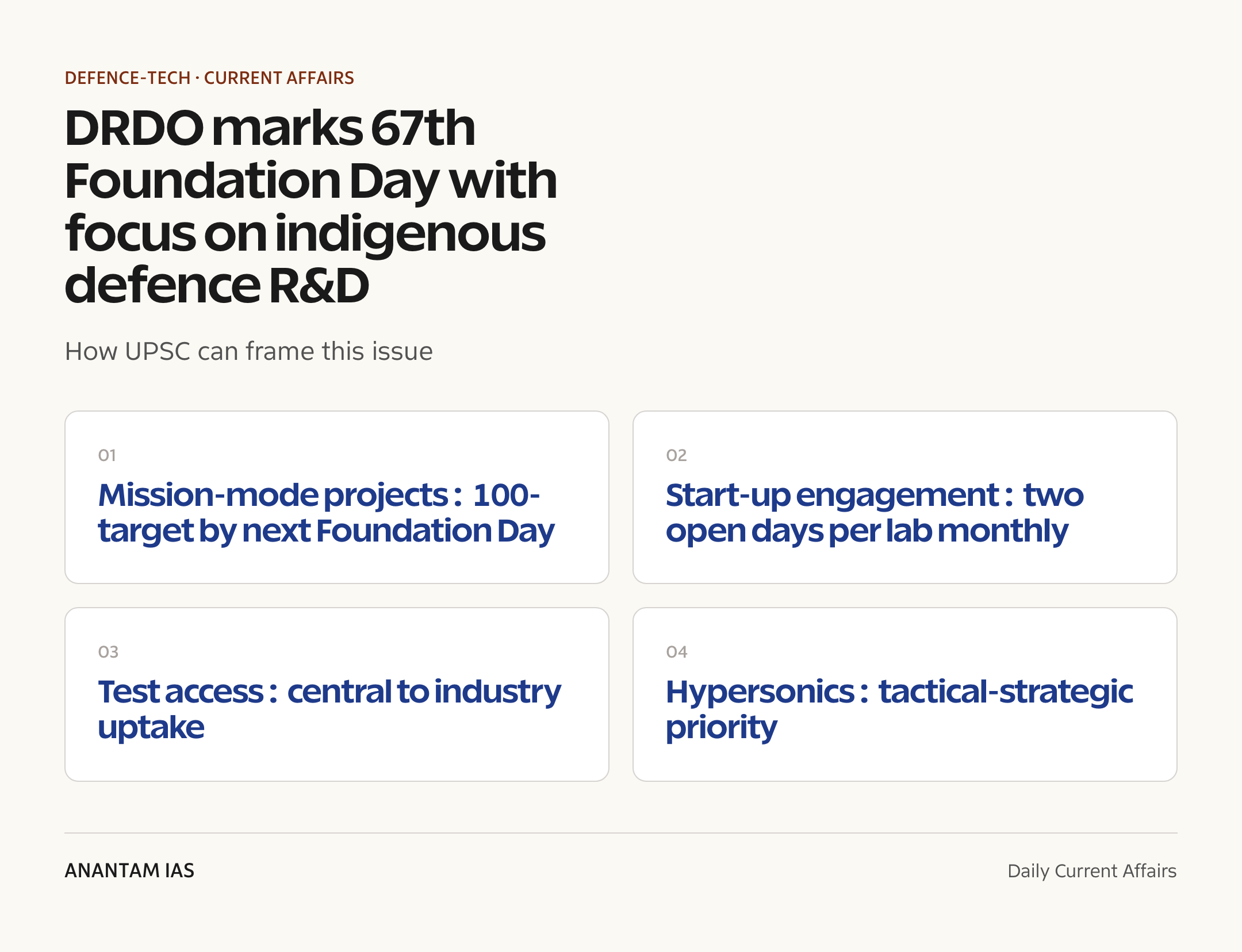
Technology transfer and licensing
How DRDO moves technologies from lab to industry and the scale of recent transfers.
- Transfer of Technology (ToT): Mechanism for handing technical designs, manufacturing know-how and documentation to industry for production.
- Volume: DRDO reported 1,950 ToTs to Indian industry to date, indicating active dissemination of defence technologies.
- 2024 surge: 256 licensing agreements signed in 2024, reflecting accelerated commercial uptake.
- Objective: Reduce import dependence, expand domestic production base and support Aatmanirbhar Bharat in defence.
- Challenges: Standardising IP terms, ensuring quality-control in licensed production and aligning industry capacity with complex systems.
Open test facilities and validation
Testing infrastructure is central to converting prototypes into producible systems.
- Policy shift: DRDO opened test facilities for use by private industry and DPSUs to enable faster validation cycles.
- Testing scale: Over 18,000 tests conducted for private industries/DPSUs in three years with > 5,000 tests in 2024 alone.
- Impact: Reduces time-to-market, lowers validation costs for industry and strengthens industry confidence in indigenous designs.
- Operational needs: Industry requires predictable booking, clear fees, and standard test-report formats to plan production runs.
- Future gaps: Need for mobile test ranges, instrumented open ranges and certified third-party test agencies for transparency.
Start-ups and industry engagement
DRDO wants increased participation from start-ups to catalyse innovation and dual-use products.
- Open days: Each DRDO lab encouraged to host two open days monthly to interact with industry and start-ups.
- Start-up role: Small firms can bring rapid prototyping, software-led solutions, sensors, autonomy and AI integration.
- Barriers: Complex procurement, security clearances and scale-up funding remain hurdles for defence start-ups.
- Support measures: DRDO can provide mentorship, access to test-beds, preferential licensing and prototype co-development.
- Expected outcome: More innovation flow into dual-use tech that benefits civilian sectors like disaster response and transportation.
Strategic technology priorities
Areas highlighted by DRDO and the wider global context that shape R&D focus.
- Hypersonics: High-priority domain for rapid strike and anti-access capabilities; public mention of a long-range hypersonic anti-ship missile.
- AI and autonomy: Integration into ISR, electronic warfare and missile guidance systems to improve decision cycles.
- Advanced materials and propulsion: Critical for lightweight platforms, hypersonic vehicles and extended endurance of systems.
- Sensors and quantum technologies: Next-generation sensing and navigation solutions to operate in contested environments.
- Dual-use focus: Emphasis on technologies that can transition to civilian applications to expand economic returns.
Operational targets and timeline
Concrete timeline set by Raksha Mantri for near-term delivery expectations.
- Lab targets: Each DRDO lab asked to pick 2-3 critical projects for completion within the year 2025.
- Aggregate goal: Aim to have 100 such projects completed by the next Foundation Day.
- Monitoring: Regular reviews and prioritisation expected to align resources for mission-mode delivery.
- Risk management: Need to balance speed with testing rigor and operational validation to avoid fielding unreliable systems.
- Success indicators: Prototype-to-production conversions, licensing deals concluded and operational inductions into forces.
Way Forward
Strengthen industry absorption
- Standardise licensing: Create standard, time-bound licensing templates with clear IP and quality clauses to speed agreements.
- Capacity building: Support MSMEs with skill development and capital access to meet defence manufacturing standards.
- Production partners: Expand Development cum Production Partner model to de-risk industry adoption and scale manufacturing.
Enhance test infrastructure and access
- Transparent booking: Implement an online portal for facility booking, standard fees and test-report accreditation.
- Regional hubs: Establish regional test centres and mobile test units to reduce logistical barriers for industry.
- Third-party certification: Authorise independent agencies to certify test outcomes to build trust among private partners.
Operationalise start-up engagement
- Incubation tie-ups: Link DRDO labs with incubators and accelerators to mentor dual-use start-ups and run co-development sprints.
- Fast-track trials: Offer sandboxed trials and security-cleared access for vetted start-ups to demonstrate concepts.
- Seed support: Provide grants or matching funding for prototype development aimed at defence-relevant outcomes.
Focus on program management
- Mission-mode governance: Create cross-lab program teams with milestone-based funding and clear deliverables.
- Performance metrics: Track key metrics such as prototype readiness levels, ToT conversions and time-to-production.
- Risk mitigation: Conduct independent technical reviews and iterative field trials to validate systems.
Conclusion
DRDO’s 67th Foundation Day set a pragmatic agenda: time-bound mission projects, deeper industry and start-up engagement, open test infrastructure and scaling of technology transfers. Implementation will require program discipline, standardised IP frameworks and capacity building in industry to convert lab successes into operational capabilities that reinforce strategic autonomy.
UPSC Practice Questions
Prelims MCQ 1
Which of the following statements about DRDO’s announcements on its 67th Foundation Day (2025) are correct? 1) DRDO reported handing over about 1,950 Transfers of Technology to Indian industry to date. 2) In 2024, DRDO signed 256 licensing agreements for ToTs. 3) DRDO conducts no tests for private industry and only works with DPSUs. Select the correct answer.
(a) 1 and 2 only (b) 2 and 3 only (c) 1 and 3 only (d) All of the above
Answer: (a) 1 and 2 only
Explanation:
Statements 1 and 2 are true as reported. Statement 3 is false because DRDO has opened test facilities for private industry and reported over 18,000 tests for private industries and DPSUs.
Prelims MCQ 2
On its 67th Foundation Day, DRDO was asked to have each lab identify how many critical projects to complete in 2025, with an aggregate target of 100 projects by the next Foundation Day? 1) One critical project 2) Two to three critical projects 3) Five critical projects Select the correct answer.
(a) 1 only (b) 2 only (c) 3 only (d) 1 and 2
Answer: (b) 2 only
Explanation:
Raksha Mantri instructed that each DRDO lab should identify two to three critical projects to be completed by 2025, aiming for about 100 completed projects overall.
UPSC Mains Questions
- {‘question’: “Analyse how DRDO’s strategy of technology transfer and opening of test facilities to private industry can strengthen ‘Aatmanirbhar Bharat’ in defence manufacturing. What institutional and policy measures are required to address challenges in this approach?”, ‘model_answer’: “Start with succinct thesis: DRDO’s ToTs and test-facility access reduce import dependence by enabling domestic firms to produce defence systems. Explain mechanisms: capacity building, supply chain development, quality assurance, and scale. Discuss benefits: faster induction cycles, job creation, export potential and dual-use spillovers. Identify challenges: IP governance, certification, production quality, financing, security clearances and absorptive capacity of MSMEs. Recommend measures: standardised licensing frameworks, credit and tax incentives, a national defence industrial certification agency, regional testing hubs, public procurement preferences for ToT-based products, accelerated security-clearance processes for vetted start-ups, and institutionalised DRDO-industry joint programmes with milestone funding. Conclude by linking to strategic autonomy and sustainable industrial base.”}
- {‘question’: “Discuss the strategic implications of India developing hypersonic weapon capabilities such as the Long Range Hypersonic Anti-Ship Missile mentioned during DRDO’s Foundation Day. How should India balance deterrence objectives with regional stability?”, ‘model_answer’: ‘Open with strategic context: hypersonics alter offense-defence calculations due to high speed, maneuverability and reduced reaction time. Assess deterrence value: enhanced denial capability, sea denial against adversary navies and signalling of technological parity. Evaluate risks: potential arms race, escalation dynamics, difficulties in attribution and collateral damage in crisis. Policy balance: pursue credible but restrained deployment, transparency measures with regional partners, invest in counter-hypersonic defenses and early warning, integrate arms-control dialogue bilaterally and in multilateral forums, and embed doctrine and command-control safeguards to reduce miscalculation. Conclude: capability must be part of a calibrated strategy combining deterrence, defence and diplomatic engagement.’}
Source: PIB, Ministry of Defence.
Frequently Asked Questions
q
a
q
a
q
a
q
a
q
a
q
a
Source: https://anantamias.com/current-affairs/drdo-67th-foundation-day-2025/
India submits 4th Biennial Update Report to UNFCCC
Why in News?
India submitted its 4th Biennial Update Report (BUR-4) to the UNFCCC on 30 December 2024, updating the national GHG inventory for 2020 and reporting progress on mitigation, adaptation and support needs.
- BUR-4 submission updates the Third National Communication and provides a full GHG inventory for 2020 to the UNFCCC secretariat.
- Policy relevance: the report documents mitigation actions, constraints and requirements in finance, technology and capacity building that shape domestic planning and international negotiations.
- Quantitative update: India reports a 7.93% decline in total GHG emissions in 2020 relative to 2019 and a 36% reduction in emissions intensity of GDP since 2005.
- Sectoral picture: energy contributes 75.66% of emissions (ex-LULUCF), agriculture 13.72%, industrial processes 8.06% and waste 2.56%.
- LULUCF role: forests and other land use sequestered ~522 Mt CO2 in 2020, equal to about 22% of CO2 emissions that year.
The development matters in the context of:
- BUR purpose: Biennial Update Reports are submissions by non-Annex I countries that provide updated GHG inventories, mitigation actions and needs related to finance, technology and capacity building.
- NDC link: BURs complement Nationally Determined Contributions by tracking progress and providing historical inventories that inform future NDC updates and policy choices.
- India’s development context: India frames its climate actions in the principles of equity and common but differentiated responsibilities and respective capabilities (CBDR-RC).
- Global process: UNFCCC uses BURs to aggregate national information, assess global progress and shape discussions on finance and technology transfer under the Paris architecture.
- Data vintage: BUR-4 reports the national inventory for the calendar year 2020, a pandemic-affected year with notable emissions fluctuation.
- Domestic use: the report informs national planning across energy, forestry, agriculture and waste sectors and supports MRV (measurement, reporting, verification) strengthening.
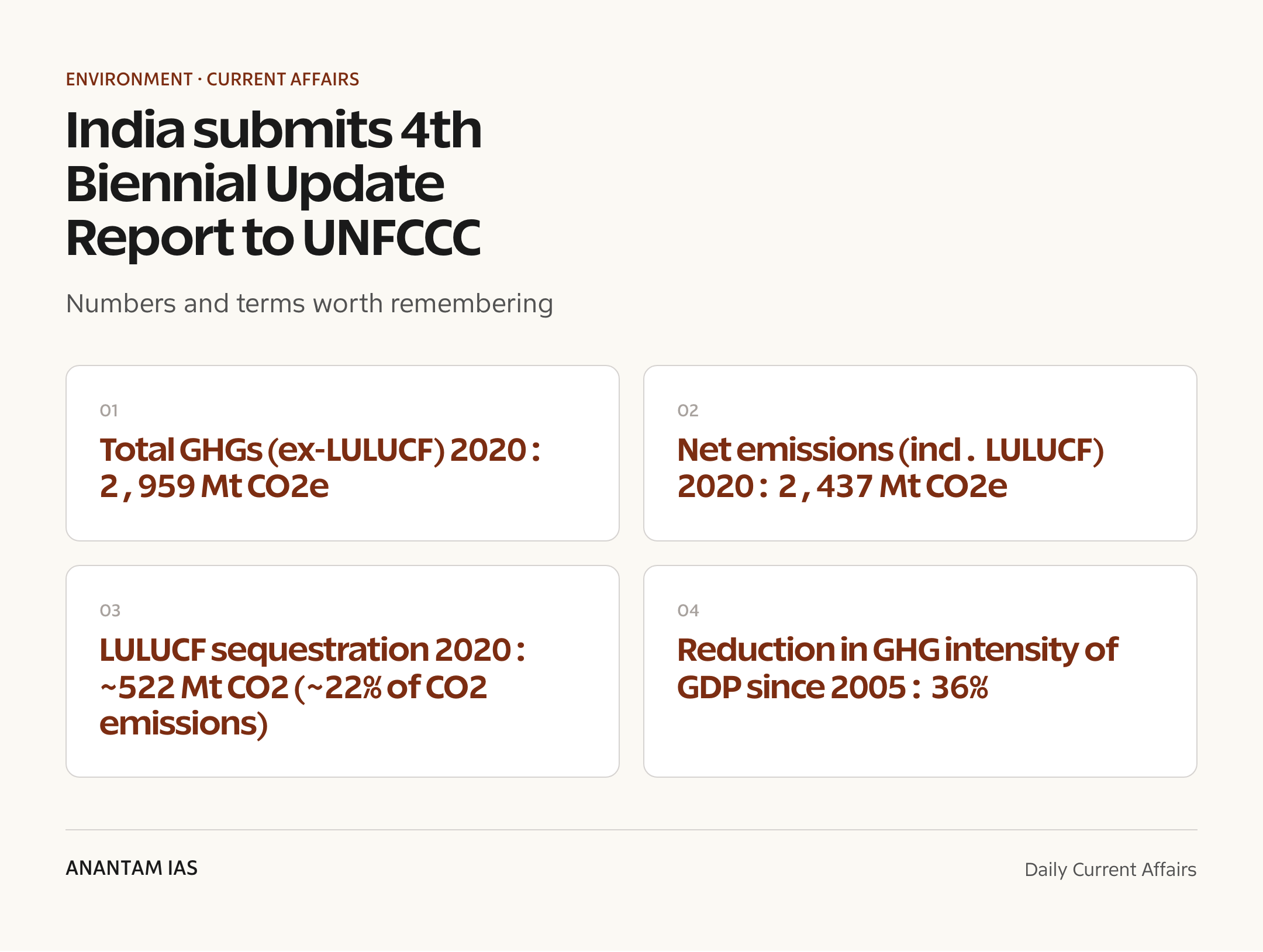
UPSC Relevance
Prelims Relevance
- Definition and purpose of Biennial Update Reports under the UNFCCC.
- Key greenhouse gas inventory figures for India in 2020: total emissions, sectoral shares and LULUCF sequestration.
- India’s stated change in GHG emission intensity of GDP since 2005 (36% by 2020).
Mains Relevance
GS3 Environment
- Assess how India’s BUR-4 reflects the balance between developmental priorities and mitigation commitments.
- Discuss the role of accurate GHG inventories and LULUCF accounting in shaping climate policy and international negotiations.
- Analyse the implications of reported finance, technology and capacity-building needs for India’s climate diplomacy and domestic implementation.
Essay
- Material for essays on sustainable development, climate justice and India’s role in global climate governance.
- Data points to support arguments on low-carbon growth pathways and energy transition in emerging economies.
- Evidence for debates on equity and differentiated responsibilities in international climate action.
Background and Context
What is a Biennial Update Report
Function and scope of BURs submitted by non-Annex I parties to the UNFCCC.
- Purpose: provide updated national GHG inventories, mitigation actions and information on needs in finance, technology and capacity building.
- Reporting cycle: BURs are usually submitted every two years, complementing National Communications and NDC updates.
- Audience: UNFCCC secretariat, other parties, researchers and international funders who use the data for synthesis reports and negotiations.
- MRV role: strengthen transparency through documented methodologies, uncertainty assessment and institutional arrangements for measurement, reporting and verification.
- Comparability limits: methodologies and data availability vary among countries; land-use accounting poses special challenges.
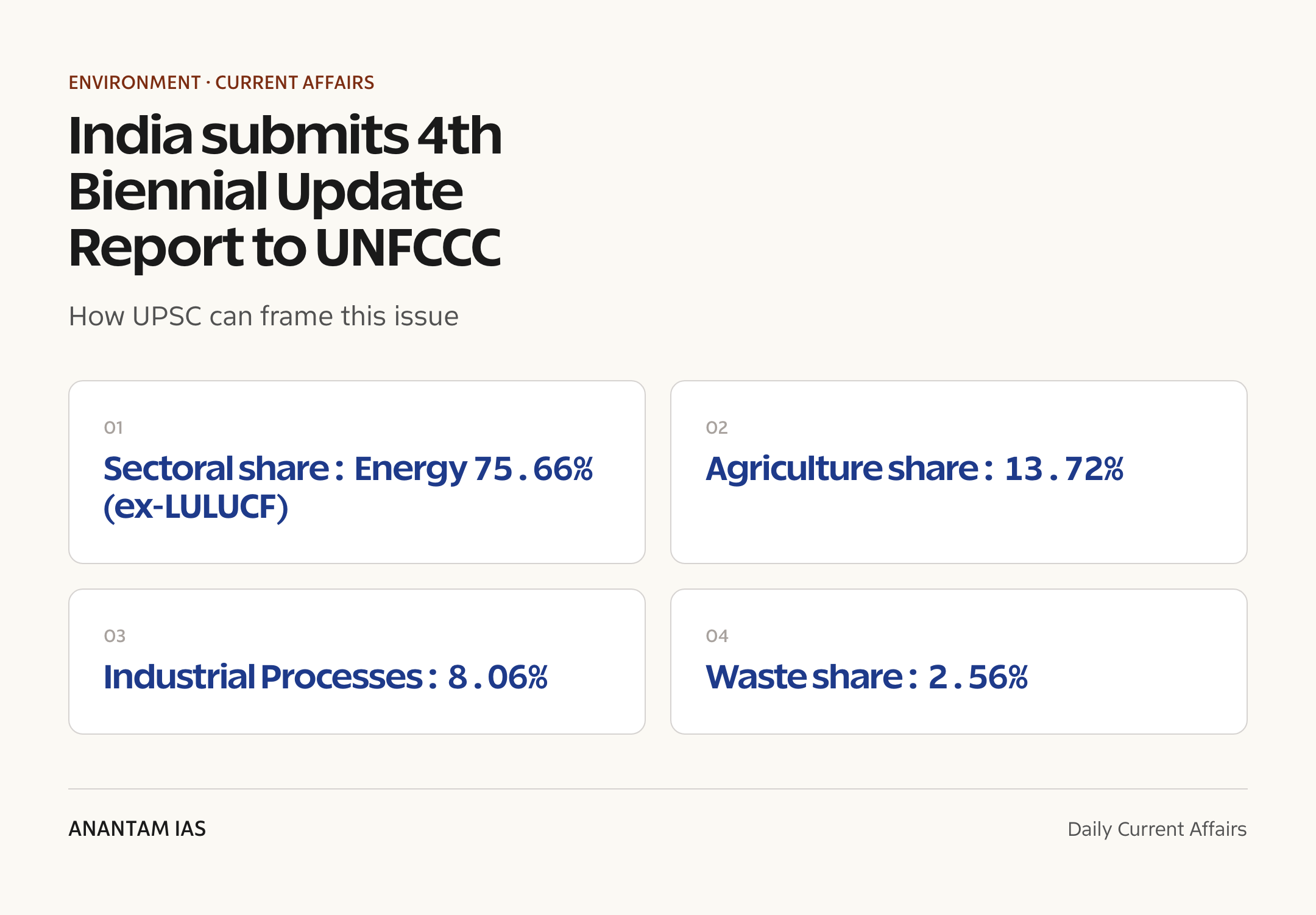
Key findings in India’s BUR-4
Quantitative and sectoral highlights from the 2020 inventory and related notes.
- Total emissions (ex-LULUCF) reported at 2,959 Mt CO2e for 2020; net emissions including LULUCF at 2,437 Mt CO2e.
- 2020 drop: total GHG emissions decreased by 7.93% compared to 2019, influenced by pandemic-related activity changes and structural factors.
- Sectoral shares: energy 75.66%, agriculture 13.72%, industrial processes 8.06%, waste 2.56%.
- LULUCF sequestration: ~522 Mt CO2 sequestered, equivalent to roughly 22% of the country’s CO2 emissions in 2020.
- Intensity gains: GHG emission intensity of GDP reduced by 36% since 2005.
Methodology and inventory issues
How India compiles GHG inventories and challenges specific to national reporting.
- IPCC guidelines: India uses IPCC Tiered approaches for sectors, mixing activity data and emission factors to estimate emissions.
- Data sources: national statistics, energy consumption datasets, industrial production figures and forestry assessments feed the inventory.
- Uncertainty: sectoral uncertainties are documented; LULUCF estimates are sensitive to land-use classification and biomass assessment methods.
- Temporal comparability: national time series depend on methodological consistency; revisions may occur when improved data become available.
- Capacity gaps: need for finer spatial data, national emission factors and improved monitoring for distributed sources like small combustion and agriculture.
India's mitigation actions reported
Overview of policies and programmes cited in BUR-4 as contributing to mitigation.
- Renewable energy expansion: large-scale deployment of solar and wind capacity and supportive policies like RPOs and auctions.
- Energy efficiency: standards and labelling, Perform Achieve and Trade (PAT) scheme and appliance efficiency programmes.
- Electrification and clean cooking: household electrification, Ujjwala LPG connections and efforts to reduce biomass burning.
- Forestry and restoration: national afforestation programmes and landscape restoration contributing to LULUCF sinks.
- Transport shifts: policies promoting public transport, vehicle fuel efficiency and gradual electrification of mobility.
Finance, technology and capacity-building needs
What BUR-4 reports about India’s constraints and support requirements for implementation.
- Finance gaps: need for concessional and climate-focused finance to scale low-carbon infrastructure and adaptation measures.
- Technology needs: access to advanced renewable integration, storage technologies and climate-smart agricultural practices.
- Capacity building: strengthening state-level MRV, sectoral modelling and local institutions for project implementation.
- Private sector role: mobilising domestic capital and blended finance to reduce reliance on external funding alone.
- International cooperation: emphasis on technology transfer, joint R&D and targeted capacity support under UNFCCC mechanisms.
Implications for global climate diplomacy
How the BUR affects India’s positioning in international negotiations and multilateral processes.
- Credibility: a transparent inventory supports India’s negotiating stance that action aligns with development priorities and equity considerations.
- Negotiation leverage: documented needs in finance and technology underpin requests for support and collaboration.
- Comparative signal: data on per capita and intensity trends strengthen arguments about differentiated responsibility.
- Policy narratives: showcasing emissions intensity improvement feeds into narratives of low-carbon development pathways.
Way Forward
Strengthen national MRV systems
- Develop and adopt national emission factors for key sectors to reduce inventory uncertainty.
- Invest in remote sensing and ground measurements for more accurate LULUCF and land-use change monitoring.
- Standardise state-level reporting templates and build capacity at subnational agencies for timely data flows.
- Create a central data platform that integrates energy, industrial and land-use datasets for automated reporting.
Mobilise finance and technology at scale
- Design blended finance instruments to de-risk private investment in renewable energy and storage projects.
- Prioritise international partnerships for transfer of grid integration and battery technologies.
- Structure targeted funds for climate-smart agriculture and livelihood-linked adaptation interventions.
- Use BUR-4 quantified needs to negotiate enhanced grant and concessional flows in UNFCCC forums.
Align domestic policy with inventory findings
- Target sectoral policies where emissions intensity remains high, such as industry and transport decarbonisation.
- Scale up programmes that deliver both development and mitigation co-benefits, including clean cooking and urban public transport.
- Mainstream LULUCF management into land-use planning and incentivise afforestation and agroforestry practices.
- Enhance monitoring of policy outcomes through annual indicator dashboards tied to inventory metrics.
Use BURs for diplomacy and domestic communication
- Present BUR evidence in climate negotiations to secure targeted technology partnerships and finance.
- Communicate inventory achievements to domestic stakeholders to build political and social support for climate measures.
- Leverage BUR data to inform NDC updates and set realistic sectoral trajectories.
- Engage private sector and civil society using transparent data to catalyse bottom-up initiatives and innovation.
Conclusion
BUR-4 is a technical and diplomatic instrument that documents India’s 2020 GHG inventory, sectoral emissions, and LULUCF sequestration while identifying gaps in finance, technology and capacity. The submission strengthens India’s transparency record and provides data to align domestic policy with internationally pledged trajectories. Continued investment in MRV, targeted finance instruments and technology partnerships will be critical to convert reported needs into measurable mitigation and adaptation outcomes.
UPSC Practice Questions
Prelims MCQ 1
Which of the following is a mandatory element of a Biennial Update Report (BUR) submitted by non-Annex I parties to the UNFCCC?
(a) Detailed national adaptation plans with costing (b) A national greenhouse gas inventory (c) A legally binding emissions budget (d) A schedule for fossil fuel phase-out
Answer: (b) A national greenhouse gas inventory
Explanation:
BURs must include updated national greenhouse gas inventories. Adaptation plans, binding budgets and fossil fuel phase-out schedules are not required elements of BURs.
Prelims MCQ 2
According to India’s BUR-4, which sector contributed the largest share of GHG emissions (excluding LULUCF) in 2020?
(a) Agriculture (b) Industrial Processes and Product Use (c) Energy (d) Waste
Answer: (c) Energy
Explanation:
BUR-4 reports the energy sector contributed 75.66% of India’s emissions excluding LULUCF, the largest share among sectors.
UPSC Mains Questions
- {‘question’: ‘Analyse how strengthened national MRV systems can improve the credibility of India’s climate commitments and aid in negotiating international support. Discuss specific institutional and technical measures.’, ‘model_answer’: ‘Start with the link between credible MRV and trust in international negotiations. Explain specific institutional measures: a centralised MRV unit, standardised state reporting templates, legal mandates for data sharing, and dedicated budgets. Discuss technical measures: development of national emission factors, enhanced activity data collection, remote sensing for LULUCF, integrated data platforms, uncertainty quantification and third-party verification. Conclude by showing how improved MRV helps quantify finance and technology needs, enabling targeted support and potentially better concessional terms.’}
- {‘question’: ‘Evaluate the role of LULUCF sequestration in India’s climate strategy as reflected in BUR-4. What are methodological and policy challenges in scaling LULUCF sinks?’, ‘model_answer’: ‘Begin with the contribution reported in BUR-4: ~522 Mt CO2 sequestered in 2020, about 22% of CO2 emissions. Discuss policy relevance: cost-effective mitigation potential, co-benefits for biodiversity and livelihoods. Examine methodological challenges: land classification, carbon stock estimation, permanence, baseline setting and avoiding double counting. Address policy challenges: competing land uses, governance across ministries and states, financing for large-scale restoration, and safeguards for community rights. Offer solutions: integrated land-use planning, improved monitoring, incentives for agroforestry, and landscape-level financing mechanisms.’}
Sources: PIB, Ministry of Environment, Forest and Climate Change and UNFCCC.
Frequently Asked Questions
q
a
q
a
q
a
q
a
q
a
q
a
Source: https://anantamias.com/current-affairs/india-4th-bur-2025/
Nano-formulation of melatonin shows therapeutic potential for Parkinson’s disease
Why in News?
A DST-INST Mohali study demonstrated that a human serum albumin nano-formulation of melatonin (nano-melatonin) enhances brain delivery, bioavailability and neuroprotective effects, including induction of mitophagy through BMI1 upregulation, reducing oxidative stress in Parkinson’s disease models.
- Novel delivery: Use of human serum albumin (HSA) as a nanocarrier enabled targeted brain delivery and sustained release of melatonin.
- Mechanistic insight: Study links nano-melatonin to upregulation of BMI1 and induction of mitophagy, clarifying a molecular pathway for neuroprotection.
- Preclinical efficacy: Nano-melatonin reduced rotenone-induced toxicity in vitro and protected TH-positive neurons in rat models.
- Translational potential: Work points to repurposing a safe neurohormone, enhanced by nanotech, as a therapeutic candidate for Parkinson’s and other mitophagy-related disorders.
The development matters in the context of:
- Parkinson’s disease burden: PD is a progressive neurodegenerative disorder driven by loss of dopaminergic neurons and alpha-synuclein aggregation; current drugs treat symptoms but do not alter disease progression.
- Therapeutic gap: No disease-modifying therapy is widely available; strategies that reduce oxidative stress and clear dysfunctional mitochondria are of high research priority.
- Melatonin as candidate: Melatonin is an antioxidant neurohormone known for sleep regulation and clinical safety as a supplement, but it has low bioavailability and is prone to premature oxidation.
- Mitophagy in PD: Quality control of mitochondria via mitophagy is central to neuronal health; several PD-associated genes modulate mitophagy.
- Nanocarriers for CNS: HSA and other protein-based nanocarriers can improve brain delivery by enhancing stability, circulation time and possibly crossing the blood brain barrier.
- Policy angle: Indian institutes developing translational neurotherapeutics align with national priorities for indigenous biotech innovation and public health preparedness.


UPSC Relevance
Prelims Relevance
- Focus on basic facts and mechanisms: melatonin properties, HSA nanocarrier, mitophagy definition, BMI1 role and rotenone as a PD toxin. Useful for factual MCQs on science and health.
Mains Relevance
GS3 Science & Tech
- Topics for GS3 answers: neurodegenerative disease biology, biotechnology for drug delivery, translational research pathways, public health implications of neurotherapeutics and research policy support mechanisms.
Essay
- Material for essays on ‘Science, Technology and Society’, ‘Biotechnology and Healthcare’, or ‘Innovation and Public Health’ with examples of nanotech-enabled drug repurposing and ethical/regulatory considerations.
Background and Context
Parkinson's disease: pathophysiology and unmet need
Key disease mechanisms and why new therapeutics are required.
- Neuronal loss: PD is characterized by progressive loss of dopaminergic neurons in the substantia nigra and consequent motor and non-motor symptoms.
- Protein aggregation: Aggregation of alpha-synuclein into Lewy bodies is a pathological hallmark linked to neuronal dysfunction.
- Oxidative stress and mitochondria: Mitochondrial dysfunction and elevated oxidative stress are central contributors to neuronal death in PD.
- Current treatment limits: Levodopa and dopamine agonists relieve symptoms but do not stop neurodegeneration or restore lost neurons.
- Disease-modifying need: Interventions that clear dysfunctional mitochondria or reduce oxidative damage are candidates for slowing progression.

Melatonin: biology and therapeutic profile
Why melatonin is considered for neuroprotection and its pharmacological limits.
- Physiology: Melatonin is a pineal gland hormone that regulates the sleep-wake cycle and has antioxidant properties.
- Neuroprotective effects: Demonstrated antioxidant, anti-inflammatory and mitochondrial stabilizing effects in several preclinical models.
- Clinical safety: Widely used as a supplement for sleep disorders with an established safety profile at common doses.
- Pharmacokinetic constraints: Low oral bioavailability, rapid metabolism and susceptibility to oxidation reduce central nervous system exposure.
- Need for delivery tech: Enhancing stability and brain delivery could unlock melatonin’s therapeutic potential in neurodegeneration.
Mitophagy and its relevance to neurodegeneration
Role of mitochondrial quality control in neuronal survival.
- Definition: Mitophagy is selective autophagic removal of damaged or dysfunctional mitochondria to maintain cellular health.
- PD genes: Several PD-related genes, including PINK1 and Parkin, regulate mitophagy; failure of this process contributes to PD pathology.
- Oxidative stress link: Accumulation of damaged mitochondria increases reactive oxygen species and promotes cell death.
- Therapeutic target: Agents that enhance mitophagy may reduce neuronal loss and slow disease progression.
- Biomarker potential: Changes in mitophagy regulators could serve as pharmacodynamic markers in trials.
BMI1: an epigenetic regulator in neuroprotection
Emerging role of BMI1 in mitophagy regulation as reported in the study.
- BMI1 identity: Member of Polycomb Repressive Complex 1 involved in chromatin regulation and gene expression control.
- Study finding: Nano-melatonin upregulated BMI1, which correlated with increased mitophagy in PD models.
- Functional implication: BMI1 may influence expression of genes governing mitochondrial quality control pathways.
- Broader links: Epigenetic modulation is an emerging axis to regulate neuronal stress responses and survival.
- Research gap: Need to map precise BMI1 targets and confirm causality in varied PD models.
Nanocarriers for CNS drug delivery
Rationale and mechanisms by which nanoparticles assist brain-targeted therapies.
- Barrier challenge: Blood brain barrier restricts passage of many therapeutic molecules into the CNS.
- HSA advantages: Human serum albumin is biocompatible, prolongs circulation and can be engineered for controlled release.
- Sustained release: Nano-formulations can protect labile drugs from premature oxidation and ensure steady brain exposure.
- Targeting potential: Surface modifications can improve uptake by endothelial or neuronal cells and reduce peripheral toxicity.
- Regulatory aspects: Nanomedicines face specific safety and manufacturing challenges that require early planning for translation.
Preclinical evidence: rotenone models and outcome measures
Experimental systems used to test neuroprotective effects of nano-melatonin.
- Rotenone model: A pesticide-based model that induces mitochondrial dysfunction and dopaminergic neuron loss resembling PD pathology.
- In vitro assays: Measure oxidative stress, mitophagy markers, cell viability and mitochondrial biogenesis after toxin exposure.
- In vivo readouts: Protection of TH-positive neurons, behavioral endpoints and biochemical markers of oxidative stress and mitophagy.
- Comparative outcomes: Study reports nano-melatonin outperformed bare melatonin on antioxidative and neuroprotective metrics.
- Limitations: Preclinical models do not fully recapitulate human PD complexity; translational steps are required.
Way Forward
Preclinical to clinical translation
- Rigorous toxicology: Conduct GLP-compliant safety studies for HSA-based nano-melatonin focusing on repeated-dose CNS and systemic toxicity.
- Pharmacokinetics and biodistribution: Establish brain/plasma ratios, metabolic fate and sustained-release profile in larger animal models.
- Dose finding: Identify minimally effective doses and therapeutic window with behavioral and biomarker endpoints.
- Regulatory engagement: Initiate early dialogue with drug regulatory authorities for pathway clarification and clinical trial design.
Mechanistic and biomarker research
- BMI1 causality: Use genetic modulation of BMI1 to confirm its role in melatonin-mediated mitophagy and neuroprotection.
- Pathway mapping: Define downstream gene networks and proteins influenced by BMI1 that mediate mitophagy induction.
- Biomarkers: Develop peripheral or imaging biomarkers for mitophagy activation and oxidative stress to monitor response.
- Disease models: Test nano-melatonin across genetic and toxin-based PD models to evaluate generalizability.
Formulation and manufacturing
- Scale-up studies: Optimize reproducible HSA nanoformulation processes suitable for GMP manufacturing.
- Stability testing: Demonstrate formulation stability, shelf-life and resistance to oxidation during storage and handling.
- Quality attributes: Establish critical quality attributes like particle size, drug loading and release kinetics.
- Cost considerations: Assess cost-effectiveness relative to other emerging neurotherapeutics to inform accessibility.
Policy and clinical adoption
- Clinical trial support: Leverage national funding and public research infrastructure for first-in-human studies.
- Ethical review: Ensure informed consent frameworks address repurposed compounds and nanomedicine-specific risks.
- Access planning: Integrate early discussions on pricing, local manufacturing and patient access in India.
- Multi-stakeholder partnerships: Engage academia, industry and patient groups for trial recruitment and post-market surveillance.
Conclusion
The INST Mohali study provides a convincing preclinical case that HSA nano-formulation significantly enhances melatonin delivery to the brain, upregulates BMI1, induces mitophagy and reduces oxidative damage in Parkinson’s disease models. These findings justify accelerated translational work spanning safety testing, formulation scale-up and clinical trials to evaluate whether nano-melatonin can become a disease-modifying therapy for PD or other conditions with mitophagy impairment.
UPSC Practice Questions
Prelims MCQ 1
Which of the following statements about melatonin is/are correct? 1. It is secreted by the pineal gland and regulates the sleep-wake cycle. 2. It is inherently a highly brain-penetrant molecule with excellent oral bioavailability. 3. It has antioxidant properties that may be neuroprotective. Select the correct answer using the code: A. 1 and 2 only; B. 1 and 3 only; C. 2 and 3 only; D. 1, 2 and 3.
Answer: B
Explanation:
Statement 1 and 3 are correct: melatonin is produced by the pineal gland and regulates sleep, and it has antioxidant properties. Statement 2 is incorrect because melatonin has limited oral bioavailability and is prone to rapid metabolism and oxidation.
Prelims MCQ 2
In the context of Parkinson’s disease research, ‘mitophagy’ refers to: A. The generation of new mitochondria in neurons. B. The selective removal of damaged mitochondria by autophagy. C. The aggregation of mitochondrial proteins into Lewy bodies. D. A type of synaptic pruning that removes unused synapses.
Answer: B
Explanation:
Mitophagy is the process of selective autophagic removal of dysfunctional mitochondria, which helps maintain cellular health. It is distinct from mitochondrial biogenesis, which is generation of new mitochondria.
UPSC Mains Questions
- {‘question’: ‘Explain how nanoparticle-based drug delivery can change the prospects of repurposing established molecules like melatonin for neurodegenerative diseases. Discuss scientific and regulatory challenges.’, ‘model_answer’: ‘Nanoparticle delivery can address pharmacokinetic and delivery limitations of repurposed molecules by improving stability, prolonging circulation, and enhancing CNS uptake through controlled release and possible BBB transcytosis. For melatonin, an HSA nanocarrier protects against premature oxidation, increases bioavailability and enables sustained brain exposure, which can reveal disease-modifying effects such as mitophagy induction. Scientific challenges include demonstrating reproducible brain targeting, understanding long-term biodistribution and off-target accumulation, and validating mechanistic biomarkers of efficacy. Regulatory challenges involve meeting safety data requirements specific to nanomaterials, establishing GMP-compliant manufacturing, and defining comparability and quality attributes. Early regulatory interaction and comprehensive toxicology, pharmacokinetic and immunogenicity studies are essential to move from preclinical promise to clinical testing.’}
- {‘question’: “Discuss the role of mitophagy in Parkinson’s disease pathogenesis and evaluate therapeutic strategies that target mitophagy pathways.”, ‘model_answer’: ‘Mitophagy maintains mitochondrial quality by clearing damaged mitochondria; dysfunction in mitophagy leads to accumulation of defective mitochondria, increased reactive oxygen species and neuronal death, contributing to PD pathogenesis. Genetic evidence from PD-linked genes (PINK1, Parkin) supports this link. Therapeutic strategies include small molecules that activate mitophagy, gene therapies restoring PINK1/Parkin function, antioxidants that reduce mitochondrial damage and nanoparticle-mediated delivery of mitophagy inducers like nano-melatonin. Each approach must be evaluated for specificity, risk of excessive mitochondrial clearance, impact on cellular metabolism and translational feasibility. Combination therapies and validated biomarkers to monitor mitophagy in patients will be required for clinical success.’}
Source: PIB, Ministry of Science & Technology.
Frequently Asked Questions
q
a
q
a
q
a
q
a
q
a
q
a
Source: https://anantamias.com/current-affairs/nano-formulation-melatonin-parkinsons-2025/
Constitution of Working Group to revise Wholesale Price Index (Base 2011-12)
Why in News?
A government Working Group has been constituted to rebase and revise the Wholesale Price Index from 2011-12 to 2022-23, with a mandate to update weights, coverage and methodology and to submit a report within 18 months.
- Official notification dated 02 January 2025 constituting the Working Group with Prof. Ramesh Chand (NITI Aayog) as chairman and representation from central statistical offices, departments, RBI and market economists.
- Mandate: move the WPI base year from 2011-12 to 2022-23, review weights, item coverage, price collection and treatment of taxes/subsidies.
- Timeline: final report to the Office of the Economic Adviser within 18 months of notification.
- Impact: potential changes in measured wholesale inflation that feed into policy signals, contract indexation and business planning.
The development matters in the context of:
- WPI role: The Wholesale Price Index is India’s primary producer-price measure covering commodities and manufactured products used by policymakers, industry and researchers.
- Current base: The active WPI series uses base year 2011-12; many price indices worldwide are updated every 5-10 years to reflect structural economic change.
- Recent concerns: Changes in product composition, services share, supply chain shifts and tax reforms like GST reduce representativeness of older weights.
- Methodology issues: WPI differs from CPI in coverage and purpose; WPI excludes most services and household consumption patterns and relies on different price collection points.
- Precedent: Base-year revisions typically alter measured inflation levels and growth rates because of updated weights and substitution patterns.
- Stakeholder interest: Industry, farmers, banks and fiscal planners track WPI for contract escalation clauses, commodity pricing and policy calibration.

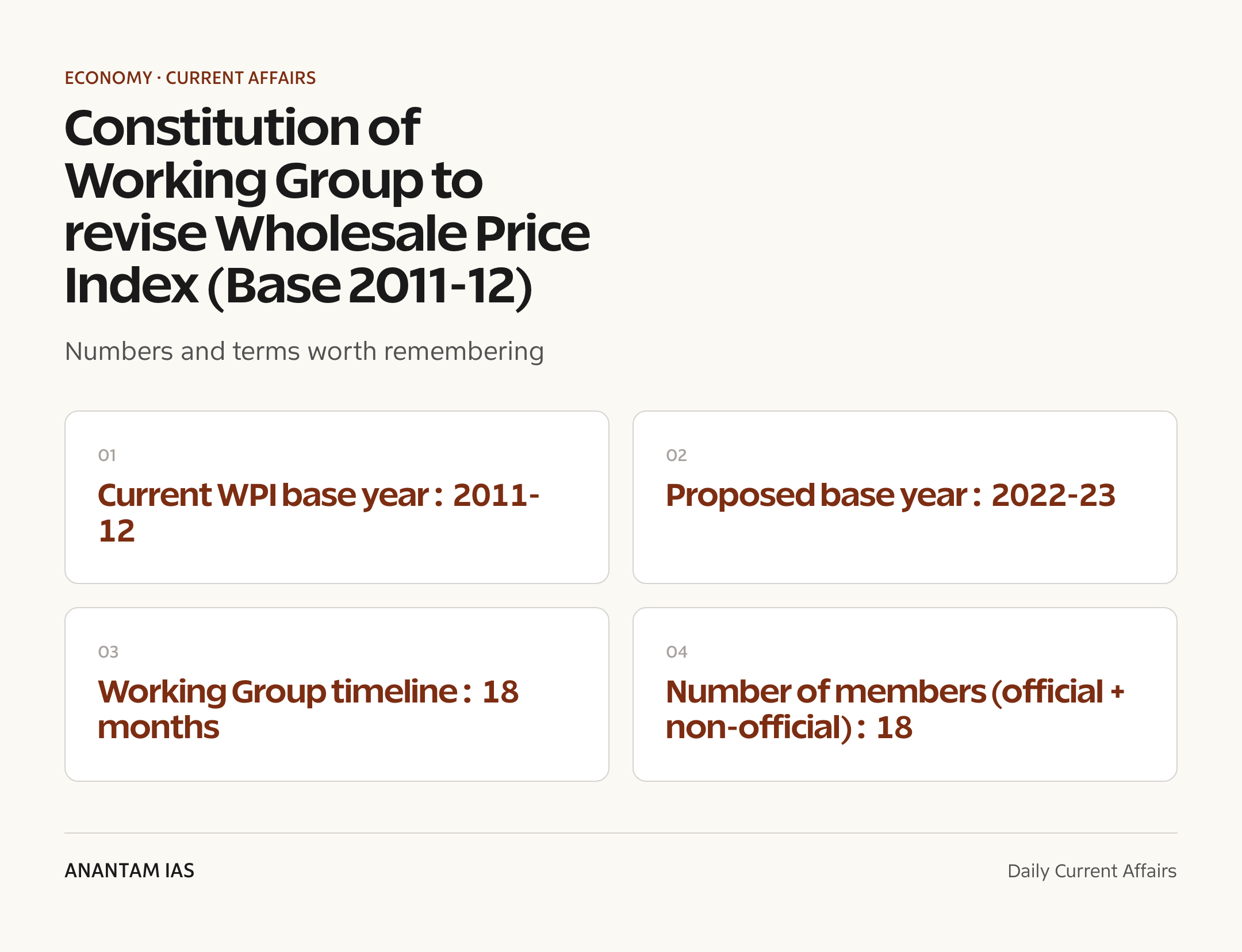
UPSC Relevance
Prelims Relevance
- High. Questions may ask about the WPI base year, lead ministry, composition of the Working Group, timeline for submission and key differences between WPI and CPI.
Mains Relevance
GS3 Economy
- High. Useful for answers on inflation measurement, index construction, statistical reforms, and policy implications of index rebasing for macro policy and sectoral stakeholders.
Essay
- Moderate. Material usable in essays on macroeconomic management, data-driven governance, and reforms in statistical systems.
Background and Context
What is the WPI and why it matters
Define the index and its principal uses.
- The Wholesale Price Index measures price changes at an early stage of the distribution chain—mainly in industry, mining and primary articles.
- It is distinct from the Consumer Price Index which tracks retail prices faced by households and includes services.
- WPI is used for policy analysis, sectoral price monitoring, contract escalation clauses and some fiscal calculations.
- Because it captures producer-level inflation, WPI often leads CPI in signalling inflationary pressures in supply chains.
- Central banks and ministries use WPI alongside CPI to obtain a fuller picture of inflation dynamics across the economy.
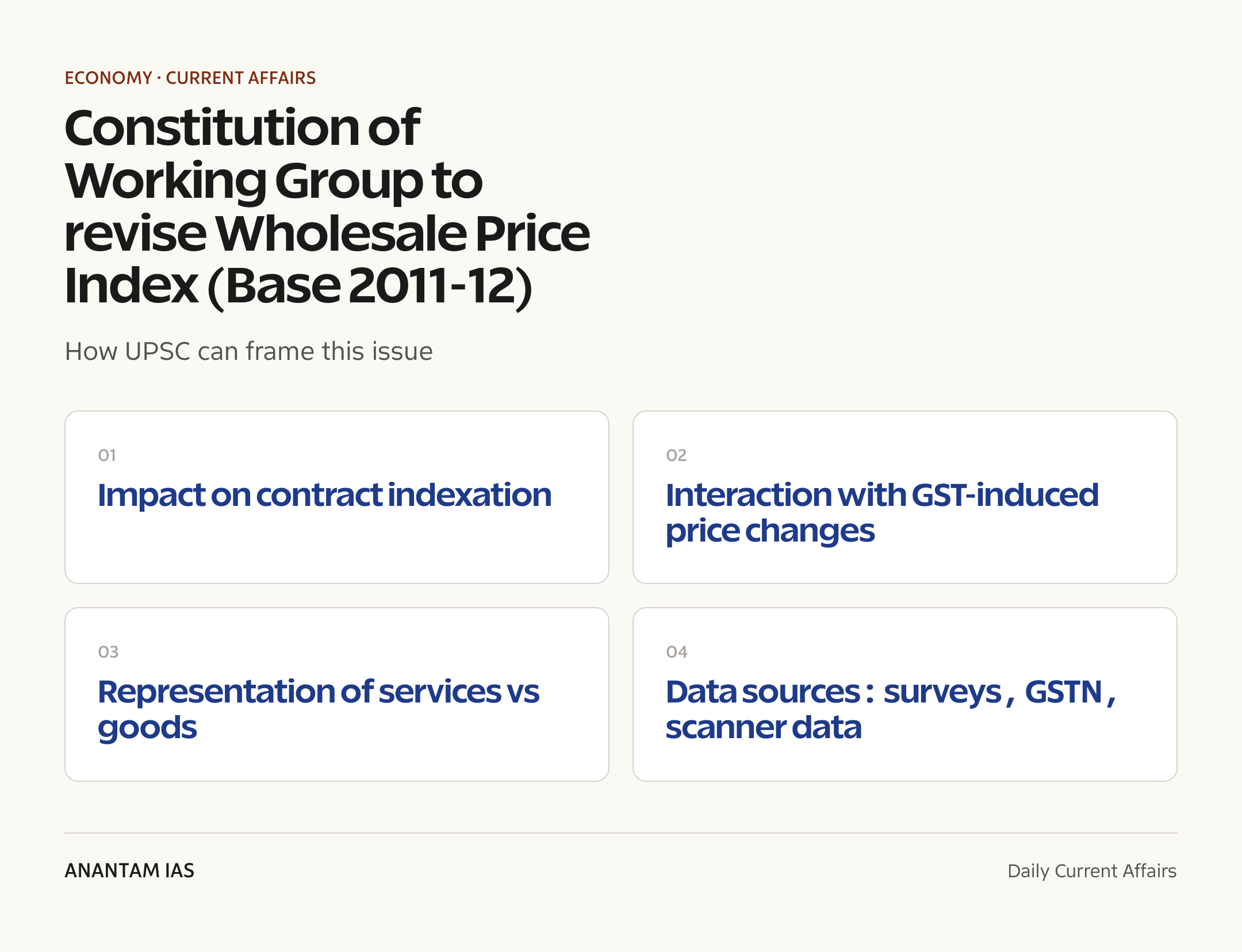
Why base-year revision is done
Rationale behind periodic rebasing of price indices.
- Over time the economy’s structure changes: new goods emerge, old goods decline and consumption patterns shift; these changes require updated weights for accurate measurement.
- Tax and institutional changes such as the introduction of GST affect prices and tax incidence; older series may no longer capture these effects properly.
- Rebasing incorporates improved data sources and advances in statistical methods, raising the quality and relevance of statistics.
- Regular updates reduce bias from outdated quantity weights and better represent current production and trade patterns.
- International practices recommend periodic rebasing, typically every 5 to 10 years, to maintain index reliability.
Recent methodological challenges for WPI
Key technical and data issues the Working Group will need to address.
- Coverage: WPI mainly covers goods and excludes most services; growth of services in the economy poses representativeness questions.
- Weights: Existing weights derive from older production and trade data; need to incorporate recent national accounts and enterprise surveys.
- Price collection: Changes in distribution channels, digital trade and manufacturing contracts require a review of price collection points and frequency.
- Treatment of taxes and subsidies: Since GST, commodity-level tax incidence changed; the Working Group must define whether indices are calculated tax-inclusive or tax-exclusive.
- Integration with other statistics: Aligning WPI with national accounts and trade statistics will improve coherence across official data systems.
Composition and mandate of the Working Group
Who is on the panel and what they must deliver.
- Chair: Prof. Ramesh Chand, Member, NITI Aayog; Member Secretary: Deputy Director General, DPIIT.
- Members include officials from Ministry of Statistics & PI, DEA, Agriculture, Consumer Affairs, Petroleum, GSTN and RBI.
- Non-official members: eminent economists and private-sector chief economists from SBI, Crisil, Kotak, Bank of America and others.
- Mandate: revise base to 2022-23, review weights, item coverage, price collection methods, and recommend statistical treatments.
- Timeline: submit final report within 18 months of the notification; Chairman may co-opt additional experts as needed.
Possible immediate effects of rebasing
Short-term statistical and market consequences to expect.
- Measured WPI inflation levels could change due to new weights; past series may be re-linked to show consistent historical movements.
- Contract indexation clauses tied to WPI might need rewording to reference the new series and rebasing formulae.
- Market participants, including commodity traders and manufacturers, will reassess pricing, hedging and inventory decisions based on revised signals.
- Policymakers may need to explain movement in reported inflation after rebasing to manage expectations in financial markets.
- Academic and media commentary will scrutinise methodological choices such as inclusion/exclusion of services and treatment of indirect taxes.
International practice and comparators
How other countries handle rebasing and index construction.
- Many statistical agencies rebase indices regularly and publish bridging series to maintain continuity for analysts.
- Some countries maintain both producer and output price indices to capture different stages in production chains; cross-checks improve reliability.
- Use of enterprise-level administrative data and scanner data has become common to improve price coverage and timeliness.
- Best practice includes clear documentation, public consultations and transparent revision policies to retain credibility.
Way Forward
Technical recommendations for the Working Group
- Adopt 2022-23 as base year with clear justification and publish bridging series for historical continuity.
- Use recent national accounts and enterprise survey data to set weights and reflect current production patterns.
- Define explicit treatment of taxes and subsidies with scenarios for tax-inclusive and tax-exclusive series to aid users.
- Pilot incorporation of high-frequency administrative or scanner data for select commodities to improve timeliness.
User communication and transition plan
- Publish methodology documents, sample weights and illustrative re-linked historical series well before formal release.
- Engage stakeholders from industry, state governments, banks and researchers through public consultations and workshops.
- Provide guidance for legal and contractual use, including model clauses to transition to the new WPI for indexation.
- Issue interim FAQs and explainer notes to help media and markets interpret year-on-year changes after rebasing.
Institutional and capacity measures
- Strengthen capacity at MSPI for price collection, data processing and rapid dissemination of metadata.
- Establish inter-agency data-sharing protocols with GSTN, customs and enterprise registries to access quality administrative data.
- Create a technical advisory panel for ongoing methodological updates beyond the current review period.
- Invest in training and statistical software to support complex chain-weighting and index linking operations.
Policy use and coordination
- Coordinate with RBI and DEA to explain implications for monetary and fiscal analysis and avoid misinterpretation of short-term shifts.
- Recommend parallel publication of WPI and complementary price indicators to capture services price movements where relevant.
- Advise government bodies to review contractual references to price indices and allow transition periods for existing agreements.
Conclusion
Rebasing the WPI to 2022-23 is a technical but consequential reform. A transparent methodology, stakeholder engagement and careful communication will be critical to ensure the new series improves measurement without creating unnecessary volatility or confusion for policymakers, markets and users.
UPSC Practice Questions
Prelims MCQ 1
Which ministry or department released the notification constituting the Working Group to revise the WPI base to 2022-23?
(a) Ministry of Finance (b) Ministry of Commerce & Industry (c) Ministry of Statistics & Programme Implementation (d) Department of Economic Affairs
Answer: (b) Ministry of Commerce & Industry
Explanation:
The Press Information Bureau release issued on 02 January 2025 was by the Ministry of Commerce & Industry announcing constitution of the Working Group.
Prelims MCQ 2
What is the timeline given to the Working Group to submit its final report on WPI revision?
(a) 6 months (b) 12 months (c) 18 months (d) 24 months
Answer: (c) 18 months
Explanation:
The official notification states that the Working Group has been asked to submit its final report within 18 months of issue of the notification.
UPSC Mains Questions
- {‘question’: ‘Explain the significance of rebasing price indices like WPI and outline the key methodological issues the Working Group should address while moving the base to 2022-23.’, ‘answer’: ‘Rebasing aligns index weights with current economic structure, improving representativeness and reducing bias from outdated consumption or production patterns. For WPI, the Working Group should update weights using recent national accounts and enterprise surveys, review item coverage especially given the rising share of services, clarify price collection points and frequency, set a transparent policy on taxation treatment (tax-inclusive or exclusive), pilot use of administrative and scanner data for select commodities, publish bridging series for historical continuity, and ensure coherence with national accounts and trade statistics.’}
- {‘question’: ‘Discuss the possible policy and market implications of rebasing the Wholesale Price Index for stakeholders such as RBI, central government and contractual users.’, ‘answer’: ‘Rebasing can change the measured level and growth of wholesale inflation, which may affect inflation expectations and monetary policy assessment by RBI. The central government may need to recalibrate indices used in certain fiscal formulas and explain changes in headline inflation trajectories. For contractual users, price escalation clauses tied to WPI will require amendment or transition rules to reference the new base. Markets and commodity traders may react to altered signals; clear communication and publication of re-linked history are necessary to prevent misinterpretation.’}
Source: PIB, Ministry of Commerce & Industry.
Frequently Asked Questions
q
a
q
a
q
a
q
a
q
a
q
a
Source: https://anantamias.com/current-affairs/wpi-working-group-2025/
DFS launches revamped BAANKNET one-stop e-auction portal for properties
Why in News?
The DFS launched a revamped BAANKNET e-auction portal that centralises property listings of all public sector banks to streamline recovery, increase transparency and make asset disposal more efficient.
- Launch by DFS Secretary signals central government push for digital consolidation of bank asset disposals.
- Portal aggregates listings from all PSBs, offering a one-stop marketplace for buyers and investors.
- Migration of over 1,22,500 properties to the new system at launch indicates scale and immediate utility.
- Expected to improve recoveries for PSBs, which can strengthen bank balance sheets and support credit flow.
The development matters in the context of:
- Asset recovery by banks has been a long-standing challenge, with dispersed auction platforms across banks creating opacity and inefficiency.
- National initiatives earlier aimed at resolving stressed assets include Insolvency and Bankruptcy Code, SARFAESI enforcement and Debt Recovery Tribunals; BAANKNET complements these by focusing on secondary-market disposal.
- Public sector banks hold significant amounts of non-performing assets and attached collateral that require transparent, wide-reach marketplaces to realise fair value.
- Digital platforms can lower transaction costs, widen bidder participation and reduce collusion risk associated with fragmented auctions.
- Coordination with DRTs, IBBI and PSB operational teams is critical for legal clearance, asset handover and dispute resolution post-auction.
- Large-scale property data standardisation and migration are prerequisites for any centralised e-auction marketplace to function effectively.

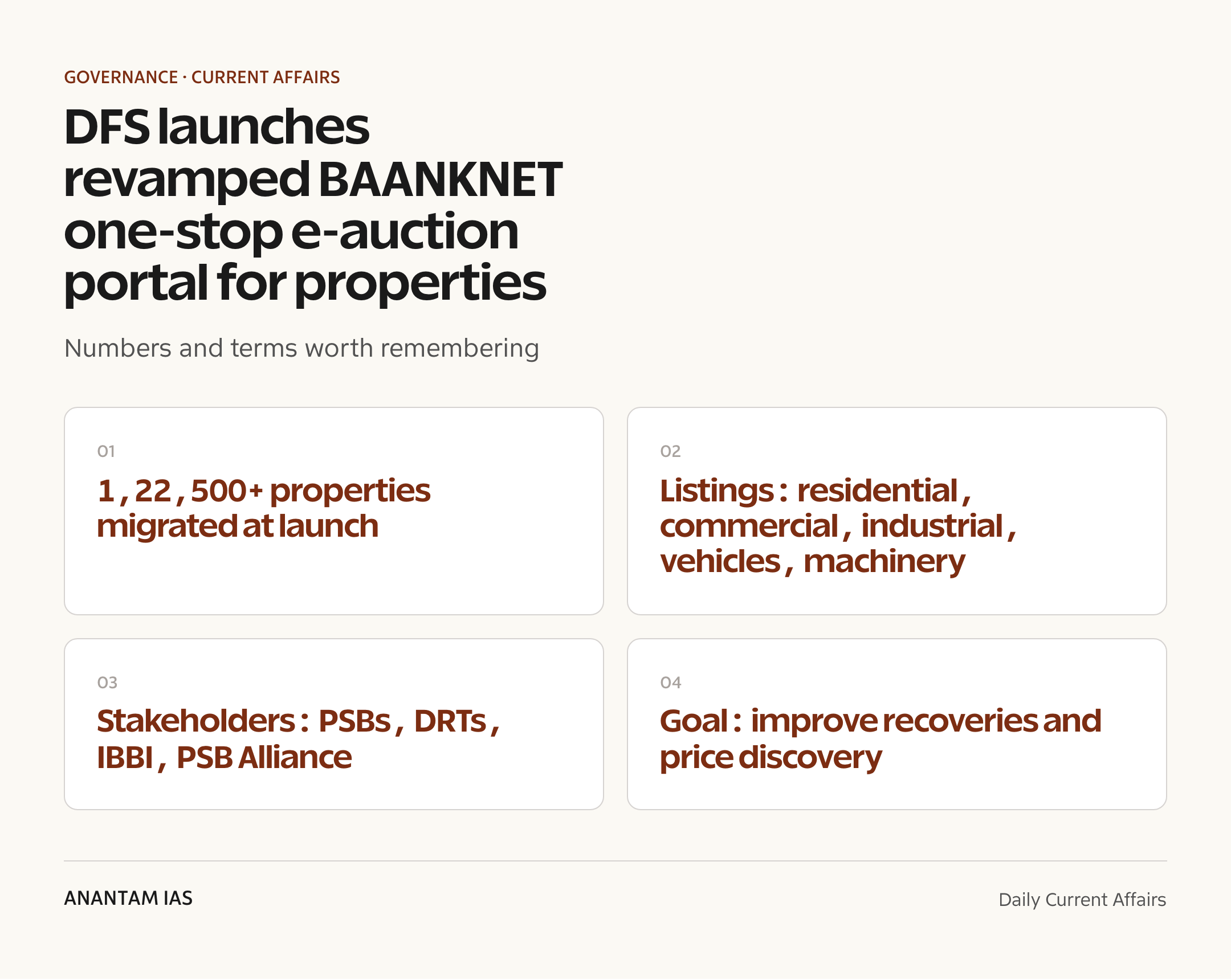
UPSC Relevance
Prelims Relevance
- BAANKNET is a centralised e-auction portal launched by the Department of Financial Services for property auctions of PSBs.
- The portal consolidates residential, commercial, industrial properties, vehicles and machinery from multiple banks in a single platform.
- Over 1,22,500 properties were migrated to the new portal at launch, indicating scale.
Mains Relevance
GS3 Economy
- Analyse how a centralised e-auction portal can strengthen bank balance sheets by improving asset disposals and recoveries.
- Discuss the governance, legal and operational challenges in implementing a unified digital marketplace for distressed assets.
- Evaluate the impact of consolidated e-auctions on market transparency, competition and price discovery in the secondary market for collateral.
Essay
- Digital interventions in public finance and banking can be evaluated in essay questions on economic reforms, governance and technology-led efficiency.
- BAANKNET can be used as a case study in essays on structural reforms to improve the banking sector and access to credit.
Background and Context
Why asset disposal matters for banks
Realising value from collateral is a key route for banks to recover dues and free up capital for fresh lending.
- Non-performing assets lock capital and reduce banks’ ability to extend credit, affecting economic growth.
- Efficient disposal of attached assets shortens recovery timelines and reduces carrying costs.
- Public sector banks hold a large share of stressed assets; recovery rates directly influence fiscal exposure and recapitalisation needs.
- Transparent auctions can improve market confidence and prevent price suppression due to lack of bidders.
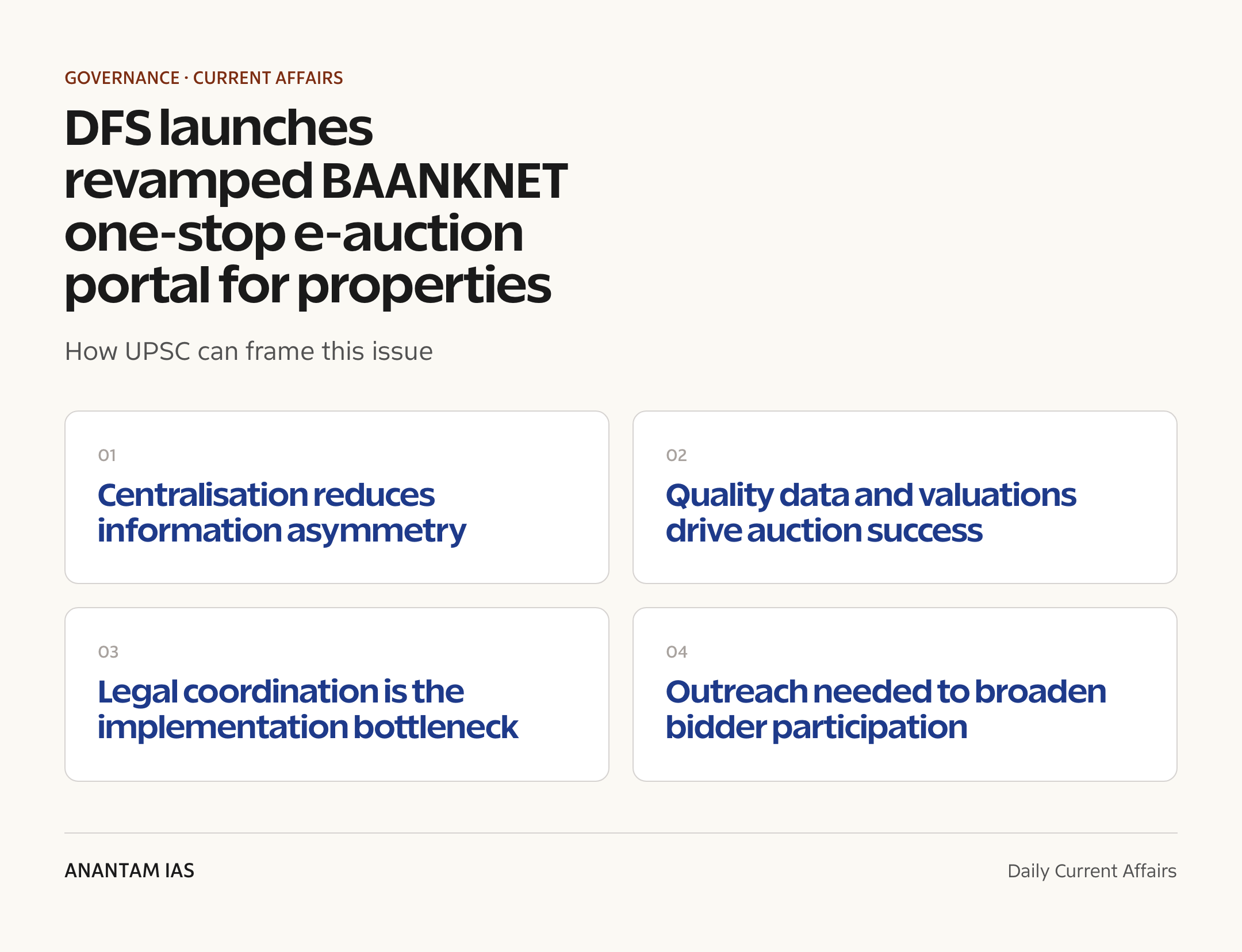
Existing legal and institutional framework
Multiple legal mechanisms support creditor recovery, but practical constraints persist.
- SARFAESI Act gives banks powers to attach and sell secured assets without court intervention in many cases.
- Insolvency and Bankruptcy Code provides an alternate route for corporate defaults, with a structured resolution timeline.
- Debt Recovery Tribunals and Debt Recovery Appellate Tribunals handle adjudication of recovery cases and appeals.
- Coordination gaps between banks, tribunals and buyers often slow down physical transfer and possession processes.
Fragmentation of auction platforms: the problem
Prior to BAANKNET, banks used individual portals or third-party marketplaces that varied widely.
- Different platforms had diverse listing formats, searchability and verification standards, making comparison hard for buyers.
- Smaller bidder base per platform reduced price discovery and encouraged bid manipulation in some locales.
- Operational overhead for banks increased as they trained staff and maintained multiple seller accounts.
- Data silos prevented analytics at scale about asset types, recovery rates and regional patterns.
BAANKNET features at launch
The revamped portal introduces centralisation and upgraded functionality to address prior gaps.
- Consolidated listings across all PSBs include residential, commercial, industrial plots, vehicles, plant and machinery.
- Improved search and discovery helps buyers filter by asset type, location, reserve price and auction date.
- Training provided to PSB executives and DRT recovery officers to ensure uniform usage and reduce procedural errors.
- Migration of existing listings to the new portal ensures continuity and provides immediate inventory for bidders.
Stakeholder roles and collaboration
Successful operation requires cooperation between banks, tribunals and regulators.
- PSBs must ensure accurate asset data, legal clearances and timely uploading of documentation.
- DRTs and appellate bodies provide adjudication; their officers are trained to operate within the portal workflow.
- Regulators like IBBI and RBI can issue guidelines to harmonise auction protocols and safeguard bidder rights.
- Third-party service providers may be needed for valuations, title searches and asset rehabilitation where required.
Risks and limitations
Centralisation is not a standalone solution; operational and legal frictions remain.
- Legal disputes over title and possession can stall transfer even after successful auctions.
- Valuation quality and reserve price setting will determine whether auctions realise true market value.
- Digital divide and bidder awareness in smaller towns may limit participation without outreach.
- Concentration risk: if many large assets are mispriced, it could distort local real estate markets.
Way Forward
Strengthen legal-operational linkages
- Create fast-track protocols between PSBs and DRTs for post-auction possession and title transfer.
- Standardise documentation templates and digital affidavits to reduce delays in legal clearance.
- Set up a helpdesk connecting auction winners with recovery officers to guide handover procedures.
Improve data quality and valuation processes
- Mandate independent, certified valuations uploaded with each listing to improve price discovery.
- Introduce mandatory digital title-search reports to reduce post-sale litigation risks.
- Use periodic audits of migrated listings to identify and fix data anomalies or stale entries.
Expand bidder outreach and market access
- Run targeted awareness campaigns and roadshows to educate investors, real estate agents and MSMEs about BAANKNET.
- Enable easy account creation and low-value bid participation to include retail buyers alongside institutional bidders.
- Provide multilingual interfaces and grievance redressal to broaden geographic reach.
Leverage analytics and policy feedback
- Use portal analytics to publish periodic reports on recovery rates, asset realisation and regional trends.
- Feed insights to policymakers to calibrate banking resolution frameworks and recapitalisation needs.
- Deploy AI-assisted search and recommendation tools to match buyers with suitable assets and improve auction outcomes.
Conclusion
BAANKNET’s centralisation of PSB property auctions is an important step to improve transparency, widen bidder participation and accelerate recoveries. Its success will depend on quality of data, legal coordination and active outreach to market participants. With appropriate operational reforms and monitoring, the portal can unlock value from distressed assets and support healthier bank balance sheets.
UPSC Practice Questions
Prelims MCQ 1
What is BAANKNET as launched by the Department of Financial Services in January 2025?
(a) A credit guarantee scheme for MSMEs (b) A centralised e-auction portal for properties and assets of public sector banks (c) A regulatory body for bank mergers (d) A loan restructuring framework for NBFCs
Answer: (b) A centralised e-auction portal for properties and assets of public sector banks
Explanation:
BAANKNET is a one-stop e-auction portal launched by DFS to consolidate property and asset listings of PSBs and facilitate transparent auctions.
Prelims MCQ 2
Which of the following was an immediate outcome at the launch of the revamped BAANKNET portal in January 2025?
(a) All stressed assets were resolved under IBC (b) Over 1,22,500 properties were migrated to the new portal (c) RBI issued a circular merging PSBs onto a single balance sheet (d) DRTs were abolished and replaced by a new tribunal
Answer: (b) Over 1,22,500 properties were migrated to the new portal
Explanation:
The press release from DFS stated that more than 1,22,500 properties had been migrated to BAANKNET at launch.
UPSC Mains Questions
- {‘question’: ‘Examine the role of a centralised e-auction platform like BAANKNET in strengthening the recovery mechanism of public sector banks. What operational and legal challenges must be addressed for the portal to be effective?’, ‘model_answer_points’: [‘Role: Centralisation improves market transparency by aggregating listings, aiding price discovery and widening bidder base.’, ‘Role: Reduces operational duplication across banks and allows analytics to identify recovery bottlenecks and regional asset trends.’, ‘Role: Faster and fairer disposal of collateral can improve bank balance sheets and boost credit availability.’, ‘Challenges: Legal disputes on title and possession require streamlined coordination with DRTs and standardised documentation.’, ‘Challenges: Accurate valuation and reserve price setting demand independent appraisals to prevent undervaluation or sale failures.’, ‘Challenges: Capacity building across PSBs and tribunals is needed to ensure consistent data entry and portal usage.’, ‘Policy measures: Issue regulatory guidelines for digital auctions, audit migrated listings and set timelines for post-auction possession transfer.’, ‘Conclusion: BAANKNET can be transformative if backed by legal reforms, strong data governance and market outreach.’]}
- {‘question’: ‘Critically discuss how digital consolidation of asset disposal interfaces impacts competition and price discovery in the secondary market for distressed assets.’, ‘model_answer_points’: [‘Digital consolidation increases market access by bringing more buyers to a single marketplace, improving competition.’, ‘Wider participation enhances price discovery which can reduce instances of artificially low sale prices.’, ‘Standardised listings and valuations make cross-comparison easier for bidders, reducing information asymmetry.’, ‘However, concentration might create single-point failure risks and dependency on platform governance for fairness.’, ‘Digital divide and low awareness in some regions could limit genuine competition unless outreach is conducted.’, ‘Regulatory oversight, transparency in reserve pricing and third-party valuation norms are needed to ensure healthy competition.’]}
Source: PIB, Ministry of Finance (Department of Financial Services).
Frequently Asked Questions
q
a
q
a
q
a
q
a
q
a
q
a
Source: https://anantamias.com/current-affairs/baanknet-e-auction-portal-launch-2025/
CSIR‑CIMFR conducts India’s first trial blast of Dozer‑Push mining method
Why in News?
First successful trial blast of the Dozer‑Push mining method conducted in India by CSIR‑CIMFR at PEKB mine, integrating automation, digital design and large‑scale cast blasting to push blasted material with unmanned dozers.
- First domestic trial: CSIR‑CIMFR conducted the inaugural Dozer‑Push trial blast in India, marking a national milestone in mining technique adaptation.
- Automation and safety: The trial used man‑less automated drilling and automated dozers, reducing frontline human exposure to blasting and haulage risks.
- Productivity and cost: Preliminary estimates indicate a 7–10% reduction in operational cost versus conventional truck‑shovel or dragline systems.
- Phased validation: The trial is the first of several planned blasts; design refinements and environmental monitoring will follow before wider adoption.
The development matters in the context of:
- Indian coal-mining profile: Surface mining still supplies a major share of domestic thermal coal; efficiency gains in opencast operations directly affect energy supply economics.
- Conventional alternatives: Typical methods include truck‑shovel, shovel‑dumper and dragline systems; Dozer‑Push offers an alternate cycle centred on cast blasting and push movement.
- CSIR‑CIMFR role: The Dhanbad institute provides applied mining R&D, including blast design, vibration mitigation and mechanisation pathways for Indian geology and operational norms.
- Private participation: Trial executed at a mine operated by Adani Natural Resources, showing private sector collaboration in technology trials.
- Regulatory environment: Mining operations must comply with environmental clearances, blast safety norms, and land restoration obligations under Indian law.
- Labour and skill impact: Automation changes skill mix at sites: fewer manual haulage roles, higher demand for remote operation, maintenance and blast engineering skills.

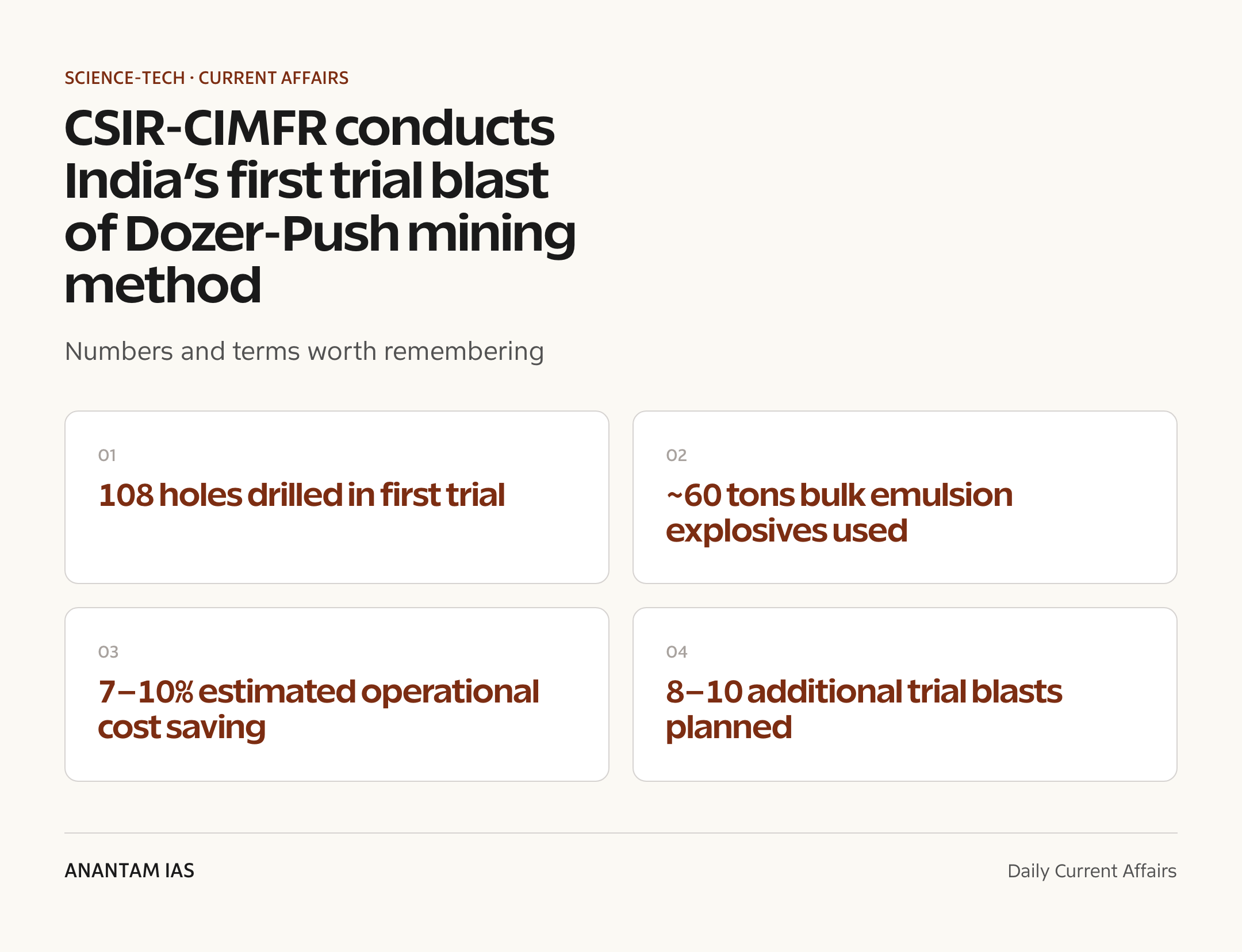
UPSC Relevance
Prelims Relevance
- Questions may test differences between opencast mining methods, features of Dozer‑Push method, and immediate operational benefits such as cost and safety metrics.
Mains Relevance
GS3 Science & Technology
- Discuss technology adoption in mineral sector, impact on productivity, labour transitions, environmental management and regulatory challenges. Useful for essays on science, technology and society and infrastructure modernisation topics.
Essay
- Material for essays on technology and employment, sustainable resource extraction, and modernization of extractive industries in India’s growth narrative.
Background and Context
What is Dozer‑Push mining?
Method built around cast blasting and pushing blasted material with dozers rather than truck haulage.
- Cast blasting: Large scale blasting to fragment and throw overburden or coal into a pre‑decoked or void area for direct dozer access.
- Dozer push: Use of large dozers to push blasted material along bench slopes to recovery points without intermediate truck haulage.
- Cycle change: Replaces repetitive drill‑load‑haul cycles with integrated drill‑blast‑push operations.
- Simpler fleet: Reduces dependency on large fleets of haul trucks, altering capital and operating cost structures.
- Automation fit: Suits unmanned or remote operation of drill rigs and dozers, reducing frontline worker exposure to hazards.
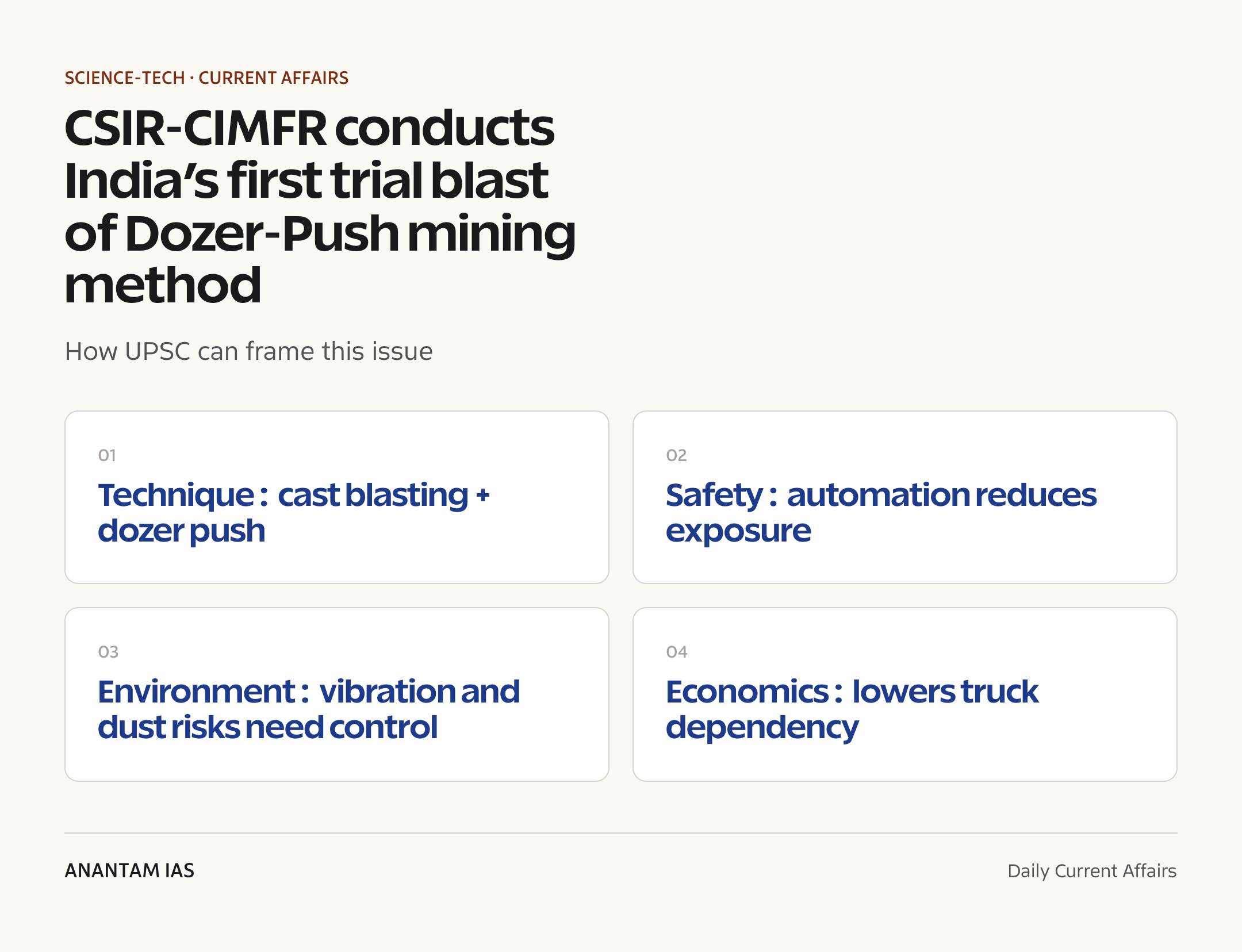
Why CSIR‑CIMFR developed the method for India
Adaptation aimed at local geology, operational conditions and safety/environmental constraints.
- Local geology: Indian seams and overburden characteristics required tailored blast design to control flyrock and vibration.
- Monsoon constraints: Dozer‑Push can limit weather‑induced haulage delays by reducing truck movement needs during heavy rains.
- Cost pressures: Rising diesel and maintenance costs make lower truck usage attractive for mining companies.
- Safety goals: Reduce exposure to haulage and loading risks through remote operation and mechanisation.
- Technology transfer: Trial allows benchmarking against global cast‑blast operations and calibration for Indian mines.
Trial specifics at PEKB mine
Technical facts about the inaugural blast and equipment used.
- Location: PEKB (Parsa East and Kanta Basan) opencast coal mine, Udaipur block, Ambikapur, Chhattisgarh.
- Drilling: 108 holes drilled using an automated, man‑less drill rig as part of the trial.
- Explosives: Bulk emulsion explosive used for cast/throw blasting; reported charging quantity was ~60 tons.
- Pushing: Specially designed, large automated dozers planned to move blasted material into decoaled area for recovery.
- Team: Trial led by Prof. Arvind Kumar Mishra and CSIR‑CIMFR S&T team with the mine operator executing site operations.
Operational advantages signalled
Immediate benefits claimed or projected from the trial data and design.
- Cost reduction: Estimated 7–10% operational cost saving compared to truck‑shovel cycles.
- Faster recovery: Enables quicker coal recovery by reducing cycle time lost to hauling and truck turnaround.
- Dragline support: Frees up dragline machines by improving bench management and material distribution.
- Safety improvements: Lowers risks from truck haulage and on‑bench personnel exposure when automated equipment used.
- Weather resilience: Less dependency on truck movement helps operations during heavy rains.
Environmental and social concerns
Potential downside areas that need assessment during scale up.
- Blast impacts: Large cast blasts raise concerns on vibration, flyrock and airblast; design must meet safety thresholds.
- Dust and emissions: Fragmentation and dozer movement generate dust; need for dust suppression plans and monitoring.
- Rehabilitation: Changed benching and material distribution can affect progressive reclamation and water management.
- Community risk perception: Larger blasts may alarm local communities; engagement and early warning systems are necessary.
- Labour displacement: Reduced haulage roles require reskilling programs and social safeguards for affected workers.
Way Forward
Refined technical validation
- Additional trial blasts: Conduct the planned 8–10 follow‑up blasts under varying seam conditions to finalise blast parameters.
- Monitoring suite: Deploy vibration, airblast, flyrock and dust monitors with public data reporting for transparency.
- Benchmark metrics: Record detailed cycle‑time, fuel, maintenance and recovery figures to validate cost claims.
Regulatory and safety measures
- Blast certification: Ensure blast design and emulsion use comply with statutory blast safety guidelines and approvals.
- Standard operating procedures: Draft SOPs for automated drilling, charging and dozer push operations with contingency protocols.
- Emergency planning: Strengthen on‑site emergency response and community notification systems around major blasts.
Environmental safeguards
- Impact assessment: Undertake site level environmental impact assessments specific to cast blasting and dozer push.
- Mitigation measures: Implement dust suppression, progressive rehabilitation, and water runoff control tailored to the method.
- Monitoring and compliance: Use continuous environmental monitoring tied to mine environmental management plans.
Social and workforce transition
- Reskilling programs: Create training modules on remote equipment operation, maintenance and blast design for local workforce.
- Stakeholder engagement: Conduct sustained consultations with affected communities to explain safety measures and benefits.
- Policy support: Consider social safety nets and placement assistance for displaced haulage workers during transition.
Conclusion
The CSIR‑CIMFR Dozer‑Push trial is a significant step toward mechanised, lower‑cost and potentially safer opencast mining in India. Realising benefits at scale will require rigorous technical validation, strict environmental safeguards, updated regulatory protocols and targeted workforce transition measures to manage social impacts.
UPSC Practice Questions
Prelims MCQ 1
Which of the following best describes the Dozer‑Push mining method trialed by CSIR‑CIMFR?
(a) A. Use of draglines to remove overburden and load trucks for haulage. (b) B. Cast blasting to throw material into a void followed by pushing fragmented material with dozers. (c) C. Continuous underground longwall extraction using hydraulic supports. (d) D. Use of conveyor belts to transport coal from benches to surface.
Answer: B
Explanation:
Dozer‑Push uses cast or throw blasting to fragment and displace material into an area where dozers push it for recovery, replacing truck haulage. Options A, C and D describe other mining methods.
Prelims MCQ 2
During the CSIR‑CIMFR trial at PEKB mine, which of the following elements was reported as used?
(a) A. Manual hand drilling for precision holes. (b) B. Bulk emulsion explosives and automated drill rigs. (c) C. Underground stoping and backfilling with cement paste. (d) D. Use of dragline only without blasting.
Answer: B
Explanation:
The trial involved automated (man‑less) drilling and use of bulk emulsion explosives for cast/throw blasting. Options A, C and D are inconsistent with the trial description.
UPSC Mains Questions
- {‘question’: ‘Analyse how adoption of the Dozer‑Push mining method could reshape opencast coal mining economics and operations in India. What policy and regulatory steps should the government take to ensure environmentally responsible scale up?’, ‘guidance’: ‘Discuss capital and operating cost implications, fleet restructuring, productivity and seasonal resilience, labour impacts and training needs. Recommend policy measures like updated blast safety norms, environmental monitoring requirements, reskilling funding and pilot‑to‑scale regulatory frameworks.’}
- {‘question’: ‘Examine the social implications of increased automation in surface mining, using the Dozer‑Push trial as an example. How can companies and the state design transition strategies that protect livelihoods while encouraging technology adoption?’, ‘guidance’: ‘Cover direct and indirect job displacement, skill upgradation pathways, local employment clauses, social safety nets and stakeholder engagement. Suggest practical modules for training and examples of corporate responsibility actions.’}
Source: PIB, Ministry of Science & Technology (CSIR‑CIMFR).
Frequently Asked Questions
q
a
q
a
q
a
q
a
q
a
q
a
Source: https://anantamias.com/current-affairs/csir-cimfr-dozer-push-mining-trial-2025/
MeitY releases Draft Digital Personal Data Protection Rules, 2025 for public consultation
Why in News?
MeitY released detailed subordinate rules to implement the Digital Personal Data Protection Act, 2023. The draft clarifies obligations, introduces procedural mechanisms, and sets up institutional architecture that will affect privacy rights, compliance costs, and data-driven services across government and industry.
- Operational detail: The draft provides actionable rules to implement key DPDP Act provisions such as notices, consent management, breach reporting and rights facilitation.
- Institutional design: It sets out the structure, appointment and functioning of the Data Protection Board as a digital office and appellate procedure.
- State processing: Rules address processing of personal data by States for issuance of subsidy, benefit or service, clarifying lawful bases and safeguards.
- Stakeholder impact: Obligations on Data Fiduciaries and new role of Consent Managers will affect businesses, startups and digital platforms.
- Public consultation: Draft is open for feedback until 18 February 2025 via MyGov, making it a live regulatory design process.
The development matters in the context of:
- DPDP Act, 2023: Replaced earlier statutory architecture to balance individual rights and legitimate processing. The Act sets broad duties and enforcement powers; rules are needed for operationalising specifics.
- SARAL framework: MeitY used principles of simple language, contextual definitions and illustrations to improve accessibility of the rules for citizens and stakeholders.
- Previous debates: Policy debate since 2017 covered cross-border data flows, data localisation, consent regimes and regulatory powers; the draft attempts to address technical and procedural gaps left by the Act.
- Comparative trend: Global jurisdictions use subordinate rules to define breach timelines, registration requirements and duties of data controllers; India is following that pattern while tailoring to administrative realities.
- Technology context: Increasing use of AI, biometrics and large-scale databases in public delivery makes specific safeguards for sensitive data and children critical in rule design.
- Enforcement stakes: The draft details notification, appeal and adjudication processes through the Data Protection Board and Appellate Tribunal, affecting compliance burden and dispute resolution timelines.

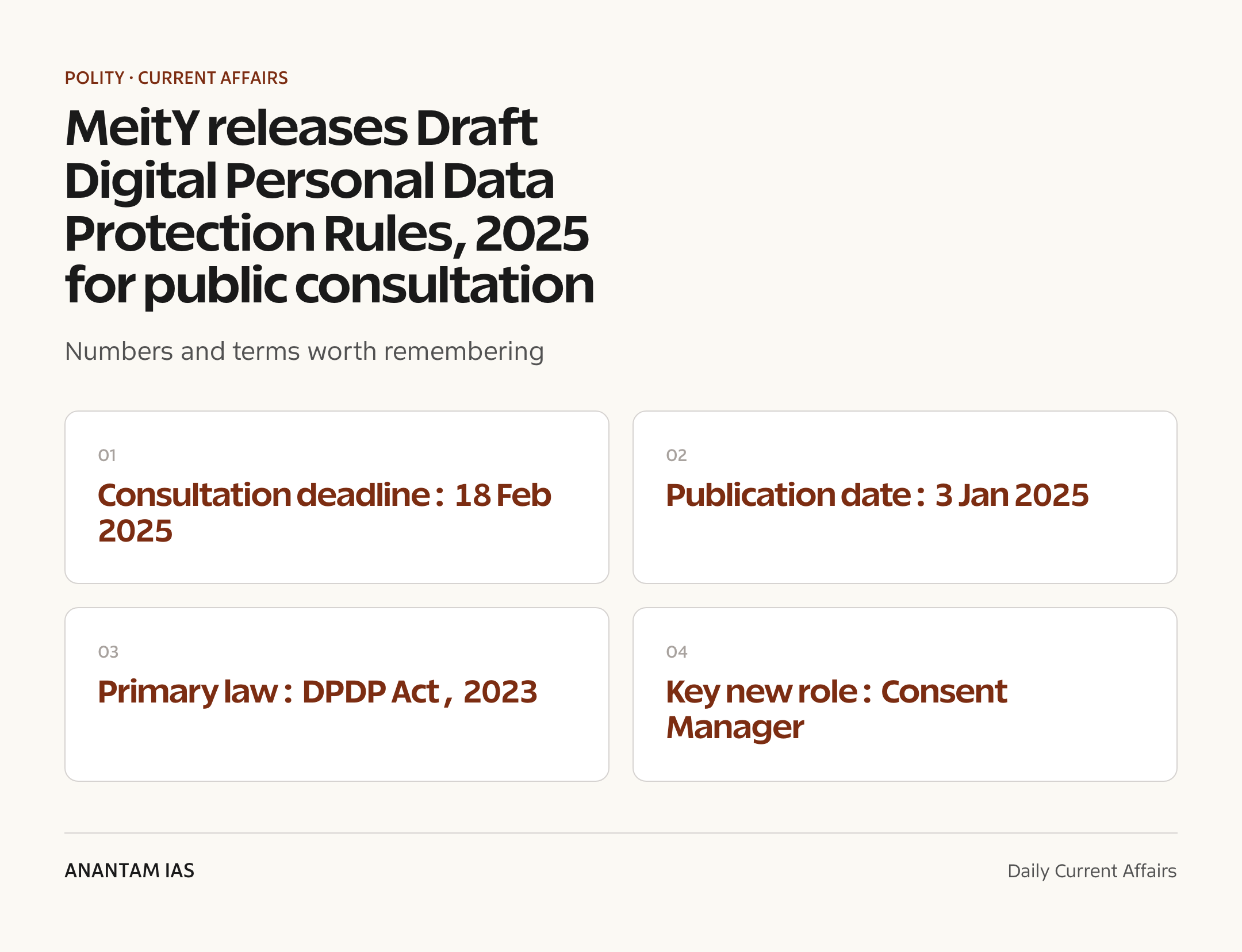
UPSC Relevance
Prelims Relevance
- Key facts: Draft Rules, 2025 published by MeitY on 3 January 2025; public comments invited until 18 February 2025 via MyGov.
- Legal link: The Rules are subordinate legislation under the Digital Personal Data Protection Act, 2023.
- Institutions: Defines operational aspects of the Data Protection Board and registration of Consent Managers.
- Scope: Includes special provisions for children and persons with disability, and for State processing of data for benefits.
Mains Relevance
GS2 Polity & Governance
- Policy analysis: Provides material to evaluate how subordinate rules can shape balance between privacy rights and governance needs.
- Governance: Illustrates how administrative design choices—like digital offices and registration systems—affect implementation and accountability.
- Regulatory economics: Helps assess compliance costs for businesses, innovation trade-offs and the role of consent managers in the digital economy.
- Human rights: Bases for argument on adequacy of safeguards for children, disability and sensitive data in the context of public services.
Essay
- Data governance: Case study on modernising personal data protection and aligning legal frameworks with digital governance objectives.
- State and market: Material for essays on the role of the state in regulating digital markets and protecting citizen rights.
- Rights vs development: Useful for arguments on reconciling data-driven service delivery with privacy and civil liberties.
Background and Context
The DPDP Act, 2023 — context and intent
The Act provides the statutory foundation; the rules operationalise technical and procedural details.
- The DPDP Act, 2023 establishes a legal framework for processing digital personal data, seeking balance between privacy rights and legitimate processing for services.
- The Act sets high-level duties, principles of fair processing and enforcement powers but leaves procedural specifics to subordinate rules.
- Key statutory elements include the rights of data principals, obligations on data fiduciaries, powers to issue codes of practice and the creation of the Data Protection Board.
- Without rules, regulators and organisations lack clarity on timelines, formats and thresholds for action, which can delay implementation.
- The 2025 draft seeks to fill these gaps by detailing notices, breach reporting, registration and special processing categories.
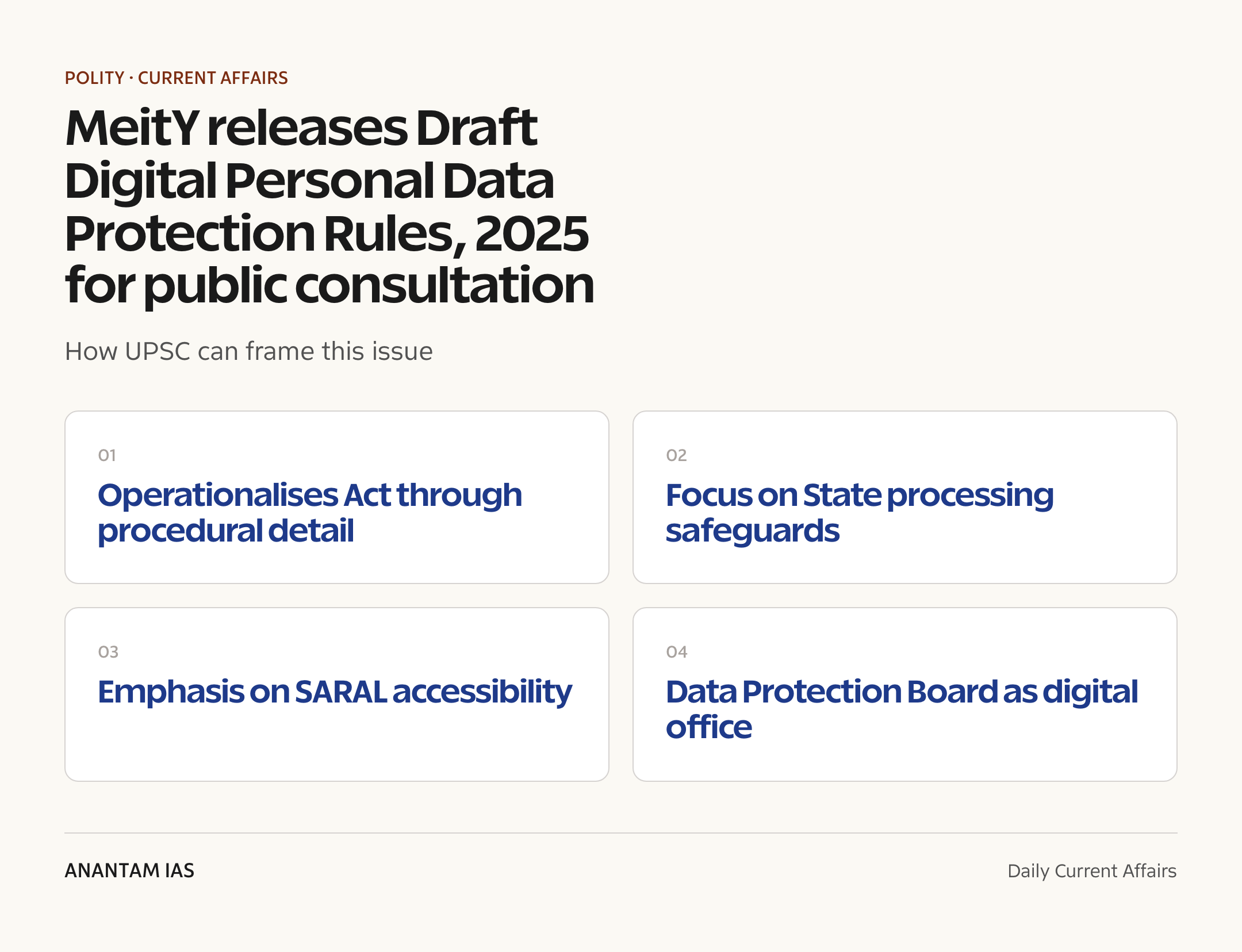
SARAL drafting approach used by MeitY
MeitY states it used SARAL principles to make the draft accessible and actionable.
- SARAL emphasizes simple language, contextual definitions and illustrative examples to aid comprehension by non-experts.
- The draft aims to reduce unnecessary cross-referencing and to provide explanatory notes alongside rule text.
- This approach can lower compliance errors and reduce disputes caused by ambiguous wording.
- Clearer rules may enable smaller enterprises and public bodies to follow obligations without heavy legal counsel.
- The format also supports more effective public consultation by making trade-offs visible to stakeholders.
Major operational elements covered in the draft
The draft Rules set out procedural mechanisms that affect everyday processing.
- Detailed requirements for notice to individuals covering purpose, retention and recipients of personal data.
- Registration requirements and obligations for a new role, the Consent Manager, including record-keeping and auditability.
- Breach notification procedures with timelines and content requirements for intimation to individuals and the Data Protection Board.
- Specific rules for processing data of children and persons with disability, including consent thresholds and parental or guardian checkpoints.
- Provisions for State-led processing of personal data for delivery of subsidies, benefits and services with safeguards against misuse.
Institutional architecture and adjudication
The draft explains how the Data Protection Board will function and how appeals will proceed.
- The draft sets out appointment criteria, service conditions and functioning of the Data Protection Board as a digital office.
- Procedures for filing complaints, timelines for Board action and modalities for issuing directions are specified.
- An Appellate Tribunal procedure is mapped for aggrieved parties seeking review of Board decisions.
- Clarity on digital functioning may speed up case processing but requires adequate staffing and technical capability.
- Design choices around powers and remedies will shape deterrence and compliance behaviour among fiduciaries.
Cross-border flows and data localisation implications
The rules address operational aspects related to transfer and storage of personal data.
- Draft clarifies conditions under which personal data may be transferred outside India and the obligations to ensure equivalent protection.
- Mechanisms for notice and consent related to cross-border transfer are outlined to reduce ambiguity for service providers.
- The rules do not introduce new sweeping localisation mandates but set standards for reasonable security safeguards.
- International interoperable frameworks and adequacy assessments are the likely next policy stage after rules are finalised.
- Business continuity, cloud providers and multinational firms will watch the final text for compliance pathways.
Special categories and public interest processing
The draft balances protection of sensitive categories with administrative needs for service delivery.
- Processing for public interest or government functions, such as welfare delivery, is permitted under specified safeguards.
- Rules demand minimalisation, purpose limitation and retention limits even for State processing to reduce over-collection.
- Sensitive personal data receives heightened procedural safeguards like stricter consent and limited retention.
- Provisions for automated decision-making and profiling aim to ensure transparency when decisions materially affect individuals.
- The degree of oversight for public authorities will be shaped by reporting and audit obligations embedded in the rules.
Way Forward
Public consultation and stakeholder engagement
- Submit detailed comments on specific rule provisions by 18 February 2025 via the MyGov portal link provided in the draft release.
- Civil society should prioritise clauses affecting children, sensitive data and remedies to ensure rights are protected.
- Industry should propose operational compliance templates and timelines to make obligations practicable for small firms.
- Academia can provide evidence-based inputs on technical feasibility, for example on breach detection timelines and consent frameworks.
Capacity building and institutional readiness
- Government must invest in staffing and technical capability to enable the Data Protection Board to function as a digital office.
- Training programmes for public officials involved in State processing will reduce legal and operational risks.
- Standard operating procedures and interoperable IT systems can streamline registration and complaint handling processes.
- A phased implementation timeline may help smaller fiduciaries meet new obligations without service disruption.
Operational measures for industry
- Organisations should adopt compliance playbooks for notice, consent records and breach response aligned to rule timelines.
- Consider appointing or integrating with registered Consent Managers to manage consent lifecycle and audits.
- Implement technical safeguards such as encryption, access control and data minimisation to meet reasonable security expectations.
- Run tabletop exercises for breach notification and individual rights requests to test readiness.
Monitoring and iterative rule-making
- MeitY should publish consolidated feedback and provide an explanation for major acceptances and rejections to build trust.
- Regulatory sandboxes can test novel compliance mechanisms like decentralised consent stores or standardised DPIA templates.
- Periodic review clauses or sunset provisions will allow rules to adapt to technological change, for example AI-driven processing.
- Stakeholders should push for clear metrics to evaluate the Board’s performance on timeliness and resolution quality.
Conclusion
The Draft Digital Personal Data Protection Rules, 2025 are a crucial implementation step for the DPDP Act, 2023. They translate statutory principles into operational obligations affecting government processing, industry compliance and individual rights. Stakeholder feedback in the consultation window can materially shape final text. Attention will shift to institutional capacity, compliance practicability and safeguards for vulnerable groups as the rules move toward finalisation.
UPSC Practice Questions
Prelims MCQ 1
Which of the following is true about the Draft Digital Personal Data Protection Rules, 2025 published by MeitY?
(a) A. They create the Digital Personal Data Protection Act, 2023. (b) B. They set procedural details to operationalise the DPDP Act, 2023. (c) C. They abolish the Data Protection Board established by the Act. (d) D. They impose a blanket data localisation requirement for all personal data.
Answer: B
Explanation:
The Draft Rules provide procedural details to implement the DPDP Act, 2023. The Act itself is primary legislation enacted earlier. The draft does not abolish the Data Protection Board and does not impose a blanket localisation requirement for all personal data.
Prelims MCQ 2
Under the Draft Digital Personal Data Protection Rules, 2025, which role is specified with registration and operational obligations?
(a) A. Data Fiduciary (b) B. Consent Manager (c) C. Data Principal (d) D. Chief Privacy Officer
Answer: B
Explanation:
The draft specifies registration and obligations for the role of Consent Manager. Data fiduciaries are already subject to duties under the Act. Data principals are the individuals whose data is processed. Chief Privacy Officer is an organisational role but the draft emphasizes Consent Manager registration.
UPSC Mains Questions
- {‘question’: ‘Examine the role of subordinate legislation in making data protection laws effective. Use the Draft Digital Personal Data Protection Rules, 2025 as an example.’, ‘demand’: ‘Explain the importance of rules in operationalising statutory principles, analyse key features of the draft Rules and assess implementation challenges and policy trade-offs.’}
- {‘question’: ‘Assess how the Draft Digital Personal Data Protection Rules, 2025 balance the need for state-led digital service delivery and protection of individual privacy rights.’, ‘demand’: ‘Critically evaluate provisions related to State processing, safeguards for vulnerable groups and institutional mechanisms for oversight.’}
Source: PIB, Ministry of Electronics & IT.
Frequently Asked Questions
q
a
q
a
q
a
q
a
q
a
q
a
Source: https://anantamias.com/current-affairs/digital-personal-data-protection-rules-2025-draft/
CAQM Sub-Committee invokes Stage-III of revised GRAP across the entire NCR
Why in News?
Activation of Stage-III of revised GRAP signals a severe air-quality emergency across the National Capital Region, triggering legally mandated restrictions on construction, transport and industrial operations with immediate public-health and urban governance implications.
- CAQM Sub-Committee invoked Stage-III of revised GRAP with immediate effect for the entire NCR as Delhi’s average AQI breached 350 and trended upward.
- Stage-III corresponds to Severe air quality (Delhi AQI band 401-450) and brings a 9-point action package across sectors.
- Measures include curbs on construction and demolition activities, tighter controls on dust-generating operations, staggered public office timings and hybrid schooling for young students in core districts.
- Action is based on real-time monitoring data and IMD/IITM forecasts indicating continued adverse meteorological conditions such as low mixing height and dense fog.
- The move activates compliance responsibilities for Pollution Control Boards, municipal bodies and district administrations across NCR districts.
The development matters in the context of:
- GRAP is a legally binding, graded action plan designed to respond to worsening air quality in NCR through progressive restrictions calibrated to AQI bands.
- The revised GRAP (December 2024) replaced earlier versions to broaden geographic coverage and update sectoral measures and enforcement roles for Commission for Air Quality Management (CAQM).
- Stage thresholds under the revised GRAP classify air quality into bands; Stage-III aligns with the ‘Severe’ range meant to prevent further deterioration to emergency levels.
- NCR comprises NCT of Delhi and adjoining districts in Haryana, Uttar Pradesh and Rajasthan; coordinated action is necessary because pollution transport and meteorology cross administrative boundaries.
- Winter months typically see higher pollution in NCR due to low temperatures, temperature inversion, reduced boundary layer mixing and increased emissions from heating, diesel transport and biomass burning.
- CAQM, supported by CPCB and state PCBs, issues directives under GRAP that carry mandatory compliance obligations for local agencies and listed sectors.
- Previous activations of GRAP stages have shown temporary AQI improvements when measures were strictly enforced, but sustained gains need structural emission controls.

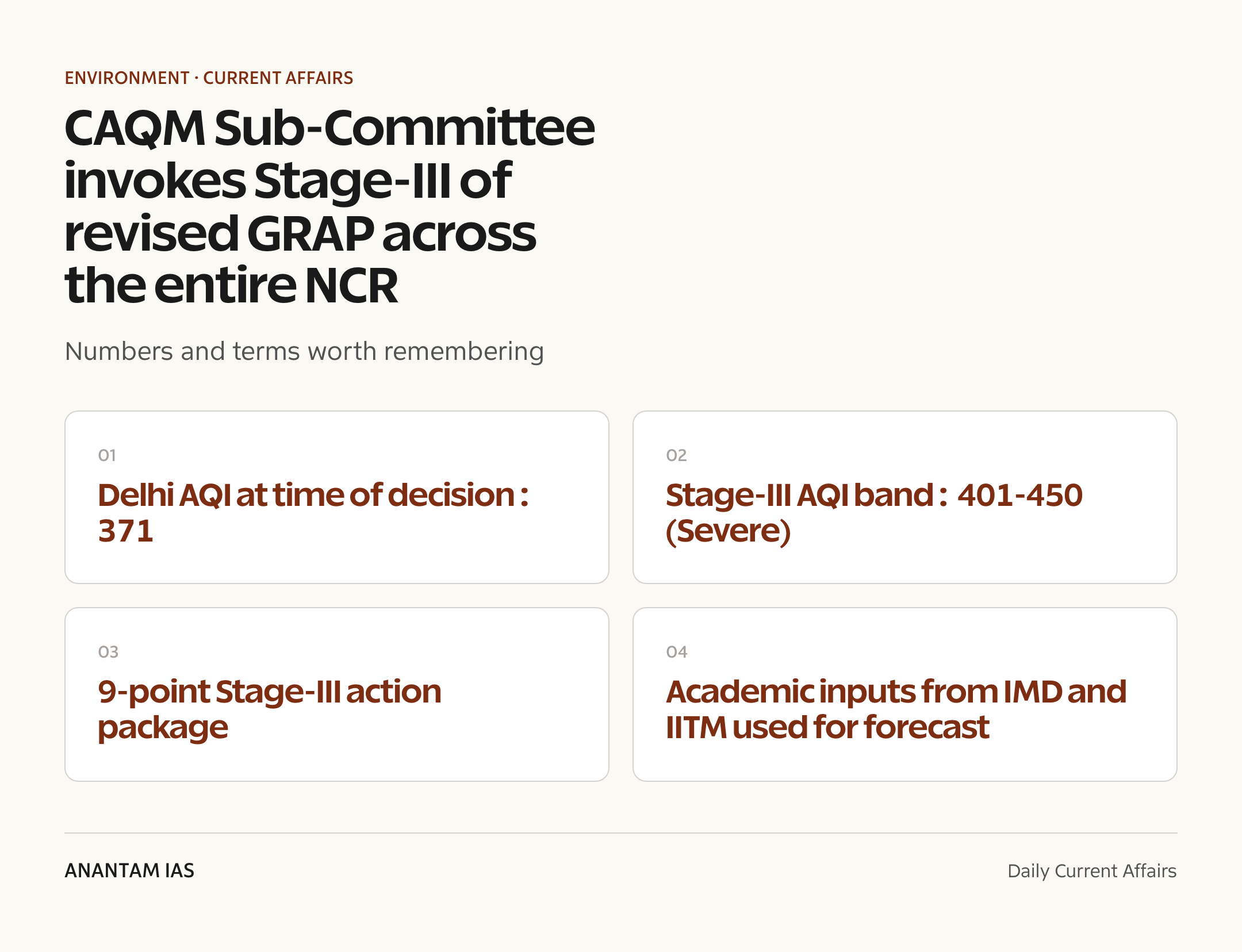
UPSC Relevance
Prelims Relevance
- Know the GRAP stages and AQI band thresholds; Stage-III corresponds to the ‘Severe’ range in the revised GRAP.
- Be aware that CAQM has jurisdiction for NCR and issues mandatory directives under the revised GRAP.
- Recognize the meteorological drivers such as low mixing height and calm winds that lead to winter pollution spikes in North India.
Mains Relevance
GS3 Environment
- Policy implication: Role of graded emergency action plans like GRAP in urban air-quality governance and inter-state coordination.
- Administrative challenge: Implementation and enforcement constraints across multiple jurisdictions in NCR; balance between short-term restrictions and long-term emission reduction.
- Science-policy linkage: Use of meteorological forecasts and monitoring data (IMD, IITM, CPCB) to trigger graded responses.
Essay
- Debate angle: Public health, economic cost and individual freedoms during environmental emergencies; resilience of cities to episodic pollution.
- Structure: Use GRAP activation as a case study to discuss urban environmental governance, technological, regulatory and behavioural solutions for air pollution.
Background and Context
What is GRAP and how it works
GRAP is a staged response mechanism to manage air-quality deterioration in NCR with defined actions for each severity level.
- Originally developed to provide a time-bound, action-oriented response to episodic pollution events with defined responsibilities for agencies.
- Revised GRAP (December 2024) updated thresholds, expanded measures and clarified roles for CAQM, CPCB, state PCBs and local bodies.
- It uses AQI bands to move from advisory measures to legally binding curbs; each stage adds measures atop earlier ones.
- Triggers are data-driven using real-time AQI and model forecasts from IMD and IITM to anticipate persistent poor conditions.
- The plan is intended to be temporary and emergency-focused, not a substitute for structural pollution-control policies.
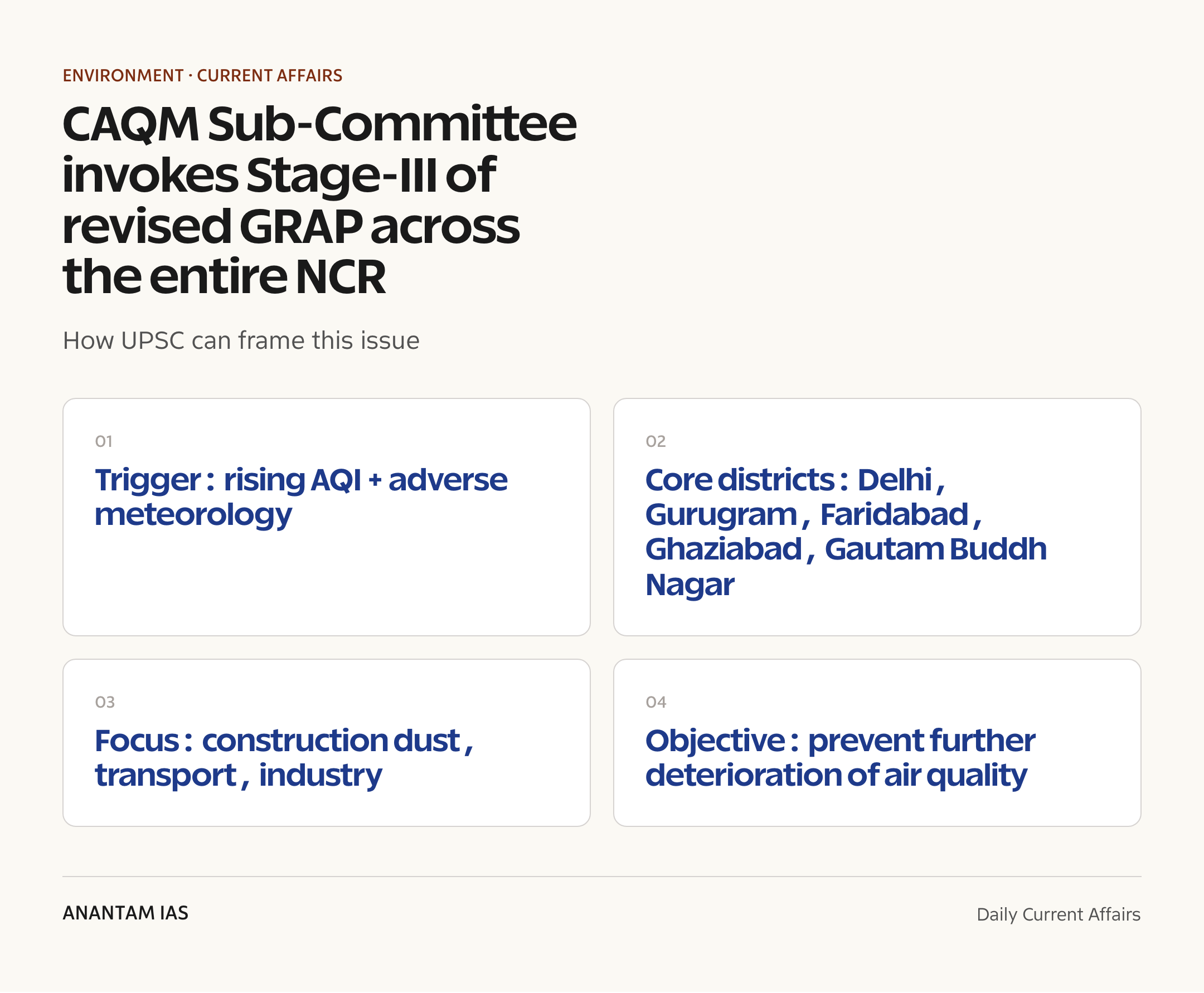
Why NCR is vulnerable in winter
Meteorology and emissions combine to produce frequent winter pollution episodes in NCR.
- Temperature inversions trap pollutants close to the surface, reducing vertical dispersion and lowering the mixing height.
- Calm winds and stable atmospheric conditions reduce horizontal dilution and transport out of the basin.
- Seasonal increases in emissions from heating, diesel transport and open burning amplify pollutant loads.
- Regional sources such as crop residue burning in parts of Punjab and Haryana add to the local emissions burden.
- Secondary aerosol formation from precursor gases (NOx, SO2, VOCs) is favoured under cold, humid conditions.
Key instruments and agencies
Multiple agencies share data, regulatory authority and implementation duties under GRAP.
- Commission for Air Quality Management (CAQM) leads regional coordination and issues enforceable directives in NCR.
- Central Pollution Control Board (CPCB) provides monitoring data, Daily AQI bulletins and technical support.
- State Pollution Control Boards and DPCC are responsible for on-ground enforcement of sectoral restrictions.
- IMD and IITM supply meteorological forecasts and modelling inputs that inform GRAP triggers.
- Local municipal bodies manage construction permits, road cleaning and waste management measures required under GRAP.
Stage-III: What changes operationally
Stage-III activates a 9-point action plan combining restrictions and advisories to limit further deterioration.
- Strict restrictions on dust-generating construction and demolition activities across NCR with limited exceptions.
- Continuation of less polluting construction works subject to strict dust control and C&D waste rules.
- Staggered office timings in core districts and hybrid schooling for students up to Class V in specified areas.
- Targeted curbs on industrial units and increased compliance checks by PCBs and municipal authorities.
- Citizen advisories to reduce outdoor exposure, limit private vehicular trips and follow the GRAP citizen charter.
Public-health implications
Severe AQI levels have immediate and short-term health impacts especially for vulnerable groups.
- High PM2.5 and PM10 concentrations increase risks of respiratory and cardiovascular events in children, elderly and people with preexisting illnesses.
- Advisories under Stage-III aim to reduce population exposure through behavioural guidance and institutional measures like hybrid schooling.
- Healthcare facilities may see an uptick in respiratory complaints and must be prepared for surge responses.
- Long-term exposure to recurrent severe episodes increases population-level burden of chronic disease.
Limitations of episodic GRAP measures
Emergency measures can reduce peak pollution but do not substitute for structural reforms.
- Short-term curbs can shift or delay emissions rather than eliminate them unless paired with permanent controls.
- Enforcement variability across districts weakens overall effectiveness, especially for diffuse sources like road dust.
- Social and economic costs to construction, small industries and daily-wage workers arise during repeated activations.
- Lasting improvement requires emission inventories, clean-fuel transitions, public transport strengthening and stricter industrial norms.
Way Forward
Strengthen enforcement and inter-agency coordination
Make GRAP measures effective by ensuring timely, uniform action across NCR jurisdictions.
- Set unified operational checklists for PCBs and municipal agencies with daily monitoring and public reporting.
- Use joint task forces for rapid response to violations in construction, industry and road-dust control.
- Deploy mobile compliance teams to inspect high-risk hotspots and issue on-the-spot penalties where permitted.
- Institutionalize weekly coordination calls among CAQM, CPCB, state PCBs and district magistrates during winter months.
Improve forecasting and early warning
Refine trigger accuracy so measures are preventive rather than reactive.
- Integrate near-real-time observations with IITM/IMD model outputs to develop probabilistic AQI forecasts for 72 hours.
- Publish simple, actionable forecasts for citizens and sectoral agencies with graded triggers and lead times.
- Expand low-cost sensor networks to increase spatial coverage and identify local hot spots.
- Invest in data platforms that allow district-level dashboards accessible to enforcement agencies and the public.
Reduce source emissions through structural reforms
Complement emergency actions with long-term policies that permanently cut emissions.
- Accelerate transition to cleaner fuels and stricter vehicular emission norms, including fast-tracking public transport electrification.
- Mandate and fund road-sweeping, sprinkling and pavement repairs to tackle road dust, an important local source.
- Implement tighter controls on small-scale industries, brick kilns and diesel generators with timelines for compliance.
- Promote decentralised heating solutions and subsidies for household clean cooking/heating to reduce winter emissions.
Public engagement and risk communication
Sustain citizen cooperation by making advisories clear, equitable and actionable.
- Disseminate plain-language health advisories tied to AQI bands with targeted guidance for schools, workplaces and vulnerable groups.
- Provide alternatives for daily-wage workers and small contractors affected by construction restrictions, such as compensated work rescheduling.
- Run behaviour-change campaigns on reduced private vehicle use, car-pooling and adoption of non-combustion heating.
- Publish transparent compliance data and enforcement actions to maintain public trust and accountability.
Conclusion
Invoking Stage-III of the revised GRAP is a necessary emergency step to limit health harms during a period of adverse meteorology and rising AQI. Short-term restrictions can blunt peaks but lasting improvement requires coordinated enforcement, better forecasting, structural emission reductions and consistent public engagement. Policymakers must balance immediate protection with measures that reduce recurrence of severe episodes.
UPSC Practice Questions
Prelims MCQ 1
Which authority has the mandate to issue enforceable directives under the revised GRAP for the National Capital Region?
(a) A. Central Pollution Control Board (CPCB) (b) B. Commission for Air Quality Management (CAQM) (c) C. Ministry of Environment, Forest and Climate Change (MoEFCC) (d) D. National Disaster Management Authority (NDMA)
Answer: B
Explanation:
The Commission for Air Quality Management (CAQM) is the statutory regional authority tasked with issuing enforceable directives and coordinating actions under the revised GRAP for the NCR. CPCB provides monitoring and technical support but CAQM leads GRAP implementation.
Prelims MCQ 2
Under the revised GRAP invoked in January 2025, Stage-III corresponds to which air-quality categorization for Delhi AQI?
(a) A. Good (0-50) (b) B. Moderate (51-100) (c) C. Poor to Very Poor (201-300) (d) D. Severe (401-450)
Answer: D
Explanation:
Stage-III in the revised GRAP corresponds to the ‘Severe’ AQI band, which for Delhi is identified as the range 401-450. The CAQM invoked Stage-III after the AQI crossed 350 and forecasts predicted worsening conditions.
UPSC Mains Questions
- {‘question’: ‘Examine the strengths and limitations of a graded emergency response plan like GRAP in managing urban air pollution. Suggest measures to increase its effectiveness in the NCR.’, ‘model_answer’: ‘Start by defining GRAP as a data-triggered, staged emergency response that imposes graduated restrictions as air quality worsens. Strengths include clear triggers, sector-specific actions, legal enforceability via CAQM and the ability to rapidly cut peak exposures. Limitations include short-term focus that does not address structural emission sources, enforcement variability across jurisdictions, economic impacts on informal workers, and potential for leakage of activities to nearby areas. To increase effectiveness recommend: (1) strengthen enforcement with unified checklists and joint task forces; (2) improve forecasting and early-warning systems with probabilistic AQI and wider sensor coverage; (3) combine GRAP with long-term measures like vehicle electrification, cleaner fuels and industrial controls; (4) expand public communication and social protection measures for affected workers; (5) institutionalize inter-state coordination with legally binding compliance timelines.’}
- {‘question’: ‘Assess the role of meteorological factors in triggering regional air-quality emergencies in North India and discuss how forecasting can be integrated into pollution management policy.’, ‘model_answer’: ‘Explain how meteorological phenomena such as low temperatures, surface inversions, low mixing heights, and calm winds limit dispersion of pollutants, creating high concentration episodes in winter. Discuss regional transport from crop-burning and upwind sources. Emphasize the use of IMD and IITM model forecasts coupled with monitoring to predict persistence of adverse conditions. For policy integration propose: (1) lead-time based graded actions where forecasts trigger preemptive measures; (2) operational dashboards combining observations and model outputs for district magistrates and PCBs; (3) routine seasonal preparedness plans for winter with pre-authorized restrictions; (4) capacity-building for local agencies to interpret forecasts and act promptly; (5) public-facing forecast products with clear behavioral guidance tied to AQI bands.’}
Source: PIB, Ministry of Environment, Forest & Climate Change.
Frequently Asked Questions
q
a
q
a
q
a
q
a
q
a
q
a
Source: https://anantamias.com/current-affairs/grap-stage-iii-ncr-air-quality-2025/
Logistics Ease Across Different States (LEADS) 2024 report unveiled
Why in News?
The Government released the sixth edition of LEADS, introducing Sustainable Logistics as a fourth pillar and expanding objective indicators to measure state logistics performance. It also launched complementary initiatives including LEAPS awards, a PM GatiShakti course, and a Logistics Cost Framework report.
- LEADS 2024 launch by the Union Commerce Minister signals renewed focus on state-level logistics reforms and competitive federalism in logistics.
- New pillar: Sustainable Logistics added to the assessment, aligning logistics policy with climate and green transition objectives.
- Objective indicators expanded to include terminal accessibility and corridor speeds, improving measurement accuracy for policy action.
- Complementary initiatives launched: LEAPS awards, PM GatiShakti course for administrators, and an NCAER Logistics Cost Framework.
The development matters in the context of:
- What is LEADS: A periodic state/UT ranking and diagnostic tool prepared by DPIIT to evaluate logistics ecosystem across states and suggest reforms.
- Scope: State-level assessment covering infrastructure, services, operating/regulatory environment and now sustainability.
- Why state focus: Logistics is multi-jurisdictional; state policies on land, terminals, last-mile connectivity and services shape costs and efficiency.
- Link to PM GatiShakti: LEADS supports GatiShakti goals by providing data-driven inputs for integrated planning of infrastructure and multimodal connectivity.
- Private sector role: Report emphasizes public-private partnerships and land allocation for multimodal hubs through transparent bidding.
- National objective: Lower logistics cost and faster movement are essential for export competitiveness, inflation control and achieving a $32 trillion economy by 2047.

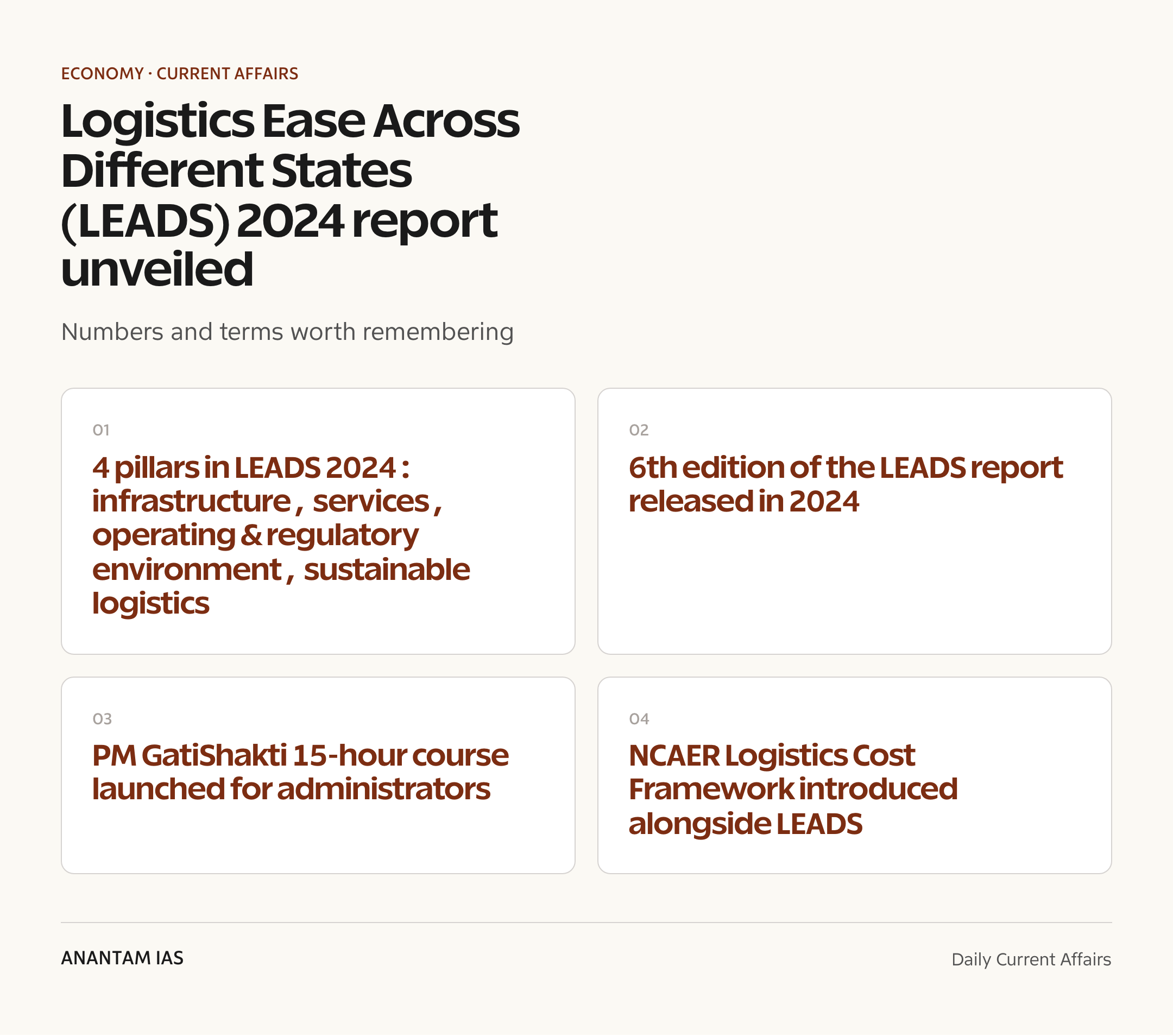
UPSC Relevance
Prelims Relevance
- Tests factual recall on what LEADS measures, the four pillars (including new Sustainable Logistics), and institutional initiatives launched alongside the report such as PM GatiShakti course and Logistics Cost Framework.
Mains Relevance
GS3 Economy
- Useful for answers on supply-chain infrastructure, state role in economic reforms, transport and logistics policy, sustainable logistics transition, and federal-state coordination for economic competitiveness.
Essay
- Material for essays on ‘Infrastructure and Economic Growth’, ‘India and the Global Supply Chain’, ‘Sustainable Development and Industrial Policy’, and ‘Cooperative Federalism for Economic Reform’.
Background and Context
Evolution and purpose of LEADS
How LEADS started and what it seeks to achieve at state level.
- Origin: LEADS is a DPIIT initiative to rank and diagnose logistics performance of States/UTs, launched to promote reforms and competitive federalism.
- Periodic editions: Sixth edition in 2024; each cycle refines methodology to increase objectivity and policy relevance.
- Policy objective: Encourage states to adopt reforms that reduce logistics cost, boost efficiency and attract investments.
- Stakeholder reach: Targets state governments, transport agencies, private logistics firms and investors for coordinated action.
- Outcome orientation: Goes beyond ranking to propose state-specific opportunities and action points for reform.
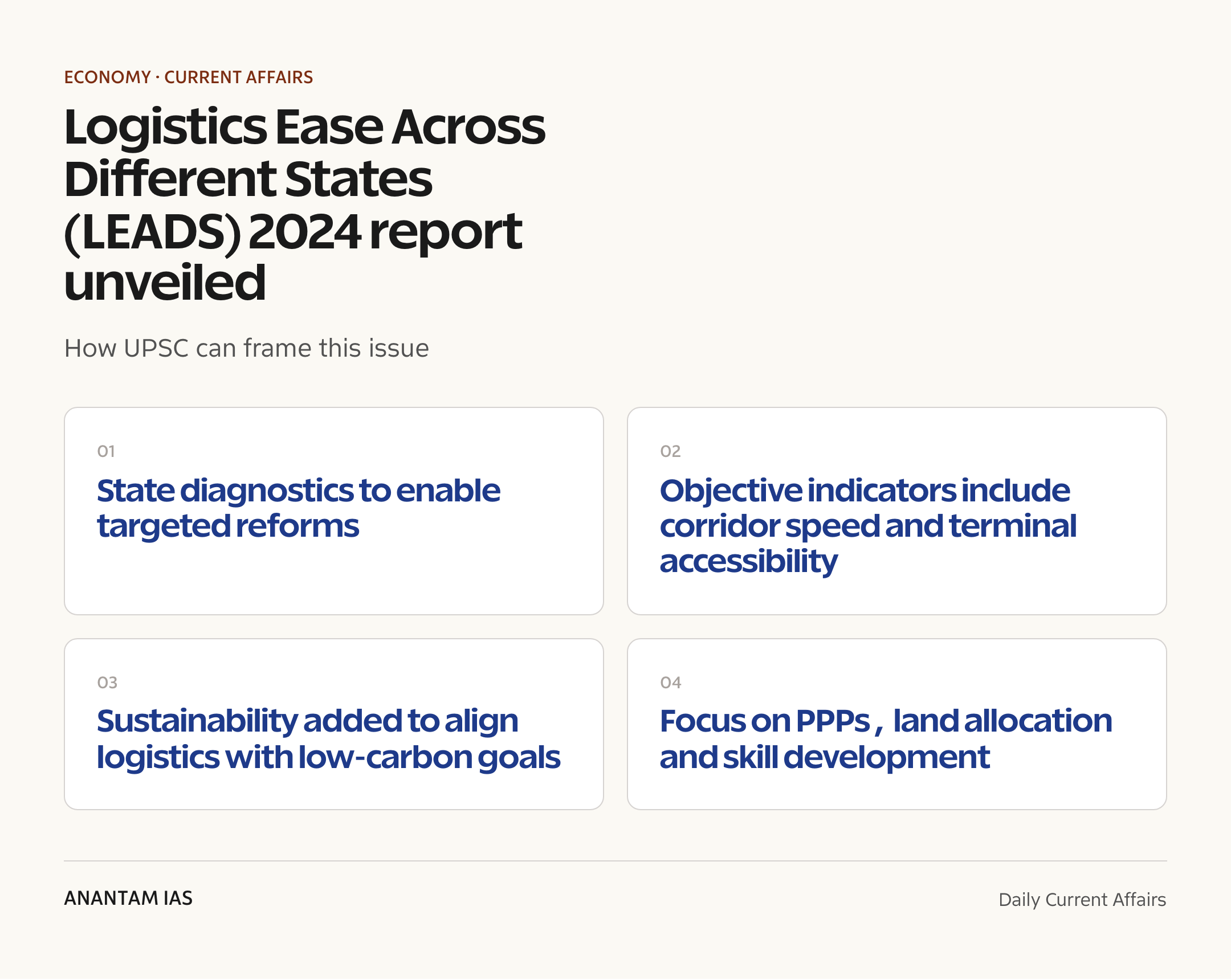
Four pillars of assessment
LEADS 2024 evaluates performance across four structured domains for comparability.
- Logistics Infrastructure: Road, rail, ports, airports, ICDs/ICDs and terminal density used to assess physical readiness.
- Logistics Services: Availability, quality and competitiveness of freight forwarders, warehousing and transport services.
- Operating and Regulatory Environment: Ease of permits, enforcement, land access, inter-agency coordination and policy clarity at state level.
- Sustainable Logistics (new): Emissions, green transport uptake, modal shift potential and policies to support low-carbon logistics.
- Composite scoring: Combines objective indicators and perception metrics to produce state-level rankings and gap analysis.
Why add Sustainable Logistics
Rationale for integrating sustainability into logistics assessment.
- Climate alignment: Logistics accounts for a growing share of emissions; sustainability pillar aligns logistics with national climate commitments.
- Risk resilience: Green logistics includes energy efficiency and modal shift which reduce vulnerability to fuel price shocks.
- Market demand: Buyers and exporters increasingly prefer low-carbon supply chains; states that act early gain competitiveness.
- Policy leverage: Encourages states to pilot electric vehicle infrastructure, biofuels, modal integration and energy-efficient terminals.
Methodology refinements in 2024
What changed in the sixth edition to improve measurement and comparability.
- More objective indicators: Added measures such as terminal accessibility and corridor speed to reduce subjective bias.
- Data sources: Combination of administrative data, satellite-based corridor speed measures and survey inputs for service quality.
- State-specific diagnostics: The report identifies targeted opportunities rather than uniform prescriptions.
- Integration with cost framework: Links findings to the NCAER Logistics Cost Framework for a monetary view of inefficiencies.
Complementary initiatives launched
Other measures announced alongside LEADS 2024 to build capacity and recognise excellence.
- LEAPS awards: Recognise exemplary performance by states, MSMEs, startups and institutions in logistics innovation and operations.
- PM GatiShakti course: A 15-hour course on integrated infrastructure planning to be hosted on iGOT Karmayogi and UGC SWAYAM to train administrators.
- Logistics Cost Framework report: NCAER-led hybrid methodology to estimate logistics costs across EXIM and domestic cargo.
- PPP and land allocation guidance: Encouragement for states to use transparent bidding to allocate land for multimodal hubs.
Key messages from Minister and DPIIT
What policymakers emphasised at the launch event.
- State action plans: States and private sector urged to prepare regional and city-level logistics plans for last-mile connectivity.
- Technology adoption: Push for AI, machine learning and data analytics to improve efficiency and planning.
- Skill and gender focus: Emphasis on workforce upskilling and greater participation of women in logistics.
- Transparency and efficiency: Use of bidding for land allocation and PPPs to lower costs and attract investment.
Way Forward
State-level action planning
- Create regional logistics masterplans that prioritise last-mile connectivity, multimodal hubs and warehousing near demand centres.
- Set measurable targets for corridor speeds, terminal accessibility and modal share shifts with timelines and monitoring.
- Use LEADS diagnostics to prioritise high-impact reforms based on state-specific bottlenecks rather than uniform templates.
Financing and PPP models
- Design transparent land allotment for logistics parks using competitive bidding and clear service-level agreements.
- Promote viability gap funding and blended finance for multimodal terminals and green infrastructure where commercial returns are slow.
- Encourage service contracts that align operator incentives with performance metrics such as dwell time reduction.
Technology and data
- Invest in digital corridor monitoring using GPS and traffic analytics to measure speeds and congestion in near real time.
- Adopt interoperable platforms for permitting, e-way bills and terminal access to reduce paperwork and dwell time.
- Leverage analytics for demand forecasting, route optimisation and greener modal choices.
Sustainability and workforce
- Pilot electric and low-emission fleets for last-mile delivery in urban clusters and link incentives to state LEADS performance.
- Upskill logistics workforce through the PM GatiShakti course and state training institutes with emphasis on digital and green skills.
- Promote gender-inclusive hiring and workplace safety measures to increase female participation in logistics.
Conclusion
LEADS 2024 deepens the policy toolkit for state-level logistics reform by adding sustainability metrics and more objective indicators. Actionable diagnostics, training initiatives and a logistics cost framework together provide a pathway to reduce logistics cost, accelerate multimodal integration and align the sector with low-carbon goals. Successful outcomes will depend on state implementation, PPP design, data-driven monitoring and upskilling of the logistics workforce.
UPSC Practice Questions
Prelims MCQ 1
Which of the following is a newly introduced pillar in the LEADS 2024 report?
(a) Logistics Technology (b) Sustainable Logistics (c) Cross-border Logistics (d) E-commerce Logistics
Answer: (b) Sustainable Logistics
Explanation:
LEADS 2024 added Sustainable Logistics as the fourth pillar alongside Logistics Infrastructure, Logistics Services, and Operating and Regulatory Environment.
Prelims MCQ 2
Which institution prepared the Logistics Cost Framework launched alongside LEADS 2024?
(a) NITI Aayog (b) NCAER (c) RITES (d) World Bank
Answer: (b) NCAER
Explanation:
The NCAER prepared the Logistics Cost Framework, using a hybrid methodology to estimate logistics costs across EXIM and domestic cargo.
UPSC Mains Questions
- {‘question’: ‘Examine how state-level reforms in logistics, guided by tools like LEADS, can contribute to reducing inflationary pressures in India. Discuss with examples.’, ‘model_answer’: ‘State-level logistics reforms reduce transactional costs, improve speed of movement and lower inventory holding costs, which can ease supply-side constraints and reduce price pressures. Improving corridor speeds and terminal accessibility cuts transit time and freight rates, lowering distribution costs that feed into consumer prices. For example, faster delivery of perishables through cold chain terminals can reduce food wastage and price volatility. Shifting freight from road to rail on key corridors can lower transport cost per tonne-kilometre, reducing input costs for industry. State reforms such as streamlined permits, better last-mile connectivity and investment in warehousing reduce lead times and buffer stock requirements. When combined with national measures like PM GatiShakti for integrated planning, these state actions can help stabilise supply chains and moderate inflation.’}
- {‘question’: ‘Critically analyse the inclusion of a Sustainable Logistics pillar in LEADS 2024. What challenges and opportunities does it create for states?’, ‘model_answer’: ‘Inclusion of Sustainable Logistics aligns logistics planning with climate objectives and market demand for low-carbon supply chains. Opportunities include access to green finance, competitive advantage for exporters, and long-term resilience to fuel shocks. States can pilot EV charging for freight, promote modal shift to rail and waterways, and incentivise energy-efficient terminals. Challenges include upfront capital costs, coordination across agencies, limited technical capacity and uneven readiness among states. Measuring emissions accurately and attributing reductions to policy actions are complex. To be effective, the pillar must be tied to financing mechanisms, capacity building and realistic transition pathways that account for regional industrial structure and modal mixes.’}
Source: PIB, Ministry of Commerce & Industry.
Frequently Asked Questions
q
a
q
a
q
a
q
a
q
a
q
a
Source: https://anantamias.com/current-affairs/leads-2024-logistics-report-2025/
Bihar Right to Public Grievances Act: Model for Time-Bound Redressal
Why in News?
A DARPG delegation studied Bihar’s implementation of the Right to Public Grievances Act 2015 and the Right to Public Services Act during a 3 January 2025 visit to assess best practices in statutory grievance redressal and service delivery.
- High-level study visit: A senior DARPG team led by the Secretary, DARPG, conducted a study tour to Bihar on 3 January 2025 to review implementation and impact.
- Focus areas: The visit examined statutory redressal mechanisms, CPGRAMS integration, call centres (SAMADHAN and JIGYASA), special campaigns to reduce pendency, and digital pensioner services.
- Institutional endorsement: Bihar’s model was showcased as a national best practice with quasi-judicial powers for Grievance Officers under the Act.
- Operational observation: The delegation observed hearing procedures at the District Grievance Redressal Office, Patna, and reviewed records management and appellate procedures.
The development matters in the context of:
- Legal framework: Bihar enacted the Right to Public Grievances Redressal Act, 2015 to create a statutory regime for citizen grievance redressal with clear timelines and enforcement powers.
- Complementary law: The Bihar Right to Public Services Act provides service delivery guarantees with time limits and penalties for delay, supporting the grievances law.
- Technology integration: CPGRAMS linkage and dedicated state call centres (SAMADHAN, JIGYASA) help channel grievances and monitor resolution status.
- Decentralised hearings: District Grievance Redressal Officers and local hearing processes enhance access to redressal close to citizens.
- Quasi-judicial powers: Grievance Officers can summon project authorities, conduct hearings and issue reasoned orders to ensure compliance.
- Administrative reform lens: The Acts are part of Bihar Prashasanik Sudhar Mission efforts to improve records management, reduce pendency and strengthen accountability.

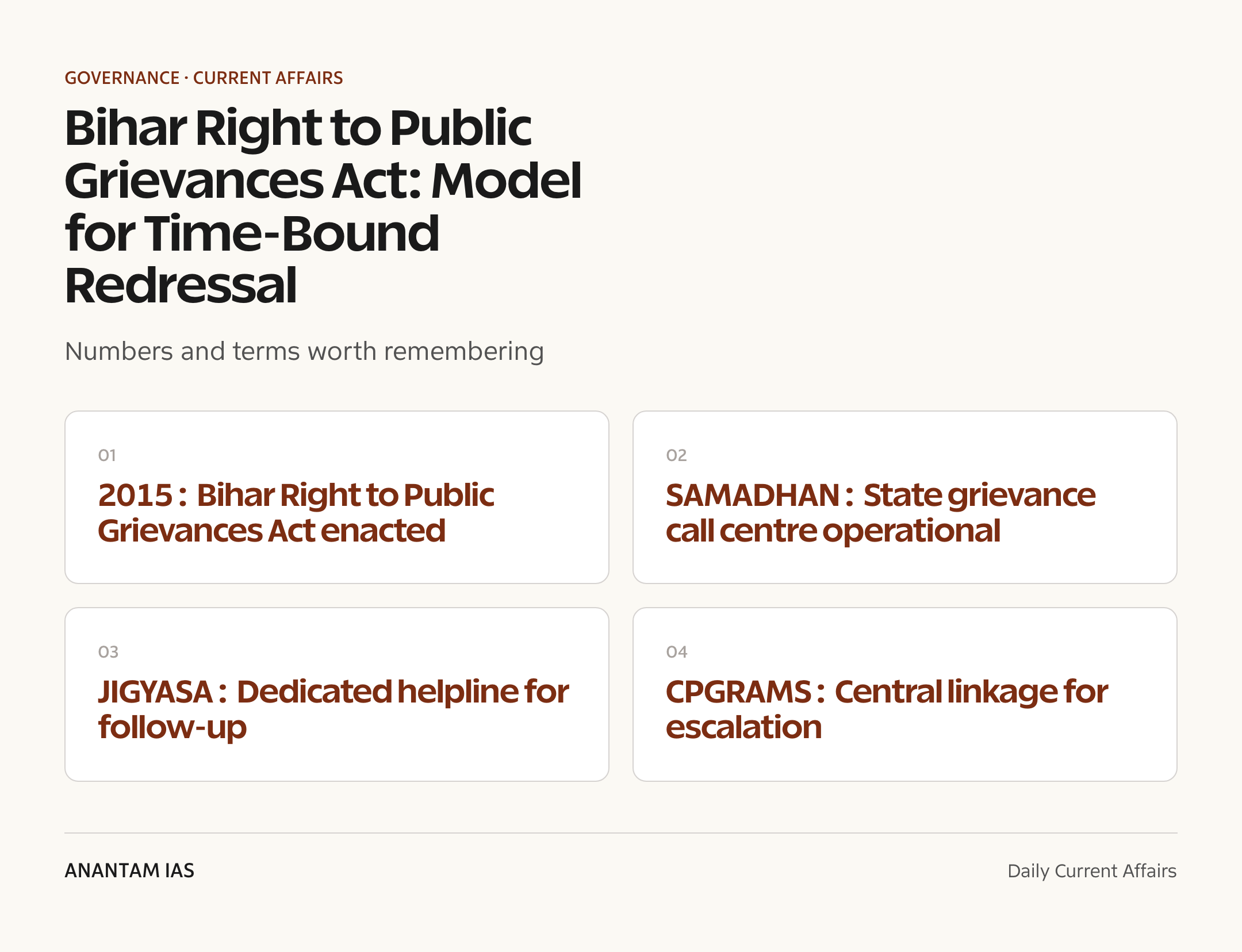
UPSC Relevance
Prelims Relevance
- Provisions and purpose of state-level public grievance laws and distinction from central mechanisms such as CPGRAMS.
- Features of the Bihar Right to Public Grievances Act, 2015: time-bound disposal, powers of Grievance Officers, appellate structure.
- Associated institutions: SAMADHAN and JIGYASA call centres, District Grievance Redressal Officers.
Mains Relevance
GS2 Governance
- Exam question material on administrative reforms, accountability and citizen-centric governance models at state level.
- Case study evidence for essays and answers on decentralisation of grievance redressal, statutory versus executive frameworks, and technology in governance.
- Discussion points on balancing quasi-judicial powers of administrative officers with procedural safeguards and administrative capacity.
Essay
- Use as an empirical example in essays on ‘Governance and Accountability’ and ‘E-Governance: Improving Service Delivery’.
- Illustrates institutional reforms for citizen empowerment and transparent administrative processes.
- Serves as evidence for arguments about the role of state innovation in replicable governance models.
Background and Context
Genesis and objectives of the Acts
Why Bihar enacted statutory regimes for grievance redressal and service delivery.
- Citizen-centric reform: Bihar sought a legal anchor to ensure time-bound grievance redressal and to make public servants accountable for delays.
- Complementarity: The Grievance Act works with the Right to Services Act to both provide services and remedy failures in delivery.
- Reduce pendency: A key objective was to address chronic backlog of service complaints and avoid escalation to courts.
- Restore trust: Structured hearings and reasoned orders aim to improve public trust in administrative processes.
- Administrative clarity: Statutory timelines and defined authorities reduce discretional ambiguity in redressal.
Key structural features of the Grievance Act
The Act’s main provisions that make it operationally distinct.
- Quasi-judicial powers: Grievance Officers can summon agencies, call witnesses and issue reasoned orders.
- Time-bound mandates: The law prescribes timelines for acknowledgement, hearing and final orders to prevent indefinite delays.
- Appellate mechanism: Provision for grievance appeal to higher state-level fora to ensure corrective review.
- Enforcement tools: Orders include directions that public agencies must carry out; failure can lead to administrative consequences.
- Record-keeping: Emphasis on improved records management to track cases and establish audit trails.
Operational ecosystem: SAMADHAN, JIGYASA and CPGRAMS
Technology and process infrastructure supporting frontline grievance work.
- SAMADHAN call centre: State-level intake hub for citizen complaints and initial triage.
- JIGYASA: Dedicated helpline for follow-up, guidance and case status updates to complainants.
- CPGRAMS linkage: Integration with the central CPGRAMS platform enables interoperability and escalation to central agencies.
- Dashboard monitoring: Digital dashboards provide pendency counts, resolution times and performance indicators for managers.
- Data-driven actions: Analytics used to identify systemic bottlenecks and target special campaigns for high-pendency categories.
Institutional arrangements and human resources
How Bihar staff and offices deliver the statutory scheme.
- District Grievance Redressal Officers: Frontline hearing officers who conduct in-person grievances hearings.
- State Public Grievance Receipt Centre: Central intake and coordination point for routing grievances to competent authorities.
- Training and capacity building: Staff familiarisation with legal powers, orders drafting and records management is prioritised.
- Mission structure: Bihar Prashasanik Sudhar Mission provides programmatic oversight and reform coordination.
- Inter-departmental coordination: Regular meetings with implementing agencies to ensure compliance with orders.
Interface with citizens and accessibility
Measures to improve access and transparency for complainants.
- Local hearings: District-level and office-level hearings reduce travel and cost for citizens.
- Information dissemination: Citizen charters and helpline information shared publicly to guide complainants.
- Digital-first intake with human touch: Online CPGRAMS registration is supplemented by call centre and in-person assistance.
- Reasoned orders: Issuing written orders with reasons improves transparency and provides remedies for appeal.
- Special outreach: Campaigns to inform marginalised groups about redressal rights and processes.
Challenges and learning constraints
Operational and legal challenges that arise when scaling statutory grievance models.
- Capacity limits: High case volumes can overwhelm Grievance Officers unless supported by adequate staff.
- Enforcement gaps: Implementing agency compliance with orders may require administrative sanctions or escalation routes.
- Quality of orders: Need for training to ensure decisions are legally sound and defensible.
- Data quality: Accurate records and consistent categorisation are needed for reliable monitoring.
- Replication hurdles: Other states may face resource and political economy barriers in adopting the model wholesale.
Way Forward
Strengthen institutional capacity
- Increase staffing: Recruit and train more Grievance Officers and support staff at district and state levels.
- Specialist training: Provide legal drafting, evidence handling and hearing management modules for officers.
- Performance incentives: Link resolution performance with career progression and rewards for timely, high-quality orders.
Improve enforcement and compliance
- Clear sanctions: Define administrative consequences for implementing agencies that repeatedly fail to comply with orders.
- Monitoring mechanisms: Use dashboards to flag non-compliance and trigger supervisory review by senior officials.
- Fast-track remedies: Introduce administrative review timelines to prevent avoidable appeals and delay.
Enhance technology and data use
- Interoperability: Deepen integration between state systems and CPGRAMS for seamless escalation and data exchange.
- Analytics: Use predictive analytics to prioritise high-risk grievance categories and allocate resources.
- User interfaces: Simplify complaint filing and status tracking for low-literacy users and multiple languages.
Scale citizen outreach and safeguards
- Awareness campaigns: Run targeted drives to inform vulnerable groups about grievance rights and processes.
- Legal aid linkages: Connect persistent or complex complainants with public legal aid or mediation services.
- Transparency practices: Publish anonymised case outcomes and compliance scores to build public confidence.
Conclusion
Bihar’s Right to Public Grievances Act 2015 shows how statutory design, backed by technology and procedures, can produce time-bound, accountable grievance redressal.
Operational success depends on adequate staffing, enforcement tools and continuous data-driven management to keep pendency low.
The model is replicable with adaptations, but scaling needs investments in capacity, monitoring and citizen outreach for sustained impact.
UPSC Practice Questions
Prelims MCQ 1
Which of the following is a feature of the Bihar Right to Public Grievances Act, 2015?
(a) A. It allows Grievance Officers to issue reasoned orders after summoning implementing agencies. (b) B. It abolishes the right to appeal against grievance orders. (c) C. It mandates that all grievances be decided by the State Administrative Tribunal. (d) D. It restricts grievance filing to only online CPGRAMS submissions.
Answer: A
Explanation:
The Act empowers Grievance Officers with quasi-judicial powers to summon agencies and issue reasoned orders. It does not abolish appeals, does not require the State Administrative Tribunal to decide all grievances, and allows multiple intake channels including call centres and in-person filing.
Prelims MCQ 2
SAMADHAN and JIGYASA in Bihar refer to:
(a) A. Special courts for service matters. (b) B. State call centres and helplines for grievance intake and follow-up. (c) C. Legislative committees overseeing grievance redressal. (d) D. Computerised case law repositories.
Answer: B
Explanation:
SAMADHAN and JIGYASA are operational call centre and helpline initiatives used by the State to receive grievances, provide assistance and follow up on case status. They are not courts, legislative committees or case law repositories.
UPSC Mains Questions
- {‘question’: ‘Examine how statutory grievance redressal mechanisms, such as the Bihar Right to Public Grievances Act, 2015, advance administrative accountability. Discuss strengths and limits with examples.’, ‘model_answer_points’: [‘Define administrative accountability and statutory grievance frameworks; explain how legal backing changes incentives for officials.’, ‘Strengths: time-bound disposal, quasi-judicial powers, transparency via reasoned orders, decentralised hearings and technology-enabled monitoring (SAMADHAN, CPGRAMS).’, ‘Limits: capacity constraints, enforcement gaps when implementing agencies do not comply, quality of orders needing legal training, data quality issues affecting monitoring.’, “Examples: Bihar’s use of Grievance Officers to summon project authorities; call centre-led triage reducing pendency in specific categories; need for sanctions and performance linkages.”, ‘Policy lessons: build staffing, enforcement sanctions, analytics for prioritisation, and strong outreach to ensure equitable access.’]}
- {‘question’: ‘Critically evaluate the role of technology in grievance redressal systems. How should states balance digital platforms with in-person accessibility?’, ‘model_answer_points’: [‘Discuss benefits of technology: faster intake, dashboard monitoring, interoperability with CPGRAMS, analytics for policy response.’, ‘Risks: digital divide, low-literacy barriers, poor data quality and over-reliance on online status without human follow-up.’, ‘Balanced approach: digital-first with assisted channels, multilingual interfaces, call centres like JIGYASA and on-ground outreach teams.’, ‘Institutional safeguards: data audits, integration with court and administrative records, training for staff to interpret digital reports.’, ‘Conclusion: Technology is an enabler, not a substitute for human processes; combining both yields better access and outcomes.’]}
Source: PIB, Ministry of Personnel, Public Grievances & Pensions.
Frequently Asked Questions
q
a
q
a
q
a
q
a
q
a
q
a
Source: https://anantamias.com/current-affairs/bihar-right-to-public-grievances-act-2025/
Omkareshwar floating solar park highlights scale of India’s clean energy push
Why in News?
A high-profile visit and statement by the Union Minister after commissioning of part of the Omkareshwar floating solar park highlighted India’s push to expand large-scale, innovative renewable installations to meet climate and energy targets.
- Scale: Project billed at 600 MW capacity, with 278 MW commissioned so far, making it among the largest floating solar parks in Asia.
- Policy signal: Central and state leadership publicly highlighting the site underlines emphasis on renewable growth and institutional support.
- Cost and support: Project development cost ~₹330 crore with central financial assistance of ₹49.85 crore, illustrating financing mix for large renewables.
- Performance claim: Cooling effect of water expected to raise panel efficiency, improving energy yield per MW compared with ground-mounted plants.
- Resource tradeoffs: Raises questions on water-body impacts, reservoir management, fisheries, and local ecology alongside energy benefits.
The development matters in the context of:
- National targets: India aims for large increases in renewable capacity to meet national commitments on emissions intensity and non-fossil electricity share.
- Floating solar rationale: Addresses land scarcity by using existing water bodies, reduces evaporation, and can improve panel output due to lower operating temperature.
- Technology status: Floating solar combines PV arrays with pontoons, anchors, mooring and electrical jacketing; scale-up requires robust civil, electrical and O&M practices.
- Cost dynamics: Capex for floating installations is higher than ground-mounted PV per MW but may be offset by land savings and reduced transmission needs if sited near reservoirs serving demand centers.
- Grid integration: Large variable injection from a 600 MW resource requires grid reinforcement, forecasting, storage or demand management to avoid curtailment and maintain stability.
- Financing landscape: Project financing mixes government support, state entities, central PSUs and private developers; public support reduces risk to attract private capital.
- Global footprint: Floating PV has grown rapidly worldwide in the last decade with notable projects in Asia, Europe and Latin America; lessons on anchoring, corrosion and ecology are emerging.
- Local context: The site at Omkareshwar reservoir in Khandwa district leverages existing irrigation and hydropower infrastructure and multi-stakeholder partnerships including NHDC, SJVN and private developers.
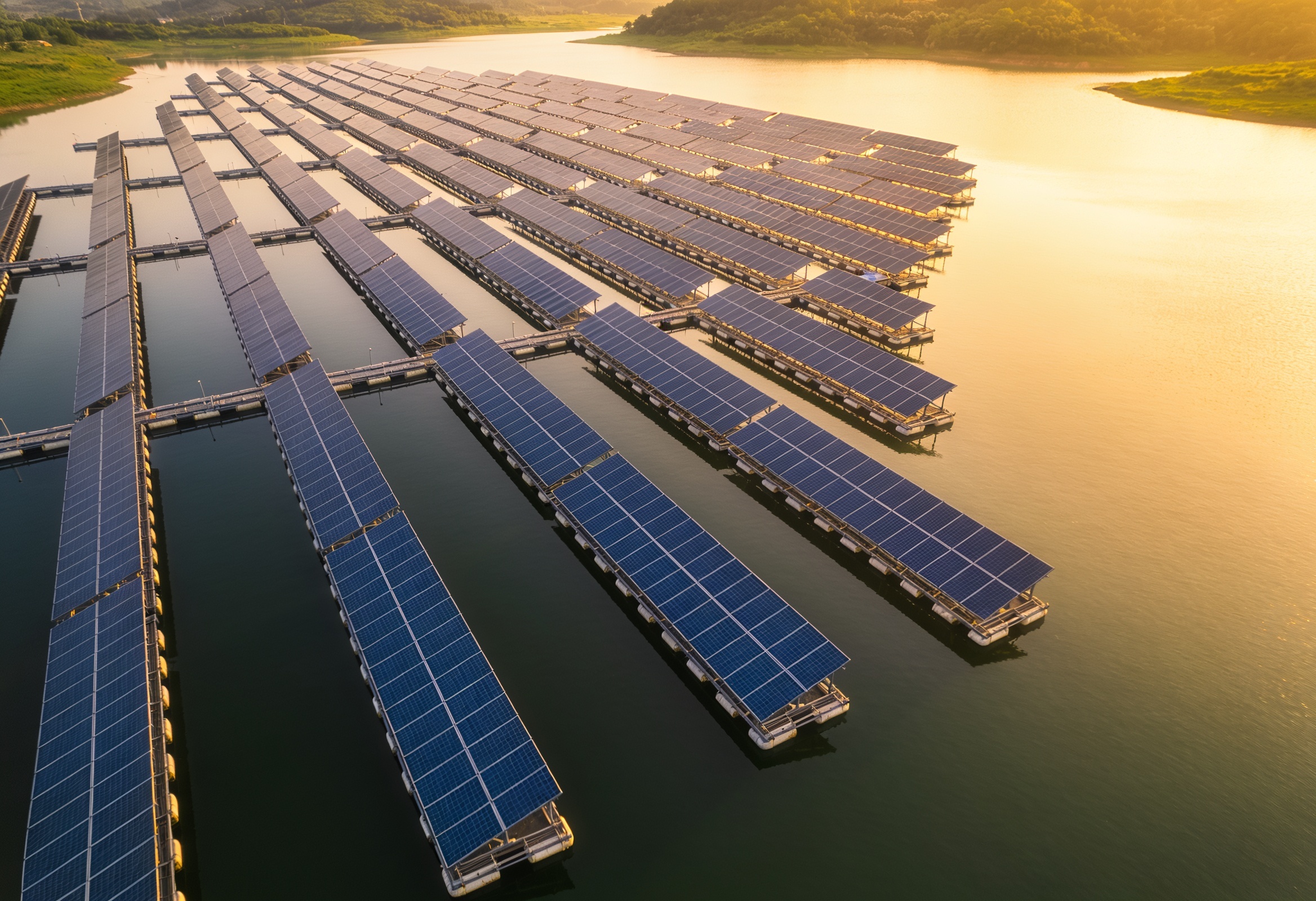
UPSC Relevance
Prelims Relevance
- Remember key figures: 600 MW capacity (278 MW commissioned), ₹330 crore development cost, ₹49.85 crore central assistance.
- Know what floating solar (floatovoltaics) means and basic advantages: land conservation, reduced evaporation, higher panel efficiency.
- Identify stakeholders: Central Ministry of New and Renewable Energy, state government of Madhya Pradesh, public and private developers such as SJVN, NHDC, Rewa UMPP and AMP Energy Green.
Mains Relevance
GS3 Economy
- Explain the role of innovative renewable technologies like floating solar in India’s energy transition and land-use policy.
- Analyse economic, social and environmental tradeoffs of large hydros and floating PV co-location on reservoirs.
- Evaluate government policy and financing mechanisms used to scale up renewable infrastructure, with example of Omkareshwar.
Essay
- Use the project as an empirical example in essays on energy security, environmental sustainability and climate action.
- Illustrate themes of technology adoption, public-private collaboration and infrastructure investment in essays on development priorities.
Background and Context
What is floating solar and why it matters
Floating solar photovoltaic systems mount solar panels on water bodies using platforms and anchoring systems.
- Basic components: PV modules, floats/pontoons, mooring systems, electrical cabling and grid interconnection equipment.
- Primary benefits include land-saving, reduced reservoir evaporation, and potential efficiency gains from cooler panel operating temperatures.
- Common sites: reservoirs, irrigation tanks, lakes and former mines filled with water.
- Technical challenges: corrosion, biofouling, anchoring under varying water levels, and specialized maintenance routines.
- Environmental concerns: Shading of aquatic habitats, impacts on fish, changes to thermal stratification and water quality need assessment.
- Scale-up considerations: Large arrays require integrated planning with water managers, grid operators and local communities.
India's renewable trajectory and policy context
India has aggressively expanded solar and wind capacity under national targets and sectoral schemes.
- National targets include large increases in non-fossil electricity capacity and commitments under the Paris Agreement.
- Policy instruments: Viability Gap Funding, Central Financial Assistance, state-level land allotment and solar park models.
- Recent programmes encourage hybridisation with storage and pumped hydro to manage intermittency.
- Public sector developers and state utilities often partner with private investors to share risk for large projects.
- Emerging focus on floating PV in National Solar Mission guidance and state renewable policies.
- Capacity factors and tariff trends have improved, making utility-scale solar a competitive source of bulk power.
Technical and grid integration aspects
Connecting a 600 MW floating PV park requires grid planning and operational tools to manage variable generation.
- Large injection points need transmission reinforcement or local consumption to avoid bottlenecks.
- Forecasting solar generation at plant level improves scheduling and reduces imbalance costs.
- Solutions include energy storage, demand response, and coordination with hydro or thermal plants for flexibility.
- Protection against faults, earthing and insulation are critical because of water proximity and humidity.
- O&M regimes must plan for access, cleaning, electrical safety and replacement of floats over asset life.
- Plant-level SCADA and remote monitoring are necessary for performance optimisation and quick fault response.
Economic and financing profile
Project economics depend on capex, O&M, tariff structure and any fiscal or grant support.
- Reported development cost around ₹330 crore implies relatively low reported capex per commissioned MW; verify phased accounting.
- Central Financial Assistance of ₹49.85 crore reduces upfront cost and signals government backing.
- Revenue stream based on power purchase agreements, merchant sales, or park-level pooling arrangements.
- Ongoing costs include maintenance of floats, cleaning panels, mooring upkeep and electrical servicing.
- Risk allocation in contracts matters: hydrological risk, grid curtailment risk and module degradation must be assigned.
- Financing mix may include commercial loans, green bonds, concessional finance and equity from developers or state entities.
Environmental and social considerations
Large floating installations change reservoir uses and may affect ecology and local livelihoods.
- Potential positive: reduced evaporation supports water security in arid regions.
- Potential negative: shading could alter aquatic plant growth and fish habitat, affecting fisheries.
- Stakeholder engagement with fisher communities and irrigation managers is essential for social licence.
- Environmental Impact Assessments should consider cumulative effects if multiple projects cluster on a river basin.
- Adaptive management and monitoring frameworks can mitigate unforeseen ecological impacts over time.
- Co-benefits can be realised if installation design leaves areas open for fisheries or integrates habitat-friendly measures.
Case specifics: Omkareshwar site and stakeholders
Omkareshwar project sits on a reservoir in Khandwa district and is developed by a mix of public and private entities.
- Stakeholders listed include Rewa Ultra Mega Solar Limited, NHDC Ltd, AMP Energy Green Pvt Ltd and SJVN Ltd.
- The Union Minister highlighted state support by the Madhya Pradesh government as crucial to project success.
- Commissioning status: 278 MW commissioned with progressive commissioning toward 600 MW.
- Projected lifetime generation quoted as over 4,600 million units over 25 years for the full 600 MW.
- The project demonstrates model of multi-developer solar park approach on a common reservoir platform.
- Operational learnings here will influence replication on other large reservoirs across India.
Way Forward
Strengthen technical standards
Uniform guidelines will reduce technical risk and improve longevity of floating PV assets.
- Develop and disseminate national technical standards for floats, mooring, cabling and corrosion protection.
- Mandate site-specific geotechnical and hydrological assessments before project approval.
- Require durability testing and certification for floats and anchoring hardware to reduce premature failures.
- Create standard O&M protocols and training modules for local technicians.
Integrate with water and fisheries management
Coordinated planning with water agencies can optimise multi-use benefits and reduce conflict.
- Formal mechanisms for joint planning between state water departments, irrigation agencies and developers.
- Designate fisheries corridors or open-water zones to preserve local livelihoods.
- Use shading design and spacing rules to maintain aquatic ecosystem functions and oxygenation.
- Institute periodic ecological monitoring and adaptive mitigation measures during operation.
Finance and scaling mechanisms
Blend public support and market instruments to accelerate sustainable deployment.
- Maintain targeted central assistance for early-stage projects to crowd in private capital.
- Promote green finance instruments such as green bonds or concessional loans for floating PV.
- Pilot insurance schemes for hydrological and anchoring risks to reduce investor uncertainty.
- Encourage hybridisation with storage or hydro-peaking to increase value and firming capability.
Grid and operational readiness
Prepare grid systems and dispatch rules to absorb large variable outputs reliably.
- Invest in local transmission upgrades and substation capacity where large parks connect.
- Improve solar generation forecasting at plant and regional scale to reduce imbalance costs.
- Facilitate contracts that reward flexibility, including storage dispatch and time-of-day tariffs.
- Coordinate with State Load Dispatch Centres and National Grid for contingency planning.
Conclusion
Omkareshwar is an important demonstration of scale for India’s renewable agenda. The project showcases practical benefits of floating solar for land-scarce settings and yields operational lessons on design, financing, grid integration and ecological management. Policy action should focus on robust technical standards, coordinated resource governance, financing innovations and grid readiness to safely replicate such projects at scale.
UPSC Practice Questions
Prelims MCQ 1
The Omkareshwar floating solar park announced in January 2025 has a total capacity of:
(a) A. 100 MW (b) B. 278 MW (c) C. 600 MW (d) D. 1000 MW
Answer: C
Explanation:
The project is billed at a total capacity of 600 MW, with 278 MW commissioned so far.
Prelims MCQ 2
Which of the following is a commonly cited advantage of floating solar over ground-mounted solar?
(a) A. Lower initial capital cost (b) B. Reduced panel efficiency due to humidity (c) C. Land conservation by using water bodies (d) D. Simpler electrical safety requirements
Answer: C
Explanation:
Floating solar conserves land by using water bodies; capital cost is usually higher and electrical safety is more complex.
UPSC Mains Questions
- {‘question’: ‘Discuss the economic and environmental tradeoffs involved in large-scale floating solar projects on reservoirs. Use Omkareshwar as an example.’, ‘model_answer_points’: [‘Start with a short thesis: floating solar offers land-saving renewable capacity but introduces reservoir management and ecological tradeoffs.’, ‘Economic positives: avoids land acquisition costs, can be sited near demand centers, potential for higher yield per panel due to cooling, and central assistance lowers project risk. Quote Omkareshwar figures: 600 MW capacity, ₹330 crore cost, ₹49.85 crore assistance.’, ‘Economic negatives: higher unit capex and specialized O&M, anchoring and corrosion mitigation costs, and financing complexity for novel risks.’, ‘Environmental positives: reduced evaporation and potential water conservation benefits, lower land conversion impacts compared with ground-mounted parks.’, ‘Environmental negatives: shading impacts on aquatic ecosystems, effects on fisheries and water quality, need for cumulative impact assessment if multiple projects cluster.’, ‘Policy implications: need for technical standards, joint planning with water agencies, clear contracts to allocate hydrological and grid risks, and financing instruments to internalise environmental monitoring costs.’, ‘Conclude with recommendations: phased pilots, adaptive monitoring, incorporation of fisheries safeguards and integration with storage for grid stability.’]}
- {‘question’: ‘Examine the role of central and state cooperation in scaling up renewable energy infrastructure, referring to the Omkareshwar floating solar project.’, ‘model_answer_points’: [‘Introduce interplay: large infrastructure requires policy, land/water access, approvals and financing across multiple tiers of government.’, ‘Role of central government: funding support, national targets, technical guidance and programme-level incentive structures. For Omkareshwar, central financial assistance was provided.’, ‘Role of state government: land/water access, local clearances, facilitating developers and ensuring grid evacuation. Madhya Pradesh support was highlighted by the Union Minister.’, ‘Role of central and state PSUs and private players: risk sharing, procurement of capital, operational expertise and project development.’, ‘Challenges: coordination delays, different priorities between water use and energy planning, and permitting bottlenecks at state level.’, ‘Policy solutions: single-window approvals for renewable parks, joint planning cells for water-energy projects and revenue-sharing models to align incentives.’, ‘Conclude on outcomes: coordinated action can accelerate deployment while protecting local uses.’]}
Source: PIB, Ministry of New and Renewable Energy.
Frequently Asked Questions
q
a
q
a
q
a
q
a
q
a
q
a
Source: https://anantamias.com/current-affairs/omkareshwar-floating-solar-park-2025/
Revolutionising digital commerce: ONDC initiative
Why in News?
PIB release (04 Jan 2025) summarises ONDC’s progress, partnerships, MSME onboarding measures and government support measures such as the MSME-TEAM scheme and stakeholder events.
- Policy push: Government statement highlights ONDC as a strategic national digital infrastructure to reshape e-commerce.
- MSME focus: Announcement of targeted onboarding and financial support under the MSME-TEAM scheme for 5 lakh MSEs.
- Scale-up signals: Reports of multiple Letter of Intents with startups and ecosystem players point to expanding network participation.
- Regulatory relevance: ONDC raises questions on competition policy, data governance and cross-platform interoperability.
The development matters in the context of:
- Origin and mandate: ONDC incorporated as a Section-8 non-profit to promote open networks for exchange of goods and services using open-source specifications and standardized APIs.
- Design principle: Decentralised architecture where buyers, sellers and service providers interact through protocol-level interoperability, not a single marketplace.
- Institutional backing: Incubated at Quality Council of India; Protean as co-founder; authorized capital provisioned to enable operations.
- Domains covered: Multi-sectoral — food, grocery, fashion, home, electronics, health, mobility, financial services, agriculture, education and more.
- Government linkages: DPIIT leads policy advocacy; collaborations with Ministries such as MSME for onboarding and with other departments for domain integration.
- Target outcomes: Increase discoverability for small sellers, reduce platform fees, stimulate competition, and foster localised digital commerce.

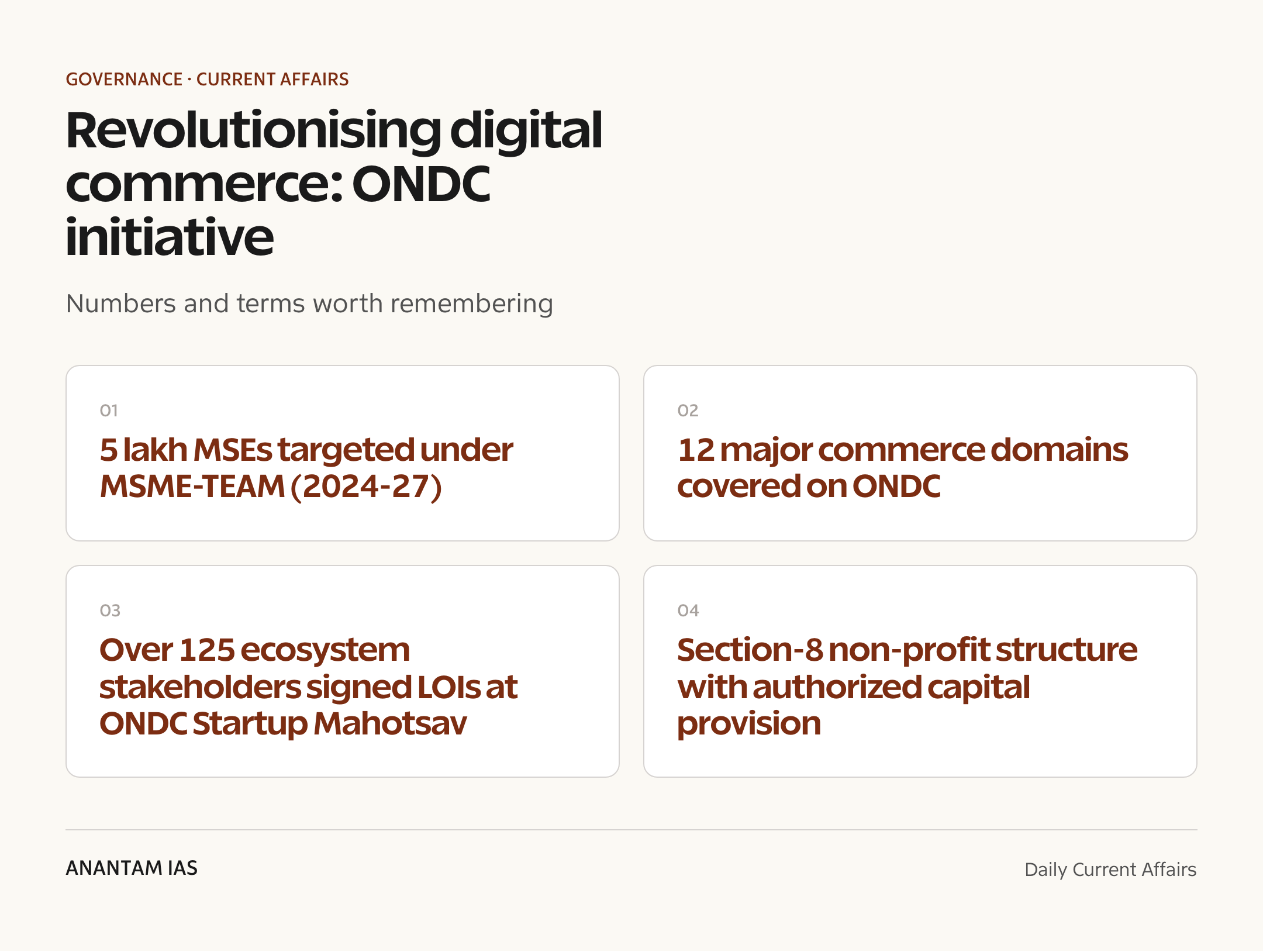
UPSC Relevance
Prelims Relevance
- Definition: Open Network for Digital Commerce — a protocol-based network to enable interoperable e-commerce.
- Basic facts: Incorporated as a Section-8 company, incubated at QCI; launched April 2022; active multi-domain network.
- Scheme specific: MSME-TEAM scheme for onboarding 5 lakh MSEs to ONDC, valid 2024-27 with priority to women-owned enterprises.
Mains Relevance
GS3 Economy
- Evaluate how open protocols can alter market power dynamics in digital platforms and implications for competition policy.
- Discuss policy measures required for digital inclusion of MSMEs and the role of public infrastructure in enabling access.
- Analyse governance trade-offs between decentralisation and the need for standards, security and consumer protection in digital commerce.
Essay
- Use ONDC as an example of public digital infrastructure shaping markets while balancing innovation and regulation.
- Discuss the broader theme of democratization of technology and implications for equitable economic growth and employment.
Background and Context
Genesis and institutional model
How ONDC was created and structured to operate as a public-good digital infrastructure.
- Launched in April 2022 with the aim to open e-commerce to protocol-based interoperability rather than platform lock-in.
- Incorporated as a Section-8 non-profit and incubated at the Quality Council of India to separate operational governance from commercial incentives.
- Protean joined as a co-founder and public and private financial institutions have contributed equity to provide an initial capital base.
- Model emphasises a startup mindset supported by government to accelerate adoption while retaining a neutral governance role.
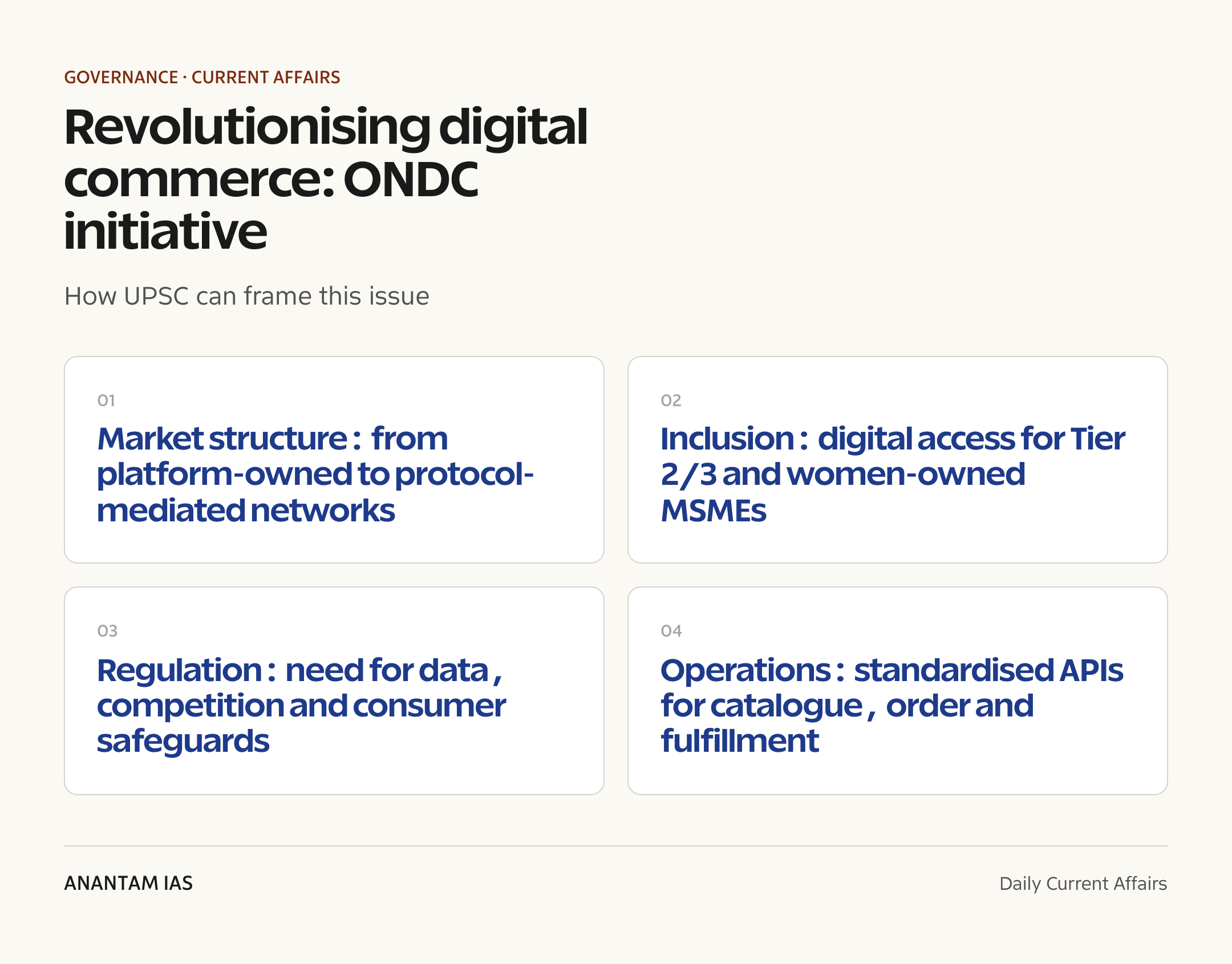
Architecture and working
Technical and operational design that enables multiple buyers and sellers to transact over a common network.
- Based on open-source specifications and standardised APIs that enable discovery, catalogue, order, fulfillment and settlement across participants.
- Network roles include: Buyer apps, Seller apps, Gateway and logistics providers, and Registry/Certification entities.
- Interoperability allows a buyer on one app to place an order fulfilled by a seller discovered via another participant.
- Domains are organised so that verticals such as grocery, fashion, health and mobility can implement domain-specific rules on the shared protocol.
MSME focus and onboarding
Why small and micro enterprises are central to ONDC’s social and economic objectives.
- MSMEs face high platform fees, limited reach and dependence on a few large marketplaces for demand discovery.
- ONDC aims to reduce entry costs by standardising cataloguing and order management so sellers can switch between ONDC-compatible front ends.
- The MSME-TEAM scheme targets 5 lakh MSEs for onboarding from 2024 to 2027 with financial assistance for catalogue creation, logistics and packaging.
- Priority components include outreach in Tier 2/3 cities, cluster-level training and special focus on women-owned and SC/ST enterprises.
Scale-up and ecosystem engagement
Progress on partnerships, events and private sector participation that indicate practical adoption.
- DPIIT convened the ONDC Startup Mahotsav in May 2024, with around 5,000 participants and over 125 ecosystem stakeholders signing Letters of Intent.
- Startups and established firms from travel, healthcare, fintech and retail have signalled intent to interoperate using ONDC protocols.
- Evidence of cross-domain pilots indicates viability for vertical expansion into services, mobility and financial services.
- Recognition via awards on e-governance and disruptive tech reflects growing institutional acceptance and validation.
Economic and market implications
How ONDC could alter competition, prices and firm strategies in the digital economy.
- By lowering switching costs, ONDC can weaken network effects that sustain platform monopolies, increasing competition.
- Greater discoverability for small sellers can increase market fragmentation and reduce concentrated market shares held by incumbents.
- Potential reduction in platform commission fees can increase margins for sellers but may shift monetisation to services like logistics or advertising.
- Wider participation may increase consumer choice, localised offers and help formalisation of informal sellers via digital footprints.
Regulatory and governance questions
Policy issues that arise as the network expands and interacts with existing laws and market practices.
- Interoperability raises issues of data portability, consent and cross-platform data flows that need clear rules and oversight.
- Competition authorities will need to define abuse in protocol-level markets and assess whether dominant gateway services can emerge.
- Standards for consumer protection, dispute resolution and quality certification must be integrated into the network architecture.
- Cybersecurity, fraud prevention and identity verification demand robust technical and legal frameworks to maintain trust in the network.
Way Forward
Strengthen technical standards and certification
- Develop comprehensive security and data governance standards for all participants, including mandatory audits.
- Create a transparent certification regime for seller and buyer apps to ensure protocol compliance and consumer protection.
- Establish domain-specific quality marks that can be displayed by compliant seller apps to build trust.
- Publish developer-friendly documentation and sandboxes to accelerate third-party integrations.
Support MSME onboarding and capacity building
- Scale up the MSME-TEAM initiative with targeted grants for catalogue digitisation, packaging and logistics integration.
- Run cluster-based training in Tier 2 and Tier 3 towns with hand-holding for women-owned and SC/ST enterprises.
- Partner with state governments and industry associations to create local support centres for onboarding and dispute redressal.
- Provide microcredit linkages and simplified digital KYC pathways to enable rapid seller activation on the network.
Regulatory and competition safeguards
- Coordinate with the Competition Commission and IT regulators to set rules for gateway neutrality and prevent exclusionary practices.
- Draft clear data portability and consent norms specific to protocol-level transactions to protect consumer privacy.
- Introduce monitoring mechanisms to detect emergent gatekeepers and mandate interoperability obligations if needed.
- Set time-bound grievance resolution standards and a central Ombudsperson for cross-platform disputes.
Market development and incentives
- Provide performance-linked incentives for logistics and payments providers to plug last-mile gaps in smaller towns.
- Pilot public procurement use-cases where government buying occurs via ONDC to create initial transactional volume.
- Encourage anchor buyers such as large institutional cafeterias, hospitals and educational institutions to transact over ONDC.
- Run consumer-awareness drives highlighting benefits of choice, price discovery and local merchant support on the network.
Conclusion
ONDC represents a shift from platform-centric marketplaces to protocol-driven digital infrastructure that can democratise e-commerce.
Realising benefits requires parallel action on standards, MSME capacity building and regulatory safeguards to manage new market dynamics.
If successfully implemented, ONDC can expand digital market access for millions of micro and small sellers and reshape competition in India’s digital economy.
UPSC Practice Questions
Prelims MCQ 1
(a) A and C (b) B and D (c) Only B (d) Only D
Answer: (b) B and D
Explanation:
ONDC is built on open-source specifications and standardised APIs to enable interoperability. It was incorporated as a Section-8 non-profit. It is not a private for-profit marketplace nor restricted to large firms.
Prelims MCQ 2
(a) A, B and C (b) A and D (c) Only D (d) B and D
Answer: (a) A, B and C
Explanation:
MSME-TEAM targets 5 lakh MSEs, offers assistance for catalogue preparation and logistics, and is valid from 2024 to 2027. It does not exclusively benefit urban large retailers; it focuses on micro and small enterprises including women-owned and cluster-based units.
UPSC Mains Questions
- {‘q’: “Critically examine how ONDC’s protocol-based model can influence competition in India’s digital commerce market. Discuss the regulatory measures required to prevent emergence of new gatekeepers.”, ‘model_answer’: ‘Introduce ONDC and explain protocol-based interoperability. Analyse how reduced switching costs and standardised discovery can dilute network effects that favour incumbents. Discuss potential for new intermediaries (gateway services, logistics aggregators, specialized registries) to become gatekeepers. Recommend regulatory measures: gateway neutrality rules, monitoring by Competition Commission, data portability and consent rules, certification for market participants, mandated open APIs for essential services, and an Ombudsperson for disputes. Conclude on balancing innovation with oversight.’}
- {‘q’: ‘Assess the role of ONDC in promoting digital inclusion of MSMEs. What complementary policy measures should the government adopt to ensure equitable outcomes?’, ‘model_answer’: “Explain ONDC’s benefits for MSMEs: discoverability, lower entry costs, multi-app presence. Evaluate barriers: digital literacy, catalogue preparation costs, logistics and payment access. Recommend complementary policies: expand MSME-TEAM funding, local training centres, simplified digital KYC, targeted microcredit, partnerships with state clusters, and incentives for last-mile logistics and payments. Emphasise monitoring impact metrics like onboarded merchants, transactions in Tier 2/3 towns and women-owned enterprise participation.”}
Source: PIB, Ministry of Commerce & Industry.
Frequently Asked Questions
q
a
q
a
q
a
q
a
q
a
q
a
Source: https://anantamias.com/current-affairs/ondc-digital-commerce-initiative-2025/
Operational demonstration by Indian Navy’s Eastern Naval Command
Why in News?
The Indian Navy staged a high-visibility Operational Demonstration at Ramakrishna Beach, Visakhapatnam on 04 Jan 2025. The event highlighted operational capabilities, public outreach and strategic messaging from the Eastern Naval Command.
- Public showcase of force: A large-scale display involving warships, aircraft, submarines and special forces (MARCOS) demonstrates breadth of capability to domestic and regional audiences.
- Deterrence signalling: Concentrated deployment and visible readiness projects a deterrence posture in the Bay of Bengal and the Indo-Pacific maritime domain.
- Defence diplomacy: High-profile events support soft power and civil-military ties, and can be calibrated to convey messages to foreign navies and partners.
- Community outreach: Engaging lakhs of citizens and elected officials builds public confidence in maritime security and helps recruitment, coastal cooperation and disaster response preparedness.
- Operational validation: Integrated displays validate inter-operability across platforms and services, useful for planning and force development.
The development matters in the context of:
- Eastern Naval Command (ENC): ENC is the Indian Navy’s principal formation on the eastern seaboard, headquartered at Visakhapatnam, with responsibilities for the Bay of Bengal and eastern Indian Ocean approaches.
- Strategic setting: The Indo-Pacific has rising maritime competition. Visible naval demonstrations are part of a set of tools used by states to reassure domestic audiences and signal resolve to neighbours and extra-regional powers.
- Force composition: Modern ENC assets include destroyers, frigates, corvettes, submarines, maritime patrol aircraft and Marine Commandos (MARCOS), enabling layered sea control and response options.
- Public diplomacy: Hosting ceremonials, laser and drone shows, and media telecasts enhances the Navy’s public narrative about technological modernisation and readiness.
: Presence of state leadership and judiciary leaders at the event underlines civilian support and the role of state governments in facilitating naval infrastructure and operations. - Disaster response overlap: Demonstrations often highlight platforms and units that have domestic roles in HADR (humanitarian assistance and disaster relief), relevant to coastal state disaster management planning.

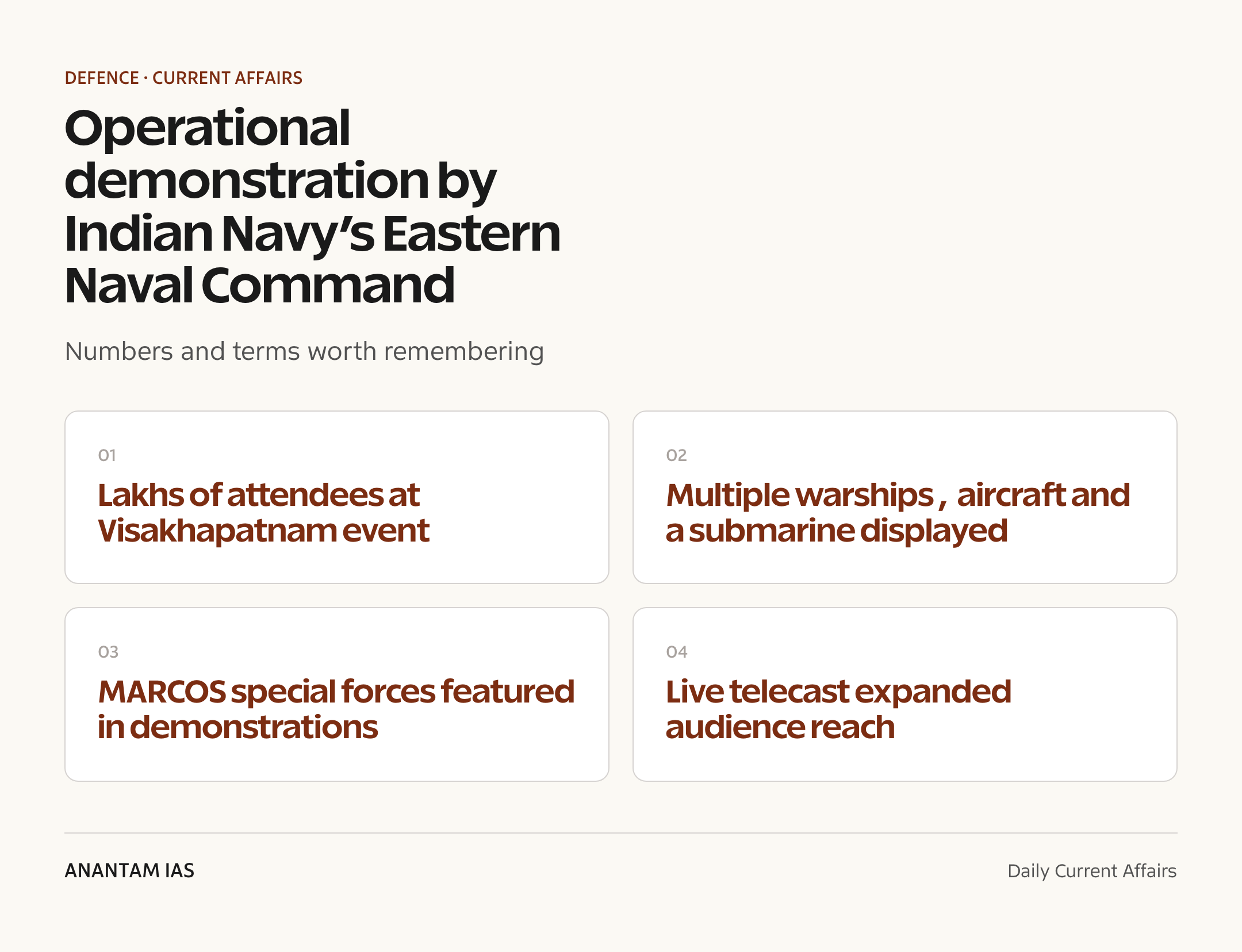
UPSC Relevance
Prelims Relevance
- Identify the role and area of responsibility of the Eastern Naval Command.
- Recognise major Indian naval platforms that operate from Visakhapatnam, including surface ships and submarines.
- Remember the significance of public naval displays like Operational Demonstrations in national security communication.
Mains Relevance
GS3 Economy
- Analyse how high-visibility military demonstrations contribute to deterrence and strategic signalling in the Indo-Pacific.
- Discuss the role of the Navy in civil-military relations and domestic outreach, including implications for governance and disaster response.
- Examine the balance between operational secrecy and public display in defence diplomacy and national security policy.
Essay
- Topics on India’s role in the Indo-Pacific, defence modernisation and maritime strategy, including themes like India’s maritime security challenges and defence and diplomacy.
- Essay prompts on civil-military relations and public trust in security institutions where public demonstrations are relevant case material.
Background and Context
Eastern Naval Command at a glance
Role, headquarters and area of responsibility for the ENC.
- The Eastern Naval Command is headquartered at Visakhapatnam and is a primary naval formation responsible for the Bay of Bengal and eastern Indian Ocean approaches.
- Operational responsibilities include maritime security operations, surveillance, fleet actions and protection of sea lines of communication on the eastern seaboard.
- ENC manages permanent and rotational assets such as destroyers, frigates, corvettes, diesel-electric submarines and maritime patrol aircraft.
- The command plays a key role in search and rescue, anti-piracy patrols, and disaster relief operations in eastern coastal states and island territories.
- ENC hosts major naval infrastructure including dockyards, maintenance facilities and training establishments that support sustained deployments.
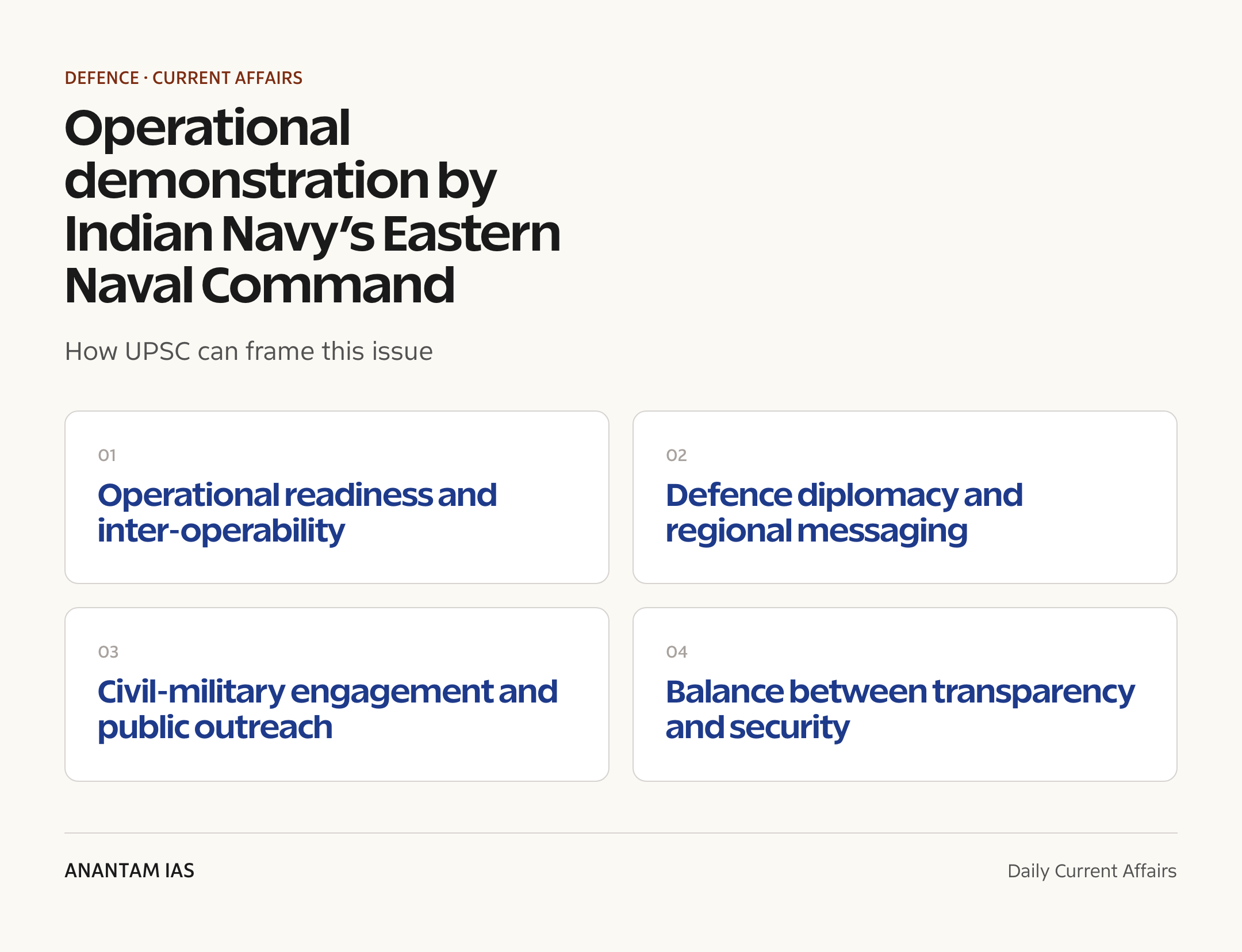
Operational demonstrations as a tool
Why navies perform public demonstrations and what they convey.
- Operational demonstrations serve to display tactical capabilities and integrated operations across surface, sub-surface and air domains.
- They function as a form of strategic communication aimed at multiple audiences: domestic public, potential adversaries, partner navies and international media.
- Displays help test inter-operability and command and control in a controlled environment while balancing operational security considerations.
- Such events boost morale and recruitment by showcasing service professionalism and advanced equipment to prospective entrants and the general public.
- They are often used to familiarise the populace with naval roles in maritime security and humanitarian assistance missions.
Force components highlighted
Key platforms and units typically involved in ENC demonstrations.
- Surface fleet: destroyers and frigates for sea control, escort and power projection tasks.
- Sub-surface assets: conventional submarines that contribute to sea denial and covert surveillance.
- Aviation: ship-borne and shore-based maritime patrol aircraft and helicopters for reconnaissance, ASW and SAR.
- Special forces: MARCOS for maritime interdiction, VBSS and direct action in littoral zones.
- Integrated sensors and weapons: showcasing
Strategic signalling in the Indo-Pacific
Contextualising the demonstration in regional maritime dynamics.
- The Indo-Pacific is marked by rising maritime competition, greater naval activity and contestation over sea lines of communication.
- Visible naval events signal intent and capability to regional states and extra-regional powers seeking influence in the area.
- Operational demonstrations contribute to deterrence by denial or punishment depending on the posture and messaging.
- They offer an opportunity to show alignment with partners through joint exercises or invited observers, reinforcing defence diplomatic ties.
- Such actions must be calibrated to avoid unnecessary escalation while achieving the desired
.
Civil-military and state engagement
The role of state actors and public participation in naval events.
- State governments provide logistical and administrative support for coastal events, enabling large scale public attendance and security arrangements.
- Presence of elected leaders, judiciary and local dignitaries signals
and helps normalise defence visibility in public life. - Public displays foster trust and improve the Navy’s ability to coordinate with local administrations during
. - Large audiences provide a platform to communicate naval capabilities, roles and career opportunities to the youth and coastal communities.
- Stakeholder engagement during such events also includes port authorities, fishermen communities and local businesses that support naval logistics.
Operational security and public displays
Balancing transparency and secrecy when conducting demonstrations.
- Authorities must protect
while allowing demonstrable elements that do not compromise operational advantage. - Detailed choreography ensures that classified systems or procedures are not exposed, while visible elements still reflect credible capability.
- Advance publicity is balanced by restricted zones and media guidance to prevent inadvertent disclosure of operational details.
- Post-event assessments help refine future demonstrations to better preserve
and public engagement goals.
Way Forward
Calibrate messaging for regional stability
- Frame demonstrations as emphasising defensive readiness and maritime safety rather than aggressive posturing.
- Where appropriate, invite regional partners and observers to promote
. - Coordinate public statements with Ministry of External Affairs to align
messaging.
Enhance civil-military coordination
- Develop joint planning protocols with state and local authorities for
during public displays. - Use demonstrations to brief coastal communities on
. - Institutionalise post-event feedback mechanisms to improve logistics and minimise local disruption.
Protect operational security while showcasing capability
- Define clear categories of
before public events. - Train public affairs teams on media handling to prevent inadvertent revelation of sensitive details.
- Employ simulated scenarios and non-deployable mock-ups when operational constraints prevent full disclosure.
Leverage demonstrations for capability assessment
- Use rehearsals and the demonstration itself to test
- Gather structured after-action reviews to inform
. - Integrate lessons learned into wider
cycles.
Conclusion
The ENC Operational Demonstration at Visakhapatnam combined ceremony, public outreach and capability display to achieve multiple objectives: reassure citizens, signal deterrence, validate operational integration and strengthen defence diplomacy. Future events should maintain an appropriate balance between transparency and operational security while deepening civil-military cooperation and drawing concrete lessons for capability development.
UPSC Practice Questions
Prelims MCQ 1
Which of the following cities is the headquarters of the Eastern Naval Command of the Indian Navy?
(a) Kochi (b) Visakhapatnam (c) Mumbai (d) Port Blair
Answer: (b) Visakhapatnam
Explanation:
The Eastern Naval Command is headquartered at Visakhapatnam and is responsible for the Bay of Bengal and eastern Indian Ocean approaches.
Prelims MCQ 2
MARCOS, often displayed in naval demonstrations, refers to which of the following?
(a) Maritime Radar and Communications System (b) Marine Commandos of the Indian Navy (c) Maritime Reconnaissance and Observation Satellite (d) Maritime Rescue Coordination Service
Answer: (b) Marine Commandos of the Indian Navy
Explanation:
MARCOS stands for Marine Commandos, the special forces unit of the Indian Navy specialising in maritime operations including VBSS and direct action.
UPSC Mains Questions
- {‘question’: ‘Analyse how public operational demonstrations by the Indian Navy contribute to deterrence and defence diplomacy in the Indo-Pacific. Comment on risks associated with such displays.’, ‘model_answer’: ‘Public naval demonstrations serve multiple strategic functions. They convey credible deterrence by showcasing capability which can dissuade potential coercive actions in nearby maritime zones. Demonstrations also act as tools of defence diplomacy, signalling to partners and adversaries alike about operational reach and commitment to regional security. They enhance
and support recruitment and public understanding of naval roles. Risks include unintended disclosure of sensitive tactics or capabilities, potential escalation if messaging is perceived as provocative by neighbouring states, and domestic resource allocation concerns if such events appear primarily ceremonial. To manage risks, demonstrations should be carefully planned with clear communication, controlled disclosure, and opportunities for international transparency such as inviting observers or conducting combined exercises.’} - {‘question’: “Discuss the ways in which the Indian Navy’s public engagement activities can support disaster response and coastal resilience in eastern India.”, ‘model_answer’: “The Navy’s public engagement creates operational familiarity with maritime capabilities that are critical in natural disasters. Demonstrations provide an avenue to inform coastal communities about
procedures, medical evacuation and reporting mechanisms. They build sustained with state authorities and local agencies which are essential for coordinated HADR operations. Visible assets like helicopters, fast-response boats and medical teams showcased during events signal available resources for emergencies. Regular outreach can also improve local resilience through community training programs and shared contingency planning, resulting in faster, more coherent responses to cyclones, floods and maritime accidents.”}
Source: PIB, Ministry of Defence.
Frequently Asked Questions
q
a
q
a
q
a
q
a
q
a
q
a
Source: https://anantamias.com/current-affairs/operation-demo-eastern-naval-command-2025/
Health Ministry convenes monitoring group as respiratory illness cases rise in China
Why in News?
Rising respiratory-illness reports from China prompted India to convene a Joint Monitoring Group under DGHS to review surveillance, laboratory and clinical preparedness and to coordinate with WHO and national agencies.
- Cross-border risk: Reports of increased respiratory illnesses in China present potential transmission risk to India through travel and trade.
- Rapid response: The Joint Monitoring Group (JMG) is a mechanism to align surveillance, diagnostics and clinical response across agencies.
- Interagency coordination: WHO, IDSP, NCDC, ICMR and major hospitals were involved to ensure technical alignment and information sharing.
- Public-health preparedness: The meeting rechecked laboratory capacity, reporting pathways and surge clinical-management plans.
- Surveillance vigilance: Emphasis on strengthening early detection at points of entry and in community surveillance systems.
The development matters in the context of:
- Recent situation: Chinese health authorities reported a rise in respiratory-illness cases in late 2024 and early 2025, creating international monitoring needs.
- India’s exposure pathways: High travel volumes, migrant flows and trade between India and China increase the chance of imported cases if the agent is transmissible.
- Existing architecture: The Integrated Disease Surveillance Programme (IDSP), NCDC and ICMR laboratories form the core of India’s surveillance and testing network.
- Global health mechanisms: WHO provides technical guidance and risk assessments; countries use WHO updates to calibrate national responses.
- Post-pandemic vigilance: Systems and protocols established during the COVID-19 response are now being applied to other respiratory threats.
- Risk communication: Timely public information reduces panic and boosts compliance with prevention measures such as testing and isolation.

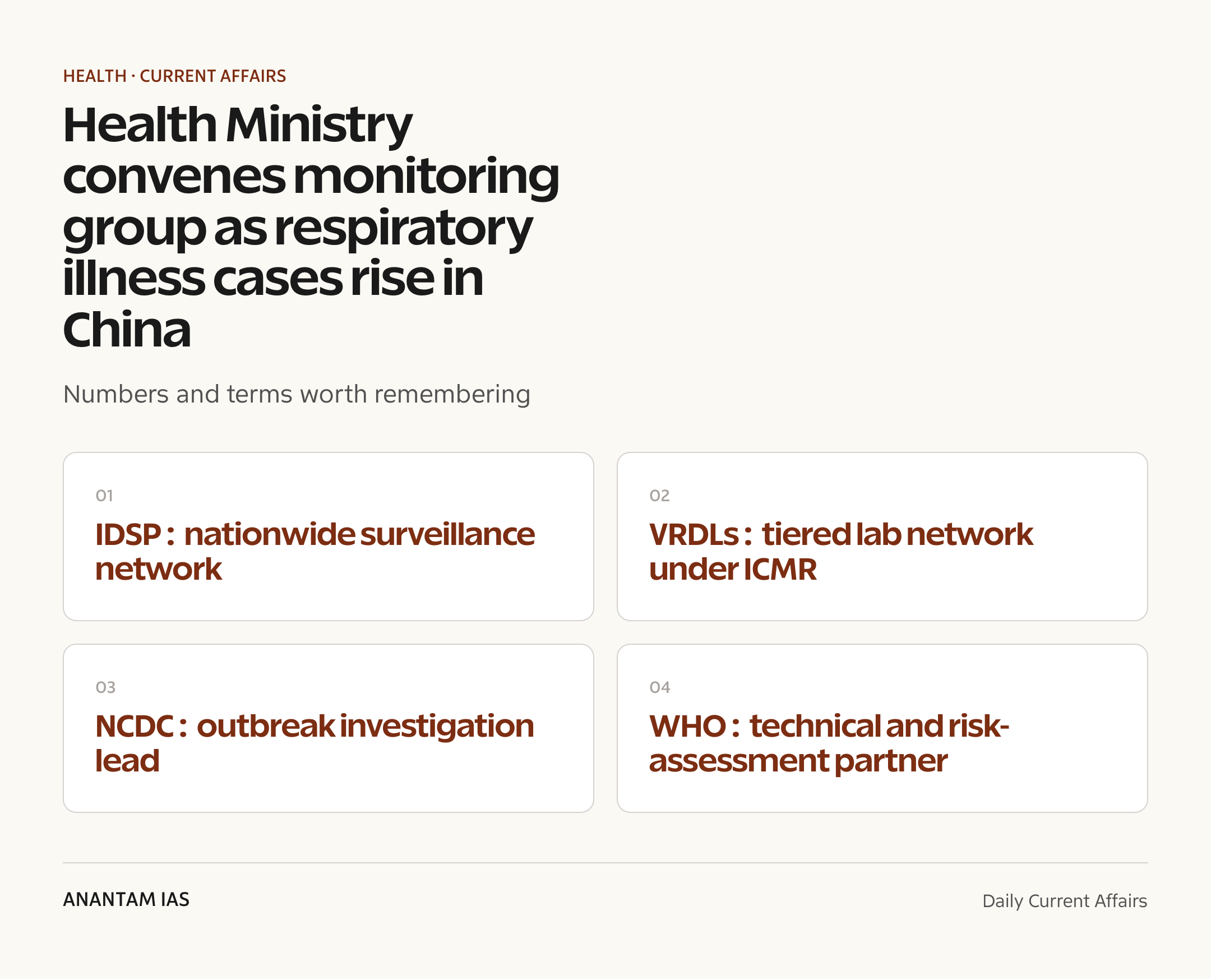
UPSC Relevance
Prelims Relevance
- IDSP: Know the role of the Integrated Disease Surveillance Programme in epidemic detection and reporting.
- NCDC: Understand the National Centre for Disease Control’s functions in outbreak investigation and laboratory coordination.
- WHO: Recognize WHO’s advisory role and how member states use global risk assessments.
- JMG: Be aware that Joint Monitoring Group meetings are convened to coordinate multiagency responses.
Mains Relevance
GS3 Economy
- Public-health system strength: Discuss the adequacy of India’s surveillance, laboratory networks and clinical surge capacity in detecting and responding to cross-border outbreaks.
- International cooperation: Evaluate how cooperation with WHO and neighbouring countries can improve early warning and joint response to infectious disease threats.
- Policy lessons: Analyse lessons from COVID-19 to propose sustainable reforms in epidemic preparedness, including financing and human resources.
Essay
- Health and governance: Use this episode to discuss the role of governance and public institutions in pandemic preparedness and resilient health systems.
- Global health security: Link to arguments on the need for strengthened global surveillance, equitable lab access and transparent data sharing.
Background and Context
Integrated Disease Surveillance Programme (IDSP)
Core early-warning network for epidemic-prone diseases in India.
- Purpose: Continuous monitoring to detect outbreaks at peripheral and district levels and trigger rapid public-health action.
- Structure: State and district surveillance units feed line lists and weekly reports to central units like NCDC.
- Data flows: Syndromic and laboratory-confirmed data are routed through IDSP channels to inform national situational analysis.
- Challenges: Reporting delays, under-notification from private sector and variable laboratory coverage in remote areas.
- Strengthening measures: Integration with ICMR networks and digital reporting tools has improved timeliness since 2020.
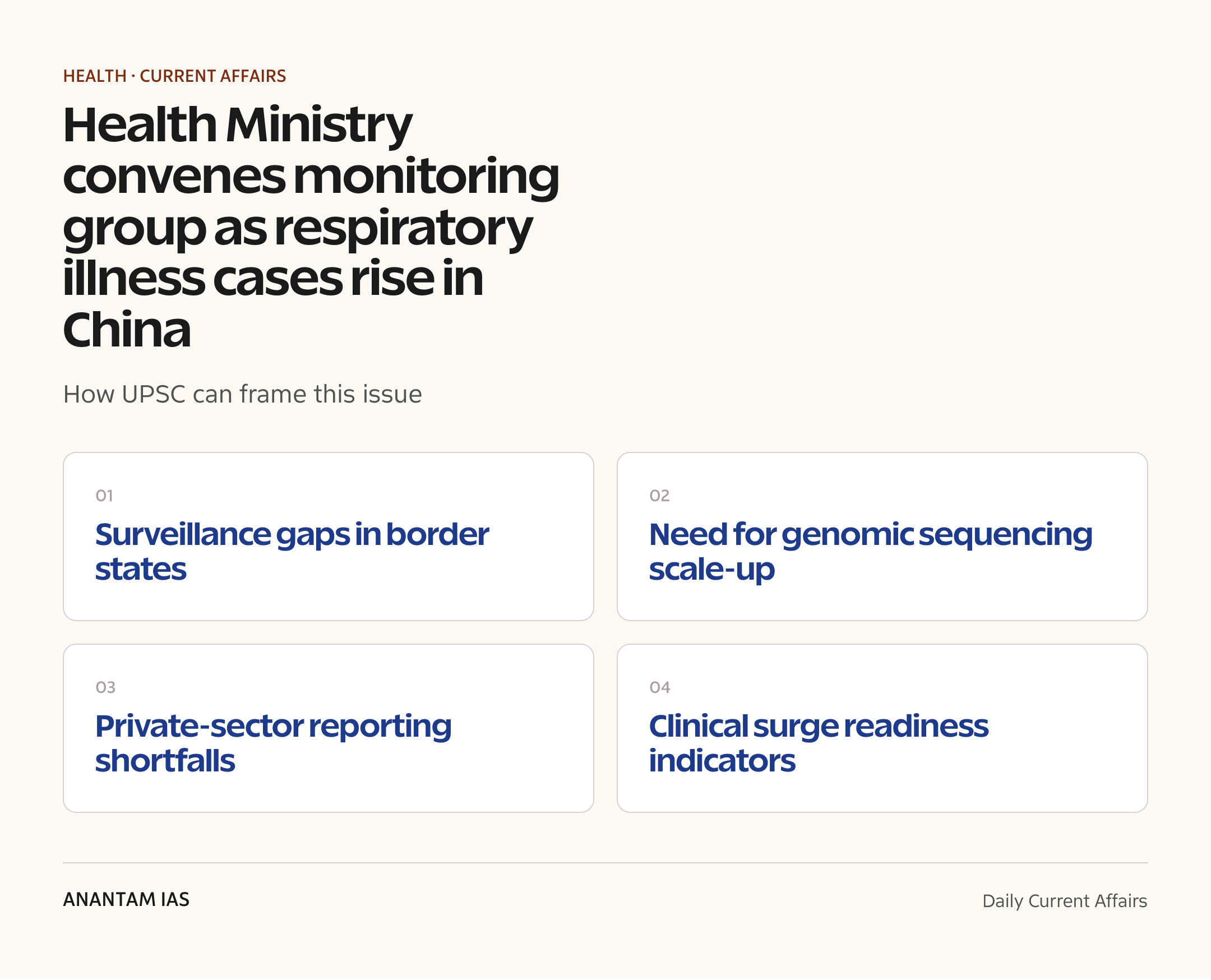
National Centre for Disease Control (NCDC)
Key agency for outbreak investigation, technical guidance and laboratory coordination.
- Mandate: Lead epidemiological investigations, provide standard case definitions and coordinate central response teams.
- Rapid response teams: NCDC deploys field epidemiologists and laboratory specialists for outbreak verification and containment.
- Training: Runs capacity-building for states in surveillance and event-based reporting.
- Lab linkage: Coordinates with ICMR and state public-health labs to ensure confirmatory testing.
- Information products: Issues advisories and situational bulletins to inform stakeholders and clinicians.
Indian Council of Medical Research (ICMR) and laboratory preparedness
National reference labs and research networks support diagnostics and genomic surveillance.
- Network: ICMR runs a tiered laboratory network from VRDLs to apex reference labs.
- Diagnostic capacity: Capability to test for multiple respiratory pathogens, including influenza and SARS-related viruses.
- Genomic surveillance: Sequencing platforms detect variants and inform transmission and vaccine considerations.
- Testing surge: Protocols exist to scale testing via public and accredited private labs during spikes.
- Quality assurance: External quality assessments and standardized protocols ensure result reliability.
Role of WHO and global coordination
Provides technical guidance, risk assessment and platforms for data sharing among states.
- Technical support: WHO shares case definitions, laboratory algorithms and clinical management guidance.
- Risk assessment: Global risk categorization guides national responses and travel guidance when needed.
- Information platforms: WHO event information systems and newsletters signal emerging threats to member states.
- Capacity building: WHO supports surveillance strengthening and laboratory training in low-resource settings.
- Constraints: WHO’s recommendations depend on data sharing from affected countries; transparency gaps can limit response speed.
Points of entry and travel-related surveillance
First line of defence against importation of new respiratory pathogens.
- Screening: Health screening at airports and seaports focuses on symptomatic travellers and enhanced information collection.
- Coordination: Port health offices coordinate with customs, immigration and airlines for follow-up of suspect travellers.
- Contact tracing: Mechanisms exist to trace and notify contacts of incoming travellers carrying infectious agents.
- Limitations: Asymptomatic transmission and incubation periods reduce the sensitivity of entry screening.
- Augmentation: Pre-departure testing, digital passenger locator forms and targeted sequencing can improve early detection.
Clinical management and hospital preparedness
Ensuring hospitals can manage a surge of respiratory cases without disrupting routine care.
- Clinical protocols: Standardized case management guides for mild to severe respiratory illness reduce variability in care.
- Capacity planning: Hospitals maintain ICU beds, oxygen supplies and trained staff for surge scenarios.
- Infection control: Strict nosocomial infection protocols protect staff and other patients.
- Referral networks: Clear pathways between primary care, district hospitals and tertiary centres ensure timely escalation.
- Supply chains: Stockpiles of PPE, medicines and oxygen should be maintained and monitored for shortages.
Way Forward
Strengthen surveillance and reporting
- Real-time integration: Link IDSP with airport screening and hospital EMRs for faster alerts.
- Private sector reporting: Mandate timely case reporting from private hospitals with enforceable timelines.
- Event-based surveillance: Expand community event reporting lines to capture unusual respiratory clusters.
- Digital tools: Use mobile reporting and dashboards to visualise hotspots and laboratory backlogs.
Enhance laboratory and genomic capacity
- Expand VRDL reach: Add targeted labs in border states and high-traffic hubs for faster turnaround.
- Sequencing scale-up: Prioritise sequencing of suspect clusters to detect novel agents or variants.
- Quality networks: Strengthen proficiency testing and inter-lab data sharing protocols.
- Public-private collaboration: Engage accredited private labs in surge testing under standard reporting SLAs.
Improve clinical readiness and supply chains
- Surge protocols: Predefine triage algorithms and critical care surge staffing models for respiratory waves.
- Supply monitoring: Maintain central dashboards for oxygen, ventilators and essential drugs across states.
- Training: Rapid refresher training for frontline clinicians on updated respiratory-management algorithms.
- Referral clarity: Map and publicise referral centres for severe respiratory cases by district.
Bolster international coordination and risk communication
- WHO liaison: Keep active channels with WHO for situational updates and technical advisories.
- Regional diplomacy: Use bilateral health channels to seek timely data from affected neighbours.
- Transparent communication: Issue clear advisories to public and clinicians to reduce misinformation.
- Travel guidance: Calibrate passenger advisories and testing recommendations based on evolving risk.
Conclusion
The JMG meeting reflects a precautionary, structured approach to a cross-border respiratory signal. Sustained vigilance, faster data flows between surveillance and labs, clinical surge preparedness and active international coordination will reduce importation risk and protect public health in India.
UPSC Practice Questions
Prelims MCQ 1
Which agency is primarily responsible for outbreak investigation and coordination of central rapid response teams in India?
(a) A. Integrated Disease Surveillance Programme (IDSP) (b) B. National Centre for Disease Control (NCDC) (c) C. Indian Council of Medical Research (ICMR) (d) D. World Health Organization (WHO)
Answer: B
Explanation:
NCDC leads epidemiological investigations and coordinates central rapid response teams and technical guidance during outbreaks. IDSP is the surveillance network that feeds data to NCDC, while ICMR focuses on laboratory and research support.
Prelims MCQ 2
The Integrated Disease Surveillance Programme (IDSP) primarily collects which type of data for early outbreak detection?
(a) A. Genomic sequencing data (b) B. Syndromic and routine surveillance data (c) C. International travel manifests (d) D. Vaccine coverage surveys
Answer: B
Explanation:
IDSP focuses on syndromic and routine surveillance data from peripheral health facilities and districts to detect unusual increases in disease and trigger investigations.
UPSC Mains Questions
- {‘question’: ‘Analyse the strengths and weaknesses of India’s existing surveillance and laboratory networks in detecting and responding to cross-border respiratory disease threats. Suggest reforms to enhance early detection and response.’, ‘model_answer_points’: [‘Strengths: Tiered laboratory network under ICMR and VRDLs; established IDSP reporting channels; NCDC rapid response teams; experience from COVID-19 improved capacities.’, ‘Weaknesses: Delays in private-sector reporting; uneven lab coverage in remote and border regions; limited routine genomic sequencing capacity; data fragmentation across systems.’, ‘Reforms: Mandate integrated digital reporting across public and private sectors; expand sequencing hubs in strategic states; invest in workforce for field epidemiology; ensure sustainable financing for surveillance.’, ‘Implementation: Set SLAs for test turnaround and reporting; create legal provisions for event-based reporting; incentivise state-level investments in public-health labs.’]}
- {‘question’: ‘Discuss the role of international cooperation in managing potential respiratory outbreaks originating in neighbouring countries. How should India balance public-health measures and economic/travel considerations?’, ‘model_answer_points’: [‘Role: Timely data sharing, joint investigations, technical assistance and resource mobilisation through WHO and bilateral channels improve situational awareness.’, ‘Balancing: Risk-based travel advisories, targeted testing and quarantine for high-risk travellers protect health while minimising broad economic disruption.’, ‘Diplomacy: Use health diplomacy to obtain transparent information and coordinate cross-border case management and contact tracing.’, ‘Policy: Adopt flexible measures that can be scaled up or down by epidemiological triggers to reduce unnecessary trade or travel restrictions.’]}
Source: PIB, Ministry of Health & Family Welfare.
Frequently Asked Questions
q
a
q
a
q
a
q
a
q
a
q
a
Source: https://anantamias.com/current-affairs/respiratory-illnesses-china-monitoring-2025/
CAQM Sub-Committee revokes Stage-III of revised GRAP across NCR
Why in News?
The highest emergency controls under the revised GRAP were withdrawn across the NCR after air-quality and meteorological forecasts indicated improvement. The move affects restrictions, enforcement posture, public health advisories and administrative coordination between the Centre and states.
- CAQM Sub-Committee revoked all actions under Stage-III of the revised GRAP in the entire NCR with immediate effect.
- Decision based on recent AQI improvements in Delhi (sample readings: 348 at 2PM to 335 at 5PM on the day) and forecasts from IMD and IITM.
- All measures under Stage-II and Stage-I remain active and must be intensified to avoid re-imposition of Stage-III.
- Closure orders issued to specific C&D sites and industrial units for non-compliance remain in force until explicit clearance from the Commission.
- Public urged to follow the Citizen Charter under Stages I and II during the ongoing winter season when conditions may quickly worsen.
The development matters in the context of:
- GRAP structure: The revised Graded Response Action Plan is a set of pre-defined stages with targeted actions to manage air pollution in NCR. Stages escalate from advisory measures to stringent emergency controls.
- Stage-III triggers: Stage-III typically involves strict restrictions on vehicular movement, closure of major non-essential services, and suspension of construction to rapidly reduce emissions.
- Institutional role: The Commission for Air Quality Management (CAQM) sets region-wide directives; the Sub-Committee on GRAP operationalises stage decisions using inputs from CPCB, IMD, IITM and local agencies.
- Operational data: The CAQM Sub-Committee relied on near-real-time AQI bulletins and short-term forecasts indicating a downward trend and expected stabilization in the lower Very Poor / Poor bands.
- Policy balance: Authorities weigh public-health benefits of restrictions against socio-economic disruption to stakeholders such as transport, construction, logistics and small businesses.
- Enforcement nuance: Revocation of Stage-III does not mean removal of all controls. Targeted orders for non-compliant units remain and local agencies must keep preparedness for rapid re-imposition.
- Seasonal risk: Winter meteorology in north India, including temperature inversions and low wind speeds, can cause rapid deterioration, creating the need for continuous monitoring and forecast-driven decisions.

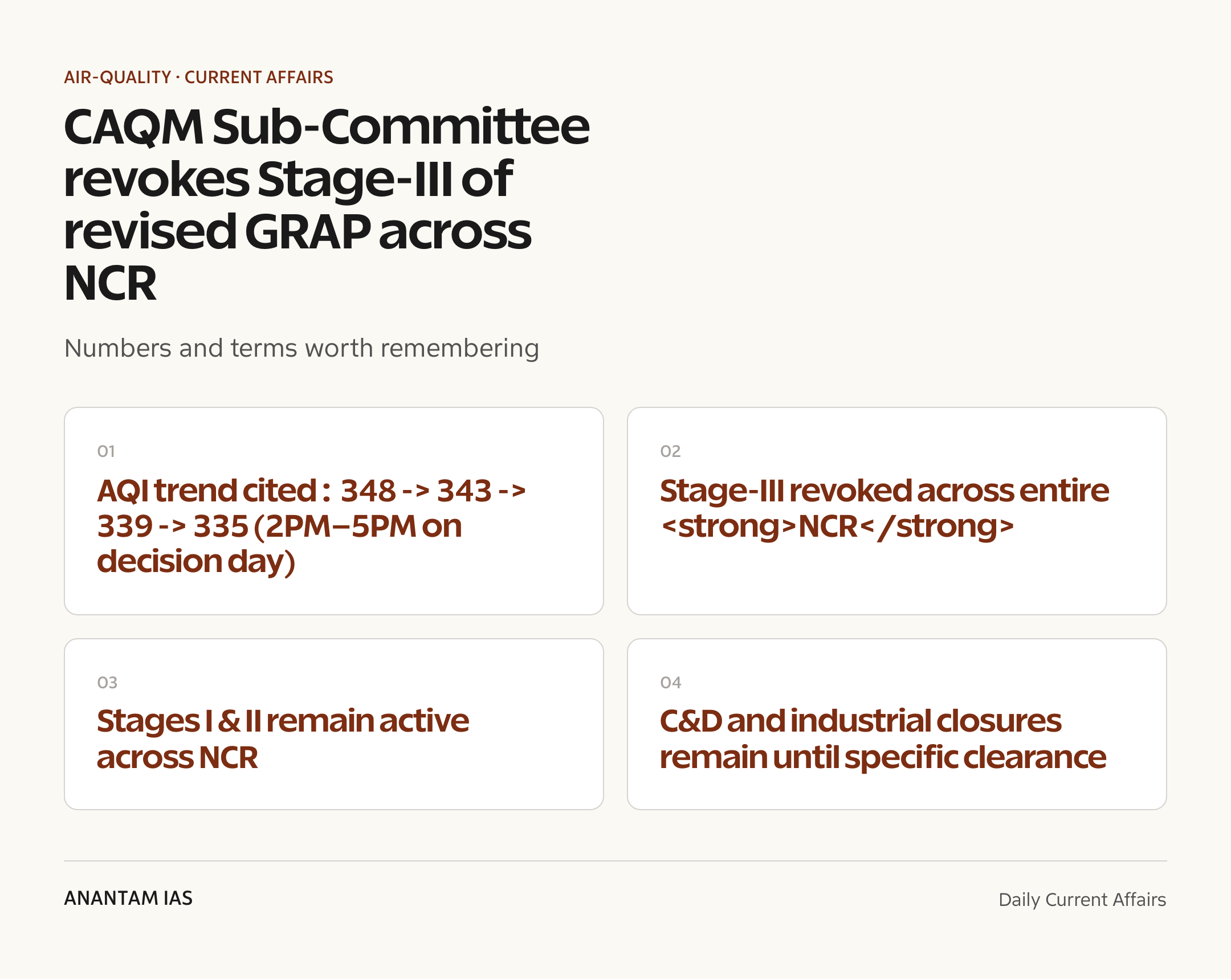
UPSC Relevance
Prelims Relevance
- Definition and stages of the Graded Response Action Plan are factual items relevant for prelims.
- Roles of CAQM, CPCB, IMD and IITM in air-quality management are directly examinable.
- Key AQI categories and corresponding health advisories form objective-type content for prelims.
Mains Relevance
GS3 Environment
- Policy evaluation topic: trade-offs between public-health protection and economic disruption from emergency pollution controls.
- Governance topic: coordination challenges between central commissions and state/local agencies during environmental emergencies.
- Science-policy linkage: use of meteorological and air-quality forecast models (IMD/IITM) in real-time decision making.
Essay
- Environmental governance and public health: the event can be used to discuss preparedness, institutional design and response frameworks.
- Urban air pollution and sustainable development: trade-offs in enforcement, livelihoods and long-term emission reduction strategies.
Background and Context
What is GRAP and why it exists
GRAP is a staged action plan designed to manage acute air-quality episodes in NCR through graduated measures.
- GRAP stands for Graded Response Action Plan and includes a set of prescribed actions triggered by AQI thresholds.
- It aims to reduce population exposure quickly during high-pollution episodes by controlling key emission sectors.
- The plan links health-based AQI categories to operational responses such as advisories, traffic restrictions and construction bans.
- GRAP’s staged design allows authorities to scale interventions in line with observed and forecast air quality, reducing arbitrary measures.
- Revisions to GRAP over time have added new trigger metrics, clarified roles of agencies and incorporated forecast information.
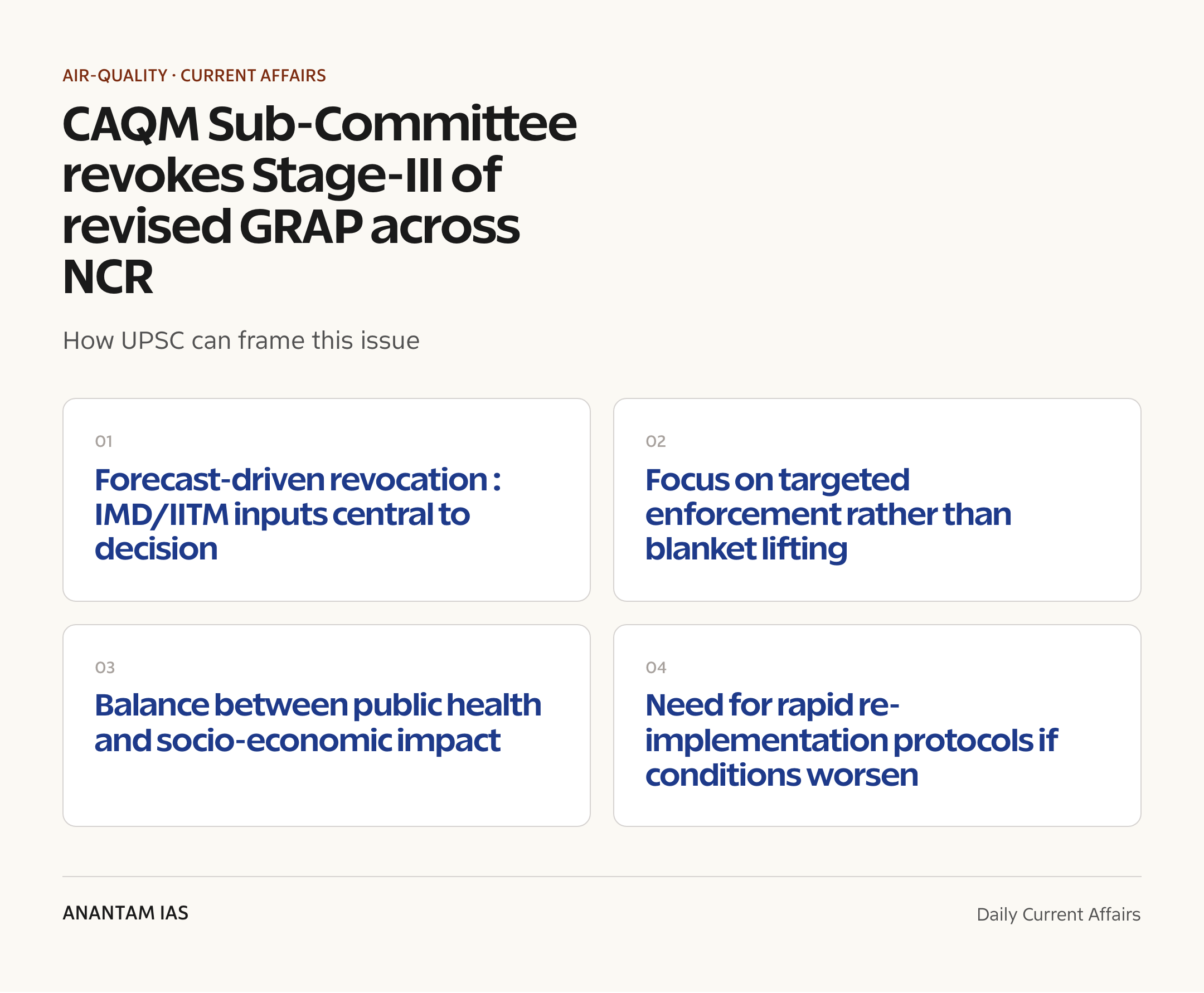
Institutional architecture behind the decision
Multiple agencies provide data, legal authority and on-ground enforcement for air-quality actions in NCR.
- CAQM (Commission for Air Quality Management) has the mandate to oversee air quality in NCR and adjoining areas with powers to issue binding directions.
- CPCB supplies the continuous AQI monitoring and technical analysis that feeds stage decisions.
- IMD and IITM provide meteorological and air-quality forecast data critical for short-term planning.
- State pollution control boards and municipal agencies execute closures, enforce construction bans and manage traffic measures at local level.
- A Sub-Committee on GRAP within CAQM operationalises the plan by reviewing real-time AQI and model forecasts to trigger or revoke stages.
Stage-III actions in practice
Stage-III is the high-intensity emergency tier aimed at rapidly reducing emissions sources.
- Typical Stage-III measures include closure of non-essential offices, restrictions on non-essential vehicular movement and banning diesel generator use except for essentials.
- Large-scale construction and demolition activities are halted, and industrial operations may be curtailed if they exceed prescribed limits.
- Public transport is often expanded to reduce private vehicle use during severe episodes, but movement restrictions can still impact commuters.
- Stage-III orders have significant socio-economic costs, affecting workers at construction sites, small businesses and logistics chains.
- Because of disruption, authorities prefer short, targeted Stage-III periods supported by accurate forecasts to avoid prolonged hardship.
AQI metrics and forecast role
Decisions pivot on current AQI and short-term forecasts that predict how pollution will evolve under prevailing meteorology.
- AQI is an aggregate indicator derived from concentrations of PM2.5, PM10, NO2, SO2, CO, O3 and other pollutants measured at monitoring stations.
- PM2.5 is often the dominant pollutant driving health risks and stage triggers in NCR winter episodes.
- Forecasts from IMD and IITM model the interplay of emissions and weather (wind, temperature inversion, boundary layer) to predict AQI over 1-5 days.
- Forecast confidence influences whether authorities escalate to Stage-III or rely on Stage-II measures combined with advisories.
- Near-real-time monitoring allows authorities to track trends and revoke or reinstate stages quickly when conditions change.
Legal and compliance considerations
Revocation or imposition of GRAP stages interacts with existing environmental laws and administrative orders.
- CAQM directions under GRAP are binding and complement state pollution-control directives and municipal rules.
- Specific closure orders for violative industrial units and C&D sites are independent and remain in force until formally withdrawn.
- Non-compliance attracts penalties under the Environment Protection Act and related statutes, with enforcement by state and central agencies.
- Clear criteria for revocation reduce legal challenges by demonstrating reliance on monitored data and forecasts.
- Transparency in decision rationale and timelines for review can improve compliance and public trust.
Public-health implications of revoking Stage-III
Lifting emergency restrictions reduces disruption but carries risk if pollution rebounds rapidly.
- Stage-III reduces exposure significantly in the short term, lowering acute health events tied to high PM2.5 and other pollutants.
- Revocation transfers responsibility to Stages I and II measures and personal protective actions like masks and limiting outdoor exposure.
- Vulnerable groups such as children, elderly and people with respiratory conditions remain at higher risk even at Very Poor AQI.
- Timely communication about the change and continued advisories are essential to avoid behavioral complacency.
- Ready thresholds and trigger criteria help ensure quick re-implementation of Stage-III if forecasts or observations worsen.
Way Forward
Strengthen forecast-driven decision making
- Integrate ensemble forecasts from IMD, IITM and independent models to increase confidence in short-term AQI outlooks.
- Publish probabilistic forecasts and decision thresholds publicly to justify stage changes and improve transparency.
- Use trigger matrices that combine observed AQI trends, emissions indicators and meteorological forecasts to guide actions.
- Invest in data assimilation and real-time model verification to reduce false positives and negatives in stage imposition.
Improve targeted mitigation to reduce disruption
- Prioritise sector-specific controls (construction dust, heavy-duty diesel vehicles, brick kilns) during Stage-II to avoid blanket Stage-III.
- Promote rapid dust suppression measures, wheel-washing and site-enclosure for construction to lower emissions without full closures.
- Expand incentives and short-term compensation mechanisms for affected informal workers when high-stage restrictions are necessary.
- Establish pre-cleared essential-service exceptions with monitoring to keep critical supply chains moving while reducing emissions.
Enhance enforcement and compliance clarity
- Maintain public registers of units under closure orders with criteria for reopening to prevent premature resumptions.
- Standardise enforcement protocols across NCR municipalities to avoid regulatory arbitrage and uneven compliance.
- Use satellite and remote-sensing tools to detect non-compliant activities like unpermitted burning or large dust plumes.
- Set review timelines and publish compliance audit results to increase accountability and public confidence.
Public communication and health preparedness
- Issue clear, actionable health advisories tied to AQI categories and stages to guide the public and vulnerable groups.
- Strengthen school and workplace protocols for rapid transitions between stages, including virtual alternatives during Stage-III.
- Run awareness campaigns on sustained pollution reduction measures like vehicle pooling and reduced burning of waste.
- Coordinate with health services for surveillance of pollution-linked morbidity to assess effectiveness of staged actions.
Conclusion
The CAQM Sub-Committee’s revocation of Stage-III reflects careful use of observed AQI trends and meteorological forecasts to balance public-health protection and socio-economic disruption. Sustained gains will depend on stronger forecast integration, targeted mitigation during Stages I and II, uniform enforcement, and clear communication to keep the NCR ready for swift re-implementation if conditions deteriorate.
UPSC Practice Questions
Prelims MCQ 1
Which body is primarily responsible for issuing region-wide directions for air quality management in the National Capital Region and adjoining areas?
(a) Central Pollution Control Board (CPCB) (b) Commission for Air Quality Management (CAQM) (c) Ministry of Environment, Forest and Climate Change (MoEFCC) (d) Indian Meteorological Department (IMD)
Answer: (b) Commission for Air Quality Management (CAQM)
Explanation:
CAQM is the statutory commission established to oversee air quality in NCR and adjoining areas and to issue binding directions. CPCB provides monitoring data and technical inputs, while IMD supplies meteorological forecasts.
Prelims MCQ 2
Under the Graded Response Action Plan, which pollutant is most commonly used as the key driver for emergency stage triggers in northern India winter episodes?
(a) Ozone (O3) (b) Sulfur dioxide (SO2) (c) Particulate matter (PM2.5) (d) Carbon monoxide (CO)
Answer: (c) Particulate matter (PM2.5)
Explanation:
PM2.5 poses the greatest short-term health risk during winter episodes in north India and often determines AQI categories that trigger emergency measures under GRAP.
UPSC Mains Questions
- {‘question’: ‘Examine the trade-offs involved in imposing Stage-III emergency pollution controls under GRAP. In your answer, discuss public-health benefits, economic and social costs, and how governance frameworks can reduce these trade-offs.’, ‘model_answer’: ‘Imposing Stage-III reduces population exposure rapidly, lowering acute respiratory and cardiovascular events linked to high PM2.5. Life-years and hospitalisations avoided constitute major public-health benefits. Economic and social costs include loss of livelihoods for construction workers, disruption to logistics and small businesses, and increased administrative burden. The disproportionate impact on informal sector workers raises equity concerns. Governance frameworks can reduce trade-offs by using accurate forecasts to limit duration of Stage-III, employing targeted measures focused on high-emission activities, providing compensation or social protection for affected workers, and ensuring transparent criteria for decisions. Coordination among CAQM, state agencies and municipalities can standardise enforcement, while pre-planned essential-service exceptions and monitoring lower collateral harm. Long-term reductions in baseline emissions through cleaner fuels, public-transport investments and industrial upgradation reduce the frequency of emergency stages.’}
- {‘question’: ‘Assess the role of meteorological forecasting in operational air-quality management for urban regions. How can forecasts be integrated to make GRAP decisions more effective?’, ‘model_answer’: ‘Meteorological forecasting is central to predicting dispersion, boundary-layer dynamics and formation of pollution episodes, thereby enabling proactive actions. Forecasts allow authorities to anticipate episodes and implement pre-emptive controls to avoid escalation. To integrate forecasts effectively, agencies should harmonise model outputs from IMD, IITM and independent centres using ensemble approaches to quantify uncertainty. Decision protocols should use probabilistic thresholds rather than single deterministic values so that action is proportionate to forecast confidence. Real-time verification of forecast skill and post-event assessment can refine trigger criteria. Communication of forecast-based advisories to local enforcement units and the public shortens response times. Investing in high-resolution urban meteorological networks and data assimilation improves local forecast accuracy, making GRAP decisions more targeted and less disruptive.’}
Source: PIB, Ministry of Environment, Forest and Climate Change.
Frequently Asked Questions
q
a
q
a
q
a
q
a
q
a
q
a
Source: https://anantamias.com/current-affairs/caqms-revokes-stage-iii-grap-in-ncr-2025/
CSIR announces indigenously developed paracetamol formulation
Why in News?
CSIR publicly announced a domestically developed paracetamol production technology at the DSIR 40th Foundation Day. The step is presented as a measure to reduce import dependence for key raw materials, support price stability and supply security for a widely used generic drug, and demonstrate science-industry translation under an Atmanirbhar Bharat agenda.
- CSIR declared successful development of an indigenous paracetamol production technology aimed at substituting imported raw materials.
- Technology transfer has been initiated to Satya Deeptha Pharmaceuticals Ltd in Karnataka to enable domestic manufacturing at commercial scale.
- The announcement links the development to broader policy goals: self-reliance, industrial translation of research, and support for MSMEs through technology transfers.
- The disclosure occurred during the DSIR 40th Foundation Day, when multiple CSIR technologies were transferred to industry and MSME partners.
The development matters in the context of:
- Paracetamol is one of the most widely used over-the-counter analgesic and antipyretic drugs in primary healthcare and hospital settings.
- India currently imports key precursors and intermediates used for paracetamol manufacture from global chemical producers; supply constraints can affect price and availability.
- CSIR is a national network of laboratories with a mandate to convert research into industrial applications via technology development and transfer.
- Public sector R&D-to-industry transfer aims to support MSMEs and domestic manufacturers under national programs like Atmanirbhar Bharat and Make in India.
- Technology transfer to private firms and MSMEs is a standard mechanism used by CSIR to scale lab-level processes to commercial production.
- Reliable domestic production of basic generics supports public distribution of essential medicines and reduces vulnerability to global supply-chain disruptions.
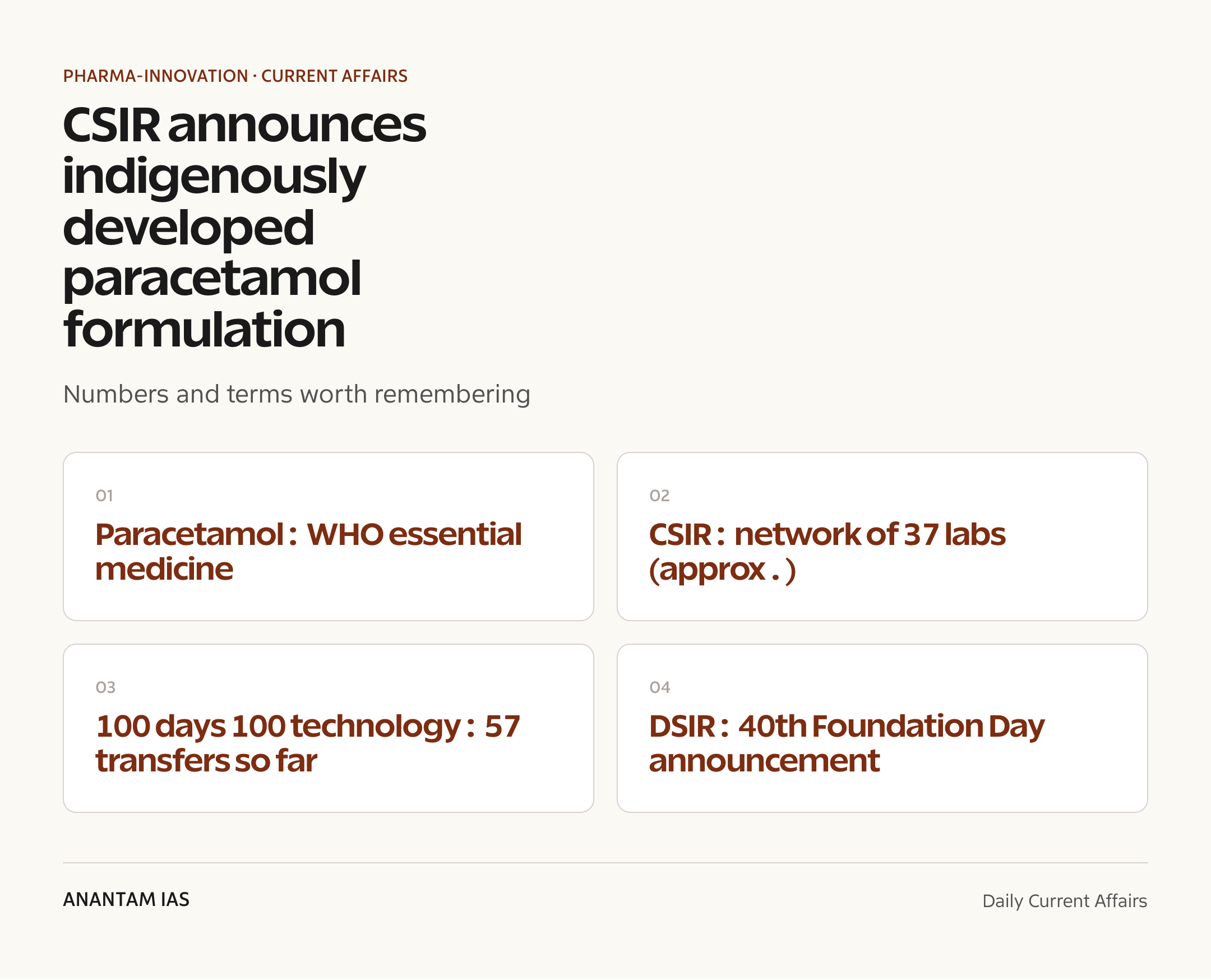
UPSC Relevance
Prelims Relevance
- Questions can test facts about CSIR mandate, DSIR, paracetamol drug class and uses, and recent tech-transfer events; also identify stakeholders like Satya Deeptha Pharmaceuticals and LAGHU UDYOG BHARATI.
Mains Relevance
GS3 Science & Technology
- Material useful for answers on science-policy linkages: translation of public research to industry, pharmaceutical supply chain resilience, Atmanirbhar Bharat in pharma, role of technology transfer for MSME capacity building, and public-health implications of domestic generic production.
Essay
- Supports essay themes on science and technology for nation building, self-reliance, healthcare infrastructure, and role of research institutions in socio-economic development.
Background and Context
Paracetamol: Therapeutic and industrial profile
Paracetamol is a basic analgesic and antipyretic with simple chemistry and large public-health utility.
- Commonly used for pain relief and fever management across age groups; on WHO Essential Medicines List as a core generic.
- Chemically known as acetaminophen or N-acetyl-p-aminophenol; synthesis involves intermediates that may be imported.
- Large volumes are consumed by hospitals, primary-care facilities, and households, making stable supply critical.
- Being an off-patent generic, paracetamol production is a volume business where input-costs determine retail price.
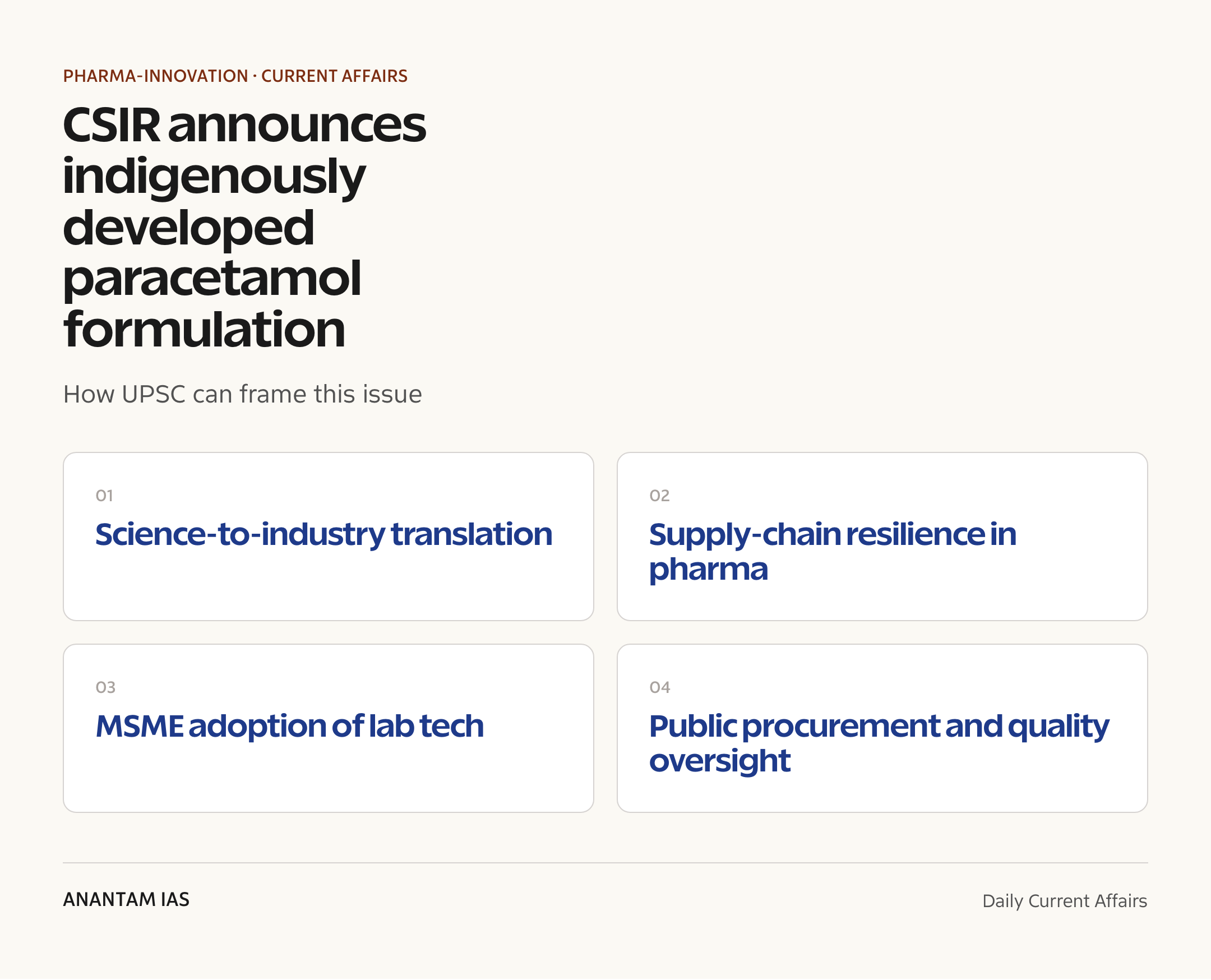
India's pharmaceutical raw-material dependence
India exports finished drugs but imports many active pharmaceutical ingredients or chemical precursors.
- Reliance on global suppliers for bulk chemicals has led to vulnerability during export restrictions or geopolitical shocks.
- Several generic drug supply interruptions worldwide in the last decade stemmed from concentration of precursor production.
- Import dependence can increase costs for manufacturers and create stock-outs for essential medicines.
- Policy focus since 2020 has prioritized resilience in drug supply chains and incentivized domestic API manufacture.
CSIR and DSIR: Institutional role in technology translation
CSIR and DSIR operate laboratories and programs to convert research outputs into deployable technologies.
- CSIR’s mandate covers basic and applied research across chemistry, biology, engineering, and process technologies.
- DSIR acts to facilitate industry linkages and enable technology transfers from public labs to private sector.
- CSIR frequently uses licensing, joint ventures, and transfers to MSMEs to scale innovations.
- The 100 days 100 technology program is an example of rapid technology transfer targeting MSME adoption.
Mechanisms of technology transfer in India
Transfer moves a lab process to industrial scale with adaptation for cost, safety, and regulatory compliance.
- Tech transfer typically includes documentation, scale-up protocols, process validation, and training of plant personnel.
- Regulatory requirements for pharmaceutical production include Good Manufacturing Practices and quality control standards.
- MSMEs may require financial and managerial support to adopt new chemical processes safely and economically.
- Successful transfer reduces time-to-market and helps build manufacturing capacity domestically.
Public health and price stability implications
Domestic production of generics influences availability and affordability in both public and private sectors.
- Localized production can lower logistics costs and reduce exposure to foreign currency fluctuations.
- A resilient supply supports national programs that supply essential medicines in primary health centers.
- Competition among domestic manufacturers tends to exert downward pressure on retail prices.
- Quality assurance must be maintained to avoid substandard or counterfeit product risks.
Industry and MSME engagement context
CSIR’s transfers often target regional MSME clusters to spur local manufacturing and employment.
- Satya Deeptha Pharmaceuticals Ltd was named as an early licensee to adopt the CSIR paracetamol process at scale.
- LAGHU UDYOG BHARATI and similar associations help diffuse technologies among small units across states.
- MSME adoption requires technical hand-holding, access to capital, and integration into supply chains.
- A successful example can catalyze further investment in domestic chemical and pharma infrastructure.
Way Forward
Regulatory approval and quality pathways
- Ensure transferred process meets GMP and national drug regulatory standards before commercial release.
- Institute independent batch testing and stability studies to establish quality equivalence to existing products.
- Facilitate fast-track clearances for technology-adopting units that comply with stringent quality criteria.
- Promote transparent data sharing of validation outcomes to build trust among buyers and health programs.
Scaling and MSME capacity building
- Provide targeted technical training modules for MSME plant staff on process operations and safety.
- Offer concessional capital or credit-linkages to upgrade reactors, effluent control, and quality labs.
- Establish regional incubation hubs where CSIR scientists co-locate temporarily with producers to supervise scale-up.
- Encourage cluster-based production models to achieve economies of scale and pooled testing facilities.
Supply-chain resilience and input substitution
- Map key precursor supply chains and promote domestic manufacture of those intermediates to reduce import risk.
- Support alternate green-chemistry synthesis routes that reduce hazardous reagents and lower costs.
- Build strategic buffer stocks of critical intermediates at national pharma warehouses.
- Foster supplier diversification through incentives for firms producing upstream chemicals.
Public procurement and price monitoring
- Encourage public procurement agencies to source from certified domestic manufacturers to sustain demand.
- Monitor market prices post-adoption to ensure anticipated cost benefits reach consumers and public programs.
- Incorporate domestically produced paracetamol in essential medicines lists and state medical store formularies.
- Use procurement levers to incentivize quality compliance and continuous capacity investments.
Conclusion
CSIR’s announcement of an indigenous paracetamol production technology is a practical example of research translation aimed at strengthening domestic pharmaceutical capacity. For impact it requires rigorous regulatory validation, coordinated scale-up with MSMEs, and supply-chain interventions to ensure quality, affordability, and sustained availability of this essential medicine.
UPSC Practice Questions
Prelims MCQ 1
1. Which organisation announced the development of an indigenously developed paracetamol production technology in January 2025?
(a) A. ICMR (b) B. CSIR (c) C. DBT (d) D. AIIMS
Answer: B
Explanation:
The Council of Scientific and Industrial Research (CSIR) announced the indigenously developed paracetamol production technology at the DSIR 40th Foundation Day.
Prelims MCQ 2
2. In the CSIR paracetamol announcement, which of the following was named as the technology transfer recipient?
(a) A. Serum Institute (b) B. Satya Deeptha Pharmaceuticals Ltd (c) C. Cipla Ltd (d) D. LUPIN Ltd
Answer: B
Explanation:
The press release stated that Satya Deeptha Pharmaceuticals Ltd in Karnataka will use the CSIR-developed paracetamol technology for domestic production.
UPSC Mains Questions
- {‘question’: ‘1. Analyse how public research institutions like CSIR can contribute to pharmaceutical self-reliance. Illustrate your answer with reference to the paracetamol technology transfer.’, ‘model_answer’: ‘Public research institutions translate scientific knowledge into industrially relevant processes that reduce dependence on imports and build domestic supply chains. CSIR, with multidisciplinary labs, develops process technologies and conducts pilot-scale validation that private industry can adopt. The paracetamol case shows key steps: development of an economically viable synthesis route; documentation and scale-up protocols; and transfer to an industry partner, Satya Deeptha Pharmaceuticals. For broader self-reliance, this model requires regulatory validation, MSME capacity building, incentives for domestic manufacture of upstream intermediates, and public procurement linked to quality standards. Combined, these measures lower supply vulnerabilities, support affordable access, and nurture a product-oriented tech economy.’}
- {‘question’: ‘2. Discuss the role of technology transfer to MSMEs in achieving Atmanirbhar Bharat objectives in the pharmaceutical sector.’, ‘model_answer’: ‘Technology transfer equips MSMEs with proven processes and know-how, enabling rapid scaling of domestic production. For Atmanirbhar Bharat, MSME adoption expands manufacturing base, creates local employment, and spreads industrial capabilities beyond large firms. Successful transfers must be accompanied by finance for plant upgrades, training for quality compliance, and access to testing infrastructure. The 100 days 100 technology program and partnership with associations like LAGHU UDYOG BHARATI show pathways to disseminate innovations. Policy support through procurement preferences and incentives for upstream chemical manufacturers will make the MSME-led model resilient and cost-competitive.’}
Source: PIB, Ministry of Science & Technology (CSIR).
Frequently Asked Questions
q
a
q
a
q
a
q
a
q
a
q
a
Source: https://anantamias.com/current-affairs/csir-paracetamol-indigenous-manufacture-2025/
French Carrier Strike Group visits India to strengthen naval ties
Why in News?
High-end naval engagement with France underscores expanding India-France defence cooperation, practical efforts to increase maritime interoperability, and strategic signalling in the Indo-Pacific.
- Visit by the nuclear-led French Carrier Strike Group (including FNS Charles de Gaulle) signals high-level naval cooperation and trust.
- Port calls at Goa and Kochi combined with a sea Passage Exercise (PASSEX) increase operational interoperability between the two navies.
- Subject Matter Expert Exchanges and cross-deck visits expand technical and procedural alignment in areas such as aviation operations, air defence and C2.
- The engagement forms part of a broader India-Europe strategic outreach amid evolving security dynamics in the Indo-Pacific.
- Regular carrier-level interactions raise the policy profile of defence ties beyond equipment contracts toward operational partnership.
The development matters in the context of:
- India-France defence relationship history and recent momentum
- Maritime security environment in the Indo-Pacific and role of carrier groups
- Operational interoperability: PASSEX, cross-deck visits, SMEEs and their practical value
- Implications for regional balance, partnerships and multilateral cooperation
- Linkages with India’s maritime doctrines and naval modernisation
- Legal and logistical issues around foreign carrier visits and nuclear-powered vessels

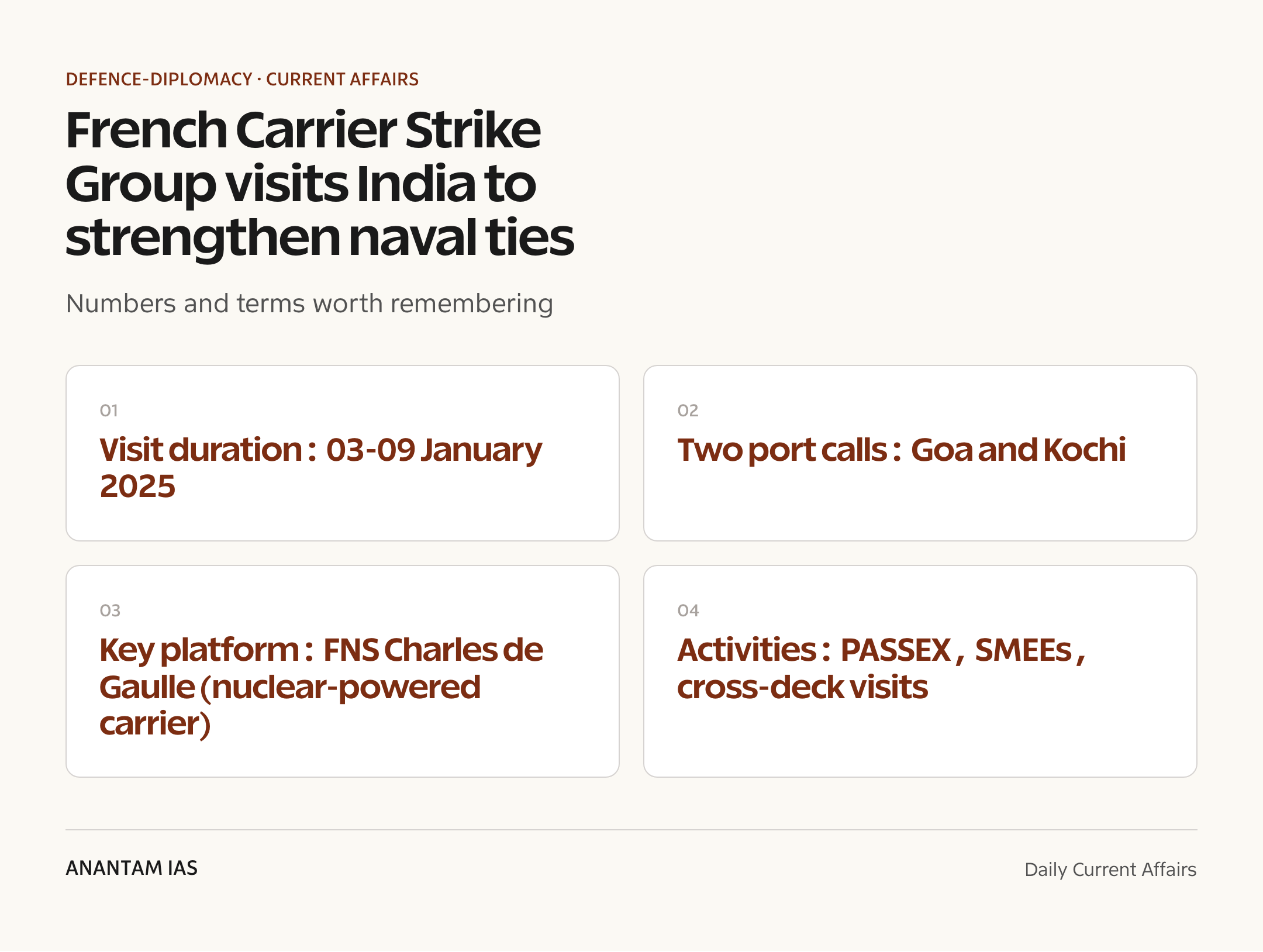
UPSC Relevance
Prelims Relevance
- Identify key naval platforms: Charles de Gaulle as France’s nuclear-powered carrier and its significance.
- Understand port call locations: Goa and Kochi as strategic Indian naval hubs.
- Basic facts on PASSEX, SMEEs and cross-deck visits as standard naval diplomacy tools.
- Know timelines and stakeholders: visit dates 03-09 Jan 2025; Western Fleet and Southern Naval Command involvement.
Mains Relevance
GS2 International Relations
- Assess India’s defence diplomacy strategy and its operationalisation through naval exercises and visits.
- Examine the role of bilateral maritime cooperation in safeguarding India’s maritime interests and contributing to regional security architectures.
- Analyse geopolitical implications of European naval presence in the Indo-Pacific and its effect on strategic partnerships.
- Discuss interoperability challenges between navies and policy measures to institutionalise operational cooperation.
Essay
- Material for essays on India as a net security provider, maritime security and regional order in the Indo-Pacific.
- Examples for essays on India’s strategic partnerships with major powers and the role of defence diplomacy.
- Evidence to support arguments about operationalisation of the SAGAR vision and Act East policy.
Background and Context
India-France defence ties: an overview
Longstanding bilateral cooperation across equipment, training and strategic dialogue.
- India and France have a multi-decade defence relationship including major equipment deals and technology transfers.
- High-level mechanisms include annual strategic dialogue, defence ministers’ meetings and service-level interactions.
- Defence trade has included fighter jets, submarines, naval equipment and joint research initiatives.
- Operational exchanges such as exercises Varuna (naval) and Garuda (air) institutionalise interoperability.
- Shared strategic interests include maritime security, counterterrorism and a stable Indo-Pacific security environment.
Role and capability of a carrier strike group
Carrier strike groups project air, surface and subsurface power across maritime domains.
- A carrier strike group is typically centred on an aircraft carrier plus escort ships including destroyers, frigates and replenishment vessels.
- FNS Charles de Gaulle is France’s flagship with fixed wing carrier aviation capability and nuclear propulsion that provides endurance.
- Carrier groups enable air superiority at sea, power projection ashore and integrated air and missile defence.
- They represent high-end platforms for interoperable operations like carrier aviation deck procedures and C2 linkages.
- Their presence contributes to deterrence, maritime security patrols and humanitarian assistance when needed.
PASSEX, SMEEs and cross-deck visits: what they achieve
Routine naval interactions build shared procedures, trust and tactical coordination.
- PASSEX (Passage Exercise) focuses on combined manoeuvres, communication drills and tactical interoperability at sea.
- Subject Matter Expert Exchanges (SMEEs) enable technical staff to discuss maintenance, aviation ops, damage control and logistics.
- Cross-deck visits let personnel observe each other’s platforms and standard operating procedures in real conditions.
- These activities generate common procedures for replenishment, air operations and maritime domain awareness sharing.
- Outcomes include smoother coordination during combined missions and faster mutual assistance in crises.
India’s maritime doctrine and carrier operations
India is building credible carrier-based capabilities as part of its maritime strategy.
- Indian Navy operates aircraft carriers to secure sea lanes, protect maritime trade and assert presence in the region.
- Carrier operations integrate with surface, sub-surface and naval aviation assets under task force doctrines.
- Interoperability with partner navies multiplies operational reach during multinational operations and contingencies.
- Carrier visits and exercises help the Indian Navy test tactics, train personnel and refine joint procedures.
- India’s carrier strategy aligns with broader goals like SAGAR (Security And Growth for All in the Region).
Strategic context: Indo-Pacific dynamics
The Indo-Pacific sees increased naval activity from regional and extra-regional powers.
- Maritime disputes, competition for sea lines of communication and evolving alliance patterns shape operational deployments.
- European navies, including France, are enhancing presence to support rules-based order and maritime security cooperation.
- India’s partnerships with France, Australia, Japan and the US are part of a layered approach to regional security.
- Carrier-level cooperation signals commitment to joint operations and burden-sharing in maintaining maritime commons.
- Such engagements can be calibrated to avoid escalation while reinforcing deterrence and crisis response capacity.
Legal and practical considerations for foreign carrier visits
Visits by foreign carrier groups involve diplomatic, logistical and regulatory arrangements.
- Nuclear-powered vessels require specific notification, port clearance and safety protocols under national law.
- Logistics include berth allocation, fuel, victualling, maintenance support and crew welfare during harbour phase.
- Information sharing is limited by security considerations even during professional exchanges.
- Visits are coordinated at multiple levels: Ministry of Defence, embassies, naval commands and local authorities.
- Public diplomacy aspects include official receptions, cultural engagements and limited media access.
Way Forward
Institutionalise higher-frequency carrier-level interactions
- Establish a calendar for regular PASSEX and carrier-group exchanges with clear objectives for each visit.
- Create a bilateral carrier operations working group to codify shared procedures and safety protocols.
- Pilot combined carrier strike rehearsals focusing on air-deconfliction and integrated air defence.
- Record lessons learned in a shared database accessible to designated staff from both navies.
Deepen technical and logistics cooperation
- Expand SMEEs to cover repair, aviation maintenance and nuclear-propulsion support contingencies where permissible.
- Set up joint logistics planning cells to streamline replenishment at sea and port servicing for large platforms.
- Explore limited co-development of carrier aviation support infrastructure and simulation-based training.
- Negotiate standing arrangements for port access and expedited clearances for future visits.
Operationalise multilateral maritime cooperation
- Use India-France carrier interactions to build trilateral and quad-like exercises that include regional partners.
- Integrate information sharing protocols for maritime domain awareness during combined patrols and exercises.
- Promote interoperability standards for communication, data links and search-and-rescue coordination.
- Leverage joint humanitarian assistance and disaster relief drills to demonstrate non-combat utility of carriers.
Policy and public diplomacy measures
- Communicate the defensive and cooperative nature of visits to domestic and regional audiences to reduce misperception.
- Include academic and think-tank exchanges to analyse strategic implications and publish joint findings.
- Use port calls for people-to-people outreach such as professional seminars and cultural programmes.
- Ensure transparency on safety protocols and environmental safeguards during visits of large naval platforms.
Conclusion
The French Carrier Strike Group visit advances practical India-France maritime cooperation beyond equipment deals into operational partnership. Regular carrier-level interactions will help the Indian Navy refine procedures, build trust with partners, and contribute to a cooperative maritime order in the Indo-Pacific while managing risks through clear protocols and public diplomacy.
UPSC Practice Questions
Prelims MCQ 1
Which of the following best describes a Passage Exercise (PASSEX) between two navies?
(a) A scheduled port call for diplomatic engagement between ships (b) A short, tactical at-sea exercise to practice coordination, communication and manoeuvres (c) A joint maintenance exercise for repair and logistics in harbour (d) An intelligence-sharing framework signed between navies
Answer: (b) A short, tactical at-sea exercise to practice coordination, communication and manoeuvres
Explanation:
PASSEX is an at-sea activity focused on combined manoeuvres, communications drills and tactical coordination to enhance interoperability between navies.
Prelims MCQ 2
FNS Charles de Gaulle, the flagship of the French Carrier Strike Group, is characterised by which of the following features?
(a) Diesel-electric propulsion and helicopter-only aviation (b) Nuclear propulsion and fixed-wing carrier aviation capability (c) Sail propulsion and unmanned aerial vehicles (d) Hybrid gas-turbine propulsion and no carrier aircraft
Answer: (b) Nuclear propulsion and fixed-wing carrier aviation capability
Explanation:
FNS Charles de Gaulle is a nuclear-powered aircraft carrier that operates fixed-wing carrier aircraft, giving it high endurance and air-power projection capability.
UPSC Mains Questions
- {‘question’: ‘Examine how carrier strike group visits help operationalise India’s maritime diplomacy. Provide examples of tasks such visits help to achieve and the constraints they face.’, ‘model_answer’: ‘Carrier strike group visits operationalise maritime diplomacy by enabling practised interoperability, signalling strategic resolve, and facilitating logistics cooperation. Tasks achieved include PASSEX to harmonise communications and manoeuvres; SMEEs to exchange technical best practices in aviation and damage control; cross-deck visits for procedural familiarisation; and joint planning for humanitarian assistance and disaster relief. Constraints include security sensitivities that limit information sharing, legal issues around nuclear-powered vessels, port logistics and berthing capacity, environmental and safety concerns, and potential strategic signalling that may be perceived as provocative by other regional actors. Effective diplomacy requires careful planning, transparency, and institutional mechanisms to translate episodic visits into sustained capability gains.’}
- {‘question’: ‘Discuss the strategic implications of enhanced India-France naval cooperation for the Indo-Pacific regional order.’, ‘model_answer’: “Enhanced India-France naval cooperation contributes to a rules-based maritime order by increasing combined capacity for patrols, exercises and crisis response. It strengthens India’s partnerships with European powers and diversifies strategic linkages beyond traditional bilateral ties. Cooperative deployments help protect sea lines of communication and deter coercive behaviour. At the same time, increased presence of extra-regional navies requires calibrated messaging to avoid escalation, and must be complemented by regional diplomacy that includes littoral states. Operational interoperability should be matched by legal agreements and logistics arrangements to ensure sustainability and legitimacy of activities in regional waters.”}
Source: PIB, Ministry of Defence.
Frequently Asked Questions
q
a
q
a
q
a
q
a
q
a
q
a
Source: https://anantamias.com/current-affairs/french-carrier-strike-group-visit-india-2025/
India’s metro network crosses 1,000 km milestone
Why in News?
The government announced that India’s operational metro network has surpassed 1,000 km across multiple cities and states. The growth includes new stretches, foundation stones for additional corridors and accelerating adoption of advanced metro technologies.
- Scale milestone: Operational metro length exceeds 1,000 km, across 23 cities and 11 states.
- Daily ridership: Metros now serve about over 1 crore passengers daily, showing mass adoption.
- Recent projects: Inauguration and foundation stones for multiple corridors in Delhi region worth over Rs 12,200 crore were announced on Jan 5, 2025.
- Global ranking: India is the third-largest metro network world-wide by operational length and is on track to rise further.
- Technology and diversity: Adoption of driverless trains, under-river tunnels and water metro systems are expanding the modal mix.
The development matters in the context of:
- Historical trajectory: Metro in India began with Kolkata in 1984. Delhi Metro catalysed rapid expansion after DMRC was set up in 1995 and opened its first corridor in 2002.
- Network spread: From initial single-city systems, metros now operate in 23 cities spanning metros, light metro and water metro models.
- Funding models: Projects use a mix of centre-state grants, loans (multilateral and bilateral), market borrowings and land monetisation through special purpose vehicles.
- Institutional role: DMRC has emerged as a model urban transport agency and exporter of consultancy services to other countries.
- Operational efficiency: Higher average speeds, signalling upgrades and automation have improved
in many systems. - Equity and access: Metros extend benefits unevenly; many tier-II cities still lack adequate mass rapid transit despite urbanisation needs.

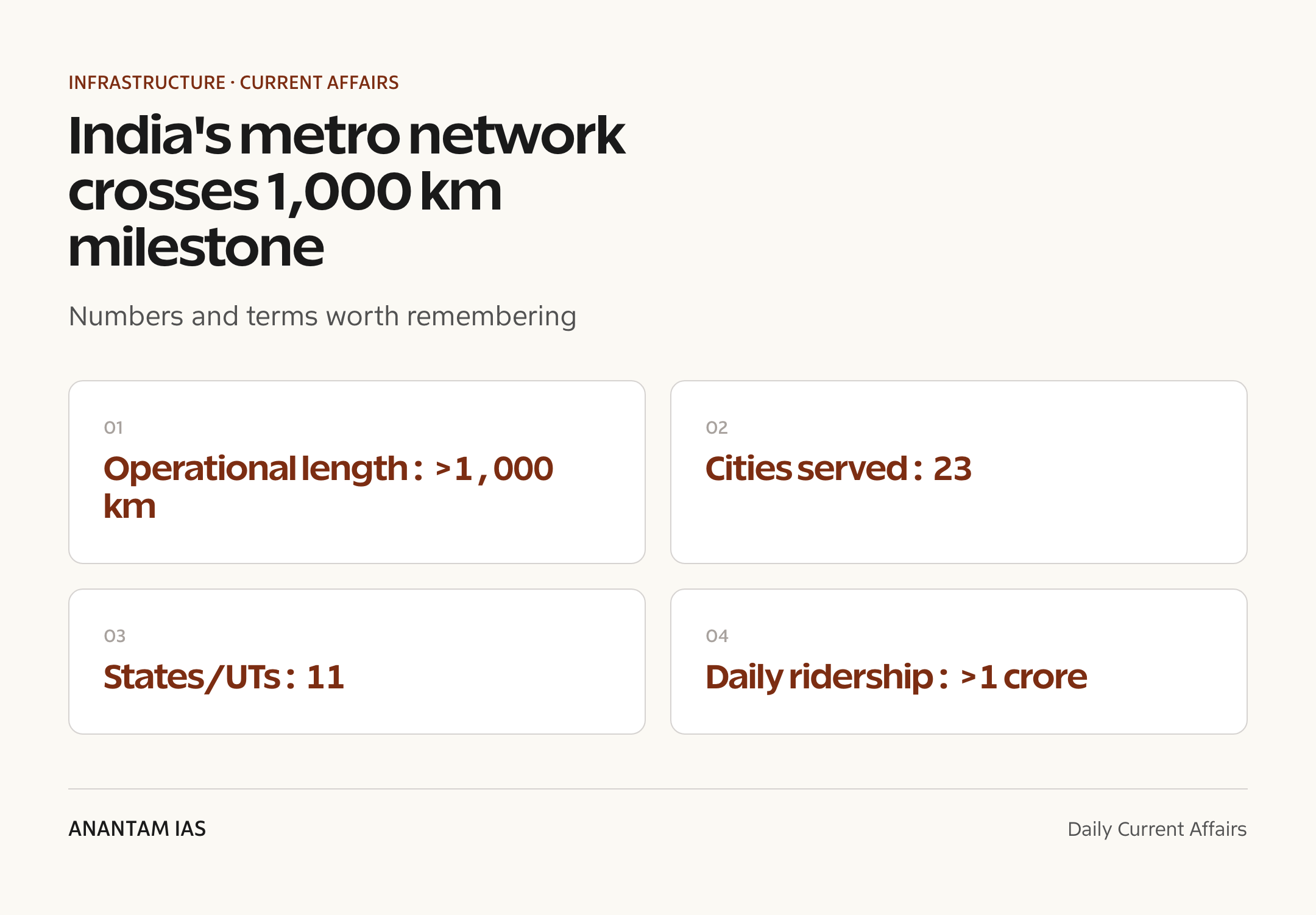
UPSC Relevance
Prelims Relevance
- Direct factual recall: operational network length (>1,000 km), number of cities/states served, recent inaugurations and techno-features like driverless metro and under-river tunnel.
Mains Relevance
GS3 Infrastructure and Urban Transport
- Issues-based answers on urban mobility policy, financing urban infrastructure, sustainable transport planning, intermodal integration, and institutional capacity for large infrastructure projects.
Essay
- Material for essays on ‘Urbanisation and Infrastructure’, ‘Sustainable Cities’, ‘Growth and Development’, and ‘Technology and Public Transport’.
Background and Context
Early history and evolution
How India moved from the first metro in Kolkata to a national metro ecosystem.
- The first metro service in India began in 1984 with Kolkata Metro; initial growth was slow due to funding and institutional constraints.
- Establishment of DMRC in 1995 provided a replicable institutional model combining technical expertise, project management and procurement capability.
- Delhi Metro’s early success after its 2002 opening triggered a wave of metro projects across metros and large cities.
- Phased commissioning and stable management practices enabled metros to evolve from isolated corridors to integrated urban networks.
- Technological evolution included shift from conventional signalling to CBTC and driverless operations in select corridors.
Network growth and geography
Spatial spread of metro infrastructure across Indian cities and states.
- Operational metro length now exceeds 1,000 km, spanning 23 cities in 11 states and union territories.
- Major contributors to cumulative length include Delhi, Kolkata, Bengaluru, Chennai, Mumbai and regional metros like Kochi and Hyderabad.
- Newer forms such as light metro and water metro address city-specific geographic constraints.
- Corridor planning increasingly targets peri-urban linkages to manage urban sprawl and commuter flows.
- Regional cross-border corridors, like Delhi-Ghaziabad-Meerut, illustrate inter-state coordination needs for metro planning.
Finance and procurement
Financing models and cost drivers for metro projects in India.
- Metro projects are capital intensive; costs driven by land acquisition, tunnelling, rolling stock and signalling systems.
- Funding mix commonly includes central and state budgetary support, multilateral loans, commercial borrowings and land monetisation.
- Special purpose vehicles and municipal bonds have been used to raise long-term finance in some cities.
- Public-private partnerships (PPP) have been attempted mainly for non-fare revenue streams like commercial development of stations.
- Standardised procurement and international bidding have reduced construction times and built local contractor capacity.
Technology and operations
Operational technologies that have shaped Indian metro services.
- Adoption of CBTC and automation increased frequency and safety while lowering headways on busy corridors.
- Driverless metro services are operational in selected corridors, improving energy efficiency and labour productivity.
- Under-river tunnelling, exemplified by Kolkata’s Hooghly crossing, shows advanced civil engineering capabilities.
- Integration with digital ticketing, smartcards and app-based services improved last-mile planning and passenger experience.
- Emphasis on energy-efficient rolling stock and regenerative braking contributes to sustainability goals.
Social and environmental impacts
How metro expansion affects urban equity, pollution and land use.
- Metros reduce surface congestion and vehicle emissions per passenger-km, improving urban air quality in corridors with high modal shift.
- Accessibility gains for low-income commuters are uneven when network coverage favours central corridors over peripheries.
- Transit-oriented development around stations increases land values and can spur mixed-use urban regeneration.
- Project construction can have negative impacts such as displacement, requiring robust resettlement and rehabilitation measures.
- Metros contribute to climate mitigation if integrated with non-motorised transport and feeder systems.
Institutional lessons and export potential
DMRC model and India’s role as a provider of metro expertise abroad.
- DMRC’s project management, standardisation and training practices are considered a for other Indian cities and abroad.
- Indian firms and agencies have offered consultancy and implementation services to countries in Asia, Africa and the Middle East.
- Knowledge export includes tunnelling, signalling and operations management rather than just rolling stock supply.
- Successful export engagements raise questions on capacity building for domestic project pipelines and manpower training.
- International collaboration can bring finance and technology but requires governance frameworks to avoid cost overruns.
Way Forward
Expand network with corridor prioritisation
- Use data on ridership, congestion and land-use to prioritise corridors that deliver maximum social benefit.
- Plan peri-urban links to integrate commuters from satellite towns and reduce private vehicle dependence.
- Adopt modular construction and standard design to shorten delivery times and reduce costs.
- Coordinate central and state planning to ensure seamless multi-jurisdictional corridors like Delhi-Meerut.
Strengthen financing and revenue streams
- Expand use of land value capture and transit-oriented development to monetise non-fare revenue.
- Promote long-term instruments such as municipal bonds and infrastructure funds for stable capital flows.
- Design fare policies that balance affordability and financial sustainability with cross-subsidies where needed.
- Leverage multilateral climate finance for energy-efficient rolling stock and regenerative technologies.
Integrate multimodal and last-mile connectivity
- Develop integrated mobility plans linking metros with bus rapid transit, feeder buses and active mobility options.
- Invest in safe station-area design, pedestrian access and bicycle infrastructure to maximise ridership.
- Use unified digital ticketing and mobility-as-a-service platforms to improve convenience and data flows.
- Partner with local bodies to manage curb space and parking to reduce dependence on private cars at stations.
Build capacity and social safeguards
- Strengthen project management units and trained technical staff to deliver complex systems on schedule.
- Institutionalise robust R&R and environmental management procedures to protect vulnerable communities.
- Invest in training for operations staff and skill development for maintenance and signalling technologies.
- Encourage public participation and transparency to improve public trust and project acceptance.
Conclusion
Crossing 1,000 km of operational metro lines is a structural shift in India’s urban transport landscape. The milestone shows capacity to deliver large-scale projects and adopt advanced technologies. Priority now should be on strategic corridor planning, sustainable financing, multimodal integration and social safeguards to ensure metros deliver inclusive, low-carbon urban mobility.
UPSC Practice Questions
Prelims MCQ 1
As of January 2025, India’s operational metro network crossed which milestone?
(a) 500 km (b) 1,000 km (c) 2,000 km (d) 3,000 km
Answer: (b) 1,000 km
Explanation:
Official announcements on Jan 5, 2025, stated that operational metro length in India exceeded 1,000 km, making it the third-largest in the world by length.
Prelims MCQ 2
Which Indian agency, established in 1995, became the model for metro project implementation?
(a) Indian Railways (b) NHAI (c) DMRC (d) MoHUA
Answer: (c) DMRC
Explanation:
The Delhi Metro Rail Corporation (DMRC) was established in 1995 and is credited with a replicable institutional model for metro implementation in India.
UPSC Mains Questions
- {‘question’: ‘Examine the role of metro expansion in achieving sustainable urban mobility in India. What policy measures are necessary to ensure equitable access and environmental benefits?’, ‘answer_outline’: [‘Introduction: Define sustainable urban mobility and place metros within public transport hierarchy.’, ‘Role of metros: High-capacity corridor operations, reduced emissions per passenger-km, catalyst for transit-oriented development and modal shift from private vehicles.’, ‘Challenges: High capital cost, uneven geographic coverage, first-and-last-mile gaps, social displacement during construction and fare affordability.’, ‘Policy measures: Integrated multimodal planning, land value capture, fare subsidy targeting, investments in feeder services, strong R&R frameworks and climate finance integration.’, ‘Conclusion: Metros are necessary but not sufficient; holistic urban transport policy and institutional coordination are essential.’]}
- {‘question’: ‘Analyse the financing challenges of metro projects in India and suggest reforms to improve fiscal sustainability of metro operations.’, ‘answer_outline’: [‘Introduction: Describe capital intensity and long gestation of metro projects.’, ‘Current financing: Central-state grants, multilateral loans, municipal contributions, occasional PPP for non-core elements and land monetisation.’, ‘Challenges: Debt servicing pressures, low non-fare revenue realisation, political pressures on fares and cost overruns.’, ‘Reforms: Broaden land value capture tools, promote municipal bonds and infrastructure funds, professionalise urban transit authorities, ring-fence non-fare revenues, use performance-linked central grants.’, ‘Conclusion: A mix of financial innovation and governance reforms can restore fiscal sustainability while preserving affordability.’]}
Source: PIB, Ministry of Housing & Urban Affairs.
Frequently Asked Questions
q
a
q
a
q
a
q
a
q
a
q
a
Source: https://anantamias.com/current-affairs/india-1000-km-metro-network-2025/
Vice‑President highlights PanchPran as foundation for national transformation
Why in News?
The Vice-President publicly presented a values-based governance narrative — PanchPran — that could shape policy discourse, civic education priorities and centre-state messaging ahead of major national milestones.
- Values articulation: PanchPran frames a compact set of five value pillars that can be integrated into public communication, curricula and civic campaigns.
- Influence on youth: Announced at the NCC Republic Day Camp, the message targets cadets and youth who are key agents for diffusion of civic norms.
- Policy signalling: Emphasis on Swadeshi and self-reliance signals continued prioritisation of domestic capacity building in governance narratives.
- Electoral and federal optics: A high-profile moral framework from the Vice-President can shape public debate and become a reference for state governments and departments.
- National security dimension: Linking vigilance against anti-national forces to civic duties embeds a security subtext in everyday citizenship discourse.
The development matters in the context of:
- Occasion: Speech delivered at the inauguration of the NCC Republic Day Camp 2025 at Cariappa Parade Ground, Delhi Cantt — a setting with disciplined youth who are potential civic leaders.
- Leadership role: The Vice-President, as the second-highest constitutional office, acts as a moral and institutional voice; such addresses have soft influence on public policy framing.
- National milestones: India is approaching important mid-century goals (for example, 2047 vision); value narratives often precede policy initiatives tied to such timelines.
- Existing programmes: The PanchPran elements overlap with current schemes: social harmony with social justice initiatives, family enlightenment with family and education programmes, environmental consciousness with climate and conservation missions, Swadeshi with Atmanirbhar Bharat, civic duties with voter and civic education.
- Historical precedents: Value-anchored frameworks by national leaders have previously been used to guide civil society campaigns, school curricula and institutional charters.
- Communication channels: The message was amplified via official PIB release and social media; targeting NCC increases propagation through institutional training and events.

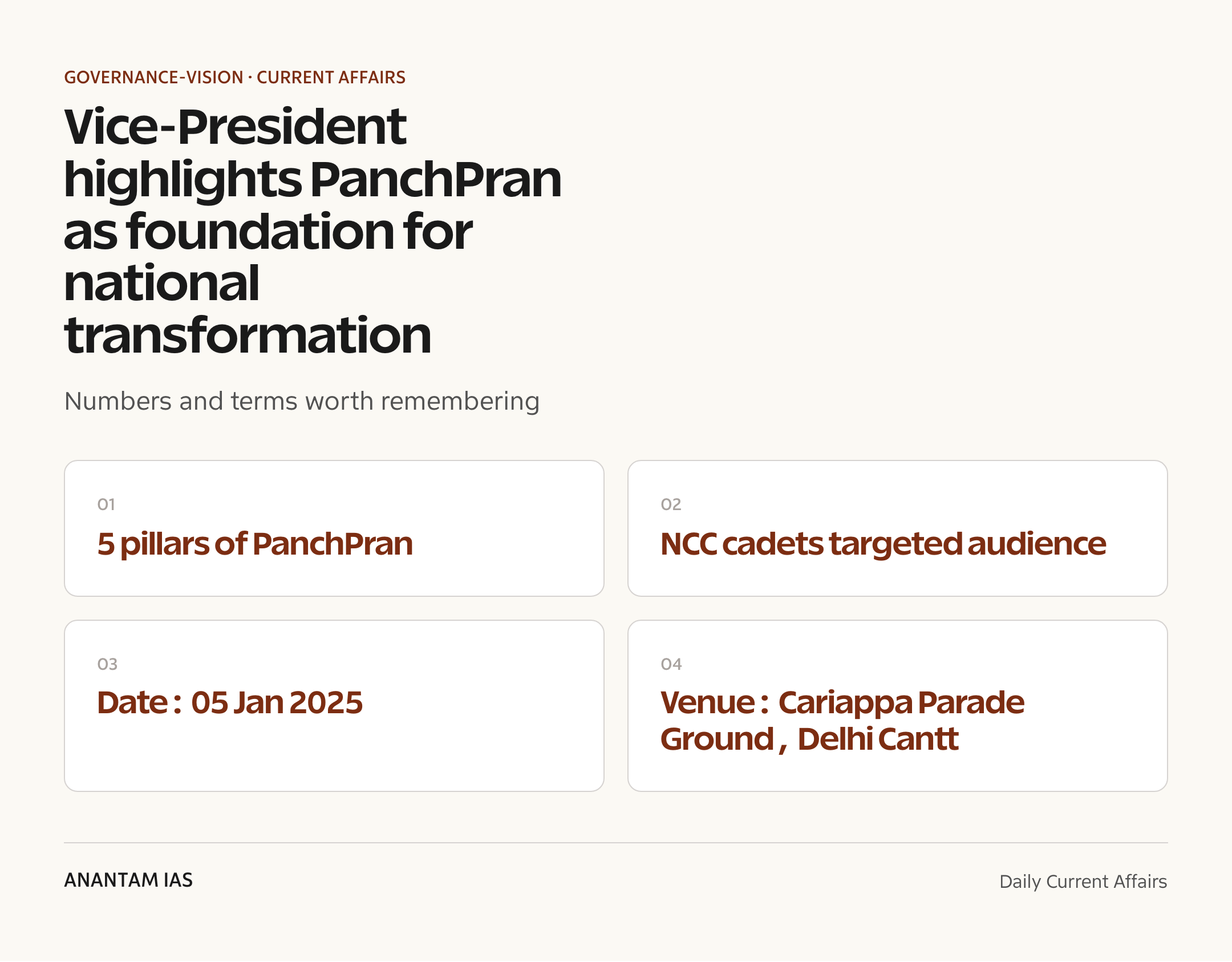
UPSC Relevance
Prelims Relevance
- Recognise PanchPran’s five pillars and their definitions for objective-type questions.
- Connect institutional contexts such as NCC and Republic Day Camp when asked about civic education platforms.
- Distinguish between constitutional roles and ceremonial or moral leadership functions of the Vice-President.
Mains Relevance
GS2 Polity & Governance
- Discuss the role of value-based narratives in public policy and governance.
- Analyse how state and central institutions can incorporate civic duties and nationalism without compromising constitutional liberties.
- Evaluate the balance between cultural identity, Swadeshi policy and economic openness in India’s development strategy.
Essay
- Use PanchPran as a case study in essays on ‘Ethics, Integrity and Aptitude in Public Life’ or on ‘India’s vision for 21st century development’.
- Cite the theme when discussing ‘Role of youth in nation-building’ or ‘India’s soft power and national identity’.
Background and Context
What is PanchPran
A compact five-point value framework articulated by the Vice-President as foundational to national transformation.
- Definition: PanchPran comprises Social Harmony, Family Enlightenment, Environmental Consciousness, Swadeshi (self-reliance) and Civic Duties.
- Source: Announced during the NCC Republic Day Camp 2025 inauguration speech by the Vice-President.
- Audience focus: Targeted at youth cadets and wider citizenry to instil a nation-first perspective.
- Practical intent: Designed to link personal conduct, family education and public responsibility with national progress.
- Format: Value-based slogan-like construct suitable for awareness drives and educational modules.
Why this matters politically
Value narratives can shape debate, set agendas and guide administrative priorities across levels of government.
- Agenda setting: High-profile moral themes often precede policy emphasis in related domains, for example, Swadeshi and industrial policy.
- Federal diffusion: States may adopt similar language in local programmes, amplifying the message through governance actions.
- Election-era utility: Value frameworks can be adopted by political actors to resonate with voters on identity and civic duty.
- Administrative uptake: Ministries of education, environment and social justice can translate pillars into operational indicators.
Connections to existing programmes
Each PanchPran element overlaps with ongoing central and state initiatives, enabling faster operationalisation.
- Social Harmony: Linked to programmes on social justice, communal harmony cells and national integration efforts.
- Family Enlightenment: Aligns with health, nutrition and education schemes that promote family-level human capital.
- Environmental Consciousness: Resonates with National Action Plan on Climate Change, AMRUT, tree plantation and conservation drives.
- Swadeshi: Echoes Atmanirbhar Bharat policies, Make in India incentives and local procurement preferences.
- Civic Duties: Parallels voter awareness, civic education in schools and citizen charter initiatives.
Role of the Vice-President in public discourse
The constitutional office combines institutional gravitas with a platform for moral and civic messaging.
- Constitutional position: Vice-President is ex officio Chairperson of the Rajya Sabha and the second-highest constitutional authority.
- Soft power: Speeches can provide normative guidance without carrying direct executive power.
- Non-partisan voice: Traditionally expected to speak above daily politics, giving broader acceptability to value frameworks.
- Institutional reach: Addressing institutions like NCC extends influence into disciplined youth training systems.
NCC as a vehicle for civic values
The National Cadet Corps is an established platform to cultivate discipline, leadership and national outlook among youth.
- Mandate: NCC imparts military training, leadership and civic sense to enrolled cadets across schools and colleges.
- Scale: Thousands of cadets participate in regular camps, parades and community service activities.
- Multiplier effect: Cadets often act as local role models, spreading values to peers and communities.
- Institutional synergy: Messaging at NCC events can be institutionalised into training modules and badges.
Contestation risks and safeguards
Value-based frameworks can become contested if perceived to restrict pluralism or civic freedoms.
- Overreach risk: Nationalism messaging may be construed as stifling dissent unless coupled with constitutional guarantees.
- Implementation clarity: Operational guidelines are needed to prevent ambiguous enforcement of ‘civic duties’.
- Inclusivity test: Social Harmony must be translated into measurable protections for minorities and vulnerable groups.
- Legal bounds: Any civic campaigns must respect fundamental rights and not encourage punitive citizen action.
Way Forward
Policy translation and programme design
- Action plans: Ministries should prepare short-term roadmaps to translate each PanchPran pillar into measurable programmes.
- Cross-Ministry task force: Establish a nodal team with education, environment, social justice and youth affairs ministries to coordinate actions.
- Pilot schemes: Run pilot projects in diverse states to test messaging and delivery modes before national rollout.
- Monitoring metrics: Develop simple indicators for impact assessment, such as civic literacy scores or community-level harmony indices.
Integrating into education and training
- Curriculum modules: Introduce age-appropriate PanchPran content in school and NCC training materials with emphasis on critical thinking.
- Teacher training: Provide capacity building for teachers and NCC officers to deliver values education without bias.
- Experiential learning: Use community projects, environmental drives and local crafts to make Swadeshi and civic duties tangible.
- Assessment: Include project-based evaluation rather than rote tests for values education.
Community engagement and partnerships
- Local committees: Form community PanchPran committees with civil society, panchayats and youth clubs to localise initiatives.
- Public-private collaboration: Engage industry for Swadeshi promotion through procurement preferences and MSME linkages.
- Media campaigns: Run balanced national campaigns that explain pillars and provide examples of positive citizen action.
- Incentivise participation: Offer recognition and small grants for grassroots projects that promote PanchPran goals.
Safeguards and legal clarity
- Rights-respecting messaging: Frame civic duties in light of fundamental rights and constitutional values to avoid misuse.
- Grievance redress: Set up transparent mechanisms to report misuse of PanchPran rhetoric for coercion or discrimination.
- Independent review: Commission periodic independent evaluations to assess social impact and rights implications.
- Training on ethics: Include ethical guidelines for officials and volunteers implementing PanchPran-related programmes.
Conclusion
PanchPran is a concise, values-based framework that links personal conduct, family formation, environmental stewardship, self-reliance and civic duties under a nation-first narrative. Operationalising it requires careful policy design, inclusive communication, safeguards for rights and measurable indicators so that the aspirational language translates into constructive public action.
UPSC Practice Questions
Prelims MCQ 1
Which of the following are part of the PanchPran as outlined by the Vice-President in January 2025? 1. Social Harmony 2. Family Enlightenment 3. Digital Sovereignty 4. Civic Duties
(a) A. 1 and 2 only (b) B. 1, 2 and 4 only (c) C. 2, 3 and 4 only (d) D. All four
Answer: B
Explanation:
PanchPran consists of Social Harmony, Family Enlightenment, Environmental Consciousness, Swadeshi (self-reliance) and Civic Duties. Digital Sovereignty is not listed.
Prelims MCQ 2
The Vice-President delivered the PanchPran remarks while addressing which of the following institutions? 1. National Cadet Corps Republic Day Camp 2025 2. National Service Scheme Annual Meet
(a) A. 1 only (b) B. 2 only (c) C. Both 1 and 2 (d) D. Neither
Answer: A
Explanation:
The speech was given at the inauguration of the NCC Republic Day Camp 2025 at HQ DG NCC Camp, Cariappa Parade Ground, Delhi Cantt.
UPSC Mains Questions
- {‘question’: ‘Examine the role of value-based national narratives, like PanchPran, in strengthening civic culture in India. Discuss operational challenges in implementing such narratives across diverse states.’, ‘model_answer’: ‘Value-based narratives can provide a shared moral vocabulary, motivate civic participation and guide policy priorities. PanchPran emphasises Social Harmony, Family Enlightenment, Environmental Consciousness, Swadeshi and Civic Duties, which can be integrated into education, youth training and community programmes. Operational challenges include ensuring non-partisan delivery, avoiding coercive enforcement, tailoring messages to regional socio-cultural contexts, aligning with rights protections, and establishing measurable outcomes. Solutions include pilot projects, cross-ministry coordination, teacher and trainer capacity building, independent impact evaluation and transparent grievance mechanisms. Careful communication that respects pluralism and constitutional safeguards is essential to prevent alienation of minorities or curtailment of dissent.’}
- {‘question’: “Analyse how emphasis on ‘Swadeshi and self-reliance’ within a values framework interacts with India’s economic openness, foreign investment goals and Make in India objectives.”, ‘model_answer’: ‘Swadeshi framed as self-reliance can complement Make in India when it targets domestic manufacturing capacity and integration into global value chains. Policy must avoid protectionist instincts that deter foreign investment. A balanced approach includes targeted support to MSMEs, improved ease of doing business, technology transfer through FDI, procurement preferences that comply with WTO and domestic law, and skill development to absorb productive capacity. Communication should clarify that Swadeshi means strategic autonomy and local value addition, not blanket isolation. Metrics should track domestic value added in output and employment, while preserving investor confidence through predictable rules and liberalised sectors.’}
Source: PIB, Vice President's Secretariat.
Frequently Asked Questions
q
a
q
a
q
a
q
a
q
a
q
a
Source: https://anantamias.com/current-affairs/panchpran-national-transformation-vice-president-2025/
BHARATPOL portal: CBI launches national INTERPOL-interface for real-time cooperation
Why in News?
Union Home Minister to launch BHARATPOL portal developed by CBI on 07 January 2025 in New Delhi; portal aims to speed up international cooperation through INTERPOL and improve field-level police access to cross-border assistance.
- Launch event scheduled for 07 January 2025 at Bharat Mandapam, New Delhi by Union Home Minister; the portal is developed by CBI in its role as National Central Bureau (NCB-New Delhi) for INTERPOL.
- Portal will replace slow, fragmented channels (letters, emails, faxes) with a single platform to process requests such as Red Notices and other colour-coded INTERPOL notices.
- Designed to support frontline officers through links between INTERPOL Liaison Officers (ILOs) and Unit Officers (UOs) at district and city levels, improving operational response to transnational crimes
- Affects investigative timelines, mutual legal assistance workflows, cyber-forensics cooperation and multi-agency coordination across Central, State and Union Territory police forces.
The development matters in the context of:
- CBI as INTERPOL NCB: CBI is designated as the National Central Bureau for INTERPOL in India and acts as the nodal point for international criminal cooperation.
- Transnational crime trends: Rising incidents of cybercrime, financial crime, drug trafficking, human trafficking and online radicalization require faster cross-border coordination and intelligence exchange.
- Current communications: Field-to-central communications for INTERPOL assistance presently rely on asynchronous methods such as letters, emails and faxes, causing delays in urgent cases.
- INTERPOL mechanisms: INTERPOL issues colour-coded notices (including Red Notices) and offers databases and secure communication channels for criminal data and alerts.
- Inter-agency footprint: Effective international cooperation requires alignment across CBI, State Police, Central Police Organisations, Ministry of External Affairs and judicial processes.
- Digital governance push: The central government is promoting digital platforms to increase speed, accountability and traceability in administrative and operational workflows.

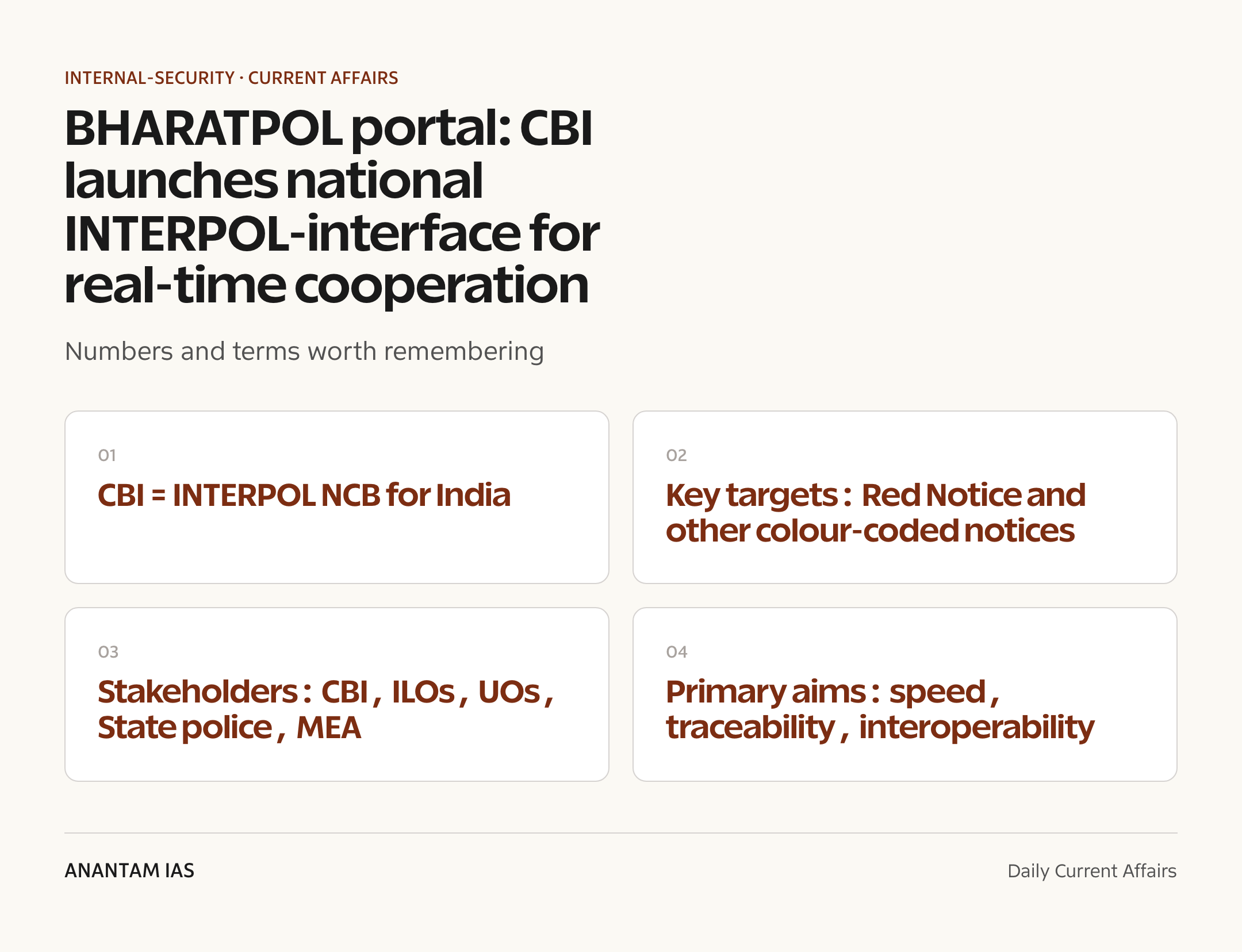
UPSC Relevance
Prelims Relevance
- Role of CBI as National Central Bureau for INTERPOL in India.
- Types of INTERPOL notices, especially Red Notice and their purpose.
- Basic understanding of transnational crimes that necessitate international police cooperation.
- Difference between national police channels and international liaison mechanisms (ILOs and UOs).
Mains Relevance
GS2 Polity & Governance
- Discuss the impact of integrated digital platforms on inter-agency coordination and rule of law.
- Analyse challenges and safeguards required when operational policing systems handle international assistance requests.
- Assess the balance between operational efficiency and procedural safeguards in cross-border criminal investigations.
- Examine implications for federal-state relations when a centralised portal links State police to international mechanisms.
Essay
- Technology and governance: Role of digital platforms in strengthening public institutions.
- Law, justice and security: Demands of the 21st century on investigative agencies and transnational cooperation.
- Centre-state relations: Central initiatives that affect state policing and federal policing structures.
Background and Context
CBI and INTERPOL: institutional role
CBI serves as India’s interface with INTERPOL and coordinates international criminal assistance.
- Designated National Central Bureau (NCB-New Delhi) for INTERPOL; acts as the nodal agency for issuance and execution of INTERPOL notices for India.
- Maintains linkages with INTERPOL’s secure global policing communications networks and databases, including criminal records, stolen property and fugitives.
- Coordinates with the Ministry of External Affairs, State police and central investigative agencies for cross-border investigations.
- Houses INTERPOL Liaison Officers (ILOs) who are connected to Unit Officers (UOs) in state police organisations for operational work.
INTERPOL notices and international assistance
INTERPOL provides standardized mechanisms for cross-border alerts and cooperation.
- Colour-coded notices: Red Notices for wanted persons, Blue for identity, Green for warnings, and others for specific needs.
- Notices are requests for cooperation and do not replace extradition or legal processes under national law.
- INTERPOL also provides databases for fingerprints, stolen travel documents, and other forensic resources to member countries.
- Operational use requires correct legal grounds and coordination with national agencies to convert notices into apprehension or evidence sharing.
Operational gaps in existing practice
Current channels for international assistance are slow and fragmented at field level.
- Field officers often rely on local supervisors to escalate requests through letters, emails or faxes to ILOs or CBI units.
- Time-sensitive cases like cyber intrusions or terror financing suffer from delays in securing international data or action.
- Lack of a standardised digital trail reduces transparency on the status of requests and accountability for timelines.
- Variations in state-level procedures and capacity create uneven access to international mechanisms across India.
Why a national portal is needed
A unified digital gateway can reduce delays and increase operational reach of Indian policing.
- Real-time submission and tracking of international assistance requests will shorten investigative timelines.
- Standard templates and workflow controls can ensure completeness of requests, reducing rework and back-and-forth.
- Improves auditability: digital records provide timestamps, status updates and accountability across agencies.
- Field-level access empowers Unit Officers to initiate requests with pre-vetted formats while keeping ILOs and CBI in loop.
Data, security and legal concerns
Digital exchange of sensitive law-enforcement data raises risks that must be addressed.
- Sensitive personal data and investigative material will flow through the portal requiring strong encryption and access controls.
- Legal safeguards needed for cross-border data transfer, retention periods and admissibility of digital evidence in courts.
- Potential for misuse or scope creep if access controls and audit logs are weak or undefined.
- Need for interoperability standards with INTERPOL systems and state police IT stacks while protecting sovereign data rights.
Governance and multi-agency coordination
Effective operation depends on defined roles and collaborative governance across stakeholders.
- Ministry of Home Affairs, CBI, Ministry of External Affairs and state police heads must agree on SOPs for portal usage.
- Training for frontline officers, ILOs and UOs is essential for correct classification of matters and efficient use.
- Performance metrics and service-level expectations (turnaround times for different notice types) should be set.
- Mechanisms for dispute resolution and escalation must be in place where states and central agencies differ.
Way Forward
Technical safeguards and standards
Secure, auditable and interoperable technical design to protect sensitive data.
- Implement end-to-end encryption, multi-factor authentication and role-based access controls for all users.
- Adopt logging, tamper-evident audit trails and regular penetration testing to detect and deter breaches.
- Use standardised APIs and data formats to enable interoperability with INTERPOL databases and state police systems.
- Define data retention and deletion policies aligned with legal requirements and human rights norms.
Legal and procedural framework
Clear rules to govern usage, admissibility and cross-border data sharing.
- Draft SOPs clarifying jurisdictional roles, thresholds for international requests and escalation mechanisms.
- Ensure compliance with domestic laws on interception, privacy and evidence, and international conventions where relevant.
- Provide guidelines on when digital records from the portal qualify as admissible evidence in courts.
- Include clauses to prevent mission creep and restrict use of portal data for unrelated administrative or intelligence purposes.
Capacity building and training
Operational effectiveness will depend on user competence across ranks and agencies.
- Conduct tiered training programs for Unit Officers, ILOs, CBI case handlers and state nodal officers.
- Develop quick-reference templates, checklists and simulated exercises for common transnational crime scenarios.
- Set up a central helpdesk and regional support cells to assist with technical or procedural queries.
- Incorporate performance-linked incentives for timely and accurate submission of requests.
Governance, oversight and performance measurement
Institutional arrangements to manage, monitor and review portal operations.
- Create a multi-stakeholder steering committee including MHA, CBI, MEA and state police representatives for policy-level oversight.
- Define KPIs such as turnaround times for Red Notice requests, percentage of digitally-complete submissions and incident response times.
- Publish periodic anonymised dashboards to foster transparency while protecting operational secrecy.
- Schedule independent third-party audits and privacy impact assessments at regular intervals.
Conclusion
BHARATPOL can materially improve India’s ability to secure timely international assistance and to prosecute transnational crimes if technical security, legal safeguards and multi-level governance are built into its rollout. Success will depend on training, interoperable standards and accountable oversight to prevent misuse while delivering operational gains for frontline policing.
UPSC Practice Questions
Prelims MCQ 1
Which agency in India functions as the National Central Bureau (NCB) for INTERPOL?
(a) National Investigation Agency (NIA) (b) Central Bureau of Investigation (CBI) (c) Ministry of Home Affairs (MHA) (d) Research and Analysis Wing (RAW)
Answer: (b) Central Bureau of Investigation (CBI)
Explanation:
CBI is designated as the National Central Bureau (NCB-New Delhi) for INTERPOL in India and serves as the nodal point for international police cooperation.
Prelims MCQ 2
A RED NOTICE issued by INTERPOL is primarily used to:
(a) Request the provisional arrest of a person pending extradition (b) Request location-based intelligence on cyber incidents (c) Serve as a binding international arrest warrant (d) Share ballistic fingerprints across member countries
Answer: (a) Request the provisional arrest of a person pending extradition
Explanation:
A Red Notice is an international alert to seek the location and provisional arrest of a person wanted for prosecution or to serve a sentence, but it is not a binding international arrest warrant; national laws determine action.
UPSC Mains Questions
- {‘question’: ‘Examine how a centralised digital portal for international police cooperation can affect federal relations between the Centre and states in India. Discuss measures to ensure balanced operational control and accountability.’, ‘model_answer_points’: [‘Centralised portal increases direct access of state police to international mechanisms, which can strengthen investigations but may raise concerns about central oversight and data control.’, ‘Potential tensions: states may fear loss of autonomy or unequal control over case-sensitive information if central agencies retain final authority over notices.’, ‘Measures: institutionalise joint governance structures with state representation, define SOPs that respect state policing jurisdiction, and allow state-level access controls and audit logs.’, ‘Legal clarity: specify thresholds for escalation to INTERPOL, preserve state consent for extradition-related actions and provide dispute resolution mechanisms.’, ‘Operational safeguards: capacity building in states, decentralised helpdesks, and transparent KPIs to build trust while maintaining national security needs.’]}
- {‘question’: ‘Assess the privacy and legal challenges posed by digital platforms that share sensitive law enforcement data internationally. Suggest a framework that balances operational necessity with rights protection.’, ‘model_answer_points’: [‘Privacy risks include unauthorized disclosure, mission creep and disproportionate retention of personal data which can harm individuals and investigations.’, ‘Legal issues: cross-border data transfer laws, admissibility of digital evidence, and compliance with domestic safeguards on surveillance and data protection.’, ‘Framework: enact clear data-sharing agreements that specify purpose limitation, retention periods, access rules and accountability mechanisms.’, ‘Technical controls: strong encryption, role-based access, and tamper-evident logs; periodic privacy impact assessments and independent audits.’, ‘Remedies: grievance redress mechanisms, judicial oversight for intrusive requests, and transparency reports that anonymise operational data.’]}
Source: PIB, Ministry of Home Affairs.
Frequently Asked Questions
q
a
q
a
q
a
q
a
q
a
q
a
Source: https://anantamias.com/current-affairs/bharatpol-cbi-portal-launch-2025/
Centre urges states to boost efforts under National Mission on Edible Oils – Oil Palm
Why in News?
Union Minister of Agriculture asked states to intensify efforts under NMEO-OP as progress and fund utilisation lag behind the mission targets aimed at edible oil self-sufficiency.
- Target shortfall: NMEO-OP aims to bring 6.5 lakh hectares under oil palm by 2025-26 but many states are behind schedule.
- Underutilised funds: Significant budget allocations remain unspent, limiting infrastructure, inputs and farmer incentives.
- Digital push: Centre promotes geo-mapping and drone surveillance to improve monitoring and transparency.
- Market protection: Introduction of a Viability Price (VP) mechanism to shield farmers from price volatility, pending state MoUs.
- Regional focus: Emphasis on leveraging the agro-climatic potential of the Northeast and other oil-palm suitable states.
The development matters in the context of:
- Strategic objective: NMEO-OP is a central element of India’s edible oil strategy to reduce import dependence and support farmer incomes.
- Import dependence: India is one of the largest edible oil importers; expanding domestic oil palm is seen as a way to cut the import bill.
- Mission components: Includes planting material, subsidies, research, development of crop management practices and post-harvest infrastructure.
- State role: Implementation relies on state governments for on-ground mobilisation, land allocation, beneficiary selection and MoU signings for VP.
- Farmer risks: Oil palm is a long-gestation perennial; returns start after several years and require assured procurement or price support.
- Environmental concerns: Expansion needs to balance land-use, biodiversity and water considerations, especially in ecologically sensitive zones.

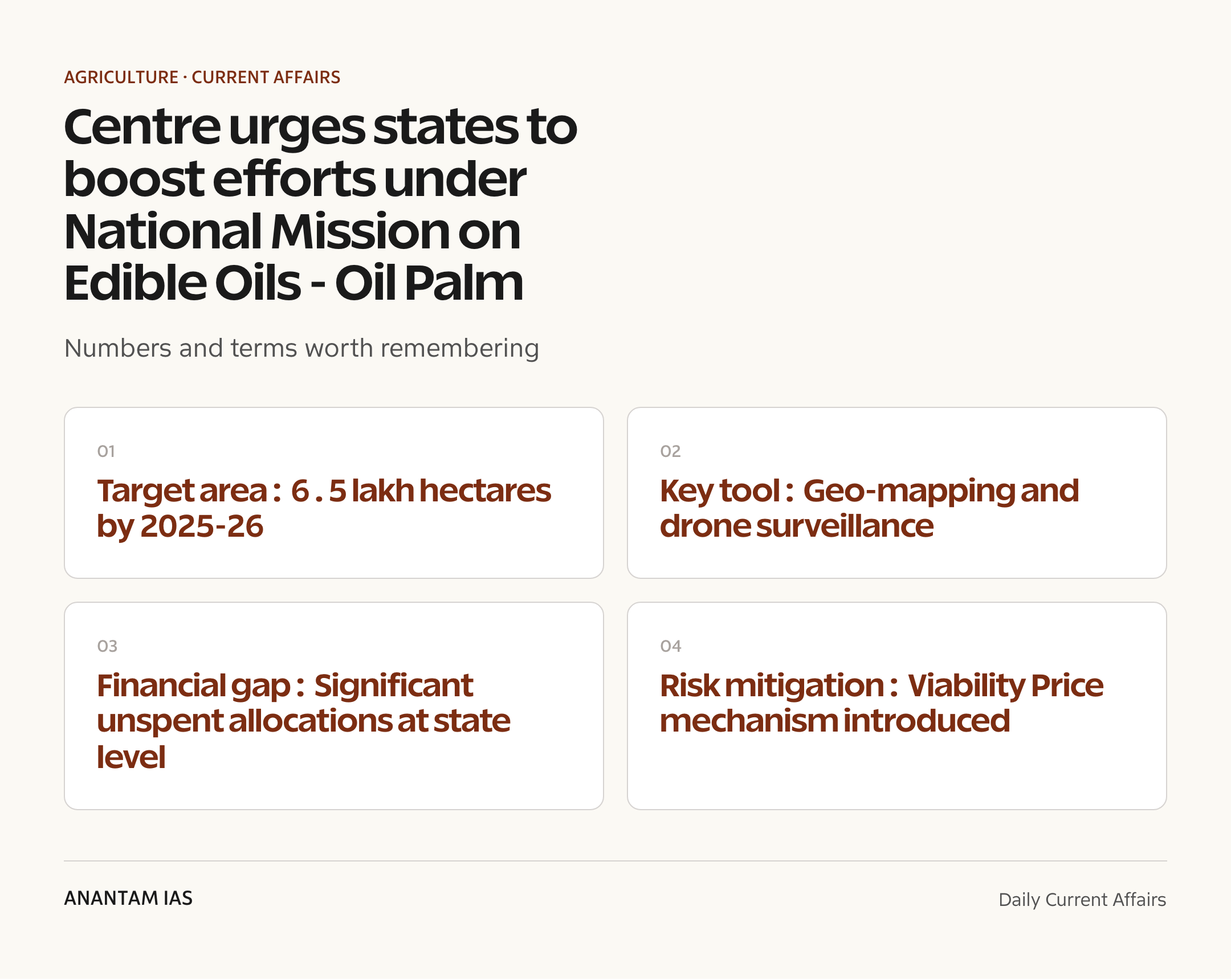
UPSC Relevance
Prelims Relevance
- Mission target: 6.5 lakh hectares by 2025-26 is a direct factual detail for prelims.
- Key instruments: Be aware of the Viability Price mechanism and digital monitoring tools like geo-mapping for scheme identification.
- Implementing agency: The mission is centrally sponsored; states are implementing partners—useful for scheme-characteristics questions.
Mains Relevance
GS3 Economy
- Policy analysis: Evaluate NMEO-OP’s role in reducing import dependence and improving farmer incomes under agricultural policy questions.
- Challenges and trade-offs: Discuss land-use, ecological impacts and long-gestation crop risks in questions on sustainable agriculture.
- Centre-state dynamics: Use NMEO-OP to illustrate cooperative federalism, fund utilisation and implementation bottlenecks.
Essay
- Food security and self-reliance: NMEO-OP links to themes of Atmanirbharta in agriculture for essays on national development.
- Rural livelihoods: The mission is relevant to essays on agrarian distress, diversification and income security for farmers.
- Sustainable development: Use oil palm expansion as a case to discuss balancing growth, environment and equity.
Background and Context
Genesis and objectives of NMEO-OP
Why the mission was launched and what it seeks to achieve.
- Launched as part of the National Mission on Edible Oils with a focus on oil palm to reduce high import dependence.
- Key objective: bring 6.5 lakh hectares under oil palm by 2025-26 across suitable agro-climatic zones.
- Targets include boosting production, productivity and developing a value chain from planting material to processing.
- Mission aims to increase farmer incomes through long-term perennial crop income streams and improved market support.
Scale of India's edible oil imports
The macroeconomic backdrop that motivates domestic edible oil expansion.
- India imports a large share of its edible oil requirement, creating a substantial import bill affecting trade balance.
- Palm oil, soybean oil and sunflower oil account for most imports; palm oil is dominant due to high yield per hectare.
- Domestic expansion is seen as a way to reduce import exposure and improve price stability for consumers and farmers.
- Import dependence exposes India to global price shocks and supply chain disruptions.
Design features and support mechanisms
Core components that define how NMEO-OP operates on the ground.
- Financial incentives for planting material, inputs, maintenance and small processing units are part of the mission package.
- Digital monitoring with geo-mapping and drone surveillance has been introduced to improve transparency.
- A Viability Price (VP) is designed to guarantee a minimum return to farmers in case of market downturns.
- States must sign MoUs to operationalise VP and access central support; implementation is a shared responsibility.
Implementation challenges observed
Operational bottlenecks that have slowed progress and reduced fund utilisation.
- Delayed plantation timelines due to the long gestation period of oil palm and initial farmer reluctance.
- Misinformation and lack of sustained farmer outreach have limited uptake in some regions.
- Administrative delays and weak capacity in certain states have led to unspent allocations and missed targets.
- Inadequate post-harvest infrastructure and uncertain procurement arrangements increase risk for farmers.
Regional focus and potential
Where expansion is viable and where the government is pushing efforts.
- The Northeast, Andaman and Nicobar Islands and parts of southern India are identified as suitable zones.
- Northeast offers expansion potential due to climatic fit and scope for livelihood diversification, if ecological safeguards are followed.
- State-specific strategies are needed: some states need land aggregation models, others need nursery and extension support.
- Coordination with state agriculture departments, research institutes and private sector is critical to scale up successfully.
Environmental and social considerations
Risks and safeguards linked to scaling up oil palm cultivation.
- Unplanned expansion can cause land-use change, biodiversity loss and pressure on water resources in sensitive areas.
- Promoting oil palm on degraded or fallow land is a mitigation option but requires careful site selection and monitoring.
- Social impact: long-gestation crops demand adequate compensation or transitional income support for farmers.
- Adopting sustainable practices and compliance with environmental clearances will be essential for credibility.
Way Forward
Improve fund utilisation and project execution
- States must carry out budget revalidation and fast-track utilisation plans for pending funds.
- Set clear timelines and milestones for annual plantation phases to convert targets into actionable work plans.
- Strengthen district-level project management units with dedicated staff and performance-linked reviews.
- Encourage public-private partnerships for nursery, logistics and processing to share implementation burden.
Strengthen farmer engagement and risk mitigation
- Roll out targeted extension campaigns to address misinformation and explain long-term benefits and risks.
- Operationalise the Viability Price quickly through timely MoUs and clear procurement protocols.
- Provide transitional income support or intercropping options for the gestation period to reduce farmer cash-flow risk.
- Use farmer producer organisations to aggregate supply and improve bargaining power for smallholders.
Deploy technology for monitoring and accountability
- Expand geo-mapping and drone-based surveillance for plantation verification and growth monitoring.
- Create a single dashboard for fund flow, plantation progress and farmer grievance redressal accessible to states and Centre.
- Use remote sensing to monitor land-use change and ensure expansion happens on suitable lands.
- Link digital records to payments to reduce leakages and speed up beneficiary assistance disbursal.
Balance expansion with sustainability
- Adopt a land-suitability framework to prioritise degraded and fallow lands over forests and sensitive ecosystems.
- Mandate soil, water and biodiversity impact assessments for large plantation blocks in ecologically fragile areas.
- Promote best agricultural practices, integrated pest management and water-efficient planting methods.
- Facilitate certification and value-addition to access premium markets for sustainably produced palm oil.
Conclusion
NMEO-OP is central to reducing edible oil imports and improving farmer incomes, but success requires faster state-level action, better fund utilisation, strong farmer engagement, adoption of digital monitoring and safeguards for sustainability. Operationalising VP and improving post-plantation value chains will determine whether the mission achieves its 2025-26 target.
UPSC Practice Questions
Prelims MCQ 1
What is the target area under oil palm plantations set by NMEO-OP to be achieved by 2025-26?
(a) 4.5 lakh hectares (b) 6.5 lakh hectares (c) 8.5 lakh hectares (d) 10 lakh hectares
Answer: (b) 6.5 lakh hectares
Explanation:
The National Mission on Edible Oils – Oil Palm aims to bring 6.5 lakh hectares under oil palm cultivation by 2025-26.
Prelims MCQ 2
Which of the following digital tools has the Centre promoted for monitoring NMEO-OP implementation?
(a) Block-chain based ledger (b) Geo-mapping and drone surveillance (c) QR-coded seed packets (d) DNA-based varietal tracking
Answer: (b) Geo-mapping and drone surveillance
Explanation:
The government has introduced geo-mapping and drone surveillance to improve transparency and monitoring of plantations under NMEO-OP.
UPSC Mains Questions
- {‘question’: ‘Analyse the role of the National Mission on Edible Oils – Oil Palm (NMEO-OP) in achieving edible oil self-sufficiency for India. Discuss key implementation challenges and policy measures to overcome them.’, ‘model_answer_points’: [‘Start with context: India imports a large share of edible oils; oil palm offers high yield per hectare and is central to reducing import dependence.’, ‘Outline NMEO-OP objectives: target of 6.5 lakh hectares, farmer income enhancement, development of value chains, support mechanisms like VP and digital monitoring.’, ‘Discuss implementation challenges: long gestation period, unspent funds, weak state capacity, misinformation among farmers, inadequate procurement and post-harvest infrastructure, environmental concerns.’, ‘Policy measures: accelerate fund utilisation, strengthen state PMUs, quick operationalisation of Viability Price via MoUs, staggered transitional support for farmers, adopt geo-mapping for transparency, incentivise PPPs for infrastructure, and enforce land suitability assessments.’, ‘Conclude with balanced view: NMEO-OP can reduce import dependence if implemented with strong centre-state coordination and sustainability safeguards.’]}
- {‘question’: ‘Examine the environmental and social trade-offs of scaling up oil palm cultivation in India and suggest a policy framework that ensures sustainable expansion.’, ‘model_answer_points’: [‘Introduce the issue: oil palm expansion can boost incomes and reduce imports but carries ecological and social risks.’, ‘Elaborate environmental risks: deforestation, biodiversity loss, water stress, soil degradation if poorly sited.’, ‘Elaborate social risks: land tenure conflicts, displacement of food crops, long-gestation income uncertainty for smallholders.’, ‘Policy framework: mandatory land-suitability mapping, prioritise degraded/fallow lands, require impact assessments, ensure community consent and benefit sharing, provide transitional income and intercropping options, monitor via remote sensing and periodic audits.’, ‘Conclude: sustainable yield increases, market linkages and social safeguards are needed to reconcile development and conservation goals.’]}
Source: PIB, Ministry of Agriculture & Farmers Welfare.
Frequently Asked Questions
q
a
q
a
q
a
q
a
q
a
q
a
Source: https://anantamias.com/current-affairs/nm-eo-op-oilpalm-mission-2025/
PLI Scheme 1.1 launched for steel sector
Why in News?
The Ministry of Steel opened PLI Scheme 1.1 for specialty steel on January 6, 2025, to broaden participation after industry feedback and to accelerate domestic production of high-value steel grades within existing budgetary allocation.
- Scheme reopening: PLI Scheme 1.1 is a fresh application window (6-31 Jan 2025) to allow more firms to join the specialty steel incentive programme.
- Product focus: Covers five product groups — coated/plated steel, high-strength/wear-resistant steel, specialty rails, alloy steel & steel wires, and electrical steel (including CRGO).
- Rule relaxations: Reduced investment and capacity thresholds for select sub-categories, carry-forward of excess production, and 50% investment threshold for capacity augmentation entrants.
- Budget continuity: Operates within the original sanction of Rs.6,322 crore, not a fresh allocation.
- Strategic objective: Cut imports, promote value addition, drive technology upgrade, and improve India’s position in global specialty steel markets.
The development matters in the context of:
- Background scheme: Original PLI for specialty steel notified in July 2021 with Rs.6,322 crore outlay to promote value-added steel and reduce reliance on imports.
- First-round performance: 44 projects by 26 firms committed ~Rs.27,106 crore in investments and 24 MT downstream capacity; actual investment ~Rs.18,300 crore and direct employment ~8,300 (as of Nov 2024).
- CRGO gap: Cold-rolled grain-oriented (CRGO) steel capability absent domestically; CRGO is critical for power transformers and HT distribution.
- Industry feedback: Low participation in eight sub-categories prompted revisions to thresholds and rules to make the scheme investor friendly.
- Timing: Implementation window for production period set as FY 2025-26 to FY 2029-30, aligning incentives with medium-term capacity creation.
- Carry-forward provision: Excess production in one year can be used to meet shortfalls in the immediately following year when claiming incentives.

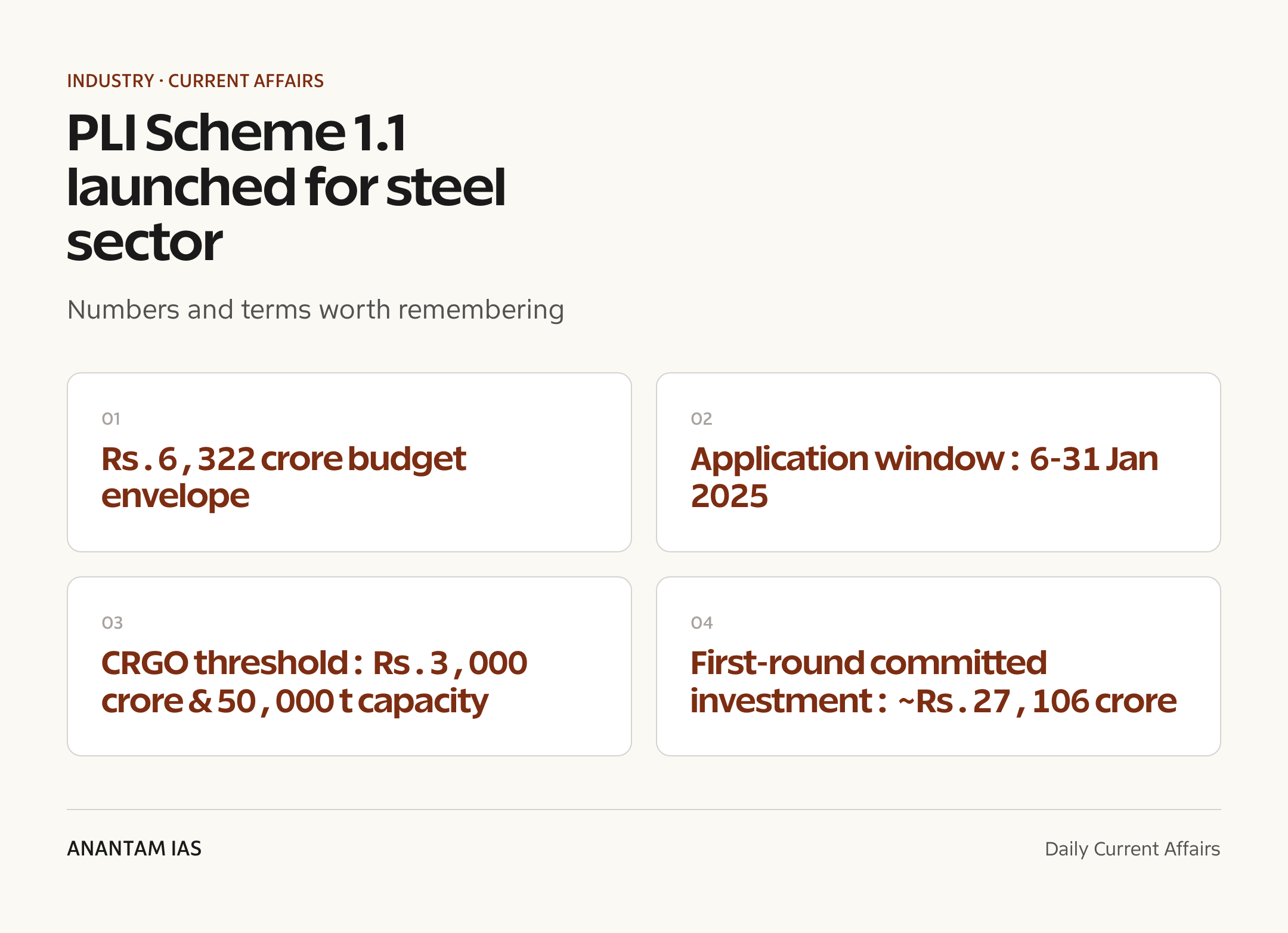
UPSC Relevance
Prelims Relevance
- Key facts: Application window 6-31 Jan 2025; scheme runs for FY 2025-26 to FY 2029-30; budget envelope Rs.6,322 crore.
- Product list: Know the five eligible product categories under the scheme.
- CRGO thresholds: Reduced investment threshold to Rs.3,000 crore and capacity threshold to 50,000 tonnes for CRGO sub-category.
Mains Relevance
GS3 Economy
- Industrial policy: Assess how PLI instruments shape manufacturing competitiveness, value chain development and import substitution.
- Economic outcomes: Discuss impact on employment, technology transfer, and domestic capital formation in the steel sector.
- Policy design: Analyse merits and limits of incentive design choices such as carry-forward rules and capacity augmentation entry at 50% investment threshold.
Essay
- Make in India: Use the scheme as an example of policies that aim to move the economy up the value chain and reduce import dependence.
- Growth & sustainability: Debate tradeoffs between large-scale industrial incentives and environment/energy considerations in heavy industries.
Background and Context
Evolution of PLI for specialty steel
The PLI pathway for specialty steel began in 2021 with a targeted outlay and has since entered a phase of calibration.
- Initial notification: PLI for specialty steel announced on July 29, 2021 with Rs.6,322 crore budget to incentivise value-added steel.
- First-round pledges: 44 projects across 26 companies committed significant investments and downstream capacity creation.
- Implementation gap: Actual investments lagged commitments by 2024, prompting review of scheme parameters.
- Objective alignment: Aimed to foster technology adoption, domestic production of niche grades and support Atmanirbhar goals.
Why specialty steel matters
Specialty steel grades have applications that are strategic for multiple sectors of the economy.
- Sectoral applications: Used in automobiles, white goods, railways, power transformers and defence components.
- Value capture: These grades command higher margins and embed more domestic value than commodity steel.
- Import dependence: India imports several high-grade steels, creating vulnerability in critical supply chains.
- Technology intensity: Production often requires advanced processing and quality control capabilities.
CRGO: strategic single-subject focus
CRGO steel is critical for power transformers; domestic production is limited by technology gaps.
- Function: CRGO has magnetic properties that reduce core losses in transformers and is crucial for efficient power distribution.
- Domestic shortfall: No Indian producer had CRGO production capability at the time of announcement.
- Policy tweak: Investment threshold reduced to Rs.3,000 crore and capacity threshold to 50,000 tonnes to attract entrants.
- Energy security link: Localising CRGO reduces exposure of the power system to foreign supply chain disruptions.
Design changes in PLI 1.1
Scheme rules were relaxed to boost investor participation and recognise capacity augmentation as a valid entry route.
- Threshold cuts: Reduced investment and capacity thresholds in some sub-categories where participation was low.
- Carry-forward rule: Excess production may be used to offset shortfalls in the immediate next year for incentive claims.
- Capacity augmentation: Firms upgrading existing mills can participate by meeting 50% of the original investment threshold.
- Investor friendliness: Not all participants must install new greenfield mills; this lowers capital entry barriers.
Fiscal and time bounds
PLI Scheme 1.1 uses the original fiscal envelope and sets clear implementation years for production targets.
- Budget envelope: No fresh allocation; scheme will operate within Rs.6,322 crore already sanctioned.
- Implementation period: Incentive eligibility tied to production during FY 2025-26 to FY 2029-30.
- Application window: Open 6 to 31 January 2025; investments after portal opening count towards eligibility.
- Payout expectations: First round payout estimated at around Rs.2,000 crore as per Ministry estimates.
Performance indicators and employment
First-round monitoring provides a baseline for expected economic impacts from the scheme.
- Committed investments: About Rs.27,106 crore committed in round one; actual lower due to project execution timelines.
- Actual deployment: Rs.18,300 crore invested as of Nov 2024 with direct employment of ~8,300 persons.
- Capacity addition: Committed downstream capacity ~24 million tonnes across participants.
- Measurement: Incentives tied to incremental production to ensure measurable outcomes on domestic output.
Way Forward
Operationalising CRGO capacity domestically
- Technology partnerships: Encourage joint ventures with global CRGO technology providers under clear IP and transfer terms.
- Targeted incentives: Consider additional performance-linked support for pilot CRGO lines to de-risk first movers.
- Skill development: Set up specialised training modules for metallurgists and process engineers for CRGO manufacture.
- Supply chain clustering: Promote supplier parks for insulation, lamination and cold-rolling to reduce unit costs.
Monitoring and accountability
- Transparent metrics: Publish periodic progress on investments, capacity created and incentive disbursals on official portals.
- Independent audits: Use third-party verification for reported incremental production before incentive payments.
- Milestone-linked disbursal: Tie tranche releases to achievement of technology and environmental compliance milestones.
- Feedback loops: Institutionalise industry consultations every 12 months to refine thresholds and rules.
Complementary policy measures
- Green steel linkages: Align PLI benefits with energy efficiency and low-carbon process adoption to lower lifecycle emissions.
- Demand signalling: Use public procurement (railways, power, defence) to anchor demand for domestically produced specialty steel.
- Finance support: Offer concessional credit windows or credit guarantees for long-lead capex in high-value steel plants.
- Export promotion: Facilitate market access and standards recognition for Indian specialty steel in targeted foreign markets.
Inclusive participation design
- SME pathways: Enable smaller downstream firms to aggregate and qualify through cluster-based investment models.
- Capacity augmentation focus: Keep the 50% threshold option to leverage existing assets and speed up production ramp-up.
- Environmental safeguards: Ensure smaller units meet minimum pollution-control standards to avoid local harm while expanding capacity.
Conclusion
Strategic recalibration: PLI Scheme 1.1 reflects a policy shift from strict greenfield emphasis to pragmatic inclusion of capacity augmentation.
Short-term intent: The window aims to plug participation gaps in the first round and jump-start domestic production of critical specialty grades.
Medium-term outcome: If implemented and monitored well, the scheme can reduce import dependence, induce technology adoption and create higher-value manufacturing jobs.
UPSC Practice Questions
Prelims MCQ 1
Which of the following product categories is included under PLI Scheme 1.1 for specialty steel?
(a) A. Stainless steel kitchen sinks (b) B. Cold-rolled grain-oriented (CRGO) electrical steel (c) C. Structural mild steel beams (d) D. Galvanised roofing sheets for low-end construction
Answer: B
Explanation:
PLI Scheme 1.1 covers five high-value categories including CRGO electrical steel. The scheme targets specialty grades rather than commodity structural or low-end construction steels.
Prelims MCQ 2
Under PLI Scheme 1.1, which provision helps companies avoid losing incentives after a year of strong production?
(a) A. Bank guarantee waiver (b) B. Carry-forward of excess production to the immediate next year (c) C. Full tax holiday for five years (d) D. One-time cash grant irrespective of production
Answer: B
Explanation:
The scheme allows carry-forward of excess production from a given year to the immediately following year for the purpose of claiming incentives, reducing the risk of losing benefits after a high-output year.
UPSC Mains Questions
- {‘question’: ‘Examine the potential of PLI-style incentives to transform India’s manufacturing competitiveness in capital-intensive sectors such as specialty steel. Discuss design features that improve efficacy and risks that policymakers must manage.’, ‘model_answer_points’: [‘Explain PLI rationale: create output-linked incentives to induce capacity, technology adoption and import substitution in value-added segments.’, ‘Design enablers: long implementation horizon, clear performance metrics, tie to incremental production, provision for capacity augmentation and carry-forward rules to smooth volatility.’, ‘Risks: fiscal concentration, crowding out if incentives favour large incumbent firms, environmental externalities in heavy industry, and technology lock-in without adequate IP transfer.’, ‘Mitigants: milestone-linked disbursal, independent verification, environmental conditionalities, support for clusters and SMEs, and export-push measures.’]}
- {‘question’: ‘Assess the role of targeted policy measures in achieving Atmanirbhar goals for critical materials like CRGO steel. Should the government consider deeper interventions beyond PLI?’, ‘model_answer_points’: [‘Outline strategic importance of CRGO for power infrastructure and national security of supply chains.’, ‘Evaluate PLI impact: demand-pull and capital subsidy-like incentive to offset high initial costs and encourage FDI/technology transfer.’, ‘Additional measures: public procurement guarantees, targeted R&D grants, concessional finance, and setting up a technology incubation and testing centre.’, ‘Conclude with a balanced view: PLI is necessary but may be insufficient; a mix of demand guarantees, R&D support and international partnerships will be required.’]}
Source: PIB, Ministry of Steel.
Frequently Asked Questions
q
a
q
a
q
a
q
a
q
a
q
a
Source: https://anantamias.com/current-affairs/pli-steel-scheme-launch-2025/
Pre-Budget consultation meetings for Union Budget 2025-26 conclude
Why in News?
The annual Pre-Budget consultations concluded ahead of the Union Budget 2025-26, gathering structured stakeholder inputs that will shape fiscal choices, sectoral allocations and policy signals for the coming financial year.
- Timing: Consultations ended in early January 2025, just weeks before the Budget, giving inputs immediate operational relevance.
- Broad participation: Over 100 invitees across nine stakeholder groups provided sector-specific recommendations on revenue, expenditure and reforms.
- Government commitment: The Finance Minister and senior secretaries led the process, indicating that recommendations will be recorded for consideration in Budget drafting.
- Citizen engagement: MyGov portal opened for public submissions from 8 January 2025, expanding the consultative base beyond invited experts.
- Policy impact: Inputs cover macro-fiscal issues, agriculture, MSMEs, infrastructure, financial sector and social sectors, which can affect deficit management and sectoral allocations.
The development matters in the context of:
- Pre-Budget consultations are a recurring institutional practice used by the Ministry of Finance to get stakeholder inputs before finalising Budget proposals.
- These consultations are one element of the Budget cycle that also includes Ministry budgets, Cabinet approvals, and Parliamentary scrutiny at the time of Budget presentation.
- The meetings bring together sector experts, industry bodies, trade unions, farmer associations and financial sector representatives to offer evidence-based and demand-side perspectives.
- Citizen inputs via MyGov aim to enhance ‘Jan Bhagidari’ and make the Budget process more inclusive by crowd-sourcing ideas on spending priorities and reform measures.
- The composition of participants signals which sectors the Ministry may prioritise for reforms or higher allocations; presence of financial sector and capital markets experts points to attention on fiscal-financial linkages.
- Policy suggestions from consultations feed into internal papers prepared by Departments and the Budget Division, which reconcile competing claims within overall fiscal constraints.

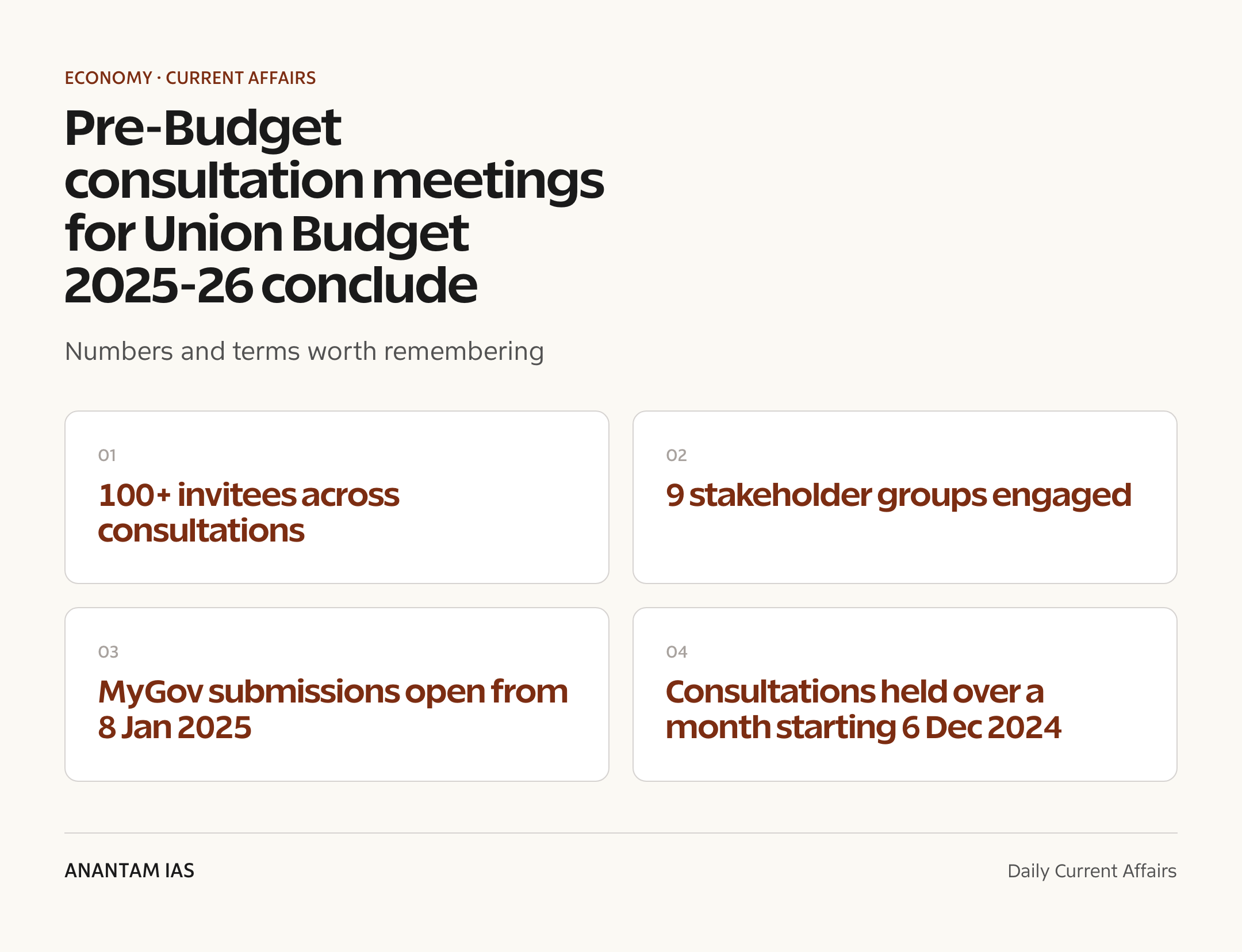
UPSC Relevance
Prelims Relevance
- High. Questions may ask about procedural aspects of budget formulation, the role of pre-budget consultations, and the MyGov platform for citizen inputs.
Mains Relevance
GS3 Economy
- Direct. Material supports answers on budgetary process, participatory governance, fiscal policy making, and evaluations of stakeholder consultation as a democratic tool.
Essay
- Relevant for essays on economic governance, participatory policymaking, fiscal responsibility and the role of institutions in enhancing accountability.
Background and Context
What are Pre-Budget Consultations
Structured meetings organised by the Ministry of Finance to obtain inputs from stakeholders before finalising the Union Budget.
- Held annually in the lead-up to the Budget presentation; timing varies but typically in December-January.
- Aim to gather evidence-based suggestions on revenue measures, expenditure priorities and structural reforms.
- Invitees include economists, industry associations, farmers’ groups, trade unions, sector experts and financial market representatives.
- Inputs are considered alongside departmental budget proposals, macro-fiscal targets and government priorities when drafting the Budget.
- The consultations are not legally binding but carry political and technical weight because they inform officials and Ministers.
Institutional actors involved
Senior officials and specialised departments participate to translate suggestions into actionable Budget items.
- Finance Minister chairs the consultations to signal political ownership of the process.
- Finance Secretary, Secretaries of Department of Economic Affairs, Department of Financial Services and DIPAM are present to assess feasibility.
- Chief Economic Adviser and officials from the Budget Division evaluate macro-fiscal implications of proposals.
- Other ministries participate in sector-specific meetings so that inter-ministerial coordination can occur early.
- MyGov and the Ministry of Finance act as channels for public submissions and contribute to transparency.
Scope of stakeholder inputs
Inputs typically cover revenue, expenditure, reform measures and special requests by sectors.
- Revenue-related suggestions include tax policy changes, simplifications, and measures to widen the tax base.
- Expenditure suggestions propose new schemes, expansion of existing benefits, or targeted subsidies for vulnerable groups.
- Sectoral reforms often focus on agriculture, MSME credit, education, health, infrastructure and energy policy.
- Financial sector inputs address capital market reforms, banking sector support, insolvency and credit delivery mechanisms.
- Trade unions and labour groups raise concerns on employment, minimum wages, social security and labour law reform.
Role of MyGov in Budget consultations
An online portal enabling citizens to submit suggestions and engage with policymaking.
- MyGov call for inputs opens after formal consultations to broaden participation to the general public.
- Submissions can be thematic and are collated for consideration by relevant departments.
- The platform increases transparency and creates a public record of citizen priorities ahead of the Budget.
- Quality and technical depth of suggestions vary; Ministries synthesise inputs and prioritise technically feasible proposals.
Budget calendar and decision points
How consultation inputs fit into the Budget-making timeline.
- Pre-Budget consultations feed into internal drafting that culminates in the Budget document presented in Parliament in February.
- Macro-fiscal targets such as the fiscal deficit ceiling are decided early in the cycle and constrain overall allocations.
- Sectoral allocations are negotiated among ministries, with the Finance Ministry mediating trade-offs.
- Cabinet approval and Parliamentary debate are later stages where policy choices are publicly tested.
Way Forward
Strengthen technical synthesis
- Create a public synthesis report that summarises major recommendations and the Ministry response to each theme.
- Require departments to publish impact assessments for high-cost suggestions to allow evidence-based prioritisation.
- Use standard templates for submissions to improve comparability and make administrative assimilation faster.
- Institutionalise follow-up mechanisms to track which consultation recommendations are implemented.
Enhance citizen participation quality
- Run capacity-building webinars on MyGov to help citizens prepare technically sound proposals.
- Encourage collaborative submissions from civil society and academic consortia to raise analytical quality.
- Introduce thematic deadlines and curated questionnaires on MyGov to focus inputs on policy trade-offs.
- Publish anonymised exemplars of high-quality submissions to guide future contributors.
Improve sectoral representation and balance
- Ensure representation from small and marginalised producer groups, and not just large industry bodies.
- Hold regional consultations or virtual sessions to capture geographically diverse needs.
- Increase participation of health and education practitioners when social sectors are under discussion.
- Invite independent fiscal experts and think tanks to provide countervailing views on major proposals.
Link consultations to medium-term fiscal strategy
- Publish an annual statement explaining how consultation inputs align with medium-term fiscal targets.
- Prioritise proposals that have high benefit-cost ratios and low recurring fiscal burden.
- Develop a multi-year investment plan for infrastructure recommendations to smooth fiscal impact.
- Use consultation outcomes to refine tax expenditure reviews and subsidy rationalisation strategies.
Conclusion
Pre-Budget consultations for 2025-26 reaffirm the role of stakeholder inputs in the budget process. The meetings and the MyGov call expand the evidence base for fiscal decisions, but to maximise value the process should improve synthesis, raise submission quality and link proposals to fiscal constraints. Expected outputs include targeted sectoral measures and reform signals in the forthcoming Budget.
UPSC Practice Questions
Prelims MCQ 1
Which of the following is a feature of the MyGov platform used in budget consultations?
(a) It legally mandates implementation of citizen suggestions. (b) It allows citizens to submit ideas for the Union Budget. (c) It replaces departmental budget proposals. (d) It only accepts submissions from registered political entities.
Answer: (b) It allows citizens to submit ideas for the Union Budget.
Explanation:
MyGov is an online platform for citizen engagement and accepts public suggestions for the Budget. It does not legally mandate implementation, nor does it replace departmental proposals, and it is open to individuals rather than only political entities.
Prelims MCQ 2
Pre-Budget consultation meetings typically include which of the following participants?
(a) Only members of Parliament and State Ministers. (b) Experts, industry representatives, farmer associations and trade unions. (c) Foreign governments’ finance ministers as mandatory invitees. (d) Judicial officers for legal vetting of Budget proposals.
Answer: (b) Experts, industry representatives, farmer associations and trade unions.
Explanation:
Consultations invite sector experts, industry bodies, farmer groups and trade unions among others. They do not routinely include foreign finance ministers or judicial officers as part of the standard consultation composition.
UPSC Mains Questions
- {‘question’: ‘Analyse the role of pre-budget consultations in enhancing the quality of fiscal policymaking in India. Discuss limitations and suggest measures to improve effectiveness.’, ‘points’: [‘Define the consultation mechanism and its place in the Budget cycle.’, ‘Explain how stakeholder inputs increase information flow, sectoral perspectives and democratic legitimacy.’, ‘Discuss limitations such as representational bias, variable technical quality of submissions and weak follow-up.’, ‘Recommend measures: publish synthesis reports, capacity building for citizens, stronger representation of marginal groups and linkages to medium-term fiscal frameworks.’]}
- {‘question’: ‘Examine the trade-offs the Finance Ministry must consider when incorporating stakeholder recommendations into the Union Budget within the constraints of fiscal deficit targets.’, ‘points’: [‘Outline the fiscal constraint: revenue mobilization, fiscal deficit ceiling and interest burden.’, ‘Assess trade-offs between capital expenditure and revenue expenditure, short-term subsidies and long-term reforms.’, ‘Consider equity issues: targeted welfare vs universal programmes and regional allocation disparities.’, ‘Suggest mechanisms like multi-year budgeting, benefit-cost assessments and prioritisation frameworks to reconcile demands.’]}
Source: PIB, Ministry of Finance.
Frequently Asked Questions
q
a
q
a
q
a
q
a
q
a
q
a
Source: https://anantamias.com/current-affairs/pre-budget-consultations-2025/
Joint strategy meeting for TB Mukt Bharat Abhiyan — 100-Day Intensified Campaign
Why in News?
A concentrated national campaign against tuberculosis has public-health, implementation and inter-ministerial coordination implications for disease elimination targets and health-system responsiveness.
- High-level push: Union Health Minister chaired a meeting with 21 line ministries to operationalise the 100-day intensified campaign under TB Mukt Bharat Abhiyan.
- Target horizon: Reiterates the national goal to eliminate TB by 2025, earlier than the UN SDG 2030 deadline.
- Early results: First 30 days reported >2 crore people screened and >1.48 lakh new TB cases identified, showing rapid operational scale-up.
- Whole-of-government: Ministries of Labour, WCD, Tribal Affairs, Steel, AYUSH, Panchayati Raj, Railways and others committed actions spanning screening, nutrition, workplace outreach and stigma reduction.
- Systems focus: Emphasis on screening expansion, treatment coverage, nutritional support and community mobilisation via Anganwadi workers and volunteers.
The development matters in the context of:
- Disease burden: India has the world’s largest absolute TB burden; national interventions determine global progress on TB elimination.
- Policy timeline: The PM’s call to eliminate TB by 2025 set an accelerated national objective that requires concentrated, short-term intensification of activities.
- Operational challenge: TB elimination needs active case-finding, diagnostic access, treatment adherence, social support and stigma reduction working together.
- Intersectoral determinants: Malnutrition, overcrowding, occupational exposures and limited access in tribal or remote areas drive transmission and poor outcomes.
- Health system readiness: Screening at workplaces, ESIC hospitals, community platforms and integration with AYUSH and WCD services can increase reach but need monitoring.
- Measurement: Progress measured through screening numbers, new case detection, treatment initiation and treatment outcomes, plus reductions in mortality.

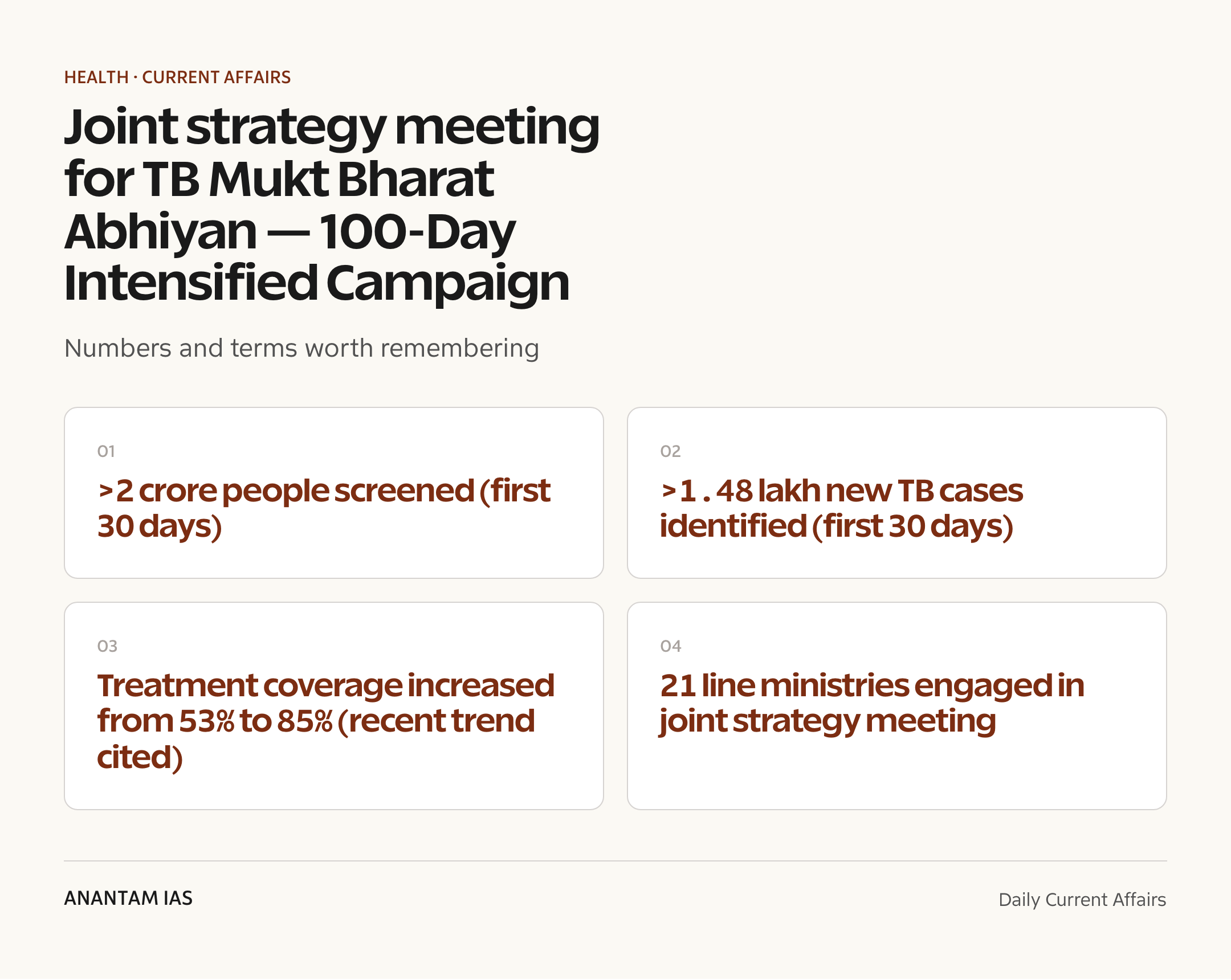
UPSC Relevance
Prelims Relevance
- Definition and symptoms of tuberculosis and causative organism Mycobacterium tuberculosis.
- Key national programmes: National Tuberculosis Elimination Programme (NTEP) and TB Mukt Bharat Abhiyan structure.
- Public health terms: active case finding, contact tracing, DOTS, diagnostic tools like CBNAAT/CB-NAAT and chest X-ray screening.
- Institutional roles: responsibilities of Ministry of Health, WCD, Ministry of Labour, AYUSH and Panchayati Raj in health campaigns.
Mains Relevance
GS2 Governance
- Evaluating whole-of-government approaches to tackle public health problems — merits, coordination challenges and accountability mechanisms.
- Policy analysis on how short, intensive campaigns affect long-term health system strengthening and disease surveillance.
- Discussing social determinants such as malnutrition and tribal disadvantage in disease control and policy responses.
- Assessment of program monitoring: selecting indicators and balancing quantity (screens) with quality (diagnostic accuracy, treatment outcomes).
Essay
- Use as a case study for public policy essays on cooperative federalism and mobilising state machinery for national goals.
- Illustrates trade-offs between vertical disease campaigns and integrated health systems for long-term outcomes.
- Material for essays on social inclusion, health equity and the role of community workers like Anganwadi staff in national missions.
Background and Context
National TB burden and targets
Where India stands and why an accelerated target was set.
- High absolute burden: India accounts for a large share of global TB cases and deaths, making national progress pivotal for global targets.
- 2025 goal: The Prime Minister’s target to eliminate TB by 2025 compresses the SDG 2030 timetable and demands rapid scale-up of interventions.
- Trends: Recent WHO data showed a notable reduction in cases and deaths in India, indicating progress but gaps remain in detection and care.
- Key metrics: Case notification, treatment coverage, treatment success rate and mortality form the core indicators monitored.
Design of the 100-Day Intensified Campaign
Operational features and immediate objectives of the campaign.
- Short-term intensity: Focus on ramping up screening and case detection over a defined 100-day window to reduce community transmission.
- Active case finding: Use of community screening, workplace outreach, railways and ESIC hospitals to detect missed cases.
- Multi-pronged interventions: Screening linked to diagnostic pathways, prompt treatment initiation and nutritional/social support.
- Performance targets: Daily/weekly screening targets and rapid linkage to treatment with data reporting for real-time course correction.
Inter-ministerial roles and contributions
What different ministries are expected to do in the whole-of-government approach.
- Ministry of Labour: Screening at workplaces and ESIC facility engagement to find cases among workers.
- WCD and Anganwadi: Nutrition support through Poshan Maah and Poshan Pakhwara and community mobilisation to reduce stigma.
- Tribal Affairs: Targeted outreach in tribal areas where malnutrition and access issues increase vulnerability.
- AYUSH and Health field collaboration: Using local health channels to expand awareness and referral linkages.
Screening and diagnostics
Tools and pathways used to detect TB cases during the campaign.
- Mass screening: Symptom screening and use of chest X-rays for large population cohorts in community and institutional settings.
- Molecular testing: CBNAAT/CB-NAAT for rapid confirmation and detection of drug resistance where necessary.
- Referral chains: Screening hubs linked to diagnostic centres and NTEP treatment facilities to avoid loss to follow-up.
- Data systems: Real-time reporting to national dashboards to monitor coverage and cascade from screening to treatment.
Nutrition and social support
Role of nutrition and social determinants in treatment outcomes.
- Malnutrition link: Poor nutrition increases susceptibility and worsens treatment outcomes, particularly in tribal and rural populations.
- Poshan initiatives: Integration with Poshan Maah/Pakhwara to provide supplements and counseling through Anganwadi workers.
- Financial and non-financial support: Incentives, food rations and counselling to improve adherence and reduce catastrophic costs.
- Community participation: Use of MyBharat volunteers and local workers to mobilise patients and reduce stigma.
Monitoring, reporting and accountability
How results are measured and the governance mechanisms envisaged.
- Indicator cascade: From people screened, tests done, positive cases diagnosed, to treatment initiation and completion.
- Inter-ministerial accountability: Secretaries and senior officers assigned deliverables and reporting responsibilities.
- Real-time dashboards: Use of digital reporting for rapid course correction and resource reallocation.
- Quality checks: Ensuring diagnostic accuracy and follow-up to prevent misdiagnosis and ensure successful treatment outcomes.
Way Forward
Operational scale-up and integration
- Institutionalise screening-to-treatment pathways with clear referral linkages and transport support where needed.
- Expand CBNAAT capacity and mobile diagnostic units to reduce turnaround times for confirmation.
- Use workplace and institutional screening (railways, ESIC, industries) as ongoing mechanisms beyond the 100 days.
- Integrate campaign activities with routine NTEP operations to avoid parallel systems and ensure continuity.
Strengthening nutrition and social support
- Coordinate with WCD and Poshan schemes to provide targeted nutrition packs for diagnosed patients.
- Enable conditional cash transfers or travel support tied to treatment milestones to reduce dropouts.
- Train Anganwadi and community volunteers to provide adherence counselling and psychosocial support.
- Monitor nutritional status as part of TB treatment indicators to measure impact on recovery.
Community engagement and stigma reduction
- Deploy MyBharat volunteers and local leaders for door-to-door awareness and debunking myths about TB.
- Run behaviour-change communications tailored for tribal and rural contexts to reduce diagnostic delays.
- Use testimonials from cured patients while protecting privacy to show treatment success and reduce fear.
- Engage faith groups, panchayats and schools to normalise screening and follow-up.
Governance, monitoring and evaluation
- Set short and medium-term KPIs with ministry-level responsibility matrices and public dashboards.
- Conduct independent rapid evaluations and audit of campaign quality and diagnostic accuracy mid-course.
- Ensure data triangulation from facility records, digital reports and field verification to prevent over-reporting.
- Plan a post-campaign transition to sustain high case-finding and integrate lessons into routine NTEP practice.
Conclusion
The 100-Day Intensified Campaign under TB Mukt Bharat Abhiyan is a focused push using a whole-of-government model to accelerate detection, treatment and social support. Early screening numbers show programmatic reach but sustaining gains will depend on integration with routine services, strengthening diagnostics, addressing social determinants like malnutrition and enforcing clear monitoring and accountability across ministries.
UPSC Practice Questions
Prelims MCQ 1
Which microorganism is the primary cause of pulmonary tuberculosis in humans?
(a) Mycobacterium leprae (b) Mycobacterium tuberculosis (c) Streptococcus pneumoniae (d) Klebsiella pneumoniae
Answer: (b) Mycobacterium tuberculosis
Explanation:
Pulmonary tuberculosis in humans is primarily caused by Mycobacterium tuberculosis. Mycobacterium leprae causes leprosy. Streptococcus pneumoniae and Klebsiella pneumoniae cause other respiratory infections.
Prelims MCQ 2
Under the National Tuberculosis Elimination Programme (NTEP), what does CBNAAT primarily provide in TB control?
(a) Nutritional support (b) Rapid molecular diagnosis and rifampicin resistance detection (c) Vaccination against TB (d) Contact tracing only
Answer: (b) Rapid molecular diagnosis and rifampicin resistance detection
Explanation:
CBNAAT (cartridge based nucleic acid amplification test) provides rapid molecular diagnosis for TB and can detect rifampicin resistance, enabling quicker treatment decisions. It does not provide nutrition or vaccination.
UPSC Mains Questions
- {‘question’: ‘Analyse the advantages and risks of pursuing short-term, intensified public health campaigns like the 100-Day TB campaign in a federal system. Discuss mechanisms to mitigate the risks.’, ‘model_answer’: ‘Short-term intensified campaigns can rapidly increase case detection, mobilise resources, and create political momentum. They can reduce transmission quickly when combined with rapid diagnostics and prompt treatment initiation. Risks include diversion of routine health-system resources, possible compromise of diagnostic quality under pressure, duplication of reporting systems and incomplete follow-through after the campaign ends. In a federal system these risks are compounded by variable state capacity and coordination gaps. Mitigation mechanisms include: (a) integration of campaign activities into routine NTEP systems to prevent parallel processes, (b) clear division of responsibilities between central and state authorities with agreed KPIs, (c) real-time quality audits and data verification to prevent over-reporting, (d) capacity building and resource support to weaker states, and (e) a defined post-campaign transition plan to sustain case-finding and treatment adherence.’}
- {‘question’: ‘Evaluate the role of non-health ministries such as WCD, Labour, Panchayati Raj and Tribal Affairs in reducing tuberculosis burden in India.’, ‘model_answer’: ‘Non-health ministries address social determinants that drive TB risk and outcomes. WCD and Anganwadi systems can provide nutritional support and community-level counselling, improving treatment adherence and recovery. Labour engages workplaces and ESIC hospitals for screening and early detection among working populations. Panchayati Raj institutions can enable local mobilisation, remove barriers to care and monitor vulnerable households. Tribal Affairs can design targeted outreach for tribal communities with higher malnutrition and access constraints. Their role is complementary to clinical services: addressing malnutrition, ensuring social security, reducing catastrophic costs and lowering stigma. For effective contribution, there must be clear coordination mechanisms, data sharing protocols, resourcing, and monitoring frameworks that align with NTEP objectives.’}
Source: PIB, Ministry of Health & Family Welfare.
Frequently Asked Questions
q
a
q
a
q
a
q
a
q
a
q
a
Source: https://anantamias.com/current-affairs/tb-mukt-bharat-100-day-campaign-2025/
Delhi Assembly election schedule announced for 2025
Why in News?
The Election Commission released the schedule and detailed operational instructions for the Delhi Assembly poll including final electoral rolls, polling station norms and voter facilitation measures. This sets the election management framework and Model Code of Conduct activation for the capital.
- Schedule and final roll published after Special Summary Revision with qualifying date 01.01.2025; final roll released on 06.01.2025.
- Electoral size disclosed for NCT of Delhi with total electors and categories such as service voters, PwD and senior citizens.
- Polling station norms mandated: ground-floor location, ramps, Assured Minimum Facilities and maximum 1500 electors per station.
- Accessibility measures for Persons with Disabilities: braille voter slips, dummy braille ballot sheets, Saksham-ECI wheelchair facility, priority entry and transport.
- Voter facilitation measures: Voter Information Slips, Voter Guide brochures, Voter Assistance Booths and standardized Voter Facilitation Posters.
- Candidature rules tightened: affidavit must be complete at filing or face rejection after notice; nominees get ‘No Dues Certificate’ assistance.
The development matters in the context of:
- Constitutional mandate: Elections to Legislative Assemblies are held under Article 172 read with Article 324, placing responsibility on the Election Commission to ensure free and fair polls.
- Legal framework: Representation of the People Acts, 1950 and 1951, and Conduct of Elections Rules, 1961, govern electoral rolls, nomination, polling and postal ballots.
- Electoral roll reforms: After the Election Laws (Amendment) Act, 2021, the ECI uses quarterly qualifying dates; this Special Summary Revision used 01.01.2025.
- Urban electorate challenge: High population density and mobility in Delhi demand more polling stations, robust BLO outreach and ASD lists for accurate rolls.
- Accessibility push: ECI directives reflect a rights-based approach to enfranchisement of PwD, elderly voters and women participation in polling staff.
- Operational clarity: Standardized voting compartments, Voter Information Slips and Voter Assistance Booths aim to reduce procedural errors and booth-level confusion.

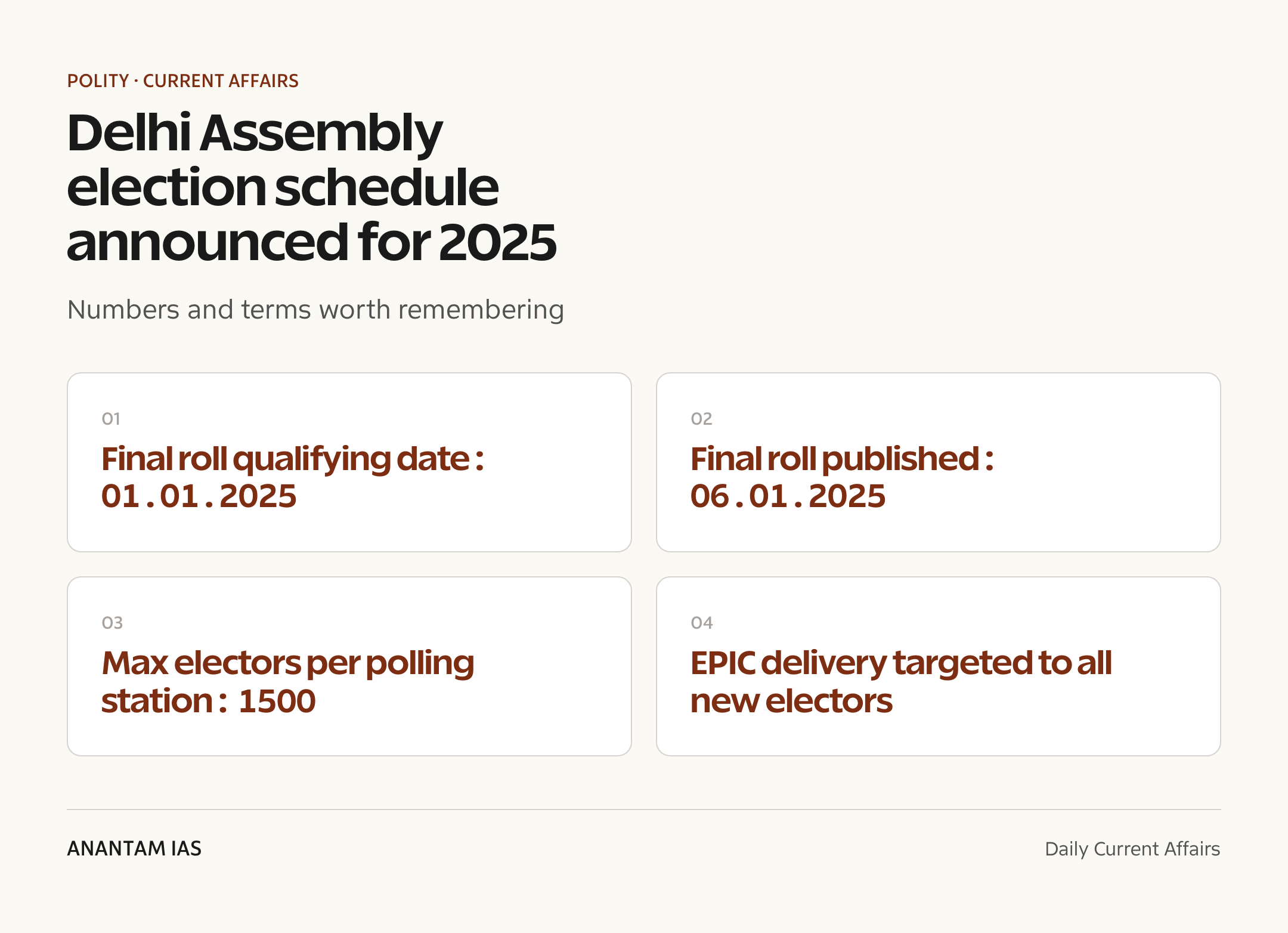
UPSC Relevance
Prelims Relevance
- High — facts on qualifying date for roll revision, final roll date, maximum electors per polling station, and special facilitation measures can be directly asked as static factual MCQs.
Mains Relevance
GS2 Polity and Elections
- Direct — issues of electoral administration, enfranchisement of PwD and senior citizens, role of ECI in ensuring free and fair elections, and legal-procedural aspects of candidacy and nominations are relevant for GS2 answers on electoral reforms and democratic processes.
Essay
- Moderate — material useful for essays on ‘Governance and Elections’, ‘Strengthening Democratic Institutions’, and ‘Inclusive Participation in Indian Democracy’. Use details on accessibility, roll quality and administrative measures as evidence.
Background and Context
Legal and constitutional basis
Framework that empowers the Election Commission and governs assembly elections.
- Article 324 vests the superintendence, direction and control of elections in the Election Commission of India; Article 172 fixes the term of state legislative assemblies.
- Representation of the People Act, 1951 regulates the conduct of elections, qualifications and disqualifications of members and electoral offences.
- Conduct of Elections Rules, 1961 specify procedural details such as voting compartments, postal ballots and appointment of polling personnel.
- Election Laws (Amendment) Act, 2021 amended Section 14 of RP Act, 1950 to allow multiple qualifying dates for roll revision, improving enrolment opportunities during the year.
- Statutory duties on Returning Officers include scrutiny of nomination papers and guidance from the Supreme Court ruling (Resurgence India case) to ensure affidavits are complete at filing.
Electoral rolls and Special Summary Revision
Why roll health matters and how the ECI updated Delhi’s rolls for 2025.
- Roll integrity is central to credible polls; errors cause proxy voting and disenfranchisement.
- Special Summary Revision was carried out with 01.01.2025 as qualifying date and final roll published on 06.01.2025.
- The Commission emphasised delivery of EPIC to newly registered electors before nomination closures to aid identification at booths.
- BLOs executed door-to-door surveys and compiled lists of Absent, Shifted or Dead (ASD) voters to be used at polls for verification.
- Electors marked as PwD, third gender and senior citizens (85+) are identified on rolls for targeted facilitation and assistance on poll day.
Polling station infrastructure and norms
Standards set to ensure accessibility, secrecy and convenience at booths.
- Maximum of 1500 electors per polling station to avoid crowding and long waits.
- Mandatory ground-floor or road entry level location with accessible approach and permanent ramp construction urged by ECI.
- Assured Minimum Facilities include drinking water, waiting shed, toilets with water, lighting and signage.
- Uniform voting compartments: steel-grey corrugated flex boards, 30-inch height for compartment and table, with adhesive stickers indicating poll details.
- Direction to create at least one women-managed and one PwD-managed polling station per Assembly Constituency where feasible.
Voter facilitation and information
Measures to inform and assist electors before and during polling.
- Voter Information Slips to be distributed at least 5 days before poll with QR code and booth details; not valid as ID.
- A household Voter Guide in Hindi/English/local language will be provided with polling details, BLO contacts and Do’s/Don’ts at booths.
- Voter Assistance Booths near polling premises will help electors locate their serial number and polling station using ERO-Net generated alphabetic locators.
- Four standardized Voter Facilitation Posters to be displayed at every polling station covering required statutory information.
- Specialised outreach for visually impaired electors: Accessible VIS with braille and dummy braille ballot sheets at polling stations.
Assistance to Persons with Disabilities and senior citizens
Specific operational steps to enable inclusive voting.
- Identified PwD and senior citizen electors are tagged to polling stations for targeted assistance and priority entry.
- Provision of Saksham-ECI app for wheelchair requests; transport facilities to be arranged at each polling station.
- Allowing companions for visually impaired voters under Rule 49N, while enabling independent voting using braille features on ballot units.
- Designated parking close to polling station entrance and volunteers trained to assist differently abled electors and those with hearing impairment.
- Instructions for presiding officers to double check identity of ASD-list voters to prevent impersonation.
Nomination and candidate compliance
Procedural safeguards for nomination filings and financial/administrative clearances.
- Affidavit filed with nomination paper must be complete; Returning Officer will issue notice if any column is left blank and can reject nomination on non-compliance.
- Latest nomination forms and affidavits are available on the ECI website for candidate reference.
- A ‘No Dues Certificate’ is to be provided by concerned agencies within 48 hours where applicable to expedite candidature certification.
- Guidelines emphasize thorough scrutiny at filing stage to reduce post-election litigation and enhance transparency.
- Postal ballot procedures remain in force for absentee voters in categories of senior citizens, PwDs and eligible health-affected persons.
Way Forward
Strengthen roll accuracy and accessibility
- Sustain periodic Special Summary Revisions and strengthen BLO capacity for door-to-door verification to reduce ASD discrepancies.
- Deploy targeted enrolment drives in high-mobility urban pockets and university residential areas to capture young electors.
- Accelerate EPIC delivery using local postal partnerships and digital acknowledgement to ensure ID availability on polling day.
- Integrate PwD tagging with municipal and health databases for proactive facilitation and transport planning on poll day.
Enhance polling station facilities and human resources
- Prioritise permanent ramp construction and AMF upgrades in identified polling stations ahead of future elections.
- Expand recruitment and training of women polling teams and youth-managed polling squads to foster trust and efficiency.
- Institutionalise Voter Assistance Booths with mobile-enabled ERO-Net kiosks for rapid query resolution on voting day.
- Set up district-level rapid response teams to resolve last-minute polling station infrastructure or staffing shortfalls.
Improve inclusion and voter experience
- Scale Saksham-ECI and similar assistive services with pre-poll registration to reduce on-the-spot requests.
- Standardise braille materials, dummy sheets and accessible VIS templates across states to ensure uniformity.
- Run targeted media literacy campaigns for PwD and elderly voters on their rights, facilities and postal ballot options.
- Encourage civil society and disabled persons organisations to monitor accessibility compliance at polling stations.
Strengthen transparency and dispute readiness
- Publish constituency-level roll health metrics and ASD statistics to enable public scrutiny and corrective action.
- Ensure Returning Officers have digital checklists and affidavit-completeness tools to reduce rejections at scrutiny.
- Create a 48-hour escalation mechanism for candidate ‘No Dues’ issues with designated nodal officers in agencies.
- Use geo-tagged photographs and audit trails for critical polling infrastructure deployment to aid post-poll review.
Conclusion
The ECI’s Delhi 2025 schedule and operational instructions reflect a focus on roll integrity, accessibility and standardised booth procedures. The measures aim to strengthen enfranchisement of PwD and senior citizens, reduce procedural variability at polling stations and streamline candidate nomination processes. Effective implementation will depend on BLO capacity, inter-agency cooperation and pre-poll infrastructure upgrades.
UPSC Practice Questions
Prelims MCQ 1
Which qualifying date was used for the Special Summary Revision of electoral rolls for the NCT of Delhi ahead of the 2025 Assembly election?
(a) 01.04.2024 (b) 01.01.2025 (c) 01.10.2024 (d) 01.01.2024
Answer: (b) 01.01.2025
Explanation:
The Election Commission conducted the Special Summary Revision with reference to the qualifying date 01.01.2025 and published the final roll on 06.01.2025.
Prelims MCQ 2
What is the maximum number of electors permitted per polling station as indicated by the ECI norms for the Delhi 2025 election?
(a) 1200 (b) 1500 (c) 2000 (d) 1000
Answer: (b) 1500
Explanation:
The Commission set a cap of a maximum of 1500 electors per polling station to reduce crowding and improve management on poll day.
UPSC Mains Questions
- {‘question’: ‘Analyse the measures taken by the Election Commission for ensuring accessibility of polling for Persons with Disabilities and elderly voters. What operational gaps remain and how should they be addressed?’, ‘model_answer_points’: [‘Summarise ECI measures: PwD tagging on rolls, Accessible Voter Information Slips with braille, dummy braille ballot sheets, Saksham-ECI wheelchair facility, priority entry and transport at polling stations.’, ‘Assess strengths: rights-based focus, procedural clarity, identification of beneficiaries and technological aids for requests.’, ‘Identify gaps: last-mile delivery of wheelchair/transport on poll day, variability in polling station infrastructure, need for consistent volunteer training and monitoring.’, ‘Recommend solutions: pre-registered mobility bookings, audit of permanent ramps before polls, mandatory accessibility training for polling personnel and civil society monitoring.’]}
- {‘question’: ‘Discuss the role of Blo (Booth Level Officer) outreach in maintaining electoral roll health in urban constituencies like Delhi. What changes can improve roll fidelity ahead of elections?’, ‘model_answer_points’: [‘Explain BLO functions: door-to-door verification, identification of absentee/shifted/dead voters, distribution of Voter Information Slips and EPIC follow-up.’, ‘Urban challenges: high mobility, rental populations and institutional voters complicate roll accuracy.’, ‘Propose improvements: strengthen BLO staffing, use GIS-enabled mobile apps for real-time updates, targeted enrolment drives in universities and rental localities, and public dashboards on roll corrections.’, ‘Emphasise institutional support: greater resources, strict timelines and coordination with municipal and civic agencies for address validation.’]}
Source: PIB, Election Commission of India.
Frequently Asked Questions
q
a
q
a
q
a
q
a
q
a
q
a
Source: https://anantamias.com/current-affairs/delhi-assembly-election-schedule-2025/
DFS convenes fintech ecosystem meeting with RBI, NPCI, FIU-IND and MeitY
Why in News?
Department of Financial Services (DFS) brought together regulators, technology partners and founders to strengthen the fintech ecosystem, discuss regulatory-sandbox tools, scale digital payment infrastructure and promote credit using digital footprints for MSMEs.
- High-level convening: Secretary, DFS chaired the meeting with senior officials from RBI, NPCI, FIU-IND, MeitY and about 60 fintech founders and associations.
- Focus on scale and standards: Participants discussed ways to elevate India’s fintech sector to global standards while maintaining strict regulatory compliance.
- Policy and infrastructure updates: RBI highlighted the Emerging Tech and Fintech Repository, Unified Lending Interface (ULI) and sandbox initiatives including video-KYC pilots.
- Inclusion and outreach: Emphasis on improving UPI and digital payments access in rural and north-eastern regions and increasing MSME access to credit via digital footprints.
- Government enablement: DFS flagged existing enablers such as Aadhaar, UPI and AePS, and policy levers like the regulatory sandbox, fintech repository and SRO framework.
The development matters in the context of:
- Fintech growth phase: India’s fintech sector has matured over the last decade, creating new payment rails, lending interfaces and identity-linked services that underpin digital finance.
- Role of public infrastructure: Aadhaar, UPI and AePS act as foundational public goods that reduce transaction costs and enable scale for fintech firms.
- Regulatory balancing act: Authorities need to support innovation while guarding against systemic risks, fraud, AML threats and privacy lapses.
- RBI initiatives: Emerging Tech and Fintech Repository aims to map technology use; ULI standardises lending data flows; sandbox projects test consumer-facing tech like video-KYC.
- NPCI role: NPCI manages key retail payment systems such as UPI, IMPS, AePS and is central to improving reach in underserved states and rural areas.
- FIU-IND role: Financial Intelligence Unit monitors suspicious transaction reporting and works with fintechs on anti-money laundering and counter-terrorist financing compliance.
- MeitY engagement: Ministry of Electronics and IT works on digital public infrastructure, cybersecurity guidance, and interoperability standards needed by fintech platforms.
- MSME credit gap: Small firms face information asymmetry; digital footprints and ULI-like interfaces can lower screening costs and broaden lender participation.

UPSC Relevance
Prelims Relevance
- Public infrastructure: Identify Aadhaar, UPI and AePS as enablers of fintech growth and financial inclusion.
- Regulatory instruments: Remember terms like regulatory sandbox, Unified Lending Interface (ULI) and fintech repository as current policy tools.
- Institution roles: Distinguish mandates of RBI, NPCI, FIU-IND and MeitY in fintech governance.
Mains Relevance
GS3 Economy and Digital Finance
- Governance and regulation: Use the meeting to discuss state capacity to balance fintech innovation with consumer protection and systemic stability.
- Digital public goods: Explain how infrastructural public goods like UPI and Aadhaar can lower transaction costs and improve inclusion.
- Financial inclusion and credit: Analyse policy measures to expand digital lending to MSMEs using alternative data and interoperable interfaces.
Essay
- Technology and development: Use the convergence of public infrastructure and private innovation as an argument on digital transformation of economy.
- Government and markets: Discuss the evolving role of the state in providing platforms, standards and supervision while allowing market-led fintech solutions.
Background and Context
India’s fintech trajectory
Rapid expansion over a decade driven by payments, lending and identity layers.
- Payment revolution: UPI transformed retail payments by enabling instant, low-cost transactions and enabling third-party apps.
- Identity and trust: Aadhaar provided a scalable identity foundation used for KYC and subsidy targeting.
- Lending innovations: APIs and alternative data analytics enabled new credit products for consumers and MSMEs.
- Start-up ecosystem: Fintech startups scaled using cloud infrastructure, VC capital and partnerships with banks and NBFCs.
- Geographic reach: Urban adoption preceded rural; recent efforts aim to close the urban-rural digital divide.
Key institutional roles
Regulators and agencies provide rails, supervision and intelligence for a safe fintech ecosystem.
- RBI: Prudential regulation for banks and NBFCs, sandbox oversight, and tech repositories to map risks.
- NPCI: Operates retail payment systems such as UPI, IMPS and AePS and manages settlement and settlement risk controls.
- FIU-IND: Collects and analyses suspicious transaction reports and issues AML/CTF guidance to reporting entities including fintechs.
- MeitY: Sets standards for digital public infrastructure, cybersecurity and data protection technical guidance.
- DFS: Policy coordination, enabling frameworks and dialogue between government, regulators and private sector.
Regulatory sandbox and repository tools
Experimentation and data mapping are central to evidence-based fintech policy.
- Regulatory sandbox: Time-bound controlled environment to test novel fintech products with consumer safeguards.
- Fintech repository: Centralised catalogue of fintech products, participants and technology usage for policymaking.
- Emerging tech repository: RBI initiative to capture baseline confidential information on technology adoption across institutions.
- ULI: Unified Lending Interface standardises data exchange between lenders, enabling faster credit decisions and portability.
- Video-KYC pilots: Seek to ease onboarding while balancing identity fraud and AML risks.
Digital public infrastructure as enabler
Shared public systems reduce duplication and enable scale for private innovation.
- Aadhaar: Supports offline and online KYC verification with consented identity authentication.
- UPI: Open interoperable payment rail that reduced costs and expanded merchant acceptance.
- AePS: Bank-led biometric-enabled cash-in/cash-out for financial access in remote areas.
- API economy: Standardised APIs allow fintechs to plug into bank rails, credit bureaus and payment networks.
Risks in a fast-growing ecosystem
Innovation brings new consumer protection, systemic and national security risks.
- Operational risk: Cyberattacks, service outages and dependency on critical third-party providers.
- Fraud and AML: Increased digital transactions raise suspicious flows; reporting quality matters for FIU-IND.
- Data privacy: Extensive use of personal and financial data requires strong data governance and consent mechanisms.
- Concentration risk: Dominant platforms can create single points of failure and market power concerns.
Fintech and MSME credit
MSMEs are a key policy focus for digital lending expansion.
- Information asymmetry: Small firms lack formal credit histories; alternative data can reduce screening costs.
- ULI potential: Standardised credit APIs can improve lender discovery and loan portability for MSMEs.
- Risk-based pricing: Digital footprints enable more granular underwriting and potentially lower interest rates for creditworthy firms.
- Financial literacy: Digital lending must be backed by consumer education to prevent over-indebtedness.
Way Forward
Scale digital payments to underserved regions
- Last-mile infrastructure: Subsidise POS devices and offline UPI solutions for rural merchants and north-eastern states.
- Local onboarding drives: Coordinate bank-post office-fintech camps to increase merchant and consumer adoption.
- Interoperable agents: Promote interoperable cash-in/cash-out agents using AePS and UPI to boost liquidity in remote areas.
Strengthen data-driven lending for MSMEs
- ULI adoption: Encourage NBFCs and banks to onboard ULI and build standardised lender APIs.
- Alternative data standards: Define privacy-preserving formats for transaction, GST and Aadhaar-linked signals usable for credit models.
- Credit sandbox: Create a dedicated lending sandbox to test underwriting using digital footprints with consumer safeguards.
Enhance regulatory coordination and intelligence
- Shared repositories: Link fintech, emerging tech and AML repositories to provide policymakers with an integrated view of risks.
- Cross-agency task force: Institutionalise regular DFS-led consultations between RBI, NPCI, FIU-IND and MeitY for rapid policy response.
- Capacity building: Provide regulator training on machine learning explainability, cyber risk assessment and privacy engineering.
Consumer protection and operational resilience
- Minimum standards: Issue baseline rules for dispute resolution, disclosures and responsible lending for fintech platforms.
- Cyber resilience: Mandate backup arrangements, incident reporting timelines and third-party concentration checks.
- Financial literacy campaigns: Target MSMEs and rural users with digital finance training and grievance redress pathways.
Conclusion
Collaborative approach: The DFS convening signals an integrated policy stance where public infrastructure, regulators and fintechs align on scaling while managing risk.
Infrastructure plus regulation: UPI, Aadhaar and ULI combined with sandboxes and repositories can expand access and improve credit delivery if matched with strong AML and privacy safeguards.
Implementation focus: Operational steps such as ULI onboarding, offline payment solutions and regulator capacity building will determine whether policy intent translates into inclusion and stability.
UPSC Practice Questions
Prelims MCQ 1
Which of the following is operated by NPCI?
(a) Aadhaar (b) UPI (c) Unified Lending Interface (ULI) (d) Video-KYC regulatory sandbox
Answer: (b) UPI
Explanation:
UPI is a retail payment system operated by NPCI. Aadhaar is an identity system managed by UIDAI. ULI is an RBI-promoted lending interface. Video-KYC may be piloted in regulatory sandboxes overseen by RBI.
Prelims MCQ 2
The Unified Lending Interface (ULI) aims to:
(a) Provide biometric authentication for payments (b) Standardise data exchange for lending decisions (c) Replace Aadhaar for KYC (d) Operate retail transactions like UPI
Answer: (b) Standardise data exchange for lending decisions
Explanation:
ULI standardises data flows between lenders and participants to speed up credit decisions and improve portability. It is not a payment rail or an identity replacement.
UPSC Mains Questions
- {‘question’: ‘Examine how digital public infrastructure such as Aadhaar and UPI have enabled fintech innovation in India. What are the governance challenges that arise from their widespread use? Illustrate with examples and suggest reforms.’, ‘difficulty’: ‘Mains’}
- {‘question’: ‘Critically analyse the role of regulatory sandboxes and fintech repositories in balancing innovation and risk in the financial sector. How should regulators coordinate to protect consumers while supporting scale?’, ‘difficulty’: ‘Mains’}
Source: PIB, Ministry of Finance.
Frequently Asked Questions
q
a
q
a
q
a
q
a
q
a
q
a
Source: https://anantamias.com/current-affairs/dfs-fintech-ecosystem-meeting-2025/
First Advance Estimates of GDP 2024-25 released
Why in News?
MoSPI released the First Advance Estimates of GDP and GVA for 2024-25, giving the first official macro growth pointers for the financial year and informing fiscal, monetary and policy calibration.
- FAE reports Real GDP for 2024-25 at ₹184.88 lakh crore with growth of 6.4% over 2023-24.
- FAE reports Nominal GDP for 2024-25 at ₹324.11 lakh crore with growth of 9.7% over 2023-24.
- Real GVA growth is estimated at 6.4%, signalling sectoral momentum weaker than 2023-24.
- Estimates are indicator based, using IIP, corporate results, agricultural production, GST data and other administrative sources.
- FAE sets the baseline for budget assumptions, fiscal projections and macroeconomic debates ahead of Second Advance Estimates and Q3 GDP release.
The development matters in the context of:
- FAE are produced by the National Statistics Office under MoSPI using the benchmark-indicator method; they are provisional and subject to revision in subsequent releases.
- The 6.4% real growth estimate contrasts with the 8.2% growth recorded in 2023-24, signalling a moderation that will affect fiscal arithmetic and market expectations.
- Nominal growth at 9.7% implies an inflation-adjusted gap between nominal and real GDP growth, influencing the nominal GDP base used in fiscal deficit calculations.
- Sectoral GVA composition and growth rates are provided for primary, secondary and tertiary sectors; these drive employment, tax buoyancy and policy focus.
- Data inputs include high-frequency indicators: IIP, corporate Q1/Q2 results, GST outward supplies, agricultural production estimates, rail and aviation traffic, coal and petroleum output.
- MoSPI highlights that improved data coverage and later revisions by source agencies can change these estimates; users should treat FAE as a working indicator.

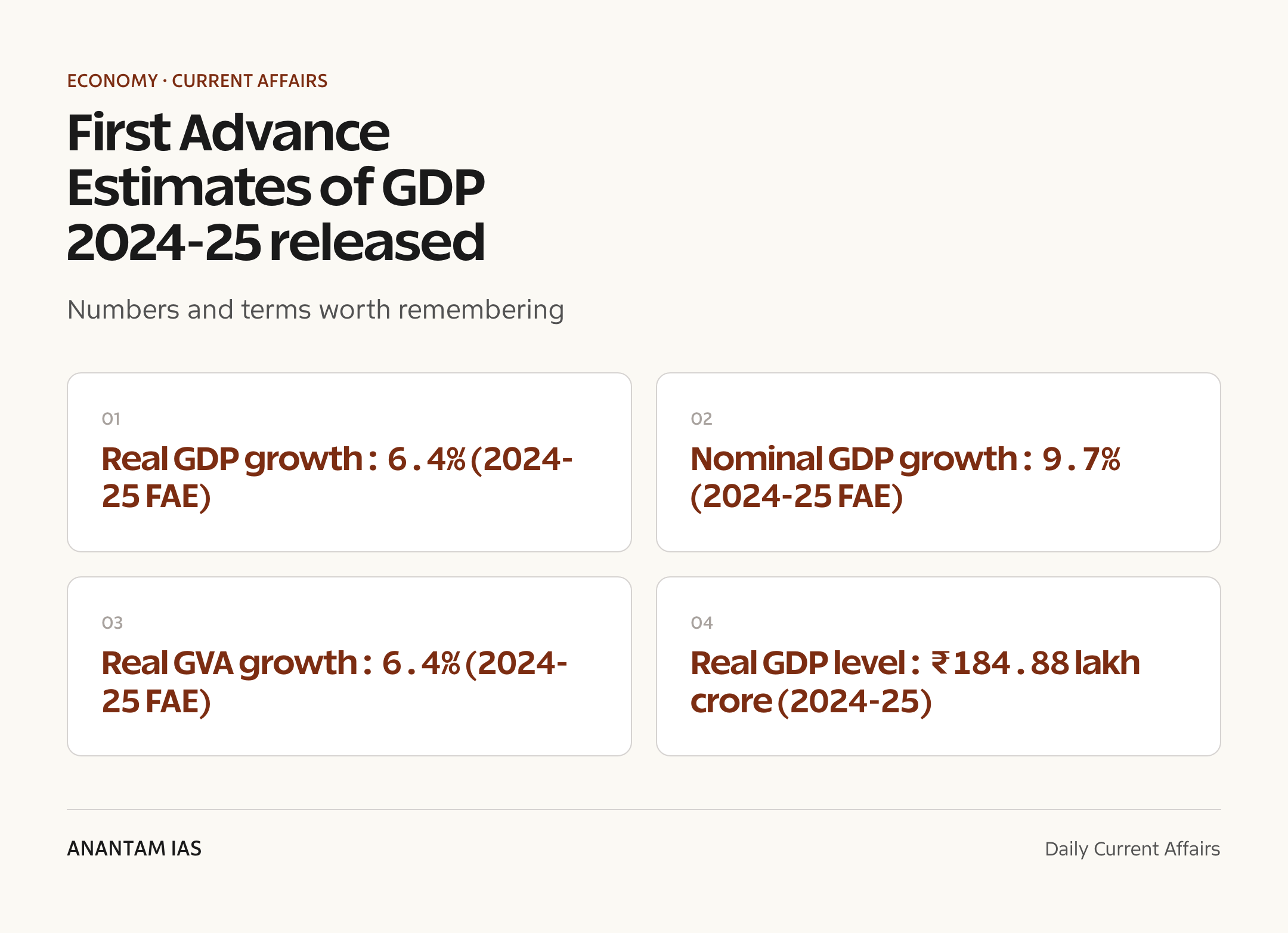
UPSC Relevance
Prelims Relevance
- FAE figures are used in exam questions on national income concepts, difference between nominal and real GDP, GVA composition and the methodology of official estimates. Remember the headline numbers: 6.4% real growth and 9.7% nominal growth for 2024-25.
Mains Relevance
GS3 Economy
- FAE informs answers on macroeconomic performance, fiscal policy design, limitations of indicator-based estimates, and sectoral policy prescriptions. Use FAE to critique data sources, discuss implications for employment and inflation, and link to government revenue projections.
Essay
- Use the FAE to build arguments on economic growth trajectory, sustainability of recovery, structural reform needs and the trade-off between growth and inflation. The nominal-real gap offers a datapoint for essays on fiscal consolidation and public investment.
Background and Context
What are Advance Estimates
Definition and purpose of advance GDP estimates published by MoSPI.
- Advance Estimates provide an early numerical picture of annual GDP and GVA before final data are available.
- These are produced using the benchmark-indicator method: last year’s detailed base is extrapolated using current indicators.
- MoSPI issues First Advance, Second Advance and Final Estimates as data coverage improves along the release calendar.
- The estimates support policy planning, budget assumptions and market signalling while remaining provisional.
Headline numbers in FAE 2024-25
Quick recall of the main figures candidates must remember.
- Real GDP at Constant (2011-12) prices: ₹184.88 lakh crore in 2024-25.
- Real GDP growth: 6.4% in 2024-25 versus 8.2% in 2023-24.
- Nominal GDP at Current prices: ₹324.11 lakh crore, growth 9.7%.
- Real GVA estimated at ₹168.91 lakh crore with growth of 6.4%.
Methodology: benchmark-indicator approach
How the FAE numbers are constructed and what indicators are used.
- Base detailed estimates (previous PE) are extended using current-year indicators for each sector.
- Key indicators include IIP, corporate financials for Q1 and Q2, and administrative datasets from ministries.
- Agricultural estimates are taken from Ministry of Agriculture and Farmers Welfare production projections for crops and horticulture.
- Transport indicators include passenger and freight metrics for rail, air and ports; mining and manufacturing use production and consumption series.
Data sources and coverage issues
List of primary data inputs and caveats about coverage.
- GST outward supplies up to November 2024 used to estimate services and goods activity, but GSTN data remain evolving.
- Corporate results for Q1 and Q2 offer early signals but exclude unlisted firms and lag some sectors.
- State and central accounts up to November 2024 inform government consumption and subsidy estimates; later revisions can alter totals.
- Some indicators have limited frequency or late reporting, creating reliance on proxy series subject to revision.
Interpretation: real vs nominal dynamics
What the gap between real and nominal growth indicates for policy.
- Real growth of 6.4% captures volume expansion after adjusting for price changes.
- Nominal growth at 9.7% reflects both volume and price increases; the difference approximates aggregate price movement.
- A rising nominal base affects tax buoyancy and the denominator in fiscal deficit ratios expressed as a percentage of GDP.
- Policymakers watch nominal GDP closely for revenue projections and for setting fiscal targets in successive budgets.
Limitations and revision risks
Why FAE can change and the consequences for use in policy and exams.
- FAE rely on partial-year indicators; improved coverage or methodological updates lead to Second Advance and Final revisions.
- Non-synchronous reporting across states and agencies can introduce bias into early estimates.
- Sectoral mismeasurement (for example in services) is a recurring challenge for timely GDP estimation.
- Exam answers should note that FAE are provisional and comment on likely directions of revision when relevant.
Way Forward
For policymakers
- Treat FAE as a working baseline when calibrating fiscal targets and avoid over-optimistic revenue pegging.
- Use sectoral GVA signals to prioritise support where growth is lagging, especially for construction and manufacturing if underperforming.
- Monitor inflation indicators alongside nominal growth to decide on the pace of fiscal expansion and public investment.
- Plan contingency buffers in budget estimates recognising potential downward revisions in second and final estimates.
For analysts and students
- Cross-check FAE indicators like IIP, GST, and corporate results to understand sector drivers behind headline growth.
- Track the Second Advance Estimates and Q3 quarterly GDP release for trend confirmation or reversal.
- Use FAE numbers to practice writing balanced Mains answers: state the figure, explain methodology, and discuss implications.
- Learn to quantify the nominal-real gap and explain its relevance for fiscal ratios and price trends.
For state governments
- Align state fiscal plans with the national nominal GDP trajectory to avoid overstating revenue expectations.
- Leverage sectoral insights from GVA to design targeted interventions for agriculture, MSMEs and transport.
- Improve timeliness and transparency of state-level accounts so national aggregates are less subject to late revision.
- Coordinate with central agencies to share administrative data that enhance the accuracy of future estimates.
For exam preparation
- Memorise the headline numbers and the distinction between real and nominal GDP for prelims recall.
- Practice mains answers that critique indicator-based estimates and propose institutional improvements to data systems.
- Use the FAE release as a prompt for essays on growth vs equity, fiscal consolidation and public investment choices.
- Prepare diagrams or short tables contrasting 2023-24 and 2024-25 numbers to present crisp answers under time pressure.
Conclusion
The First Advance Estimates for 2024-25 give the first official view of the year’s macro trajectory: a moderate 6.4% real growth and 9.7% nominal expansion. These figures are provisional and shaped by indicator coverage; they will guide fiscal assumptions and policy debate until revised by the Second Advance and Final Estimates.
UPSC Practice Questions
Prelims MCQ 1
Which of the following is true about the First Advance Estimates (FAE) of GDP published by MoSPI for a financial year?
(a) FAE are final and cannot be revised in subsequent releases. (b) FAE use the benchmark-indicator method to extrapolate from previous year estimates. (c) FAE rely solely on annual surveys completed after the financial year end. (d) FAE provide only nominal GDP and not real GDP estimates.
Answer: (b) FAE use the benchmark-indicator method to extrapolate from previous year estimates.
Explanation:
FAE are provisional and produced using the benchmark-indicator method that extrapolates previous detailed estimates with current indicators. They include both real and nominal GDP estimates and are subject to revision.
Prelims MCQ 2
According to the First Advance Estimates for FY 2024-25, the estimated real GDP growth and nominal GDP growth were:
(a) 8.2% real and 12.0% nominal (b) 6.4% real and 9.7% nominal (c) 5.0% real and 7.5% nominal (d) 7.5% real and 10.2% nominal
Answer: (b) 6.4% real and 9.7% nominal
Explanation:
The FAE for 2024-25 reported real GDP growth of 6.4% and nominal GDP growth of 9.7% compared with 2023-24.
UPSC Mains Questions
- {‘question’: “Critically examine the strengths and weaknesses of the benchmark-indicator method used in India’ s Advance Estimates of GDP. How does reliance on high-frequency indicators affect the reliability of early GDP estimates?”, ‘model_answer’: “Begin by defining the benchmark-indicator method: it extrapolates last year’ s detailed estimates using current-year indicators for each sector. Strengths: provides timely macro signals; uses diverse high-frequency indicators such as IIP, GST data, corporate results and agricultural estimates; helps policymakers and markets form expectations. Weaknesses: partial coverage bias as many indicators exclude informal and unlisted activity; administrative data have reporting lags and revision risk; services sector measurement remains weak with proxy indicators that may misstate growth. Reliance on high-frequency indicators improves timeliness but can reduce reliability if series are noisy or unrepresentative. Conclude by suggesting ways to improve reliability: expand administrative data sharing, strengthen sample surveys, integrate real-time digital footprints cautiously, and communicate uncertainty through confidence ranges or scenario estimates.”}
- {‘question’: ‘What are the implications of a widening gap between nominal and real GDP growth for fiscal policy? Illustrate your answer with reference to the FAE 2024-25 numbers.’, ‘model_answer’: ‘Start by explaining nominal vs real GDP: nominal includes price changes while real adjusts for inflation. A widening gap means higher nominal growth relative to real growth, signalling price effects or inflation. Fiscal implications: higher nominal GDP raises the denominator for fiscal ratios, easing headline fiscal deficit targets if revenues grow correspondingly; it can improve tax buoyancy and debt-to-GDP metrics. Risks include over-reliance on price-driven nominal growth when real activity is weaker, leading to unsustainable expenditure commitments. Using FAE 2024-25: nominal growth 9.7% against real 6.4% suggests an aggregate price component near 3.3 percentage points. Policymakers should treat nominal buoyancy cautiously, avoid permanently raising recurring expenditure based on price-driven gains, and prioritise growth-enhancing capital spending while monitoring inflation.’}
Source: PIB, Ministry of Statistics & Programme Implementation.
Frequently Asked Questions
q
a
q
a
q
a
q
a
q
a
q
a
Source: https://anantamias.com/current-affairs/gdp-first-advance-estimates-2024-25-2025/
Major Kandla Port capacity projects announced
Why in News?
Government announced large investments to expand Kandla (Deendayal) Port capacity: a mega shipbuilding complex and a new external cargo port, together costing about ₹57,000 crore and adding substantial cargo and shipbuilding capacity.
- Announcement covers two headline projects: ₹30,000 crore Mega Shipbuilding Facility and ₹27,000 crore new cargo port outside Kandla creek.
- New cargo port will add 135 MTPA to Kandla’s throughput and allow segregation of dry and liquid cargo.
- Shipbuilding complex will have capacity to build 32 ships and repair 50 vessels annually, including VLCC-class units up to 3,20,000 DWT.
- Projects aim to catalyse a marine industrial cluster, marina, fishing harbour and townships on over 8,000 acres.
- Announcements are pitched as elements of the government’s Make in India, Make for the World and port-led industrialisation agenda.
The development matters in the context of:
- Kandla (Deendayal) Port is one of India’s oldest and largest multipurpose ports and a key hub on the western coast handling bulk, liquid and container traffic.
- India’s port capacity expansion is part of a broader strategy to improve logistics efficiency, reduce turnaround time, and lower trade costs for importers and exporters.
- Shipbuilding and repair capacity in India has been a policy priority to reduce dependence on foreign yards for large commercial and strategic vessels.
- Coastal Economic Zones and port-led industrial clusters are promoted to link ports with manufacturing, services and export-oriented units.
- Large greenfield port projects require significant coastal land, dredging, and environmental and social clearances, plus long-term cargo commitments under PPP models.
- Port modernisation interacts with inland connectivity (rail and road), hinterland logistics, and national-level initiatives like Sagarmala and PM Gati Shakti.

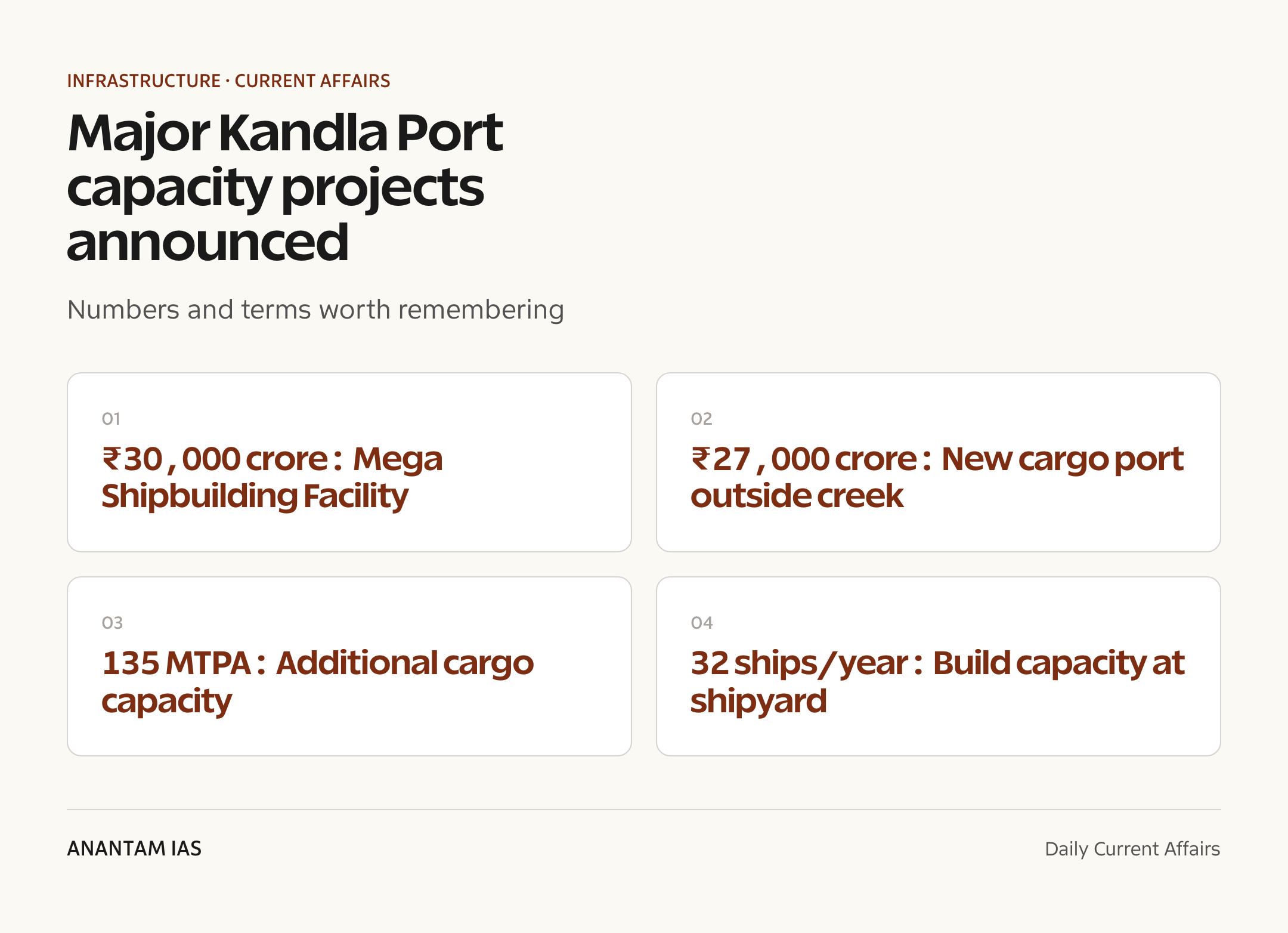
UPSC Relevance
Prelims Relevance
- Numbers and facts: investment amounts (₹30,000 crore and ₹27,000 crore) and added capacity (135 MTPA).
- Deendayal Port (Kandla) location: Gujarat, near Gulf of Kutch and Tuna coast; relevance to questions on Indian ports.
- Technical terms: VLCC (Very Large Crude Carrier) and DWT (deadweight tonnage) — common in shipping prelims vocabulary.
Mains Relevance
GS3 Infrastructure and Economy
- Discuss port-led development and its role in trade competitiveness, employment generation and regional industrialisation.
- Evaluate public-private partnership models in port infrastructure and financing large greenfield maritime projects.
- Analyse environmental, social and coastal regulation challenges in large port and shipbuilding projects.
- Assess strategic and security implications of enhancing shipbuilding and repair capacity domestically.
Essay
- Topics on infrastructure-led growth, Make in India, coastal economy and India’s integration with global value chains.
- Questions on sustainable development, balancing economic development with coastal ecology and fisherfolk livelihoods.
Background and Context
Deendayal (Kandla) Port: profile and significance
A strategic western port that anchors trade in Gujarat and the larger western hinterland.
- Located on the Gulf of Kutch coastline, Kandla is one of India’s busiest multipurpose ports handling dry bulk, liquid bulk and containers.
- Serves hinterlands of Gujarat, Rajasthan, Madhya Pradesh and parts of western India, making it crucial for export-import flows.
- Historically developed as a response to partition-era maritime needs; now rebranded administratively as Deendayal Port Authority.
- Existing infrastructure includes multiple jetties, liquid berths at Vadinar and container facilities at Tuna Tekra (ongoing expansion).
Existing capacity and recent projects
Kandla has been expanding incrementally through discrete projects under PPP and authority-led investments.
- Tuna Tekra container terminal is already being developed under PPP with plans for multi-cargo handling and TEU capacity additions.
- New oil jetties, SBMs and product jetties at Vadinar have added liquid handling capacity over recent years.
- Ship repair and smaller shipbuilding activities exist, but not at VLCC construction scale; capacity mostly for coastal and medium-size vessels.
- Port modernisation under national programmes has emphasised mechanisation, automation and hinterland connectivity improvements.
Technical aspects: shipbuilding and port construction
Shipyards and new port terminals require specialised infrastructure and ecosystem linkages.
- VLCC construction demands large slipways or dry docks, heavy-lift equipment, block assembly facilities and deep-water access.
- Ship repair depends on dry docks, floating docks, repair berths and skilled labour for diverse trades — welding, piping, electrical works.
- Port terminals need berths with sufficient draft, quay cranes, conveyor systems for bulk, pipelines for liquid cargo and yard space.
- Dredging and channel maintenance are recurring costs; placing a port outside the creek can reduce dredging needs if near navigation channels.
Economic multipliers and employment
Large maritime projects can stimulate direct and indirect economic activity across supply chains.
- Shipbuilding/repair cluster creates skilled and semi-skilled jobs across manufacturing, engineering and services.
- Ancillary industries include steel fabrication, engine suppliers, electrical equipment, ship interiors and maritime logistics firms.
- Townships, marina and fisheries infrastructure bring non-maritime employment in retail, hospitality and local services.
- Long-term cargo terminal operations generate port operations staff, stevedoring, customs-related services and logistics firms.
Environmental and social considerations
Coastal projects face risks that need mitigation through regulation, technology and community consultation.
- Dredging, reclamation and construction can impact mangroves, fisheries and coastal erosion patterns; environmental impact assessments are mandatory.
- Fisherfolk displacement and access to traditional fishing grounds need to be addressed through rehabilitation and compensation.
- Pollution control plans for shipbuilding yards are essential to manage metal, paint and chemical effluents.
- Regulatory clearances involve central and state agencies; compliance with CRZ (Coastal Regulation Zone) and environmental norms is central.
Financing and PPP models
Large capex projects typically rely on mixed financing and long-term concession arrangements.
- Projects can be funded through central allocations, port authority balance sheets, PPP concessions and private investor capital.
- Risk allocation in PPP includes traffic risk, construction risk, environmental approvals and land acquisition responsibilities.
- Long-term offtake commitments, common user policies and tariff frameworks determine bankability of port projects.
- Sovereign support or viability gap funding may be needed for strategic projects with long gestation.
Way Forward
Robust environmental and social safeguards
Integrate strong mitigation measures early in project design to reduce delays and social friction.
- Conduct comprehensive, public EIA with transparent disclosure of findings and independent review panels.
- Design fishery access corridors and compensation schemes to protect livelihoods of coastal communities.
- Adopt low-impact dredging techniques and silt management plans to reduce ecological damage.
- Mandate zero-liquid-discharge and effluent treatment standards for shipbuilding and repair units.
Hinterland connectivity and modal integration
Ensure rail and road links and logistics parks are planned in tandem to realise full throughput benefits.
- Prioritise dedicated freight corridors, last-mile rail links and multimodal freight terminals to decongest roads.
- Synchronise port capacity addition timelines with rail/road projects under PM Gati Shakti planning processes.
- Facilitate connected inland container depots and warehousing clusters to speed cargo evacuation.
- Promote digital integration for customs, terminal operations and cargo tracking to lower turnaround times.
Skill development and local industry linkages
Build human capital and supplier networks to capture value from shipbuilding and repair activity.
- Set up specialised maritime skill centres for welding, marine engineering and shipfitting near the project site.
- Incentivise supplier parks and component manufacturers to locate within the marine industrial cluster.
- Use local hiring quotas and apprenticeship programmes to ensure community benefits and build workforce depth.
- Link vocational institutes with shipyards for internships and on-the-job training pipelines.
Financing structures and risk mitigation
Adopt financing models that spread risk and secure long-term cargo commitments.
- Use blended finance: combine sovereign support, institutional investors and strategic industry partners.
- Structure PPPs with clear traffic sharing, performance benchmarks and dispute resolution mechanisms.
- Offer anchor tenancy or throughput guarantees for initial years to make projects bankable.
- Explore green finance instruments for eco-friendly construction practices and pollution-control investments.
Conclusion
The Kandla announcements aim to transform Deendayal Port into a major shipbuilding and cargo-handling hub with large economic multipliers. Success will depend on aligned hinterland connectivity, strict environmental and social safeguards, skill creation, and robust financing and PPP frameworks. If implemented with balanced regulation and stakeholder engagement, the projects can advance port-led industrialisation and strengthen India’s maritime capabilities.
UPSC Practice Questions
Prelims MCQ 1
Which of the following statements about the Kandla (Deendayal) Port announcements of January 2025 is/are correct? 1. A Mega Shipbuilding Facility with capacity to build VLCC-class ships up to 3,20,000 DWT was announced. 2. A new cargo port outside Kandla creek will add 135 MTPA to existing capacity. 3. The total announced investment for both projects is ₹75,000 crore. Select the correct answer using the code given below: A. 1 and 2 only B. 2 and 3 only C. 1 and 3 only D. 1, 2 and 3
(a) A (b) B (c) C (d) D
Answer: (a) A
Explanation:
Statements 1 and 2 are correct: the shipbuilding facility includes construction of VLCC-class vessels up to 3,20,000 DWT and the new cargo port is projected to add 135 MTPA. The combined investment announced is about ₹57,000 crore, not ₹75,000 crore, so statement 3 is incorrect.
Prelims MCQ 2
Consider the following features related to Very Large Crude Carrier (VLCC) construction: 1. Requires deep-draft access for launching and commissioning. 2. Demands large dry docks or slipways and heavy-lift equipment for block assembly. 3. Is typically free from environmental regulations due to its strategic nature. Which of the above statements are correct? A. 1 and 2 only B. 2 only C. 1 and 3 only D. 1, 2 and 3
(a) A (b) B (c) C (d) D
Answer: (a) A
Explanation:
Statements 1 and 2 are correct: VLCC construction needs deep-draft access and large docks/slipways and heavy-lift equipment. Statement 3 is incorrect because shipbuilding is subject to environmental regulations and clearances.
UPSC Mains Questions
- {‘question’: ‘Analyse how large port-capacity projects like the Kandla shipbuilding complex and new cargo port can influence regional economic development. Discuss both the potential gains and the challenges that must be managed.’, ‘model_answer’: ‘Large port-capacity projects act as catalysts for regional industrialisation by providing scale, connectivity and cost advantages. Potential gains include direct employment in construction, shipbuilding and terminal operations; indirect employment across steel, engineering, logistics and services; improved trade competitiveness through lower turnaround times and higher berth capacity; technology transfer and domestic manufacturing capability with shipyards building VLCCs; and attraction of foreign and domestic investment into the marine industrial cluster. Challenges include environmental risks from dredging and reclamation affecting fisheries and mangroves; displacement of coastal communities and associated social costs; requirement for large upfront capital leading to long payback periods and financial risk; dependence on hinterland connectivity and modal integration to realise throughput; and need for skilled labour and supplier ecosystems. Policy responses should include rigorous environmental impact management, stakeholder consultations and rehabilitation plans, integrated planning for rail and road links, skill development programmes, blended finance and PPP structures with clear risk sharing, and strong governance to ensure timely implementation and tariff discipline.’}
- {‘question’: ‘Critically examine the role of PPP (public-private partnership) in port development in India, using recent Kandla projects as an example. What policy measures would improve PPP outcomes in large maritime projects?’, ‘model_answer’: ‘PPP has been central to Indian port development to mobilise private capital and operational expertise. In the Kandla context, the Tuna Tekra container terminal and possibilities for multi-cargo terminals show scope for PPPs to deliver capacity. PPP strengths include access to private investment, enhanced efficiency, innovation and quicker execution. Limitations are traffic risk for private partners, delays in clearances, land acquisition hurdles, tariff regulation constraints, and mismatch between public policy objectives and private return horizons. Policy measures to improve outcomes include: offering structured viability gap funding where cargo certainty is weak; providing anchor client arrangements or minimum throughput guarantees for initial years; streamlining environmental and coastal clearances to reduce timeline risk while keeping safeguards; improving land acquisition and compensation frameworks; establishing clear tariff-setting mechanisms and dispute resolution systems; and promoting blended finance with institutional investors to lower cost of capital.’}
Source: PIB, Ministry of Ports, Shipping and Waterways.
Frequently Asked Questions
q
a
q
a
q
a
q
a
q
a
q
a
Source: https://anantamias.com/current-affairs/kandla-port-capacity-projects-57000-cr-2025/
New method to increase nitrogen use efficiency can support sustainable crop yields
Why in News?
A new biological strategy to raise Nitrogen Use Efficiency (NUE) in crops by modulating plant nitric oxide (NO) levels was reported by NIPGR on 07 Jan 2025. The method could reduce dependence on inorganic nitrogen fertilisers and lower agricultural greenhouse gas emissions.
- Novel approach: Study shows systemic NO modulation upregulates high-affinity nitrate transporters (HATs) to improve NUE.
- Policy relevance: Potential to reduce inorganic fertiliser demand, lowering input costs and fertilizer-linked emissions.
- Scalable options: Work combines genetic (phytoglobin overexpression) and pharmacological (NO scavengers) routes, offering multiple deployment paths.
- Food security: Improved NUE helps sustain crop yields on limited N inputs, relevant for low-fertility soils and resource-poor farmers.
- Research to product path: Team is exploring soil bacteria and formulations that act as NO scavengers for field deployment.
The development matters in the context of:
- Nitrogen Use Efficiency (NUE) measures biomass or yield produced per unit of nitrogen input. Low NUE means more fertiliser needed and greater environmental impact.
- Global problem: Inorganic N fertiliser manufacture and over-application contribute substantial greenhouse gases and reactive nitrogen emissions (NOx, N2O).
- Existing solutions: Agronomic measures include split-dose application, slow-release fertilisers and precision fertigation; these reduce losses but raise costs and have operational limits.
- Biological route: Manipulating plant physiology and microbiome to improve uptake and assimilation offers an alternative to increasing fertiliser volumes.
- High-affinity nitrate transporters (HATs) like NRT2.1 and NRT2.4 are activated under low external N and are critical for uptake when soil nitrate is scarce.
- Nitric oxide (NO) is a signalling molecule in plants that can modify proteins via nitrosylation and alter transporter expression and activity.

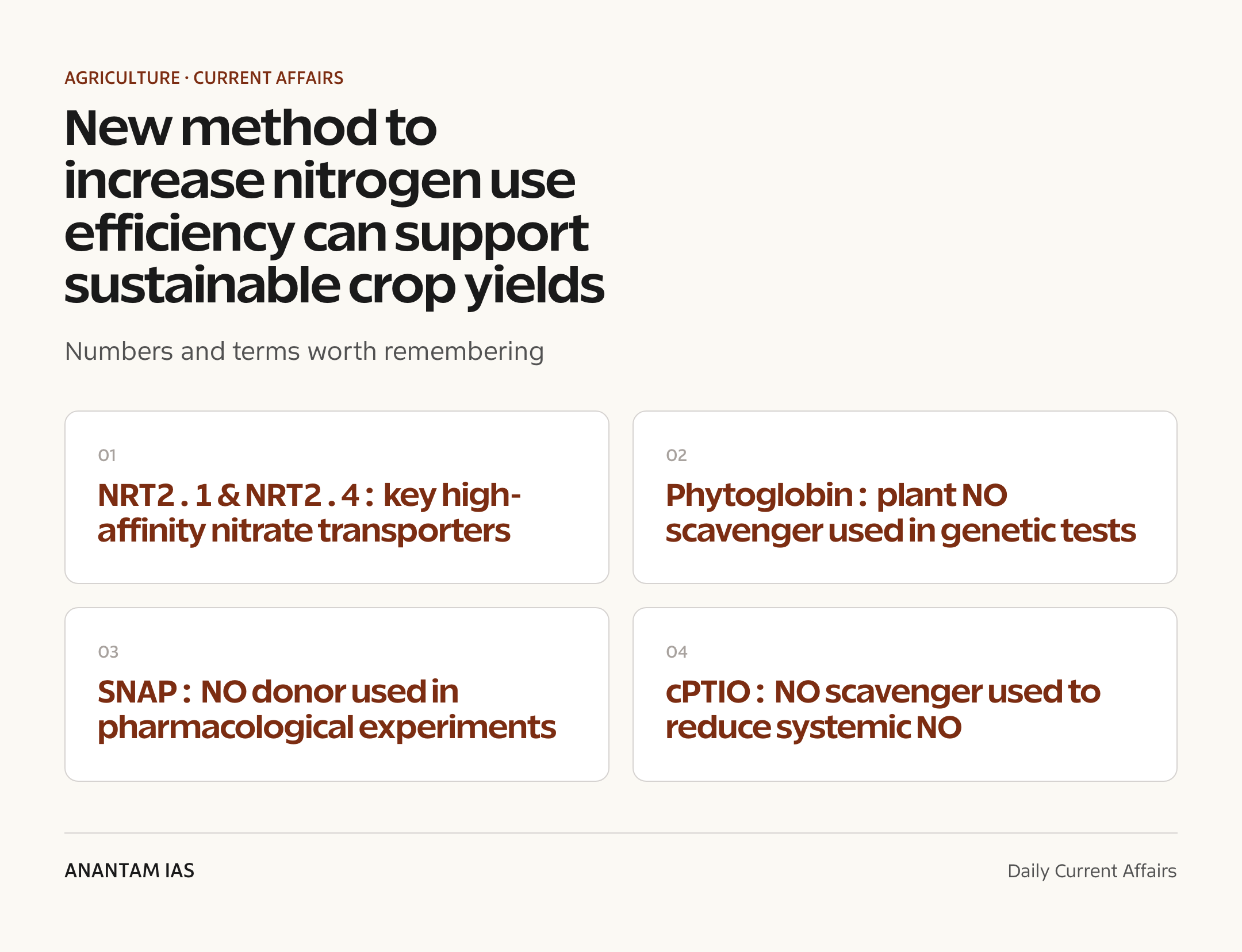
UPSC Relevance
Prelims Relevance
- Definition and meaning of Nitrogen Use Efficiency and its environmental significance.
- Role of high-affinity nitrate transporters (NRT2 family) in plant nitrogen uptake.
- Biological function of nitric oxide (NO) in plants and concept of NO scavengers like phytoglobin.
Mains Relevance
GS3 Science, Agriculture and Environment
- Discuss strategies to raise agricultural productivity sustainably by reducing chemical fertiliser dependence; link to NUE innovations.
- Analyse the role of plant signalling molecules in nutrient use and how biotechnology can contribute to climate-friendly agriculture.
- Evaluate policy implications and implementation challenges in scaling biological NUE solutions across India.
Essay
- Sustainable Agriculture: Integrating biological solutions such as NO modulation to reduce fertiliser use and greenhouse gas emissions.
- Science and Technology in Indian Agriculture: Role of plant molecular biology research in addressing food security and environmental goals.
Background and Context
Why nitrogen matters for crops
Nitrogen is the primary limiting nutrient for crop growth and yield in most major cropping systems.
- Nitrogen forms: Plants take up nitrogen mostly as nitrate (NO3-) and ammonium (NH4+).
- Yield driver: Adequate N supports leaf area, photosynthetic capacity and grain protein content.
- Soil pools: Mineral N in soil is dynamic and affected by mineralisation, leaching and denitrification.
- Trade-offs: High N rates boost yields but increase risk of leaching, runoff, NOx and N2O emissions, and water pollution.
Nitrogen Use Efficiency (NUE) — concept and indicators
NUE quantifies how effectively plants convert applied nitrogen into harvestable product.
- Common metrics: Agronomic efficiency (kg yield per kg N applied), recovery efficiency and internal NUE.
- Determinants: Soil type, water availability, fertiliser timing, crop genetics and microbial activity.
- Targeting NUE: Improving uptake (root traits, transporters), assimilation (enzyme activity) and partitioning to grain.
- Policy targets: Higher NUE cuts fertiliser imports, farmer costs and national emissions footprints.
Role of nitrate transporters
Nitrate uptake is mediated by transporter families with distinct affinities and regulatory controls.
- Dual systems: Low-affinity transporters operate at high soil N; high-affinity transporters (HATs) function under low N.
- NRT2 family: Members like NRT2.1 and NRT2.4 are critical HATs that support uptake when soil nitrate is scarce.
- Regulation: Transporter expression is finely tuned by N status, root signalling and systemic cues including signalling molecules.
- Breeding target: Enhancing HAT expression/function is a strategy to improve uptake on low-input soils.
Nitric oxide in plant physiology
NO is a gaseous signalling molecule that influences growth, stress responses and nutrient signalling.
- Signalling roles: NO modulates stomatal movement, root development, pathogen response and protein activity via nitrosylation.
- Interaction with N: NO influences nitrate transporter regulation and nitrogen assimilation pathways.
- NO levels: Both endogenous production and scavenging determine steady-state NO available for signalling.
- Negative effects: Excess NO can lead to inappropriate protein modification and regulatory disruption.
Phytoglobin and NO scavenging
Phytoglobins are plant hemoglobins that bind and scavenge NO, affecting NO-mediated signalling.
- Molecular function: Phytoglobin catalyses NO oxidation or sequestration, lowering free NO levels in plant tissues.
- Genetic route: Overexpression of phytoglobin decreases systemic NO and shifts regulatory networks.
- Observed effect: In the reported study, phytoglobin overexpression increased HAT expression and improved NUE under low N.
- Translational potential: Genetic or microbial strategies that increase phytoglobin activity or mimic its effect may be used in crops.
Limitations of agronomic NUE measures
Current agronomic practices reduce losses but have cost, operational and environmental limits.
- Split dosing and slow-release fertilisers reduce leaching but raise input costs and management complexity.
- Precision tools need capital, technical skills and supply chains not always present for smallholders.
- Manufacturing footprint of synthetic fertilisers contributes CO2 and other emissions upstream.
- Need for alternatives: Biological and genetic innovations can complement agronomy to push NUE higher.
Way Forward
Translational research and field validation
- Pilot multi-location field trials in major cereal zones to validate NO-scavenging strategies under realistic agronomic conditions.
- Evaluate yield response and grain quality, not only plant N metrics, across soil types and seasons.
- Assess economic trade-offs for farmers: input savings versus costs of new treatments or seed varieties.
- Set monitoring protocols for environmental outcomes: soil N, nitrate leaching and greenhouse gas fluxes.
Biological formulations and microbiome routes
- Develop and screen soil bacterial strains that act as NO scavengers or modulate plant NO metabolism.
- Formulate seed coatings, soil amendments or foliar sprays with safe NO-scavenging agents for easy farmer use.
- Test compatibility with existing fertiliser practices and beneficial microbes such as rhizobia and mycorrhizae.
- Design regulatory and biosafety testing pathways for microbial products under national norms.
Genetic approaches and breeding
- Introduce phytoglobin overexpression into elite varieties using breeding or targeted gene-editing with clear regulatory pathways.
- Screen diverse germplasm for natural variation in NO metabolism and HAT expression for marker-assisted selection.
- Ensure trait stacks preserve yield, stress tolerance and grain quality under farmer conditions.
- Plan containment and stewardship strategies for any transgenic or edited lines deployed.
Policy, incentives and farmer adoption
- Provide incentives or subsidies for validated low-N technologies that demonstrably reduce fertiliser use and emissions.
- Deploy extension modules to train farmers on integrating biological NUE solutions with best agronomy.
- Create public-private partnerships to scale production and distribution of NO-scavenging formulations and improved seeds.
- Incorporate NUE metrics into national soil fertility and climate-smart agriculture programs.
Conclusion
Modulating plant nitric oxide to boost Nitrogen Use Efficiency offers a promising biological complement to agronomic measures. Genetic and microbial NO-scavenging routes could reduce fertiliser demand, cut emissions and maintain yields, but success will depend on rigorous field validation, cost-effective productisation, regulatory clarity and farmer-centric deployment.
UPSC Practice Questions
Prelims MCQ 1
Which of the following statements about high-affinity nitrate transporters (HATs) is/are correct? 1. HATs operate primarily when soil nitrate concentrations are low. 2. NRT2.1 and NRT2.4 are examples of HAT genes. 3. Their expression is not influenced by plant signalling molecules. Choose the correct answer using the code given below.
(a) 1 and 2 only (b) 2 and 3 only (c) 1 and 3 only (d) 1, 2 and 3
Answer: (a) 1 and 2 only
Explanation:
Statements 1 and 2 are correct: HATs function under low soil nitrate and NRT2.1 and NRT2.4 are HATs. Statement 3 is incorrect because expression of HATs is regulated by plant signalling molecules including nitric oxide.
Prelims MCQ 2
Phytoglobin improves Nitrogen Use Efficiency in plants primarily by which mechanism? A. Increasing nitrate fertiliser uptake from soil by acting as a carrier. B. Scavenging nitric oxide, thereby altering transporter expression. C. Fixing atmospheric nitrogen in root nodules. D. Converting ammonium to nitrate in soil.
(a) A (b) B (c) C (d) D
Answer: (b) B
Explanation:
Phytoglobin acts as a plant NO scavenger. Lowering NO levels changes regulatory networks and increases expression of high-affinity nitrate transporters, improving N uptake and NUE. It does not fix atmospheric N or act in soil conversions.
UPSC Mains Questions
- {‘question’: ‘Explain how modulation of plant nitric oxide (NO) levels can change Nitrogen Use Efficiency (NUE). Discuss the potential benefits and risks of deploying NO-scavenging strategies in Indian agriculture.’, ‘model_answer’: ‘Modulating NO levels alters plant signalling pathways that regulate nitrate uptake and assimilation. NO can nitrosylate proteins involved in nutrient sensing and transporter regulation. Reduced NO, achieved by phytoglobin overexpression or pharmacological scavengers, upregulates high-affinity nitrate transporters (NRT2 family), improving uptake under low soil N and increasing internal N status, amino acid levels and growth. Benefits include lower fertiliser requirements, reduced emissions from fertiliser manufacture and application, cost savings for farmers and improved yields on marginal soils. Risks include off-target effects on NO-dependent stress responses, potential impacts on beneficial soil microbes, agronomic variability across soils and climates, biosafety and regulatory issues for genetic or microbial products, and the need to ensure grain quality is maintained. Any deployment requires multi-location field validation, environmental impact assessment, economic analysis and extension support.’}
- {‘question’: ‘What policy measures should the government consider to facilitate adoption of biological approaches that improve NUE, such as NO-scavenging formulations or phytoglobin-enhanced varieties?’, ‘model_answer’: ‘Policy measures could include: funding for translational research and large-scale field trials; fast-track evaluation and registration pathways for low-risk microbial and biochemical formulations; incentives or subsidies tied to verified reductions in fertiliser use or emissions; integrating NUE targets into national soil health and climate-smart agriculture programs; capacity building for extension services to train farmers; public-private partnerships for manufacturing and distribution; and clear biosafety regulations and stewardship plans for genetically modified or gene-edited varieties. Monitoring frameworks to track agronomic performance, environmental outcomes and socio-economic impacts should be mandated to guide scaling and course corrections.’}
Source: PIB, Ministry of Science & Technology.
Frequently Asked Questions
q
a
q
a
q
a
q
a
q
a
q
a
Source: https://anantamias.com/current-affairs/nitrogen-use-efficiency-crop-yield-2025/