Why in News?
Department of Financial Services (DFS) brought together regulators, technology partners and founders to strengthen the fintech ecosystem, discuss regulatory-sandbox tools, scale digital payment infrastructure and promote credit using digital footprints for MSMEs.
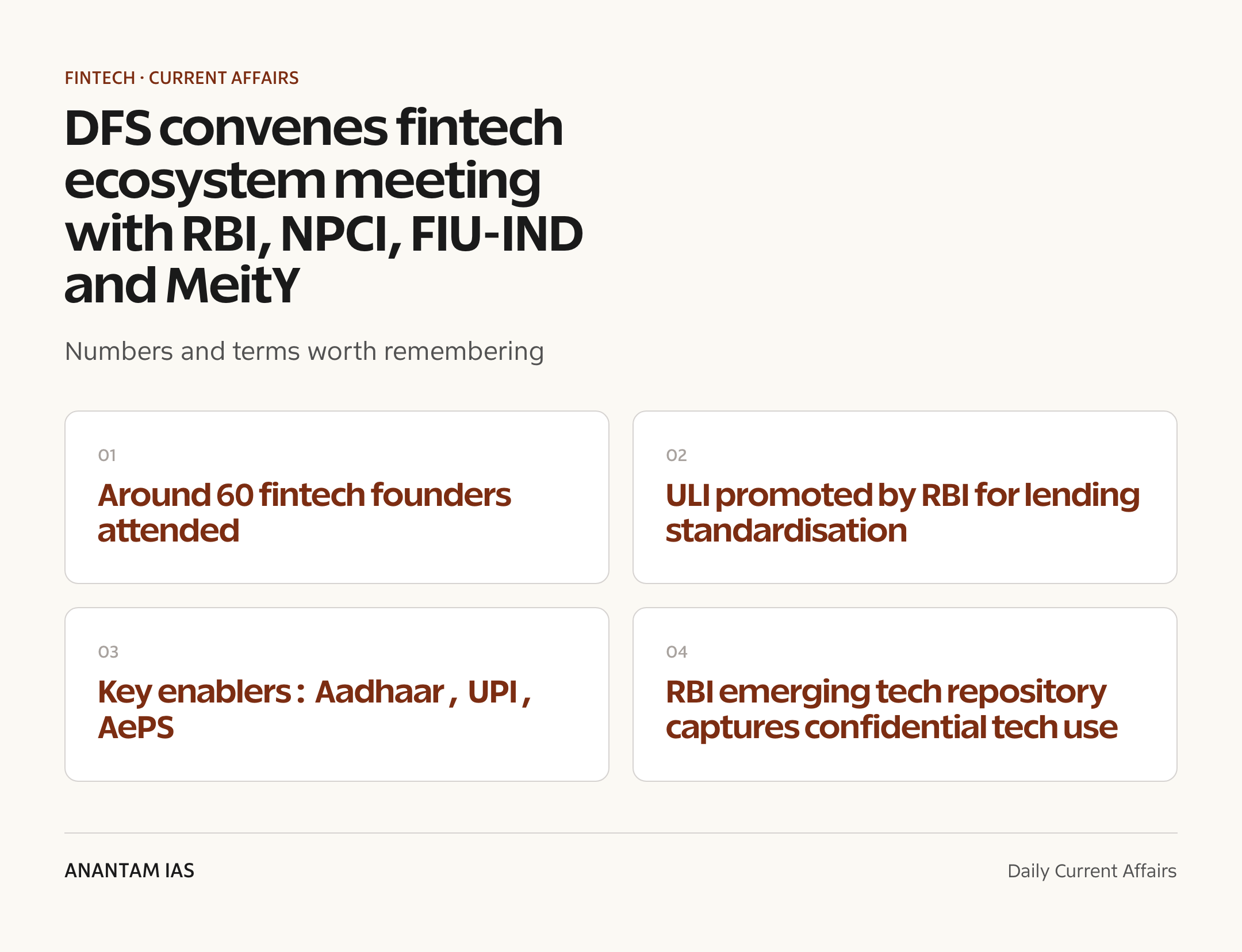
- High-level convening: Secretary, DFS chaired the meeting with senior officials from RBI, NPCI, FIU-IND, MeitY and about 60 fintech founders and associations.
- Focus on scale and standards: Participants discussed ways to elevate India’s fintech sector to global standards while maintaining strict regulatory compliance.
- Policy and infrastructure updates: RBI highlighted the Emerging Tech and Fintech Repository, Unified Lending Interface (ULI) and sandbox initiatives including video-KYC pilots.
- Inclusion and outreach: Emphasis on improving UPI and digital payments access in rural and north-eastern regions and increasing MSME access to credit via digital footprints.
- Government enablement: DFS flagged existing enablers such as Aadhaar, UPI and AePS, and policy levers like the regulatory sandbox, fintech repository and SRO framework.
The development matters in the context of:
- Fintech growth phase: India’s fintech sector has matured over the last decade, creating new payment rails, lending interfaces and identity-linked services that underpin digital finance.
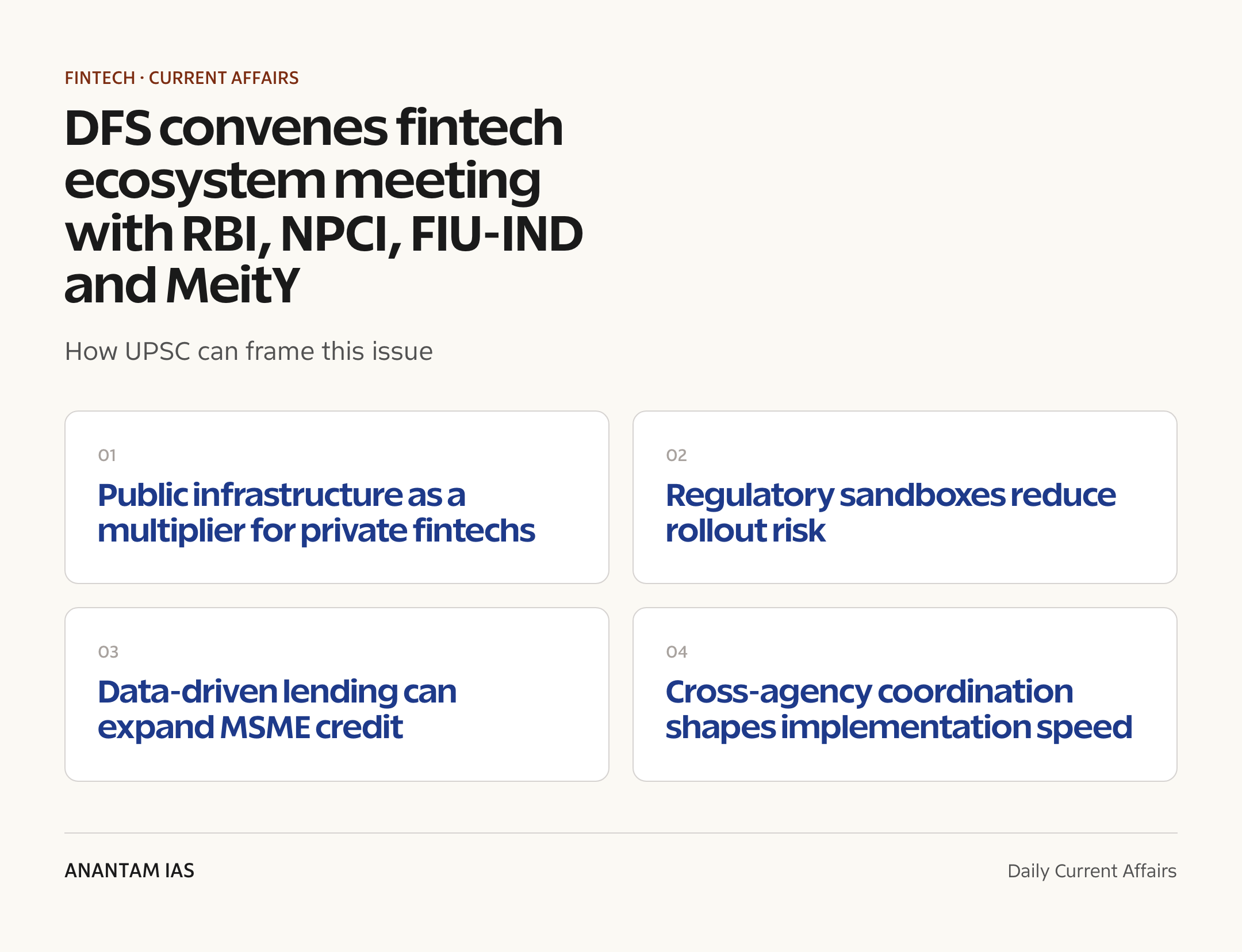
- Role of public infrastructure: Aadhaar, UPI and AePS act as foundational public goods that reduce transaction costs and enable scale for fintech firms.
- Regulatory balancing act: Authorities need to support innovation while guarding against systemic risks, fraud, AML threats and privacy lapses.
- RBI initiatives: Emerging Tech and Fintech Repository aims to map technology use; ULI standardises lending data flows; sandbox projects test consumer-facing tech like video-KYC.
- NPCI role: NPCI manages key retail payment systems such as UPI, IMPS, AePS and is central to improving reach in underserved states and rural areas.
- FIU-IND role: Financial Intelligence Unit monitors suspicious transaction reporting and works with fintechs on anti-money laundering and counter-terrorist financing compliance.
- MeitY engagement: Ministry of Electronics and IT works on digital public infrastructure, cybersecurity guidance, and interoperability standards needed by fintech platforms.
- MSME credit gap: Small firms face information asymmetry; digital footprints and ULI-like interfaces can lower screening costs and broaden lender participation.

UPSC Relevance
Prelims Relevance
- Public infrastructure: Identify Aadhaar, UPI and AePS as enablers of fintech growth and financial inclusion.
- Regulatory instruments: Remember terms like regulatory sandbox, Unified Lending Interface (ULI) and fintech repository as current policy tools.
- Institution roles: Distinguish mandates of RBI, NPCI, FIU-IND and MeitY in fintech governance.
Mains Relevance
GS3 Economy and Digital Finance
- Governance and regulation: Use the meeting to discuss state capacity to balance fintech innovation with consumer protection and systemic stability.
- Digital public goods: Explain how infrastructural public goods like UPI and Aadhaar can lower transaction costs and improve inclusion.
- Financial inclusion and credit: Analyse policy measures to expand digital lending to MSMEs using alternative data and interoperable interfaces.
Essay
- Technology and development: Use the convergence of public infrastructure and private innovation as an argument on digital transformation of economy.
- Government and markets: Discuss the evolving role of the state in providing platforms, standards and supervision while allowing market-led fintech solutions.
Background and Context
India’s fintech trajectory
Rapid expansion over a decade driven by payments, lending and identity layers.
- Payment revolution: UPI transformed retail payments by enabling instant, low-cost transactions and enabling third-party apps.
- Identity and trust: Aadhaar provided a scalable identity foundation used for KYC and subsidy targeting.
- Lending innovations: APIs and alternative data analytics enabled new credit products for consumers and MSMEs.
- Start-up ecosystem: Fintech startups scaled using cloud infrastructure, VC capital and partnerships with banks and NBFCs.
- Geographic reach: Urban adoption preceded rural; recent efforts aim to close the urban-rural digital divide.
Key institutional roles
Regulators and agencies provide rails, supervision and intelligence for a safe fintech ecosystem.
- RBI: Prudential regulation for banks and NBFCs, sandbox oversight, and tech repositories to map risks.
- NPCI: Operates retail payment systems such as UPI, IMPS and AePS and manages settlement and settlement risk controls.
- FIU-IND: Collects and analyses suspicious transaction reports and issues AML/CTF guidance to reporting entities including fintechs.
- MeitY: Sets standards for digital public infrastructure, cybersecurity and data protection technical guidance.
- DFS: Policy coordination, enabling frameworks and dialogue between government, regulators and private sector.
Regulatory sandbox and repository tools
Experimentation and data mapping are central to evidence-based fintech policy.
- Regulatory sandbox: Time-bound controlled environment to test novel fintech products with consumer safeguards.
- Fintech repository: Centralised catalogue of fintech products, participants and technology usage for policymaking.
- Emerging tech repository: RBI initiative to capture baseline confidential information on technology adoption across institutions.
- ULI: Unified Lending Interface standardises data exchange between lenders, enabling faster credit decisions and portability.
- Video-KYC pilots: Seek to ease onboarding while balancing identity fraud and AML risks.
Digital public infrastructure as enabler
Shared public systems reduce duplication and enable scale for private innovation.
- Aadhaar: Supports offline and online KYC verification with consented identity authentication.
- UPI: Open interoperable payment rail that reduced costs and expanded merchant acceptance.
- AePS: Bank-led biometric-enabled cash-in/cash-out for financial access in remote areas.
- API economy: Standardised APIs allow fintechs to plug into bank rails, credit bureaus and payment networks.
Risks in a fast-growing ecosystem
Innovation brings new consumer protection, systemic and national security risks.
- Operational risk: Cyberattacks, service outages and dependency on critical third-party providers.
- Fraud and AML: Increased digital transactions raise suspicious flows; reporting quality matters for FIU-IND.
- Data privacy: Extensive use of personal and financial data requires strong data governance and consent mechanisms.
- Concentration risk: Dominant platforms can create single points of failure and market power concerns.
Fintech and MSME credit
MSMEs are a key policy focus for digital lending expansion.
- Information asymmetry: Small firms lack formal credit histories; alternative data can reduce screening costs.
- ULI potential: Standardised credit APIs can improve lender discovery and loan portability for MSMEs.
- Risk-based pricing: Digital footprints enable more granular underwriting and potentially lower interest rates for creditworthy firms.
- Financial literacy: Digital lending must be backed by consumer education to prevent over-indebtedness.
Way Forward
Scale digital payments to underserved regions
- Last-mile infrastructure: Subsidise POS devices and offline UPI solutions for rural merchants and north-eastern states.
- Local onboarding drives: Coordinate bank-post office-fintech camps to increase merchant and consumer adoption.
- Interoperable agents: Promote interoperable cash-in/cash-out agents using AePS and UPI to boost liquidity in remote areas.
Strengthen data-driven lending for MSMEs
- ULI adoption: Encourage NBFCs and banks to onboard ULI and build standardised lender APIs.
- Alternative data standards: Define privacy-preserving formats for transaction, GST and Aadhaar-linked signals usable for credit models.
- Credit sandbox: Create a dedicated lending sandbox to test underwriting using digital footprints with consumer safeguards.
Enhance regulatory coordination and intelligence
- Shared repositories: Link fintech, emerging tech and AML repositories to provide policymakers with an integrated view of risks.
- Cross-agency task force: Institutionalise regular DFS-led consultations between RBI, NPCI, FIU-IND and MeitY for rapid policy response.
- Capacity building: Provide regulator training on machine learning explainability, cyber risk assessment and privacy engineering.
Consumer protection and operational resilience
- Minimum standards: Issue baseline rules for dispute resolution, disclosures and responsible lending for fintech platforms.
- Cyber resilience: Mandate backup arrangements, incident reporting timelines and third-party concentration checks.
- Financial literacy campaigns: Target MSMEs and rural users with digital finance training and grievance redress pathways.
Conclusion
Collaborative approach: The DFS convening signals an integrated policy stance where public infrastructure, regulators and fintechs align on scaling while managing risk.
Infrastructure plus regulation: UPI, Aadhaar and ULI combined with sandboxes and repositories can expand access and improve credit delivery if matched with strong AML and privacy safeguards.
Implementation focus: Operational steps such as ULI onboarding, offline payment solutions and regulator capacity building will determine whether policy intent translates into inclusion and stability.
UPSC Practice Questions
Prelims MCQ 1
Which of the following is operated by NPCI?
(a) Aadhaar (b) UPI (c) Unified Lending Interface (ULI) (d) Video-KYC regulatory sandbox
Answer: (b) UPI
Explanation:
UPI is a retail payment system operated by NPCI. Aadhaar is an identity system managed by UIDAI. ULI is an RBI-promoted lending interface. Video-KYC may be piloted in regulatory sandboxes overseen by RBI.
Prelims MCQ 2
The Unified Lending Interface (ULI) aims to:
(a) Provide biometric authentication for payments (b) Standardise data exchange for lending decisions (c) Replace Aadhaar for KYC (d) Operate retail transactions like UPI
Answer: (b) Standardise data exchange for lending decisions
Explanation:
ULI standardises data flows between lenders and participants to speed up credit decisions and improve portability. It is not a payment rail or an identity replacement.
UPSC Mains Questions
- {‘question’: ‘Examine how digital public infrastructure such as Aadhaar and UPI have enabled fintech innovation in India. What are the governance challenges that arise from their widespread use? Illustrate with examples and suggest reforms.’, ‘difficulty’: ‘Mains’}
- {‘question’: ‘Critically analyse the role of regulatory sandboxes and fintech repositories in balancing innovation and risk in the financial sector. How should regulators coordinate to protect consumers while supporting scale?’, ‘difficulty’: ‘Mains’}
Source: PIB, Ministry of Finance.
Frequently Asked Questions
q
a
q
a
q
a
q
a
q
a
q
a
Tell Google you want more of this.
Add Anantam IAS as a preferred sourceOne tap, and this site shows up more often in your own Top Stories, AI Overviews and AI Mode. Remove it any time.