Why in News?
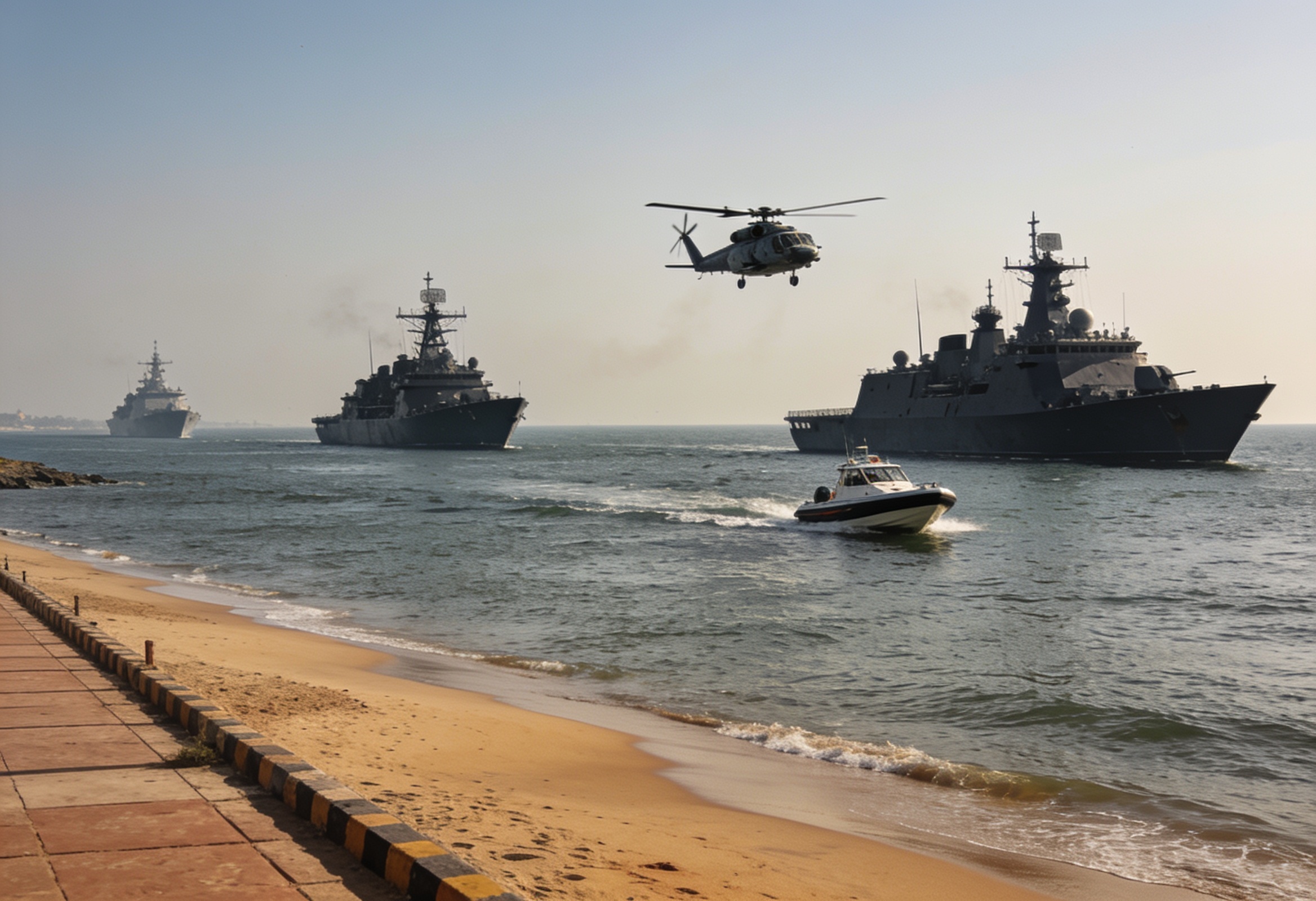
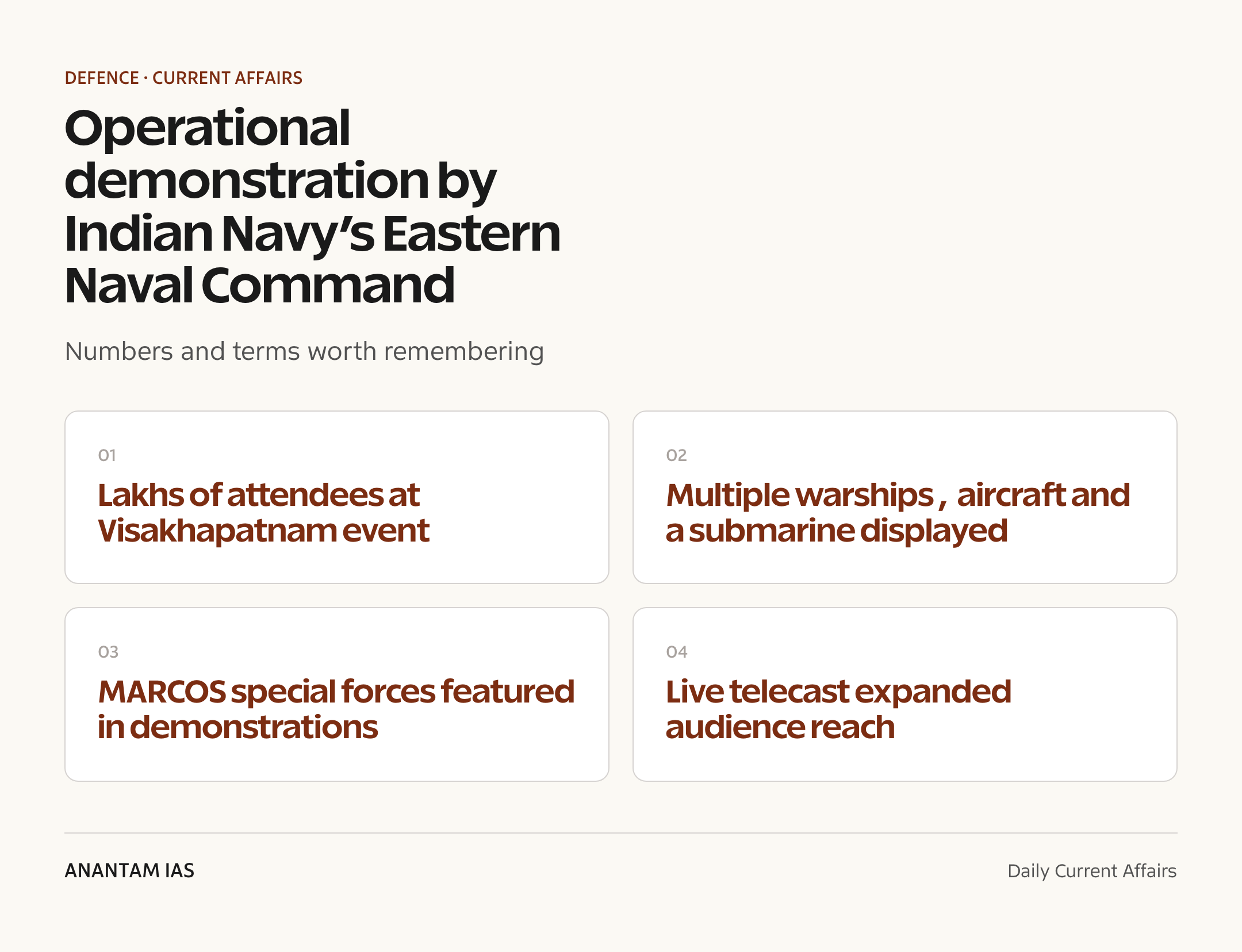
The Indian Navy staged a high-visibility Operational Demonstration at Ramakrishna Beach, Visakhapatnam on 04 Jan 2025. The event highlighted operational capabilities, public outreach and strategic messaging from the Eastern Naval Command.
- Public showcase of force: A large-scale display involving warships, aircraft, submarines and special forces (MARCOS) demonstrates breadth of capability to domestic and regional audiences.
- Deterrence signalling: Concentrated deployment and visible readiness projects a deterrence posture in the Bay of Bengal and the Indo-Pacific maritime domain.
- Defence diplomacy: High-profile events support soft power and civil-military ties, and can be calibrated to convey messages to foreign navies and partners.
- Community outreach: Engaging lakhs of citizens and elected officials builds public confidence in maritime security and helps recruitment, coastal cooperation and disaster response preparedness.
- Operational validation: Integrated displays validate inter-operability across platforms and services, useful for planning and force development.
The development matters in the context of:
- Eastern Naval Command (ENC): ENC is the Indian Navy’s principal formation on the eastern seaboard, headquartered at Visakhapatnam, with responsibilities for the Bay of Bengal and eastern Indian Ocean approaches.
- Strategic setting: The Indo-Pacific has rising maritime competition. Visible naval demonstrations are part of a set of tools used by states to reassure domestic audiences and signal resolve to neighbours and extra-regional powers.
- Force composition: Modern ENC assets include destroyers, frigates, corvettes, submarines, maritime patrol aircraft and Marine Commandos (MARCOS), enabling layered sea control and response options.
- Public diplomacy: Hosting ceremonials, laser and drone shows, and media telecasts enhances the Navy’s public narrative about technological modernisation and readiness.
: Presence of state leadership and judiciary leaders at the event underlines civilian support and the role of state governments in facilitating naval infrastructure and operations. - Disaster response overlap: Demonstrations often highlight platforms and units that have domestic roles in HADR (humanitarian assistance and disaster relief), relevant to coastal state disaster management planning.
UPSC Relevance
Prelims Relevance
- Identify the role and area of responsibility of the Eastern Naval Command.
- Recognise major Indian naval platforms that operate from Visakhapatnam, including surface ships and submarines.
- Remember the significance of public naval displays like Operational Demonstrations in national security communication.
Mains Relevance
GS3 Economy
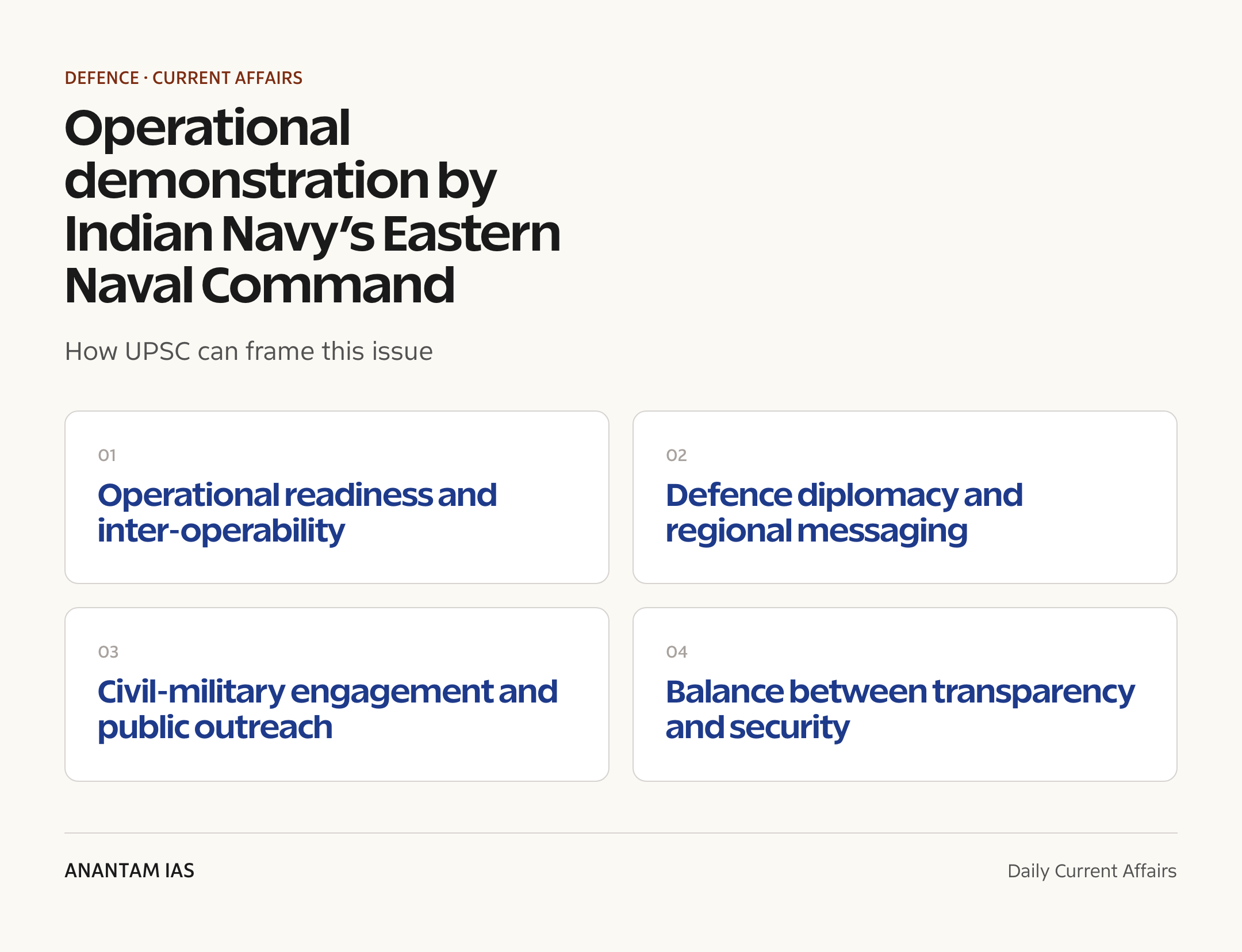
- Analyse how high-visibility military demonstrations contribute to deterrence and strategic signalling in the Indo-Pacific.
- Discuss the role of the Navy in civil-military relations and domestic outreach, including implications for governance and disaster response.
- Examine the balance between operational secrecy and public display in defence diplomacy and national security policy.
Essay
- Topics on India’s role in the Indo-Pacific, defence modernisation and maritime strategy, including themes like India’s maritime security challenges and defence and diplomacy.
- Essay prompts on civil-military relations and public trust in security institutions where public demonstrations are relevant case material.
Background and Context
Eastern Naval Command at a glance
Role, headquarters and area of responsibility for the ENC.
- The Eastern Naval Command is headquartered at Visakhapatnam and is a primary naval formation responsible for the Bay of Bengal and eastern Indian Ocean approaches.
- Operational responsibilities include maritime security operations, surveillance, fleet actions and protection of sea lines of communication on the eastern seaboard.
- ENC manages permanent and rotational assets such as destroyers, frigates, corvettes, diesel-electric submarines and maritime patrol aircraft.
- The command plays a key role in search and rescue, anti-piracy patrols, and disaster relief operations in eastern coastal states and island territories.
- ENC hosts major naval infrastructure including dockyards, maintenance facilities and training establishments that support sustained deployments.
Operational demonstrations as a tool
Why navies perform public demonstrations and what they convey.
- Operational demonstrations serve to display tactical capabilities and integrated operations across surface, sub-surface and air domains.
- They function as a form of strategic communication aimed at multiple audiences: domestic public, potential adversaries, partner navies and international media.
- Displays help test inter-operability and command and control in a controlled environment while balancing operational security considerations.
- Such events boost morale and recruitment by showcasing service professionalism and advanced equipment to prospective entrants and the general public.
- They are often used to familiarise the populace with naval roles in maritime security and humanitarian assistance missions.
Force components highlighted
Key platforms and units typically involved in ENC demonstrations.
- Surface fleet: destroyers and frigates for sea control, escort and power projection tasks.
- Sub-surface assets: conventional submarines that contribute to sea denial and covert surveillance.
- Aviation: ship-borne and shore-based maritime patrol aircraft and helicopters for reconnaissance, ASW and SAR.
- Special forces: MARCOS for maritime interdiction, VBSS and direct action in littoral zones.
- Integrated sensors and weapons: showcasing
Strategic signalling in the Indo-Pacific
Contextualising the demonstration in regional maritime dynamics.
- The Indo-Pacific is marked by rising maritime competition, greater naval activity and contestation over sea lines of communication.
- Visible naval events signal intent and capability to regional states and extra-regional powers seeking influence in the area.
- Operational demonstrations contribute to deterrence by denial or punishment depending on the posture and messaging.
- They offer an opportunity to show alignment with partners through joint exercises or invited observers, reinforcing defence diplomatic ties.
- Such actions must be calibrated to avoid unnecessary escalation while achieving the desired
.
Civil-military and state engagement
The role of state actors and public participation in naval events.
- State governments provide logistical and administrative support for coastal events, enabling large scale public attendance and security arrangements.
- Presence of elected leaders, judiciary and local dignitaries signals
and helps normalise defence visibility in public life. - Public displays foster trust and improve the Navy’s ability to coordinate with local administrations during
. - Large audiences provide a platform to communicate naval capabilities, roles and career opportunities to the youth and coastal communities.
- Stakeholder engagement during such events also includes port authorities, fishermen communities and local businesses that support naval logistics.
Operational security and public displays
Balancing transparency and secrecy when conducting demonstrations.
- Authorities must protect
while allowing demonstrable elements that do not compromise operational advantage. - Detailed choreography ensures that classified systems or procedures are not exposed, while visible elements still reflect credible capability.
- Advance publicity is balanced by restricted zones and media guidance to prevent inadvertent disclosure of operational details.
- Post-event assessments help refine future demonstrations to better preserve
and public engagement goals.
Way Forward
Calibrate messaging for regional stability
- Frame demonstrations as emphasising defensive readiness and maritime safety rather than aggressive posturing.
- Where appropriate, invite regional partners and observers to promote
. - Coordinate public statements with Ministry of External Affairs to align
messaging.
Enhance civil-military coordination
- Develop joint planning protocols with state and local authorities for
during public displays. - Use demonstrations to brief coastal communities on
. - Institutionalise post-event feedback mechanisms to improve logistics and minimise local disruption.
Protect operational security while showcasing capability
- Define clear categories of
before public events. - Train public affairs teams on media handling to prevent inadvertent revelation of sensitive details.
- Employ simulated scenarios and non-deployable mock-ups when operational constraints prevent full disclosure.
Leverage demonstrations for capability assessment
- Use rehearsals and the demonstration itself to test
- Gather structured after-action reviews to inform
. - Integrate lessons learned into wider
cycles.
Conclusion
The ENC Operational Demonstration at Visakhapatnam combined ceremony, public outreach and capability display to achieve multiple objectives: reassure citizens, signal deterrence, validate operational integration and strengthen defence diplomacy. Future events should maintain an appropriate balance between transparency and operational security while deepening civil-military cooperation and drawing concrete lessons for capability development.
UPSC Practice Questions
Prelims MCQ 1
Which of the following cities is the headquarters of the Eastern Naval Command of the Indian Navy?
(a) Kochi (b) Visakhapatnam (c) Mumbai (d) Port Blair
Answer: (b) Visakhapatnam
Explanation:
The Eastern Naval Command is headquartered at Visakhapatnam and is responsible for the Bay of Bengal and eastern Indian Ocean approaches.
Prelims MCQ 2
MARCOS, often displayed in naval demonstrations, refers to which of the following?
(a) Maritime Radar and Communications System (b) Marine Commandos of the Indian Navy (c) Maritime Reconnaissance and Observation Satellite (d) Maritime Rescue Coordination Service
Answer: (b) Marine Commandos of the Indian Navy
Explanation:
MARCOS stands for Marine Commandos, the special forces unit of the Indian Navy specialising in maritime operations including VBSS and direct action.
UPSC Mains Questions
- {‘question’: ‘Analyse how public operational demonstrations by the Indian Navy contribute to deterrence and defence diplomacy in the Indo-Pacific. Comment on risks associated with such displays.’, ‘model_answer’: ‘Public naval demonstrations serve multiple strategic functions. They convey credible deterrence by showcasing capability which can dissuade potential coercive actions in nearby maritime zones. Demonstrations also act as tools of defence diplomacy, signalling to partners and adversaries alike about operational reach and commitment to regional security. They enhance
and support recruitment and public understanding of naval roles. Risks include unintended disclosure of sensitive tactics or capabilities, potential escalation if messaging is perceived as provocative by neighbouring states, and domestic resource allocation concerns if such events appear primarily ceremonial. To manage risks, demonstrations should be carefully planned with clear communication, controlled disclosure, and opportunities for international transparency such as inviting observers or conducting combined exercises.’} - {‘question’: “Discuss the ways in which the Indian Navy’s public engagement activities can support disaster response and coastal resilience in eastern India.”, ‘model_answer’: “The Navy’s public engagement creates operational familiarity with maritime capabilities that are critical in natural disasters. Demonstrations provide an avenue to inform coastal communities about
procedures, medical evacuation and reporting mechanisms. They build sustained with state authorities and local agencies which are essential for coordinated HADR operations. Visible assets like helicopters, fast-response boats and medical teams showcased during events signal available resources for emergencies. Regular outreach can also improve local resilience through community training programs and shared contingency planning, resulting in faster, more coherent responses to cyclones, floods and maritime accidents.”}
Source: PIB, Ministry of Defence.
Frequently Asked Questions
q
a
q
a
q
a
q
a
q
a
q
a
Tell Google you want more of this.
Add Anantam IAS as a preferred sourceOne tap, and this site shows up more often in your own Top Stories, AI Overviews and AI Mode. Remove it any time.