Why in News?
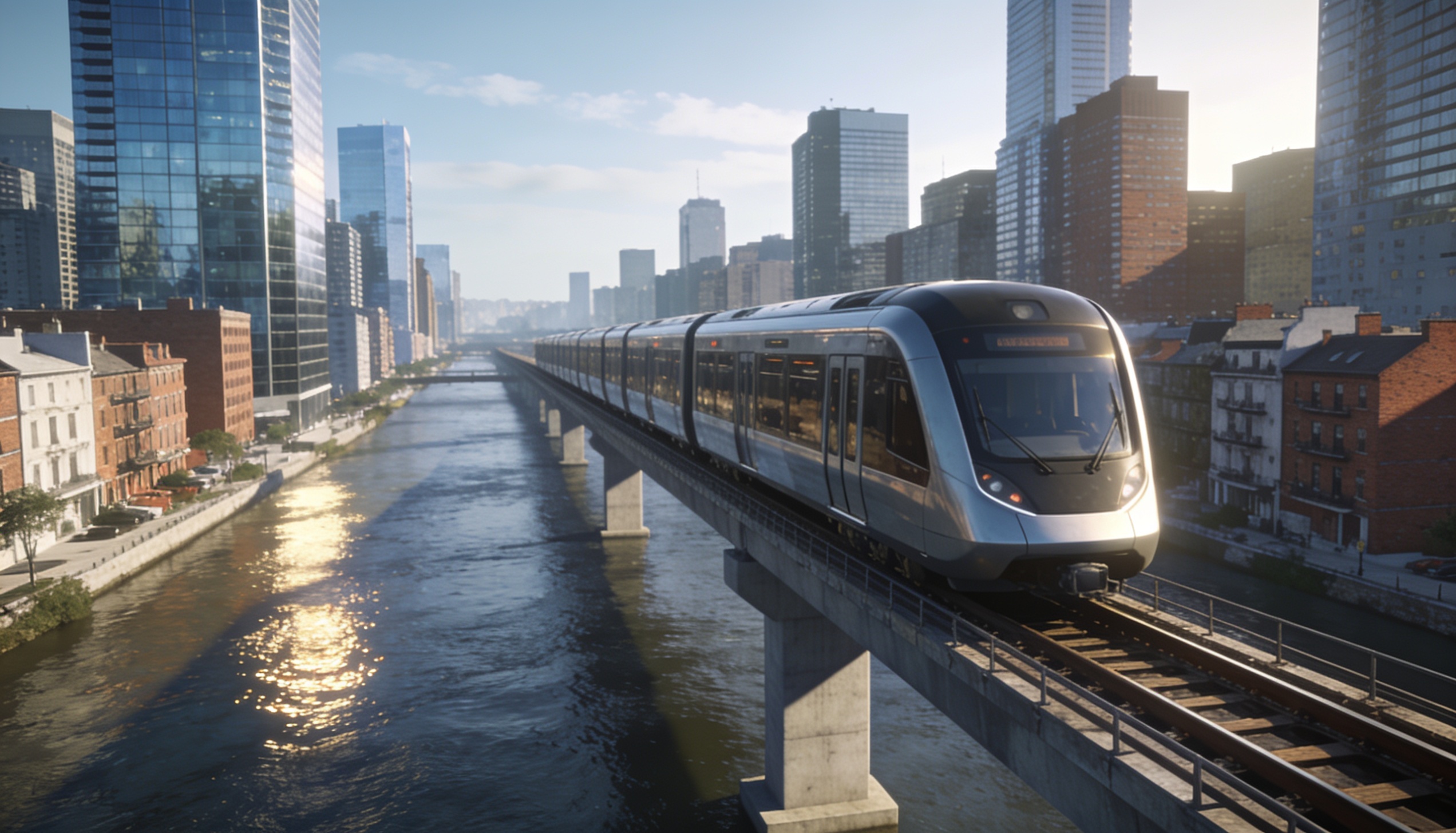
The government announced that India’s operational metro network has surpassed 1,000 km across multiple cities and states. The growth includes new stretches, foundation stones for additional corridors and accelerating adoption of advanced metro technologies.
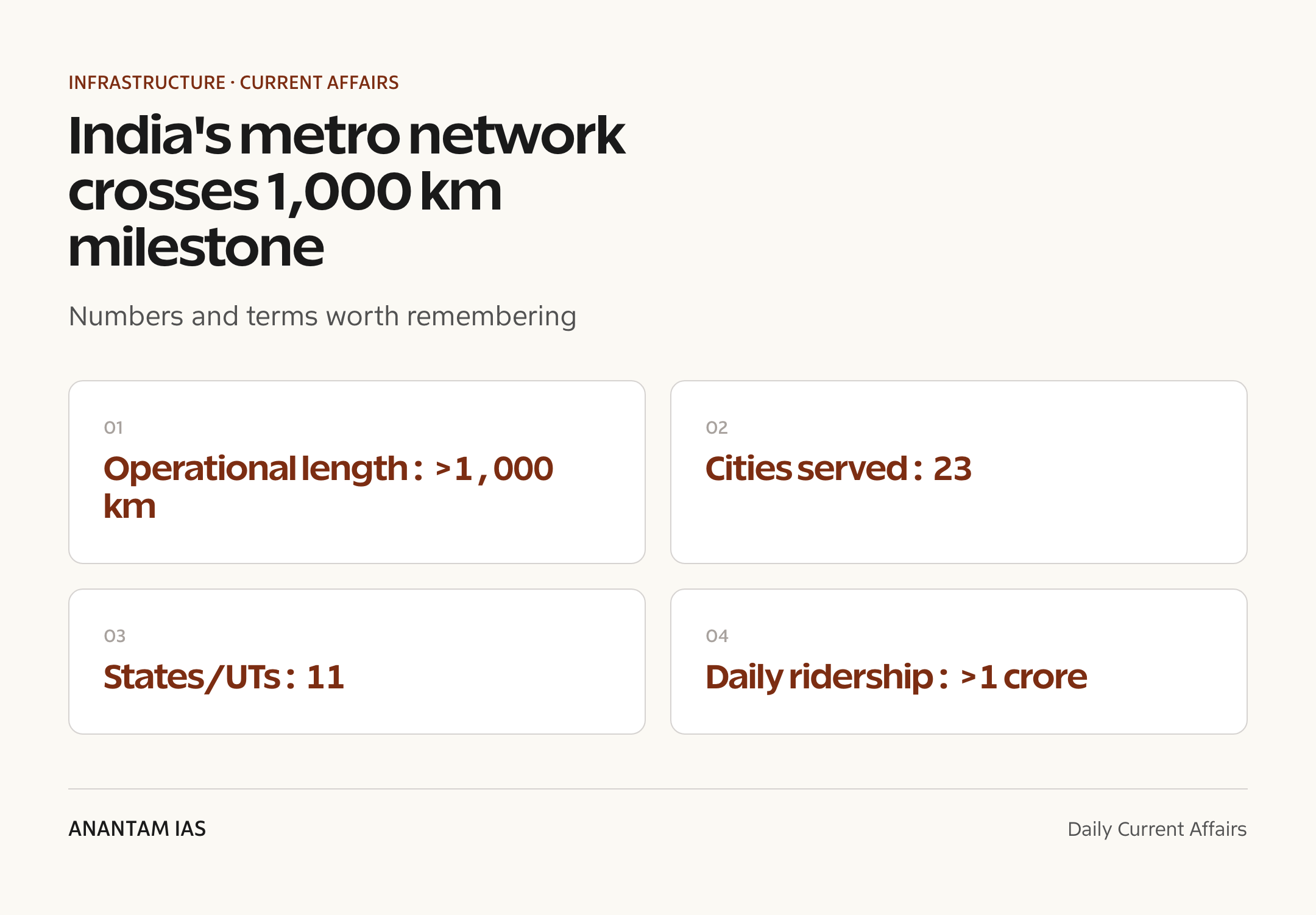
- Scale milestone: Operational metro length exceeds 1,000 km, across 23 cities and 11 states.
- Daily ridership: Metros now serve about over 1 crore passengers daily, showing mass adoption.
- Recent projects: Inauguration and foundation stones for multiple corridors in Delhi region worth over Rs 12,200 crore were announced on Jan 5, 2025.
- Global ranking: India is the third-largest metro network world-wide by operational length and is on track to rise further.
- Technology and diversity: Adoption of driverless trains, under-river tunnels and water metro systems are expanding the modal mix.
The development matters in the context of:
- Historical trajectory: Metro in India began with Kolkata in 1984. Delhi Metro catalysed rapid expansion after DMRC was set up in 1995 and opened its first corridor in 2002.
- Network spread: From initial single-city systems, metros now operate in 23 cities spanning metros, light metro and water metro models.
- Funding models: Projects use a mix of centre-state grants, loans (multilateral and bilateral), market borrowings and land monetisation through special purpose vehicles.
- Institutional role: DMRC has emerged as a model urban transport agency and exporter of consultancy services to other countries.
- Operational efficiency: Higher average speeds, signalling upgrades and automation have improved
in many systems. - Equity and access: Metros extend benefits unevenly; many tier-II cities still lack adequate mass rapid transit despite urbanisation needs.
UPSC Relevance
Prelims Relevance
- Direct factual recall: operational network length (>1,000 km), number of cities/states served, recent inaugurations and techno-features like driverless metro and under-river tunnel.
Mains Relevance
GS3 Infrastructure and Urban Transport
- Issues-based answers on urban mobility policy, financing urban infrastructure, sustainable transport planning, intermodal integration, and institutional capacity for large infrastructure projects.
Essay
- Material for essays on ‘Urbanisation and Infrastructure’, ‘Sustainable Cities’, ‘Growth and Development’, and ‘Technology and Public Transport’.
Background and Context
Early history and evolution
How India moved from the first metro in Kolkata to a national metro ecosystem.
- The first metro service in India began in 1984 with Kolkata Metro; initial growth was slow due to funding and institutional constraints.
- Establishment of DMRC in 1995 provided a replicable institutional model combining technical expertise, project management and procurement capability.
- Delhi Metro’s early success after its 2002 opening triggered a wave of metro projects across metros and large cities.
- Phased commissioning and stable management practices enabled metros to evolve from isolated corridors to integrated urban networks.
- Technological evolution included shift from conventional signalling to CBTC and driverless operations in select corridors.
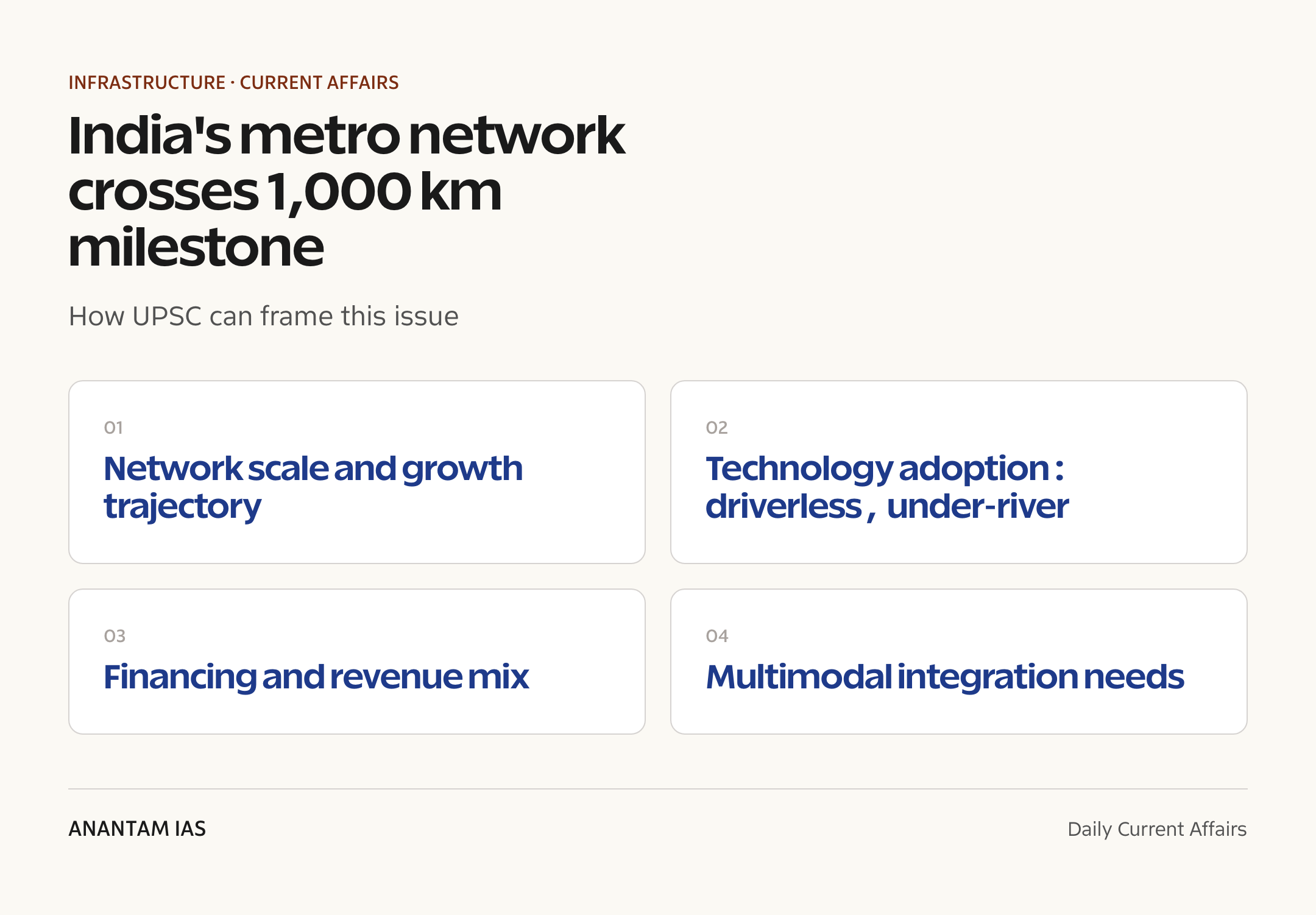
Network growth and geography
Spatial spread of metro infrastructure across Indian cities and states.
- Operational metro length now exceeds 1,000 km, spanning 23 cities in 11 states and union territories.
- Major contributors to cumulative length include Delhi, Kolkata, Bengaluru, Chennai, Mumbai and regional metros like Kochi and Hyderabad.
- Newer forms such as light metro and water metro address city-specific geographic constraints.
- Corridor planning increasingly targets peri-urban linkages to manage urban sprawl and commuter flows.
- Regional cross-border corridors, like Delhi-Ghaziabad-Meerut, illustrate inter-state coordination needs for metro planning.
Finance and procurement
Financing models and cost drivers for metro projects in India.
- Metro projects are capital intensive; costs driven by land acquisition, tunnelling, rolling stock and signalling systems.
- Funding mix commonly includes central and state budgetary support, multilateral loans, commercial borrowings and land monetisation.
- Special purpose vehicles and municipal bonds have been used to raise long-term finance in some cities.
- Public-private partnerships (PPP) have been attempted mainly for non-fare revenue streams like commercial development of stations.
- Standardised procurement and international bidding have reduced construction times and built local contractor capacity.
Technology and operations
Operational technologies that have shaped Indian metro services.
- Adoption of CBTC and automation increased frequency and safety while lowering headways on busy corridors.
- Driverless metro services are operational in selected corridors, improving energy efficiency and labour productivity.
- Under-river tunnelling, exemplified by Kolkata’s Hooghly crossing, shows advanced civil engineering capabilities.
- Integration with digital ticketing, smartcards and app-based services improved last-mile planning and passenger experience.
- Emphasis on energy-efficient rolling stock and regenerative braking contributes to sustainability goals.
Social and environmental impacts
How metro expansion affects urban equity, pollution and land use.
- Metros reduce surface congestion and vehicle emissions per passenger-km, improving urban air quality in corridors with high modal shift.
- Accessibility gains for low-income commuters are uneven when network coverage favours central corridors over peripheries.
- Transit-oriented development around stations increases land values and can spur mixed-use urban regeneration.
- Project construction can have negative impacts such as displacement, requiring robust resettlement and rehabilitation measures.
- Metros contribute to climate mitigation if integrated with non-motorised transport and feeder systems.
Institutional lessons and export potential
DMRC model and India’s role as a provider of metro expertise abroad.
- DMRC’s project management, standardisation and training practices are considered a for other Indian cities and abroad.
- Indian firms and agencies have offered consultancy and implementation services to countries in Asia, Africa and the Middle East.
- Knowledge export includes tunnelling, signalling and operations management rather than just rolling stock supply.
- Successful export engagements raise questions on capacity building for domestic project pipelines and manpower training.
- International collaboration can bring finance and technology but requires governance frameworks to avoid cost overruns.
Way Forward
Expand network with corridor prioritisation
- Use data on ridership, congestion and land-use to prioritise corridors that deliver maximum social benefit.
- Plan peri-urban links to integrate commuters from satellite towns and reduce private vehicle dependence.
- Adopt modular construction and standard design to shorten delivery times and reduce costs.
- Coordinate central and state planning to ensure seamless multi-jurisdictional corridors like Delhi-Meerut.
Strengthen financing and revenue streams
- Expand use of land value capture and transit-oriented development to monetise non-fare revenue.
- Promote long-term instruments such as municipal bonds and infrastructure funds for stable capital flows.
- Design fare policies that balance affordability and financial sustainability with cross-subsidies where needed.
- Leverage multilateral climate finance for energy-efficient rolling stock and regenerative technologies.
Integrate multimodal and last-mile connectivity
- Develop integrated mobility plans linking metros with bus rapid transit, feeder buses and active mobility options.
- Invest in safe station-area design, pedestrian access and bicycle infrastructure to maximise ridership.
- Use unified digital ticketing and mobility-as-a-service platforms to improve convenience and data flows.
- Partner with local bodies to manage curb space and parking to reduce dependence on private cars at stations.
Build capacity and social safeguards
- Strengthen project management units and trained technical staff to deliver complex systems on schedule.
- Institutionalise robust R&R and environmental management procedures to protect vulnerable communities.
- Invest in training for operations staff and skill development for maintenance and signalling technologies.
- Encourage public participation and transparency to improve public trust and project acceptance.
Conclusion
Crossing 1,000 km of operational metro lines is a structural shift in India’s urban transport landscape. The milestone shows capacity to deliver large-scale projects and adopt advanced technologies. Priority now should be on strategic corridor planning, sustainable financing, multimodal integration and social safeguards to ensure metros deliver inclusive, low-carbon urban mobility.
UPSC Practice Questions
Prelims MCQ 1
As of January 2025, India’s operational metro network crossed which milestone?
(a) 500 km (b) 1,000 km (c) 2,000 km (d) 3,000 km
Answer: (b) 1,000 km
Explanation:
Official announcements on Jan 5, 2025, stated that operational metro length in India exceeded 1,000 km, making it the third-largest in the world by length.
Prelims MCQ 2
Which Indian agency, established in 1995, became the model for metro project implementation?
(a) Indian Railways (b) NHAI (c) DMRC (d) MoHUA
Answer: (c) DMRC
Explanation:
The Delhi Metro Rail Corporation (DMRC) was established in 1995 and is credited with a replicable institutional model for metro implementation in India.
UPSC Mains Questions
- {‘question’: ‘Examine the role of metro expansion in achieving sustainable urban mobility in India. What policy measures are necessary to ensure equitable access and environmental benefits?’, ‘answer_outline’: [‘Introduction: Define sustainable urban mobility and place metros within public transport hierarchy.’, ‘Role of metros: High-capacity corridor operations, reduced emissions per passenger-km, catalyst for transit-oriented development and modal shift from private vehicles.’, ‘Challenges: High capital cost, uneven geographic coverage, first-and-last-mile gaps, social displacement during construction and fare affordability.’, ‘Policy measures: Integrated multimodal planning, land value capture, fare subsidy targeting, investments in feeder services, strong R&R frameworks and climate finance integration.’, ‘Conclusion: Metros are necessary but not sufficient; holistic urban transport policy and institutional coordination are essential.’]}
- {‘question’: ‘Analyse the financing challenges of metro projects in India and suggest reforms to improve fiscal sustainability of metro operations.’, ‘answer_outline’: [‘Introduction: Describe capital intensity and long gestation of metro projects.’, ‘Current financing: Central-state grants, multilateral loans, municipal contributions, occasional PPP for non-core elements and land monetisation.’, ‘Challenges: Debt servicing pressures, low non-fare revenue realisation, political pressures on fares and cost overruns.’, ‘Reforms: Broaden land value capture tools, promote municipal bonds and infrastructure funds, professionalise urban transit authorities, ring-fence non-fare revenues, use performance-linked central grants.’, ‘Conclusion: A mix of financial innovation and governance reforms can restore fiscal sustainability while preserving affordability.’]}
Source: PIB, Ministry of Housing & Urban Affairs.
Frequently Asked Questions
q
a
q
a
q
a
q
a
q
a
q
a
Tell Google you want more of this.
Add Anantam IAS as a preferred sourceOne tap, and this site shows up more often in your own Top Stories, AI Overviews and AI Mode. Remove it any time.