Why in News?
Raksha Mantri and DRDO leadership set priorities for 2025: mission-mode completion targets, greater private-sector and start-up engagement, open test facilities and accelerated technology transfers to industry.
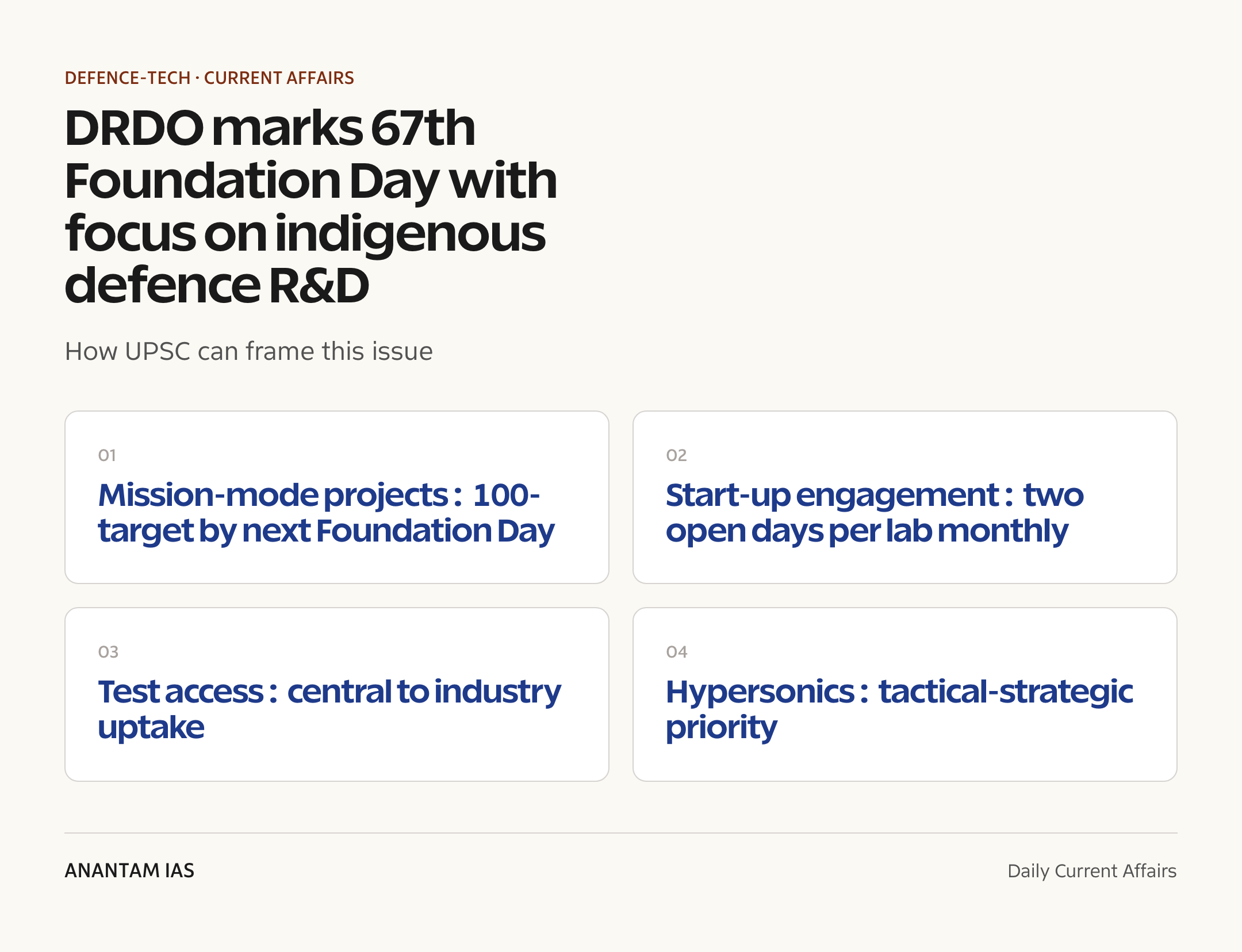
- Policy push: Raksha Mantri asked DRDO labs to identify 2-3 critical projects each and complete them by 2025, targeting 100 completed projects by next Foundation Day.
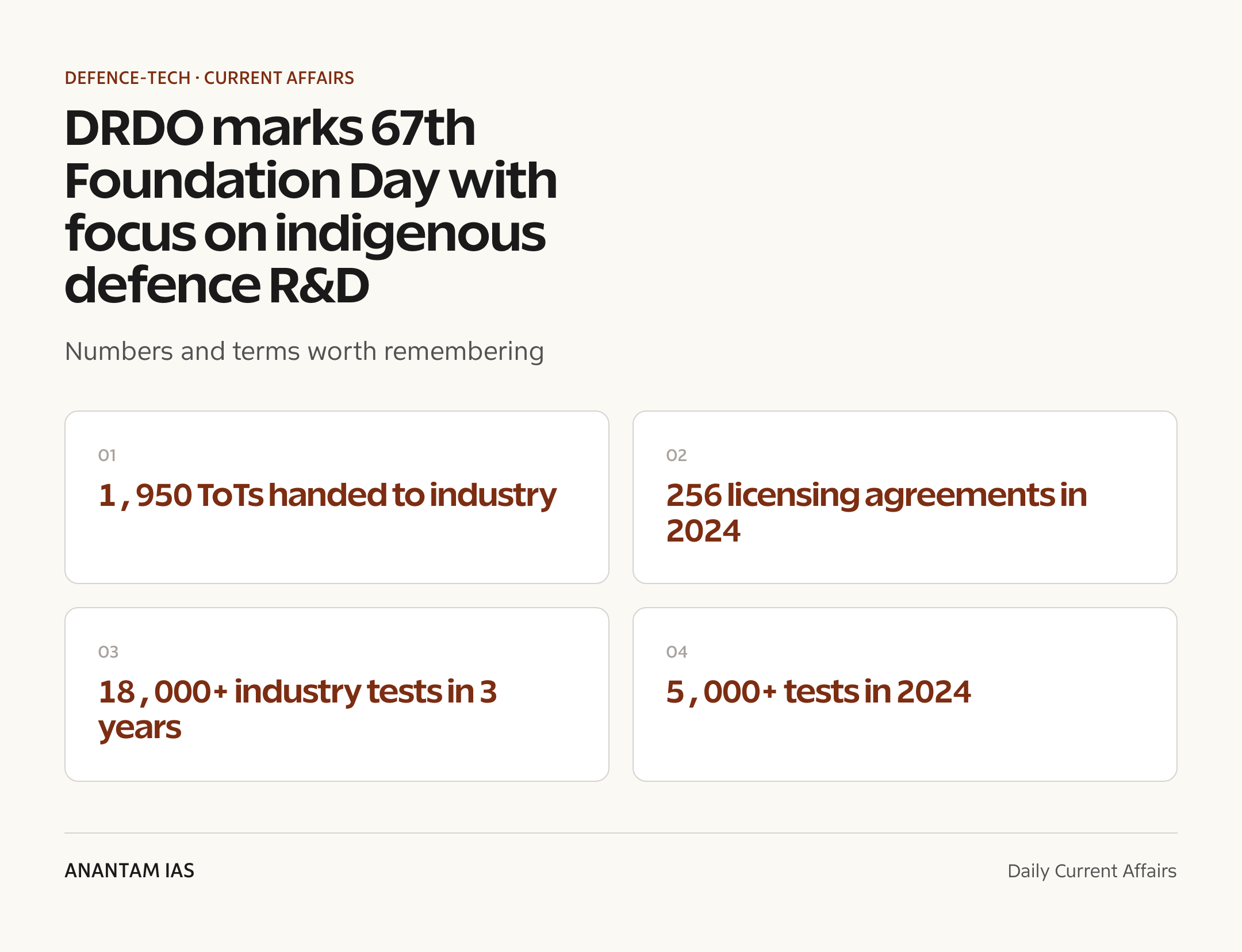
- Industry linkage: DRDO has handed over 1,950 Transfers of Technology to industry; 256 licensing agreements were signed in 2024 to scale indigenous production.
- Test infrastructure access: DRDO opened facilities to industry — over 18,000 tests in three years, with more than 5,000 tests in 2024 — to speed up private-sector adoption.
- Start-up outreach: Directives to include start-ups in R&D and hold regular open days aim to inject innovation and accelerate dual-use solutions.
- Strategic capability: Public felicitation of the design team for a Long Range Hypersonic Anti-Ship Missile signals emphasis on advanced deterrence technologies.
The development matters in the context of:
- DRDO mandate: National agency for defence research, design and development covering missiles, avionics, electronic warfare, naval systems, armaments and more.
- Aatmanirbhar Bharat link: Technology transfer and industry partnerships are central to the government’s push for indigenous manufacturing in defence.
- Defence industrial ecosystem: Since reforms beginning in 2020, greater private-sector participation, licensing, and corporatised production agencies have been promoted.
- Global tech competition: Hypersonics, AI, quantum sensing and missile defence are priority domains as regional security dynamics intensify.
- Testing bottlenecks: Limited test infrastructure historically slowed private-sector absorption of defence tech; opening facilities addresses this gap.
- Mission-mode projects: Focused, time-bound R&D projects are used to fast-track operational systems from lab prototypes to production.

UPSC Relevance
Prelims Relevance
- Facts to remember: DRDO celebrates Foundation Day on 1 January every year; 67th Foundation Day marked in 2025.
- Key numbers: 1,950 ToTs handed to industry overall; 256 licensing agreements in 2024; > 18,000 tests for industry over three years.
- Organisational leaders: Raksha Mantri Shri Rajnath Singh and DRDO Chairman Dr Samir V Kamat featured in the event.
Mains Relevance
GS3 Science & Tech
- Policy analysis: Implications of accelerating ToTs and test-facility access for domestic defence manufacturing and strategic autonomy.
- Governance: Role of DRDO as a state R&D agency in enabling private-sector growth while balancing security and intellectual property concerns.
- Strategic studies: Significance of hypersonic weapon development for regional deterrence, arms-race dynamics and arms control debates.
Essay
- Technology and national power: DRDO’s initiatives exemplify how state-led R&D ecosystems contribute to economic and strategic strength.
- Public-private partnerships: Case study on defence-technology transfer, start-up engagement and converting research into production.
- Innovation ecosystems: Discuss creating dual-use technology flows and the societal impact of defence R&D spillovers.
Background and Context
DRDO: mandate and structure
Basic overview of the organisation, its responsibilities and working model.
- Mandate: Design, develop and deliver state-of-the-art indigenous defence systems and technologies to Indian Armed Forces and security agencies.
- Organisational spread: Comprises multiple labs and establishments across domains like missiles, aeronautics, armaments, electronics and naval systems.
- Governance: Falls under the Department of Defence R&D, Ministry of Defence; chaired by the Chairman, DRDO who also serves as Secretary, Defence R&D.
- Partner model: Works with DPSUs, private industry, academic institutions and start-ups through ToTs, licensing, and Development cum Production Partners.
- Funding & priorities: Funded by central allocations with project-specific prioritisation; recent years show emphasis on rapid prototyping and production partnerships.
Technology transfer and licensing
How DRDO moves technologies from lab to industry and the scale of recent transfers.
- Transfer of Technology (ToT): Mechanism for handing technical designs, manufacturing know-how and documentation to industry for production.
- Volume: DRDO reported 1,950 ToTs to Indian industry to date, indicating active dissemination of defence technologies.
- 2024 surge: 256 licensing agreements signed in 2024, reflecting accelerated commercial uptake.
- Objective: Reduce import dependence, expand domestic production base and support Aatmanirbhar Bharat in defence.
- Challenges: Standardising IP terms, ensuring quality-control in licensed production and aligning industry capacity with complex systems.
Open test facilities and validation
Testing infrastructure is central to converting prototypes into producible systems.
- Policy shift: DRDO opened test facilities for use by private industry and DPSUs to enable faster validation cycles.
- Testing scale: Over 18,000 tests conducted for private industries/DPSUs in three years with > 5,000 tests in 2024 alone.
- Impact: Reduces time-to-market, lowers validation costs for industry and strengthens industry confidence in indigenous designs.
- Operational needs: Industry requires predictable booking, clear fees, and standard test-report formats to plan production runs.
- Future gaps: Need for mobile test ranges, instrumented open ranges and certified third-party test agencies for transparency.
Start-ups and industry engagement
DRDO wants increased participation from start-ups to catalyse innovation and dual-use products.
- Open days: Each DRDO lab encouraged to host two open days monthly to interact with industry and start-ups.
- Start-up role: Small firms can bring rapid prototyping, software-led solutions, sensors, autonomy and AI integration.
- Barriers: Complex procurement, security clearances and scale-up funding remain hurdles for defence start-ups.
- Support measures: DRDO can provide mentorship, access to test-beds, preferential licensing and prototype co-development.
- Expected outcome: More innovation flow into dual-use tech that benefits civilian sectors like disaster response and transportation.
Strategic technology priorities
Areas highlighted by DRDO and the wider global context that shape R&D focus.
- Hypersonics: High-priority domain for rapid strike and anti-access capabilities; public mention of a long-range hypersonic anti-ship missile.
- AI and autonomy: Integration into ISR, electronic warfare and missile guidance systems to improve decision cycles.
- Advanced materials and propulsion: Critical for lightweight platforms, hypersonic vehicles and extended endurance of systems.
- Sensors and quantum technologies: Next-generation sensing and navigation solutions to operate in contested environments.
- Dual-use focus: Emphasis on technologies that can transition to civilian applications to expand economic returns.
Operational targets and timeline
Concrete timeline set by Raksha Mantri for near-term delivery expectations.
- Lab targets: Each DRDO lab asked to pick 2-3 critical projects for completion within the year 2025.
- Aggregate goal: Aim to have 100 such projects completed by the next Foundation Day.
- Monitoring: Regular reviews and prioritisation expected to align resources for mission-mode delivery.
- Risk management: Need to balance speed with testing rigor and operational validation to avoid fielding unreliable systems.
- Success indicators: Prototype-to-production conversions, licensing deals concluded and operational inductions into forces.
Way Forward
Strengthen industry absorption
- Standardise licensing: Create standard, time-bound licensing templates with clear IP and quality clauses to speed agreements.
- Capacity building: Support MSMEs with skill development and capital access to meet defence manufacturing standards.
- Production partners: Expand Development cum Production Partner model to de-risk industry adoption and scale manufacturing.
Enhance test infrastructure and access
- Transparent booking: Implement an online portal for facility booking, standard fees and test-report accreditation.
- Regional hubs: Establish regional test centres and mobile test units to reduce logistical barriers for industry.
- Third-party certification: Authorise independent agencies to certify test outcomes to build trust among private partners.
Operationalise start-up engagement
- Incubation tie-ups: Link DRDO labs with incubators and accelerators to mentor dual-use start-ups and run co-development sprints.
- Fast-track trials: Offer sandboxed trials and security-cleared access for vetted start-ups to demonstrate concepts.
- Seed support: Provide grants or matching funding for prototype development aimed at defence-relevant outcomes.
Focus on program management
- Mission-mode governance: Create cross-lab program teams with milestone-based funding and clear deliverables.
- Performance metrics: Track key metrics such as prototype readiness levels, ToT conversions and time-to-production.
- Risk mitigation: Conduct independent technical reviews and iterative field trials to validate systems.
Conclusion
DRDO’s 67th Foundation Day set a pragmatic agenda: time-bound mission projects, deeper industry and start-up engagement, open test infrastructure and scaling of technology transfers. Implementation will require program discipline, standardised IP frameworks and capacity building in industry to convert lab successes into operational capabilities that reinforce strategic autonomy.
UPSC Practice Questions
Prelims MCQ 1
Which of the following statements about DRDO’s announcements on its 67th Foundation Day (2025) are correct? 1) DRDO reported handing over about 1,950 Transfers of Technology to Indian industry to date. 2) In 2024, DRDO signed 256 licensing agreements for ToTs. 3) DRDO conducts no tests for private industry and only works with DPSUs. Select the correct answer.
(a) 1 and 2 only (b) 2 and 3 only (c) 1 and 3 only (d) All of the above
Answer: (a) 1 and 2 only
Explanation:
Statements 1 and 2 are true as reported. Statement 3 is false because DRDO has opened test facilities for private industry and reported over 18,000 tests for private industries and DPSUs.
Prelims MCQ 2
On its 67th Foundation Day, DRDO was asked to have each lab identify how many critical projects to complete in 2025, with an aggregate target of 100 projects by the next Foundation Day? 1) One critical project 2) Two to three critical projects 3) Five critical projects Select the correct answer.
(a) 1 only (b) 2 only (c) 3 only (d) 1 and 2
Answer: (b) 2 only
Explanation:
Raksha Mantri instructed that each DRDO lab should identify two to three critical projects to be completed by 2025, aiming for about 100 completed projects overall.
UPSC Mains Questions
- {‘question’: “Analyse how DRDO’s strategy of technology transfer and opening of test facilities to private industry can strengthen ‘Aatmanirbhar Bharat’ in defence manufacturing. What institutional and policy measures are required to address challenges in this approach?”, ‘model_answer’: “Start with succinct thesis: DRDO’s ToTs and test-facility access reduce import dependence by enabling domestic firms to produce defence systems. Explain mechanisms: capacity building, supply chain development, quality assurance, and scale. Discuss benefits: faster induction cycles, job creation, export potential and dual-use spillovers. Identify challenges: IP governance, certification, production quality, financing, security clearances and absorptive capacity of MSMEs. Recommend measures: standardised licensing frameworks, credit and tax incentives, a national defence industrial certification agency, regional testing hubs, public procurement preferences for ToT-based products, accelerated security-clearance processes for vetted start-ups, and institutionalised DRDO-industry joint programmes with milestone funding. Conclude by linking to strategic autonomy and sustainable industrial base.”}
- {‘question’: “Discuss the strategic implications of India developing hypersonic weapon capabilities such as the Long Range Hypersonic Anti-Ship Missile mentioned during DRDO’s Foundation Day. How should India balance deterrence objectives with regional stability?”, ‘model_answer’: ‘Open with strategic context: hypersonics alter offense-defence calculations due to high speed, maneuverability and reduced reaction time. Assess deterrence value: enhanced denial capability, sea denial against adversary navies and signalling of technological parity. Evaluate risks: potential arms race, escalation dynamics, difficulties in attribution and collateral damage in crisis. Policy balance: pursue credible but restrained deployment, transparency measures with regional partners, invest in counter-hypersonic defenses and early warning, integrate arms-control dialogue bilaterally and in multilateral forums, and embed doctrine and command-control safeguards to reduce miscalculation. Conclude: capability must be part of a calibrated strategy combining deterrence, defence and diplomatic engagement.’}
Source: PIB, Ministry of Defence.
Frequently Asked Questions
q
a
q
a
q
a
q
a
q
a
q
a
Tell Google you want more of this.
Add Anantam IAS as a preferred sourceOne tap, and this site shows up more often in your own Top Stories, AI Overviews and AI Mode. Remove it any time.