Why in News?
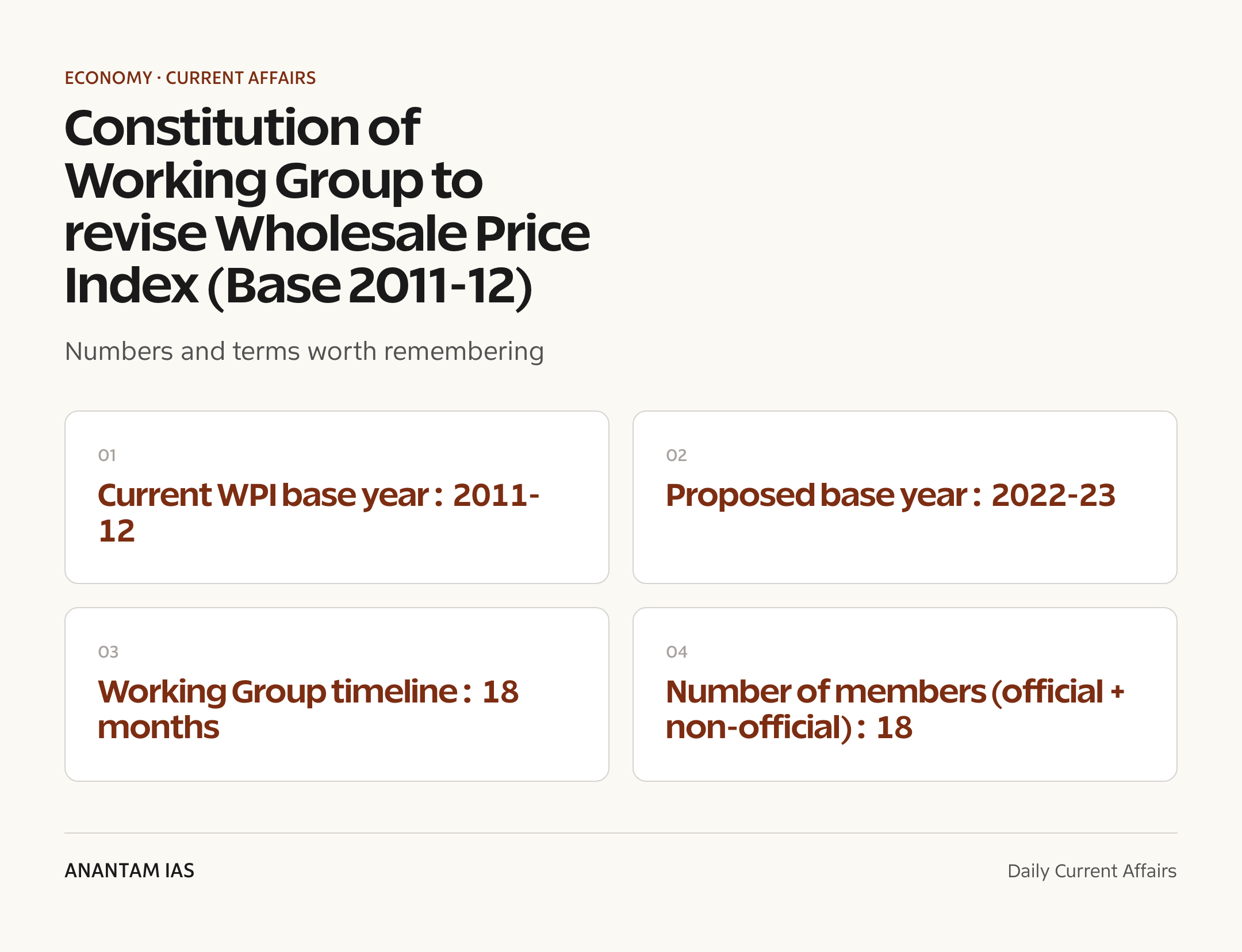
A government Working Group has been constituted to rebase and revise the Wholesale Price Index from 2011-12 to 2022-23, with a mandate to update weights, coverage and methodology and to submit a report within 18 months.
- Official notification dated 02 January 2025 constituting the Working Group with Prof. Ramesh Chand (NITI Aayog) as chairman and representation from central statistical offices, departments, RBI and market economists.
- Mandate: move the WPI base year from 2011-12 to 2022-23, review weights, item coverage, price collection and treatment of taxes/subsidies.
- Timeline: final report to the Office of the Economic Adviser within 18 months of notification.
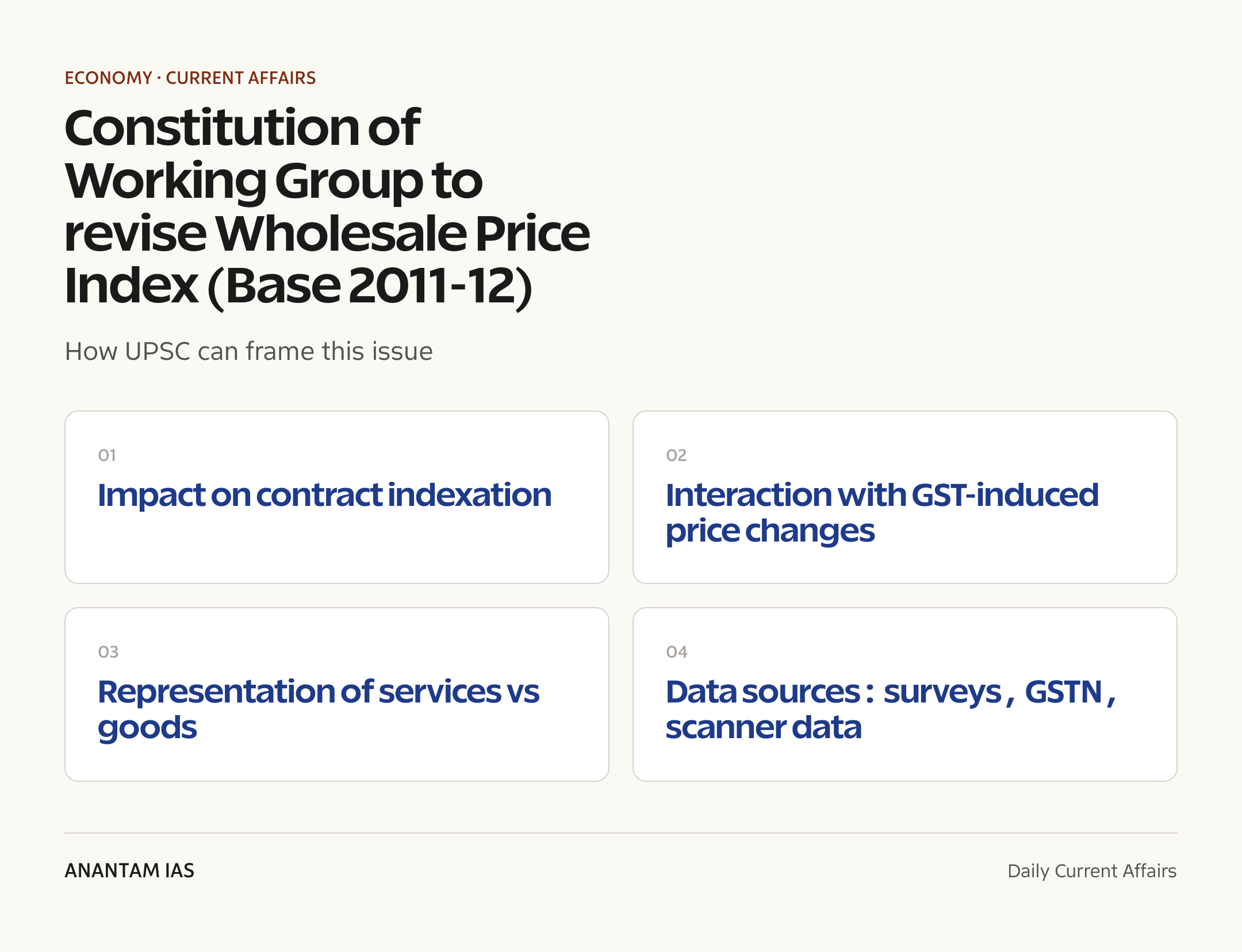
- Impact: potential changes in measured wholesale inflation that feed into policy signals, contract indexation and business planning.
The development matters in the context of:
- WPI role: The Wholesale Price Index is India’s primary producer-price measure covering commodities and manufactured products used by policymakers, industry and researchers.
- Current base: The active WPI series uses base year 2011-12; many price indices worldwide are updated every 5-10 years to reflect structural economic change.
- Recent concerns: Changes in product composition, services share, supply chain shifts and tax reforms like GST reduce representativeness of older weights.
- Methodology issues: WPI differs from CPI in coverage and purpose; WPI excludes most services and household consumption patterns and relies on different price collection points.
- Precedent: Base-year revisions typically alter measured inflation levels and growth rates because of updated weights and substitution patterns.
- Stakeholder interest: Industry, farmers, banks and fiscal planners track WPI for contract escalation clauses, commodity pricing and policy calibration.

UPSC Relevance
Prelims Relevance
- High. Questions may ask about the WPI base year, lead ministry, composition of the Working Group, timeline for submission and key differences between WPI and CPI.
Mains Relevance
GS3 Economy
- High. Useful for answers on inflation measurement, index construction, statistical reforms, and policy implications of index rebasing for macro policy and sectoral stakeholders.
Essay
- Moderate. Material usable in essays on macroeconomic management, data-driven governance, and reforms in statistical systems.
Background and Context
What is the WPI and why it matters
Define the index and its principal uses.
- The Wholesale Price Index measures price changes at an early stage of the distribution chain—mainly in industry, mining and primary articles.
- It is distinct from the Consumer Price Index which tracks retail prices faced by households and includes services.
- WPI is used for policy analysis, sectoral price monitoring, contract escalation clauses and some fiscal calculations.
- Because it captures producer-level inflation, WPI often leads CPI in signalling inflationary pressures in supply chains.
- Central banks and ministries use WPI alongside CPI to obtain a fuller picture of inflation dynamics across the economy.
Why base-year revision is done
Rationale behind periodic rebasing of price indices.
- Over time the economy’s structure changes: new goods emerge, old goods decline and consumption patterns shift; these changes require updated weights for accurate measurement.
- Tax and institutional changes such as the introduction of GST affect prices and tax incidence; older series may no longer capture these effects properly.
- Rebasing incorporates improved data sources and advances in statistical methods, raising the quality and relevance of statistics.
- Regular updates reduce bias from outdated quantity weights and better represent current production and trade patterns.
- International practices recommend periodic rebasing, typically every 5 to 10 years, to maintain index reliability.
Recent methodological challenges for WPI
Key technical and data issues the Working Group will need to address.
- Coverage: WPI mainly covers goods and excludes most services; growth of services in the economy poses representativeness questions.
- Weights: Existing weights derive from older production and trade data; need to incorporate recent national accounts and enterprise surveys.
- Price collection: Changes in distribution channels, digital trade and manufacturing contracts require a review of price collection points and frequency.
- Treatment of taxes and subsidies: Since GST, commodity-level tax incidence changed; the Working Group must define whether indices are calculated tax-inclusive or tax-exclusive.
- Integration with other statistics: Aligning WPI with national accounts and trade statistics will improve coherence across official data systems.
Composition and mandate of the Working Group
Who is on the panel and what they must deliver.
- Chair: Prof. Ramesh Chand, Member, NITI Aayog; Member Secretary: Deputy Director General, DPIIT.
- Members include officials from Ministry of Statistics & PI, DEA, Agriculture, Consumer Affairs, Petroleum, GSTN and RBI.
- Non-official members: eminent economists and private-sector chief economists from SBI, Crisil, Kotak, Bank of America and others.
- Mandate: revise base to 2022-23, review weights, item coverage, price collection methods, and recommend statistical treatments.
- Timeline: submit final report within 18 months of the notification; Chairman may co-opt additional experts as needed.
Possible immediate effects of rebasing
Short-term statistical and market consequences to expect.
- Measured WPI inflation levels could change due to new weights; past series may be re-linked to show consistent historical movements.
- Contract indexation clauses tied to WPI might need rewording to reference the new series and rebasing formulae.
- Market participants, including commodity traders and manufacturers, will reassess pricing, hedging and inventory decisions based on revised signals.
- Policymakers may need to explain movement in reported inflation after rebasing to manage expectations in financial markets.
- Academic and media commentary will scrutinise methodological choices such as inclusion/exclusion of services and treatment of indirect taxes.
International practice and comparators
How other countries handle rebasing and index construction.
- Many statistical agencies rebase indices regularly and publish bridging series to maintain continuity for analysts.
- Some countries maintain both producer and output price indices to capture different stages in production chains; cross-checks improve reliability.
- Use of enterprise-level administrative data and scanner data has become common to improve price coverage and timeliness.
- Best practice includes clear documentation, public consultations and transparent revision policies to retain credibility.
Way Forward
Technical recommendations for the Working Group
- Adopt 2022-23 as base year with clear justification and publish bridging series for historical continuity.
- Use recent national accounts and enterprise survey data to set weights and reflect current production patterns.
- Define explicit treatment of taxes and subsidies with scenarios for tax-inclusive and tax-exclusive series to aid users.
- Pilot incorporation of high-frequency administrative or scanner data for select commodities to improve timeliness.
User communication and transition plan
- Publish methodology documents, sample weights and illustrative re-linked historical series well before formal release.
- Engage stakeholders from industry, state governments, banks and researchers through public consultations and workshops.
- Provide guidance for legal and contractual use, including model clauses to transition to the new WPI for indexation.
- Issue interim FAQs and explainer notes to help media and markets interpret year-on-year changes after rebasing.
Institutional and capacity measures
- Strengthen capacity at MSPI for price collection, data processing and rapid dissemination of metadata.
- Establish inter-agency data-sharing protocols with GSTN, customs and enterprise registries to access quality administrative data.
- Create a technical advisory panel for ongoing methodological updates beyond the current review period.
- Invest in training and statistical software to support complex chain-weighting and index linking operations.
Policy use and coordination
- Coordinate with RBI and DEA to explain implications for monetary and fiscal analysis and avoid misinterpretation of short-term shifts.
- Recommend parallel publication of WPI and complementary price indicators to capture services price movements where relevant.
- Advise government bodies to review contractual references to price indices and allow transition periods for existing agreements.
Conclusion
Rebasing the WPI to 2022-23 is a technical but consequential reform. A transparent methodology, stakeholder engagement and careful communication will be critical to ensure the new series improves measurement without creating unnecessary volatility or confusion for policymakers, markets and users.
UPSC Practice Questions
Prelims MCQ 1
Which ministry or department released the notification constituting the Working Group to revise the WPI base to 2022-23?
(a) Ministry of Finance (b) Ministry of Commerce & Industry (c) Ministry of Statistics & Programme Implementation (d) Department of Economic Affairs
Answer: (b) Ministry of Commerce & Industry
Explanation:
The Press Information Bureau release issued on 02 January 2025 was by the Ministry of Commerce & Industry announcing constitution of the Working Group.
Prelims MCQ 2
What is the timeline given to the Working Group to submit its final report on WPI revision?
(a) 6 months (b) 12 months (c) 18 months (d) 24 months
Answer: (c) 18 months
Explanation:
The official notification states that the Working Group has been asked to submit its final report within 18 months of issue of the notification.
UPSC Mains Questions
- {‘question’: ‘Explain the significance of rebasing price indices like WPI and outline the key methodological issues the Working Group should address while moving the base to 2022-23.’, ‘answer’: ‘Rebasing aligns index weights with current economic structure, improving representativeness and reducing bias from outdated consumption or production patterns. For WPI, the Working Group should update weights using recent national accounts and enterprise surveys, review item coverage especially given the rising share of services, clarify price collection points and frequency, set a transparent policy on taxation treatment (tax-inclusive or exclusive), pilot use of administrative and scanner data for select commodities, publish bridging series for historical continuity, and ensure coherence with national accounts and trade statistics.’}
- {‘question’: ‘Discuss the possible policy and market implications of rebasing the Wholesale Price Index for stakeholders such as RBI, central government and contractual users.’, ‘answer’: ‘Rebasing can change the measured level and growth of wholesale inflation, which may affect inflation expectations and monetary policy assessment by RBI. The central government may need to recalibrate indices used in certain fiscal formulas and explain changes in headline inflation trajectories. For contractual users, price escalation clauses tied to WPI will require amendment or transition rules to reference the new base. Markets and commodity traders may react to altered signals; clear communication and publication of re-linked history are necessary to prevent misinterpretation.’}
Source: PIB, Ministry of Commerce & Industry.
Frequently Asked Questions
q
a
q
a
q
a
q
a
q
a
q
a
Tell Google you want more of this.
Add Anantam IAS as a preferred sourceOne tap, and this site shows up more often in your own Top Stories, AI Overviews and AI Mode. Remove it any time.