Why in News?
MeitY released detailed subordinate rules to implement the Digital Personal Data Protection Act, 2023. The draft clarifies obligations, introduces procedural mechanisms, and sets up institutional architecture that will affect privacy rights, compliance costs, and data-driven services across government and industry.
- Operational detail: The draft provides actionable rules to implement key DPDP Act provisions such as notices, consent management, breach reporting and rights facilitation.
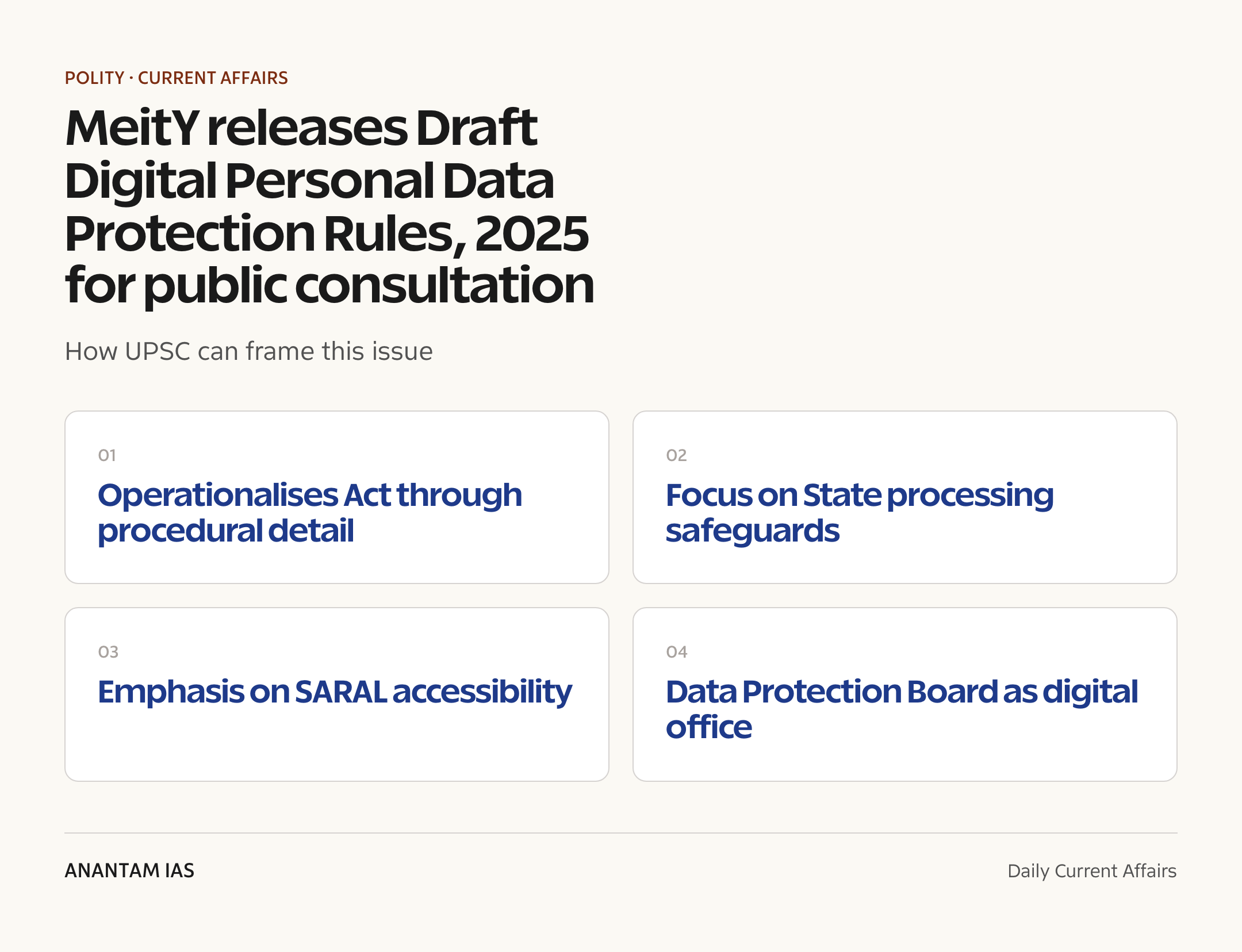
- Institutional design: It sets out the structure, appointment and functioning of the Data Protection Board as a digital office and appellate procedure.
- State processing: Rules address processing of personal data by States for issuance of subsidy, benefit or service, clarifying lawful bases and safeguards.
- Stakeholder impact: Obligations on Data Fiduciaries and new role of Consent Managers will affect businesses, startups and digital platforms.
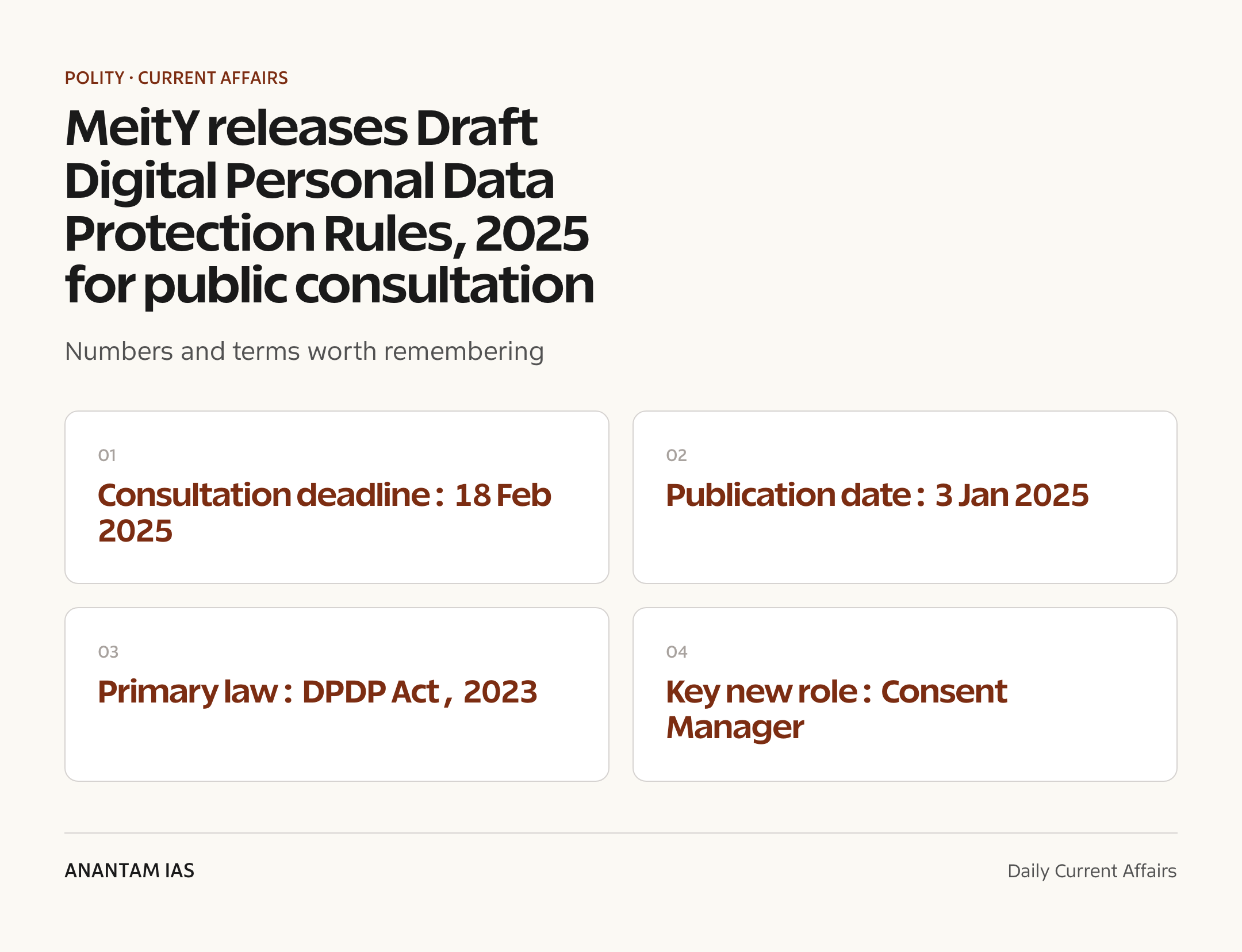
- Public consultation: Draft is open for feedback until 18 February 2025 via MyGov, making it a live regulatory design process.
The development matters in the context of:
- DPDP Act, 2023: Replaced earlier statutory architecture to balance individual rights and legitimate processing. The Act sets broad duties and enforcement powers; rules are needed for operationalising specifics.
- SARAL framework: MeitY used principles of simple language, contextual definitions and illustrations to improve accessibility of the rules for citizens and stakeholders.
- Previous debates: Policy debate since 2017 covered cross-border data flows, data localisation, consent regimes and regulatory powers; the draft attempts to address technical and procedural gaps left by the Act.
- Comparative trend: Global jurisdictions use subordinate rules to define breach timelines, registration requirements and duties of data controllers; India is following that pattern while tailoring to administrative realities.
- Technology context: Increasing use of AI, biometrics and large-scale databases in public delivery makes specific safeguards for sensitive data and children critical in rule design.
- Enforcement stakes: The draft details notification, appeal and adjudication processes through the Data Protection Board and Appellate Tribunal, affecting compliance burden and dispute resolution timelines.

UPSC Relevance
Prelims Relevance
- Key facts: Draft Rules, 2025 published by MeitY on 3 January 2025; public comments invited until 18 February 2025 via MyGov.
- Legal link: The Rules are subordinate legislation under the Digital Personal Data Protection Act, 2023.
- Institutions: Defines operational aspects of the Data Protection Board and registration of Consent Managers.
- Scope: Includes special provisions for children and persons with disability, and for State processing of data for benefits.
Mains Relevance
GS2 Polity & Governance
- Policy analysis: Provides material to evaluate how subordinate rules can shape balance between privacy rights and governance needs.
- Governance: Illustrates how administrative design choices—like digital offices and registration systems—affect implementation and accountability.
- Regulatory economics: Helps assess compliance costs for businesses, innovation trade-offs and the role of consent managers in the digital economy.
- Human rights: Bases for argument on adequacy of safeguards for children, disability and sensitive data in the context of public services.
Essay
- Data governance: Case study on modernising personal data protection and aligning legal frameworks with digital governance objectives.
- State and market: Material for essays on the role of the state in regulating digital markets and protecting citizen rights.
- Rights vs development: Useful for arguments on reconciling data-driven service delivery with privacy and civil liberties.
Background and Context
The DPDP Act, 2023 — context and intent
The Act provides the statutory foundation; the rules operationalise technical and procedural details.
- The DPDP Act, 2023 establishes a legal framework for processing digital personal data, seeking balance between privacy rights and legitimate processing for services.
- The Act sets high-level duties, principles of fair processing and enforcement powers but leaves procedural specifics to subordinate rules.
- Key statutory elements include the rights of data principals, obligations on data fiduciaries, powers to issue codes of practice and the creation of the Data Protection Board.
- Without rules, regulators and organisations lack clarity on timelines, formats and thresholds for action, which can delay implementation.
- The 2025 draft seeks to fill these gaps by detailing notices, breach reporting, registration and special processing categories.
SARAL drafting approach used by MeitY
MeitY states it used SARAL principles to make the draft accessible and actionable.
- SARAL emphasizes simple language, contextual definitions and illustrative examples to aid comprehension by non-experts.
- The draft aims to reduce unnecessary cross-referencing and to provide explanatory notes alongside rule text.
- This approach can lower compliance errors and reduce disputes caused by ambiguous wording.
- Clearer rules may enable smaller enterprises and public bodies to follow obligations without heavy legal counsel.
- The format also supports more effective public consultation by making trade-offs visible to stakeholders.
Major operational elements covered in the draft
The draft Rules set out procedural mechanisms that affect everyday processing.
- Detailed requirements for notice to individuals covering purpose, retention and recipients of personal data.
- Registration requirements and obligations for a new role, the Consent Manager, including record-keeping and auditability.
- Breach notification procedures with timelines and content requirements for intimation to individuals and the Data Protection Board.
- Specific rules for processing data of children and persons with disability, including consent thresholds and parental or guardian checkpoints.
- Provisions for State-led processing of personal data for delivery of subsidies, benefits and services with safeguards against misuse.
Institutional architecture and adjudication
The draft explains how the Data Protection Board will function and how appeals will proceed.
- The draft sets out appointment criteria, service conditions and functioning of the Data Protection Board as a digital office.
- Procedures for filing complaints, timelines for Board action and modalities for issuing directions are specified.
- An Appellate Tribunal procedure is mapped for aggrieved parties seeking review of Board decisions.
- Clarity on digital functioning may speed up case processing but requires adequate staffing and technical capability.
- Design choices around powers and remedies will shape deterrence and compliance behaviour among fiduciaries.
Cross-border flows and data localisation implications
The rules address operational aspects related to transfer and storage of personal data.
- Draft clarifies conditions under which personal data may be transferred outside India and the obligations to ensure equivalent protection.
- Mechanisms for notice and consent related to cross-border transfer are outlined to reduce ambiguity for service providers.
- The rules do not introduce new sweeping localisation mandates but set standards for reasonable security safeguards.
- International interoperable frameworks and adequacy assessments are the likely next policy stage after rules are finalised.
- Business continuity, cloud providers and multinational firms will watch the final text for compliance pathways.
Special categories and public interest processing
The draft balances protection of sensitive categories with administrative needs for service delivery.
- Processing for public interest or government functions, such as welfare delivery, is permitted under specified safeguards.
- Rules demand minimalisation, purpose limitation and retention limits even for State processing to reduce over-collection.
- Sensitive personal data receives heightened procedural safeguards like stricter consent and limited retention.
- Provisions for automated decision-making and profiling aim to ensure transparency when decisions materially affect individuals.
- The degree of oversight for public authorities will be shaped by reporting and audit obligations embedded in the rules.
Way Forward
Public consultation and stakeholder engagement
- Submit detailed comments on specific rule provisions by 18 February 2025 via the MyGov portal link provided in the draft release.
- Civil society should prioritise clauses affecting children, sensitive data and remedies to ensure rights are protected.
- Industry should propose operational compliance templates and timelines to make obligations practicable for small firms.
- Academia can provide evidence-based inputs on technical feasibility, for example on breach detection timelines and consent frameworks.
Capacity building and institutional readiness
- Government must invest in staffing and technical capability to enable the Data Protection Board to function as a digital office.
- Training programmes for public officials involved in State processing will reduce legal and operational risks.
- Standard operating procedures and interoperable IT systems can streamline registration and complaint handling processes.
- A phased implementation timeline may help smaller fiduciaries meet new obligations without service disruption.
Operational measures for industry
- Organisations should adopt compliance playbooks for notice, consent records and breach response aligned to rule timelines.
- Consider appointing or integrating with registered Consent Managers to manage consent lifecycle and audits.
- Implement technical safeguards such as encryption, access control and data minimisation to meet reasonable security expectations.
- Run tabletop exercises for breach notification and individual rights requests to test readiness.
Monitoring and iterative rule-making
- MeitY should publish consolidated feedback and provide an explanation for major acceptances and rejections to build trust.
- Regulatory sandboxes can test novel compliance mechanisms like decentralised consent stores or standardised DPIA templates.
- Periodic review clauses or sunset provisions will allow rules to adapt to technological change, for example AI-driven processing.
- Stakeholders should push for clear metrics to evaluate the Board’s performance on timeliness and resolution quality.
Conclusion
The Draft Digital Personal Data Protection Rules, 2025 are a crucial implementation step for the DPDP Act, 2023. They translate statutory principles into operational obligations affecting government processing, industry compliance and individual rights. Stakeholder feedback in the consultation window can materially shape final text. Attention will shift to institutional capacity, compliance practicability and safeguards for vulnerable groups as the rules move toward finalisation.
UPSC Practice Questions
Prelims MCQ 1
Which of the following is true about the Draft Digital Personal Data Protection Rules, 2025 published by MeitY?
(a) A. They create the Digital Personal Data Protection Act, 2023. (b) B. They set procedural details to operationalise the DPDP Act, 2023. (c) C. They abolish the Data Protection Board established by the Act. (d) D. They impose a blanket data localisation requirement for all personal data.
Answer: B
Explanation:
The Draft Rules provide procedural details to implement the DPDP Act, 2023. The Act itself is primary legislation enacted earlier. The draft does not abolish the Data Protection Board and does not impose a blanket localisation requirement for all personal data.
Prelims MCQ 2
Under the Draft Digital Personal Data Protection Rules, 2025, which role is specified with registration and operational obligations?
(a) A. Data Fiduciary (b) B. Consent Manager (c) C. Data Principal (d) D. Chief Privacy Officer
Answer: B
Explanation:
The draft specifies registration and obligations for the role of Consent Manager. Data fiduciaries are already subject to duties under the Act. Data principals are the individuals whose data is processed. Chief Privacy Officer is an organisational role but the draft emphasizes Consent Manager registration.
UPSC Mains Questions
- {‘question’: ‘Examine the role of subordinate legislation in making data protection laws effective. Use the Draft Digital Personal Data Protection Rules, 2025 as an example.’, ‘demand’: ‘Explain the importance of rules in operationalising statutory principles, analyse key features of the draft Rules and assess implementation challenges and policy trade-offs.’}
- {‘question’: ‘Assess how the Draft Digital Personal Data Protection Rules, 2025 balance the need for state-led digital service delivery and protection of individual privacy rights.’, ‘demand’: ‘Critically evaluate provisions related to State processing, safeguards for vulnerable groups and institutional mechanisms for oversight.’}
Source: PIB, Ministry of Electronics & IT.
Frequently Asked Questions
q
a
q
a
q
a
q
a
q
a
q
a
Tell Google you want more of this.
Add Anantam IAS as a preferred sourceOne tap, and this site shows up more often in your own Top Stories, AI Overviews and AI Mode. Remove it any time.