Why in News?
The Ministry of Steel opened PLI Scheme 1.1 for specialty steel on January 6, 2025, to broaden participation after industry feedback and to accelerate domestic production of high-value steel grades within existing budgetary allocation.
- Scheme reopening: PLI Scheme 1.1 is a fresh application window (6-31 Jan 2025) to allow more firms to join the specialty steel incentive programme.
- Product focus: Covers five product groups — coated/plated steel, high-strength/wear-resistant steel, specialty rails, alloy steel & steel wires, and electrical steel (including CRGO).
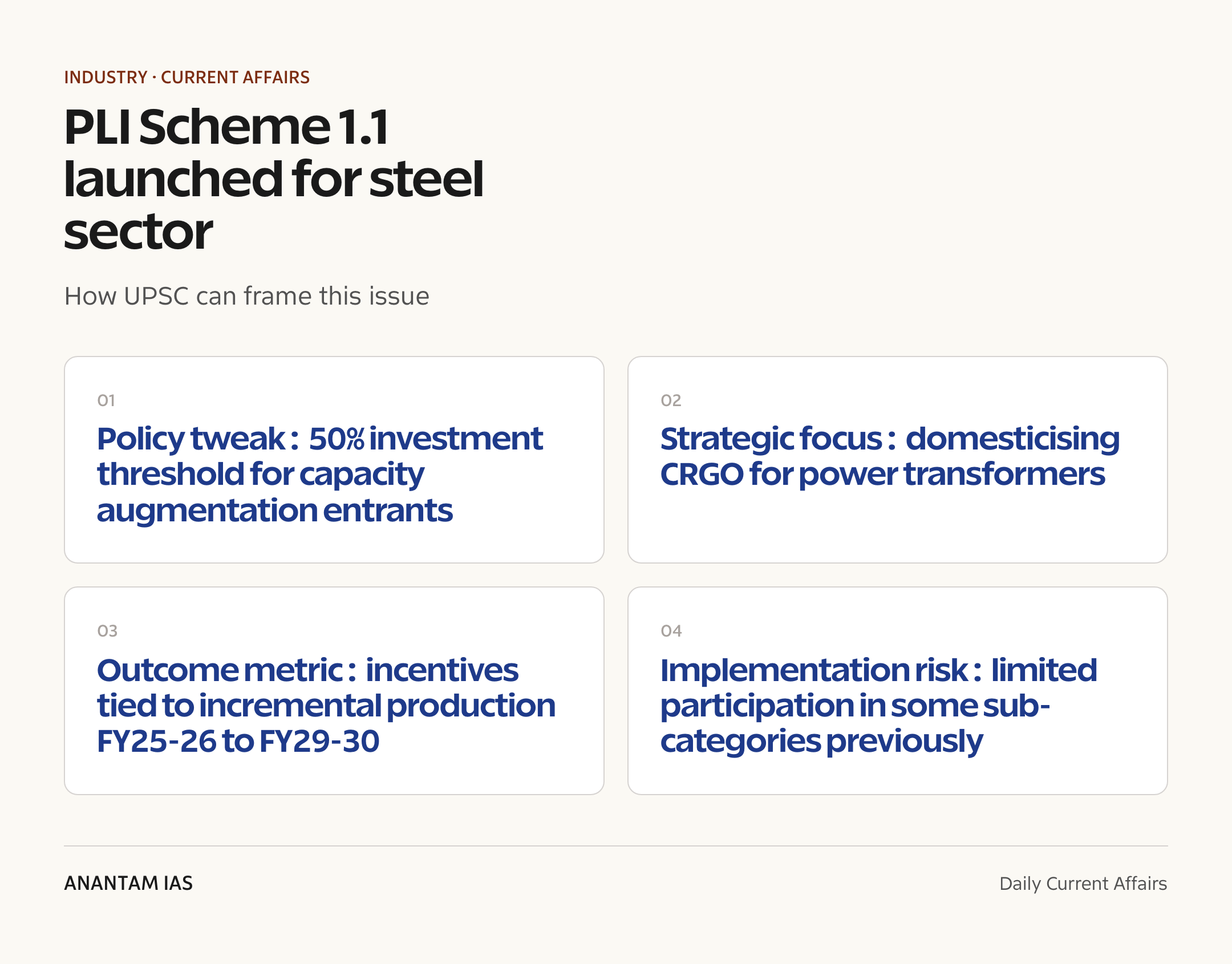
- Rule relaxations: Reduced investment and capacity thresholds for select sub-categories, carry-forward of excess production, and 50% investment threshold for capacity augmentation entrants.
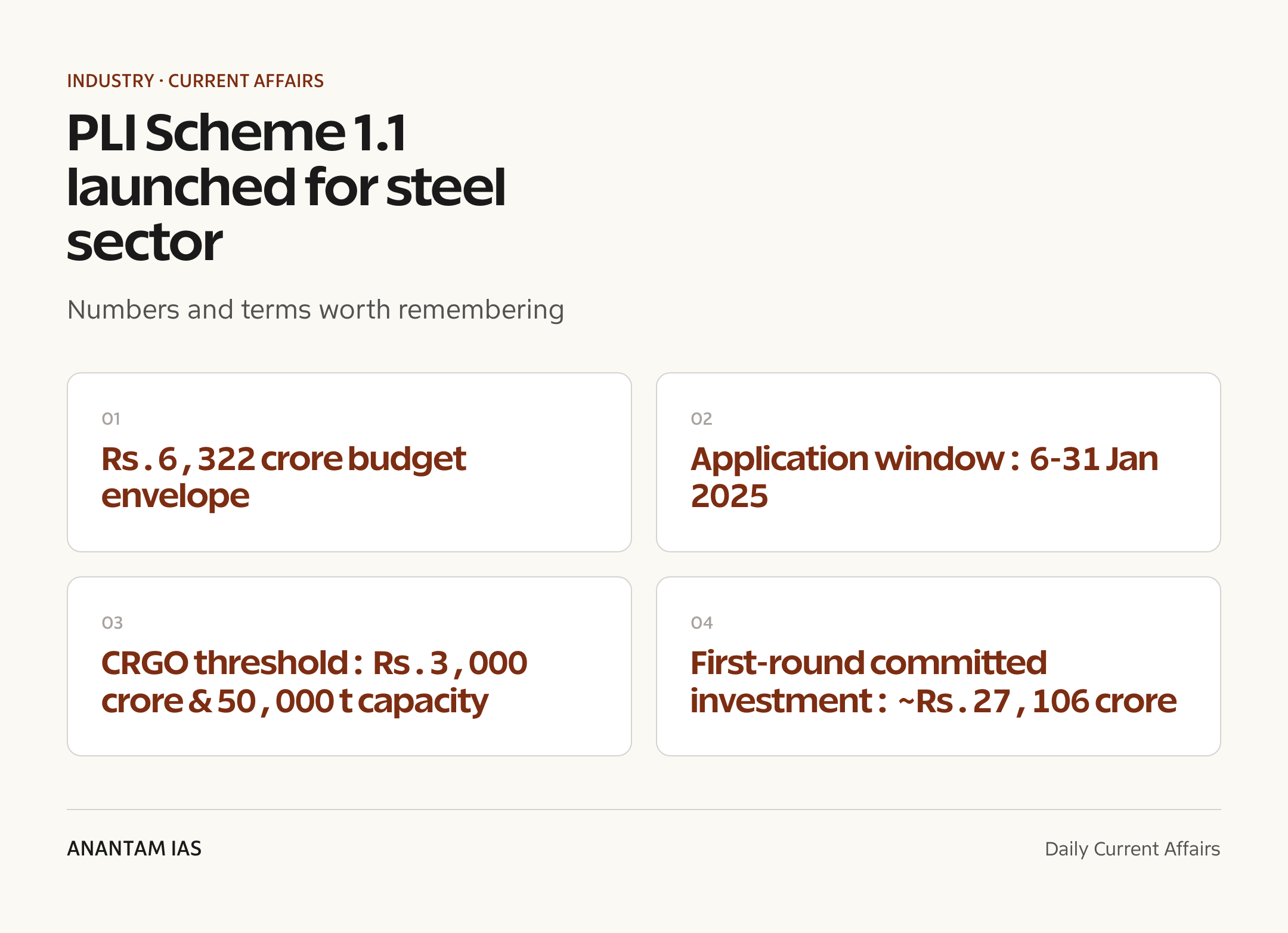
- Budget continuity: Operates within the original sanction of Rs.6,322 crore, not a fresh allocation.
- Strategic objective: Cut imports, promote value addition, drive technology upgrade, and improve India’s position in global specialty steel markets.
The development matters in the context of:
- Background scheme: Original PLI for specialty steel notified in July 2021 with Rs.6,322 crore outlay to promote value-added steel and reduce reliance on imports.
- First-round performance: 44 projects by 26 firms committed ~Rs.27,106 crore in investments and 24 MT downstream capacity; actual investment ~Rs.18,300 crore and direct employment ~8,300 (as of Nov 2024).
- CRGO gap: Cold-rolled grain-oriented (CRGO) steel capability absent domestically; CRGO is critical for power transformers and HT distribution.
- Industry feedback: Low participation in eight sub-categories prompted revisions to thresholds and rules to make the scheme investor friendly.
- Timing: Implementation window for production period set as FY 2025-26 to FY 2029-30, aligning incentives with medium-term capacity creation.
- Carry-forward provision: Excess production in one year can be used to meet shortfalls in the immediately following year when claiming incentives.
UPSC Relevance
Prelims Relevance
- Key facts: Application window 6-31 Jan 2025; scheme runs for FY 2025-26 to FY 2029-30; budget envelope Rs.6,322 crore.
- Product list: Know the five eligible product categories under the scheme.
- CRGO thresholds: Reduced investment threshold to Rs.3,000 crore and capacity threshold to 50,000 tonnes for CRGO sub-category.
Mains Relevance
GS3 Economy
- Industrial policy: Assess how PLI instruments shape manufacturing competitiveness, value chain development and import substitution.
- Economic outcomes: Discuss impact on employment, technology transfer, and domestic capital formation in the steel sector.
- Policy design: Analyse merits and limits of incentive design choices such as carry-forward rules and capacity augmentation entry at 50% investment threshold.
Essay
- Make in India: Use the scheme as an example of policies that aim to move the economy up the value chain and reduce import dependence.
- Growth & sustainability: Debate tradeoffs between large-scale industrial incentives and environment/energy considerations in heavy industries.
Background and Context
Evolution of PLI for specialty steel
The PLI pathway for specialty steel began in 2021 with a targeted outlay and has since entered a phase of calibration.
- Initial notification: PLI for specialty steel announced on July 29, 2021 with Rs.6,322 crore budget to incentivise value-added steel.
- First-round pledges: 44 projects across 26 companies committed significant investments and downstream capacity creation.
- Implementation gap: Actual investments lagged commitments by 2024, prompting review of scheme parameters.
- Objective alignment: Aimed to foster technology adoption, domestic production of niche grades and support Atmanirbhar goals.
Why specialty steel matters
Specialty steel grades have applications that are strategic for multiple sectors of the economy.
- Sectoral applications: Used in automobiles, white goods, railways, power transformers and defence components.
- Value capture: These grades command higher margins and embed more domestic value than commodity steel.
- Import dependence: India imports several high-grade steels, creating vulnerability in critical supply chains.
- Technology intensity: Production often requires advanced processing and quality control capabilities.
CRGO: strategic single-subject focus
CRGO steel is critical for power transformers; domestic production is limited by technology gaps.
- Function: CRGO has magnetic properties that reduce core losses in transformers and is crucial for efficient power distribution.
- Domestic shortfall: No Indian producer had CRGO production capability at the time of announcement.
- Policy tweak: Investment threshold reduced to Rs.3,000 crore and capacity threshold to 50,000 tonnes to attract entrants.
- Energy security link: Localising CRGO reduces exposure of the power system to foreign supply chain disruptions.
Design changes in PLI 1.1
Scheme rules were relaxed to boost investor participation and recognise capacity augmentation as a valid entry route.
- Threshold cuts: Reduced investment and capacity thresholds in some sub-categories where participation was low.
- Carry-forward rule: Excess production may be used to offset shortfalls in the immediate next year for incentive claims.
- Capacity augmentation: Firms upgrading existing mills can participate by meeting 50% of the original investment threshold.
- Investor friendliness: Not all participants must install new greenfield mills; this lowers capital entry barriers.
Fiscal and time bounds
PLI Scheme 1.1 uses the original fiscal envelope and sets clear implementation years for production targets.
- Budget envelope: No fresh allocation; scheme will operate within Rs.6,322 crore already sanctioned.
- Implementation period: Incentive eligibility tied to production during FY 2025-26 to FY 2029-30.
- Application window: Open 6 to 31 January 2025; investments after portal opening count towards eligibility.
- Payout expectations: First round payout estimated at around Rs.2,000 crore as per Ministry estimates.
Performance indicators and employment
First-round monitoring provides a baseline for expected economic impacts from the scheme.
- Committed investments: About Rs.27,106 crore committed in round one; actual lower due to project execution timelines.
- Actual deployment: Rs.18,300 crore invested as of Nov 2024 with direct employment of ~8,300 persons.
- Capacity addition: Committed downstream capacity ~24 million tonnes across participants.
- Measurement: Incentives tied to incremental production to ensure measurable outcomes on domestic output.
Way Forward
Operationalising CRGO capacity domestically
- Technology partnerships: Encourage joint ventures with global CRGO technology providers under clear IP and transfer terms.
- Targeted incentives: Consider additional performance-linked support for pilot CRGO lines to de-risk first movers.
- Skill development: Set up specialised training modules for metallurgists and process engineers for CRGO manufacture.
- Supply chain clustering: Promote supplier parks for insulation, lamination and cold-rolling to reduce unit costs.
Monitoring and accountability
- Transparent metrics: Publish periodic progress on investments, capacity created and incentive disbursals on official portals.
- Independent audits: Use third-party verification for reported incremental production before incentive payments.
- Milestone-linked disbursal: Tie tranche releases to achievement of technology and environmental compliance milestones.
- Feedback loops: Institutionalise industry consultations every 12 months to refine thresholds and rules.
Complementary policy measures
- Green steel linkages: Align PLI benefits with energy efficiency and low-carbon process adoption to lower lifecycle emissions.
- Demand signalling: Use public procurement (railways, power, defence) to anchor demand for domestically produced specialty steel.
- Finance support: Offer concessional credit windows or credit guarantees for long-lead capex in high-value steel plants.
- Export promotion: Facilitate market access and standards recognition for Indian specialty steel in targeted foreign markets.
Inclusive participation design
- SME pathways: Enable smaller downstream firms to aggregate and qualify through cluster-based investment models.
- Capacity augmentation focus: Keep the 50% threshold option to leverage existing assets and speed up production ramp-up.
- Environmental safeguards: Ensure smaller units meet minimum pollution-control standards to avoid local harm while expanding capacity.
Conclusion
Strategic recalibration: PLI Scheme 1.1 reflects a policy shift from strict greenfield emphasis to pragmatic inclusion of capacity augmentation.
Short-term intent: The window aims to plug participation gaps in the first round and jump-start domestic production of critical specialty grades.
Medium-term outcome: If implemented and monitored well, the scheme can reduce import dependence, induce technology adoption and create higher-value manufacturing jobs.
UPSC Practice Questions
Prelims MCQ 1
Which of the following product categories is included under PLI Scheme 1.1 for specialty steel?
(a) A. Stainless steel kitchen sinks (b) B. Cold-rolled grain-oriented (CRGO) electrical steel (c) C. Structural mild steel beams (d) D. Galvanised roofing sheets for low-end construction
Answer: B
Explanation:
PLI Scheme 1.1 covers five high-value categories including CRGO electrical steel. The scheme targets specialty grades rather than commodity structural or low-end construction steels.
Prelims MCQ 2
Under PLI Scheme 1.1, which provision helps companies avoid losing incentives after a year of strong production?
(a) A. Bank guarantee waiver (b) B. Carry-forward of excess production to the immediate next year (c) C. Full tax holiday for five years (d) D. One-time cash grant irrespective of production
Answer: B
Explanation:
The scheme allows carry-forward of excess production from a given year to the immediately following year for the purpose of claiming incentives, reducing the risk of losing benefits after a high-output year.
UPSC Mains Questions
- {‘question’: ‘Examine the potential of PLI-style incentives to transform India’s manufacturing competitiveness in capital-intensive sectors such as specialty steel. Discuss design features that improve efficacy and risks that policymakers must manage.’, ‘model_answer_points’: [‘Explain PLI rationale: create output-linked incentives to induce capacity, technology adoption and import substitution in value-added segments.’, ‘Design enablers: long implementation horizon, clear performance metrics, tie to incremental production, provision for capacity augmentation and carry-forward rules to smooth volatility.’, ‘Risks: fiscal concentration, crowding out if incentives favour large incumbent firms, environmental externalities in heavy industry, and technology lock-in without adequate IP transfer.’, ‘Mitigants: milestone-linked disbursal, independent verification, environmental conditionalities, support for clusters and SMEs, and export-push measures.’]}
- {‘question’: ‘Assess the role of targeted policy measures in achieving Atmanirbhar goals for critical materials like CRGO steel. Should the government consider deeper interventions beyond PLI?’, ‘model_answer_points’: [‘Outline strategic importance of CRGO for power infrastructure and national security of supply chains.’, ‘Evaluate PLI impact: demand-pull and capital subsidy-like incentive to offset high initial costs and encourage FDI/technology transfer.’, ‘Additional measures: public procurement guarantees, targeted R&D grants, concessional finance, and setting up a technology incubation and testing centre.’, ‘Conclude with a balanced view: PLI is necessary but may be insufficient; a mix of demand guarantees, R&D support and international partnerships will be required.’]}
Source: PIB, Ministry of Steel.
Frequently Asked Questions
q
a
q
a
q
a
q
a
q
a
q
a
Tell Google you want more of this.
Add Anantam IAS as a preferred sourceOne tap, and this site shows up more often in your own Top Stories, AI Overviews and AI Mode. Remove it any time.