Why in News?
On the eve of the New Year, Raksha Mantri chaired a meeting of all MoD Secretaries and the Ministry resolved to observe 2025 as its ‘Year of Reforms’. The declaration creates a concentrated policy window to accelerate ongoing modernisation efforts across organisational structures, procurement systems and the defence industrial ecosystem.
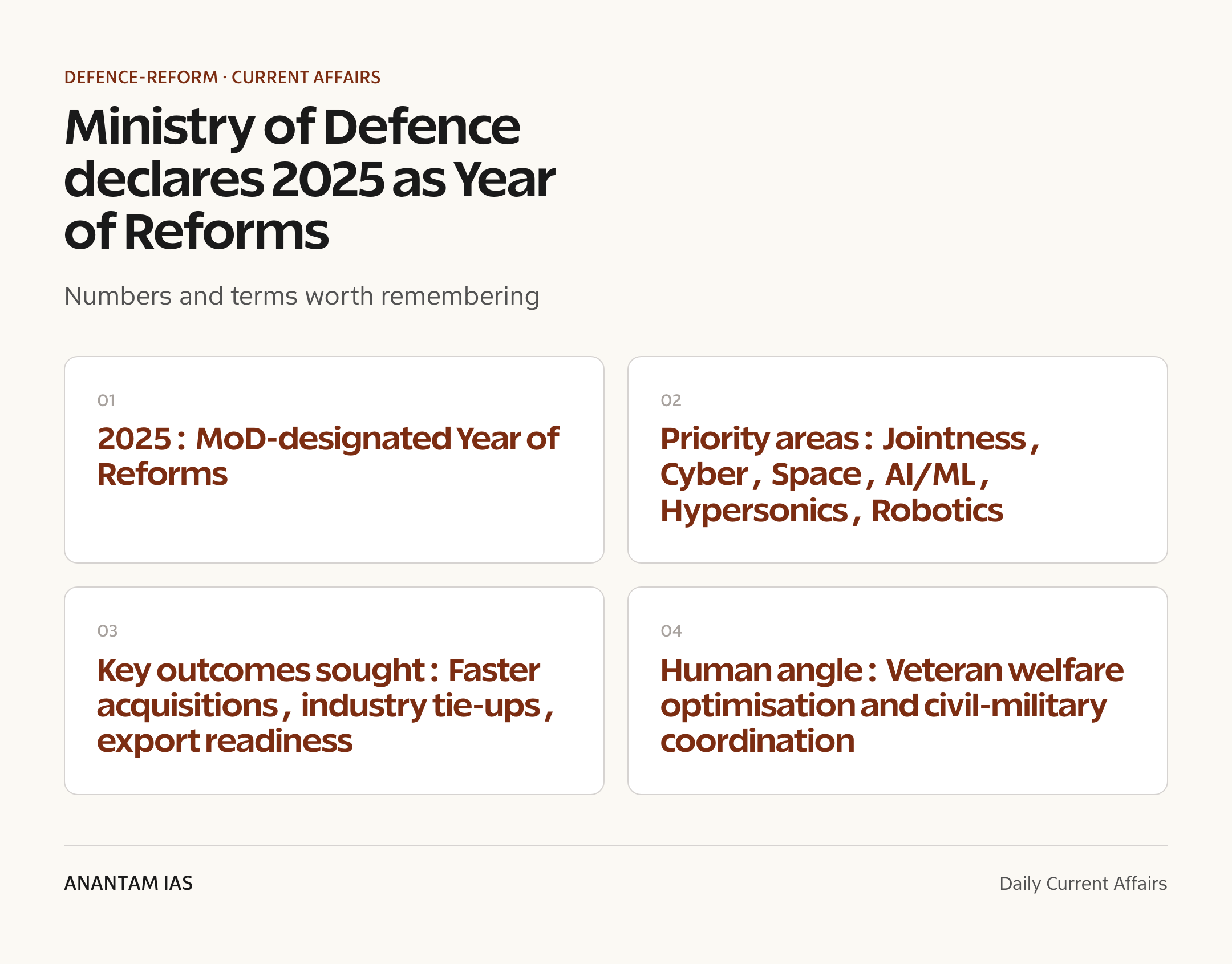
The initiative identifies a cluster of priority interventions — strengthening jointness through Integrated Theatre Commands, operationalising new domains such as cyber and space, prioritising emerging technologies (AI/ML, hypersonics, robotics), simplifying acquisitions, encouraging public-private partnerships and improving veteran welfare. The move signals an administrative attempt to align doctrine, resources and industry over a clearly defined timeframe.
- Official policy signal: The MoD has designated a calendar year to concentrate administrative energy and political will on defence reform, which helps focus leadership attention and resource allocation.
- Priority areas identified: Jointness and Integrated Theatre Commands; operational capacity in cyber and space; investment in AI/ML, hypersonics and robotics; doctrinal updates to match technological change.
- Procurement and industry push: Commitment to simplify acquisition procedures, promote technology transfer, incentivise public-private partnerships and improve ease of doing business to accelerate capability delivery and export readiness.
- Human and institutional aspects: Emphasis on veteran welfare, utilising ex-servicemen expertise, breaking silos across stakeholders and strengthening civil-military coordination to reduce duplication and optimise resources.
The development matters in the context of:
- Modernisation backlog: Indian Armed Forces are engaged in a long-running modernisation cycle; many platforms and systems need replacement or augmentation, and procurement delays have affected force preparedness.
- Integrated Theatre Commands: A structural reform intended to create unified command for theatre-level operations, requiring changes to command-and-control, logistics and legal frameworks.
- New operational domains: Cyber and space have become essential to contemporary warfare; developing doctrine, persistent capabilities and resilient systems is a strategic imperative.
- Emerging tech centrality: AI/ML, hypersonics and robotics are expected to transform combat dynamics; bridging R&D to production is essential for operational utility.
- Defence industrial base: ‘Make in India’ objectives and export ambitions demand regulatory ease, quality assurance, supply-chain integration and international partnerships.
- Procurement bottlenecks: Complex approval chains, protracted trials and unclear vendor engagement processes have contributed to delays and cancellations in defence projects.

UPSC Relevance
Prelims Relevance
- Facts to remember: 2025 designated by MoD as ‘Year of Reforms’ to focus on jointness, new domains, acquisitions and industry tie-ups.
- Key terms and concepts: Integrated Theatre Commands, public-private partnership (PPP), technology transfer, defence exports, AI/ML in defence.
Mains Relevance
GS3 Economy
- Governance and public administration: Demonstrates how the executive uses focused timelines to push cross-cutting reforms and the administrative machinery required to implement sectoral change.
- Industrial policy and trade: Links defence industrial policy with ease of doing business, incentives for domestic production and export promotion; useful for analysing industrial strategy and trade implications.
- Science & technology and national security: Illustrates the strategic integration of emerging technologies into national security planning and the policy levers needed to transition R&D into fielded capabilities.
Essay
- Themes: Modernisation of the armed forces, technology and national power, civil-military relations, administrative reform and industry-state relations.
- Use in essays: Can be cited as a recent example of targeted administrative focus to accelerate sectoral reform, and to discuss the interplay between policy intent and execution challenges in large public organisations.
Background and Context
Why a Year-based push
A time-bound declaration aims to create momentum and internal accountability within MoD and services.
- Concentrated timelines generate measurable milestones, which can be tracked through quarterly reviews and performance indicators.
- Political and administrative visibility can help resolve inter-departmental blockages and prioritise funds in budgetary cycles.
- Task forces and dedicated cells can be constituted to break complex reforms into implementable packages with assigned timelines.
- A single-year focus helps test pilot reforms and produce implementation templates for scaling up in subsequent years.
- Public reporting, where appropriate, can create external accountability and reduce information asymmetry with stakeholders.
Integrated Theatre Commands
An institutional change aimed at improving joint operational capability and faster decision-making in theatres of operation.
- Objective is to unify command of land, sea and air assets under theatre commanders for theatre-specific strategy and operations.
- Operational prerequisites include shared logistics, joint intelligence, common planning systems and interoperable communications.
- Administrative measures needed: transfer of assets, funding realignment, personnel policies and changes to service-specific command prerogatives.
- Risks include institutional resistance from services protective of domain-specific identities and redistribution of resources.
- A phased implementation with pilot commands, legal clarifications and doctrinal publications reduces friction and operational disruption.
Operationalising cyber and space
New domains need tailored organisational structures, doctrine and resilient infrastructure.
- Space requirements include persistent situational awareness, resilient satellite communications and space situational awareness capabilities.
- Cyber needs include defensive posture, offensive options with legal oversight, and integration with conventional operations for real-time support.
- Doctrine must clarify attribution thresholds, rules of engagement and escalation control in non-kinetic theatres.
- Human capital pipelines should be created through specialised training institutes, lateral recruitment and civil-military exchanges.
- Procurement pathways should favour rapid fielding of modular, upgradable systems to keep pace with short technology cycles.
Emerging technologies: AI, hypersonics and robotics
These technologies are force multipliers but require systems-level integration and governance.
- Research must move beyond prototype to certified platforms with clear test-and-evaluation regimes and interoperability standards.
- Supply chains for critical components (sensors, semiconductors, composites) must be secured through domestic capacity and trusted imports.
- Legal, ethical and operational frameworks should guide use of autonomy, human oversight and fail-safe mechanisms.
- Collaboration between DRDO, academia, startups and industry will accelerate transition from lab to operational use.
- Investments in simulation, digital twins and live testing ranges are necessary to validate systems under realistic conditions.
Acquisition reform and industry linkages
Faster, transparent procurement can incentivise domestic manufacturing and global competitiveness.
- Simplified procurement rules and fast-track clearances for critical projects can reduce cycle times and cost overruns.
- Pre-qualification frameworks and strategic vendor lists for key technologies can shorten tendering while maintaining oversight.
- PPP models and technology transfer clauses can help scale production and embed industrial capability domestically.
- Export promotion requires quality assurance, lifecycle support mechanisms and diplomatic initiatives to open markets.
- Standards alignment with global systems and participation in international supply chains will increase supplier credibility.
Veteran welfare and civil-military coordination
Retaining institutional knowledge and ensuring social compact with veterans strengthens human resources and societal trust.
- Optimising pensions and healthcare delivery is part of social justice and reduces administrative burden through digitisation.
- Structured programs to place veterans in training, maintenance, manufacturing and R&D roles can channel experience into capability building.
- Civil-military coordination improvements can reduce duplication of infrastructure and improve disaster-response synergy.
- Leveraging veteran expertise in doctrine development and institutional training can bridge operational requirements and industry needs.
- Transparent grievance redressal and stakeholder consultations help maintain morale and public confidence.
Way Forward
Governance and accountability
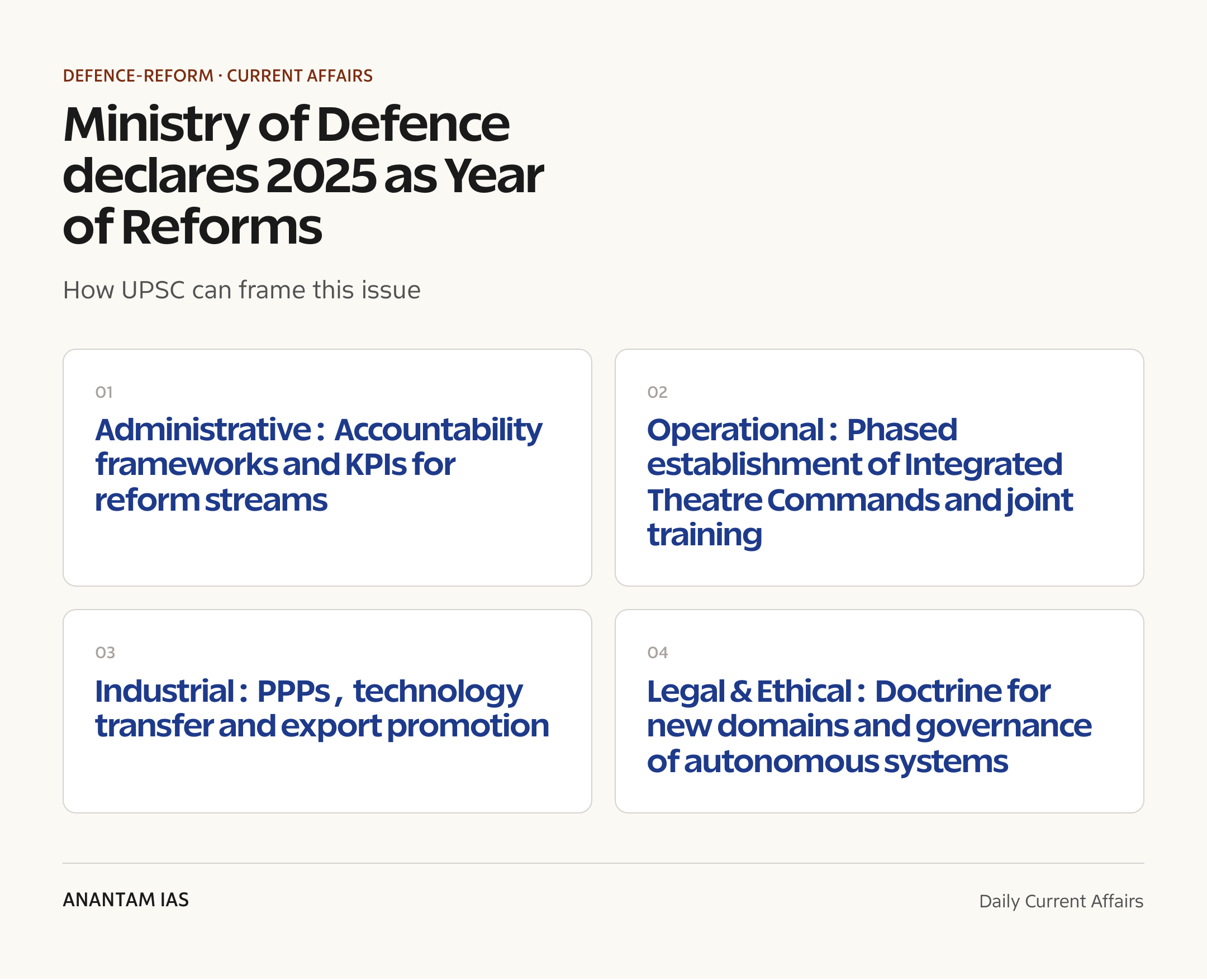
- Set measurable KPIs for each reform stream with quarterly reviews by an empowered steering committee.
- Publish periodic progress reports to build stakeholder confidence and enable course correction.
- Create cross-functional task forces with clear mandates, deliverables and sunset clauses to avoid permanent bureaucratic expansion.
Acquisition and industrial incentives
- Fast-track acquisition paths for critical technologies with pre-qualified vendor lists and fixed evaluation timelines.
- Offer targeted fiscal incentives, concessional financing and procurement preference tied to technology transfer and export milestones.
- Encourage clustering of defence MSMEs and anchor large orders to create scalable supply chains and quality standards.
Operational and doctrinal measures
- Establish joint centres of excellence for cyber and space with pooled funding and integrated staffing.
- Pilot Integrated Theatre Commands in selected regions with monitored performance metrics before national rollout.
- Develop doctrinal handbooks for AI and autonomous systems specifying human-in-loop mandates and escalation protocols.
Human capital and veterans
- Create lateral recruitment channels for specialists from industry and academia, supplemented by in-service training.
- Launch veteran integration programs linking ex-servicemen to training roles, maintenance contracts and industry placements.
- Invest in education partnerships to build a pipeline of engineers and technologists attuned to defence requirements.
Conclusion
The ‘Year of Reforms’ is a clear policy intent by MoD to accelerate cross-cutting modernisation, but success will depend on follow-through, institutional incentives and measurable delivery against timelines.
If reforms are synchronised across doctrine, procurement and industry while safeguarding operational readiness, India can achieve meaningful improvements in jointness, technology adoption and defence industrial capacity with positive spillovers for exports and strategic autonomy.
UPSC Practice Questions
Prelims MCQ 1
Which of the following is a declared focus area in the MoD’s 2025 ‘Year of Reforms’?
(a) Privatisation of the Indian Army (b) Development of Integrated Theatre Commands (c) Abolition of defence exports policy (d) Complete civilianisation of defence R and D
Answer: (b) Development of Integrated Theatre Commands
Explanation:
The MoD announcement explicitly lists strengthening jointness and facilitating establishment of Integrated Theatre Commands as a priority. Options (a), (c) and (d) do not reflect the content of the press release and are not part of the declared agenda.
Prelims MCQ 2
The MoD’s 2025 reforms explicitly list which technological domains for attention?
(a) Artificial Intelligence, Machine Learning, Hypersonics and Robotics (b) Quantum computing, Blockchain, 3D printing and Bioengineering (c) Nuclear propulsion, Coal gasification, Traditional artillery modernization (d) None of the above
Answer: (a) Artificial Intelligence, Machine Learning, Hypersonics and Robotics
Explanation:
The press release names AI, ML, hypersonics and robotics among the emerging technologies to be focussed on during the Year of Reforms. The other choices include technologies not listed in the announcement or are unrelated.
UPSC Mains Questions
- {‘question’: ‘Examine the likely administrative and doctrinal challenges in establishing Integrated Theatre Commands in India and suggest measures to address them.’, ‘guidance’: ‘Discuss inter-service rivalry, allocation of assets, command and control, logistics, legal frameworks and propose institutional reforms, phased implementation and legislative or policy adjustments.’}
- {‘question’: ‘Assess how prioritising new domains such as cyber and space in defence reforms would alter India’s strategic posture. What policy steps are required to operationalise these domains?’, ‘guidance’: ‘Cover capability development, doctrine, international norms, resource allocation, human capital and inter-agency coordination.’}
Sources: PIB, Ministry of Defence and PIB, Indian Navy commissioning release (context).
Frequently Asked Questions
q
a
q
a
q
a
q
a
q
a
Tell Google you want more of this.
Add Anantam IAS as a preferred sourceOne tap, and this site shows up more often in your own Top Stories, AI Overviews and AI Mode. Remove it any time.