Why in News?
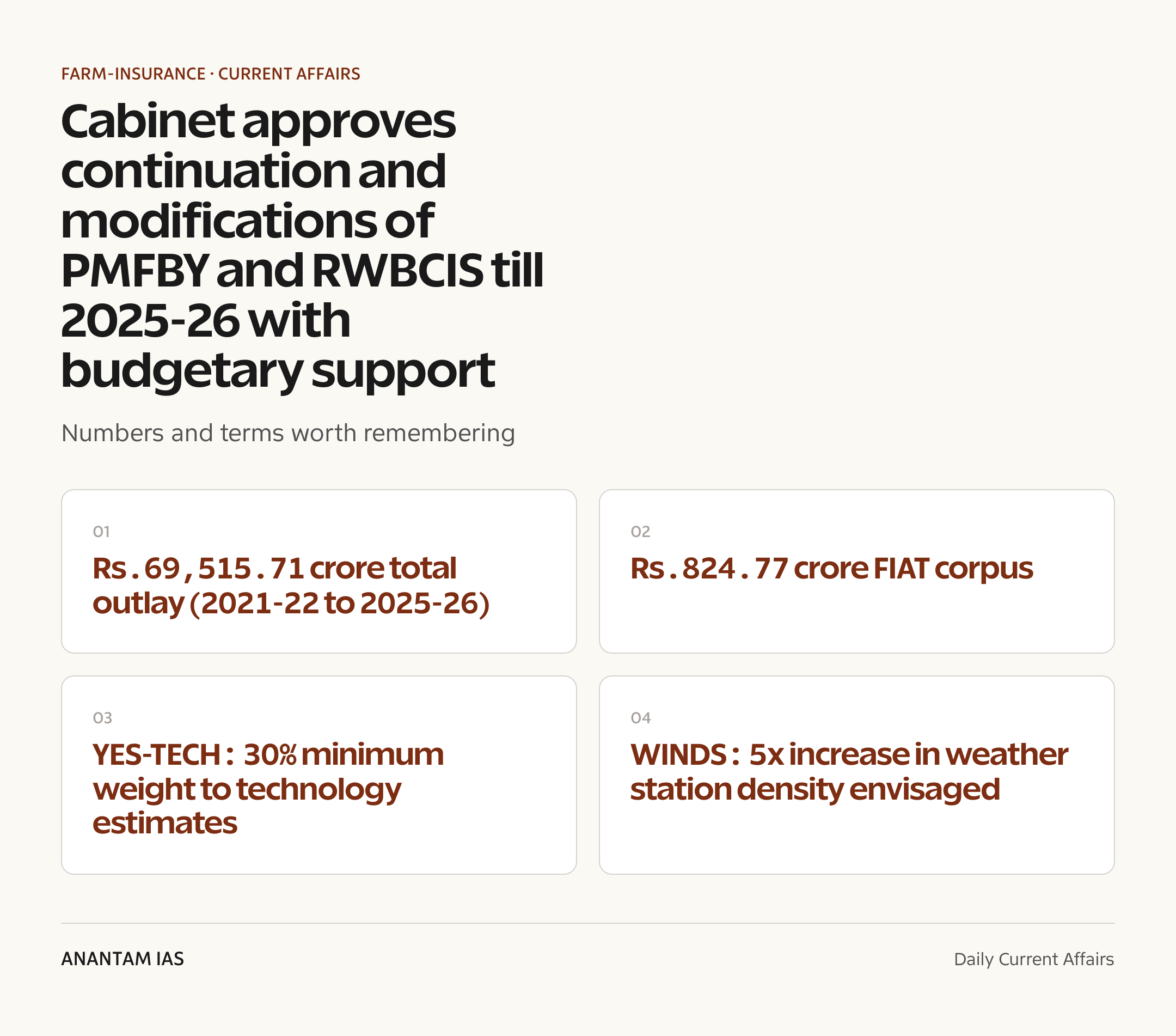
The Union Cabinet approved the continuation of Pradhan Mantri Fasal Bima Yojana (PMFBY) and Restructured Weather Based Crop Insurance Scheme (RWBCIS) up to the financial year 2025-26, along with modifications intended to improve transparency and speed of claim settlement. The decision includes an overall budgetary outlay of Rs.69,515.71 crore for the period 2021-22 to 2025-26 and establishes a dedicated Fund for Innovation and Technology (FIAT) to accelerate technology adoption across scheme operations.
The move is significant because it institutionalises a large central subsidy for crop insurance while signalling a shift towards technology-driven yield estimation and weather monitoring. Key initiatives under the modifications — YES-TECH (remote sensing based yield estimation) and WINDS (a denser network of Automatic Weather Stations and rain gauges) — aim to reduce dependence on manual Crop Cutting Experiments and enable more objective, quicker settlements. The policy change will influence fiscal planning, state implementation strategies and the broader approach to agrarian risk management.
- Continuation: PMFBY and RWBCIS extended through 2025-26 with central funding and operational modifications.
- Budget outlay: Total allocation of Rs.69,515.71 crore for 2021-22 to 2025-26 to meet premium subsidies and implementation costs.
- Tech fund: Creation of FIAT with a corpus of Rs.824.77 crore to finance YES-TECH, WINDS and research & development required for scaling.
- YES-TECH: Remote sensing-based yield estimation will carry a minimum 30% weight in yield calculations and is already in implementation in nine major states.
- WINDS: Plan to increase weather station density up to five times current networks, with AWS at block level and ARGs at panchayat level to generate hyper-local weather data.
- Special support: A 90:10 central-state premium sharing for North Eastern States and flexibility to reallocate unused funds there to other development schemes.
The development matters in the context of:
- Scheme background: PMFBY launched to protect farmers from crop losses due to non-preventable natural calamities, pests and diseases and to stabilise farm incomes.
- Coverage model: Premiums are actuarially determined, with central and state governments subsidising portions to keep farmer contributions affordable.
- Operational issues: Persistent delays in claim settlement, disputes over Crop Cutting Experiments (CCEs), and limited weather data coverage have undermined farmer trust.
- Technology push: Strengthening remote sensing and local weather networks is intended to increase objectivity and reduce the logistical burdens of field-based yield estimation.
- Fiscal implications: The large outlay increases the recurring subsidy burden, raising questions about medium-term sustainability and prioritisation within agriculture spending.
- State heterogeneity: States vary in administrative capacity and willingness to adopt technology-based methods; some have moved faster to tech-heavy approaches than others.

UPSC Relevance
Prelims Relevance
- Memorise: Schemes extended up to 2025-26; total outlay Rs.69,515.71 crore for 2021-22 to 2025-26; FIAT corpus Rs.824.77 crore.
- Understand components: YES-TECH (remote sensing yield estimation with minimum 30% weight) and WINDS (block-level AWS and panchayat-level ARGs).
- Remember special provisions: Central premium sharing on a 90:10 basis for North Eastern States and flexibility to reallocate unused funds.
Mains Relevance
GS3 Economy
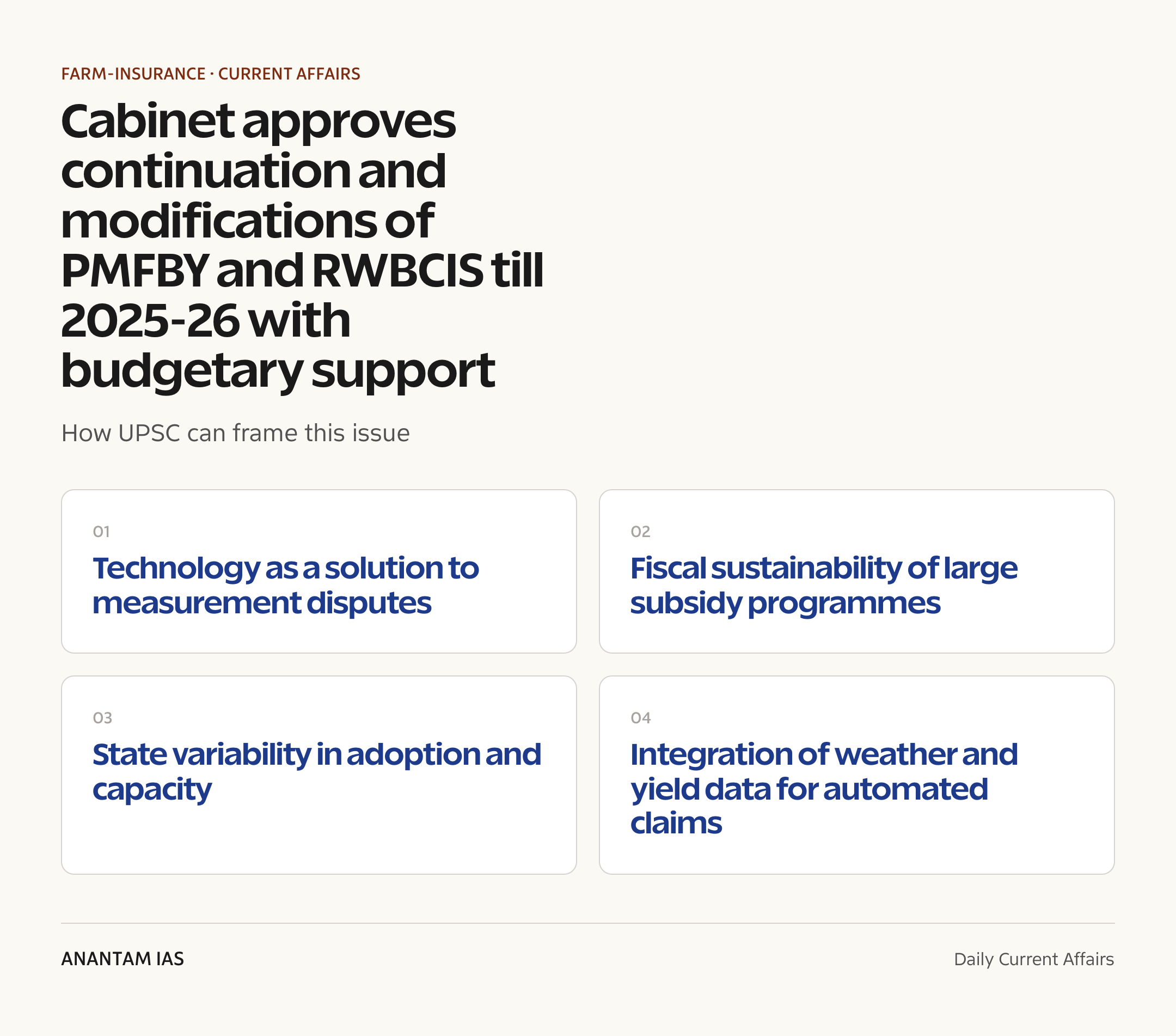
- Evaluate the role of technology in improving the delivery and credibility of public crop insurance and reducing measurement disputes.
- Discuss fiscal tradeoffs and sustainability concerns associated with large subsidy-backed insurance programmes and alternatives to fiscal transfers.
- Analyse centre-state relations in scheme administration, capacity differences across states and their implications for farmer welfare and coverage equity.
Essay
- Themes: Agrarian distress and policy responses; Role of technology and data in governance; Public finance and subsidy design.
- Arguments: Assess balancing protective public finance for farmers against incentives for risk reduction, efficiency and market-based solutions.
Background and Context
Origin and objectives
Why PMFBY and RWBCIS were created and what they aim to achieve.
- Provide insurance cover to farmers against crop losses from natural calamities, pests and diseases to stabilise incomes and protect credit flow.
- Reduce post-disaster distress among farmers that can lead to indebtedness and farm abandonment.
- Encourage agricultural investments by reducing farm-sector volatility and improving access to institutional credit against insured crop value.
- Design intended to be national in scope, with central subsidy to make insurance affordable and with scope for state adaptations.
Implementation mechanics
How the schemes have functioned operationally since inception.
- Premiums are determined on actuarial principles, with the government subsidising a portion of the actuarial premium to keep farmer premiums capped.
- Private and public insurance companies are contracted as implementing agencies by state governments to underwrite risks and manage claims.
- Claims traditionally rely on Crop Cutting Experiments (CCEs) for area-yield estimation and on weather/area-index methodologies for certain crops.
- Farmer enrolment is done seasonally; the schemes cover notified crops, with sums insured linked to scale of finance or expected yield.
Key operational challenges
Persistent problems that have limited scheme effectiveness and farmer trust.
- Delay in claim settlements and procedural complexities leading to farmer dissatisfaction and litigation in some instances.
- Disputes around CCEs, inadequate sample sizes, and alleged manipulation have undermined perceived fairness.
- Sparse weather station networks and limited granularity of ground data reduce precision of weather-index products and area estimates.
- Adverse selection concerns, insurer solvency risks in high-loss years and heterogeneity across states in subsidy capacity and monitoring.
Technology interventions introduced
YES-TECH and WINDS are designed to address measurement and data gaps.
- YES-TECH employs remote sensing and satellite-derived indices to estimate yields, with technology-based estimates carrying at least 30% weight in final calculations.
- WINDS proposes Automatic Weather Stations at block level and Automatic Rain Gauges at panchayat level to create hyper-local weather datasets for trigger-based assessments.
- Early adopters: Nine major states have begun implementing YES-TECH and are in different stages of piloting WINDS installations.
- Objective is to reduce reliance on time-consuming CCEs and to enable faster, more objective, and automated claim triggers.
FIAT: Fund for Innovation and Technology
Purpose, scope and intended uses of the new technology fund.
- FIAT has a corpus of Rs.824.77 crore dedicated to scaling technology solutions under PMFBY and RWBCIS.
- Funds will finance procurement of remote sensing data, installation and maintenance of weather station networks, platform development and research studies.
- Intended to support state-level onboarding, capacity building, tendering and proof-of-concept testing before full roll-out.
- Expectation that central funding will reduce entry barriers for states to adopt tech-based estimation and monitoring systems.
Special provisions for North Eastern States
Why the North East receives differentiated treatment under the scheme.
- Centre offers a 90:10 central-state premium sharing to encourage coverage in the North Eastern States where agriculture is predominantly small and fragmented.
- Given low gross cropped area and voluntary nature of participation, states have flexibility to reallocate unspent scheme funds to other development needs.
- Policy aims to balance equity in coverage with practical considerations about scheme uptake and administrative cost-effectiveness in difficult terrain.
- Prioritisation for saturation of farmers in the region is part of a wider strategy to improve outreach and social protection for marginal cultivators.
Fiscal and policy trade-offs
Budgetary implications and broader policy considerations.
- The Rs.69,515.71 crore allocation for 2021-22 to 2025-26 represents a substantial recurring subsidy that must be balanced against other agricultural investments.
- Sustainability questions arise in high-loss years when claims spike and insurer stress can lead to contingent liabilities for the exchequer.
- Policymakers face trade-offs between broad subsidisation to protect farmers and targeting limited resources to most vulnerable areas or crops.
- Long-run resilience requires combining insurance with investments in irrigation, extension, climate-resilient practices and market infrastructure.
Way Forward
Operationalising and validating technology
- Scale YES-TECH after rigorous ground-truthing and transparent methodology disclosure to reduce distrust among stakeholders.
- Create standard validation protocols and third-party audits for remote sensing algorithms and yield models.
- Pilot interoperability standards so remote-sensing outputs, CCEs and WINDS data can be reconciled during transition periods.
- Invest in local capacity building for data interpretation at state agricultural departments and insurance implementing agencies.
Fast-tracking WINDS deployment
- Adopt standard procurement templates and central-supported tenders to reduce planning delays and economies of scale.
- Ensure ongoing maintenance and data quality agreements to prevent sensor downtimes and data gaps.
- Integrate WINDS outputs with national meteorological and agri-data platforms to enrich modelling and index designs.
- Provide funds from FIAT for initial capital expenditure and training for state-level staff to operate AWS/ARG networks.
Strengthening governance and grievance redress
- Establish clear timelines for claim settlement, with automated triggers for index-based payouts and defined escalation mechanisms.
- Set up independent grievance cells with farmer-friendly access and mobile-enabled claim status tracking.
- Mandate disclosure of actuarial assumptions, premium components and claim ratios to improve transparency.
- Use open-data policies selectively to enable research while protecting farmer privacy and commercial data rights.
Fiscal sustainability and policy integration
- Institute periodic actuarial reviews and scenario-based stress tests to assess long-term subsidy needs and insurer solvency risks.
- Consider targeting higher subsidy rates to regions with greater vulnerability while encouraging market-based products elsewhere.
- Link insurance with investments in risk reduction — irrigation, improved seeds and extension — to reduce indemnity burden over time.
- Explore blended finance and reinsurance arrangements, and encourage private-sector innovation in complementary products.
Conclusion
The Cabinet decision secures continuity of two flagship crop insurance programmes while committing resources to technological modernisation intended to address core operational weaknesses.
Realising the intended gains will require transparent implementation of YES-TECH and WINDS, robust validation and grievance mechanisms, timely claim settlements and prudent fiscal management so that insurance strengthens farmer resilience without unsustainable subsidy pressure.
UPSC Practice Questions
Prelims MCQ 1
Which of the following statements about YES-TECH under PMFBY is/are correct? 1) It uses remote sensing for yield estimation. 2) Technology based yield estimates must carry minimum 30 percent weightage. 3) YES-TECH replaces WINDS. Choose the correct option.
(a) 1 and 2 only (b) 1 and 3 only (c) 2 and 3 only (d) All of the above
Answer: (a) 1 and 2 only
Explanation:
YES-TECH employs remote sensing to generate yield estimates and mandates that technology-based estimates carry at least 30% weight when computing final yields. It is designed to complement other initiatives and does not replace WINDS, which focuses on weather data infrastructure.
Prelims MCQ 2
The Fund for Innovation and Technology (FIAT) approved for PMFBY has a corpus closest to which of the following amounts?
(a) Rs.82.5 crore (b) Rs.824.77 crore (c) Rs.8,247.7 crore (d) Rs.82,477 crore
Answer: (b) Rs.824.77 crore
Explanation:
The Cabinet approved a Fund for Innovation and Technology (FIAT) with a corpus of Rs.824.77 crore to support technology initiatives such as YES-TECH and WINDS and related R&D and pilot activities.
UPSC Mains Questions
- {‘question’: ‘Analyse the potential of remote sensing based yield estimation in improving the effectiveness of crop insurance schemes. What governance measures are needed to ensure its credibility?’, ‘model_answer_points’: [‘Begin by outlining the limitations of crop cutting experiments (CCEs): logistical complexity, sampling errors, time lags and susceptibility to disputes in heterogeneous smallholder landscapes.’, ‘Explain how remote sensing provides scalable, repeatable and frequent observations over large areas, potentially enabling area-based yield estimation, early-warning signals and automation of parts of claim processing.’, ‘Identify implementation challenges: sensor resolution constraints for fragmented holdings, cloud cover affecting optical data, need for robust calibration with ground truth, potential algorithmic bias and data ownership concerns.’, ‘Recommend governance measures: mandatory ground-truth validation and phased roll-out, independent third-party audits of algorithms and models, publication of methodologies and error margins, grievance mechanisms and continuity of CCEs until validated technology attains reliability.’, ‘Conclude by suggesting integration with complementary investments (local weather stations, farmer registries, digital land records) to maximise the benefits and credibility of technology-driven estimation.’]}
- {‘question’: ‘Critically examine the fiscal tradeoffs involved in providing large central subsidies for crop insurance. Suggest policy alternatives to complement insurance for managing agrarian risk.’, ‘model_answer_points’: [‘Start with the fiscal dimension: present the Rs.69,515.71 crore allocation and discuss recurring subsidy implications, particularly under years with large claims that can strain budgets.’, ‘Examine efficiency and incentive effects: subsidies can buffer farmers but may create moral hazard, reduce private risk mitigation investments and favour broad coverage over targeted protection.’, ‘Discuss distributional issues: uniform subsidy regimes may not prioritise the most vulnerable regions or crops, and insurer risks can translate into contingent public liabilities.’, ‘Offer alternatives and complements: invest in climate-resilient infrastructure (irrigation, watershed management), expand risk-reducing extension services, promote diversified and indexed financial products, and design targeted cash transfers for highly vulnerable households.’, ‘Propose policy mixes: use targeted subsidies, encourage private crop insurance markets for commercially viable segments, leverage reinsurance markets, and condition subsidies on adoption of risk-reduction measures to reduce long-term fiscal exposure.’]}
Sources: PIB, Cabinet Secretariat and PIB, Ministry of Agriculture & Farmers Welfare.
Frequently Asked Questions
q
a
q
a
q
a
q
a
q
a
q
a
Tell Google you want more of this.
Add Anantam IAS as a preferred sourceOne tap, and this site shows up more often in your own Top Stories, AI Overviews and AI Mode. Remove it any time.