Disclosure: this guide contains Amazon affiliate links. As an Amazon Associate, Anantam IAS earns from qualifying purchases — at no extra cost to you.
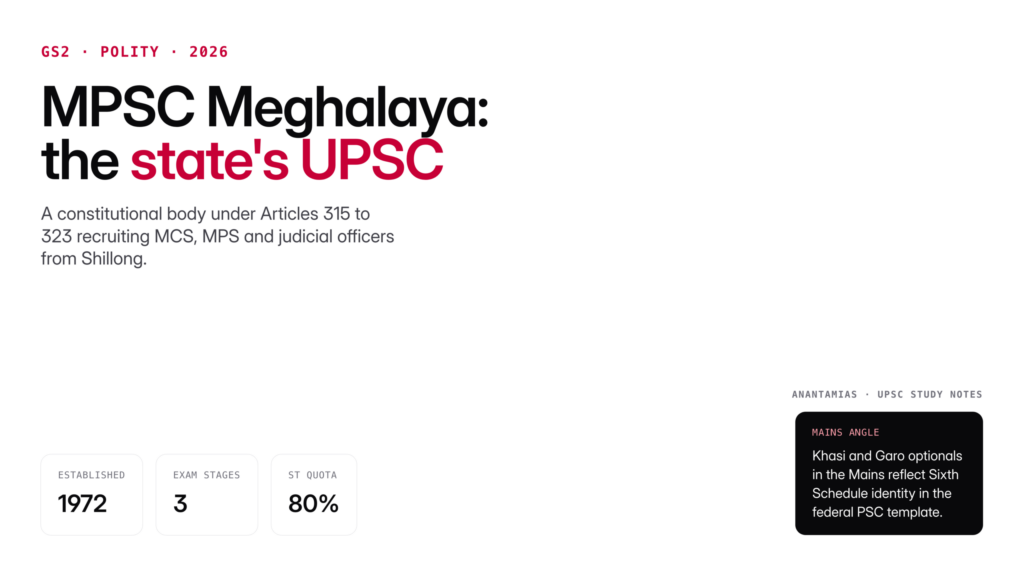
The Meghalaya Public Service Commission (MPSC) is the constitutional body under Articles 315–323 of the Constitution that recruits Meghalaya’s state civil servants, most notably through the Meghalaya Civil Services (MCS) Combined Competitive Examination. Established in 1972 after Meghalaya’s statehood and headquartered at Lum Survey, Shillong, it also conducts the Meghalaya Police, Forest and Judicial Service exams. Its official portal is mpsc.nic.in.
Introduction
The Meghalaya Public Service Commission, usually abbreviated MPSC, is the constitutional body responsible for recruiting the state’s civil servants, from the Meghalaya Civil Service to police officers, forest officers and teaching cadres. For a UPSC aspirant, the MPSC is a dual-purpose study topic. It is relevant as a governance institution under Articles 315 to 323 of the Constitution, and it is a live parallel recruitment track for candidates who also write the Union Public Service Commission civil services examination.
This note consolidates the constitutional framework, the MCS and MPS examination structure, the latest notification cycle and eligibility rules, and the key reforms debated in the 2020s. It also positions MPSC within the wider State Public Service Commission ecosystem, so you have a ready answer for questions that compare state PSCs with UPSC.
Quick Facts at a Glance
| Parameter | Detail |
|---|---|
| Constitutional basis | Articles 315 to 323 (Part XIV) |
| Established | 1972, after Meghalaya became a full state on 21 January 1972 |
| Headquarters | Lum Survey, Shillong |
| Appointing authority | Governor of Meghalaya (Article 316) |
| Tenure of chairperson | 6 years or age 62, whichever is earlier |
| Flagship exam | Meghalaya Civil Services (MCS) Combined Competitive Examination |
| Paper stages | Preliminary, Main, Personality Test |
| Other exams | Meghalaya Police Service, Forest Service, Judicial Service, Labour Inspector |
| Official portal | mpsc.nic.in |
| Annual vacancies (avg 2020 to 2025) | 20 to 60 across all services |
Background and Historical Context
Meghalaya was carved out of Assam under the North-Eastern Areas Reorganisation Act 1971 and became a full-fledged state on 21 January 1972. Until then the territory’s civil services were recruited through the Assam Public Service Commission. The Meghalaya Public Service Commission was constituted shortly after statehood under Article 315 clause 1, which requires every state to have its own commission unless Parliament provides a joint commission. The Governor, under Article 316, appointed the first chairperson and members, and the commission became functional from its Shillong headquarters at Lum Survey.
In its early decades MPSC focused on filling posts in the Meghalaya Civil Service and Meghalaya Police Service, services that are feeder cadres to the all-India IAS and IPS through promotion quotas under the Indian Administrative Service Recruitment Rules 1954. Recruitment was initially modest, with only 10 to 20 combined MCS and MPS vacancies per year, reflecting the state’s small government footprint.
The commission modernised through the 2000s. Online applications were introduced around 2014, and a structured syllabus for the MCS Combined Competitive Examination was adopted that mirrors the UPSC pattern of Prelims, Mains and Personality Test. The MPSC also took on judicial recruitment after the Supreme Court’s All India Judges Association judgment, and now conducts the Meghalaya Judicial Service examination. Post-2019, the commission has been central to debates about reservation, the role of the Sixth Schedule autonomous district councils and demands for an Inner Line Permit, because state-service recruitment sits at the crossroads of identity and employment in the Northeast.
Key Features of the MCS Examination
Stage 1: Preliminary Examination
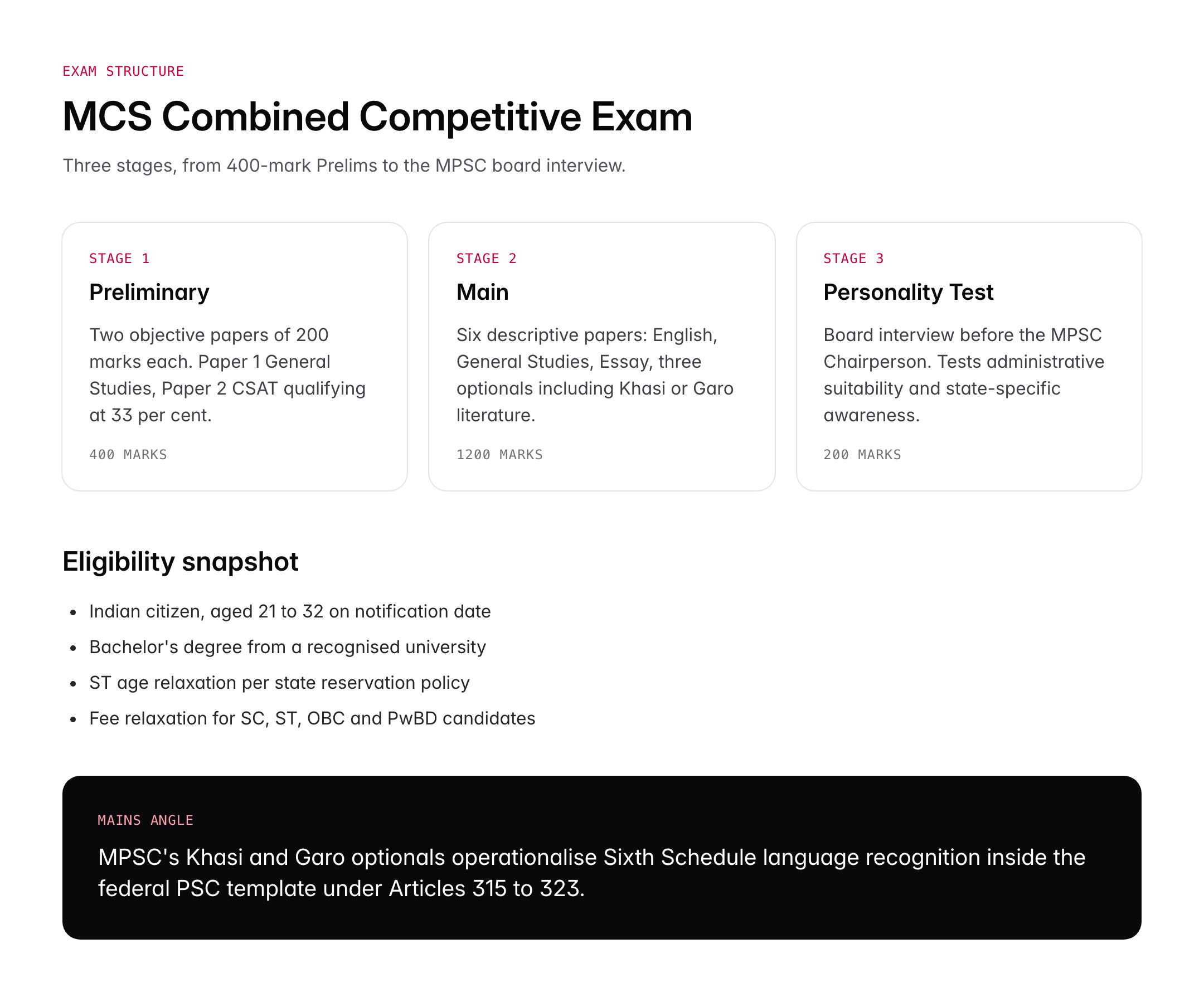
The MCS Preliminary Examination has two objective papers of 200 marks each. Paper 1 covers General Studies with questions on Indian polity, economy, geography, history, current affairs and Meghalaya-specific knowledge. Paper 2 is a Civil Services Aptitude Test modelled on the UPSC CSAT, covering comprehension, logical reasoning and quantitative aptitude. Paper 2 is qualifying in nature at 33 per cent.
Stage 2: Main Examination
The Main Examination is descriptive and comprises six papers: a compulsory English language paper, a General Studies paper, an Essay paper, and three optional subject papers chosen from a list that includes Public Administration, Political Science, Economics, History, Sociology, Anthropology, Botany, Zoology and Khasi or Garo literature. The emphasis on Khasi and Garo as optional literatures is unique to MPSC and reflects the Sixth Schedule character of the state.
Stage 3: Personality Test
Candidates clearing the Mains are called for a personality test or interview of 200 marks before a board typically chaired by the MPSC Chairperson. Questions test administrative suitability, awareness of Meghalaya-specific issues such as the Sixth Schedule, autonomous district councils and border disputes with Assam.
Eligibility
The candidate must be an Indian citizen between 21 and 32 years of age as on the date of notification. Educational qualification is a bachelor’s degree from a recognised university. Relaxations apply for Scheduled Tribes (Khasi, Jaintia, Garo) as per state reservation policy, and for Other Backward Classes and persons with benchmark disabilities.
Notification Cycle
MPSC typically releases the MCS notification in the second half of the calendar year, with the Preliminary Examination in early winter and the Mains in the following spring. The most recent notification cycles have shown two to three months between Prelims and Mains, shorter than UPSC’s four-month gap.
Reservation Policy
Meghalaya reserves 40 per cent of posts for Khasi and Jaintia, 40 per cent for Garo, and 5 per cent for other tribes, following the state’s 80 per cent reservation for Scheduled Tribes under the tribal-state policy framework.
Significance for UPSC and General Knowledge
- Provides a concrete example of Articles 315 to 323 in practice, which is high-yield for Prelims.
- Illustrates federalism and state-specific reservation policy under the Sixth Schedule.
- Offers a comparison point with UPSC on syllabus, pattern and reservation.
- Useful for GS2 answers on public-service reform, autonomy of constitutional bodies and Northeast governance.
- Serves as a fallback career path for aspirants; many UPSC candidates write MPSC simultaneously.
- Links to current-affairs topics like the Meghalaya-Assam border pact of 2022 and the autonomous district council debate.
Detailed Analysis: Structure and Reform Agenda
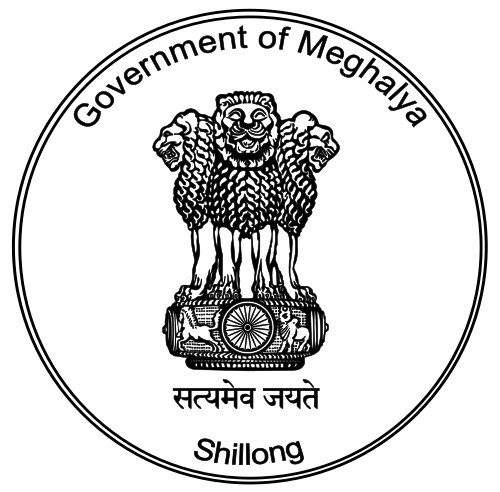
The MPSC’s institutional architecture mirrors the UPSC template but operates at a smaller scale. The commission has a chairperson and up to five members appointed by the Governor, each serving a six-year term or until age 62. Removal requires a reference to the Supreme Court under Article 317 of the Constitution, guaranteeing the same tenure security that shields the UPSC and guards its independence.
Recruitment volumes remain modest. Data compiled from MPSC annual reports between 2020 and 2025 show that combined MCS and MPS vacancies ranged from 20 to 60 a year, with occasional large recruitments for specialist cadres such as Assistant Forest Conservator or Labour Inspector. This modest scale is both a strength, in that candidates get more personal attention at interview stage, and a weakness, in that cycle frequency can be irregular and notifications are occasionally pushed from one financial year to the next.
Reform pressure in the 2020s has focused on three areas. First, digitisation: while online applications exist, hall-ticket delivery and result publication have been plagued by portal outages, and the commission is migrating to a more robust NIC-hosted platform. Second, syllabus harmonisation: aspirants have petitioned MPSC to align optional subjects more closely with UPSC, so that preparation effort transfers across exams. Third, transparency: calls for publishing cut-offs, answer keys and score-sheets of unsuccessful candidates have grown louder, citing parallel reforms at UPSC and at state PSCs like Maharashtra.
Accountability-wise, the MPSC tables its annual report before the Meghalaya Legislative Assembly under Article 323, and the report is examined by the Public Accounts Committee. In 2022 the Comptroller and Auditor General flagged delays in filling sanctioned posts of teachers, a finding MPSC has since moved to address through combined recruitment rounds.
Comparative Perspective
| Feature | UPSC | MPSC (Meghalaya) |
|---|---|---|
| Constitutional article | 315 to 323 | 315 to 323 |
| Established | 1926 (as PSC of India) | 1972 |
| Chairperson tenure | 6 years or age 65 | 6 years or age 62 |
| Annual vacancies | 1000+ (CSE) | 20 to 60 combined |
| Optional papers | 48 choices | Around 20 choices, includes Khasi and Garo |
| Interview marks | 275 | 200 |
| Reservation | Central policy | 80% for STs (state policy) |
Two points stand out for answers. One, state PSCs enjoy the same constitutional insulation as UPSC, a fact sometimes missed in Mains papers that conflate UPSC’s supremacy with state PSCs. Two, the inclusion of Khasi and Garo literature as optional subjects shows how state PSCs adapt the federal template to local linguistic identity, a feature celebrated in the Eighth Schedule and Sixth Schedule debates.
Challenges and Criticisms
MPSC has faced sustained criticism on three fronts. First, exam-cycle delays: between 2018 and 2021 the MCS cycle stretched almost 30 months from notification to final result, causing aspirants to age out of eligibility windows. Second, allegations of paper leaks and cheating surfaced during the 2022 MCS cycle, forcing the commission to cancel and re-conduct one paper; a Special Investigation Team inquiry was constituted. Third, limited outreach in rural areas and a perception that candidates from Shillong-based coaching ecosystems have a systemic advantage have fuelled demand for decentralised exam centres.
Civil-society organisations have also questioned the slow adoption of digital evaluation. The Meghalaya Information Commission, separately, has flagged inadequate compliance with Right to Information requests filed against the MPSC, although the commission contends that selection data is protected by Section 8 exemptions. Balanced against these concerns are improvements made since 2023 in syllabus clarity, recruitment calendar publication and online fee payment.
Prelims Pointers
- MPSC is constituted under Articles 315 to 323 of the Constitution of India.
- It was established in 1972 following Meghalaya’s statehood under the North-Eastern Areas Reorganisation Act 1971.
- The commission is headquartered at Lum Survey, Shillong.
- The Governor of Meghalaya appoints the chairperson and members under Article 316.
- The chairperson’s tenure is six years or age 62, whichever is earlier.
- Removal of members requires a reference to the Supreme Court under Article 317.
- The flagship exam is the MCS Combined Competitive Examination.
- The Mains has six papers, including three optional papers chosen from a list that features Khasi and Garo literature.
- Reservation in Meghalaya government posts is 80 per cent for Scheduled Tribes.
- MPSC’s annual report is tabled before the State Legislature under Article 323.
- The MPS recruitment feeds promotion quotas into the Indian Police Service.
- The portal is mpsc.nic.in.
Mains Practice Questions
Q1. “State Public Service Commissions are the first line of merit-based recruitment in India’s federal structure.” Examine with reference to the Meghalaya Public Service Commission. (15 marks, 250 words)
- Trace the constitutional basis (Articles 315 to 323) and tenure security (Article 317).
- Use MPSC-specific examples: modest vacancy scale, Khasi-Garo optionals, ST reservation.
- Evaluate reform agenda: digitisation, transparency, syllabus harmonisation.
Q2. Discuss the challenges faced by State Public Service Commissions in the Northeast, citing reform pathways. (10 marks, 150 words)
- Identify challenges: exam delays, paper leaks, outreach gaps.
- Cite MPSC 2022 cancellation and SIT inquiry as evidence.
- Suggest pathways: decentralised centres, digital evaluation, RTI compliance.
Conclusion
The Meghalaya Public Service Commission is a compact illustration of how India’s federal structure localises the constitutional design of merit-based recruitment. Small in scale but constitutionally equal in stature to UPSC, MPSC has kept the civil-service pipeline moving in a state where tribal identity, Sixth Schedule autonomy and modern administrative demands intersect. Its optional subjects in Khasi and Garo, reservation tuned to the ST-majority demography, and proximity to the Assam border dispute make it unlike any other state PSC.
For the UPSC aspirant, MPSC is both an exam topic and a policy microcosm. A strong answer on state PSCs weaves together Articles 315 to 323, Article 317’s removal safeguard, and real examples like the 2022 MCS cycle controversy. A strong career strategy, for those eligible, also uses MPSC as a parallel examination, because the preparation overlap with UPSC is substantial and the roles feed directly into the Indian Administrative Service and Indian Police Service through promotion.
Books for the Meghalaya PSC exams
Most of what you read for UPSC transfers to the Meghalaya PSC exams: polity, economy, modern history and the NCERT base. What does not transfer is the Meghalaya section, and that is where the selection is decided. One state book, read three times, beats five read once.

Meghalaya General Knowledge — Ramesh Publishing
- 168 pages, Ramesh Publishing House, 2026
- Meghalaya history, tribes, geography, economy and administration
- Slim, factual, built for the state paper

Lucent's General Knowledge 2026 — English (15th revised edition)
- 460 pages, Lucent Publications
- Static GK in the compressed, list-heavy format state PSC prelims reward
- Overrated for UPSC, right for this exam
- Indian Polity, M. Laxmikanth (Amazon.in). The polity questions are the same exam everywhere.
- Lucent’s General Knowledge (Amazon.in). Overrated for UPSC, right for the static questions here.
- Indian Economy, Ramesh Singh (Amazon.in). Read the concept chapters; the state budget goes on top.
- A Brief History of Modern India, Spectrum (Amazon.in). The freedom-struggle questions come straight from here.
- Meghalaya General Knowledge — Ramesh Publishing (Amazon.in): the only Meghalaya-specific GK book in regular print.
- NCERTs, Classes 6 to 12, for history, geography and science. Free from NCERT; nothing to buy.
Skip the coaching compilations until you have finished these. They summarise books you have not read yet.
Frequently Asked Questions
What is the Meghalaya Public Service Commission (MPSC)?
MPSC is the constitutional body established in 1972 to recruit civil servants for the state of Meghalaya, including the Meghalaya Civil Service, Meghalaya Police Service, Forest Service, Judicial Service and various teaching cadres. It is constituted under Articles 315 to 323 of the Constitution of India and is headquartered at Lum Survey, Shillong.
Why is MPSC important for UPSC aspirants?
MPSC is examinable on two counts. It is a textbook example of state public-service commissions under Articles 315 to 323 for GS2 polity, and it is a parallel career track for aspirants writing the UPSC civil services exam. The MCS Combined Competitive Examination mirrors the UPSC pattern of Prelims, Mains and Personality Test, which makes preparation effort largely transferable.
How is MPSC related to UPSC?
MPSC and UPSC share identical constitutional anchoring under Part XIV of the Constitution. Both are appointed by the respective executive, enjoy tenure security under Article 317, and submit annual reports to the legislature under Article 323. MPS officers recruited via MPSC feed the Indian Police Service through promotion quotas, and MCS officers similarly feed the Indian Administrative Service.
What is the structure of the MCS examination?
The Meghalaya Civil Services examination has three stages. Stage one is the Preliminary with a General Studies paper and a qualifying CSAT paper. Stage two is the Main with six descriptive papers including English, General Studies, Essay and three optional papers. Stage three is a 200-mark Personality Test conducted by the MPSC board.
Which optional subjects are unique to MPSC?
MPSC offers Khasi literature and Garo literature as optional subjects in the MCS Main Examination. This reflects the Sixth Schedule character of Meghalaya, where Khasi, Jaintia and Garo are recognised indigenous languages. Candidates can also choose mainstream optionals like Public Administration, Political Science, Sociology and Anthropology.
What is the reservation policy for MPSC recruitment?
Meghalaya reserves 80 per cent of posts for Scheduled Tribes, split roughly as 40 per cent for Khasi and Jaintia, 40 per cent for Garo, and 5 per cent for other Scheduled Tribes. The remainder is unreserved. Other Backward Classes and persons with benchmark disabilities receive age and fee relaxations, and vacancies follow the state’s tribal-state policy framework.
How is the MPSC chairperson appointed and removed?
The chairperson and members of MPSC are appointed by the Governor of Meghalaya under Article 316 of the Constitution. Their tenure is six years or age 62, whichever is earlier. Removal requires a presidential order after a Supreme Court inquiry under Article 317, the same safeguard that protects UPSC members and ensures the commission’s functional independence from the state executive.
What are the main criticisms of MPSC?
Three criticisms dominate recent discourse. First, exam cycles have occasionally stretched to 30 months, causing aspirants to age out. Second, paper-leak allegations in the 2022 MCS cycle led to a Special Investigation Team inquiry and a re-examination. Third, limited outreach beyond Shillong and slow RTI compliance have been flagged by the Meghalaya Information Commission.
Tell Google you want more of this.
Add Anantam IAS as a preferred sourceOne tap, and this site shows up more often in your own Top Stories, AI Overviews and AI Mode. Remove it any time.