Daily Digest
UPSC · Civil Services Examination
Current Affairs · Monday, 13 July 2026
Current affairs curated and edited by Anantam IAS faculty — pulled from The Hindu, PIB, IDSA, Foreign Affairs and the ministries. Read, annotate, revise.
Old Rajinder Nagar · Delhi 110005 · anantamias.com
EPFO Amnesty Scheme 2026: One-time compliance window for exempted PF trusts
Why in News?
The Employees’ Provident Fund Organisation (EPFO), under the Ministry of Labour & Employment, has invited applications for the Amnesty Scheme, 2026 — a one-time window for establishments running Provident Fund (PF) trusts recognised under the Income Tax Act, 1961 to regularise their exemption status. PIB confirmed the scheme through a release on 12 July 2026.
The scheme was notified on 29 June 2026 and stays open for six months. It flows from the Finance Act, 2026, which ties income-tax recognition of provident funds to exemption under Section 17 of the EPF & MP Act, 1952 — so trusts that never obtained a formal exemption notification must now regularise or migrate.
- Notified on 29 June 2026 via Gazette notification GSR 525(E); the window runs for six months from notification.
- Covers establishments operating a PF trust recognised under the Income Tax Act, 1961 but lacking a formal exemption notification from the Central or State government.
- Amnesty is granted retrospectively under Section 17 of the EPF & MP Act, 1952 and Section 143 of the Code on Social Security, 2020.
- Two routes: Category I (move to compliance as an un-exempted establishment) and Category II (continue as an exempted establishment under the Code).
- Reliefs are conditional — member accounts must have received contributions and interest at or above statutory EPFO rates.
The development matters in the context of:
- A live case study of regulatory amnesty in social security — usable in GS3 (economy, employment) and GS2 (governance) answers.
- It shows tax-law and labour-law convergence: the Finance Act, 2026 now hinges PF tax recognition on a labour-law exemption.
- It anchors the static syllabus — the EPF & MP Act, 1952 and the Code on Social Security, 2020 — to a dated, testable development.
UPSC Relevance
Prelims Relevance
- Amnesty Scheme, 2026 — EPFO’s one-time regularisation window for PF trusts; notified 29 June 2026, open for six months.
- EPFO — statutory body under the EPF & MP Act, 1952, Ministry of Labour & Employment; runs the EPF, EPS (1995) and EDLI (1976) schemes.
- Section 17, EPF & MP Act, 1952 — power to exempt an establishment that runs its own PF trust with benefits not less favourable than the statutory scheme.
- Section 143, Code on Social Security, 2020 — the exemption provision under the Code; amnesty is granted retrospectively under both sections.
- Exempted PF trust — an employer-managed private trust that holds and invests employees’ PF in-house, subject to EPFO oversight and income-tax rules.
- Recognised provident fund — a PF recognised for tax benefits (Fourth Schedule, Income Tax Act, 1961); recognition under the Income-tax Act, 2025 now requires a Section 17 exemption.
- Category I vs Category II — regularise and comply as un-exempted vs regularise and continue as exempted under the Code.
- GSR 525(E) — gazette notification dated 29.06.2026; Part C of its Annexure to the Employees’ Provident Fund Scheme, 2026 carries the amnesty.
Mains Relevance
GS Paper 3
- Social security and formalisation of the workforce — a conditional amnesty widens the statutory net without years of litigation.
- Ease of doing business vs worker protection: conditional relief as a design template for compliance schemes.
- Fiscal-legal coherence: aligning the Finance Act, 2026 and labour law ends dual, contradictory recognition regimes.
GS Paper 2
- Governance: a rule-based, time-bound amnesty as an alternative to prolonged quasi-judicial proceedings; the moral-hazard critique of repeated amnesties.
- Statutory bodies: EPFO’s regulatory role over exempted trusts and its coordination with the tax administration.
Essay
- Forgiveness as statecraft: when should the state offer amnesty for past non-compliance?
- Good regulation simplifies: one law, one recognition, one window.
Background and Context
EPFO and India's Provident Fund Architecture
The EPFO is the statutory anchor of retirement savings for India’s organised workforce.
- The Employees’ Provident Fund Organisation (EPFO) is a statutory body under the Ministry of Labour & Employment, created by the EPF & Miscellaneous Provisions (EPF & MP) Act, 1952.
- It administers three schemes — the EPF Scheme, 1952, the Employees’ Pension Scheme (EPS), 1995 and the EDLI Scheme, 1976.
- The Act generally covers establishments employing 20 or more persons; contributions come from both employer and employee.
- The tripartite Central Board of Trustees (CBT), chaired by the Union Labour Minister, sets policy and recommends the annual EPF interest rate.
The Exempted-Trust Regime under Section 17
Exemption lets an employer run the provident fund in-house — without diluting employee benefits.
- Section 17 of the EPF & MP Act, 1952 empowers the appropriate government to exempt an establishment from the statutory scheme if it maintains its own PF trust offering benefits not less favourable than EPFO’s.
- The Hindu explains that in an exempted provident fund, the employer sets up a private trust to manage PF contributions, run privately but bound by the rules of the Income Tax Department and the labour ministry.
- Exempted trusts must credit interest at or above the statutory EPF rate, and EPFO retains supervisory oversight.
- In parallel, tax law treated such funds as recognised provident funds under the Fourth Schedule of the Income Tax Act, 1961, with favourable tax treatment.
- The gap: many establishments ran trusts recognised for tax purposes but never secured the formal exemption notification under labour law — compliant on one statute, irregular on the other.
What Triggered the Scheme: Finance Act 2026 Alignment
A tax-law change made labour-law regularisation unavoidable.
- PIB confirmed that the Finance Act, 2026 has aligned the income-tax framework for recognised provident funds with the EPF & MP Act, 1952.
- Recognition under the Income-tax Act, 2025 — the statute replacing the 1961 Act — is now available only to provident funds that hold an exemption under Section 17 of the 1952 Act.
- Trusts without a formal exemption notification risked losing recognised PF status, and with it the tax treatment of members’ balances — so a one-time regularisation route was opened.
- Amnesty is granted retrospectively under Section 17 of the 1952 Act and Section 143 of the Code on Social Security, 2020, the code that subsumes the EPF & MP Act.
- Its legal home is Part C of the Annexure to the Employees’ Provident Fund Scheme, 2026, issued via GSR 525(E) dated 29 June 2026.
Scheme Design: Eligibility and the Two Categories
The scheme is precise about who can apply and on what terms.
- It applies to establishments operating a PF trust recognised under the Income Tax Act, 1961 but lacking a formal exemption notification from the appropriate government — Central or State.
- Category I: establishments seeking retrospective trust regularisation that have already started compliance as un-exempted establishments, or opt for prospective compliance as un-exempted.
- Category II: establishments seeking retrospective regularisation that choose to continue as exempted establishments under the Code on Social Security, 2020.
- The window runs for six months from the date of notification (29 June 2026).
- The Hindu notes the eligible pool spans small businesses to large enterprises that contributed to PF but never formalised exemption.
Benefits, Reliefs and Employee Safeguards
Relief for employers is conditional on members having been kept whole.
- Retrospective regularisation: exemption status and trust recognition are granted from the inception of the trust up to the designated cut-off date.
- Waivers under the Code on Social Security, 2020: minimum employee-headcount and corpus-size norms are waived, and the 3-year prior-compliance rule is deemed satisfied.
- Abatement of legal proceedings: pending assessments for dues, damages and interest are withdrawn and stand abated; past finalised orders are treated as void ab initio (void from the beginning).
- The core safeguard: these reliefs apply only if member accounts received contributions and interest at par with or better than statutory rates.
- For workers, formalisation brings legal clarity on the status of the employer’s trust, cleaner benefit administration and smoother portability.
Employer Obligations and Application Process
The amnesty isn’t automatic — it runs on application, audit and verification.
- A formal application must be addressed to the Central Government; it may be submitted by email to the jurisdictional EPFO Regional Office.
- An expression of interest can be sent to [email protected].
- Trust accounts must be audited by a Chartered Accountant; any special or compliance audit directed by EPF authorities must be completed within 3 months of the application.
- Detailed procedure sits in the circulars and SoPs on the EPFO website, and regional offices will guide and process applications.
Amnesty as a Policy Instrument
The scheme sits in a longer Indian tradition of time-bound compliance windows.
- A regulatory amnesty trades relief on past defaults for future formalisation: the state gains compliance and fewer disputes; firms gain certainty.
- Precedents include EPFO’s Employees’ Enrolment Campaign, 2017, and tax-side windows such as Vivad se Vishwas (direct-tax) and Sabka Vishwas (legacy indirect-tax disputes).
- The standing critique is moral hazard — repeated amnesties can reward defaulters and demoralise firms that complied on time.
- This scheme’s answer is conditionality: relief flows only where workers’ accounts were credited at or above statutory rates — it forgives a paperwork lapse, not denial of benefits.
Way Forward
Outreach within the window
- EPFO regional offices and industry chambers should map recognised trusts lacking exemption notifications and contact them early — six months is a short runway.
- Publish a plain-language checklist and SoP with online status-tracking, so smaller establishments aren’t deterred by procedure.
Protect workers through the transition
- Verify the statutory-rate condition rigorously before granting relief; member balances are the non-negotiable test.
- Build audit capacity — the 3-month special-audit timeline needs coordinated planning between EPF authorities and Chartered Accountants.
Credibility after the deadline
- Once the window closes, act firmly against holdouts — an amnesty deters future default only if the post-amnesty enforcement is visibly stricter.
- Use this tax-labour alignment as a template for wider social security coverage, including registration-linked benefits for gig and informal workers under the Code.
Conclusion
The Amnesty Scheme, 2026 is a small notification with a large signal: after the Finance Act, 2026, a provident fund trust can’t stay recognised by the tax department while remaining invisible to the labour regulator. One recognition now presupposes the other.
Its design is worth remembering — retrospective relief, waived thresholds, abated proceedings, all conditional on employees having received statutory-or-better benefits. That conditionality separates a worker-friendly regularisation from a plain employer bailout.
The test lies in execution: six months of outreach, credible audits and firm post-window enforcement will decide whether this becomes a model for other compliance backlogs in India’s social security architecture.
UPSC Practice Questions
Prelims MCQ 1
With reference to the EPFO Amnesty Scheme, 2026, consider the following statements:
- It offers a one-time window to establishments running Provident Fund trusts recognised under the Income Tax Act, 1961 but lacking a formal exemption notification.
- The scheme remains open for a period of three years from the date of its notification.
- Amnesty is granted retrospectively under Section 17 of the EPF & MP Act, 1952 and Section 143 of the Code on Social Security, 2020.
How many of the above statements are correct?
(a) Only one (b) Only two (c) All three (d) None
Answer: (b) Only two
Explanation:
Statements 1 and 3 are correct, as per the PIB release of 12 July 2026. Statement 2 is wrong — the scheme, notified on 29 June 2026, is open for six months, not three years.
Prelims MCQ 2
Which of the following best describes an ‘exempted’ establishment under India’s provident fund law?
(a) An establishment placed entirely outside the EPF & MP Act, 1952, with no provident fund obligations (b) An establishment permitted to manage employees’ provident fund through its own private trust, with benefits at least matching the statutory scheme (c) An establishment whose employees are exempt from making any provident fund contribution (d) An establishment whose provident fund contributions are paid by the government on its behalf
Answer: (b) An establishment permitted to manage employees' provident fund through its own private trust, with benefits at least matching the statutory scheme
Explanation:
Under Section 17 of the EPF & MP Act, 1952, an exempted establishment runs its own PF trust in place of the statutory scheme, but must offer benefits not less favourable than EPFO’s and remains under its regulatory oversight.
UPSC Mains Questions
- Amnesty schemes trade relief on past non-compliance for future formalisation. In the light of the EPFO Amnesty Scheme, 2026, examine the case for and against regulatory amnesties in India’s social security architecture. (250 words)
- The Finance Act, 2026 makes income-tax recognition of provident funds conditional on exemption under the EPF & MP Act, 1952. Discuss how such alignment of tax law and labour law can promote ease of compliance while protecting workers’ interests. (250 words)
Sources: PIB, Ministry of Labour & Employment and The Hindu.
Frequently Asked Questions
What is the EPFO Amnesty Scheme 2026?
It is a one-time, six-month window notified on 29 June 2026 that lets establishments running Provident Fund trusts recognised under the Income Tax Act, 1961 — but lacking a formal exemption notification — regularise their status retrospectively under Section 17 of the EPF & MP Act, 1952 and Section 143 of the Code on Social Security, 2020.
Who is eligible to apply under the scheme?
Establishments operating a PF trust recognised for income-tax purposes but without a formal exemption notification from the Central or State government. They apply either under Category I, moving to compliance as un-exempted establishments with EPFO, or Category II, continuing as exempted establishments under the Code on Social Security, 2020.
What is an exempted provident fund trust?
It is a private trust through which an employer manages employees’ provident fund in-house instead of routing it to EPFO. The trust must offer benefits at least as favourable as the statutory scheme, credit interest at or above EPFO’s declared rate, and follow the rules of both the labour ministry and the income-tax authorities.
Why was the amnesty scheme needed now?
The Finance Act, 2026 aligned tax law with labour law: recognition of provident funds under the Income-tax Act, 2025 is now available only to funds exempted under Section 17 of the EPF & MP Act, 1952. Trusts recognised for tax but never formally exempted risked losing that status, so a one-time regularisation route was opened.
What reliefs do applicant establishments receive?
Approved establishments get retrospective exemption and trust recognition from the trust’s inception to a designated cut-off date, waiver of headcount and corpus norms under the Code on Social Security, deemed satisfaction of the 3-year compliance rule, and abatement of pending proceedings for dues, damages and interest — provided members received statutory-or-better benefits.
How can establishments apply for the amnesty?
A formal application addressed to the Central Government can be emailed to the jurisdictional EPFO Regional Office, and an expression of interest to [email protected]. Trust accounts must be audited by a Chartered Accountant, and any special or compliance audit directed by EPF authorities must be completed within three months of applying.
Source: https://anantamias.com/current-affairs/epfo-amnesty-scheme-2026-exempted-pf-trusts/
AI in Indian Courts: Inside the Supreme Court’s Draft Regulations, 2026
Why in News?
The Supreme Court released the draft Regulations for Use of Artificial Intelligence (AI) in Courts, 2026 in June 2026 — India’s first comprehensive governance framework for AI across the judiciary. The Indian Express explained the draft this month; public comments are open till July 15, 2026.
The core principle is unambiguous: no judicial outcome may be reached through algorithmic decision-making alone. AI can assist with transcription, translation, research and case management, but human judicial authority stays determinative in every adjudicative decision — and risk-scoring, bail evaluation and black-box tools are banned outright.
- The draft prescribes general principles for AI use in the judiciary and an institutional framework to enforce them; public comments close on July 15, 2026.
- It takes effect for the Supreme Court on a date notified by the Chief Justice of India; each High Court’s Chief Justice notifies separately for courts and tribunals under it.
- Courts must “actively seek opportunities” to deploy AI that demonstrably improves access to justice, cuts delays or raises administrative efficiency.
- A new Apex Body at the Supreme Court, AI Committees, AI Secretariats and a research centre (CoRE-AI) will govern adoption.
- Bans on risk scoring, recidivism prediction, bail-eligibility evaluation and witness-credibility assessment are “absolute and non-derogable” — no authority can relax them.
The development matters in the context of:
- India’s first formal rulebook on what AI may and may not do inside a public institution — a ready-made example for GS2 governance and GS3 technology-regulation answers.
- It lands amid over 5 crore pending cases (National Judicial Data Grid) and the ₹7,210-crore e-Courts Phase III push — efficiency pressure meeting due-process safeguards.
- The EU AI Act classifies AI in the administration of justice as high-risk; India’s draft answers the same concern through institutional design, not statute.
UPSC Relevance
Prelims Relevance
- Draft Regulations for Use of AI in Courts, 2026 — released by the Supreme Court, June 2026; comments till July 15, 2026.
- Apex Body — sitting SC and High Court judges, a MeitY official, finance and cybersecurity experts; works through five specialised committees.
- CoRE-AI — Centre of Research and Excellence on Artificial Intelligence; evaluates tools and tracks developments for the Apex Body.
- AI Register — per court, lists approved systems and audit outcomes; AI Incident Database — per AI Secretariat, with a 24-hour failure-notification rule.
- Absolutely prohibited: risk scoring, recidivism prediction, bail-eligibility evaluation, witness-credibility assessment, and black-box AI in personal-liberty matters.
- SUVAS (2019) — SC’s AI judgment-translation software; SUPACE (2021) — its AI research-assistance portal.
- e-Courts Phase III — approved 2023; ₹7,210-crore outlay for judicial digitisation.
- Kerala High Court (July 2025) — first High Court with an AI-use policy for its district judiciary.
- EU AI Act — lists AI in the administration of justice among high-risk uses.
Mains Relevance
GS Paper 2
- Judicial accountability — disclosure when AI “materially assists” a court; grievance route for prohibited-use harms.
- Institutional design for technology governance: Apex Body, AI Committees and Secretariats instead of a statute.
- Due process and Article 21 — why black-box AI is barred from matters touching personal liberty.
GS Paper 3
- Lifecycle regulation of AI — impact assessment, controlled testing, audits, incident reporting — as a template for high-risk deployments.
- Data governance with vendors: court data can’t train or fine-tune models without written approval; no exclusive IP over tools built on judicial data.
GS Paper 4
- Accountability can’t be delegated to a tool — automation bias, the seduction of fluent output, and human-in-the-loop ethics.
Essay
- AI can advise; only humans may decide — technology on the perch, judgment on the throne.
- Efficiency without accountability is a false bargain in public institutions.
- Regulating a technology while adopting it: the governance tightrope of the AI age.
Background and Context
What the Draft Regulations Are
The draft is the judiciary’s own rulebook for AI — principles, permissions and institutions in one document.
- Formally the draft Regulations for Use of Artificial Intelligence in Courts, 2026, released by the Supreme Court in June 2026, with comments invited till July 15, 2026.
- Three aims: a governance framework for AI in the judiciary, general principles for its use, and institutional machinery to enforce both.
- Commencement is decentralised — the Chief Justice of India notifies dates for the Supreme Court; each High Court’s Chief Justice notifies for courts and tribunals under it, and different provisions can start on different dates, phasing adoption.
- Researchers at the Vidhi Centre for Legal Policy read the draft as optimising court administration — not bringing AI into adjudication.
What AI May Do: The Permitted Zone
The draft is actively pro-adoption for assistive work — with approvals, supervision and disclosure attached.
- Courts must “actively seek opportunities” to deploy AI that demonstrably improves access to justice, cuts delays or raises efficiency.
- Permitted: case management, transcription, translation, legal research, document summarisation, accessibility and court administration.
- Every use needs written approval — from the Apex Body (Supreme Court) or the AI Committee of the High Court or tribunal concerned.
- Nominated court officers must supervise and verify AI-assisted work; no tool runs unattended.
- If AI materially assists in case management, document analysis or judicial administration, parties must be told in a timely, accessible manner — trivial uses don’t trigger disclosure.
What AI May Never Do: The Red Lines
A short list of prohibitions is drafted to be permanent — “absolute and non-derogable”.
- No risk scoring of flight risk, no recidivism prediction, no AI evaluation of bail eligibility.
- No AI assessment of witness credibility; no predicting or profiling the future conduct of parties, accused persons, witnesses or lawyers.
- AI-generated output can’t be submitted as independent evidence without full disclosure of its AI-generated character.
- Black-box (unexplainable) AI is barred from any matter affecting personal liberty.
- Above all: no judicial outcome through algorithmic decision-making alone — human judicial authority is determinative; AI input stays advisory, subject to independent judicial evaluation.
The Institutional Architecture
Governance runs through a three-tier machinery, topped by an Apex Body at the Supreme Court.
- Apex Body: sitting SC and High Court judges, a MeitY official, and finance and cybersecurity experts — sets mandatory standards and approves AI systems through five specialised committees.
- The Supreme Court and every High Court get their own AI Committee, each backed by an AI Secretariat.
- CoRE-AI — Centre of Research and Excellence on Artificial Intelligence — evaluates tools and tracks developments for the Apex Body.
- Each court keeps an AI Register of approved systems and audit outcomes; each Secretariat logs malfunctions, errors and biases in an AI Incident Database, with 24-hour notification when a tool fails or is suspended.
- Every High Court must keep an emergency fall-back protocol so court processes continue manually if a system goes down.
Vendors, Data and the Safety Lifecycle
Private AI vendors can enter — but on the judiciary’s terms, across the tool’s entire life.
- Vendor contracts must settle ownership of court data and AI outputs, bar the use of sensitive judicial data, and need written approval.
- Vendors can’t retain or fine-tune models on court data without the AI Committee’s written nod, nor claim exclusive intellectual property over tools built substantially on judicial data or public resources.
- Pre-deployment: a Technical and Ethical Impact Assessment — architecture, training data, bias, hallucination risks, cybersecurity; some systems must first clear Controlled Environment Testing in isolation.
- Post-deployment: technical, legal, ethical and cybersecurity audits — all in-house, since source code and training data can never go to a third party.
- Where a prohibited use causes harm, the affected party applies to the court that used the system, which must hear them and pass appropriate orders; High Courts may add simplified complaint formats.
How India Got Here: From SUVAS to the Draft
The judiciary has experimented with AI for years; the draft turns scattered practice into one framework.
- SUVAS (Supreme Court Vidhik Anuvaad Software, 2019) translates judgments into Indian languages; SUPACE (2021) assists judges with research — both strictly assistive.
- In 2023, a Punjab and Haryana High Court judge consulted ChatGPT on bail jurisprudence while clarifying it played no role in the merits — an early test of the advise-don’t-decide line.
- In July 2025, the Kerala High Court became the first to issue an AI-use policy for its district judiciary, restricting AI in drafting judgments and findings.
- The push coincides with e-Courts Phase III (2023, ₹7,210 crore) and over 5 crore pending cases on the National Judicial Data Grid — see our note on the judicial pendency crisis.
- India has no standalone AI statute; governance stays sector-led — our explainer on AI governance in India maps the wider landscape.
Significance and the Open Questions
The draft is a milestone, but commentators flag where the design could fray in daily practice.
- It answers the concern the EU AI Act codifies by listing justice administration as high-risk — but through institutional oversight, not legislation.
- The Hindu carried an essay by the Vice-Chancellor of RV University using a Jataka image: the clever parrot may advise from the perch, but only the king decides from the throne.
- Its warning fits courts — institutions are seduced by fluency, not accuracy, and verification is the step they sustain worst; a tool’s operator shouldn’t also certify its output.
- Disclosure covers only material assistance, and the special grievance route only prohibited-use harms — a litigant hurt by a sloppy but permitted use falls back on ordinary remedies.
- In-house audits protect confidentiality but trade away independent scrutiny; much depends on whether AI Registers go public.
Way Forward
Build capacity before deployment
- Train judges, registrars and staff — through the National Judicial Academy and state academies — in how generative AI and large language models work, fail and hallucinate.
- Separate roles: the officer who operates an AI tool shouldn’t certify its output — operator-verifier separation keeps the check honest.
- Staff AI Secretariats and CoRE-AI with technologists, not just registry officials, so audits are substantive.
Deepen transparency
- Publish each court’s AI Register and audit summaries proactively; opacity would undercut the draft’s own accountability logic.
- Clarify the material assistance threshold through illustrative guidelines so disclosure doesn’t vary bench to bench.
- Roll out simplified grievance formats in local languages, as the draft invites High Courts to do.
Phase in, measure honestly
- Start with low-risk, high-volume work — translation, transcription, summarisation — and log errors caught, not just hours saved.
- Align rollout with e-Courts Phase III infrastructure and data duties under the DPDP Act, 2023.
- Review the regulations on a fixed cycle; rules written for today’s models must anticipate tomorrow’s.
Conclusion
The draft Regulations mark a first for India: a constitutional institution writing, for itself, a complete rulebook on what AI may and may not do inside its walls — an adoption mandate for assistive uses, hard red lines around liberty and adjudication, and a full stack of approvals, audits and incident reporting.
The deeper principle survives every clause: machines may inform, only judges decide. Whether that line holds will be settled not by the text but by daily practice — by whether verification survives the seduction of fluent output. For aspirants, this is the cleanest live model yet of a public institution embracing a powerful technology without outsourcing its judgment to it.
UPSC Practice Questions
Prelims MCQ 1
With reference to the draft Regulations for Use of Artificial Intelligence in Courts, 2026, consider the following statements:
- They have been released by the Supreme Court and will come into force for High Courts on dates notified by the Chief Justices of the respective High Courts.
- They permit courts to use AI for evaluating bail eligibility, subject to written approval of the Apex Body.
- They provide that no judicial outcome shall be reached through algorithmic decision-making alone.
How many of the above statements are correct?
(a) Only one (b) Only two (c) All three (d) None
Answer: (b) Only two
Explanation:
Statements 1 and 3 are correct. Statement 2 is wrong: evaluating bail eligibility is an absolute, non-derogable prohibition — no authority, including the Apex Body, can permit it.
Prelims MCQ 2
Under the Supreme Court’s draft AI regulations, the Centre of Research and Excellence on Artificial Intelligence (CoRE-AI) is best described as:
(a) A tribunal that hears grievances from litigants harmed by AI use in courts (b) A research body that evaluates AI tools and tracks developments to support the Apex Body (c) A vendor-accreditation agency functioning under MeitY (d) A committee of High Court judges that approves AI use in district courts
Answer: (b) A research body that evaluates AI tools and tracks developments to support the Apex Body
Explanation:
CoRE-AI is the dedicated research arm under the draft. Grievances go to the court where the AI system was used; approvals come from the Apex Body or the AI Committees.
UPSC Mains Questions
- The Supreme Court’s draft Regulations for Use of Artificial Intelligence in Courts, 2026 direct courts to actively adopt AI while excluding it from adjudication. Examine how the draft reconciles administrative efficiency with judicial accountability and due process. (250 words)
- “AI can advise, but humans must decide.” In the light of the proposed institutional architecture for AI in Indian courts, discuss the safeguards public institutions need when they deploy artificial intelligence tools. (250 words)
Sources: The Indian Express (Explained) and The Hindu.
Frequently Asked Questions
What are the draft AI regulations for courts?
Released by the Supreme Court in June 2026, they are India’s first judiciary-wide AI framework: general principles, assistive uses under written approval, outright bans on high-risk uses, and a new Apex Body, AI Committees and research centre (CoRE-AI) to govern it all. Public comments were invited till July 15, 2026.
Can AI decide cases under the draft rules?
No. The draft is categorical that no judicial outcome shall be reached through algorithmic decision-making alone or solely on AI-generated information. Human judicial authority is determinative in every adjudicative decision. AI input can only be advisory, and it must pass through independent evaluation by the judge before it influences anything.
Which AI uses are completely banned in courts?
The absolute, non-derogable prohibitions cover risk scoring of flight risk, predicting recidivism, evaluating bail eligibility, assessing witness credibility, profiling the future conduct of parties or witnesses, presenting undisclosed AI output as independent evidence, and using black-box (unexplainable) AI in matters affecting personal liberty. No authority can later permit these.
Will litigants know when AI is used?
Only when it matters. If an AI tool materially assists the court in case management, document analysis or judicial administration, the parties must be informed in a timely, accessible manner. Routine or trivial uses don’t trigger disclosure — the threshold is material assistance to the judge, not any use at all.
What are the Apex Body and CoRE-AI?
The Apex Body is the top governance tier at the Supreme Court — sitting SC and High Court judges, a MeitY official, and finance and cybersecurity experts — setting standards and approving AI systems through five committees. CoRE-AI is the research centre that evaluates tools and tracks developments to support it.
What remedy exists if court AI causes harm?
Where harm flows from a prohibited use of AI, the affected party can apply to the court where the system was used; that court must grant a hearing and pass appropriate orders. High Courts may prescribe simplified complaint formats for people with limited legal literacy, and this remedy operates alongside ordinary legal remedies.
Source: https://anantamias.com/current-affairs/sc-draft-regulations-ai-use-in-courts/
Article 317 in Action: Karnataka Governor Suspends KPSC Chairperson
Why in News?
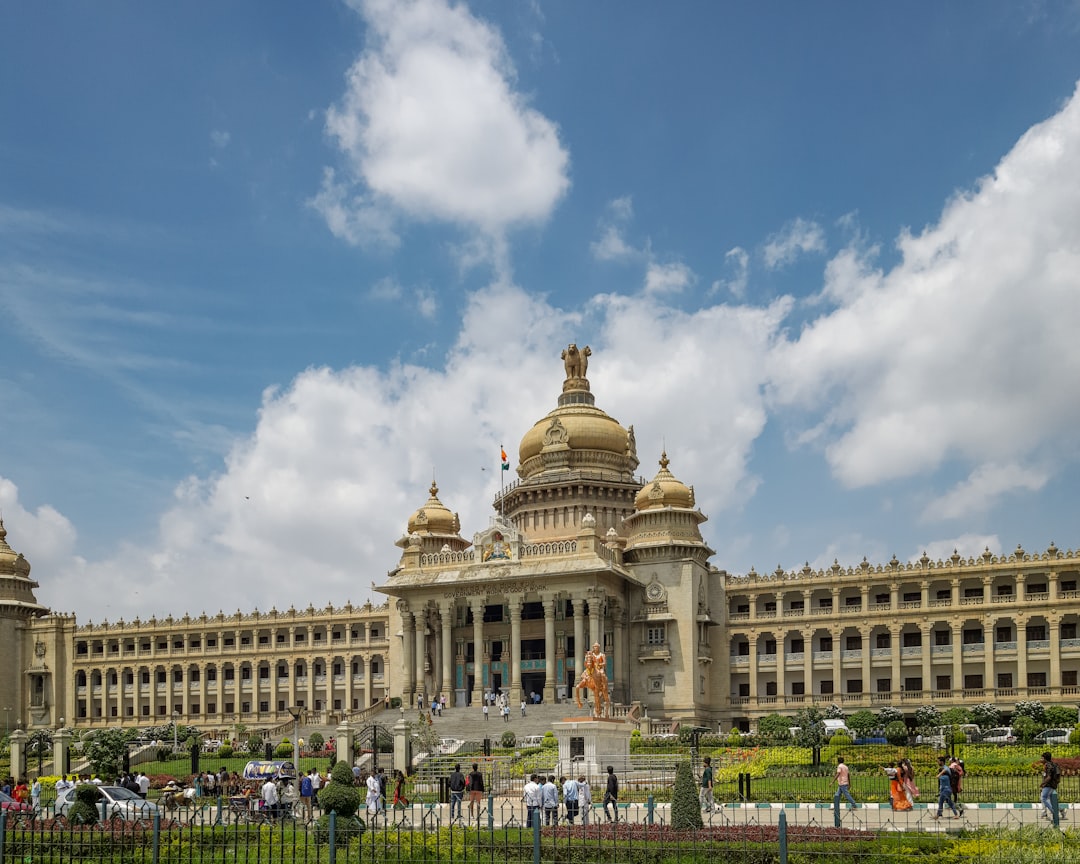
The Governor of Karnataka, Thaawarchand Gehlot, on 13 July 2026 suspended Shivashankarappa S. Sahukar, Chairperson of the Karnataka Public Service Commission (KPSC), pending an inquiry into alleged misconduct linked to the selection of his daughters through the KPSC’s own recruitment.
The Hindu reported that the Governor has recommended that the President of India refer the allegations to the Supreme Court under Article 317(1) — the only route for removing a Public Service Commission chairperson or member for misbehaviour. The senior-most member will function as Acting Chairperson until the President’s orders.
- The suspension runs “until further orders from the President’s office” — tracking Article 317(2), which lets the Governor suspend a State PSC chairperson while a Presidential reference is in play.
- On 10 July, police registered an FIR against Suma S. Sahukar, the chairperson’s daughter: her certificate declared the family’s annual income as ₹40,000 to claim Karnataka’s 3B-category reservation for a Junior Engineer (Civil) post in March 2024.
- During that selection, her father was KPSC Chairperson drawing about ₹2.25 lakh a month — the basis for calling the certificate false.
- Also on 10 July, the High Court of Karnataka stayed a 19 June resolution by other KPSC members asking the chairperson to resign on moral responsibility.
- Complaints allege the chairperson facilitated the selection of his two daughters as Industrial Extension Officers without recusal or a declared conflict of interest.
- A Karnataka government order of 30 March 2002 bars children of the PSC chairperson from backward-classes reservation.
The development matters in the context of:
- A live, worked-out use of Article 317 — usually taught only as bare text under constitutional bodies.
- A clean illustration of the appointment–removal asymmetry: the Governor appoints the State PSC chairperson but only the President can remove, after a Supreme Court inquiry.
- Strong GS4 crossover: conflict of interest, recusal, probity, and misuse of the OBC creamy-layer exemption.
UPSC Relevance
Prelims Relevance
- Articles 315–323 (Part XIV) govern Public Service Commissions — UPSC, State PSCs and Joint State PSCs.
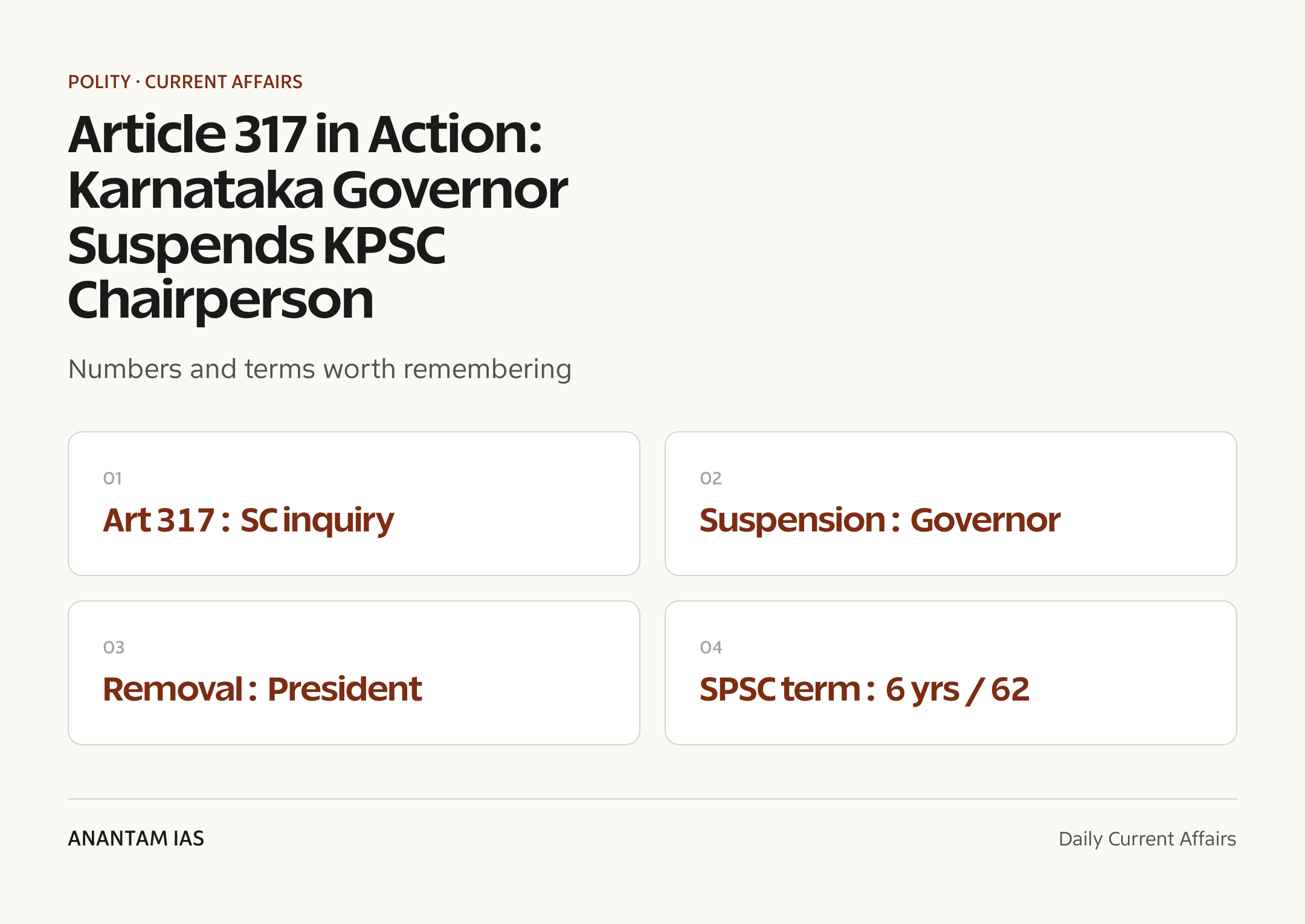
- State PSC chairperson and members: appointed by the Governor (Article 316); removed only by the President (Article 317).
- Removal for misbehaviour needs a Presidential reference to the Supreme Court; the Court’s inquiry report is binding on the President.
- Article 317(2): the Governor may suspend a State PSC chairperson or member pending the Court’s report; for UPSC and JSPSC, the President.
- Article 317(3): direct Presidential removal — no Court reference — for insolvency, paid outside employment, or infirmity of mind or body.
- Article 317(4): interest in a government contract is deemed misbehaviour.
- Term of a State PSC member: 6 years or age 62, whichever is earlier (65 for UPSC).
- Conditions of service cannot be varied to a member’s disadvantage after appointment (Article 318); PSC expenses are charged on the state’s Consolidated Fund (Article 322).
- Post-tenure bar (Article 319): a State PSC chairperson may only become UPSC chairperson or member, or chairperson of another State PSC.
Mains Relevance
GS Paper 2
- Article 317 as an insulation device: appointment by the Governor, removal only by the President after judicial inquiry — separating patronage from punishment.
- Health of State Public Service Commissions: recurring recruitment scandals versus the safeguards meant to keep merit-based selection credible.
- Comparative removal design: judicial inquiry for PSC members versus parliamentary address for judges — what each protects against.
GS Paper 4
- Conflict of interest and the duty to recuse: the head of a recruiting body whose dependants compete in its examinations.
- Probity in public life: the Supreme Court’s standard that PSC chairpersons must command public confidence, not merely avoid conviction.
Essay
- Institutions are only as strong as the integrity of those who run them.
- Merit in public recruitment as the foundation of citizens’ trust in the state.
Background and Context
What happened in Karnataka: the sequence
The episode moved from an internal KPSC revolt to a full constitutional process in under a month.
- 19 June 2026: other KPSC members resolve that the chairperson should resign on moral responsibility; the High Court of Karnataka stays this resolution on 10 July.
- 10 July: on a KPSC complaint, police register an FIR against Suma S. Sahukar over a certificate declaring family income of ₹40,000 a year, used for 3B-category reservation in a Junior Engineer (Civil) selection of March 2024.
- Verification showed it was false: her father was then KPSC Chairperson on about ₹2.25 lakh a month.
- The Governor’s Secretariat says the chairperson allegedly facilitated the selection of his two daughters as Industrial Extension Officers, and neither recused himself nor declared a conflict of interest.
- 13 July: the Governor suspends the chairperson, recommends a Presidential reference to the Supreme Court under Article 317(1), and directs the senior-most member to act as chairperson.
- The Secretariat framed the alleged suppression of material facts as misbehaviour warranting constitutional action.
Article 317: the removal architecture
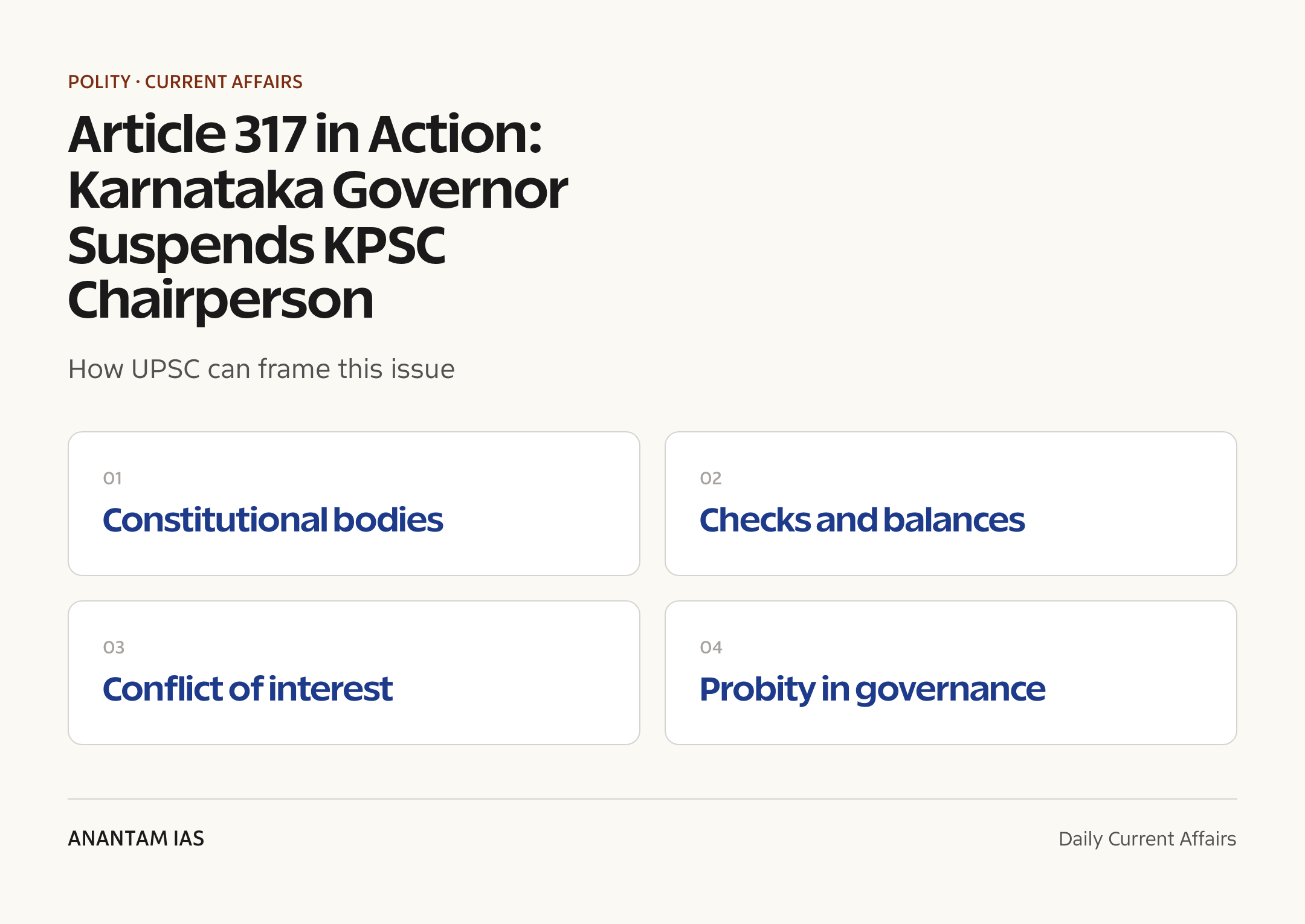
Article 317 deliberately makes removing a PSC chairperson hard, and puts the Supreme Court — not any government — at the centre.
- Article 317(1): removal for misbehaviour only by order of the President, and only after the Supreme Court, on a Presidential reference, has inquired and reported that removal is warranted.
- The Court’s report is binding: if it clears the incumbent, the President cannot remove — a judicial determination, not executive discretion.
- Article 317(2): pending the report, the President may suspend a UPSC or Joint PSC chairperson or member; the Governor may suspend a State PSC chairperson or member — the power Karnataka’s Governor used.
- Article 317(3): direct Presidential removal, no reference needed, for insolvency, paid employment outside office, or infirmity of mind or body.
- Article 317(4): any interest in a government contract is deemed misbehaviour.
- Contrast the removal of judges, which needs a special-majority address by Parliament under Article 124(4) — for PSC members the legislature plays no role at all.
Appointed by the Governor, removable only by the President
The appointment–removal asymmetry is the most-tested feature of State Public Service Commissions.
- Article 316: the Governor appoints the State PSC chairperson and members; as nearly as may be, one-half of the members must have held government office for at least 10 years.
- Tenure: 6 years or age 62, whichever is earlier (UPSC: 65). The Constitution prescribes no other qualifications for members — a long-flagged design gap.
- The Governor who appoints cannot remove: removal is the President’s alone, on the Supreme Court’s finding — shielding commissions from the state government whose recruitment they police.
- Article 318: conditions of service cannot be varied to a member’s disadvantage after appointment — a judicial-style protection.
- Article 319: after office, a State PSC chairperson may only become UPSC chairperson or member, or chairperson of another State PSC — no other government employment.
- Article 322: salaries and pensions are charged on the Consolidated Fund of the state — payable without a legislative vote.
What counts as 'misbehaviour': the Supreme Court's reading
The Constitution never defines misbehaviour; the Supreme Court has filled the gap, and read it widely.
- In In Re Ram Ashray Yadav (2000), the Bihar PSC reference, the Court held that a PSC chairperson must maintain the highest standards of probity — the office runs on public confidence.
- In In Re Mehar Singh Saini (2010), the Haryana PSC reference, the Court read misbehaviour broadly: conduct eroding the dignity, integrity or credibility of the institution qualifies, even short of proven criminality.
- On that reading, suppression of material facts and using the office to benefit family fall squarely within misbehaviour — the framing Karnataka’s Raj Bhavan has used.
- Article 317 has form: the Punjab PSC cash-for-jobs scandal (2002) and the Haryana reference of 2010 are the standard precedents.
- The safeguard cuts both ways: because only the Supreme Court’s finding can trigger removal, honest incumbents are protected from motivated complaints too.
The reservation angle: creamy layer and false certificates
The FIR at the heart of this case turns on a familiar prelims theme — the OBC creamy layer.
- The chairperson’s daughter allegedly claimed OBC (3B) reservation with a creamy-layer exemption on a certificate showing family income of ₹40,000 a year — while her father held a high constitutional office.
- Karnataka’s order of 30 March 2002 makes children of the PSC chairperson ineligible for backward-classes reservation — mirroring the creamy-layer rules, which exclude children of constitutional post-holders from OBC benefits regardless of income.
- A false income or caste certificate invites criminal prosecution and cancellation of the appointment obtained through it.
- Two parallel tracks are moving at once: criminal law (the FIR) for the beneficiary, the constitutional process (Article 317) for the chairperson.
Why PSCs get this insulation — and why it is straining
Public Service Commissions are the constitutional gatekeepers of merit in government jobs; the design assumes probity at the very top.
- Article 320: PSCs conduct recruitment exams and are consulted on appointments, promotions, transfers and disciplinary matters.
- Article 323: a State PSC reports annually to the Governor; the report goes before the legislature with a memorandum explaining every case where the commission’s advice was rejected.
- State PSC recruitments touch lakhs of aspirants; a tainted selection at the top corrodes faith in the merit system — among constitutional bodies, PSCs are the most citizen-facing.
- The structural gap: no statutory conflict-of-interest or recusal code binds PSC members, and the Constitution sets no selection criteria beyond the 50% official-experience rule.
- Wide gatekeeping power, thin entry filters, near-immovability — that mix is why Punjab (2002), Haryana (2010) and now Karnataka (2026) keep recurring.
Way Forward
Codify integrity safeguards
- A statutory conflict-of-interest and recusal code for PSC members — written declarations and automatic recusal whenever a relative enters any recruitment the commission conducts.
- Laid-down criteria and a search-committee process for appointing State PSC members, filling the Constitution’s silence on qualifications.
Speed up the Article 317 route
- Time-bound Presidential references and Supreme Court inquiries, so commissions are not left under acting heads for years.
- Publish the action taken on Governors’ recommendations — the reference stage is opaque today.
Harden the recruitment pipeline
- End-to-end digital audit trails for evaluation, interviews and selection lists, with independent audit of PSC examinations.
- Mandatory pre-appointment verification of income and caste certificates, with cancellation and prosecution where forgery is established.
Conclusion
The Karnataka suspension is a textbook demonstration of Article 317 working as designed. The Governor who appointed the chairperson cannot remove him; he can only suspend him and set the Presidential–Supreme Court machinery in motion. Removal now turns on a judicial inquiry, not any government’s preference.
For aspirants, the case stitches three syllabus threads around one live event: the removal design for constitutional bodies (GS2), creamy-layer and certificate rules (prelims), and conflict of interest (GS4). File it as your standing example for Articles 315–323.
UPSC Practice Questions
Prelims MCQ 1
With reference to the Chairperson of a State Public Service Commission, consider the following statements:
- The Chairperson is appointed by the Governor of the state.
- The Chairperson can be removed from office by the Governor on the ground of misbehaviour.
- The Governor can suspend the Chairperson pending the Supreme Court’s inquiry on a Presidential reference.
How many of the above statements are correct?
(a) Only one (b) Only two (c) All three (d) None
Answer: (b) Only two
Explanation:
Statements 1 and 3 are correct (Articles 316 and 317(2)). Statement 2 is wrong: only the President can remove — for misbehaviour, only after the Supreme Court’s inquiry on a Presidential reference under Article 317(1). The Governor appoints and may suspend, never removes.
Prelims MCQ 2
Under Article 317(1) of the Constitution, the inquiry into alleged ‘misbehaviour’ of the Chairperson of a State Public Service Commission is conducted by:
(a) The High Court of the state concerned (b) The Supreme Court, on a reference made by the President (c) A committee constituted by the state legislature (d) The Union Public Service Commission
Answer: (b) The Supreme Court, on a reference made by the President
Explanation:
Removal for misbehaviour requires the President to refer the matter to the Supreme Court; the Court’s report that removal is (or is not) warranted binds the President. Neither the High Court, the legislature nor UPSC has any role.
UPSC Mains Questions
- The removal procedure under Article 317 insulates Public Service Commissions from executive pressure, yet recurring recruitment scandals suggest insulation alone cannot guarantee integrity. Examine with reference to recent instances, and suggest reforms to protect the credibility of State Public Service Commissions.
- “A recruiting institution fails the moment its own selections need policing.” In the light of conflict-of-interest allegations against heads of State Public Service Commissions, discuss the safeguards needed in bodies that control entry into public service.
Source: The Hindu.
Frequently Asked Questions
What is Article 317 of the Constitution?
Article 317 lays down how the chairperson or a member of a Public Service Commission is removed. For misbehaviour, the President must refer the matter to the Supreme Court, and removal follows only if the Court’s inquiry says it is warranted. Insolvency, outside paid employment or infirmity allow direct Presidential removal.
Who can remove a State PSC chairperson?
Only the President of India. The Governor appoints the chairperson under Article 316 but has no power of removal. For misbehaviour, removal needs a Supreme Court inquiry on a Presidential reference, and the Court’s finding binds the President. The asymmetry insulates State PSCs from state-level political pressure.
Can the Governor suspend a State PSC chairperson?
Yes. Under Article 317(2), the Governor may suspend the chairperson or a member of a State Public Service Commission once a Presidential reference to the Supreme Court is in motion, until the President passes final orders on the Court’s report. Karnataka’s Governor used exactly this power in July 2026.
Why was the KPSC chairperson suspended?
The Governor acted on complaints that chairperson Shivashankarappa S. Sahukar facilitated the selection of his daughters through KPSC recruitment without recusing himself. One daughter allegedly used a false income certificate to claim OBC reservation. He was suspended, and a Presidential reference to the Supreme Court has been recommended.
What counts as misbehaviour under Article 317?
The Constitution does not define it. In references such as In Re Ram Ashray Yadav (2000) and In Re Mehar Singh Saini (2010), the Supreme Court read it broadly: conduct eroding the integrity, dignity or public credibility of the commission, plus the deemed case of interest in a government contract under Article 317(4).
How does PSC removal differ from a judge’s removal?
A Supreme Court or High Court judge is removed by the President after Parliament passes a special-majority address under Article 124(4). A PSC chairperson’s removal skips the legislature entirely: the President refers the case to the Supreme Court, and the Court’s inquiry report decides the outcome.
Source: https://anantamias.com/current-affairs/kpsc-chairperson-suspension-article-317/
Strait of Hormuz standoff: US strikes on Iran and India’s energy security stakes
Why in News?
The US military launched fresh strikes on Iran overnight into Monday, 13 July 2026, saying they were meant to degrade Tehran’s ability to attack commercial ships transiting the Strait of Hormuz. The Hindu reported this was the third round of American airstrikes in a week, set off by an Iranian strike on a container ship in the waterway.
Iran retaliated with missile and drone attacks on Gulf Arab states hosting US forces — Qatar, Kuwait, Jordan, the UAE and Oman — with Washington and Tehran midway through a 60-day interim deal meant to end the war. UN Secretary-General António Guterres warned of “catastrophic consequences” if full-scale hostilities resume.
- Three rounds of US airstrikes in a week hit missile and air-defence systems and Revolutionary Guard fast boats near Qeshm Island, Bandar Abbas and Hajiabad.
- Iranian retaliation reached across the Gulf: Qatar intercepted incoming missiles, a Kuwait Oil Company offshore platform was damaged, and three missiles struck Jordan.
- Oman summoned Iran’s ambassador — its first such protest since the war began — calling Iran’s actions “irresponsible”.
- Tehran insists it alone must control the strait and has floated charging vessels for transit — a direct challenge to freedom of navigation.
- Talks under the 60-day interim deal are near collapse at their halfway mark, with the strait’s status the biggest sticking point.
The development matters in the context of:
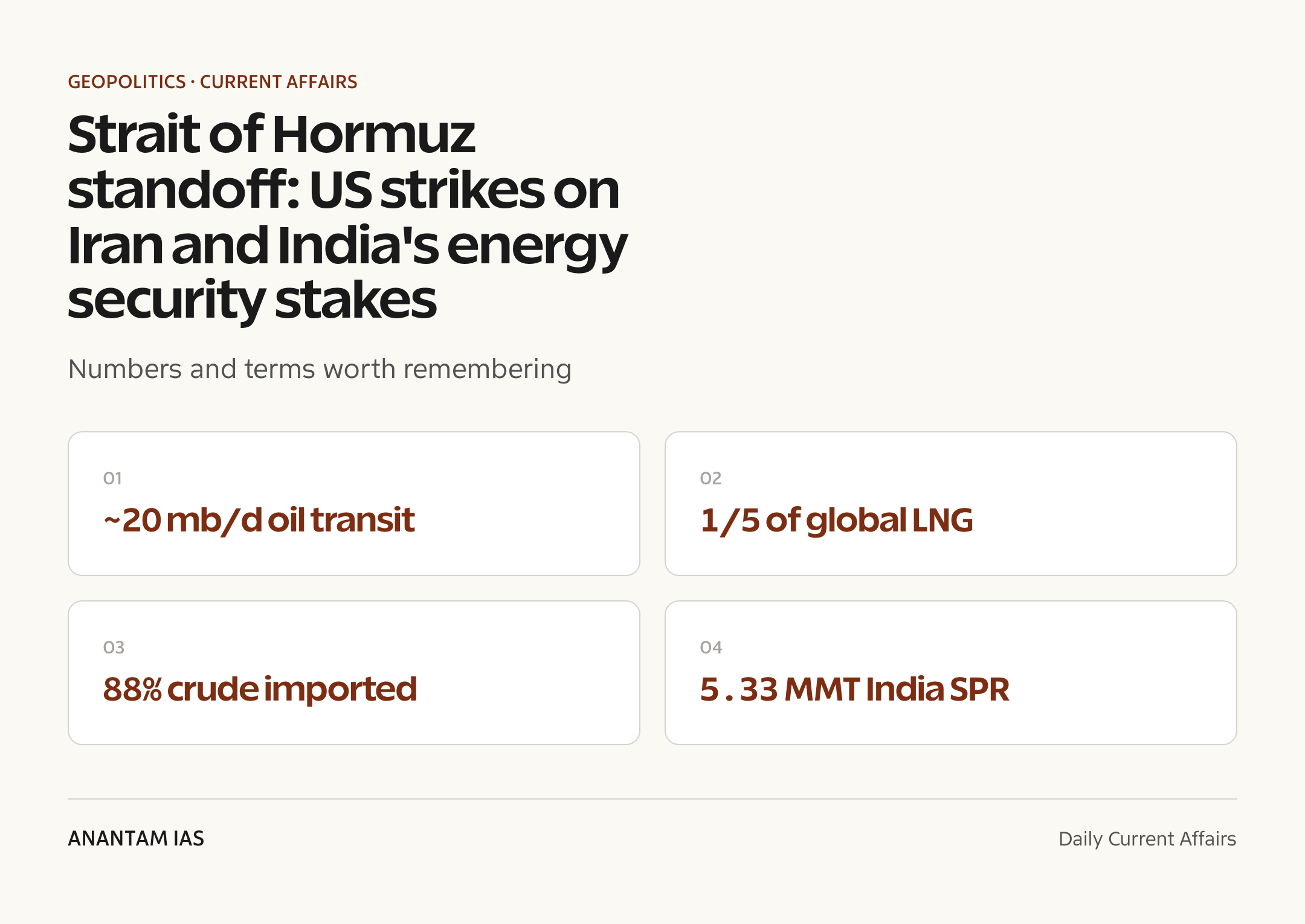
- Roughly a fifth of the world’s traded oil and LNG passes through this one channel — and there’s no sea alternative.
- For India, which imports about 88% of its crude oil, Hormuz is the single biggest physical chokepoint in the energy supply chain.
- The standoff stress-tests India’s West Asia balancing act: Gulf energy and diaspora ties, a stake in Iran’s Chabahar port, a growing US partnership.

UPSC Relevance
Prelims Relevance
- Strait of Hormuz: connects the Persian Gulf with the Gulf of Oman and the Arabian Sea; Iran to its north, Oman’s Musandam exclave to its south.
- Narrowest width about 21 nautical miles (39 km); shipping lanes only about 3 km wide each way under an IMO traffic separation scheme.
- Carries roughly 20 million barrels per day — about one-fifth of global oil consumption — and about a fifth of global LNG trade (US EIA estimates).
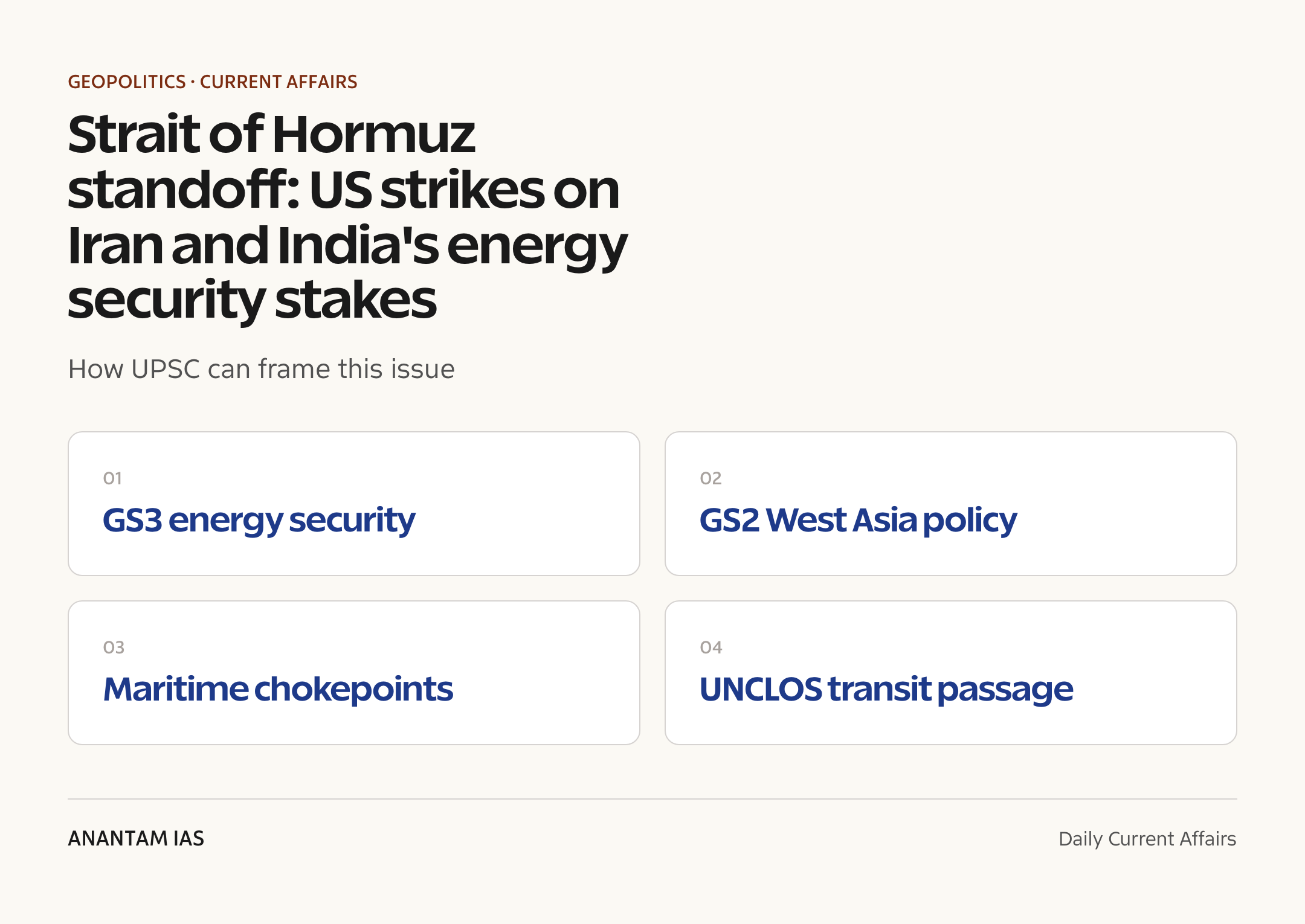
- Lies entirely within the territorial waters of Iran and Oman; passage is governed by the transit passage regime under Part III of UNCLOS.
- Partial bypasses: Saudi Arabia’s East–West (Petroline) pipeline (~5 million b/d) and the UAE’s Habshan–Fujairah pipeline. Qatar’s LNG has no bypass.
- ISPRL reserves: Visakhapatnam (1.33 MMT), Mangaluru (1.5 MMT), Padur (2.5 MMT); Phase II at Chandikhol (Odisha) and Padur.
- Operation Sankalp (2019): the Indian Navy’s escort operation in the Gulf of Oman after tanker attacks.
- Bandar Abbas hosts Iran’s main naval base; Qeshm is Iran’s largest island, just inside the channel.
Mains Relevance
GS Paper 3
- Energy security as national security: import dependence, chokepoint concentration risk, strategic reserves and supplier diversification.
- Macroeconomic transmission of an oil shock — current account deficit, rupee, imported inflation, fertilizer and fuel subsidy burden.
GS Paper 2
- India’s West Asia policy under stress: balancing the US, the Gulf Arab states, Israel and Iran simultaneously.
- The ~9 million Indian diaspora in the Gulf and remittances as foreign-policy determinants; evacuation preparedness.
Essay
- Energy is the new geography: chokepoints, not borders, shape the destiny of importing nations.
- Strategic autonomy is tested in crises, not in peacetime.
Background and Context
The strait: geography of the world's most watched waterway
One narrow channel between Iran and Oman carries more traded energy than any other stretch of water on earth.
- The Strait of Hormuz is the only sea outlet from the Persian Gulf: exports from Kuwait, Qatar, Bahrain and southern Iraq — and most Saudi and UAE cargoes — must pass through it.
- About 21 nautical miles (39 km) wide at its narrowest, with usable shipping lanes of roughly 3 km each way under an IMO traffic separation scheme.
- US Energy Information Administration estimates: about 20 million barrels per day — near a fifth of global oil consumption — plus about a fifth of the world’s LNG, almost all from Qatar.
- It has never been fully closed, not even during the Tanker War (1984–88), when the US Navy escorted reflagged Kuwaiti tankers.
- Full geography in our explainers on the Strait of Hormuz and important straits of the world.
How the July 2026 escalation unfolded
A strike on one container ship has spiralled into a region-wide exchange of fire in under a week.
- After an Iranian strike on a container ship, the US hit back on Sunday and again overnight into Monday, 13 July — its third round of airstrikes in a week, The Hindu reported.
- A US official said the strikes targeted missile and air-defence systems and Revolutionary Guard boats; Iranian agencies reported a navy officer killed.
- Iran’s counter-strikes spanned the Gulf: interceptions over Qatar, damage to a Kuwait Oil Company platform, missiles in Jordan, explosions in the UAE, drones over Oman.
- Ships had begun routing off Oman’s coast to avoid Iranian waters; Tehran insists it alone should control the strait and could charge vessels for passage.
- The strait’s status is now the sticking point on which the 60-day interim deal — and the path out of the war — may collapse.
The legal battle beneath the military one
Under the shooting war runs an older dispute: who, if anyone, controls passage through the strait?
- The channel lies inside the territorial waters of Iran and Oman, so shipping depends on the transit passage regime of UNCLOS Part III: continuous, expeditious passage that bordering states cannot suspend.
- Iran signed but never ratified UNCLOS. It argues transit passage doesn’t bind it in favour of non-parties (the US hasn’t ratified either) and recognises only the suspendable innocent passage.
- Tehran’s demand to levy transit fees would overturn the principle that international straits stay open to all — a precedent reaching from Malacca to Bab-el-Mandeb.
- Oman — co-littoral state and traditional US–Iran mediator — summoning Iran’s ambassador shows how far the escalation has strained even Tehran’s most patient interlocutor.
India's exposure: counting the barrels
India is the world’s third-largest oil importer, and a large share of what it buys sails through this one channel.
- India imports about 88% of its crude and roughly 50% of its natural gas (PPAC); estimates during the June 2025 flare-up put about 2 million barrels a day — near 40% of crude imports — through Hormuz.
- Cargoes from Iraq, Saudi Arabia, the UAE and Kuwait all transit the strait; so does about half of India’s LNG. Petronet’s 7.5 MMTPA contract with QatarEnergy, running till 2048, has no alternative route.
- The cushion: Russia, India’s largest crude supplier since 2022–23, plus US and West African barrels arrive by routes that avoid Hormuz. But refinery configurations and pricing still tie Indian refiners to Gulf grades.
- India stopped importing Iranian crude in 2019 under US sanctions — background in our note on India–Iran relations.
What a disruption would do to the economy
Even a partial squeeze on the strait transmits into Indian inflation, the rupee and the fisc within weeks.
- Markets price the risk before any blockade: during the June 2025 Israel–Iran flare-up, Brent briefly rose past $80 a barrel on Hormuz fears.
- Widely used estimates: every US$10/barrel rise in crude widens India’s current account deficit by roughly 0.4% of GDP and adds about 0.3 percentage points to headline inflation.
- War-risk insurance and freight rates spike even when ships keep moving; costlier LNG and naphtha raise the fertilizer subsidy bill and squeeze petrochemicals, power and city gas.
- Beyond energy: close to 9 million Indians work in the Gulf, and India received about $129 billion in remittances in 2024 (World Bank) — a war endangers both.
India's buffers and playbook
India has built partial insurance against exactly this scenario — enough for a short crisis, not a long one.
- Strategic Petroleum Reserves (ISPRL) hold 5.33 MMT of crude — about 9.5 days of demand; with refiners’ stocks, total cover is around 74 days, against the IEA’s 90-day norm.
- Phase II caverns at Chandikhol (4 MMT) and Padur (2.5 MMT) are sanctioned but unbuilt — the crisis strengthens the case to accelerate them.
- The Indian Navy has run Operation Sankalp escorts in the Gulf of Oman since 2019; the IFC-IOR (Gurugram) tracks regional shipping, and India has naval-logistics access to Oman’s Duqm port.
- Evacuation muscle memory exists: Operation Sindhu (Iran–Israel war, 2025), Operation Kaveri (Sudan, 2023), Operation Ajay (Israel, 2023) and the 1990 Kuwait airlift.
The balancing act: Iran, the Gulf and Washington
Every escalation in the strait forces India to hold together relationships that are shooting at each other.
- India’s stake in Iran survives sanctions: the 10-year Chabahar agreement (2024) gives India Ports Global the Shahid Beheshti terminal — the gateway to Central Asia and the INSTC, all hostage to a wider war.
- On the other flank sit the India–UAE CEPA, I2U2 and IMEC, announced at the 2023 G20 in Delhi — a corridor whose viability assumes a stable West Asia.
- Washington expects alignment, Tehran expects neutrality, and the Gulf capitals under Iranian fire host India’s workers and supply its oil. India’s answer: issue-based alignment — de-escalation calls without naming sides.
- The doctrinal frame — strategic autonomy through multi-alignment — is examined in our note on India’s West Asia policy.
Way Forward
Diversify barrels and routes
- Deepen term contracts with non-Hormuz suppliers — Russia, the US, West Africa, Latin America — and widen refinery crude slates.
- Fast-track SPR Phase II and commercial stockpiling to lift total cover toward the 90-day IEA norm.
Harden the maritime shield
- Scale up Operation Sankalp escorts and mine-countermeasure readiness; deepen coordination with Gulf navies.
- Use IFC-IOR and Duqm access for persistent domain awareness — drones and small-boat swarms, not fleets, are the threat in the strait.
Cut structural oil dependence
- Press demand-side levers: the E20 ethanol milestone, electric mobility, the 500 GW non-fossil target and the National Green Hydrogen Mission all shrink the barrel-shaped hole in the balance of payments.
Diplomacy for de-escalation
- Back Oman- and UN-mediated channels; as the world’s third-largest oil buyer, India has standing to insist the strait stays open to all.
- Keep consular and evacuation plans for the Gulf diaspora current — the lesson of every West Asia crisis since 1990.
Conclusion
The Strait of Hormuz is where geography refuses to be negotiated with. A channel a few kilometres wide carries a fifth of the world’s oil, and India — importing nearly nine of every ten barrels it refines — feels every tremor in it as inflation, a weaker rupee and a bigger subsidy bill.
The July 2026 standoff shows India’s buffers are real but shallow: reserves counted in days, escorts in ships, and a diplomacy that must keep the US, the Gulf and Iran within talking distance. The durable levers — diversified suppliers, deeper reserves, less oil in the economy — need pulling before the crisis, not during it.
For the exam, Hormuz is the cleanest case study there is: a maritime chokepoint, a contested legal regime, an energy stress test and a balancing act, all in one strip of water.
UPSC Practice Questions
Prelims MCQ 1
With reference to the Strait of Hormuz, consider the following statements:
- It connects the Persian Gulf with the Gulf of Oman.
- Its designated shipping lanes pass through the territorial waters of Iran and Oman.
- Qatar’s LNG exports can reach world markets through an existing pipeline that bypasses the strait.
How many of the above statements are correct?
(a) Only one (b) Only two (c) All three (d) None
Answer: (b) Only two
Explanation:
Statements 1 and 2 are correct. Statement 3 is wrong — Qatar’s LNG has no bypass; only Saudi Arabia and the UAE have partial crude-oil bypass pipelines.
Prelims MCQ 2
Under the UN Convention on the Law of the Sea (UNCLOS), the ‘transit passage’ regime applicable to straits used for international navigation provides that:
(a) Coastal states may suspend passage temporarily on security grounds (b) Ships and aircraft enjoy continuous and expeditious passage that bordering states cannot suspend (c) Only merchant vessels, not warships, may pass without prior authorisation (d) Passage requires prior notification to all littoral states
Answer: (b) Ships and aircraft enjoy continuous and expeditious passage that bordering states cannot suspend
Explanation:
Transit passage under UNCLOS Part III covers ships and aircraft and cannot be suspended — unlike innocent passage. Iran signed but never ratified UNCLOS and contests transit passage for non-parties.
UPSC Mains Questions
- The Strait of Hormuz remains the single biggest physical vulnerability in India’s energy security. Examine the risks a prolonged disruption of the strait would pose to the Indian economy, and evaluate the adequacy of the buffers India has built against such a shock. (250 words)
- India’s West Asia policy is a balancing act between partners in conflict with one another. In the context of the US–Iran confrontation over the Strait of Hormuz, discuss how India can protect its energy, diaspora and connectivity interests while preserving strategic autonomy. (250 words)
Source: The Hindu.
Frequently Asked Questions
Why is the Strait of Hormuz in the news?
The US launched its third round of airstrikes on Iran in a week, saying it was protecting commercial ships transiting the strait after Iran struck a container ship. Iran retaliated against Gulf states hosting US forces, and talks under a 60-day interim deal to end the war are close to collapse.
How much oil passes through the Strait of Hormuz?
US Energy Information Administration estimates put transit at roughly 20 million barrels per day — about one-fifth of global petroleum liquids consumption — plus around a fifth of the world’s LNG trade, almost all from Qatar. It is the world’s most important energy chokepoint.
How dependent is India on the strait?
India imports about 88% of its crude oil, and roughly 40% of those imports — around 2 million barrels a day, from Iraq, Saudi Arabia, the UAE and Kuwait — transit Hormuz. About half of India’s LNG, including all Qatari cargoes under the long-term Petronet contract, also comes through it.
Can ships avoid the strait entirely?
Only partially. Saudi Arabia’s East–West (Petroline) pipeline can move about 5 million barrels a day to the Red Sea, and the UAE’s Habshan–Fujairah line carries crude past the strait. Qatar’s LNG has no bypass at all, so a closure would halt those exports completely.
What is India’s strategic petroleum reserve?
ISPRL stores 5.33 million tonnes of crude in rock caverns at Visakhapatnam, Mangaluru and Padur — roughly 9.5 days of national demand. With refiners’ commercial stocks, total cover is about 74 days, below the IEA’s 90-day norm. Phase II caverns at Chandikhol and Padur are sanctioned but unbuilt.
Has the strait ever been fully closed?
No. Even during the Tanker War of 1984–88, when Iran and Iraq attacked hundreds of merchant vessels and the US Navy escorted reflagged Kuwaiti tankers, traffic never stopped completely. Closing the strait would also choke Iran’s own oil exports — one reason threats have historically outnumbered attempts.
Source: https://anantamias.com/current-affairs/strait-of-hormuz-us-iran-strikes-india-energy/
CAG on Ladki Bahin: Excess spend and budgetary lapses in Maharashtra’s flagship scheme
Why in News?
The Comptroller and Auditor General (CAG) has flagged excess expenditure of ₹3,541.16 crore, large-scale parking of funds in deposit accounts and weak financial management in Maharashtra’s flagship Mukhyamantri Majhi Ladki Bahin Yojana. The findings appear in the CAG’s State Finances Audit Report 2024-25, tabled in the Maharashtra legislature on 10 July 2026, The Hindu reported citing PTI.
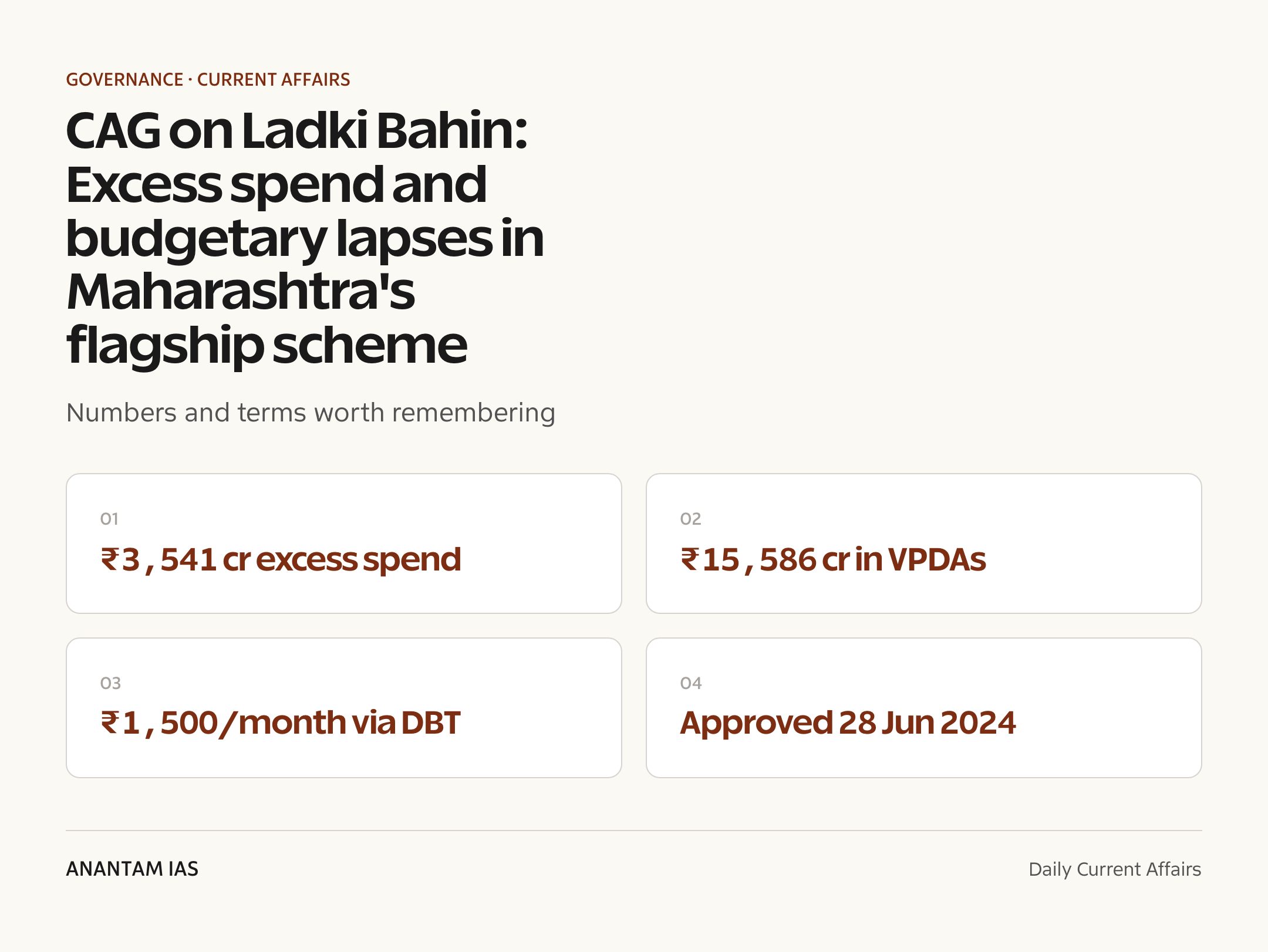
The state’s Women and Child Development Department spent ₹33,237.24 crore on the scheme against an authorised budget of ₹29,693.09 crore — with no specific justification for the overshoot. Another ₹15,586 crore drawn between January and March 2025 was parked in Virtual Personal Deposit Accounts without immediate expenditure needs.
- ₹3,541.16 crore spent in excess of the authorised budget — expenditure the legislature never sanctioned in advance.
- The grant of ₹29,693.09 crore itself leaned on ₹26,200 crore of supplementary provisions and ₹3,490.75 crore re-appropriated from the Lek Ladki Yojana.
- ₹15,586 crore drawn between January and March 2025 went to Virtual Personal Deposit Accounts (VPDAs) — “contrary to principles of budgetary discipline and financial propriety”, the CAG said.
- The report noted “significant deficiencies in budget estimation, expenditure control, and financial management“.
- Women’s welfare spending jumped from ₹261.78 crore to more than ₹33,500 crore in a year — a shift towards transfers over capital asset formation, the CAG observed.
The development matters in the context of:
- A textbook illustration of legislative control over public finance — appropriation, supplementary demands, excess grants and audit — on a live welfare scheme.
- It feeds the freebies versus welfare debate: women-centric cash transfers now run in a dozen states, and their fiscal design faces growing scrutiny.
- For GS2, it connects DBT-based scheme design with accountability institutions — the CAG, the state PAC and the legislature.
UPSC Relevance
Prelims Relevance
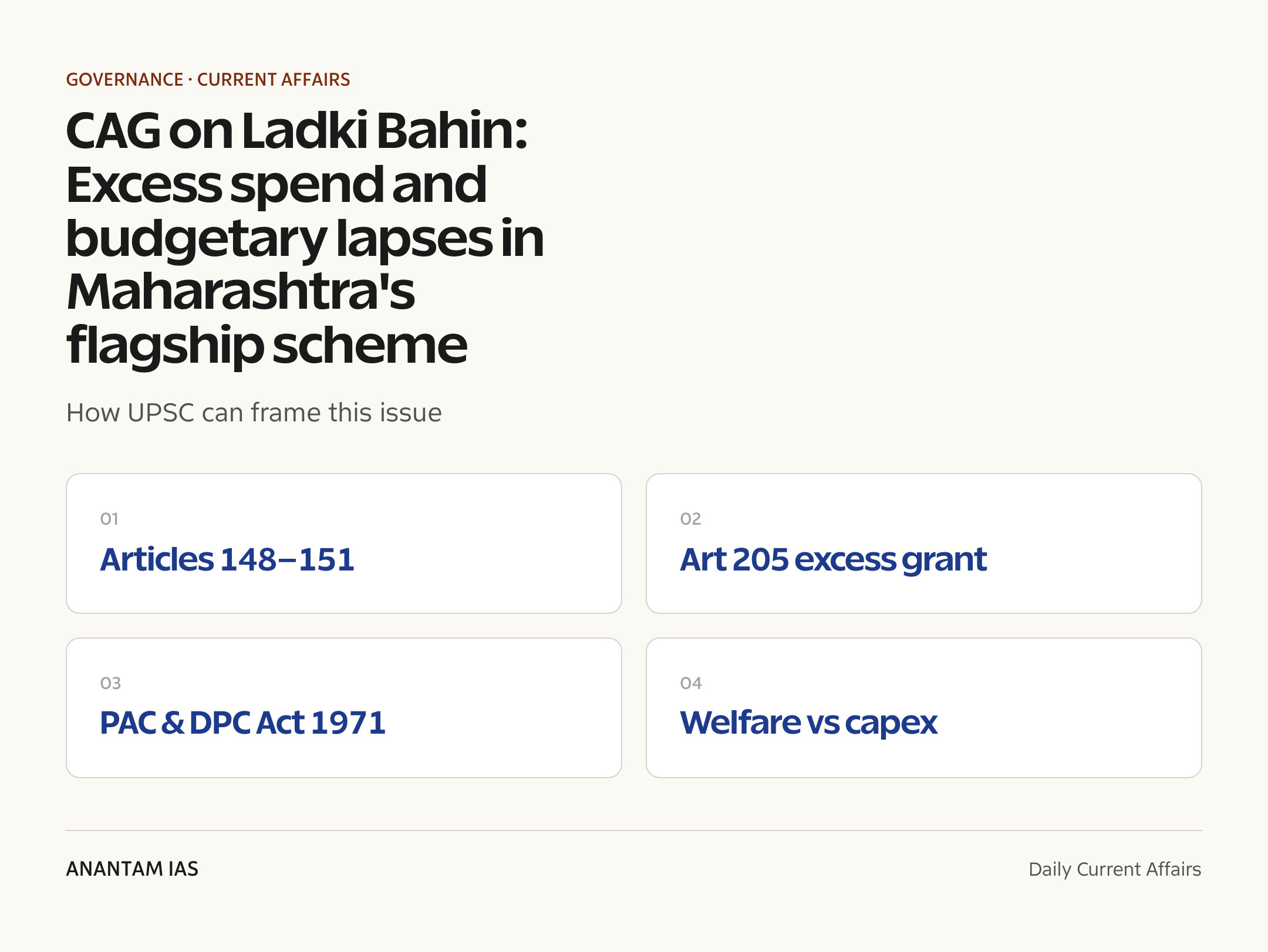
- CAG of India — Articles 148 to 151; appointed by the President; removal like a Supreme Court judge; term 6 years or age 65.
- DPC Act, 1971 — the CAG’s (Duties, Powers and Conditions of Service) Act, enacted under Article 149.
- Article 151(2) — CAG reports on state accounts go to the Governor, then to the state legislature.
- State Finances Audit Report — the CAG’s annual report on a state’s finances and budgetary management.
- Articles 204-205 — withdrawals from a state’s Consolidated Fund need an Appropriation Act; overshoots need an excess grant.
- PD / Virtual Personal Deposit Accounts — treasury accounts where drawn funds are parked; expenditure is booked without money being spent.
- Mukhyamantri Majhi Ladki Bahin Yojana — approved 28 June 2024; ₹1,500 per month via DBT to Maharashtra women aged 21 to 65.
- Direct Benefit Transfer (DBT) — launched 2013; rides on the JAM trinity.
- Public Accounts Committee — examines CAG reports and recommends regularisation of excess expenditure.
Mains Relevance
GS Paper 2
- Government policies and interventions: design flaws in large cash-transfer schemes — beneficiary estimation, budgeting, expenditure control.
- Transparency and accountability: the CAG and the PAC as checks on executive spending.
- Welfare schemes for vulnerable sections: women-centric transfers — empowerment gains versus fiscal-governance risks.
- State legislatures: how excess expenditure and fund parking erode legislative control over the purse.
GS Paper 3
- Government budgeting: appropriation, supplementary demands, re-appropriation and excess grants in practice.
- State finances: revenue-heavy transfers crowding out capital expenditure and asset creation.
Essay
- Welfare that outruns the budget: can populism and prudence coexist in Indian states?
- Audit is the conscience of the exchequer — institutions matter more than intentions.
- Cash transfers empower women, but who keeps the treasury honest?
Background and Context
What the CAG Audit Found
The State Finances Audit Report 2024-25 reads like a case study in how a flagship scheme can outrun every budgetary guardrail in a single year.
- The Women and Child Development Department spent ₹33,237.24 crore against an authorised budget of ₹29,693.09 crore — an unexplained excess of ₹3,541.16 crore.
- The grant was itself improvised: ₹26,200 crore came through supplementary provisions and ₹3,490.75 crore was re-appropriated from the Lek Ladki Yojana, a girl-child scheme.
- ₹15,586 crore drawn between January and March 2025 — the fiscal year’s last quarter — was moved to Virtual Personal Deposit Accounts (VPDAs).
- The CAG said the funds “were drawn from the treasury without actual expenditure needs”, calling the parking a serious financial irregularity that undermined legislative control over public finances.
- The report recorded “significant deficiencies in budget estimation, expenditure control, and financial management“.
- Women’s welfare spending rose from ₹261.78 crore the previous year to over ₹33,500 crore — a shift towards welfare-oriented transfers over capital asset formation, the CAG noted.
Ladki Bahin Yojana: Design of the Scheme
Behind the audit numbers sits one of India’s largest state-level cash transfer programmes for women.
- The Mukhyamantri Majhi Ladki Bahin Yojana was approved on 28 June 2024, with women’s economic independence as its stated aim.
- Eligible women aged 21 to 65 years receive ₹1,500 per month through Direct Benefit Transfer.
- It’s implemented by the Women and Child Development Department — the same department the CAG faulted for weak budget estimation and expenditure control.
- It joined a national wave of women-centric transfers — Ladli Behna (Madhya Pradesh), Lakshmir Bhandar (West Bengal), Gruha Lakshmi (Karnataka), Kalaignar Magalir Urimai Thogai (Tamil Nadu), Maiya Samman (Jharkhand).
- DBT was meant to fix leakages in delivery; this audit shows the risk has migrated upstream — from who receives the money to how it is budgeted and drawn.
The CAG: Constitutional Anchor of Public Audit
The institution making these findings is a constitutional authority, not an arm of any government.
- Article 148: the CAG is appointed by the President; removal only in the manner of a Supreme Court judge, on proved misbehaviour or incapacity.
- Article 149: Parliament prescribes the CAG’s duties and powers — done through the DPC Act, 1971.
- Article 150: Union and state accounts are kept in a form prescribed by the President on the CAG’s advice.
- Article 151(2): audit reports on a state’s accounts go to the Governor, who has them laid before the state legislature — exactly the route this report took.
- The CAG conducts financial, compliance and performance audits; the annual State Finances Audit Report assesses a state’s budgetary management.
- Dr B.R. Ambedkar called the CAG possibly the most important officer of the Constitution — the guardian of the public purse.
Legislative Control: Where Excess Expenditure Breaks the Chain
The Constitution builds a strict chain of legislative authorisation over every rupee a state spends — and excess expenditure snaps it.
- Article 202: the state lays an annual financial statement before the legislature; Article 203 puts expenditure through votable demands for grants.
- Article 204: no money leaves the Consolidated Fund of the State except under an Appropriation Act — spending beyond it has no legal sanction when incurred.
- Article 205: overshoots must return as an excess grant, regularised by the legislature after the Public Accounts Committee examines the CAG’s findings.
- Supplementary demands are legal, but routinely funding a flagship scheme through supplementary provisions and re-appropriation signals the original budget was never realistic.
- Unexplained excess spending means the executive bypassed the legislature’s authority — the core of the no-spending-without-representation principle.
PD Accounts: How Parked Funds Defeat the Budget
The ₹15,586 crore moved into VPDAs is the report’s most instructive finding, because the money looked spent while it sat idle.
- A Personal Deposit (PD) account — here in virtual form as a VPDA — is a treasury device where a designated officer holds funds drawn from the Consolidated Fund.
- Once transferred, the amount is booked as expenditure even though no benefit has reached anyone — inflating reported spending.
- The classic motive is beating the lapse rule: unspent provisions lapse on 31 March, so departments draw and park funds in March to “save” them.
- The practice distorts fiscal indicators, weakens cash management — the state may borrow while cash idles — and escapes the legislature’s year-wise control.
- The CAG recommended withdrawals be strictly linked to actual and immediate expenditure needs, with realistic assessment of beneficiary coverage at budget formulation itself.
- The Union’s just-in-time release framework for centrally sponsored schemes tackles the same disease — money leaves the treasury only when payouts are due.
The Bigger Debate: Cash Transfers, Populism and State Finances
The audit lands in the middle of India’s running argument over welfare transfers and fiscal prudence.
- Women-centric transfers have real welfare logic — income support, financial inclusion and greater household bargaining power for women.
- The fiscal worry is compositional: the CAG itself noted the shift towards transfers over capital asset formation; revenue-heavy budgets leave less for capacity-building infrastructure.
- The RBI’s studies of state budgets have repeatedly cautioned states about the growing burden of subsidies and income transfers on revenue expenditure.
- In S. Subramaniam Balaji vs State of Tamil Nadu (2013), the Supreme Court held that pre-poll promises implemented through appropriations aren’t “corrupt practices” — pushing the freebies-versus-welfare question back to fiscal institutions and voters.
- That’s why audit matters: courts won’t police welfare populism, so budgetary discipline, CAG audit and PAC scrutiny are the accountability instruments that remain.
Way Forward
Budget honestly for DBT schemes
- Build scheme budgets on a realistic beneficiary database — registry-based estimation of coverage and monthly outgo, as the CAG recommends.
- Treat supplementary demands as exceptions for genuine shocks, not a routine second budget for flagship schemes.
Restore treasury discipline
- Prohibit parking of scheme funds in PD/VPDA accounts; adopt just-in-time release so money leaves the Consolidated Fund only against actual payout files.
- Publish a live DBT dashboard — funds drawn versus funds paid — so parked balances are visible in-year, not a year later in audit.
Close the accountability loop
- The state Public Accounts Committee should examine the report promptly; the legislature should regularise the excess under Article 205 with recorded justification.
- Pair financial audit with a performance audit of outcomes — did ₹33,000-plus crore measurably improve women’s economic independence?
Conclusion
The CAG hasn’t questioned whether Maharashtra should pay women ₹1,500 a month — that’s a political choice for elected governments. What the audit questions is the plumbing: a flagship scheme financed by improvised supplementary grants, overshooting its budget by ₹3,541 crore without explanation, and parking ₹15,586 crore where money looks spent but isn’t.
For aspirants, this one story stitches together the CAG’s constitutional mandate, the appropriation-to-excess-grant chain, PD accounts and the welfare-populism debate. The durable lesson: in a DBT era, welfare credibility depends as much on budgetary discipline as on delivery to the last beneficiary.
UPSC Practice Questions
Prelims MCQ 1
With reference to the Comptroller and Auditor General (CAG) of India, consider the following statements:
- The CAG is appointed by the President and can be removed from office in the same manner as a judge of the Supreme Court.
- Audit reports of the CAG relating to the accounts of a state are submitted to the Governor, who causes them to be laid before the state legislature.
- The duties and powers of the CAG are exhaustively laid down in the Constitution and cannot be prescribed by Parliament through legislation.
How many of the above statements are correct?
(a) Only one (b) Only two (c) All three (d) None
Answer: (b) Only two
Explanation:
Statements 1 and 2 are correct (Articles 148 and 151(2)). Statement 3 is wrong: Article 149 expressly empowers Parliament to prescribe the CAG’s duties and powers, which it did through the CAG’s (Duties, Powers and Conditions of Service) Act, 1971.
Prelims MCQ 2
The CAG’s State Finances Audit Report 2024-25 criticised the transfer of Ladki Bahin scheme funds to Virtual Personal Deposit Accounts (VPDAs) primarily because such parking of funds:
(a) earns market interest for the implementing department (b) shows money as spent in government accounts without actual expenditure, undermining legislative control (c) delays Direct Benefit Transfer payments to beneficiaries by a full quarter (d) converts revenue expenditure into capital expenditure in the state’s books
Answer: (b) shows money as spent in government accounts without actual expenditure, undermining legislative control
Explanation:
Funds moved to PD/VPDA accounts are booked as expenditure though unspent — typically to evade the 31 March lapse of budget provisions. The CAG called this contrary to budgetary discipline and financial propriety, since it erodes the legislature’s control over public finances.
UPSC Mains Questions
- The CAG’s audit of Maharashtra’s Ladki Bahin Yojana suggests the weakest link in India’s welfare architecture is no longer last-mile delivery but budgetary discipline. Discuss with reference to the constitutional framework for legislative control over state expenditure.
- Direct cash-transfer schemes for women have spread rapidly across Indian states. Examine their contribution to social justice alongside the fiscal-governance risks they carry, and suggest safeguards that reconcile welfare commitments with budgetary integrity.
- “Audit is the last mile of financial accountability.” In the light of recent CAG findings on state welfare schemes, evaluate the effectiveness of the CAG-PAC mechanism, and suggest reforms.
Sources: The Hindu (PTI) and Comptroller and Auditor General of India.
Frequently Asked Questions
What did the CAG flag in the Ladki Bahin scheme?
The CAG State Finances Audit Report 2024-25 flagged excess expenditure of ₹3,541.16 crore over the authorised budget, parking of ₹15,586 crore in Virtual Personal Deposit Accounts, and significant deficiencies in budget estimation, expenditure control and financial management by Maharashtra’s Women and Child Development Department.
What is the Mukhyamantri Majhi Ladki Bahin Yojana?
It’s Maharashtra’s flagship cash-transfer scheme, approved on 28 June 2024, paying eligible women aged 21 to 65 years ₹1,500 per month through Direct Benefit Transfer. Its stated aim is women’s economic independence, and it’s among India’s largest state-level income transfer programmes for women.
What is a Virtual Personal Deposit Account (VPDA)?
A PD or VPDA is a treasury account where funds drawn from the Consolidated Fund sit with a designated officer. The amount is booked as expenditure even though it hasn’t been spent, so departments use it to stop unspent budgets lapsing on 31 March — a practice the CAG treats as a financial irregularity.
Why must excess expenditure be regularised?
Under Article 204, money can leave the Consolidated Fund of a State only under an Appropriation Act. Spending beyond that authorisation lacks legislative sanction, so Article 205 requires the government to seek an excess grant, which the legislature approves after the Public Accounts Committee examines the CAG’s findings.
Which constitutional articles govern the CAG?
Articles 148 to 151. Article 148 covers appointment by the President and removal like a Supreme Court judge; Article 149 lets Parliament prescribe duties through the DPC Act, 1971; Article 150 covers the form of accounts; Article 151 routes audit reports to the President or Governor for the legislature.
How is this news useful for UPSC preparation?
It links GS2 governance with GS3 budgeting in one live example: CAG audit, legislative financial control, excess grants, PD accounts and the freebies-versus-welfare debate. Prelims can test the CAG’s articles and DBT facts; Mains can ask about accountability institutions or the fiscal design of cash-transfer schemes.
Source: https://anantamias.com/current-affairs/cag-audit-ladki-bahin-scheme-lapses/
BRICS Transport Ministers’ Meeting: Nagpur Declaration under India’s Chairship 2026
Why in News?
PIB confirmed that the 3rd BRICS Transport Ministers’ Meeting concluded in Nagpur, Maharashtra, on 11 July 2026 — the first transport-ministerial outcome of India’s BRICS Chairship 2026. The meeting was hosted by the Ministry of Road Transport & Highways, with Union Minister Nitin Gadkari thanking delegations for a consensus outcome.
Ministers unanimously adopted a Ministerial Declaration setting a shared framework across six areas: circularity in infrastructure, Sustainable Aviation Fuel (SAF), transport decarbonisation, an Urban Mobility Hub, logistics supply-chain cooperation and a BRICS Railway Research Network.
- The Ministerial Meeting of 11 July 2026 was preceded by the 3rd BRICS Transport Working Group (TWG) Senior Officials’ Meeting on 9–10 July 2026, where officials finalised the agenda outcomes and the draft declaration.
- The declaration was adopted unanimously — PIB noted the deliberations reflected the BRICS spirit of mutual respect, equality and consensus.
- The four-day programme combined the officials’ meeting, the ministerial and bilateral engagements on the sidelines.
- India committed to a smooth transition of these initiatives to the successive BRICS Chairship, signalling continuity beyond 2026.
The development matters in the context of:
- The expanded BRICS speaks for close to half of the world’s population, so even a sectoral transport declaration carries real economic weight.
- For India, the Nagpur outcome links external connectivity diplomacy with domestic reforms — PM Gati Shakti and the National Logistics Policy — making the chairship agenda credible.
- Sector-specific ministerials like this one are how plurilateral groupings move from declaratory summitry to functional cooperation — a recurring GS2 mains theme.
UPSC Relevance
Prelims Relevance
- 3rd BRICS Transport Ministers’ Meeting — Nagpur, Maharashtra; ministerial on 11 July 2026; TWG Senior Officials’ Meeting on 9–10 July 2026.
- Host ministry: Ministry of Road Transport & Highways (Union Minister Nitin Gadkari); held under India’s BRICS Chairship 2026.
- Declaration’s six pillars: circularity in infrastructure, SAF, transport decarbonisation, Urban Mobility Hub, logistics supply-chain cooperation, BRICS Railway Research Network.
- BRIC acronym coined by Jim O’Neill (Goldman Sachs, 2001); first summit at Yekaterinburg, Russia (2009); South Africa joined in 2010.
- Expansion: Egypt, Ethiopia, Iran and the UAE joined on 1 January 2024; Indonesia was admitted in January 2025, taking BRICS to ten full members (Saudi Arabia is invited but yet to formally join).
- The partner-country category was created at the 16th summit at Kazan, Russia (2024).
- New Development Bank — set up by the Fortaleza Declaration (2014), headquartered in Shanghai; the Contingent Reserve Arrangement pools $100 billion.
- India hosts the 18th BRICS Summit in 2026 — its fourth turn at the helm after the 2012 (New Delhi) and 2016 (Goa) summits and the virtual 2021 chairship.
- SAF context: India targets 1% SAF blending in jet fuel for international flights by 2027 and 2% by 2028 (National Biofuel Coordination Committee, November 2023).
Mains Relevance
GS Paper 2
- Groupings and agreements involving India: BRICS as a Global South platform and what sectoral ministerials add to its institutional depth.
- India’s BRICS Chairship 2026 — agenda-setting power, consensus-building among a heterogeneous ten-member grouping, and handover continuity.
- Connectivity as foreign policy: how transport and logistics cooperation complements initiatives like the INSTC and the India–Middle East–Europe Economic Corridor.
GS Paper 3
- Infrastructure and logistics: aligning BRICS cooperation with PM Gati Shakti, the National Logistics Policy and India’s Logistics Performance Index climb.
- Green transport transition: SAF economics, transport decarbonisation and circular use of construction materials in roads and railways.
Essay
- Multipolarity is built brick by brick — sectoral cooperation as the quiet engine of a new world order.
- Connectivity is the geopolitics of the 21st century: whoever moves goods fastest shapes the rules.
Background and Context
BRICS in brief: from acronym to expanded grouping
BRICS began as an investment-bank acronym and has grown into the Global South’s most-watched plurilateral platform.
- The term BRIC was coined by Goldman Sachs economist Jim O’Neill in 2001 to describe fast-growing emerging economies; the first leaders’ summit was held at Yekaterinburg, Russia, in 2009.
- South Africa joined in 2010, making it BRICS; the grouping works by consensus and has no permanent secretariat — the rotating chair drives each year’s agenda.
- From 1 January 2024, Egypt, Ethiopia, Iran and the UAE joined as full members; Indonesia followed in January 2025, taking membership to ten. Saudi Arabia has been invited but hasn’t formally confirmed.
- The Kazan Summit (2024) added a partner-country tier — states like Belarus, Kazakhstan, Malaysia, Thailand and Nigeria engage without full membership.
- Institutional anchors: the New Development Bank (Fortaleza Declaration, 2014; HQ Shanghai) and the Contingent Reserve Arrangement ($100 billion currency-swap safety net).
- The expanded grouping speaks for close to half of humanity, so even sectoral cooperation is consequential.
India's BRICS Chairship 2026
The Nagpur ministerial is an early, concrete deliverable of India’s year in the BRICS chair.
- India took over the rotating chair for 2026 and will host the 18th BRICS Summit — its fourth time leading the grouping after 2012, 2016 and the virtual 2021 summit.
- At the Rio de Janeiro summit (July 2025), PM Modi said India’s presidency would work to redefine BRICS as “Building Resilience and Innovation for Cooperation and Sustainability” — a people-centric framing.
- Sectoral ministerials are where a chair converts themes into work programmes; the transport track is among the first to deliver a signed outcome in 2026.
- PIB reported India’s commitment to a smooth transition of the Nagpur initiatives to the next chairship — continuity is the test of any BRICS outcome.
What the Nagpur Ministerial Declaration covers
The declaration, finalised by senior officials and adopted unanimously by ministers, sets a six-part cooperation framework.
- Circularity in infrastructure — reusing and recycling construction materials in roads, bridges and rail, cutting the sector’s raw-material and carbon footprint.
- Sustainable Aviation Fuel (SAF) — cooperation on jet fuel made from feedstocks like used cooking oil and agricultural residue, which can cut aviation’s lifecycle emissions sharply.
- Transport decarbonisation — transport accounts for roughly 14% of India’s energy-related CO2 emissions, road transport being the dominant share; electrification and modal shift are the levers.
- Urban Mobility Hub — a platform for sharing city-transport solutions across BRICS megacities, from metro networks to bus electrification.
- Logistics supply-chain cooperation — smoothing customs, documentation and multimodal linkages among economies that together handle a large slice of world trade.
- BRICS Railway Research Network — a proposed research linkage among member-country rail institutions on technology, safety and freight efficiency.
- The meeting brought together ministers, senior officials and technical experts from member countries.
Why Nagpur: geography meets logistics
The venue choice is itself a statement about India’s logistics ambitions.
- Nagpur hosts the colonial-era Zero Mile Stone, long treated as the geographical centre of India — a symbolic fit for a connectivity summit.
- The city anchors MIHAN (Multi-modal International Cargo Hub and Airport at Nagpur), one of India’s largest integrated cargo-hub and SEZ projects.
- It sits at the crossroads of the Mumbai–Kolkata and Delhi–Chennai corridors, and the 701-km Samruddhi Mahamarg expressway links it to Mumbai’s ports.
- Showcasing a tier-2 logistics hub, rather than Delhi or Mumbai, signals that India’s connectivity story now runs through its hinterland.
The domestic anchor: India's logistics and green-transport stack
India negotiates from a stronger position because its own logistics reform has visible momentum.
- PM Gati Shakti National Master Plan (October 2021) puts all infrastructure ministries on one GIS-based planning platform to end siloed project design.
- The National Logistics Policy (September 2022) targets cutting logistics costs to global benchmarks and lifting India into the top 25 of the World Bank’s Logistics Performance Index by 2030.
- India climbed to 38th of 139 countries in the LPI 2023, up from 44th in 2018 — proof the reforms register externally.
- Dedicated Freight Corridors shift bulk cargo to rail, and electric-mobility schemes push demand-side decarbonisation — see our explainer on electric vehicles in India.
- On SAF, India’s indicative blending targets — 1% for international flights by 2027, 2% by 2028 — dovetail with ICAO’s CORSIA scheme, whose mandatory phase begins in 2027.
- These domestic pieces make the BRICS transport agenda an extension of India’s own connectivity diplomacy, alongside projects like the India–ASEAN connectivity corridors.
Significance — and the sceptic's view
A unanimous declaration is an achievement, but its worth depends on what happens after the photo-op.
- Functional tracks like transport give BRICS practical depth — the same logic that produced the New Development Bank in finance.
- Consensus matters because BRICS is heterogeneous: India–China strategic mistrust, differing rail gauges and standards, and members at very different income levels all complicate delivery.
- Ministerial declarations are non-binding; without funded work plans, a Railway Research Network or Urban Mobility Hub can remain a paper entity.
- The grouping’s cohesion has been tested before — we examined the strains in BRICS without a joint statement — which is exactly why a unanimous sectoral outcome under India’s chair is being read as a course correction.
- For India, the win is agenda ownership: the declaration’s pillars mirror India’s domestic priorities, so implementation abroad reinforces reform at home.
Way Forward
Institutionalise the outcomes
- Give the Transport Working Group a standing work plan with timelines, and anchor the BRICS Railway Research Network in a named host institution with seed funding.
- Fold the Nagpur pillars into the 18th BRICS Summit declaration so leaders, not just ministers, own the agenda.
Harmonise standards and finance
- Work towards mutual recognition of customs and e-documentation, green-corridor protocols and interoperable logistics data standards among members.
- Tap the New Development Bank for green-transport lending — SAF plants, rail electrification and urban mobility projects need patient capital.
Deliver at home
- Accelerate National Logistics Policy execution and SAF production scale-up so India’s chairship claims stay backed by domestic performance.
- Use the Urban Mobility Hub to import best practices for Indian cities — bus electrification, transit-oriented development and last-mile integration.
Conclusion
The Nagpur meeting shows what a chairship can do when it plays to national strength. India didn’t just host a BRICS event; it steered ten diverse economies to a unanimous declaration on an agenda — logistics, SAF, decarbonisation, rail research — that reads like an internationalised version of its own reform programme.
The harder test begins now. Declarations don’t move freight; work plans, standards and finance do. If the Transport Working Group converts the six pillars into funded projects before the chairship passes on, Nagpur will be remembered as the moment BRICS transport cooperation became real rather than rhetorical.
For aspirants, the takeaways are twin-track: a dated, name-the-city prelims fact, and a mains-ready case study of sectoral diplomacy giving a grouping functional depth.
UPSC Practice Questions
Prelims MCQ 1
With reference to the 3rd BRICS Transport Ministers’ Meeting (2026), consider the following statements:
- It was held in Nagpur, Maharashtra, under India’s BRICS Chairship 2026.
- The Ministerial Declaration was adopted unanimously and covers Sustainable Aviation Fuel and a BRICS Railway Research Network.
- The meeting was hosted by the Union Ministry of Ports, Shipping and Waterways.
How many of the above statements are correct?
(a) Only one (b) Only two (c) All three (d) None
Answer: (b) Only two
Explanation:
Statements 1 and 2 are correct: the ministerial was held in Nagpur on 11 July 2026 and adopted a unanimous declaration covering SAF, transport decarbonisation, logistics cooperation and a BRICS Railway Research Network. Statement 3 is wrong — the host was the Ministry of Road Transport & Highways under Nitin Gadkari.
Prelims MCQ 2
With reference to the BRICS grouping, which one of the following statements is correct?
(a) BRICS has a permanent secretariat headquartered in Shanghai. (b) Egypt, Ethiopia, Iran and the UAE joined BRICS as full members in January 2024. (c) The New Development Bank was established by the Kazan Declaration of 2024. (d) India is chairing a BRICS summit for the first time in 2026.
Answer: (b) Egypt, Ethiopia, Iran and the UAE joined BRICS as full members in January 2024.
Explanation:
BRICS has no permanent secretariat — Shanghai hosts the New Development Bank, which was created by the Fortaleza Declaration (2014), not Kazan. India chaired BRICS earlier in 2012, 2016 and 2021, so 2026 is its fourth turn. The 2024 expansion added Egypt, Ethiopia, Iran and the UAE; Indonesia joined in January 2025.
UPSC Mains Questions
- The value of plurilateral groupings such as BRICS increasingly lies in functional, sector-specific cooperation rather than declaratory summitry. Discuss with reference to the outcomes of the 3rd BRICS Transport Ministers’ Meeting held under India’s Chairship in 2026.
- India’s external connectivity diplomacy is only as credible as its domestic logistics reform. Examine this statement in the light of the PM Gati Shakti National Master Plan, the National Logistics Policy and the transport agenda of India’s BRICS Chairship 2026.
Source: PIB, Ministry of Road Transport & Highways.
Frequently Asked Questions
What was the 3rd BRICS Transport Ministers’ Meeting?
It was a meeting of BRICS transport ministers held in Nagpur, Maharashtra, on 11 July 2026 under India’s BRICS Chairship 2026. It concluded a four-day programme that began with the Transport Working Group Senior Officials’ Meeting on 9–10 July and ended with a unanimously adopted Ministerial Declaration.
What does the Nagpur Ministerial Declaration cover?
The declaration sets a shared framework across six areas: circularity in infrastructure, Sustainable Aviation Fuel (SAF), transport decarbonisation, an Urban Mobility Hub, logistics supply-chain cooperation and a BRICS Railway Research Network. PIB confirmed it was adopted unanimously by all member delegations, reflecting the BRICS practice of consensus-based decision-making.
Who hosted the meeting for India?
The Ministry of Road Transport & Highways hosted the meeting, with Union Minister Nitin Gadkari thanking delegations for the consensus outcome. India also reaffirmed its commitment to ensuring a smooth transition of the initiatives launched at Nagpur to the country that takes over the BRICS chairship after 2026.
Who are the current full members of BRICS?
BRICS now has ten full members: Brazil, Russia, India, China, South Africa, Egypt, Ethiopia, Iran, the UAE and Indonesia. The first four new members joined on 1 January 2024 and Indonesia in January 2025. Saudi Arabia has been invited but is yet to formally confirm. A separate partner-country tier was created at the 2024 Kazan Summit.
Why is India’s BRICS Chairship 2026 significant?
India holds the rotating chair for 2026 and will host the 18th BRICS Summit — its fourth time leading the grouping after 2012, 2016 and the virtual 2021 summit. The chair sets the year’s agenda, and India has framed its presidency around resilience, innovation, cooperation and sustainability, with sectoral ministerials like Nagpur delivering early outcomes.
What is the BRICS Railway Research Network?
It’s a cooperation platform proposed in the Nagpur declaration to link railway research institutions across BRICS countries. The idea is to share work on rail technology, safety and freight efficiency among members that operate some of the world’s largest rail networks. Its real-world impact will depend on follow-up work plans, a host institution and funding.
Source: https://anantamias.com/current-affairs/brics-transport-ministers-meeting-nagpur-2026/
West Bengal madrasas verdict: Why the Supreme Court rejected State-salary claims
Why in News?
The Supreme Court on July 13, 2026 rejected the claims of over 350 teachers and non-teaching staff who sought regularised appointments and State-funded salaries in West Bengal madrasas under the State’s grant-in-aid scheme. The Hindu reported that a Bench headed by Justice Dipankar Datta held that none of the petitioners could persuade the court on the merits of their cases.
More than 40 petitions filed by 361 petitioners traced their appointments to the period after the Calcutta High Court declared the West Bengal Madrasa Service Commission Act, 2008 unconstitutional — a declaration later confirmed within the High Court. The case turned on two threshold questions: whether the madrasas where the petitioners worked were validly recognised by the State, and whether they were run by lawfully constituted managing committees.
- 361 petitioners across more than 40 petitions sought regularisation of service and State-funded salaries.
- The Bench was headed by Justice Dipankar Datta; the verdict came on July 13, 2026.
- The appointments were made directly by madrasa managing committees during the window when the 2008 Act stood struck down by the Calcutta High Court.
- Two tests framed the case: valid State recognition of each madrasa, and a validly constituted managing committee running it.
- The Supreme Court had already revived Commission-based recruitment by upholding the 2008 Act in SK Md Rafique (2020).
The development matters in the context of:
- The verdict sits at the intersection of Article 30 autonomy for minority institutions and the State’s power to regulate institutions that draw public money.
- It reinforces the rule that salaries from the public exchequer flow only to staff appointed lawfully in recognised institutions.
- It extends the Umadevi (2006) bar on regularising backdoor appointments to the aided-madrasa sector.
- For GS2, it’s a ready case study on how recognition, aid and regulation travel together in education governance.
UPSC Relevance
Prelims Relevance
- Article 30(1): right of religious AND linguistic minorities to establish and administer educational institutions of their choice.
- Article 30(2): the State shall not discriminate in granting aid on the ground that an institution is under minority management.
- Article 30(1A) (added by the 44th Amendment, 1978): compensation for compulsory acquisition of minority-institution property.
- West Bengal Madrasa Service Commission Act, 2008: created a Commission whose recommendations bind managing committees of aided madrasas in teacher recruitment.
- SK Md Rafique v. Contai Rahamania High Madrasah (2020): Supreme Court upheld the 2008 Act; Commission recruitment in aided madrasas doesn’t violate Article 30.
- In re Kerala Education Bill (1958): the right to administer is not a right to maladminister.
- TMA Pai Foundation (2002): 11-judge Bench; Article 30 rights aren’t absolute, and aid may carry conditions.
- Secretary, State of Karnataka v. Umadevi (2006): Constitution Bench; backdoor appointments to public posts can’t be regularised as a right.
- Pramati Educational Trust (2014): the RTE Act doesn’t apply to minority institutions, aided or unaided.
- AMU v. Naresh Agarwal (2024): 7-judge Bench laid down the indicia of a minority institution, overruling Azeez Basha (1967).
Mains Relevance
GS Paper 2
- Balancing minority autonomy under Article 30 with the State’s regulatory interest in institutions funded from the exchequer.
- Public-employment discipline: how the Umadevi bar on regularising irregular appointments extends to staff of aided institutions.
- Governance of grant-in-aid: recognition, sanctioned posts and lawful recruitment as preconditions for public salary claims.
- Welfare of minorities: the tension between expanding access to madrasa education and enforcing quality and accountability norms.
GS Paper 1
- Education and minority communities in Indian society: the role of State-aided madrasas in educational access and modernisation.
Essay
- Rights travel with process: autonomy without accountability weakens the very institutions it protects.
- Public money, public trust: why the State must ask hard questions before it pays.
Background and Context
Article 30: the constitutional shield for minority institutions
The dispute sits on one of the Constitution’s most litigated guarantees — the education rights of minorities.
- Article 30(1) gives all minorities — religious and linguistic — the right to establish and administer educational institutions of their choice; see the full text in the Constitution of India.
- Article 30(2) bars the State from discriminating against a minority-managed institution when granting aid — but it doesn’t create a right to receive aid.
- The advisory opinion in In re Kerala Education Bill (1958) settled the founding principle: the right to administer is not a right to maladminister, so reasonable conditions on recognition and aid are valid.
- In Ahmedabad St. Xavier’s College (1974), a nine-judge Bench allowed regulation aimed at educational excellence — qualifications, discipline and similar standards.
- The 11-judge Bench in TMA Pai Foundation (2002) confirmed that Article 30 rights aren’t absolute, and that aided institutions can face tighter conditions than unaided ones. Our Fundamental Rights deep dive maps this case law.
The West Bengal Madrasa Service Commission Act, 2008
The statute at the centre of this litigation replaced committee-level hiring with Commission-based recruitment.
- The Act created the West Bengal Madrasah Service Commission to select teachers for State-aided madrasas through a transparent, merit-based process.
- The Commission’s recommendations were made binding on managing committees — the elected or nominated bodies that run individual madrasas.
- Recognition and curriculum for these institutions run through the West Bengal Board of Madrasah Education, while the State’s grant-in-aid pays salaries in recognised, aided madrasas.
- Managing committees challenged the Act as a violation of Article 30(1), arguing that choosing teachers is the heart of a minority community’s right to administer its institutions.
The litigation arc: strike-down, revival and the 2026 verdict
Today’s ruling closes a loop that began when the High Court took the Commission out of the picture.
- The Calcutta High Court declared the 2008 Act unconstitutional, and the declaration was confirmed within the High Court — creating an interregnum in which managing committees appointed teachers and staff directly.
- In SK Md Rafique v. Managing Committee, Contai Rahamania High Madrasah (2020), the Supreme Court reversed course and upheld the Act, holding that recruitment through an expert Commission serves educational quality and doesn’t destroy minority character.
- That revival left the direct appointees of the interregnum in limbo: they moved the Supreme Court seeking regularisation and State-funded salaries under the grant-in-aid scheme.
- On July 13, 2026, the Bench headed by Justice Dipankar Datta rejected the claims, the case turning on whether the madrasas were validly recognised and run by valid managing committees. Our Supreme Court explainer covers how such disputes reach the apex court.
Recognition and aid: privileges that come with conditions
The verdict restates a quiet but powerful rule of education law — the State pays only where its conditions are met.
- Recognition is the State’s certification that an institution meets prescribed standards; without it, degrees, posts and salary claims lack a legal foundation.
- There is no fundamental right to grant-in-aid: aid is a matter of State policy, and TMA Pai confirmed that a State may attach conditions to it.
- Once an institution accepts aid, it accepts the accompanying regulatory framework — sanctioned posts, prescribed qualifications, Commission-routed recruitment and audits.
- Staff appointed outside this framework — in unrecognised institutions or by invalid committees — can’t convert years of service into an enforceable right to a public salary.
- Article 30(2) operates only as a non-discrimination guarantee: it stops the State from penalising minority management, but it doesn’t excuse non-compliance with recognition norms.
Umadevi and the rule against backdoor entry
The regularisation claims ran into a Constitution Bench precedent that governs all public employment.
- In Secretary, State of Karnataka v. Umadevi (2006), a Constitution Bench held that appointments made outside the constitutional scheme of Articles 14 and 16 confer no right to regularisation.
- The judgment drew a line between irregular appointments (curable defects in a lawful process) and illegal ones (no lawful process at all), allowing only a narrow, one-time window for qualified irregular appointees with long service against sanctioned posts.
- Courts apply this discipline to aided institutions too, since their salary bill is drawn from the public exchequer.
- The West Bengal petitioners’ difficulty was structural: appointments by committees of doubtful validity, in institutions of doubtful recognition, sit on the wrong side of the Umadevi line.
The wider minority-education docket
This case joins a series of rulings that together define how far the State can go inside minority institutions.
- Pramati Educational Trust (2014): a five-judge Bench held that the Right to Education Act doesn’t apply to minority institutions, aided or unaided — autonomy at its widest.
- SK Md Rafique (2020): recruitment through an expert Commission in aided madrasas is valid — autonomy narrows where public money enters.
- AMU v. Naresh Agarwal (2024): a seven-judge Bench laid down the indicia of minority character, overruling the reasoning of Azeez Basha (1967).
- The National Commission for Minority Educational Institutions (NCMEI), set up under a 2004 Act, certifies minority status and hears grievances.
- Article 30 protects linguistic minorities too — a dimension UPSC tests often; see our guide on linguistic minorities in India.
Way Forward
Clean up recognition and records
- A time-bound recognition audit of madrasas, with a public list of recognised and aided institutions, would prevent appointments in grey-zone institutions.
- Digitised records of managing committees — composition, tenure, approvals — would let job-seekers verify a committee’s validity before accepting an appointment.
Institutionalise transparent recruitment
- With the 2008 Act upheld, recruitment should run through the Madrasah Service Commission on a predictable vacancy calendar, cutting the incentive for direct hiring.
- Clear messaging that only Commission-routed appointments against sanctioned posts earn State salaries would stop candidates from investing years in unenforceable jobs.
Protect the human cost
- Many affected staff served in good faith; the State can consider age relaxation or weightage in future Commission recruitment, without breaching the Umadevi line.
- Strengthening madrasa modernisation — infrastructure, teacher training, mainstream curriculum — keeps the welfare goal in view while enforcing process discipline.
Conclusion
The Supreme Court’s rejection of the West Bengal madrasa salary claims isn’t a ruling against minority education — it’s a ruling about process. Article 30 protects a community’s right to run its institutions, but the moment an institution seeks recognition and public money, the State’s conditions on recruitment, posts and committees become part of the bargain.
For aspirants, the case is a compact illustration of three converging doctrines: Article 30 autonomy is real but not absolute, grant-in-aid is a policy privilege and not a right, and public salaries flow only to lawfully made appointments. Institutions that honour all three rules serve their communities best — and their staff most securely.
UPSC Practice Questions
Prelims MCQ 1
With reference to Article 30 of the Constitution of India, consider the following statements:
- Article 30(1) extends to both religious and linguistic minorities.
- The Supreme Court has held that Article 30 places minority-run aided institutions beyond all State regulation.
- Under Article 30(2), the State cannot discriminate against an institution in granting aid merely because it is under minority management.
How many of the above statements are correct?
(a) Only one (b) Only two (c) All three (d) None
Answer: (b) Only two
Explanation:
Statements 1 and 3 are correct. Statement 2 is wrong: from In re Kerala Education Bill (1958) to TMA Pai (2002) and SK Md Rafique (2020), the Court has consistently allowed reasonable regulation of minority institutions — especially aided ones — in the interest of educational standards.
Prelims MCQ 2
The Supreme Court’s 2020 ruling in SK Md Rafique v. Managing Committee, Contai Rahamania High Madrasah is best associated with which of the following?
(a) Exempting minority schools from the Right to Education Act (b) Upholding the West Bengal Madrasa Service Commission Act, 2008 (c) Laying down the indicia for the minority status of universities (d) Barring the regularisation of irregular appointments in public employment
Answer: (b) Upholding the West Bengal Madrasa Service Commission Act, 2008
Explanation:
SK Md Rafique (2020) upheld Commission-based teacher recruitment in West Bengal’s aided madrasas as consistent with Article 30. Option (a) is Pramati (2014), option (c) is AMU v. Naresh Agarwal (2024), and option (d) is Umadevi (2006).
UPSC Mains Questions
- The right of minorities under Article 30 to administer educational institutions is neither absolute nor a licence to maladminister. In the light of recent Supreme Court rulings on State-aided madrasas in West Bengal, examine the balance between minority autonomy and State regulation of aided institutions.
- Grant-in-aid is a matter of State policy, not a fundamental right. Discuss how recognition and aid reshape the regulatory relationship between the State and minority educational institutions, with special reference to the recruitment of teachers.
- The bar on regularising backdoor appointments protects the constitutional scheme of public employment but carries real human costs. Critically examine how governments can enforce recruitment discipline in aided institutions without abandoning long-serving staff.
Source: The Hindu.
Frequently Asked Questions
What did the Supreme Court decide on West Bengal madrasas?
On July 13, 2026, a Bench headed by Justice Dipankar Datta rejected over 40 petitions by 361 madrasa teachers and non-teaching staff seeking regularised appointments and State salaries. The Court found that none of the petitioners could establish their claims, with valid recognition of the madrasas and validly constituted managing committees being the central questions.
What is the West Bengal Madrasa Service Commission Act, 2008?
It’s a State law that created the Madrasah Service Commission to recruit teachers for State-aided madrasas through a merit-based process, with its recommendations binding on managing committees. The Calcutta High Court had struck it down, but the Supreme Court upheld it in SK Md Rafique (2020).
What does Article 30 of the Constitution guarantee?
Article 30(1) gives religious and linguistic minorities the right to establish and administer educational institutions of their choice. Article 30(2) bars the State from discriminating in granting aid because an institution is minority-managed. The right is real but not absolute — reasonable regulation, especially of aided institutions, is valid.
Why did the salary claims fail?
The appointments were made directly by managing committees during the period when the 2008 Act stood struck down. The case raised whether the madrasas were validly recognised and their committees lawfully constituted, and the petitioners couldn’t persuade the Court on the merits — so no right to State-funded salaries arose.
What is the Umadevi judgment and why is it relevant?
In Secretary, State of Karnataka v. Umadevi (2006), a Constitution Bench held that appointments made outside the lawful recruitment process confer no right to regularisation, since public employment must follow Articles 14 and 16. That discipline extends to aided institutions whose salaries come from the public exchequer.
Is grant-in-aid a fundamental right for minority institutions?
No. Courts have consistently held that receiving grant-in-aid is a matter of State policy, not a fundamental right. Article 30(2) only prevents discrimination against minority-managed institutions in the grant of aid; once aid is accepted, the institution must follow the conditions attached to it.
Source: https://anantamias.com/current-affairs/sc-rejects-wb-madrasa-salary-claims/
Bhojshala Dispute: Supreme Court to List All Petitions Against the High Court Order
Why in News?
The Supreme Court agreed on July 13, 2026 to urgently list all petitions challenging the Madhya Pradesh High Court order that declared the disputed Bhojshala complex in Dhar district a temple dedicated to Goddess Saraswati. The Hindu reported that a Bench led by Chief Justice of India Surya Kant assured counsel that every connected petition would be taken up together on July 14.
The High Court’s May 15 ruling had also quashed the April 7, 2003 order of the Archaeological Survey of India (ASI) allowing Friday namaz inside the complex, and permitted the Muslim community to seek separate land in the district for a mosque. One appeal is by Qazi Moinuddin, caretaker of the Kamal Maula Mosque.
- Senior advocate Huzefa Ahmadi orally mentioned that several connected petitions were missing from the July 14 cause list; the CJI asked for details and said all would be listed together.
- The complex sits in Dhar district, Madhya Pradesh, as a centrally protected monument in ASI custody — the fact that decides which statutes govern the dispute.
- The Hindu community regards the 11th-century monument as a temple of Goddess Saraswati (Vagdevi); the Muslim side identifies it as the Kamal Maula Mosque.
- The High Court verdict displaced a two-decade-old 2003 ASI arrangement of time-shared worship — Tuesday puja for Hindus, Friday namaz for Muslims.
The development matters in the context of:
- The case is a live test of the Places of Worship (Special Provisions) Act, 1991 — specifically its exemption for ancient monuments covered by the AMASR Act, 1958 — and will shape similar disputes at Gyanvapi, Mathura and Sambhal.
- It joins three UPSC threads: Paramara-era art and learning (GS1), religious freedom under Articles 25–26 (GS2), and the judiciary’s management of faith-heritage conflicts.
- How the Supreme Court handles the batch will signal its approach after its December 2024 nationwide freeze on fresh suits and survey orders in place-of-worship cases.
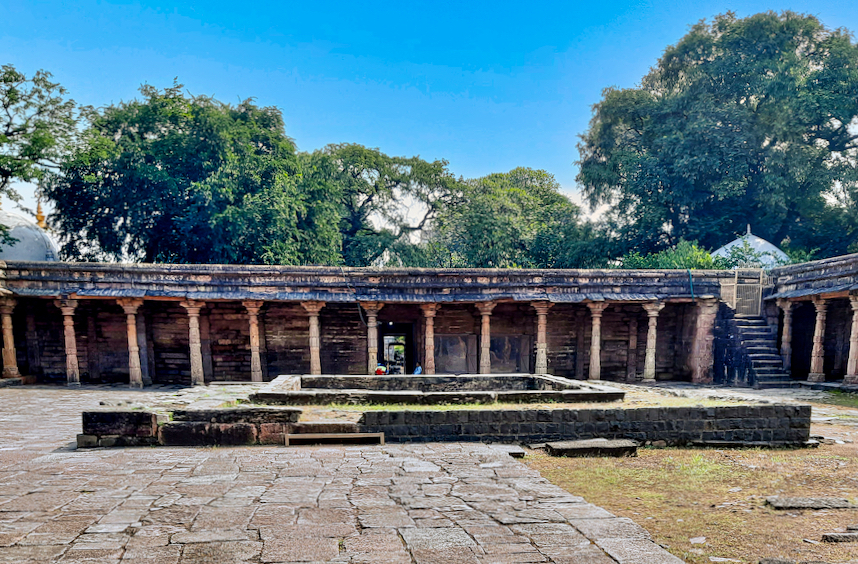
UPSC Relevance
Prelims Relevance
- Bhojshala–Kamal Maula complex: disputed 11th-century monument at Dhar, Madhya Pradesh; ASI-protected.
- Raja Bhoja (r. c. 1010–1055 CE): Paramara ruler of Malwa from Dhara (modern Dhar); credited with the Samarangana Sutradhara and Saraswatikanthabharana.
- Kamal Maula: Chishti Sufi saint Kamal al-Din, whose dargah adjoins the complex; the mosque structure is generally dated to the early 14th century.
- April 7, 2003 ASI order: Hindus worship on Tuesdays; Muslims offer namaz on Fridays (1–3 pm).
- Places of Worship Act, 1991: freezes religious character as on August 15, 1947 (Section 4); Section 4(3)(a) exempts monuments covered by the AMASR Act, 1958.
- AMASR Act, 1958: statute under which ASI protects centrally protected monuments.
- Vagdevi (Saraswati) image: a sculpture dated 1034 CE found at Dhar in the colonial era is now in the British Museum, London; its return is a long-standing demand.
- Basant Panchami: the day of peak Hindu worship (Saraswati Puja) at Bhojshala; friction rises when it falls on a Friday.
Mains Relevance
GS Paper 2
- Interplay of the Places of Worship Act, 1991 with the AMASR Act, 1958 — does the monument exemption open a judicial lane around the 1947 freeze?
- Judiciary as arbiter of faith-heritage conflicts: survey orders, interim arrangements, and the risk of conflicting High Court and Supreme Court directions.
- Secularism as part of the basic structure — the Ayodhya Constitution Bench (2019) read the 1991 Act as embodying non-retrogression.
GS Paper 1
- Paramara contribution to learning and architecture: Raja Bhoja, the Bhojshala tradition, sarpabandha grammar inscriptions and reused temple fabric.
- Layered sacred sites in medieval India: temple material in mosque construction and what it says about Indo-Islamic architecture.
Essay
- Heritage as a shared inheritance: can one monument carry two faiths?
- Law can freeze a building’s status, not a society’s memory — courts and the burden of history.
Background and Context
What Is the Bhojshala–Kamal Maula Complex?
One walled, ASI-protected compound in Dhar carries two names and two claims.
- The monument stands in Dhar town, western Madhya Pradesh, on the Malwa plateau — once Dhara-nagari, capital of the Paramara dynasty.
- The Hindu claim: it’s the Bhojshala (‘Hall of Bhoja’), a hall of learning and shrine of Vagdevi (Saraswati) associated with Raja Bhoja.
- The Muslim claim: it’s the Kamal Maula Mosque, named for the Chishti Sufi saint Kamal al-Din (Kamal Maula), whose dargah adjoins the compound; the mosque structure is generally dated to the early 14th century.
- It’s a centrally protected monument under the AMASR Act, 1958, in ASI custody since the colonial-era protection regime.
- Its fabric is visibly layered: a colonnaded hall of carved pillars and slabs, with serpentine (sarpabandha) inscriptions of Sanskrit–Prakrit grammar and slabs of the play Parijatamanjari from the court of Paramara king Arjunavarman.
- That layering lets both communities point at the same stones — see our note on Indo-Islamic architecture for how such reuse shaped Sultanate-era building.
Raja Bhoja and the Paramara Legacy
The dispute draws its emotional charge from the most celebrated king of Malwa.
- Raja Bhoja (r. c. 1010–1055 CE) of the Paramara dynasty was a rare philosopher-king — soldier, builder and prolific author.
- Works attributed to him include the Samarangana Sutradhara (a treatise on architecture and engineering) and the Saraswatikanthabharana (on poetics and grammar) — the basis of his image as a patron of Saraswati.
- Tradition holds that Bhoja endowed a great Sanskrit school at Dhar — the Bhojshala — where the goddess of learning was worshipped.
- A sculpture dated 1034 CE, found at Dhar in the colonial period, now sits in the British Museum; Hindu groups identify it as the Bhojshala’s Vagdevi and seek its return, though some art historians read the image differently.
- Basant Panchami (Saraswati Puja) is the high point of Hindu observance at the site; the calendar itself becomes a flashpoint when the festival falls on a Friday, the day of congregational namaz.
- For the wider canon this story sits in, see our guide to temple architecture in India.
The 2003 ASI Arrangement
For over two decades, access to Bhojshala ran on a timetable rather than a title.
- By an order dated April 7, 2003, the ASI fixed a time-share: Hindus perform puja on Tuesdays, Muslims offer namaz on Fridays (1–3 pm), with visitor access on other days.
- The arrangement settled usage, not ownership — it deliberately left the question of religious character undecided.
- It mostly held, with tension in years when Basant Panchami fell on a Friday and both communities claimed the same hours.
- The High Court’s May 15 ruling quashed this 2003 order — the first time the working compromise itself was displaced, which is why the appeals carry such urgency.
The Litigation Trail: 2022 to 2026
The present case built up over four years of survey orders, reports and appeals.
- 2022: the ‘Hindu Front for Justice’ moved the Indore Bench of the Madhya Pradesh High Court, challenging the 2003 arrangement and seeking full worship rights at the complex.
- March 2024: the High Court ordered a ‘scientific survey’ of the complex by the ASI, using ground-penetrating radar and photogrammetry.
- April 2024: the Supreme Court let the survey continue but barred any physical excavation altering the site’s character, and directed that no action be taken on the outcome without its leave.
- July 2024: the ASI filed a report running over 2,000 pages before the High Court, concluding that the existing structure incorporated parts of earlier temples of the Paramara period.
- May 15, 2026: the High Court declared the complex a Saraswati temple, quashed the 2003 ASI order, and allowed the Muslim community to seek separate land for a mosque.
- July 13, 2026: the Supreme Court agreed to list all challenge petitions for hearing on July 14.
Places of Worship Act, 1991 and the AMASR Exemption
The statutory heart of the case is one exemption clause inside the 1991 Act.
- The Places of Worship (Special Provisions) Act, 1991 bars conversion of any place of worship (Section 3) and freezes its religious character as it existed on August 15, 1947 (Section 4(1)).
- But Section 4(3)(a) carves out ancient monuments and archaeological sites covered by the AMASR Act, 1958 — and the Hindu side argues ASI-protected Bhojshala falls squarely within this exemption.
- The Muslim side contests that reading: an exemption meant to protect monuments as heritage can’t become a licence to re-litigate their religious character.
- Section 5 separately exempted only the Ram Janmabhoomi–Babri Masjid case; in the Ayodhya judgment (2019), a Constitution Bench described the 1991 Act as embodying secularism and the principle of non-retrogression.
- In December 2024, while the Act’s validity was under challenge, the Supreme Court restrained courts nationwide from registering fresh suits or ordering surveys in place-of-worship disputes — the backdrop against which the Bhojshala appeals now return to it.
- The constitutional anchors: Articles 25–26 (freedom of religion), Article 49 (State’s duty to protect monuments) and Article 51A(f) (duty to value the composite culture).
Why the Case Matters Beyond Dhar
Whatever the Supreme Court decides will echo far outside one Malwa town.
- It’s the first appellate test of whether the AMASR exemption lets courts adjudicate the religious character of an ASI monument despite the 1991 freeze — a question that shadows Gyanvapi (Varanasi), Shahi Idgah (Mathura) and Sambhal.
- It will define how much weight archaeological survey reports can carry in deciding questions of faith and title — evidence law meeting archaeology.
- It tests institutional roles: the ASI as neutral custodian, High Courts as fact-finders, the Supreme Court as stabiliser of communal peace.
- The outcome will show whether the Court’s December 2024 freeze was a pause or a doctrine — whether such disputes are to be decided or de-escalated.
Way Forward
For the courts
- Hear the batch together and settle the PoW Act–AMASR interplay authoritatively, so High Courts stop reaching divergent answers on the same clause.
- Protect the subject-matter meanwhile: a clear status-quo order on worship and custody keeps facts on the ground from outrunning the law.
- Ring-fence ASI surveys as evidence — expert findings on construction history aren’t automatic verdicts on religious character.
For heritage administration
- Keep the ASI’s mandate conservation-first: documentation, structural protection and transparent public reporting of any scientific study.
- Until final adjudication, administer access through published, predictable timetables in the spirit of the 2003 arrangement, with advance planning for Basant Panchami–Friday overlaps.
For social cohesion
- Activate district peace committees and interfaith dialogue in Dhar ahead of each hearing date and festival window.
- Political actors should resist turning court listings into mobilisation events — Ayodhya showed the value of calm around verdicts.
Conclusion
Bhojshala compresses a millennium into one compound: a Paramara king who wrote treatises on architecture, a Sufi saint whose dargah still draws devotees, a colonial-era protection order, and a courtroom asked to say what the stones mean. Hearing every petition together is the right procedural start — fragmentary orders are how such disputes fester.
The larger question is systemic. If the AMASR exemption becomes a general gateway for re-opening the character of protected monuments, the 1991 freeze loses much of its force; read narrowly, Bhojshala may become the case that shut the gate. Either way, the judgment will be studied wherever India’s medieval heritage and modern Constitution meet.
UPSC Practice Questions
Prelims MCQ 1
With reference to the Bhojshala–Kamal Maula complex, consider the following statements:
- It is located in Dhar district of Madhya Pradesh and is a centrally protected monument under the Archaeological Survey of India.
- Raja Bhoja, with whom the complex is traditionally associated, belonged to the Chandela dynasty.
- The Places of Worship (Special Provisions) Act, 1991 contains an exemption for ancient monuments covered by the AMASR Act, 1958.
How many of the above statements are correct?
(a) Only one (b) Only two (c) All three (d) None
Answer: (b) Only two
Explanation:
Statements 1 and 3 are correct. Raja Bhoja (r. c. 1010–1055 CE) was a Paramara ruler of Malwa with his capital at Dhara (modern Dhar), not a Chandela; the Chandelas ruled from Khajuraho–Mahoba.
Prelims MCQ 2
Under the Places of Worship (Special Provisions) Act, 1991, the religious character of a place of worship is to be maintained as it existed on:
(a) January 26, 1950 (b) August 15, 1947 (c) November 26, 1949 (d) The date of commencement of the Act in 1991
Answer: (b) August 15, 1947
Explanation:
Section 4(1) freezes the religious character of every place of worship as on August 15, 1947. The Ram Janmabhoomi–Babri Masjid case (Section 5) and monuments covered by the AMASR Act, 1958 (Section 4(3)(a)) are exempt.
UPSC Mains Questions
- The exemption for protected monuments under the Places of Worship Act, 1991 has turned heritage sites into fresh arenas of religious litigation. Discuss with reference to the Bhojshala dispute, and examine the judiciary’s role in balancing heritage protection with communal harmony.
- The Bhojshala–Kamal Maula complex reflects the layered character of medieval Indian sacred architecture. Examine what such monuments reveal about Paramara-era learning and patronage, and about the practice of reusing temple material in Sultanate-period construction.
- Archaeological evidence can establish how a structure was built, but courts must decide what it means. Critically analyse the role of ASI scientific surveys in adjudicating disputes over the religious character of monuments.
Source: The Hindu.
Frequently Asked Questions
What is the Bhojshala dispute?
It’s a contest over one ASI-protected 11th-century monument in Dhar, Madhya Pradesh. Hindus regard it as the Bhojshala, a Saraswati temple and hall of learning linked to Raja Bhoja; Muslims identify it as the Kamal Maula Mosque, attached to the dargah of a Chishti Sufi saint.
What did the Madhya Pradesh High Court decide?
By its May 15, 2026 order, the High Court declared the complex a temple dedicated to Goddess Saraswati, quashed the April 2003 ASI order that allowed Friday namaz inside it, and permitted the Muslim community to seek separate land in Dhar district for a mosque.
What has the Supreme Court done now?
On July 13, 2026, a Bench led by Chief Justice Surya Kant agreed to urgently list all petitions challenging the High Court order — including the appeal by mosque caretaker Qazi Moinuddin — and fixed July 14 for hearing the entire batch together.
What was the 2003 ASI arrangement at Bhojshala?
An ASI order of April 7, 2003 time-shared the monument: Hindus performed puja on Tuesdays, Muslims offered namaz on Fridays between 1 pm and 3 pm, and the site stayed open to visitors on other days. It settled usage without deciding ownership or religious character.
Does the Places of Worship Act, 1991 apply here?
That’s the central legal question. The Act freezes a shrine’s religious character as on August 15, 1947, but Section 4(3)(a) exempts ancient monuments covered by the AMASR Act, 1958. Since Bhojshala is ASI-protected, the parties dispute whether the freeze applies to it at all.
Who was Raja Bhoja?
Bhoja (reigned c. 1010–1055 CE) was the celebrated Paramara king of Malwa, ruling from Dhara, modern Dhar. A soldier-scholar, he’s credited with treatises such as the Samarangana Sutradhara on architecture, and tradition links him to the Bhojshala school of Sanskrit learning.
Source: https://anantamias.com/current-affairs/bhojshala-kamal-maula-dispute-sc-listing/
China’s military and space moves: What three new developments signal for India
Why in News?
The Indian Express reported three developments in China’s military and space sectors within one week of July 2026. On July 3, President Xi Jinping promoted two officers to general — the highest active rank in the People’s Liberation Army (PLA) — amid anti-corruption purges of the top brass. Days later, Xinhua announced that a PLA Navy strategic nuclear submarine had test-launched a missile, identified by Reuters as an intercontinental ballistic missile (ICBM), toward the high seas of the Pacific. And on July 10, the Long March-10B rocket achieved China’s first-ever controlled recovery of a rocket’s first stage.
Each strand feeds India’s threat assessment. Analysts at the Center for Strategic and International Studies (CSIS) note China has tripled its nuclear arsenal from about 200 to over 600 warheads in six years, while reusable rockets promise cheaper, faster access to space for commercial and military payloads alike.
- On July 3, Xi Jinping promoted Zhang Shuguang, head of the CMC’s discipline inspection commission, and Wang Gang, commander of the PLA Air Force, to full general.
- Purges have left five of the seven Central Military Commission positions vacant; Generals Zhang Youxia and Liu Zhenli were removed in late January 2026 for “violating discipline” — a euphemism for corruption.
- The PLA Navy said its missile carried a dummy warhead and “landed precisely within the designated waters”; CSIS called it China’s first submarine-launched ballistic missile (SLBM) launch into international open waters.
- Japan, Australia and New Zealand criticised the test, which Beijing framed as routine, pre-notified annual training aimed at no country.
- The Long March-10B lifted off from Hainan province on July 10 and recovered its first stage under control — the manoeuvre that made SpaceX’s Falcon 9 cheap and prolific.
The development matters in the context of:
- China’s internal civil-military politics — who controls the PLA — shapes its assertiveness on Taiwan and along the Line of Actual Control (LAC): standing GS2 material.
- For GS3, the week showcases the sea leg of the nuclear triad and reusable launch technology — races in which India’s Agni-SSBN complex and ISRO’s NGLV are the direct comparatives.
- The Indo-Pacific security architecture, including the Quad, exists largely as a response to these capability shifts.

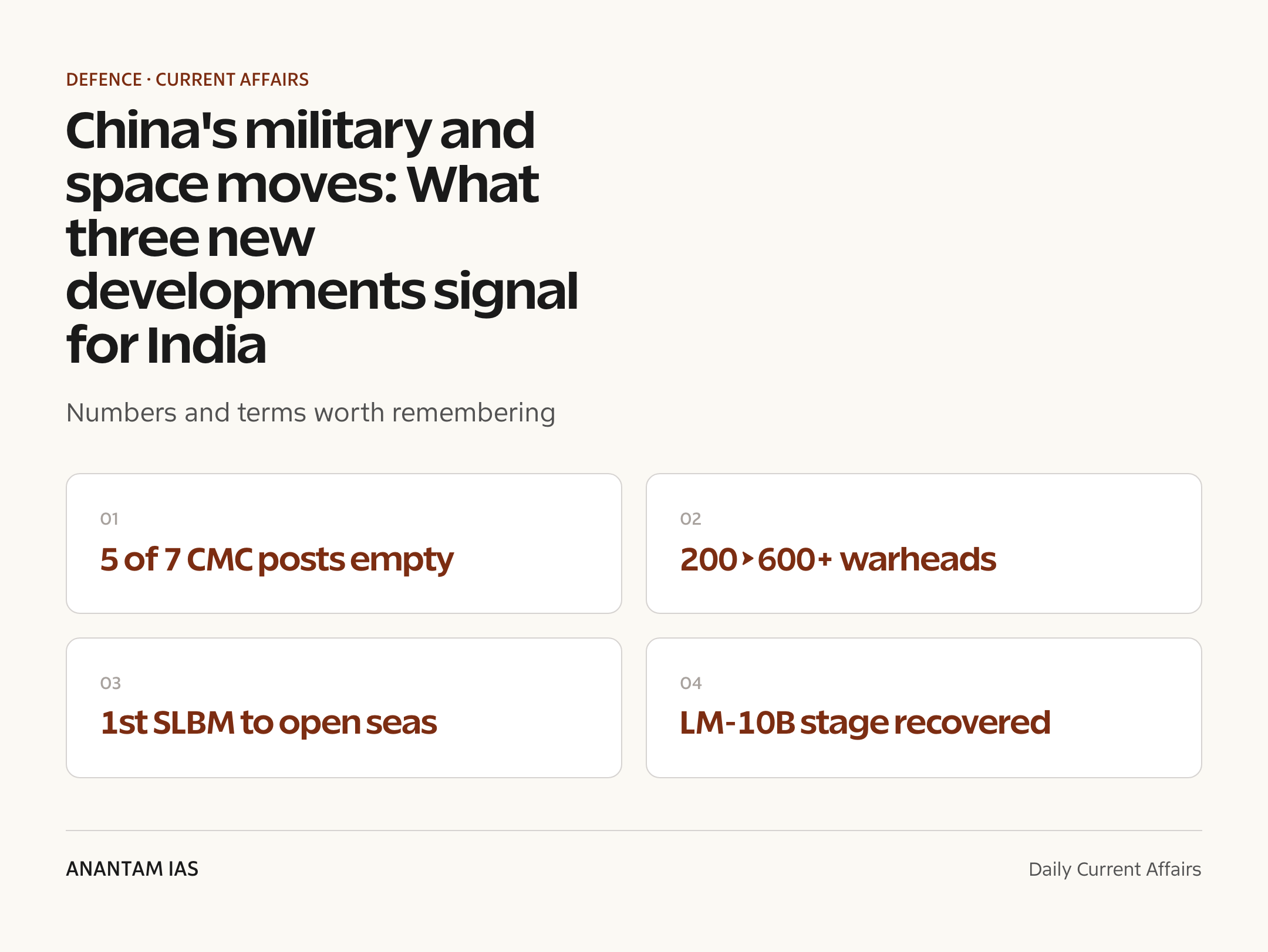
UPSC Relevance
Prelims Relevance
- Central Military Commission (CMC) — China’s apex military administration body, chaired by Xi Jinping; its discipline inspection commission, one of 15 CMC sections, runs anti-corruption work.
- ICBM — a ballistic missile with range conventionally beyond about 5,500 km; an SLBM is a ballistic missile launched from a submarine.
- Nuclear triad — land, sea and air delivery legs; the sea leg on SSBNs is the most survivable, guaranteeing second-strike capability.
- Long March-10 family (10A, 10B, 10C) — backbone of China’s future space transport and crewed programme; the 10B’s first-stage recovery (July 2026) was China’s first.
- Mission Divyastra (March 2024) — first flight test of India’s Agni-5 with MIRV technology.
- INS Arihant and INS Arighaat (commissioned August 2024) — India’s SSBNs; the K-4 SLBM ranges about 3,500 km.
- India’s nuclear doctrine (2003) — credible minimum deterrence, no first use, massive retaliation.
- SIPRI Yearbook 2025 — China roughly 600 warheads, India about 180.
- NGLV — approved by the Union Cabinet in September 2024 with a reusable first stage; ISRO’s RLV-LEX ‘Pushpak’ landing experiments concluded in June 2024.
Mains Relevance
GS Paper 2
- India-China relations: how opacity in PLA decision-making and a loyalist CMC concentrate Taiwan and LAC choices in one leader’s hands, raising miscalculation risks.
- Indo-Pacific diplomacy: the SLBM test as nuclear signalling to Japan, Australia and the US, and India’s alignment choices within the Quad.
- China’s party-army fusion as a contrast with democratic civilian control of the military.
GS Paper 3
- Nuclear deterrence: what a demonstrated sea-based second strike plus a tripled arsenal does to strategic stability in Asia and to India’s credible minimum deterrence.
- Space technology as security infrastructure: reusable rockets cut launch costs and raise cadence, accelerating military satellite constellations.
- Indigenisation: lessons from China’s state-backed technological self-reliance for India’s defence and space ecosystems.
Essay
- Twenty-first-century arsenals are built in laboratories and launchpads, not just barracks.
- Deterrence in an age of opacity: peace between powers that cannot read each other.
Background and Context
Three developments, one week, one message
Between July 3 and July 10, 2026, three announcements sketched the arc of China’s hard-power ambitions.
- July 3: promotion orders for Zhang Shuguang and Wang Gang — full general, the PLA’s highest active rank — amid an anti-corruption churn in the top brass.
- Days later: a strategic nuclear submarine launched a dummy-warhead missile toward the high seas of the Pacific; Reuters identified it as an ICBM.
- July 10: the Long March-10B flew from Hainan and achieved China’s first controlled recovery of a rocket first stage.
- The common thread: tightening political control over the PLA while demonstrating strategic nuclear and space capability to the region — and to Washington.
Inside the CMC: purges, promotions and Pekingology
The promotions matter because of where they land — a Central Military Commission gutted by investigations.
- The Central Military Commission (CMC) is China’s apex military administration body, chaired by Xi Jinping; its discipline inspection commission — one of 15 CMC sections — handles anti-corruption work.
- Zhang Shuguang heads that commission; Wang Gang commands the PLA Air Force.
- After Generals Zhang Youxia and Liu Zhenli were removed in late January 2026, five of seven CMC positions stand vacant, their occupants investigated for “violating discipline”.
- The South China Morning Post reported that at the Communist Party’s 105th founding anniversary gala, the two sat beside Defence Minister Dong Jun and theatre commander Han Shengyan — seating charts being a classic tell where processes are opaque.
- Analysts such as Lyle Morris of the Asia Society Policy Institute read the moves as Xi re-staffing the CMC with loyalists ahead of the party congress due in about a year — with sensitive Taiwan decisions in mind.
The submarine missile test: a nuclear signal in the Pacific
Beijing called it routine training; the firsts embedded in the test say otherwise.
- The PLA Navy said the missile carried a dummy warhead, “landed precisely within the designated waters”, was part of annual training, was aimed at no country, and had been notified to relevant states in advance.
- CSIS analysts called it China’s first SLBM launch into international open waters — and the first public demonstration of a strategic nuclear strike capability from a nuclear-powered submarine.
- A working sea leg is the heart of second-strike capability: submarines are hard to find, so retaliation survives a first strike.
- CSIS adds the wider context: China is undergoing the largest expansion of its nuclear arsenal ever, tripling from about 200 to over 600 warheads in six years.
- China last publicly fired an ICBM into the Pacific in September 2024; two rare public tests in two years read as deliberate signalling amid tensions over Taiwan.
Long March-10B: China joins the reusable-rocket club
Recovering a first stage is the single most consequential cost technology in spaceflight — and China has now demonstrated it.
- The Long March-10B flew from Hainan province on July 10, achieving China’s first controlled recovery of a carrier rocket’s first stage — the manoeuvre SpaceX’s Falcon 9 pioneered in December 2015.
- Reusability slashes per-launch costs and multiplies launch cadence; it underpins the US commercial space boom and mega-constellations like Starlink.
- A Chinese Academy of Engineering expert told Xinhua the Long March-10A, 10B and 10C will “collectively form the backbone of China’s space transportation system” and anchor its next-generation crewed rocket programme.
- State media framed the goals as boosting commercial space competitiveness, routinising reusable launches and cutting dependence on Western technology.
- The name carries party symbolism: the Long March was Mao Zedong’s 10,000-km trek of the mid-1930s — tech milestones fused with Communist Party founding mythology.
Why India must read the three together
Individually incremental, the three developments compound into a single strategic picture for New Delhi.
- A loyalist CMC concentrates decisions on Taiwan and the LAC in Xi’s hands; purge-era opacity raises the risk that Indian planners misread intent — a core problem in the US-China-Russia triangle India navigates.
- A demonstrated sea-based second strike, stacked on a tripling arsenal, widens the asymmetry: SIPRI 2025 pegs China at about 600 warheads against India’s 180 — and India must deter on two fronts.
- Cheap, reusable launch means faster deployment of military satellites — reconnaissance, communications and the BeiDou navigation constellation that guides PLA precision weapons.
- The October 2024 disengagement at Depsang and Demchok eased the LAC crisis, but capability trends like these outlast diplomatic thaws.
- China’s launch cadence runs above 60 orbital attempts a year — roughly ten times India’s — a gap reusability will widen unless India accelerates.
Where India stands: triad, doctrine and reusable tech
India holds a credible but much smaller deterrent, and its reusable-launch effort is a generation behind demonstration.
- Land leg: the Agni missile series tops out with Agni-5 (range over 5,000 km); Mission Divyastra (March 2024) flight-tested MIRV on it.
- Sea leg: India’s submarine fleet includes the SSBNs INS Arihant and INS Arighaat (commissioned August 2024); the K-4 SLBM (about 3,500 km) was test-fired from Arighaat in November 2024.
- Doctrine: the 2003 doctrine rests on credible minimum deterrence, no first use and massive retaliation — the sea leg is what makes the NFU pledge credible.
- Reusable tech: ISRO’s RLV-LEX series (‘Pushpak’) completed three landing experiments by June 2024; the Cabinet approved the NGLV in September 2024 at about ₹8,240 crore, with a reusable first stage — compared in GSLV vs NGLV vs Falcon Heavy.
- Private sector: IN-SPACe-era startups such as Skyroot and Agnikul have flown early vehicles, but no Indian rocket has yet attempted a first-stage recovery.
Way Forward
Harden the deterrent
- Deepen the sea leg: more SSBNs on patrol, longer-range SLBMs, survivable command-and-control — so credible minimum deterrence stays credible as China’s arsenal grows.
- Mature MIRV and penetration aids against expanding Chinese missile defences, without abandoning doctrinal restraint.
Win the launch-cost race
- Fast-track the NGLV and orbital re-landing demonstrations; treat reusability as strategic infrastructure, not prestige.
- Crowd in private launch firms through IN-SPACe and assured government demand; grow surveillance constellations and space situational awareness under the Defence Space Agency.
Watch, engage, hedge
- Institutionalise China-study capacity — language, PLA analysis — so assessments don’t hinge on seating charts alone.
- Keep LAC dialogue alive while deepening Quad partnerships; push for strategic-stability and risk-reduction talks with Beijing.
Conclusion
One week gave China-watchers a purge-reshaped high command, a first-of-its-kind submarine missile launch and a SpaceX-style rocket recovery. The thread is capability plus control: Xi Jinping is centralising the PLA’s leadership even as it demonstrates the tools of a first-rank strategic power.
For India, the lesson isn’t panic but pace. A credible sea-based deterrent, a reusable launch programme that reaches demonstration, and durable Indo-Pacific partnerships compound — and each runs on decisions taken now, not in a crisis.
UPSC Practice Questions
Prelims MCQ 1
With reference to recent developments in China’s military and space sectors (July 2026), consider the following statements:
- The Central Military Commission (CMC) is the apex military administration body of China.
- The missile test-launched by the PLA Navy from a strategic nuclear submarine carried a live nuclear warhead.
- The Long March-10B mission marked China’s first controlled recovery of a carrier rocket’s first stage.
How many of the above statements are correct?
(a) Only one (b) Only two (c) All three (d) None
Answer: (b) Only two
Explanation:
Statements 1 and 3 are correct. Statement 2 is wrong — Xinhua reported the missile carried a dummy warhead and landed in designated Pacific waters during what Beijing called routine annual training.
Prelims MCQ 2
‘Mission Divyastra’, sometimes seen in the news, is associated with which of the following?
(a) India’s first submarine-launched ballistic missile test (b) The first flight test of the Agni-5 missile with MIRV technology (c) India’s anti-satellite missile test (d) A DRDO directed-energy weapon programme
Answer: (b) The first flight test of the Agni-5 missile with MIRV technology
Explanation:
Mission Divyastra (March 2024) was DRDO’s first flight test of Agni-5 fitted with multiple independently targetable re-entry vehicles (MIRV), letting one missile deliver warheads to several targets.
UPSC Mains Questions
- China has demonstrated a sea-based nuclear strike capability while tripling its warhead stockpile within a decade. Examine the implications for strategic stability in Asia and for India’s doctrine of credible minimum deterrence and no first use. (250 words)
- Reusable launch vehicles are reshaping the economics and the military utility of access to space. Assess India’s preparedness in reusable launch technology in the light of recent advances by China and the United States. (250 words)
- Opacity in China’s civil-military politics complicates India’s strategic assessments. Discuss how leadership churn in the People’s Liberation Army affects India’s China policy on the Line of Actual Control and in the Indo-Pacific. (250 words)
Source: Indian Express Explained.
Frequently Asked Questions
What three Chinese developments are in the news?
Within one July 2026 week: Xi Jinping promoted two officers to general amid PLA purges; a PLA Navy nuclear submarine test-launched a missile, identified by Reuters as an ICBM, into the Pacific; and the Long March-10B achieved China’s first controlled recovery of a rocket first stage.
What is China’s Central Military Commission?
The Central Military Commission (CMC) is China’s apex military administration body, chaired by Xi Jinping, with 15 sections including a discipline inspection commission for anti-corruption work. After recent purges, five of its seven leadership positions stand vacant — which is why the new promotions drew such attention.
Why was the submarine missile test significant?
CSIS analysts say it was China’s first launch of a submarine-launched ballistic missile into international open waters, and the first public proof of a strategic nuclear strike capability from a nuclear-powered submarine — the survivable ‘second-strike’ sea leg of a nuclear triad.
How big is China’s nuclear arsenal now?
CSIS analysts estimate China tripled its arsenal from about 200 to over 600 warheads in six years — the fastest expansion by any nuclear power. SIPRI’s 2025 yearbook similarly puts China near 600 warheads, against roughly 180 for India.
What did the Long March-10B achieve?
Launched from Hainan on July 10, 2026, it performed China’s first controlled recovery of a carrier rocket’s first stage — the reusability manoeuvre SpaceX’s Falcon 9 pioneered in 2015. Reusable stages cut launch costs sharply and allow far more frequent launches.
What is India’s sea-based nuclear deterrent?
India operates the SSBNs INS Arihant and INS Arighaat (commissioned August 2024), armed with K-15 and K-4 submarine-launched ballistic missiles; the K-4 ranges about 3,500 km. This sea leg underwrites India’s no-first-use doctrine by guaranteeing retaliation.
Source: https://anantamias.com/current-affairs/china-military-space-developments/
Physics Olympiad 2026: India’s five-gold sweep and joint world No. 1 finish
Why in News?
PIB confirmed on 12 July 2026 that all five members of the Indian team won gold medals at the 56th International Physics Olympiad (IPhO) 2026, held at Bucaramanga, Colombia. A five-for-five gold sweep is the best result a country can post at the Olympiad.
With this performance, India finished joint world No. 1 alongside China, Kazakhstan, Russia, South Korea and Taiwan, in a field of 381 students from 87 countries. The team was selected, trained and mentored by the Homi Bhabha Centre for Science Education (HBCSE), a national centre of the Tata Institute of Fundamental Research working under the Department of Atomic Energy.
- All five Indian students won gold medals — the country’s ceiling performance at a single IPhO.
- India shared the world No. 1 position with five countries: China, Kazakhstan, Russia, South Korea and Taiwan.
- The 56th edition drew 381 students from 87 countries to Bucaramanga, Colombia.
- The gold medallists: Kanishk Jain (Pune), Riddhesh Anant Bendale (Indore), Rishit Garg (Dwarka, New Delhi), Shresth Suraiya (Mumbai) and Svarit Joshi (Ahmedabad).
- PIB noted that every Indian participant over the last decade has finished on the podium at IPhO.
- Dr Ajit Kumar Mohanty, Secretary, DAE and Chairman, Atomic Energy Commission, credited the students and the HBCSE-TIFR Olympiad programme.
The development matters in the context of:
- The result is a report card on India’s science-talent pipeline — a decades-old, state-funded system of identifying and mentoring gifted school students rather than a one-off win.
- It spotlights an unusual institutional chain: a school-level competition programme run by a research institution (TIFR) under the Department of Atomic Energy, not the education ministry.
- For UPSC, it packages classic prelims fodder (venue, ranks, institutions) with a GS3 mains theme — converting Olympiad excellence into research leadership.
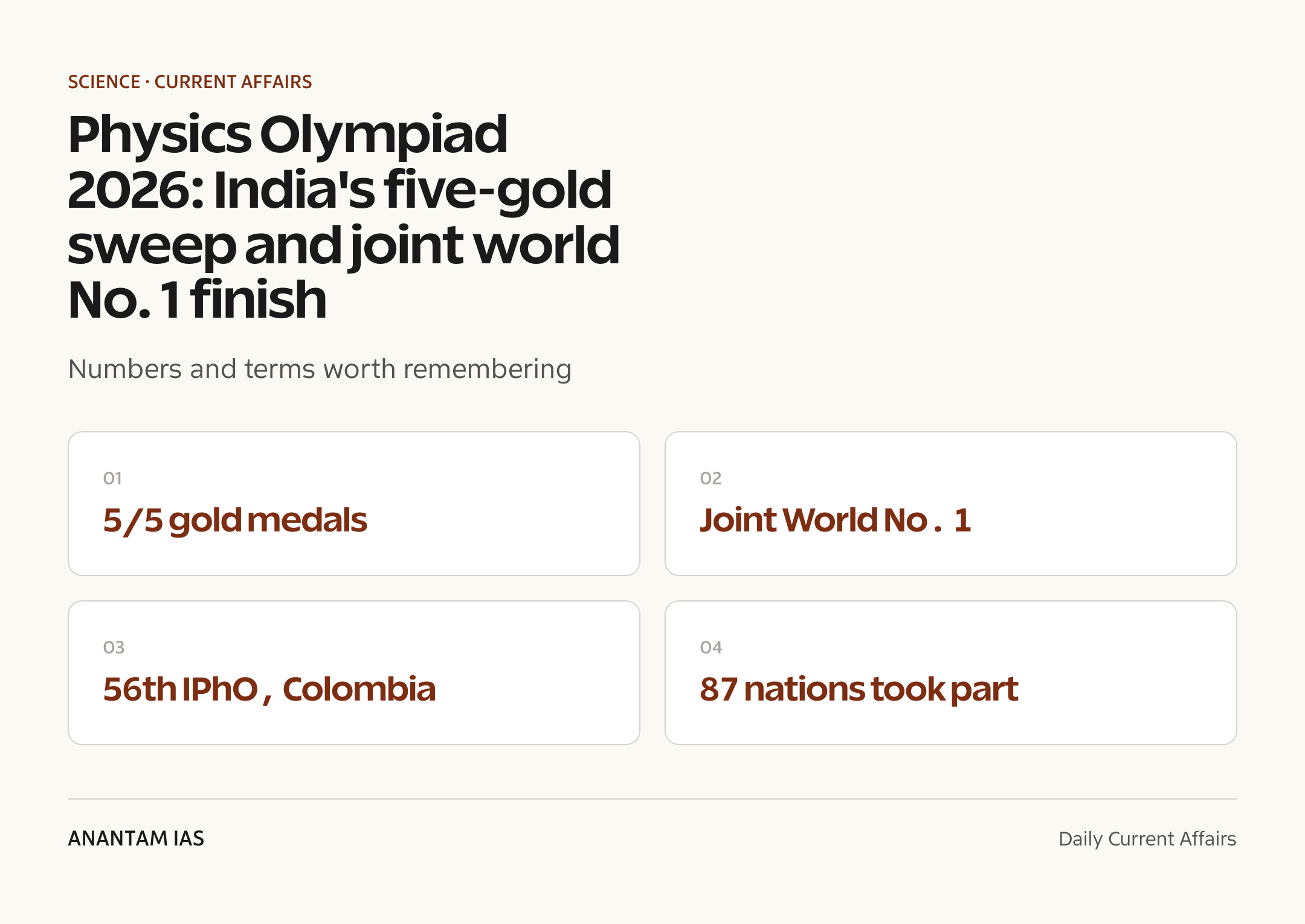
UPSC Relevance
Prelims Relevance
- IPhO 2026: 56th edition, held at Bucaramanga, Colombia; 381 students from 87 countries.
- India’s result: 5 gold medals (all five team members); joint world No. 1 with China, Kazakhstan, Russia, South Korea and Taiwan.
- HBCSE (Homi Bhabha Centre for Science Education), Mumbai — a national centre of TIFR and the nodal centre for India’s National Olympiad Programme.
- TIFR is an aided institution under the Department of Atomic Energy (DAE); DAE (set up 1954) works directly under the Prime Minister.
- The Secretary, DAE is ex-officio Chairman of the Atomic Energy Commission — currently Dr Ajit Kumar Mohanty.
- The International Physics Olympiad began in 1967 in Warsaw, Poland; India has participated since 1998.
- Selection chain for physics: NSEP (by the Indian Association of Physics Teachers) → INPhO → Orientation-cum-Selection Camp at HBCSE → pre-departure training → IPhO.
- IPhO medals go by score benchmarks, not country quotas — which is why several countries can tie at the top of the medal table.
- Article 51A(h): fundamental duty to develop scientific temper, humanism and the spirit of inquiry and reform.
Mains Relevance
GS Paper 3
- Achievements of Indians in science and technology — what sustained, institution-led talent nurturing (HBCSE-TIFR, DAE) delivers versus episodic schemes.
- Building a research pipeline: how Olympiad-level excellence can feed into basic-science research careers through fellowships, undergraduate research and the Anusandhan National Research Foundation.
- Indigenisation of talent development — a fully home-grown selection and training system producing world-topping results.
GS Paper 2
- Education and human-resource development: identifying and nurturing gifted children, a stated priority of NEP 2020.
- Issues relating to the development and management of education — the gap between elite-apex outcomes (Olympiad golds) and mass learning outcomes in school science.
Essay
- Scientific temper as a national project — from Article 51A(h) to Olympiad podiums.
- Excellence versus equity in education: can a country celebrate five golds while its median classroom struggles with basics?
Background and Context
What is the International Physics Olympiad?
The IPhO is the world championship of school physics — and its structure explains how six countries can share the top rank.
- An annual competition for pre-university students, first held in 1967 in Warsaw, Poland; the 2026 edition at Bucaramanga, Colombia was the 56th.
- Each country sends a team of up to five students, accompanied by team leaders; contestants sit demanding theoretical and experimental examinations.
- Medals are awarded against absolute score benchmarks, not country quotas — every student who crosses the gold cut-off gets gold. Country rankings are then read off the medal tallies, which is how India tied at No. 1 with five other nations.
- IPhO 2026 drew 381 students from 87 countries, making a full five-gold sweep statistically rare and competitively significant.
- India has competed at IPhO since 1998; PIB notes that every Indian participant over the last decade has won a medal or podium finish.

India's scorecard at Bucaramanga
The five-member team converted every seat into gold — the best possible national outcome.
- Kanishk Jain — Pune, Maharashtra.
- Riddhesh Anant Bendale — Indore, Madhya Pradesh.
- Rishit Garg — Dwarka, New Delhi.
- Shresth Suraiya — Mumbai, Maharashtra.
- Svarit Joshi — Ahmedabad, Gujarat.
- The delegation was led by Prof Anwesh Mazumdar (HBCSE-TIFR) and Dr Leena Joshi (St. Xavier’s College, Mumbai), with scientific observers Prof Ananda Dasgupta (IISER Kolkata) and Ms Nisha Kelkar (Gogate-Joglekar College, Ratnagiri).
- Note the geographic spread — five students from five different cities across four states and Delhi, a sign the catchment is wider than one or two coaching hubs.
HBCSE-TIFR: the institution behind the medals
India’s Olympiad machine sits inside its atomic-energy establishment, not its education ministry.
- The Homi Bhabha Centre for Science Education (HBCSE), Mumbai, established in 1974, is a national centre of the Tata Institute of Fundamental Research (TIFR).
- TIFR — founded in 1945 by Homi J. Bhabha — is an aided institution of the Department of Atomic Energy, which functions directly under the Prime Minister.
- HBCSE is the nodal centre for the National Olympiad Programme and India’s link to the international Olympiad community, running selection, orientation camps and intensive training for maths and the sciences.
- The programme spans olympiads in mathematics, physics, chemistry, biology, astronomy and junior science — the physics golds are one arm of a broader system.
- Dr Ajit Kumar Mohanty, Secretary, DAE and Chairman, Atomic Energy Commission, called the result a testament to the students’ scientific temperament and the HBCSE-TIFR programme’s commitment.
- Prof Arnab Bhattacharya, Centre Director, HBCSE, attributed the now-routine success to patient mentoring over decades, backed by sustained DAE funding — an argument for institutional continuity over short-term schemes.
How the Indian team is picked
Reaching the IPhO team means surviving a multi-stage national funnel that starts with a mass examination.
- Stage 1 — National Standard Examination in Physics (NSEP), conducted by the Indian Association of Physics Teachers (IAPT), open to school students nationwide.
- Stage 2 — Indian National Physics Olympiad (INPhO), a tougher written round for NSEP toppers, run with HBCSE.
- Stage 3 — Orientation-cum-Selection Camp (OCSC) at HBCSE, Mumbai: theory and experimental tests that pick the final five.
- Stage 4 — pre-departure training at HBCSE, with intensive laboratory work and problem-solving before the team flies out.
- PIB describes this as a rigorous multi-stage selection with orientation camps and training — the design filters lakhs of aspirants down to five.
Why the sweep matters for India's science ecosystem
The medals are a leading indicator for the research pipeline India is trying to build.
- It validates a long-horizon, publicly funded talent model: HBCSE’s mentoring has run for decades, insulated from annual policy churn.
- NEP 2020 explicitly calls for identifying and nurturing gifted students; the Olympiad programme is the working prototype of that idea.
- Olympiad alumni disproportionately enter basic-science and engineering research; each cohort feeds institutions from the IITs and IISERs to global universities.
- Sustained podium finishes build scientific soft power — signalling depth in human capital the way ISRO missions signal capability in technology.
- The win reinforces the case for new research plumbing — the Anusandhan National Research Foundation (ANRF), set up under the ANRF Act 2023, and DST’s INSPIRE scheme — to retain this talent in Indian science.
- It also strengthens the scientific temper mandate of Article 51A(h): role models matter, and five teenagers on a world podium are persuasive ones.
The caveats: apex excellence, broad-base gaps
A clear-eyed note must weigh the golds against the wider state of school science.
- Olympiad golds sit at the apex of a narrow funnel; national learning surveys have repeatedly flagged weak foundational science and maths outcomes in the median classroom.
- Access is uneven — laboratory-grade preparation clusters in urban, English-medium schools, so much latent talent in small towns and government schools never enters the funnel.
- Gender balance in India’s science Olympiad teams has historically been poor; widening the base is both an equity and a talent-yield issue.
- A recurring worry is brain drain: many top Olympiad performers pursue degrees and careers abroad, so the domestic research ecosystem must compete to retain them.
- Medal tallies are a proxy, not a policy outcome — the durable goal is more working scientists, patents and papers, not podium photographs.
Way Forward
Widen the funnel
- Take NSEP-style talent searches into regional-language and government schools, with fee waivers and travel support so the entry gate isn’t self-selecting.
- Expand school-level experimental exposure — Atal Tinkering Labs under the Atal Innovation Mission are natural feeders for Olympiad-style problem-solving.
- Set explicit targets to raise girls’ participation across Olympiad stages, with mentoring camps modelled on HBCSE’s.
Convert medals into careers
- Link Olympiad performance to research fellowships (INSPIRE and successor schemes) and guaranteed undergraduate research placements at IISERs, IITs and TIFR.
- Use ANRF funding to build attractive domestic PhD and early-career tracks so top performers see a future in Indian labs.
- Institutionalise alumni networks so past medallists mentor new cohorts — cheap, high-yield continuity of the kind HBCSE has practised for decades.
Conclusion
India’s five-gold sweep at the 56th International Physics Olympiad is more than a happy headline. It’s evidence that a patient, institutionally anchored talent system — HBCSE, TIFR, DAE — can put Indian school students at the top of the world, jointly with China, Russia, South Korea, Kazakhstan and Taiwan.
The policy task now is symmetry: widen the base so the funnel draws from every classroom, and deepen the exits so the country that trains these physicists also gets to employ them. Medals mark potential; laboratories, fellowships and research careers decide whether it compounds.
For aspirants, this is a compact GS3 package — an institution chain worth memorising, a venue-and-rank fact set for prelims, and a ready mains argument on nurturing scientific talent. Fold it into your GS Paper 3 preparation notes.
UPSC Practice Questions
Prelims MCQ 1
With reference to the 56th International Physics Olympiad (IPhO) 2026, consider the following statements:
- It was held at Bucaramanga, Colombia.
- All five members of the Indian team won gold medals, and India finished joint world No. 1.
- India’s Olympiad programme is anchored by the Homi Bhabha Centre for Science Education, which functions under the Department of Science and Technology.
How many of the above statements are correct?
(a) Only one (b) Only two (c) All three (d) None
Answer: (b) Only two
Explanation:
Statements 1 and 2 are correct: the 56th IPhO was held at Bucaramanga, Colombia, where all five Indian students won gold and India tied for world No. 1 with China, Kazakhstan, Russia, South Korea and Taiwan. Statement 3 is wrong — HBCSE is a national centre of TIFR, an aided institution under the Department of Atomic Energy, not the DST.
Prelims MCQ 2
The Homi Bhabha Centre for Science Education (HBCSE), the nodal centre for India’s National Olympiad Programme, is a national centre of which institution?
(a) Indian Institute of Science, Bengaluru (b) Tata Institute of Fundamental Research, Mumbai (c) Council of Scientific and Industrial Research (d) Indian Association of Physics Teachers
Answer: (b) Tata Institute of Fundamental Research, Mumbai
Explanation:
HBCSE, established in 1974 in Mumbai, is a national centre of TIFR — itself an aided institution of the Department of Atomic Energy. The IAPT conducts only the first-stage NSEP examination; selection and training beyond that run through HBCSE.
UPSC Mains Questions
- India’s sustained medal streak at international science Olympiads coexists with weak foundational learning outcomes in school science. Examine this paradox and suggest measures to build a broad-based talent pipeline in the basic sciences. (250 words)
- Discuss the role of institutions such as HBCSE-TIFR and the Department of Atomic Energy in nurturing scientific talent, and evaluate how NEP 2020 and the Anusandhan National Research Foundation can convert Olympiad excellence into research leadership. (250 words)
Source: PIB, Department of Atomic Energy.
Frequently Asked Questions
Where was the International Physics Olympiad 2026 held?
The 56th International Physics Olympiad (IPhO) 2026 was held at Bucaramanga, Colombia. It brought together 381 pre-university students from 87 countries, who competed in demanding theoretical and experimental physics examinations. It was India’s best possible outing — every member of the five-student team returned with a gold medal.
How did India perform at IPhO 2026?
India won five gold medals — one for each team member — and finished joint world No. 1 alongside China, Kazakhstan, Russia, South Korea and Taiwan. PIB also noted that every Indian participant at the IPhO over the last decade has finished on the podium, underlining the consistency of the programme.
Who were India’s gold medallists at IPhO 2026?
The five gold medallists were Kanishk Jain (Pune), Riddhesh Anant Bendale (Indore), Rishit Garg (Dwarka, New Delhi), Shresth Suraiya (Mumbai) and Svarit Joshi (Ahmedabad). The team was led by Prof Anwesh Mazumdar of HBCSE-TIFR and Dr Leena Joshi of St. Xavier’s College, Mumbai.
What is HBCSE and who runs India’s Olympiad programme?
The Homi Bhabha Centre for Science Education (HBCSE), Mumbai, is the nodal centre for India’s National Olympiad Programme. It is a national centre of the Tata Institute of Fundamental Research (TIFR), an aided institution under the Department of Atomic Energy — so the programme runs under the DAE, not the education ministry.
How are students selected for India’s physics Olympiad team?
Selection is multi-stage: the National Standard Examination in Physics (NSEP) conducted by the Indian Association of Physics Teachers, then the Indian National Physics Olympiad (INPhO), then an Orientation-cum-Selection Camp at HBCSE with theory and experimental tests, and finally pre-departure training before the international round.
Why is this result important for UPSC preparation?
It packs classic prelims facts — venue, joint No. 1 rank, the HBCSE-TIFR-DAE chain — with a GS3 mains theme: how institution-led talent nurturing builds a research pipeline. It also connects to NEP 2020’s gifted-student mandate, ANRF, and the Article 51A(h) duty to develop scientific temper.
Source: https://anantamias.com/current-affairs/india-golden-sweep-56th-physics-olympiad/