Introduction
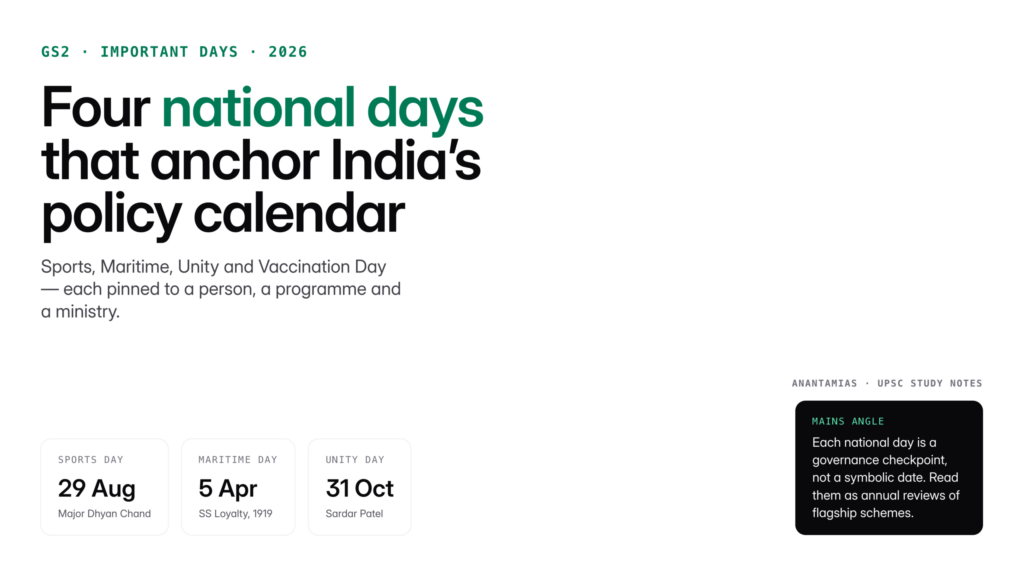
Every year, India marks a calendar full of national observances that commemorate individuals, ideas and institutions central to the Republic. Four of these, National Sports Day, National Maritime Day, National Unity Day and National Vaccination Day, sit at the intersection of history, governance and current affairs. They show up on static GS lists, in prelims MCQs on important days, and in mains questions on public health, sports policy, national integration and the blue economy.
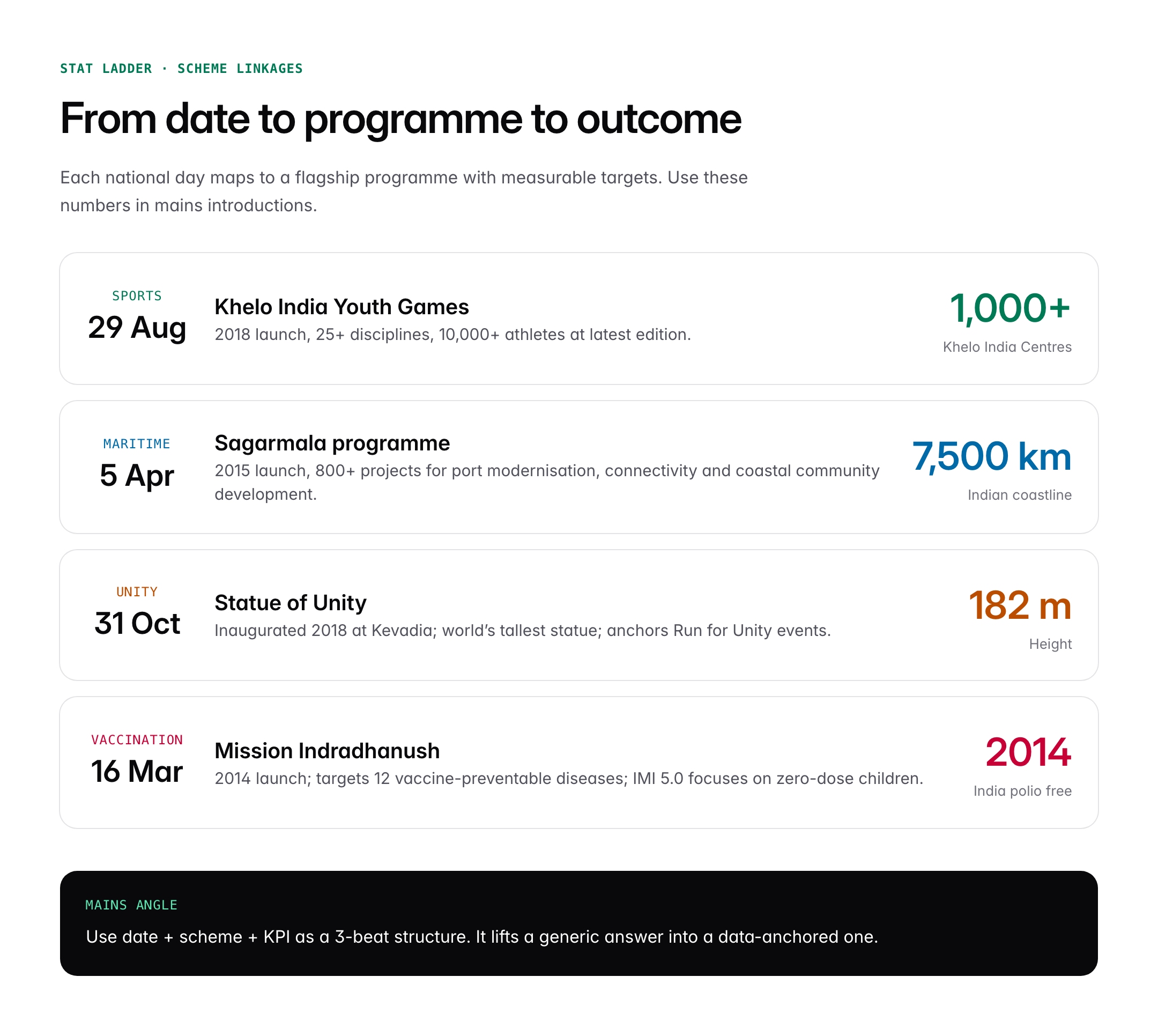
For UPSC aspirants, learning these days by rote is not enough. Each one carries a governance message and a ministry programme behind it. National Sports Day is tied to Khelo India and the Fit India Movement. National Maritime Day speaks to the Sagarmala programme and the blue economy. National Unity Day, or Rashtriya Ekta Diwas, is linked to the Statue of Unity and the Run for Unity. National Vaccination Day is tied to the Universal Immunisation Programme and Mission Indradhanush. This article places all four in a single, exam-ready frame.
Quick Facts at a Glance
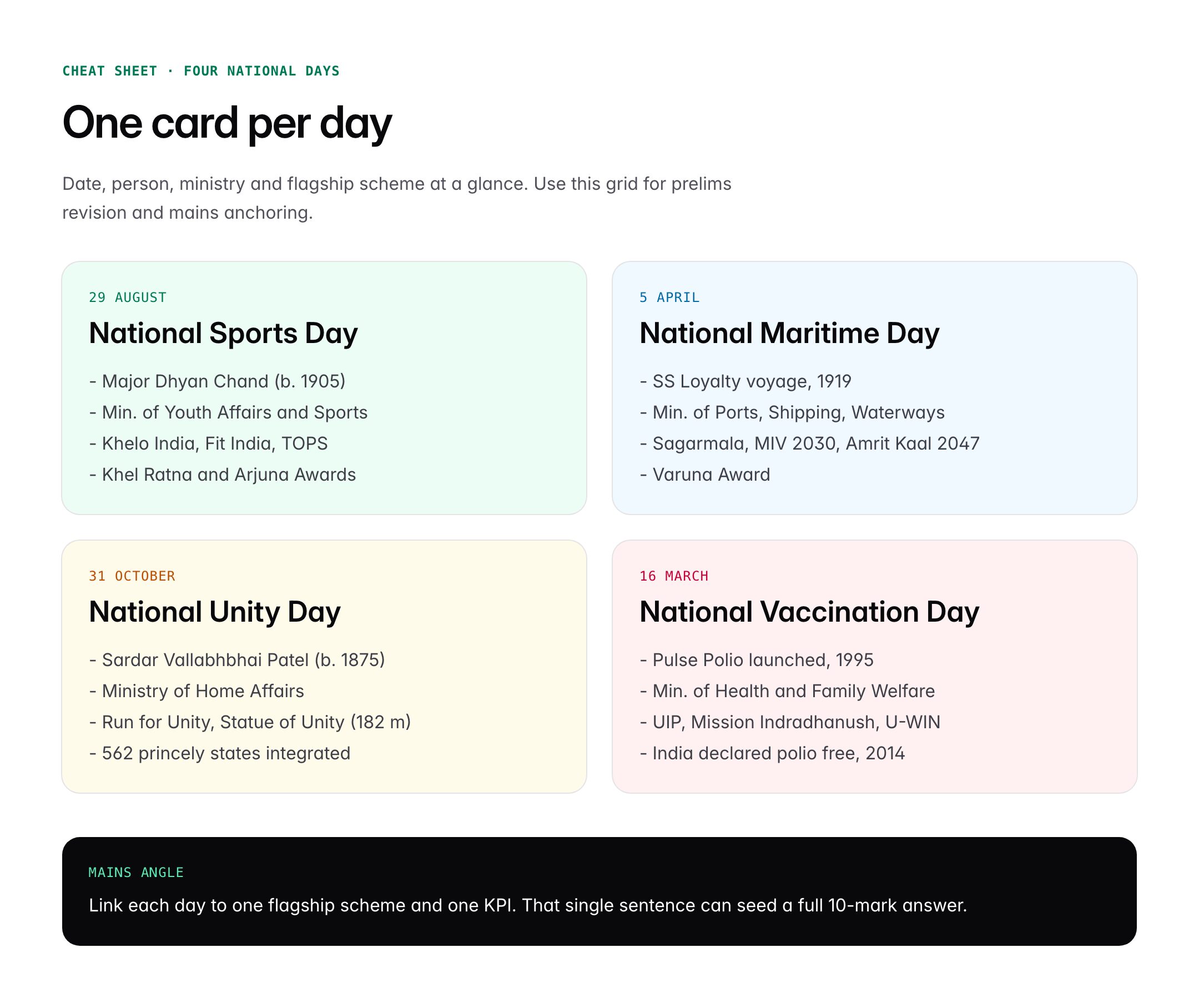
| National Day | Date | Commemorates | Nodal ministry |
|---|---|---|---|
| National Sports Day | 29 August | Birth anniversary of Major Dhyan Chand (1905) | Ministry of Youth Affairs and Sports |
| National Maritime Day | 5 April | First voyage of SS Loyalty, 1919, from Mumbai to London | Ministry of Ports, Shipping and Waterways |
| National Unity Day | 31 October | Birth anniversary of Sardar Vallabhbhai Patel (1875) | Ministry of Home Affairs |
| National Vaccination Day | 16 March | First oral polio vaccine dose in India, 1995 | Ministry of Health and Family Welfare |
Background and Historical Context
India’s national days fall into two broad buckets. The first are commemorative, marking the birth or death anniversaries of national figures. The second are policy anchored, marking a historic first that catalysed a major programme.
National Sports Day was instituted in 2012 to honour Major Dhyan Chand, born 29 August 1905, the hockey wizard whose teams won Olympic gold in 1928, 1932 and 1936. The day gained policy teeth when the Khelo India scheme was launched in 2018 and when the Fit India Movement was unveiled on National Sports Day in 2019. Since 2021, India’s highest sporting honour was renamed from the Rajiv Gandhi Khel Ratna to the Major Dhyan Chand Khel Ratna Award.
National Maritime Day has been observed since 1964 to mark 5 April 1919, the day the SS Loyalty, owned by the Scindia Steam Navigation Company, undertook India’s first domestically owned international voyage from Mumbai to London. This is treated as the symbolic beginning of Indian maritime sovereignty. The day has since become an occasion to announce shipping reforms, award the Varuna Award and publicise the Sagarmala programme.
National Unity Day, or Rashtriya Ekta Diwas, was instituted in 2014 on the 139th birth anniversary of Sardar Vallabhbhai Patel. Patel, as India’s first Home Minister and Deputy Prime Minister, integrated over 560 princely states into the Union. The day is marked by the Run for Unity and by events at the Statue of Unity in Kevadia, Gujarat, unveiled in 2018.
National Vaccination Day, observed since 1995, commemorates the launch of the Pulse Polio Immunisation programme on 16 March 1995, when the first oral polio vaccine doses were administered under the Universal Immunisation Programme framework. India was declared polio free by WHO in 2014, making the day both historical and celebratory.
Key Features
National Sports Day
National Sports Day, observed on 29 August, celebrates Major Dhyan Chand’s legacy and is used to confer national sports awards. These include the Major Dhyan Chand Khel Ratna Award (highest sporting honour), the Arjuna Award (outstanding performance over four years), the Dronacharya Award (coaching excellence) and the Dhyan Chand Award for Lifetime Achievement. The Fit India Movement, launched on 29 August 2019, uses this day for school-level fitness drives, freedom runs and the Fit India School certification programme.
National Maritime Day
Observed on 5 April, this day marks the voyage of the SS Loyalty owned by the Scindia Steam Navigation Company. India today has 13 major ports and over 200 minor and intermediate ports. The day is used to highlight the Sagarmala programme (2015), the Maritime India Vision 2030, and the recently announced Maritime Amrit Kaal Vision 2047. The Varuna Award, instituted by the National Maritime Day Committee, recognises outstanding contributions to Indian shipping.
National Unity Day (Rashtriya Ekta Diwas)
Observed on 31 October, the day was instituted on Sardar Patel’s 139th birth anniversary in 2014. The flagship event is the Run for Unity and an oath of unity taken across government offices. The Statue of Unity, at 182 metres the world’s tallest statue, stands on the Narmada near Kevadia and anchors the day’s iconography. Patel is remembered as the architect of the integration of 562 princely states into the Indian Union.
National Vaccination Day
Observed on 16 March, the day remembers the first oral polio vaccine administered in India in 1995. The Universal Immunisation Programme, launched in 1985, and Mission Indradhanush, launched in 2014, together cover 12 vaccine-preventable diseases. The Intensified Mission Indradhanush targets low-coverage districts, and U-WIN, a digital platform modelled on Co-WIN, is digitising routine immunisation records.
Significance for UPSC and General Knowledge
- Each day maps to an active central government scheme, making them current-affairs anchors rather than static trivia.
- National Sports Day links to GS2 governance questions on sports policy, the National Sports Development Code 2011 and the pending Sports Governance Bill.
- National Maritime Day links to GS3 infrastructure and GS1 geography via Sagarmala, port-led development and the blue economy.
- National Unity Day links to GS1 history and post-Independence consolidation and to GS2 on centre-state relations.
- National Vaccination Day links to GS2 health and GS3 biotechnology, covering UIP, cold chain and pandemic preparedness.
- Prelims routinely tests founding year, nodal ministry and the specific historical event these days commemorate.
Detailed Analysis: Policy Anchors Behind Each Day
These days function as annual checkpoints for major policy programmes. Understanding the programme architecture is more useful for mains than memorising dates.
Sports policy. India’s per capita sports spending has historically lagged peers. National Sports Day is used to announce medal targets, audit state-level Khelo India Centres and publicise the Target Olympic Podium Scheme (TOPS). The Khelo India Youth Games, Khelo India University Games and Khelo India Winter Games together form a school-to-elite talent pipeline. On GS2, questions have covered sports federation governance, the Sports Code, the role of the National Anti-Doping Agency (NADA) and the National Sports University Act 2018.
Maritime policy. National Maritime Day spotlights India’s 7500 kilometre coastline, 13 major ports and the ambition to raise port capacity to 10,000 million tonnes by 2047. Key programmes include Sagarmala (port modernisation, port-led industrialisation, coastal community development), Maritime India Vision 2030, the Green Ports Guidelines, the Harit Sagar initiative, and the Marine Aids to Navigation Act 2021. Mains questions on the blue economy, cruise tourism and inland waterways are commonly anchored to this day.
National integration. National Unity Day is tied to the integration of princely states, the Instrument of Accession, the V. P. Menon-Patel partnership and the strategic role of Article 3 in reorganisation. Modern questions examine whether Patel’s method of integration holds lessons for contemporary centre-state frictions, language politics and the idea of cooperative federalism.
Public health. National Vaccination Day anchors questions on Mission Indradhanush, Intensified Mission Indradhanush 5.0, the Universal Immunisation Programme, cold-chain infrastructure, indigenous vaccine platforms (Covaxin, Corbevax, iNCOVACC), the Ayushman Bharat Health Infrastructure Mission (PM-ABHIM) and pandemic preparedness via the National One Health Mission.
Comparative Perspective
The four days show how India builds a policy calendar. The table below compares them on the core dimensions aspirants are tested on.
| Dimension | Sports Day | Maritime Day | Unity Day | Vaccination Day |
|---|---|---|---|---|
| Date | 29 August | 5 April | 31 October | 16 March |
| Year instituted | 2012 | 1964 | 2014 | 1995 |
| GS linkage | GS2 governance | GS3 infrastructure | GS1 history, GS2 polity | GS2 health |
| Flagship scheme | Khelo India, Fit India | Sagarmala, MIV 2030 | Run for Unity, SoU | UIP, Mission Indradhanush |
| Iconic award or event | Khel Ratna, Arjuna | Varuna Award | Run for Unity oath | Pulse Polio campaign |
| Signature monument | Major Dhyan Chand Stadium | SS Loyalty | Statue of Unity | AIIMS, ICMR network |
Globally, the UN tags comparable observances, such as International Day of Sport for Development and Peace (6 April), World Maritime Day (last Thursday of September), International Day for the Remembrance of the Slave Trade (23 August) and World Immunization Week (24-30 April). India’s calendar is both nationally specific and aligned with these global frames.
Challenges and Criticisms
Each of these days faces the same critique: symbolism can outrun delivery. On National Sports Day, the Khelo India Games draw headlines but grassroots sports infrastructure in many states remains patchy, with CAG reports noting underutilisation of funds and weak federation governance. The National Sports Development Code 2011 is widely seen as needing legal backing through a statutory Sports Governance Bill.
On National Maritime Day, India’s share in global shipping tonnage is still modest and ship-building lags East Asian peers. Issues include slow port turnaround times, environmental compliance under the Green Ports initiative, coastal erosion and the livelihoods of traditional fishing communities under the CRZ and Coastal Aquaculture Authority frameworks. National Unity Day has drawn debate over whether the Run for Unity reaches beyond official participants and whether its political framing respects the plurality Patel himself championed. National Vaccination Day must reconcile India’s strong vaccine manufacturing capacity with patchy immunisation coverage in Empowered Action Group states and rising vaccine hesitancy flagged in NFHS-5 data.
Prelims Pointers
- National Sports Day: 29 August, instituted 2012, honours Major Dhyan Chand (b. 1905).
- Khel Ratna was renamed Major Dhyan Chand Khel Ratna Award in 2021.
- Fit India Movement was launched on 29 August 2019.
- National Maritime Day: 5 April, observed since 1964, marks voyage of SS Loyalty (1919).
- SS Loyalty was owned by the Scindia Steam Navigation Company.
- Varuna Award is the top recognition in Indian shipping.
- National Unity Day: 31 October, instituted 2014, marks birth of Sardar Patel (1875).
- Statue of Unity, 182 m, at Kevadia, Gujarat; inaugurated 31 October 2018.
- National Vaccination Day: 16 March, observed since 1995.
- Pulse Polio Immunisation programme launched 1995; India declared polio free in 2014.
- Universal Immunisation Programme launched 1985; Mission Indradhanush launched 2014.
- U-WIN is the digital platform for routine immunisation.
Mains Practice Questions
- National Sports Day has become an occasion to evaluate India’s sporting ecosystem. Examine the role of Khelo India, the Fit India Movement and the Target Olympic Podium Scheme in building a sustained sporting culture. (GS2, 15 marks)
- Trace the evolution of sports policy from the 1984 National Sports Policy to the 2011 Sports Code.
- Evaluate Khelo India tiers, TOPS, NSF governance, and NADA.
- Offer reforms: statutory backing, grassroots funding, women in sport, para-sport integration.
- The integration of princely states under Sardar Patel is often cited as the unfinished template of Indian federalism. Critically analyse with reference to contemporary centre-state relations. (GS1 / GS2, 15 marks)
- Explain the 1947-1949 integration process, V. P. Menon’s role, and Article 3.
- Contrast with today’s issues: GST council, finance commission, reorganisation demands.
- Conclude with the Sarkaria, Punchhi and Inter-State Council agenda.
Conclusion
National observances are often dismissed as ceremonial, yet they are the most efficient way India reviews its own commitments. Each of these four days turns the calendar into a governance dashboard: sports policy in August, maritime ambition in April, national integration in October, public health in March. For aspirants, this framework converts rote memorisation into active understanding of how dates, ministries and schemes interlock.
The best answers in both prelims and mains will anchor a date to a person, a person to a policy, and a policy to a measurable outcome. Use these four days as that anchoring grid, and the broader static-plus-current approach of UPSC preparation becomes visibly easier to navigate.
Frequently Asked Questions
What is National Sports Day?
National Sports Day is observed in India on 29 August every year to commemorate the birth anniversary of Major Dhyan Chand, the hockey legend who led India to Olympic gold in 1928, 1932 and 1936. Instituted in 2012, the day is used to confer sports awards such as the Major Dhyan Chand Khel Ratna and the Arjuna Award, and to launch fitness initiatives like the Fit India Movement.
Why is National Sports Day important for UPSC?
It anchors GS2 governance questions on sports policy, the 2011 National Sports Development Code, federation autonomy, NADA and the pending Sports Governance Bill. It also supports GS3 discussions on the Khelo India ecosystem, TOPS, sports infrastructure financing and the sports economy, making it a frequent reference for prelims MCQs and mains analytical answers.
When is National Maritime Day and what does it commemorate?
National Maritime Day is observed on 5 April each year since 1964. It marks the maiden voyage of the SS Loyalty, the first domestically owned Indian ship, operated by the Scindia Steam Navigation Company, which sailed from Mumbai to London on 5 April 1919. The day spotlights Indian shipping, the Sagarmala programme, and the Maritime India Vision 2030 and 2047 roadmaps.
What is National Unity Day or Rashtriya Ekta Diwas?
National Unity Day, observed on 31 October, commemorates the birth anniversary of Sardar Vallabhbhai Patel, India’s first Home Minister, who integrated more than 560 princely states into the Indian Union. Instituted in 2014, it is marked by the Run for Unity, a unity oath in government offices and events at the 182-metre Statue of Unity near Kevadia in Gujarat.
What is National Vaccination Day and when is it observed?
National Vaccination Day is observed on 16 March every year since 1995 to mark the first dose of oral polio vaccine administered in India under the Pulse Polio Immunisation programme. It highlights the Universal Immunisation Programme, Mission Indradhanush, Intensified Mission Indradhanush and the U-WIN digital platform that digitises routine childhood immunisation records.
How is National Sports Day related to Khelo India and Fit India?
National Sports Day functions as the annual launchpad for India’s sports and fitness flagships. Khelo India, launched in 2018, runs the Youth, University and Winter Games to build a school-to-elite pipeline. The Fit India Movement was unveiled on 29 August 2019 and uses this day for fitness drives and school certifications. Khel Ratna, Arjuna and Dronacharya awards are traditionally presented around this date.
Why was SS Loyalty significant for Indian maritime history?
SS Loyalty was the first ship owned by an Indian company, the Scindia Steam Navigation Company founded in 1919, to sail to a foreign port. Its voyage from Mumbai to London on 5 April 1919 broke a colonial-era monopoly of British shipping firms over Indian trade routes. It is therefore treated as the symbolic beginning of Indian maritime sovereignty and is commemorated as National Maritime Day.
Which ministry is the nodal body for National Vaccination Day?
The Ministry of Health and Family Welfare is the nodal body for National Vaccination Day. It operates the Universal Immunisation Programme through state health departments, runs Mission Indradhanush and its intensified rounds, and coordinates with ICMR, NIV Pune and the National Centre for Disease Control. The day is used to highlight vaccine coverage data from NFHS rounds and to launch booster or catch-up campaigns.
Tell Google you want more of this.
Add Anantam IAS as a preferred sourceOne tap, and this site shows up more often in your own Top Stories, AI Overviews and AI Mode. Remove it any time.