
Disclosure: this guide contains Amazon affiliate links. As an Amazon Associate, Anantam IAS earns from qualifying purchases — at no extra cost to you.
UKPSC stands for the Uttarakhand Public Service Commission — the constitutional body under Articles 315 to 323 that recruits civil servants for the Government of Uttarakhand, most notably through the Combined State Civil and Upper Subordinate Services Examination (the Uttarakhand PCS). Established on 14 May 2001 and headquartered at Gurukul Kangri, Haridwar, it appoints officers up to the rank of Deputy Collector, who anchor the state’s district administrative hierarchy.
Introduction
The Uttarakhand Public Service Commission, universally known as UKPSC, is the constitutional body that recruits civil servants for the Government of Uttarakhand. Created on 14 May 2001 soon after the state was carved out of Uttar Pradesh in November 2000, UKPSC conducts the Combined State Civil and Upper Subordinate Services Examination that feeds Uttarakhand’s secretariat, revenue administration, police and allied services. For a young state with a specific Himalayan, border and disaster-management profile, the Commission’s role in shaping the administrative cadre is significant.
For UPSC aspirants, UKPSC deserves attention for two reasons. First, it is a textbook application of Articles 315 to 323 of the Constitution, which establish and regulate State Public Service Commissions. Second, for aspirants with Uttarakhand domicile, UKPSC is a credible parallel track to the UPSC Civil Services Examination, with overlapping syllabus architecture and comparable posts at the state level. This guide covers the Commission’s structure, the exam pattern, the post hierarchy, the syllabus and a preparation approach that respects the state’s distinctive administrative needs.
Quick Facts at a Glance
| Attribute | Detail |
|---|---|
| Full name | Uttarakhand Public Service Commission |
| Commonly called | UKPSC, UKPCS |
| Established | 14 May 2001 |
| Constitutional basis | Articles 315 to 323 of the Constitution of India |
| Headquarters | Gurukul Kangri, Haridwar, Uttarakhand |
| Parent state | Uttarakhand (formed 9 November 2000) |
| Appointing authority | Governor of Uttarakhand |
| Flagship exam | Combined State Civil and Upper Subordinate Services Exam |
| Stages | Preliminary, Mains, Interview |
| Eligibility age | 21 to 42 years (with category relaxations) |
| Official website | psc.uk.gov.in |
| Top post | Deputy Collector (Provincial Civil Service, Executive Branch) |
Background and Historical Context
The Uttarakhand Public Service Commission traces its legal pedigree to Part XIV of the Constitution, which in Articles 315 to 323 provides for Public Service Commissions at the Union and State levels. When Uttarakhand was created as the 27th state of the Indian Union on 9 November 2000 under the Uttar Pradesh Reorganisation Act, 2000, Article 315(1) required the new state to establish its own Public Service Commission. Until that was operational, recruitment to state services continued to be handled by the Uttar Pradesh Public Service Commission under the transitional provisions of the Reorganisation Act.
UKPSC was formally constituted on 14 May 2001 with its headquarters at Gurukul Kangri in Haridwar. The first Chairman took charge that year, and the Commission conducted its first Combined State Civil Services examination in the early 2000s. Over the next two decades, UKPSC expanded its mandate from core civil services to a wide basket of recruitment examinations, including the Judicial Services, Assistant Conservator of Forests, Range Officer, Assistant Prosecution Officer, Lecturer, Medical Officer and Lower Subordinate Services examinations.
The Commission operates within the federal architecture of the Indian public service system. The Governor of Uttarakhand appoints the Chairman and Members of UKPSC under Article 316. Members serve a term of six years or until the age of sixty-two, whichever is earlier. The Commission is insulated from executive interference through provisions in Article 317 that permit removal only by the President of India on grounds of misbehaviour, following an inquiry by the Supreme Court. Its expenditure is charged on the Consolidated Fund of the State under Article 322, making it non-votable in the Legislative Assembly.
Key Features of the UKPSC Examination
The Combined State Civil and Upper Subordinate Services Examination
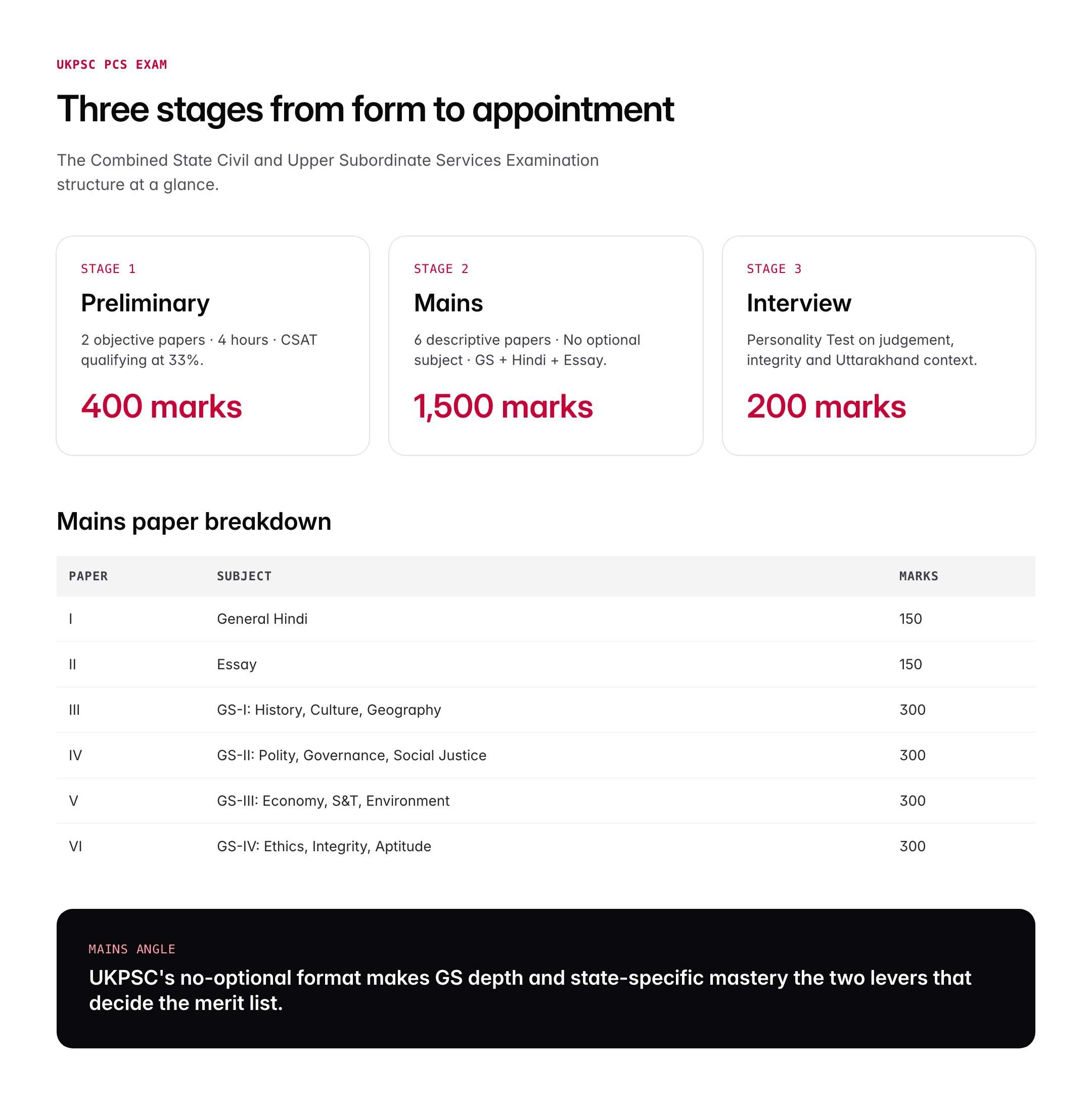
The flagship recruitment is the Combined State Civil and Upper Subordinate Services Examination, often shortened to Uttarakhand PCS or UKPCS. It is held through a three-stage process: a Preliminary Examination, a Mains Examination and a Personality Test. The structure is modelled closely on the UPSC Civil Services Examination, with state-specific adaptations for Uttarakhand history, geography, polity and current affairs.
Preliminary Examination
The Preliminary stage comprises two objective papers, each of two hours. Paper I is a General Studies paper covering Indian history with emphasis on the national movement, Indian and world geography with emphasis on Uttarakhand, Indian Polity, economic and social development, general issues on environment and biodiversity, and current events. Paper II is a CSAT-style paper on comprehension, logical reasoning, decision-making, basic numeracy and data interpretation. Paper II is qualifying in nature at 33 per cent. Negative marking of one-third applies.
Mains Examination
The Mains consists of six papers. Paper I is General Hindi, Paper II is Essay, and Papers III to VI are General Studies papers covering history and culture, geography and disaster management, polity and administration, economy and development, science and technology, and ethics and governance. Each paper is descriptive, of three hours, and carries 200 marks. The aggregate written component is 1,500 marks, followed by a 200-mark Interview or Personality Test.
Interview and Final Merit
The Personality Test assesses the candidate’s suitability for public service on parameters such as mental alertness, clarity of expression, balance of judgement, intellectual and moral integrity, leadership and understanding of contemporary issues. Final merit is based on combined Mains plus Interview marks. Preliminary scores are not carried forward.
Eligibility and Reservation
A candidate must be a citizen of India, between 21 and 42 years of age on the cut-off date, and hold a Bachelor’s degree. Age relaxations apply for SC, ST, OBC, PwBD, ex-servicemen and Uttarakhand domicile categories. Horizontal reservation of 30 per cent for women of Uttarakhand origin is applied as per state policy. Physical standards apply for uniformed posts such as Deputy Superintendent of Police.
Significance for UPSC and General Knowledge
- UKPSC is a live case study of Articles 315 to 323 of the Constitution and the role of State Public Service Commissions in cooperative federalism.
- Questions on the autonomy of UPSCs and SPSCs, their insulation from the executive, and the removal procedure under Article 317 appear in Prelims and GS2 Mains.
- UKPSC recruitment profile reflects Uttarakhand’s administrative priorities, including border management, disaster response and hill-area governance.
- Debates around paper leaks, revaluation and examination integrity in UKPSC connect to broader themes of administrative ethics and institutional reform.
- UKPSC offers a domicile-friendly alternative career path that many Uttarakhand UPSC aspirants pursue in parallel.
- The Commission’s functioning under the Governor’s appointing authority connects to Centre-State relations, a recurring GS2 theme.
Detailed Analysis: Posts, Cadre and Career Path
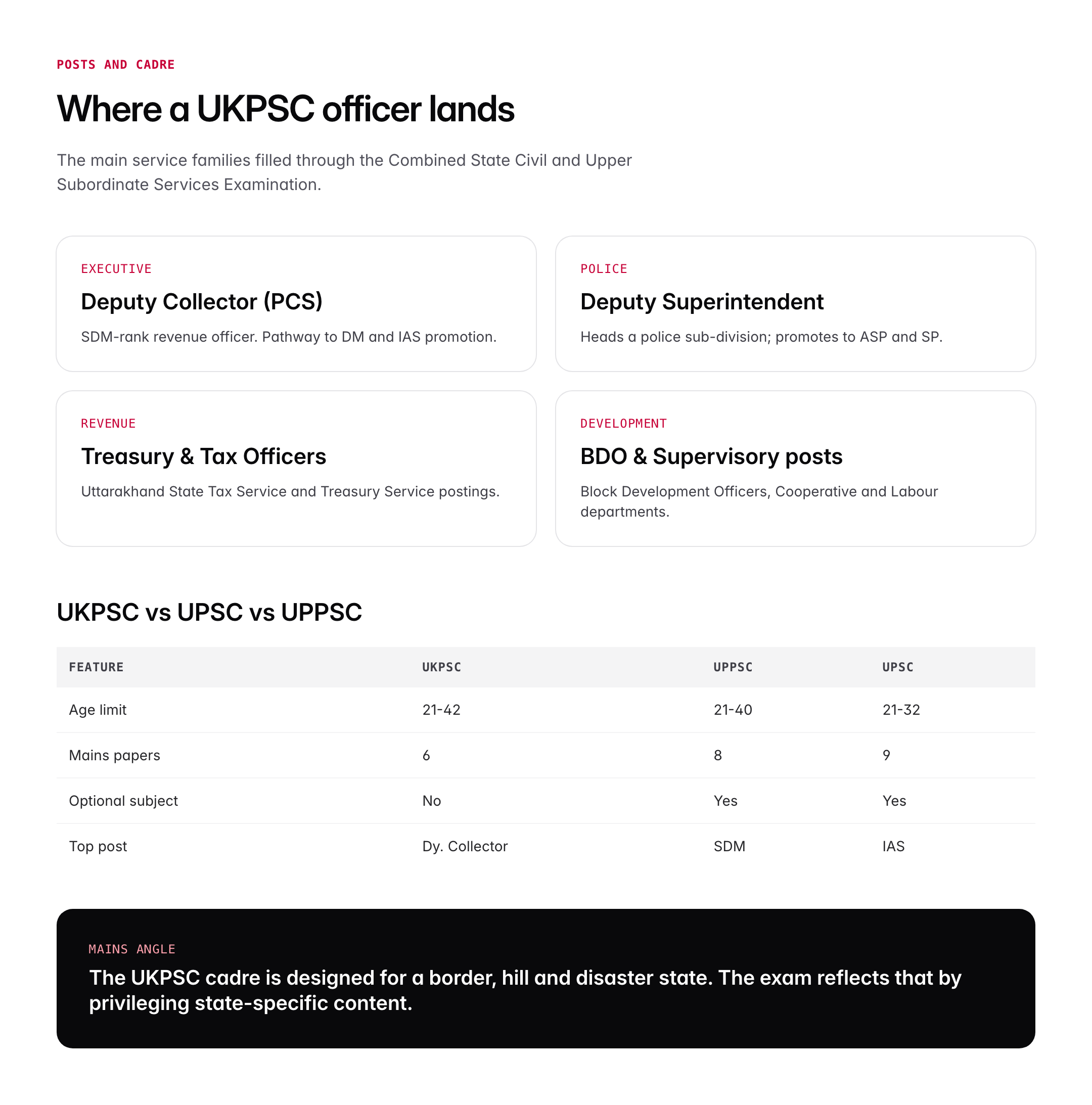
UKPSC recruitments feed a layered cadre structure under the Uttarakhand Secretariat. The most sought-after post is Deputy Collector, equivalent to the Sub-Divisional Magistrate rank in the Provincial Civil Service (Executive Branch). Deputy Collectors handle revenue administration, land records, law and order at the sub-division level, election duties and disaster response. Over a career, a Deputy Collector can rise through Additional District Magistrate, District Magistrate, Divisional Commissioner and Secretariat posts, with a realistic pathway to Indian Administrative Service promotion through the state-service quota.
A second tier of PCS Executive posts includes Deputy Superintendent of Police, who heads a sub-division in the state police, and District Commandant Home Guards. Below these sit supervisory posts in the Uttarakhand Revenue Service, Transport Department, Labour Department, Food and Civil Supplies, Cooperative Department, and Excise. UKPSC also fills posts in the State Tax Service, Treasury Service, Registrar of Societies and various development departments through the Combined exam.
Specialised UKPSC examinations include the Judicial Services Examination for Civil Judge (Junior Division), the Assistant Conservator of Forests and Range Officer examinations for the State Forest Service, the Lecturer Examination for government degree colleges, the Medical Officer Examination for the Uttarakhand Health Service, the Assistant Prosecution Officer Examination and the Assistant Engineer Examination. Each uses its own syllabus and pattern. The overall annual notification calendar publishes vacancies for close to twenty separate examinations across the service families.
The administrative geography that UKPSC candidates eventually serve is unusual. Uttarakhand has 13 districts across two divisions, Kumaon and Garhwal, with significant forest cover, a long border with Tibet and Nepal, and a population heavily reliant on tourism and agriculture. A UKPSC officer deals routinely with the Disaster Management Act, 2005, the Forest Conservation Act, 1980, the Wildlife Protection Act, 1972, the Char Dham Yatra administration, and border-area development schemes. This specialisation is why the UKPSC syllabus devotes entire sections to Uttarakhand-specific history, geography and statutes.

Comparative Perspective
UKPSC sits in a family of State Public Service Commissions that share constitutional origins but differ in size, exam pattern and post profile. The table compares UKPSC with three adjacent commissions, including the much larger UPPSC of neighbouring Uttar Pradesh.
| Feature | UKPSC (Uttarakhand) | UPPSC (Uttar Pradesh) | HPPSC (Himachal Pradesh) | UPSC (Union) |
|---|---|---|---|---|
| Established | 2001 | 1937 | 1971 | 1926 |
| Stages | Prelims, Mains, Interview | Prelims, Mains, Interview | Prelims, Mains, Interview | Prelims, Mains, Interview |
| Mains papers | 6 | 8 (incl. optional) | 6 | 9 (incl. optional) |
| Top post | Deputy Collector (PCS) | SDM (PCS) | Deputy Collector | IAS |
| Age limit | 21 to 42 | 21 to 40 | 21 to 45 | 21 to 32 |
| Optional subject | No | Yes | No | Yes |
| Annual vacancies | 80 to 400 typical | 400 to 900 | 50 to 200 | 900 to 1,100 |
The most operationally important difference is the absence of an optional subject paper in the UKPSC Mains, which simplifies preparation but rewards depth in the compulsory General Studies and state-specific papers. The age ceiling at UKPSC is more generous than both UPSC and UPPSC, reflecting a deliberate state policy to draw late-stream talent into civil services.
Challenges and Controversies
UKPSC has faced recurrent criticism on examination integrity, pace of recruitment and backlog. The 2022 paper leak case involving UKSSSC, a separate subordinate selection commission, spilled over into public trust in the broader Uttarakhand recruitment ecosystem and led to the promulgation of the Uttarakhand Competitive Examination (Measures for Control and Prevention of Unfair Means in Recruitment) Act, 2023. UKPSC’s own examinations have occasionally been rescheduled or cancelled in response to question paper disputes and legal challenges, most notably around the 2016 PCS cycle.
A second criticism is the gap between notification and final result. The PCS cycle has at times extended over two to three years end to end, which reduces candidate confidence and encourages simultaneous preparation with UPSC and neighbouring state commissions. Vacancy figures have also been smaller than the state’s documented administrative needs, reflecting fiscal constraints and cadre-review delays.
A third debate concerns the balance between state-specific content and general administrative knowledge. Critics argue that excessive weight on Uttarakhand-local factual content, at the Mains stage, narrows the candidate pool and may not produce officers fluent in the wider themes of policy and governance. Supporters respond that locally rooted officers are better fitted to the state’s specific hill, border and disaster context. UKPSC has responded by revising syllabi periodically and publishing more transparent model answers.
Prelims Pointers
- UKPSC was established on 14 May 2001, about six months after Uttarakhand was carved out of Uttar Pradesh on 9 November 2000.
- The Commission is constituted under Articles 315 to 323 of the Constitution of India.
- The Chairman and Members are appointed by the Governor of Uttarakhand under Article 316.
- Members hold office for six years or until age 62, whichever is earlier.
- Removal of a UKPSC Chairman is by the President of India on grounds specified in Article 317.
- Expenditure of UKPSC is charged on the Consolidated Fund of the State under Article 322.
- The Commission’s headquarters is at Gurukul Kangri, Haridwar.
- The Combined State Civil Services examination has three stages: Preliminary, Mains, Interview.
- Preliminary CSAT is a qualifying paper at 33 per cent.
- The topmost post through the PCS examination is Deputy Collector in the PCS Executive Branch.
- UKPSC does not have an optional subject in Mains.
- The Uttarakhand Competitive Examination Act, 2023 criminalises cheating and paper leaks in state recruitment.
Mains Practice Questions
- Discuss the constitutional framework governing State Public Service Commissions, with particular reference to their independence and accountability. How far does the UKPSC experience validate the framers’ design?
- Explain Articles 315 to 323 with focus on appointment, removal, tenure and budget.
- Assess institutional autonomy through examples of removal procedure and Consolidated Fund charging.
- Evaluate UKPSC’s record against these yardsticks and suggest reform pathways.
- Analyse the unique administrative challenges of Uttarakhand and their implications for the design of the state civil services examination.
- Map hill, border and disaster dimensions of Uttarakhand’s administration.
- Link these to specific UKPSC syllabus components in history, geography and governance.
- Argue for or against deeper specialisation in disaster management and Himalayan development within the PCS syllabus.
Conclusion
UKPSC is both a textbook illustration of constitutional design and a live laboratory of state administrative recruitment in a young Himalayan state. Its architecture flows from Articles 315 to 323. Its syllabus tries to marry national-level General Studies with a granular mastery of Uttarakhand’s history, geography and policy. Its post profile, centred on the Deputy Collector and allied PCS cadres, staffs a state with distinctive border, disaster and environmental responsibilities.
For UPSC aspirants with Uttarakhand roots, UKPSC offers a parallel and credible civil services path. For all students of GS2, it is a worked example of how the Constitution’s federal civil service architecture actually operates at the state level. Watching UKPSC adapt to new challenges around examination integrity, digitalisation and specialist recruitment will tell us a great deal about how Indian sub-national bureaucracies will evolve over the next decade.
Books for UKPSC
Most of what you read for UPSC transfers to UKPSC: polity, economy, modern history and the NCERT base. What does not transfer is the Uttarakhand section, and that is where the selection is decided. One state book, read three times, beats five read once.

Know Your State: Uttarakhand 2025 — Arihant
- 384 pages, Arihant
- Uttarakhand history, geography, culture and administration with coloured maps
- Practice MCQs after every chapter

Lucent's General Knowledge 2026 — English (15th revised edition)
- 460 pages, Lucent Publications
- Static GK in the compressed, list-heavy format state PSC prelims reward
- Overrated for UPSC, right for this exam
- Indian Polity, M. Laxmikanth (Amazon.in). The polity questions are the same exam everywhere.
- Lucent’s General Knowledge (Amazon.in). Overrated for UPSC, right for the static questions here.
- Indian Economy, Ramesh Singh (Amazon.in). Read the concept chapters; the state budget goes on top.
- A Brief History of Modern India, Spectrum (Amazon.in). The freedom-struggle questions come straight from here.
- Know Your State: Uttarakhand 2025 — Arihant (Amazon.in): the Uttarakhand-specific section in one book.
- NCERTs, Classes 6 to 12, for history, geography and science. Free from NCERT; nothing to buy.
Skip the coaching compilations until you have finished these. They summarise books you have not read yet.
Frequently Asked Questions
What is UKPSC?
UKPSC is the Uttarakhand Public Service Commission, the constitutional body that recruits officers for the Uttarakhand state civil services. Established on 14 May 2001 under Articles 315 to 323 of the Constitution, it is headquartered at Gurukul Kangri, Haridwar, and conducts the Combined State Civil and Upper Subordinate Services Examination along with over fifteen other specialised recruitment examinations.
Why is UKPSC important for UPSC aspirants?
UKPSC illustrates how State Public Service Commissions operate under Articles 315 to 323, making it a GS2 Polity case study. For Uttarakhand domicile candidates, it is also a parallel civil services track with a syllabus overlapping the UPSC CSE, especially in General Studies, and with posts such as Deputy Collector that offer eventual IAS promotion through the state-service quota.
What are the stages of the UKPSC PCS exam?
The Combined State Civil and Upper Subordinate Services Examination has three stages: a two-paper Preliminary Examination with General Studies and CSAT, a six-paper descriptive Mains Examination covering General Hindi, Essay and four General Studies papers, and a Personality Test of 200 marks. Final merit is based on the Mains and Interview combined.
How is UKPSC related to the Uttar Pradesh Public Service Commission?
Before Uttarakhand was carved out of Uttar Pradesh on 9 November 2000, recruitment for the region was handled by UPPSC. Under the Uttar Pradesh Reorganisation Act, 2000 and Article 315(1) of the Constitution, Uttarakhand created its own UKPSC on 14 May 2001. Since then, UKPSC has operated independently with its own cadre, syllabus and examination calendar.
What is the top post offered through UKPSC?
The topmost post through the Combined State Civil and Upper Subordinate Services Examination is Deputy Collector in the Provincial Civil Service, Executive Branch. Deputy Collectors handle revenue administration, law and order, elections and disaster response at the sub-division level and can rise to District Magistrate and IAS promotion through the state-service quota.
What is the age limit for UKPSC examinations?
The general age range for the UKPSC Combined State Civil Services examination is 21 to 42 years on the cut-off date, which is more generous than UPSC’s 21 to 32. Additional relaxations apply for SC, ST, OBC, PwBD, women of Uttarakhand origin and ex-servicemen candidates, subject to the notification of each specific examination.
Does UKPSC Mains have an optional subject?
No. Unlike UPSC and UPPSC, the UKPSC Mains does not include an optional subject paper. The six Mains papers are General Hindi, Essay and four General Studies papers covering history, geography, polity, economy, science and technology, environment and ethics. This simplifies preparation but increases the weight of state-specific factual content.
How has UKPSC addressed examination integrity concerns?
Following the 2022 paper leak cases that shook Uttarakhand’s recruitment ecosystem, the state enacted the Uttarakhand Competitive Examination (Measures for Control and Prevention of Unfair Means in Recruitment) Act, 2023, which criminalises leaks and organised cheating. UKPSC has also strengthened question-paper security, digital answer-sheet processing and model-answer publication to improve transparency.
Tell Google you want more of this.
Add Anantam IAS as a preferred sourceOne tap, and this site shows up more often in your own Top Stories, AI Overviews and AI Mode. Remove it any time.