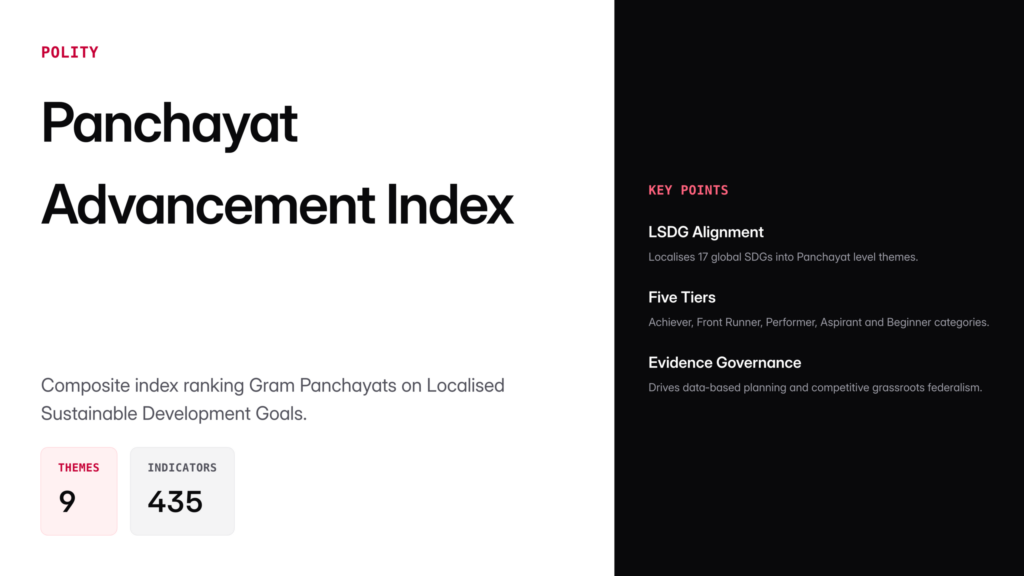
The Panchayat Advancement Index (PAI) is a composite index developed by the Ministry of Panchayati Raj to assess and rank Gram Panchayats (GPs) across India based on their progress on Localised Sustainable Development Goals (LSDGs). The index provides a data-driven, evidence-based framework to measure development at the grassroots level and ranks Panchayats into categories such as Achiever, Front Runner, Performer, Aspirant, and Beginner. For UPSC aspirants, the Panchayat Advancement Index is an important topic under GS Paper II (Polity, Local Governance, and Government Schemes), intersecting with the 73rd Constitutional Amendment, SDGs, and cooperative federalism. Understanding its themes, indicators, and findings is essential for both Prelims and Mains.
What Is the Panchayat Advancement Index?
The Panchayat Advancement Index (PAI) is a multi-domain composite index launched by the Ministry of Panchayati Raj (MoPR). It enables data-driven assessment of Gram Panchayat performance based on nine themes derived from the Sustainable Development Goals (SDGs) at the Panchayat level — the Localised SDGs (LSDGs).
Key Features
- Composite: Aggregates hundreds of indicators across nine themes.
- Multi-source: Uses 21 data sources across ministries and state departments.
- Panchayat-level: Drills down to over 2.55 lakh Gram Panchayats.
- Baseline: The first PAI Baseline Report was released by MoPR, providing a nationwide benchmark on Panchayats' performance.
Background: Why PAI?
India's 73rd Constitutional Amendment (1992) devolved 29 subjects under the Eleventh Schedule to Panchayats. But uniform measurement of their performance was missing. The PAI addresses:
- Lack of standardised data at Panchayat level.
- Need to localise SDGs in line with the UN 2030 Agenda.
- Evidence-based planning and resource allocation under the Gram Panchayat Development Plan (GPDP).
- Inter-Panchayat comparison and motivation.
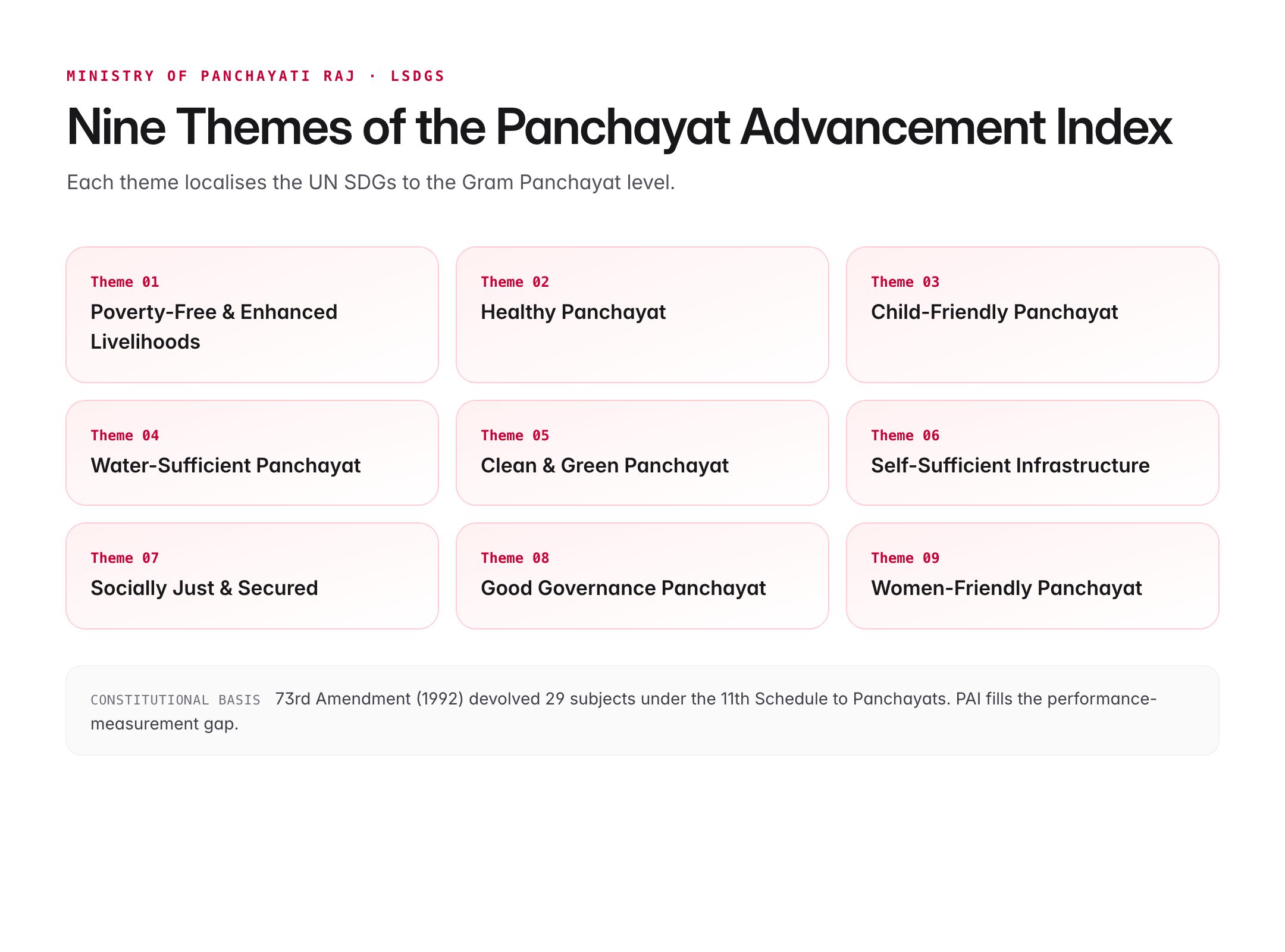
The Nine LSDG Themes of PAI
| Theme No. | LSDG Theme |
|---|---|
| 1 | Poverty-Free and Enhanced Livelihoods Panchayat |
| 2 | Healthy Panchayat |
| 3 | Child-Friendly Panchayat |
| 4 | Water-Sufficient Panchayat |
| 5 | Clean and Green Panchayat |
| 6 | Self-Sufficient Infrastructure in Panchayat |
| 7 | Socially Just and Socially Secured Panchayat |
| 8 | Good Governance Panchayat |
| 9 | Women-Friendly Panchayat |
These nine themes are aligned with the 17 global SDGs but adapted to Panchayat realities.
Structure of the Index
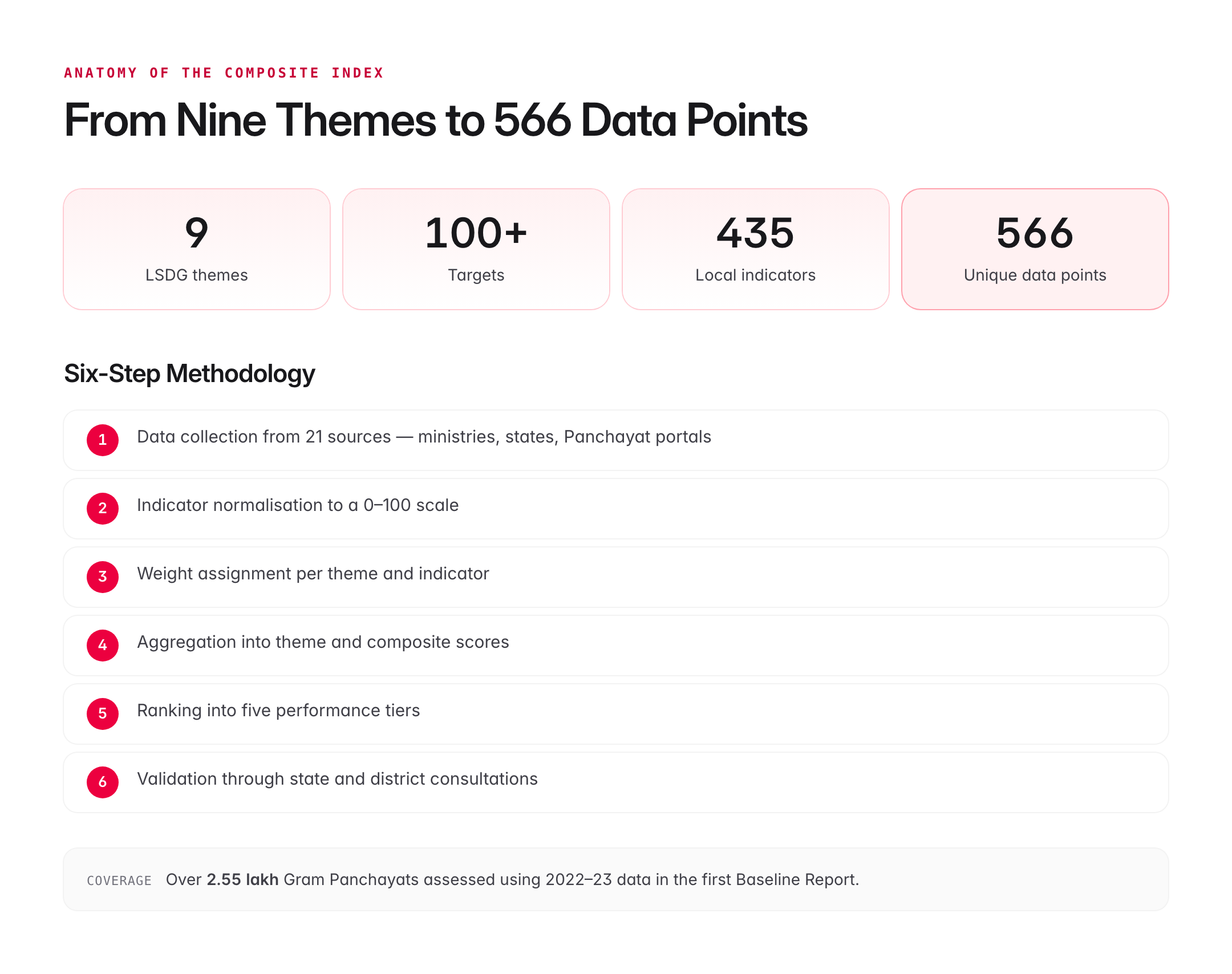
- 9 themes → 100+ targets → ~435 local indicators → 566 unique data points.
- Each indicator is scored, normalised, and weighted.
- Final composite score for each GP on a scale of 0–100.
Categories of Performance
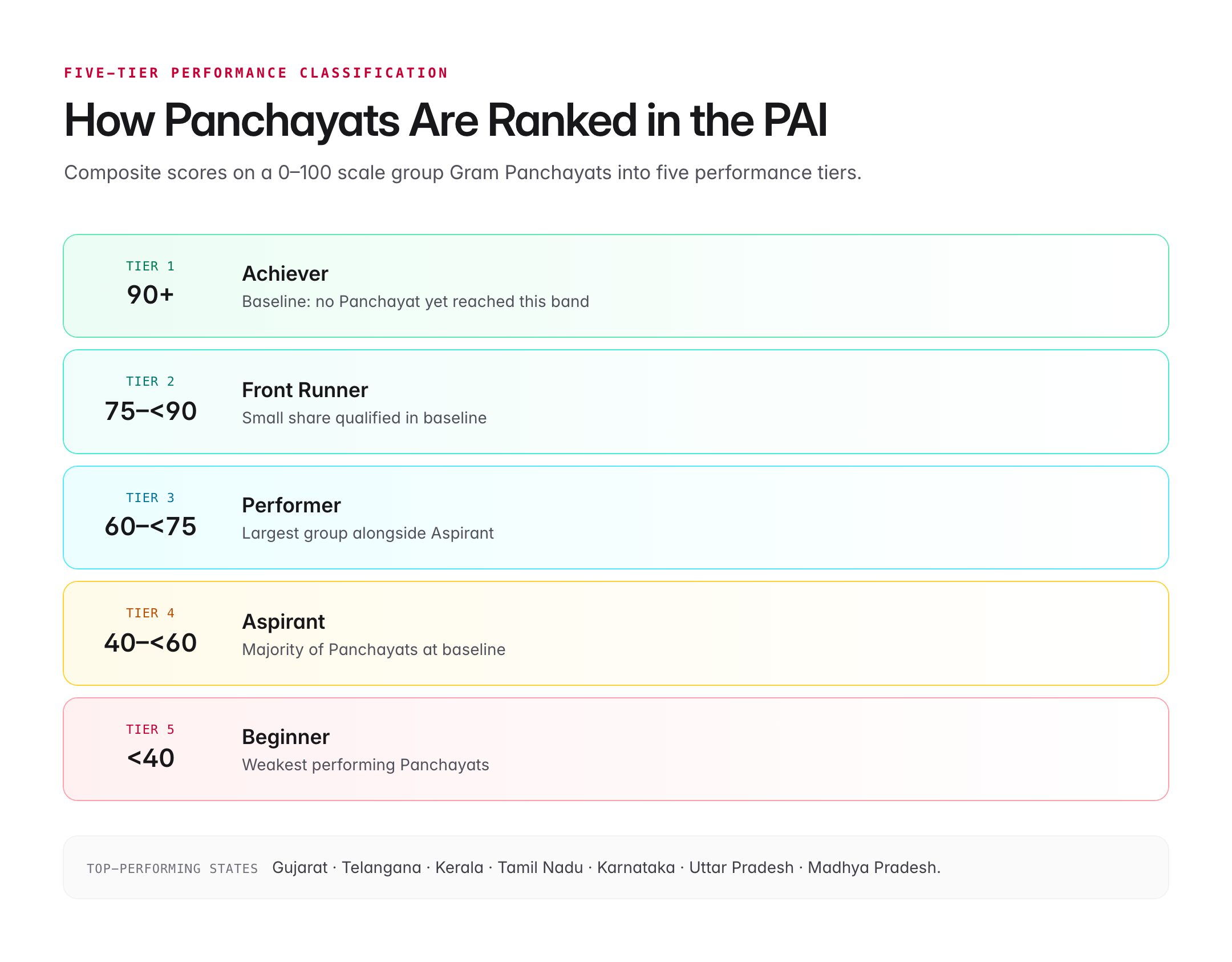
Panchayats are grouped into five tiers based on composite scores:
| Category | Score Range (indicative) |
|---|---|
| Achiever | 90 and above |
| Front Runner | 75 to <90 |
| Performer | 60 to <75 |
| Aspirant | 40 to <60 |
| Beginner | Below 40 |
Baseline Report: Key Findings
The PAI Baseline Report assessed Panchayats using data for 2022–23. Key takeaways (as per MoPR release):
- A small share of Panchayats qualified as Front Runners, and none reached the Achiever band at the baseline.
- The majority fell into the Aspirant and Performer categories.
- Gujarat, Telangana, Kerala, Tamil Nadu, Karnataka, Uttar Pradesh, and Madhya Pradesh emerged among the better-performing states.
- Themes such as Child-Friendly Panchayat and Healthy Panchayat showed comparatively better scores.
- Self-Sufficient Infrastructure and Women-Friendly Panchayat emerged as weaker areas needing targeted intervention.
(Note: Exact state-wise rankings and numerical thresholds may be updated in subsequent editions; use the latest MoPR release for answer writing.)
Data Sources
PAI integrates data from multiple official sources, including:
- Mission Antyodaya
- NFHS (National Family Health Survey)
- SECC
- PRIA Soft / eGramSwaraj
- Swachh Bharat Mission dashboards
- Jal Jeevan Mission portal
- MGNREGS MIS
- Samagra Shiksha
- Agricultural census
- Ministry-specific MIS and state portals
This makes PAI one of the most comprehensive grassroots indices in India.
Methodology
- Data collection from ministries, states, and Panchayat-level portals.
- Indicator normalisation (0–100 scale).
- Weight assignment per theme and indicator.
- Aggregation into theme scores and overall composite score.
- Ranking and classification into five performance tiers.
- Validation through state and district consultations.
Significance of PAI
Governance
- Enables evidence-based planning under GPDP.
- Promotes competitive federalism among Panchayats.
- Aligns local bodies with SDG 2030 Agenda.
Policy & Finance
- Guides 15th Finance Commission tied grants to Panchayats.
- Strengthens Central Sector and Centrally Sponsored Schemes at local level.
- Helps identify gaps in scheme delivery.
Social Outcomes
- Drives focus on women-friendly, child-friendly, and socially just Panchayats.
- Accelerates the Vibrant Villages Programme in border areas.
Accountability
- Makes performance publicly visible through dashboards.
- Encourages citizen monitoring and community ownership.
Challenges in PAI Implementation
- Data gaps at Panchayat level.
- Uneven digital literacy among PRIs.
- Overlapping indicators across ministries.
- Comparability across states with different functional devolution.
- Need for regular updates and third-party validation.
Way Forward
- Strengthen eGramSwaraj and PES (Panchayat Enterprise Suite).
- Link PAI rankings to performance-based grants.
- Build capacity of elected representatives (EWRs & PRI reps).
- Integrate climate change indicators going forward.
- Annual publication and theme-wise deep-dive reports.
UPSC Relevance
- Prelims focus: PAI launched by Ministry of Panchayati Raj; aligned with 9 LSDG themes; 5 performance categories (Achiever, Front Runner, Performer, Aspirant, Beginner); linked to 73rd Constitutional Amendment and 11th Schedule; uses 21 data sources; PAI Baseline Report.
- Mains GS-II angle: Local governance; effective implementation of schemes at grassroots; cooperative and competitive federalism; SDG localisation; role of Panchayati Raj Institutions.
- Sample PYQ angle: "Assess the role of the Panchayat Advancement Index in strengthening evidence-based grassroots governance in India." — structure answer with background of 73rd Amendment, LSDG framework, PAI themes, baseline findings, and linkage with 15th Finance Commission grants.