Kathakali dance is a highly stylised classical dance-drama of Kerala, renowned for its elaborate costumes, vividly painted faces, intricate hand gestures, and powerful storytelling drawn from Hindu epics. The word "Kathakali" literally means "story-play" – katha (story) and kali (play or performance) – and the form is one of the eight classical dance styles recognised by the Sangeet Natak Akademi. A full performance traditionally unfolds through the night, combining dance, music, drama, and makeup into a single immersive spectacle. For UPSC aspirants, Kathakali is a flagship topic under Indian Art and Culture in both Prelims and Mains.
Origin and Historical Evolution
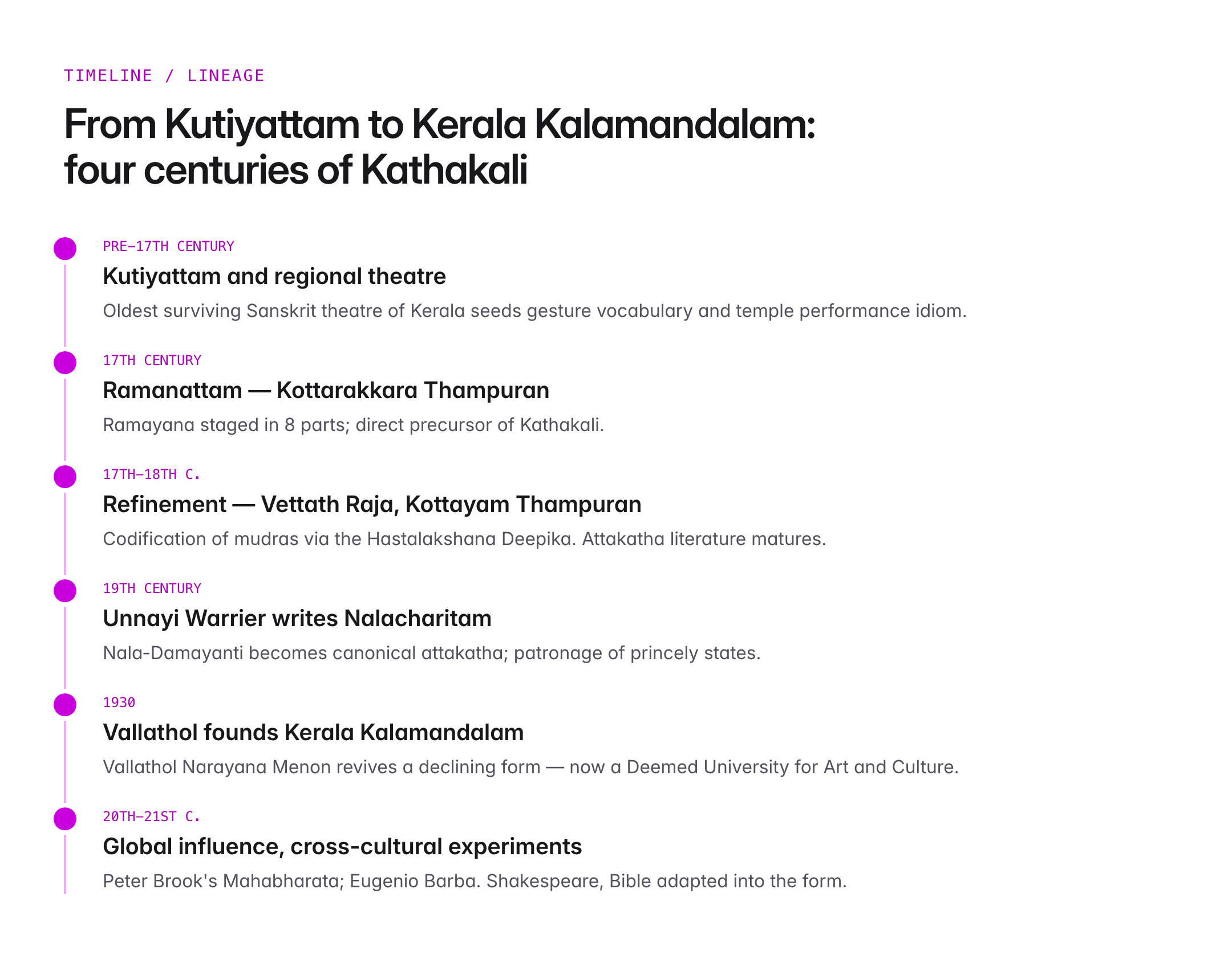
Kathakali emerged in the 17th century in the princely states of Kerala, drawing from older performance traditions of the region.
- It evolved from earlier forms such as Kutiyattam (the oldest surviving Sanskrit theatre), Krishnanattam, and Ramanattam.
- Ramanattam, created by Kottarakkara Thampuran in the 17th century, presented the Ramayana in eight parts and is considered the direct precursor of Kathakali.
- The Vettath Raja and later the Kottayam Thampuran are credited with refining the technique and choreography.
- Codification of gestures drew on the Hastalakshana Deepika, a Kerala treatise on hand gestures (mudras).
- Poet Vallathol Narayana Menon revived the declining form in the 20th century by founding the Kerala Kalamandalam in 1930.
Defining Features
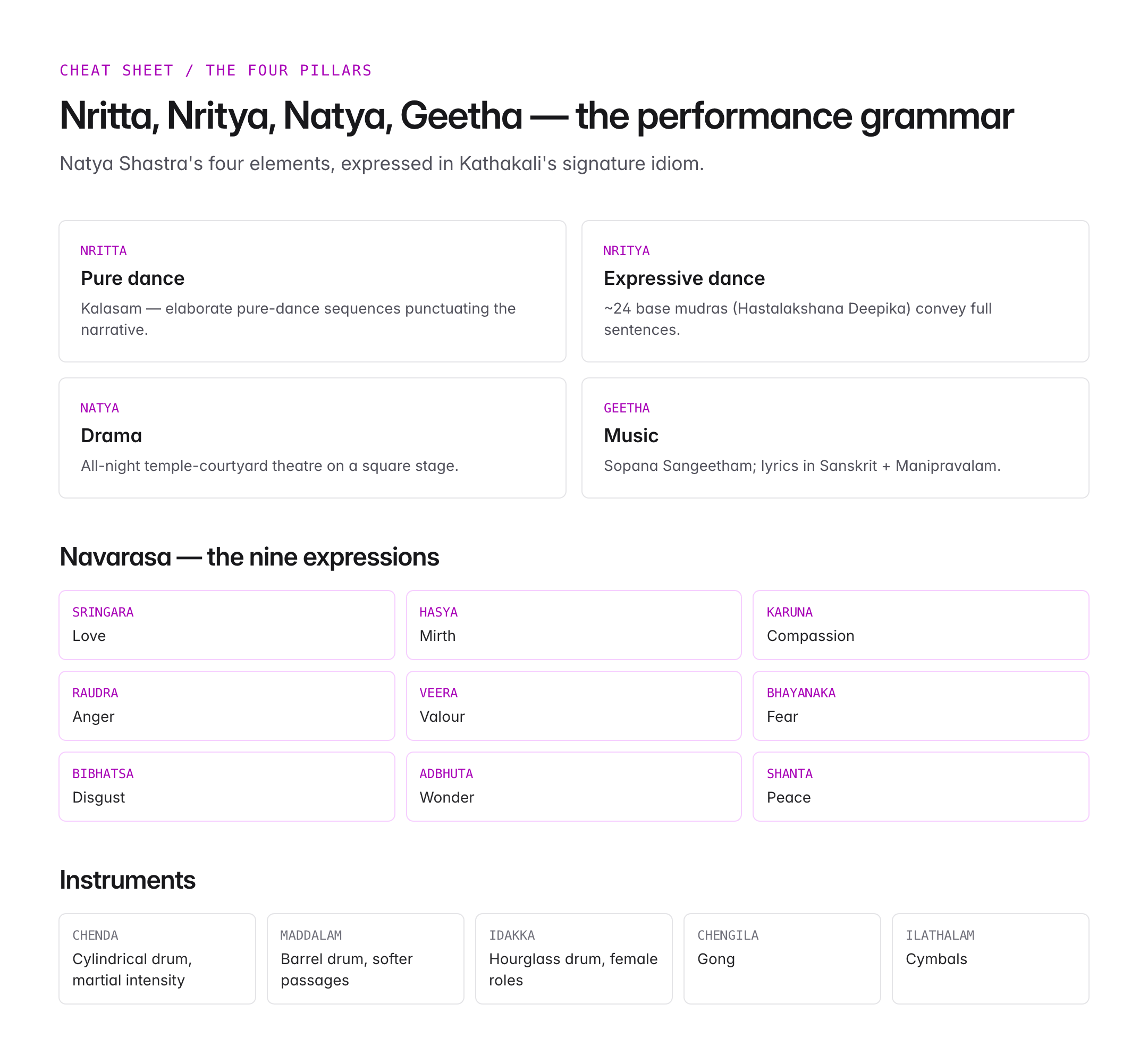
Kathakali integrates four performance elements prescribed by the Natya Shastra: Nritta (pure dance), Nritya (expressive dance), Natya (drama), and Geetha (music).
- Mudras: Around 24 basic hand gestures and their combinations, drawn from the Hastalakshana Deepika, convey complete sentences.
- Navarasa: The nine expressions – Sringara (love), Hasya (mirth), Karuna (compassion), Raudra (anger), Veera (valour), Bhayanaka (fear), Bibhatsa (disgust), Adbhuta (wonder), Shanta (peace) – are rendered through highly trained facial muscles and eye movements.
- Kalasam: Elaborate pure-dance sequences punctuating the narrative.
- All-night performances: Traditionally staged in temple courtyards on a square stage lit by a large brass oil lamp, the Kalivilakku.
- Performed largely by men, including female roles, though women performers are increasingly visible.
Costumes and Makeup
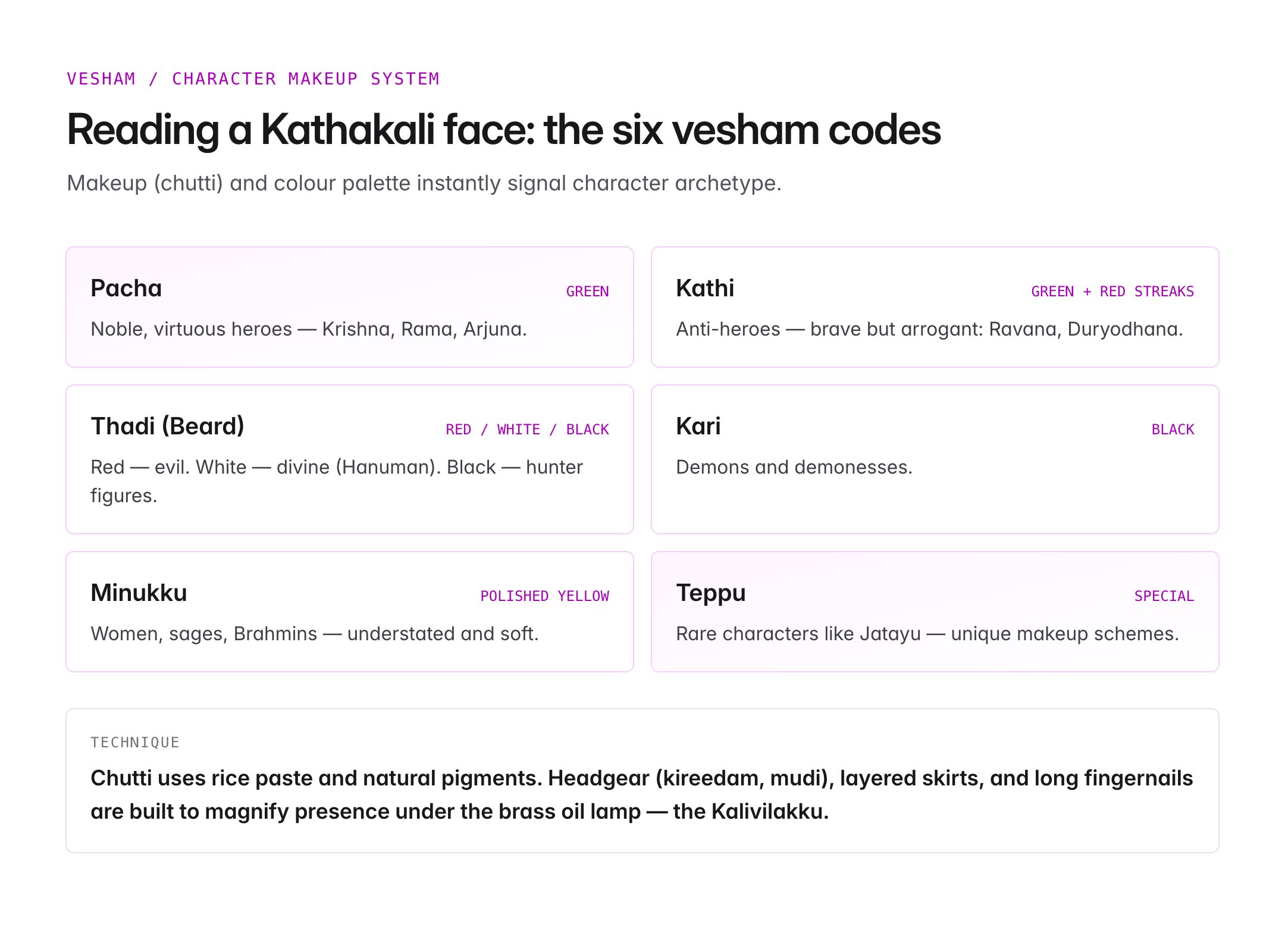
The most recognisable aspect of Kathakali is its visual grammar, where makeup and costume identify character types.
| Character Type (Vesham) | Makeup Colour | Represents |
|---|---|---|
| Pacha (Green) | Green face | Noble, virtuous heroes (Krishna, Rama, Arjuna) |
| Kathi (Knife) | Green with red streaks | Anti-heroes with bravery but arrogance (Ravana, Duryodhana) |
| Thadi (Beard) | Red, white, or black beard | Red – evil; White – divine (Hanuman); Black – hunters |
| Kari (Black) | Black face | Demons and demonesses |
| Minukku | Polished yellowish | Women, sages, Brahmins |
| Teppu | Special | Rare characters like Jatayu |
Makeup (chutti) uses rice paste and natural pigments. The massive headgears (kireedam, mudi), layered skirts, ornaments, and long fingernails are designed to magnify the performer's presence in lamplight.
Music and Instruments
Kathakali music is known as Sopana Sangeetham, a temple-based style close to, but distinct from, classical Carnatic music.
- Vocalists: Two singers – the lead ponnani and the accompanying shinkidi – narrate the story and guide the dancer.
- Language: Lyrics (called attakathas) are in a mix of Sanskrit and Manipravalam (a blend of Sanskrit and Malayalam).
- Instruments:
- Chenda – a cylindrical drum played with sticks, lending martial intensity.
- Maddalam – a horizontal barrel drum for softer passages.
- Idakka – an hourglass drum, especially for female characters.
- Chengila (gong) and Ilathalam (cymbals) keep rhythm.
The singers do not merely accompany; they actively converse with the dancer, cueing mudras and expressions.
Themes and Repertoire
Kathakali performances are based on attakathas, dramatic poems written specifically for the stage.
- Themes are drawn overwhelmingly from the Mahabharata, Ramayana, and the Puranas.
- Famous attakathas include Nalacharitam (story of Nala-Damayanti) by Unnayi Warrier, Kalyana Saugandhikam, Duryodhana Vadham, and Kirmira Vadham.
- Modern experiments have adapted Shakespeare, the Bible, and international stories into Kathakali, though temple performances remain traditional.
Training and Institutions
Kathakali demands rigorous physical and expressive training, often beginning in childhood.
- Eye exercises: Students practise moving their eyeballs along prescribed paths for hours.
- Body massage with feet (uzhichil) is used to render the body supple.
- Oil lamps and mirrors are employed to perfect expressions and gestures.
- Training typically spans 6 to 10 years.
Key institutions include:
- Kerala Kalamandalam (1930), founded by Vallathol Narayana Menon – now a Deemed University for Art and Culture.
- PSV Natyasangham, Kottakkal.
- Margi, Thiruvananthapuram.
- International Centre for Kathakali, New Delhi.
Significance and Contemporary Relevance
- Kathakali is recognised as one of the eight classical dances of India by the Sangeet Natak Akademi, alongside Bharatanatyam, Kathak, Kuchipudi, Odissi, Manipuri, Mohiniyattam, and Sattriya.
- It embodies a unique synthesis of ritual, martial arts (Kalaripayattu), temple theatre, and literature.
- Globally, it has influenced theatre practitioners like Peter Brook (Mahabharata production) and Eugenio Barba.
- It contributes to Kerala's cultural tourism, festivals, and soft power, performed at events from temple utsavams to international festivals.
- Challenges include declining patronage, long apprenticeship periods, and difficulty in sustaining all-night performances in the modern entertainment economy. Government grants, scholarships, and private foundations now play a critical role in preservation.
UPSC Relevance
Prelims focus:
- Kathakali as one of the eight classical dances of India recognised by Sangeet Natak Akademi.
- Origin in Kerala; evolution from Ramanattam and Krishnanattam; role of Kottarakkara Thampuran and Vallathol Narayana Menon.
- Distinctive features: mudras, navarasa, vesham types (Pacha, Kathi, Thadi, Kari, Minukku).
- Instruments: Chenda, Maddalam, Idakka, Chengila, Ilathalam.
- Music style: Sopana Sangeetham; language: Manipravalam.
Mains GS-I angle (Indian Culture):
- Discuss how classical dance forms like Kathakali integrate music, dance, drama, and literature.
- Examine the role of institutions such as Kerala Kalamandalam in preserving traditional art.
- Analyse the interplay of temple traditions, patronage, and community in sustaining Kathakali.
Sample PYQ angle: "Safeguarding the Indian art heritage is the need of the moment. Discuss." Kathakali provides an ideal case study, illustrating challenges of long training, patronage, and modernisation, as well as state and civil-society responses to preserve intangible cultural heritage.
Tell Google you want more of this.
Add Anantam IAS as a preferred sourceOne tap, and this site shows up more often in your own Top Stories, AI Overviews and AI Mode. Remove it any time.