Context:
NATO has recently issued warning to Russia to abstain from violating airspace of its members.
UPSC Relevance: Important International institutions.
UPSC PYQ:
Q) Consider the following countries:
I. Austria
II. Bulgaria
III. Croatia
IV. Serbia
V. Sweden
VI. North Macedonia
How many of the above are members of the North Atlantic Treaty Organization?
[A] Only three
[B] Only four
[C] Only five
[D] All the six
About NATO:
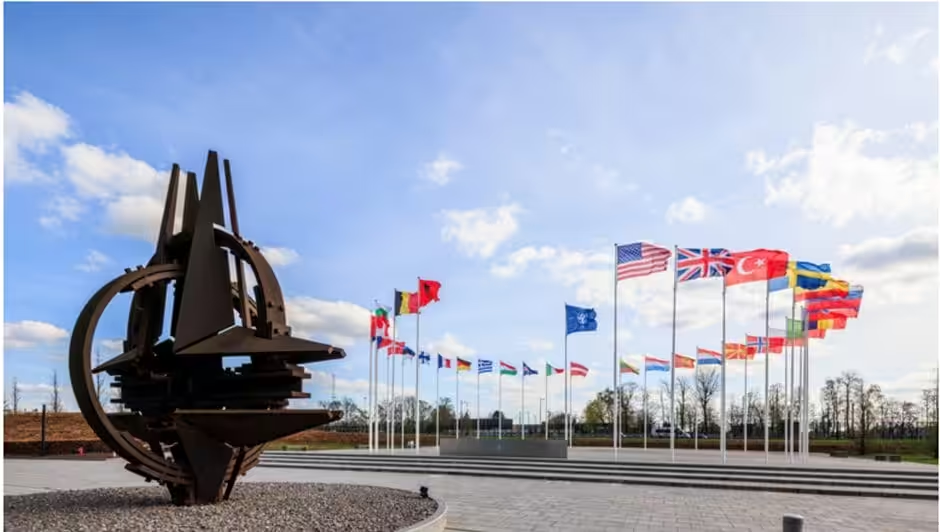
- The North Atlantic Treaty Organisation is a political and military alliance created in the aftermath of World War II by 12 countries from Europe and North America. It was founded on April 4, 1949.
- 12 founding members: Belgium, Canada, Denmark, France, Iceland, Italy, Luxembourg, the Netherlands, Norway, Portugal, the United Kingdom and the United States.
- Since then, 20 more countries have joined NATO through 10 rounds of enlargement (in 1952, 1955, 1982, 1999, 2004, 2009, 2017, 2020, 2023 and 2024).
- Headquarters: Brussels, Belgium, while the Allied Command Operations headquarters is near Mons, Belgium.
- It was formed by the signing of the Washington Treaty, which is based on Article 51 of the United Nations Charter, “which reaffirms the right of individual or collective defence.”
- The principle of collective defence (an attack against one Ally is an attack against all) is enshrined in Article 5 of the North Atlantic Treaty, which commits NATO members to mutual defence.
- Open door policy (Article 10): Article 10 of the North Atlantic Treaty sets out how countries can join the Alliance. It states that membership is open to any “European State in a position to further the principles of this Treaty and to contribute to the security of the North Atlantic area”.
- All European countries are eligible to join NATO.
- Since 1949, the alliance membership has increased from 12 to 32 countries through ten rounds of enlargement.
- Sweden became the latest country to join the Alliance in 2024.
- NATO makes its decisions by consensus. Hence, if a new country wants to join NATO, it must be supported by all other members. Any of its member countries can veto a new member. is a political and military alliance created in the aftermath of World War II by 12 countries from Europe and North America. It was founded on April 4, 1949.
Process of joining:
- Accession talks: To obtain formal confirmation from the invitees.
- Letters of intent: They are sent to NATO along with the timeline of reforms.
- Accession protocols are signed and ratified by NATO countries with the consensus of all members.
- Accession to the North Atlantic Treaty.
- Submission of instruments of accession to the US State Department makes invitees NATO members.
- Any decision to invite a country to join the Alliance is taken by the North Atlantic Council, NATO’s principal political decision-making body, on the basis of consensus among all Allies.
Functioning
- North Atlantic Council is the principal political decision-making body.
- Military Command Structure: It includes Strategic Commands (e.g., Allied Command Operations) responsible for operational planning and execution, as well as Regional Commands and Force Headquarters.
- Integrated Military Forces: NATO maintains integrated military forces, allowing member countries to contribute personnel and assets to collective defence efforts under NATO command.
- Funding: Every NATO country contributes to the costs of running the Alliance, based on a cost-share formula derived from Gross National Income.
Tell Google you want more of this.
Add Anantam IAS as a preferred sourceOne tap, and this site shows up more often in your own Top Stories, AI Overviews and AI Mode. Remove it any time.