Daily Digest
UPSC · Civil Services Examination
Current Affairs · Tuesday, 21 July 2026
Current affairs curated and edited by Anantam IAS faculty — pulled from The Hindu, PIB, IDSA, Foreign Affairs and the ministries. Read, annotate, revise.
Old Rajinder Nagar · Delhi 110005 · anantamias.com
Mission Senehjori: Turning Muga Silk Waste into High-Value Yarn
Why in News?
On 21 July 2026, The Hindu reported Assam Chief Minister Himanta Biswa Sarma’s renewed emphasis on using Muga silk waste to produce high-value spun yarn. The immediate concern is a processing gap: the Chief Minister said about 40% of Muga cocoons currently go unused, leaving potentially valuable fibre outside the formal value chain.
The waste-to-yarn proposal is one component of Mission Senehjori, which had already been launched on 2 June 2026 by the Union Minister for Development of North Eastern Region and the Assam Chief Minister. The PIB launch release presents it as a three-year, cluster-based programme for the full Muga value chain, not as a newly announced standalone waste scheme.
- The programme proposes a dedicated Muga Spun Mill to turn reeling waste, pierced cocoons and other non-reelable material into marketable yarn.
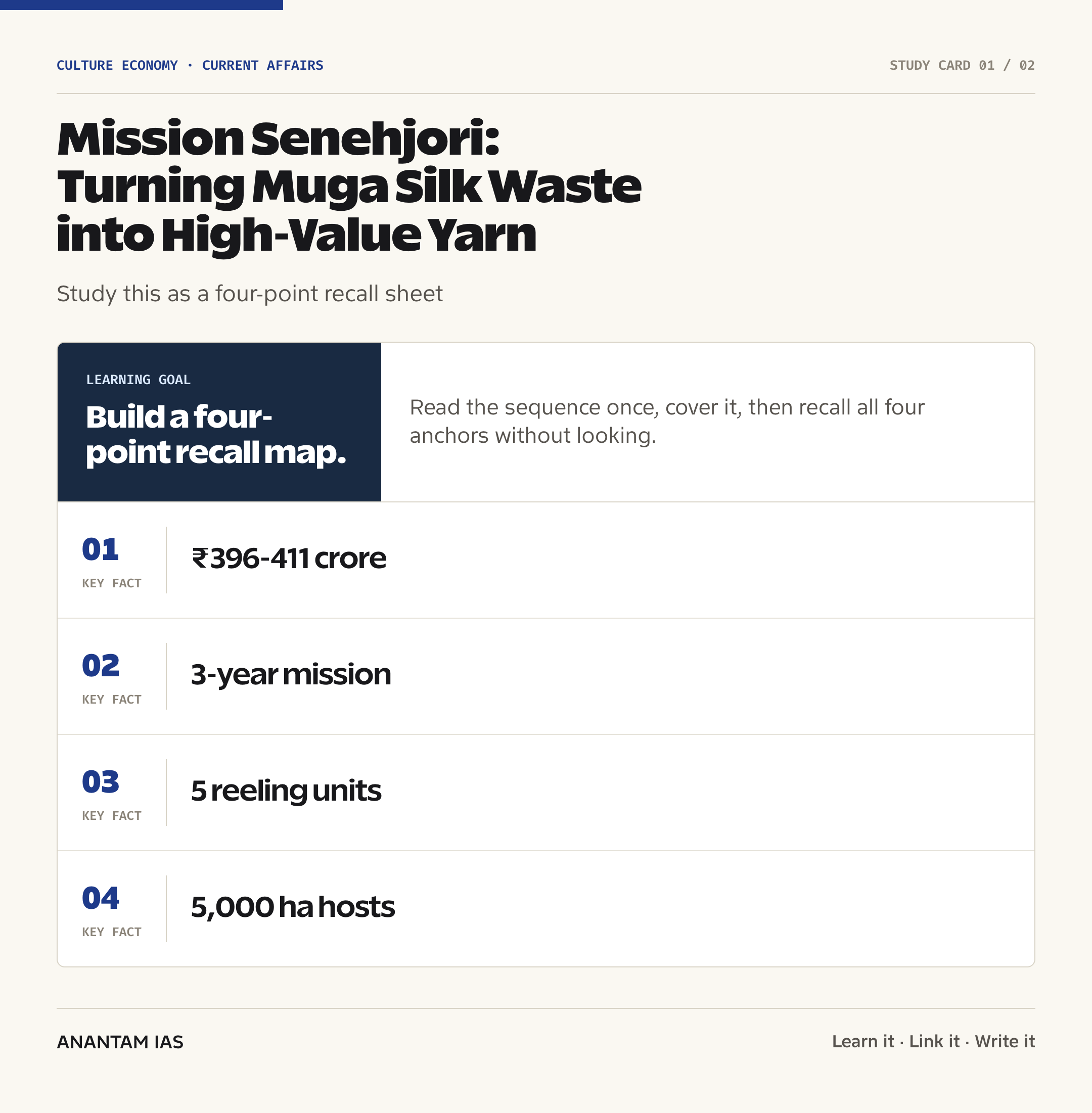
- The official mission envelope is an estimated ₹396-411 crore over three years, including ₹136-151 crore from MDoNER.
- The mission is anchored by MDoNER in convergence with the Government of Assam, the Central Silk Board, the Ministry of Textiles and other central organisations.
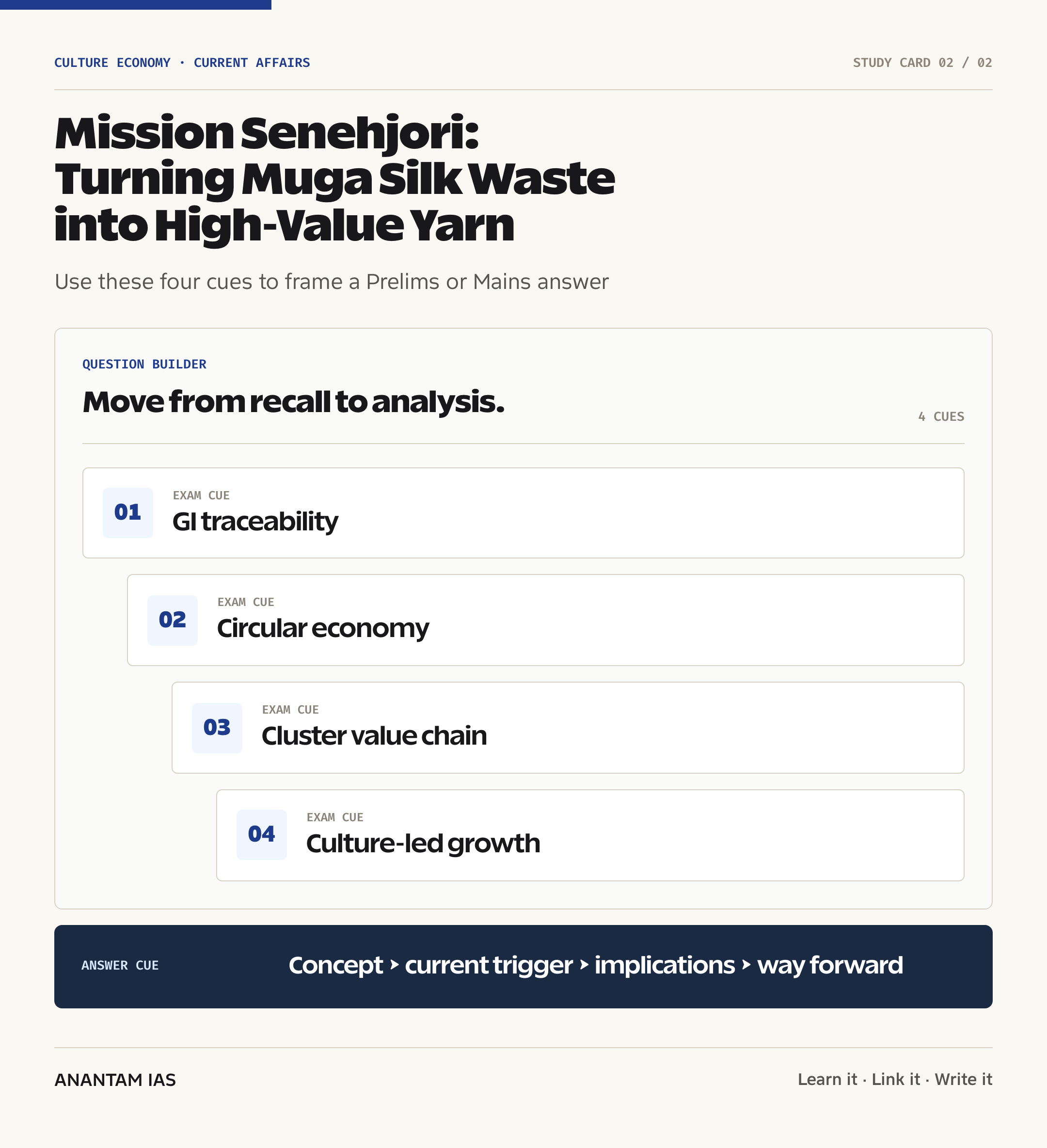
- Its design also covers host plants, seed security, reeling, weaving, producer organisations, GI authentication, traceability, exports and silk tourism.
- Income growth, job creation and reduced waste are expected benefits; they shouldn’t be read as outcomes already achieved.
The development matters in the context of:
- The issue matters in the context of converting a heritage fibre into a circular production system without diluting its place-based identity.
- It tests whether public investment can shift value towards rearers, reelers and weavers, rather than only expanding premium retail markets.
- It links cultural economy, rural livelihoods, biological resources and modern traceability within one cluster policy.
UPSC Relevance
Prelims Relevance
- Muga silk is produced by the semi-domesticated, multivoltine silkworm Antheraea assamensis.
- Its principal host plants are Som and Soalu; the worms are reared outdoors on trees.
- Muga is classed with Vanya silks, alongside Tasar and Eri; India produces Mulberry, Tasar, Eri and Muga natural silks.
- The Central Silk Board describes Muga’s defining feature as its natural golden-yellow sheen.
- The Central Silk Board is a statutory body under the Ministry of Textiles, while Mission Senehjori is anchored by MDoNER through convergence.
- Muga Silk of Assam, GI application number 55, was registered on 20 July 2006; its separate logo registration followed in 2012.
- A Geographical Indication identifies goods whose quality, reputation or other characteristic is essentially attributable to geographical origin.
- Spun silk yarn is made from discontinuous fibres such as reeling waste, unlike reeled raw silk drawn as continuous filament from suitable cocoons.
- The mission’s clusters include Jorhat, Sivasagar, Lakhimpur, Dhemaji, Dibrugarh, Tinsukia, Majuli and Sualkuchi.
Mains Relevance
GS Paper 1
- Muga as a living element of Assamese textile heritage, expressed in sarees, mekhela-chadars and local weaving traditions.
- The role of GI protection, cultural tourism and design innovation in conserving a craft while adapting it to contemporary markets.
GS Paper 3
- Agro-based rural industry, producer collectivisation, common infrastructure and value-chain development in the Northeast.
- Waste valorisation as a practical form of the circular economy, with quality, energy, effluent and market safeguards.
- Climate-sensitive host-plant ecology, seed security and the distribution of gains among 2.6 lakh rearer and weaver families cited by PIB.
Essay
- Heritage survives best when communities can earn from conserving it.
- Waste is often a design and infrastructure failure, not a material without value.
- Traceability can connect local identity with ethical global markets.
Background and Context
Muga silk: biological and cultural foundations
Muga is a place-linked fibre whose value begins with a specific silkworm-host plant ecology and continues through Assam’s reeling and weaving knowledge.
- The Central Silk Board identifies the silkworm as Antheraea assamensis, a semi-domesticated and multivoltine species that can produce several crops in a year.
- The larvae feed mainly on aromatic leaves of Som and Soalu; outdoor rearing makes crop performance closely dependent on host-plant health, weather, pests and disease.
- Its filament has a characteristic golden-yellow colour. This natural sheen, rather than dye alone, is central to Muga’s premium identity.
- Traditional products include sarees, mekhela-chadars, chadars and dress material. Sualkuchi is an important reeling and weaving cluster, while cultivation extends across several Upper Assam districts.
- CSB’s distribution note says production is concentrated in Assam but also occurs in adjoining northeastern areas and Cooch Bihar. Claims that the biological culture exists nowhere outside Assam should be avoided.
- The mission launch release estimated Assam’s share at 90% of world Muga production. A separate CSB overview says more than 95% without a current denominator, so 90% is best treated as the launch estimate, not a timeless constant.
- For the wider sectoral setting, see sericulture in India.
Why silk waste can become yarn
Reeling and spinning are different processing routes, which is why material unsuitable for continuous filament can still have commercial value.
- Reeled silk is obtained by unwinding a continuous filament from a suitable cocoon; uniform, intact cocoons are preferred for this route.
- Spun silk uses shorter discontinuous fibres after waste is sorted, opened, cleaned, carded or combed, and spun with twist into yarn.
- The Assam Directorate of Sericulture states that roughly half of the silk in each cocoon can be reeled and the remainder becomes silk waste or noil that can be processed further.
- This technical statement isn’t identical to the Chief Minister’s reported estimate that 40% of cocoons go unused. One concerns fibre recovery within a cocoon; the other concerns cocoons left outside adequate processing.
- Potential feedstock includes pierced cocoons, flimsy cocoons and reeling waste. Traditional practice already produces forms of spun Muga yarn, so the policy is scaling and standardising an existing principle rather than inventing waste use from scratch.
- A mill can improve volume, count consistency and market access, but the output shouldn’t be passed off as premium reeled Muga. Fibre composition and production method need truthful labelling.
- This is a textile example of the circular economy: retain material value, reduce discard and create a second product stream.
Mission design and institutional architecture
Mission Senehjori is designed as a convergent cluster programme spanning biological inputs, production infrastructure and market institutions.
- The PIB release says the mission is anchored by MDoNER in convergence with the Government of Assam, Central Silk Board, Ministry of Textiles and other central ministries and organisations.
- The phrase matters: it isn’t presented as a scheme implemented by the Central Silk Board alone, nor solely as an Assam Directorate of Sericulture project.
- The estimated investment is ₹396-411 crore over three years, of which MDoNER is expected to contribute ₹136-151 crore. The range signals a programme envelope, not a final audited expenditure.
- The cluster approach covers production centres named by the launch release: Jorhat, Sivasagar, Lakhimpur, Dhemaji, Dibrugarh, Tinsukia, Majuli and Sualkuchi.
- Upstream measures cover Som-Soalu regeneration and seed security; midstream measures cover reeling, spinning, common facilities and weaving; downstream measures cover authentication, branding, exports and tourism.
- Producer organisation is built around proposed Farmer Interest Groups and Farmer Producer Organisations, intended to aggregate demand, supply and bargaining power.
- A unified Senehjori brand and digital traceability are meant to connect origin claims with buyer confidence, but governance rules for brand use will determine credibility.
Planned infrastructure and 2028 targets
The official launch release sets measurable outputs for 2028, all of which remain targets until completion and use are independently verified.
- Set up five modernised Muga reeling units and one Muga Spun Mill; the mill is the mission component most directly linked to waste-to-yarn conversion.
- Create 30 FPOs and more than 1,180 Farmer Interest Groups to organise dispersed producers and improve aggregation.
- Regenerate 5,000 hectares of Som and Soalu host plants, tying industrial expansion to the ecological base of silkworm rearing.
- Authenticate more than 80% of traded Muga silk through GI-linked systems, which would need reliable testing, authorised users and enforcement against imitation.
- Create digital traceability mechanisms for more than 8,000 households; enrolment is only an input unless records remain accurate and producers can access the system.
- Expand annual Muga silk exports to more than 2,000 kilograms. Export growth is a target, not proof of demand, premium prices or higher household income.
- Develop a Muga Silk Trail, Silk Tourism Park and annual Muga Utsav to connect production with Assam’s cultural economy.
- These outputs should be tracked separately: a facility can be built yet underused, an FPO can be registered yet inactive, and a traceability ID can exist without credible chain-of-custody data.
GI protection, authentication and market trust
A premium Muga strategy needs legal origin protection and physical product verification to work together.
- IP India’s registry records Muga Silk of Assam as GI application number 55, registered on 20 July 2006 in the handicraft category.
- The separate Muga Silk of Assam logo, application number 384, was registered in 2012. A logo can aid consumer recognition but doesn’t replace authorised-user and origin checks.
- The public registry entry for application 55 displayed validity through 19 July 2026 when checked for this note. Since GI protection is renewable, the registry’s current renewal status should be confirmed before making a categorical post-date claim.
- The official mission release calls Muga India’s first GI-tagged silk, but IP India records Kancheepuram Silk with a 2 June 2005 certificate, earlier than Muga’s 2006 registration. The safer exam fact is Muga’s exact registry date and application number.
- GI authentication should establish geographical origin and compliance with the registered specification; it isn’t simply a marketing sticker available to any silk trader.
- Digital traceability can record movements from rearer to yarn and fabric, while laboratory or field authentication supports the material claim. Neither tool can substitute for inspected source data.
- Read the legal concept separately in Geographical Indications explained.
Likely gains are conditional, not automatic
The mission has a plausible development logic, but its social and environmental benefits depend on who owns assets, who bears costs and who captures the premium.
- Waste recovery can add a second revenue stream for pierced cocoons and short fibre that fetch little value, provided procurement prices are transparent.
- Local spinning can create work in sorting, cleaning, carding, spinning, testing and product development; the number and quality of jobs remain to be measured.
- FPOs and aggregation centres may reduce transaction costs and improve bargaining, but weak management or buyer dependence can reproduce the same imbalance at a larger scale.
- Common facilities can widen access to machinery that individual reelers can’t afford. User fees, downtime, maintenance and distance will decide whether small producers benefit.
- Product diversification can make Muga more accessible through textured yarn and blends, but poor disclosure could weaken the premium attached to authentic reeled Muga.
- Resource efficiency can reduce discard, yet spinning still has water, chemical, energy and effluent footprints. Circularity needs cleaner processing, not waste conversion alone.
- Silk tourism can increase craft visibility and direct sales; community consent, cultural accuracy and revenue sharing are needed to prevent heritage from becoming only a visitor spectacle.
Implementation risks and policy tests
The strongest evaluation question is whether the mission can preserve fibre integrity and producer agency while building scale.
- Feedstock mapping must distinguish unreelable cocoons, reeling waste, noil and usable continuous filament; inflated waste estimates can produce oversized plants.
- Host-plant restoration should use suitable local germplasm and survival audits, not plantation counts alone, because Muga rearing depends on leaf quality and seasonal resilience.
- Seed security and disease management require coordination with Central Silk Board research and seed institutions, backed by local extension rather than one-time training.
- Spun-yarn standards should declare fibre content, count, twist, strength and origin. Blended or waste-derived yarn must not be sold as pure reeled silk.
- Procurement rules should publish the price paid for each waste grade so that rearers and reelers share in value addition instead of supplying cheap residue to a central mill.
- The mission needs a public dashboard separating sanctions, expenditure, completed assets, operating capacity and household income change.
- Baseline and end-line studies should report participation and gains by gender, social group, district and value-chain role; an aggregate export figure can’t show distributive impact.
Way Forward
Build from verified material flows
- Conduct district-wise audits of cocoon output, reelable share and waste grades before fixing mill capacity.
- Use traceable procurement lots so finished spun yarn can be linked back to clusters and producer groups.
- Report recovery rates and rejected material instead of presenting all collected waste as saleable yarn.
Put producers into commercial governance
- Give FPOs and reeler groups representation in pricing, facility management and brand decisions.
- Publish grade-wise floor or reference prices and make payment records auditable.
- Pair machinery with working capital, repair support, design advice and assured quality testing.
Protect both GI and product truth
- Confirm and publicly update the GI renewal status, authorised-user base and enforcement protocol.
- Use separate labels for reeled Muga, spun Muga and blends, with fibre composition visible to buyers.
- Connect QR records to verifiable chain-of-custody data, not just promotional pages.
Make processing genuinely circular
- Set benchmarks for water, energy, chemicals and effluent per kilogram of spun yarn.
- Recover more fibre without diverting healthy seed cocoons or lowering reeling quality.
- Plan safe handling of residues that remain after cleaning, degumming and spinning.
Measure outcomes, not announcements
- Track facility use, household earnings, jobs, women’s control over income and price realisation against a baseline.
- Disclose progress against every 2028 target, with district and institution responsible.
- Commission independent technical, financial and social audits before scaling beyond the initial clusters.
Conclusion
Mission Senehjori treats Assam’s Muga silk as both heritage and a production system. Its waste-to-yarn component is credible because reeling naturally leaves short fibre and unusable cocoons that can be spun, but the mission’s larger promise depends on host plants, seed, institutions, authentication and market access moving together.
The policy test isn’t whether a mill is announced. It is whether verified waste becomes honestly labelled yarn, whether producers receive a fair share of the added value, and whether Assam’s ecological and cultural foundations remain stronger after commercial expansion.
UPSC Practice Questions
Prelims MCQ 1
With reference to Muga silk, consider the following statements:
- It is produced by Antheraea assamensis.
- Som and Soalu are important host plants for its silkworm.
- Spun Muga yarn must be made only from a continuous filament reeled from intact cocoons.
How many of the above statements are correct?
(a) Only one (b) Only two (c) All three (d) None
Answer: (b) Only two
Explanation:
Statements 1 and 2 are correct. Spun silk uses discontinuous fibres, including suitable reeling waste and non-reelable cocoon material; continuous filament produces reeled raw silk.
Prelims MCQ 2
Which institution anchors Mission Senehjori according to the official launch release?
(a) Ministry of Development of North Eastern Region (b) Ministry of Environment, Forest and Climate Change (c) Khadi and Village Industries Commission (d) North Eastern Council alone
Answer: (a) Ministry of Development of North Eastern Region
Explanation:
MDoNER anchors the mission in convergence with the Government of Assam, Central Silk Board, Ministry of Textiles and other central ministries and organisations.
UPSC Mains Questions
- Mission Senehjori frames Muga silk waste as an economic resource, but infrastructure alone can’t guarantee inclusive value addition. Examine the mission’s cluster design and suggest safeguards for producer incomes, ecological sustainability, product authenticity and accountable delivery.
- Geographical Indications can protect a cultural product’s origin, while traceability can protect trust across its value chain. Discuss this distinction with reference to Assam’s Muga silk and the challenges of scaling it for premium domestic and export markets.
Sources: PIB, Ministry of Development of North Eastern Region and The Hindu.
Frequently Asked Questions
What is Mission Senehjori?
Mission Senehjori is a three-year, cluster-based programme for Assam’s Muga silk value chain. MDoNER anchors it with the Government of Assam, Central Silk Board, Ministry of Textiles and other organisations. It covers host plants, seed, reeling, spinning, producer groups, GI authentication, traceability, branding, exports and cultural tourism.
Why is Muga silk waste valuable?
Not all cocoon fibre can be drawn as a continuous reeled filament. Pierced or flimsy cocoons, reeling waste and short fibres can be cleaned, carded or combed and spun into yarn. This creates a distinct product stream, but it should be labelled as spun Muga rather than represented as premium reeled raw silk.
Is 40% of Muga silk currently wasted?
The 40% figure is a reported estimate attributed to Assam’s Chief Minister for cocoons going unused because of inadequate processing. Assam’s technical sericulture page separately says roughly half the silk in each cocoon may remain after reeling as waste or noil. The two figures measure different stages and shouldn’t be merged.
Who implements Mission Senehjori?
The official launch release says MDoNER anchors the mission in convergence with the Government of Assam, Central Silk Board, Ministry of Textiles and other central ministries or organisations. It doesn’t assign the entire mission to one silk agency. Delivery will require coordinated state, central, technical and producer-level institutions.
What are the mission’s main 2028 targets?
Targets include five modernised reeling units, a Muga Spun Mill, 30 FPOs, over 1,180 Farmer Interest Groups, regeneration of 5,000 hectares of Som and Soalu, GI-linked authentication of over 80% of traded silk, traceability for more than 8,000 households and exports above 2,000 kilograms annually.
Does Muga silk have a GI registration?
IP India records Muga Silk of Assam under application 55, registered on 20 July 2006, with a separate logo registered in 2012. The public entry displayed validity through 19 July 2026 when this note was checked, so the latest renewal or registry update should be confirmed for claims after that date.
Source: https://anantamias.com/current-affairs/assam-muga-silk-waste-yarn-mission/
India-North Macedonia Ties: First Presidential Visit
Why in News?
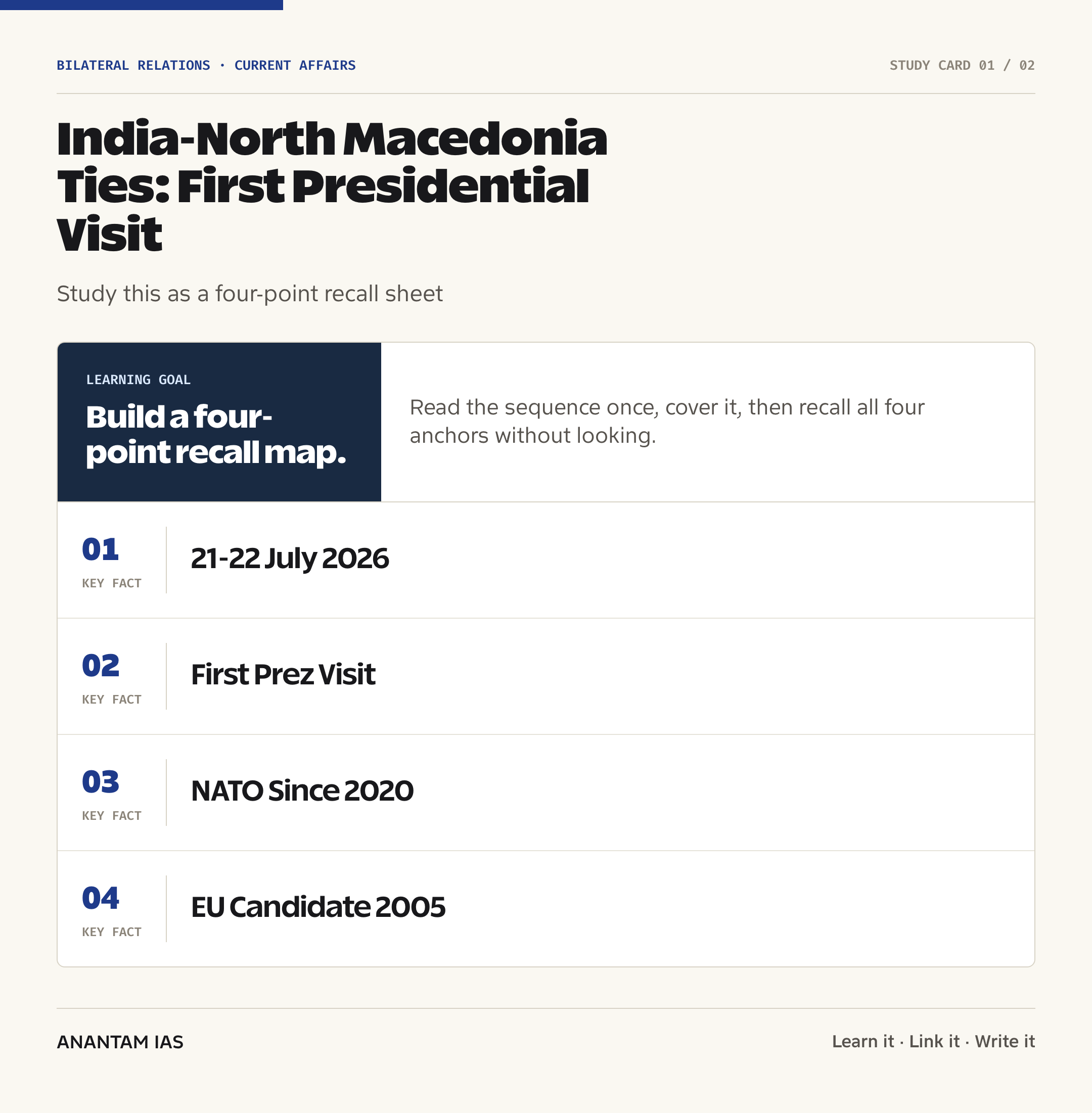
President Droupadi Murmu is visiting North Macedonia on 21-22 July 2026 during a three-country tour of Moldova, North Macedonia and Romania. The Ministry of External Affairs described it as the first-ever visit by an Indian President to North Macedonia, while the Presidency of North Macedonia separately confirmed the two-day official visit.
The confirmed programme combines head-of-state talks, meetings with the Prime Minister and the President of the Assembly, an address to the Assembly and an India-North Macedonia Business Forum. These are announced engagements; possible gains in trade, technology, education or India’s wider Western Balkans outreach remain analytical implications until the two governments announce specific outcomes.
- The visit takes place at the invitation of President Gordana Siljanovska-Davkova of North Macedonia.
- The official dates are 21 and 22 July 2026, following President Murmu’s visit to Moldova.
- The announced political agenda includes bilateral discussions and meetings with Prime Minister Hristijan Mickoski and the President of the Assembly.
- President Murmu is scheduled to address both the Assembly of North Macedonia and a bilateral business forum.
- MEA identified agriculture, pharmaceuticals, science and technology, IT and IT-enabled services as sectors in which both sides seek deeper economic cooperation.
The development matters in the context of:
- The visit matters in the context of India’s effort to build sustained relations with smaller and middle-sized European states beyond its major-power partnerships.
- North Macedonia is a NATO member and an EU candidate country, giving it relevance to debates on the Western Balkans, European integration and regional connectivity.
- The bilateral relationship is friendly but economically modest, so the value of the visit will depend on follow-up mechanisms rather than ceremonial visibility alone.
UPSC Relevance
Prelims Relevance
- North Macedonia is a landlocked country in the Balkan Peninsula; its capital is Skopje.
- It borders Albania, Bulgaria, Greece, Kosovo and Serbia.
- The Prespa Agreement with Greece was signed on 17 June 2018; the name Republic of North Macedonia took effect on 14 February 2019.
- North Macedonia became the 30th member of NATO on 27 March 2020.
- It applied for European Union membership in March 2004 and obtained candidate status in December 2005.
- The first EU-North Macedonia Intergovernmental Conference on accession was held in July 2022.
- India’s Embassy in Sofia, Bulgaria, is concurrently accredited to North Macedonia.
- North Macedonia has maintained an embassy in New Delhi since 2008.
- India co-sponsored the UN General Assembly resolution admitting the country to the UN under the provisional designation FYROM.
- Mother Teresa, an ethnic Albanian, was born in Skopje and lived there until the age of 18.
Mains Relevance
GS Paper 2
- India’s bilateral, regional and economic diplomacy in Eastern Europe and the Western Balkans.
- The role of high-level visits, parliamentary diplomacy and business forums in converting cordial ties into practical cooperation.
- How North Macedonia’s NATO membership and EU accession process shape its external partnerships.
GS Paper 1
- Location of the Balkan Peninsula, landlocked states, neighbouring countries and regional transport corridors.
- The post-Yugoslav political geography and the significance of the Prespa Agreement.
Essay
- Diplomacy is often built through patient engagement with states that aren’t major powers but occupy important regional positions.
- Symbolic first visits acquire durable value only when institutions, businesses and people can carry the relationship forward.
Background and Context
What the Official Programme Confirms
The announced schedule is broad enough to open several channels, but it shouldn’t be confused with completed agreements or negotiated outcomes.
- The Presidency of North Macedonia confirmed an official visit on 21-22 July 2026; MEA described it as the first visit by an Indian President to the country.
- The visit is being made at the invitation of President Gordana Siljanovska-Davkova, with bilateral discussions between the two Presidents on the programme.
- Separate meetings with Prime Minister Hristijan Mickoski and the President of the Assembly create executive and legislative channels in addition to ceremonial diplomacy.
- An address to the Assembly of North Macedonia gives the visit a public parliamentary dimension and can communicate India’s approach directly to political representatives.
- The India-North Macedonia Business Forum is the confirmed commercial engagement; its presence signals interest in trade and investment but doesn’t by itself establish any contract or target.
- MEA listed agriculture, pharmaceuticals, science and technology, information technology and IT-enabled services as prospective areas for deeper economic cooperation.
- The combination of presidential talks, an Assembly address and a business meeting is designed to reach the executive, legislature and private sector during one visit, giving follow-up agencies several channels to use.
- No bilateral treaty, investment commitment or implementation timetable should be treated as concluded unless it appears in the official post-visit record.

Evolution of Bilateral Relations
India supported North Macedonia’s international entry after Yugoslavia’s breakup, while formal engagement has remained cordial but relatively light.
- After the country separated from the former Yugoslavia, India was among the co-sponsors of the UN General Assembly resolution for its admission to the United Nations.
- It entered the UN under the provisional designation Former Yugoslav Republic of Macedonia, or FYROM, because of the long-running name dispute with Greece.
- The Prespa Agreement of 17 June 2018 resolved that dispute; the constitutional name Republic of North Macedonia became effective on 14 February 2019.
- India’s Embassy in Sofia is concurrently accredited to North Macedonia, while North Macedonia has operated an embassy in New Delhi since 2008.
- Minister of State for External Affairs and Culture Meenakashi Lekhi visited North Macedonia in July 2023 and met officials from its foreign affairs, culture and Assembly institutions.
- North Macedonia’s then Foreign Minister Bujar Osmani visited India in August-September 2023 for meetings including with the Vice-President and External Affairs Minister.
- These 2023 ministerial exchanges established recent political contact, but a presidential visit carries greater symbolic weight because it represents the Indian state at its highest constitutional level and can convene several institutions together.
- The 2026 presidential visit is a qualitative rise in political visibility, but durable depth will still require regular official consultations and sector-level projects.
North Macedonia: Geography and Strategic Setting
The country’s position explains why a small bilateral relationship can carry a wider European and connectivity dimension.
- North Macedonia is a landlocked Western Balkan state with Skopje as its capital.
- It shares borders with Serbia and Kosovo to the north, Bulgaria to the east, Greece to the south and Albania to the west.
- The Vardar river valley and the country’s location on European transport routes connect the central Balkans with the Aegean direction and neighbouring markets.
- Its landlocked geography makes dependable road, rail, border and customs connectivity central to trade competitiveness.
- For India, this geography means commercial access depends on regional transport networks, neighbouring ports and harmonised border procedures; bilateral intent must be paired with workable routes to European production and consumer markets.
- North Macedonia joined NATO on 27 March 2020 as the alliance’s 30th member.
- It has been an EU candidate country since December 2005; the first intergovernmental accession conference took place in July 2022.
- Aspirants should distinguish membership: North Macedonia is in NATO, but it isn’t yet a member of the European Union.
Economic Base and Sectoral Possibilities
Official data show a small and highly unbalanced trade relationship, which gives the business forum both an opportunity and a demanding baseline.
- The Embassy of India in Sofia recorded total bilateral merchandise trade of US$37.37 million in 2023-24.
- India’s exports accounted for US$36.64 million, while imports from North Macedonia were only US$0.73 million in that year.
- Indian exports include organic chemicals, iron and steel, textiles, electrical and mechanical machinery, medical instruments, auto parts and pharmaceuticals.
- North Macedonia’s exports to India have included ferro-alloys, marble and travertine, electrical equipment and plastics.
- The confirmed agenda’s focus on pharmaceuticals and digital services matches Indian strengths, while agriculture and scientific cooperation can support targeted institutional partnerships.
- The sharp trade imbalance suggests two parallel tasks: help Indian exporters move into higher-value niches while identifying competitive North Macedonian products and services that can enter India on commercially sound terms.
- North Macedonia’s proximity to European supply chains may interest Indian firms, but market size, logistics, regulation and commercial viability must be assessed project by project.
- India’s wider economic engagement with Europe, including the India-EU trade framework, provides context but doesn’t automatically extend EU-member privileges to a candidate country.
Capacity Building and People-to-People Links
A thin economic relationship can still be widened through training, education, culture and professional networks that create repeated contact.
- India offers training opportunities to professionals from North Macedonia through the Indian Technical and Economic Cooperation programme.
- Macedonian diplomats have participated in professional courses conducted by India’s Foreign Service Institute, while parliamentary employees have received training under ITEC.
- The two sides can develop university, research and start-up links in digital technology, science, medicine and agriculture without waiting for large merchandise flows.
- Yoga and Indian cultural activities have an existing audience in North Macedonia, creating a modest base for cultural diplomacy.
- Skopje is the birthplace of Mother Teresa, whose life provides a recognisable human connection between the city and India.
- Tourism, film and cultural events can generate familiarity, but programmes should be designed around reciprocal participation and sustained local partners rather than one-off festivals that disappear when official attention moves elsewhere.
- Cultural familiarity shouldn’t be used as a substitute for policy; visa access, academic recognition, institutional contacts and dependable mobility matter for lasting exchanges.
- A small Indian community also means that people-to-people ties will need active support from universities, chambers, cultural bodies and diplomatic missions.
Analytical Significance for India's Europe Policy
The visit can be read as part of diversified European outreach, but that interpretation is an analytical lens rather than a declared alliance shift.
- Engagement with North Macedonia broadens India’s European diplomacy beyond large economies and established partners to the Western Balkans.
- Relations with a NATO ally and EU candidate can improve India’s understanding of Euro-Atlantic institutions, enlargement debates and Balkan political economy.
- For North Macedonia, India offers a large market, digital capabilities, pharmaceutical capacity and a partnership that isn’t tied to its formal EU accession process.
- Parliamentary and business engagements can distribute ownership across institutions, reducing dependence on a single leader-level meeting.
- India can also learn from North Macedonia’s experience of balancing national choices with NATO obligations and a prolonged EU accession process, while avoiding any assumption that the two countries share identical positions on every European issue.
- The relationship can support India’s preference for multi-alignment and issue-based cooperation, but no strategic partnership or security commitment was announced in the pre-visit programme.
- The first-visit symbolism will be tested by measurable follow-up: consultations held, training seats used, business leads converted, research links created and trade barriers resolved.
- The sound conclusion is that the visit opens diplomatic space; it doesn’t by itself prove a geopolitical realignment, major economic breakthrough or institutional upgrade.
Way Forward
Institutionalise the Political Dialogue
- Create a regular calendar for foreign-office consultations, parliamentary exchanges and sector-specific working contacts.
- Record agreed tasks, responsible agencies and review dates so the first presidential visit produces an accountable follow-up cycle.
Turn the Business Forum into a Pipeline
- Match firms and regulators in a few realistic areas such as generic medicines, digital services, agri-processing and engineering goods.
- Use chambers of commerce to identify standards, payments, logistics and market-access barriers before setting headline trade ambitions.
Expand Skills and Knowledge Partnerships
- Use ITEC, diplomatic training, university agreements and research exchanges to build networks that can survive political cycles.
- Design short programmes around cyber diplomacy, digital public infrastructure, agricultural technology and pharmaceutical regulation where Indian institutions can add value.
Keep Claims Proportionate
- Separate confirmed agreements from proposed sectors and analytical possibilities in every official assessment of the visit.
- Judge progress through implementation, balanced commercial benefit and institutional continuity rather than the novelty of a first visit alone.
Conclusion
The first visit by an Indian President to North Macedonia is a genuine diplomatic milestone. Its confirmed substance lies in leader-level talks, engagement with the government and Assembly, and a bilateral business forum spanning agriculture, pharmaceuticals, science and technology, and digital services.
Its larger meaning is prospective, not settled. If both sides convert the programme into recurring consultations, training, research and commercially viable projects, the visit can give India a steadier foothold in the Western Balkans. Without that follow-through, it will remain an important symbol with limited material depth.
UPSC Practice Questions
Prelims MCQ 1
With reference to North Macedonia, consider the following statements:
- It is a landlocked country in the Balkan Peninsula.
- It is a member of NATO but not yet a member of the European Union.
- It shares a land border with Romania.
How many of the above statements are correct?
(a) Only one (b) Only two (c) All three (d) None
Answer: (b) Only two
Explanation:
Statements 1 and 2 are correct. North Macedonia is landlocked, joined NATO in 2020 and remains an EU candidate. Its neighbours are Albania, Bulgaria, Greece, Kosovo and Serbia, not Romania.
Prelims MCQ 2
Which one of the following correctly describes the Prespa Agreement?
(a) It created a customs union between India and the Western Balkans. (b) It settled the name dispute between Greece and the country now called North Macedonia. (c) It admitted North Macedonia directly into the European Union. (d) It established the North Atlantic Treaty Organization.
Answer: (b) It settled the name dispute between Greece and the country now called North Macedonia.
Explanation:
The 2018 Prespa Agreement resolved the long-running name dispute with Greece. The name Republic of North Macedonia took effect in February 2019; the agreement didn’t make the country an EU member.
UPSC Mains Questions
- The first visit by an Indian President to North Macedonia marks a diplomatic opening, but symbolism alone can’t deepen a bilateral relationship. Analyse the opportunities in political dialogue, pharmaceuticals, digital services, capacity building and parliamentary engagement, and identify the institutional follow-up required. (15 marks, 250 words)
- Small Western Balkan states occupy an important space at the intersection of European integration, connectivity and strategic competition. Discuss how India can broaden engagement with North Macedonia while keeping expectations realistic and preserving issue-based, mutually beneficial cooperation. (15 marks, 250 words)
Sources: Rashtrapati Bhavan and Ministry of External Affairs and The Hindu.
Frequently Asked Questions
Why is President Murmu’s visit historic?
MEA described the 21-22 July 2026 trip as the first-ever visit by an Indian President to North Macedonia. It raises bilateral engagement to head-of-state level and combines talks with the President, meetings with government and Assembly leaders, a parliamentary address and a bilateral business forum.
What is the confirmed visit agenda?
The announced programme includes talks with President Gordana Siljanovska-Davkova, meetings with Prime Minister Hristijan Mickoski and the President of the Assembly, an address to the Assembly of North Macedonia, and an India-North Macedonia Business Forum. Outcomes must await official post-visit announcements.
Where is North Macedonia located?
North Macedonia is a landlocked country in the Western Balkans, with Skopje as its capital. It borders Albania, Bulgaria, Greece, Kosovo and Serbia. Its location links north-south and east-west routes across southeastern Europe, while lack of direct sea access makes regional connectivity especially important.
Is North Macedonia in NATO and the EU?
North Macedonia joined NATO on 27 March 2020. It isn’t an EU member. It applied for EU membership in March 2004, received candidate status in December 2005 and held its first intergovernmental accession conference with the European Union in July 2022.
What is the Prespa Agreement?
The Prespa Agreement, signed by Greece and the then Republic of Macedonia in June 2018, resolved their long-running dispute over the country’s name. The name Republic of North Macedonia took effect in February 2019, helping clear a major obstacle to closer Euro-Atlantic integration.
Which sectors can deepen bilateral ties?
MEA identified agriculture, pharmaceuticals, science and technology, information technology and IT-enabled services as promising sectors. ITEC training, diplomatic courses, university links, culture and tourism can add people-to-people depth. These are areas for cooperation, not evidence that specific investments or agreements are already complete.
Source: https://anantamias.com/current-affairs/india-north-macedonia-first-presidential-visit/
Andy Burnham Becomes U.K. Prime Minister: India-U.K. Ties at a Transition Point
Why in News?
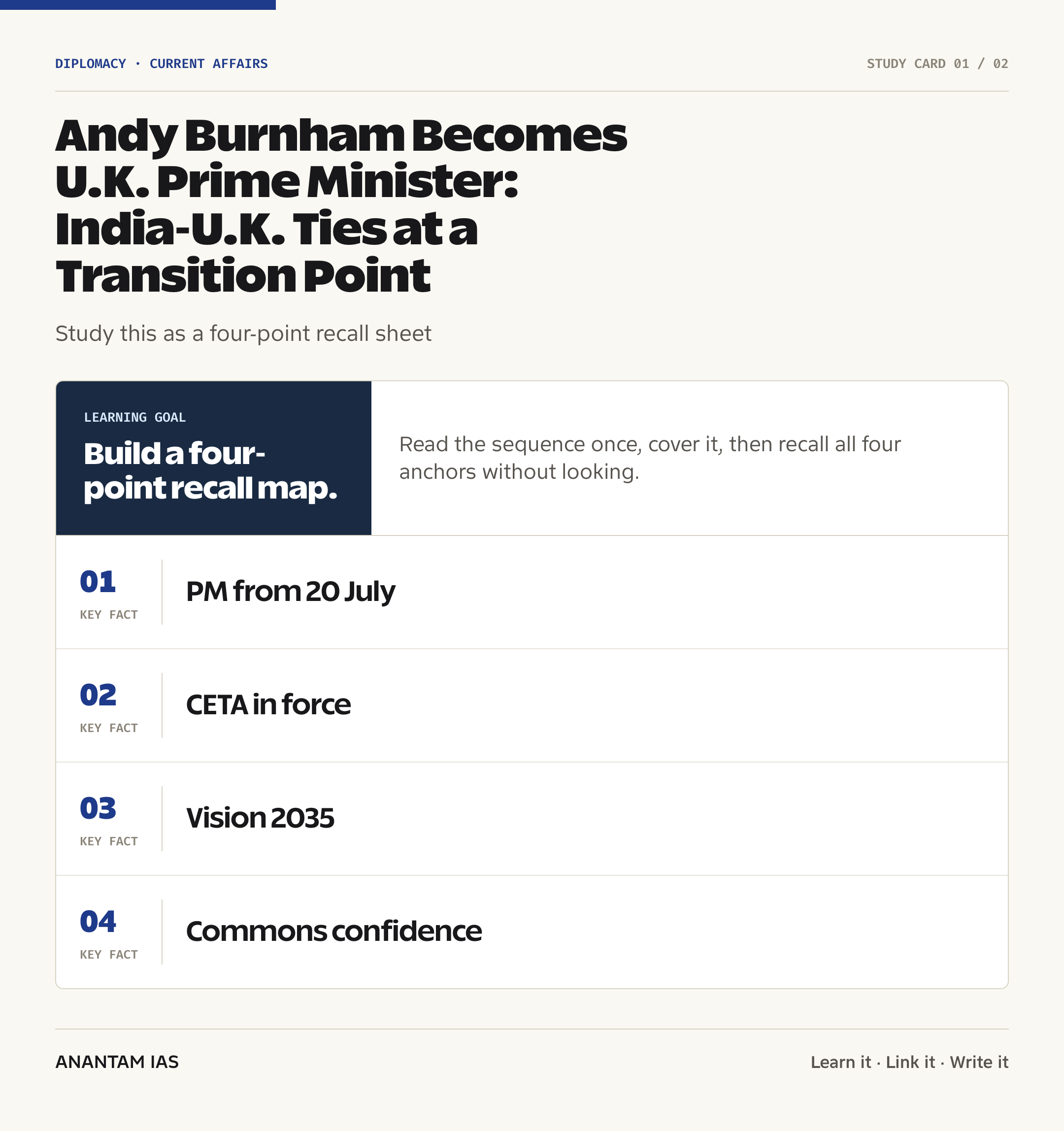
Andy Burnham became Prime Minister of the United Kingdom on 20 July 2026 after accepting King Charles III’s invitation to form a government. The official GOV.UK profile and the U.K. Parliament both record his new office, while his first Downing Street speech confirms the constitutional handover.
The Hindu reported the change from Keir Starmer to Burnham and highlighted the new Prime Minister’s promise of a different social and political model. Indian Express Explained traced Burnham’s rise from Greater Manchester mayor to Labour leader and Prime Minister. The two reports match the official record on the central fact of succession.
- The appointment took effect on 20 July 2026; it wasn’t merely a leadership bid or an expected future succession.
- Burnham had returned to the House of Commons as MP for Makerfield in June 2026 and became Labour Party leader on 16 July 2026, according to GOV.UK.
- He succeeds Keir Starmer without a fresh general election because the governing party selected a new leader capable of commanding Commons confidence.
- The transition comes five days after the India-U.K. Comprehensive Economic and Trade Agreement entered into force on 15 July 2026.
- No official Burnham policy statement reviewed for this note announced a reversal or revision of the India-U.K. Vision 2035 or the trade agreement.
The development matters in the context of:
- This matters in the context of the Westminster system, where a change of Prime Minister can occur between general elections while the government retains legislative confidence.
- For India, the immediate question is continuity in an already institutionalised partnership covering trade, technology, defence, climate and education.
- Leadership style can alter diplomatic emphasis, but treaty obligations and formal bilateral roadmaps don’t disappear automatically when a Prime Minister changes.
UPSC Relevance
Prelims Relevance
- The United Kingdom has an uncodified constitution built from statutes, conventions, judicial decisions and authoritative practices.
- The Monarch formally appoints the Prime Minister under the royal prerogative, guided in practice by who can command confidence in the House of Commons.
- The U.K. Prime Minister is normally the leader of the government and the principal government figure in the House of Commons.
- The officeholder also serves as First Lord of the Treasury, Minister for the Civil Service and Minister for the Union.
- A governing party may replace its leader without automatically triggering a general election.
- The India-U.K. CETA was signed on 24 July 2025 and entered into force on 15 July 2026.
- The India-U.K. Vision 2035 covers growth, technology and innovation, defence and security, climate and clean energy, and education.
- The U.K. is a permanent member of the UN Security Council and a member of the G7, G20 and NATO.
Mains Relevance
GS Paper 2
- Compare the conventions governing a change of Prime Minister in the U.K. Westminster system with India’s codified constitutional provisions on appointment and collective responsibility.
- Assess how leadership transitions affect bilateral ties when cooperation is anchored in a treaty, a long-term vision document and multiple institutional mechanisms.
- Examine the strategic content of India-U.K. relations beyond trade, including technology security, defence industry, climate finance and education.
Essay
- Institutions and personalities: durable international partnerships require both political leadership and rules that outlast leaders.
- Continuity amid change: democratic transitions can renew political priorities without erasing prior state commitments.
Background and Context
What the Official Record Confirms
The leadership change is a completed constitutional event, not a forecast based on media speculation.
- The Prime Minister’s Office published Burnham’s first speech as delivered at Downing Street on 20 July 2026. In it, he said he had accepted the King’s invitation to form a government.
- The official GOV.UK biography states that Andy Burnham became Prime Minister on 20 July 2026 and lists his accompanying offices.
- Burnham described himself as the seventh U.K. Prime Minister since 2016, presenting political stability as an immediate governance challenge.
- His first-day confirmed domestic measure was an additional £340 million for a drive against long-term rough sleeping. That announcement shows his social-policy emphasis, but it isn’t evidence of a new India policy.
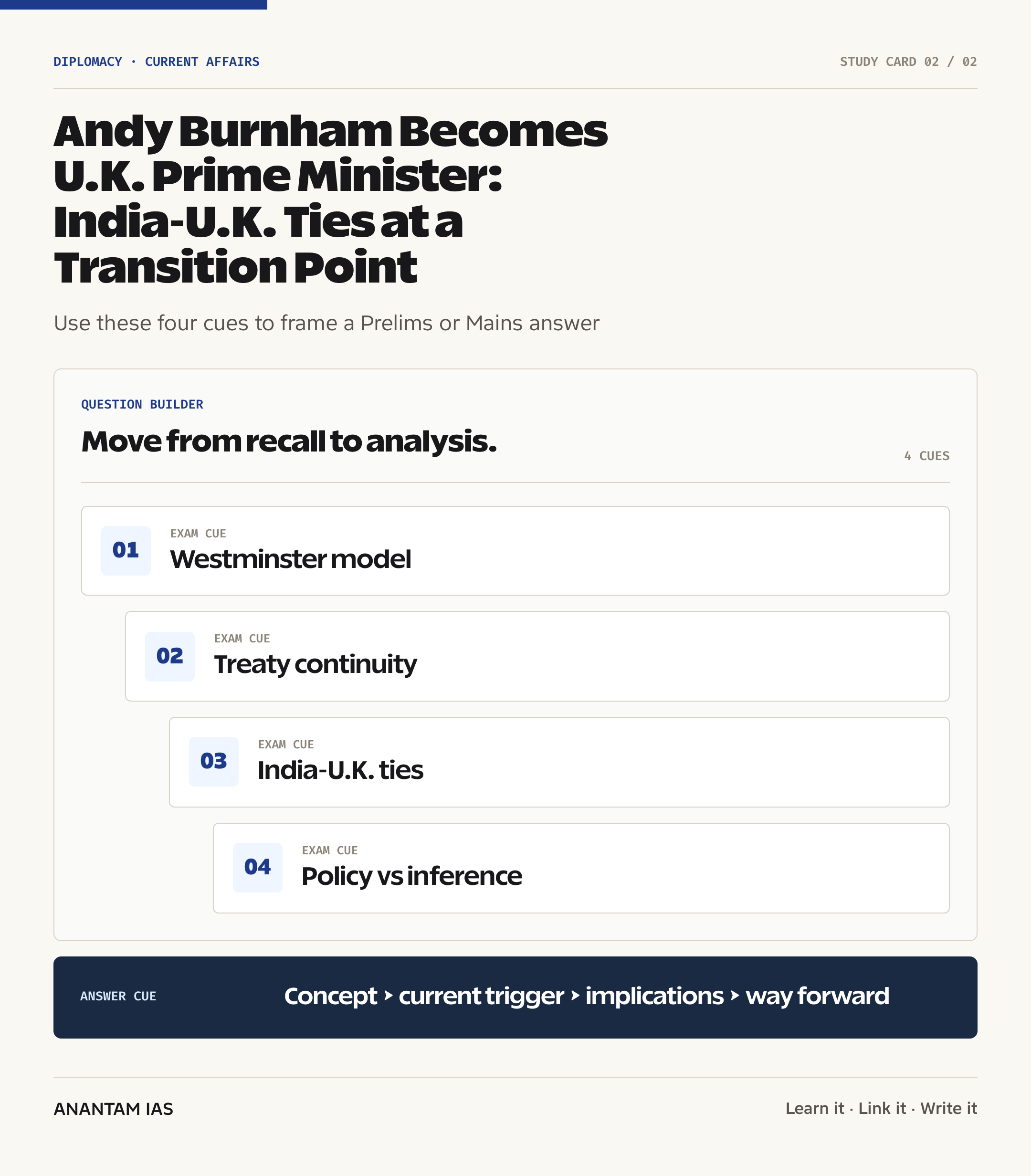
How a British Prime Minister Changes Mid-Parliament
The British transition illustrates constitutional government through conventions rather than a single written constitutional document.
- The House of Commons Library explains that a government must command the confidence of the House of Commons to assume and remain in office.
- When a Prime Minister resigns while the governing party can still command confidence, that party identifies a successor under its own rules. A national election isn’t a legal precondition for every change at 10 Downing Street.
- The Sovereign formally appoints the person best placed to form a government. Modern convention leaves political parties to determine and clearly communicate who can command Commons confidence.
- The distinction is central to the parliamentary form of government: citizens elect MPs, and the executive remains in office through legislative confidence. For comparison, see Anantam IAS’s parliamentary system guide.
- A party leadership change can alter the head of government while the same parliamentary mandate continues. But the new Prime Minister remains accountable to Parliament through debates, questions, legislation, supply and confidence mechanisms.
Burnham's Political and Administrative Background
His career combines national ministerial experience with nearly a decade of devolved metropolitan leadership.
- Burnham first entered Parliament for Leigh in 2001 and served in Cabinet-era roles including Chief Secretary to the Treasury, Culture Secretary and Health Secretary between 2007 and 2010.
- He became Mayor of Greater Manchester in May 2017 and won re-election in 2021 and 2024. GOV.UK credits his mayoralty with bringing the bus network back under public control.
- His regional record supports an inference that devolution, public services and place-based growth may shape his governing style. It doesn’t by itself establish a foreign-policy change.
- His return to the Commons was constitutionally significant because, by modern convention, the Prime Minister sits in the elected chamber.
The India-U.K. Relationship He Inherits
Burnham takes office after India and the U.K. converted a broad strategic partnership into recent operational commitments.
- The India-U.K. Comprehensive Strategic Partnership is organised through political dialogue and sector-specific arrangements rather than a single issue or leader-to-leader relationship.
- The India-U.K. Vision 2035, endorsed in July 2025, sets cooperation across growth, emerging technology, defence and security, climate and clean energy, and education.
- Its technology pillar covers future telecoms, artificial intelligence, critical minerals, semiconductors, quantum technologies, biotechnology and advanced materials under mechanisms such as the Technology Security Initiative.
- Its defence pillar includes a 10-year Defence Industrial Roadmap, cooperation on electric propulsion and jet-engine core technologies, and stronger official-level dialogue.
- These written commitments create institutional continuity across leadership changes.
CETA Is the Immediate Economic Anchor
The most time-sensitive bilateral fact is that the trade agreement entered into force just before the premiership changed.
- The India-U.K. CETA was signed on 24 July 2025 and took effect on 15 July 2026, according to the British High Commission and GOV.UK trade-deal collection.
- The British government’s implementation release says total bilateral trade was worth £48 billion in 2025 and projects a long-run annual increase of £25.5 billion. Projections are scenarios, not guaranteed outcomes.
- From entry into force, the official release says 99% of Indian goods entering the U.K. and 90% of U.K. goods entering India receive either duty-free access or reduced tariffs.
- For the agreement’s provisions and adjustment issues, read the Anantam IAS note on India-U.K. trade gains and costs.
Implications for India: Confirmed Continuity and Open Questions
The safest assessment separates obligations already in force from choices the new government hasn’t yet announced.
- Confirmed continuity: CETA is in force, so tariff schedules and implementation duties continue unless changed through the agreement’s legal mechanisms. A new Prime Minister doesn’t cancel a treaty by taking office.
- Strategic opportunity: Vision 2035 gives both sides ready-made channels in defence technology, critical minerals, clean energy, universities and research. Ministerial appointments and budget choices will show how strongly the new government backs each channel.
- Mobility sensitivity: student, professional and migration rules often carry domestic political weight in Britain. India should distinguish the binding services and mobility provisions from future U.K. immigration policy decisions.
- No verified rupture: the official material reviewed by 21 July 2026 contains no Burnham announcement withdrawing from CETA or Vision 2035. Claims of either a major reset or automatic continuity on every policy detail would run ahead of evidence.
What India Should Watch Next
The content of the relationship will become clearer through appointments, meetings and implementation decisions rather than the succession ceremony alone.
- Watch the new Foreign, Trade, Defence and Home Secretaries, because their portfolios shape diplomacy, CETA implementation, defence cooperation and mobility.
- Track the first India-U.K. leader call or summit statement for explicit references to CETA, Vision 2035 and the Indo-Pacific.
- Follow the agreement’s committees and business guidance for evidence on tariff use, rules-of-origin compliance and services access. Early utilisation rates will be more informative than headline projections.
- Assess whether future fiscal and industrial-policy decisions support the Defence Industrial Roadmap, technology partnerships and climate-finance commitments.
- Keep domestic politics in perspective: Burnham’s first speech focused on British stability and social outcomes. Applying that message to India-U.K. ties requires evidence from later foreign-policy decisions.
Way Forward
Lock in Early CETA Delivery
- India and the U.K. should publish accessible customs and rules-of-origin guidance so small firms can claim preferences correctly.
- The two sides should use formal committees to resolve implementation frictions before they become political disputes.
- Governments should report actual preference use and sectoral trade outcomes instead of relying only on long-run modelled gains.
Institutionalise the Wider Partnership
- Maintain time-bound reviews of Vision 2035 across technology, defence, climate, education and health.
- Protect research and sensitive-technology cooperation through clear safeguards on intellectual property, data and export controls.
- Build multiple ministerial, parliamentary, university and business channels so the relationship doesn’t depend on one leader.
Use Evidence in India's Diplomatic Assessment
- Treat confirmed statements, cabinet appointments and budget allocations as stronger signals than assumptions based on Burnham’s mayoral record.
- Separate legal continuity under CETA from political discretion in migration, spending and foreign-policy emphasis.
- Prepare issue-specific engagement briefs so India can advance concrete proposals when the new British government sets its international agenda.
Conclusion
Andy Burnham’s appointment is constitutionally confirmed and illustrates a defining feature of the Westminster model: the head of government can change mid-Parliament when a successor can command Commons confidence. It doesn’t require treating the change as a new general-election mandate.
For India, the sound starting point is institutional continuity with policy vigilance. CETA is already in force and Vision 2035 supplies a broad roadmap, but Burnham’s exact priorities toward India must be judged from later official decisions. The transition creates a moment for engagement, not a factual basis for predicting either rupture or an automatic strategic upgrade.
UPSC Practice Questions
Prelims MCQ 1
With reference to the appointment of the U.K. Prime Minister, consider the following statements:
- The Monarch formally appoints the Prime Minister.
- The government must command the confidence of the House of Commons.
- Every change of Prime Minister requires a fresh general election.
How many of the above statements are correct?
(a) Only one (b) Only two (c) All three (d) None
Answer: (b) Only two
Explanation:
Statements 1 and 2 are correct. The Monarch’s formal appointment is guided by the confidence convention. A governing party can change its leader and Prime Minister during a Parliament without an automatic general election.
Prelims MCQ 2
Which document provides the current long-term framework for cooperation across growth, technology, defence, climate and education between India and the United Kingdom?
(a) India-U.K. Vision 2035 (b) New Delhi Declaration 2023 (c) Indo-Pacific Economic Framework (d) Windsor Framework
Answer: (a) India-U.K. Vision 2035
Explanation:
India-U.K. Vision 2035, endorsed in July 2025, sets the bilateral roadmap across these five broad pillars. The Windsor Framework concerns post-Brexit arrangements for Northern Ireland.
UPSC Mains Questions
- A change of Prime Minister in a Westminster system may occur without a general election, yet executive legitimacy remains tied to the legislature. Explain the constitutional conventions involved in the U.K. transition and compare them with the Indian constitutional framework for appointing and holding a Prime Minister accountable.
- Leadership transitions can change diplomatic emphasis without automatically displacing treaties and institutional roadmaps. Assess the likely opportunities and uncertainties for India-U.K. relations under Andy Burnham, with particular reference to CETA, Vision 2035, technology cooperation, defence ties, professional mobility and diaspora issues.
Sources: Prime Minister's Office, 10 Downing Street and UK Parliament and The Hindu and Indian Express Explained.
Frequently Asked Questions
When did Andy Burnham become U.K. Prime Minister?
Andy Burnham became U.K. Prime Minister on 20 July 2026. GOV.UK published his first Downing Street speech that day, and the U.K. Parliament lists him as Prime Minister and First Lord of the Treasury from the same date.
Was a U.K. general election held for this change?
No fresh general election was required for this succession. Under the Westminster system, the governing party can select a new leader during a Parliament. The Monarch appoints the person positioned to form a government and command the confidence of the House of Commons.
What offices does the U.K. Prime Minister hold?
The Prime Minister leads His Majesty’s Government and is also normally First Lord of the Treasury, Minister for the Civil Service and Minister for the Union. The officeholder chooses ministers, oversees government and serves as the principal government figure in the Commons.
Does Burnham’s appointment cancel the India-U.K. trade deal?
No. The India-U.K. CETA entered into force on 15 July 2026. A leadership change doesn’t itself cancel a treaty. Any modification or termination would require lawful action under the agreement and domestic processes; no such Burnham announcement was found in the official material reviewed.
What is India-U.K. Vision 2035?
India-U.K. Vision 2035 is the long-term bilateral roadmap endorsed in July 2025. It organises cooperation around growth, technology and innovation, defence and security, climate and clean energy, and education, supported by continuing political engagement and sector-specific mechanisms.
What should India monitor under the new government?
India should track cabinet appointments, the first bilateral leader-level statement, CETA implementation committees, mobility policy, and budget support for technology, defence and clean-energy projects. These decisions will provide firmer evidence than assumptions drawn from Burnham’s earlier domestic record.
Source: https://anantamias.com/current-affairs/andy-burnham-new-uk-prime-minister/
Operation Southern Readiness: Training for Non-Traditional Maritime Threats
Why in News?
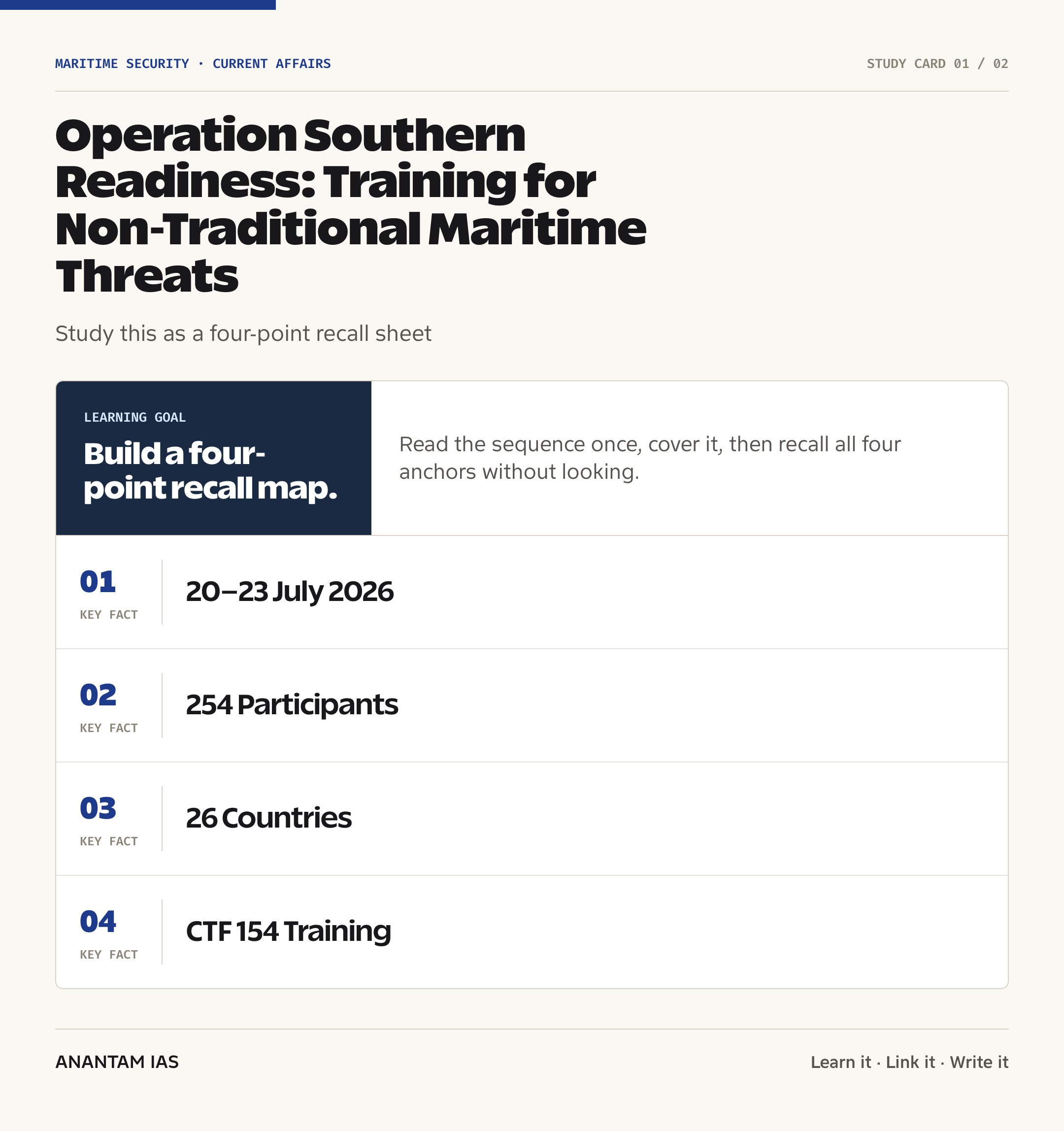
Operation Southern Readiness 26-2, a four-day multinational maritime security training engagement, began at the Southern Naval Command, Kochi, on 20 July 2026. The event runs until 23 July under the aegis of the Indian Navy-led Combined Task Force 154, in partnership with the Combined Maritime Forces.
The Hindu reported that the opening brought together 254 participants from 26 countries, supported by 74 facilitators, representatives of four international organisations and subject experts. This is the first edition of Operation Southern Readiness held in India, with training centred on practical responses to non-traditional maritime threats.
- The Indian Navy is hosting the engagement at its principal training command in Kochi.
- The schedule combines classroom instruction, simulator training and practical exposure from 20 to 23 July 2026.
- The opening-day programme included a UN Office on Drugs and Crime session on threats in the Red Sea and western Indian Ocean.
- Planned modules cover maritime law, domain awareness, counter-narcotics, force protection and asymmetric threats.
- Participants also train in boarding, damage control, firefighting, survival at sea and maritime communications.
- The engagement builds common procedures and professional familiarity; it doesn’t create a treaty-based defence obligation.
The development matters in the context of:
- Shipping routes carry legal commerce and can also be exploited by pirates, traffickers and other illicit non-state actors.
- Many maritime incidents cross jurisdictions, so detection, evidence handling, rescue and prosecution require cross-border coordination.
- Training ashore lets states strengthen skills and common procedures even when they cannot contribute a warship or aircraft.
- India’s command of CTF 154 expands its capacity-building role without converting a flexible partnership into a military alliance.
UPSC Relevance
Prelims Relevance
- Operation Southern Readiness 26-2 was hosted at the Southern Naval Command in Kochi from 20 to 23 July 2026.
- CTF 154, established in May 2023, is the Combined Maritime Forces task force dedicated to maritime security training.
- The Indian Navy assumed its first command of CTF 154 in February 2026 under Commodore Milind M. Mokashi.
- CMF has five task forces: CTF 150, 151, 152, 153 and 154, with different geographic or functional roles.
- Maritime Domain Awareness means an effective understanding of activities that could affect maritime security, safety, economy or environment.
- The International Ship and Port Facility Security Code is made mandatory through Chapter XI-2 of the SOLAS Convention.
- The Global Maritime Distress and Safety System is part of SOLAS and supports alerting, communication and rescue coordination.
- CMF describes itself as a coalition of the willing; its members aren’t bound by a fixed political or military mandate.
- UNODC’s Global Maritime Crime Programme supports maritime law enforcement, legal capacity and regional cooperation.
Mains Relevance
GS Paper 3
- Non-traditional security challenges such as piracy, narcotics trafficking, irregular migration and attacks by non-state actors.
- Role of Maritime Domain Awareness, information sharing, interdiction skills and resilient communications in coastal and maritime security.
- Capacity building for lawful boarding, evidence preservation, search and rescue, damage control and disaster response.
GS Paper 2
- India’s use of flexible maritime partnerships for capacity building and regional public goods.
- Balancing practical cooperation with strategic autonomy, international law and the varied interests of partner states.
- The distinction between an operational partnership and a treaty-based military alliance.
Essay
- Security at sea depends as much on shared skills and trust as on platforms and firepower.
- The ocean is a connected space where local instability can generate transnational risks.
- Strategic autonomy can coexist with issue-based, rules-based cooperation.
Background and Context
Operation Southern Readiness and CTF 154
The engagement belongs to a training architecture designed to improve readiness without requiring every partner to deploy major naval assets.
- Operation Southern Readiness is one of the multinational training formats conducted by CTF 154, alongside activities such as Compass Rose and Maritime Security Enhancement Training.
- The Ministry of Defence confirmed that the Kochi edition is conducted by the Southern Naval Command under the Indian Navy-led CTF 154 and in partnership with CMF.
- Established in May 2023, CTF 154 concentrates on capacity building rather than maintaining a permanently assigned combat force for a single theatre.
- Its five enduring training pillars are maritime awareness, law of the sea, maritime interdiction, maritime rescue and assistance, and leadership development.
- India assumed command of the task force on 11 February 2026 at the CMF headquarters in Manama, Bahrain, for the first time.
- Ashore-based courses widen participation because personnel can join professional training even when their country cannot spare a ship, aircraft or large detachment.
- The Kochi venue gives participants access to the Indian Navy’s simulators, instructional facilities and onboard practical exposure.
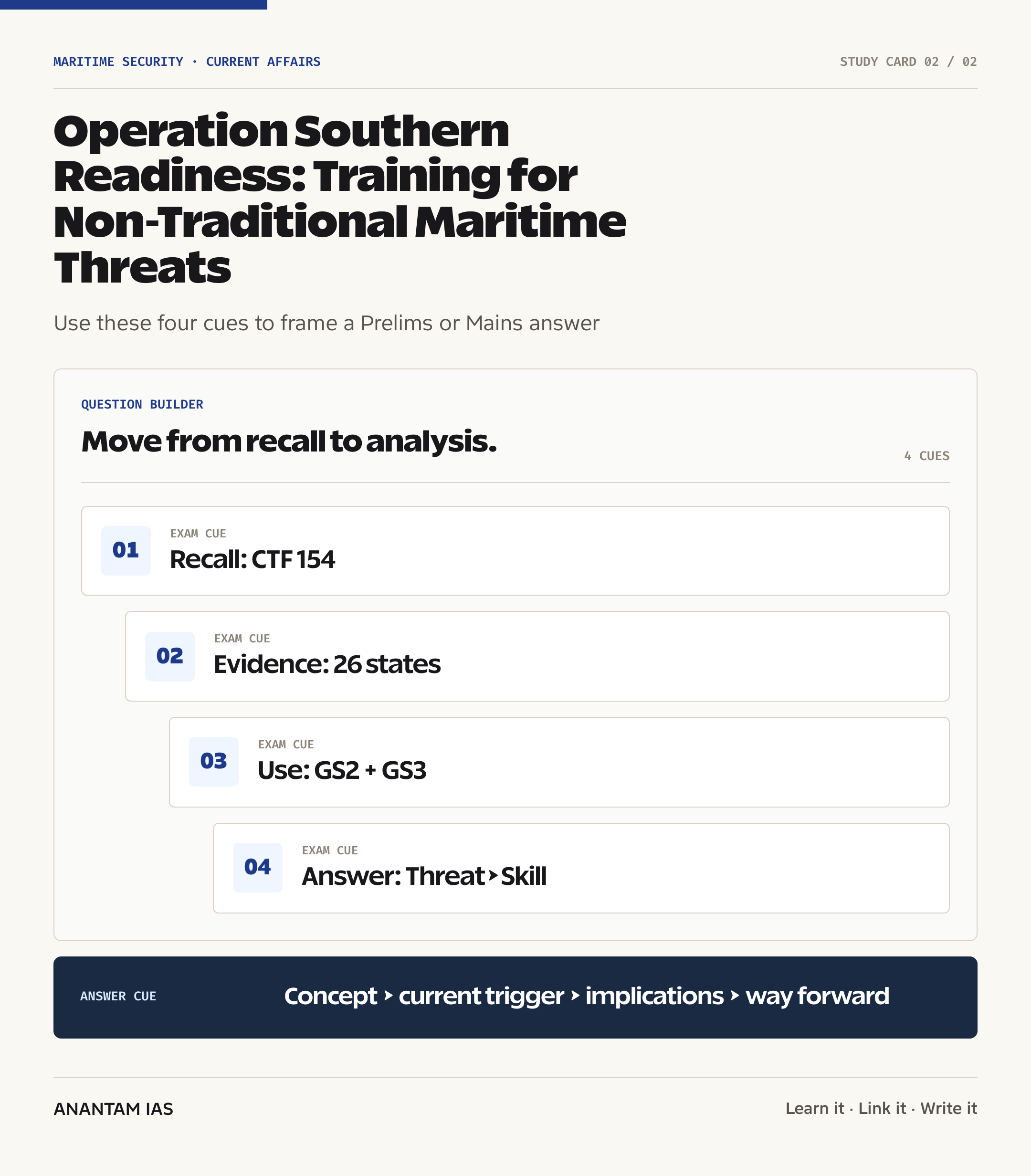
What Counts as a Non-Traditional Maritime Threat?
The term covers security risks that don’t fit a conventional state-versus-state naval conflict but can still disrupt lives, trade and sovereignty.
- Piracy and armed robbery at sea threaten crews, cargo and navigation, while incidents may occur across territorial seas and the high seas under different legal rules.
- Narcotics, arms and human trafficking use maritime routes, small craft, commercial vessels and weakly monitored coastlines to move illicit goods or people.
- Irregular migration combines humanitarian duties with identification, rescue, trafficking investigation and lawful disembarkation challenges.
- Asymmetric threats may involve small boats, drones, improvised devices, sabotage or attacks on shipping and port infrastructure by non-state actors.
- Marine accidents, extreme weather and humanitarian crises demand search and rescue, damage control, firefighting and coordination across agencies.
- Cyber incidents, spoofed identity data and interference with navigation can reduce trust in the maritime information picture even without a visible attack.
- Illegal, unreported and unregulated fishing can overlap with broader maritime crime, but enforcement must respect jurisdiction, flag-state rights and applicable treaties.
Training Design: From Information to Action
The programme connects legal knowledge and shared information with the physical skills needed to manage an incident safely.
- Maritime Domain Awareness brings together vessel identity, position, behaviour, cargo, weather and intelligence so authorities can detect anomalies and prioritise responses.
- Information sharing is useful only when partners apply common terminology, protect sensitive data and establish trusted points of contact before an emergency.
- Boarding procedures require safe approach, authority to board, crew control, search discipline, documentation and proportionate use of force.
- Counter-narcotics training must link interception with chain of custody, evidence preservation and prosecution; a seizure without legally usable evidence is an incomplete outcome.
- Damage-control and firefighting simulators allow repeated practice under pressure without exposing trainees or an operational ship to avoidable risk.
- Maritime communications training complements the distress, urgency and safety communication framework used to coordinate assistance at sea.
- Training on uncrewed systems and asymmetric threats helps personnel examine both their operational value and vulnerability in crowded maritime environments.
Legal and Institutional Framework
Interoperability isn’t permission to act anywhere; maritime cooperation remains bounded by jurisdiction, consent and international law.
- The UN Convention on the Law of the Sea allocates rights and duties across internal waters, territorial seas, exclusive economic zones and the high seas.
- On the high seas, flag-state jurisdiction is the general rule, while limited exceptions and treaty-based powers apply to specific conduct such as piracy.
- The SUA Convention creates a framework for suppressing unlawful acts against the safety of maritime navigation and for cooperation over covered offences.
- SOLAS Chapter XI-2 and the ISPS Code establish preventive security requirements for covered ships and port facilities engaged in international trade.
- The SOLAS radiocommunications framework incorporates GMDSS, while the 1979 SAR Convention promotes coordinated rescue regardless of where distress occurs.
- The developing governance of areas beyond national jurisdiction can be revised through the UNCLOS and BBNJ framework, but it isn’t a general law-enforcement mandate.
- UNODC helps states connect operational training with domestic criminal law, prosecution and judicial cooperation, reducing the gap between interdiction and conviction.
Why the Kochi Edition Matters for India
Hosting the first Indian edition turns India’s command role into a practical contribution to regional maritime capacity.
- The Southern Naval Command is the Indian Navy’s training command, making Kochi a logical site for simulator-led instruction and professional exchanges.
- Leading CTF 154 allows India to shape a training agenda around lawful, interoperable and request-based capacity building rather than only platform deployment.
- Participants can learn from India’s experience in navigation, communications, ship handling, damage control and operating across the Indian Ocean Region.
- The event supports India’s role as a provider of regional public goods, including training, humanitarian assistance, search and rescue and secure sea lanes.
- Professional networks built during courses can shorten coordination time during a later incident, especially where several navies, coast guards and civilian agencies are involved.
- The focus overlaps with other regional efforts against maritime crime, including BIMSTEC security cooperation, but the institutions have distinct memberships and mandates.
- For India, the durable gain lies in standard-setting influence, trust and usable procedures, not in treating one training event as proof of strategic alignment.
Interoperability Without Alliance Overreach
The exercise should be read as functional cooperation against shared risks, not as a new collective-defence commitment. Training capacity can improve without prior agreement on every specific regional political or strategic dispute.
- CMF describes itself as a coalition of the willing whose national contributions vary with capability, availability and sovereign choice.
- Its members aren’t bound by a fixed political or military mandate; participation may range from liaison staff to ships, aircraft or associated support.
- Interoperability here means the ability to communicate, understand procedures and work safely together when states separately choose to cooperate.
- It doesn’t automatically imply common threat perceptions, a mutual-defence clause, permanent basing rights or consent for operations in another state’s waters.
- The presence of 26 participating countries at Kochi also shouldn’t be confused with the total membership of CMF or with a list of states making identical commitments.
- Training against non-state threats can remain politically inclusive because piracy, trafficking, distress and disaster response create shared operational problems.
- India can preserve strategic autonomy by favouring transparent mandates, international law, case-specific consent and capacity building over bloc politics.
Operational Gaps to Watch
A training event creates readiness only when lessons survive beyond the classroom and remain lawful under real operational pressure.
- Partners may use different languages, equipment, rules of engagement and legal thresholds, so a shared drill doesn’t erase institutional differences.
- Information sharing faces concerns about classification, data protection, source exposure and the unequal ability to maintain surveillance systems.
- Smaller states may need sustained maintenance, refresher courses and instructor development rather than a one-time transfer of advanced procedures.
- Boarding and interdiction can fail in court if personnel don’t preserve evidence, document authority or coordinate early with prosecutors and flag states.
- Uncrewed systems and digital tools introduce dependence on resilient communications, cyber protection and procedures for misidentification or spoofing.
- Success should be assessed through improved response time, safer boarding, valid prosecutions and stronger rescue coordination, not only participant counts.
- Regular after-action reviews can turn diverse national experience into updated curricula while respecting sovereign operational limits.
Way Forward
Build a Repeatable Training Cycle
- Convert lessons from Kochi into standard operating procedure modules, refresher courses and train-the-trainer packages for partner institutions.
- Use scenario-based exercises that connect detection, decision, boarding, rescue, evidence handling and post-incident review in one chain.
Join Operations with Law
- Include maritime lawyers, coast guards, customs officers, investigators and prosecutors so an operational success can become a legally sustainable case.
- Practise jurisdiction checks, flag-state contact, treatment of rescued persons and chain-of-custody protocols before deployment.
Make Information Sharing Trustworthy
- Agree on minimum data fields, contact points, classification rules and verification steps for a common maritime picture.
- Pair advanced sensors with basic reporting networks so capacity gaps don’t exclude smaller partners from situational awareness.
Protect Strategic Autonomy
- Keep participation transparent, request-based and consistent with international law and national consent.
- Measure cooperation by public-security outcomes rather than alliance symbolism or the number of platforms displayed.
Conclusion
Operation Southern Readiness 26-2 shows why maritime security is a systems problem. Surveillance may detect a suspicious vessel, but a lawful response still requires communications, trained boarding teams, rescue capability, evidence handling and coordination across national agencies.
For India, hosting the engagement at Southern Naval Command converts leadership of CTF 154 into a concrete capacity-building role. The strongest interpretation is practical: India is helping partners prepare for shared non-state and humanitarian risks while expanding professional trust.
That value shouldn’t be inflated into an alliance claim. CMF’s flexible structure leaves contributions to sovereign choice. The durable test is whether common training produces faster, safer and legally sound cooperation when a real incident occurs.
UPSC Practice Questions
Prelims MCQ 1
With reference to Operation Southern Readiness 26-2, consider the following statements:
- It was hosted at the Southern Naval Command in Kochi.
- It was conducted under CTF 154, the Combined Maritime Forces task force dedicated to training.
- Participation in CMF creates a fixed collective-defence obligation for every member.
How many of the above statements are correct?
(a) Only one (b) Only two (c) All three (d) None
Answer: (b) Only two
Explanation:
Statements 1 and 2 are correct. CMF is a flexible coalition of the willing; its members aren’t bound by a fixed political or military mandate.
Prelims MCQ 2
Which one of the following best describes Combined Task Force 154?
(a) A treaty body for settling maritime boundaries (b) A CMF task force for multinational maritime security training (c) A UN peacekeeping fleet permanently based in Kochi (d) An Indian coastal police unit for port security
Answer: (b) A CMF task force for multinational maritime security training
Explanation:
CTF 154 is CMF’s dedicated training task force. Its core areas include maritime awareness, law, interdiction, rescue and assistance, and leadership development.
UPSC Mains Questions
- Non-traditional maritime threats blur the boundary between security, law enforcement and humanitarian response. Using Operation Southern Readiness 26-2 as context, analyse how domain awareness, legal interoperability, interdiction training and rescue capacity can improve cooperative security in the Indian Ocean Region. (15 marks, 250 words)
- India’s leadership of CTF 154 expands its regional capacity-building role but doesn’t create a military alliance. Discuss the strategic benefits of flexible maritime partnerships and the safeguards needed to preserve sovereign choice, strategic autonomy and compliance with international law. (15 marks, 250 words)
Sources: PIB, Ministry of Defence and The Hindu.
Frequently Asked Questions
What is Operation Southern Readiness 26-2?
It is a four-day multinational maritime security training engagement held at the Southern Naval Command in Kochi from 20 to 23 July 2026. Conducted under the Indian Navy-led CTF 154 with CMF, it combines classroom, simulator and practical training for shared maritime security challenges.
Who participated in the Kochi exercise?
The opening brought together 254 participants from 26 countries, supported by 74 facilitators, representatives of four international organisations and subject experts. The reports don’t identify every participating country, so the figure shouldn’t be treated as a confirmed country-by-country roster or as the total CMF membership.
What is Combined Task Force 154?
CTF 154 is the Combined Maritime Forces task force dedicated to multinational maritime security training and capacity building. Established in May 2023, it works across maritime awareness, law of the sea, interdiction, rescue and assistance, and leadership development. The Indian Navy assumed command in February 2026.
Which skills were covered in training?
The programme covers maritime law, domain awareness, information sharing, counter-narcotics, force protection, asymmetric threats and uncrewed systems. Practical modules include boarding, ship handling, navigation, maritime communications, survival at sea, damage control and firefighting, supported by simulators and onboard exposure.
Does CMF membership mean a military alliance?
No. CMF calls itself a coalition of the willing, and its members aren’t bound by a fixed political or military mandate. Contributions vary by national decision and availability. Interoperability in this setting means the ability to communicate and work together when states choose to cooperate, not automatic collective defence.
Why do non-traditional maritime threats need cooperation?
Piracy, trafficking, irregular migration, maritime accidents and attacks by non-state actors can cross jurisdictions and affect several countries. A sound response may require shared information, rescue coordination, lawful boarding, evidence preservation and prosecution support. No single navy or agency controls every link in that chain.
Source: https://anantamias.com/current-affairs/operation-southern-readiness-maritime-security/
Odisha PVTG Nutrition: Anaemia and Adolescent Stunting Gaps
Why in News?
A Utkal University study released on 20 July 2026 found serious Odisha PVTG nutrition gaps, including anaemia among more than half of the adult women studied and stunting among just over half of the female adolescents assessed.
The evidence comes from 10 of Odisha’s 13 PVTGs. It is a large field study, but it isn’t an Odisha-wide nutrition survey. That distinction matters because each percentage describes a defined study group, age band and indicator.
- The Hindu reported that researchers covered 9,222 individuals from 2,041 households in seven districts: Malkangiri, Rayagada, Kandhamal, Keonjhar, Deogarh, Mayurbhanj and Gajapati.
- The released study covered the Bonda, Didayi, Dongria Kandha, Kutia Kandha, Juang, Paudi Bhuiya, Hill Kharia, Mankidia, Lodha and Lanjia Saora communities.
- Among the adult women studied, more than 53% were anaemic. Among 1,015 adult men, the reported anaemia prevalence was 36.95%.
- Stunting affected 50.74% of female adolescents assessed. The reported group rates were highest among Hill Kharia, 82.76%, followed by Paudi Bhuiya, 72.73%, and Juang, 53.49%.
- Among male adolescents assessed, 30.88% were thin. The study also reported a 59% home-delivery rate and signs of emerging blood-pressure and random-blood-sugar risks.
The development matters in the context of:
- The study links tribal welfare with the nutrition continuum: an adolescent girl’s nutrition affects her present health and can shape pregnancy outcomes and the next generation’s growth.
- The figures support differentiated planning. A single state average can hide sharp intra-PVTG variation, such as the spread in adult male anaemia across Mankidia, Bonda, Lodha and Lanjia Saora participants.
- Related notes on counting PVTGs explain the data problem, while the nutrition survey gap shows why age group and denominator must travel with every percentage.
- The policy test isn’t only whether food or tablets exist. It is whether ASHA, ANM and Anganwadi services reach remote habitations regularly, in a language and form that communities can use.
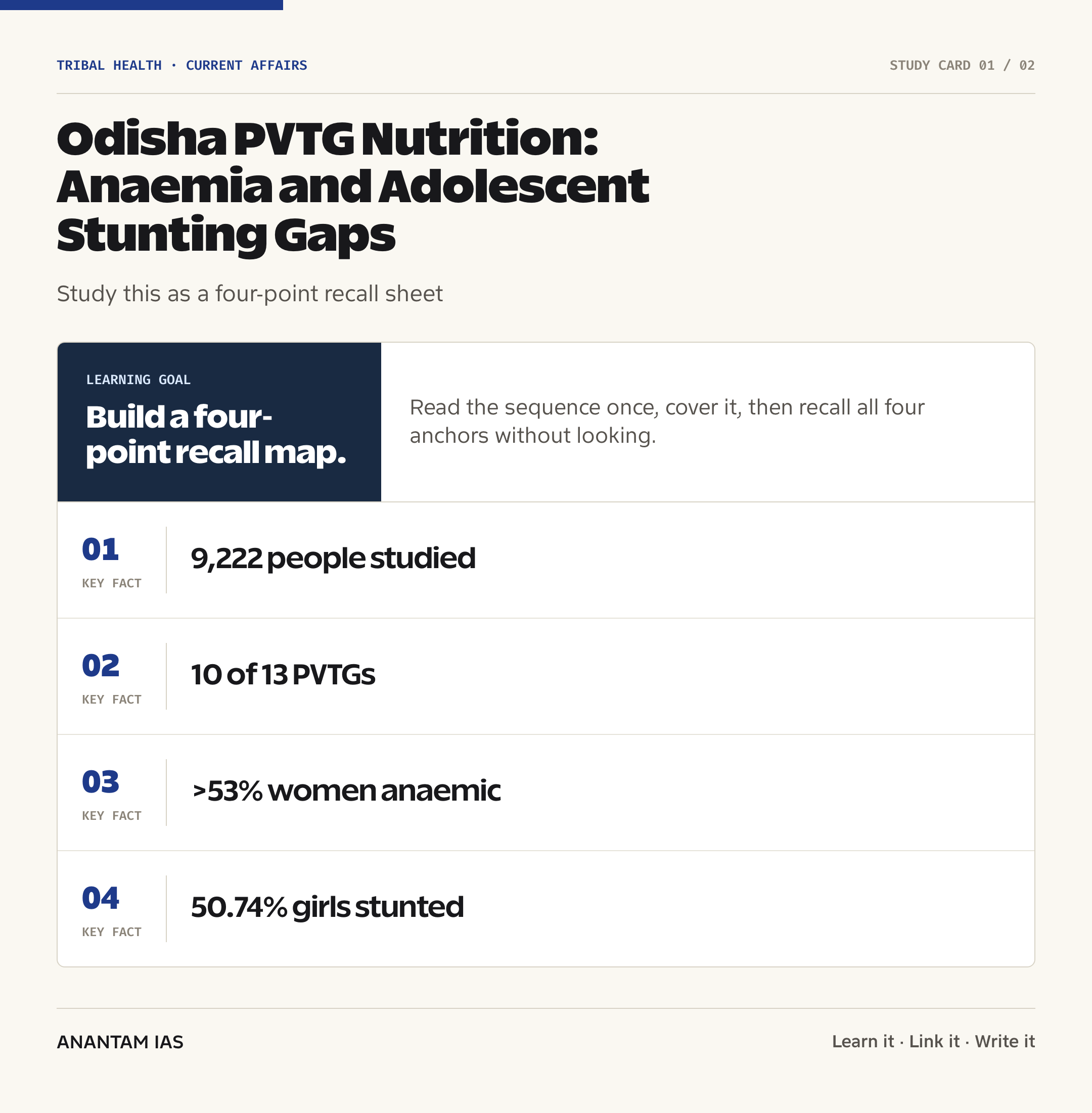
UPSC Relevance
Prelims Relevance
- Particularly Vulnerable Tribal Groups are an administrative sub-category within Scheduled Tribes, not a separate category named in the Constitution.
- India has 75 PVTG communities across 18 States and one Union Territory, according to the Ministry of Tribal Affairs.
- Odisha has 13 PVTGs, the highest number for any State; the Utkal University study covered 10 of them.
- Stunting means low height for age and indicates chronic or repeated undernutrition. Thinness in adolescents is commonly assessed through age-specific body-mass measures.
- Anaemia is low haemoglobin, but iron deficiency isn’t its only cause. Infection, malaria, parasitic infestation, haemoglobinopathies and other micronutrient deficiencies can contribute.
- PM-JANMAN seeks saturation of basic services for PVTG families and habitations through 11 interventions by nine ministries.
- The updated Anaemia Mukt Bharat Abhiyaan uses a life-cycle approach covering children, adolescents, pregnant and lactating women, women of reproductive age and low-birth-weight infants.
- Article 46 directs the State to promote the educational and economic interests of weaker sections, especially Scheduled Castes and Scheduled Tribes, and protect them from social injustice and exploitation.
Mains Relevance
GS Paper 2
- Welfare schemes for vulnerable sections, mechanisms and institutions for their protection and betterment, with PVTGs as the most vulnerable segment within Scheduled Tribes.
- Issues relating to development and management of health and human resources, especially last-mile maternal, adolescent and nutrition services in remote habitations.
- Government policies and implementation problems, including the gap between scheme eligibility and effective service saturation.
GS Paper 1
- Salient features of Indian society and diversity, including how language, livelihood, terrain and food systems shape health-seeking behaviour.
- Role of women and population issues, especially the intergenerational cycle connecting adolescent nutrition, maternal health and child growth.
Essay
- A welfare state is measured not by the number of schemes announced, but by whether its hardest-to-reach citizens can use them.
- Equality offers the same service; equity redesigns delivery around unequal distance, language, nutrition and social constraints.
Background and Context
How to Read the Study Evidence
The percentages are valuable only when the sample, age group and indicator stay attached to them.
- The released-study account reports 9,222 people, 2,041 households and 10 PVTGs. It doesn’t cover all 13 Odisha PVTGs, so its findings shouldn’t be converted into a prevalence estimate for every PVTG person in the State.
- Utkal University’s project page lists 2,051 households for its ethnographic data collection, while The Hindu’s account of the released study gives 2,041. The two figures may reflect different project stages or components and shouldn’t be merged.
- The NFHS-5 Odisha State Fact Sheet, 2019-21, reported 64.3% anaemia among all women aged 15-49 and 31.0% stunting among under-five children. Those state-representative groups differ from this study’s adult women and female adolescents, so direct ranking is unsound.
- A fair comparison also needs the same laboratory method, threshold and survey period. Without those details, a higher or lower percentage may reflect measurement and sampling differences rather than a proven change in underlying health.
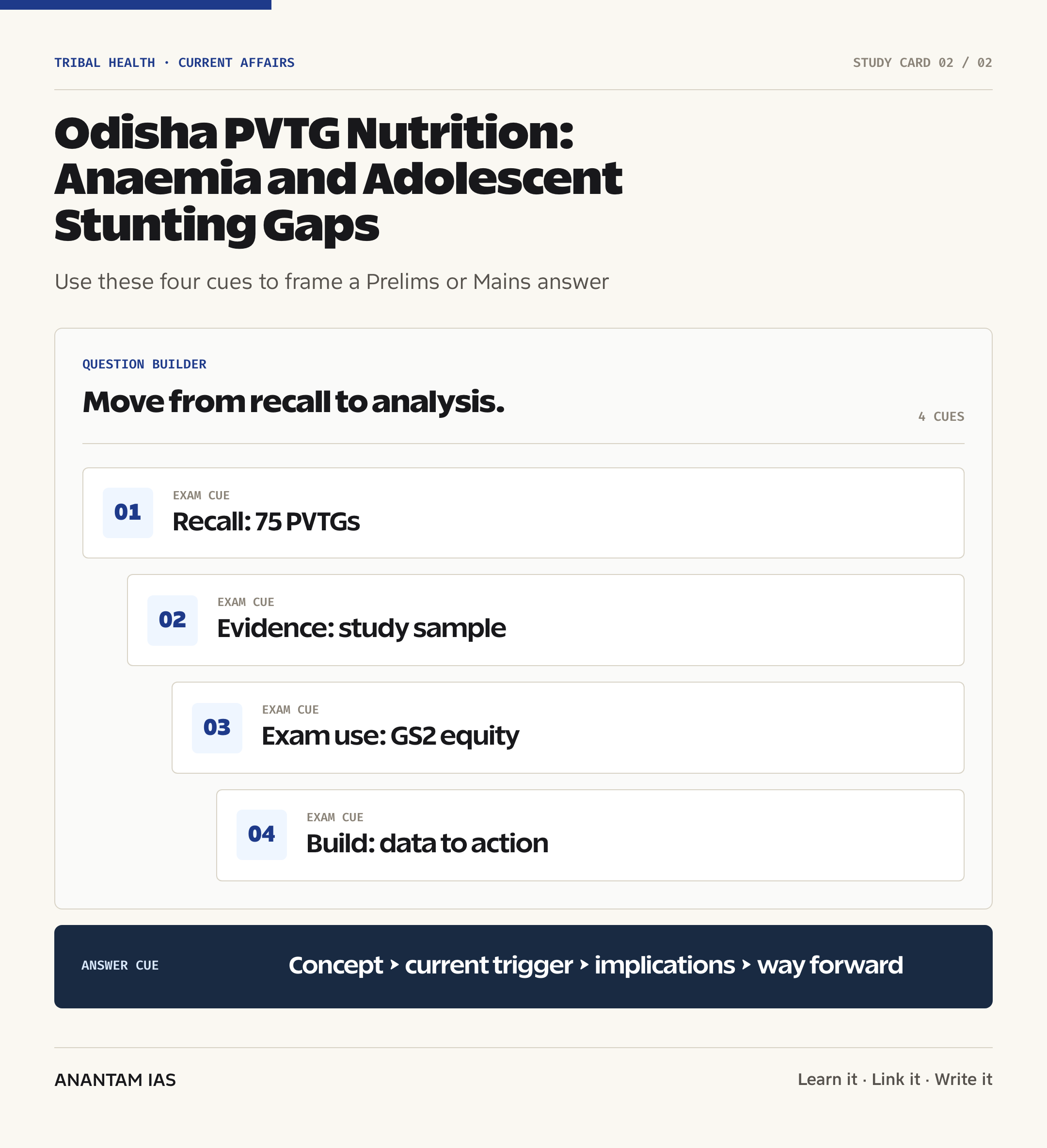
What the Nutrition Indicators Mean
Anaemia, stunting and thinness describe different biological problems, not three labels for the same condition.
- Anaemia describes haemoglobin below the relevant threshold. It can reduce work capacity and, during pregnancy, raise risks of prematurity and low birth weight, but diagnosis must also examine non-iron causes.
- Stunting, low height for age, reflects long-duration growth restriction. Among adolescents it can carry childhood deprivation forward and signal that nutrition recovery hasn’t caught up with the growth spurt.
- Thinness captures low body mass relative to age among adolescents. The study’s 30.88% figure concerns male adolescents assessed, not all children and not the same measure as under-five wasting.
- None of these indicators identifies a single cause on its own. Diet, infection, sanitation, workload, puberty, pregnancy and inherited blood disorders can overlap, so screening must lead to clinical assessment rather than an automatic one-cause conclusion.
Variation Within the Study Population
The most policy-relevant finding is the variation between communities, not a single pooled headline.
- Adult male anaemia was 59.18% among Mankidia and 56.30% among Bonda participants, compared with the study’s pooled adult male prevalence of 36.95%.
- The corresponding reported rates were 47.32% among Lodha and 39.26% among Lanjia Saora men. Different local burdens call for local diagnosis, food mapping and follow-up.
- Male-adolescent thinness was reported at 48.15% among Didayi, 44.74% among Lodha, 40% among Hill Kharia and 36% among Bonda participants. Pooling can hide precisely the communities needing the earliest response.
- The report also notes emerging blood-pressure and random-blood-sugar risks. This possible double burden, undernutrition alongside metabolic risk, means programmes shouldn’t assume that every adult health problem is explained by calorie shortage alone.
Why a Life-Cycle Lens Matters
Nutrition risk accumulates across adolescence, pregnancy, infancy and childhood, so one age-specific intervention can’t break the cycle.
- An adolescent girl enters pregnancy with the nutrition built during childhood and puberty. Stunting and anaemia can sit in the same life history even though they measure different outcomes.
- A reported 59% home-delivery rate in the study points to continuity-of-care gaps, but it shouldn’t be compared casually with statewide institutional-birth data because the populations and study designs differ.
- The service chain runs through Anganwadi centres, schools, ASHAs, ANMs, Ayushman Arogya Mandirs and referral facilities. A missed link can mean no screening, irregular supplements or delayed treatment.
- A life-cycle response follows the person, not the scheme calendar: adolescent screening, preconception nutrition, antenatal testing, safe delivery, breastfeeding support and child growth monitoring must connect through shared referral and follow-up records.
Policy Architecture for PVTG Health
India already has schemes for nutrition and tribal development; the hard part is convergent delivery at habitation level.
- PM-JANMAN, launched in 2023-24, targets 75 PVTG communities with housing, drinking water, education, health and nutrition, connectivity, electrification and livelihoods.
- Anaemia Mukt Bharat combines supplementation, testing and treatment, deworming, food fortification, diet communication and attention to non-nutritional causes.
- The National Sickle Cell Anaemia Elimination Mission matters in tribal areas because a haemoglobinopathy can cause anaemia that food advice or iron tablets alone won’t correct.
- The child-health and anaemia continuum works only when screening results lead to treatment, repeat testing and referral rather than a one-day camp.
- The 2026 Anaemia Mukt Bharat Abhiyaan guidelines expand the earlier 6x6x6 design to a 7x7x7 framework, adding low-birth-weight babies, stronger therapeutic management, locally available iron-rich foods and digital monitoring.
Rights, Culture and Last-Mile Delivery
Culturally responsive care changes the delivery method without lowering the medical standard.
- Article 46 supplies the social-justice direction, while Article 244 and the Fifth Schedule frame administration of Scheduled Areas in States such as Odisha.
- Language support, women community workers, seasonal outreach and respect for local food knowledge can improve trust. But cultural sensitivity can’t become an excuse for absent diagnostics, unsafe delivery or untreated severe anaemia.
- Gram Sabhas and PVTG institutions should help identify access barriers and suitable timings. Clinical protocols, consent, privacy and referral standards must remain uniform.
- The Panchayats (Extension to Scheduled Areas) Act, 1996 gives Gram Sabhas a central role in Scheduled Areas. That participation can make nutrition planning locally grounded, but departments remain accountable for staff, supplies, diagnostics and emergency transport.
Determinants Behind the Health Gap
A nutrition programme misses the problem when it treats food intake as the only variable.
- Remote settlements can face long travel times, seasonal road breaks and weak phone networks. For a pregnant woman or severely anaemic adolescent, distance becomes a clinical risk when screening, referral or emergency transport is delayed.
- Dietary diversity depends on forest access, cultivation, wages, markets, the Public Distribution System and seasonal availability. A calorie entitlement may prevent hunger while still leaving gaps in iron, protein, folate, vitamin B12 or vitamin C.
- Unsafe water, malaria and intestinal parasites can repeatedly drain nutritional gains. Convergence must connect Jal Jeevan Mission, sanitation, vector control, deworming and primary care with food and supplementation programmes.
- Women and girls may eat last, carry heavy work burdens or lack control over travel and care-seeking. These gendered constraints can’t be corrected by counselling the individual while household and service barriers remain unchanged.
- Traditional foods and ethnomedicinal knowledge can support programme design when communities choose to share them. But clinical safety and informed consent require testing claims rather than treating every customary practice as either automatically effective or automatically backward.
Turning Local Evidence Into Administration
The study is most useful as a targeting tool and baseline for follow-up, not as a label attached permanently to a community.
- District teams should convert group-level findings into habitation micro-plans: who needs repeat haemoglobin testing, which adolescents missed school-based services, where transport fails and which facility receives referrals.
- Process counts such as tablets issued or camps held are easy to inflate. Better indicators include screening coverage, treatment completion, haemoglobin recovery, growth follow-up, referral arrival and respectful-care feedback from women and adolescents.
- Small PVTG populations create privacy risks. Public dashboards should show enough disaggregation to reveal inequity while suppressing cells that could expose an individual’s health condition, pregnancy or genetic status.
- Independent evaluation should compare like with like across time. Use the same age bands, anthropometric standards, haemoglobin method, season and sampling frame, then report confidence limits and attrition instead of presenting a lone percentage as proof of success.
- Financing should follow the diagnosed bottleneck. A district with repeated IFA stock-outs needs supply-chain repair; a habitation with high home delivery may need transport and trusted birth planning; a community with persistent stunting needs years of child and adolescent follow-up, not a short nutrition drive.
- This is the larger governance lesson: evidence must travel into budgets, rosters, supply chains and review meetings. Research has little public value if its sharpest findings stop at a release ceremony.
Way Forward
Create Group-Specific Nutrition Dashboards
- Disaggregate anaemia, adolescent growth, pregnancy and service-use data by PVTG, sex, age, habitation and season while protecting small-community privacy.
- Publish the denominator and measurement method beside every rate so administrators don’t mistake a local sample for a state estimate.
Diagnose Before Treating
- Pair haemoglobin testing with protocols for malaria, helminths, sickle-cell disease, dietary gaps and referral of moderate or severe cases.
- Track IFA receipt, consumption, adverse effects, repeat testing and recovery, not tablet distribution alone.
Reach Adolescents Beyond School
- Combine school and community outreach so out-of-school girls and boys receive growth assessment, WIFS, deworming, counselling and referral.
- Use locally available pulses, millets, greens, animal-source foods where accepted, and vitamin-C combinations rather than a generic menu detached from local seasons.
Make Maternal Care Continuous
- Map pregnancy early, plan transport before labour and connect ASHA, ANM, Anganwadi and referral facilities for antenatal care, safe delivery and postnatal follow-up.
- Measure travel time, stock-outs, language access and failed referrals as service-quality indicators under PM-JANMAN.
Co-Design and Independently Evaluate
- Let PVTG women, adolescents and Gram Sabhas shape outreach timings, counselling language and acceptable foods while trained health teams retain diagnostic responsibility.
- Commission repeat surveys with clear sampling and comparable age groups to test whether community-specific action reduces gaps over time.
Conclusion
The Utkal University study provides a warning and a map for action: anaemia and impaired growth are substantial in the surveyed communities, but their intensity varies sharply. Policy loses that signal when it treats Odisha’s 13 PVTGs as one uniform population.
The workable response is convergence with precision: diagnose the cause, follow the same person across the life cycle, adapt delivery to each habitation and publish denominators honestly. PM-JANMAN can close the access gap only when saturation means care received and completed, not services listed on paper.
UPSC Practice Questions
Prelims MCQ 1
With reference to Particularly Vulnerable Tribal Groups (PVTGs), consider the following statements:
- India has 75 PVTG communities across 18 States and one Union Territory.
- PVTGs form a separate constitutional category distinct from Scheduled Tribes.
- Odisha has 13 PVTGs.
How many of the above statements are correct?
(a) Only one (b) Only two (c) All three (d) None
Answer: (b) Only two
Explanation:
Statements 1 and 3 are correct. PVTG is an administrative sub-category within Scheduled Tribes, not a separate category created by the Constitution.
Prelims MCQ 2
Which is the most methodologically sound reading of the Odisha PVTG study?
(a) Its female-adolescent stunting rate is directly comparable with NFHS under-five stunting (b) Its adult-women anaemia rate represents every PVTG woman in Odisha (c) Its 36.95% adult-male anaemia rate refers to the 1,015 men studied (d) Its findings cover all 13 PVTGs in Odisha
Answer: (c) Its 36.95% adult-male anaemia rate refers to the 1,015 men studied
Explanation:
The study covered 10 PVTGs and defined participant groups. Different ages, samples and indicators can’t be treated as directly comparable population estimates.
UPSC Mains Questions
- The coexistence of anaemia, adolescent stunting and emerging metabolic risk among Particularly Vulnerable Tribal Groups shows why tribal health can’t be reduced to food supplementation alone. Examine the social determinants and institutional gaps involved, and suggest a convergent life-cycle response. (15 marks, 250 words)
- A uniform welfare scheme may produce unequal outcomes across culturally and geographically distinct PVTG communities. Discuss how disaggregated evidence, community participation and habitation-level service saturation can improve nutrition policy without weakening common standards of clinical care and accountability. (15 marks, 250 words)
Sources: Utkal University Centre of Excellence in Studies on Tribal and Marginalised Communities and The Hindu.
Frequently Asked Questions
What did the Odisha PVTG study find?
The Utkal University study reported anaemia in more than 53% of adult women studied, 36.95% of 1,015 adult men, stunting in 50.74% of female adolescents assessed and thinness in 30.88% of male adolescents assessed. These are study findings from 10 PVTGs, not statewide estimates for every PVTG person.
How large was the study sample?
The Hindu’s account of the released study reports 9,222 individuals from 2,041 households across 10 PVTGs and seven Odisha districts. Utkal University’s broader project page lists 2,051 households for an ethnographic component, so the two household counts shouldn’t be combined or treated as the same denominator.
Is stunting the same as thinness?
No. Stunting is low height for age and usually signals chronic or repeated growth restriction. Adolescent thinness reflects low body mass relative to age. The study reported stunting for female adolescents and thinness for male adolescents, so swapping the labels would change both the biological meaning and the population described.
Can these figures be compared directly with NFHS-5?
Not directly. NFHS-5 is a state-representative household survey with specified age groups, including women aged 15-49 and children under five. The Utkal study covers selected participants from 10 PVTGs and reports some adolescent indicators. A comparison must align age, sex, indicator, sampling frame and measurement method.
What is PM-JANMAN’s role in tribal health?
PM-JANMAN targets 75 PVTG communities across 18 States and one Union Territory. Its 11 interventions, implemented through nine ministries, seek to saturate PVTG families and habitations with housing, water, education, health and nutrition, connectivity, electricity and livelihood services. Health outcomes depend on whether that convergence reaches each habitation.
Why isn’t iron supplementation alone enough?
Iron deficiency is one cause of anaemia, but malaria, intestinal worms, sickle-cell disease, other haemoglobin disorders, infection and micronutrient deficiencies can also lower haemoglobin. Effective control needs testing, cause-specific treatment, diet diversity, deworming where indicated, repeat measurement and referral, alongside reliable iron and folic acid delivery.
Source: https://anantamias.com/current-affairs/odisha-pvtg-women-anaemia-stunting-study/
Public Education Financing: Reading the Union Budget Share Correctly
Why in News?
An Indian Express analysis published on 21 July 2026 renewed debate on public education financing by tracking the Ministry of Education’s share in Union expenditure. It placed that share at about 4.6% in 2013-14 and 2.5% in 2025-26.
The comparison matters because an allocation can rise in rupee terms while losing relative weight in an expanding Budget. Official documents put the Ministry’s 2025-26 Budget Estimate at ₹1,28,650.05 crore against total Union expenditure of ₹50,65,345 crore, which works out to about 2.54%.
- The article used a series beginning in 2009-10 and focused on a ministry’s share of overall Union expenditure, not merely the annual change in its nominal allocation.
- The Ministry of Education consists of the Department of School Education and Literacy and the Department of Higher Education.
- The official 2026-27 Budget Estimate raises the Ministry’s allocation to ₹1,39,289.48 crore; against total Union expenditure of ₹53,47,315 crore, its share is about 2.61%.
- The small movement from roughly 2.54% to 2.61% does not erase the longer decline identified in the 2013-14 to 2025-26 comparison, but estimate categories must be matched before drawing a trend line.
- The debate is especially relevant to the National Education Policy 2020, which asks the Centre and states together to take public investment in education to 6% of GDP.
The development matters in the context of:
- This matters in the context of state capacity: classrooms, teachers, scholarships, laboratories and regulators need predictable multi-year financing, not only one-time announcements.
- It also matters in the context of educational accountability: more money is an input, while access, retention, learning and integrity of examinations are outcomes.
- The Union Ministry’s share is only one lens because state governments finance a large part of school and higher education expenditure.
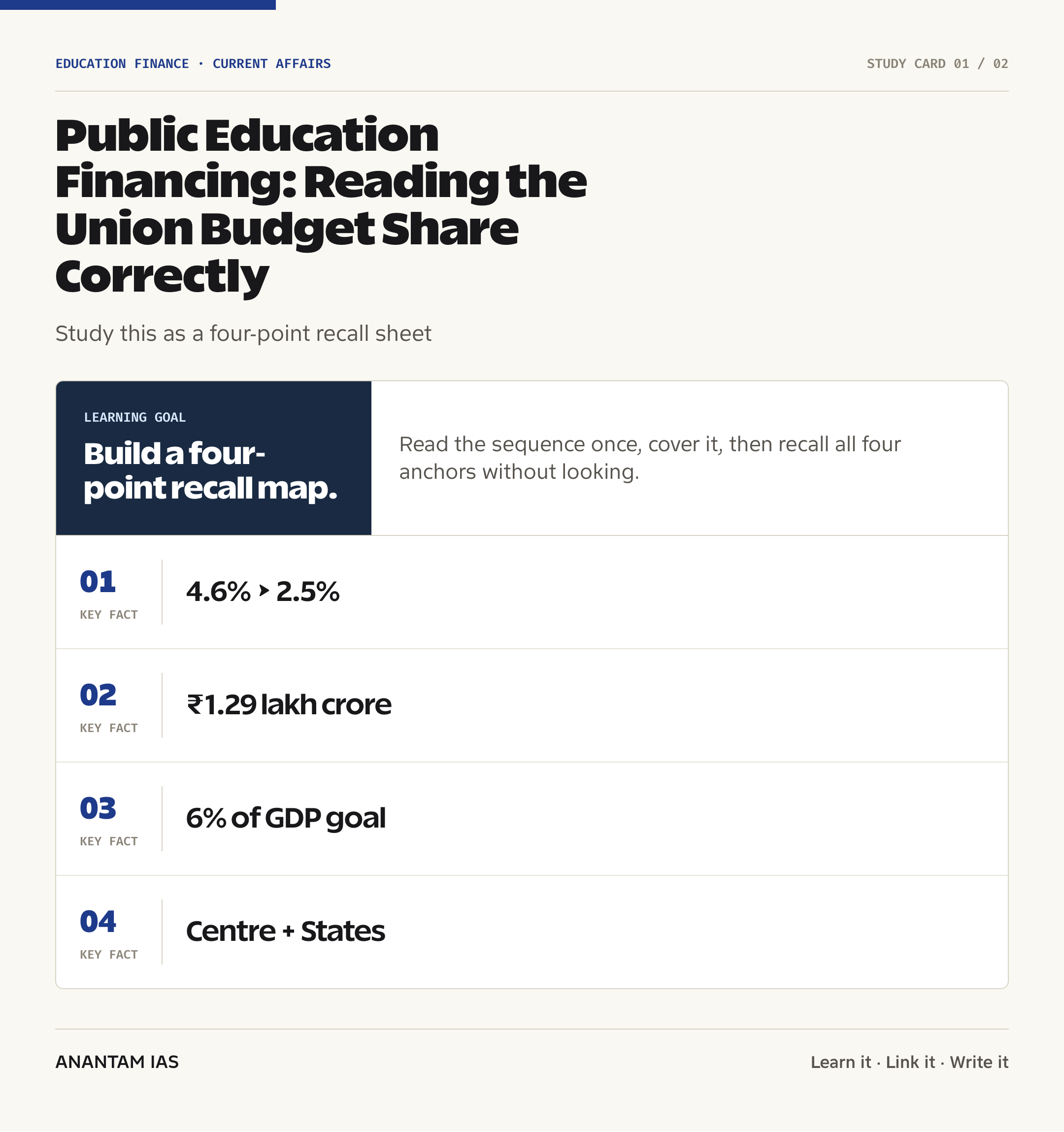
UPSC Relevance
Prelims Relevance
- Under the Seventh Schedule, education is in the Concurrent List, so both Parliament and state legislatures can make laws on the subject.
- The Ministry of Education has two departments: School Education and Literacy and Higher Education.
- A Budget Estimate (BE) is the amount proposed for the coming financial year; a Revised Estimate (RE) updates the likely expenditure during that year.
- An Actual records expenditure after the financial year closes and can differ from both BE and RE.
- The 6% of GDP goal in NEP 2020 applies to combined public investment by the Centre and states, not only to the Union Ministry of Education.
- The Ministry’s share in the Union Budget uses total Union expenditure as the denominator; education expenditure as a share of GDP uses a different denominator and often a wider set of governments.
- The Right of Children to Free and Compulsory Education Act, 2009 operationalises the entitlement under Article 21A for children aged six to fourteen years.
- Samagra Shiksha is an integrated centrally sponsored school-education scheme spanning pre-school to Class XII.
- PM POSHAN supports nutritional provision in eligible schools, linking education finance with attendance, health and equity.
Mains Relevance
GS Paper 2
- Assess education as a public good and as a means of substantive equality, social mobility and human-capital formation.
- Examine how fiscal federalism affects delivery when the Union sets national goals but states run most school systems and many universities.
- Connect financing with Article 21A, the RTE Act, inclusion of disadvantaged groups and accountability for learning outcomes.
GS Paper 3
- Link education spending to demographic dividend, productivity, employability, research capacity and long-run growth.
- Discuss expenditure quality through outcome budgeting, fund-release timing, absorption capacity and evaluation.
Essay
- A nation reveals its development priorities through the balance between physical infrastructure and human capabilities.
- Public money creates opportunity only when adequate inputs are joined with accountable institutions and equitable access.
- Education is both an individual ladder of mobility and a collective democratic investment.
Background and Context
The denominator changes the story
Budget debates often mix absolute allocations, expenditure shares and GDP ratios even though each answers a different question.
- A rise from one rupee amount to another shows nominal growth; it does not by itself show whether education gained priority relative to all Union spending.
- The ratio Ministry allocation ÷ total Union expenditure measures the Ministry’s relative claim on the Union Budget.
- The ratio public education expenditure ÷ GDP is broader: it can include spending by both the Centre and states and compares that spending with the size of the economy.
- A per-student measure answers yet another question by relating expenditure to the number and needs of learners.
- For a defensible comparison, use the same scope, price basis and estimate stage across years; mixing BE, RE and Actuals can create a false rise or fall.
- A current-price series includes inflation, while a constant-price series attempts to measure real purchasing power. Fast nominal growth can coexist with a weak real increase.
- A Budget share can also fall when education spending rises but the denominator grows faster. This is why both the numerator and total expenditure must be shown.
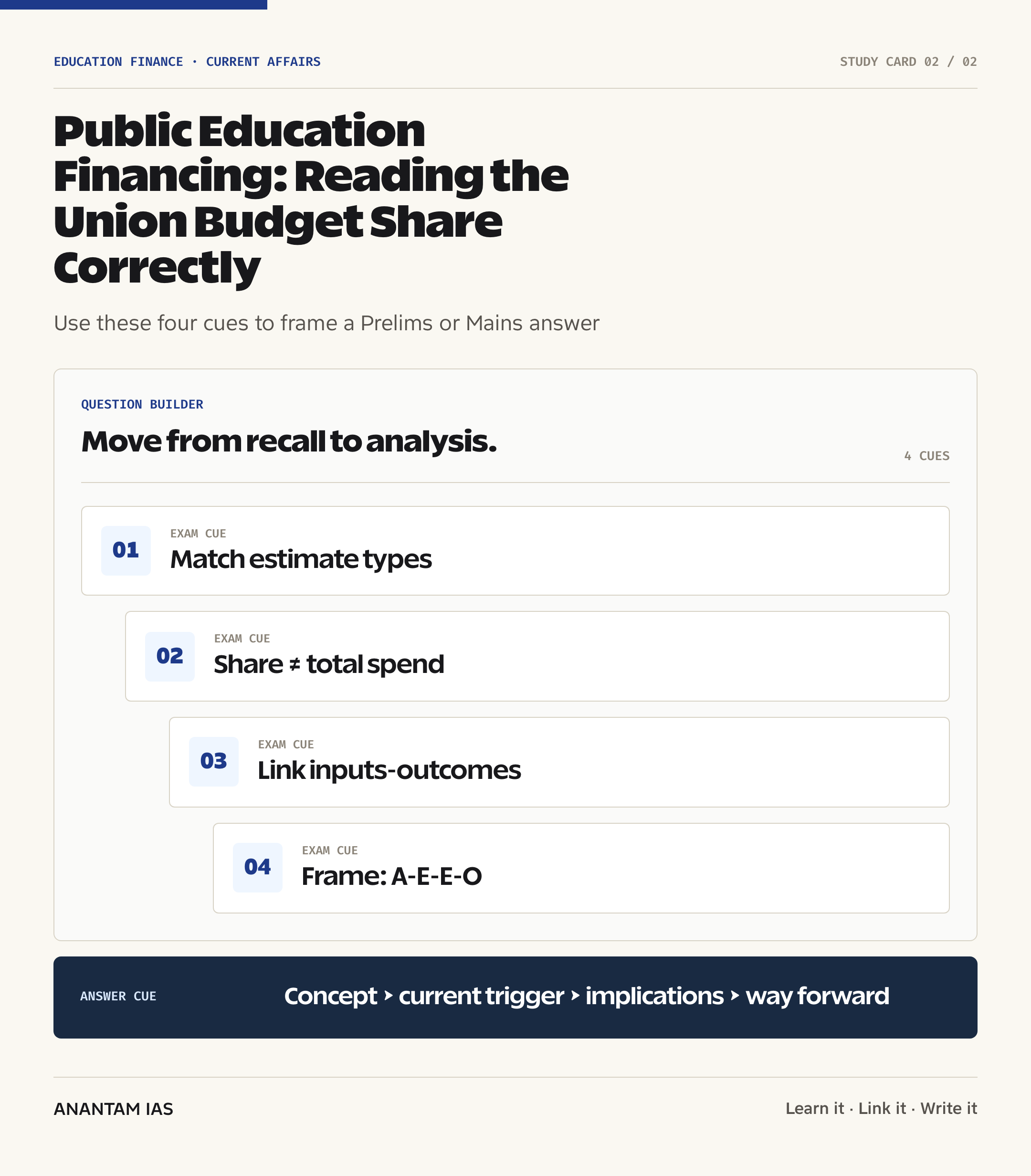
What the verified Budget numbers show
The official totals confirm the recent share calculation while the longer series supplies the historical warning.
- The 2025-26 BE allocated ₹78,572.10 crore to School Education and Literacy and ₹50,077.95 crore to Higher Education, totalling ₹1,28,650.05 crore.
- The 2025-26 Budget at a Glance put total Union expenditure at ₹50,65,345 crore; the Ministry’s calculated share was about 2.54%.
- For 2026-27 BE, the Ministry’s official total is ₹1,39,289.48 crore, split between ₹83,562.26 crore for school education and ₹55,727.22 crore for higher education.
- Total Union expenditure in 2026-27 BE is ₹53,47,315 crore, making the Ministry’s calculated share about 2.61%.
- The Indian Express-CMIE series places the comparable longer-run share at about 4.6% in 2013-14 and 2.5% in 2025-26; this is a decline in relative Budget weight, not a claim that rupee spending fell.
- The Ministry’s 2026-27 BE is 8.27% above its 2025-26 BE in nominal terms, according to the Ministry of Education, while its calculated Union Budget share changes only modestly.
- One year’s uptick can mark a welcome correction, but a priority claim needs a consistent multi-year series and eventual Actuals rather than a comparison of announcements alone.
Union allocation is not India's total education bill
The federal structure makes a ministry-only ratio useful but incomplete.
- Education’s place in the Concurrent List permits national legislation and programmes while leaving major delivery responsibilities with states.
- States finance teacher salaries, state universities, school buildings and many recurring costs, so the Union Ministry’s share cannot stand in for general-government education spending.
- Centrally sponsored schemes such as Samagra Shiksha also use shared financing and state implementation, making the release and matching of funds important.
- A sound answer should use both lenses: the Union Budget share for central priority, and combined Centre-state expenditure for progress toward the national financing goal.
- For a detailed conceptual companion, see India’s education spending and the 6% promise.
- Union support reaches education through ministry schemes, statutory or discretionary transfers and tax devolution that enlarges state fiscal space; not every education-relevant rupee appears under one demand for grants.
- State capacity varies sharply, so equal national goals can produce unequal services unless the transfer system recognises fiscal capacity and educational need.
The 6% goal and its correct use
The 6% benchmark is a public-investment ambition, not a guaranteed measure of educational quality.
- The National Education Policy 2020 asks the Centre and states to work together to raise public investment in education to 6% of GDP at the earliest.
- The benchmark was not invented by NEP 2020; the policy notes its roots in the Education Policy of 1968, reiteration in 1986 and review in 1992.
- The Ministry of Education reported combined public education expenditure at 4.64% of GDP in 2020-21; the year and coverage must accompany the figure because later estimates may differ.
- Aspirants should not compare the Ministry’s roughly 2.5-2.6% share of Union expenditure directly with the 6% of GDP goal; the numerators and denominators differ.
- Read NEP 2020 structure and reforms alongside financing data to connect money with policy commitments.
- The 6% benchmark is a policy commitment rather than an automatically enforceable annual appropriation; budgets still pass through constitutional and legislative processes each year.
- Reaching an aggregate percentage would not settle distribution questions. The composition between early childhood, schools, higher education, vocational learning, research and adult literacy remains a separate policy choice.
Why adequacy still matters
Funding cannot guarantee learning, but chronic under-provision can make quality and equity targets unattainable.
- Schools need recurrent financing for teachers, training, textbooks, digital access, maintenance and inclusive facilities; capital announcements alone cannot keep these services running.
- Higher education needs stable support for faculty, laboratories, scholarships, libraries and research, where stop-start grants weaken institutional planning.
- Poor households face higher exclusion when public capacity is weak because private spending on fees, devices, coaching and transport becomes an informal substitute.
- Adequate public financing can reduce gaps by gender, disability, caste, tribe, income and geography when allocations follow measured need.
- The latest school-system evidence should be read with the UDISE+ 2025-26 report, which helps connect fiscal inputs to access and system indicators.
- Education assets carry life-cycle costs: a new classroom needs teachers, electricity, water, repairs and learning materials. Funding construction without recurrent support creates visible assets but weak services.
- Underinvestment can compound over time. Unfilled posts, deferred maintenance and learning gaps become more expensive to repair, while affected students cannot recover lost years simply through a later Budget increase.
Why expenditure quality matters just as much
A larger allocation produces value only when funds arrive on time, reach the intended level and address the binding constraint.
- Track the chain from allocation to release to expenditure to output to outcome; a Budget announcement is only the first stage.
- Low spending against allocation may reflect delayed approvals, procurement bottlenecks, vacancies or weak local capacity, not a lack of educational need.
- Spending near the financial year’s end can weaken planning and value for money; predictable releases allow schools and universities to sequence hiring, procurement and maintenance.
- Outcome indicators should cover foundational learning, attendance, transition, completion, inclusion and employability, while avoiding incentives to manipulate a single metric.
- Independent audits, parliamentary scrutiny and public dashboards can make fiscal transparency useful to citizens rather than merely procedural.
- Outputs and outcomes should not be confused: distributing devices is an output, while improved attendance or learning is an outcome that depends on connectivity, training and classroom use.
- Disaggregated data can expose whether an average gain hides exclusion. Budget reviews should test results across districts and social groups, not only report one national total.
A balanced UPSC evaluation
The strongest answer neither treats spending as a magic cure nor dismisses it as irrelevant.
- The case for more resources rests on positive externalities: education raises productivity, public health awareness, civic participation and intergenerational mobility.
- The case for reform rests on evidence that funds can be weakened by vacancies, fragmented schemes, poor targeting and limited evaluation.
- Inter-sectoral comparisons require care because roads, health and education have different capital profiles, time horizons and spillovers; a larger share for one does not mechanically prove waste in another.
- The right analytical frame is adequacy + equity + efficiency + outcomes, supported by comparable data across Union and state governments.
- Public education financing is best judged over a medium-term path, not through one headline year or one scheme announcement.
- Budgeting always involves opportunity cost, but human-capability spending has long gestation and broad spillovers that annual construction or revenue metrics can understate.
- A democratic government may choose its priorities; the accountability test is whether it explains the trade-offs, supplies comparable evidence and protects the minimum conditions for equal educational opportunity.
Way Forward
Adopt a transparent medium-term financing path
- Publish a phased Centre-state roadmap toward the NEP financing commitment, with separate baselines for school, higher, vocational and research education.
- Report BE, RE and Actuals together so that higher announcements can be distinguished from realised expenditure.
- Present inflation-adjusted and per-student series beside nominal allocations to reveal changes in purchasing power.
Fund need and equal opportunity
- Use formulas that recognise poverty, remoteness, disability, gender gaps, tribal concentration and school size rather than relying only on enrolment totals.
- Protect high-impact recurrent spending on teachers, scholarships, nutrition, accessibility and maintenance from abrupt compression.
- Give local institutions bounded flexibility with transparent safeguards, because the binding constraint differs across districts.
Link finance to capability and results
- Fill sanctioned vacancies and strengthen procurement, data and financial-management capacity before blaming low spending solely on institutions.
- Use outcome budgets that connect money to service standards, but combine quantitative targets with classroom observation and independent assessment.
- Evaluate schemes for additional learning, retention and equity, and redesign programmes that repeatedly fail to convert outlay into outcomes.
Strengthen cooperative fiscal federalism
- Create a common Centre-state education-finance dashboard with comparable definitions, timely releases and district-level visibility.
- Use forums such as the Central Advisory Board of Education for negotiated priorities instead of treating national targets as unilateral instructions.
- Let Parliament, state legislatures, audit institutions and school communities review both spending gaps and learning consequences.
Conclusion
The fall from about 4.6% to 2.5% in the reported historical series is a signal about the Education Ministry’s relative place in Union expenditure. It deserves scrutiny even though the Ministry’s nominal allocation has risen and the 2026-27 BE produces a small increase in the recent share.
The policy test is wider than one ratio. India needs enough public money, fair Centre-state burden sharing and institutions capable of turning allocations into access, learning, integrity and mobility. A good answer keeps all four in view.
UPSC Practice Questions
Prelims MCQ 1
With reference to public education financing in India, consider the following statements:
- The 6% of GDP goal in National Education Policy 2020 concerns combined public investment by the Centre and states.
- The Ministry of Education’s share in the Union Budget is identical to total public education expenditure as a share of GDP.
- A Budget Estimate may differ from both the Revised Estimate and the final Actual expenditure.
How many of the above statements are correct?
(a) Only one (b) Only two (c) All three (d) None
Answer: (b) Only two
Explanation:
Statements 1 and 3 are correct. Statement 2 is incorrect because the Union Ministry share and the GDP ratio use different government coverage and different denominators.
Prelims MCQ 2
Which denominator is used to calculate the Ministry of Education’s share in the Union Budget?
(a) India’s nominal GDP (b) Total Union government expenditure (c) Combined expenditure of all state governments (d) Total expenditure of the social sector
Answer: (b) Total Union government expenditure
Explanation:
The ministry-share measure divides the Ministry of Education’s allocation or expenditure by total Union expenditure for the same year and estimate stage.
UPSC Mains Questions
- The declining share of the Ministry of Education in Union expenditure raises questions of priority, but it does not capture India’s complete education-finance effort. Examine this statement through the lenses of fiscal federalism, estimate quality, equity and educational outcomes. (250 words)
- National Education Policy 2020’s 6% of GDP ambition is an adequacy benchmark, not an outcome guarantee. Discuss how India can combine higher and more predictable public financing with institutional capacity, transparent expenditure tracking and accountability for learning. (250 words)
Sources: Union Budget 2025-26, Ministry of Finance and Indian Express Explained.
Frequently Asked Questions
What does the education Budget share measure?
It measures the Ministry of Education’s allocation or expenditure as a percentage of total Union government expenditure for the same financial year. It shows relative Budget priority. It does not measure all education spending in India, because states finance a large share and the GDP ratio uses a different denominator.
Did education spending fall in rupee terms?
No. The Ministry’s nominal allocation rose over the long period discussed. The concern is that total Union expenditure expanded faster, so the Ministry’s relative share declined. Nominal growth, real growth after inflation, per-student expenditure and share of the Budget are separate indicators and should not be used interchangeably.
Why compare BE, RE and Actuals separately?
BE is the initial proposal, RE is the in-year revision and Actuals record spending after closure of accounts. A ministry may receive a high BE but spend less, or receive a higher RE. Comparing BE in one year with Actuals in another can produce a misleading trend.
Does NEP require 6% of Union expenditure?
No. NEP 2020 calls for combined public investment by the Centre and state governments to reach 6% of GDP. It is not a target for the Union Ministry’s share in total Union expenditure. The two ratios cover different governments and use different denominators.
Why do states matter in education finance?
Education is in the Concurrent List, and states operate most government schools and many public higher-education institutions. They bear major recurring costs such as salaries and maintenance. A complete assessment must combine Union support, state budgets, intergovernmental transfers and actual local delivery.
Can higher spending guarantee better learning?
Higher spending cannot guarantee learning on its own, but severe input gaps can block improvement. Results depend on timely releases, capable institutions, teachers, sound procurement and monitoring. The useful framework joins adequacy and equity with efficiency and outcomes instead of choosing money or reform as competing answers.
Source: https://anantamias.com/current-affairs/education-budget-share-public-financing/
Indus Waters Treaty: Chenab Hydropower Push and Renegotiation
Why in News?
Government sources told The Hindu and The Indian Express on July 20, 2026 that the Indus Waters Treaty would require review and renegotiation before its river-sharing provisions could operate again in any modified form.
The immediate developmental focus is faster execution of a Chenab basin hydropower portfolio exceeding 5,000 MW when the reported projects are considered together. The policy combines water security, clean power and regional development with India’s post-2025 position on cross-border terrorism.
- India placed the 1960 treaty in abeyance after the April 22, 2025 Pahalgam terror attack; the Cabinet Committee on Security linked restoration to Pakistan credibly and irrevocably ending support for cross-border terrorism.
- The five prominently named projects are Sawalkot, Pakal Dul, Ratle, Kiru and Kwar, with a combined listed capacity of 4,870 MW.
- Adding the separately listed Dulhasti Stage-II, 260 MW, takes the identifiable development portfolio to 5,130 MW; reports describing about 5,300 MW may be using a wider project grouping.
- Official NHPC project pages show different stages: several schemes are under construction, while Sawalkot remains under clearance. Capacity and commissioning claims must be read project by project.
- Any revised arrangement would have to address climate variability, sediment, dam safety, environmental flows, data exchange and contemporary power-system needs, not only the original allocation formula.
The development matters in the context of:
- The development sits at the intersection of India-Pakistan relations, treaty law and cooperative management of a shared river basin.
- Hydropower can support grid balancing, but Himalayan projects also raise cumulative ecological, seismic, livelihood and downstream-flow concerns.
- The central analytical distinction is between India’s rights under the treaty text, its present policy of abeyance, and the separate legal process needed for modification or termination.
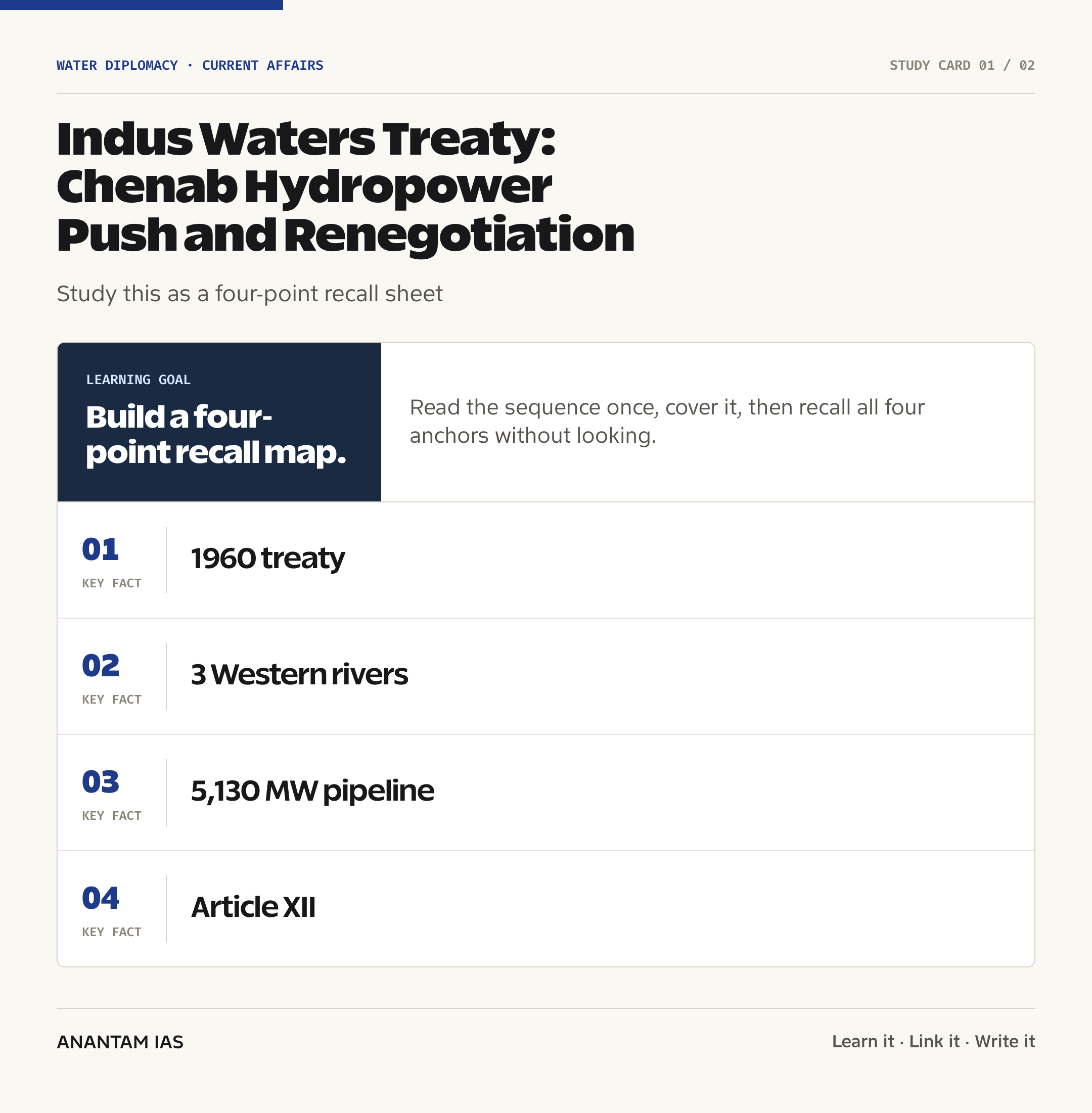
UPSC Relevance
Prelims Relevance
- The Indus Waters Treaty was signed at Karachi on September 19, 1960 and took effect retrospectively from April 1, 1960.
- The Eastern Rivers are the Ravi, Beas and Sutlej; the Western Rivers are the Indus, Jhelum and Chenab.
- India received unrestricted use of the Eastern Rivers, while Pakistan received use of the Western Rivers subject to specified Indian exceptions.
- Permitted Indian uses on the Western Rivers include domestic use, non-consumptive use, limited agricultural use, hydropower and storage within treaty conditions.
- The Permanent Indus Commission consists of one commissioner appointed by each country and handles cooperation, information exchange and questions arising from implementation.
- The treaty distinguishes a question, a technical difference that may reach a Neutral Expert, and a dispute that may reach a Court of Arbitration.
- Under Article XII, modification and termination are framed through duly ratified treaties between the two governments; the text contains no express unilateral abeyance clause.
- Pakal Dul is a 1,000 MW storage project on the Marusudar, a tributary of the Chenab; Kiru, Ratle and Sawalkot are run-of-river projects on the Chenab.
- The World Bank is a treaty signatory for limited functions specified in the agreement; it does not allocate day-to-day river flows.
Mains Relevance
GS Paper 2
- Assess treaty durability, good faith, national security and the legal distinction among suspension, modification and termination.
- Examine how cross-border terrorism has altered India’s approach to a cooperative institution that survived earlier wars and crises.
- Evaluate the role and limits of the Permanent Indus Commission, Neutral Expert, Court of Arbitration and World Bank.
GS Paper 3
- Connect hydropower with renewable electricity, peaking support, grid stability and development in Jammu and Kashmir.
- Analyse Himalayan dam safety, environmental flows, sediment management, cumulative impacts, climate uncertainty and disaster preparedness.
- Discuss basin planning that treats water, energy, ecology and livelihoods as a connected water-energy-food nexus.
Essay
- Shared rivers turn geography into interdependence: upstream capability creates responsibility as well as leverage.
Background and Context
How the 1960 allocation works
The treaty divides river use, but its structure isn’t a simple territorial ownership rule.
- India is assigned unrestricted use of the Eastern Rivers after the transition arrangements, while it must generally let the Western Rivers flow for Pakistan’s use, subject to carefully defined exceptions.
- Those exceptions allow Indian domestic and non-consumptive uses, specified agricultural withdrawals, hydropower generation and limited storage under the relevant annexures.
- Indian hydropower on Western Rivers is allowed, but Annexure D prescribes design and operating constraints intended to prevent impermissible manipulation of downstream flows.
- This is why a project can be located on the Chenab without automatically violating the treaty; the decisive questions concern design, pondage, spillways, intake levels and operation.
- For a concise account of the post-2025 position, revise India’s Indus Waters Treaty abeyance policy.
Institutions and dispute-settlement ladder
The treaty converts a politically sensitive basin into a rules-based technical process.
- The Permanent Indus Commission is the first forum for implementation, data exchange, inspections and efforts to resolve questions between the two commissioners.
- A technical difference may be referred to a Neutral Expert for matters assigned under Annexure F, while a qualifying dispute may go to a seven-member Court of Arbitration under Annexure G.
- Parallel proceedings became contentious in disputes over the Kishenganga and Ratle project designs because India preferred the Neutral Expert route while Pakistan sought arbitration.
- The 2026 Neutral Expert proceedings show why forum, jurisdiction and engineering evidence matter as much as political statements.
Abeyance, renegotiation and treaty law
Policy language and the treaty’s own amendment rules must be kept analytically separate.
- The Cabinet Committee on Security placed the treaty in abeyance with immediate effect in April 2025 until Pakistan credibly and irrevocably abjures support for cross-border terrorism.
- The official rationale links security conduct to the treaty preamble’s language of goodwill and friendship and to the conditions needed for sustained bilateral cooperation.
- But Article XII(3) says the treaty may be modified by a duly ratified treaty between both governments, while Article XII(4) frames termination through another duly ratified bilateral treaty.
- The text doesn’t expressly provide a unilateral suspension or abeyance mechanism. Claims based on material breach, necessity or fundamental change of circumstances would raise contested questions under general international law.
- India isn’t a party to the Vienna Convention on the Law of Treaties, 1969, though several convention principles are also discussed as customary international law; an answer should avoid treating every convention clause as automatically binding.
- A durable revision would require mutual consent, precise drafting and domestic ratification procedures.
The Chenab hydropower portfolio
The new policy emphasis is concrete because it is tied to named projects and measurable capacity.
- Sawalkot, 1,856 MW, is an NHPC run-of-river proposal on the Chenab in Ramban and Udhampur districts; the official project page lists it as under clearance rather than under construction.
- Pakal Dul, 1,000 MW, is a storage project on the Marusudar tributary in Kishtwar and is being developed through Chenab Valley Power Projects Limited.
- Ratle, 850 MW, is a run-of-river project on the Chenab in Kishtwar; its design has also featured in treaty dispute-settlement proceedings.
- Kiru, 624 MW, and Kwar, 540 MW, are run-of-river schemes in the Chenab basin under Chenab Valley Power Projects Limited.
- These five capacities total 4,870 MW. Including Dulhasti Stage-II, 260 MW, gives 5,130 MW, supporting the broader description of a portfolio above 5,000 MW while cautioning against false precision.
- NHPC places the projects at different stages. The portfolio represents phased development, not commissioned capacity.
Strategic and developmental significance
The hydropower push turns an abstract water entitlement into energy and infrastructure capability.
- Reservoir and run-of-river plants can provide renewable electricity, peaking capacity, frequency support and balancing for variable solar and wind generation.
- Construction can improve roads, local procurement and public infrastructure in Kishtwar, Ramban and Udhampur, but benefits depend on fair rehabilitation, employment quality and revenue sharing.
- Faster execution signals India’s intent to exercise the permitted uses historically available to it, while abeyance may change the operational context for notifications, inspections and data exchange.
- The issue belongs in a broader account of India-Pakistan relations, where water cooperation cannot be isolated from security, trade and diplomatic channels.
Ecological, social and engineering constraints
Installed megawatts are only one measure of whether a Himalayan river project is sound.
- The western Himalaya faces earthquakes, landslides, intense rainfall, glacial hazards and difficult access, all of which raise construction and emergency-management risks.
- A cascade of projects can alter sediment transport, fish movement, river connectivity, environmental flows and the timing of water available to downstream communities.
- Storage and diversion structures need updated probable maximum flood, seismic design, dam-break analysis and independent safety review under India’s dam-safety framework.
- Cumulative impact assessment is more useful than evaluating each project as an isolated footprint because multiple structures affect the same Chenab main stem and tributaries.
- Climate change strengthens the case for flexible rule curves and real-time observation because snowmelt, glacier contribution and extreme precipitation may shift away from historical assumptions.
Way Forward
Define a legally coherent negotiating position
- Publish a clear distinction among abeyance, suspension, modification and termination, along with the legal and policy basis claimed for each step.
- If dialogue resumes, seek a revised arrangement covering climate adaptation, sediment, dam safety, environmental flows, real-time data and time-bound dispute settlement.
- Keep technical channels available for floods and emergencies even during political crises because humanitarian risk can cross borders quickly.
Sequence projects by readiness and system value
- Prioritise schemes with completed clearances, mature designs and demonstrable grid, safety and economic benefits instead of treating aggregate capacity as the only target.
- Use independent milestone audits for tunnelling, slopes, resettlement, cost escalation and commissioning so deadlines don’t weaken quality control.
- Plan generation with transmission, peaking demand and renewable integration to avoid building capacity without adequate power evacuation.
Protect the Chenab as one connected basin
- Prepare a basin-wide cumulative assessment covering flow alteration, sediment, aquatic ecology, disaster risk and impacts across project boundaries.
- Set transparent environmental-flow rules, publish monitoring data and update operating protocols as observed climate and hydrology change.
- Give district administrations and local communities access to dam-break plans, warning systems, evacuation routes and periodic preparedness drills.
Strengthen domestic water governance
- Pair external claims with better irrigation efficiency, canal maintenance, wastewater reuse, watershed restoration and demand management inside India.
- Build a shared data platform across power, water, environment and disaster agencies so basin decisions use consistent inflow, snow, sediment and safety information.
- Ensure project benefits reach Jammu and Kashmir through transparent employment, procurement, rehabilitation and local-development commitments.
Conclusion
The Chenab hydropower programme gives India’s Indus policy a material dimension: named projects can add clean electricity and improve basin capability. But the portfolio’s value depends on accurate project status, sound engineering, ecological safeguards and local legitimacy, not a headline megawatt total alone.
A strong UPSC assessment should hold two ideas together. National security and legitimate development rights shape India’s hardening position, while treaty law and shared-river interdependence still demand precision, risk management and a credible route to stable rules.
UPSC Practice Questions
Prelims MCQ 1
With reference to the Indus Waters Treaty, consider the following statements:
- The Ravi, Beas and Sutlej are classified as the Eastern Rivers.
- India may construct hydropower facilities on the Western Rivers subject to treaty conditions.
- Article XII expressly allows either party to terminate the treaty through unilateral written notice.
How many of the above statements are correct?
(a) Only one (b) Only two (c) All three (d) None
Answer: (b) Only two
Explanation:
Statements 1 and 2 are correct. Article XII frames modification and termination through duly ratified treaties between both governments; it doesn’t contain the unilateral-notice rule described in statement 3.
Prelims MCQ 2
Which one of the following correctly describes the Pakal Dul Hydroelectric Project?
(a) A run-of-river project on the Sutlej (b) A storage project on the Marusudar, a Chenab tributary (c) A pumped-storage project on the Ravi (d) A barrage project on the main Indus in Ladakh
Answer: (b) A storage project on the Marusudar, a Chenab tributary
Explanation:
Pakal Dul is a 1,000 MW storage hydroelectric project in Kishtwar on the Marusudar River, a tributary of the Chenab.
UPSC Mains Questions
- The Indus Waters Treaty dispute is no longer only about water allocation; it now links national security, international law and infrastructure capability. Examine India’s post-2025 position and identify the principles that should guide any renegotiated framework. (250 words)
- Chenab hydropower can advance clean-energy and regional-development goals, but Himalayan river cascades create cumulative ecological and disaster risks. Discuss how India should balance project acceleration with basin-wide safeguards, local participation and downstream responsibility. (250 words)
Sources: Ministry of External Affairs treaty text and Press Information Bureau and The Hindu and The Indian Express.
Frequently Asked Questions
What is the Indus Waters Treaty?
The Indus Waters Treaty is a 1960 India-Pakistan agreement governing the Indus river system. It assigns the Ravi, Beas and Sutlej to India and the Indus, Jhelum and Chenab largely to Pakistan, while preserving specified uses for each side on rivers allocated to the other.
Why is the treaty in abeyance?
India’s Cabinet Committee on Security placed the treaty in abeyance in April 2025 after the Pahalgam terror attack. The official condition for restoration is that Pakistan credibly and irrevocably end its support for cross-border terrorism. The treaty text itself doesn’t use the term abeyance.
Can India build dams on the Chenab?
The treaty permits Indian hydropower generation on Western Rivers such as the Chenab, subject to detailed conditions on project design and operation. A project’s legality can’t be judged from its location alone; pondage, spillways, intake levels, storage and flow effects are central technical questions.
Which Chenab projects are in focus?
The reported focus includes Sawalkot, Pakal Dul, Ratle, Kiru and Kwar. Their listed capacities total 4,870 MW. A wider portfolio including 260 MW Dulhasti Stage-II crosses 5,000 MW. The schemes are at different stages, so the total shouldn’t be described as already commissioned.
How can the treaty be modified?
Under Article XII, modification requires a duly ratified treaty concluded between India and Pakistan. The same article frames termination through a duly ratified bilateral treaty. Any unilateral legal claim would need a separate basis in general international law and would remain open to contestation.
Why does Chenab hydropower matter?
Chenab projects can supply renewable electricity, peaking support and regional infrastructure while helping India exercise permitted basin uses. Their long-term value depends on dam safety, cumulative environmental assessment, sediment and flow management, local benefit sharing, transparent data and credible emergency planning.
Source: https://anantamias.com/current-affairs/indus-treaty-chenab-hydropower-renegotiation/
EPFO 3.0 Proposal: Universal Pension Architecture for Gig Workers
Why in News?
The Indian Express reported that the Employees’ Provident Fund Organisation is planning an EPFO 3.0 phase built around universal pension access, first-time contributory coverage for gig and platform workers, and a core-banking technology platform. The proposal is still being designed; it should not be confused with an already-notified pension entitlement.
The planned system would let a worker build a Target Retirement Sum through contributions from several sources and choose, at retirement, between an annuity-based pension and a systematic withdrawal plan. EPFO’s official expression of interest separately confirms its search for a core-banking solution capable of administering provident fund, pension and insurance benefits for gig, construction and other unorganised workers.
- The proposed coverage universe is India’s workforce of more than 60 crore workers, over three-fourths of whom are reported to be in the unorganised sector with limited pension protection.
- A single Universal Account Number could be mapped to multiple employers and aggregators, while preserving a payer-wise contribution trail.
- The design allows contributions from the worker, employer, government, aggregator, CSR funds and approved third parties rather than depending on one payroll employer.
- EPFO expects the new architecture to serve about 2.5 crore gig and construction workers over five years, subject to scheme design and implementation.
- The proposed retirement choices are an annuity, which converts corpus into periodic income, and a systematic withdrawal plan with adjustable drawdown.
The development matters in the context of:
- This matters in the context of labour-market informality: platform workers can earn from several apps without a stable employer-linked pension account.
- It also matters in the context of social justice: pension adequacy depends not only on enrolment but on regular contributions, pooled risk, low charges and inflation protection.
- The reform links a welfare objective to digital public administration, making identity, transaction capacity, portability and grievance redress part of social-security delivery.
UPSC Relevance
Prelims Relevance
- The EPFO is a statutory social-security organisation under the Ministry of Labour and Employment and administers provident fund, pension and insurance schemes for covered workers.
- A Universal Account Number is a portable identifier intended to connect a member’s employment-linked provident-fund accounts across job changes.
- A gig worker performs work outside a traditional employer-employee relationship; a platform worker accesses work through an online platform.
- Section 114 of the Code on Social Security, 2020 permits schemes for gig and platform workers covering life, disability, accident, health, maternity and old-age protection, among other benefits.
- The Code permits an aggregator contribution of 1–2% of annual turnover when notified, capped at 5% of the amount paid or payable to gig and platform workers.
- A core banking solution is a centralised transaction system that supports real-time account operations across service points instead of keeping isolated regional databases.
- A defined-contribution arrangement links the eventual benefit to accumulated contributions and investment outcomes rather than promising a predetermined benefit solely by formula.
- An annuity converts retirement savings into periodic payments; a systematic withdrawal plan draws periodically from an invested corpus without necessarily locking the full amount into an annuity.
- The Target Retirement Sum in the proposal is a dynamic corpus goal based on a member’s desired pension, retirement age and contribution path.
Mains Relevance
GS Paper 2
- Assess social-security inclusion for workers outside standard employment and the State’s duty to protect income in old age.
- Examine delivery questions involving identification, portability, grievance redress, Centre-State coordination and digital exclusion.
- Distinguish legal recognition under the Code on Social Security from the actual notification, funding and delivery of a benefit scheme.
GS Paper 3
- Connect the proposal with the changing gig economy, multiple-employer work and the limits of payroll-based welfare.
- Evaluate pension adequacy through contribution density, investment safety, inflation and longevity risk.
- Analyse how a core-banking platform could improve transaction scale while creating cyber-security, privacy and operational risks.
Essay
- A welfare state must adapt its institutions when the nature of work changes.
- Portability can turn fragmented livelihoods into continuous social protection.
- Digital capacity expands access only when institutional accountability grows with it.
Background and Context
Why Payroll-Based Protection Misses Gig Work
India’s traditional contributory architecture assumes a recognisable employer, a regular wage and a stable payroll relationship.
- A delivery partner or driver may work for several aggregators, switch platforms frequently and combine platform income with casual or self-employment.
- Irregular earnings create contribution gaps; a monthly fixed contribution that suits salaried work may be unaffordable in a low-income month.
- The absence of a conventional employer can leave unclear who should collect, match and remit a social-security contribution.
- Women often combine paid platform tasks with unpaid care and may enter or leave work repeatedly. A portable design should recognise career breaks and low contribution density without cancelling membership or imposing re-entry costs.
- Workers in smaller towns may alternate between app work, farm work, construction and self-employment. Coverage must follow the person rather than the occupation label, or the same worker will move in and out of protection as livelihoods change.
- This coverage gap is explained in Anantam IAS notes on gig workers and the Social Security Code, which separate legal recognition from effective benefit delivery.
- A universal architecture must support worker mobility without treating every change of platform as a break in pension membership.
How the Proposed Target Retirement Sum Works
The proposed Target Retirement Sum converts a desired retirement income into a visible, adjustable savings goal.
- The system would calculate the Target Retirement Sum from the member’s chosen pension goal and expected retirement age.
- A dashboard would show the accumulated corpus, contribution history and progress toward the target, with scenarios for different contribution frequencies.
- Members could revise the target as income or household needs change; the platform would then recompute the required contribution path.
- At retirement, the corpus could support an annuity or a systematic withdrawal plan, offering a choice between income certainty and drawdown flexibility.
- The dashboard should distinguish a nominal pension from its inflation-adjusted purchasing power. A target that appears large decades before retirement may still finance only a modest real income when prices and longevity are included.
- Default settings matter because most members won’t continuously optimise contributions or drawdown. A prudent lifecycle default, backed by simple comparisons and the right to change course, can protect less financially confident workers without removing choice.
- Choice creates a need for plain-language disclosure: a higher early drawdown can reduce the future corpus, while inflation can erode a pension that looks adequate in nominal terms.
Multi-Source Contributions and One UAN
The proposal treats pension building as a shared contribution problem rather than a single-employer deduction.
- The potential sources include the worker, employer, Union or State government, aggregator, CSR pool and approved third parties.
- A one-to-many mapping would connect one UAN with several platforms or employers while recording the contribution attributable to each source.
- A split-payment feature could divert a small, disclosed share of a platform transaction toward social security, making micro-contributions possible when earnings are irregular.
- The ledger must state when a contribution becomes final, how reversals or refunds are handled and who bears a failed payment. Without common reconciliation standards, millions of tiny transactions could create balances that workers and aggregators cannot independently verify.
- Portability also needs a clear rule for duplicate or dormant accounts. UAN-based consolidation should preserve the worker’s complete contribution history while correcting identity errors through due process rather than automatic account blocking.
- The design could also accept voluntary additions, but a voluntary-only model risks low balances for workers with thin and volatile incomes.
- The wider policy context is covered in Anantam IAS notes on social security for gig and informal workers.
Code on Social Security as the Legal Base
The Code creates the legal vocabulary and funding possibilities, but an operational pension still needs notified rules and administrative machinery.
- Section 114 authorises schemes for gig and platform workers covering old-age protection along with life, disability, accident, health and maternity benefits.
- A scheme may be funded by governments, aggregators, beneficiaries, CSR funds or a combination specified in the notified design.
- The aggregator levy, when notified, may range from 1% to 2% of annual turnover, subject to the statutory cap linked to payments made to workers.
- Registration makes an eligible worker capable of receiving the concerned scheme benefit, but registration alone does not create an adequate pension corpus.
- The Code assigns a role to the National Social Security Board, including worker and aggregator representation when it deals with gig-worker welfare. Scheme rules should use this forum for review rather than treating platform design as a purely technical exercise.
- Rules must identify the authority that collects and spends contributions, the consequences of delayed payment and the route for appeals. These institutional details determine whether a statutory funding power becomes an enforceable worker benefit.
- For answer writing, separate four stages: recognition, registration, contribution and benefit delivery. Confusing them produces an incomplete policy assessment.
Why Core Banking Is Central to EPFO 3.0
The technology shift is meant to support a much larger and more transaction-intensive membership base.
- EPFO’s official expression of interest seeks a mix of core-banking and custom applications for provident-fund, pension and insurance administration.
- The proposed platform supports Aadhaar-based authentication, mobile-first access, real-time fund management and multilingual interfaces in at least 12 Scheduled languages.
- Centralised processing can reduce dependence on isolated regional databases and improve balance visibility, reconciliation and timely crediting.
- Migration should be phased through parallel runs, sampled balance checks and worker-visible statements. A technically successful transfer that changes a pension balance without explanation would create a serious trust and accountability failure.
- Interoperability with e-Shram, State welfare boards and aggregator systems should use only the fields needed for the stated purpose. More data linkage isn’t automatically better; data minimisation lowers breach risk and reduces exclusion from inconsistent records.
- The preceding portal reform and its centralised database are explained in EPFO’s new portal.
- But a pension system is not only a payment engine: it also requires actuarial governance, investment controls, audit trails and accessible dispute resolution.
Construction Workers and Dormant Welfare Funds
The proposal also tries to connect portable pensions with construction-worker welfare resources that are now managed through State boards.
- The report cited more than 3.5 crore registered building and other construction workers and net cess collections above ₹70,000 crore across State welfare boards.
- A pension route could convert part of available welfare financing into long-term income security, subject to legal authority, consent and transparent fund accounting.
- Construction work is often seasonal and inter-State, so benefits need portability across contractors and States rather than residence- or employer-locked access.
- State boards differ in registration quality, benefits and unspent balances. A common pension channel should retain State-level accountability and publish transfer records instead of pooling resources in a way that obscures their origin and intended beneficiaries.
- Workers need continuity when they cross State borders, but portability doesn’t require identical benefits everywhere. The Union can set minimum data and service standards while allowing States to finance additional welfare according to local needs.
- Any transfer of cess-supported resources must not crowd out health, accident, education or immediate welfare benefits already financed by the boards.
- Centre-State data standards will be needed to avoid duplicate identities while preventing exclusion caused by mismatched records.
Pension Adequacy, Risk and Worker Protection
Universal enrolment is only the first test; the harder test is whether the final pension is adequate, predictable and fairly financed.
- A defined-contribution corpus depends on the amount and regularity of contributions; low contribution density can produce a very small pension despite long membership.
- Government co-contributions for low-income workers could improve adequacy, but they require a clear fiscal rule and eligibility test that don’t penalise fluctuating income.
- Annuities pool longevity risk, while systematic withdrawals offer flexibility but can exhaust the corpus if drawdown is excessive or life expectancy is underestimated.
- A family or survivor pension must specify eligibility, contribution cost and treatment of nominees after death. A pooled Family Benefit Fund needs regular actuarial valuation so benefits aren’t promised without adequate reserves.
- Investment governance should state permissible assets, benchmarks, custody, conflict rules and public reporting. Government-backed securities can reduce credit risk, but interest-rate and inflation risks still affect the real value of a long-term pension.
- Inflation-adjusted projections should disclose assumptions on returns, charges, inflation and retirement age instead of presenting one forecast as a guarantee.
- Data safeguards must apply to UAN-linked work histories, earnings and identity records through purpose limitation, consent, encryption and breach response.
- A comparative answer may mention Atal Pension Yojana, but it should distinguish a guaranteed-pension scheme from EPFO 3.0’s proposed corpus-and-drawdown design.
Way Forward
Notify a Clear Rights-and-Funding Framework
- Specify the benefit formula, vesting, withdrawal conditions and treatment of interrupted contributions before large-scale enrolment.
- Make aggregator, government and worker contributions predictable, with a transparent rule for low-income co-contributions.
- Clarify that platform participation in social-security financing doesn’t settle the separate legal question of employment classification and labour rights.
Design for Irregular Earnings
- Allow low-value, high-frequency contributions and pause-resume flexibility without punitive charges for seasonal or volatile income.
- Use automatic contribution prompts with informed opt-in, easy reversal and a visible payer-wise ledger.
- Provide a minimum-protection layer for workers whose earnings cannot generate an adequate retirement corpus even with regular saving.
Build Trust into the Digital Platform
- Subject the CBS platform to independent security audits, load tests and disaster-recovery drills before migration.
- Offer assisted offline service, multilingual help and time-bound grievance escalation so digital exclusion doesn’t become benefit exclusion.
- Publish scheme-level dashboards on enrolment, contribution density, claims, grievances, investment performance and pension adequacy, with privacy-preserving aggregation.
Protect Retirement Outcomes
- Use default investment and drawdown options based on prudent fiduciary and actuarial standards, while preserving informed choice.
- Display inflation-adjusted pension ranges and downside scenarios rather than a single optimistic projection of future income.
- Create survivor benefits and nomination rules that work for diverse households, backed by transparent pricing of the proposed Family Benefit Fund.
Conclusion
EPFO 3.0 could shift social security from a job-linked account to a worker-linked, portable retirement architecture. Its strongest idea is continuity: one identity, many payers and a pension corpus that follows the worker across platforms, employers and States.
But universal pension cannot mean universal registration alone. The durable measure of success will be adequate retirement income, fair contribution sharing, safe investment, accessible grievance redress and credible protection of workers’ data.
UPSC Practice Questions
Prelims MCQ 1
With reference to the Code on Social Security, 2020, consider the following statements:
- The Central Government may frame schemes for old-age protection of gig and platform workers.
- The Code fixes the aggregator contribution at exactly 5% of annual turnover.
- A gig-worker scheme may receive funding from corporate social responsibility funds.
How many of the above statements are correct?
(a) Only one (b) Only two (c) All three (d) None
Answer: (b) Only two
Explanation:
Statements 1 and 3 are correct. Section 114 permits old-age protection and CSR funding. The aggregator contribution, when notified, is 1–2% of annual turnover, subject to a separate cap of 5% of the amount paid or payable to gig and platform workers.
Prelims MCQ 2
In the EPFO 3.0 proposal, what is the primary purpose of a core banking solution?
(a) To replace every pension with a fixed government grant (b) To process centralised, real-time account transactions across service points (c) To limit each UAN to one employer for its entire lifetime (d) To invest the entire pension corpus only in equities
Answer: (b) To process centralised, real-time account transactions across service points
Explanation:
A core banking solution provides a central transaction backbone. For EPFO, it is intended to support high-volume, portable and multi-source contributions while improving account visibility and reconciliation.
UPSC Mains Questions
- The proposed EPFO 3.0 architecture seeks to move social security from an employer-linked model to a worker-linked model. Examine how multi-source contributions and a portable UAN can improve gig-worker protection, and identify the safeguards needed for pension adequacy.
- Core-banking technology can expand the scale and portability of social-security delivery, but technology cannot substitute for sound welfare design. Discuss with reference to contribution equity, digital exclusion, data protection, grievance redress and actuarial governance.
Sources: EPFO and The Indian Express Explained and The Indian Express Explained.
Frequently Asked Questions
What is EPFO 3.0?
EPFO 3.0 is the proposed next reform phase of the Employees’ Provident Fund Organisation. It combines a core-banking technology platform with new contribution and retirement features intended to support organised, unorganised, gig and construction workers. The reported universal-pension design is under development and is not yet the same as a notified entitlement.
What is a Target Retirement Sum?
The Target Retirement Sum is a proposed personalised corpus goal. It would be calculated from a worker’s desired pension, expected retirement age and contribution pattern. A dashboard would track progress and recalculate the required amount when the worker changes the pension goal, contribution frequency or retirement assumptions.
How could gig workers contribute?
The design allows contributions from workers, aggregators, employers where relevant, governments, CSR pools and approved third parties. One UAN could receive contributions from several platforms while preserving a source-wise ledger. Small split-payment contributions could suit irregular earnings, but adequate pensions may still require mandatory or publicly supported contributions.
What does the Social Security Code provide?
Section 114 of the Code on Social Security, 2020 permits schemes for gig and platform workers covering old age, accident, health, maternity, life and disability. It also permits mixed funding and an aggregator contribution of 1–2% of annual turnover when notified, subject to the statutory worker-payment cap.
Why does EPFO need core banking?
A core banking solution can process account transactions centrally and in real time across service points. EPFO expects a much larger, mobile membership with multiple contribution sources. The platform can improve portability and reconciliation, but it also needs cyber-security, privacy, audit, disaster-recovery and assisted-service safeguards.
Is universal enrolment enough for pension security?
No. Enrolment creates access, but pension adequacy depends on contribution size and continuity, investment returns, charges, inflation, longevity and drawdown choices. Low-income workers with volatile earnings may need government co-contributions or a minimum-protection layer, alongside simple disclosures and strong grievance redress.
Source: https://anantamias.com/current-affairs/epfo-3-universal-pension-gig-worker-social-security/