Why in News?
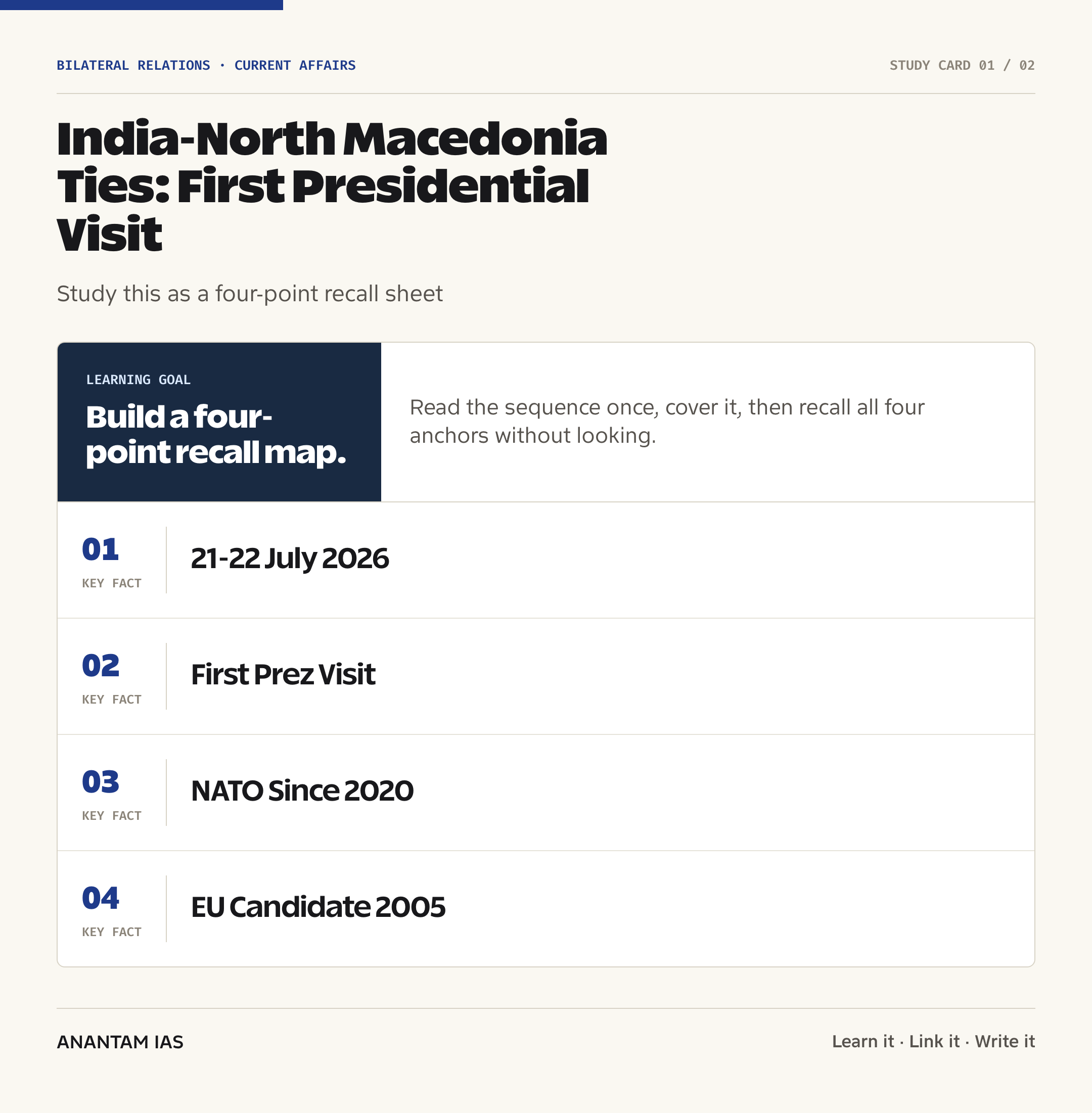
President Droupadi Murmu is visiting North Macedonia on 21-22 July 2026 during a three-country tour of Moldova, North Macedonia and Romania. The Ministry of External Affairs described it as the first-ever visit by an Indian President to North Macedonia, while the Presidency of North Macedonia separately confirmed the two-day official visit.
The confirmed programme combines head-of-state talks, meetings with the Prime Minister and the President of the Assembly, an address to the Assembly and an India-North Macedonia Business Forum. These are announced engagements; possible gains in trade, technology, education or India’s wider Western Balkans outreach remain analytical implications until the two governments announce specific outcomes.
- The visit takes place at the invitation of President Gordana Siljanovska-Davkova of North Macedonia.
- The official dates are 21 and 22 July 2026, following President Murmu’s visit to Moldova.
- The announced political agenda includes bilateral discussions and meetings with Prime Minister Hristijan Mickoski and the President of the Assembly.
- President Murmu is scheduled to address both the Assembly of North Macedonia and a bilateral business forum.
- MEA identified agriculture, pharmaceuticals, science and technology, IT and IT-enabled services as sectors in which both sides seek deeper economic cooperation.
The development matters in the context of:
- The visit matters in the context of India’s effort to build sustained relations with smaller and middle-sized European states beyond its major-power partnerships.
- North Macedonia is a NATO member and an EU candidate country, giving it relevance to debates on the Western Balkans, European integration and regional connectivity.
- The bilateral relationship is friendly but economically modest, so the value of the visit will depend on follow-up mechanisms rather than ceremonial visibility alone.
UPSC Relevance
Prelims Relevance
- North Macedonia is a landlocked country in the Balkan Peninsula; its capital is Skopje.
- It borders Albania, Bulgaria, Greece, Kosovo and Serbia.
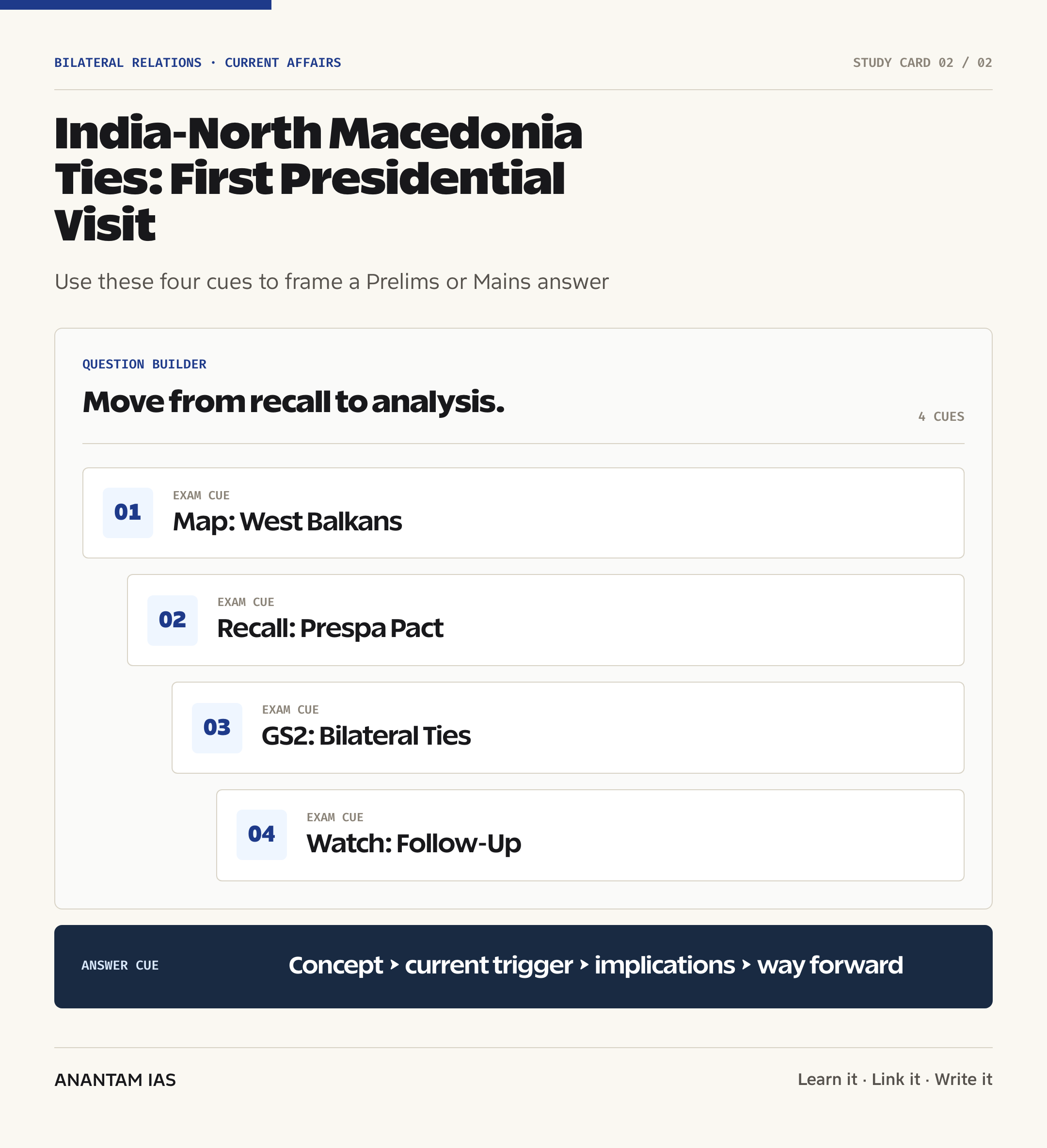
- The Prespa Agreement with Greece was signed on 17 June 2018; the name Republic of North Macedonia took effect on 14 February 2019.
- North Macedonia became the 30th member of NATO on 27 March 2020.
- It applied for European Union membership in March 2004 and obtained candidate status in December 2005.
- The first EU-North Macedonia Intergovernmental Conference on accession was held in July 2022.
- India’s Embassy in Sofia, Bulgaria, is concurrently accredited to North Macedonia.
- North Macedonia has maintained an embassy in New Delhi since 2008.
- India co-sponsored the UN General Assembly resolution admitting the country to the UN under the provisional designation FYROM.
- Mother Teresa, an ethnic Albanian, was born in Skopje and lived there until the age of 18.
Mains Relevance
GS Paper 2
- India’s bilateral, regional and economic diplomacy in Eastern Europe and the Western Balkans.
- The role of high-level visits, parliamentary diplomacy and business forums in converting cordial ties into practical cooperation.
- How North Macedonia’s NATO membership and EU accession process shape its external partnerships.
GS Paper 1
- Location of the Balkan Peninsula, landlocked states, neighbouring countries and regional transport corridors.
- The post-Yugoslav political geography and the significance of the Prespa Agreement.
Essay
- Diplomacy is often built through patient engagement with states that aren’t major powers but occupy important regional positions.
- Symbolic first visits acquire durable value only when institutions, businesses and people can carry the relationship forward.
Background and Context
What the Official Programme Confirms
The announced schedule is broad enough to open several channels, but it shouldn’t be confused with completed agreements or negotiated outcomes.
- The Presidency of North Macedonia confirmed an official visit on 21-22 July 2026; MEA described it as the first visit by an Indian President to the country.
- The visit is being made at the invitation of President Gordana Siljanovska-Davkova, with bilateral discussions between the two Presidents on the programme.
- Separate meetings with Prime Minister Hristijan Mickoski and the President of the Assembly create executive and legislative channels in addition to ceremonial diplomacy.
- An address to the Assembly of North Macedonia gives the visit a public parliamentary dimension and can communicate India’s approach directly to political representatives.
- The India-North Macedonia Business Forum is the confirmed commercial engagement; its presence signals interest in trade and investment but doesn’t by itself establish any contract or target.
- MEA listed agriculture, pharmaceuticals, science and technology, information technology and IT-enabled services as prospective areas for deeper economic cooperation.
- The combination of presidential talks, an Assembly address and a business meeting is designed to reach the executive, legislature and private sector during one visit, giving follow-up agencies several channels to use.
- No bilateral treaty, investment commitment or implementation timetable should be treated as concluded unless it appears in the official post-visit record.
Evolution of Bilateral Relations
India supported North Macedonia’s international entry after Yugoslavia’s breakup, while formal engagement has remained cordial but relatively light.
- After the country separated from the former Yugoslavia, India was among the co-sponsors of the UN General Assembly resolution for its admission to the United Nations.
- It entered the UN under the provisional designation Former Yugoslav Republic of Macedonia, or FYROM, because of the long-running name dispute with Greece.
- The Prespa Agreement of 17 June 2018 resolved that dispute; the constitutional name Republic of North Macedonia became effective on 14 February 2019.
- India’s Embassy in Sofia is concurrently accredited to North Macedonia, while North Macedonia has operated an embassy in New Delhi since 2008.
- Minister of State for External Affairs and Culture Meenakashi Lekhi visited North Macedonia in July 2023 and met officials from its foreign affairs, culture and Assembly institutions.
- North Macedonia’s then Foreign Minister Bujar Osmani visited India in August-September 2023 for meetings including with the Vice-President and External Affairs Minister.
- These 2023 ministerial exchanges established recent political contact, but a presidential visit carries greater symbolic weight because it represents the Indian state at its highest constitutional level and can convene several institutions together.
- The 2026 presidential visit is a qualitative rise in political visibility, but durable depth will still require regular official consultations and sector-level projects.
North Macedonia: Geography and Strategic Setting
The country’s position explains why a small bilateral relationship can carry a wider European and connectivity dimension.
- North Macedonia is a landlocked Western Balkan state with Skopje as its capital.
- It shares borders with Serbia and Kosovo to the north, Bulgaria to the east, Greece to the south and Albania to the west.
- The Vardar river valley and the country’s location on European transport routes connect the central Balkans with the Aegean direction and neighbouring markets.
- Its landlocked geography makes dependable road, rail, border and customs connectivity central to trade competitiveness.
- For India, this geography means commercial access depends on regional transport networks, neighbouring ports and harmonised border procedures; bilateral intent must be paired with workable routes to European production and consumer markets.
- North Macedonia joined NATO on 27 March 2020 as the alliance’s 30th member.
- It has been an EU candidate country since December 2005; the first intergovernmental accession conference took place in July 2022.
- Aspirants should distinguish membership: North Macedonia is in NATO, but it isn’t yet a member of the European Union.
Economic Base and Sectoral Possibilities
Official data show a small and highly unbalanced trade relationship, which gives the business forum both an opportunity and a demanding baseline.
- The Embassy of India in Sofia recorded total bilateral merchandise trade of US$37.37 million in 2023-24.
- India’s exports accounted for US$36.64 million, while imports from North Macedonia were only US$0.73 million in that year.
- Indian exports include organic chemicals, iron and steel, textiles, electrical and mechanical machinery, medical instruments, auto parts and pharmaceuticals.
- North Macedonia’s exports to India have included ferro-alloys, marble and travertine, electrical equipment and plastics.
- The confirmed agenda’s focus on pharmaceuticals and digital services matches Indian strengths, while agriculture and scientific cooperation can support targeted institutional partnerships.
- The sharp trade imbalance suggests two parallel tasks: help Indian exporters move into higher-value niches while identifying competitive North Macedonian products and services that can enter India on commercially sound terms.
- North Macedonia’s proximity to European supply chains may interest Indian firms, but market size, logistics, regulation and commercial viability must be assessed project by project.
- India’s wider economic engagement with Europe, including the India-EU trade framework, provides context but doesn’t automatically extend EU-member privileges to a candidate country.
Capacity Building and People-to-People Links
A thin economic relationship can still be widened through training, education, culture and professional networks that create repeated contact.
- India offers training opportunities to professionals from North Macedonia through the Indian Technical and Economic Cooperation programme.
- Macedonian diplomats have participated in professional courses conducted by India’s Foreign Service Institute, while parliamentary employees have received training under ITEC.
- The two sides can develop university, research and start-up links in digital technology, science, medicine and agriculture without waiting for large merchandise flows.
- Yoga and Indian cultural activities have an existing audience in North Macedonia, creating a modest base for cultural diplomacy.
- Skopje is the birthplace of Mother Teresa, whose life provides a recognisable human connection between the city and India.
- Tourism, film and cultural events can generate familiarity, but programmes should be designed around reciprocal participation and sustained local partners rather than one-off festivals that disappear when official attention moves elsewhere.
- Cultural familiarity shouldn’t be used as a substitute for policy; visa access, academic recognition, institutional contacts and dependable mobility matter for lasting exchanges.
- A small Indian community also means that people-to-people ties will need active support from universities, chambers, cultural bodies and diplomatic missions.
Analytical Significance for India's Europe Policy
The visit can be read as part of diversified European outreach, but that interpretation is an analytical lens rather than a declared alliance shift.
- Engagement with North Macedonia broadens India’s European diplomacy beyond large economies and established partners to the Western Balkans.
- Relations with a NATO ally and EU candidate can improve India’s understanding of Euro-Atlantic institutions, enlargement debates and Balkan political economy.
- For North Macedonia, India offers a large market, digital capabilities, pharmaceutical capacity and a partnership that isn’t tied to its formal EU accession process.
- Parliamentary and business engagements can distribute ownership across institutions, reducing dependence on a single leader-level meeting.
- India can also learn from North Macedonia’s experience of balancing national choices with NATO obligations and a prolonged EU accession process, while avoiding any assumption that the two countries share identical positions on every European issue.
- The relationship can support India’s preference for multi-alignment and issue-based cooperation, but no strategic partnership or security commitment was announced in the pre-visit programme.
- The first-visit symbolism will be tested by measurable follow-up: consultations held, training seats used, business leads converted, research links created and trade barriers resolved.
- The sound conclusion is that the visit opens diplomatic space; it doesn’t by itself prove a geopolitical realignment, major economic breakthrough or institutional upgrade.
Way Forward
Institutionalise the Political Dialogue
- Create a regular calendar for foreign-office consultations, parliamentary exchanges and sector-specific working contacts.
- Record agreed tasks, responsible agencies and review dates so the first presidential visit produces an accountable follow-up cycle.
Turn the Business Forum into a Pipeline
- Match firms and regulators in a few realistic areas such as generic medicines, digital services, agri-processing and engineering goods.
- Use chambers of commerce to identify standards, payments, logistics and market-access barriers before setting headline trade ambitions.
Expand Skills and Knowledge Partnerships
- Use ITEC, diplomatic training, university agreements and research exchanges to build networks that can survive political cycles.
- Design short programmes around cyber diplomacy, digital public infrastructure, agricultural technology and pharmaceutical regulation where Indian institutions can add value.
Keep Claims Proportionate
- Separate confirmed agreements from proposed sectors and analytical possibilities in every official assessment of the visit.
- Judge progress through implementation, balanced commercial benefit and institutional continuity rather than the novelty of a first visit alone.
Conclusion
The first visit by an Indian President to North Macedonia is a genuine diplomatic milestone. Its confirmed substance lies in leader-level talks, engagement with the government and Assembly, and a bilateral business forum spanning agriculture, pharmaceuticals, science and technology, and digital services.
Its larger meaning is prospective, not settled. If both sides convert the programme into recurring consultations, training, research and commercially viable projects, the visit can give India a steadier foothold in the Western Balkans. Without that follow-through, it will remain an important symbol with limited material depth.
UPSC Practice Questions
Prelims MCQ 1
With reference to North Macedonia, consider the following statements:
- It is a landlocked country in the Balkan Peninsula.
- It is a member of NATO but not yet a member of the European Union.
- It shares a land border with Romania.
How many of the above statements are correct?
(a) Only one (b) Only two (c) All three (d) None
Answer: (b) Only two
Explanation:
Statements 1 and 2 are correct. North Macedonia is landlocked, joined NATO in 2020 and remains an EU candidate. Its neighbours are Albania, Bulgaria, Greece, Kosovo and Serbia, not Romania.
Prelims MCQ 2
Which one of the following correctly describes the Prespa Agreement?
(a) It created a customs union between India and the Western Balkans. (b) It settled the name dispute between Greece and the country now called North Macedonia. (c) It admitted North Macedonia directly into the European Union. (d) It established the North Atlantic Treaty Organization.
Answer: (b) It settled the name dispute between Greece and the country now called North Macedonia.
Explanation:
The 2018 Prespa Agreement resolved the long-running name dispute with Greece. The name Republic of North Macedonia took effect in February 2019; the agreement didn’t make the country an EU member.
UPSC Mains Questions
- The first visit by an Indian President to North Macedonia marks a diplomatic opening, but symbolism alone can’t deepen a bilateral relationship. Analyse the opportunities in political dialogue, pharmaceuticals, digital services, capacity building and parliamentary engagement, and identify the institutional follow-up required. (15 marks, 250 words)
- Small Western Balkan states occupy an important space at the intersection of European integration, connectivity and strategic competition. Discuss how India can broaden engagement with North Macedonia while keeping expectations realistic and preserving issue-based, mutually beneficial cooperation. (15 marks, 250 words)
Sources: Rashtrapati Bhavan and Ministry of External Affairs and The Hindu.
Frequently Asked Questions
Why is President Murmu’s visit historic?
MEA described the 21-22 July 2026 trip as the first-ever visit by an Indian President to North Macedonia. It raises bilateral engagement to head-of-state level and combines talks with the President, meetings with government and Assembly leaders, a parliamentary address and a bilateral business forum.
What is the confirmed visit agenda?
The announced programme includes talks with President Gordana Siljanovska-Davkova, meetings with Prime Minister Hristijan Mickoski and the President of the Assembly, an address to the Assembly of North Macedonia, and an India-North Macedonia Business Forum. Outcomes must await official post-visit announcements.
Where is North Macedonia located?
North Macedonia is a landlocked country in the Western Balkans, with Skopje as its capital. It borders Albania, Bulgaria, Greece, Kosovo and Serbia. Its location links north-south and east-west routes across southeastern Europe, while lack of direct sea access makes regional connectivity especially important.
Is North Macedonia in NATO and the EU?
North Macedonia joined NATO on 27 March 2020. It isn’t an EU member. It applied for EU membership in March 2004, received candidate status in December 2005 and held its first intergovernmental accession conference with the European Union in July 2022.
What is the Prespa Agreement?
The Prespa Agreement, signed by Greece and the then Republic of Macedonia in June 2018, resolved their long-running dispute over the country’s name. The name Republic of North Macedonia took effect in February 2019, helping clear a major obstacle to closer Euro-Atlantic integration.
Which sectors can deepen bilateral ties?
MEA identified agriculture, pharmaceuticals, science and technology, information technology and IT-enabled services as promising sectors. ITEC training, diplomatic courses, university links, culture and tourism can add people-to-people depth. These are areas for cooperation, not evidence that specific investments or agreements are already complete.
Tell Google you want more of this.
Add Anantam IAS as a preferred sourceOne tap, and this site shows up more often in your own Top Stories, AI Overviews and AI Mode. Remove it any time.