Why in News?
Andy Burnham became Prime Minister of the United Kingdom on 20 July 2026 after accepting King Charles III’s invitation to form a government. The official GOV.UK profile and the U.K. Parliament both record his new office, while his first Downing Street speech confirms the constitutional handover.
The Hindu reported the change from Keir Starmer to Burnham and highlighted the new Prime Minister’s promise of a different social and political model. Indian Express Explained traced Burnham’s rise from Greater Manchester mayor to Labour leader and Prime Minister. The two reports match the official record on the central fact of succession.
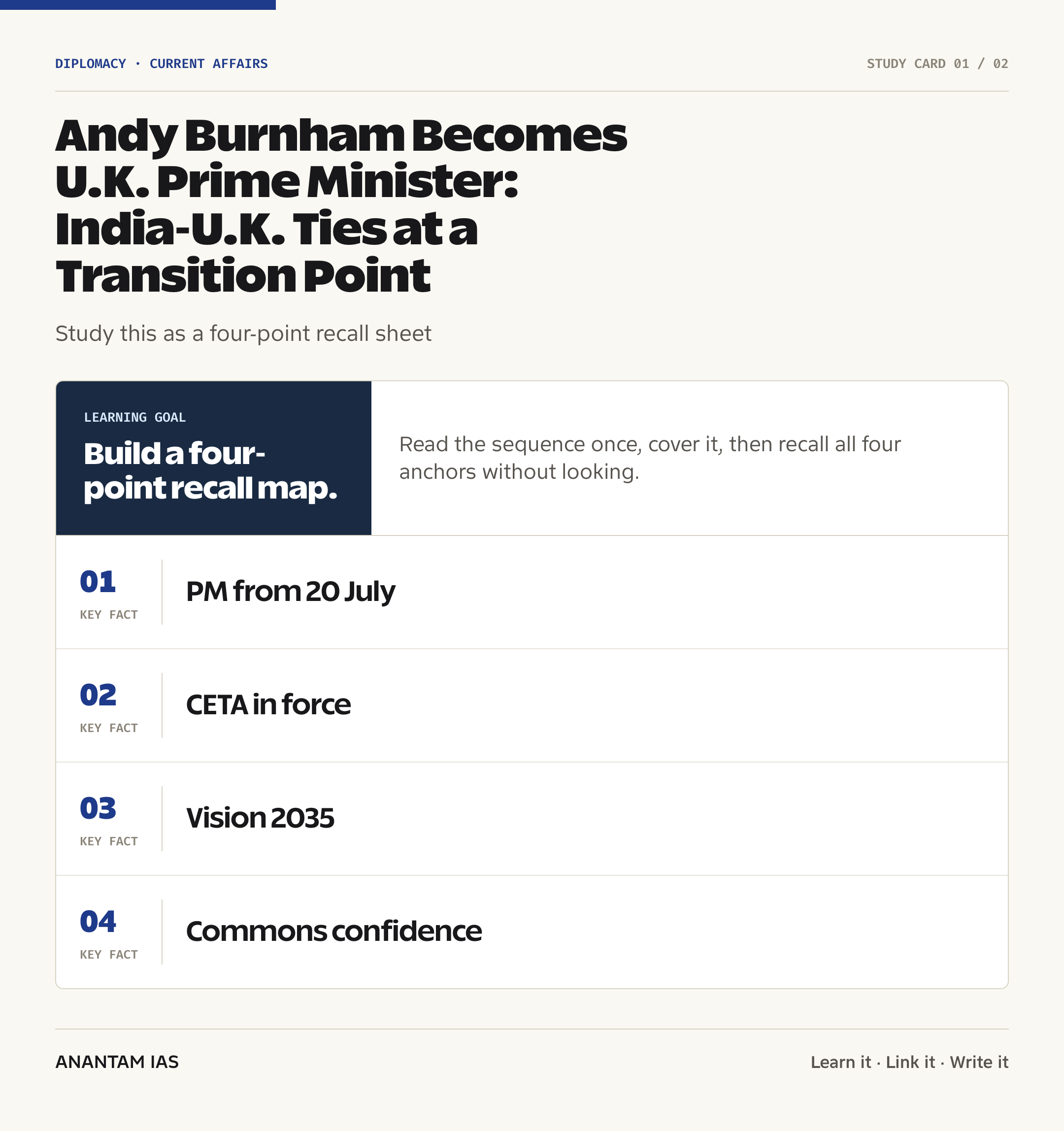
- The appointment took effect on 20 July 2026; it wasn’t merely a leadership bid or an expected future succession.
- Burnham had returned to the House of Commons as MP for Makerfield in June 2026 and became Labour Party leader on 16 July 2026, according to GOV.UK.
- He succeeds Keir Starmer without a fresh general election because the governing party selected a new leader capable of commanding Commons confidence.
- The transition comes five days after the India-U.K. Comprehensive Economic and Trade Agreement entered into force on 15 July 2026.
- No official Burnham policy statement reviewed for this note announced a reversal or revision of the India-U.K. Vision 2035 or the trade agreement.
The development matters in the context of:
- This matters in the context of the Westminster system, where a change of Prime Minister can occur between general elections while the government retains legislative confidence.
- For India, the immediate question is continuity in an already institutionalised partnership covering trade, technology, defence, climate and education.
- Leadership style can alter diplomatic emphasis, but treaty obligations and formal bilateral roadmaps don’t disappear automatically when a Prime Minister changes.
UPSC Relevance
Prelims Relevance
- The United Kingdom has an uncodified constitution built from statutes, conventions, judicial decisions and authoritative practices.
- The Monarch formally appoints the Prime Minister under the royal prerogative, guided in practice by who can command confidence in the House of Commons.
- The U.K. Prime Minister is normally the leader of the government and the principal government figure in the House of Commons.
- The officeholder also serves as First Lord of the Treasury, Minister for the Civil Service and Minister for the Union.
- A governing party may replace its leader without automatically triggering a general election.
- The India-U.K. CETA was signed on 24 July 2025 and entered into force on 15 July 2026.
- The India-U.K. Vision 2035 covers growth, technology and innovation, defence and security, climate and clean energy, and education.
- The U.K. is a permanent member of the UN Security Council and a member of the G7, G20 and NATO.
Mains Relevance
GS Paper 2
- Compare the conventions governing a change of Prime Minister in the U.K. Westminster system with India’s codified constitutional provisions on appointment and collective responsibility.
- Assess how leadership transitions affect bilateral ties when cooperation is anchored in a treaty, a long-term vision document and multiple institutional mechanisms.
- Examine the strategic content of India-U.K. relations beyond trade, including technology security, defence industry, climate finance and education.
Essay
- Institutions and personalities: durable international partnerships require both political leadership and rules that outlast leaders.
- Continuity amid change: democratic transitions can renew political priorities without erasing prior state commitments.
Background and Context
What the Official Record Confirms
The leadership change is a completed constitutional event, not a forecast based on media speculation.
- The Prime Minister’s Office published Burnham’s first speech as delivered at Downing Street on 20 July 2026. In it, he said he had accepted the King’s invitation to form a government.
- The official GOV.UK biography states that Andy Burnham became Prime Minister on 20 July 2026 and lists his accompanying offices.
- Burnham described himself as the seventh U.K. Prime Minister since 2016, presenting political stability as an immediate governance challenge.
- His first-day confirmed domestic measure was an additional £340 million for a drive against long-term rough sleeping. That announcement shows his social-policy emphasis, but it isn’t evidence of a new India policy.
How a British Prime Minister Changes Mid-Parliament
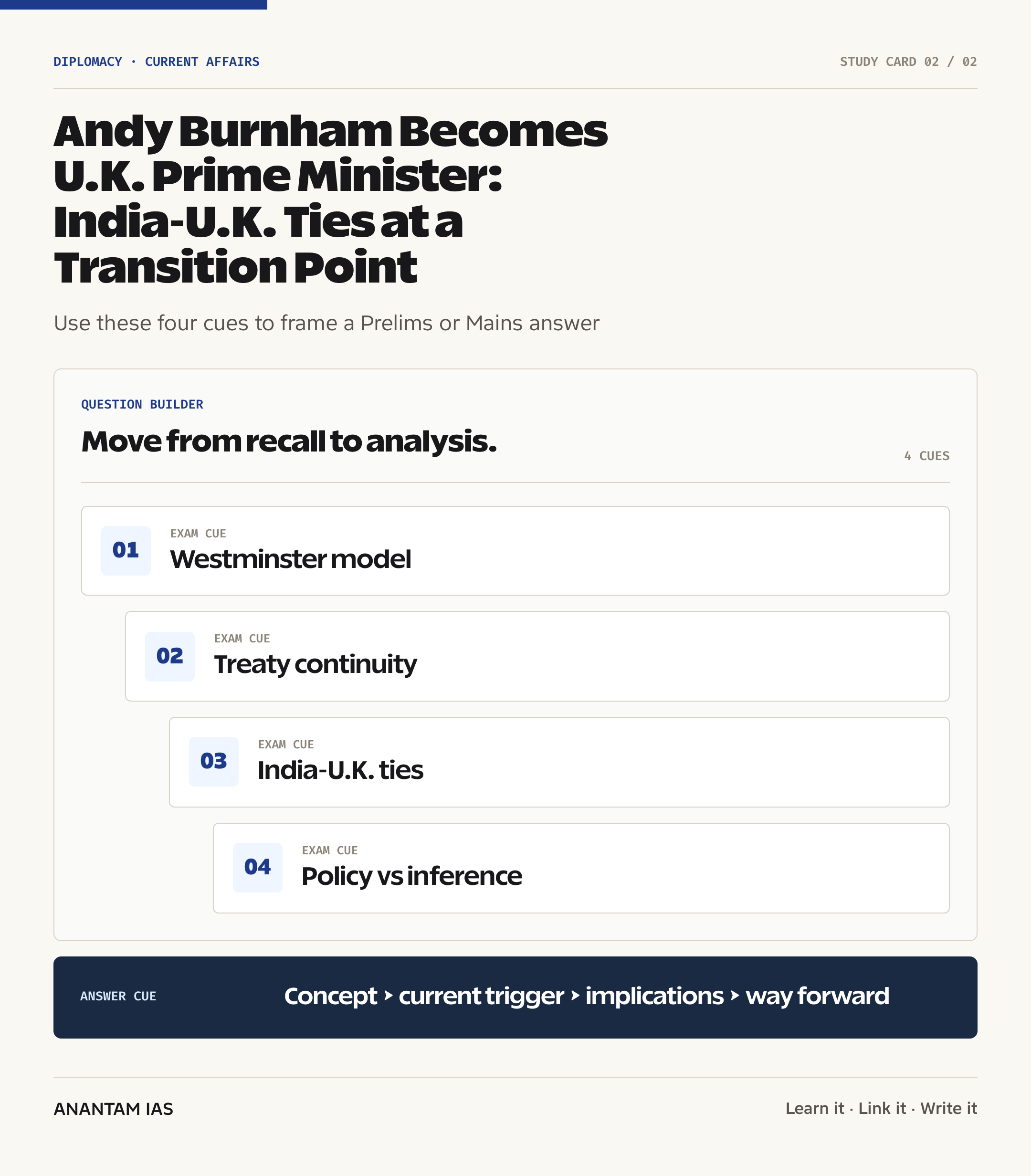
The British transition illustrates constitutional government through conventions rather than a single written constitutional document.
- The House of Commons Library explains that a government must command the confidence of the House of Commons to assume and remain in office.
- When a Prime Minister resigns while the governing party can still command confidence, that party identifies a successor under its own rules. A national election isn’t a legal precondition for every change at 10 Downing Street.
- The Sovereign formally appoints the person best placed to form a government. Modern convention leaves political parties to determine and clearly communicate who can command Commons confidence.
- The distinction is central to the parliamentary form of government: citizens elect MPs, and the executive remains in office through legislative confidence. For comparison, see Anantam IAS’s parliamentary system guide.
- A party leadership change can alter the head of government while the same parliamentary mandate continues. But the new Prime Minister remains accountable to Parliament through debates, questions, legislation, supply and confidence mechanisms.
Burnham's Political and Administrative Background
His career combines national ministerial experience with nearly a decade of devolved metropolitan leadership.
- Burnham first entered Parliament for Leigh in 2001 and served in Cabinet-era roles including Chief Secretary to the Treasury, Culture Secretary and Health Secretary between 2007 and 2010.
- He became Mayor of Greater Manchester in May 2017 and won re-election in 2021 and 2024. GOV.UK credits his mayoralty with bringing the bus network back under public control.
- His regional record supports an inference that devolution, public services and place-based growth may shape his governing style. It doesn’t by itself establish a foreign-policy change.
- His return to the Commons was constitutionally significant because, by modern convention, the Prime Minister sits in the elected chamber.
The India-U.K. Relationship He Inherits
Burnham takes office after India and the U.K. converted a broad strategic partnership into recent operational commitments.
- The India-U.K. Comprehensive Strategic Partnership is organised through political dialogue and sector-specific arrangements rather than a single issue or leader-to-leader relationship.
- The India-U.K. Vision 2035, endorsed in July 2025, sets cooperation across growth, emerging technology, defence and security, climate and clean energy, and education.
- Its technology pillar covers future telecoms, artificial intelligence, critical minerals, semiconductors, quantum technologies, biotechnology and advanced materials under mechanisms such as the Technology Security Initiative.
- Its defence pillar includes a 10-year Defence Industrial Roadmap, cooperation on electric propulsion and jet-engine core technologies, and stronger official-level dialogue.
- These written commitments create institutional continuity across leadership changes.
CETA Is the Immediate Economic Anchor
The most time-sensitive bilateral fact is that the trade agreement entered into force just before the premiership changed.
- The India-U.K. CETA was signed on 24 July 2025 and took effect on 15 July 2026, according to the British High Commission and GOV.UK trade-deal collection.
- The British government’s implementation release says total bilateral trade was worth £48 billion in 2025 and projects a long-run annual increase of £25.5 billion. Projections are scenarios, not guaranteed outcomes.
- From entry into force, the official release says 99% of Indian goods entering the U.K. and 90% of U.K. goods entering India receive either duty-free access or reduced tariffs.
- For the agreement’s provisions and adjustment issues, read the Anantam IAS note on India-U.K. trade gains and costs.
Implications for India: Confirmed Continuity and Open Questions
The safest assessment separates obligations already in force from choices the new government hasn’t yet announced.
- Confirmed continuity: CETA is in force, so tariff schedules and implementation duties continue unless changed through the agreement’s legal mechanisms. A new Prime Minister doesn’t cancel a treaty by taking office.
- Strategic opportunity: Vision 2035 gives both sides ready-made channels in defence technology, critical minerals, clean energy, universities and research. Ministerial appointments and budget choices will show how strongly the new government backs each channel.
- Mobility sensitivity: student, professional and migration rules often carry domestic political weight in Britain. India should distinguish the binding services and mobility provisions from future U.K. immigration policy decisions.
- No verified rupture: the official material reviewed by 21 July 2026 contains no Burnham announcement withdrawing from CETA or Vision 2035. Claims of either a major reset or automatic continuity on every policy detail would run ahead of evidence.
What India Should Watch Next
The content of the relationship will become clearer through appointments, meetings and implementation decisions rather than the succession ceremony alone.
- Watch the new Foreign, Trade, Defence and Home Secretaries, because their portfolios shape diplomacy, CETA implementation, defence cooperation and mobility.
- Track the first India-U.K. leader call or summit statement for explicit references to CETA, Vision 2035 and the Indo-Pacific.
- Follow the agreement’s committees and business guidance for evidence on tariff use, rules-of-origin compliance and services access. Early utilisation rates will be more informative than headline projections.
- Assess whether future fiscal and industrial-policy decisions support the Defence Industrial Roadmap, technology partnerships and climate-finance commitments.
- Keep domestic politics in perspective: Burnham’s first speech focused on British stability and social outcomes. Applying that message to India-U.K. ties requires evidence from later foreign-policy decisions.
Way Forward
Lock in Early CETA Delivery
- India and the U.K. should publish accessible customs and rules-of-origin guidance so small firms can claim preferences correctly.
- The two sides should use formal committees to resolve implementation frictions before they become political disputes.
- Governments should report actual preference use and sectoral trade outcomes instead of relying only on long-run modelled gains.
Institutionalise the Wider Partnership
- Maintain time-bound reviews of Vision 2035 across technology, defence, climate, education and health.
- Protect research and sensitive-technology cooperation through clear safeguards on intellectual property, data and export controls.
- Build multiple ministerial, parliamentary, university and business channels so the relationship doesn’t depend on one leader.
Use Evidence in India's Diplomatic Assessment
- Treat confirmed statements, cabinet appointments and budget allocations as stronger signals than assumptions based on Burnham’s mayoral record.
- Separate legal continuity under CETA from political discretion in migration, spending and foreign-policy emphasis.
- Prepare issue-specific engagement briefs so India can advance concrete proposals when the new British government sets its international agenda.
Conclusion
Andy Burnham’s appointment is constitutionally confirmed and illustrates a defining feature of the Westminster model: the head of government can change mid-Parliament when a successor can command Commons confidence. It doesn’t require treating the change as a new general-election mandate.
For India, the sound starting point is institutional continuity with policy vigilance. CETA is already in force and Vision 2035 supplies a broad roadmap, but Burnham’s exact priorities toward India must be judged from later official decisions. The transition creates a moment for engagement, not a factual basis for predicting either rupture or an automatic strategic upgrade.
UPSC Practice Questions
Prelims MCQ 1
With reference to the appointment of the U.K. Prime Minister, consider the following statements:
- The Monarch formally appoints the Prime Minister.
- The government must command the confidence of the House of Commons.
- Every change of Prime Minister requires a fresh general election.
How many of the above statements are correct?
(a) Only one (b) Only two (c) All three (d) None
Answer: (b) Only two
Explanation:
Statements 1 and 2 are correct. The Monarch’s formal appointment is guided by the confidence convention. A governing party can change its leader and Prime Minister during a Parliament without an automatic general election.
Prelims MCQ 2
Which document provides the current long-term framework for cooperation across growth, technology, defence, climate and education between India and the United Kingdom?
(a) India-U.K. Vision 2035 (b) New Delhi Declaration 2023 (c) Indo-Pacific Economic Framework (d) Windsor Framework
Answer: (a) India-U.K. Vision 2035
Explanation:
India-U.K. Vision 2035, endorsed in July 2025, sets the bilateral roadmap across these five broad pillars. The Windsor Framework concerns post-Brexit arrangements for Northern Ireland.
UPSC Mains Questions
- A change of Prime Minister in a Westminster system may occur without a general election, yet executive legitimacy remains tied to the legislature. Explain the constitutional conventions involved in the U.K. transition and compare them with the Indian constitutional framework for appointing and holding a Prime Minister accountable.
- Leadership transitions can change diplomatic emphasis without automatically displacing treaties and institutional roadmaps. Assess the likely opportunities and uncertainties for India-U.K. relations under Andy Burnham, with particular reference to CETA, Vision 2035, technology cooperation, defence ties, professional mobility and diaspora issues.
Sources: Prime Minister's Office, 10 Downing Street and UK Parliament and The Hindu and Indian Express Explained.
Frequently Asked Questions
When did Andy Burnham become U.K. Prime Minister?
Andy Burnham became U.K. Prime Minister on 20 July 2026. GOV.UK published his first Downing Street speech that day, and the U.K. Parliament lists him as Prime Minister and First Lord of the Treasury from the same date.
Was a U.K. general election held for this change?
No fresh general election was required for this succession. Under the Westminster system, the governing party can select a new leader during a Parliament. The Monarch appoints the person positioned to form a government and command the confidence of the House of Commons.
What offices does the U.K. Prime Minister hold?
The Prime Minister leads His Majesty’s Government and is also normally First Lord of the Treasury, Minister for the Civil Service and Minister for the Union. The officeholder chooses ministers, oversees government and serves as the principal government figure in the Commons.
Does Burnham’s appointment cancel the India-U.K. trade deal?
No. The India-U.K. CETA entered into force on 15 July 2026. A leadership change doesn’t itself cancel a treaty. Any modification or termination would require lawful action under the agreement and domestic processes; no such Burnham announcement was found in the official material reviewed.
What is India-U.K. Vision 2035?
India-U.K. Vision 2035 is the long-term bilateral roadmap endorsed in July 2025. It organises cooperation around growth, technology and innovation, defence and security, climate and clean energy, and education, supported by continuing political engagement and sector-specific mechanisms.
What should India monitor under the new government?
India should track cabinet appointments, the first bilateral leader-level statement, CETA implementation committees, mobility policy, and budget support for technology, defence and clean-energy projects. These decisions will provide firmer evidence than assumptions drawn from Burnham’s earlier domestic record.
Tell Google you want more of this.
Add Anantam IAS as a preferred sourceOne tap, and this site shows up more often in your own Top Stories, AI Overviews and AI Mode. Remove it any time.